

#bstock
bstock
92,101 views
467 Discussing
Hot
Latest

·
--
Bridging the Gap: How BStocks and Crypto are Reshaping Modern Portfolio DiversificationIn the fast-evolving world of global finance, modern investors no longer have to choose strictly between traditional financial assets and the dynamic ecosystem of cryptocurrency. For years, retail investors—especially those based in emerging regions—faced significant barrier-to-entry issues when trying to access traditional stock markets like Wall Street. From complex brokerage setups and high international transaction fees to geographical restrictions, owning shares of world-leading tech giants was often a distant reality.
However, with the introduction of innovative concepts like BStocks on Binance, the line between traditional stock investing and Web3 access has become seamlessly blurred. This article explores how combining traditional Stocks and Crypto through BStocks offers a unique, modernized approach to asset diversification for both beginners and experienced traders.
Understanding BStocks: What Are They?
To put it simply, BStocks represent a bridge connecting traditional stock equity concepts with the speed, efficiency, and accessibility of the crypto ecosystem. Instead of navigating legacy banking systems or opening offshore brokerage accounts, users can gain exposure to key equity markets directly within the crypto environment they are already familiar with.
Key characteristics that set BStocks apart include:
Accessibility: Investors can monitor, analyze, and gain market exposure through the Binance ecosystem.
Fractional Opportunities: Traditional stock prices (like Tesla or Nvidia) can sometimes be expensive for single-share purchases. Digital stock exposure often allows users to start small and scale over time.
Unified Management: Managing both crypto assets and equity exposure under one unified interface streamlines portfolio tracking significantly.
Crypto vs. Traditional Stocks: A Complementary Relationship
Many newcomers view Crypto and Stocks as competing asset classes. In reality, they serve complementary roles within a well-balanced investment strategy:
Volatility & Growth (Crypto): Cryptocurrencies are known for higher volatility, offering rapid innovation and dynamic growth opportunities, though accompanied by higher risk.
Stability & Corporate Value (Traditional Stocks): Stocks represent ownership in established companies with proven revenue models, corporate governance, and physical assets.
The Hybrid Advantage: By combining both, an investor can hedge against high crypto market volatility while still capturing market momentum from technological growth.
3-Step Strategy for Beginners Entering the BStocks Ecosystem
If you are transitioning from pure crypto trading to exploring stock-backed assets, here is a practical approach to building your foundation:
1. Research Fundamental Market Drivers
Unlike crypto tokens, which are heavily driven by tokenomics, community sentiment, and protocol upgrades, stocks are heavily anchored to real-world corporate health. Always evaluate quarterly earnings reports, revenue growth, and industry sector performance.
2. Practice Sector-Based Diversification
Don't put all your capital into a single sector. Balance high-growth tech stocks with defensive sectors (like consumer staples or energy) alongside your core crypto holdings (such as Bitcoin or Ethereum).
3. Focus on Long-Term Dollar-Cost Averaging (DCA)
Whether dealing with Crypto or BStocks, market timing is notoriously difficult. Implementing a steady DCA strategy helps smooth out market fluctuations over time.
Why the Future Belongs to Unified Financial Ecosystems
The financial industry is moving toward frictionless asset management. Educating oneself on both equities and digital assets is no longer optional—it is essential for financial literacy in the modern era. Products like BStocks pave the way for a more inclusive, borderless, and efficient global economy where anyone can participate seamlessly.
By staying educated, managing risks prudently, and leveraging unified platform tools, creators and investors alike can navigate the future of finance with confidence!
@BinanceBurmese
#BinanceSquare
#BStock
#SEAstock
#SEABstock
$AAPLB $MSFTB
{spot}(AAPLBUSDT)
Bridging the Gap: How BStocks and Crypto are Reshaping Modern Portfolio Diversification
In the fast-evolving world of global finance, modern investors no longer have to choose strictly between traditional financial assets and the dynamic ecosystem of cryptocurrency. For years, retail investors—especially those based in emerging regions—faced significant barrier-to-entry issues when trying to access traditional stock markets like Wall Street. From complex brokerage setups and high international transaction fees to geographical restrictions, owning shares of world-leading tech giants was often a distant reality.
However, with the introduction of innovative concepts like BStocks on Binance, the line between traditional stock investing and Web3 access has become seamlessly blurred. This article explores how combining traditional Stocks and Crypto through BStocks offers a unique, modernized approach to asset diversification for both beginners and experienced traders.
Understanding BStocks: What Are They?
To put it simply, BStocks represent a bridge connecting traditional stock equity concepts with the speed, efficiency, and accessibility of the crypto ecosystem. Instead of navigating legacy banking systems or opening offshore brokerage accounts, users can gain exposure to key equity markets directly within the crypto environment they are already familiar with.
Key characteristics that set BStocks apart include:
Accessibility: Investors can monitor, analyze, and gain market exposure through the Binance ecosystem.
Fractional Opportunities: Traditional stock prices (like Tesla or Nvidia) can sometimes be expensive for single-share purchases. Digital stock exposure often allows users to start small and scale over time.
Unified Management: Managing both crypto assets and equity exposure under one unified interface streamlines portfolio tracking significantly.
Crypto vs. Traditional Stocks: A Complementary Relationship
Many newcomers view Crypto and Stocks as competing asset classes. In reality, they serve complementary roles within a well-balanced investment strategy:
Volatility & Growth (Crypto): Cryptocurrencies are known for higher volatility, offering rapid innovation and dynamic growth opportunities, though accompanied by higher risk.
Stability & Corporate Value (Traditional Stocks): Stocks represent ownership in established companies with proven revenue models, corporate governance, and physical assets.
The Hybrid Advantage: By combining both, an investor can hedge against high crypto market volatility while still capturing market momentum from technological growth.
3-Step Strategy for Beginners Entering the BStocks Ecosystem
If you are transitioning from pure crypto trading to exploring stock-backed assets, here is a practical approach to building your foundation:
1. Research Fundamental Market Drivers
Unlike crypto tokens, which are heavily driven by tokenomics, community sentiment, and protocol upgrades, stocks are heavily anchored to real-world corporate health. Always evaluate quarterly earnings reports, revenue growth, and industry sector performance.
2. Practice Sector-Based Diversification
Don't put all your capital into a single sector. Balance high-growth tech stocks with defensive sectors (like consumer staples or energy) alongside your core crypto holdings (such as Bitcoin or Ethereum).
3. Focus on Long-Term Dollar-Cost Averaging (DCA)
Whether dealing with Crypto or BStocks, market timing is notoriously difficult. Implementing a steady DCA strategy helps smooth out market fluctuations over time.
Why the Future Belongs to Unified Financial Ecosystems
The financial industry is moving toward frictionless asset management. Educating oneself on both equities and digital assets is no longer optional—it is essential for financial literacy in the modern era. Products like BStocks pave the way for a more inclusive, borderless, and efficient global economy where anyone can participate seamlessly.
By staying educated, managing risks prudently, and leveraging unified platform tools, creators and investors alike can navigate the future of finance with confidence!
@Binance Burmese
#BinanceSquare
#BStock
#SEAstock
#SEABstock
$AAPLB $MSFTB
However, with the introduction of innovative concepts like BStocks on Binance, the line between traditional stock investing and Web3 access has become seamlessly blurred. This article explores how combining traditional Stocks and Crypto through BStocks offers a unique, modernized approach to asset diversification for both beginners and experienced traders.
Understanding BStocks: What Are They?
To put it simply, BStocks represent a bridge connecting traditional stock equity concepts with the speed, efficiency, and accessibility of the crypto ecosystem. Instead of navigating legacy banking systems or opening offshore brokerage accounts, users can gain exposure to key equity markets directly within the crypto environment they are already familiar with.
Key characteristics that set BStocks apart include:
Accessibility: Investors can monitor, analyze, and gain market exposure through the Binance ecosystem.
Fractional Opportunities: Traditional stock prices (like Tesla or Nvidia) can sometimes be expensive for single-share purchases. Digital stock exposure often allows users to start small and scale over time.
Unified Management: Managing both crypto assets and equity exposure under one unified interface streamlines portfolio tracking significantly.
Crypto vs. Traditional Stocks: A Complementary Relationship
Many newcomers view Crypto and Stocks as competing asset classes. In reality, they serve complementary roles within a well-balanced investment strategy:
Volatility & Growth (Crypto): Cryptocurrencies are known for higher volatility, offering rapid innovation and dynamic growth opportunities, though accompanied by higher risk.
Stability & Corporate Value (Traditional Stocks): Stocks represent ownership in established companies with proven revenue models, corporate governance, and physical assets.
The Hybrid Advantage: By combining both, an investor can hedge against high crypto market volatility while still capturing market momentum from technological growth.
3-Step Strategy for Beginners Entering the BStocks Ecosystem
If you are transitioning from pure crypto trading to exploring stock-backed assets, here is a practical approach to building your foundation:
1. Research Fundamental Market Drivers
Unlike crypto tokens, which are heavily driven by tokenomics, community sentiment, and protocol upgrades, stocks are heavily anchored to real-world corporate health. Always evaluate quarterly earnings reports, revenue growth, and industry sector performance.
2. Practice Sector-Based Diversification
Don't put all your capital into a single sector. Balance high-growth tech stocks with defensive sectors (like consumer staples or energy) alongside your core crypto holdings (such as Bitcoin or Ethereum).
3. Focus on Long-Term Dollar-Cost Averaging (DCA)
Whether dealing with Crypto or BStocks, market timing is notoriously difficult. Implementing a steady DCA strategy helps smooth out market fluctuations over time.
Why the Future Belongs to Unified Financial Ecosystems
The financial industry is moving toward frictionless asset management. Educating oneself on both equities and digital assets is no longer optional—it is essential for financial literacy in the modern era. Products like BStocks pave the way for a more inclusive, borderless, and efficient global economy where anyone can participate seamlessly.
By staying educated, managing risks prudently, and leveraging unified platform tools, creators and investors alike can navigate the future of finance with confidence!
@Binance Burmese
#BinanceSquare
#BStock
#SEAstock
#SEABstock
$AAPLB $MSFTB
87

·
--
Article
📈 **Crypto Meets Wall Street: Why Every Crypto Investor Needs to Look at Stocks & BStocks!** 💰📈 Crypto Meets Wall Street: Why Every Crypto Investor Needs to Look at Stocks & BStocks! 💰
As crypto users, we all love the high-energy, 24/7 world of Web3. But if there’s one golden rule in financial freedom, it’s this: Never put all your eggs in one basket.
With Binance Square bridging the gap between traditional finance and crypto, it’s time to talk about how integrating US Stocks and BStocks (Tokenized/Blockchain Stocks & Bonds) can level up your portfolio. 🚀
🌟 What exactly are Stocks and BStocks?
Traditional US Stocks: Buying a share in tech giants like Apple, Tesla, or Nvidia. It means owning a piece of real-world corporate success and tapping into time-tested equity growth.BStocks (Blockchain/Tokenized Stocks): This is where the magic happens! BStocks represent traditional stocks or bonds brought onto the blockchain as RWAs (Real World Assets). You get the stability and regulatory backing of traditional finance, combined with the 24/7 liquidity, fractional ownership, and efficiency of crypto.
🔥 3 Reasons Crypto Users Should Care:
Hedging Volatility: Crypto markets can be a wild ride. Shifting some profits into US Stocks or BStocks acts as a stabilizing anchor for your net worth during market corrections.The Best of Both Worlds: Through BStocks, you don't have to leave the blockchain ecosystem to access Wall Street wealth. You can diversify seamlessly using your crypto infrastructure.Passive Income via Dividends: Many stable US companies and bonds offer regular dividend payments. It’s like earning staking rewards, but backed by real-world cash flows and corporate earnings!
💡 My Strategy for 2026:
A balanced portfolio is a winning portfolio. Keeping a core allocation in high-conviction crypto assets for aggressive growth, while scaling into BStocks for steady passive income and capital preservation is a smart move.
Traditional finance isn't the enemy—when combined with Web3, it becomes our ultimate superpower! 🌐✨
What’s your take? Are you diversifying your crypto gains into tokenized real-world assets or traditional US stocks yet? Let’s discuss in the comments! 👇
@BinanceBurmese #SEAstock #bstock #BinanceSquare
📈 **Crypto Meets Wall Street: Why Every Crypto Investor Needs to Look at Stocks & BStocks!** 💰
📈 Crypto Meets Wall Street: Why Every Crypto Investor Needs to Look at Stocks & BStocks! 💰
As crypto users, we all love the high-energy, 24/7 world of Web3. But if there’s one golden rule in financial freedom, it’s this: Never put all your eggs in one basket.
With Binance Square bridging the gap between traditional finance and crypto, it’s time to talk about how integrating US Stocks and BStocks (Tokenized/Blockchain Stocks & Bonds) can level up your portfolio. 🚀
🌟 What exactly are Stocks and BStocks?
Traditional US Stocks: Buying a share in tech giants like Apple, Tesla, or Nvidia. It means owning a piece of real-world corporate success and tapping into time-tested equity growth.BStocks (Blockchain/Tokenized Stocks): This is where the magic happens! BStocks represent traditional stocks or bonds brought onto the blockchain as RWAs (Real World Assets). You get the stability and regulatory backing of traditional finance, combined with the 24/7 liquidity, fractional ownership, and efficiency of crypto.
🔥 3 Reasons Crypto Users Should Care:
Hedging Volatility: Crypto markets can be a wild ride. Shifting some profits into US Stocks or BStocks acts as a stabilizing anchor for your net worth during market corrections.The Best of Both Worlds: Through BStocks, you don't have to leave the blockchain ecosystem to access Wall Street wealth. You can diversify seamlessly using your crypto infrastructure.Passive Income via Dividends: Many stable US companies and bonds offer regular dividend payments. It’s like earning staking rewards, but backed by real-world cash flows and corporate earnings!
💡 My Strategy for 2026:
A balanced portfolio is a winning portfolio. Keeping a core allocation in high-conviction crypto assets for aggressive growth, while scaling into BStocks for steady passive income and capital preservation is a smart move.
Traditional finance isn't the enemy—when combined with Web3, it becomes our ultimate superpower! 🌐✨
What’s your take? Are you diversifying your crypto gains into tokenized real-world assets or traditional US stocks yet? Let’s discuss in the comments! 👇
@Binance Burmese #SEAstock #bstock #BinanceSquare
As crypto users, we all love the high-energy, 24/7 world of Web3. But if there’s one golden rule in financial freedom, it’s this: Never put all your eggs in one basket.
With Binance Square bridging the gap between traditional finance and crypto, it’s time to talk about how integrating US Stocks and BStocks (Tokenized/Blockchain Stocks & Bonds) can level up your portfolio. 🚀
🌟 What exactly are Stocks and BStocks?
Traditional US Stocks: Buying a share in tech giants like Apple, Tesla, or Nvidia. It means owning a piece of real-world corporate success and tapping into time-tested equity growth.BStocks (Blockchain/Tokenized Stocks): This is where the magic happens! BStocks represent traditional stocks or bonds brought onto the blockchain as RWAs (Real World Assets). You get the stability and regulatory backing of traditional finance, combined with the 24/7 liquidity, fractional ownership, and efficiency of crypto.
🔥 3 Reasons Crypto Users Should Care:
Hedging Volatility: Crypto markets can be a wild ride. Shifting some profits into US Stocks or BStocks acts as a stabilizing anchor for your net worth during market corrections.The Best of Both Worlds: Through BStocks, you don't have to leave the blockchain ecosystem to access Wall Street wealth. You can diversify seamlessly using your crypto infrastructure.Passive Income via Dividends: Many stable US companies and bonds offer regular dividend payments. It’s like earning staking rewards, but backed by real-world cash flows and corporate earnings!
💡 My Strategy for 2026:
A balanced portfolio is a winning portfolio. Keeping a core allocation in high-conviction crypto assets for aggressive growth, while scaling into BStocks for steady passive income and capital preservation is a smart move.
Traditional finance isn't the enemy—when combined with Web3, it becomes our ultimate superpower! 🌐✨
What’s your take? Are you diversifying your crypto gains into tokenized real-world assets or traditional US stocks yet? Let’s discuss in the comments! 👇
@Binance Burmese #SEAstock #bstock #BinanceSquare
M M Z:
good luck
16
1
13
136

·
--
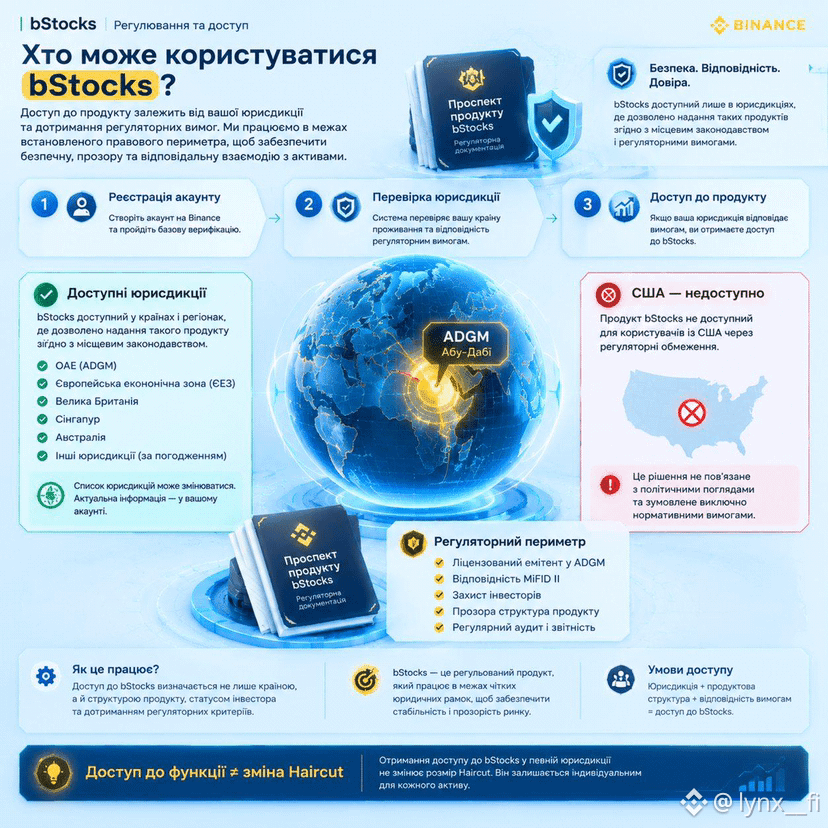
A regulatory aspect you should know in advance: bStocks are not available to U.S. citizens. 🌍
This is not an arbitrary restriction or a temporary technical delay with access expanded later—it's part of the product’s very structure: it’s built for specific jurisdictions through regulated ADGM structures in Abu Dhabi, and compliance checks happen at the account registration stage—not after the fact. 📄 In other words, this is not “a block just in case,” but a deliberately constrained regulatory perimeter from the very beginning of the product’s development.
For all other available jurisdictions, this means a transparent, pre-defined set of rules—not a gray area that could change without notice. ✅
It’s also worth understanding the other side: the very existence of a clear regulatory perimeter means that, for the jurisdictions where the product is available, it operates within a specific, publicly disclosed prospectus—not in an uncertain legal environment where interpretations may vary depending on the situation.
Are such regulatory restrictions a familiar part of financial products for you, or have you not paid attention to them before?
@Binance_Ukraine
#bstock
A regulatory aspect you should know in advance: bStocks are not available to U.S. citizens. 🌍
This is not an arbitrary restriction or a temporary technical delay with access expanded later—it's part of the product’s very structure: it’s built for specific jurisdictions through regulated ADGM structures in Abu Dhabi, and compliance checks happen at the account registration stage—not after the fact. 📄 In other words, this is not “a block just in case,” but a deliberately constrained regulatory perimeter from the very beginning of the product’s development.
For all other available jurisdictions, this means a transparent, pre-defined set of rules—not a gray area that could change without notice. ✅
It’s also worth understanding the other side: the very existence of a clear regulatory perimeter means that, for the jurisdictions where the product is available, it operates within a specific, publicly disclosed prospectus—not in an uncertain legal environment where interpretations may vary depending on the situation.
Are such regulatory restrictions a familiar part of financial products for you, or have you not paid attention to them before?
@Binance_Ukraine
#bstock
This is not an arbitrary restriction or a temporary technical delay with access expanded later—it's part of the product’s very structure: it’s built for specific jurisdictions through regulated ADGM structures in Abu Dhabi, and compliance checks happen at the account registration stage—not after the fact. 📄 In other words, this is not “a block just in case,” but a deliberately constrained regulatory perimeter from the very beginning of the product’s development.
For all other available jurisdictions, this means a transparent, pre-defined set of rules—not a gray area that could change without notice. ✅
It’s also worth understanding the other side: the very existence of a clear regulatory perimeter means that, for the jurisdictions where the product is available, it operates within a specific, publicly disclosed prospectus—not in an uncertain legal environment where interpretations may vary depending on the situation.
Are such regulatory restrictions a familiar part of financial products for you, or have you not paid attention to them before?
@Binance_Ukraine
#bstock
70
·
--
@Binance_Ukraine #bstock
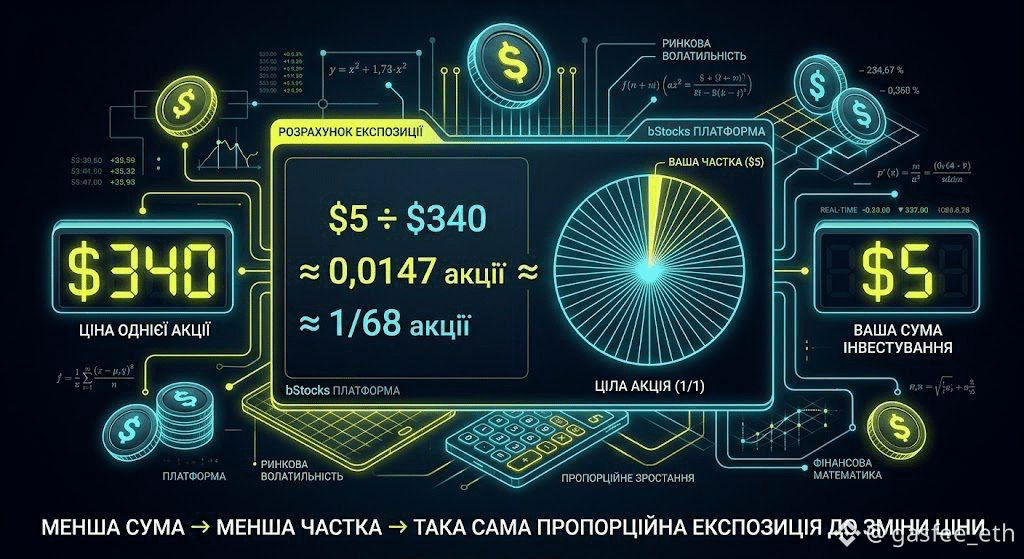
A practical case with real numbers: what “starting with $5” actually means in bStocks. 🧮
Let’s take, for example, a share priced at $340 per share — a completely realistic price for many well-known companies from the bStocks list. A contribution of $5 gives you a portion of about 1/68 of the full share — a figure that may look insignificant at first glance, but it is a real, proportional economic exposure to price movement, not a symbolic “ticket to participate.” 📊 That is, profit or loss is scaled exactly the same way as it would be on a full share—just in a smaller absolute amount.
This changes the very logic of the decision: the question is no longer “do I have enough money for a share?” but “what portion of the position do I want to open right now?” 💡
Another way to look at the same numbers: the same logic works in the opposite direction too — if you have a specific amount you want to invest, you can calculate in advance what portion of a share you’ll actually receive, instead of relying only on the purchase amount.
Do you usually calculate the share portion before entering, or do you just determine the amount you’re willing to invest?
@Binance_Ukraine #bstock
A practical case with real numbers: what “starting with $5” actually means in bStocks. 🧮
Let’s take, for example, a share priced at $340 per share — a completely realistic price for many well-known companies from the bStocks list. A contribution of $5 gives you a portion of about 1/68 of the full share — a figure that may look insignificant at first glance, but it is a real, proportional economic exposure to price movement, not a symbolic “ticket to participate.” 📊 That is, profit or loss is scaled exactly the same way as it would be on a full share—just in a smaller absolute amount.
This changes the very logic of the decision: the question is no longer “do I have enough money for a share?” but “what portion of the position do I want to open right now?” 💡
Another way to look at the same numbers: the same logic works in the opposite direction too — if you have a specific amount you want to invest, you can calculate in advance what portion of a share you’ll actually receive, instead of relying only on the purchase amount.
Do you usually calculate the share portion before entering, or do you just determine the amount you’re willing to invest?
A practical case with real numbers: what “starting with $5” actually means in bStocks. 🧮
Let’s take, for example, a share priced at $340 per share — a completely realistic price for many well-known companies from the bStocks list. A contribution of $5 gives you a portion of about 1/68 of the full share — a figure that may look insignificant at first glance, but it is a real, proportional economic exposure to price movement, not a symbolic “ticket to participate.” 📊 That is, profit or loss is scaled exactly the same way as it would be on a full share—just in a smaller absolute amount.
This changes the very logic of the decision: the question is no longer “do I have enough money for a share?” but “what portion of the position do I want to open right now?” 💡
Another way to look at the same numbers: the same logic works in the opposite direction too — if you have a specific amount you want to invest, you can calculate in advance what portion of a share you’ll actually receive, instead of relying only on the purchase amount.
Do you usually calculate the share portion before entering, or do you just determine the amount you’re willing to invest?
105

·
--
#BinanceUkraine #bstock
Many have heard about bStocks, but few have checked exactly what threshold is needed for access. 🔐 I’ll break it down specifically.
VIP Level 3 opens through one of two paths: either trading volume of approximately $50 million over the last 30 days, or holding around 1,000 BNB — you only need one of the options, not both at once. This is a fairly high threshold for a typical retail account, so it’s worth honestly assessing how relevant this feature is for your current activity level on the exchange. After that, bStocks become available as collateral for Cross or Portfolio Margin, with an individual discount set for each asset. 📊
For most regular accounts, trading volume is the real barrier—not owning BNB—so this feature is essentially designed for active traders. 🧩
Another point to keep in mind: the discount on a specific bStock does not depend on your VIP level—it is determined solely by the asset’s volatility. That means reaching VIP 3 grants access to the function, but does not change how much collateral value a particular token provides.
If you trade actively, is VIP 3 already close for you, or does this level still look out of reach?
@Binance_Ukraine
#BinanceUkraine #bstock
Many have heard about bStocks, but few have checked exactly what threshold is needed for access. 🔐 I’ll break it down specifically.
VIP Level 3 opens through one of two paths: either trading volume of approximately $50 million over the last 30 days, or holding around 1,000 BNB — you only need one of the options, not both at once. This is a fairly high threshold for a typical retail account, so it’s worth honestly assessing how relevant this feature is for your current activity level on the exchange. After that, bStocks become available as collateral for Cross or Portfolio Margin, with an individual discount set for each asset. 📊
For most regular accounts, trading volume is the real barrier—not owning BNB—so this feature is essentially designed for active traders. 🧩
Another point to keep in mind: the discount on a specific bStock does not depend on your VIP level—it is determined solely by the asset’s volatility. That means reaching VIP 3 grants access to the function, but does not change how much collateral value a particular token provides.
If you trade actively, is VIP 3 already close for you, or does this level still look out of reach?
@Binance_Ukraine
Many have heard about bStocks, but few have checked exactly what threshold is needed for access. 🔐 I’ll break it down specifically.
VIP Level 3 opens through one of two paths: either trading volume of approximately $50 million over the last 30 days, or holding around 1,000 BNB — you only need one of the options, not both at once. This is a fairly high threshold for a typical retail account, so it’s worth honestly assessing how relevant this feature is for your current activity level on the exchange. After that, bStocks become available as collateral for Cross or Portfolio Margin, with an individual discount set for each asset. 📊
For most regular accounts, trading volume is the real barrier—not owning BNB—so this feature is essentially designed for active traders. 🧩
Another point to keep in mind: the discount on a specific bStock does not depend on your VIP level—it is determined solely by the asset’s volatility. That means reaching VIP 3 grants access to the function, but does not change how much collateral value a particular token provides.
If you trade actively, is VIP 3 already close for you, or does this level still look out of reach?
@Binance_Ukraine

105

·
--
Bullish
📊 $SPCXB : What does the chart show over the last few months?
This time I’m looking at SPCXB/USDT in motion.
The chart shows a pretty clear scenario: at first, the asset gradually declined, then it formed a local bottom and started to recover. By the end of the period, the price is moving much more steadily and staying close to the current level.
🗓️ Period shown on the chart: 27.06.2026 — 25.09.2026
One interesting point—after the stronger drop, the asset didn’t stay at the minimum values; it gradually regained part of the positions. But I wouldn’t rush to draw conclusions based only on this chart.
Before trading with bStocks, it’s worth checking:
🔹 the current price and its trend;
🔹 volatility;
🔹 liquidity;
🔹 the trade conditions;
🔹 possible fees;
🔹 the risks of the specific asset.
⚠️ Past price changes do not guarantee the same movement in the future. Before using the product, it’s important to familiarize yourself with its terms and assess the possible risks.
For me, SPCXB is interesting right now specifically from the standpoint of observing its dynamics and understanding how TradFi assets work in the bStocks format.
👀 I’ll keep watching the chart.
#Binance #bstock #spcxb #TradFi #crypto
📊 $SPCXB : What does the chart show over the last few months?
This time I’m looking at SPCXB/USDT in motion.
The chart shows a pretty clear scenario: at first, the asset gradually declined, then it formed a local bottom and started to recover. By the end of the period, the price is moving much more steadily and staying close to the current level.
🗓️ Period shown on the chart: 27.06.2026 — 25.09.2026
One interesting point—after the stronger drop, the asset didn’t stay at the minimum values; it gradually regained part of the positions. But I wouldn’t rush to draw conclusions based only on this chart.
Before trading with bStocks, it’s worth checking:
🔹 the current price and its trend;
🔹 volatility;
🔹 liquidity;
🔹 the trade conditions;
🔹 possible fees;
🔹 the risks of the specific asset.
⚠️ Past price changes do not guarantee the same movement in the future. Before using the product, it’s important to familiarize yourself with its terms and assess the possible risks.
For me, SPCXB is interesting right now specifically from the standpoint of observing its dynamics and understanding how TradFi assets work in the bStocks format.
👀 I’ll keep watching the chart.
#Binance #bstock #spcxb #TradFi #crypto
This time I’m looking at SPCXB/USDT in motion.
The chart shows a pretty clear scenario: at first, the asset gradually declined, then it formed a local bottom and started to recover. By the end of the period, the price is moving much more steadily and staying close to the current level.
🗓️ Period shown on the chart: 27.06.2026 — 25.09.2026
One interesting point—after the stronger drop, the asset didn’t stay at the minimum values; it gradually regained part of the positions. But I wouldn’t rush to draw conclusions based only on this chart.
Before trading with bStocks, it’s worth checking:
🔹 the current price and its trend;
🔹 volatility;
🔹 liquidity;
🔹 the trade conditions;
🔹 possible fees;
🔹 the risks of the specific asset.
⚠️ Past price changes do not guarantee the same movement in the future. Before using the product, it’s important to familiarize yourself with its terms and assess the possible risks.
For me, SPCXB is interesting right now specifically from the standpoint of observing its dynamics and understanding how TradFi assets work in the bStocks format.
👀 I’ll keep watching the chart.
#Binance #bstock #spcxb #TradFi #crypto
2
146

·
--

Article
Are you afraid of Crypto’s volatility? How do you balance with BStocks?Are you afraid of Crypto’s volatility? How do you balance with BStocks?
Every trader and every investor operating in the Crypto market must face thrilling opportunities along with extremely harsh price volatility. While the Crypto market teaches you fast decision-making, market sentiment analysis, and Risk Management, long-term financial stability depends greatly on asset allocation through Portfolio Diversification.
Are you afraid of Crypto’s volatility? How do you balance with BStocks?
Are you afraid of Crypto’s volatility? How do you balance with BStocks?
Every trader and every investor operating in the Crypto market must face thrilling opportunities along with extremely harsh price volatility. While the Crypto market teaches you fast decision-making, market sentiment analysis, and Risk Management, long-term financial stability depends greatly on asset allocation through Portfolio Diversification.
Every trader and every investor operating in the Crypto market must face thrilling opportunities along with extremely harsh price volatility. While the Crypto market teaches you fast decision-making, market sentiment analysis, and Risk Management, long-term financial stability depends greatly on asset allocation through Portfolio Diversification.
Pyae Phyo Aung1991:
Good Luck
26
1
23
62


Verified
$AMZNB ✨ $AAPLB ✨$GOOGLB
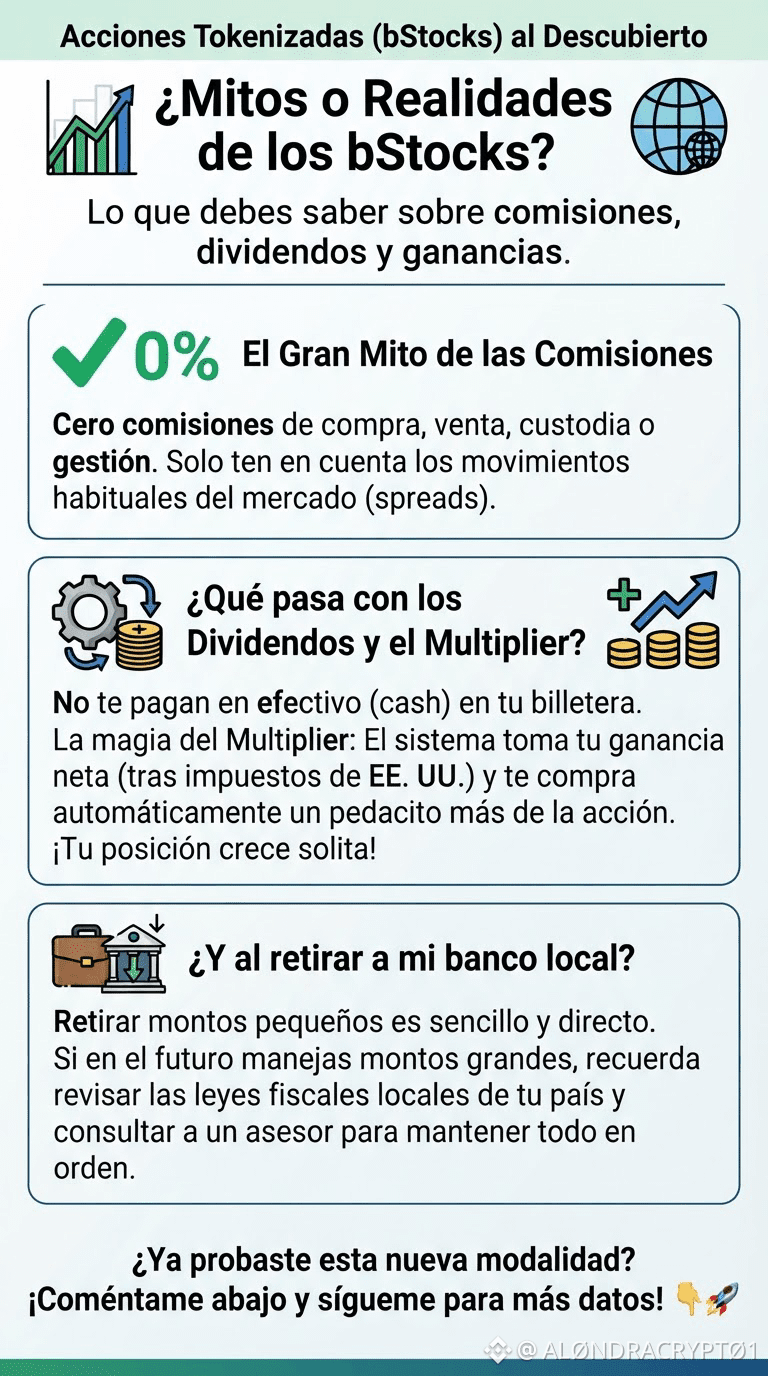
Have you heard about the new tokenized shares (bStocks) and get confused about fees and dividends? Let’s clear this up once and for all in the simplest way possible.
To start, forget the myths: trading these tokens does not charge you any commission for buying or selling, nor for custody or management. You get clean management where you only need to keep in mind the usual movements of the market. We should clarify two practical details that always exist on any exchange platform:
1. The spread (difference): Even though the platform doesn’t charge you a direct commission or a fixed percentage to trade, the spread always exists.
2. Network fees or trading minimums: Depending on how you operate or move the associated funds, network fees may apply or there may be a minimum per order.
Now, what happens with dividends if the US stock companies distribute them? Imagine the company wants to give you your share of the profits, but since you’re in crypto, cash bills won’t just land in your wallet. Instead, the system does the magic for you: it takes that money you’re entitled to (after the withholding of US taxes) and reinvests it automatically by buying you even more of that same stock.
The multiplier is simply the tool that updates the numbers on your screen to add that extra little piece you bought without you having to do anything.
And what if you decide to sell and bring those gains into real money to your local bank?
No worries—this doesn’t mean you have to go crazy with paperwork from day one. As long as in the future you handle larger amounts, that’s when common sense kicks in: review the tax laws in your own country and consult a local advisor to keep everything compliant with your own regulations.
Have you tried this new mode yet, or do you prefer to trade only with traditional cryptocurrencies?
#noticias #bstock
{spot}(AAPLBUSDT)
{spot}(GOOGLBUSDT)
{spot}(AMZNBUSDT)
$AMZNB ✨ $AAPLB ✨$GOOGLB
Have you heard about the new tokenized shares (bStocks) and get confused about fees and dividends? Let’s clear this up once and for all in the simplest way possible.
To start, forget the myths: trading these tokens does not charge you any commission for buying or selling, nor for custody or management. You get clean management where you only need to keep in mind the usual movements of the market. We should clarify two practical details that always exist on any exchange platform:
1. The spread (difference): Even though the platform doesn’t charge you a direct commission or a fixed percentage to trade, the spread always exists.
2. Network fees or trading minimums: Depending on how you operate or move the associated funds, network fees may apply or there may be a minimum per order.
Now, what happens with dividends if the US stock companies distribute them? Imagine the company wants to give you your share of the profits, but since you’re in crypto, cash bills won’t just land in your wallet. Instead, the system does the magic for you: it takes that money you’re entitled to (after the withholding of US taxes) and reinvests it automatically by buying you even more of that same stock.
The multiplier is simply the tool that updates the numbers on your screen to add that extra little piece you bought without you having to do anything.
And what if you decide to sell and bring those gains into real money to your local bank?
No worries—this doesn’t mean you have to go crazy with paperwork from day one. As long as in the future you handle larger amounts, that’s when common sense kicks in: review the tax laws in your own country and consult a local advisor to keep everything compliant with your own regulations.
Have you tried this new mode yet, or do you prefer to trade only with traditional cryptocurrencies?
#noticias #bstock
Have you heard about the new tokenized shares (bStocks) and get confused about fees and dividends? Let’s clear this up once and for all in the simplest way possible.
To start, forget the myths: trading these tokens does not charge you any commission for buying or selling, nor for custody or management. You get clean management where you only need to keep in mind the usual movements of the market. We should clarify two practical details that always exist on any exchange platform:
1. The spread (difference): Even though the platform doesn’t charge you a direct commission or a fixed percentage to trade, the spread always exists.
2. Network fees or trading minimums: Depending on how you operate or move the associated funds, network fees may apply or there may be a minimum per order.
Now, what happens with dividends if the US stock companies distribute them? Imagine the company wants to give you your share of the profits, but since you’re in crypto, cash bills won’t just land in your wallet. Instead, the system does the magic for you: it takes that money you’re entitled to (after the withholding of US taxes) and reinvests it automatically by buying you even more of that same stock.
The multiplier is simply the tool that updates the numbers on your screen to add that extra little piece you bought without you having to do anything.
And what if you decide to sell and bring those gains into real money to your local bank?
No worries—this doesn’t mean you have to go crazy with paperwork from day one. As long as in the future you handle larger amounts, that’s when common sense kicks in: review the tax laws in your own country and consult a local advisor to keep everything compliant with your own regulations.
Have you tried this new mode yet, or do you prefer to trade only with traditional cryptocurrencies?
#noticias #bstock
Gusty68:
en Binance no lo he probado aún Pero lo voy a probar, me gusta lo de los dividendos
2
1
15
2.4k

·
--
Verified

Article
Crypto vs US Stocks: Key Differences & How to Start on BinancIn today’s financial and investment landscape, technological advancements have unlocked numerous new opportunities for investors. Crypto traders, in particular, are increasingly looking toward the traditional stock market to strengthen and diversify their portfolios.
Today, learning about BStocks and the US stock market has become effortless through the Binance Square platform. This article provides a comprehensive overview of the key differences between stocks and crypto, the inherent risks involved, and how beginners can start exploring the US stock market using Binance.
1. Primary Differences Between Stocks and Crypto
Before placing your first investment, it is essential to understand the fundamental differences between stocks and digital assets.
Nature of the Asset: Buying a stock represents acquiring fractional ownership in a real-world, registered company. Crypto assets (such as Bitcoin or Ethereum) are digital tokens or decentralized networks built on blockchain technology.
Market Hours: Traditional stock markets operate strictly during standard business hours, Monday through Friday, and close on weekends and holidays. In contrast, the crypto market operates 24/7, 365 days a year without interruption.
Market Volatility: The crypto market exhibits significantly higher price volatility than the stock market, carrying a higher overall risk profile. Stock prices are typically anchored to company fundamentals, earnings reports, and macroeconomic indicators.
2. US Stocks Checklist for Beginners
For beginners aiming to enter the US stock market, the following step-by-step preparation is recommended:
Master Basic Financial Terminology: Familiarize yourself with core metrics such as Market Cap, P/E Ratio, Dividends, and Earnings Per Share (EPS).
Monitor Major Stock Indices: Track benchmark indices such as the S&P 500, Nasdaq 100, and the Dow Jones Industrial Average to understand broader market trends.
Stay Informed on Company News: Follow quarterly financial reports, technological developments, and general news regarding leading companies like Apple, Microsoft, and Tesla.
Implement Strict Risk Management: Never invest money you cannot afford to lose, whether in stocks or crypto.
Important Note on Risk: If a project or company fails and its asset/coin is delisted or liquidated, you risk losing your entire principal investment. Always conduct thorough research before committing capital.
3. Portfolio Diversification from Crypto to Stocks via Binance
For crypto investors, transitioning profits or capital into traditional equities is an effective strategy for risk diversification. Through Binance Square, users can access educational posts, community discussions, and market updates regarding BStocks and US Stocks—bridging the gap between the crypto ecosystem and traditional financial markets.
4. Conclusion and Recommendations
Both crypto trading and traditional stock trading present unique opportunities for wealth creation. Beginners should prioritize continuous learning through the "Do Your Own Research" (DYOR) principle and engage with reliable trading communities. By regularly following BStocks and US stock market updates on Binance Square, you can build a more resilient and strategic investment journey.
Thanks for taking the time to read this.😍
@BinanceBurmese #bstock
#SEABstock
#SEAstock
Crypto vs US Stocks: Key Differences & How to Start on Binanc
In today’s financial and investment landscape, technological advancements have unlocked numerous new opportunities for investors. Crypto traders, in particular, are increasingly looking toward the traditional stock market to strengthen and diversify their portfolios.
Today, learning about BStocks and the US stock market has become effortless through the Binance Square platform. This article provides a comprehensive overview of the key differences between stocks and crypto, the inherent risks involved, and how beginners can start exploring the US stock market using Binance.
1. Primary Differences Between Stocks and Crypto
Before placing your first investment, it is essential to understand the fundamental differences between stocks and digital assets.
Nature of the Asset: Buying a stock represents acquiring fractional ownership in a real-world, registered company. Crypto assets (such as Bitcoin or Ethereum) are digital tokens or decentralized networks built on blockchain technology.
Market Hours: Traditional stock markets operate strictly during standard business hours, Monday through Friday, and close on weekends and holidays. In contrast, the crypto market operates 24/7, 365 days a year without interruption.
Market Volatility: The crypto market exhibits significantly higher price volatility than the stock market, carrying a higher overall risk profile. Stock prices are typically anchored to company fundamentals, earnings reports, and macroeconomic indicators.
2. US Stocks Checklist for Beginners
For beginners aiming to enter the US stock market, the following step-by-step preparation is recommended:
Master Basic Financial Terminology: Familiarize yourself with core metrics such as Market Cap, P/E Ratio, Dividends, and Earnings Per Share (EPS).
Monitor Major Stock Indices: Track benchmark indices such as the S&P 500, Nasdaq 100, and the Dow Jones Industrial Average to understand broader market trends.
Stay Informed on Company News: Follow quarterly financial reports, technological developments, and general news regarding leading companies like Apple, Microsoft, and Tesla.
Implement Strict Risk Management: Never invest money you cannot afford to lose, whether in stocks or crypto.
Important Note on Risk: If a project or company fails and its asset/coin is delisted or liquidated, you risk losing your entire principal investment. Always conduct thorough research before committing capital.
3. Portfolio Diversification from Crypto to Stocks via Binance
For crypto investors, transitioning profits or capital into traditional equities is an effective strategy for risk diversification. Through Binance Square, users can access educational posts, community discussions, and market updates regarding BStocks and US Stocks—bridging the gap between the crypto ecosystem and traditional financial markets.
4. Conclusion and Recommendations
Both crypto trading and traditional stock trading present unique opportunities for wealth creation. Beginners should prioritize continuous learning through the "Do Your Own Research" (DYOR) principle and engage with reliable trading communities. By regularly following BStocks and US stock market updates on Binance Square, you can build a more resilient and strategic investment journey.
Thanks for taking the time to read this.😍
@Binance Burmese #bstock
#SEABstock
#SEAstock
Today, learning about BStocks and the US stock market has become effortless through the Binance Square platform. This article provides a comprehensive overview of the key differences between stocks and crypto, the inherent risks involved, and how beginners can start exploring the US stock market using Binance.
1. Primary Differences Between Stocks and Crypto
Before placing your first investment, it is essential to understand the fundamental differences between stocks and digital assets.
Nature of the Asset: Buying a stock represents acquiring fractional ownership in a real-world, registered company. Crypto assets (such as Bitcoin or Ethereum) are digital tokens or decentralized networks built on blockchain technology.
Market Hours: Traditional stock markets operate strictly during standard business hours, Monday through Friday, and close on weekends and holidays. In contrast, the crypto market operates 24/7, 365 days a year without interruption.
Market Volatility: The crypto market exhibits significantly higher price volatility than the stock market, carrying a higher overall risk profile. Stock prices are typically anchored to company fundamentals, earnings reports, and macroeconomic indicators.
2. US Stocks Checklist for Beginners
For beginners aiming to enter the US stock market, the following step-by-step preparation is recommended:
Master Basic Financial Terminology: Familiarize yourself with core metrics such as Market Cap, P/E Ratio, Dividends, and Earnings Per Share (EPS).
Monitor Major Stock Indices: Track benchmark indices such as the S&P 500, Nasdaq 100, and the Dow Jones Industrial Average to understand broader market trends.
Stay Informed on Company News: Follow quarterly financial reports, technological developments, and general news regarding leading companies like Apple, Microsoft, and Tesla.
Implement Strict Risk Management: Never invest money you cannot afford to lose, whether in stocks or crypto.
Important Note on Risk: If a project or company fails and its asset/coin is delisted or liquidated, you risk losing your entire principal investment. Always conduct thorough research before committing capital.
3. Portfolio Diversification from Crypto to Stocks via Binance
For crypto investors, transitioning profits or capital into traditional equities is an effective strategy for risk diversification. Through Binance Square, users can access educational posts, community discussions, and market updates regarding BStocks and US Stocks—bridging the gap between the crypto ecosystem and traditional financial markets.
4. Conclusion and Recommendations
Both crypto trading and traditional stock trading present unique opportunities for wealth creation. Beginners should prioritize continuous learning through the "Do Your Own Research" (DYOR) principle and engage with reliable trading communities. By regularly following BStocks and US stock market updates on Binance Square, you can build a more resilient and strategic investment journey.
Thanks for taking the time to read this.😍
@Binance Burmese #bstock
#SEABstock
#SEAstock
bontott:
very good
44
3
50
344

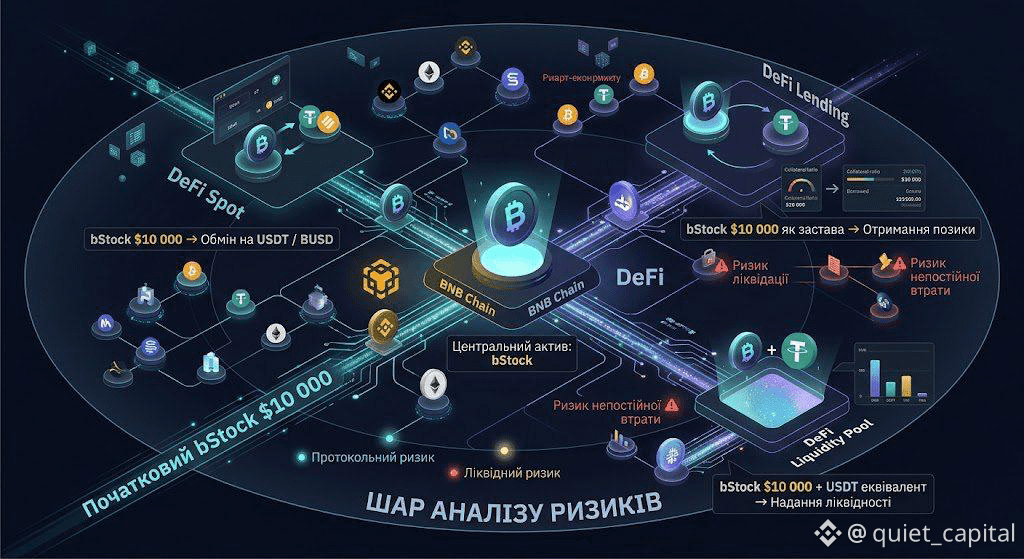
@Binance_Ukraine #BinanceUkraine Market overview + guide for those who haven’t heard yet: bStocks are now integrated into several DeFi protocols on BNB Chain, and that changes what the token can do after you buy it. 🔌
In practice, this means that NVDAB or TSLAB isn’t just a spot balance—it’s an asset you can use as working capital: for example, as collateral in protocols like Venus or in liquidity pools. In simple terms: the token doesn’t have to just sit there and wait for the price to move—if you want, it can work in DeFi at the same time. 🧩
This opens up new options for your portfolio: part of bStocks can remain a long-term position, while the other part can be actively used in DeFi protocols for potential additional yield. At the same time, it adds a separate layer of smart-contract risk that you shouldn’t ignore. ⚠️
The smartest approach is to start with a small amount and first understand how the specific protocol works. A new level of asset utilization automatically means a new set of risks.
Do you use bStocks somewhere in DeFi, or do you keep them exclusively on Binance spot?
#bstock
@Binance_Ukraine #BinanceUkraine Market overview + guide for those who haven’t heard yet: bStocks are now integrated into several DeFi protocols on BNB Chain, and that changes what the token can do after you buy it. 🔌
In practice, this means that NVDAB or TSLAB isn’t just a spot balance—it’s an asset you can use as working capital: for example, as collateral in protocols like Venus or in liquidity pools. In simple terms: the token doesn’t have to just sit there and wait for the price to move—if you want, it can work in DeFi at the same time. 🧩
This opens up new options for your portfolio: part of bStocks can remain a long-term position, while the other part can be actively used in DeFi protocols for potential additional yield. At the same time, it adds a separate layer of smart-contract risk that you shouldn’t ignore. ⚠️
The smartest approach is to start with a small amount and first understand how the specific protocol works. A new level of asset utilization automatically means a new set of risks.
Do you use bStocks somewhere in DeFi, or do you keep them exclusively on Binance spot?
#bstock
In practice, this means that NVDAB or TSLAB isn’t just a spot balance—it’s an asset you can use as working capital: for example, as collateral in protocols like Venus or in liquidity pools. In simple terms: the token doesn’t have to just sit there and wait for the price to move—if you want, it can work in DeFi at the same time. 🧩
This opens up new options for your portfolio: part of bStocks can remain a long-term position, while the other part can be actively used in DeFi protocols for potential additional yield. At the same time, it adds a separate layer of smart-contract risk that you shouldn’t ignore. ⚠️
The smartest approach is to start with a small amount and first understand how the specific protocol works. A new level of asset utilization automatically means a new set of risks.
Do you use bStocks somewhere in DeFi, or do you keep them exclusively on Binance spot?
#bstock
93
·
--
#BinanceUkraine #bstock
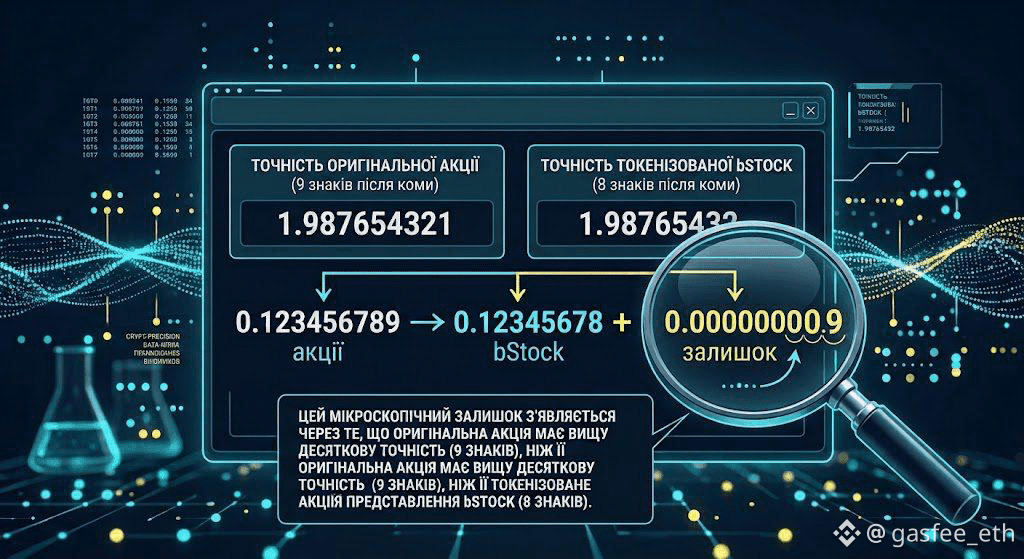
A practical case plus a bit of education about risks: what to do with the “dust” that remains after selling 100% of bStock. 🧮
The technical reason: orders are usually calculated with precision up to 9 digits after the decimal point, while bStocks are only accurate up to 8. When you fully sell a position, that same last, ninth digit cannot be physically fit into the token format, and a tiny remainder—typically fractions of a cent—may be left unshown. This is not a system error and not a hidden fee; it’s a structural outcome of different rounding precision on both sides. 💡
In practice, this remainder is so small that it affects only psychologically—seeing a non-zero balance where you expected zero. So there’s no need to panic over a few digits after the sale. 🔍
If you want to get rid of such a remainder completely, there are few options—most often it’s easier to leave it as it is, since the amount is usually too small to justify extra actions or commissions to eliminate it.
Have you noticed this kind of leftover on your balance before, or did you learn about this mechanism only now?
@Binance_Ukraine
#BinanceUkraine #bstock
A practical case plus a bit of education about risks: what to do with the “dust” that remains after selling 100% of bStock. 🧮
The technical reason: orders are usually calculated with precision up to 9 digits after the decimal point, while bStocks are only accurate up to 8. When you fully sell a position, that same last, ninth digit cannot be physically fit into the token format, and a tiny remainder—typically fractions of a cent—may be left unshown. This is not a system error and not a hidden fee; it’s a structural outcome of different rounding precision on both sides. 💡
In practice, this remainder is so small that it affects only psychologically—seeing a non-zero balance where you expected zero. So there’s no need to panic over a few digits after the sale. 🔍
If you want to get rid of such a remainder completely, there are few options—most often it’s easier to leave it as it is, since the amount is usually too small to justify extra actions or commissions to eliminate it.
Have you noticed this kind of leftover on your balance before, or did you learn about this mechanism only now?
@Binance_Ukraine
A practical case plus a bit of education about risks: what to do with the “dust” that remains after selling 100% of bStock. 🧮
The technical reason: orders are usually calculated with precision up to 9 digits after the decimal point, while bStocks are only accurate up to 8. When you fully sell a position, that same last, ninth digit cannot be physically fit into the token format, and a tiny remainder—typically fractions of a cent—may be left unshown. This is not a system error and not a hidden fee; it’s a structural outcome of different rounding precision on both sides. 💡
In practice, this remainder is so small that it affects only psychologically—seeing a non-zero balance where you expected zero. So there’s no need to panic over a few digits after the sale. 🔍
If you want to get rid of such a remainder completely, there are few options—most often it’s easier to leave it as it is, since the amount is usually too small to justify extra actions or commissions to eliminate it.
Have you noticed this kind of leftover on your balance before, or did you learn about this mechanism only now?
@Binance_Ukraine
92

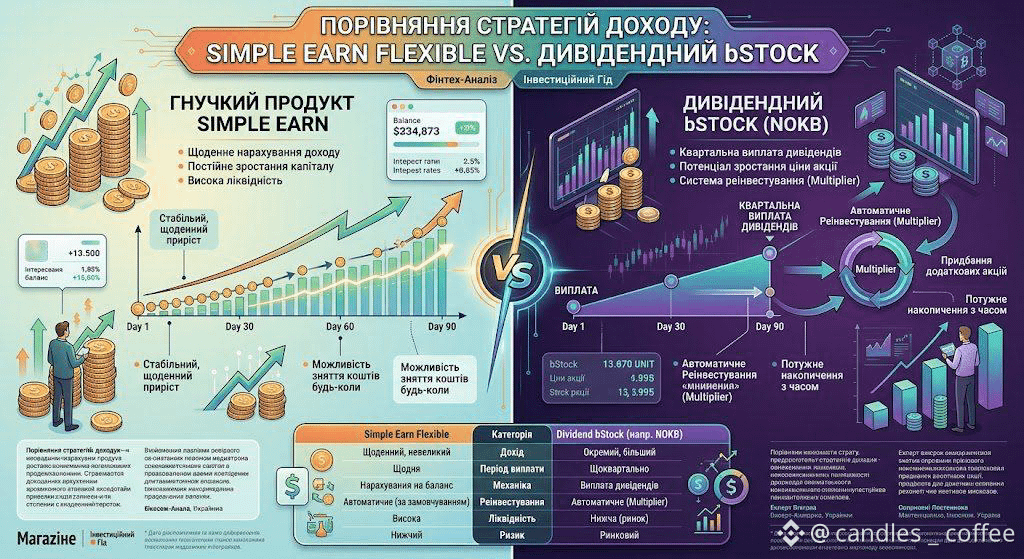
A practical case with a comparison: the same amount in Simple Earn Flexible and, in parallel, a dividend bStock (NOKB) — it’s interesting to see how differently the accrual mechanics work. 📐
In Flexible Earn, the interest is calculated every minute and paid out daily, and the rate may change depending on market conditions. In NOKB, the dividend is reinvested automatically via the Multiplier only when the company actually makes the payment — meaning it’s not a daily process, but a periodic one tied to the company’s real corporate schedule. 🔄
The key difference here is the pace: Flexible Earn provides regular accruals, while the dividend bStock works according to the payment schedule of a specific company. Both options can run automatically, but the logic and frequency of the process differ significantly. 💡
So comparing them only by the income yield figure isn’t quite correct — it’s also important to look at the mechanics, the payment frequency, and the terms of the underlying asset.
What matters more to you in such a choice: the regularity of accruals or the link between income and the company’s dividend policy?
@Binance_Ukraine #bstock #simpleearn
A practical case with a comparison: the same amount in Simple Earn Flexible and, in parallel, a dividend bStock (NOKB) — it’s interesting to see how differently the accrual mechanics work. 📐
In Flexible Earn, the interest is calculated every minute and paid out daily, and the rate may change depending on market conditions. In NOKB, the dividend is reinvested automatically via the Multiplier only when the company actually makes the payment — meaning it’s not a daily process, but a periodic one tied to the company’s real corporate schedule. 🔄
The key difference here is the pace: Flexible Earn provides regular accruals, while the dividend bStock works according to the payment schedule of a specific company. Both options can run automatically, but the logic and frequency of the process differ significantly. 💡
So comparing them only by the income yield figure isn’t quite correct — it’s also important to look at the mechanics, the payment frequency, and the terms of the underlying asset.
What matters more to you in such a choice: the regularity of accruals or the link between income and the company’s dividend policy?
@Binance_Ukraine #bstock #simpleearn
In Flexible Earn, the interest is calculated every minute and paid out daily, and the rate may change depending on market conditions. In NOKB, the dividend is reinvested automatically via the Multiplier only when the company actually makes the payment — meaning it’s not a daily process, but a periodic one tied to the company’s real corporate schedule. 🔄
The key difference here is the pace: Flexible Earn provides regular accruals, while the dividend bStock works according to the payment schedule of a specific company. Both options can run automatically, but the logic and frequency of the process differ significantly. 💡
So comparing them only by the income yield figure isn’t quite correct — it’s also important to look at the mechanics, the payment frequency, and the terms of the underlying asset.
What matters more to you in such a choice: the regularity of accruals or the link between income and the company’s dividend policy?
@Binance_Ukraine #bstock #simpleearn
107
·
--
@Binance_Ukraine #bstock
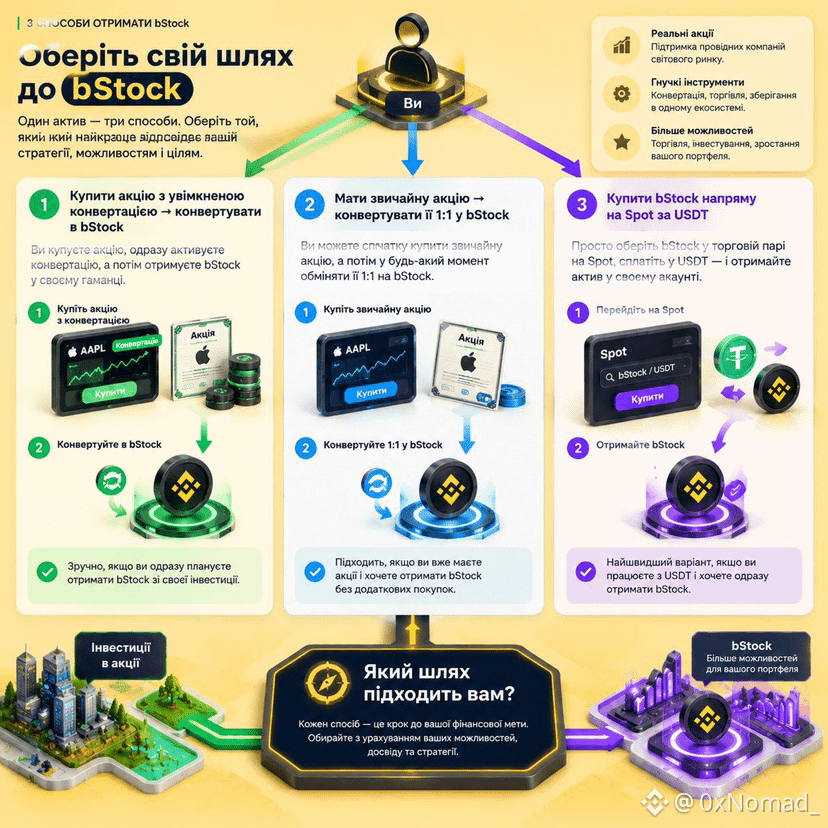
A guide plus strategy in one: three ways to get bStock — and each of them has its own logic depending on where you’re entering the position from. 🧭
The first method is to buy the base share with the conversion toggle enabled, and it immediately “lands” as bStock; this is suitable if you plan from the very beginning to hold the tokenized version. The second is to convert an already existing direct share 1:1 for free; this is for those who already have an active position and want the flexibility of 24/7 trading without selling. The third, most common one, is to buy bStock directly on the spot market using USDT; the simplest path for a tactical position. 💵
So the choice depends not so much on the method itself, but on where your asset is currently and what you plan to do with it next.
If the share is already yours, it makes sense to look at conversion. If you’re starting from scratch, you can buy bStock right away. And when you need a quick spot trade, the third option is the most straightforward in terms of mechanics.
Which of the three methods do you use most often?
@Binance_Ukraine #bstock
A guide plus strategy in one: three ways to get bStock — and each of them has its own logic depending on where you’re entering the position from. 🧭
The first method is to buy the base share with the conversion toggle enabled, and it immediately “lands” as bStock; this is suitable if you plan from the very beginning to hold the tokenized version. The second is to convert an already existing direct share 1:1 for free; this is for those who already have an active position and want the flexibility of 24/7 trading without selling. The third, most common one, is to buy bStock directly on the spot market using USDT; the simplest path for a tactical position. 💵
So the choice depends not so much on the method itself, but on where your asset is currently and what you plan to do with it next.
If the share is already yours, it makes sense to look at conversion. If you’re starting from scratch, you can buy bStock right away. And when you need a quick spot trade, the third option is the most straightforward in terms of mechanics.
Which of the three methods do you use most often?
A guide plus strategy in one: three ways to get bStock — and each of them has its own logic depending on where you’re entering the position from. 🧭
The first method is to buy the base share with the conversion toggle enabled, and it immediately “lands” as bStock; this is suitable if you plan from the very beginning to hold the tokenized version. The second is to convert an already existing direct share 1:1 for free; this is for those who already have an active position and want the flexibility of 24/7 trading without selling. The third, most common one, is to buy bStock directly on the spot market using USDT; the simplest path for a tactical position. 💵
So the choice depends not so much on the method itself, but on where your asset is currently and what you plan to do with it next.
If the share is already yours, it makes sense to look at conversion. If you’re starting from scratch, you can buy bStock right away. And when you need a quick spot trade, the third option is the most straightforward in terms of mechanics.
Which of the three methods do you use most often?
117

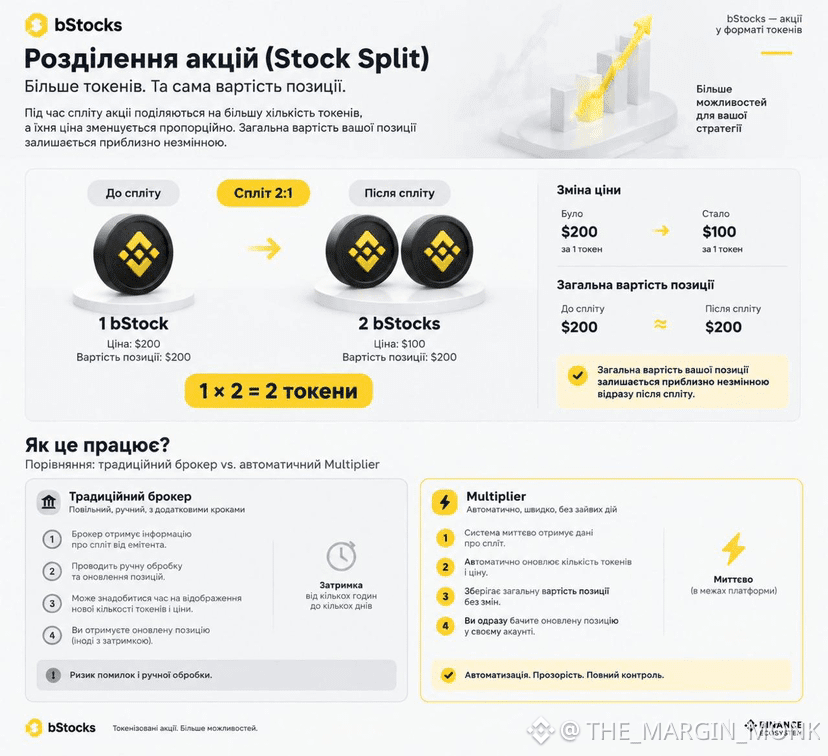
I want to explain the stock-split mechanism in bStocks in simple terms — and immediately compare how it looks with a traditional broker, because the difference is telling. 📘
With a traditional broker, a stock split is usually handled automatically, but it can come with a delay in updating your balance by a few days, depending on the broker. In bStocks, this process happens via the Multiplier mechanism: if the underlying company, for example, does a 2-for-1 split, the displayed token balance adjusts automatically, without any separate steps on your side. 🔄
In practice, this means that for the holder of a tokenized asset, a split is simply a change of the number on the screen, with no need to convert anything or manually confirm. The convenience here is precisely the lack of extra actions required from the user. ⚙️
That’s the main point of automation: you don’t need to separately watch the technical processing of a corporate event if the mechanism already provides for its automatic display.
Have you ever run into delays or confusion with a stock split in a classic broker?
@Binance_Ukraine #BinanceUkraine #bstock
I want to explain the stock-split mechanism in bStocks in simple terms — and immediately compare how it looks with a traditional broker, because the difference is telling. 📘
With a traditional broker, a stock split is usually handled automatically, but it can come with a delay in updating your balance by a few days, depending on the broker. In bStocks, this process happens via the Multiplier mechanism: if the underlying company, for example, does a 2-for-1 split, the displayed token balance adjusts automatically, without any separate steps on your side. 🔄
In practice, this means that for the holder of a tokenized asset, a split is simply a change of the number on the screen, with no need to convert anything or manually confirm. The convenience here is precisely the lack of extra actions required from the user. ⚙️
That’s the main point of automation: you don’t need to separately watch the technical processing of a corporate event if the mechanism already provides for its automatic display.
Have you ever run into delays or confusion with a stock split in a classic broker?
@Binance_Ukraine #BinanceUkraine #bstock
With a traditional broker, a stock split is usually handled automatically, but it can come with a delay in updating your balance by a few days, depending on the broker. In bStocks, this process happens via the Multiplier mechanism: if the underlying company, for example, does a 2-for-1 split, the displayed token balance adjusts automatically, without any separate steps on your side. 🔄
In practice, this means that for the holder of a tokenized asset, a split is simply a change of the number on the screen, with no need to convert anything or manually confirm. The convenience here is precisely the lack of extra actions required from the user. ⚙️
That’s the main point of automation: you don’t need to separately watch the technical processing of a corporate event if the mechanism already provides for its automatic display.
Have you ever run into delays or confusion with a stock split in a classic broker?
@Binance_Ukraine #BinanceUkraine #bstock
97

·
--
Learning US Stocks via Binance: A Quick Guide
Expanding into traditional equities via Binance (BStocks) helps diversify your portfolio. Here is how to start:
Binance Academy: Access free articles and guides covering stock basics, valuation, and tokenized assets.
Binance Research: Read in-depth macroeconomic analysis to understand stock market trends.
Binance Square: Follow market experts and hashtags like #SEABstock for real-time technical and fundamental insights.
Track Live Data: Monitor US Stock token price charts and analyze how global news impacts performance.
Combine educational guides with Binance Square insights to build a strong investment foundation.
#SEABstock #SEAstock
#BinanceSquareTalks #BinanceMyanmar #stockmarketnews #bstock
Learning US Stocks via Binance: A Quick Guide
Expanding into traditional equities via Binance (BStocks) helps diversify your portfolio. Here is how to start:
Binance Academy: Access free articles and guides covering stock basics, valuation, and tokenized assets.
Binance Research: Read in-depth macroeconomic analysis to understand stock market trends.
Binance Square: Follow market experts and hashtags like #SEABstock for real-time technical and fundamental insights.
Track Live Data: Monitor US Stock token price charts and analyze how global news impacts performance.
Combine educational guides with Binance Square insights to build a strong investment foundation.
#SEABstock #SEAstock
#BinanceSquareTalks #BinanceMyanmar #stockmarketnews #bstock
Expanding into traditional equities via Binance (BStocks) helps diversify your portfolio. Here is how to start:
Binance Academy: Access free articles and guides covering stock basics, valuation, and tokenized assets.
Binance Research: Read in-depth macroeconomic analysis to understand stock market trends.
Binance Square: Follow market experts and hashtags like #SEABstock for real-time technical and fundamental insights.
Track Live Data: Monitor US Stock token price charts and analyze how global news impacts performance.
Combine educational guides with Binance Square insights to build a strong investment foundation.
#SEABstock #SEAstock
#BinanceSquareTalks #BinanceMyanmar #stockmarketnews #bstock
1
53

·
--

Article
Binance Weekend Starter ParkIf it’s the weekend, my routine isn’t too complicated. I’ll go to the gym, eat, and during my free time, I’ll study the markets of companies I’m interested in. 😄
One thing I often end up looking at in my free time is bStocks.
That’s because I’m not only looking at one company; I end up studying the price movements of big companies like Apple, Microsoft, NVIDIA, Tesla, and Amazon all at once.
Binance Weekend Starter Park
If it’s the weekend, my routine isn’t too complicated. I’ll go to the gym, eat, and during my free time, I’ll study the markets of companies I’m interested in. 😄
One thing I often end up looking at in my free time is bStocks.
That’s because I’m not only looking at one company; I end up studying the price movements of big companies like Apple, Microsoft, NVIDIA, Tesla, and Amazon all at once.
One thing I often end up looking at in my free time is bStocks.
That’s because I’m not only looking at one company; I end up studying the price movements of big companies like Apple, Microsoft, NVIDIA, Tesla, and Amazon all at once.
3
133
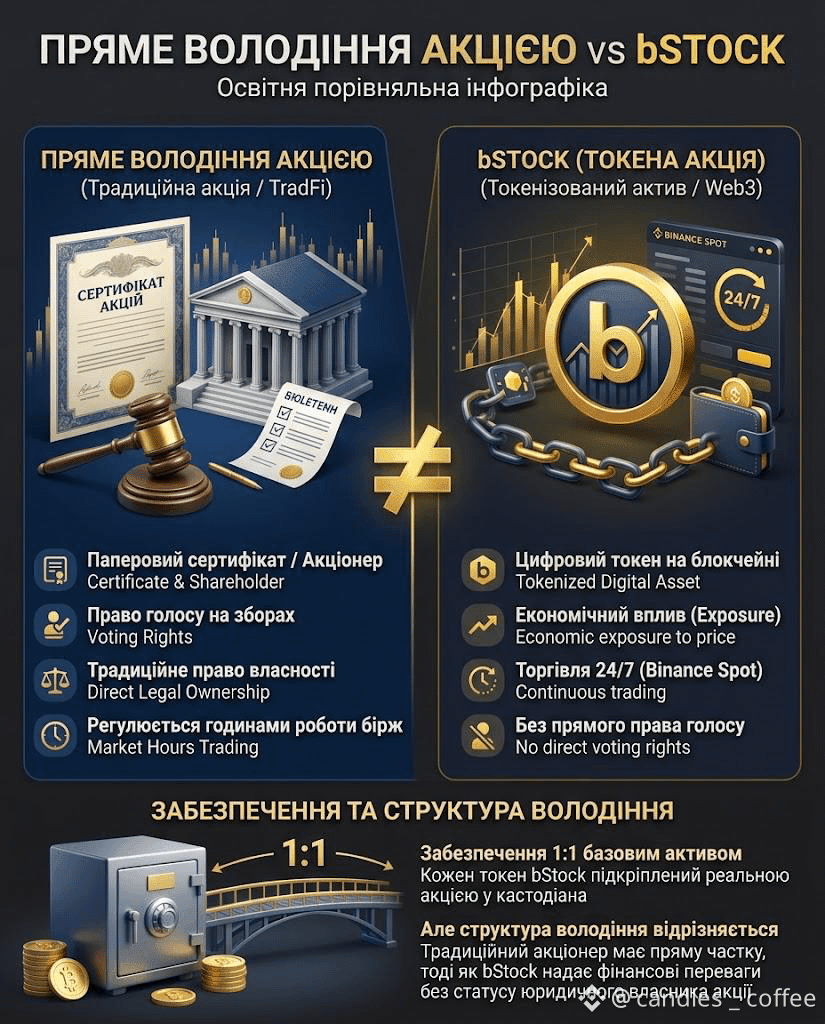
Before you press the “Buy” button on any new financial instrument, stop and ask yourself: do you understand the structure of this asset?
With bStocks, beginners often have dangerous misconceptions. ⚠️
The main mistake is to think that a bStock is a full-fledged replacement for a regular share. Yes, they move in lockstep with the price (1:1 ratio) 🎯 But legally, a bStock is a tokenized security. You get only a financial exposure to the price movement.
You do not become a company shareholder in the legal sense. You have no voting rights at meetings 🗳️
On the positive side: the assets are indeed backed by real securities held with the custodian 🛡️ Transparency is confirmed by Proof of Collateral reports.
You get an instrument that trades 24/7 ⚡, with instant settlement and the ability to withdraw to the blockchain. However, don’t forget about market risks: when the US exchange is closed, the bStock price on the Binance spot market is formed solely by user demand and supply 📉📈
Always keep three core details in mind: what you’re buying ➡️ what it’s backed by ➡️ and what rights you actually receive.
Only then should you make a decision about the trade and the position size. 👍
@Binance_Ukraine #BinanceSquare #bstock
Before you press the “Buy” button on any new financial instrument, stop and ask yourself: do you understand the structure of this asset?
With bStocks, beginners often have dangerous misconceptions. ⚠️
The main mistake is to think that a bStock is a full-fledged replacement for a regular share. Yes, they move in lockstep with the price (1:1 ratio) 🎯 But legally, a bStock is a tokenized security. You get only a financial exposure to the price movement.
You do not become a company shareholder in the legal sense. You have no voting rights at meetings 🗳️
On the positive side: the assets are indeed backed by real securities held with the custodian 🛡️ Transparency is confirmed by Proof of Collateral reports.
You get an instrument that trades 24/7 ⚡, with instant settlement and the ability to withdraw to the blockchain. However, don’t forget about market risks: when the US exchange is closed, the bStock price on the Binance spot market is formed solely by user demand and supply 📉📈
Always keep three core details in mind: what you’re buying ➡️ what it’s backed by ➡️ and what rights you actually receive.
Only then should you make a decision about the trade and the position size. 👍
@Binance_Ukraine #BinanceSquare #bstock
With bStocks, beginners often have dangerous misconceptions. ⚠️
The main mistake is to think that a bStock is a full-fledged replacement for a regular share. Yes, they move in lockstep with the price (1:1 ratio) 🎯 But legally, a bStock is a tokenized security. You get only a financial exposure to the price movement.
You do not become a company shareholder in the legal sense. You have no voting rights at meetings 🗳️
On the positive side: the assets are indeed backed by real securities held with the custodian 🛡️ Transparency is confirmed by Proof of Collateral reports.
You get an instrument that trades 24/7 ⚡, with instant settlement and the ability to withdraw to the blockchain. However, don’t forget about market risks: when the US exchange is closed, the bStock price on the Binance spot market is formed solely by user demand and supply 📉📈
Always keep three core details in mind: what you’re buying ➡️ what it’s backed by ➡️ and what rights you actually receive.
Only then should you make a decision about the trade and the position size. 👍
@Binance_Ukraine #BinanceSquare #bstock
92
·
--
@Binance_Ukraine #BinanceUkraine #bstock
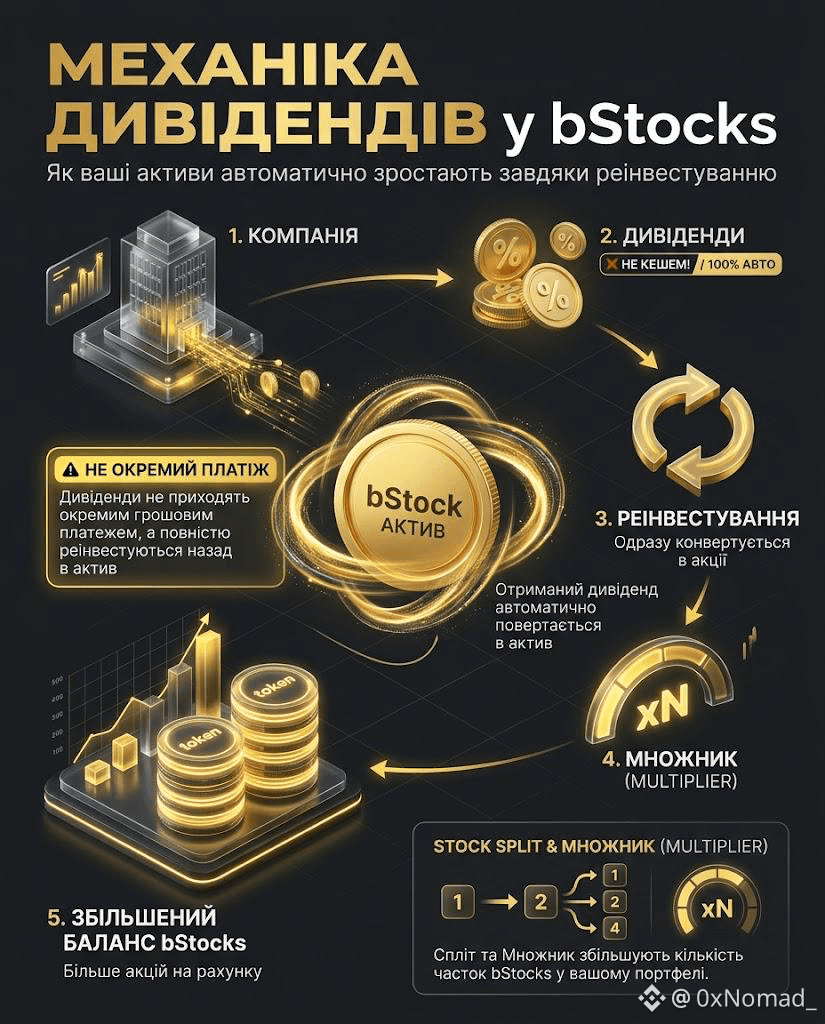
First about bStocks: forget about classic dividends to your card. If you’re expecting quarterly cashback — this isn’t it. 📚
The mechanism is different: when a company pays dividends, Binance deducts taxes and automatically reinvests the net amount into the same shares. 💵 Then, using the Multiplier coefficient, the number of your bStocks simply grows proportionally.
The formula is simple: Payout ➡️ reinvest into the underlying asset ➡️ automatic token balance increase 📈
The same goes for splits — the system recalculates everything via Multiplier without any involvement from you. ⚙️
Legally, bStock provides economic exposure to the underlying asset, but it doesn’t make you a co-owner: there are no voting rights.
For crypto, this auto-compounding percentage is convenient — no fees for small repeated trades. The key is to understand the difference from a broker BEFORE the agreement.
Did you know about such reinvestment before? 🤔
@Binance_Ukraine #BinanceUkraine #bstock
First about bStocks: forget about classic dividends to your card. If you’re expecting quarterly cashback — this isn’t it. 📚
The mechanism is different: when a company pays dividends, Binance deducts taxes and automatically reinvests the net amount into the same shares. 💵 Then, using the Multiplier coefficient, the number of your bStocks simply grows proportionally.
The formula is simple: Payout ➡️ reinvest into the underlying asset ➡️ automatic token balance increase 📈
The same goes for splits — the system recalculates everything via Multiplier without any involvement from you. ⚙️
Legally, bStock provides economic exposure to the underlying asset, but it doesn’t make you a co-owner: there are no voting rights.
For crypto, this auto-compounding percentage is convenient — no fees for small repeated trades. The key is to understand the difference from a broker BEFORE the agreement.
Did you know about such reinvestment before? 🤔
First about bStocks: forget about classic dividends to your card. If you’re expecting quarterly cashback — this isn’t it. 📚
The mechanism is different: when a company pays dividends, Binance deducts taxes and automatically reinvests the net amount into the same shares. 💵 Then, using the Multiplier coefficient, the number of your bStocks simply grows proportionally.
The formula is simple: Payout ➡️ reinvest into the underlying asset ➡️ automatic token balance increase 📈
The same goes for splits — the system recalculates everything via Multiplier without any involvement from you. ⚙️
Legally, bStock provides economic exposure to the underlying asset, but it doesn’t make you a co-owner: there are no voting rights.
For crypto, this auto-compounding percentage is convenient — no fees for small repeated trades. The key is to understand the difference from a broker BEFORE the agreement.
Did you know about such reinvestment before? 🤔
123
Hello good morning Investors! 👋 I just finished my certification in @Binance_Academy in the course that connects traditional finance with the crypto world, and the truth is it really opens your eyes to where the market is going.
But beyond theory, what grabs my attention the most is seeing how this year new tokenized shares have been added to the platform.
Think about it for a second. Before, to invest in giant companies or in the traditional stock market, we had to go through a bunch of paperwork, extremely high fees, or rely on complicated international brokers.
Now, with this type of platform that has been arriving and integrating throughout this year, we as retail investors have the power to get exposure to those markets in a super direct and fractional way using our cryptocurrencies.
You no longer need to have thousands of dollars to take part in the movements of big corporate giants.
Understanding how the global economy moves is key, but knowing these tools that are making their way in is vital to look for real opportunities.
I’ll leave my certificate here and the direct link so you can take a look at the course and get ready. Let’s educate ourselves and make the most of the new trends—because that’s that!
I’ll be uploading more information about bStock
⬇️⬇️
[ENTRA AQUÍ](https://www.binance.com/es/academy/track/from-tradfi-to-crypto?utm_medium=web_share_link_telegram)
$AAPLB
#bstock
{spot}(AAPLBUSDT)
$AMZNB
{spot}(AMZNBUSDT)
$MSFTB
{spot}(MSFTBUSDT)
Hello good morning Investors! 👋 I just finished my certification in @Binance Academy in the course that connects traditional finance with the crypto world, and the truth is it really opens your eyes to where the market is going.
But beyond theory, what grabs my attention the most is seeing how this year new tokenized shares have been added to the platform.
Think about it for a second. Before, to invest in giant companies or in the traditional stock market, we had to go through a bunch of paperwork, extremely high fees, or rely on complicated international brokers.
Now, with this type of platform that has been arriving and integrating throughout this year, we as retail investors have the power to get exposure to those markets in a super direct and fractional way using our cryptocurrencies.
You no longer need to have thousands of dollars to take part in the movements of big corporate giants.
Understanding how the global economy moves is key, but knowing these tools that are making their way in is vital to look for real opportunities.
I’ll leave my certificate here and the direct link so you can take a look at the course and get ready. Let’s educate ourselves and make the most of the new trends—because that’s that!
I’ll be uploading more information about bStock
⬇️⬇️
ENTRA AQUÍ
$AAPLB
#bstock
$AMZNB
$MSFTB
But beyond theory, what grabs my attention the most is seeing how this year new tokenized shares have been added to the platform.
Think about it for a second. Before, to invest in giant companies or in the traditional stock market, we had to go through a bunch of paperwork, extremely high fees, or rely on complicated international brokers.
Now, with this type of platform that has been arriving and integrating throughout this year, we as retail investors have the power to get exposure to those markets in a super direct and fractional way using our cryptocurrencies.
You no longer need to have thousands of dollars to take part in the movements of big corporate giants.
Understanding how the global economy moves is key, but knowing these tools that are making their way in is vital to look for real opportunities.
I’ll leave my certificate here and the direct link so you can take a look at the course and get ready. Let’s educate ourselves and make the most of the new trends—because that’s that!
I’ll be uploading more information about bStock
⬇️⬇️
ENTRA AQUÍ
$AAPLB
#bstock
$AMZNB
$MSFTB

User-magda1808:
Excelente iniciativa! Binance Academy tiene herramientas increíbles y completar esos cursos demuestra verdadero compromiso con el crecimiento personal y financiero. Gracias por motivar a la comunidad a seguir preparándose. ¡Enhorabuena! 👏💡
24
39
5.1k

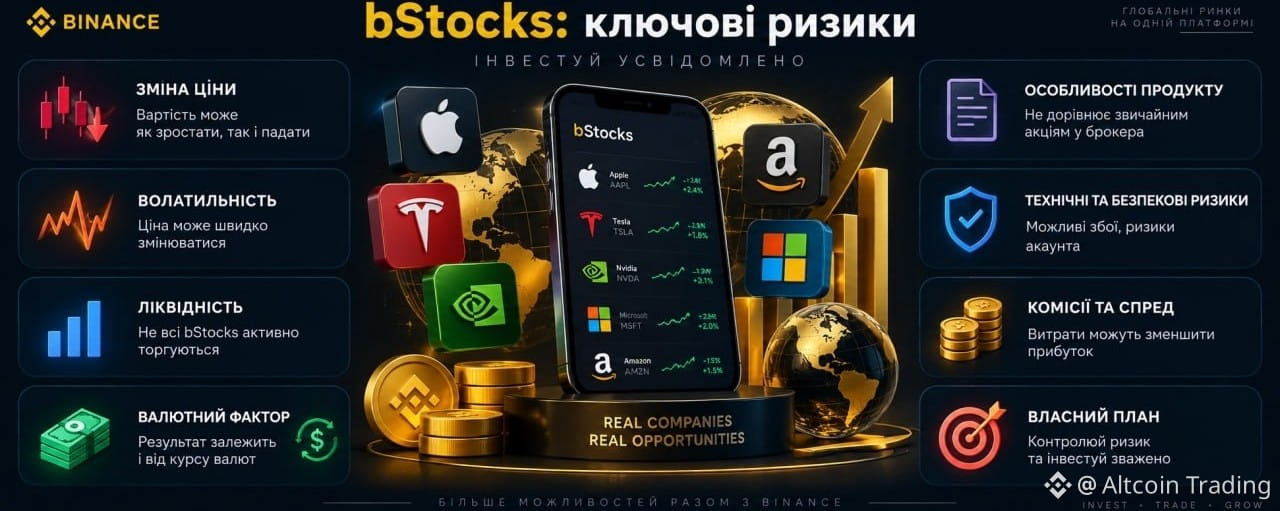
Article
Key Risks and Important Aspects of Trading bStocksTrading bStocks on
may be convenient for those who want access to assets related to the traditional stock market through a cryptocurrency platform. However, like any trading, it involves risks. It's important to understand that the price of bStocks can change depending on conditions in the relevant market, news, demand, and supply.
Key Risks and Important Aspects of Trading bStocks
Trading bStocks on
may be convenient for those who want access to assets related to the traditional stock market through a cryptocurrency platform. However, like any trading, it involves risks. It's important to understand that the price of bStocks can change depending on conditions in the relevant market, news, demand, and supply.
may be convenient for those who want access to assets related to the traditional stock market through a cryptocurrency platform. However, like any trading, it involves risks. It's important to understand that the price of bStocks can change depending on conditions in the relevant market, news, demand, and supply.
1
404
Log in to explore more content
Join global crypto users on Binance Square
⚡️ Get latest and useful information about crypto.
💬 Trusted by the world’s largest crypto exchange.
👍 Discover real insights from verified creators.
Email / Phone number
Trending Topics
1
#CircleMints500MUSDCOnSolana
78,043 views
1,802 Discussing
2
#PolymarketBankFailureBetsDrawFDICConcern
84,072 views
1,679 Discussing
3
#BlackRockBuildsTokenizedPortfoliosForOndo
74,548 views
1,193 Discussing
4
#BitwiseFilesToListNEARETFOnNYSEArca
62,602 views
977 Discussing
5
#SECCommissionerPeirceToLeaveOct2
61,073 views
795 Discussing
6
#SECSaysBuybacksUpgradesDontMakeTokenSecurity
50,691 views
596 Discussing
7
#StrategyProposesDailyDividendsForPreferreds
11,035 views
218 Discussing
8
#CircleTetherFreezeBitgetHackerWallet
12,459 views
133 Discussing
9
#CoinMarketCapCompletesCoinglassAcquisition
12,564 views
168 Discussing
10
#QNTRises39%
112,266 views
1,667 Discussing