
#bstockscis
bstockscis
326,107 views
9,196 Discussing
Hot
Latest

·
--
I never thought you could put a grid-bot on an event like you would with an altcoin. 🤖
I happened to notice while browsing the bots section on Binance that among the available pairs there’s not just crypto, but also $NVDAB. At first I thought it was some kind of mistake.
Turns out—no. Since bStock is traded like a regular spot pair, the same tools work on it: a DCA bot, a grid bot, everything that used to be applied only to BTC or ETH.
I set a small grid on NVDAB just to test the mechanics—I defined a price range and the number of grids, and the bot started buying on dips and selling on rebounds even though I didn’t open the app at all.
What’s most interesting is that the grid runs 24/7, just like bStock itself. On a regular stock, something like this simply wouldn’t happen: a bot on TSLA through a broker would “sleep” about nineteen hours a day, waiting for the market to open. Here it doesn’t sleep at all.
Earlier, I saw algo-bots as purely a crypto toy. Now I understand it’s the same kind of tool for stocks too—just that not many people think to try.
Have you ever set a bot on something that initially looked completely “non-crypto”?
@Binance_Ukraine #bStocksCIS
I never thought you could put a grid-bot on an event like you would with an altcoin. 🤖
I happened to notice while browsing the bots section on Binance that among the available pairs there’s not just crypto, but also $NVDAB. At first I thought it was some kind of mistake.
Turns out—no. Since bStock is traded like a regular spot pair, the same tools work on it: a DCA bot, a grid bot, everything that used to be applied only to BTC or ETH.
I set a small grid on NVDAB just to test the mechanics—I defined a price range and the number of grids, and the bot started buying on dips and selling on rebounds even though I didn’t open the app at all.
What’s most interesting is that the grid runs 24/7, just like bStock itself. On a regular stock, something like this simply wouldn’t happen: a bot on TSLA through a broker would “sleep” about nineteen hours a day, waiting for the market to open. Here it doesn’t sleep at all.
Earlier, I saw algo-bots as purely a crypto toy. Now I understand it’s the same kind of tool for stocks too—just that not many people think to try.
Have you ever set a bot on something that initially looked completely “non-crypto”?
@Binance_Ukraine #bStocksCIS
I happened to notice while browsing the bots section on Binance that among the available pairs there’s not just crypto, but also $NVDAB. At first I thought it was some kind of mistake.
Turns out—no. Since bStock is traded like a regular spot pair, the same tools work on it: a DCA bot, a grid bot, everything that used to be applied only to BTC or ETH.
I set a small grid on NVDAB just to test the mechanics—I defined a price range and the number of grids, and the bot started buying on dips and selling on rebounds even though I didn’t open the app at all.
What’s most interesting is that the grid runs 24/7, just like bStock itself. On a regular stock, something like this simply wouldn’t happen: a bot on TSLA through a broker would “sleep” about nineteen hours a day, waiting for the market to open. Here it doesn’t sleep at all.
Earlier, I saw algo-bots as purely a crypto toy. Now I understand it’s the same kind of tool for stocks too—just that not many people think to try.
Have you ever set a bot on something that initially looked completely “non-crypto”?
@Binance_Ukraine #bStocksCIS

76

·
--
Earlier, I thought that if a stock doesn’t pay dividends, it simply means less profit for shareholders—and that’s that. For a long time, Google (Alphabet) was an example for me of such a company: growth is there, but there are no regular payouts.
But after looking a bit deeper, I realized that this is an oversimplification. Instead of dividends, Alphabet for years has been running a large-scale buyback—repurchasing its own shares from the market and removing them from circulation. Money doesn’t come directly into shareholders’ accounts, but each share that remains in circulation represents a slightly larger slice of the company than before.
This is especially interesting to look at through $GOOGLB. The token simply reflects the price of GOOGL—and if buybacks support the price from below by reducing the supply of shares in the market, it has the same effect on bStock, even though there are essentially no dividend accruals here via the Multiplier—only the price movement itself.
Earlier, I used to divide bStocks into “dividend” and “non-dividend,” as if they were two different asset types. Now I see that a non-dividend company is simply returning value to shareholders in another way—less visible, but no less real.
I still haven’t figured out which method is more beneficial from the standpoint of taxes and long-term returns—buybacks or direct payments. I want to compare them🤔.
@Binance_Ukraine $GOOGLB #bStocksCIS
Earlier, I thought that if a stock doesn’t pay dividends, it simply means less profit for shareholders—and that’s that. For a long time, Google (Alphabet) was an example for me of such a company: growth is there, but there are no regular payouts.
But after looking a bit deeper, I realized that this is an oversimplification. Instead of dividends, Alphabet for years has been running a large-scale buyback—repurchasing its own shares from the market and removing them from circulation. Money doesn’t come directly into shareholders’ accounts, but each share that remains in circulation represents a slightly larger slice of the company than before.
This is especially interesting to look at through $GOOGLB . The token simply reflects the price of GOOGL—and if buybacks support the price from below by reducing the supply of shares in the market, it has the same effect on bStock, even though there are essentially no dividend accruals here via the Multiplier—only the price movement itself.
Earlier, I used to divide bStocks into “dividend” and “non-dividend,” as if they were two different asset types. Now I see that a non-dividend company is simply returning value to shareholders in another way—less visible, but no less real.
I still haven’t figured out which method is more beneficial from the standpoint of taxes and long-term returns—buybacks or direct payments. I want to compare them🤔.
@Binance_Ukraine $GOOGLB #bStocksCIS
But after looking a bit deeper, I realized that this is an oversimplification. Instead of dividends, Alphabet for years has been running a large-scale buyback—repurchasing its own shares from the market and removing them from circulation. Money doesn’t come directly into shareholders’ accounts, but each share that remains in circulation represents a slightly larger slice of the company than before.
This is especially interesting to look at through $GOOGLB . The token simply reflects the price of GOOGL—and if buybacks support the price from below by reducing the supply of shares in the market, it has the same effect on bStock, even though there are essentially no dividend accruals here via the Multiplier—only the price movement itself.
Earlier, I used to divide bStocks into “dividend” and “non-dividend,” as if they were two different asset types. Now I see that a non-dividend company is simply returning value to shareholders in another way—less visible, but no less real.
I still haven’t figured out which method is more beneficial from the standpoint of taxes and long-term returns—buybacks or direct payments. I want to compare them🤔.
@Binance_Ukraine $GOOGLB #bStocksCIS

116
·
--
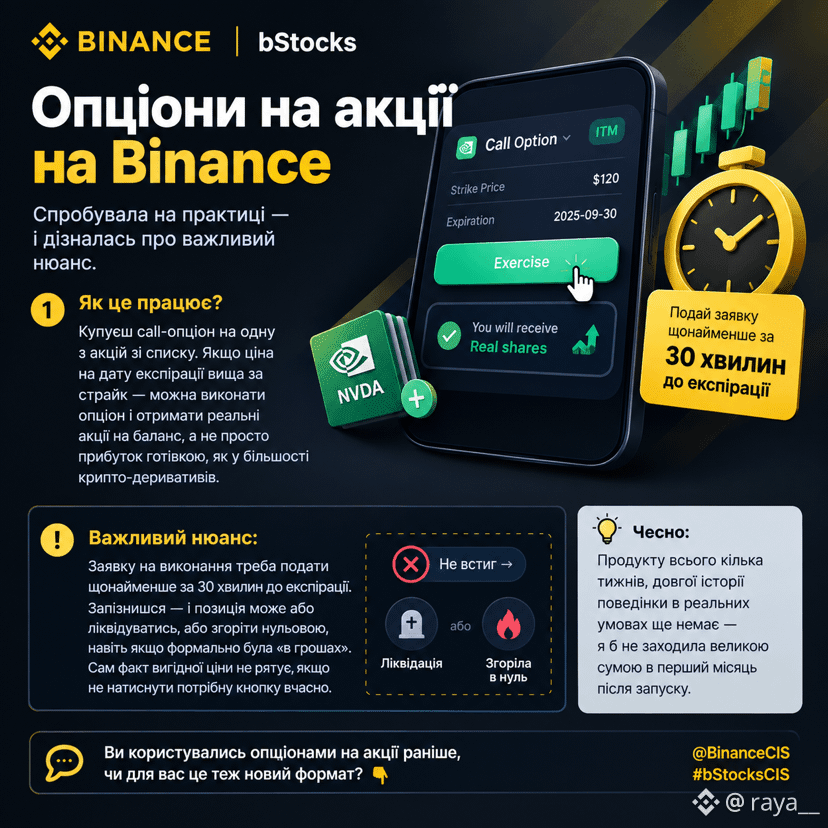
I opened the app and saw a new section—Options on stocks. First thought: yet another way to play volatility, like the usual perps?🙄🤔
I dug into it—this is something else. It launched on September 1st; the main feature is physical settlement: when you exercise, you don’t receive a cash difference—instead, you get the actual shares or an ETF held in custody with Alpaca. Available on 1,000+ stocks and ETFs, with fees mostly paid in USDC.
I tried an example: I bought a call option on one of the stocks. If the price on the expiration date is higher than the strike, you exercise and receive real shares in your balance—not just cash profit like most crypto derivatives.
I found a nuance that’s easy to miss: you have to submit the exercise request 30 minutes before expiration. If you’re late, the position expires to zero, even if it was “in the money” by definition. A good price won’t save you if you don’t hit the button on time.
Honestly: the product is only a few weeks old, so there’s no long track record of how it behaves yet—I wouldn’t enter with a large amount in the first month.
Have you used stock options before, or is this new format for you too? 👇
@Binance_Ukraine #bStocksCIS
I opened the app and saw a new section—Options on stocks. First thought: yet another way to play volatility, like the usual perps?🙄🤔
I dug into it—this is something else. It launched on September 1st; the main feature is physical settlement: when you exercise, you don’t receive a cash difference—instead, you get the actual shares or an ETF held in custody with Alpaca. Available on 1,000+ stocks and ETFs, with fees mostly paid in USDC.
I tried an example: I bought a call option on one of the stocks. If the price on the expiration date is higher than the strike, you exercise and receive real shares in your balance—not just cash profit like most crypto derivatives.
I found a nuance that’s easy to miss: you have to submit the exercise request 30 minutes before expiration. If you’re late, the position expires to zero, even if it was “in the money” by definition. A good price won’t save you if you don’t hit the button on time.
Honestly: the product is only a few weeks old, so there’s no long track record of how it behaves yet—I wouldn’t enter with a large amount in the first month.
Have you used stock options before, or is this new format for you too? 👇
@Binance_Ukraine #bStocksCIS
I dug into it—this is something else. It launched on September 1st; the main feature is physical settlement: when you exercise, you don’t receive a cash difference—instead, you get the actual shares or an ETF held in custody with Alpaca. Available on 1,000+ stocks and ETFs, with fees mostly paid in USDC.
I tried an example: I bought a call option on one of the stocks. If the price on the expiration date is higher than the strike, you exercise and receive real shares in your balance—not just cash profit like most crypto derivatives.
I found a nuance that’s easy to miss: you have to submit the exercise request 30 minutes before expiration. If you’re late, the position expires to zero, even if it was “in the money” by definition. A good price won’t save you if you don’t hit the button on time.
Honestly: the product is only a few weeks old, so there’s no long track record of how it behaves yet—I wouldn’t enter with a large amount in the first month.
Have you used stock options before, or is this new format for you too? 👇
@Binance_Ukraine #bStocksCIS
144

$SPCXB 154.09 +1.09% · The onshore Niu stocks are not on the same schedule
Tokenized US stocks are not on the same schedule as the spot market. Which is most likely to turn “it looks like it’s going up” into a misreading—time-zone differences, liquidity, or the cadence of information disclosure? Based on the judgment framework from BinanceCIS · bStocks CreatorPad (for learning purposes).
For discussion: which do you think is more likely to cause a misreading—time-zone differences or liquidity?
Discussion only; not investment advice.
Follow $SPCXB
@BinanceCIS #bStocksCIS $SPCXB
$SPCXB 154.09 +1.09% · The onshore Niu stocks are not on the same schedule
Tokenized US stocks are not on the same schedule as the spot market. Which is most likely to turn “it looks like it’s going up” into a misreading—time-zone differences, liquidity, or the cadence of information disclosure? Based on the judgment framework from BinanceCIS · bStocks CreatorPad (for learning purposes).
For discussion: which do you think is more likely to cause a misreading—time-zone differences or liquidity?
Discussion only; not investment advice.
Follow $SPCXB
@BinanceCIS #bStocksCIS $SPCXB
Tokenized US stocks are not on the same schedule as the spot market. Which is most likely to turn “it looks like it’s going up” into a misreading—time-zone differences, liquidity, or the cadence of information disclosure? Based on the judgment framework from BinanceCIS · bStocks CreatorPad (for learning purposes).
For discussion: which do you think is more likely to cause a misreading—time-zone differences or liquidity?
Discussion only; not investment advice.
Follow $SPCXB
@BinanceCIS #bStocksCIS $SPCXB
83

Hello everyone! 👋 Have you ever wondered how blockchain is changing familiar investing? Trading tokenized stocks through bStocks on Binance is a great example of how real financial instruments are entering the crypto world. Personally, I’m really drawn to this idea of blurring the lines between traditional markets and Web3. So what do you think about the future of bStocks? Let’s trade wisely and take part in a cool campaign from @BinanceCIS #bStocksCIS
Hello everyone! 👋 Have you ever wondered how blockchain is changing familiar investing? Trading tokenized stocks through bStocks on Binance is a great example of how real financial instruments are entering the crypto world. Personally, I’m really drawn to this idea of blurring the lines between traditional markets and Web3. So what do you think about the future of bStocks? Let’s trade wisely and take part in a cool campaign from @BinanceCIS #bStocksCIS
65
$SPCXB 152.33 -0.14% · Tokenized U.S. stock certificates, not spot Bitcoin
$SPCXB maps traditional U.S. stock exposure into on-chain certificates. When describing it, use three sentences: what it is, what categories of risk to discuss, and why it matters in this activity.
If you can only explain it to a friend in one minute, do you start with the mechanism or the risks?
Follow $SPCXB
@BinanceCIS #bStocksCIS $SPCXB
$SPCXB 152.33 -0.14% · Tokenized U.S. stock certificates, not spot Bitcoin
$SPCXB maps traditional U.S. stock exposure into on-chain certificates. When describing it, use three sentences: what it is, what categories of risk to discuss, and why it matters in this activity.
If you can only explain it to a friend in one minute, do you start with the mechanism or the risks?
Follow $SPCXB
@BinanceCIS #bStocksCIS $SPCXB
$SPCXB maps traditional U.S. stock exposure into on-chain certificates. When describing it, use three sentences: what it is, what categories of risk to discuss, and why it matters in this activity.
If you can only explain it to a friend in one minute, do you start with the mechanism or the risks?
Follow $SPCXB
@BinanceCIS #bStocksCIS $SPCXB
86

·
--
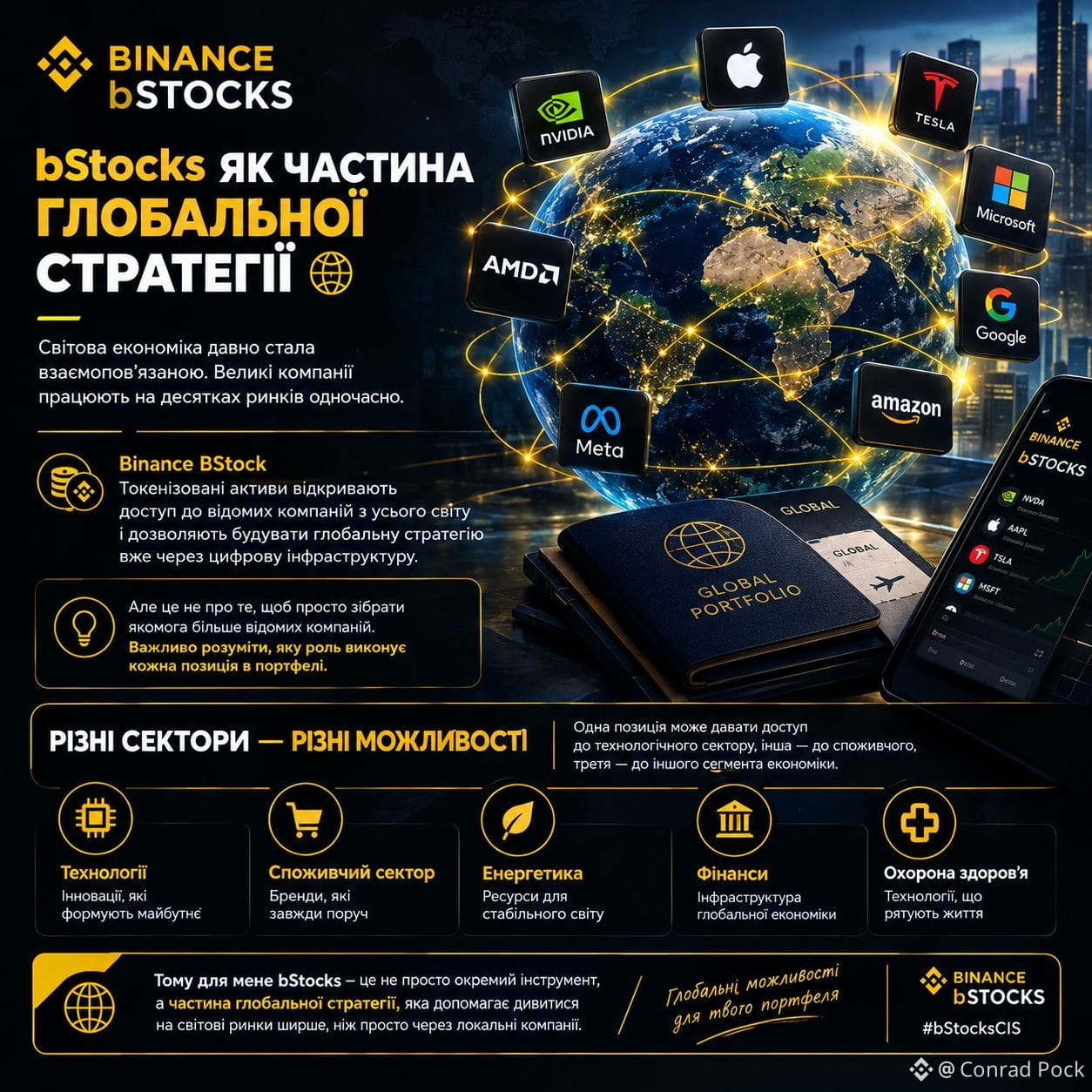
🪙 Stocks as part of a global strategy
🌍 I’m interested in having in my portfolio access not only to the local market
When I think about a long-term strategy, I don’t want to limit myself to companies that operate only in one region.
The global economy has long become interconnected.
Technology, consumer goods, energy, finance — large companies can operate across dozens of markets at once.
That’s why I pay attention to Binance BStock.
For me, its appeal is that tokenized assets can be viewed as a separate part of a global portfolio approach.
But I wouldn’t set out to just collect as many well-known companies as possible.
It’s more important to understand what role each position serves.
📊 One can provide access to the technology sector, another to consumer goods, and the third to another segment of the economy.
That way, the portfolio becomes not a set of names, but a thoughtfully designed structure.
#bStocksCIS @BinanceCIS $NVDAB
🪙 Stocks as part of a global strategy
🌍 I’m interested in having in my portfolio access not only to the local market
When I think about a long-term strategy, I don’t want to limit myself to companies that operate only in one region.
The global economy has long become interconnected.
Technology, consumer goods, energy, finance — large companies can operate across dozens of markets at once.
That’s why I pay attention to Binance BStock.
For me, its appeal is that tokenized assets can be viewed as a separate part of a global portfolio approach.
But I wouldn’t set out to just collect as many well-known companies as possible.
It’s more important to understand what role each position serves.
📊 One can provide access to the technology sector, another to consumer goods, and the third to another segment of the economy.
That way, the portfolio becomes not a set of names, but a thoughtfully designed structure.
#bStocksCIS @BinanceCIS $NVDAB
🌍 I’m interested in having in my portfolio access not only to the local market
When I think about a long-term strategy, I don’t want to limit myself to companies that operate only in one region.
The global economy has long become interconnected.
Technology, consumer goods, energy, finance — large companies can operate across dozens of markets at once.
That’s why I pay attention to Binance BStock.
For me, its appeal is that tokenized assets can be viewed as a separate part of a global portfolio approach.
But I wouldn’t set out to just collect as many well-known companies as possible.
It’s more important to understand what role each position serves.
📊 One can provide access to the technology sector, another to consumer goods, and the third to another segment of the economy.
That way, the portfolio becomes not a set of names, but a thoughtfully designed structure.
#bStocksCIS @BinanceCIS $NVDAB
1
112
$SPCXB 152.41 -1.45% · Tradable and compliant packaging, not a lottery-ticket get-rich plot
We only go deep on one thread: $SPCXB is discussing “tradable and compliant packaging,” not a story about getting rich overnight. Topic: tokenized US stocks / bStocks.
Do you care more about the compliance route or the trading experience?
Follow $SPCXB
@BinanceCIS #bStocksCIS $SPCXB
$SPCXB 152.41 -1.45% · Tradable and compliant packaging, not a lottery-ticket get-rich plot
We only go deep on one thread: $SPCXB is discussing “tradable and compliant packaging,” not a story about getting rich overnight. Topic: tokenized US stocks / bStocks.
Do you care more about the compliance route or the trading experience?
Follow $SPCXB
@BinanceCIS #bStocksCIS $SPCXB
We only go deep on one thread: $SPCXB is discussing “tradable and compliant packaging,” not a story about getting rich overnight. Topic: tokenized US stocks / bStocks.
Do you care more about the compliance route or the trading experience?
Follow $SPCXB
@BinanceCIS #bStocksCIS $SPCXB
93
$SPCXB 143.99 -3.25% · Appears in this campaign because the prompt is tokenized US stocks
The prompt of this campaign is tokenized US stocks / bStocks, so the body focuses on the mechanism behind $SPCXB , rather than just pasting a coin name at the end to make it feel relevant.
Do you think “relevant” should be written in the mechanism, or in the tag?
Follow $SPCXB
@BinanceCIS #bStocksCIS $SPCXB
$SPCXB 143.99 -3.25% · Appears in this campaign because the prompt is tokenized US stocks
The prompt of this campaign is tokenized US stocks / bStocks, so the body focuses on the mechanism behind $SPCXB , rather than just pasting a coin name at the end to make it feel relevant.
Do you think “relevant” should be written in the mechanism, or in the tag?
Follow $SPCXB
@BinanceCIS #bStocksCIS $SPCXB
The prompt of this campaign is tokenized US stocks / bStocks, so the body focuses on the mechanism behind $SPCXB , rather than just pasting a coin name at the end to make it feel relevant.
Do you think “relevant” should be written in the mechanism, or in the tag?
Follow $SPCXB
@BinanceCIS #bStocksCIS $SPCXB
92
$SPCXB 148.81 -0.99% · The WIN and Niu stocks aren’t on the same clock
Tokenized US stocks and spot trading aren’t on the same schedule. Which is most likely to turn “looks like it’s going up” into a misread? Use the assessment framework from BinanceCIS · bStocks CreatorPad (educational content).
Between time difference and liquidity, which do you think is more likely to cause a misread?
Discussion only; not investment advice.
Follow $SPCXB
@BinanceCIS #bStocksCIS $SPCXB
$SPCXB 148.81 -0.99% · The WIN and Niu stocks aren’t on the same clock
Tokenized US stocks and spot trading aren’t on the same schedule. Which is most likely to turn “looks like it’s going up” into a misread? Use the assessment framework from BinanceCIS · bStocks CreatorPad (educational content).
Between time difference and liquidity, which do you think is more likely to cause a misread?
Discussion only; not investment advice.
Follow $SPCXB
@BinanceCIS #bStocksCIS $SPCXB
Tokenized US stocks and spot trading aren’t on the same schedule. Which is most likely to turn “looks like it’s going up” into a misread? Use the assessment framework from BinanceCIS · bStocks CreatorPad (educational content).
Between time difference and liquidity, which do you think is more likely to cause a misread?
Discussion only; not investment advice.
Follow $SPCXB
@BinanceCIS #bStocksCIS $SPCXB
111
$SPCXB 150.28 +0.07% · Tokenized U.S. stock certificates, not spot Bitcoin
$SPCXB maps traditional U.S. stock exposure into on-chain certificates. When writing it, use three sentences to make it clear: what it is, what types of risks it discusses, and why it matters in this activity.
If you only had one minute to explain it to a friend, would you start with the mechanism or the risks?
Follow $SPCXB
@BinanceCIS #bStocksCIS $SPCXB
$SPCXB 150.28 +0.07% · Tokenized U.S. stock certificates, not spot Bitcoin
$SPCXB maps traditional U.S. stock exposure into on-chain certificates. When writing it, use three sentences to make it clear: what it is, what types of risks it discusses, and why it matters in this activity.
If you only had one minute to explain it to a friend, would you start with the mechanism or the risks?
Follow $SPCXB
@BinanceCIS #bStocksCIS $SPCXB
$SPCXB maps traditional U.S. stock exposure into on-chain certificates. When writing it, use three sentences to make it clear: what it is, what types of risks it discusses, and why it matters in this activity.
If you only had one minute to explain it to a friend, would you start with the mechanism or the risks?
Follow $SPCXB
@BinanceCIS #bStocksCIS $SPCXB
99

At first, I treated bStocks simply as another way to buy exposure to well-known companies. But the more I use this format, the more I see it as a tool for building a portfolio.
I like the ability to start with a small amount—say, $5—and not make decisions right away with all the capital. You can test the idea, look at the asset, liquidity, and your own attitude toward the position, and only then increase it.
For me, it’s an interesting bridge between the familiar crypto interface and traditional assets. At the same time, it’s important to remember: bStocks don’t mean direct ownership of shares and don’t grant the usual shareholder rights.
I think of bStocks more like a constructor: several small positions, different sectors, and the gradual formation of a portfolio.
Would you use a fractional format to test an investment idea with a small amount first?
@BinanceCIS #bStocksCIS
At first, I treated bStocks simply as another way to buy exposure to well-known companies. But the more I use this format, the more I see it as a tool for building a portfolio.
I like the ability to start with a small amount—say, $5—and not make decisions right away with all the capital. You can test the idea, look at the asset, liquidity, and your own attitude toward the position, and only then increase it.
For me, it’s an interesting bridge between the familiar crypto interface and traditional assets. At the same time, it’s important to remember: bStocks don’t mean direct ownership of shares and don’t grant the usual shareholder rights.
I think of bStocks more like a constructor: several small positions, different sectors, and the gradual formation of a portfolio.
Would you use a fractional format to test an investment idea with a small amount first?
@BinanceCIS #bStocksCIS
I like the ability to start with a small amount—say, $5—and not make decisions right away with all the capital. You can test the idea, look at the asset, liquidity, and your own attitude toward the position, and only then increase it.
For me, it’s an interesting bridge between the familiar crypto interface and traditional assets. At the same time, it’s important to remember: bStocks don’t mean direct ownership of shares and don’t grant the usual shareholder rights.
I think of bStocks more like a constructor: several small positions, different sectors, and the gradual formation of a portfolio.
Would you use a fractional format to test an investment idea with a small amount first?
@BinanceCIS #bStocksCIS
1
2
382

·
--
bStocks are gradually becoming more interesting precisely due to the expanded range of options.
At first, attention was mostly focused on large technology companies, but with the emergence of new assets, ETFs, and companies from different sectors, opportunities have become much broader.
For me, the main advantage is that users get access to different directions through a single ecosystem. The more assets that will be added, the more interesting it will be to follow the development of bStocks.
What do you think—which asset should be added next?
@BinanceCIS #bStocksCIS
bStocks are gradually becoming more interesting precisely due to the expanded range of options.
At first, attention was mostly focused on large technology companies, but with the emergence of new assets, ETFs, and companies from different sectors, opportunities have become much broader.
For me, the main advantage is that users get access to different directions through a single ecosystem. The more assets that will be added, the more interesting it will be to follow the development of bStocks.
What do you think—which asset should be added next?
@BinanceCIS #bStocksCIS
At first, attention was mostly focused on large technology companies, but with the emergence of new assets, ETFs, and companies from different sectors, opportunities have become much broader.
For me, the main advantage is that users get access to different directions through a single ecosystem. The more assets that will be added, the more interesting it will be to follow the development of bStocks.
What do you think—which asset should be added next?
@BinanceCIS #bStocksCIS
109
$SPCXB 150.20 +1.60% · It’s a tradable compliant wrapper, not a get-rich-quick target
We only dig into one thing: $SPCXB is discussing a “tradable compliant wrapper,” not a one-night fortune story. Topic: tokenized US stocks / bStocks.
What do you care more about—the compliance pathway or the trading experience?
Follow $SPCXB
@BinanceCIS #bStocksCIS $SPCXB
$SPCXB 150.20 +1.60% · It’s a tradable compliant wrapper, not a get-rich-quick target
We only dig into one thing: $SPCXB is discussing a “tradable compliant wrapper,” not a one-night fortune story. Topic: tokenized US stocks / bStocks.
What do you care more about—the compliance pathway or the trading experience?
Follow $SPCXB
@BinanceCIS #bStocksCIS $SPCXB
We only dig into one thing: $SPCXB is discussing a “tradable compliant wrapper,” not a one-night fortune story. Topic: tokenized US stocks / bStocks.
What do you care more about—the compliance pathway or the trading experience?
Follow $SPCXB
@BinanceCIS #bStocksCIS $SPCXB
1
90

·
--
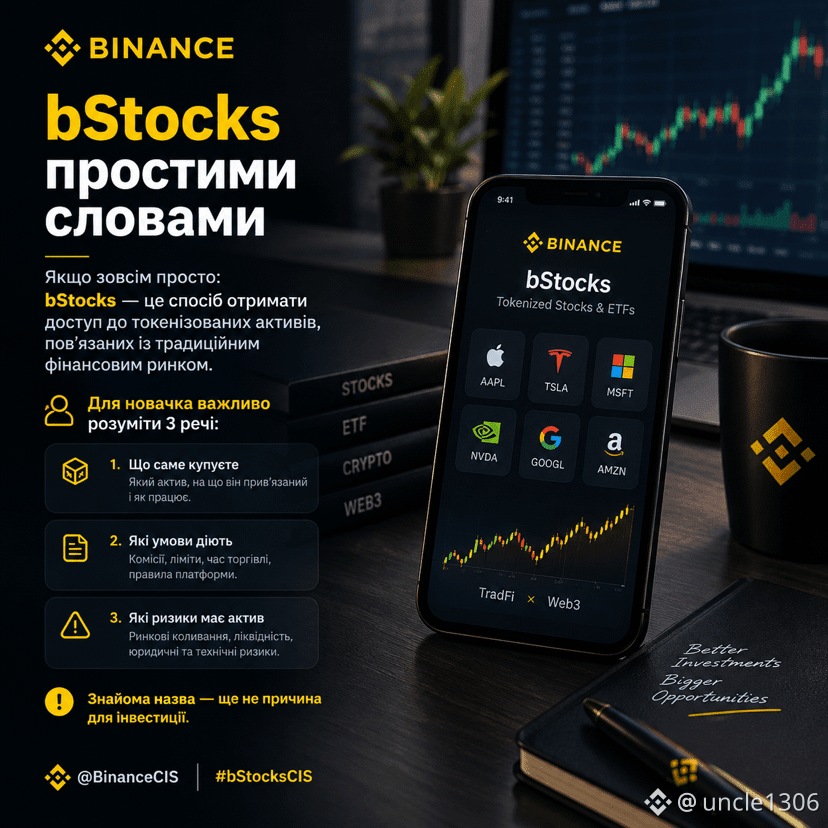
If simply put: bStocks is a way to gain access to tokenized assets linked to the traditional financial market.
For a beginner, it’s important to understand 3 things: what exactly you are buying, what terms apply, and what risks the asset has. A familiar name is not a reason to invest. @Binance_Ukraine #bStocksCIS
If simply put: bStocks is a way to gain access to tokenized assets linked to the traditional financial market.
For a beginner, it’s important to understand 3 things: what exactly you are buying, what terms apply, and what risks the asset has. A familiar name is not a reason to invest. @Binance_Ukraine #bStocksCIS
For a beginner, it’s important to understand 3 things: what exactly you are buying, what terms apply, and what risks the asset has. A familiar name is not a reason to invest. @Binance_Ukraine #bStocksCIS
2
1
430
$SPCXB 153.16 +2.28% · It appears in this event because the topic is tokenized US stocks
The topic of this event is tokenized US stocks / bStocks, so the main text is written around the mechanism of $SPCXB —not by putting a coin name at the end just to make it feel related.
Do you think “related” should be written in the mechanism, or in the tags?
Follow $SPCXB
@BinanceCIS #bStocksCIS $SPCXB
$SPCXB 153.16 +2.28% · It appears in this event because the topic is tokenized US stocks
The topic of this event is tokenized US stocks / bStocks, so the main text is written around the mechanism of $SPCXB —not by putting a coin name at the end just to make it feel related.
Do you think “related” should be written in the mechanism, or in the tags?
Follow $SPCXB
@BinanceCIS #bStocksCIS $SPCXB
The topic of this event is tokenized US stocks / bStocks, so the main text is written around the mechanism of $SPCXB —not by putting a coin name at the end just to make it feel related.
Do you think “related” should be written in the mechanism, or in the tags?
Follow $SPCXB
@BinanceCIS #bStocksCIS $SPCXB
124

If I have $500 on Binance, I see 3 different scenarios.
And the question is not which product is “better,” but what these funds are meant to accomplish.
1. Binance Earn
If I don’t need the money yet → I can earn potential returns. Here, APR, terms, limits, and liquidity matter.
2. TradFi
I want exposure to traditional financial assets → my result depends on the movement of the asset itself, not on a fixed APR.
3. bStocks
I want exposure to stocks through a tokenized instrument. Binance describes bStocks as tokenized securities, backed 1:1 by the corresponding shares and available for trading 24/7.
But it’s important: bStock ≠ the stock itself and does not provide direct ownership rights to it.
So I’d look at it like this:
Earn → returns + liquidity
TradFi → traditional assets
bStocks → stock exposure through crypto infrastructure
So instead of asking “where is the higher percentage?” I would ask:
“What job do I want these $500 to do?”
That answer is what determines the choice.
#bstockscis
If I have $500 on Binance, I see 3 different scenarios.
And the question is not which product is “better,” but what these funds are meant to accomplish.
1. Binance Earn
If I don’t need the money yet → I can earn potential returns. Here, APR, terms, limits, and liquidity matter.
2. TradFi
I want exposure to traditional financial assets → my result depends on the movement of the asset itself, not on a fixed APR.
3. bStocks
I want exposure to stocks through a tokenized instrument. Binance describes bStocks as tokenized securities, backed 1:1 by the corresponding shares and available for trading 24/7.
But it’s important: bStock ≠ the stock itself and does not provide direct ownership rights to it.
So I’d look at it like this:
Earn → returns + liquidity
TradFi → traditional assets
bStocks → stock exposure through crypto infrastructure
So instead of asking “where is the higher percentage?” I would ask:
“What job do I want these $500 to do?”
That answer is what determines the choice.
#bstockscis
And the question is not which product is “better,” but what these funds are meant to accomplish.
1. Binance Earn
If I don’t need the money yet → I can earn potential returns. Here, APR, terms, limits, and liquidity matter.
2. TradFi
I want exposure to traditional financial assets → my result depends on the movement of the asset itself, not on a fixed APR.
3. bStocks
I want exposure to stocks through a tokenized instrument. Binance describes bStocks as tokenized securities, backed 1:1 by the corresponding shares and available for trading 24/7.
But it’s important: bStock ≠ the stock itself and does not provide direct ownership rights to it.
So I’d look at it like this:
Earn → returns + liquidity
TradFi → traditional assets
bStocks → stock exposure through crypto infrastructure
So instead of asking “where is the higher percentage?” I would ask:
“What job do I want these $500 to do?”
That answer is what determines the choice.
#bstockscis

2
208

·
--
#bstockscis @BinanceCIS
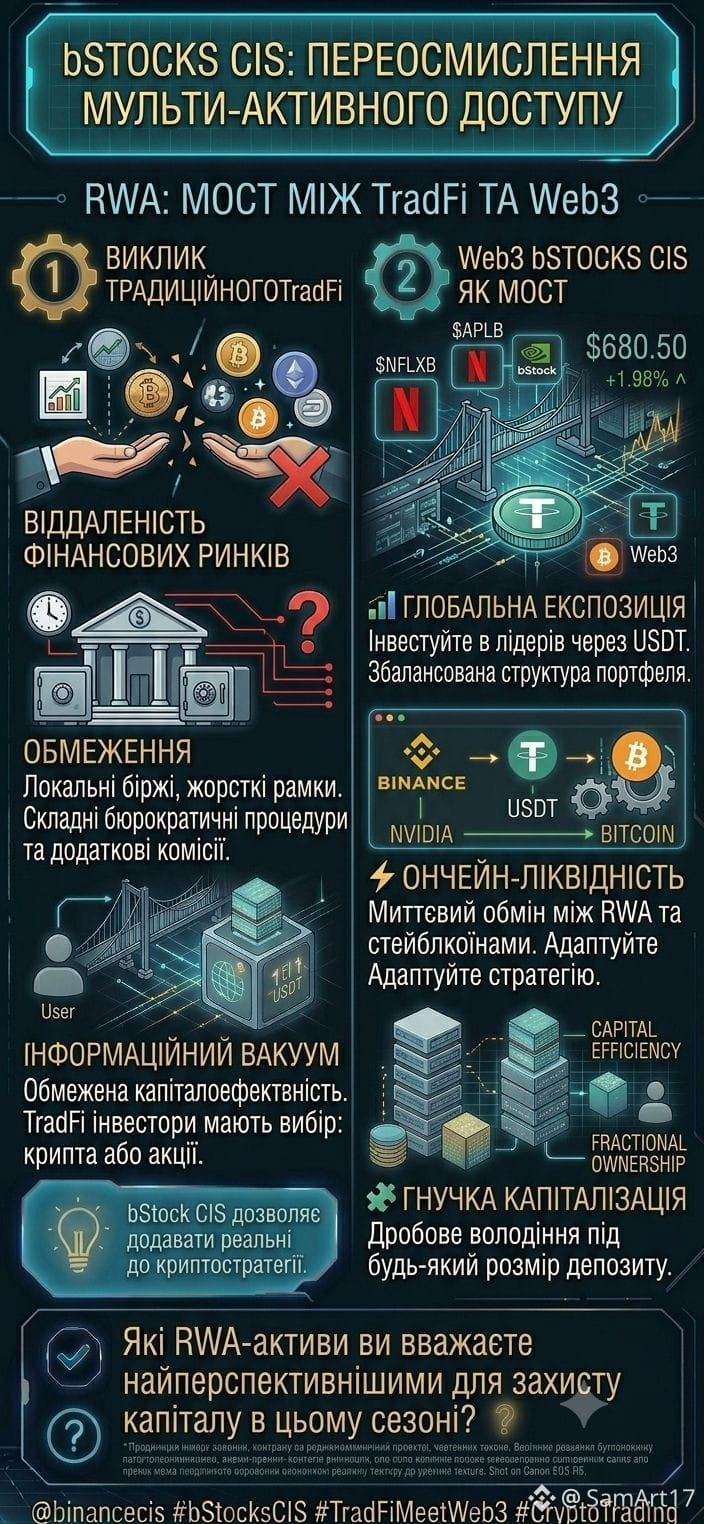
Deleveraging and effective risk management are the foundation of successful trading. However, most traditional investors are limited by rigid frameworks of local exchanges, where access to the global technology sector is often accompanied by complex bureaucratic procedures and additional fees.
Tokenized bStocks on the BNB Chain expand horizons for the Web3 community, offering direct access to the shares of global leaders:
📊 Global exposure: Invest in $NFLXB , $AAPLB , or $AMZNB directly through USDT, supporting a balanced portfolio structure.
⚡ On-chain liquidity: Instant swapping between RWA tokens and stablecoins lets you adapt your strategy to new market conditions within seconds.
🧩 Flexible capitalization: Fractional ownership makes it possible to precisely size a position for any deposit amount.
This is a new level of freedom for traders—combining the stability of the fundamental market with the speed and technology of decentralized finance.
Which RWA assets do you consider the most promising for protecting your capital this season?
#bstockscis @BinanceCIS
Deleveraging and effective risk management are the foundation of successful trading. However, most traditional investors are limited by rigid frameworks of local exchanges, where access to the global technology sector is often accompanied by complex bureaucratic procedures and additional fees.
Tokenized bStocks on the BNB Chain expand horizons for the Web3 community, offering direct access to the shares of global leaders:
📊 Global exposure: Invest in $NFLXB , $AAPLB , or $AMZNB directly through USDT, supporting a balanced portfolio structure.
⚡ On-chain liquidity: Instant swapping between RWA tokens and stablecoins lets you adapt your strategy to new market conditions within seconds.
🧩 Flexible capitalization: Fractional ownership makes it possible to precisely size a position for any deposit amount.
This is a new level of freedom for traders—combining the stability of the fundamental market with the speed and technology of decentralized finance.
Which RWA assets do you consider the most promising for protecting your capital this season?
Deleveraging and effective risk management are the foundation of successful trading. However, most traditional investors are limited by rigid frameworks of local exchanges, where access to the global technology sector is often accompanied by complex bureaucratic procedures and additional fees.
Tokenized bStocks on the BNB Chain expand horizons for the Web3 community, offering direct access to the shares of global leaders:
📊 Global exposure: Invest in $NFLXB , $AAPLB , or $AMZNB directly through USDT, supporting a balanced portfolio structure.
⚡ On-chain liquidity: Instant swapping between RWA tokens and stablecoins lets you adapt your strategy to new market conditions within seconds.
🧩 Flexible capitalization: Fractional ownership makes it possible to precisely size a position for any deposit amount.
This is a new level of freedom for traders—combining the stability of the fundamental market with the speed and technology of decentralized finance.
Which RWA assets do you consider the most promising for protecting your capital this season?
1
66

·
--
What interested me most in bStocks wasn’t the stock tokenization itself, but what happens with dividends. There is no regular cash payout to your balance. For example, when a company pays a dividend, its net amount is reinvested back into the same bStock—meaning the number of economic exposures gradually increases. Binance has already separately announced such distributions for Qualcomm, PayPal, Alphabet, Corning, and Goldman Sachs.
For me, this is an interesting point because bStocks go beyond just a simple return based on a stock price increase. Something closer to automated income reinvestment is being formed here, but in a tokenized format.
Even more interesting is that Binance allows you to convert bStocks and the underlying shares in both directions, and the product itself has already surpassed $100 million in AUM.
So I would assess bStocks not by the number of new tickers, but by how well this model works for long-term accumulation. That, in my opinion, is where the real product test will happen.
#bStocksCIS #Binance #RWA #TradFi #Investing
What interested me most in bStocks wasn’t the stock tokenization itself, but what happens with dividends. There is no regular cash payout to your balance. For example, when a company pays a dividend, its net amount is reinvested back into the same bStock—meaning the number of economic exposures gradually increases. Binance has already separately announced such distributions for Qualcomm, PayPal, Alphabet, Corning, and Goldman Sachs.
For me, this is an interesting point because bStocks go beyond just a simple return based on a stock price increase. Something closer to automated income reinvestment is being formed here, but in a tokenized format.
Even more interesting is that Binance allows you to convert bStocks and the underlying shares in both directions, and the product itself has already surpassed $100 million in AUM.
So I would assess bStocks not by the number of new tickers, but by how well this model works for long-term accumulation. That, in my opinion, is where the real product test will happen.
#bStocksCIS #Binance #RWA #TradFi #Investing
For me, this is an interesting point because bStocks go beyond just a simple return based on a stock price increase. Something closer to automated income reinvestment is being formed here, but in a tokenized format.
Even more interesting is that Binance allows you to convert bStocks and the underlying shares in both directions, and the product itself has already surpassed $100 million in AUM.
So I would assess bStocks not by the number of new tickers, but by how well this model works for long-term accumulation. That, in my opinion, is where the real product test will happen.
#bStocksCIS #Binance #RWA #TradFi #Investing

60
·
--
Recently, I’ve been looking at bStocks not just as “tokenized shares,” but as an experiment in how far it’s possible to blend TradFi and crypto. And the numbers here are interesting: bStocks were launched only in June 2026, and by September 2, Binance had already added four more instruments—CrowdStrike, Moderna, Seagate, and ProShares UltraPro Short QQQ. What’s more, they were integrated not only into Spot, but also into trading bots and Margin as collateral.
For me, this matters more than simply expanding the list of assets. bStocks are gradually turning into infrastructure where stocks gain crypto-like properties: 24/7 trading, transfers to a wallet, and use in an on-chain environment. At the same time, the backing is declared as 1:1 with real shares.
But there’s a crucial nuance: bStocks are not the shares themselves and do not grant voting rights or direct ownership of the company.
So, I see the main value of bStocks not in replacing the stock market, but in making it a part of the crypto ecosystem.
#bStocksCIS #Binance #RWA #TradFi #Crypto
Recently, I’ve been looking at bStocks not just as “tokenized shares,” but as an experiment in how far it’s possible to blend TradFi and crypto. And the numbers here are interesting: bStocks were launched only in June 2026, and by September 2, Binance had already added four more instruments—CrowdStrike, Moderna, Seagate, and ProShares UltraPro Short QQQ. What’s more, they were integrated not only into Spot, but also into trading bots and Margin as collateral.
For me, this matters more than simply expanding the list of assets. bStocks are gradually turning into infrastructure where stocks gain crypto-like properties: 24/7 trading, transfers to a wallet, and use in an on-chain environment. At the same time, the backing is declared as 1:1 with real shares.
But there’s a crucial nuance: bStocks are not the shares themselves and do not grant voting rights or direct ownership of the company.
So, I see the main value of bStocks not in replacing the stock market, but in making it a part of the crypto ecosystem.
#bStocksCIS #Binance #RWA #TradFi #Crypto
For me, this matters more than simply expanding the list of assets. bStocks are gradually turning into infrastructure where stocks gain crypto-like properties: 24/7 trading, transfers to a wallet, and use in an on-chain environment. At the same time, the backing is declared as 1:1 with real shares.
But there’s a crucial nuance: bStocks are not the shares themselves and do not grant voting rights or direct ownership of the company.
So, I see the main value of bStocks not in replacing the stock market, but in making it a part of the crypto ecosystem.
#bStocksCIS #Binance #RWA #TradFi #Crypto

108
Log in to explore more content
Join global crypto users on Binance Square
⚡️ Get latest and useful information about crypto.
💬 Trusted by the world’s largest crypto exchange.
👍 Discover real insights from verified creators.
Email / Phone number
Trending Topics
1
#AIStocksWhatNext
198,110 views
2,213 Discussing
2
#BitcoinBreaksAboveMayHighNears$86K
6,676 views
116 Discussing
3
#DogecoinRises15%
16,781 views
652 Discussing
4
#$14BBitcoinOptionsExpireFriday
1,008 views
57 Discussing
5
#BNBMarketCapPassesBNYMellon
10,764 views
478 Discussing
6
#CryptoMarketCapReclaims$3Trillion
1,488 views
51 Discussing
7
#MuseOvertakesChatGPTAsTopFreeIOSApp
8,387 views
400 Discussing
8
#TokenizedStockPlatformsCouldLaunchNextQuarter
12,716 views
450 Discussing
9
#StrategyAdds950Bitcoin
17,787 views
516 Discussing
10
#CardanoAddedToX402KitForADAPayments
19,960 views
575 Discussing