

#bitcoinetf
bitcoinetf
1.9M views
4,514 Discussing
Hot
Latest

🚨 BITCOIN HAS A BIGGER BATTLE THAN $90K. 👀
Bitcoin is facing a strange situation right now.
📈 Institutional demand is still strong.
U.S. spot Bitcoin ETFs recorded another $347M in net inflows on September 23, extending the inflow streak to five consecutive trading days.
But at the same time…
⚠️ Macro pressure is getting stronger.
The U.S. 10-year Treasury yield has climbed to its highest level since 2007, while BTC has slipped below $85K after failing to break the $87K area.
So the market is caught between two forces:
🏦 Institutional buying
vs.
📉 Rising yields & tighter liquidity
This is why the next BTC move could be important.
If ETF demand continues while macro pressure eases, buyers could regain control.
But if yields keep climbing, even strong ETF inflows may struggle to push Bitcoin higher.
The real battle isn't just BTC vs $90K.
It's institutional demand vs macro pressure. ⚔️
What are you watching more closely right now — ETF flows or Treasury yields? 👇
#bitcoin #BTC #Crypto #BitcoinETF #BinanceSquare
🚨 BITCOIN HAS A BIGGER BATTLE THAN $90K. 👀
Bitcoin is facing a strange situation right now.
📈 Institutional demand is still strong.
U.S. spot Bitcoin ETFs recorded another $347M in net inflows on September 23, extending the inflow streak to five consecutive trading days.
But at the same time…
⚠️ Macro pressure is getting stronger.
The U.S. 10-year Treasury yield has climbed to its highest level since 2007, while BTC has slipped below $85K after failing to break the $87K area.
So the market is caught between two forces:
🏦 Institutional buying
vs.
📉 Rising yields & tighter liquidity
This is why the next BTC move could be important.
If ETF demand continues while macro pressure eases, buyers could regain control.
But if yields keep climbing, even strong ETF inflows may struggle to push Bitcoin higher.
The real battle isn't just BTC vs $90K.
It's institutional demand vs macro pressure. ⚔️
What are you watching more closely right now — ETF flows or Treasury yields? 👇
#bitcoin #BTC #Crypto #BitcoinETF #BinanceSquare
Bitcoin is facing a strange situation right now.
📈 Institutional demand is still strong.
U.S. spot Bitcoin ETFs recorded another $347M in net inflows on September 23, extending the inflow streak to five consecutive trading days.
But at the same time…
⚠️ Macro pressure is getting stronger.
The U.S. 10-year Treasury yield has climbed to its highest level since 2007, while BTC has slipped below $85K after failing to break the $87K area.
So the market is caught between two forces:
🏦 Institutional buying
vs.
📉 Rising yields & tighter liquidity
This is why the next BTC move could be important.
If ETF demand continues while macro pressure eases, buyers could regain control.
But if yields keep climbing, even strong ETF inflows may struggle to push Bitcoin higher.
The real battle isn't just BTC vs $90K.
It's institutional demand vs macro pressure. ⚔️
What are you watching more closely right now — ETF flows or Treasury yields? 👇
#bitcoin #BTC #Crypto #BitcoinETF #BinanceSquare

77

·
--
🚀 Don't Let the Pullback Fool You—The Big Money is Accumulating! 💰Yes, BTC dipped under $84,000 today due to spiking macro bond yields. But look at what the institutions are doing behind the scenes:🌟 Nearly $1 BILLION poured into U.S. spot Bitcoin ETFs in a single day!While short-term leverage gets flushed out, institutional backing is setting a massive floor for this cycle. Weak hands sell, but smart money accumulates. Stay patient, focus on the big picture! 💎🙌Tagging my active pairs: BTC BNB#Crypto #BullMarket📈 et #BitcoinETF #USWeighsPromotingDollarStablecoinsAbroad #US10YTreasuryYieldHits19YearHigh #WallStreetEarningsRevisionsTurnBearish $BTC
{spot}(BTCUSDT)
$ETH
{spot}(ETHUSDT)
$BNB
{spot}(BNBUSDT)
🚀 Don't Let the Pullback Fool You—The Big Money is Accumulating! 💰Yes, BTC dipped under $84,000 today due to spiking macro bond yields. But look at what the institutions are doing behind the scenes:🌟 Nearly $1 BILLION poured into U.S. spot Bitcoin ETFs in a single day!While short-term leverage gets flushed out, institutional backing is setting a massive floor for this cycle. Weak hands sell, but smart money accumulates. Stay patient, focus on the big picture! 💎🙌Tagging my active pairs: BTC BNB#Crypto #BullMarket📈 et #BitcoinETF #USWeighsPromotingDollarStablecoinsAbroad #US10YTreasuryYieldHits19YearHigh #WallStreetEarningsRevisionsTurnBearish $BTC
$ETH
$BNB
$ETH
$BNB
73

·
--
#BitcoinTops$87KAtEightMonthHigh
🚨 BTC SLIPS BELOW $85K 👀
Bitcoin is currently around $84,194, down 3.1% in 24 hours from a recent high of $86,846.94.
⚠️ Claims that BTC is already above $87K or at an 8-month high are not confirmed by the current Binance market data.
Meanwhile, strong Bitcoin ETF inflows were reported on Sept. 23, but broader risk-off conditions are still weighing on BTC.
📊 The setup to watch:
💰 ETF inflows = continued demand
📉 Price weakness = selling pressure
🌍 Risk-off markets = added headwind
👀 The big question: Can strong ETF demand offset the broader market pressure?
#Bitcoin #BTC #Crypto #BitcoinETF
#BitcoinTops$87KAtEightMonthHigh
🚨 BTC SLIPS BELOW $85K 👀
Bitcoin is currently around $84,194, down 3.1% in 24 hours from a recent high of $86,846.94.
⚠️ Claims that BTC is already above $87K or at an 8-month high are not confirmed by the current Binance market data.
Meanwhile, strong Bitcoin ETF inflows were reported on Sept. 23, but broader risk-off conditions are still weighing on BTC.
📊 The setup to watch:
💰 ETF inflows = continued demand
📉 Price weakness = selling pressure
🌍 Risk-off markets = added headwind
👀 The big question: Can strong ETF demand offset the broader market pressure?
#Bitcoin #BTC #Crypto #BitcoinETF
🚨 BTC SLIPS BELOW $85K 👀
Bitcoin is currently around $84,194, down 3.1% in 24 hours from a recent high of $86,846.94.
⚠️ Claims that BTC is already above $87K or at an 8-month high are not confirmed by the current Binance market data.
Meanwhile, strong Bitcoin ETF inflows were reported on Sept. 23, but broader risk-off conditions are still weighing on BTC.
📊 The setup to watch:
💰 ETF inflows = continued demand
📉 Price weakness = selling pressure
🌍 Risk-off markets = added headwind
👀 The big question: Can strong ETF demand offset the broader market pressure?
#Bitcoin #BTC #Crypto #BitcoinETF

1
1
·
--
#SpotBitcoinETFsInflow$2.31BInFourDays
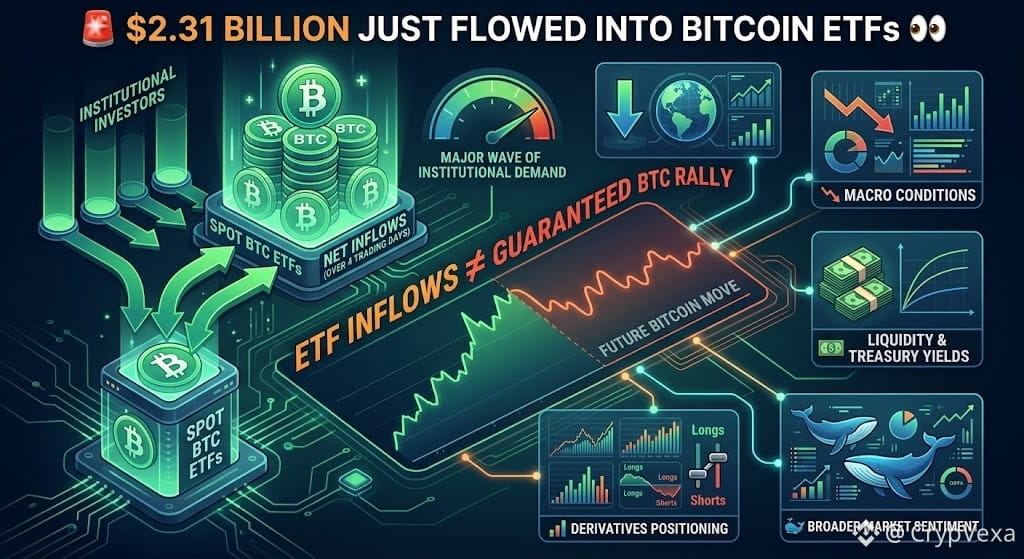
🚨 $2.31 BILLION JUST FLOWED INTO BITCOIN ETFs 👀
Bitcoin is seeing a major wave of institutional demand.
📊 Spot BTC ETFs recorded ~$2.31B in net inflows over 4 trading days.
That’s a significant flow signal, but there’s an important catch:
🔥 ETF inflows ≠ guaranteed BTC rally
Bitcoin’s next move can still be influenced by:
• 📉 Macro conditions
• 💵 Liquidity & Treasury yields
• 📊 Derivatives positioning
• 🐋 Broader market sentiment
The real story isn’t just the $2.31B.
👀 Can these inflows continue while BTC stabilizes after its recent pullback?
That’s the metric worth watching.
#Bitcoin #BTC #BitcoinETF #Crypto
#SpotBitcoinETFsInflow$2.31BInFourDays
🚨 $2.31 BILLION JUST FLOWED INTO BITCOIN ETFs 👀
Bitcoin is seeing a major wave of institutional demand.
📊 Spot BTC ETFs recorded ~$2.31B in net inflows over 4 trading days.
That’s a significant flow signal, but there’s an important catch:
🔥 ETF inflows ≠ guaranteed BTC rally
Bitcoin’s next move can still be influenced by:
• 📉 Macro conditions
• 💵 Liquidity & Treasury yields
• 📊 Derivatives positioning
• 🐋 Broader market sentiment
The real story isn’t just the $2.31B.
👀 Can these inflows continue while BTC stabilizes after its recent pullback?
That’s the metric worth watching.
#Bitcoin #BTC #BitcoinETF #Crypto
🚨 $2.31 BILLION JUST FLOWED INTO BITCOIN ETFs 👀
Bitcoin is seeing a major wave of institutional demand.
📊 Spot BTC ETFs recorded ~$2.31B in net inflows over 4 trading days.
That’s a significant flow signal, but there’s an important catch:
🔥 ETF inflows ≠ guaranteed BTC rally
Bitcoin’s next move can still be influenced by:
• 📉 Macro conditions
• 💵 Liquidity & Treasury yields
• 📊 Derivatives positioning
• 🐋 Broader market sentiment
The real story isn’t just the $2.31B.
👀 Can these inflows continue while BTC stabilizes after its recent pullback?
That’s the metric worth watching.
#Bitcoin #BTC #BitcoinETF #Crypto
BTC-2.97%
IBITETF-1.41%
5

🚨 $2.31B just moved into Spot Bitcoin ETFs in four sessions. The bigger question is: who is buying this dip?
U.S. spot Bitcoin ETFs recorded roughly $2.31B in net inflows from Sept. 17–22, including $999M on Sept. 21 and another $714.75M on Sept. 22. BlackRock’s IBIT led Tuesday with about $350M, followed by Fidelity’s FBTC near $257M.
BTC responded by reclaiming the $85K area and pushing toward $87K, but price has not yet established a clean breakout above the recent high. The $85K–$86.5K zone is now important demand, while ~$87K remains the immediate resistance to watch.
My take: The strongest part of this move is that ETF demand stayed positive even after BTC pulled back from $87K. That gives the rally real spot-demand support, but I’d still want to see BTC hold $85K before calling the move structurally stronger.
Do you think ETF demand can push BTC through $87K decisively?
#Bitcoin #BitcoinETF #InstitutionalInvestors #CryptoMarket
$IBIT.ETF $BTC
#SpotBitcoinETFsInflow$2.31BInFourDays
🚨 $2.31B just moved into Spot Bitcoin ETFs in four sessions. The bigger question is: who is buying this dip?
U.S. spot Bitcoin ETFs recorded roughly $2.31B in net inflows from Sept. 17–22, including $999M on Sept. 21 and another $714.75M on Sept. 22. BlackRock’s IBIT led Tuesday with about $350M, followed by Fidelity’s FBTC near $257M.
BTC responded by reclaiming the $85K area and pushing toward $87K, but price has not yet established a clean breakout above the recent high. The $85K–$86.5K zone is now important demand, while ~$87K remains the immediate resistance to watch.
My take: The strongest part of this move is that ETF demand stayed positive even after BTC pulled back from $87K. That gives the rally real spot-demand support, but I’d still want to see BTC hold $85K before calling the move structurally stronger.
Do you think ETF demand can push BTC through $87K decisively?
#Bitcoin #BitcoinETF #InstitutionalInvestors #CryptoMarket
$IBIT.ETF $BTC
#SpotBitcoinETFsInflow$2.31BInFourDays
U.S. spot Bitcoin ETFs recorded roughly $2.31B in net inflows from Sept. 17–22, including $999M on Sept. 21 and another $714.75M on Sept. 22. BlackRock’s IBIT led Tuesday with about $350M, followed by Fidelity’s FBTC near $257M.
BTC responded by reclaiming the $85K area and pushing toward $87K, but price has not yet established a clean breakout above the recent high. The $85K–$86.5K zone is now important demand, while ~$87K remains the immediate resistance to watch.
My take: The strongest part of this move is that ETF demand stayed positive even after BTC pulled back from $87K. That gives the rally real spot-demand support, but I’d still want to see BTC hold $85K before calling the move structurally stronger.
Do you think ETF demand can push BTC through $87K decisively?
#Bitcoin #BitcoinETF #InstitutionalInvestors #CryptoMarket
$IBIT.ETF $BTC
#SpotBitcoinETFsInflow$2.31BInFourDays

87
·
--
🔥 Bitcoin & Ethereum ETFs See Strong Inflows
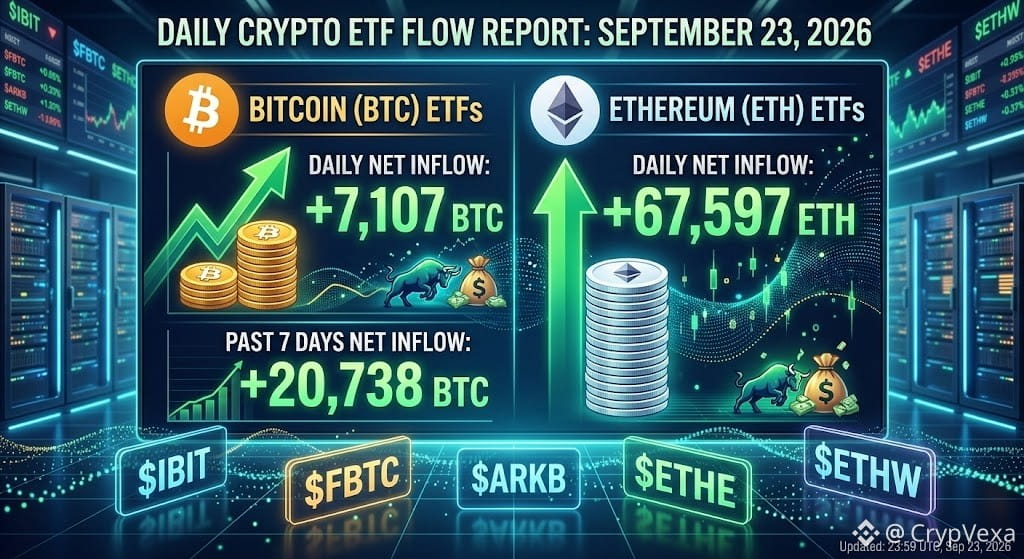
₿ Bitcoin ETFs: +7,107 BTC net inflow on September 23
♦ Ethereum ETFs: +67,597 ETH net inflow
📊 Over the past 7 days, Bitcoin ETFs added 20,738 BTC in net inflows.
💰 The latest figures highlight continued ETF demand across both major crypto assets.
👀 Is institutional demand for BTC and ETH picking up again?
#Bitcoin #Ethereum #BitcoinETF #CryptoMarket
🔥 Bitcoin & Ethereum ETFs See Strong Inflows
₿ Bitcoin ETFs: +7,107 BTC net inflow on September 23
♦ Ethereum ETFs: +67,597 ETH net inflow
📊 Over the past 7 days, Bitcoin ETFs added 20,738 BTC in net inflows.
💰 The latest figures highlight continued ETF demand across both major crypto assets.
👀 Is institutional demand for BTC and ETH picking up again?
#Bitcoin #Ethereum #BitcoinETF #CryptoMarket
₿ Bitcoin ETFs: +7,107 BTC net inflow on September 23
♦ Ethereum ETFs: +67,597 ETH net inflow
📊 Over the past 7 days, Bitcoin ETFs added 20,738 BTC in net inflows.
💰 The latest figures highlight continued ETF demand across both major crypto assets.
👀 Is institutional demand for BTC and ETH picking up again?
#Bitcoin #Ethereum #BitcoinETF #CryptoMarket
1
90

·
--
🚨 BITCOIN ETFs SEE $2.31B INFLOW IN JUST 4 DAYS
Institutional demand for Bitcoin is heating up again. 🇺🇸₿
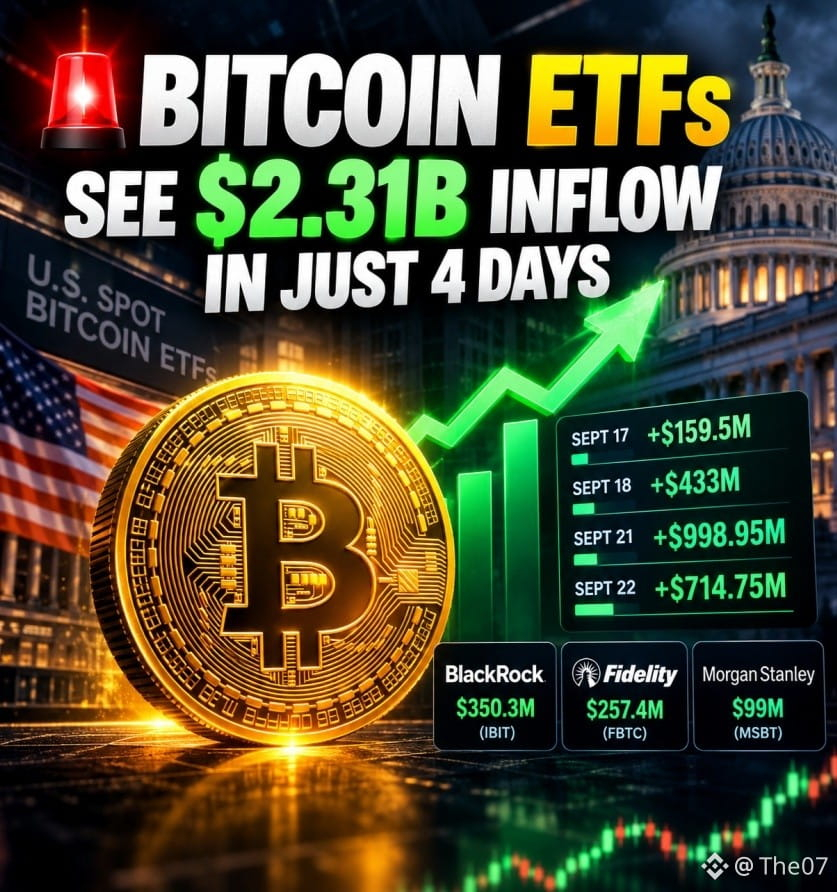
U.S. spot Bitcoin ETFs recorded approximately $2.31 billion in net inflows across four trading sessions, from September 17–22.
📊 The breakdown:
• Sept. 17: +$159.5M
• Sept. 18: +$433M
• Sept. 21: +$998.95M
• Sept. 22: +$714.75M
That means nearly $1 billion entered Bitcoin ETFs in a single day on September 21 — the largest daily inflow since October 2025.
🏦 BlackRock leads
On September 22, BlackRock's IBIT attracted about $350.3M, followed by Fidelity's FBTC with $257.4M and Morgan Stanley's MSBT with approximately $99M. No U.S. spot Bitcoin ETF recorded a net outflow that day.
📈 Why it matters
The strong ETF demand coincided with Bitcoin climbing toward $87,000, suggesting that the recent price recovery was accompanied by substantial demand through regulated investment products.
However, ETF inflows alone don't guarantee that Bitcoin will continue rising. Market conditions, interest rates, liquidity and investor sentiment can all affect the next move.
👀 The key number to watch now:
Will ETF inflows continue after this $2.31B surge?
#bitcoin #BTC #BitcoinETF #blackRock $BTC
{spot}(BTCUSDT)
🚨 BITCOIN ETFs SEE $2.31B INFLOW IN JUST 4 DAYS
Institutional demand for Bitcoin is heating up again. 🇺🇸₿
U.S. spot Bitcoin ETFs recorded approximately $2.31 billion in net inflows across four trading sessions, from September 17–22.
📊 The breakdown:
• Sept. 17: +$159.5M
• Sept. 18: +$433M
• Sept. 21: +$998.95M
• Sept. 22: +$714.75M
That means nearly $1 billion entered Bitcoin ETFs in a single day on September 21 — the largest daily inflow since October 2025.
🏦 BlackRock leads
On September 22, BlackRock's IBIT attracted about $350.3M, followed by Fidelity's FBTC with $257.4M and Morgan Stanley's MSBT with approximately $99M. No U.S. spot Bitcoin ETF recorded a net outflow that day.
📈 Why it matters
The strong ETF demand coincided with Bitcoin climbing toward $87,000, suggesting that the recent price recovery was accompanied by substantial demand through regulated investment products.
However, ETF inflows alone don't guarantee that Bitcoin will continue rising. Market conditions, interest rates, liquidity and investor sentiment can all affect the next move.
👀 The key number to watch now:
Will ETF inflows continue after this $2.31B surge?
#bitcoin #BTC #BitcoinETF #blackRock $BTC
Institutional demand for Bitcoin is heating up again. 🇺🇸₿
U.S. spot Bitcoin ETFs recorded approximately $2.31 billion in net inflows across four trading sessions, from September 17–22.
📊 The breakdown:
• Sept. 17: +$159.5M
• Sept. 18: +$433M
• Sept. 21: +$998.95M
• Sept. 22: +$714.75M
That means nearly $1 billion entered Bitcoin ETFs in a single day on September 21 — the largest daily inflow since October 2025.
🏦 BlackRock leads
On September 22, BlackRock's IBIT attracted about $350.3M, followed by Fidelity's FBTC with $257.4M and Morgan Stanley's MSBT with approximately $99M. No U.S. spot Bitcoin ETF recorded a net outflow that day.
📈 Why it matters
The strong ETF demand coincided with Bitcoin climbing toward $87,000, suggesting that the recent price recovery was accompanied by substantial demand through regulated investment products.
However, ETF inflows alone don't guarantee that Bitcoin will continue rising. Market conditions, interest rates, liquidity and investor sentiment can all affect the next move.
👀 The key number to watch now:
Will ETF inflows continue after this $2.31B surge?
#bitcoin #BTC #BitcoinETF #blackRock $BTC
72

·
--
🔥 $2.31 BILLION JUST FLOWED INTO SPOT BITCOIN ETFs IN 4 DAYS!
Wall Street isn’t just watching Bitcoin — capital is moving into it. 💰₿
U.S. spot BTC ETFs recorded roughly $2.31B in net inflows across four trading days, including about $714.7M in the latest session. BlackRock’s IBIT alone pulled in roughly $350.3M.
The big question now: Is this the beginning of another major Bitcoin accumulation wave? 👀
📈 ETF flows = WATCH
🐋 Institutional demand = RISING
₿ Bitcoin = BACK IN FOCUS
Don’t watch the candles only. Watch where the money is going.
#BitcoinETF #BTCNews
#SpotBitcoinETFsInflow$2.31BInFourDays
$BTC
🔥 $2.31 BILLION JUST FLOWED INTO SPOT BITCOIN ETFs IN 4 DAYS!
Wall Street isn’t just watching Bitcoin — capital is moving into it. 💰₿
U.S. spot BTC ETFs recorded roughly $2.31B in net inflows across four trading days, including about $714.7M in the latest session. BlackRock’s IBIT alone pulled in roughly $350.3M.
The big question now: Is this the beginning of another major Bitcoin accumulation wave? 👀
📈 ETF flows = WATCH
🐋 Institutional demand = RISING
₿ Bitcoin = BACK IN FOCUS
Don’t watch the candles only. Watch where the money is going.
#BitcoinETF #BTCNews
#SpotBitcoinETFsInflow$2.31BInFourDays
$BTC
Wall Street isn’t just watching Bitcoin — capital is moving into it. 💰₿
U.S. spot BTC ETFs recorded roughly $2.31B in net inflows across four trading days, including about $714.7M in the latest session. BlackRock’s IBIT alone pulled in roughly $350.3M.
The big question now: Is this the beginning of another major Bitcoin accumulation wave? 👀
📈 ETF flows = WATCH
🐋 Institutional demand = RISING
₿ Bitcoin = BACK IN FOCUS
Don’t watch the candles only. Watch where the money is going.
#BitcoinETF #BTCNews
#SpotBitcoinETFsInflow$2.31BInFourDays
$BTC

54
·
--
🔥 Crypto Market Cap Reclaims $3 Trillion
🌐 Total crypto market capitalization briefly climbed back above $3T, marking a roughly 13% gain over four sessions.
₿ Bitcoin reached $86,000, leading the broader market recovery.
💰 U.S. spot Bitcoin ETFs also provided a major boost, attracting nearly $1B in net inflows on Monday, reportedly their largest single-day inflow since October.
📈 Strong ETF demand plus BTC’s rebound is bringing fresh attention to the broader crypto market.
👀 Can the total crypto market cap hold above $3T?
#Bitcoin #CryptoMarket #BitcoinETF #CryptoNews
🔥 Crypto Market Cap Reclaims $3 Trillion
🌐 Total crypto market capitalization briefly climbed back above $3T, marking a roughly 13% gain over four sessions.
₿ Bitcoin reached $86,000, leading the broader market recovery.
💰 U.S. spot Bitcoin ETFs also provided a major boost, attracting nearly $1B in net inflows on Monday, reportedly their largest single-day inflow since October.
📈 Strong ETF demand plus BTC’s rebound is bringing fresh attention to the broader crypto market.
👀 Can the total crypto market cap hold above $3T?
#Bitcoin #CryptoMarket #BitcoinETF #CryptoNews
🌐 Total crypto market capitalization briefly climbed back above $3T, marking a roughly 13% gain over four sessions.
₿ Bitcoin reached $86,000, leading the broader market recovery.
💰 U.S. spot Bitcoin ETFs also provided a major boost, attracting nearly $1B in net inflows on Monday, reportedly their largest single-day inflow since October.
📈 Strong ETF demand plus BTC’s rebound is bringing fresh attention to the broader crypto market.
👀 Can the total crypto market cap hold above $3T?
#Bitcoin #CryptoMarket #BitcoinETF #CryptoNews

1
78

·
--
🚨 $BTC just got an interesting signal — and it’s not another “BTC to $100K tomorrow” prediction 😂
After a period of ETF outflows, money started flowing back into U.S. spot Bitcoin ETFs.
The big headline?
💰 Nearly $1B flowed into spot Bitcoin ETFs in one recent session, followed by another ~$715M the next day.
So what’s actually interesting here?
It’s not simply “institutions are bullish.”
The more useful story is the change in flow direction:
🔴 Outflows
⬇️
🟢 Flows turn positive
⬇️
💰 Large inflows return
That matters because ETF flows give us a window into demand from investors accessing Bitcoin through regulated spot products.
But there’s an important catch 👀
ETF inflows alone don’t mean Bitcoin can only go up.
Price can still be affected by macro conditions, leverage, profit-taking and broader risk appetite.
So instead of asking:
“Is Bitcoin bullish now?”
A better question might be:
“Does this renewed demand continue?”
Because one big inflow is interesting.
A sustained trend is much more meaningful. 👀
What do you think matters more from here — ETF flows continuing or Bitcoin’s price structure confirming the demand?
#Bitcoin #CryptoNews #BitcoinETF #CryptoMarket #BinanceSquare
🚨 $BTC just got an interesting signal — and it’s not another “BTC to $100K tomorrow” prediction 😂
After a period of ETF outflows, money started flowing back into U.S. spot Bitcoin ETFs.
The big headline?
💰 Nearly $1B flowed into spot Bitcoin ETFs in one recent session, followed by another ~$715M the next day.
So what’s actually interesting here?
It’s not simply “institutions are bullish.”
The more useful story is the change in flow direction:
🔴 Outflows
⬇️
🟢 Flows turn positive
⬇️
💰 Large inflows return
That matters because ETF flows give us a window into demand from investors accessing Bitcoin through regulated spot products.
But there’s an important catch 👀
ETF inflows alone don’t mean Bitcoin can only go up.
Price can still be affected by macro conditions, leverage, profit-taking and broader risk appetite.
So instead of asking:
“Is Bitcoin bullish now?”
A better question might be:
“Does this renewed demand continue?”
Because one big inflow is interesting.
A sustained trend is much more meaningful. 👀
What do you think matters more from here — ETF flows continuing or Bitcoin’s price structure confirming the demand?
#Bitcoin #CryptoNews #BitcoinETF #CryptoMarket #BinanceSquare
After a period of ETF outflows, money started flowing back into U.S. spot Bitcoin ETFs.
The big headline?
💰 Nearly $1B flowed into spot Bitcoin ETFs in one recent session, followed by another ~$715M the next day.
So what’s actually interesting here?
It’s not simply “institutions are bullish.”
The more useful story is the change in flow direction:
🔴 Outflows
⬇️
🟢 Flows turn positive
⬇️
💰 Large inflows return
That matters because ETF flows give us a window into demand from investors accessing Bitcoin through regulated spot products.
But there’s an important catch 👀
ETF inflows alone don’t mean Bitcoin can only go up.
Price can still be affected by macro conditions, leverage, profit-taking and broader risk appetite.
So instead of asking:
“Is Bitcoin bullish now?”
A better question might be:
“Does this renewed demand continue?”
Because one big inflow is interesting.
A sustained trend is much more meaningful. 👀
What do you think matters more from here — ETF flows continuing or Bitcoin’s price structure confirming the demand?
#Bitcoin #CryptoNews #BitcoinETF #CryptoMarket #BinanceSquare
🟢 ETF inflows
📈 BTC price structure
3 hr(s) left
1
87


·
--
Bearish
I’m watching the Bitcoin ETF flows closely again 👀
Nearly $1B reportedly flowed into U.S. spot Bitcoin ETFs in a single day, marking one of the strongest daily inflows of 2026.
That kind of capital doesn’t guarantee a straight-up move, but it definitely puts institutional demand back on the radar.
If these inflows keep building, BTC could have a much stronger demand backdrop than the chart alone suggests.
$BTC
{spot}(BTCUSDT)
#Bitcoin #BTC #BitcoinETF
I’m watching the Bitcoin ETF flows closely again 👀
Nearly $1B reportedly flowed into U.S. spot Bitcoin ETFs in a single day, marking one of the strongest daily inflows of 2026.
That kind of capital doesn’t guarantee a straight-up move, but it definitely puts institutional demand back on the radar.
If these inflows keep building, BTC could have a much stronger demand backdrop than the chart alone suggests.
$BTC
#Bitcoin #BTC #BitcoinETF
Nearly $1B reportedly flowed into U.S. spot Bitcoin ETFs in a single day, marking one of the strongest daily inflows of 2026.
That kind of capital doesn’t guarantee a straight-up move, but it definitely puts institutional demand back on the radar.
If these inflows keep building, BTC could have a much stronger demand backdrop than the chart alone suggests.
$BTC
#Bitcoin #BTC #BitcoinETF


53

·
--
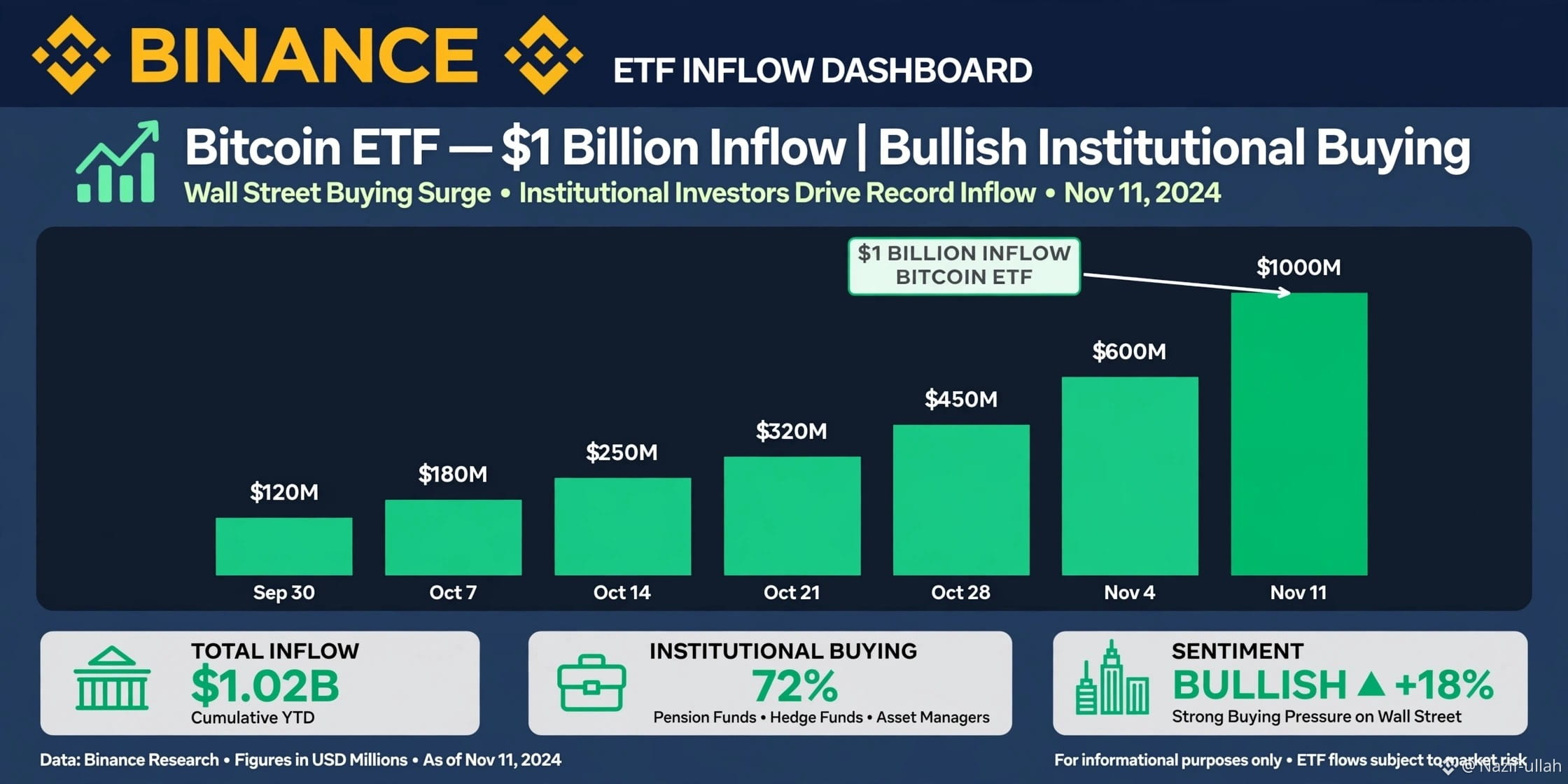
$1 BILLION ETF INFLOW IN ONE DAY! 💰
Wall Street is buying. Biggest BTC ETF inflow since October 2025.
Retail fear = Whale accumulation. Don't miss the rotation.
#BitcoinETF #Whales #CryptoNews
$1 BILLION ETF INFLOW IN ONE DAY! 💰
Wall Street is buying. Biggest BTC ETF inflow since October 2025.
Retail fear = Whale accumulation. Don't miss the rotation.
#BitcoinETF #Whales #CryptoNews
Wall Street is buying. Biggest BTC ETF inflow since October 2025.
Retail fear = Whale accumulation. Don't miss the rotation.
#BitcoinETF #Whales #CryptoNews
65

Bitcoin ETFs Are Buying Big Again 👀
Nearly $1 BILLION flowed into U.S. spot Bitcoin ETFs in a single day.
That’s not a small move.
On September 21, spot Bitcoin ETFs recorded around $998.95M in net inflows, marking their biggest single-day inflow since October 2025.
BlackRock’s IBIT led the charge with about $381M, followed by ARKB with $289M and Fidelity’s FBTC with nearly $239M.
At the same time, Bitcoin briefly pushed above $87K.
The interesting part? ETF flows had been much weaker just days earlier. Now institutional demand has suddenly picked up again.
If these strong inflows continue, Bitcoin demand could remain a major market story.
But one big day doesn’t confirm a trend.
BTC traders are watching the next ETF flow numbers closely. 👀
#Bitcoin #BTC #BitcoinETF
$BTC
{future}(BTCUSDT)
Bitcoin ETFs Are Buying Big Again 👀
Nearly $1 BILLION flowed into U.S. spot Bitcoin ETFs in a single day.
That’s not a small move.
On September 21, spot Bitcoin ETFs recorded around $998.95M in net inflows, marking their biggest single-day inflow since October 2025.
BlackRock’s IBIT led the charge with about $381M, followed by ARKB with $289M and Fidelity’s FBTC with nearly $239M.
At the same time, Bitcoin briefly pushed above $87K.
The interesting part? ETF flows had been much weaker just days earlier. Now institutional demand has suddenly picked up again.
If these strong inflows continue, Bitcoin demand could remain a major market story.
But one big day doesn’t confirm a trend.
BTC traders are watching the next ETF flow numbers closely. 👀
#Bitcoin #BTC #BitcoinETF
$BTC
Nearly $1 BILLION flowed into U.S. spot Bitcoin ETFs in a single day.
That’s not a small move.
On September 21, spot Bitcoin ETFs recorded around $998.95M in net inflows, marking their biggest single-day inflow since October 2025.
BlackRock’s IBIT led the charge with about $381M, followed by ARKB with $289M and Fidelity’s FBTC with nearly $239M.
At the same time, Bitcoin briefly pushed above $87K.
The interesting part? ETF flows had been much weaker just days earlier. Now institutional demand has suddenly picked up again.
If these strong inflows continue, Bitcoin demand could remain a major market story.
But one big day doesn’t confirm a trend.
BTC traders are watching the next ETF flow numbers closely. 👀
#Bitcoin #BTC #BitcoinETF
$BTC

71

Article
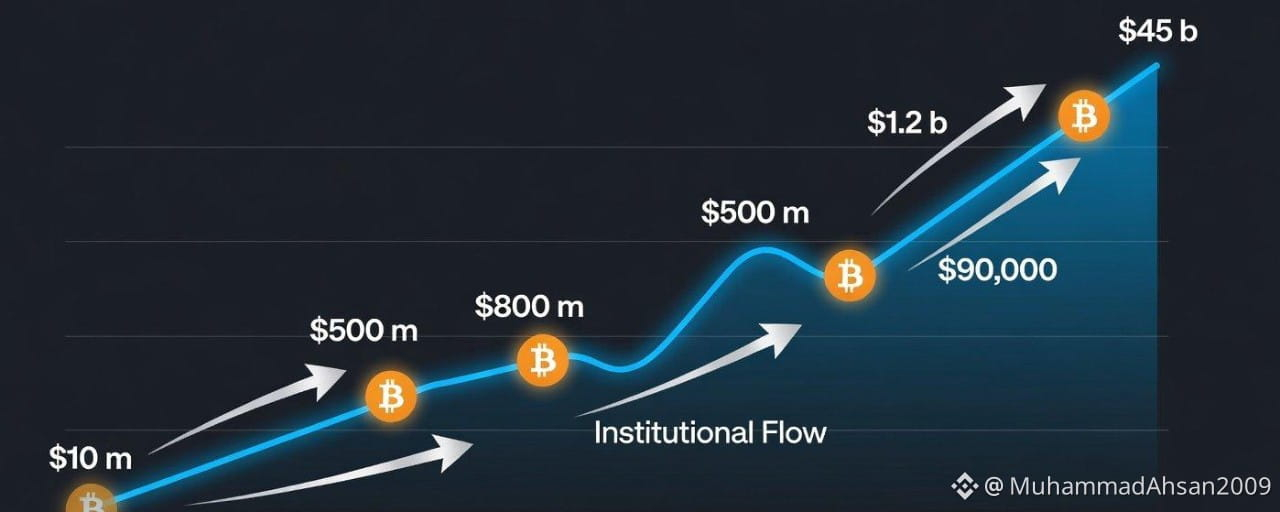
WALL STREET JUST SENT A HUGE SIGNAL TO BITCOIN! ₿🚨🚨 WALL STREET JUST SENT A HUGE SIGNAL TO BITCOIN! ₿🔥
💰 $999 MILLION flowed into U.S. Spot Bitcoin ETFs in ONE DAY!
That makes it one of the largest ETF inflow days ever. 🤯
And look where Bitcoin went next… 👀
₿ BTC pushed above $87,000
📈 Nearly $1 BILLION ETF inflow
🏦 Institutional demand is back in focus
🔥 Crypto market momentum is heating up
The big question:
Is this the beginning of Bitcoin’s next major move? 👀
👇 Drop your BTC price target!
#bitcoin #BTC #Crypto #BitcoinETF #CryptoNews #BTCNews #Binance #BinanceSquare #Ethereum #trading
$BITCOIN
$BTC
{spot}(BTCUSDT)
{alpha}(10x72e4f9f808c49a2a61de9c5896298920dc4eeea9)
WALL STREET JUST SENT A HUGE SIGNAL TO BITCOIN! ₿
🚨🚨 WALL STREET JUST SENT A HUGE SIGNAL TO BITCOIN! ₿🔥
💰 $999 MILLION flowed into U.S. Spot Bitcoin ETFs in ONE DAY!
That makes it one of the largest ETF inflow days ever. 🤯
And look where Bitcoin went next… 👀
₿ BTC pushed above $87,000
📈 Nearly $1 BILLION ETF inflow
🏦 Institutional demand is back in focus
🔥 Crypto market momentum is heating up
The big question:
Is this the beginning of Bitcoin’s next major move? 👀
👇 Drop your BTC price target!
#bitcoin #BTC #Crypto #BitcoinETF #CryptoNews #BTCNews #Binance #BinanceSquare #Ethereum #trading
$BITCOIN
$BTC
💰 $999 MILLION flowed into U.S. Spot Bitcoin ETFs in ONE DAY!
That makes it one of the largest ETF inflow days ever. 🤯
And look where Bitcoin went next… 👀
₿ BTC pushed above $87,000
📈 Nearly $1 BILLION ETF inflow
🏦 Institutional demand is back in focus
🔥 Crypto market momentum is heating up
The big question:
Is this the beginning of Bitcoin’s next major move? 👀
👇 Drop your BTC price target!
#bitcoin #BTC #Crypto #BitcoinETF #CryptoNews #BTCNews #Binance #BinanceSquare #Ethereum #trading
$BITCOIN
$BTC
73

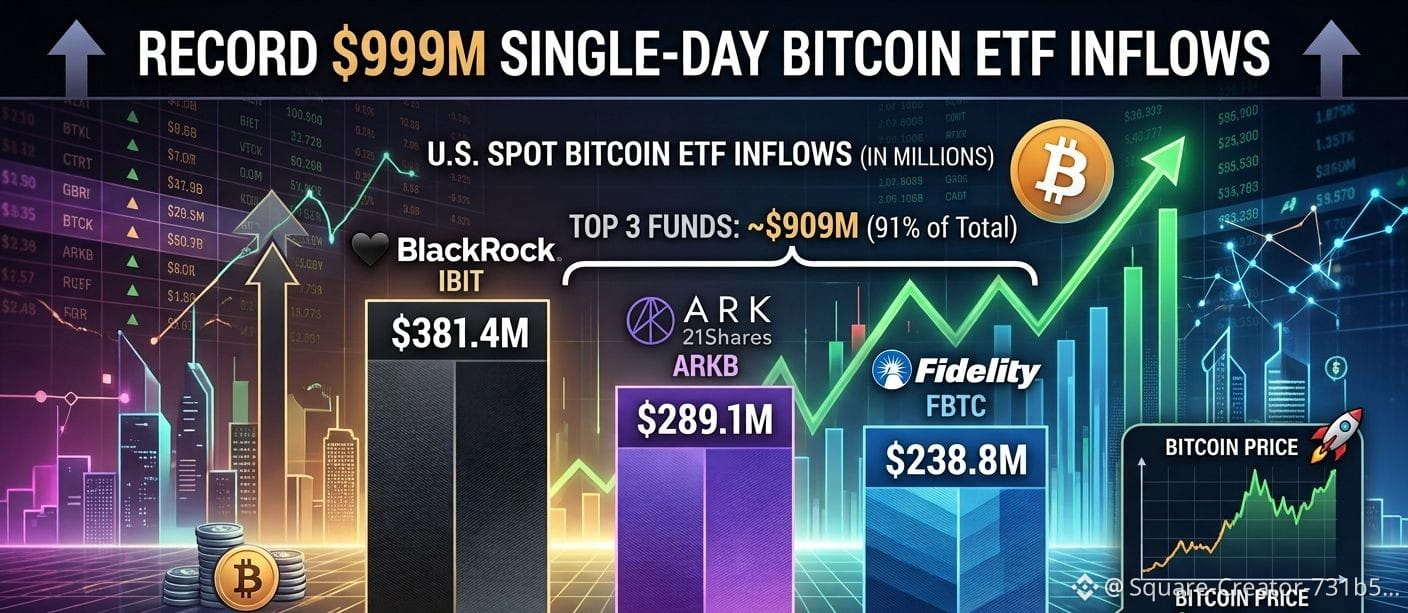
🏦₿ BlackRock, ARKB & Fidelity Drive $999M Bitcoin ETF Inflows 🚀
U.S. spot Bitcoin ETFs attracted $998.9 million on September 21, their biggest single-day inflow of 2026. 💰📈
🔥 Top three funds:
BlackRock IBIT: $381.4M
🟣 ARKB: $289.1M
🔵 Fidelity FBTC: $238.8M
Together, these three ETFs brought in about $909M, roughly 91% of the day's total Bitcoin ETF inflows. 📊
₿ The strong institutional flows came as Bitcoin climbed above $86,000, reaching its highest level since January. 🚀 The surge followed earlier September outflows and marked a sharp reversal in ETF demand.
💰 Spot Bitcoin ETFs now hold about $110.1B in net assets, with cumulative net inflows around $56.2B. 🌐
#Bitcoin ₿ #BitcoinETF 💰 #IBIT 🏦 #ARKB 📊 #FBTC 🔵 #InstitutionalInvestors 💼
🏦₿ BlackRock, ARKB & Fidelity Drive $999M Bitcoin ETF Inflows 🚀
U.S. spot Bitcoin ETFs attracted $998.9 million on September 21, their biggest single-day inflow of 2026. 💰📈
🔥 Top three funds:
BlackRock IBIT: $381.4M
🟣 ARKB: $289.1M
🔵 Fidelity FBTC: $238.8M
Together, these three ETFs brought in about $909M, roughly 91% of the day's total Bitcoin ETF inflows. 📊
₿ The strong institutional flows came as Bitcoin climbed above $86,000, reaching its highest level since January. 🚀 The surge followed earlier September outflows and marked a sharp reversal in ETF demand.
💰 Spot Bitcoin ETFs now hold about $110.1B in net assets, with cumulative net inflows around $56.2B. 🌐
#Bitcoin ₿ #BitcoinETF 💰 #IBIT 🏦 #ARKB 📊 #FBTC 🔵 #InstitutionalInvestors 💼
U.S. spot Bitcoin ETFs attracted $998.9 million on September 21, their biggest single-day inflow of 2026. 💰📈
🔥 Top three funds:
BlackRock IBIT: $381.4M
🟣 ARKB: $289.1M
🔵 Fidelity FBTC: $238.8M
Together, these three ETFs brought in about $909M, roughly 91% of the day's total Bitcoin ETF inflows. 📊
₿ The strong institutional flows came as Bitcoin climbed above $86,000, reaching its highest level since January. 🚀 The surge followed earlier September outflows and marked a sharp reversal in ETF demand.
💰 Spot Bitcoin ETFs now hold about $110.1B in net assets, with cumulative net inflows around $56.2B. 🌐
#Bitcoin ₿ #BitcoinETF 💰 #IBIT 🏦 #ARKB 📊 #FBTC 🔵 #InstitutionalInvestors 💼
1
75

·
--
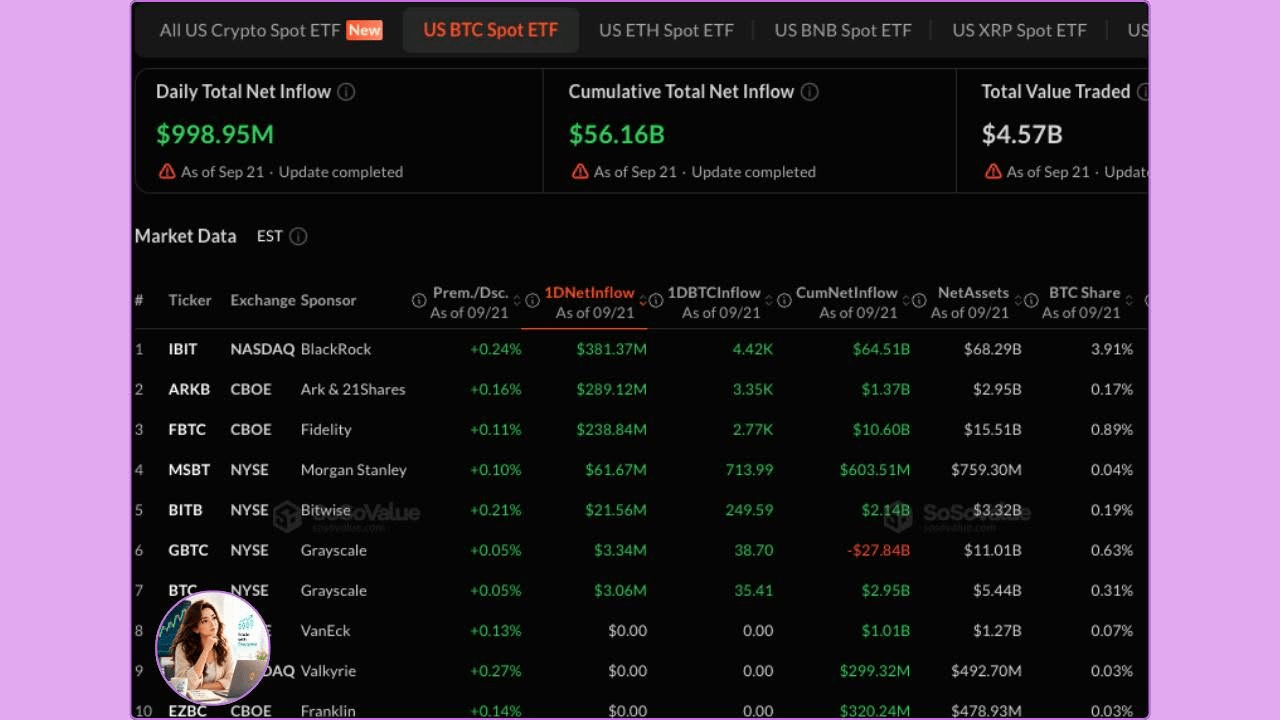
💥 BITCOIN ETFs NEAR $1B AS 2026 INFLOW RECORD SHATTERS
U.S. spot Bitcoin ETFs pulled in $998.9 million on Sept. 21, marking their biggest single-day inflow of 2026 and the strongest since October 2025.
The inflow surpassed the previous 2026 record of $844 million set on Jan. 14. BlackRock’s IBIT led with $381 million, followed by ARKB at $289 million and Fidelity’s FBTC at about $239 million.
The surge came as Bitcoin briefly climbed above $87,000, while ETF demand rebounded sharply after heavy outflows earlier in September.
Ether ETFs also attracted around $270 million on Monday, their strongest daily inflow of 2026.
Is this ETF demand becoming a more meaningful driver of Bitcoin’s latest recovery?
#BTC #BitcoinETF #InstitutionalDemand
#ThuyBNB
$BTC $BNB
$NEAR
💥 BITCOIN ETFs NEAR $1B AS 2026 INFLOW RECORD SHATTERS
U.S. spot Bitcoin ETFs pulled in $998.9 million on Sept. 21, marking their biggest single-day inflow of 2026 and the strongest since October 2025.
The inflow surpassed the previous 2026 record of $844 million set on Jan. 14. BlackRock’s IBIT led with $381 million, followed by ARKB at $289 million and Fidelity’s FBTC at about $239 million.
The surge came as Bitcoin briefly climbed above $87,000, while ETF demand rebounded sharply after heavy outflows earlier in September.
Ether ETFs also attracted around $270 million on Monday, their strongest daily inflow of 2026.
Is this ETF demand becoming a more meaningful driver of Bitcoin’s latest recovery?
#BTC #BitcoinETF #InstitutionalDemand
#ThuyBNB
$BTC $BNB
$NEAR
U.S. spot Bitcoin ETFs pulled in $998.9 million on Sept. 21, marking their biggest single-day inflow of 2026 and the strongest since October 2025.
The inflow surpassed the previous 2026 record of $844 million set on Jan. 14. BlackRock’s IBIT led with $381 million, followed by ARKB at $289 million and Fidelity’s FBTC at about $239 million.
The surge came as Bitcoin briefly climbed above $87,000, while ETF demand rebounded sharply after heavy outflows earlier in September.
Ether ETFs also attracted around $270 million on Monday, their strongest daily inflow of 2026.
Is this ETF demand becoming a more meaningful driver of Bitcoin’s latest recovery?
#BTC #BitcoinETF #InstitutionalDemand
#ThuyBNB
$BTC $BNB
$NEAR
28

🚨 Bitcoin ETFs Near $1B in Daily Inflows
US spot Bitcoin ETFs recorded $998.9M in net inflows, marking their strongest single-day inflow of 2026.
BlackRock’s IBIT led with $381M, followed by ARKB at $289M and Fidelity’s FBTC at $239M.
The data highlights renewed institutional demand for Bitcoin, putting ETF flows back in focus for the crypto market.
Digital Alpha | Crypto • Insights • Opportunities
#BTC #BitcoinETF #DigitalAlpha #AIStocksWhatNext $BTC
{spot}(BTCUSDT)
🚨 Bitcoin ETFs Near $1B in Daily Inflows
US spot Bitcoin ETFs recorded $998.9M in net inflows, marking their strongest single-day inflow of 2026.
BlackRock’s IBIT led with $381M, followed by ARKB at $289M and Fidelity’s FBTC at $239M.
The data highlights renewed institutional demand for Bitcoin, putting ETF flows back in focus for the crypto market.
Digital Alpha | Crypto • Insights • Opportunities
#BTC #BitcoinETF #DigitalAlpha #AIStocksWhatNext $BTC
US spot Bitcoin ETFs recorded $998.9M in net inflows, marking their strongest single-day inflow of 2026.
BlackRock’s IBIT led with $381M, followed by ARKB at $289M and Fidelity’s FBTC at $239M.
The data highlights renewed institutional demand for Bitcoin, putting ETF flows back in focus for the crypto market.
Digital Alpha | Crypto • Insights • Opportunities
#BTC #BitcoinETF #DigitalAlpha #AIStocksWhatNext $BTC

26

🚨 BITCOIN SPOT ETFs SEE NEARLY $1B IN A SINGLE DAY
🇺🇸 U.S. spot Bitcoin ETFs recorded roughly $999M in net inflows, marking their strongest daily inflow in about a year.
📈 The surge highlights renewed institutional demand for $BTC, with Bitcoin trading above $85,000 as capital flows back into regulated investment products.
💡 Why It Matters:
Large ETF inflows can become an important force in Bitcoin’s price discovery and market liquidity.
⚠️ One strong session does not confirm a lasting trend. ETF flows can reverse, while macro conditions, rates, liquidity, and positioning remain key factors.
🔥 Is institutional ETF demand becoming Bitcoin’s next major momentum driver?
#Bitcoin #BTC #BitcoinETF #crypto #BinanceSquare
🚨 BITCOIN SPOT ETFs SEE NEARLY $1B IN A SINGLE DAY
🇺🇸 U.S. spot Bitcoin ETFs recorded roughly $999M in net inflows, marking their strongest daily inflow in about a year.
📈 The surge highlights renewed institutional demand for $BTC, with Bitcoin trading above $85,000 as capital flows back into regulated investment products.
💡 Why It Matters:
Large ETF inflows can become an important force in Bitcoin’s price discovery and market liquidity.
⚠️ One strong session does not confirm a lasting trend. ETF flows can reverse, while macro conditions, rates, liquidity, and positioning remain key factors.
🔥 Is institutional ETF demand becoming Bitcoin’s next major momentum driver?
#Bitcoin #BTC #BitcoinETF #crypto #BinanceSquare
🇺🇸 U.S. spot Bitcoin ETFs recorded roughly $999M in net inflows, marking their strongest daily inflow in about a year.
📈 The surge highlights renewed institutional demand for $BTC, with Bitcoin trading above $85,000 as capital flows back into regulated investment products.
💡 Why It Matters:
Large ETF inflows can become an important force in Bitcoin’s price discovery and market liquidity.
⚠️ One strong session does not confirm a lasting trend. ETF flows can reverse, while macro conditions, rates, liquidity, and positioning remain key factors.
🔥 Is institutional ETF demand becoming Bitcoin’s next major momentum driver?
#Bitcoin #BTC #BitcoinETF #crypto #BinanceSquare

37

#BitcoinSpotETFs$999MNetInflow
🚨 Bitcoin $BTC Spot ETFs Pull In $999M: Institutional Demand Roars Back 🚨
Picture the market after a long night of hesitation. Then, almost silently, nearly 1 Dollor billion flows through the ETF door in a single session, and suddenly Bitcoin's story looks different.
U.S. spot Bitcoin ETFs recorded roughly $999 million in net inflows, their strongest single-day inflow in about a year. The scale matters because ETF flows offer a direct window into institutional and traditional-market demand for BTC.
This is more than a headline number. Strong ETF buying arrives while Bitcoin has pushed above $85,000, showing that capital is returning alongside the price move rather than simply chasing a distant narrative.
My take: the primary driver here is capital flow, not supply mechanics. When regulated investment vehicles absorb meaningful spot exposure, available market liquidity can tighten and amplify price movements.
But one strong inflow should not be treated as a permanent trend. ETF demand can reverse quickly, and Bitcoin remains sensitive to macro conditions, rates, liquidity, and positioning.
The useful signal is therefore not “$999M means BTC must rise.” It is that institutional demand is currently strong enough to become a major force in Bitcoin's price discovery.
When capital changes direction, the chart usually tells the story afterward.
❓Do you think sustained ETF inflows can become the next major engine of Bitcoin's momentum?
Disclaimer: This content is for educational purposes only and is not financial advice.
#Bitcoin #BitcoinETF #GrowWithSAC $KERNEL $ONE
#BitcoinSpotETFs$999MNetInflow
🚨 Bitcoin $BTC Spot ETFs Pull In $999M: Institutional Demand Roars Back 🚨
Picture the market after a long night of hesitation. Then, almost silently, nearly 1 Dollor billion flows through the ETF door in a single session, and suddenly Bitcoin's story looks different.
U.S. spot Bitcoin ETFs recorded roughly $999 million in net inflows, their strongest single-day inflow in about a year. The scale matters because ETF flows offer a direct window into institutional and traditional-market demand for BTC.
This is more than a headline number. Strong ETF buying arrives while Bitcoin has pushed above $85,000, showing that capital is returning alongside the price move rather than simply chasing a distant narrative.
My take: the primary driver here is capital flow, not supply mechanics. When regulated investment vehicles absorb meaningful spot exposure, available market liquidity can tighten and amplify price movements.
But one strong inflow should not be treated as a permanent trend. ETF demand can reverse quickly, and Bitcoin remains sensitive to macro conditions, rates, liquidity, and positioning.
The useful signal is therefore not “$999M means BTC must rise.” It is that institutional demand is currently strong enough to become a major force in Bitcoin's price discovery.
When capital changes direction, the chart usually tells the story afterward.
❓Do you think sustained ETF inflows can become the next major engine of Bitcoin's momentum?
Disclaimer: This content is for educational purposes only and is not financial advice.
#Bitcoin #BitcoinETF #GrowWithSAC $KERNEL $ONE
🚨 Bitcoin $BTC Spot ETFs Pull In $999M: Institutional Demand Roars Back 🚨
Picture the market after a long night of hesitation. Then, almost silently, nearly 1 Dollor billion flows through the ETF door in a single session, and suddenly Bitcoin's story looks different.
U.S. spot Bitcoin ETFs recorded roughly $999 million in net inflows, their strongest single-day inflow in about a year. The scale matters because ETF flows offer a direct window into institutional and traditional-market demand for BTC.
This is more than a headline number. Strong ETF buying arrives while Bitcoin has pushed above $85,000, showing that capital is returning alongside the price move rather than simply chasing a distant narrative.
My take: the primary driver here is capital flow, not supply mechanics. When regulated investment vehicles absorb meaningful spot exposure, available market liquidity can tighten and amplify price movements.
But one strong inflow should not be treated as a permanent trend. ETF demand can reverse quickly, and Bitcoin remains sensitive to macro conditions, rates, liquidity, and positioning.
The useful signal is therefore not “$999M means BTC must rise.” It is that institutional demand is currently strong enough to become a major force in Bitcoin's price discovery.
When capital changes direction, the chart usually tells the story afterward.
❓Do you think sustained ETF inflows can become the next major engine of Bitcoin's momentum?
Disclaimer: This content is for educational purposes only and is not financial advice.
#Bitcoin #BitcoinETF #GrowWithSAC $KERNEL $ONE

1
177

#BitcoinSpotETFs$999MNetInflow
🔥 $BTC BITCOIN ETF FLOWS JUST FIRED A $999M SIGNAL 🚀
Money can whisper for weeks,
then suddenly arrive like a wave nobody can ignore.
U.S. spot Bitcoin ETFs recorded roughly $999 million in net inflows in a single day, their largest daily inflow in 12 months. BlackRock’s IBIT led with $381.4M, followed by ARKB at $289.1M and Fidelity’s FBTC at $238.8M.
My Take: The important part is not simply the size of the number. It is the speed at which institutional-style exposure returned through regulated investment vehicles.
Bitcoin also surged above $86,000 on September 21, with ETF inflows and broader market participation accompanying the move.
That creates an interesting feedback loop: stronger ETF demand can improve market liquidity and sentiment, while rising prices can attract additional attention. But flows can reverse just as quickly.
One huge inflow does not automatically establish a lasting trend. The next sessions matter because sustained inflows would provide stronger evidence that this was more than a one-day burst of demand.
The real signal is simple: capital is returning to Bitcoin through Wall Street’s regulated gateway.
❓Will ETF demand remain strong enough to support this momentum?
Disclaimer: Informational content only, not financial advice. Crypto markets remain highly volatile.
#Bitcoin #BitcoinETF #GrowWithSAC $AKE $AGT
#BitcoinSpotETFs$999MNetInflow
🔥 $BTC BITCOIN ETF FLOWS JUST FIRED A $999M SIGNAL 🚀
Money can whisper for weeks,
then suddenly arrive like a wave nobody can ignore.
U.S. spot Bitcoin ETFs recorded roughly $999 million in net inflows in a single day, their largest daily inflow in 12 months. BlackRock’s IBIT led with $381.4M, followed by ARKB at $289.1M and Fidelity’s FBTC at $238.8M.
My Take: The important part is not simply the size of the number. It is the speed at which institutional-style exposure returned through regulated investment vehicles.
Bitcoin also surged above $86,000 on September 21, with ETF inflows and broader market participation accompanying the move.
That creates an interesting feedback loop: stronger ETF demand can improve market liquidity and sentiment, while rising prices can attract additional attention. But flows can reverse just as quickly.
One huge inflow does not automatically establish a lasting trend. The next sessions matter because sustained inflows would provide stronger evidence that this was more than a one-day burst of demand.
The real signal is simple: capital is returning to Bitcoin through Wall Street’s regulated gateway.
❓Will ETF demand remain strong enough to support this momentum?
Disclaimer: Informational content only, not financial advice. Crypto markets remain highly volatile.
#Bitcoin #BitcoinETF #GrowWithSAC $AKE $AGT
🔥 $BTC BITCOIN ETF FLOWS JUST FIRED A $999M SIGNAL 🚀
Money can whisper for weeks,
then suddenly arrive like a wave nobody can ignore.
U.S. spot Bitcoin ETFs recorded roughly $999 million in net inflows in a single day, their largest daily inflow in 12 months. BlackRock’s IBIT led with $381.4M, followed by ARKB at $289.1M and Fidelity’s FBTC at $238.8M.
My Take: The important part is not simply the size of the number. It is the speed at which institutional-style exposure returned through regulated investment vehicles.
Bitcoin also surged above $86,000 on September 21, with ETF inflows and broader market participation accompanying the move.
That creates an interesting feedback loop: stronger ETF demand can improve market liquidity and sentiment, while rising prices can attract additional attention. But flows can reverse just as quickly.
One huge inflow does not automatically establish a lasting trend. The next sessions matter because sustained inflows would provide stronger evidence that this was more than a one-day burst of demand.
The real signal is simple: capital is returning to Bitcoin through Wall Street’s regulated gateway.
❓Will ETF demand remain strong enough to support this momentum?
Disclaimer: Informational content only, not financial advice. Crypto markets remain highly volatile.
#Bitcoin #BitcoinETF #GrowWithSAC $AKE $AGT

118
Log in to explore more content
Join global crypto users on Binance Square
⚡️ Get latest and useful information about crypto.
💬 Trusted by the world’s largest crypto exchange.
👍 Discover real insights from verified creators.
Email / Phone number
Trending Topics
1
#BinanceWillListHyperliquid(HYPE)
2,620 views
152 Discussing
2
#ETHBreaksAbove$2,700
278 views
20 Discussing
3
#USWeighsPromotingDollarStablecoinsAbroad
14,042 views
644 Discussing
4
#US10YTreasuryYieldHits19YearHigh
11,860 views
504 Discussing
5
#SpotBitcoinETFsInflow$2.31BInFourDays
1,266 views
46 Discussing
6
#BitcoinRejectedAt$87,300Twice
0 views
0 Discussing
7
#BCHJumps28%OnCMEFuturesListing
55,773 views
1,191 Discussing
8
#WallStreetEarningsRevisionsTurnBearish
38,966 views
903 Discussing
9
#DollarIndexReclaims101
36,352 views
865 Discussing
10
#21SharesLaunchesEuropesFirstZcashETP
83,135 views
1,618 Discussing