
#asic
asic
73,292 views
158 Discussing
Hot
Latest

·
--
$BTC | On the desk beginners treat ASIC's 2:1 crypto CFD cap as a safety net. It is not. SatoshiMacro's guide to trading crypto in Australia sizes risk at 1 to 2 percent per trade, and that rule, not leverage, caps the loss. An AUD 850 account risking 1.5 percent is AUD 12.75 on the trade, even though 2:1 lets you open AUD 1,700. Skip the stop and size off full margin, and one swing erases far more than 1.5 percent. Forex pairs get 30:1; crypto sits at 2:1 because it moves harder. My read: the cap limits what the broker lends you, not what you can lose. Spot gets the 50 percent CGT discount past 12 months; CFD profit is ordinary income instead. These are the AU rules, not advice on your account.
https://satoshimacro.com/guides/forex/how-to-trade-crypto/?utm_source=binance_square&utm_medium=social&utm_campaign=autopilot_short-2
#SatoshiMacro #CryptoCFD #ASIC #Bitcoin
https://satoshimacro.com/guides/forex/how-to-trade-crypto/?utm_source=binance_square&utm_medium=social&utm_campaign=autopilot_short-2
#SatoshiMacro #CryptoCFD #ASIC #Bitcoin
58
·
--
Does ASIC's 2:1 Crypto CFD Cap Actually Protect Retail Traders?$BTC | Does ASIC's 2:1 leverage cap on crypto CFDs actually stop Australians from blowing up an account, or does it just slow the bleed? My read after years of sizing leveraged positions on an institutional desk: the cap limits how violently one bad day can hurt you, but it does not change who ends up losing. Severity goes down. The base rate stays roughly where it always was.
## Why Is Crypto Leverage Capped at 2:1 When Forex Gets 30:1?
ASIC does not treat all CFDs the same. Major forex pairs are capped at 30:1 and gold at 20:1, but crypto sits in its own bracket at 2:1, a 50 percent margin requirement, the lowest cap of any asset class ASIC regulates. SatoshiMacro's crypto CFD guide traces this back to ASIC's Product Intervention Order, published as CP 322 on 14 April 2021: regulators looked at how fast crypto moves and decided retail clients needed a different ceiling entirely. A broker offering an Australian client higher crypto leverage than that is operating outside the ASIC framework, full stop.
## How Much Can a 2:1 Position Actually Swing in a Day?
Here is the part traders underweight. Bitcoin regularly moves 5 to 10 percent in a single day. At 2:1, that ordinary daily range translates to a 10 to 20 percent swing against your margin, not your position value. On a sharp day it is worse. Work the numbers plainly: an AUD 1,000 margin deposit controls an AUD 2,000 crypto position under the cap. A 10 percent adverse move in the coin is a 20 percent move against that margin before any swap charge gets deducted. The cap halves what a forex trader on 30:1 would be exposed to on the same dollar move, but it does not make crypto a low-volatility product. It just makes a reckless account harder to zero out in one candle.
## If the Cap Protects Traders, Why Do Most Still Lose?
This is the uncomfortable number. ASIC-mandated retail disclosures show 70 to 85 percent of retail CFD accounts lose money, and crypto is where SatoshiMacro's guide notes that tends to happen fastest, cap or no cap. On the desk, the lesson was never that a lower leverage ceiling fixes trader behaviour. It slows the clock. A trader who oversizes at 2:1 instead of overnight 5:1 or 10:1 on an unregulated venue still finds a way to erode an account, just over more sessions instead of one. The cap is a circuit breaker on magnitude, not a cure for poor position sizing, and I have watched disciplined traders lose slower and undisciplined traders lose anyway.
## What a 2:1 Cap Actually Buys You
Three honest things. First, it removes the single worst outcome, a total account wipeout from one leveraged candle, which is common on offshore venues running 50:1 or 100:1 crypto leverage. Second, it forces a trader to hold real skin in the game: a 50 percent margin requirement means half your exposure is actual deposited capital, not borrowed, so the maths of ruin are slower. Third, it buys time to react, since a position moving 10 to 20 percent of margin on a normal day still leaves room to adjust a stop before a margin call, where a higher cap would not.
What it does not buy you is competence. The cap says nothing about entry timing, position size relative to account equity, or whether a trade should exist at all. A trader risking the full margin allowance on every position is still one bad week away from the same outcome a 30:1 forex trader on half the position size would reach. Crypto's extra volatility and the overnight swap charge on any multi-day leveraged hold both still apply regardless of the cap.
## The Honest Limitation Here
Those 70 to 85 percent loss-rate figures come from each broker's own ASIC-mandated disclosure pages, not from an independent audit SatoshiMacro ran itself, and the exact number moves broker to broker and quarter to quarter. Treat it as a real range, not a precise forecast of what happens to your account specifically. It is also worth saying plainly that a crypto CFD is a cash-settled derivative, not ownership: no wallet, no coin, nothing to self-custody, and profits sit under ordinary income tax rather than the 50 percent CGT discount that applies to crypto held 12 months or more on an exchange. The cap governs the leverage question. It does not touch the tax question, and it does not touch whether a CFD was even the right product for the goal.
My actual read, having sat on both sides of leveraged risk limits: a 2:1 cap on a genuinely volatile asset is sound regulatory design, not box-ticking. It is simply a limit on how fast you can lose, sized to how fast the underlying moves. Position sizing, stop discipline and knowing when a weekend gap can run against you before the market reopens all still sit entirely on the trader. Nothing about a leverage cap, at 2:1 or otherwise, removes the job of managing risk yourself. Crypto CFDs are not financial advice and carry real loss risk; size accordingly.
https://satoshimacro.com/guides/forex/crypto-cfd-trading-australia/?utm_source=binance_square&utm_medium=social&utm_campaign=autopilot_article
#SatoshiMacro #Bitcoin #CryptoCFD #ASIC
Does ASIC's 2:1 Crypto CFD Cap Actually Protect Retail Traders?
$BTC | Does ASIC's 2:1 leverage cap on crypto CFDs actually stop Australians from blowing up an account, or does it just slow the bleed? My read after years of sizing leveraged positions on an institutional desk: the cap limits how violently one bad day can hurt you, but it does not change who ends up losing. Severity goes down. The base rate stays roughly where it always was.
## Why Is Crypto Leverage Capped at 2:1 When Forex Gets 30:1?
ASIC does not treat all CFDs the same. Major forex pairs are capped at 30:1 and gold at 20:1, but crypto sits in its own bracket at 2:1, a 50 percent margin requirement, the lowest cap of any asset class ASIC regulates. SatoshiMacro's crypto CFD guide traces this back to ASIC's Product Intervention Order, published as CP 322 on 14 April 2021: regulators looked at how fast crypto moves and decided retail clients needed a different ceiling entirely. A broker offering an Australian client higher crypto leverage than that is operating outside the ASIC framework, full stop.
## How Much Can a 2:1 Position Actually Swing in a Day?
Here is the part traders underweight. Bitcoin regularly moves 5 to 10 percent in a single day. At 2:1, that ordinary daily range translates to a 10 to 20 percent swing against your margin, not your position value. On a sharp day it is worse. Work the numbers plainly: an AUD 1,000 margin deposit controls an AUD 2,000 crypto position under the cap. A 10 percent adverse move in the coin is a 20 percent move against that margin before any swap charge gets deducted. The cap halves what a forex trader on 30:1 would be exposed to on the same dollar move, but it does not make crypto a low-volatility product. It just makes a reckless account harder to zero out in one candle.
## If the Cap Protects Traders, Why Do Most Still Lose?
This is the uncomfortable number. ASIC-mandated retail disclosures show 70 to 85 percent of retail CFD accounts lose money, and crypto is where SatoshiMacro's guide notes that tends to happen fastest, cap or no cap. On the desk, the lesson was never that a lower leverage ceiling fixes trader behaviour. It slows the clock. A trader who oversizes at 2:1 instead of overnight 5:1 or 10:1 on an unregulated venue still finds a way to erode an account, just over more sessions instead of one. The cap is a circuit breaker on magnitude, not a cure for poor position sizing, and I have watched disciplined traders lose slower and undisciplined traders lose anyway.
## What a 2:1 Cap Actually Buys You
Three honest things. First, it removes the single worst outcome, a total account wipeout from one leveraged candle, which is common on offshore venues running 50:1 or 100:1 crypto leverage. Second, it forces a trader to hold real skin in the game: a 50 percent margin requirement means half your exposure is actual deposited capital, not borrowed, so the maths of ruin are slower. Third, it buys time to react, since a position moving 10 to 20 percent of margin on a normal day still leaves room to adjust a stop before a margin call, where a higher cap would not.
What it does not buy you is competence. The cap says nothing about entry timing, position size relative to account equity, or whether a trade should exist at all. A trader risking the full margin allowance on every position is still one bad week away from the same outcome a 30:1 forex trader on half the position size would reach. Crypto's extra volatility and the overnight swap charge on any multi-day leveraged hold both still apply regardless of the cap.
## The Honest Limitation Here
Those 70 to 85 percent loss-rate figures come from each broker's own ASIC-mandated disclosure pages, not from an independent audit SatoshiMacro ran itself, and the exact number moves broker to broker and quarter to quarter. Treat it as a real range, not a precise forecast of what happens to your account specifically. It is also worth saying plainly that a crypto CFD is a cash-settled derivative, not ownership: no wallet, no coin, nothing to self-custody, and profits sit under ordinary income tax rather than the 50 percent CGT discount that applies to crypto held 12 months or more on an exchange. The cap governs the leverage question. It does not touch the tax question, and it does not touch whether a CFD was even the right product for the goal.
My actual read, having sat on both sides of leveraged risk limits: a 2:1 cap on a genuinely volatile asset is sound regulatory design, not box-ticking. It is simply a limit on how fast you can lose, sized to how fast the underlying moves. Position sizing, stop discipline and knowing when a weekend gap can run against you before the market reopens all still sit entirely on the trader. Nothing about a leverage cap, at 2:1 or otherwise, removes the job of managing risk yourself. Crypto CFDs are not financial advice and carry real loss risk; size accordingly.
https://satoshimacro.com/guides/forex/crypto-cfd-trading-australia/?utm_source=binance_square&utm_medium=social&utm_campaign=autopilot_article
#SatoshiMacro #Bitcoin #CryptoCFD #ASIC
94
·
--
Is Bitcoin's Five-Week Losing Streak Actually a Signal to Short It?$BTC | Bitcoin's run of weekly red candles is trending on Square, and the question traders keep asking is whether a losing streak like that is actually shortable through a regulated AU crypto CFD account. It is, but the ASIC 2:1 leverage cap, the account's negative balance protection, and the tax treatment of a CFD short all change the math more than a five-week slide alone does.
## What Does Shorting Bitcoin Through Plus500 Crypto Actually Involve?
A crypto CFD is a synthetic position. You never touch the underlying coin. Plus500 Crypto's own product page says the same thing for longs and shorts: you take a position whose profit and loss tracks the BTC price, you cannot withdraw the coin, stake it, or move it on-chain. Going short works the same mechanically as going long, just pointed the other way. Plus500AU Pty Ltd holds ASIC AFSL 417727, the Australian arm of an LSE-listed, FTSE 250 parent, and the page explicitly lists short-selling or hedging crypto exposure within an ASIC-regulated retail account as one of the use cases the product is built for. That is the honest answer to why a losing streak draws CFD traffic: shorting spot crypto outright is awkward in Australia without a derivatives wrapper, so the CFD is the mechanism, not a side door.
## How Does the 2:1 Cap Change the Sizing Math After a Losing Streak?
This is where the trend gets less exciting than the hashtag. Every ASIC-regulated crypto CFD broker, Plus500 included, caps retail leverage at 2:1 under the product intervention order that took effect 29 March 2021 and was made permanent the following year. On the AUD 200 minimum deposit the page quotes, that is AUD 400 of notional exposure, not the 20x or 50x an offshore perpetual venue would wave at the same account. On the desk, the losing streaks that actually hurt people were never the first short. They were the third or fourth, sized up specifically to make back the first two. The streak was never the real risk. The sizing was. The 2:1 cap does not stop that behaviour, but it puts a hard ceiling on how fast it can compound: to double your notional you have to double your deposited capital, not just click a bigger multiplier.
## What Happens if the Short Gets Squeezed?
A five-week slide ending in a sharp relief rally is the textbook short-squeeze setup, and it is the scenario the CFD structure is actually built to survive, not avoid. Retail accounts carry mandatory negative balance protection under the same 2021 ASIC order, so if a reversal gaps hard against an open short overnight, the most that account can lose is the funded balance. Plus500, not the trader, eats anything beyond zero. That protection is worth more on a losing-streak short than on a long, because a short's theoretical downside has no natural floor the way a long's does at zero.
## Does Shorting Through a CFD Dodge the Tax Question?
No. This is the part a losing-streak short gets wrong most often. The ATO treats CFD trading profits and losses as ordinary income for traders running it as a business, or as Section 70-25 trading-stock income for casual users, not as a capital gain. SatoshiMacro's Plus500 Crypto review flags that distinction specifically because people assume a short is tax-neutral in a way that selling spot coin is not; it is not. Spot crypto held as an investment still gets the 50 percent CGT discount past 12 months. A CFD short never qualifies for that discount regardless of how long the position runs, because it is not the asset class the discount applies to. If the point of shorting is to protect an existing long-term spot holding through a slide rather than sell it and trigger a disposal, that is a legitimate hedge. If the point is to speculate on five more red weeks, it is ordinary trading income from day one.
## Where the Page's Own Numbers Fall Short
The review does not break out whether Plus500 charges or pays overnight financing differently on a short position versus a long one, only that financing applies to leveraged positions generally and that pricing is spread-based with no separate commission. That is a real gap if the plan is to run a short across several weeks rather than close it the same session, since financing direction and cost compound daily and the published review simply does not have the number. Check the live platform's financing schedule before assuming a short either costs or pays the same as a long would.
My read is a five-week slide is a reason to check your setup and your sizing, not a reason to lever into it chasing the bounce. The 2:1 cap means the account grows a short the same slow way it grows a long. The negative balance protection is the backstop if the squeeze comes. The tax line is ordinary income either way, with no CGT discount shortcut for ducking out of a long position through a derivative.
Full review: https://satoshimacro.com/reviews/crypto/plus500-crypto-review/?utm_source=binance_square&utm_medium=social&utm_campaign=autopilot_article
#SatoshiMacro #Bitcoin #CryptoCFD #ASIC
Is Bitcoin's Five-Week Losing Streak Actually a Signal to Short It?
$BTC | Bitcoin's run of weekly red candles is trending on Square, and the question traders keep asking is whether a losing streak like that is actually shortable through a regulated AU crypto CFD account. It is, but the ASIC 2:1 leverage cap, the account's negative balance protection, and the tax treatment of a CFD short all change the math more than a five-week slide alone does.
## What Does Shorting Bitcoin Through Plus500 Crypto Actually Involve?
A crypto CFD is a synthetic position. You never touch the underlying coin. Plus500 Crypto's own product page says the same thing for longs and shorts: you take a position whose profit and loss tracks the BTC price, you cannot withdraw the coin, stake it, or move it on-chain. Going short works the same mechanically as going long, just pointed the other way. Plus500AU Pty Ltd holds ASIC AFSL 417727, the Australian arm of an LSE-listed, FTSE 250 parent, and the page explicitly lists short-selling or hedging crypto exposure within an ASIC-regulated retail account as one of the use cases the product is built for. That is the honest answer to why a losing streak draws CFD traffic: shorting spot crypto outright is awkward in Australia without a derivatives wrapper, so the CFD is the mechanism, not a side door.
## How Does the 2:1 Cap Change the Sizing Math After a Losing Streak?
This is where the trend gets less exciting than the hashtag. Every ASIC-regulated crypto CFD broker, Plus500 included, caps retail leverage at 2:1 under the product intervention order that took effect 29 March 2021 and was made permanent the following year. On the AUD 200 minimum deposit the page quotes, that is AUD 400 of notional exposure, not the 20x or 50x an offshore perpetual venue would wave at the same account. On the desk, the losing streaks that actually hurt people were never the first short. They were the third or fourth, sized up specifically to make back the first two. The streak was never the real risk. The sizing was. The 2:1 cap does not stop that behaviour, but it puts a hard ceiling on how fast it can compound: to double your notional you have to double your deposited capital, not just click a bigger multiplier.
## What Happens if the Short Gets Squeezed?
A five-week slide ending in a sharp relief rally is the textbook short-squeeze setup, and it is the scenario the CFD structure is actually built to survive, not avoid. Retail accounts carry mandatory negative balance protection under the same 2021 ASIC order, so if a reversal gaps hard against an open short overnight, the most that account can lose is the funded balance. Plus500, not the trader, eats anything beyond zero. That protection is worth more on a losing-streak short than on a long, because a short's theoretical downside has no natural floor the way a long's does at zero.
## Does Shorting Through a CFD Dodge the Tax Question?
No. This is the part a losing-streak short gets wrong most often. The ATO treats CFD trading profits and losses as ordinary income for traders running it as a business, or as Section 70-25 trading-stock income for casual users, not as a capital gain. SatoshiMacro's Plus500 Crypto review flags that distinction specifically because people assume a short is tax-neutral in a way that selling spot coin is not; it is not. Spot crypto held as an investment still gets the 50 percent CGT discount past 12 months. A CFD short never qualifies for that discount regardless of how long the position runs, because it is not the asset class the discount applies to. If the point of shorting is to protect an existing long-term spot holding through a slide rather than sell it and trigger a disposal, that is a legitimate hedge. If the point is to speculate on five more red weeks, it is ordinary trading income from day one.
## Where the Page's Own Numbers Fall Short
The review does not break out whether Plus500 charges or pays overnight financing differently on a short position versus a long one, only that financing applies to leveraged positions generally and that pricing is spread-based with no separate commission. That is a real gap if the plan is to run a short across several weeks rather than close it the same session, since financing direction and cost compound daily and the published review simply does not have the number. Check the live platform's financing schedule before assuming a short either costs or pays the same as a long would.
My read is a five-week slide is a reason to check your setup and your sizing, not a reason to lever into it chasing the bounce. The 2:1 cap means the account grows a short the same slow way it grows a long. The negative balance protection is the backstop if the squeeze comes. The tax line is ordinary income either way, with no CGT discount shortcut for ducking out of a long position through a derivative.
Full review: https://satoshimacro.com/reviews/crypto/plus500-crypto-review/?utm_source=binance_square&utm_medium=social&utm_campaign=autopilot_article
#SatoshiMacro #Bitcoin #CryptoCFD #ASIC
87

AUSTRALIA'S REGULATOR SAYS ZERO PREDICTION MARKET APPLICATIONS — POLYMARKET FACES A MAJOR ROADBLOCK🇦🇺 Australia's financial watchdog has delivered a tough message to the prediction-market industry.
The Australian Securities and Investments Commission (ASIC) has reportedly received ZERO applications from prediction-market operators seeking approval to operate in the country.
During a parliamentary hearing on October 29, 2026, ASIC Chair Sarah Court indicated that any future application would face strict scrutiny, with prediction markets assessed in a similar way to binary options.
📊 The Key Regulatory Developments
Zero applications: No prediction-market operator has applied for an Australian market licence, according to reports of the hearing.No licensed operators: No prediction-market platform currently holds an Australian financial market licence.Binary options comparison: ASIC sees similarities between prediction contracts and binary options because both can involve all-or-nothing outcomes.October 1, 2031: Australia's retail binary-options ban has been extended until this date.August 2026 warning: ASIC's Moneysmart guidance warned Australians about the risks of using unlicensed offshore prediction markets.
⚠️ Why Is ASIC Concerned?
Prediction markets allow users to trade YES-or-NO contracts on future events, including elections, economic developments, sports and global news.
But ASIC says these contracts can create serious risks:
Potential misuse of confidential or insider information.Market manipulation.Disputes over how event outcomes are determined.Retail users losing their entire stake.Limited legal protections when using offshore platforms.
ASIC has also stated that it is not currently convinced prediction markets for retail clients are in the public interest.
🪙 Crypto Tokens to Watch
$UMA — An oracle and dispute-resolution protocol associated with Polymarket's optimistic oracle system.$GNO — The Gnosis ecosystem is connected to decentralized prediction-market infrastructure.$LINK — Chainlink provides oracle infrastructure used across blockchain applications and data-driven markets.
These tokens have different roles in the wider prediction-market ecosystem. Australia's regulatory position does not automatically mean their networks or tokens are banned.
🎯 What Could Happen Next?
Australia's regulatory stance could create a significant obstacle for prediction-market platforms seeking access to its retail market.
However, this does not mean every prediction-market model is permanently prohibited. Any future application would need to satisfy Australia's licensing requirements and ASIC's public-interest assessment.
The big question: Will Australia eventually approve a regulated prediction-market platform, or will strict oversight keep these markets away from retail investors?
👇 Is ASIC protecting investors or slowing down financial innovation? Share your opinion!
Related tokens: $UMA $GNO $LINK
#ASIC #Australia #Polymarket #Regulation #asichasreceivednopredictionmarketapplications
{spot}(LINKUSDT)
{spot}(GNOUSDT)
{spot}(UMAUSDT)
AUSTRALIA'S REGULATOR SAYS ZERO PREDICTION MARKET APPLICATIONS — POLYMARKET FACES A MAJOR ROADBLOCK
🇦🇺 Australia's financial watchdog has delivered a tough message to the prediction-market industry.
The Australian Securities and Investments Commission (ASIC) has reportedly received ZERO applications from prediction-market operators seeking approval to operate in the country.
During a parliamentary hearing on October 29, 2026, ASIC Chair Sarah Court indicated that any future application would face strict scrutiny, with prediction markets assessed in a similar way to binary options.
📊 The Key Regulatory Developments
Zero applications: No prediction-market operator has applied for an Australian market licence, according to reports of the hearing.No licensed operators: No prediction-market platform currently holds an Australian financial market licence.Binary options comparison: ASIC sees similarities between prediction contracts and binary options because both can involve all-or-nothing outcomes.October 1, 2031: Australia's retail binary-options ban has been extended until this date.August 2026 warning: ASIC's Moneysmart guidance warned Australians about the risks of using unlicensed offshore prediction markets.
⚠️ Why Is ASIC Concerned?
Prediction markets allow users to trade YES-or-NO contracts on future events, including elections, economic developments, sports and global news.
But ASIC says these contracts can create serious risks:
Potential misuse of confidential or insider information.Market manipulation.Disputes over how event outcomes are determined.Retail users losing their entire stake.Limited legal protections when using offshore platforms.
ASIC has also stated that it is not currently convinced prediction markets for retail clients are in the public interest.
🪙 Crypto Tokens to Watch
$UMA — An oracle and dispute-resolution protocol associated with Polymarket's optimistic oracle system.$GNO — The Gnosis ecosystem is connected to decentralized prediction-market infrastructure.$LINK — Chainlink provides oracle infrastructure used across blockchain applications and data-driven markets.
These tokens have different roles in the wider prediction-market ecosystem. Australia's regulatory position does not automatically mean their networks or tokens are banned.
🎯 What Could Happen Next?
Australia's regulatory stance could create a significant obstacle for prediction-market platforms seeking access to its retail market.
However, this does not mean every prediction-market model is permanently prohibited. Any future application would need to satisfy Australia's licensing requirements and ASIC's public-interest assessment.
The big question: Will Australia eventually approve a regulated prediction-market platform, or will strict oversight keep these markets away from retail investors?
👇 Is ASIC protecting investors or slowing down financial innovation? Share your opinion!
Related tokens: $UMA $GNO $LINK
#ASIC #Australia #Polymarket #Regulation #asichasreceivednopredictionmarketapplications
1
487
#ASICHasReceivedNoPredictionMarketApplications 🚨 ASIC RECEIVES ZERO PREDICTION MARKET APPLICATIONS! 🇦🇺
Australia's financial regulator is raising serious concerns about prediction markets!
ASIC Chair Sarah Court confirmed on October 29 that no prediction market operator has applied for approval to operate in Australia.
🔥 KEY DEVELOPMENTS:
🔹 ASIC says any future application will face strict regulatory scrutiny.
🔹 The regulator questions whether prediction markets serve the public interest.
🔹 Concerns include market manipulation, insider information and all-or-nothing outcomes.
🔹 ASIC compares these contracts to binary options, which are banned for Australian retail clients.
📊 THE BIG PICTURE:
Australia is taking a cautious approach as prediction markets face increasing regulatory pressure.
Will stricter regulation reshape the global prediction market industry?
💬 What is your take?
#ASICHasReceivedNoPredictionMarketApplications #ASIC #CryptoRegulation #PredictionMarkets
2
148

#asichasreceivednopredictionmarketapplications
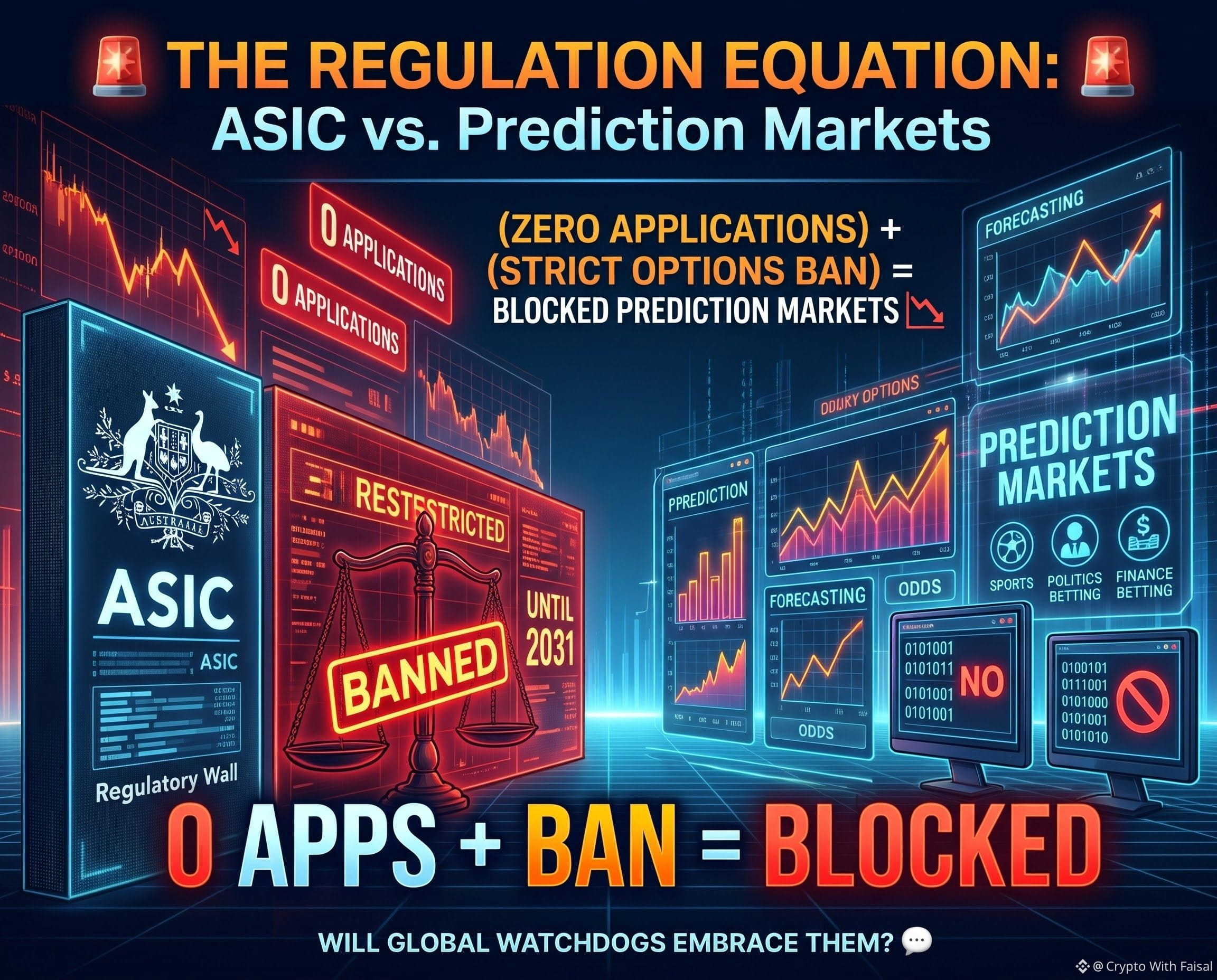
🚨 THE REGULATION EQUATION: ASIC vs. Prediction Markets 🚨
Australia is taking a hard stance. Let's break down the math 🧮👇
(Zero Applications) + (Strict Options Ban) = Blocked Prediction Markets 📉
The Asset Input:
(The Catalyst) = ASIC Chair Sarah Court confirmed to parliament that the regulator currently has zero applications from prediction market operators. Any future filings will face severe scrutiny.
The Key Deliverable:
(The Stance) ➔ ASIC officially classifies prediction platforms in the same high-risk bucket as binary options. Since binary options are strictly banned for retail clients in Australia until October 2031, prediction markets face a massive regulatory wall.
The Breakdown:
Local regulators are refusing to play ball. With zero local licenses, Australian users trading offshore have no financial protection if things go wrong.
Will global watchdogs eventually embrace prediction markets? 👇💬
$BTC
{future}(BTCUSDT)
$POL
{future}(POLUSDT)
$BNB
{future}(BNBUSDT)
#ASIC #Polymarket #predictionmarket
#asichasreceivednopredictionmarketapplications
🚨 THE REGULATION EQUATION: ASIC vs. Prediction Markets 🚨
Australia is taking a hard stance. Let's break down the math 🧮👇
(Zero Applications) + (Strict Options Ban) = Blocked Prediction Markets 📉
The Asset Input:
(The Catalyst) = ASIC Chair Sarah Court confirmed to parliament that the regulator currently has zero applications from prediction market operators. Any future filings will face severe scrutiny.
The Key Deliverable:
(The Stance) ➔ ASIC officially classifies prediction platforms in the same high-risk bucket as binary options. Since binary options are strictly banned for retail clients in Australia until October 2031, prediction markets face a massive regulatory wall.
The Breakdown:
Local regulators are refusing to play ball. With zero local licenses, Australian users trading offshore have no financial protection if things go wrong.
Will global watchdogs eventually embrace prediction markets? 👇💬
$BTC
$POL
$BNB
#ASIC #Polymarket #predictionmarket
1
191
·
--
Can You Run an Algorithmic Bitcoin CFD Strategy in Australia Under ASIC's Cap?$BTC | Can you run an EA or cAlgo strategy on Bitcoin CFDs in Australia and stay inside ASIC's retail rules? Yes. Pepperstone's crypto CFD desk runs on MT4, MT5 and cTrader with Expert Advisor and cAlgo scripting supported, but the mandatory 2:1 leverage cap means a strategy coded for an offshore account needs its position sizing rebuilt from the ground up, not just its API keys swapped over.
## Why does platform support matter more than the coin list here?
On the desk we never separated "is this broker any good" from "can my process actually run on it." A spot exchange like CoinSpot or Binance Australia gives you hundreds of coins and an API, but no charting platform built for running a strategy on the position itself. SatoshiMacro's review of Pepperstone's crypto CFD desk lists about 10 USD-denominated pairs, BTC through to MATIC, running across MT4, MT5, cTrader, TradingView integration and the native web and mobile apps, with EA and cAlgo scripting available on top of all of them. Narrower coin list, wider platform stack. That trade-off is the actual decision, not the headline rating.
## What does the 2:1 cap do to a strategy built elsewhere?
This is where most traders get it wrong. ASIC's leverage cap on retail crypto CFDs has sat at 2:1 since 29 March 2021 and was made permanent in 2022, under AFSL 414530. Take a strategy built on an offshore account running 50x. At 50x, a $1,000 margin unit opens roughly $50,000 of exposure. Drop the same logic onto a 2:1 Pepperstone account and that same $1,000 opens about $2,000, a position 25 times smaller than the backtest assumed. The strategy does not fail on the first signal. It fails three or four trades in, once a sizing error has quietly compounded.
## Where does an AUD 0 minimum deposit actually help?
It is the one number on the page that genuinely helps here. Pepperstone lists an AUD 0 minimum deposit, which means a trader can run a strategy through live execution, real spreads and overnight financing on genuinely small size before scaling up, instead of backtesting in isolation and meeting the real cost structure for the first time at full size. My read is that this does more for a trader porting a system than the leverage cap gets blamed for.
## Does running a bot change how the ATO treats the profit?
No. CFD profits and losses are generally assessed as ordinary income, not a capital gain, whether a human clicks the button or an EA does. The 50 percent CGT discount that applies to crypto held on a spot exchange past 12 months does not apply here, regardless of who or what places the trade. That is a tax outcome, not a technology one.
## What's the honest limitation?
Segregated client funds in Australian Tier-1 banks and negative balance protection stop the account from owing more than it holds. Neither one stops a strategy that is simply wrong. A systematic approach amplifies discipline when the logic holds and losses when it does not, at the same speed either way. This is not a strategy endorsement. A backtest run on offshore leverage and liquidity conditions is not evidence of anything once it is sitting at 2:1 on an ASIC-regulated book.
## My take
What I would actually do before porting anything across is run it on paper at the real 2:1 sizing first, then on the smallest live size the AUD 0 minimum allows, and only then compare the equity curve to the original backtest. If the two do not resemble each other, the leverage assumption was doing more of the work than the edge was.
https://satoshimacro.com/reviews/crypto/pepperstone-crypto-review/?utm_source=binance_square&utm_medium=social&utm_campaign=autopilot_article
#SatoshiMacro #Bitcoin #CryptoCFD #ASIC
Can You Run an Algorithmic Bitcoin CFD Strategy in Australia Under ASIC's Cap?
$BTC | Can you run an EA or cAlgo strategy on Bitcoin CFDs in Australia and stay inside ASIC's retail rules? Yes. Pepperstone's crypto CFD desk runs on MT4, MT5 and cTrader with Expert Advisor and cAlgo scripting supported, but the mandatory 2:1 leverage cap means a strategy coded for an offshore account needs its position sizing rebuilt from the ground up, not just its API keys swapped over.
## Why does platform support matter more than the coin list here?
On the desk we never separated "is this broker any good" from "can my process actually run on it." A spot exchange like CoinSpot or Binance Australia gives you hundreds of coins and an API, but no charting platform built for running a strategy on the position itself. SatoshiMacro's review of Pepperstone's crypto CFD desk lists about 10 USD-denominated pairs, BTC through to MATIC, running across MT4, MT5, cTrader, TradingView integration and the native web and mobile apps, with EA and cAlgo scripting available on top of all of them. Narrower coin list, wider platform stack. That trade-off is the actual decision, not the headline rating.
## What does the 2:1 cap do to a strategy built elsewhere?
This is where most traders get it wrong. ASIC's leverage cap on retail crypto CFDs has sat at 2:1 since 29 March 2021 and was made permanent in 2022, under AFSL 414530. Take a strategy built on an offshore account running 50x. At 50x, a $1,000 margin unit opens roughly $50,000 of exposure. Drop the same logic onto a 2:1 Pepperstone account and that same $1,000 opens about $2,000, a position 25 times smaller than the backtest assumed. The strategy does not fail on the first signal. It fails three or four trades in, once a sizing error has quietly compounded.
## Where does an AUD 0 minimum deposit actually help?
It is the one number on the page that genuinely helps here. Pepperstone lists an AUD 0 minimum deposit, which means a trader can run a strategy through live execution, real spreads and overnight financing on genuinely small size before scaling up, instead of backtesting in isolation and meeting the real cost structure for the first time at full size. My read is that this does more for a trader porting a system than the leverage cap gets blamed for.
## Does running a bot change how the ATO treats the profit?
No. CFD profits and losses are generally assessed as ordinary income, not a capital gain, whether a human clicks the button or an EA does. The 50 percent CGT discount that applies to crypto held on a spot exchange past 12 months does not apply here, regardless of who or what places the trade. That is a tax outcome, not a technology one.
## What's the honest limitation?
Segregated client funds in Australian Tier-1 banks and negative balance protection stop the account from owing more than it holds. Neither one stops a strategy that is simply wrong. A systematic approach amplifies discipline when the logic holds and losses when it does not, at the same speed either way. This is not a strategy endorsement. A backtest run on offshore leverage and liquidity conditions is not evidence of anything once it is sitting at 2:1 on an ASIC-regulated book.
## My take
What I would actually do before porting anything across is run it on paper at the real 2:1 sizing first, then on the smallest live size the AUD 0 minimum allows, and only then compare the equity curve to the original backtest. If the two do not resemble each other, the leverage assumption was doing more of the work than the edge was.
https://satoshimacro.com/reviews/crypto/pepperstone-crypto-review/?utm_source=binance_square&utm_medium=social&utm_campaign=autopilot_article
#SatoshiMacro #Bitcoin #CryptoCFD #ASIC
126

·
--
Came across this update from Australia’s ASIC: Brian Jacques Creigh, from Queensland, has been criminally charged over running an unlicensed crypto investment fund.
Key details: The case was filed in the Melbourne Magistrates’ Court on 19 October 2026. Prosecutors allege that from April 2021 to June 2022, he promoted the “Panacea Capital Cryptocurrency Investment Fund” through Panacea Capital without an AFS licence or authorisation to act as a representative. He is also alleged to have dealt with more than US$1 million in proceeds of crime, linked to the approximately US$4.4 million in investments raised through the unlicensed business. Federal prosecutors brought the charges based on ASIC’s criminal brief, and the court has granted conditional bail. Providing financial services without a licence carries a maximum penalty of 5 years’ imprisonment; dealing with more than US$1 million in proceeds of crime carries a maximum of 25 years. He had already been permanently banned from the industry in March 2024 in connection with the same fund.
Going from an administrative ban to criminal charges is a pretty serious escalation.
#ASIC #加密监管 #Australia

12
·
--
$BTC | On the desk, clients ask about the leverage cap first on a crypto CFD. The number that matters more is negative balance protection.
SatoshiMacro's Pepperstone Crypto review (AFSL 414530) notes ASIC's 2:1 cap started 29 March 2021, but negative balance protection only became permanent in 2022. A sharp swing cannot leave you owing the broker more than your margin. Add AFCA access on a dispute, and that is the real safety net, not the cap itself.
My read: price in the roughly 10 USD-quoted pairs on offer, against 500-plus coins on a spot exchange, before leverage enters the decision. The limit: protection covers broker-side blowups, not your own sizing mistakes. ASIC removes one risk, not all of them.
https://satoshimacro.com/reviews/crypto/pepperstone-crypto-review/?utm_source=binance_square&utm_medium=social&utm_campaign=autopilot_short-2
#SatoshiMacro #CryptoCFD #ASIC #Bitcoin
84

·
--
The Australian Securities and Investments Commission (ASIC) published a consultation paper on October 15 proposing stricter operating standards for cryptocurrency exchanges and custodians.
Under the proposal, exchange capital requirements could start at A$14 million, with ASIC considering three capital models. Custodial businesses would face a A$200,000 threshold, along with asset and revenue tests.
The new rules are being prepared in conjunction with the Digital Assets Framework Amendment Act 2026, which takes effect in 2027. Relevant businesses will then be required to hold an Australian financial services licence.
Platforms will also need to safeguard client assets, segregate funds, assess tokens before listing them, and be restricted from trading against their customers.
#澳大利亚 #加密货币监管 #ASIC
(Source: CryptoSlate)
⚠️Risk warning: The above is shared for market information purposes only and does not constitute investment advice. Investing involves risks; please exercise caution.

16


Canberra is tightening the screws on digital asset platforms. ASIC is pushing for tougher compliance mandates as the deadline for formal exchange licensing approaches fast. Stay sharp and track how regulatory shifts impact liquidity across $BTC and $ETH. #Write2Earn #CryptoRegulation #ASIC #Australia
Canberra is tightening the screws on digital asset platforms. ASIC is pushing for tougher compliance mandates as the deadline for formal exchange licensing approaches fast. Stay sharp and track how regulatory shifts impact liquidity across $BTC and $ETH . #Write2Earn #CryptoRegulation #ASIC #Australia

34

·
--
Australia’s securities regulator ASIC opened a consultation on proposed capital, custody and trading rules for crypto platforms, following the April passage of the Digital Assets Framework Act. The proposal outlines three capital models, including a baseline of 14 million Australian dollars ($9.7 million) in net tangible assets or 10 % of average revenue for firms without approved third‑party custody. It also calls for quarterly reporting of customer‑asset wallets, limits on platforms trading for their own account, and allows offshore custody while seeking feedback on safeguards if an overseas parent fails. Comments are due by 27 November, with final standards expected in March 2027 and the law taking effect on 8 April 2027, giving operators until 7 October 2027 to lodge licence applications.
#AustraliaCrypto #ASIC #CryptoRegulation
#AustraliaCrypto #ASIC #CryptoRegulation

77

·
--
ASIC hands Australian exchanges their homework: the rules won’t be finalised until next springAustralia’s ASIC has laid out the homework for digital asset platforms: this isn’t just talk—they’ll have to enter the financial licensing system.
ASIC’s media release 26-245MR opens a consultation on Consultation Paper CP 392, implementing the Digital Asset Framework Act 2026 (DAF). It covers two areas: digital asset platforms (DAPs, which hold digital tokens for clients and provide platform services) and tokenised custody platforms (TCPs, which represent underlying assets as digital tokens). The new rules are scheduled to take effect on 8 April 2027.
If they want to keep operating, there’s basically no avoiding the requirements: apply for or vary an Australian financial services licence (AFSL), provide client disclosure documents and platform rules, and meet standards for asset custody, trade settlement and net tangible assets. Existing licence holders, as well as those who have submitted an authorisation application under INFO 225, will have access to a streamlined pathway. The consultation closes at 5:00 pm on 27 November 2026 (Sydney daylight saving time).
ASIC hands Australian exchanges their homework: the rules won’t be finalised until next spring
Australia’s ASIC has laid out the homework for digital asset platforms: this isn’t just talk—they’ll have to enter the financial licensing system.
ASIC’s media release 26-245MR opens a consultation on Consultation Paper CP 392, implementing the Digital Asset Framework Act 2026 (DAF). It covers two areas: digital asset platforms (DAPs, which hold digital tokens for clients and provide platform services) and tokenised custody platforms (TCPs, which represent underlying assets as digital tokens). The new rules are scheduled to take effect on 8 April 2027.
If they want to keep operating, there’s basically no avoiding the requirements: apply for or vary an Australian financial services licence (AFSL), provide client disclosure documents and platform rules, and meet standards for asset custody, trade settlement and net tangible assets. Existing licence holders, as well as those who have submitted an authorisation application under INFO 225, will have access to a streamlined pathway. The consultation closes at 5:00 pm on 27 November 2026 (Sydney daylight saving time).
193

·
--
Details of Australia’s crypto licensing framework take shape: consultation open until November 27
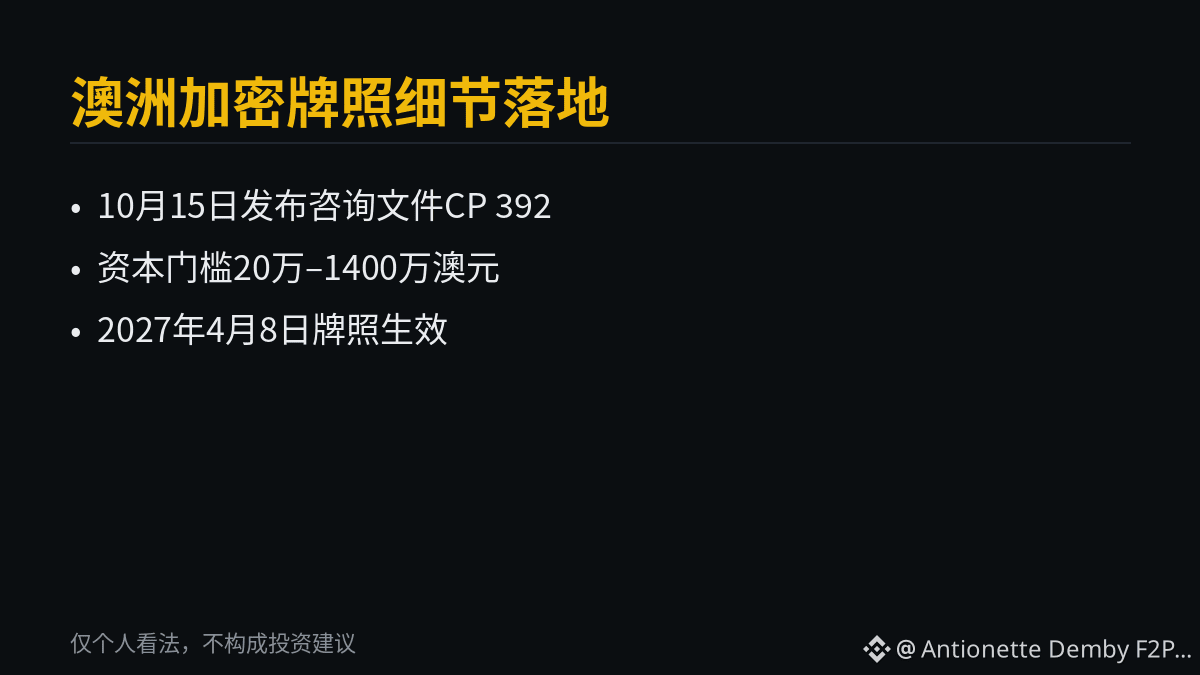
On October 15, Australia’s securities regulator ASIC released consultation paper CP 392, proposing capital, custody, and trading rules for Digital Asset Platforms (DAPs) and Tokenised Custody Platforms (TCPs). This is a key step ahead of the licensing regime’s formal commencement on April 8, 2027.
1. Timeline. On April 8, 2026, the Corporations Amendment (Digital Assets Framework) Act received royal assent. The law is set to take effect on April 8, 2027. The consultation closes on November 27, 2026, at 5 p.m. AEDT. The industry will have less than six months to transition from the consultation process to the regime’s formal implementation.
2. Capital requirements. The proposal sets out three alternative capital models, ranging from A$200,000 to A$14 million. ASIC also wants to restrict platforms’ proprietary trading and require quarterly reporting on wallets holding client assets.
3. Current situation. ASIC disclosed that it has already received more than 140 applications for authorisation to provide digital asset-related financial services, with over 110 submitted during the INFO 225 no-action statement period (October 2025 to September 30, 2026). The number of firms waiting for a licence is already substantial.
Notably, the rules also consider whether overseas custodians should be allowed, as well as safeguards in the event of problems with an overseas parent company or affiliated custodian—these are real cost considerations for cross-border platforms.
My view: The strictness of these rules is approaching that of traditional financial licences. Once implemented, compliance costs will become a barrier that could drive smaller platforms out of the market. For retail investors, asset segregation and quarterly disclosures mean a lower risk of platform failures. This kind of regulatory implementation is generally a long-term positive and short-term neutral. This is just my personal opinion and does not constitute investment advice.
$BTC
#澳洲 #加密监管 #ASIC
66

Australia's regulator ASIC is proposing new leverage caps and negative balance protections for derivatives settled using digital assets. This move signals a tighter regulatory environment for high risk trading in the region.
#ASIC #LeverageCaps
Australia's regulator ASIC is proposing new leverage caps and negative balance protections for derivatives settled using digital assets. This move signals a tighter regulatory environment for high risk trading in the region.
#ASIC #LeverageCaps
#ASIC #LeverageCaps
17
·
--
The Australian Securities and Investments Commission (ASIC) has proposed extending retail investor protection rules, including leverage limits, to contracts for difference (CFDs) settled in digital assets.
Rules in place since 2021 limit leverage, require positions to be closed out when account funds fall below a certain threshold, and provide negative balance protection. The new proposal would cover contracts settled in crypto assets, while crypto futures and options with fixed expiry dates would remain exempt. ASIC has opened a public consultation on the proposal, with submissions due by November 9. Australia has also previously legislated to bring crypto exchanges under its financial services licensing framework, with the new rules taking effect in April 2027.
(Source: Cointelegraph)
⚠️Risk warning: The above is for sharing market information only and does not constitute investment advice. Investing involves risk; please exercise caution.
#澳洲监管 #加密衍生品 #ASIC
34

Australia proposes a leverage cap for crypto derivatives
- ASIC proposes leverage limits for derivatives settled in digital assets
- Extends negative balance protection to investors
- Applies to certain derivatives
#BinanceSquare #CryptoNews #ASIC #Regulation
$btc $eth
#vlikevn Titanbot
Source: CoinTelegraph
- ASIC proposes leverage limits for derivatives settled in digital assets
- Extends negative balance protection to investors
- Applies to certain derivatives
#BinanceSquare #CryptoNews #ASIC #Regulation
$btc $eth
#vlikevn Titanbot
Source: CoinTelegraph
270

·
--
ASIC proposes leverage caps for crypto-settled derivatives, signaling a clear tightening of compliance requirements
According to Cointelegraph, ASIC has proposed extending leverage limits and negative balance protection to certain derivatives settled in crypto assets. This development is noteworthy because it signals that Australia’s regulatory framework is expanding beyond traditional securities derivatives to cover crypto-settled instruments.
The key aim of ASIC’s move is to bring crypto-settled derivatives under a clearer investor protection framework. In the past, some derivatives were subject to inconsistent disclosures about leverage and negative balance risks because of their specific settlement methods. If the new rules take effect, the leverage available on these products and their risk profiles could be redefined, requiring exchanges and market makers to adjust product design and risk controls.
In terms of market impact, this is a regional tightening of compliance requirements, not a global reduction in leverage. For local Australian participants, the costs and risk limits of trading high-leverage crypto derivatives may change. Cross-border platforms, meanwhile, will need to consider whether to adjust leverage settings for Australian users. Since the available information does not specify the leverage multiples, effective date, or scope, the extent of the impact remains unclear pending further details.
One counterpoint is that tighter regulation may not directly suppress market activity. Some investors may shift to products with more transparent leverage and clearer rules, potentially making compliant platforms relatively more attractive. In addition, if the detailed rules allow for flexibility in implementation, the market adjustment may be limited.
It is worth watching whether ASIC announces specific leverage caps, negative balance protection mechanisms, and the scope of covered products. If the rules are clear and strictly enforced, Australia’s crypto derivatives landscape may undergo a temporary adjustment.
#CryptoRegulation #ASIC
The above is a summary of information and personal analysis, and does not constitute investment advice.
I will continue to provide updates as further policy details become clear.
12
Australia proposes leverage limits for crypto-settled derivatives
- ASIC (the Australian Securities and Investments Commission) has proposed introducing leverage limits and negative balance protection for certain derivatives settled in digital assets.
- The proposal aims to extend existing safeguards to the crypto-settled derivatives sector.
- Details about the specific limits and implementation timeline were not included in the RSS description.
#CryptoNews #ASIC #CryptoRegulation #Derivatives #BinanceSquare
$btc $eth
vlikevn Titanbot
Source: CoinTelegraph
143

·
--
Silicon for ZK: The Rise of Zero-Knowledge ASICs 🔌⚙️
Generating ZK proofs requires heavy computing. Companies are building specialized hardware chips (ASICs) purely to speed up ZK cryptography, making Web3 hyper-fast.
#ZKHardware #ASIC #CryptoInfrastructure #TechTrends .
Silicon for ZK: The Rise of Zero-Knowledge ASICs 🔌⚙️
Generating ZK proofs requires heavy computing. Companies are building specialized hardware chips (ASICs) purely to speed up ZK cryptography, making Web3 hyper-fast.
#ZKHardware #ASIC #CryptoInfrastructure #TechTrends .
Generating ZK proofs requires heavy computing. Companies are building specialized hardware chips (ASICs) purely to speed up ZK cryptography, making Web3 hyper-fast.
#ZKHardware #ASIC #CryptoInfrastructure #TechTrends .
1
76
Log in to explore more content
Join global crypto users on Binance Square
⚡️ Get latest and useful information about crypto.
💬 Trusted by the world’s largest crypto exchange.
👍 Discover real insights from verified creators.
Email / Phone number
Trending Topics
1
#HotCPIDecemberHikePriced
297,950 views
3,125 Discussing
2
#ZcashFallsBelow$1000ForFirstTimeSinceSeptember
6,628 views
47 Discussing
3
#StrategyFaces$2.8BSelloffRiskFromMSCIRemoval
17,577 views
130 Discussing
4
#AnthropicRejectsIPODelayValuationinQuestion
349,608 views
3,135 Discussing
5
#BitcoinETFsLose$1.6BInNovember
5,941 views
33 Discussing
6
#AnthropicDisclosesOver$10BNewComputeDeals
1,517 views
24 Discussing
7
#CoreWeaveJumps10%On168%RevenueGrowth
17,417 views
414 Discussing
8
#CanNvidiaEarningsEaseMarketConcerns?
101,405 views
1,347 Discussing
9
#BarclaysRaisesBlackRockBitcoinETFStake48%
14,283 views
306 Discussing
10
#BitmineReports$6.3BFiscal2026Loss
6,966 views
22 Discussing