
#aave
aave
6.9M views
23,594 Discussing
Hot
Latest

·
--
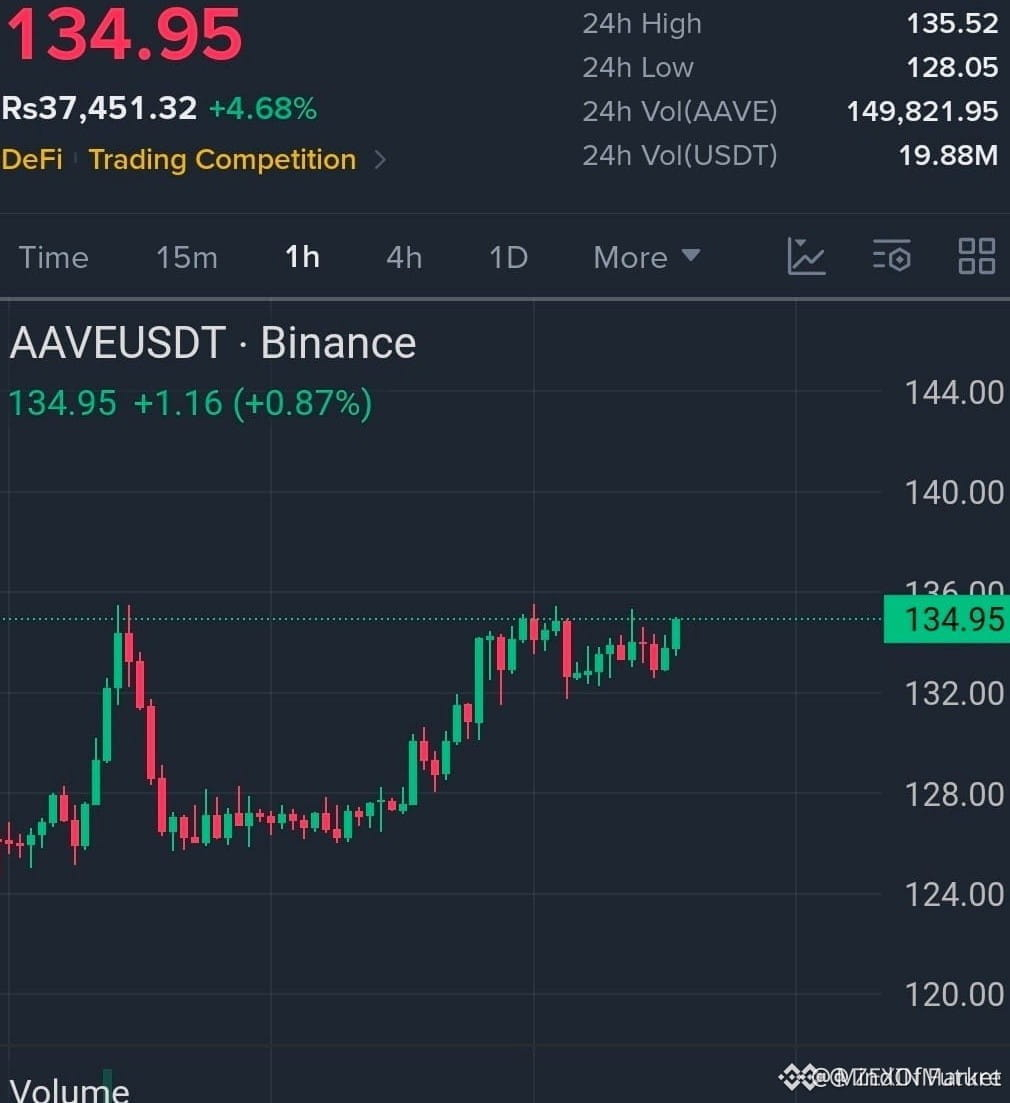
🚨 $AAVE ACCUMULATION BASE ABSORBS SELLER LIQUIDITY BEFORE POTENTIAL SQUEEZE! 💥
Entry: 133.5 - 134.5 ⚡
Target: 138 - 142 🚀
Stop Loss: 130.5 ⚠️
$AAVE has established a firm demand block around 134, demonstrating aggressive institutional absorption of lower-side liquidity. 🔍 Sustained bid pressure off this key structural floor indicates smart money positioning while overleveraged shorts remain exposed.
With buy-side order flow accelerating, a clean expansion toward overhead imbalance targets is taking shape. 📊 Risk remains strictly defined below the structural invalidation level, offering an asymmetric risk-to-reward profile. 💬 Are you anticipating an immediate liquidity sweep higher, or waiting for a deeper retest of demand? 👇
⚠️ Not financial advice. Always manage your risk. 🛡️
🏷️ #AAVE #LongSetup #Crypto #Defi #MarketStructure
🔥 🎯
🚨 $AAVE ACCUMULATION BASE ABSORBS SELLER LIQUIDITY BEFORE POTENTIAL SQUEEZE! 💥
Entry: 133.5 - 134.5 ⚡
Target: 138 - 142 🚀
Stop Loss: 130.5 ⚠️
$AAVE has established a firm demand block around 134, demonstrating aggressive institutional absorption of lower-side liquidity. 🔍 Sustained bid pressure off this key structural floor indicates smart money positioning while overleveraged shorts remain exposed.
With buy-side order flow accelerating, a clean expansion toward overhead imbalance targets is taking shape. 📊 Risk remains strictly defined below the structural invalidation level, offering an asymmetric risk-to-reward profile. 💬 Are you anticipating an immediate liquidity sweep higher, or waiting for a deeper retest of demand? 👇
⚠️ Not financial advice. Always manage your risk. 🛡️
🏷️ #AAVE #LongSetup #Crypto #Defi #MarketStructure
🔥 🎯
Entry: 133.5 - 134.5 ⚡
Target: 138 - 142 🚀
Stop Loss: 130.5 ⚠️
$AAVE has established a firm demand block around 134, demonstrating aggressive institutional absorption of lower-side liquidity. 🔍 Sustained bid pressure off this key structural floor indicates smart money positioning while overleveraged shorts remain exposed.
With buy-side order flow accelerating, a clean expansion toward overhead imbalance targets is taking shape. 📊 Risk remains strictly defined below the structural invalidation level, offering an asymmetric risk-to-reward profile. 💬 Are you anticipating an immediate liquidity sweep higher, or waiting for a deeper retest of demand? 👇
⚠️ Not financial advice. Always manage your risk. 🛡️
🏷️ #AAVE #LongSetup #Crypto #Defi #MarketStructure
🔥 🎯
41

·
--
$AAVE has an actual DeFi use case behind it. 👀
As lending activity and liquidity grow across crypto, Aave could remain one of the major names in decentralized finance.
Possible bull-market zones I’d watch:
$300 → Recovery zone
$400 → Strong momentum
$500 → Major psychological level
$700+ → Aggressive bull-case
Nothing is guaranteed—but $AAVE reaching the $500 area again is an interesting scenario to watch if DeFi gains momentum.
Would you hold $AAVE for the next major DeFi cycle?
#altcoins #AAVE
$AAVE has an actual DeFi use case behind it. 👀
As lending activity and liquidity grow across crypto, Aave could remain one of the major names in decentralized finance.
Possible bull-market zones I’d watch:
$300 → Recovery zone
$400 → Strong momentum
$500 → Major psychological level
$700+ → Aggressive bull-case
Nothing is guaranteed—but $AAVE reaching the $500 area again is an interesting scenario to watch if DeFi gains momentum.
Would you hold $AAVE for the next major DeFi cycle?
#altcoins #AAVE
As lending activity and liquidity grow across crypto, Aave could remain one of the major names in decentralized finance.
Possible bull-market zones I’d watch:
$300 → Recovery zone
$400 → Strong momentum
$500 → Major psychological level
$700+ → Aggressive bull-case
Nothing is guaranteed—but $AAVE reaching the $500 area again is an interesting scenario to watch if DeFi gains momentum.
Would you hold $AAVE for the next major DeFi cycle?
#altcoins #AAVE

36

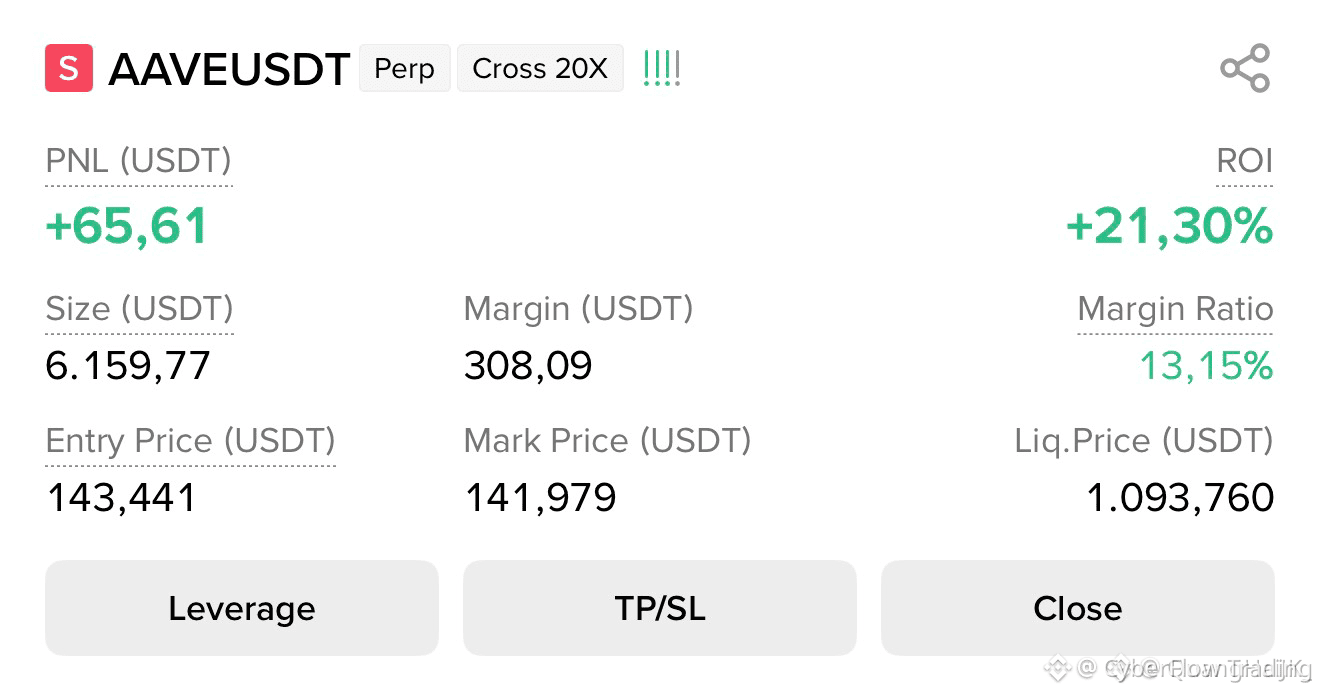
📉 $AAVE HEAVY SUPPLY AT RESISTANCE SIGNS DOWNSIDE EXHAUSTION! 🚨
Entry: 142 - 147 ⚡
Target: 137 - 105 🎯
Stop Loss: 148 ⚠️
📌 $AAVE is showing clear exhaustion right into the 142-147 supply zone, where aggressive sell orders are suppressing upside attempts. 📊 Sellers are defending this structural level tightly while buying volume fades on lower timeframes.
💡 An invalidation cap at 148 protects the position cleanly, setting up a sharp short opportunity down toward lower liquidity pockets. 📉 If this supply wall holds, the slide down could be swift. 💬 Are you riding this short setup down to support or waiting for a complete liquidity sweep below 105? 👇
⚠️ Not financial advice. Always manage your risk. 🛡️
🏷️ #AAVE #ShortSetup #DeFi #Crypto
🐻 🔻
📉 $AAVE HEAVY SUPPLY AT RESISTANCE SIGNS DOWNSIDE EXHAUSTION! 🚨
Entry: 142 - 147 ⚡
Target: 137 - 105 🎯
Stop Loss: 148 ⚠️
📌 $AAVE is showing clear exhaustion right into the 142-147 supply zone, where aggressive sell orders are suppressing upside attempts. 📊 Sellers are defending this structural level tightly while buying volume fades on lower timeframes.
💡 An invalidation cap at 148 protects the position cleanly, setting up a sharp short opportunity down toward lower liquidity pockets. 📉 If this supply wall holds, the slide down could be swift. 💬 Are you riding this short setup down to support or waiting for a complete liquidity sweep below 105? 👇
⚠️ Not financial advice. Always manage your risk. 🛡️
🏷️ #AAVE #ShortSetup #DeFi #Crypto
🐻 🔻
Entry: 142 - 147 ⚡
Target: 137 - 105 🎯
Stop Loss: 148 ⚠️
📌 $AAVE is showing clear exhaustion right into the 142-147 supply zone, where aggressive sell orders are suppressing upside attempts. 📊 Sellers are defending this structural level tightly while buying volume fades on lower timeframes.
💡 An invalidation cap at 148 protects the position cleanly, setting up a sharp short opportunity down toward lower liquidity pockets. 📉 If this supply wall holds, the slide down could be swift. 💬 Are you riding this short setup down to support or waiting for a complete liquidity sweep below 105? 👇
⚠️ Not financial advice. Always manage your risk. 🛡️
🏷️ #AAVE #ShortSetup #DeFi #Crypto
🐻 🔻
28
🚨 $AAVE INSTITUTIONAL ACCUMULATION COMPLETE AS STRUCTURAL EXPANSION TARGETS $200 💥
Target: 200 🚀
Institutional footprint indicates heavy smart money absorption near key demand zones, clearing local overhead resistance. 🦈 Systemic order flow has transitioned firmly bullish, paving the structural path of least resistance toward major liquidity targets. 📊
As structural market expansion takes hold and inefficiency gaps fill, waiting for secondary confirmation often results in suboptimal risk-to-reward positioning. 💡 Are you capturing the structural expansion early or waiting for the sweep into overhead supply? 👇
⚠️ Not financial advice. Always manage your risk. 🛡️
🏷️ #AAVE #LongSetup #DeFi #Breakout #Crypto
🎯 🦈
🚨 $AAVE INSTITUTIONAL ACCUMULATION COMPLETE AS STRUCTURAL EXPANSION TARGETS $200 💥
Target: 200 🚀
Institutional footprint indicates heavy smart money absorption near key demand zones, clearing local overhead resistance. 🦈 Systemic order flow has transitioned firmly bullish, paving the structural path of least resistance toward major liquidity targets. 📊
As structural market expansion takes hold and inefficiency gaps fill, waiting for secondary confirmation often results in suboptimal risk-to-reward positioning. 💡 Are you capturing the structural expansion early or waiting for the sweep into overhead supply? 👇
⚠️ Not financial advice. Always manage your risk. 🛡️
🏷️ #AAVE #LongSetup #DeFi #Breakout #Crypto
🎯 🦈
Target: 200 🚀
Institutional footprint indicates heavy smart money absorption near key demand zones, clearing local overhead resistance. 🦈 Systemic order flow has transitioned firmly bullish, paving the structural path of least resistance toward major liquidity targets. 📊
As structural market expansion takes hold and inefficiency gaps fill, waiting for secondary confirmation often results in suboptimal risk-to-reward positioning. 💡 Are you capturing the structural expansion early or waiting for the sweep into overhead supply? 👇
⚠️ Not financial advice. Always manage your risk. 🛡️
🏷️ #AAVE #LongSetup #DeFi #Breakout #Crypto
🎯 🦈
25



Aave is looking at giving BTC-backed borrowing more room — while leaving borrowers with less room for error.
That’s the part I find more interesting.
The reported proposal would raise borrowing capacity for WBTC and cbBTC while narrowing the simplified maximum-leverage price cushion from 6.4% to 4.7%. If that parameter change is implemented as reported, a relatively modest BTC drawdown could matter much faster for highly leveraged positions.
And this is where the headline gets a little misleading.
More borrowing capacity sounds like better capital efficiency. But capital efficiency and liquidation resilience aren’t the same thing. You can make collateral work harder while simultaneously making the edge of the system thinner.
Aave has already been actively adjusting BTC-related risk parameters. Recent governance work proposed higher collateral efficiency for WBTC and cbBTC on several markets, while earlier risk reviews have also adjusted supply caps as utilization changed.
So I’m not reading this simply as “Aave is becoming more bullish on BTC.”
I’m reading it as a risk-engineering tradeoff: more leverage capacity on one side, less tolerance for adverse price movement on the other.
That tradeoff matters a lot more than the headline APY or borrowing limit.
Still trying to figure out what this actually changes.
#AAVE
Source: Aave Governance; CryptoSlate.
Aave is looking at giving BTC-backed borrowing more room — while leaving borrowers with less room for error.
That’s the part I find more interesting.
The reported proposal would raise borrowing capacity for WBTC and cbBTC while narrowing the simplified maximum-leverage price cushion from 6.4% to 4.7%. If that parameter change is implemented as reported, a relatively modest BTC drawdown could matter much faster for highly leveraged positions.
And this is where the headline gets a little misleading.
More borrowing capacity sounds like better capital efficiency. But capital efficiency and liquidation resilience aren’t the same thing. You can make collateral work harder while simultaneously making the edge of the system thinner.
Aave has already been actively adjusting BTC-related risk parameters. Recent governance work proposed higher collateral efficiency for WBTC and cbBTC on several markets, while earlier risk reviews have also adjusted supply caps as utilization changed.
So I’m not reading this simply as “Aave is becoming more bullish on BTC.”
I’m reading it as a risk-engineering tradeoff: more leverage capacity on one side, less tolerance for adverse price movement on the other.
That tradeoff matters a lot more than the headline APY or borrowing limit.
Still trying to figure out what this actually changes.
#AAVE
Source: Aave Governance; CryptoSlate.
That’s the part I find more interesting.
The reported proposal would raise borrowing capacity for WBTC and cbBTC while narrowing the simplified maximum-leverage price cushion from 6.4% to 4.7%. If that parameter change is implemented as reported, a relatively modest BTC drawdown could matter much faster for highly leveraged positions.
And this is where the headline gets a little misleading.
More borrowing capacity sounds like better capital efficiency. But capital efficiency and liquidation resilience aren’t the same thing. You can make collateral work harder while simultaneously making the edge of the system thinner.
Aave has already been actively adjusting BTC-related risk parameters. Recent governance work proposed higher collateral efficiency for WBTC and cbBTC on several markets, while earlier risk reviews have also adjusted supply caps as utilization changed.
So I’m not reading this simply as “Aave is becoming more bullish on BTC.”
I’m reading it as a risk-engineering tradeoff: more leverage capacity on one side, less tolerance for adverse price movement on the other.
That tradeoff matters a lot more than the headline APY or borrowing limit.
Still trying to figure out what this actually changes.
#AAVE
Source: Aave Governance; CryptoSlate.
221

·
--
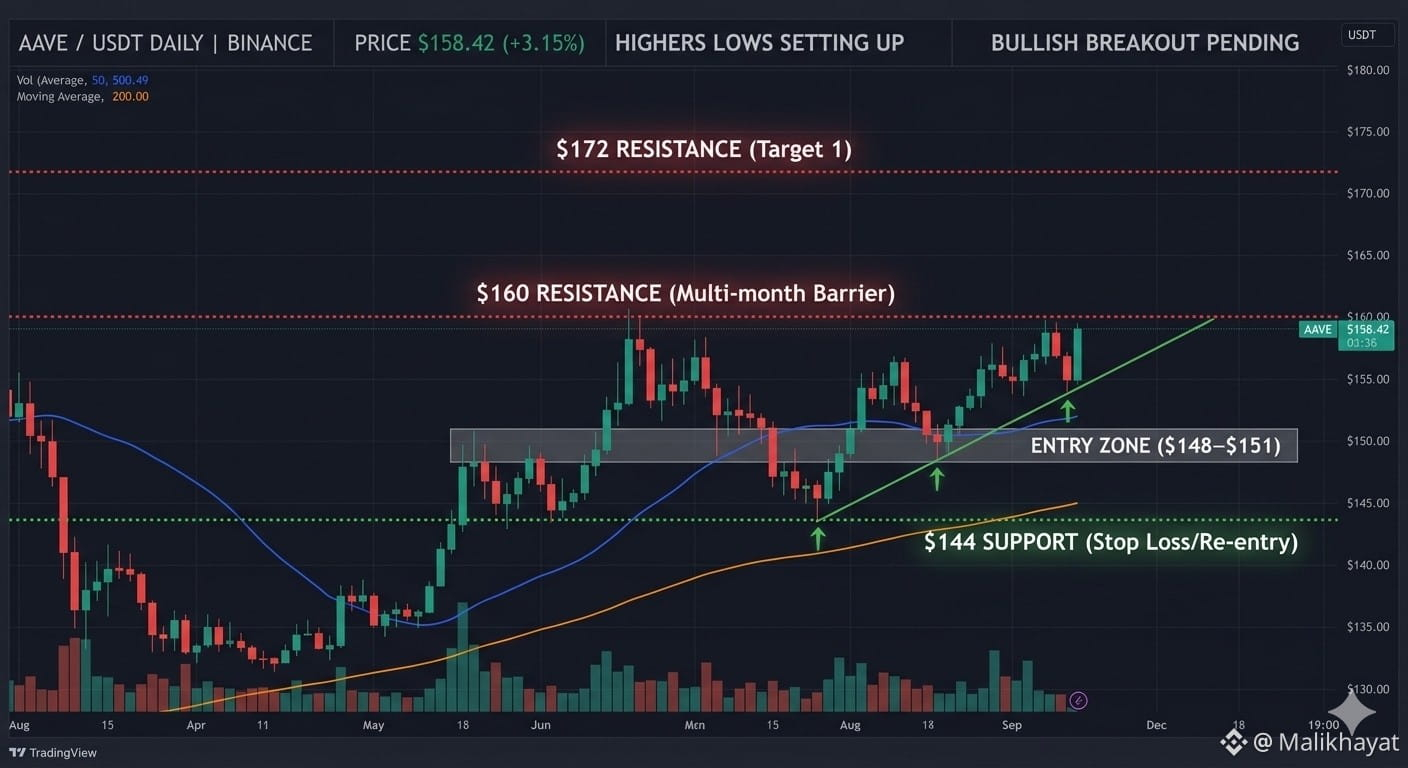
$AAVE is trading near multi-month resistance while continuing to form higher lows on the daily chart. The 20-EMA at $144 is acting as dynamic support, and the supplied data shows spot accumulation dominating futures leverage. The $148–$151 entry zone sits below the $160 resistance level, making that area important for confirmation of further upside.
📈 Bias: Bullish Accumulation | 🎯 Entry: $148–$151 | 🛡 Support: $144, $136 | 🚧 Resistance: $160, $172 | 🎯 Targets: $160, $170, $182 | ❌ Invalidation: $142
Strategy: Confirmation around the consolidation-breakout structure.
#AAVE #DeFi #CryptoTrading #Binance #TechnicalAnalysis
{future}(AAVEUSDT)
$AAVE is trading near multi-month resistance while continuing to form higher lows on the daily chart. The 20-EMA at $144 is acting as dynamic support, and the supplied data shows spot accumulation dominating futures leverage. The $148–$151 entry zone sits below the $160 resistance level, making that area important for confirmation of further upside.
📈 Bias: Bullish Accumulation | 🎯 Entry: $148–$151 | 🛡 Support: $144, $136 | 🚧 Resistance: $160, $172 | 🎯 Targets: $160, $170, $182 | ❌ Invalidation: $142
Strategy: Confirmation around the consolidation-breakout structure.
#AAVE #DeFi #CryptoTrading #Binance #TechnicalAnalysis
📈 Bias: Bullish Accumulation | 🎯 Entry: $148–$151 | 🛡 Support: $144, $136 | 🚧 Resistance: $160, $172 | 🎯 Targets: $160, $170, $182 | ❌ Invalidation: $142
Strategy: Confirmation around the consolidation-breakout structure.
#AAVE #DeFi #CryptoTrading #Binance #TechnicalAnalysis
7

🚨 $AAVE
IS BACK ON THE RADAR 👀📊
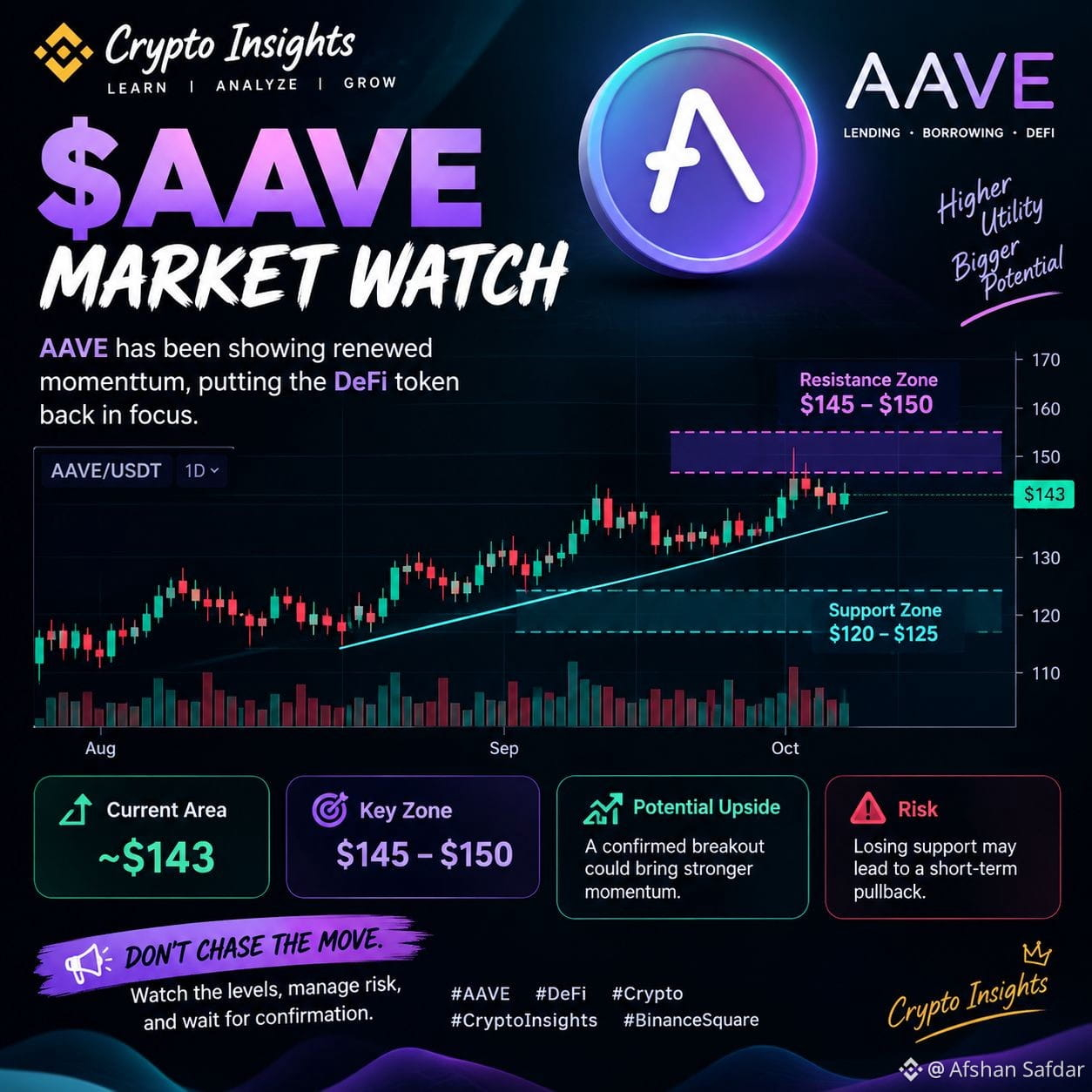
AAVE has been showing renewed momentum, putting the DeFi token back in focus.
{spot}(AAVEUSDT)
🔹 Current area: ~$143
🔹 Key zone: $145–$150
🔹 A confirmed breakout could bring stronger momentum
🔹 Losing support may lead to a short-term pullback
📌 Don’t chase the move. Watch the levels and wait for confirmation.
#AAVE #DeFi #Crypto #CryptoInsights #BinanceSquare
🚨 $AAVE
IS BACK ON THE RADAR 👀📊
AAVE has been showing renewed momentum, putting the DeFi token back in focus.
🔹 Current area: ~$143
🔹 Key zone: $145–$150
🔹 A confirmed breakout could bring stronger momentum
🔹 Losing support may lead to a short-term pullback
📌 Don’t chase the move. Watch the levels and wait for confirmation.
#AAVE #DeFi #Crypto #CryptoInsights #BinanceSquare
IS BACK ON THE RADAR 👀📊
AAVE has been showing renewed momentum, putting the DeFi token back in focus.
🔹 Current area: ~$143
🔹 Key zone: $145–$150
🔹 A confirmed breakout could bring stronger momentum
🔹 Losing support may lead to a short-term pullback
📌 Don’t chase the move. Watch the levels and wait for confirmation.
#AAVE #DeFi #Crypto #CryptoInsights #BinanceSquare
67


·
--
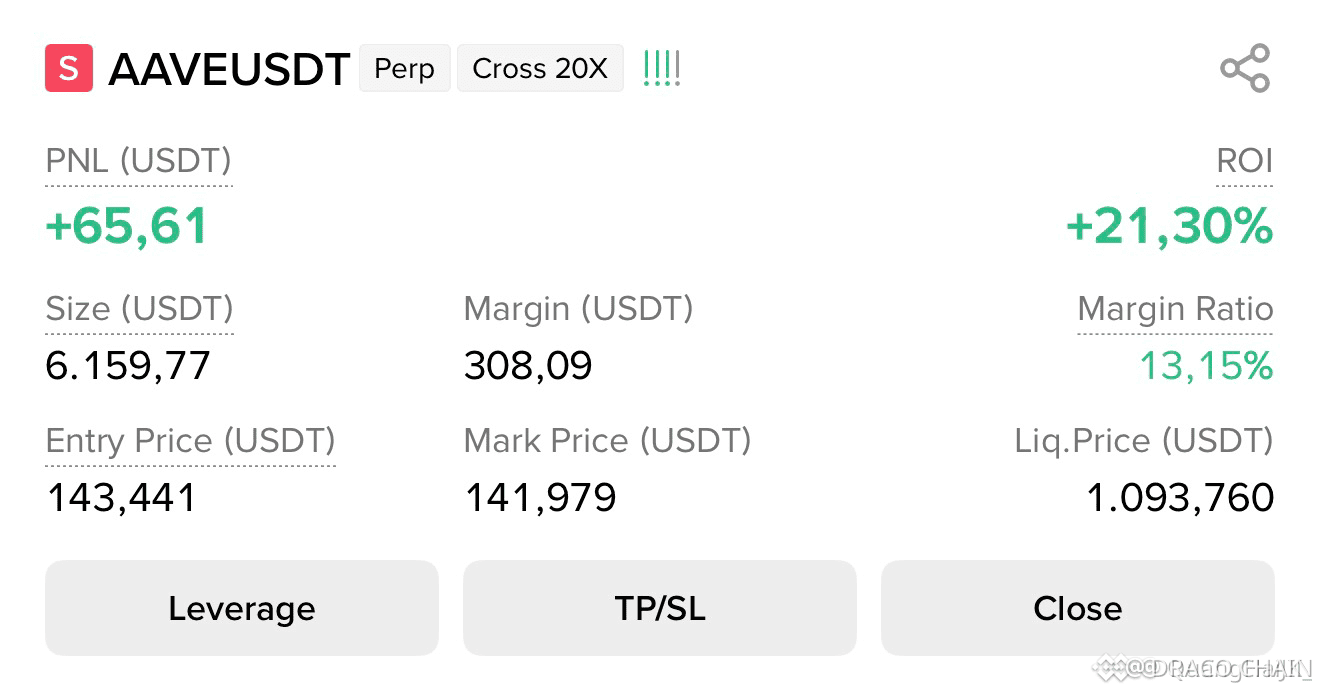
🚨 $AAVE FACES HEAVY PREMIUM REJECTION AS INSTITUTIONAL DOWNWARD EXPANSION LOOMS 🔻
Entry: 142 - 147 ⚡
Target: 137 - 105 🎯
Stop Loss: 148 ⚠️
📌 $AAVE has swept buy-side liquidity into the 142-147 supply zone, signaling decisive seller defense at key structural resistance. 🔍 Order flow reflects exhaustion at these high levels, creating a prime environment to target lower liquidity pools down to 105.
💡 With a tight stop above structure at 148, this short configuration offers exceptional risk-to-reward as price gravitates toward lower inefficiencies. 💬 Are you positioning for this downside expansion or waiting for extra structural confirmation? 👇
⚠️ Not financial advice. Always manage your risk. 🛡️
🏷️ #AAVE #ShortSetup #MarketStructure #Crypto
🐻 🎯
🚨 $AAVE FACES HEAVY PREMIUM REJECTION AS INSTITUTIONAL DOWNWARD EXPANSION LOOMS 🔻
Entry: 142 - 147 ⚡
Target: 137 - 105 🎯
Stop Loss: 148 ⚠️
📌 $AAVE has swept buy-side liquidity into the 142-147 supply zone, signaling decisive seller defense at key structural resistance. 🔍 Order flow reflects exhaustion at these high levels, creating a prime environment to target lower liquidity pools down to 105.
💡 With a tight stop above structure at 148, this short configuration offers exceptional risk-to-reward as price gravitates toward lower inefficiencies. 💬 Are you positioning for this downside expansion or waiting for extra structural confirmation? 👇
⚠️ Not financial advice. Always manage your risk. 🛡️
🏷️ #AAVE #ShortSetup #MarketStructure #Crypto
🐻 🎯
Entry: 142 - 147 ⚡
Target: 137 - 105 🎯
Stop Loss: 148 ⚠️
📌 $AAVE has swept buy-side liquidity into the 142-147 supply zone, signaling decisive seller defense at key structural resistance. 🔍 Order flow reflects exhaustion at these high levels, creating a prime environment to target lower liquidity pools down to 105.
💡 With a tight stop above structure at 148, this short configuration offers exceptional risk-to-reward as price gravitates toward lower inefficiencies. 💬 Are you positioning for this downside expansion or waiting for extra structural confirmation? 👇
⚠️ Not financial advice. Always manage your risk. 🛡️
🏷️ #AAVE #ShortSetup #MarketStructure #Crypto
🐻 🎯
30
·
--
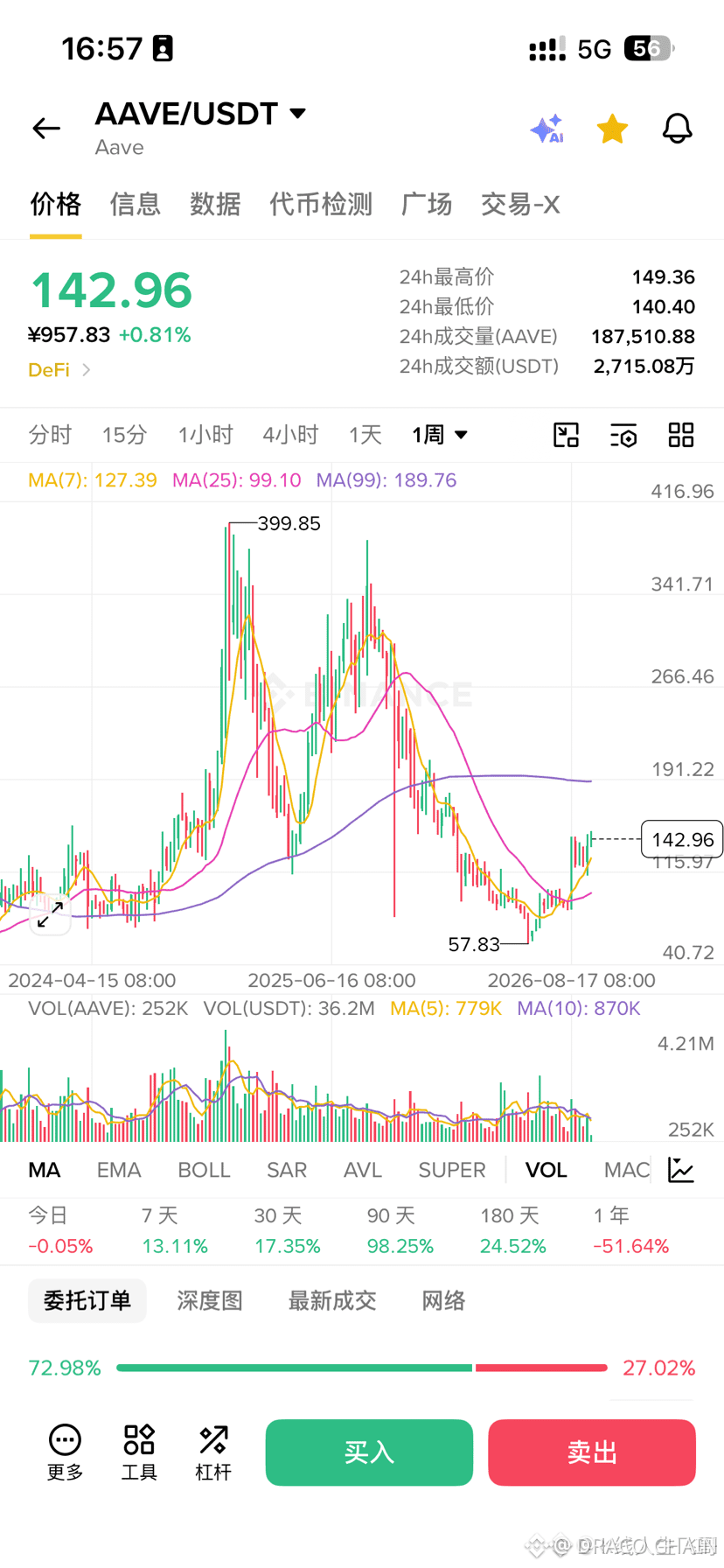
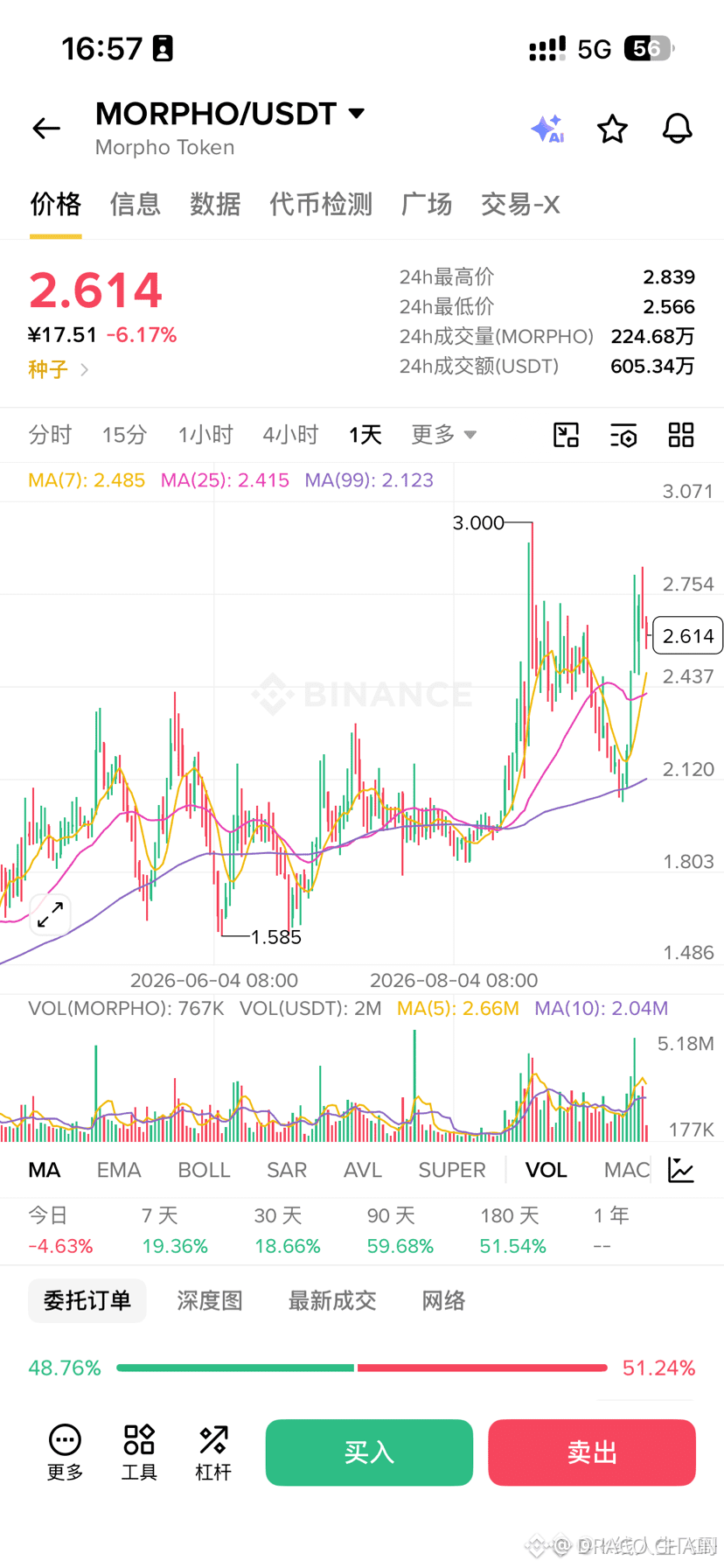
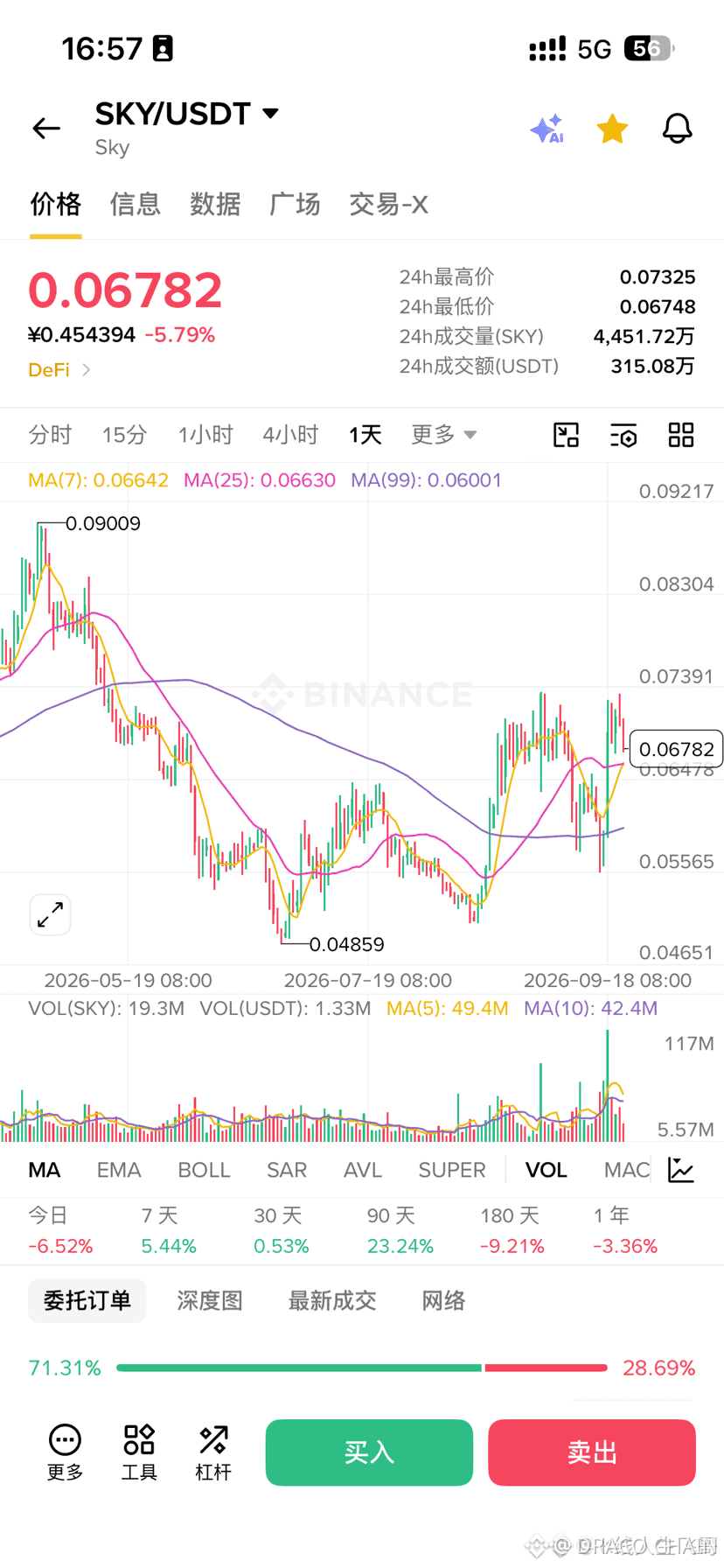
🚨 $AAVE VS $MORPHO : DEFI VALUE CAPTURE AND INSTITUTIONAL REVENUE FLOWS 📊
Smart money rotation across DeFi lending reveals stark structural differences. While institutional capital behind $MORPHO leverages strong backing, curator fee distribution heavily dilutes native token value capture. Conversely, $AAVE is positioning for 100% protocol revenue redirection to the DAO, establishing superior long-term structural alignment. 🦈
The critical catalyst for $AAVE remains the execution of automated token buybacks alongside smooth V4 scaling. If revenue redistribution fails to materialize, the structural thesis invalidates. Meanwhile, $SKY tokenomics remain too diluted to justify long-term capital allocation. 💡
💬 Which protocol structure are you backing for institutional yield capture this cycle? 👇
⚠️ Not financial advice. Always manage your risk. 🛡️
🏷️ #AAVE #DeFi #Crypto #Altcoins #Morpho
🎯 🦈
🚨 $AAVE VS $MORPHO : DEFI VALUE CAPTURE AND INSTITUTIONAL REVENUE FLOWS 📊
Smart money rotation across DeFi lending reveals stark structural differences. While institutional capital behind $MORPHO leverages strong backing, curator fee distribution heavily dilutes native token value capture. Conversely, $AAVE is positioning for 100% protocol revenue redirection to the DAO, establishing superior long-term structural alignment. 🦈
The critical catalyst for $AAVE remains the execution of automated token buybacks alongside smooth V4 scaling. If revenue redistribution fails to materialize, the structural thesis invalidates. Meanwhile, $SKY tokenomics remain too diluted to justify long-term capital allocation. 💡
💬 Which protocol structure are you backing for institutional yield capture this cycle? 👇
⚠️ Not financial advice. Always manage your risk. 🛡️
🏷️ #AAVE #DeFi #Crypto #Altcoins #Morpho
🎯 🦈
Smart money rotation across DeFi lending reveals stark structural differences. While institutional capital behind $MORPHO leverages strong backing, curator fee distribution heavily dilutes native token value capture. Conversely, $AAVE is positioning for 100% protocol revenue redirection to the DAO, establishing superior long-term structural alignment. 🦈
The critical catalyst for $AAVE remains the execution of automated token buybacks alongside smooth V4 scaling. If revenue redistribution fails to materialize, the structural thesis invalidates. Meanwhile, $SKY tokenomics remain too diluted to justify long-term capital allocation. 💡
💬 Which protocol structure are you backing for institutional yield capture this cycle? 👇
⚠️ Not financial advice. Always manage your risk. 🛡️
🏷️ #AAVE #DeFi #Crypto #Altcoins #Morpho
🎯 🦈
129

·
--
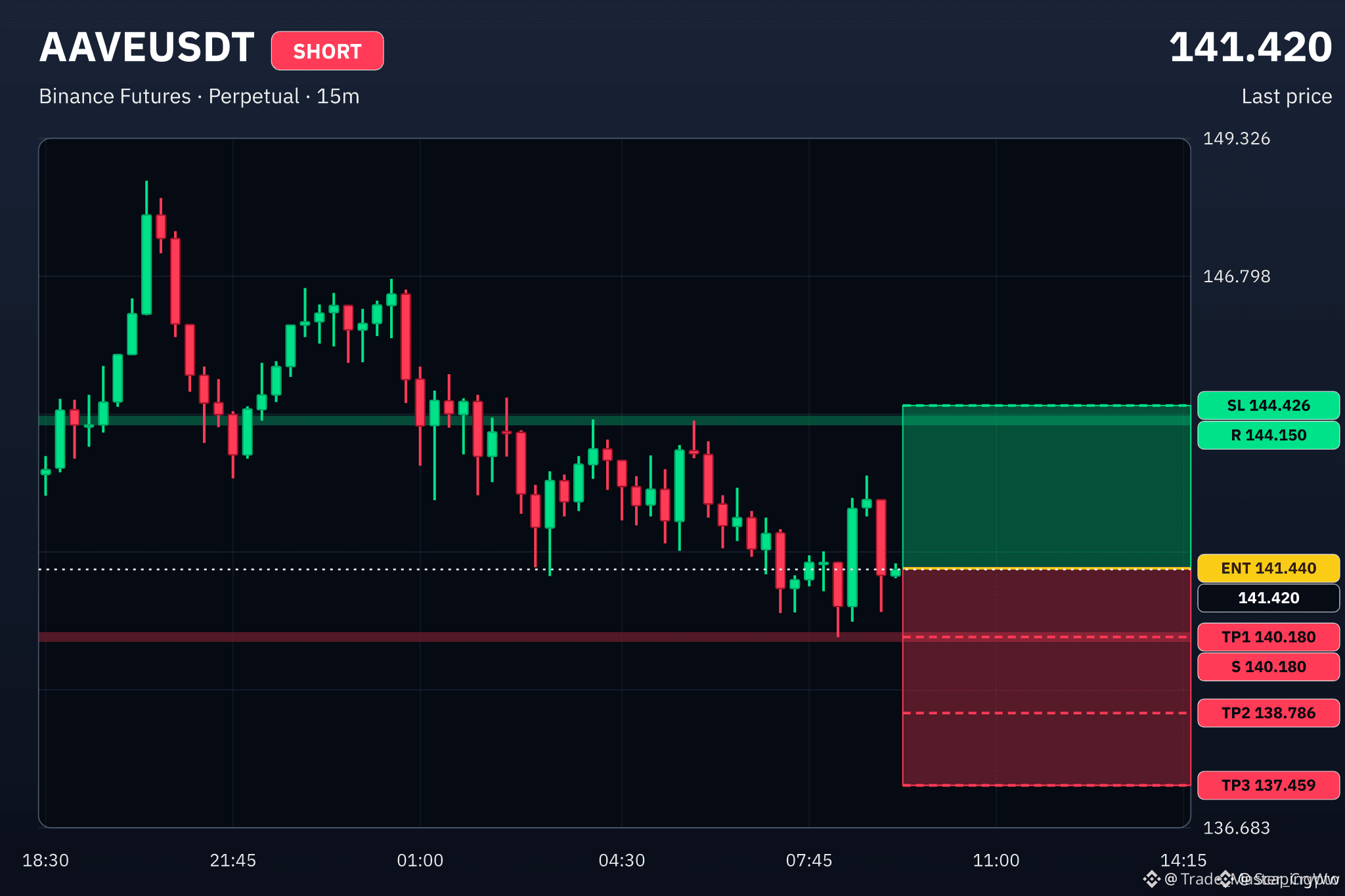
🚨 $AAVE REJECTS KEY RESISTANCE AS SELLERS HEAVY-HAND THE 15M STRUCTURE! 📉
Entry: 141.1636 - 141.7164 ⚡
Target: 140.1800 - 137.4594 🎯
Stop Loss: 144.4264 ⚠️
📌 Sellers are asserting total control below the 144.15 resistance ceiling, keeping $AAVE capped under a heavy short-term structure. 📉 The 15m order flow shows steady supply absorption right into our entry zone as momentum tilts heavily toward lower price levels.
💡 If buyers fail to protect the immediate 140.18 floor, expect a swift liquidity sweep down toward 137.45. 💬 Are you taking the short off this rejection or waiting for support to snap first? 👇
⚠️ Not financial advice. Always manage your risk. 🛡️
🏷️ #AAVE #ShortSetup #CryptoTrading #Bearish
📉 🐻
🚨 $AAVE REJECTS KEY RESISTANCE AS SELLERS HEAVY-HAND THE 15M STRUCTURE! 📉
Entry: 141.1636 - 141.7164 ⚡
Target: 140.1800 - 137.4594 🎯
Stop Loss: 144.4264 ⚠️
📌 Sellers are asserting total control below the 144.15 resistance ceiling, keeping $AAVE capped under a heavy short-term structure. 📉 The 15m order flow shows steady supply absorption right into our entry zone as momentum tilts heavily toward lower price levels.
💡 If buyers fail to protect the immediate 140.18 floor, expect a swift liquidity sweep down toward 137.45. 💬 Are you taking the short off this rejection or waiting for support to snap first? 👇
⚠️ Not financial advice. Always manage your risk. 🛡️
🏷️ #AAVE #ShortSetup #CryptoTrading #Bearish
📉 🐻
Entry: 141.1636 - 141.7164 ⚡
Target: 140.1800 - 137.4594 🎯
Stop Loss: 144.4264 ⚠️
📌 Sellers are asserting total control below the 144.15 resistance ceiling, keeping $AAVE capped under a heavy short-term structure. 📉 The 15m order flow shows steady supply absorption right into our entry zone as momentum tilts heavily toward lower price levels.
💡 If buyers fail to protect the immediate 140.18 floor, expect a swift liquidity sweep down toward 137.45. 💬 Are you taking the short off this rejection or waiting for support to snap first? 👇
⚠️ Not financial advice. Always manage your risk. 🛡️
🏷️ #AAVE #ShortSetup #CryptoTrading #Bearish
📉 🐻
16
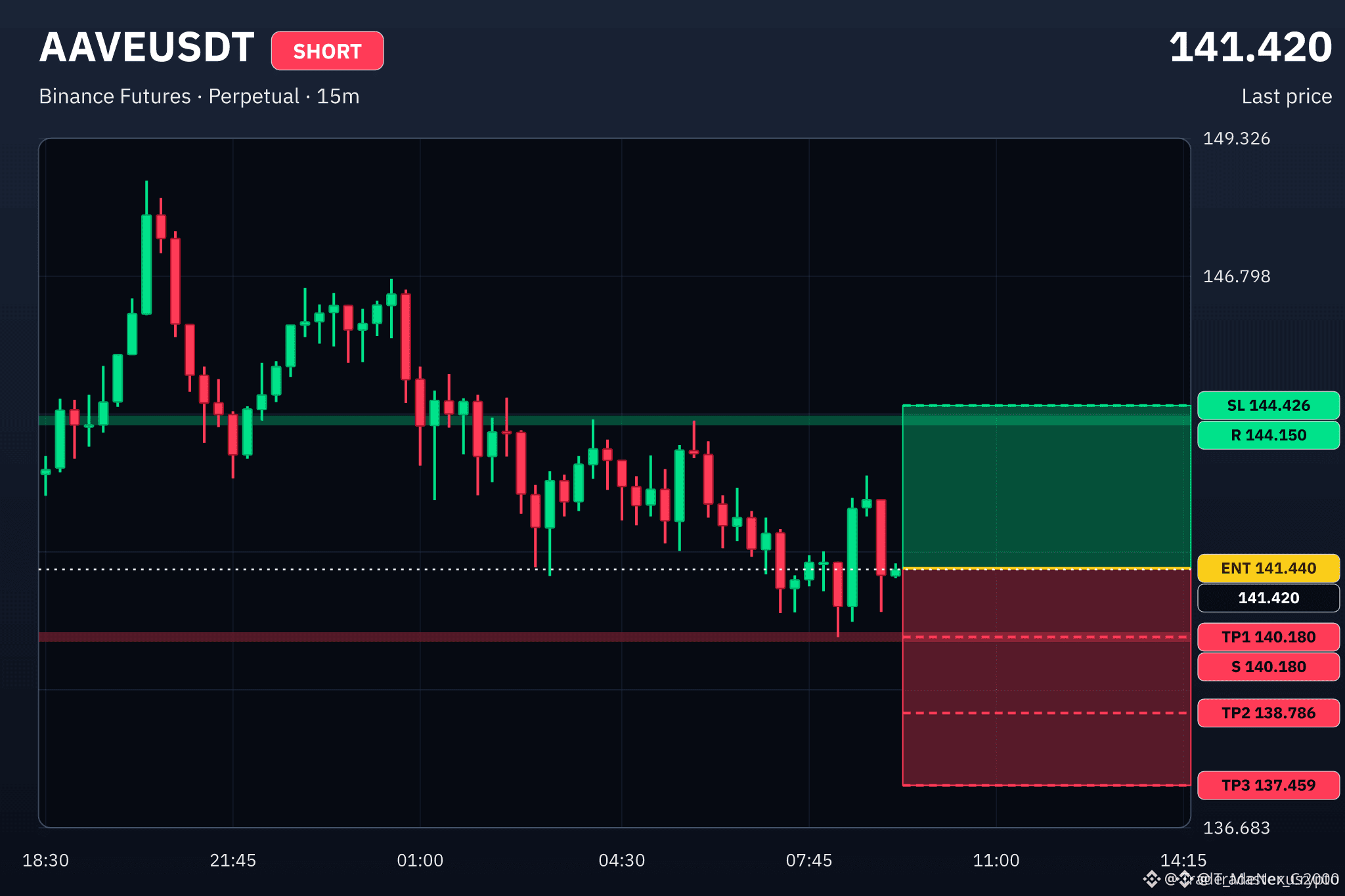
🚨 $AAVE REJECTS KEY RESISTANCE AS BEARISH MARKET STRUCTURE FAILS TO RECLAIM HIGHER LIQUIDITY! 📉
Entry: 141.1636 - 141.7164 ⚡
Target: 140.1800 - 137.4594 🎯
Stop Loss: 144.4264 ⚠️
📌 $AAVE continues to print a clean bearish structural shift on the 15-minute timeframe, consistently respecting overhead supply below the 144.1500 mark. Institutional order flow shows distribution as every attempt to reclaim higher price action gets capped into resistance. 📉
🔍 Order book depth reveals minimal bid-side liquidity holding above 140.1800 support. 💡 With seller volume accelerating, the path of least resistance points toward an inefficiency fill down to the 137.4594 demand pool. 💬 Are you capitalizing on this lower-high setup or watching for a breakdown confirmation? 👇
⚠️ Not financial advice. Always manage your risk. 🛡️
🏷️ #AAVE #ShortSetup #Crypto #MarketStructure
🔴 📉
🚨 $AAVE REJECTS KEY RESISTANCE AS BEARISH MARKET STRUCTURE FAILS TO RECLAIM HIGHER LIQUIDITY! 📉
Entry: 141.1636 - 141.7164 ⚡
Target: 140.1800 - 137.4594 🎯
Stop Loss: 144.4264 ⚠️
📌 $AAVE continues to print a clean bearish structural shift on the 15-minute timeframe, consistently respecting overhead supply below the 144.1500 mark. Institutional order flow shows distribution as every attempt to reclaim higher price action gets capped into resistance. 📉
🔍 Order book depth reveals minimal bid-side liquidity holding above 140.1800 support. 💡 With seller volume accelerating, the path of least resistance points toward an inefficiency fill down to the 137.4594 demand pool. 💬 Are you capitalizing on this lower-high setup or watching for a breakdown confirmation? 👇
⚠️ Not financial advice. Always manage your risk. 🛡️
🏷️ #AAVE #ShortSetup #Crypto #MarketStructure
🔴 📉
Entry: 141.1636 - 141.7164 ⚡
Target: 140.1800 - 137.4594 🎯
Stop Loss: 144.4264 ⚠️
📌 $AAVE continues to print a clean bearish structural shift on the 15-minute timeframe, consistently respecting overhead supply below the 144.1500 mark. Institutional order flow shows distribution as every attempt to reclaim higher price action gets capped into resistance. 📉
🔍 Order book depth reveals minimal bid-side liquidity holding above 140.1800 support. 💡 With seller volume accelerating, the path of least resistance points toward an inefficiency fill down to the 137.4594 demand pool. 💬 Are you capitalizing on this lower-high setup or watching for a breakdown confirmation? 👇
⚠️ Not financial advice. Always manage your risk. 🛡️
🏷️ #AAVE #ShortSetup #Crypto #MarketStructure
🔴 📉
35
·
--
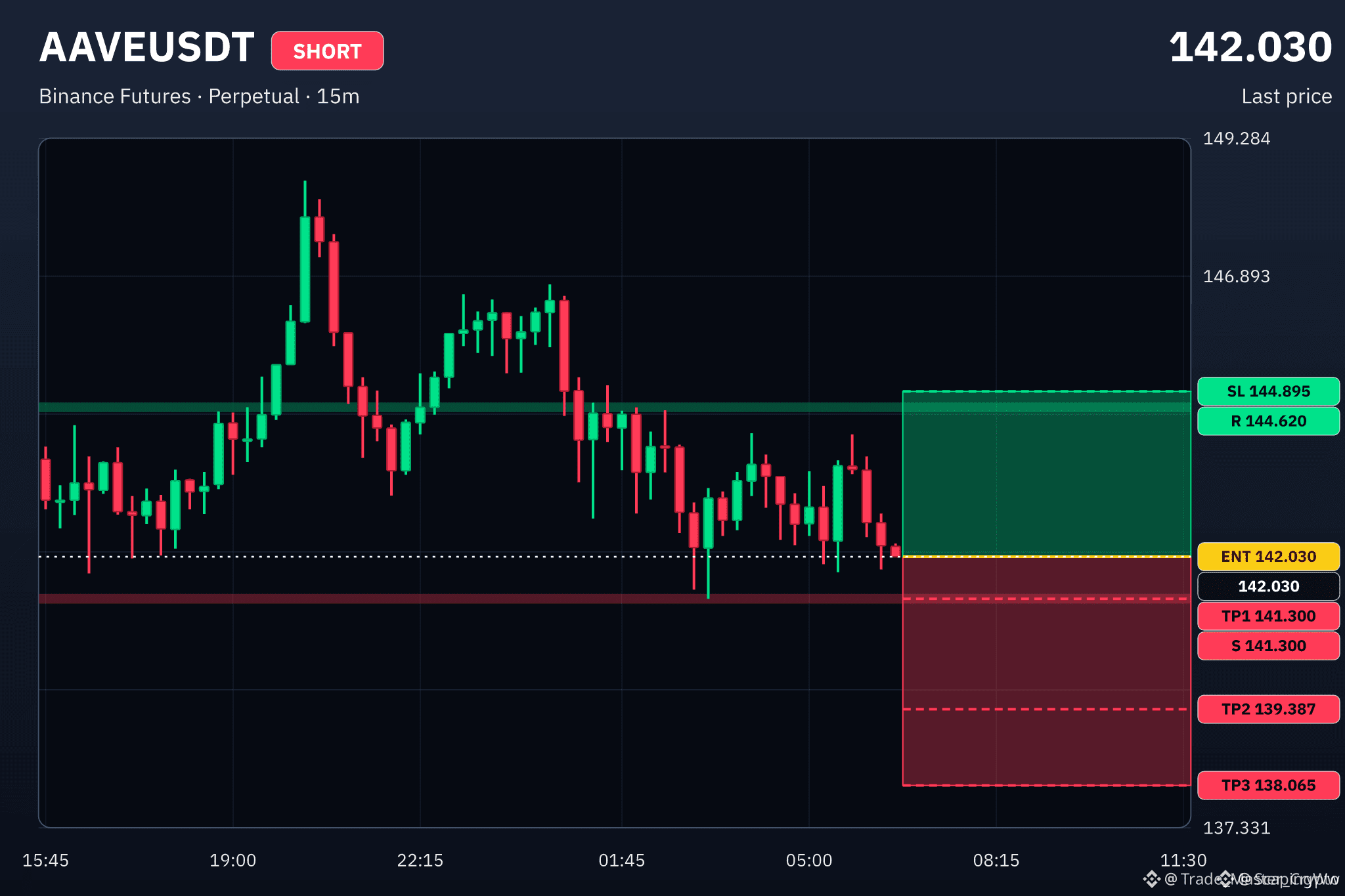
🚨 $AAVE REJECTED AT RESISTANCE WITH SELLER PRESSURE BUILDING FOR A DOWNWARD FLIP! 🐻
Entry: 141.7546 - 142.3054 ⚡
Target: 138.0649 🎯
Stop Loss: 144.8954 ⚠️
$AAVE is holding a clean bearish structure on the 15-minute timeframe underneath strong overhead resistance near 144.6200. 📉 Sellers are consistently absorbing weak buyer attempts into the entry zone, paving the path for a move toward immediate support near 141.3000.
📌 As downside momentum accelerates, a crisp break below immediate support exposes the lower liquidity targets. 🔍 Are you leaning into this lower timeframe short or waiting for support to hold? 👇
⚠️ Not financial advice. Always manage your risk. 🛡️
🏷️ #AAVE #ShortSetup #Crypto #Trading #Bearish
🐻 📉
🚨 $AAVE REJECTED AT RESISTANCE WITH SELLER PRESSURE BUILDING FOR A DOWNWARD FLIP! 🐻
Entry: 141.7546 - 142.3054 ⚡
Target: 138.0649 🎯
Stop Loss: 144.8954 ⚠️
$AAVE is holding a clean bearish structure on the 15-minute timeframe underneath strong overhead resistance near 144.6200. 📉 Sellers are consistently absorbing weak buyer attempts into the entry zone, paving the path for a move toward immediate support near 141.3000.
📌 As downside momentum accelerates, a crisp break below immediate support exposes the lower liquidity targets. 🔍 Are you leaning into this lower timeframe short or waiting for support to hold? 👇
⚠️ Not financial advice. Always manage your risk. 🛡️
🏷️ #AAVE #ShortSetup #Crypto #Trading #Bearish
🐻 📉
Entry: 141.7546 - 142.3054 ⚡
Target: 138.0649 🎯
Stop Loss: 144.8954 ⚠️
$AAVE is holding a clean bearish structure on the 15-minute timeframe underneath strong overhead resistance near 144.6200. 📉 Sellers are consistently absorbing weak buyer attempts into the entry zone, paving the path for a move toward immediate support near 141.3000.
📌 As downside momentum accelerates, a crisp break below immediate support exposes the lower liquidity targets. 🔍 Are you leaning into this lower timeframe short or waiting for support to hold? 👇
⚠️ Not financial advice. Always manage your risk. 🛡️
🏷️ #AAVE #ShortSetup #Crypto #Trading #Bearish
🐻 📉
49
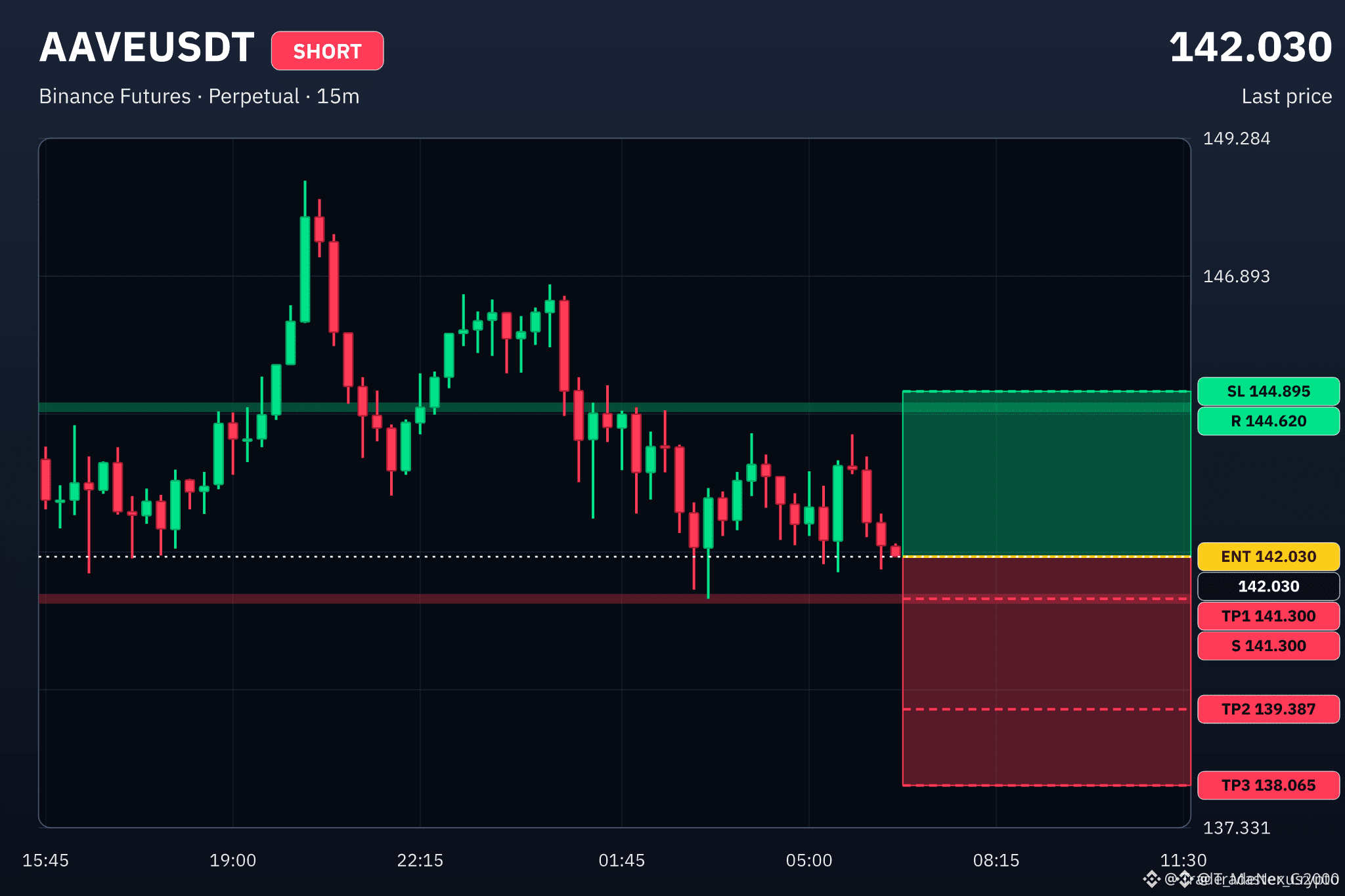
🚨 $AAVE REJECTS KEY RESISTANCE AS BEARISH MARKET STRUCTURE FAILS LOCAL SUPPORT 📉
Entry: 141.7546 - 142.3054 🔻
Target: 141.3000 / 139.3866 / 138.0649 🎯
Stop Loss: 144.8954 ⚠️
📌 Price action on the 15-minute timeframe confirms systematic distribution below the 144.6200 order block. 🔍 Smart money is defending lower highs while leaning heavily on the immediate demand zone at 141.3000, setting up an inefficiency sweep toward deeper liquidity pools below.
📊 A decisive breakdown beneath current intraday support clears the runway toward secondary target zones with minimal historical friction. 💬 Are you positioning for this structural breakdown, or waiting for a temporary relief sweep before entering? 👇
⚠️ Not financial advice. Always manage your risk. 🛡️
🏷️ #AAVE #ShortSetup #MarketStructure #Crypto #Trading
📉 🔍
🚨 $AAVE REJECTS KEY RESISTANCE AS BEARISH MARKET STRUCTURE FAILS LOCAL SUPPORT 📉
Entry: 141.7546 - 142.3054 🔻
Target: 141.3000 / 139.3866 / 138.0649 🎯
Stop Loss: 144.8954 ⚠️
📌 Price action on the 15-minute timeframe confirms systematic distribution below the 144.6200 order block. 🔍 Smart money is defending lower highs while leaning heavily on the immediate demand zone at 141.3000, setting up an inefficiency sweep toward deeper liquidity pools below.
📊 A decisive breakdown beneath current intraday support clears the runway toward secondary target zones with minimal historical friction. 💬 Are you positioning for this structural breakdown, or waiting for a temporary relief sweep before entering? 👇
⚠️ Not financial advice. Always manage your risk. 🛡️
🏷️ #AAVE #ShortSetup #MarketStructure #Crypto #Trading
📉 🔍
Entry: 141.7546 - 142.3054 🔻
Target: 141.3000 / 139.3866 / 138.0649 🎯
Stop Loss: 144.8954 ⚠️
📌 Price action on the 15-minute timeframe confirms systematic distribution below the 144.6200 order block. 🔍 Smart money is defending lower highs while leaning heavily on the immediate demand zone at 141.3000, setting up an inefficiency sweep toward deeper liquidity pools below.
📊 A decisive breakdown beneath current intraday support clears the runway toward secondary target zones with minimal historical friction. 💬 Are you positioning for this structural breakdown, or waiting for a temporary relief sweep before entering? 👇
⚠️ Not financial advice. Always manage your risk. 🛡️
🏷️ #AAVE #ShortSetup #MarketStructure #Crypto #Trading
📉 🔍
43

🚀 DEFI ON FIRE: Massive Setup Unfolding Across Top Winners! 🚀
The DeFi sector is flashing strong bullish signals, and momentum is building up fast on the 1D chart! Here is how the key levels are lining up:
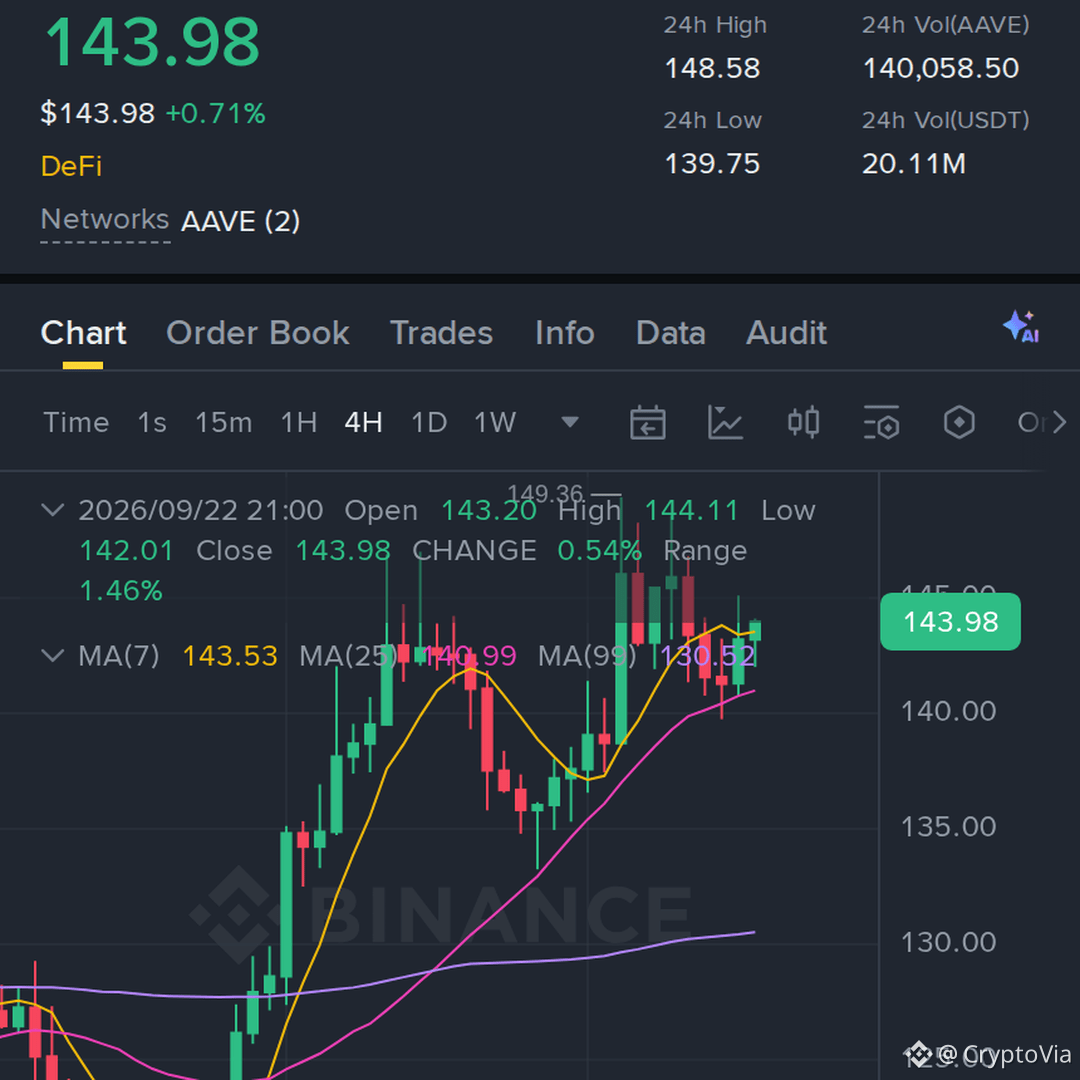
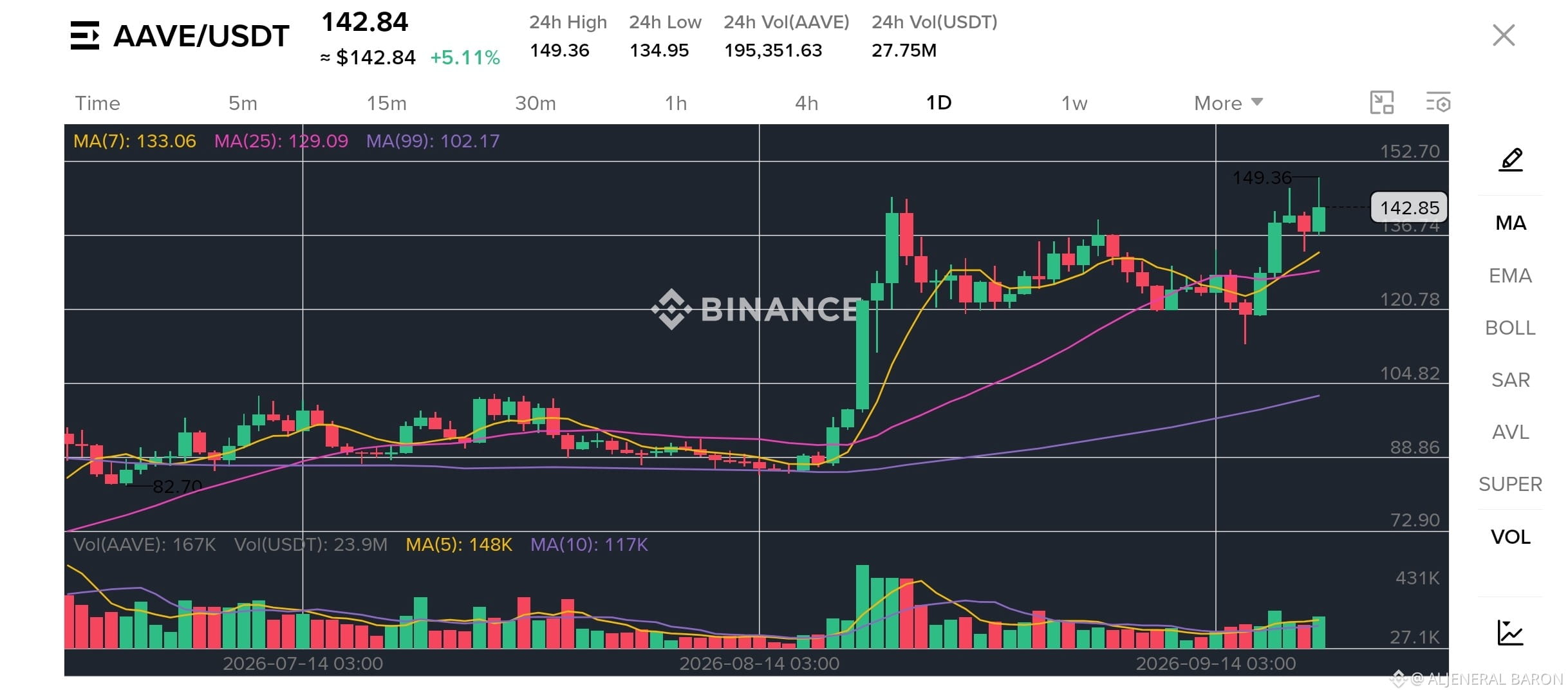
💥 $AAVE : Exploding with +5.11% gain! Currently around $142.8. Holding strong support above MA(7) ($133.0). A clean breakout above the $149.3 high could unlock the next major expansion target!
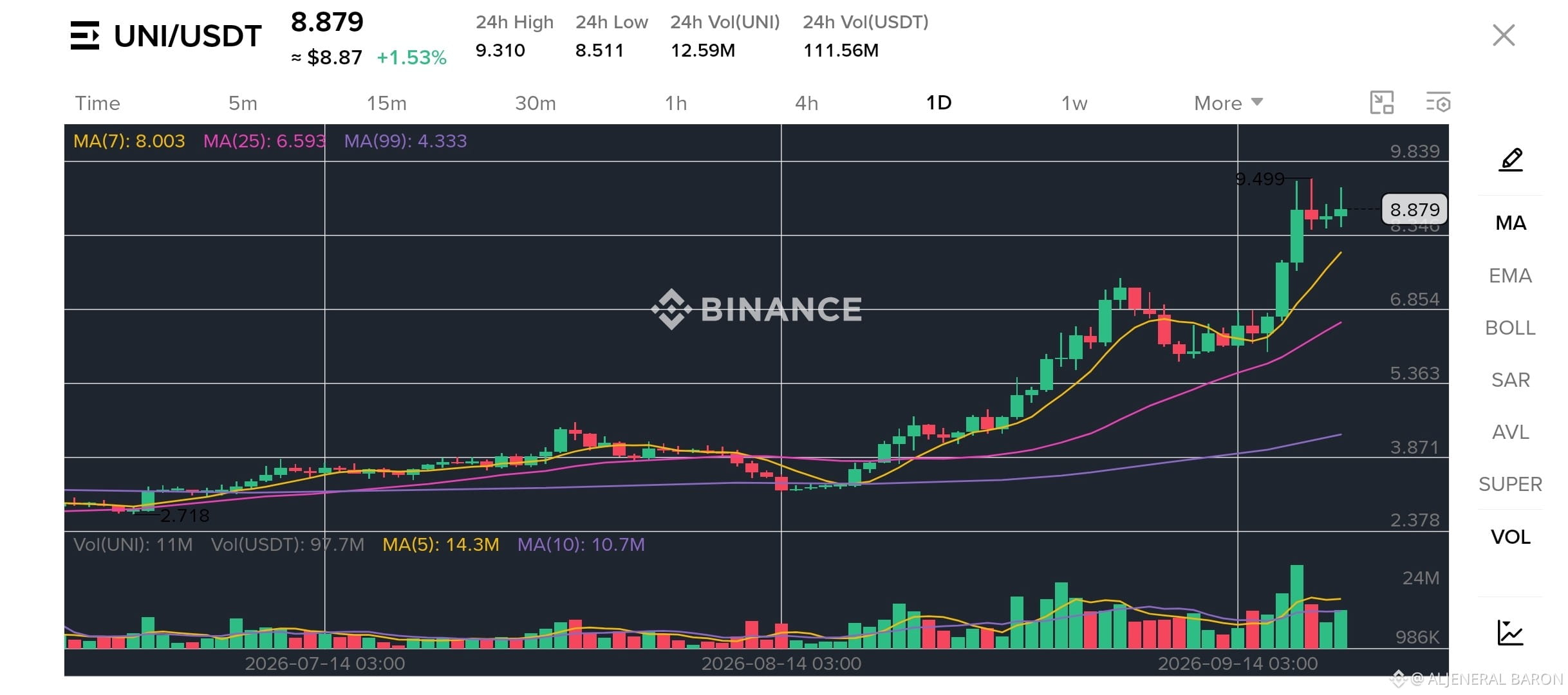
💥 $UNI : Showing insane strength at $8.87. Bulls are protecting the $8.00 support level firmly. Reclaiming and holding above $9.50 could open the doors for a massive rally toward two-digit targets!
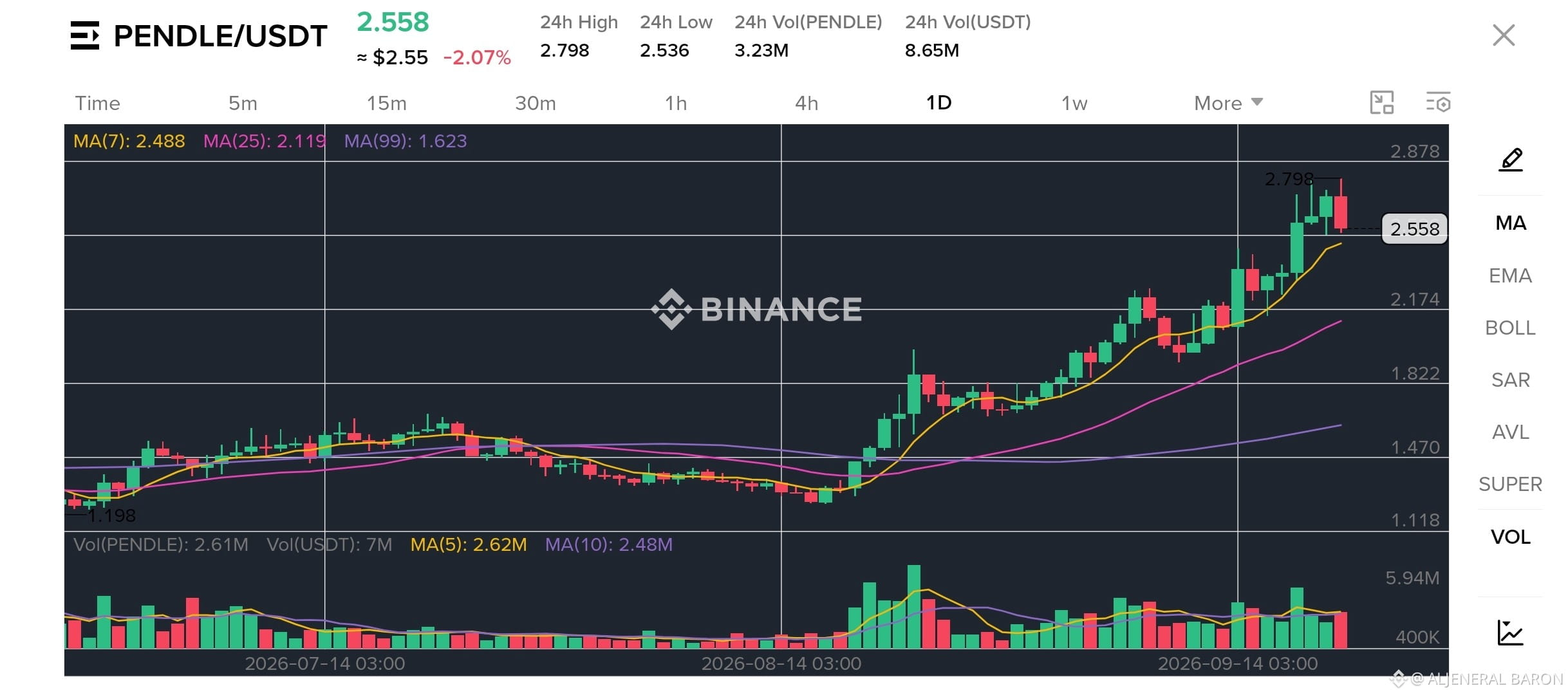
💥 $PENDLE : Pulling back slightly to $2.55 (-2.07%) — presenting a key retest area near MA(7) ($2.48). If buyers hold this trendline, a surge back to test $2.80+ resistance is on the horizon.
High volatility = Big opportunities! Manage your risk wisely and watch these key breakout zones closely. 📈🔥
Which DeFi runner are you trading this week? Let's hear it below! 👇
#AAVE #UNI #PENDLE #cryptotrading #BinanceSquare
🚀 DEFI ON FIRE: Massive Setup Unfolding Across Top Winners! 🚀
The DeFi sector is flashing strong bullish signals, and momentum is building up fast on the 1D chart! Here is how the key levels are lining up:
💥 $AAVE : Exploding with +5.11% gain! Currently around $142.8. Holding strong support above MA(7) ($133.0). A clean breakout above the $149.3 high could unlock the next major expansion target!
💥 $UNI : Showing insane strength at $8.87. Bulls are protecting the $8.00 support level firmly. Reclaiming and holding above $9.50 could open the doors for a massive rally toward two-digit targets!
💥 $PENDLE : Pulling back slightly to $2.55 (-2.07%) — presenting a key retest area near MA(7) ($2.48). If buyers hold this trendline, a surge back to test $2.80+ resistance is on the horizon.
High volatility = Big opportunities! Manage your risk wisely and watch these key breakout zones closely. 📈🔥
Which DeFi runner are you trading this week? Let's hear it below! 👇
#AAVE #UNI #PENDLE #cryptotrading #BinanceSquare
The DeFi sector is flashing strong bullish signals, and momentum is building up fast on the 1D chart! Here is how the key levels are lining up:
💥 $AAVE : Exploding with +5.11% gain! Currently around $142.8. Holding strong support above MA(7) ($133.0). A clean breakout above the $149.3 high could unlock the next major expansion target!
💥 $UNI : Showing insane strength at $8.87. Bulls are protecting the $8.00 support level firmly. Reclaiming and holding above $9.50 could open the doors for a massive rally toward two-digit targets!
💥 $PENDLE : Pulling back slightly to $2.55 (-2.07%) — presenting a key retest area near MA(7) ($2.48). If buyers hold this trendline, a surge back to test $2.80+ resistance is on the horizon.
High volatility = Big opportunities! Manage your risk wisely and watch these key breakout zones closely. 📈🔥
Which DeFi runner are you trading this week? Let's hear it below! 👇
#AAVE #UNI #PENDLE #cryptotrading #BinanceSquare
1
368
·
--
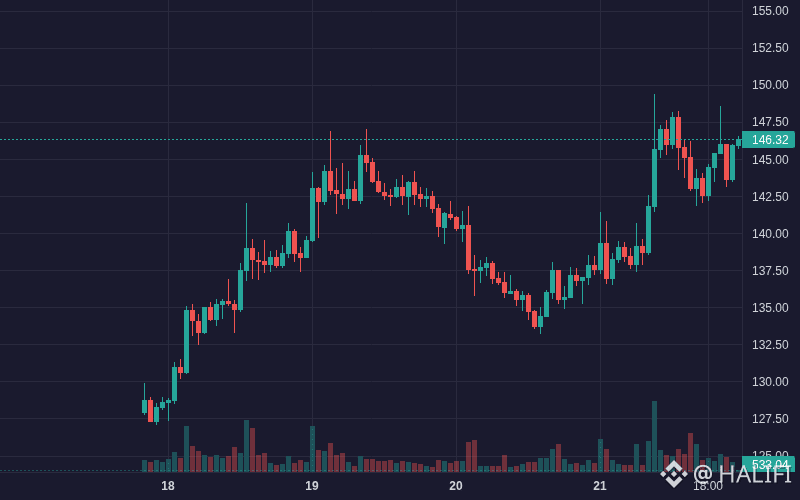
$AAVE AAVE is showing bullish movement: 6.48% (Crypto).
Volume: 28.80M | Last: $146.43
Key signals: strong momentum, high volatility, high trader activity.
Bias Daily: BULLISH 🟢 | Weekly: BULLISH 🟢
AAVE gained 4.2% in 24h driven by Aavenomics 3.0 buyback catalysts and strong institutional RWA expansion.
**Aavenomics 3.0 (High)**: Upcoming token buybacks funded by protocol and GHO revenue → creates structural deflationary pressure and aligns value capture
- **Institutional expansion (High)**: Proposed custodied off-chain BTC lending and a new RWA credit market on Avalanche → drives institutional adoption, pushing V4 deposits past $1B
- **Capital inflows (Medium)**: +$865K large-wallet net inflow spike in a single hour → fueled the volume-backed rally toward $147
#AAVE #BitcoinHits$85K #SaylorHintsStrategyBitcoinBuy #BTCBreaks80K #Crypto
$AAVE AAVE is showing bullish movement: 6.48% (Crypto).
Volume: 28.80M | Last: $146.43
Key signals: strong momentum, high volatility, high trader activity.
Bias Daily: BULLISH 🟢 | Weekly: BULLISH 🟢
AAVE gained 4.2% in 24h driven by Aavenomics 3.0 buyback catalysts and strong institutional RWA expansion.
**Aavenomics 3.0 (High)**: Upcoming token buybacks funded by protocol and GHO revenue → creates structural deflationary pressure and aligns value capture
- **Institutional expansion (High)**: Proposed custodied off-chain BTC lending and a new RWA credit market on Avalanche → drives institutional adoption, pushing V4 deposits past $1B
- **Capital inflows (Medium)**: +$865K large-wallet net inflow spike in a single hour → fueled the volume-backed rally toward $147
#AAVE #BitcoinHits$85K #SaylorHintsStrategyBitcoinBuy #BTCBreaks80K #Crypto
Volume: 28.80M | Last: $146.43
Key signals: strong momentum, high volatility, high trader activity.
Bias Daily: BULLISH 🟢 | Weekly: BULLISH 🟢
AAVE gained 4.2% in 24h driven by Aavenomics 3.0 buyback catalysts and strong institutional RWA expansion.
**Aavenomics 3.0 (High)**: Upcoming token buybacks funded by protocol and GHO revenue → creates structural deflationary pressure and aligns value capture
- **Institutional expansion (High)**: Proposed custodied off-chain BTC lending and a new RWA credit market on Avalanche → drives institutional adoption, pushing V4 deposits past $1B
- **Capital inflows (Medium)**: +$865K large-wallet net inflow spike in a single hour → fueled the volume-backed rally toward $147
#AAVE #BitcoinHits$85K #SaylorHintsStrategyBitcoinBuy #BTCBreaks80K #Crypto
18
·
--
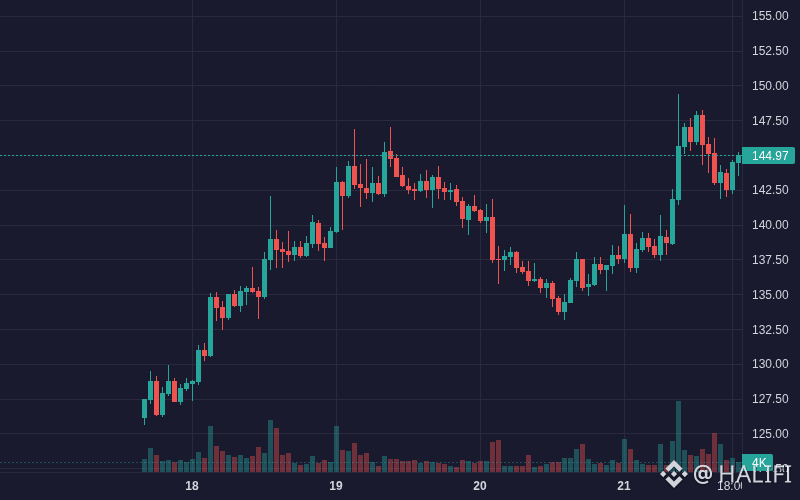
$AAVE AAVE is showing bullish movement: 5.44% (Crypto).
Volume: 27.74M | Last: $144.70
Key signals: strong momentum, high volatility, high trader activity.
Bias Daily: BULLISH 🟢 | Weekly: BULLISH 🟢
AAVE climbed 5.3% in 24 hours fueled by institutional adoption and Aavenomics 3.0 anticipation, despite lingering security concerns.
**Institutional Adoption (High)**: Aave V4 surpassing $1 billion in deposits and expanding onto Circle's institutional-grade 'Arc' blockchain catalyzed strong market confidence.
- **Protocol Upgrades (High)**: The upcoming Aavenomics 3.0 upgrade introduces automated, revenue-driven token buybacks, creating a more reliable value accrual mechanism for holders.
- **Capital Inflows (Medium)**: The fundamental developments triggered concentrated buying activity, highlighted by over $1.15 million in net inflows during peak trading hours, driving the price upward.
#AAVE #SaylorHintsStrategyBitcoinBuy #altcoins #BitcoinHits$85K #Crypto
$AAVE AAVE is showing bullish movement: 5.44% (Crypto).
Volume: 27.74M | Last: $144.70
Key signals: strong momentum, high volatility, high trader activity.
Bias Daily: BULLISH 🟢 | Weekly: BULLISH 🟢
AAVE climbed 5.3% in 24 hours fueled by institutional adoption and Aavenomics 3.0 anticipation, despite lingering security concerns.
**Institutional Adoption (High)**: Aave V4 surpassing $1 billion in deposits and expanding onto Circle's institutional-grade 'Arc' blockchain catalyzed strong market confidence.
- **Protocol Upgrades (High)**: The upcoming Aavenomics 3.0 upgrade introduces automated, revenue-driven token buybacks, creating a more reliable value accrual mechanism for holders.
- **Capital Inflows (Medium)**: The fundamental developments triggered concentrated buying activity, highlighted by over $1.15 million in net inflows during peak trading hours, driving the price upward.
#AAVE #SaylorHintsStrategyBitcoinBuy #altcoins #BitcoinHits$85K #Crypto
Volume: 27.74M | Last: $144.70
Key signals: strong momentum, high volatility, high trader activity.
Bias Daily: BULLISH 🟢 | Weekly: BULLISH 🟢
AAVE climbed 5.3% in 24 hours fueled by institutional adoption and Aavenomics 3.0 anticipation, despite lingering security concerns.
**Institutional Adoption (High)**: Aave V4 surpassing $1 billion in deposits and expanding onto Circle's institutional-grade 'Arc' blockchain catalyzed strong market confidence.
- **Protocol Upgrades (High)**: The upcoming Aavenomics 3.0 upgrade introduces automated, revenue-driven token buybacks, creating a more reliable value accrual mechanism for holders.
- **Capital Inflows (Medium)**: The fundamental developments triggered concentrated buying activity, highlighted by over $1.15 million in net inflows during peak trading hours, driving the price upward.
#AAVE #SaylorHintsStrategyBitcoinBuy #altcoins #BitcoinHits$85K #Crypto
24

·
--
Bullish
🚨 $AAVE BULLS ARE STILL IN THE FIGHT! 🔥
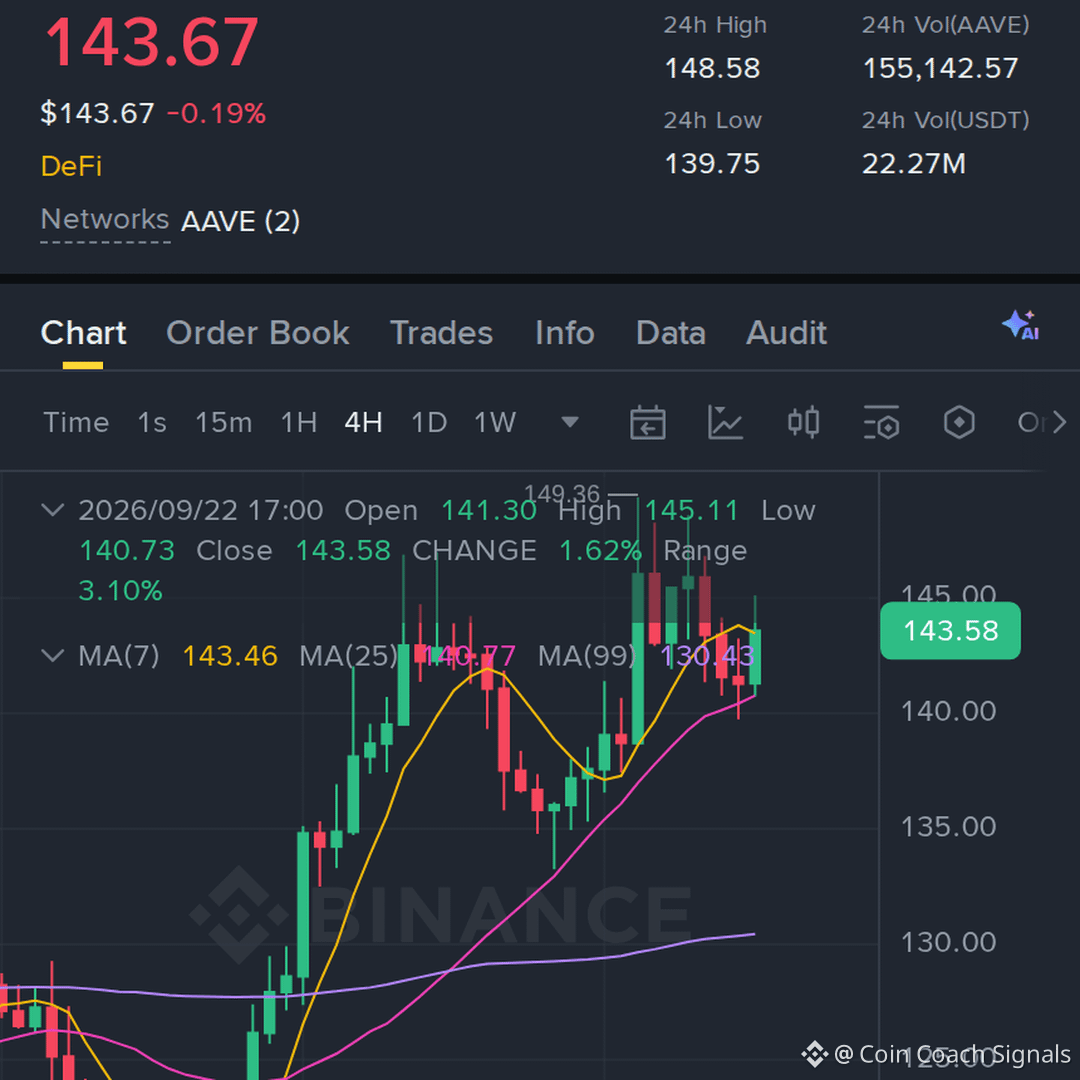
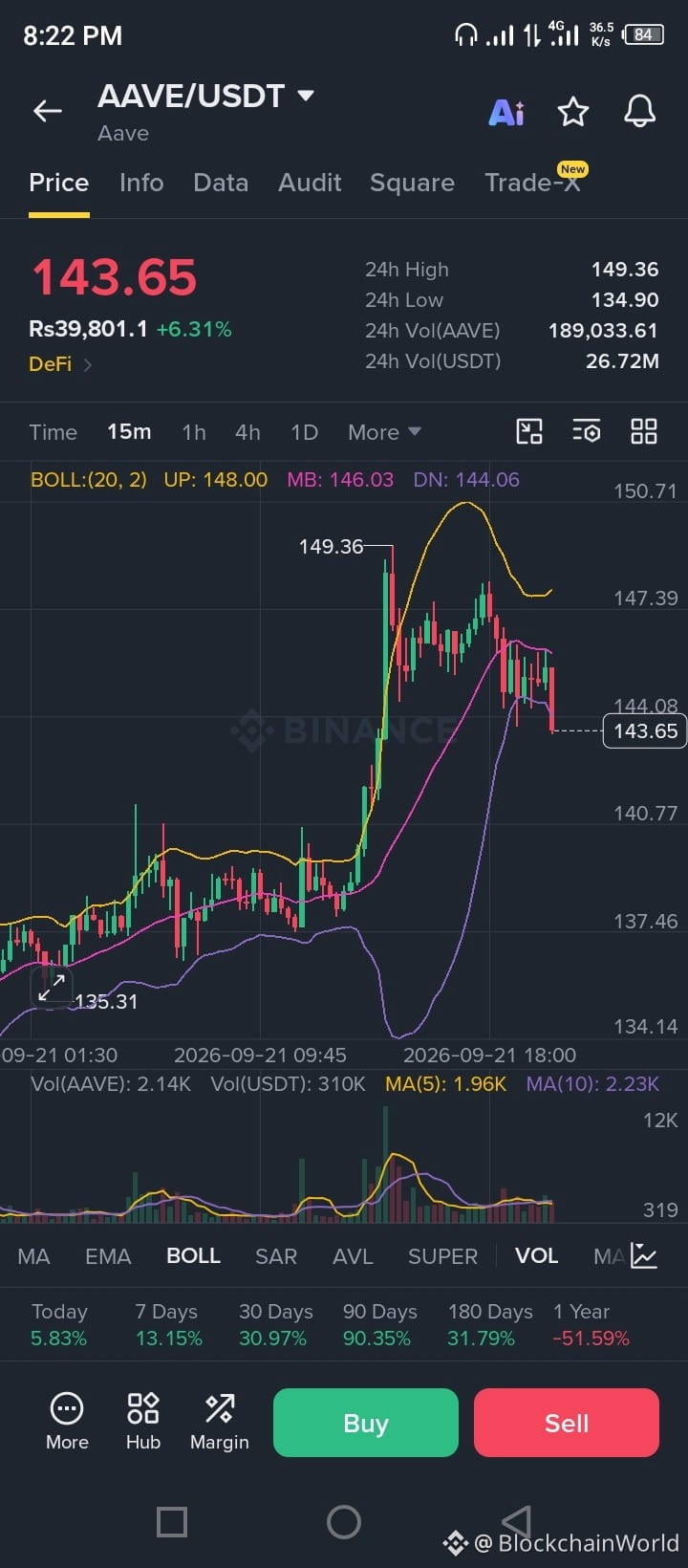
$AAVE is trading around $143.65, up +6.31% in 24H. After touching $149.36, price has pulled back toward the lower Bollinger Band, making the $144 area an important short-term level. 👀📊
📍 Entry Zone: $143.50–$144.50
🎯 TP1: $146.00
🎯 TP2: $148.00
🎯 TP3: $149.36
🛑 SL: $141.50
A reclaim of $146 could strengthen the short-term momentum, while a break below $143 may increase downside pressure.
⚠️ Manage risk carefully and avoid chasing sudden moves.
#AAVE #Aave #Crypto #DeFi #Altcoins #Trading #Binance #USDT
🚨 $AAVE BULLS ARE STILL IN THE FIGHT! 🔥
$AAVE is trading around $143.65, up +6.31% in 24H. After touching $149.36, price has pulled back toward the lower Bollinger Band, making the $144 area an important short-term level. 👀📊
📍 Entry Zone: $143.50–$144.50
🎯 TP1: $146.00
🎯 TP2: $148.00
🎯 TP3: $149.36
🛑 SL: $141.50
A reclaim of $146 could strengthen the short-term momentum, while a break below $143 may increase downside pressure.
⚠️ Manage risk carefully and avoid chasing sudden moves.
#AAVE #Aave #Crypto #DeFi #Altcoins #Trading #Binance #USDT
$AAVE is trading around $143.65, up +6.31% in 24H. After touching $149.36, price has pulled back toward the lower Bollinger Band, making the $144 area an important short-term level. 👀📊
📍 Entry Zone: $143.50–$144.50
🎯 TP1: $146.00
🎯 TP2: $148.00
🎯 TP3: $149.36
🛑 SL: $141.50
A reclaim of $146 could strengthen the short-term momentum, while a break below $143 may increase downside pressure.
⚠️ Manage risk carefully and avoid chasing sudden moves.
#AAVE #Aave #Crypto #DeFi #Altcoins #Trading #Binance #USDT
2
103

·
--
Bullish
A $16.484K AAVE short just got liquidated.
That squeeze puts $147.44 on the immediate reaction zone.
$AAVE
{future}(AAVEUSDT)
$ZETA
{future}(ZETAUSDT)
$PHA
{future}(PHAUSDT)
🟢 LIQUIDITY ZONE HIT 🟢
Short liquidation spotted 🧨
$16.484K cleared at $147.444
Upside liquidity swept — watch reaction 👀
🎯 TP Targets:
TP1: ~$148.92
TP2: ~$150.39
TP3: ~$151.87
#AAVE
A $16.484K AAVE short just got liquidated.
That squeeze puts $147.44 on the immediate reaction zone.
$AAVE
$ZETA
$PHA
🟢 LIQUIDITY ZONE HIT 🟢
Short liquidation spotted 🧨
$16.484K cleared at $147.444
Upside liquidity swept — watch reaction 👀
🎯 TP Targets:
TP1: ~$148.92
TP2: ~$150.39
TP3: ~$151.87
#AAVE
That squeeze puts $147.44 on the immediate reaction zone.
$AAVE
$ZETA
$PHA
🟢 LIQUIDITY ZONE HIT 🟢
Short liquidation spotted 🧨
$16.484K cleared at $147.444
Upside liquidity swept — watch reaction 👀
🎯 TP Targets:
TP1: ~$148.92
TP2: ~$150.39
TP3: ~$151.87
#AAVE
53
Log in to explore more content
Join global crypto users on Binance Square
⚡️ Get latest and useful information about crypto.
💬 Trusted by the world’s largest crypto exchange.
👍 Discover real insights from verified creators.
Email / Phone number
Trending Topics
1
#AIStocksWhatNext
369,684 views
2,987 Discussing
2
#BitcoinBreaksAboveMayHighNears$86K
14,832 views
191 Discussing
3
#DogecoinRises15%
47,162 views
992 Discussing
4
#$14BBitcoinOptionsExpireFriday
3,847 views
89 Discussing
5
#BNBMarketCapPassesBNYMellon
29,829 views
709 Discussing
6
#CryptoMarketCapReclaims$3Trillion
5,086 views
82 Discussing
7
#MuseOvertakesChatGPTAsTopFreeIOSApp
17,555 views
532 Discussing
8
#TokenizedStockPlatformsCouldLaunchNextQuarter
28,268 views
588 Discussing
9
#StrategyAdds950Bitcoin
34,932 views
685 Discussing
10
#CardanoAddedToX402KitForADAPayments
29,753 views
657 Discussing