

OroCryptoTrends
8.9k Posts

OroCryptoTrends
 Square Verified+
Report
Block User
OroCryptoTrends | Crypto Insights: Real-time crypto news, market analysis, Web3, DeFi & emerging trends. Research-driven, actionable insights. No hype.
Open Trade
Frequent Trader
3.2 Years
3.2K+ Following
51.1K+ Followers
49.2K+ Liked
Posts
Portfolio
All
Quotes
Videos
Live
$AMD.US
AMD crossed $1 trillion. I think the valuation milestone is actually the less interesting part.
What matters is what investors are now willing to pay AMD for.
The market is increasingly treating AMD as more than a company selling CPUs and GPUs. Its AI exposure now touches accelerators, data-center systems, inference demand, major customer relationships, and increasingly the software and intelligence layer around those systems.
And that’s where the thesis gets more interesting.
AMD is trying to capture more of the AI infrastructure stack, not simply sell more chips. Its expansion into areas like spatial intelligence and physical AI points toward a broader strategy around where compute demand could develop next.
But there’s a catch.
A $1T valuation raises the execution bar. Strong AI demand alone isn’t enough. AMD still needs sustained revenue growth, improving margins, accelerator adoption and durable hyperscaler relationships to justify the expectations embedded in the valuation.
So I’m watching the fundamentals behind the headline, not the headline itself.
The next phase is really about whether AMD can turn AI demand into durable economic value.
That’s the part of this story I think matters most.
$AMD.US
AMD crossed $1 trillion. I think the valuation milestone is actually the less interesting part.
What matters is what investors are now willing to pay AMD for.
The market is increasingly treating AMD as more than a company selling CPUs and GPUs. Its AI exposure now touches accelerators, data-center systems, inference demand, major customer relationships, and increasingly the software and intelligence layer around those systems.
And that’s where the thesis gets more interesting.
AMD is trying to capture more of the AI infrastructure stack, not simply sell more chips. Its expansion into areas like spatial intelligence and physical AI points toward a broader strategy around where compute demand could develop next.
But there’s a catch.
A $1T valuation raises the execution bar. Strong AI demand alone isn’t enough. AMD still needs sustained revenue growth, improving margins, accelerator adoption and durable hyperscaler relationships to justify the expectations embedded in the valuation.
So I’m watching the fundamentals behind the headline, not the headline itself.
The next phase is really about whether AMD can turn AI demand into durable economic value.
That’s the part of this story I think matters most.
AMD crossed $1 trillion. I think the valuation milestone is actually the less interesting part.
What matters is what investors are now willing to pay AMD for.
The market is increasingly treating AMD as more than a company selling CPUs and GPUs. Its AI exposure now touches accelerators, data-center systems, inference demand, major customer relationships, and increasingly the software and intelligence layer around those systems.
And that’s where the thesis gets more interesting.
AMD is trying to capture more of the AI infrastructure stack, not simply sell more chips. Its expansion into areas like spatial intelligence and physical AI points toward a broader strategy around where compute demand could develop next.
But there’s a catch.
A $1T valuation raises the execution bar. Strong AI demand alone isn’t enough. AMD still needs sustained revenue growth, improving margins, accelerator adoption and durable hyperscaler relationships to justify the expectations embedded in the valuation.
So I’m watching the fundamentals behind the headline, not the headline itself.
The next phase is really about whether AMD can turn AI demand into durable economic value.
That’s the part of this story I think matters most.
AMD-0.32%
AMDUS-0.21%
269
$ACN Binance just added seven more TradFi perpetuals. The bigger story isn’t the tickers — it’s the market structure.
Today’s rollout covers CRML, BWET, ACN, MP, SECZ, UNH and NKE, all as USDT-priced perpetual contracts with 24/7 trading and up to 20x leverage.
That matters because Binance is increasingly treating traditional equities and other real-world assets as instruments that can plug directly into crypto-native derivatives infrastructure.
But I’d be careful with the “tokenization” framing.
SECZ, for example, tracks Securitize Corp. common stock. The Binance announcement does not say these contracts represent tokenized ownership of the underlying equities. They are perpetual derivatives referencing those underlying assets.
That distinction is important. The real development here is not necessarily bringing stock ownership on-chain. It is bringing more traditional-market exposure into a 24/7, USDT-settled derivatives environment.
And Binance has been expanding this category rapidly, following another five TradFi perpetuals added just yesterday.
The interesting question now is whether this becomes a genuine bridge between crypto liquidity and traditional markets — or simply creates another derivatives layer around familiar assets.
Long-term impact will depend on whether liquidity, pricing quality and user demand hold up as the product set expands.
$ACN Binance just added seven more TradFi perpetuals. The bigger story isn’t the tickers — it’s the market structure.
Today’s rollout covers CRML, BWET, ACN, MP, SECZ, UNH and NKE, all as USDT-priced perpetual contracts with 24/7 trading and up to 20x leverage.
That matters because Binance is increasingly treating traditional equities and other real-world assets as instruments that can plug directly into crypto-native derivatives infrastructure.
But I’d be careful with the “tokenization” framing.
SECZ, for example, tracks Securitize Corp. common stock. The Binance announcement does not say these contracts represent tokenized ownership of the underlying equities. They are perpetual derivatives referencing those underlying assets.
That distinction is important. The real development here is not necessarily bringing stock ownership on-chain. It is bringing more traditional-market exposure into a 24/7, USDT-settled derivatives environment.
And Binance has been expanding this category rapidly, following another five TradFi perpetuals added just yesterday.
The interesting question now is whether this becomes a genuine bridge between crypto liquidity and traditional markets — or simply creates another derivatives layer around familiar assets.
Long-term impact will depend on whether liquidity, pricing quality and user demand hold up as the product set expands.
Today’s rollout covers CRML, BWET, ACN, MP, SECZ, UNH and NKE, all as USDT-priced perpetual contracts with 24/7 trading and up to 20x leverage.
That matters because Binance is increasingly treating traditional equities and other real-world assets as instruments that can plug directly into crypto-native derivatives infrastructure.
But I’d be careful with the “tokenization” framing.
SECZ, for example, tracks Securitize Corp. common stock. The Binance announcement does not say these contracts represent tokenized ownership of the underlying equities. They are perpetual derivatives referencing those underlying assets.
That distinction is important. The real development here is not necessarily bringing stock ownership on-chain. It is bringing more traditional-market exposure into a 24/7, USDT-settled derivatives environment.
And Binance has been expanding this category rapidly, following another five TradFi perpetuals added just yesterday.
The interesting question now is whether this becomes a genuine bridge between crypto liquidity and traditional markets — or simply creates another derivatives layer around familiar assets.
Long-term impact will depend on whether liquidity, pricing quality and user demand hold up as the product set expands.
443
#EarningsSeason
Can Micron beat 86% gross margin — and will that even be enough for MU?
That’s the part I’m watching most closely going into Micron’s FY2026 Q4 report on September 30.
Micron’s own guide is already huge: $50B ± $1B revenue, roughly 86% gross margin, and $31 ± $1 in non-GAAP EPS.
And honestly, I think 86% is achievable.
But maybe that’s not the real question.
Q3 already delivered an 84.9% non-GAAP gross margin, so the step toward 86% isn’t some crazy leap. The bigger issue is what happens after that. Micron says its Q4 margin outlook already assumes a meaningful moderation in the rate of price increases.
That makes the FY2027 outlook really important.
If Micron beats Q4 but sounds cautious on future pricing, margins, or capacity, the market could focus on the second half of the sentence rather than the headline beat.
And there’s another interesting piece: Micron is already shipping HBM4 in high volume to its lead customer, while HBM4E volume production is expected in 2027. The company also expects FY2027 quarterly capex to run above Q4 levels as it expands cleanroom capacity for longer-term demand.
So I’m constructive on the fundamentals, but much less comfortable assuming the stock automatically follows.
The real test is whether these margins are becoming a durable earnings structure — or simply an extraordinary point in the memory cycle.
That’s what I’ll be listening for after the numbers.
Still trying to figure out what this actually changes.
#EarningsSeason
Can Micron beat 86% gross margin — and will that even be enough for MU?
That’s the part I’m watching most closely going into Micron’s FY2026 Q4 report on September 30.
Micron’s own guide is already huge: $50B ± $1B revenue, roughly 86% gross margin, and $31 ± $1 in non-GAAP EPS.
And honestly, I think 86% is achievable.
But maybe that’s not the real question.
Q3 already delivered an 84.9% non-GAAP gross margin, so the step toward 86% isn’t some crazy leap. The bigger issue is what happens after that. Micron says its Q4 margin outlook already assumes a meaningful moderation in the rate of price increases.
That makes the FY2027 outlook really important.
If Micron beats Q4 but sounds cautious on future pricing, margins, or capacity, the market could focus on the second half of the sentence rather than the headline beat.
And there’s another interesting piece: Micron is already shipping HBM4 in high volume to its lead customer, while HBM4E volume production is expected in 2027. The company also expects FY2027 quarterly capex to run above Q4 levels as it expands cleanroom capacity for longer-term demand.
So I’m constructive on the fundamentals, but much less comfortable assuming the stock automatically follows.
The real test is whether these margins are becoming a durable earnings structure — or simply an extraordinary point in the memory cycle.
That’s what I’ll be listening for after the numbers.
Still trying to figure out what this actually changes.
Can Micron beat 86% gross margin — and will that even be enough for MU?
That’s the part I’m watching most closely going into Micron’s FY2026 Q4 report on September 30.
Micron’s own guide is already huge: $50B ± $1B revenue, roughly 86% gross margin, and $31 ± $1 in non-GAAP EPS.
And honestly, I think 86% is achievable.
But maybe that’s not the real question.
Q3 already delivered an 84.9% non-GAAP gross margin, so the step toward 86% isn’t some crazy leap. The bigger issue is what happens after that. Micron says its Q4 margin outlook already assumes a meaningful moderation in the rate of price increases.
That makes the FY2027 outlook really important.
If Micron beats Q4 but sounds cautious on future pricing, margins, or capacity, the market could focus on the second half of the sentence rather than the headline beat.
And there’s another interesting piece: Micron is already shipping HBM4 in high volume to its lead customer, while HBM4E volume production is expected in 2027. The company also expects FY2027 quarterly capex to run above Q4 levels as it expands cleanroom capacity for longer-term demand.
So I’m constructive on the fundamentals, but much less comfortable assuming the stock automatically follows.
The real test is whether these margins are becoming a durable earnings structure — or simply an extraordinary point in the memory cycle.
That’s what I’ll be listening for after the numbers.
Still trying to figure out what this actually changes.
332
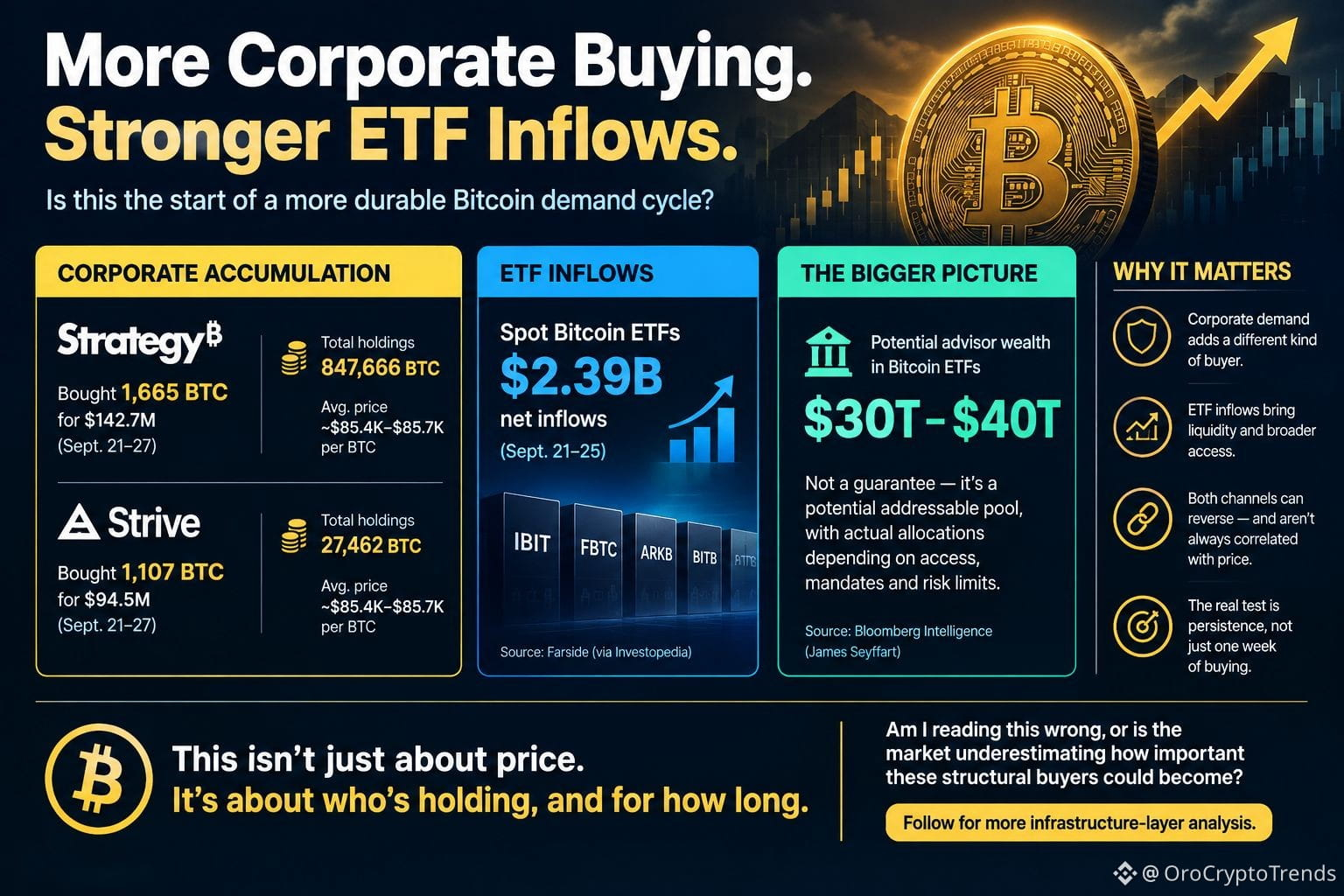
$BTC Strategy just bought another 1,665 BTC.
That’s the part of this story I’m paying attention to.
Strategy spent $142.7M between Sept. 21–27, taking its Bitcoin holdings to 847,666 BTC. Strive added another 1,107 BTC for $94.5M, bringing its stack to 27,462 BTC. Both purchases were made around $85.4K–$85.7K per BTC.
But I think the bigger signal is the combination of corporate accumulation and ETF demand.
Spot Bitcoin ETFs pulled roughly $2.4B in net inflows during Sept. 21–25, according to Farside data cited by Investopedia.
Meanwhile, Bloomberg Intelligence’s James Seyffart has pointed to roughly $30T–$40T in advisor-managed wealth that remains largely outside Bitcoin ETFs. That isn’t $40T waiting to buy Bitcoin tomorrow — it’s a potential addressable pool, and actual allocations depend on access, mandates and risk limits.
That distinction matters.
This isn’t simply “institutions are buying, therefore BTC goes up.” Corporate treasury demand can be financed through equity issuance, while ETF flows can reverse just as quickly as they arrive. The interesting part is whether these channels keep absorbing supply through different market conditions.
That’s the signal I’m watching — persistence, not one week of buying.
Am I reading this wrong, or is the market underestimating how important these structural buyers could become?
$BTC
$BTC Strategy just bought another 1,665 BTC.
That’s the part of this story I’m paying attention to.
Strategy spent $142.7M between Sept. 21–27, taking its Bitcoin holdings to 847,666 BTC. Strive added another 1,107 BTC for $94.5M, bringing its stack to 27,462 BTC. Both purchases were made around $85.4K–$85.7K per BTC.
But I think the bigger signal is the combination of corporate accumulation and ETF demand.
Spot Bitcoin ETFs pulled roughly $2.4B in net inflows during Sept. 21–25, according to Farside data cited by Investopedia.
Meanwhile, Bloomberg Intelligence’s James Seyffart has pointed to roughly $30T–$40T in advisor-managed wealth that remains largely outside Bitcoin ETFs. That isn’t $40T waiting to buy Bitcoin tomorrow — it’s a potential addressable pool, and actual allocations depend on access, mandates and risk limits.
That distinction matters.
This isn’t simply “institutions are buying, therefore BTC goes up.” Corporate treasury demand can be financed through equity issuance, while ETF flows can reverse just as quickly as they arrive. The interesting part is whether these channels keep absorbing supply through different market conditions.
That’s the signal I’m watching — persistence, not one week of buying.
Am I reading this wrong, or is the market underestimating how important these structural buyers could become?
$BTC
That’s the part of this story I’m paying attention to.
Strategy spent $142.7M between Sept. 21–27, taking its Bitcoin holdings to 847,666 BTC. Strive added another 1,107 BTC for $94.5M, bringing its stack to 27,462 BTC. Both purchases were made around $85.4K–$85.7K per BTC.
But I think the bigger signal is the combination of corporate accumulation and ETF demand.
Spot Bitcoin ETFs pulled roughly $2.4B in net inflows during Sept. 21–25, according to Farside data cited by Investopedia.
Meanwhile, Bloomberg Intelligence’s James Seyffart has pointed to roughly $30T–$40T in advisor-managed wealth that remains largely outside Bitcoin ETFs. That isn’t $40T waiting to buy Bitcoin tomorrow — it’s a potential addressable pool, and actual allocations depend on access, mandates and risk limits.
That distinction matters.
This isn’t simply “institutions are buying, therefore BTC goes up.” Corporate treasury demand can be financed through equity issuance, while ETF flows can reverse just as quickly as they arrive. The interesting part is whether these channels keep absorbing supply through different market conditions.
That’s the signal I’m watching — persistence, not one week of buying.
Am I reading this wrong, or is the market underestimating how important these structural buyers could become?
$BTC
4
2.1k
Verified
$QNT QNT isn’t moving on a normal crypto narrative anymore. That’s the part I’m watching.
The interesting thing isn’t simply that Quant is getting attention. It’s where the infrastructure is showing up.
On September 24, The Clearing House selected Quant to provide the interoperability, orchestration and transaction-management layer for its U.S. On-Chain Money Initiative — a network designed to clear and settle tokenized bank deposits.
The network is expected to open to participating institutions in the first half of 2027.
The Clearing House
Then there’s the UK.
Seven major banks — including Barclays, HSBC, Lloyds, NatWest, Nationwide, Santander and Monzo — completed live customer transactions using tokenized sterling deposits on a shared platform built by Quant.
That changes the way I look at the QNT narrative.
This isn’t proof that QNT’s token value must keep rising. And it definitely doesn’t mean every tokenization project will automatically create demand for QNT.
But it does show something more concrete: Quant is becoming part of the plumbing being tested for regulated money moving on-chain.
Wait — maybe that’s the better story here.
The question isn’t “how high can QNT go?”
It’s whether this infrastructure gets used at meaningful scale.
Still trying to figure out what this actually changes.
$QNT QNT isn’t moving on a normal crypto narrative anymore. That’s the part I’m watching.
The interesting thing isn’t simply that Quant is getting attention. It’s where the infrastructure is showing up.
On September 24, The Clearing House selected Quant to provide the interoperability, orchestration and transaction-management layer for its U.S. On-Chain Money Initiative — a network designed to clear and settle tokenized bank deposits.
The network is expected to open to participating institutions in the first half of 2027.
The Clearing House
Then there’s the UK.
Seven major banks — including Barclays, HSBC, Lloyds, NatWest, Nationwide, Santander and Monzo — completed live customer transactions using tokenized sterling deposits on a shared platform built by Quant.
That changes the way I look at the QNT narrative.
This isn’t proof that QNT’s token value must keep rising. And it definitely doesn’t mean every tokenization project will automatically create demand for QNT.
But it does show something more concrete: Quant is becoming part of the plumbing being tested for regulated money moving on-chain.
Wait — maybe that’s the better story here.
The question isn’t “how high can QNT go?”
It’s whether this infrastructure gets used at meaningful scale.
Still trying to figure out what this actually changes.
The interesting thing isn’t simply that Quant is getting attention. It’s where the infrastructure is showing up.
On September 24, The Clearing House selected Quant to provide the interoperability, orchestration and transaction-management layer for its U.S. On-Chain Money Initiative — a network designed to clear and settle tokenized bank deposits.
The network is expected to open to participating institutions in the first half of 2027.
The Clearing House
Then there’s the UK.
Seven major banks — including Barclays, HSBC, Lloyds, NatWest, Nationwide, Santander and Monzo — completed live customer transactions using tokenized sterling deposits on a shared platform built by Quant.
That changes the way I look at the QNT narrative.
This isn’t proof that QNT’s token value must keep rising. And it definitely doesn’t mean every tokenization project will automatically create demand for QNT.
But it does show something more concrete: Quant is becoming part of the plumbing being tested for regulated money moving on-chain.
Wait — maybe that’s the better story here.
The question isn’t “how high can QNT go?”
It’s whether this infrastructure gets used at meaningful scale.
Still trying to figure out what this actually changes.

5
2.1k
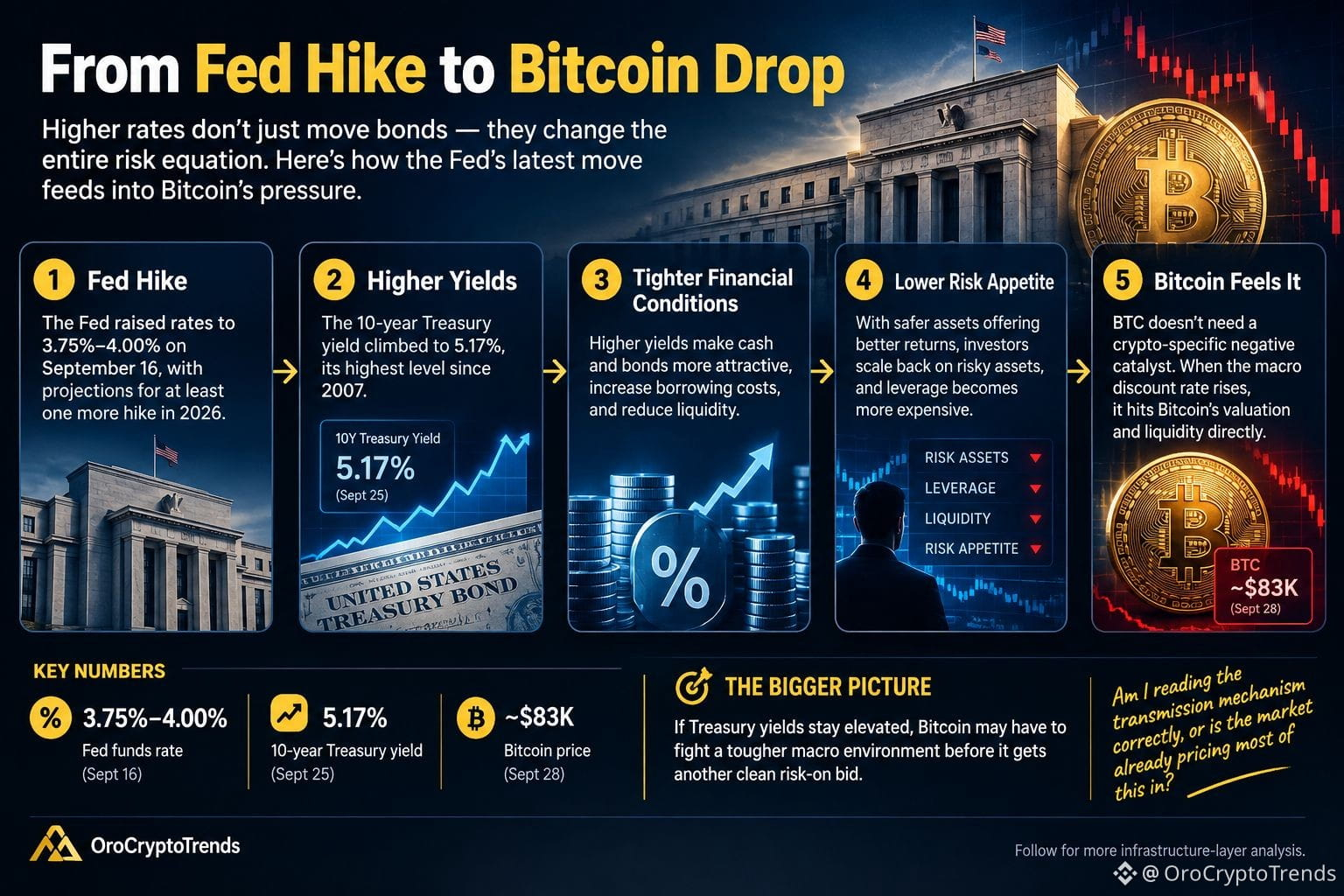
$BTC The Fed hiked. Treasury yields jumped. Bitcoin is absorbing the shock.
On September 16, the Fed raised rates to 3.75%–4.00%, while its projections still showed at least one more hike in 2026.
Then the 10-year Treasury yield climbed to 5.17%.
That’s where the Bitcoin connection gets interesting.
A tighter Fed raises the cost of money. Higher Treasury yields then give investors a more attractive alternative to volatile risk assets. Financial conditions tighten, leverage becomes more expensive, and liquidity becomes harder to chase.
Bitcoin sits directly in that risk-liquidity channel.
So when yields reprice higher, BTC doesn't need a crypto-specific negative catalyst to come under pressure. The macro discount rate itself can become the catalyst.
That’s why I’m paying less attention to the headline Fed hike and more attention to what happens to yields, liquidity and positioning afterward.
If Treasury yields stay elevated, Bitcoin may have to fight the macro environment before it gets another clean risk-on bid.
Am I reading the transmission mechanism correctly, or is the market already pricing most of this in?
$BTC The Fed hiked. Treasury yields jumped. Bitcoin is absorbing the shock.
On September 16, the Fed raised rates to 3.75%–4.00%, while its projections still showed at least one more hike in 2026.
Then the 10-year Treasury yield climbed to 5.17%.
That’s where the Bitcoin connection gets interesting.
A tighter Fed raises the cost of money. Higher Treasury yields then give investors a more attractive alternative to volatile risk assets. Financial conditions tighten, leverage becomes more expensive, and liquidity becomes harder to chase.
Bitcoin sits directly in that risk-liquidity channel.
So when yields reprice higher, BTC doesn't need a crypto-specific negative catalyst to come under pressure. The macro discount rate itself can become the catalyst.
That’s why I’m paying less attention to the headline Fed hike and more attention to what happens to yields, liquidity and positioning afterward.
If Treasury yields stay elevated, Bitcoin may have to fight the macro environment before it gets another clean risk-on bid.
Am I reading the transmission mechanism correctly, or is the market already pricing most of this in?
On September 16, the Fed raised rates to 3.75%–4.00%, while its projections still showed at least one more hike in 2026.
Then the 10-year Treasury yield climbed to 5.17%.
That’s where the Bitcoin connection gets interesting.
A tighter Fed raises the cost of money. Higher Treasury yields then give investors a more attractive alternative to volatile risk assets. Financial conditions tighten, leverage becomes more expensive, and liquidity becomes harder to chase.
Bitcoin sits directly in that risk-liquidity channel.
So when yields reprice higher, BTC doesn't need a crypto-specific negative catalyst to come under pressure. The macro discount rate itself can become the catalyst.
That’s why I’m paying less attention to the headline Fed hike and more attention to what happens to yields, liquidity and positioning afterward.
If Treasury yields stay elevated, Bitcoin may have to fight the macro environment before it gets another clean risk-on bid.
Am I reading the transmission mechanism correctly, or is the market already pricing most of this in?
4
2
12
15.6k
Verified
Binance Wallet just made one annoying part of crypto a lot less annoying.
You can now use USDT to pay gas fees directly on BNB Smart Chain, Ethereum, Solana, and TRON. So instead of realizing you have USDT but somehow zero BNB, ETH, SOL, or TRX for the transaction… you can use USDT itself for the gas payment.
Honestly, this looks like a small wallet feature. I don’t think it is.
Gas-token friction is one of those boring UX problems that quietly stops people from using on-chain apps. You can have the asset you actually want to move, but still get stuck because you’re missing a tiny amount of the network’s native token.
That creates unnecessary steps: buy the gas token, transfer it, choose the right network, wait, then try the original transaction again.
Removing that step makes the wallet feel more like one system instead of a collection of separate blockchain rules.
The interesting part is what happens if this approach expands across more networks. Binance’s current announcement confirms the four supported networks, but doesn’t give a rollout schedule for additional ones.
That’s the part I’ll be watching.
Is this just better wallet UX, or a bigger shift toward hiding blockchain complexity from the average user?
Binance Wallet just made one annoying part of crypto a lot less annoying.
You can now use USDT to pay gas fees directly on BNB Smart Chain, Ethereum, Solana, and TRON. So instead of realizing you have USDT but somehow zero BNB, ETH, SOL, or TRX for the transaction… you can use USDT itself for the gas payment.
Honestly, this looks like a small wallet feature. I don’t think it is.
Gas-token friction is one of those boring UX problems that quietly stops people from using on-chain apps. You can have the asset you actually want to move, but still get stuck because you’re missing a tiny amount of the network’s native token.
That creates unnecessary steps: buy the gas token, transfer it, choose the right network, wait, then try the original transaction again.
Removing that step makes the wallet feel more like one system instead of a collection of separate blockchain rules.
The interesting part is what happens if this approach expands across more networks. Binance’s current announcement confirms the four supported networks, but doesn’t give a rollout schedule for additional ones.
That’s the part I’ll be watching.
Is this just better wallet UX, or a bigger shift toward hiding blockchain complexity from the average user?
You can now use USDT to pay gas fees directly on BNB Smart Chain, Ethereum, Solana, and TRON. So instead of realizing you have USDT but somehow zero BNB, ETH, SOL, or TRX for the transaction… you can use USDT itself for the gas payment.
Honestly, this looks like a small wallet feature. I don’t think it is.
Gas-token friction is one of those boring UX problems that quietly stops people from using on-chain apps. You can have the asset you actually want to move, but still get stuck because you’re missing a tiny amount of the network’s native token.
That creates unnecessary steps: buy the gas token, transfer it, choose the right network, wait, then try the original transaction again.
Removing that step makes the wallet feel more like one system instead of a collection of separate blockchain rules.
The interesting part is what happens if this approach expands across more networks. Binance’s current announcement confirms the four supported networks, but doesn’t give a rollout schedule for additional ones.
That’s the part I’ll be watching.
Is this just better wallet UX, or a bigger shift toward hiding blockchain complexity from the average user?
2
603
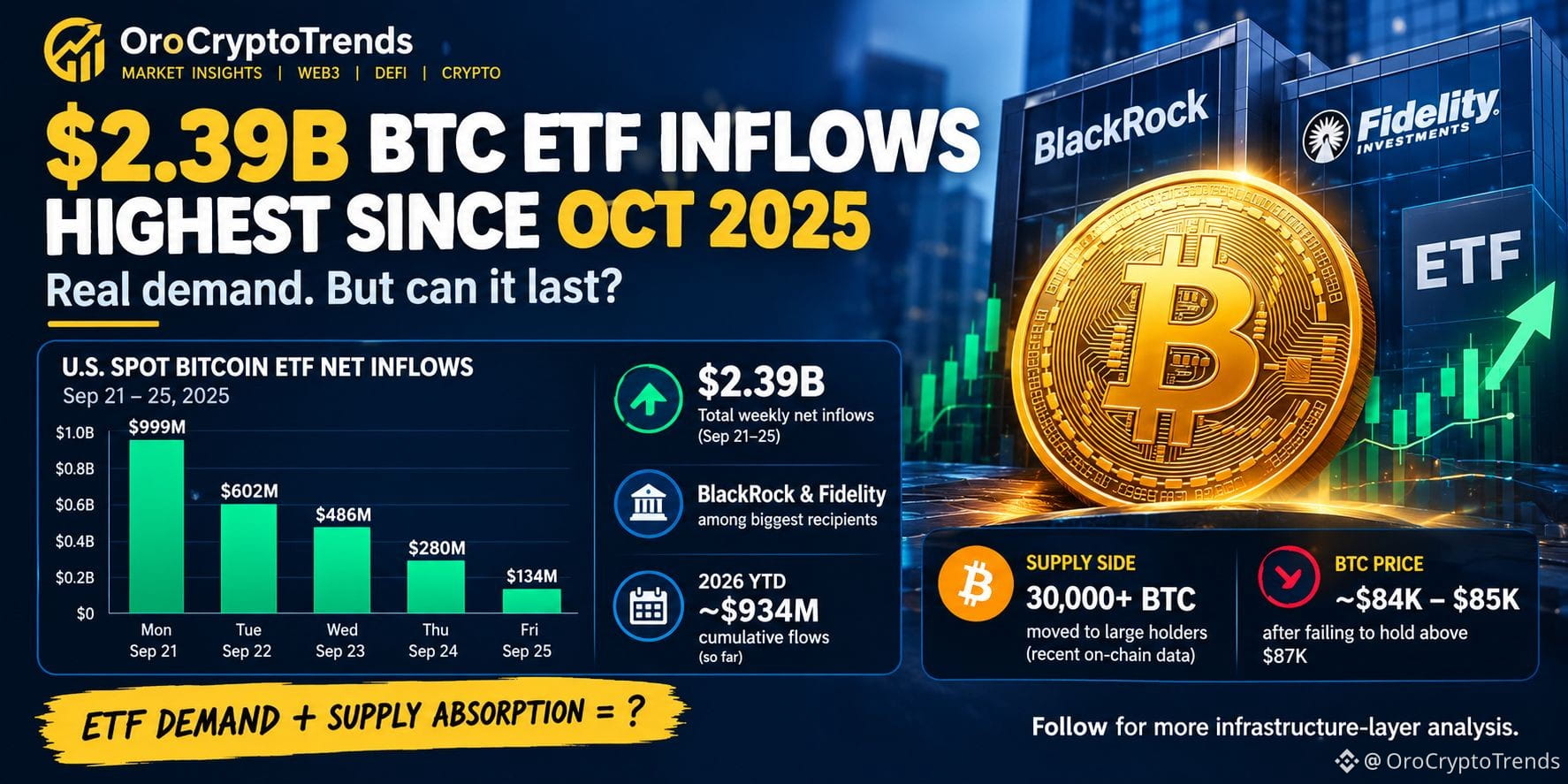
$BTC $2.39B flowed into U.S. spot Bitcoin ETFs last week. But the interesting part isn’t the headline.
It’s what happened after the money arrived.
The Sep. 21–25 week brought roughly $2.39B of net inflows, the strongest weekly result since October 2025. BlackRock’s IBIT and Fidelity’s FBTC were among the biggest recipients. That’s real demand through regulated products, not just crypto Twitter getting excited.
But I’m not ready to call this a clean institutional accumulation trend yet.
Look at the flow sequence. Monday brought almost $999M. By Friday, the daily inflow had fallen to roughly $134M. Money was still coming in, yes, but the intensity cooled dramatically during the week.
And this is where the supply story gets interesting.
Separate on-chain reports point to more than 30,000 BTC moving into the hands of large holders during recent price weakness, while BTC remained around the mid-$84K area after failing to hold the move above $87K.
So the setup I’m watching isn’t simply “ETF inflows = bullish.”
It’s whether ETF demand keeps absorbing supply while BTC is sitting underneath the $86K–$87K resistance area.
If the flows stay strong and that supply keeps getting absorbed, the structure changes.
If inflows fade while sellers keep defending the highs, this could turn out to be one very large week of positioning rather than the start of something bigger.
Still trying to figure out what this actually changes.
$BTC $2.39B flowed into U.S. spot Bitcoin ETFs last week. But the interesting part isn’t the headline.
It’s what happened after the money arrived.
The Sep. 21–25 week brought roughly $2.39B of net inflows, the strongest weekly result since October 2025. BlackRock’s IBIT and Fidelity’s FBTC were among the biggest recipients. That’s real demand through regulated products, not just crypto Twitter getting excited.
But I’m not ready to call this a clean institutional accumulation trend yet.
Look at the flow sequence. Monday brought almost $999M. By Friday, the daily inflow had fallen to roughly $134M. Money was still coming in, yes, but the intensity cooled dramatically during the week.
And this is where the supply story gets interesting.
Separate on-chain reports point to more than 30,000 BTC moving into the hands of large holders during recent price weakness, while BTC remained around the mid-$84K area after failing to hold the move above $87K.
So the setup I’m watching isn’t simply “ETF inflows = bullish.”
It’s whether ETF demand keeps absorbing supply while BTC is sitting underneath the $86K–$87K resistance area.
If the flows stay strong and that supply keeps getting absorbed, the structure changes.
If inflows fade while sellers keep defending the highs, this could turn out to be one very large week of positioning rather than the start of something bigger.
Still trying to figure out what this actually changes.
It’s what happened after the money arrived.
The Sep. 21–25 week brought roughly $2.39B of net inflows, the strongest weekly result since October 2025. BlackRock’s IBIT and Fidelity’s FBTC were among the biggest recipients. That’s real demand through regulated products, not just crypto Twitter getting excited.
But I’m not ready to call this a clean institutional accumulation trend yet.
Look at the flow sequence. Monday brought almost $999M. By Friday, the daily inflow had fallen to roughly $134M. Money was still coming in, yes, but the intensity cooled dramatically during the week.
And this is where the supply story gets interesting.
Separate on-chain reports point to more than 30,000 BTC moving into the hands of large holders during recent price weakness, while BTC remained around the mid-$84K area after failing to hold the move above $87K.
So the setup I’m watching isn’t simply “ETF inflows = bullish.”
It’s whether ETF demand keeps absorbing supply while BTC is sitting underneath the $86K–$87K resistance area.
If the flows stay strong and that supply keeps getting absorbed, the structure changes.
If inflows fade while sellers keep defending the highs, this could turn out to be one very large week of positioning rather than the start of something bigger.
Still trying to figure out what this actually changes.
2
3k
Verified
$QNT QNT just got a much bigger real-world catalyst — but the interesting part isn’t the price spike.
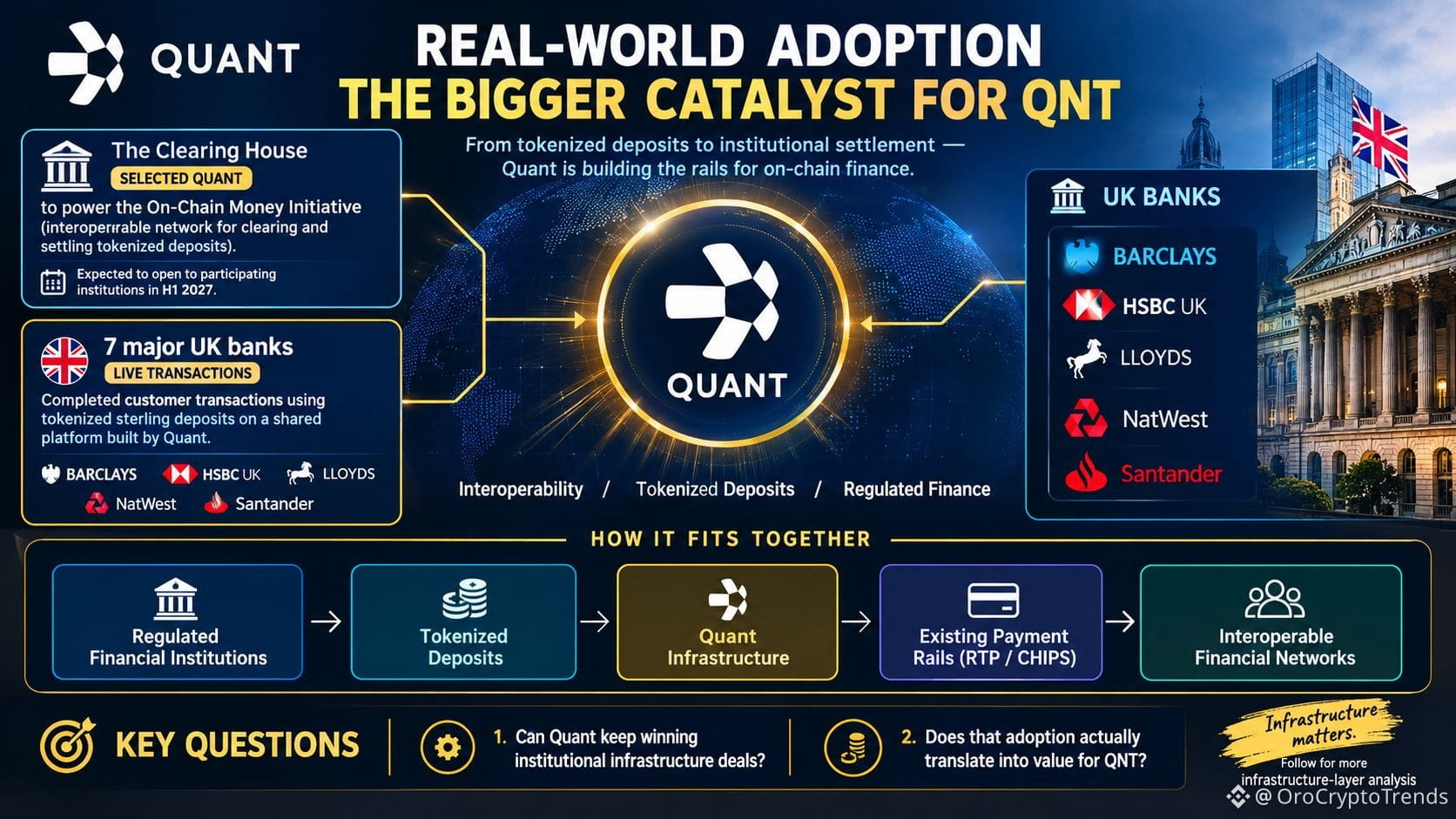
The Clearing House selected Quant to power its On-Chain Money Initiative, an interoperable network for clearing and settling tokenized deposits. The network is expected to open to participating financial institutions in the first half of 2027.
And this isn’t happening in isolation.
Seven major UK banks — including Barclays, HSBC UK, Lloyds, NatWest and Santander — have already completed live customer transactions using tokenized sterling deposits on a shared platform built by Quant.
What I find more interesting is the infrastructure layer.
This isn’t simply another bank putting something “on-chain.” Quant is sitting between regulated financial institutions, tokenized deposits and existing payment infrastructure like RTP and CHIPS. That’s a much more boring story than a meme-driven pump, but potentially a more important one.
Wait — there’s an important distinction, though.
Adoption of Quant’s technology does not automatically mean every dollar flowing through these networks creates direct demand for QNT. The company’s infrastructure business and the token’s economics shouldn’t be treated as the same thing.
So I’m watching two separate questions: can Quant keep winning institutional infrastructure deals, and does that adoption actually translate into value for QNT?
That distinction matters.
Still trying to figure out what this actually changes.
#Write2Earn
$QNT QNT just got a much bigger real-world catalyst — but the interesting part isn’t the price spike.
The Clearing House selected Quant to power its On-Chain Money Initiative, an interoperable network for clearing and settling tokenized deposits. The network is expected to open to participating financial institutions in the first half of 2027.
And this isn’t happening in isolation.
Seven major UK banks — including Barclays, HSBC UK, Lloyds, NatWest and Santander — have already completed live customer transactions using tokenized sterling deposits on a shared platform built by Quant.
What I find more interesting is the infrastructure layer.
This isn’t simply another bank putting something “on-chain.” Quant is sitting between regulated financial institutions, tokenized deposits and existing payment infrastructure like RTP and CHIPS. That’s a much more boring story than a meme-driven pump, but potentially a more important one.
Wait — there’s an important distinction, though.
Adoption of Quant’s technology does not automatically mean every dollar flowing through these networks creates direct demand for QNT. The company’s infrastructure business and the token’s economics shouldn’t be treated as the same thing.
So I’m watching two separate questions: can Quant keep winning institutional infrastructure deals, and does that adoption actually translate into value for QNT?
That distinction matters.
Still trying to figure out what this actually changes.
#Write2Earn
The Clearing House selected Quant to power its On-Chain Money Initiative, an interoperable network for clearing and settling tokenized deposits. The network is expected to open to participating financial institutions in the first half of 2027.
And this isn’t happening in isolation.
Seven major UK banks — including Barclays, HSBC UK, Lloyds, NatWest and Santander — have already completed live customer transactions using tokenized sterling deposits on a shared platform built by Quant.
What I find more interesting is the infrastructure layer.
This isn’t simply another bank putting something “on-chain.” Quant is sitting between regulated financial institutions, tokenized deposits and existing payment infrastructure like RTP and CHIPS. That’s a much more boring story than a meme-driven pump, but potentially a more important one.
Wait — there’s an important distinction, though.
Adoption of Quant’s technology does not automatically mean every dollar flowing through these networks creates direct demand for QNT. The company’s infrastructure business and the token’s economics shouldn’t be treated as the same thing.
So I’m watching two separate questions: can Quant keep winning institutional infrastructure deals, and does that adoption actually translate into value for QNT?
That distinction matters.
Still trying to figure out what this actually changes.
#Write2Earn
2
1.1k
Verified
$NEAR NEAR just entered the U.S. spot ETF market.
The bigger story isn’t the spike toward $5.
NEAR just crossed a line that matters more than the price spike.
Bitwise’s NEAR ETF, ticker NRR, has been approved for listing on NYSE Arca. And yes, NEAR reacted sharply around the news, briefly pushing toward the $5 area.
But honestly, the price move isn’t the part I find most interesting.
The bigger change is access.
The ETF is designed to hold actual NEAR, while also pursuing staking rewards as a secondary objective. Coinbase Custody is handling custody of the NEAR. That means the product isn’t simply creating another paper exposure to the token — it’s trying to bring NEAR into a more familiar investment structure.
And that creates a weird tension.
Everyone sees “first U.S. spot NEAR ETF” and immediately thinks demand. Fair enough. But an ETF listing doesn’t automatically mean sustained capital flows. The real test comes after launch: assets under management, liquidity, spreads, and whether investors actually use the vehicle at scale.
Bitwise has also published much more aggressive long-term NEAR scenarios, including a $155 base target and $562 bull case. I’d treat those as assumptions to examine, not predictions to repeat as fact.
The interesting question now isn’t whether the headline sounds bullish.
It’s whether regulated access actually creates durable demand for NEAR.
Still trying to figure out what this actually changes.
$NEAR NEAR just entered the U.S. spot ETF market.
The bigger story isn’t the spike toward $5.
NEAR just crossed a line that matters more than the price spike.
Bitwise’s NEAR ETF, ticker NRR, has been approved for listing on NYSE Arca. And yes, NEAR reacted sharply around the news, briefly pushing toward the $5 area.
But honestly, the price move isn’t the part I find most interesting.
The bigger change is access.
The ETF is designed to hold actual NEAR, while also pursuing staking rewards as a secondary objective. Coinbase Custody is handling custody of the NEAR. That means the product isn’t simply creating another paper exposure to the token — it’s trying to bring NEAR into a more familiar investment structure.
And that creates a weird tension.
Everyone sees “first U.S. spot NEAR ETF” and immediately thinks demand. Fair enough. But an ETF listing doesn’t automatically mean sustained capital flows. The real test comes after launch: assets under management, liquidity, spreads, and whether investors actually use the vehicle at scale.
Bitwise has also published much more aggressive long-term NEAR scenarios, including a $155 base target and $562 bull case. I’d treat those as assumptions to examine, not predictions to repeat as fact.
The interesting question now isn’t whether the headline sounds bullish.
It’s whether regulated access actually creates durable demand for NEAR.
Still trying to figure out what this actually changes.
The bigger story isn’t the spike toward $5.
NEAR just crossed a line that matters more than the price spike.
Bitwise’s NEAR ETF, ticker NRR, has been approved for listing on NYSE Arca. And yes, NEAR reacted sharply around the news, briefly pushing toward the $5 area.
But honestly, the price move isn’t the part I find most interesting.
The bigger change is access.
The ETF is designed to hold actual NEAR, while also pursuing staking rewards as a secondary objective. Coinbase Custody is handling custody of the NEAR. That means the product isn’t simply creating another paper exposure to the token — it’s trying to bring NEAR into a more familiar investment structure.
And that creates a weird tension.
Everyone sees “first U.S. spot NEAR ETF” and immediately thinks demand. Fair enough. But an ETF listing doesn’t automatically mean sustained capital flows. The real test comes after launch: assets under management, liquidity, spreads, and whether investors actually use the vehicle at scale.
Bitwise has also published much more aggressive long-term NEAR scenarios, including a $155 base target and $562 bull case. I’d treat those as assumptions to examine, not predictions to repeat as fact.
The interesting question now isn’t whether the headline sounds bullish.
It’s whether regulated access actually creates durable demand for NEAR.
Still trying to figure out what this actually changes.
4
3.2k
Verified
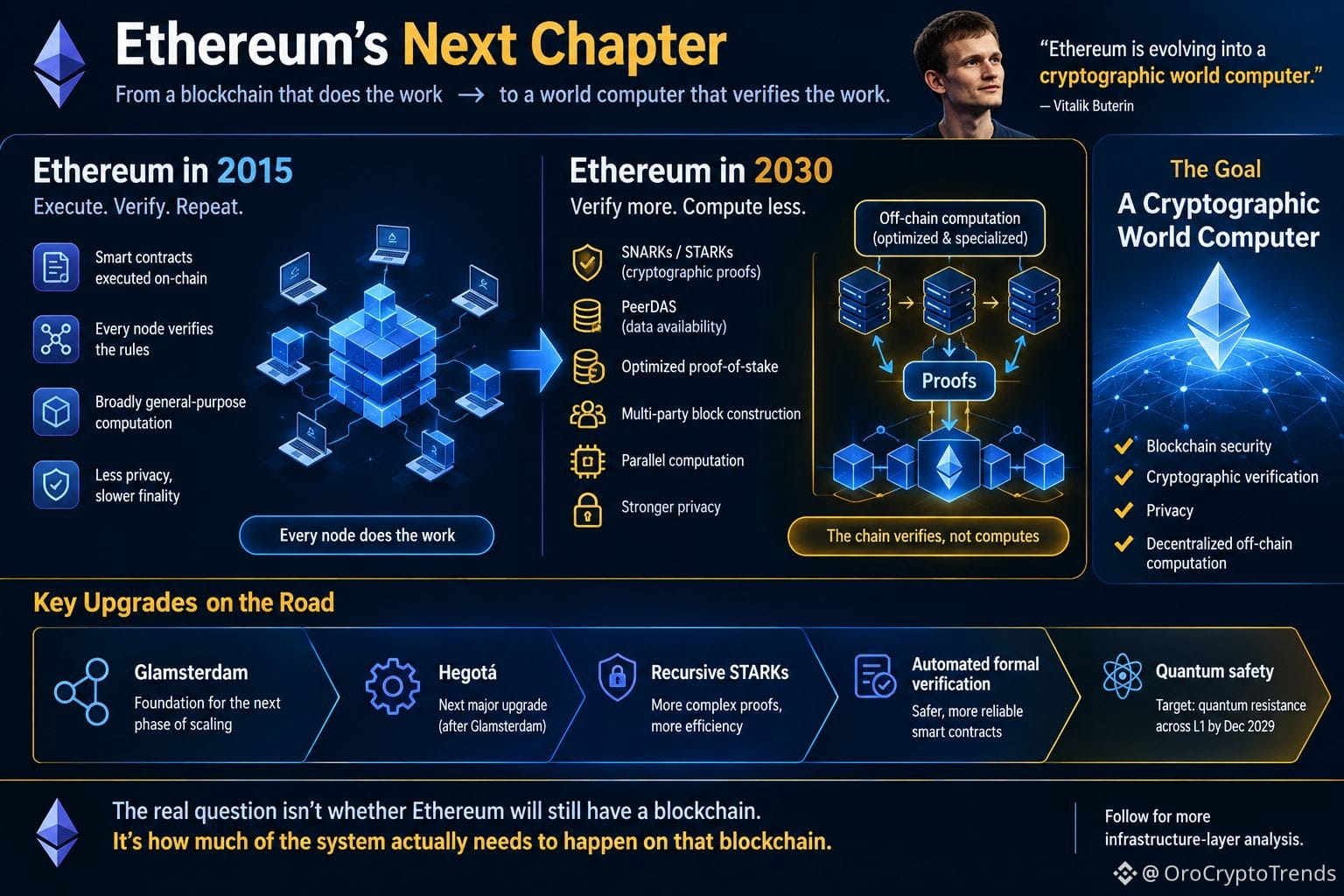
$ETH Ethereum may be moving toward something much stranger than a faster blockchain.
Vitalik Buterin’s latest framing is that Ethereum is evolving into a “cryptographic world computer” — where the chain itself does less computation and more verification.
That distinction matters.
The 2015 Ethereum model was relatively simple: execute smart contracts on-chain, have every node verify the rules, and keep the system broadly general-purpose. The 2030 direction shown here is different: SNARKs/STARKs, parallelized computation, stronger privacy, multi-party block construction, lighter verification, and more work happening outside the chain before cryptographic proofs are brought back for verification.
So Ethereum’s scaling problem is increasingly being reframed.
Not “How do we make every node compute more?”
But “How do we make the network verify more computation without requiring every node to perform all of it?”
That’s a much bigger architectural shift.
The trade-off is interesting, though. General-purpose computation still carries substantial overhead, while specialized computation can become dramatically cheaper. Ethereum’s own roadmap also puts major emphasis on faster finality, privacy and post-quantum security, with the Foundation targeting quantum resistance across the L1 by December 2029.
And Hegotá is currently being scoped as the next major upgrade after Glamsterdam, with several proposals aimed at preparing the longer cryptographic transition.
The interesting question isn’t whether Ethereum will still have a blockchain.
It’s how much of the system actually needs to happen on that blockchain.
$ETH Ethereum may be moving toward something much stranger than a faster blockchain.
Vitalik Buterin’s latest framing is that Ethereum is evolving into a “cryptographic world computer” — where the chain itself does less computation and more verification.
That distinction matters.
The 2015 Ethereum model was relatively simple: execute smart contracts on-chain, have every node verify the rules, and keep the system broadly general-purpose. The 2030 direction shown here is different: SNARKs/STARKs, parallelized computation, stronger privacy, multi-party block construction, lighter verification, and more work happening outside the chain before cryptographic proofs are brought back for verification.
So Ethereum’s scaling problem is increasingly being reframed.
Not “How do we make every node compute more?”
But “How do we make the network verify more computation without requiring every node to perform all of it?”
That’s a much bigger architectural shift.
The trade-off is interesting, though. General-purpose computation still carries substantial overhead, while specialized computation can become dramatically cheaper. Ethereum’s own roadmap also puts major emphasis on faster finality, privacy and post-quantum security, with the Foundation targeting quantum resistance across the L1 by December 2029.
And Hegotá is currently being scoped as the next major upgrade after Glamsterdam, with several proposals aimed at preparing the longer cryptographic transition.
The interesting question isn’t whether Ethereum will still have a blockchain.
It’s how much of the system actually needs to happen on that blockchain.
Vitalik Buterin’s latest framing is that Ethereum is evolving into a “cryptographic world computer” — where the chain itself does less computation and more verification.
That distinction matters.
The 2015 Ethereum model was relatively simple: execute smart contracts on-chain, have every node verify the rules, and keep the system broadly general-purpose. The 2030 direction shown here is different: SNARKs/STARKs, parallelized computation, stronger privacy, multi-party block construction, lighter verification, and more work happening outside the chain before cryptographic proofs are brought back for verification.
So Ethereum’s scaling problem is increasingly being reframed.
Not “How do we make every node compute more?”
But “How do we make the network verify more computation without requiring every node to perform all of it?”
That’s a much bigger architectural shift.
The trade-off is interesting, though. General-purpose computation still carries substantial overhead, while specialized computation can become dramatically cheaper. Ethereum’s own roadmap also puts major emphasis on faster finality, privacy and post-quantum security, with the Foundation targeting quantum resistance across the L1 by December 2029.
And Hegotá is currently being scoped as the next major upgrade after Glamsterdam, with several proposals aimed at preparing the longer cryptographic transition.
The interesting question isn’t whether Ethereum will still have a blockchain.
It’s how much of the system actually needs to happen on that blockchain.
1
517
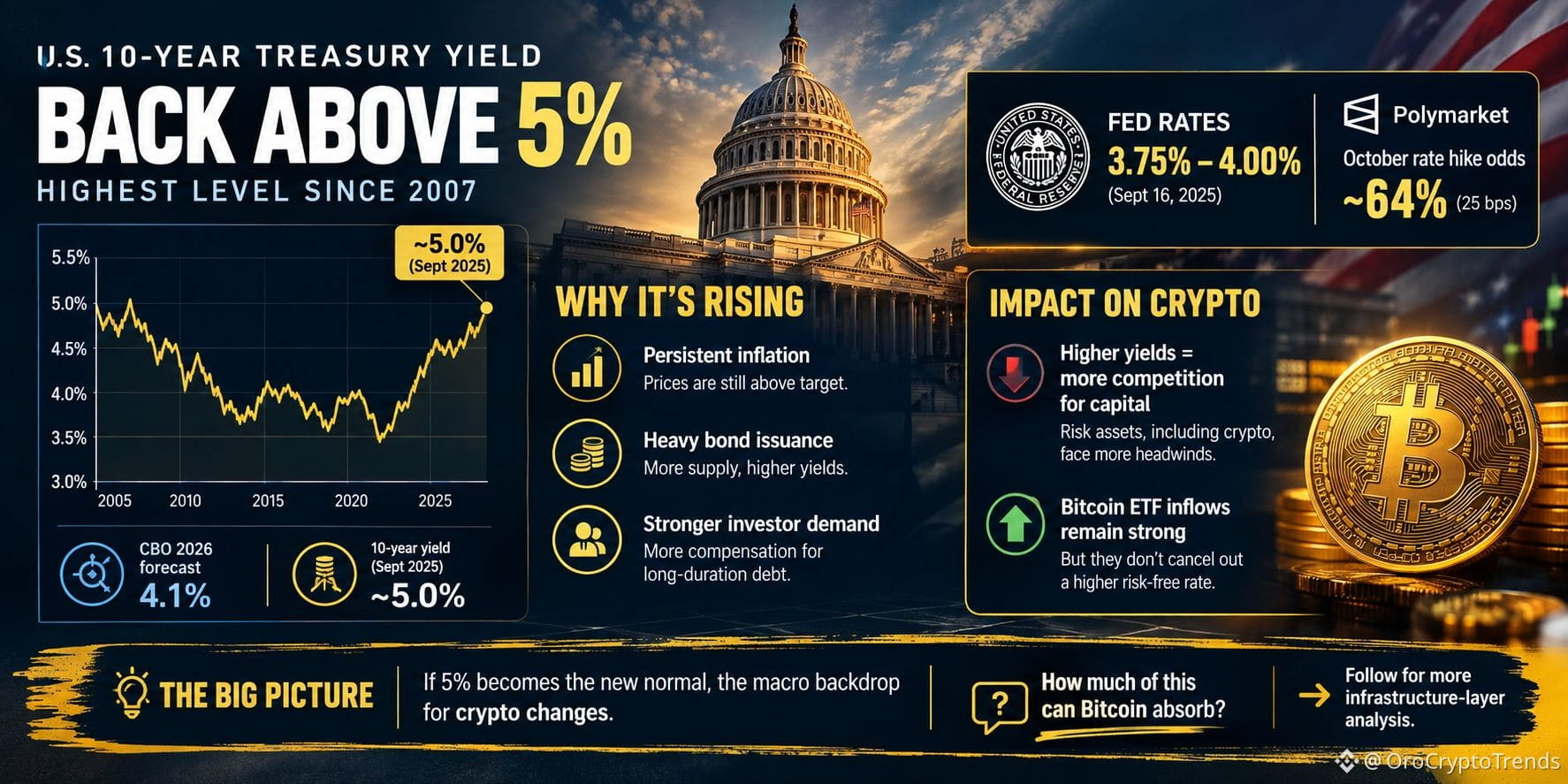
$BTC The 10-year Treasury yield is back around 5% — and crypto shouldn’t ignore that.
What caught my attention isn’t just the number. It’s what the bond market is saying about the cost of capital.
The 10-year briefly moved above 5% in September, around levels not seen since the mid-2000s. At the same time, the CBO’s 2026 projection was only 4.1%. That gap matters.
And the pressure isn’t coming from one thing. Inflation is still elevated, Treasury supply is heavy, and investors are demanding more compensation for holding long-duration debt. The Fed also raised its target range to 3.75%–4.00% on September 16, while prediction markets have been pricing a meaningful probability of another 25-bp hike in October.
This is where I think the crypto narrative gets too simple.
Strong Bitcoin ETF flows can keep demand alive, but they don’t cancel out a higher risk-free rate. If capital can earn substantially more in Treasuries, speculative assets have to compete harder for that capital.
So I’m watching yields more closely than the headline Fed decision right now.
Because if 5% becomes the new normal rather than a temporary spike, the macro backdrop for crypto changes.
Still trying to figure out how much of this Bitcoin can absorb.
#Write2Earn
$BTC The 10-year Treasury yield is back around 5% — and crypto shouldn’t ignore that.
What caught my attention isn’t just the number. It’s what the bond market is saying about the cost of capital.
The 10-year briefly moved above 5% in September, around levels not seen since the mid-2000s. At the same time, the CBO’s 2026 projection was only 4.1%. That gap matters.
And the pressure isn’t coming from one thing. Inflation is still elevated, Treasury supply is heavy, and investors are demanding more compensation for holding long-duration debt. The Fed also raised its target range to 3.75%–4.00% on September 16, while prediction markets have been pricing a meaningful probability of another 25-bp hike in October.
This is where I think the crypto narrative gets too simple.
Strong Bitcoin ETF flows can keep demand alive, but they don’t cancel out a higher risk-free rate. If capital can earn substantially more in Treasuries, speculative assets have to compete harder for that capital.
So I’m watching yields more closely than the headline Fed decision right now.
Because if 5% becomes the new normal rather than a temporary spike, the macro backdrop for crypto changes.
Still trying to figure out how much of this Bitcoin can absorb.
#Write2Earn
What caught my attention isn’t just the number. It’s what the bond market is saying about the cost of capital.
The 10-year briefly moved above 5% in September, around levels not seen since the mid-2000s. At the same time, the CBO’s 2026 projection was only 4.1%. That gap matters.
And the pressure isn’t coming from one thing. Inflation is still elevated, Treasury supply is heavy, and investors are demanding more compensation for holding long-duration debt. The Fed also raised its target range to 3.75%–4.00% on September 16, while prediction markets have been pricing a meaningful probability of another 25-bp hike in October.
This is where I think the crypto narrative gets too simple.
Strong Bitcoin ETF flows can keep demand alive, but they don’t cancel out a higher risk-free rate. If capital can earn substantially more in Treasuries, speculative assets have to compete harder for that capital.
So I’m watching yields more closely than the headline Fed decision right now.
Because if 5% becomes the new normal rather than a temporary spike, the macro backdrop for crypto changes.
Still trying to figure out how much of this Bitcoin can absorb.
#Write2Earn
1
5.3k
Verified
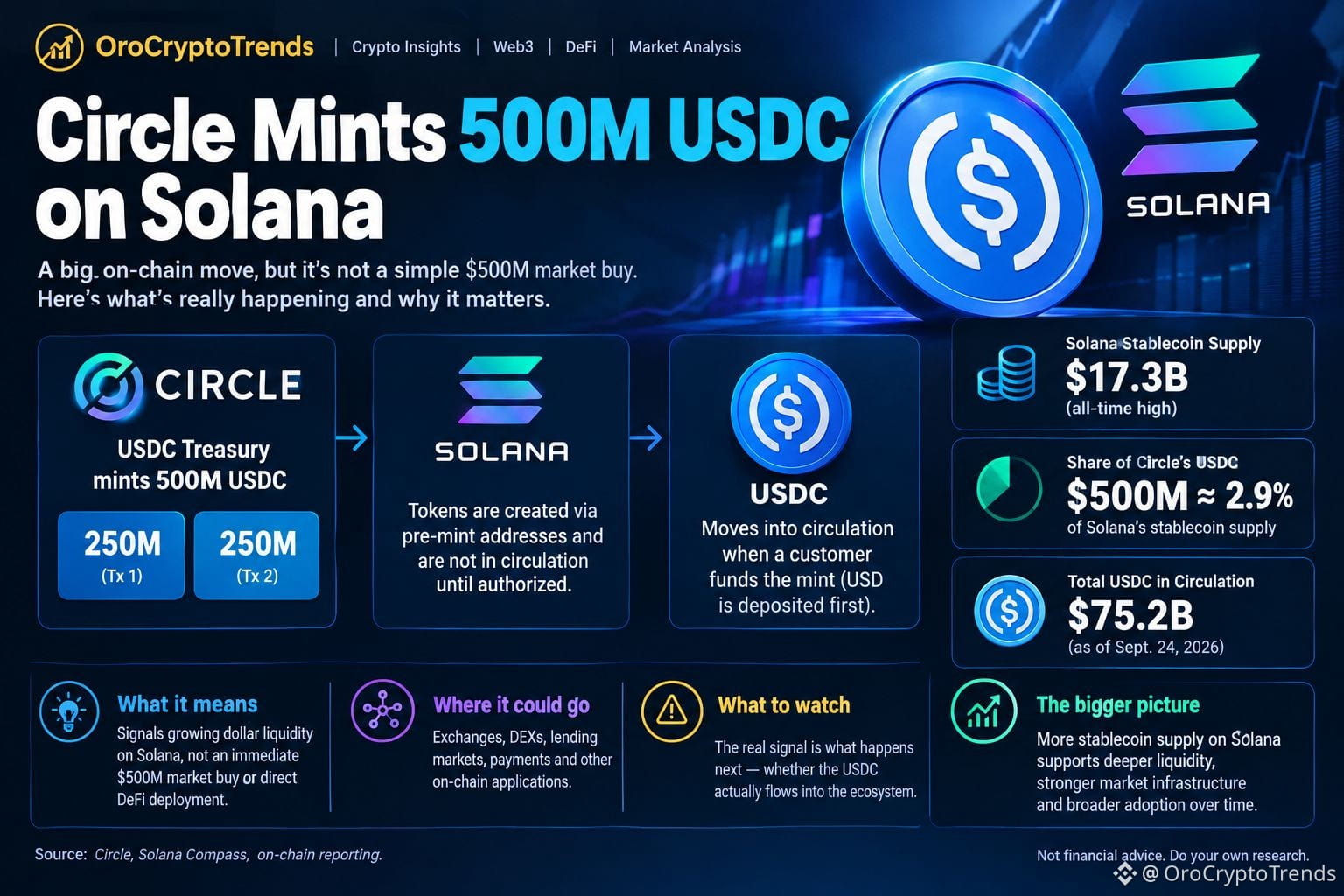
$500M of USDC just appeared on Solana. The interesting part isn’t the headline number.
Circle’s USDC Treasury minted 500 million USDC across two 250M transactions on Solana. And yes, that sounds like a giant liquidity injection.
But wait — maybe “liquidity injection” is the wrong frame.
A mint isn’t the same thing as someone market-buying $500M of SOL or pouring $500M straight into DeFi. Circle’s own documentation makes the plumbing more interesting. On Solana, Circle uses pre-mint addresses, and those tokens aren’t counted as circulating supply until Circle authorizes them for issuance. Its normal minting process is tied to customers providing dollars and receiving USDC.
So I’m less interested in the viral “Circle just printed $500M” narrative and more interested in what happens next.
Solana’s stablecoin supply has already reached roughly $17.3B. That tells me the bigger story is the growing amount of dollar liquidity being positioned on the network.
But positioned liquidity isn’t necessarily deployed liquidity.
The real signal comes after the mint: does that USDC actually move into exchanges, DEXs, lending markets, payments or other applications?
That’s the part I’ll be watching.
A $500M mint is notable. Where it goes is the actual story.
Still trying to figure out what this actually changes.
CircleMints500MUSDCOnSolana
$500M of USDC just appeared on Solana. The interesting part isn’t the headline number.
Circle’s USDC Treasury minted 500 million USDC across two 250M transactions on Solana. And yes, that sounds like a giant liquidity injection.
But wait — maybe “liquidity injection” is the wrong frame.
A mint isn’t the same thing as someone market-buying $500M of SOL or pouring $500M straight into DeFi. Circle’s own documentation makes the plumbing more interesting. On Solana, Circle uses pre-mint addresses, and those tokens aren’t counted as circulating supply until Circle authorizes them for issuance. Its normal minting process is tied to customers providing dollars and receiving USDC.
So I’m less interested in the viral “Circle just printed $500M” narrative and more interested in what happens next.
Solana’s stablecoin supply has already reached roughly $17.3B. That tells me the bigger story is the growing amount of dollar liquidity being positioned on the network.
But positioned liquidity isn’t necessarily deployed liquidity.
The real signal comes after the mint: does that USDC actually move into exchanges, DEXs, lending markets, payments or other applications?
That’s the part I’ll be watching.
A $500M mint is notable. Where it goes is the actual story.
Still trying to figure out what this actually changes.
CircleMints500MUSDCOnSolana
Circle’s USDC Treasury minted 500 million USDC across two 250M transactions on Solana. And yes, that sounds like a giant liquidity injection.
But wait — maybe “liquidity injection” is the wrong frame.
A mint isn’t the same thing as someone market-buying $500M of SOL or pouring $500M straight into DeFi. Circle’s own documentation makes the plumbing more interesting. On Solana, Circle uses pre-mint addresses, and those tokens aren’t counted as circulating supply until Circle authorizes them for issuance. Its normal minting process is tied to customers providing dollars and receiving USDC.
So I’m less interested in the viral “Circle just printed $500M” narrative and more interested in what happens next.
Solana’s stablecoin supply has already reached roughly $17.3B. That tells me the bigger story is the growing amount of dollar liquidity being positioned on the network.
But positioned liquidity isn’t necessarily deployed liquidity.
The real signal comes after the mint: does that USDC actually move into exchanges, DEXs, lending markets, payments or other applications?
That’s the part I’ll be watching.
A $500M mint is notable. Where it goes is the actual story.
Still trying to figure out what this actually changes.
CircleMints500MUSDCOnSolana
1
2
1k
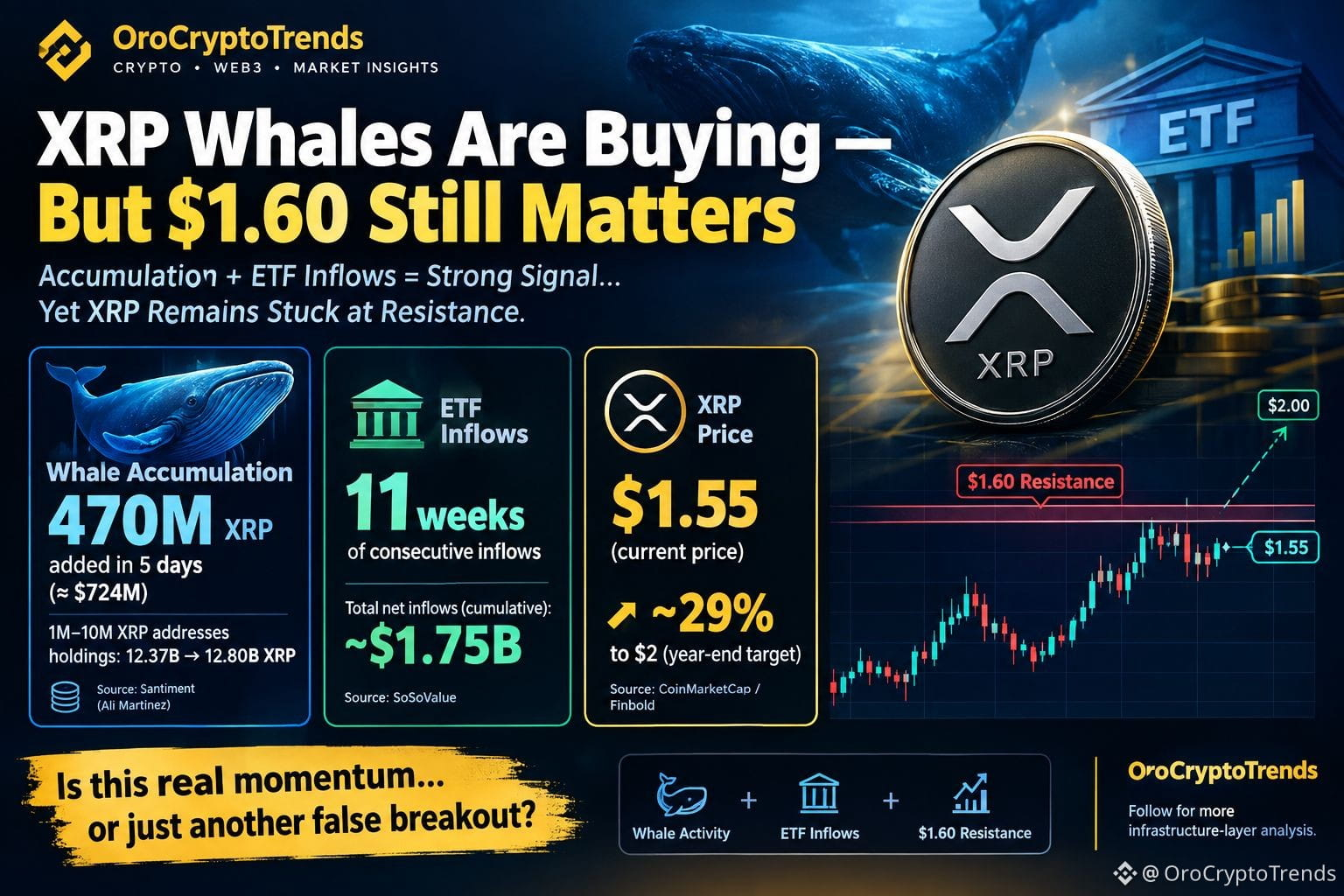
470 million XRP added in five days is hard to ignore. But I’m more interested in what it hasn’t changed yet.
Addresses holding 1M–10M XRP reportedly added roughly 470M tokens, worth about $724M, taking their combined holdings from 12.37B to 12.80B XRP. At roughly the same time, U.S. spot XRP ETFs extended their weekly inflow streak to 11 weeks, with cumulative net inflows reported around $1.75B.
On the surface, that looks pretty straightforward: whales are accumulating while institutional money keeps coming in.
But wait — maybe that’s not the right frame.
If demand is really this persistent, why is XRP still struggling around the $1.60 area?
That resistance matters. XRP has already pushed into that zone and pulled back, so the market still needs to prove that this buying pressure can actually absorb the supply sitting above it.
The $2 target being discussed comes from a technical setup, not some guaranteed destination. A sustained break above $1.60 would make that scenario more interesting. Failure there would tell me the accumulation story still hasn’t translated into enough price discovery.
Honestly, this is the part I’m watching more closely than the whale headline.
Big wallets buying is interesting.
Big wallets buying while price remains stuck at resistance? That’s the real test.
Still trying to figure out what this actually changes.$XRP
470 million XRP added in five days is hard to ignore. But I’m more interested in what it hasn’t changed yet.
Addresses holding 1M–10M XRP reportedly added roughly 470M tokens, worth about $724M, taking their combined holdings from 12.37B to 12.80B XRP. At roughly the same time, U.S. spot XRP ETFs extended their weekly inflow streak to 11 weeks, with cumulative net inflows reported around $1.75B.
On the surface, that looks pretty straightforward: whales are accumulating while institutional money keeps coming in.
But wait — maybe that’s not the right frame.
If demand is really this persistent, why is XRP still struggling around the $1.60 area?
That resistance matters. XRP has already pushed into that zone and pulled back, so the market still needs to prove that this buying pressure can actually absorb the supply sitting above it.
The $2 target being discussed comes from a technical setup, not some guaranteed destination. A sustained break above $1.60 would make that scenario more interesting. Failure there would tell me the accumulation story still hasn’t translated into enough price discovery.
Honestly, this is the part I’m watching more closely than the whale headline.
Big wallets buying is interesting.
Big wallets buying while price remains stuck at resistance? That’s the real test.
Still trying to figure out what this actually changes.$XRP
Addresses holding 1M–10M XRP reportedly added roughly 470M tokens, worth about $724M, taking their combined holdings from 12.37B to 12.80B XRP. At roughly the same time, U.S. spot XRP ETFs extended their weekly inflow streak to 11 weeks, with cumulative net inflows reported around $1.75B.
On the surface, that looks pretty straightforward: whales are accumulating while institutional money keeps coming in.
But wait — maybe that’s not the right frame.
If demand is really this persistent, why is XRP still struggling around the $1.60 area?
That resistance matters. XRP has already pushed into that zone and pulled back, so the market still needs to prove that this buying pressure can actually absorb the supply sitting above it.
The $2 target being discussed comes from a technical setup, not some guaranteed destination. A sustained break above $1.60 would make that scenario more interesting. Failure there would tell me the accumulation story still hasn’t translated into enough price discovery.
Honestly, this is the part I’m watching more closely than the whale headline.
Big wallets buying is interesting.
Big wallets buying while price remains stuck at resistance? That’s the real test.
Still trying to figure out what this actually changes.$XRP
7
3k
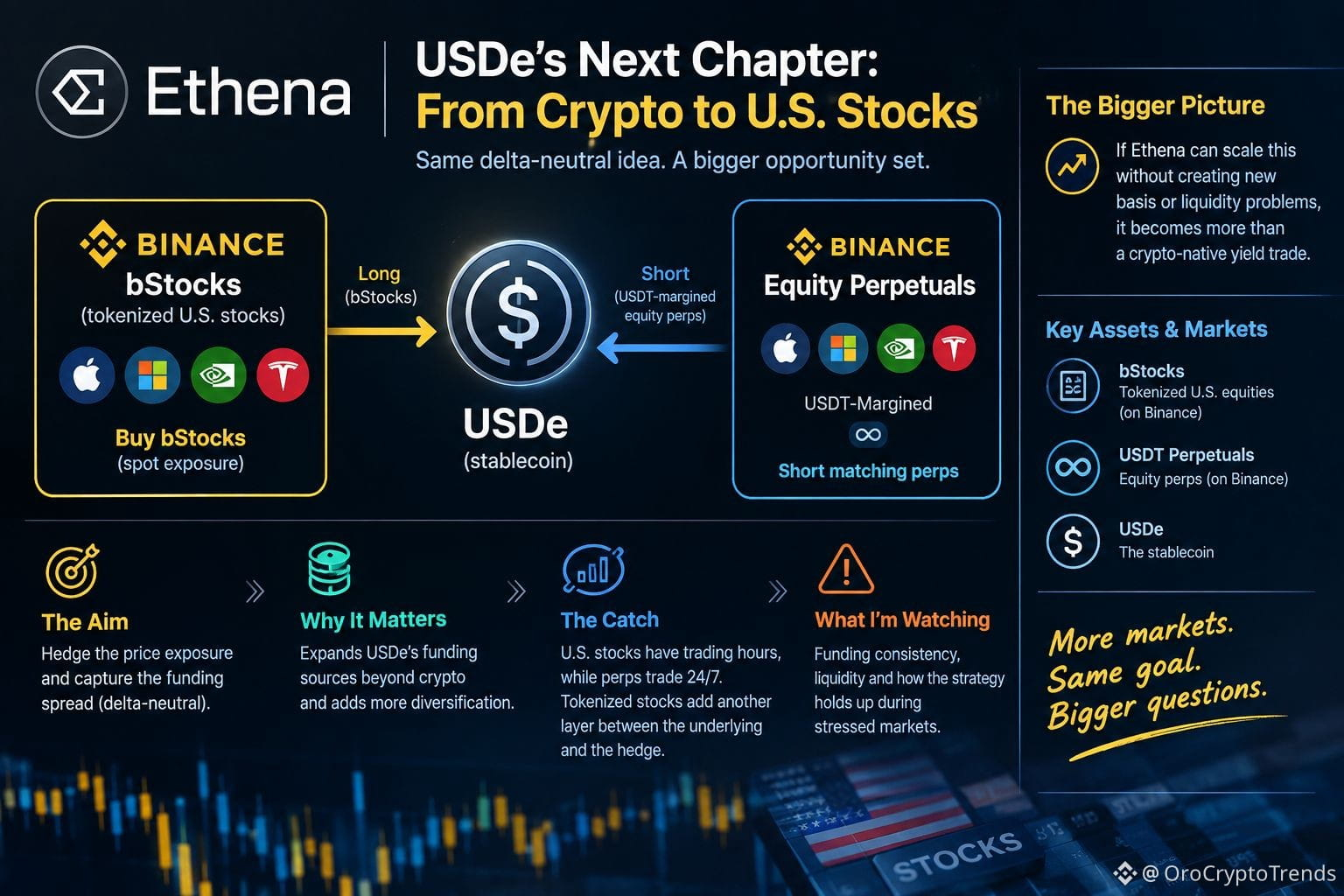
Ethena isn’t just chasing crypto funding anymore. It’s taking the USDe strategy into U.S. stocks.
The mechanism is fairly simple: Ethena can buy Binance’s bStocks as the spot exposure while shorting matching USDT-margined equity perpetuals. The goal is the same delta-neutral structure it has used in crypto — hedge the exposure and capture the funding spread.
That matters because USDe’s yield engine has historically depended heavily on crypto derivatives. Equity perps give Ethena another potential source of funding and expand the opportunity set beyond BTC and ETH.
But diversification here comes with a catch.
U.S. equities have defined trading hours, while perpetual contracts can trade continuously. Tokenized stock receipts add another layer between the underlying security and the hedge. During normal markets, that may be manageable. Under stress, the mismatch could become much more important.
That’s the part I’m watching.
Not whether ENA reacts positively to the announcement, but whether this new funding source can remain deep, liquid and consistently attractive when market conditions get ugly.
If Ethena can scale that without creating new basis or liquidity problems, the strategy becomes more than a crypto-native yield trade.
Still trying to figure out what this actually changes.$USDE #Write2Earn
Ethena isn’t just chasing crypto funding anymore. It’s taking the USDe strategy into U.S. stocks.
The mechanism is fairly simple: Ethena can buy Binance’s bStocks as the spot exposure while shorting matching USDT-margined equity perpetuals. The goal is the same delta-neutral structure it has used in crypto — hedge the exposure and capture the funding spread.
That matters because USDe’s yield engine has historically depended heavily on crypto derivatives. Equity perps give Ethena another potential source of funding and expand the opportunity set beyond BTC and ETH.
But diversification here comes with a catch.
U.S. equities have defined trading hours, while perpetual contracts can trade continuously. Tokenized stock receipts add another layer between the underlying security and the hedge. During normal markets, that may be manageable. Under stress, the mismatch could become much more important.
That’s the part I’m watching.
Not whether ENA reacts positively to the announcement, but whether this new funding source can remain deep, liquid and consistently attractive when market conditions get ugly.
If Ethena can scale that without creating new basis or liquidity problems, the strategy becomes more than a crypto-native yield trade.
Still trying to figure out what this actually changes.$USDE #Write2Earn
The mechanism is fairly simple: Ethena can buy Binance’s bStocks as the spot exposure while shorting matching USDT-margined equity perpetuals. The goal is the same delta-neutral structure it has used in crypto — hedge the exposure and capture the funding spread.
That matters because USDe’s yield engine has historically depended heavily on crypto derivatives. Equity perps give Ethena another potential source of funding and expand the opportunity set beyond BTC and ETH.
But diversification here comes with a catch.
U.S. equities have defined trading hours, while perpetual contracts can trade continuously. Tokenized stock receipts add another layer between the underlying security and the hedge. During normal markets, that may be manageable. Under stress, the mismatch could become much more important.
That’s the part I’m watching.
Not whether ENA reacts positively to the announcement, but whether this new funding source can remain deep, liquid and consistently attractive when market conditions get ugly.
If Ethena can scale that without creating new basis or liquidity problems, the strategy becomes more than a crypto-native yield trade.
Still trying to figure out what this actually changes.$USDE #Write2Earn
497
Verified
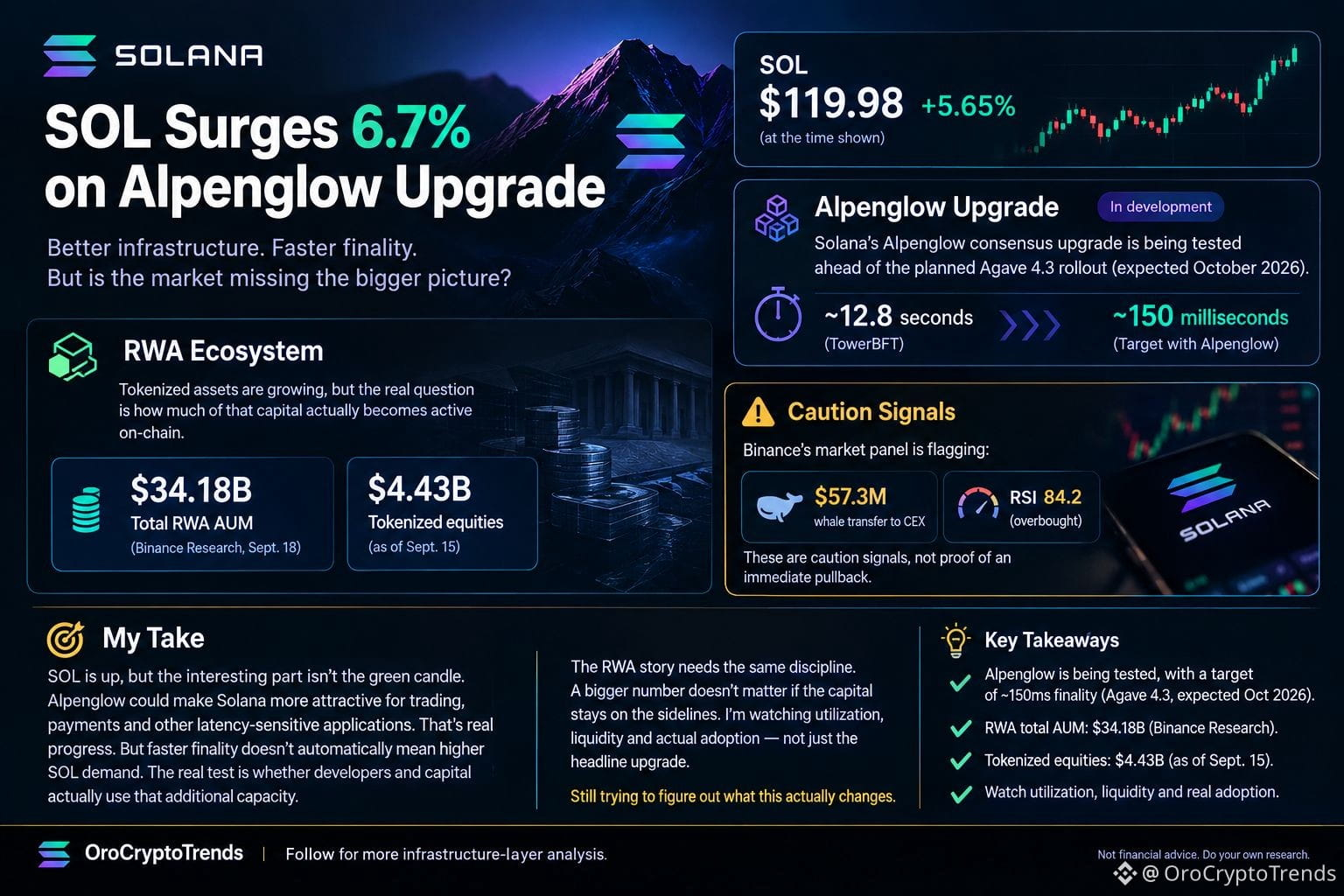
$SOL SOL is up more than 5%, but the interesting part isn’t the green candle.
Binance’s latest market panel is pointing to Alpenglow, Solana’s upcoming consensus upgrade, alongside some caution signals. Alpenglow is being tested ahead of the planned Agave 4.3 rollout, with Solana targeting roughly 150ms finality versus about 12.8 seconds under TowerBFT. Solana
That’s a meaningful infrastructure change.
But wait — faster finality doesn’t automatically mean higher SOL demand.
That’s the part I think gets lost when every technical upgrade becomes a price narrative. Better settlement infrastructure can make Solana more attractive for trading, payments and other latency-sensitive applications. But the real test is whether developers and capital actually use that additional capacity.
Binance is also flagging a $57.3M whale transfer to a CEX and an RSI reading of 84.2. I’d treat those as caution signals rather than proof that a pullback is coming.
And the RWA story needs the same discipline. Binance Research puts total RWA AUM at $34.18B, while tokenized equities alone reached $4.43B by Sept. 15. Binance
So I’m watching utilization, liquidity and actual adoption — not just the headline upgrade.
#sol
Still trying to figure out what this actually changes.
$SOL SOL is up more than 5%, but the interesting part isn’t the green candle.
Binance’s latest market panel is pointing to Alpenglow, Solana’s upcoming consensus upgrade, alongside some caution signals. Alpenglow is being tested ahead of the planned Agave 4.3 rollout, with Solana targeting roughly 150ms finality versus about 12.8 seconds under TowerBFT. Solana
That’s a meaningful infrastructure change.
But wait — faster finality doesn’t automatically mean higher SOL demand.
That’s the part I think gets lost when every technical upgrade becomes a price narrative. Better settlement infrastructure can make Solana more attractive for trading, payments and other latency-sensitive applications. But the real test is whether developers and capital actually use that additional capacity.
Binance is also flagging a $57.3M whale transfer to a CEX and an RSI reading of 84.2. I’d treat those as caution signals rather than proof that a pullback is coming.
And the RWA story needs the same discipline. Binance Research puts total RWA AUM at $34.18B, while tokenized equities alone reached $4.43B by Sept. 15. Binance
So I’m watching utilization, liquidity and actual adoption — not just the headline upgrade.
#sol
Still trying to figure out what this actually changes.
Binance’s latest market panel is pointing to Alpenglow, Solana’s upcoming consensus upgrade, alongside some caution signals. Alpenglow is being tested ahead of the planned Agave 4.3 rollout, with Solana targeting roughly 150ms finality versus about 12.8 seconds under TowerBFT. Solana
That’s a meaningful infrastructure change.
But wait — faster finality doesn’t automatically mean higher SOL demand.
That’s the part I think gets lost when every technical upgrade becomes a price narrative. Better settlement infrastructure can make Solana more attractive for trading, payments and other latency-sensitive applications. But the real test is whether developers and capital actually use that additional capacity.
Binance is also flagging a $57.3M whale transfer to a CEX and an RSI reading of 84.2. I’d treat those as caution signals rather than proof that a pullback is coming.
And the RWA story needs the same discipline. Binance Research puts total RWA AUM at $34.18B, while tokenized equities alone reached $4.43B by Sept. 15. Binance
So I’m watching utilization, liquidity and actual adoption — not just the headline upgrade.
#sol
Still trying to figure out what this actually changes.
1
1
4
9.1k
#EthereumBreaksAbove$2700
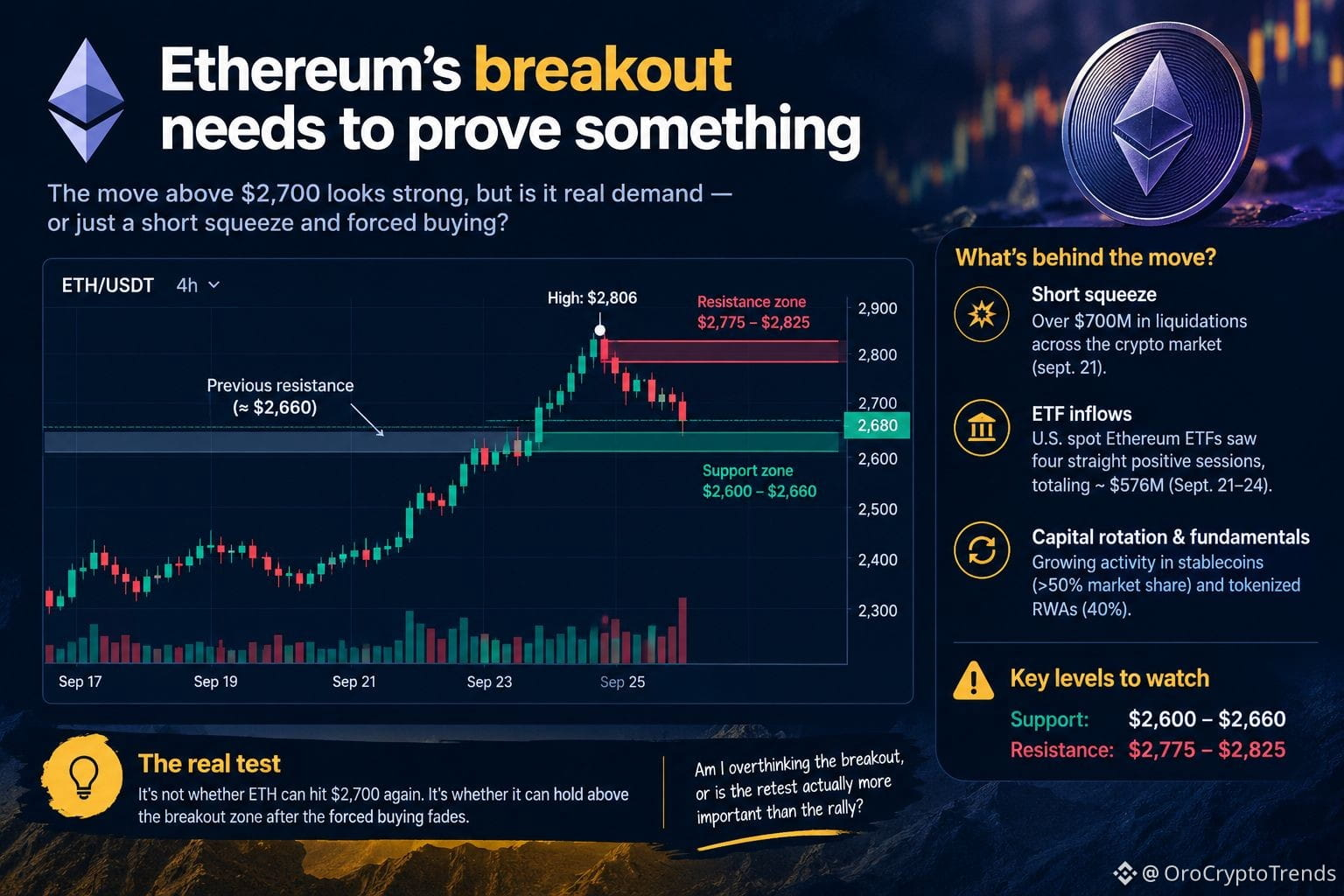
Ethereum just got the move everyone was waiting for — but I’m not convinced the breakout has proved itself yet.
ETH pushed above $2,700 and briefly traded around $2,800 on Sept. 21–23 before cooling back toward the high-$2,600s. The move was helped by a huge wave of crypto short liquidations, with more than $700M wiped out across the market during the Sept. 21 squeeze. So yes, there was real momentum. But part of that momentum was forced buying.
What makes this more interesting is what happened underneath it.
U.S. spot Ethereum ETFs recorded four straight positive sessions from Sept. 21 through Sept. 24, totaling roughly $576M in net inflows according to Farside. That’s a different kind of demand from leveraged shorts getting squeezed.
And this is where I’m watching ETH differently.
The question isn’t whether $2,700 can be touched again. It’s whether the market can keep accepting prices above the old breakout area after the forced liquidation fuel is gone.
The retest matters more to me than the initial move.
If ETH can hold above that former resistance with continued spot demand, the structure starts looking more credible.
If it can’t, this could turn out to be another leverage-driven spike that looked stronger than the underlying demand.
Am I overthinking the breakout, or is the retest actually more important than the rally?
#EthereumBreaksAbove$2700
Ethereum just got the move everyone was waiting for — but I’m not convinced the breakout has proved itself yet.
ETH pushed above $2,700 and briefly traded around $2,800 on Sept. 21–23 before cooling back toward the high-$2,600s. The move was helped by a huge wave of crypto short liquidations, with more than $700M wiped out across the market during the Sept. 21 squeeze. So yes, there was real momentum. But part of that momentum was forced buying.
What makes this more interesting is what happened underneath it.
U.S. spot Ethereum ETFs recorded four straight positive sessions from Sept. 21 through Sept. 24, totaling roughly $576M in net inflows according to Farside. That’s a different kind of demand from leveraged shorts getting squeezed.
And this is where I’m watching ETH differently.
The question isn’t whether $2,700 can be touched again. It’s whether the market can keep accepting prices above the old breakout area after the forced liquidation fuel is gone.
The retest matters more to me than the initial move.
If ETH can hold above that former resistance with continued spot demand, the structure starts looking more credible.
If it can’t, this could turn out to be another leverage-driven spike that looked stronger than the underlying demand.
Am I overthinking the breakout, or is the retest actually more important than the rally?
Ethereum just got the move everyone was waiting for — but I’m not convinced the breakout has proved itself yet.
ETH pushed above $2,700 and briefly traded around $2,800 on Sept. 21–23 before cooling back toward the high-$2,600s. The move was helped by a huge wave of crypto short liquidations, with more than $700M wiped out across the market during the Sept. 21 squeeze. So yes, there was real momentum. But part of that momentum was forced buying.
What makes this more interesting is what happened underneath it.
U.S. spot Ethereum ETFs recorded four straight positive sessions from Sept. 21 through Sept. 24, totaling roughly $576M in net inflows according to Farside. That’s a different kind of demand from leveraged shorts getting squeezed.
And this is where I’m watching ETH differently.
The question isn’t whether $2,700 can be touched again. It’s whether the market can keep accepting prices above the old breakout area after the forced liquidation fuel is gone.
The retest matters more to me than the initial move.
If ETH can hold above that former resistance with continued spot demand, the structure starts looking more credible.
If it can’t, this could turn out to be another leverage-driven spike that looked stronger than the underlying demand.
Am I overthinking the breakout, or is the retest actually more important than the rally?
2
635
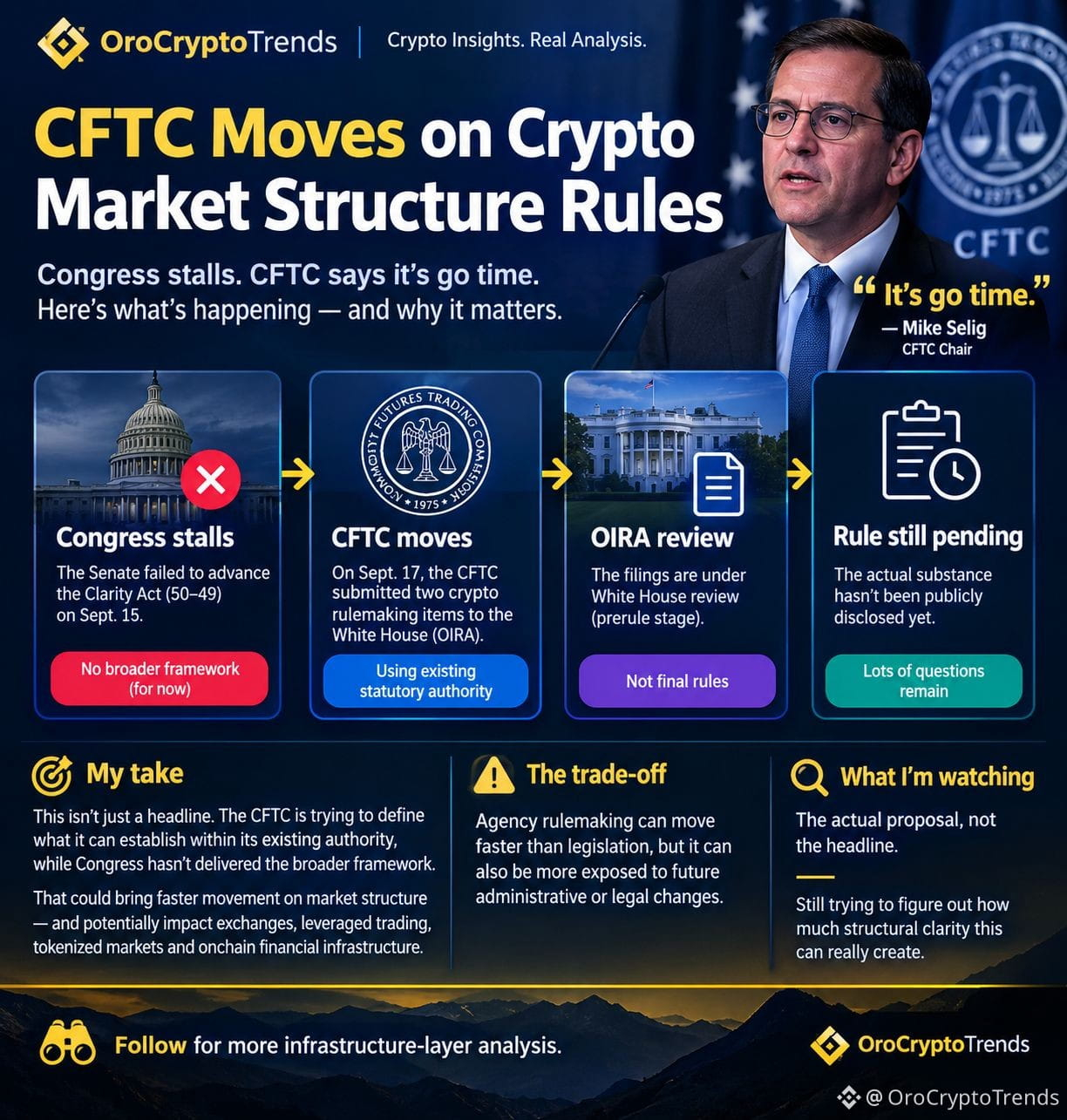
$CRCLon The CFTC basically just said: we’re moving with or without a new crypto law.
Chair Michael Selig called it “go time” on Wednesday, saying the agency believes it can use its existing statutory authority to advance crypto market-structure rules.
And honestly, this is more interesting than the headline makes it sound.
The Senate failed to advance the Clarity Act last week, 50–49. Two days later, the CFTC sent two crypto rulemaking items to the White House’s regulatory review office.
But wait — there’s an important distinction here.
These are not final rules. The filings are still at the prerule stage, and the actual substance hasn’t been made public. So anyone already talking as if the U.S. has a finished crypto market structure framework is getting ahead of the evidence.
What I find interesting is the shift in process.
Congress hasn’t delivered the broader framework, while the CFTC is trying to define what it can establish within its existing authority. That could matter for exchanges, leveraged trading, tokenized markets and potentially onchain financial infrastructure.
But there’s a trade-off: agency rulemaking can move faster than legislation, yet it can also be more exposed to future administrative or legal changes.
So I’m watching the actual proposal, not the headline.
Still trying to figure out how much structural clarity this can really create.
$CRCLon The CFTC basically just said: we’re moving with or without a new crypto law.
Chair Michael Selig called it “go time” on Wednesday, saying the agency believes it can use its existing statutory authority to advance crypto market-structure rules.
And honestly, this is more interesting than the headline makes it sound.
The Senate failed to advance the Clarity Act last week, 50–49. Two days later, the CFTC sent two crypto rulemaking items to the White House’s regulatory review office.
But wait — there’s an important distinction here.
These are not final rules. The filings are still at the prerule stage, and the actual substance hasn’t been made public. So anyone already talking as if the U.S. has a finished crypto market structure framework is getting ahead of the evidence.
What I find interesting is the shift in process.
Congress hasn’t delivered the broader framework, while the CFTC is trying to define what it can establish within its existing authority. That could matter for exchanges, leveraged trading, tokenized markets and potentially onchain financial infrastructure.
But there’s a trade-off: agency rulemaking can move faster than legislation, yet it can also be more exposed to future administrative or legal changes.
So I’m watching the actual proposal, not the headline.
Still trying to figure out how much structural clarity this can really create.
Chair Michael Selig called it “go time” on Wednesday, saying the agency believes it can use its existing statutory authority to advance crypto market-structure rules.
And honestly, this is more interesting than the headline makes it sound.
The Senate failed to advance the Clarity Act last week, 50–49. Two days later, the CFTC sent two crypto rulemaking items to the White House’s regulatory review office.
But wait — there’s an important distinction here.
These are not final rules. The filings are still at the prerule stage, and the actual substance hasn’t been made public. So anyone already talking as if the U.S. has a finished crypto market structure framework is getting ahead of the evidence.
What I find interesting is the shift in process.
Congress hasn’t delivered the broader framework, while the CFTC is trying to define what it can establish within its existing authority. That could matter for exchanges, leveraged trading, tokenized markets and potentially onchain financial infrastructure.
But there’s a trade-off: agency rulemaking can move faster than legislation, yet it can also be more exposed to future administrative or legal changes.
So I’m watching the actual proposal, not the headline.
Still trying to figure out how much structural clarity this can really create.
4
1.5k
Verified
PAXGy sounds like another gold token at first. It isn’t quite that simple.
Paxos Labs has launched PAXGy, a receipt token backed by PAX Gold (PAXG). The interesting part is what happens underneath: instead of your token balance increasing, each PAXGy is designed to represent an increasing amount of PAXG over time.
That means the return is measured in gold ounces, not dollars.
Honestly, I think that distinction matters more than the “gold-backed token” headline.
PAXG gives you a fixed amount of tokenized gold. PAXGy is trying to make that gold position productive by putting part of the underlying reserve into institutional gold lending. Paxos Labs says a portion is kept as unencumbered PAXG for redemptions, while the remainder is deployed to vetted institutional borrowers.
And there’s the trade-off.
You’re no longer looking only at gold exposure. You’re also taking on lending, counterparty and duration risk. Paxos Labs itself lists those risks, including the possibility of default despite collateral requirements.
So I wouldn’t frame PAXGy as simply “PAXG with yield.”
It’s closer to tokenized gold exposure with a credit-market layer sitting underneath it.
That’s a much more interesting experiment to watch.
Still trying to figure out what this actually changes.
#PAXG $PAXG
{spot}(PAXGUSDT)
PAXGy sounds like another gold token at first. It isn’t quite that simple.
Paxos Labs has launched PAXGy, a receipt token backed by PAX Gold (PAXG). The interesting part is what happens underneath: instead of your token balance increasing, each PAXGy is designed to represent an increasing amount of PAXG over time.
That means the return is measured in gold ounces, not dollars.
Honestly, I think that distinction matters more than the “gold-backed token” headline.
PAXG gives you a fixed amount of tokenized gold. PAXGy is trying to make that gold position productive by putting part of the underlying reserve into institutional gold lending. Paxos Labs says a portion is kept as unencumbered PAXG for redemptions, while the remainder is deployed to vetted institutional borrowers.
And there’s the trade-off.
You’re no longer looking only at gold exposure. You’re also taking on lending, counterparty and duration risk. Paxos Labs itself lists those risks, including the possibility of default despite collateral requirements.
So I wouldn’t frame PAXGy as simply “PAXG with yield.”
It’s closer to tokenized gold exposure with a credit-market layer sitting underneath it.
That’s a much more interesting experiment to watch.
Still trying to figure out what this actually changes.
#PAXG $PAXG
Paxos Labs has launched PAXGy, a receipt token backed by PAX Gold (PAXG). The interesting part is what happens underneath: instead of your token balance increasing, each PAXGy is designed to represent an increasing amount of PAXG over time.
That means the return is measured in gold ounces, not dollars.
Honestly, I think that distinction matters more than the “gold-backed token” headline.
PAXG gives you a fixed amount of tokenized gold. PAXGy is trying to make that gold position productive by putting part of the underlying reserve into institutional gold lending. Paxos Labs says a portion is kept as unencumbered PAXG for redemptions, while the remainder is deployed to vetted institutional borrowers.
And there’s the trade-off.
You’re no longer looking only at gold exposure. You’re also taking on lending, counterparty and duration risk. Paxos Labs itself lists those risks, including the possibility of default despite collateral requirements.
So I wouldn’t frame PAXGy as simply “PAXG with yield.”
It’s closer to tokenized gold exposure with a credit-market layer sitting underneath it.
That’s a much more interesting experiment to watch.
Still trying to figure out what this actually changes.
#PAXG $PAXG
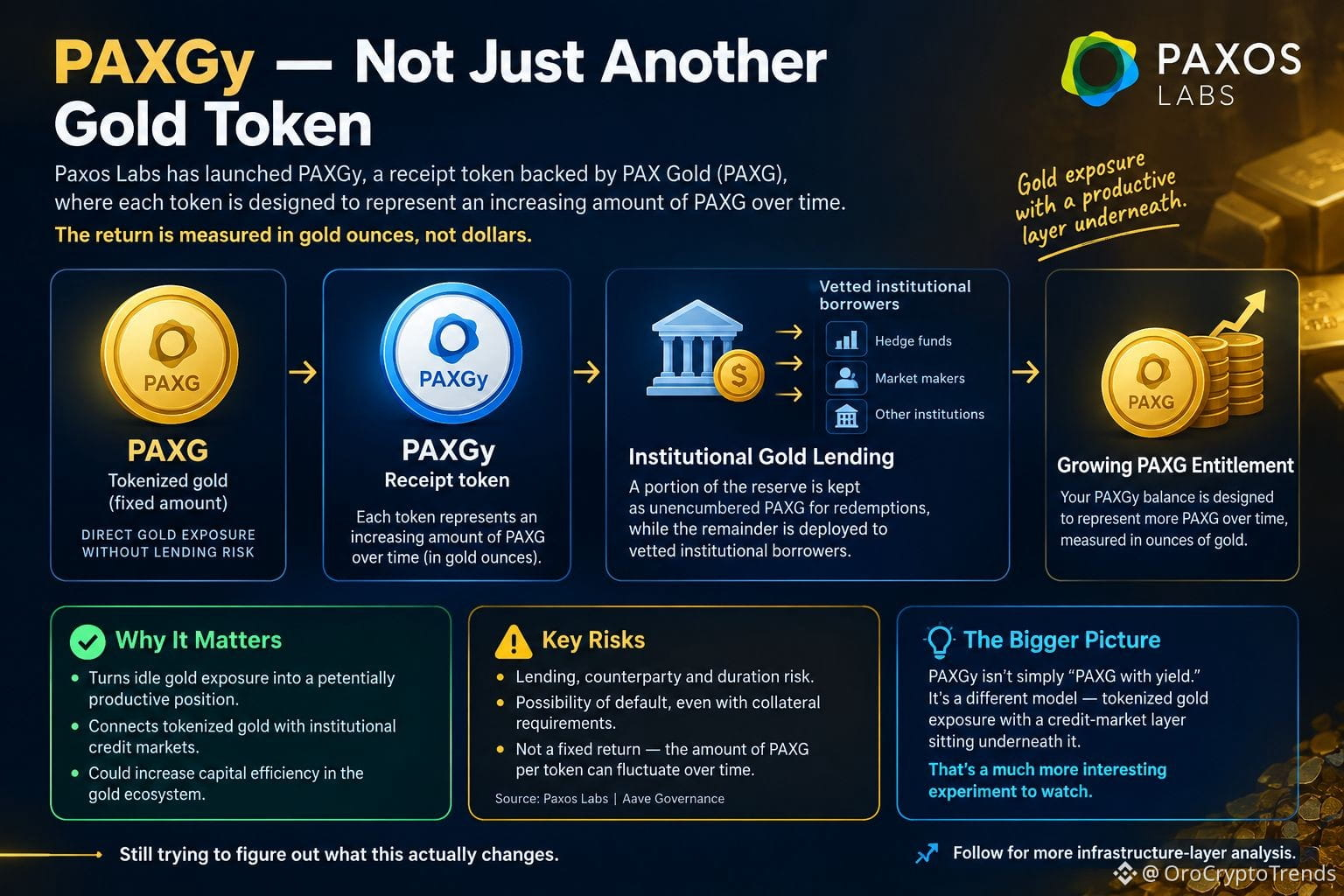
1
3
842
Singapore is trying to train its way through the AI disruption — and the number is bigger than I first thought.
NTUC and the Institute of Banking and Finance are targeting up to 100,000 finance professionals for AI skills training over the next three years.
At first, that sounds like a straightforward workforce-upskilling story.
But I think there’s a more interesting question underneath it.
Training people to use AI is not the same thing as preparing them for what AI does to their actual job.
A worker can become much better at using an AI tool while the company is simultaneously redesigning the role around that tool. That distinction matters.
Singapore’s own labour ministry has said AI is currently augmenting work more than replacing it, with firms reporting role redesign and new AI-related jobs rather than widespread displacement. But that doesn’t mean the structure of white-collar work stays the same.
And honestly, finance may be one of the clearest places to watch this.
If AI can automate parts of research, analysis, documentation and customer workflows, the valuable skill may gradually shift from “doing the task” to knowing what should be delegated to AI — and what still requires human judgement.
That’s a much bigger change than simply taking an AI course.
The real test is what happens to the jobs after the training.
Still trying to figure out what this actually changes.
Source: Institute of Banking and Finance Singapore / Singapore Ministry of Manpower / DBS.
#Write2Earn
Singapore is trying to train its way through the AI disruption — and the number is bigger than I first thought.
NTUC and the Institute of Banking and Finance are targeting up to 100,000 finance professionals for AI skills training over the next three years.
At first, that sounds like a straightforward workforce-upskilling story.
But I think there’s a more interesting question underneath it.
Training people to use AI is not the same thing as preparing them for what AI does to their actual job.
A worker can become much better at using an AI tool while the company is simultaneously redesigning the role around that tool. That distinction matters.
Singapore’s own labour ministry has said AI is currently augmenting work more than replacing it, with firms reporting role redesign and new AI-related jobs rather than widespread displacement. But that doesn’t mean the structure of white-collar work stays the same.
And honestly, finance may be one of the clearest places to watch this.
If AI can automate parts of research, analysis, documentation and customer workflows, the valuable skill may gradually shift from “doing the task” to knowing what should be delegated to AI — and what still requires human judgement.
That’s a much bigger change than simply taking an AI course.
The real test is what happens to the jobs after the training.
Still trying to figure out what this actually changes.
Source: Institute of Banking and Finance Singapore / Singapore Ministry of Manpower / DBS.
#Write2Earn
NTUC and the Institute of Banking and Finance are targeting up to 100,000 finance professionals for AI skills training over the next three years.
At first, that sounds like a straightforward workforce-upskilling story.
But I think there’s a more interesting question underneath it.
Training people to use AI is not the same thing as preparing them for what AI does to their actual job.
A worker can become much better at using an AI tool while the company is simultaneously redesigning the role around that tool. That distinction matters.
Singapore’s own labour ministry has said AI is currently augmenting work more than replacing it, with firms reporting role redesign and new AI-related jobs rather than widespread displacement. But that doesn’t mean the structure of white-collar work stays the same.
And honestly, finance may be one of the clearest places to watch this.
If AI can automate parts of research, analysis, documentation and customer workflows, the valuable skill may gradually shift from “doing the task” to knowing what should be delegated to AI — and what still requires human judgement.
That’s a much bigger change than simply taking an AI course.
The real test is what happens to the jobs after the training.
Still trying to figure out what this actually changes.
Source: Institute of Banking and Finance Singapore / Singapore Ministry of Manpower / DBS.
#Write2Earn

1
483
Log in to explore more content
Join global crypto users on Binance Square
⚡️ Get latest and useful information about crypto.
💬 Trusted by the world’s largest crypto exchange.
👍 Discover real insights from verified creators.
Email / Phone number