
#validadores
validadores
338 views
6 Discussing
Hot
Latest

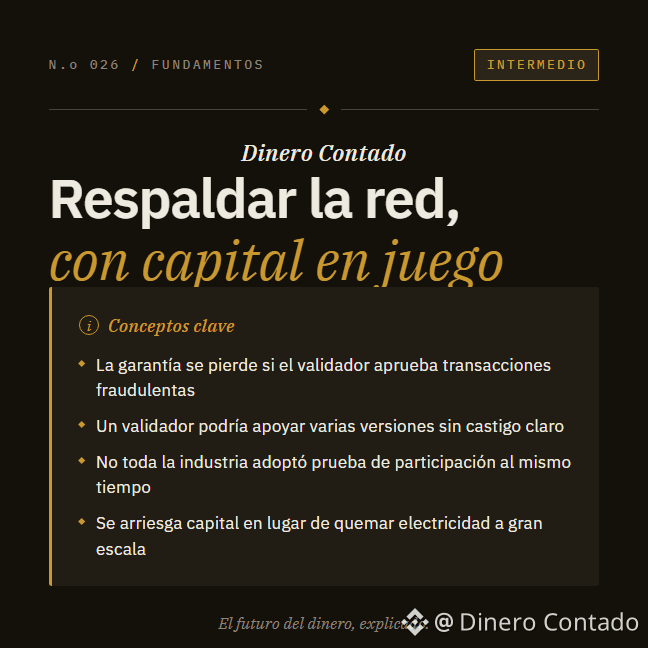
Validating a block no longer has to consume energy. It can simply require putting something at stake.
Imagine a validator who sets aside 100 coins as collateral before they can confirm transactions. If they approve a valid block, they receive a small reward, say 2 coins. But if they try to slip in a fraudulent transaction and the network detects it, they lose some or all of that collateral. There’s no need to solve a mathematical puzzle that consumes electricity on a massive scale. You just need to have something to lose.
This mechanism is called proof of stake. Ethereum, for example, switched to this model so validators can $ETH back the network with locked-up capital instead of computation.
KEY CONCEPTS
- The collateral isn’t just for show: if the validator misbehaves, they lose it. There’s still a cost; it’s just taken a different form.
- Depositing collateral doesn’t automatically make anyone honest. Without a clear penalty for backing an invalid chain, some validators might try to support several versions at once.
- Not every part of the industry uses this model, or adopted it at the same time. Other networks still use the previous method, spending electricity to validate.
- Agreement on which block is valid is a technical process among validators, not a popular vote among everyday users.
And that’s the real difference from the energy use of the past: electricity is no longer burned to prove commitment; instead, validators put their own capital at risk. Same problem, different collateral.
Transparency: Binance may pay us a commission if you trade after clicking an asset symbol or a price link in this post.
#PruebaDeParticipacion #Criptomonedas #Blockchain #Validators
1
127

·
--
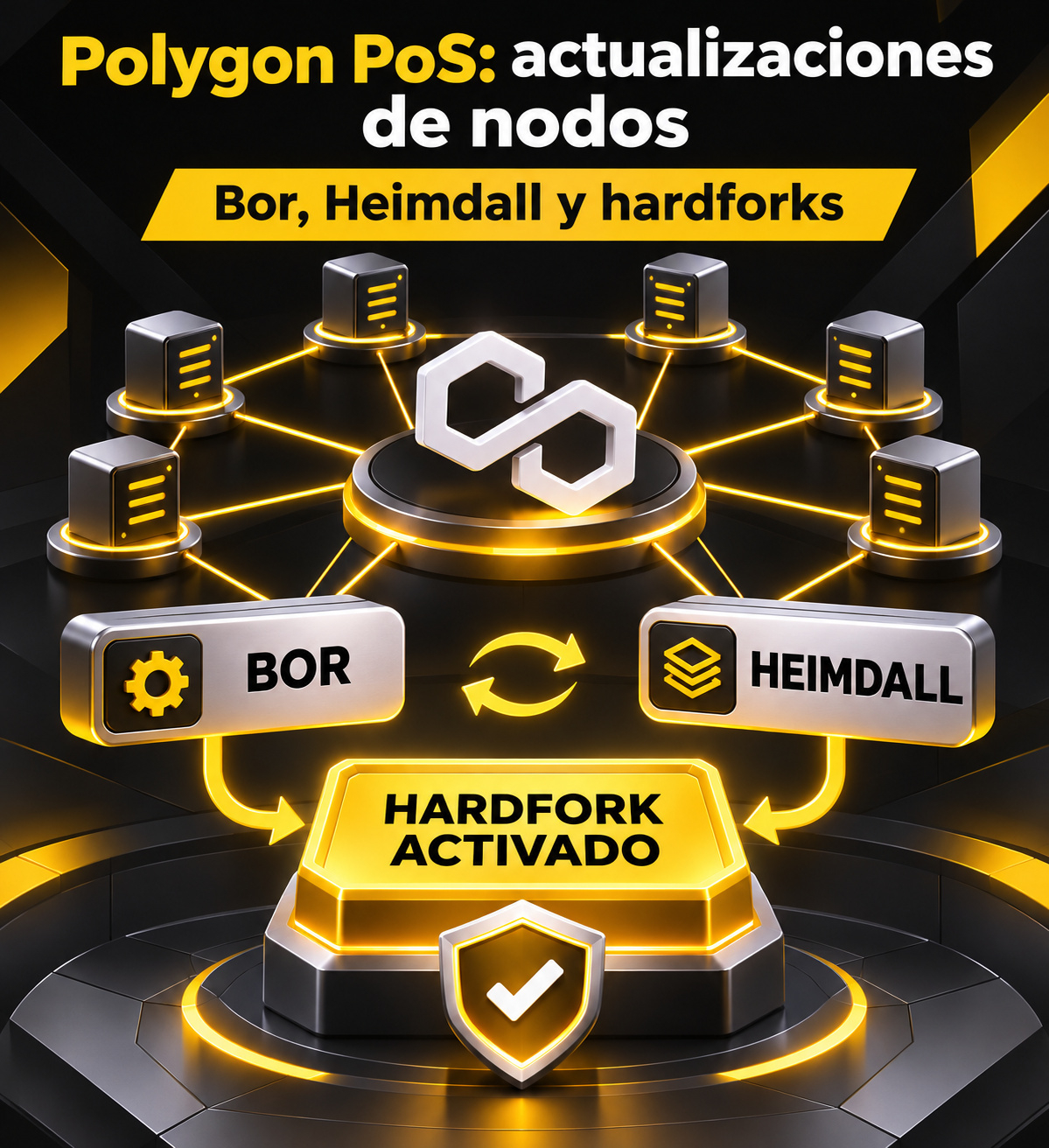
Polygon PoS updates Bor and Heimdall: what nodes should review
Confirmed fact: Polygon Labs announced Bor v2.11.0 for Polygon PoS and Amoy on November 5, 2026. It is the public build of v2.11.0-priv and includes the Uburu hard fork and security and stability fixes. Uburu was activated on Amoy at block 51.978.200 on November 4 and on mainnet at block 96.787.900 on November 5.
Operators still running Bor v2.10.3 or earlier stopped following the chain when those blocks were reached and must upgrade. Moving from the private build to the public one does not change consensus: the same code and the same fork blocks, with no genesis change, database migration, or resynchronization. Bor adds controls for conditional transactions in the txpool, disabled by default, and improvements to consensus, synchronization, and RPC.
Heimdall v0.13.2, released on November 3, activated the Karwar hard fork on mainnet at block 57.006.000. It includes limits on vote extension size, canonical signatures for checkpoints, and an improvement to RPC state. It also removes an unnecessary wait during consensus locking. This is a binary upgrade: it requires no configuration changes, state migration, or resynchronization.
The practical takeaway is operational: an active hard fork makes version discipline, checksum and signature verification, and coordination with Heimdall critical. Polygon warns that some packages may still be in the process of being published; it is advisable to validate the artifacts before using them. The upgrade does not guarantee higher performance or predict the token's price.
Market snapshot, not a signal: at 04:58 UTC, POL was trading near 0,09289 USDT (-4,207% in 24 h) and was moving about 4,86 million USDT; BTC stood at 75.795,35 (-5,886%) and ETH at 2.233,16 (-7,963%). This is context, not a reaction attributable to the announcement.
$POL $BTC $ETH
Educational Content. Not financial advice.
#Polygon #POL #Validadores #Hardfork #FinancialEducation
132
·
--
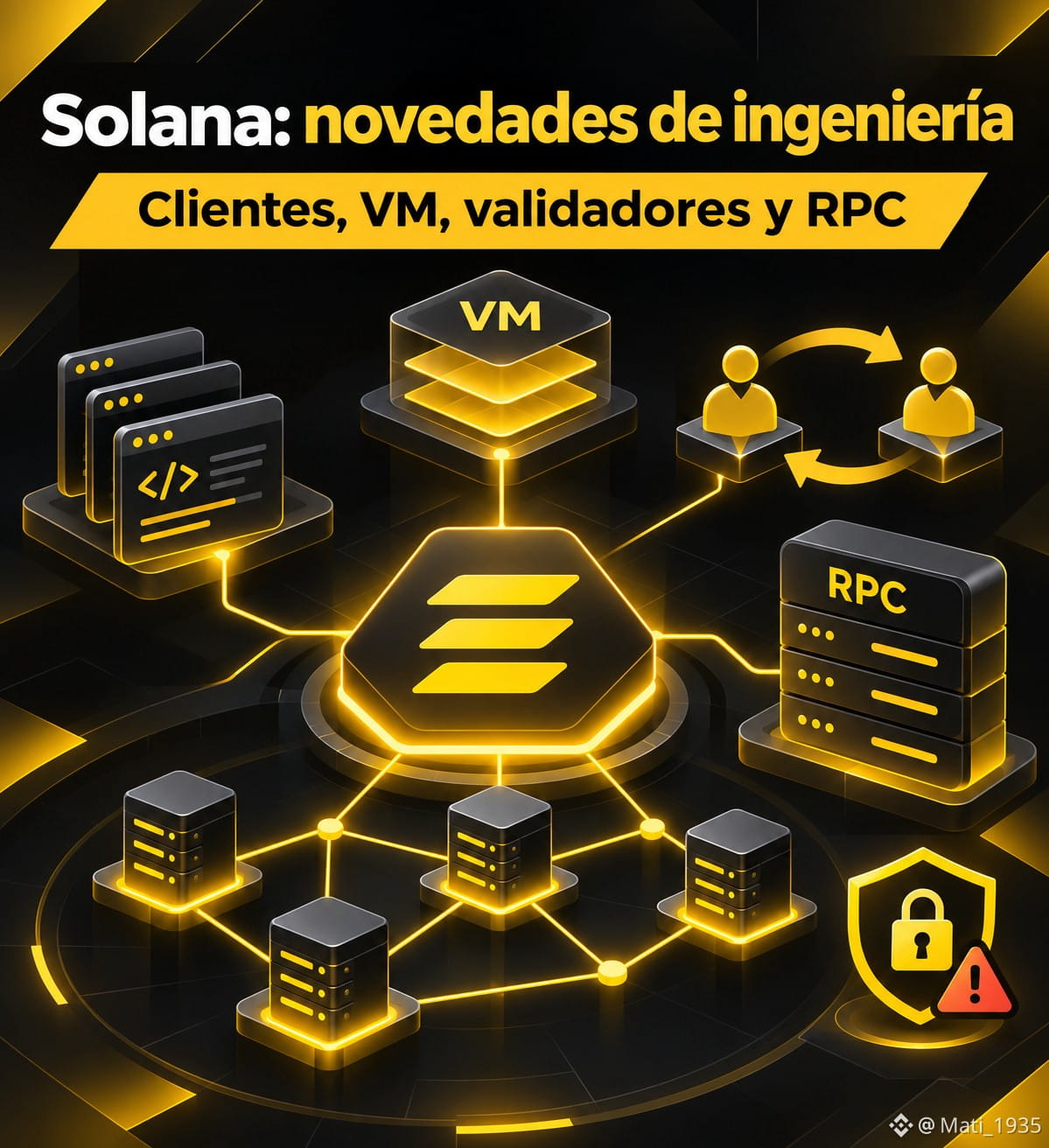
Solana publishes its November 5 Changelog: clients, VM, and validator handoffs
Confirmed fact: On November 5, 2026, the Solana Foundation published its weekly engineering newsletter. It brings together releases and work in progress; it does not announce a new coin or guarantee performance. Highlights include Solana Go 2.3.0 and 1.26.0, Token-2022 Program JS SDK 0.20.1, Anchor 0.32.3, and LiteSVM 0.18.2.
At the protocol level, a testnet feature gate proposes removing inactive stakes from delegation calculations. A discussion has also begun on aligning a common specification, and another proposal explores vector instructions for the virtual machine. These are proposals, not final mainnet changes.
The newsletter describes progress across clients. Agave is working on a typed ABI and a worker pool with state hashing; Firedancer reimplemented leader handoffs to reduce latency during epoch changes. In RPC 2.0, Cloudbreak improves getAccountInfo and getMultipleAccounts queries.
The useful takeaway is to distinguish available code, feature gates, discussions, and experiments. A client change requires testing and coordination; a performance improvement does not eliminate bugs, incompatibilities, or geographic concentration. The newsletter also mentions a Linux kernel vulnerability and a DNS issue: operational security is also real-world performance.
Market snapshot, not a signal: at 00:57 UTC, SOL was trading near 90.32 USDT (-5.78% over 24 h), BTC at 76,310.96 (-5.29%), and ETH at 2,244.91 (-7.28%). This is context, not a reaction attributable to the newsletter.
$SOL $BTC $ETH
Educational Content. Not financial advice.
#Solana #DesarrolloBlockchain #Validadores #RPC #FinancialEducation
120
·
--
Solana Company in Hong Kong: Office Established, Validators Planned
On October 22, Solana Company, listed on Nasdaq under the ticker HSDT, announced that it had been recognized as a strategic enterprise by OASES, Hong Kong’s Office for Attracting Strategic Enterprises.
The government announcement confirms a new cohort of 18 companies; its appendix includes Solana. This is the program’s seventh cohort.
According to the company, it has already established an office to coordinate its Asia-Pacific operations. Under Pacific Backbone, it plans to deploy validators in Hong Kong. The announcement does not specify a launch date, the number of nodes, or the amount of SOL allocated: the office and the future infrastructure are separate milestones.
Validators process transactions and participate in network consensus. Operating them requires computing resources; a corporate presence alone does not demonstrate new operational capacity.
HSDT identifies the company; SOL is the network’s asset. The company’s recognition does not prove a government purchase of SOL or make the company the owner of Solana.
Reference as of October 26, 03:41 UTC: Binance Spot showed SOL at 100.69 USDT (-1.72% over 24 hours). For market context, BTC was trading at 79,746.01 USDT (-1.47%) and ETH at 2,311.16 (-2.22%).
Market perspective: the economic value will depend on carrying out the deployment, controlling costs, and achieving sustainable activity. The next useful data points will be the validators’ launch and their actual usage. The announcement does not guarantee revenue or, by itself, explain SOL’s movement relative to BTC and ETH.
$SOL $BTC $ETH
Educational Content. Not financial advice.
#Solana #HongKong #Blockchain #Validadores #Infrastructure

138
·
--
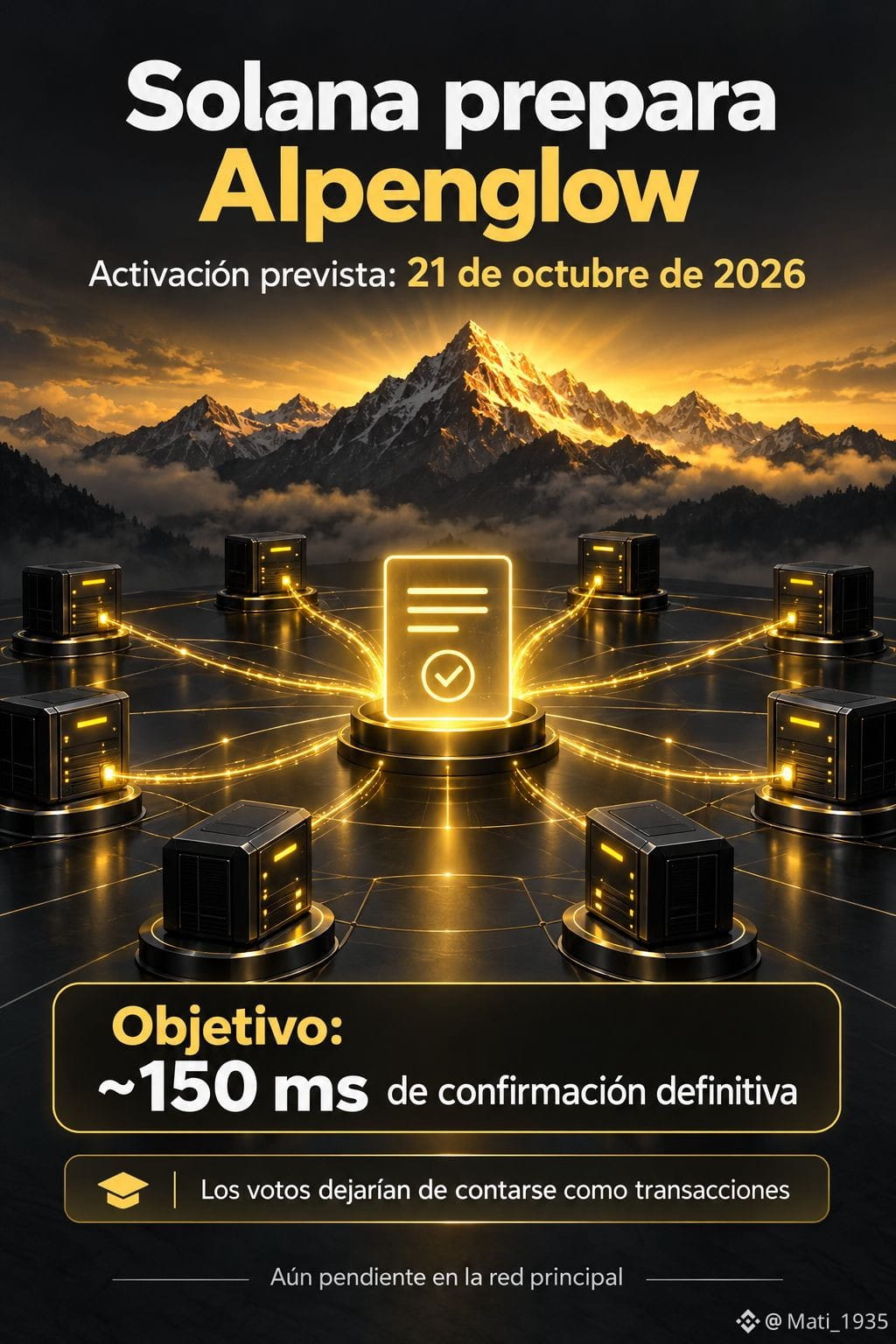
Solana prepares Alpenglow for October 21: what’s changing and what’s still pending
On October 13, 2026, Anza announced the planned migration to Alpenglow on the Solana mainnet for October 21. The Solana Foundation guide places activation in epoch 1064; when the sources were checked, it was still listed as not activated.
The goal is to achieve finality in about 150 milliseconds under normal conditions. This is a design target, not a result already measured on the mainnet or a guarantee that every user will experience that wait. It is also not the time between blocks.
The first phase introduces Votor: validators exchange votes directly and bundle them into certificates, instead of sending them as transactions. Program execution does not change. Rotor, another phase focused on distributing block data, is planned for later, with no date set.
One detail to keep in mind when reading the metrics: when votes are removed from blocks, transaction-per-second counts that previously included them may fall. A drop caused by this change in accounting would not demonstrate lower user activity; equivalent metrics will need to be compared.
The migration requires software updates and changes to services that read data from the network. Readiness and operational stability are aspects to monitor; the planned schedule does not replace verifying that activation has actually occurred.
Market perspective: faster finality could benefit payments and applications, but it does not guarantee demand for SOL or a higher price. On Binance, at 05:27 UTC on October 14, SOL was trading at 107.58 USDT (−0.775% in 24 hours) and BTC at 83,606.06 USDT (−0.204%). These are contextual figures, not a reaction attributed to the announcement.
Sources: Anza, Solana Foundation, and public Binance data.
$SOL $BTC $USDT
Educational Content. Not financial advice.
#Solana #Alpenglow #Blockchain #Validadores #FinancialEducation
85
Log in to explore more content
Join global crypto users on Binance Square
⚡️ Get latest and useful information about crypto.
💬 Trusted by the world’s largest crypto exchange.
👍 Discover real insights from verified creators.
Email / Phone number
Trending Topics
1
#A Packed Week of Earnings and Data Tests Markets
81,486 views
488 Discussing
2
#AnthropicIPOTestsInvestorAppetiteForAI
160,908 views
1,717 Discussing
3
#NvidiaBoardNotConsideringHuang’sReturnasCEO
15,437 views
213 Discussing
4
#WhatInvestmentSignalsDo13FFilingsReveal?
9,794 views
149 Discussing
5
#InvescoStablecoinReservesFundLaunchesOnEthereum
3,716 views
78 Discussing
6
#CypherpunkReports$306MQ3NetProfit
738 views
15 Discussing
7
#OPTIMJACKAttackInfectsAtLeast186Websites
6,971 views
110 Discussing
8
#StrategySells2.09MMSTRSharesFor$244.7M
2,189 views
19 Discussing
9
#StablecoinMarketShrinksAtFastestPaceSinceTerraLuna
8,213 views
75 Discussing
10
#BitcoinExtendsLosingStreakToSixWeeks
124,322 views
881 Discussing