
#uniswap
uniswap
2.4M views
8,825 Discussing
Hot
Latest


·
--
Verified
Article
Uniswap Burned $9.2M Worth of UNI in October. Is That Enough?Uniswap has spent years processing billions in decentralized trading volume.
But for a long time, there was an awkward problem with UNI.
People could trade on Uniswap without owning the token. Liquidity providers earned trading fees, while UNI holders mainly received governance rights.
That changed in December 2025.
The UNIfication proposal activated protocol fees and introduced a system that connects trading activity to UNI burns.
Now we finally have numbers to examine.
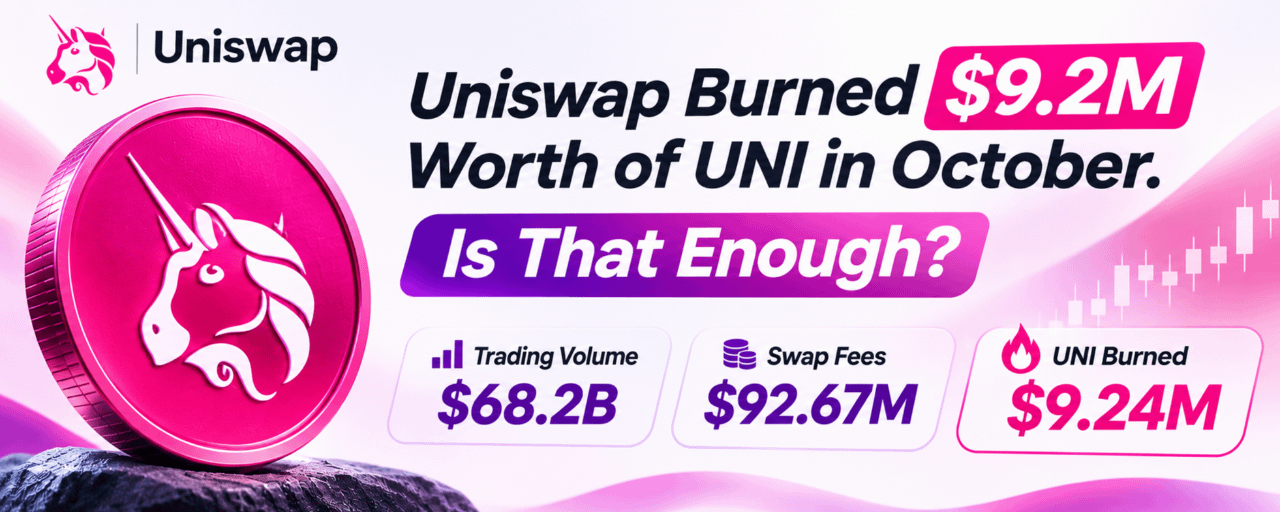
According to BlockPinned, Uniswap processed roughly $68.2 billion in trading volume during October 2026.
Traders paid approximately $92.67 million in swap fees.
Of that, $9.24 million in value was associated with UNI burned through the protocol's fee mechanism.
That's about 10% of total swap fees.
I find that relationship more useful than simply looking at Uniswap's trading volume.
Here's how the mechanism works.
A portion of trading fees goes into smart contracts called TokenJars.
External participants can claim those collected assets by providing UNI to a contract called Firepit, where the UNI is sent to the burn address.
The process gives market participants an incentive to acquire UNI and permanently remove it from spendable supply.
It's similar to a buyback in economic effect, although Uniswap itself isn't simply placing conventional buy orders using a corporate treasury.
And UNI holders don't receive cash dividends.
Their potential benefit comes through reduced available supply.
But there's another side to the story.
Uniswap governance also approved a growth budget of 20 million UNI per year for Uniswap Labs.
That's larger than the roughly 16.1 million UNI annualized burn pace estimated by BlockPinned.
The comparison doesn't automatically mean UNI is becoming inflationary.
Treasury allocations aren't the same as newly minted tokens, and receiving tokens doesn't mean the recipient immediately sells them.
Still, those distributions matter when evaluating how much UNI could eventually reach the market.
A burn mechanism can reduce available supply while treasury spending increases the amount of liquid UNI.
Both deserve attention.
There's also something unusual about the token's supply rules.
UNI launched with 1 billion tokens in September 2020.
Governance has the authority to approve additional issuance of up to 2% annually, although Uniswap's current documentation says that authority hasn't been exercised.
So I wouldn't describe UNI as having an absolutely fixed maximum supply.
The fee switch has improved its economic model, but the final supply outcome still depends on governance decisions and token movements.
Then there's the trading business itself.
Uniswap competes with other DEXs, aggregators, and liquidity venues across Ethereum and multiple Layer 2 networks.
If protocol fees become too expensive relative to alternatives, liquidity providers and traders may choose different routes.
That's why turning on more fees isn't automatically better.
The protocol needs enough trading activity to make those fees worthwhile without losing its competitive position.
On November 16, Uniswap Labs proposed expanding v4 protocol fees to five additional chains.
That could increase the amount of trading activity contributing to UNI burns if governance approves and implements the changes.
But a proposal isn't the same as an executed upgrade.
For me, the interesting part is that UNI finally has an economic mechanism we can track.
I'd watch the dollar value of monthly burns, actual treasury distributions, DEX market share, and how much trading volume Uniswap retains as protocol fees expand.
October's $9.24 million burn is a useful starting point.
What I'd really like to know is whether that figure can grow without pushing traders and liquidity elsewhere.
#UNI #Uniswap $UNI
{future}(UNIUSDT)
Uniswap Burned $9.2M Worth of UNI in October. Is That Enough?
Uniswap has spent years processing billions in decentralized trading volume.
But for a long time, there was an awkward problem with UNI.
People could trade on Uniswap without owning the token. Liquidity providers earned trading fees, while UNI holders mainly received governance rights.
That changed in December 2025.
The UNIfication proposal activated protocol fees and introduced a system that connects trading activity to UNI burns.
Now we finally have numbers to examine.
According to BlockPinned, Uniswap processed roughly $68.2 billion in trading volume during October 2026.
Traders paid approximately $92.67 million in swap fees.
Of that, $9.24 million in value was associated with UNI burned through the protocol's fee mechanism.
That's about 10% of total swap fees.
I find that relationship more useful than simply looking at Uniswap's trading volume.
Here's how the mechanism works.
A portion of trading fees goes into smart contracts called TokenJars.
External participants can claim those collected assets by providing UNI to a contract called Firepit, where the UNI is sent to the burn address.
The process gives market participants an incentive to acquire UNI and permanently remove it from spendable supply.
It's similar to a buyback in economic effect, although Uniswap itself isn't simply placing conventional buy orders using a corporate treasury.
And UNI holders don't receive cash dividends.
Their potential benefit comes through reduced available supply.
But there's another side to the story.
Uniswap governance also approved a growth budget of 20 million UNI per year for Uniswap Labs.
That's larger than the roughly 16.1 million UNI annualized burn pace estimated by BlockPinned.
The comparison doesn't automatically mean UNI is becoming inflationary.
Treasury allocations aren't the same as newly minted tokens, and receiving tokens doesn't mean the recipient immediately sells them.
Still, those distributions matter when evaluating how much UNI could eventually reach the market.
A burn mechanism can reduce available supply while treasury spending increases the amount of liquid UNI.
Both deserve attention.
There's also something unusual about the token's supply rules.
UNI launched with 1 billion tokens in September 2020.
Governance has the authority to approve additional issuance of up to 2% annually, although Uniswap's current documentation says that authority hasn't been exercised.
So I wouldn't describe UNI as having an absolutely fixed maximum supply.
The fee switch has improved its economic model, but the final supply outcome still depends on governance decisions and token movements.
Then there's the trading business itself.
Uniswap competes with other DEXs, aggregators, and liquidity venues across Ethereum and multiple Layer 2 networks.
If protocol fees become too expensive relative to alternatives, liquidity providers and traders may choose different routes.
That's why turning on more fees isn't automatically better.
The protocol needs enough trading activity to make those fees worthwhile without losing its competitive position.
On November 16, Uniswap Labs proposed expanding v4 protocol fees to five additional chains.
That could increase the amount of trading activity contributing to UNI burns if governance approves and implements the changes.
But a proposal isn't the same as an executed upgrade.
For me, the interesting part is that UNI finally has an economic mechanism we can track.
I'd watch the dollar value of monthly burns, actual treasury distributions, DEX market share, and how much trading volume Uniswap retains as protocol fees expand.
October's $9.24 million burn is a useful starting point.
What I'd really like to know is whether that figure can grow without pushing traders and liquidity elsewhere.
#UNI #Uniswap $UNI
harrat:
بتوفيق
2
5
975

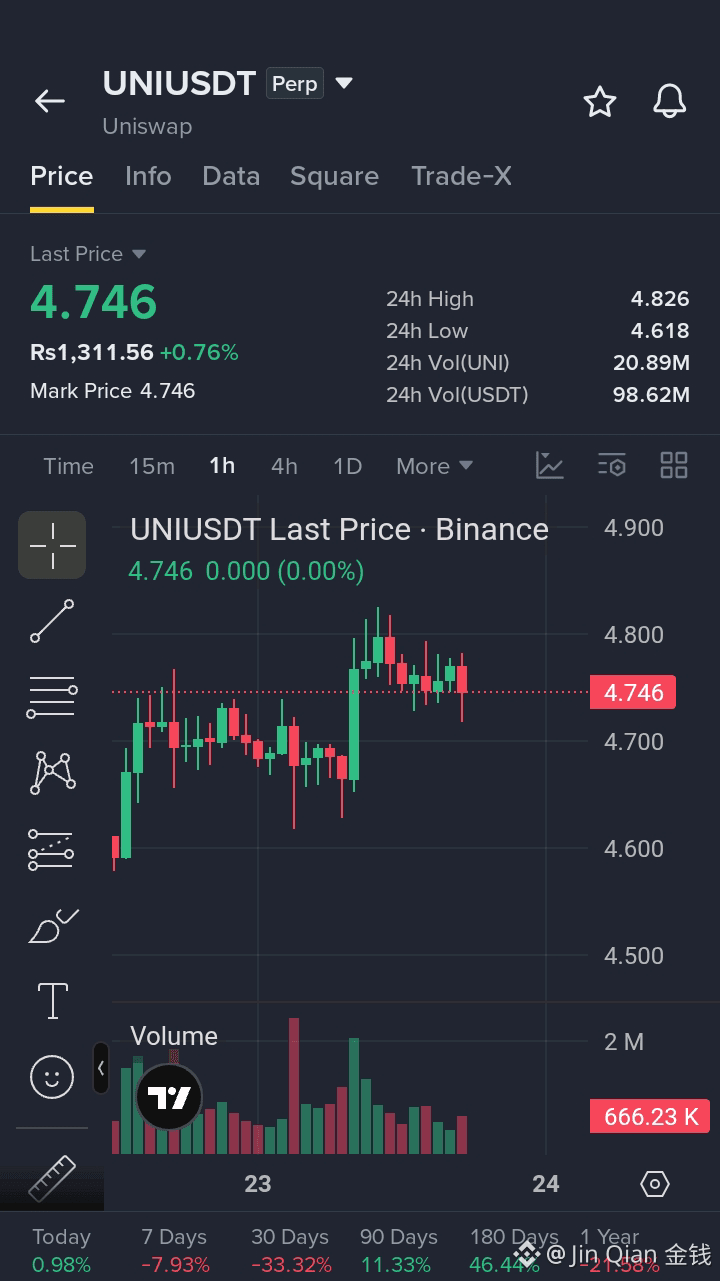

Everyone's been glued to Bitcoin's $61K nap all day, and meanwhile UNI just quietly bounced 15% off Saturday's low.
Uniswap's sitting around $4.83 now — tagged $5.31 earlier, cooled off a bit, but still up ~3% on the day. Saturday it bottomed at $4.19. That's a proper bounce for the token of the biggest DEX in crypto, and barely anyone noticed.
$5.31 is the wall to clear next. Lose $4.63 and the bounce story gets shaky. BTC's holding ~$61,339 in the meantime, so the market's not exactly screaming risk-on yet.
Sometimes the quiet ones move first.
$UNI $BTC
#Uniswap #Crypto #DeFi
Not financial advice. DYOR.
4

·
--
$UNI
Uniswap’s relevance comes from decentralized trading infrastructure, not just token price movements. Liquidity depth, trading activity, user experience, and expansion across networks are key indicators. The real test is whether decentralized exchanges can keep attracting meaningful volume through changing market conditions.
#Uniswap #UNI #defi
25

·
--
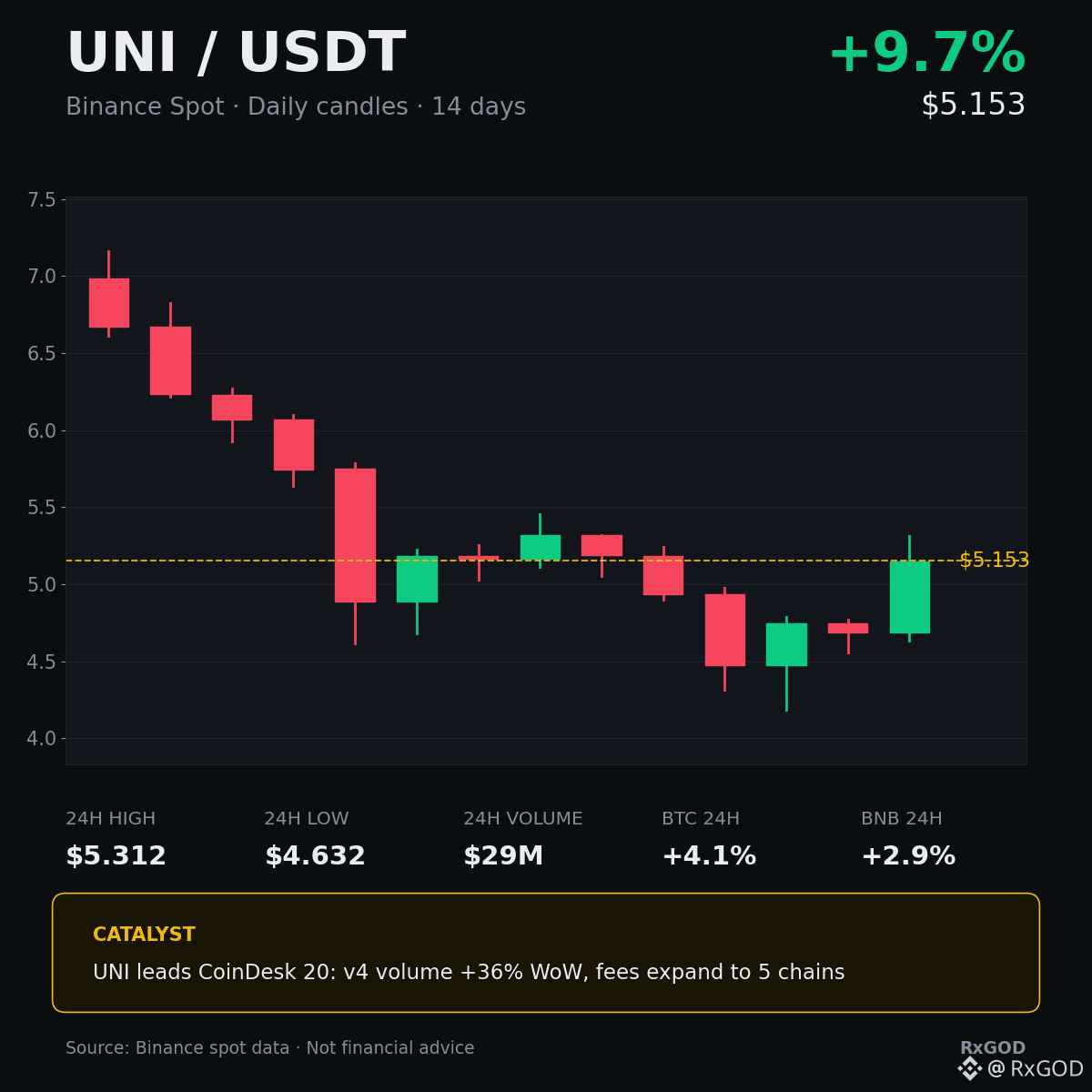
Uniswap just topped the entire CoinDesk 20 — but is this a real comeback, or just a relief bounce in a brutal downtrend?
$UNI is trading at $5.16, up 9.8% in 24 hours, making it the strongest performer in the CoinDesk 20 index (+13.5% in the latest update, ahead of NEAR's +11.7%). The move has real fuel behind it: Uniswap v4 daily spot volume hit $1.291 billion on Nov 20, up 35.85% week-on-week, according to DefiLlama data.
The catalysts stack up. On Nov 21, UNI holders approved expanding v4 fees to five more chains. And today, reports say OKX and ICE plan to route tokenized asset trading through Uniswap pools — a direct usage driver if it materializes.
But keep the context honest: UNI is still down 22.6% over the past 14 days, trading below all its major moving averages, and 89% below its $44.97 all-time high. The 24-hour high of $5.31 is the first wall; support sits at $4.63. The wider market is still in Extreme Fear (index 12), even as $BTC holds $63,634.
So the real question: does the fee expansion plus tokenized-asset flow make UNI a buy at $5 — or is this a bounce to sell into? $6 first, or back to $4.60?
Not financial advice — DYOR.
#Uniswap #DeFi #WillMarketsStageAThanksgivingReliefRally #CryptoNews
27
Here's a weird one. Uniswap's v4 did $1.29 billion of spot volume in a single day on Nov 20 — up almost 36% week over week. The exchange is absolutely packed.
And $UNI? Sitting at $4.76, up about 3% today, but still down 32% this month. The shop is doing record business while the token trades like it's closed.
It bounced off Saturday's $4.19 low and now it's knocking on $4.83, today's high. Clear that and $4.98 (Nov 20 high) is next. Lose $4.61 and it's back toward $4.19.
$BTC is holding above $61K at $61,513, up almost 4% today, so the wind is at UNI's back for once. If volume stays hot, the token usually catches up eventually — usually.
Not financial advice. DYOR.
#Uniswap #Crypto #DeFi
Here's a weird one. Uniswap's v4 did $1.29 billion of spot volume in a single day on Nov 20 — up almost 36% week over week. The exchange is absolutely packed.
And $UNI ? Sitting at $4.76, up about 3% today, but still down 32% this month. The shop is doing record business while the token trades like it's closed.
It bounced off Saturday's $4.19 low and now it's knocking on $4.83, today's high. Clear that and $4.98 (Nov 20 high) is next. Lose $4.61 and it's back toward $4.19.
$BTC is holding above $61K at $61,513, up almost 4% today, so the wind is at UNI's back for once. If volume stays hot, the token usually catches up eventually — usually.
Not financial advice. DYOR.
#Uniswap #Crypto #DeFi
5

·
--
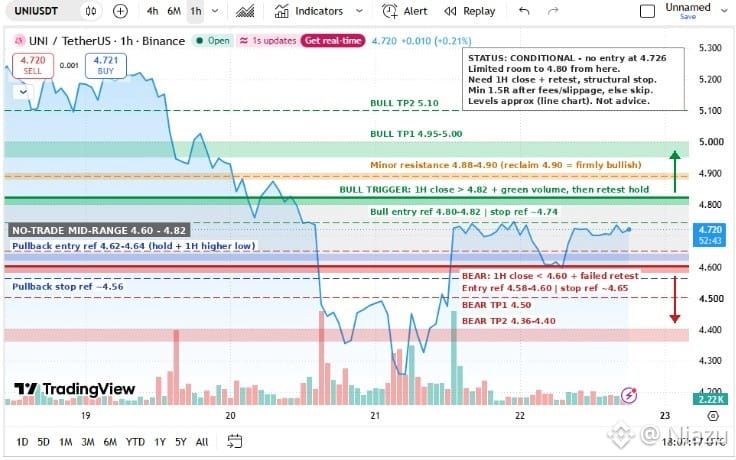
$UNI — TIGHT RANGE AFTER A V-SHAPED RECOVERY: WILL $4.82 BREAK FIRST?
UNI/USDT is around $4.726 after a sharp flush to $4.255 and a strong recovery. Price is consolidating between $4.60 and $4.82, but has not yet reclaimed overhead resistance.
Trade plan
**Bullish plan**
- Wait for a 1H close above $4.82 with expanding green volume.
- Enter only after a successful retest of $4.80–$4.82 as support.
- Entry reference: $4.80–$4.82.
- Stop: Below the retest low, around $4.74.
- Target: $4.95–$5.00 first, then $5.10.
- Require at least 1.5R after fees and slippage.
**Pullback long plan**
- Wait for a dip into $4.60–$4.64 that holds and forms a 1H higher low.
- Entry reference: $4.62–$4.64.
- Stop: Below the range low, around $4.56.
- Target: $4.78–$4.80 first, then $4.88.
- Require at least 1.5R after fees and slippage.
**Bearish plan**
- Wait for a 1H close below $4.60 with rising red volume, followed by a failed retest.
- Entry reference: $4.58–$4.60.
- Stop: Above the retest high, around $4.65.
- Target: $4.50 first, then $4.36–$4.40.
- Require at least 1.5R after fees and slippage.
My take
I’m not entering at $4.726 because price is mid-range. A long here has limited room to $4.80, while a short goes against the improving recovery structure.
Wait for a confirmed 1H close and retest of either $4.82 or $4.60, with a structural stop and at least 1.5R after fees and slippage.
Levels are approximate—confirm with candlesticks.
**Status: conditional
💬 Will UNI reclaim $4.82 first, or break toward $4.60?
$UNI #Uniswap #CryptoTrading #BinanceSquare
127

·
--
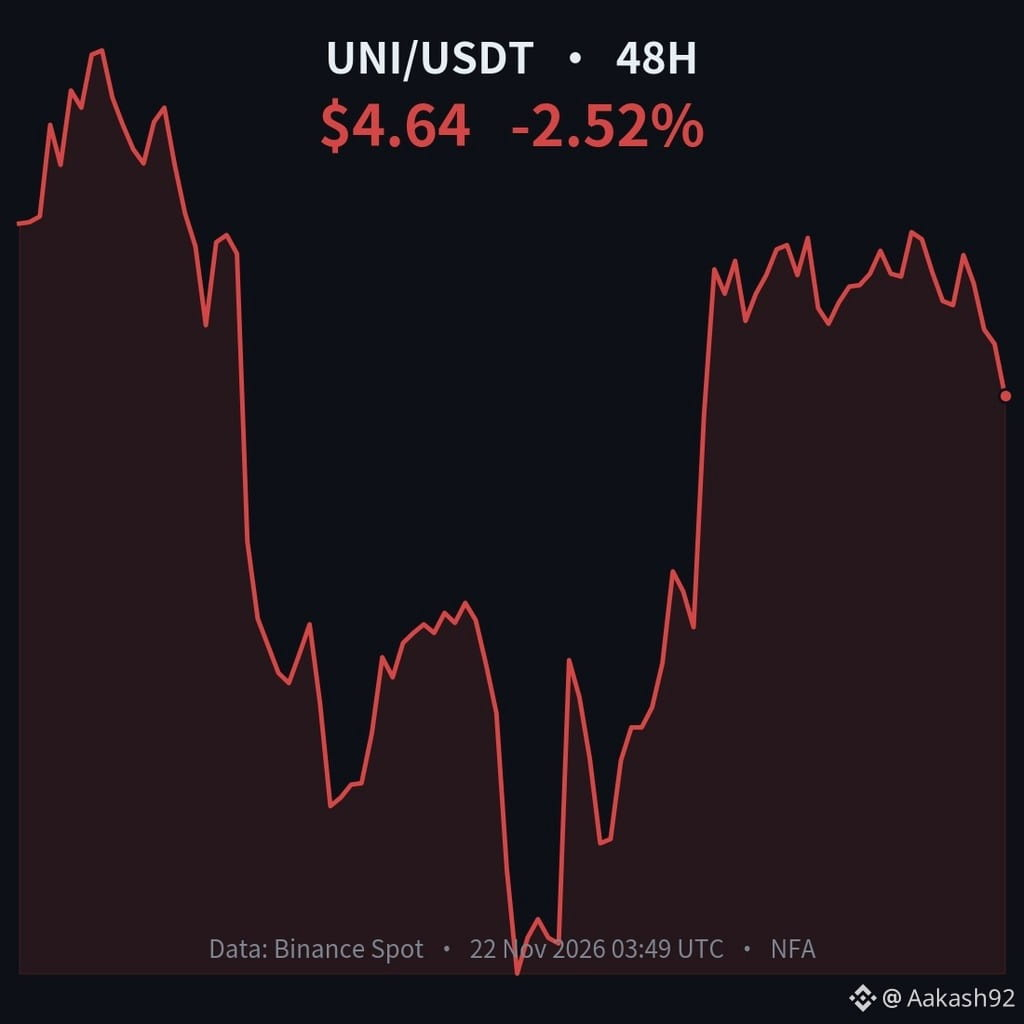
UNI's 48 hours span $4.188-$5.061 and price sits 64% up it after -5.20%, yet it still leads majors today at about +5%. Round trips inside one day are data. What does the leadership tell you? 4.74 now, -5.20% on the 48-hour window. $UNI #uniswap #WriteToEarn NFA
UNI's 48 hours span $4.188-$5.061 and price sits 64% up it after -5.20%, yet it still leads majors today at about +5%. Round trips inside one day are data. What does the leadership tell you? 4.74 now, -5.20% on the 48-hour window. $UNI #uniswap #WriteToEarn NFA
15
UNI quietly put in a decent bounce — $4.19 yesterday, $4.71 now, and $5 is staring it right in the face. Question is whether it actually gets there before Bitcoin decides to ruin the party again.
$5 next, or back under $4.50 first?
Not financial advice. DYOR.
#Uniswap #Crypto
UNI quietly put in a decent bounce — $4.19 yesterday, $4.71 now, and $5 is staring it right in the face. Question is whether it actually gets there before Bitcoin decides to ruin the party again.
$5 next, or back under $4.50 first?
Not financial advice. DYOR.
#Uniswap #Crypto
$5 next, or back under $4.50 first?
Not financial advice. DYOR.
#Uniswap #Crypto
4
UNI is quietly having one of the better days out there — up about 6.5% to around $4.73 while Bitcoin is still wrestling with $60K.
Honestly, this looks like shorts giving up more than anything else. $UNI fell to $4.19 on Friday, bounced hard, and now it is holding above $4.70. Open interest dropped about 10% as those shorts closed out — that is short covering doing the lifting, not some big announcement.
The level that matters now is $4.79, today's high. Clear that and $5 is right there, a nice round number for the bulls to aim at. Lose $4.41 and it is straight back to retesting Friday's mess.
Still down 34% this month, so let's not get carried away — but in a market this beaten up, a 6% green day on a top-30 coin is worth noticing. $BTC holding $60,950 helps, obviously. If Bitcoin slips again, UNI goes with it.
Not financial advice. DYOR.
#Uniswap #Crypto #Altcoins
5

UNI is one of the top 30's biggest gainers today, near $4.60 — but I'm reading this rally as shorts closing, not fresh buying.
The Snapshot vote to switch on v4 fees — and UNI burns — on five more chains closed yesterday, with an on-chain vote still to come. Does that turn into real demand? v4 did $1.291 billion on November 20, up 35.85% week on week, and Uniswap led all DEXs with $14.58 billion.
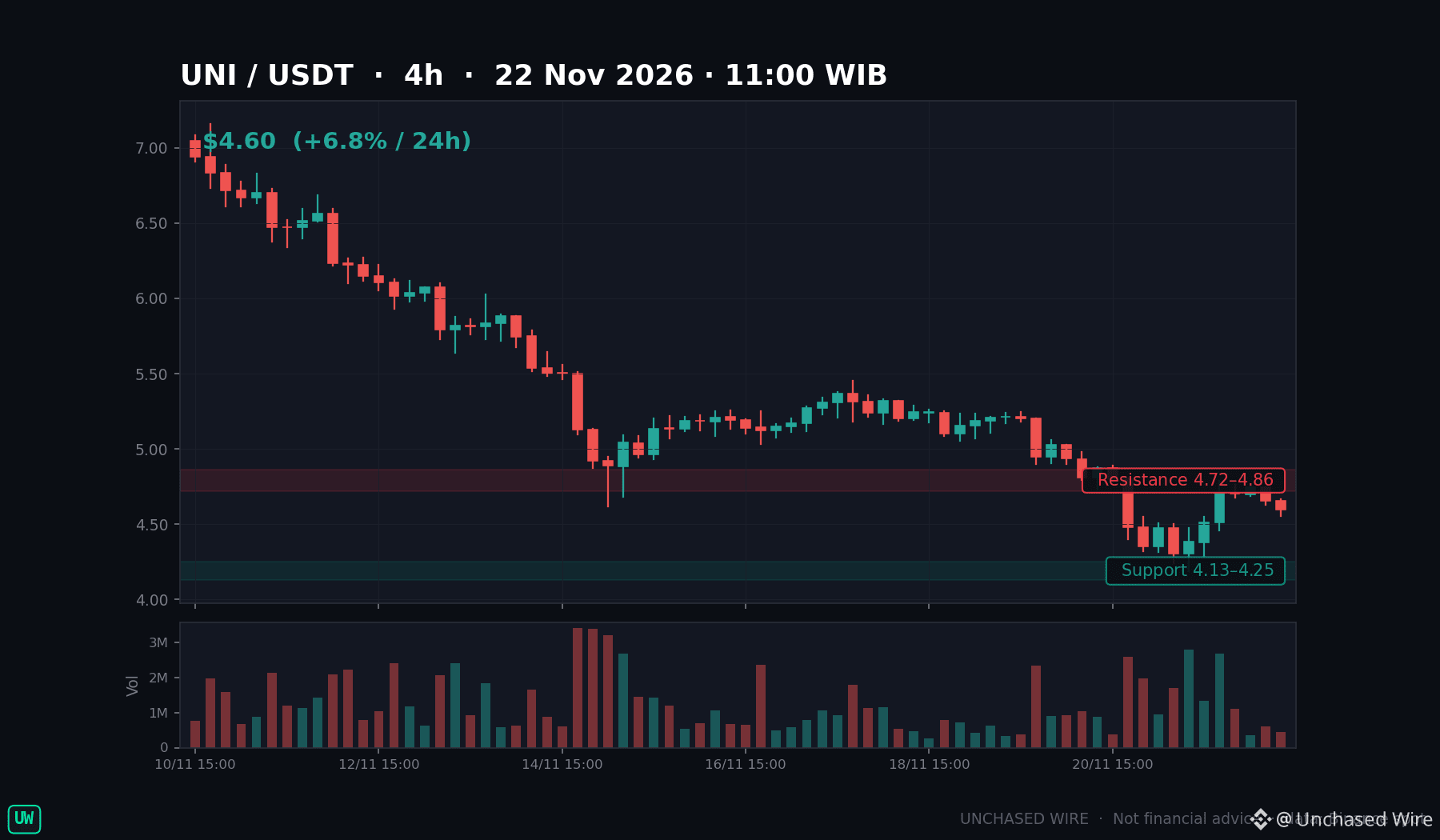
The part that keeps me from getting comfortable: UNI is still down about a third in a month, RSI sits near 32, and open interest has fallen 42% in 30 days — this bounce is short covering. Three paths from here: (A) hold $4.19 and reclaim $4.79, and the $5.00 200-day average comes into play. (B) chop between $4.19 and $4.79 while the on-chain vote pends. (C) a close below $4.19 opens $3.96.
Support: $4.19 · $3.96
Resistance: $4.79 · $5.00 (200-day)
Invalidation: daily close below $4.19
Reclaim $4.79, chop, or break $4.19 — which prints first?
DYOR — not financial advice.
$UNI #DeFi #Uniswap #Governance #DEX
127

·
--
Bullish
🔥 UNISWAP COULD BENEFIT FROM THE GROWING INTEREST IN DECENTRALIZED TRADING!
$UNI remains an important token in the decentralized finance sector.
The growing interest in tokenized assets and on-chain trading is creating new opportunities for decentralized exchanges. Recent November market developments have also brought renewed attention to Uniswap and its role in the expanding tokenization ecosystem.
However, increased platform activity does not automatically translate into higher token prices. Traders should evaluate protocol adoption, liquidity, token economics and actual buying pressure.
I'm watching whether the broader DeFi narrative can translate into sustained market strength for UNI.
NFA. DYOR.
#Uniswap #UNI #DeFi #DecentralizedTrading #BinanceSquare
8

·
--
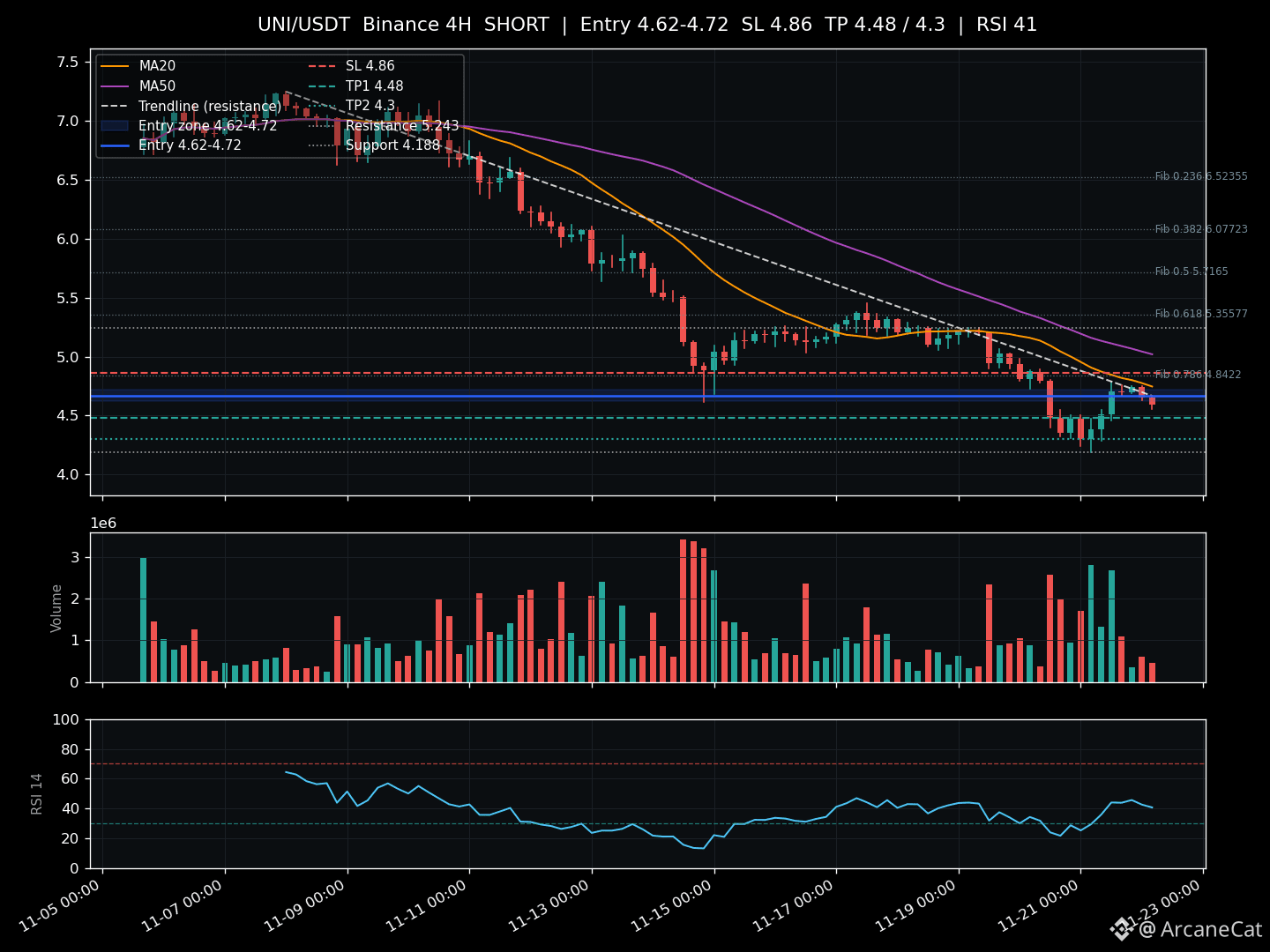
🚨 $UNI pumped +9% into a wall — rejected 3 times
SHORT $UNI
Entry: $4.62–4.72
SL: $4.86
TP1: $4.48 | TP2: $4.30
Invalidation: 4H close above $4.86
$4.75–4.79 resistance rejected every test since yesterday, while BTC's bounce stalls under $60.5K. Relief rally looks exhausted.
Not financial advice.
#UNI #Uniswap #Crypto
SHORT $UNI
Entry: $4.62–4.72
SL: $4.86
TP1: $4.48 | TP2: $4.30
Invalidation: 4H close above $4.86
$4.75–4.79 resistance rejected every test since yesterday, while BTC's bounce stalls under $60.5K. Relief rally looks exhausted.
Not financial advice.
#UNI #Uniswap #Crypto
10
UNI is quietly doing something most coins aren't right now.
While $BTC slipped back under $60K to ~$59,100, Uniswap is up ~8% today at ~$4.59. It bounced off $4.19 and tagged $4.79 earlier — one of the few green names while the rest of the market is still licking its wounds.
The funny part? There's no big announcement behind it. The move is mostly shorts covering — open interest actually fell ~10% while the price climbed. A governance vote on extending v4 fees to more chains closed yesterday, outcome still unreported.
Levels I'm watching: $4.79 is today's high, $4.19 is the floor. Lose that and the bounce fades fast. And keep it in context — UNI is still down ~41% this month.
Not financial advice. DYOR.
#Uniswap #Crypto #Altcoins
8

Article
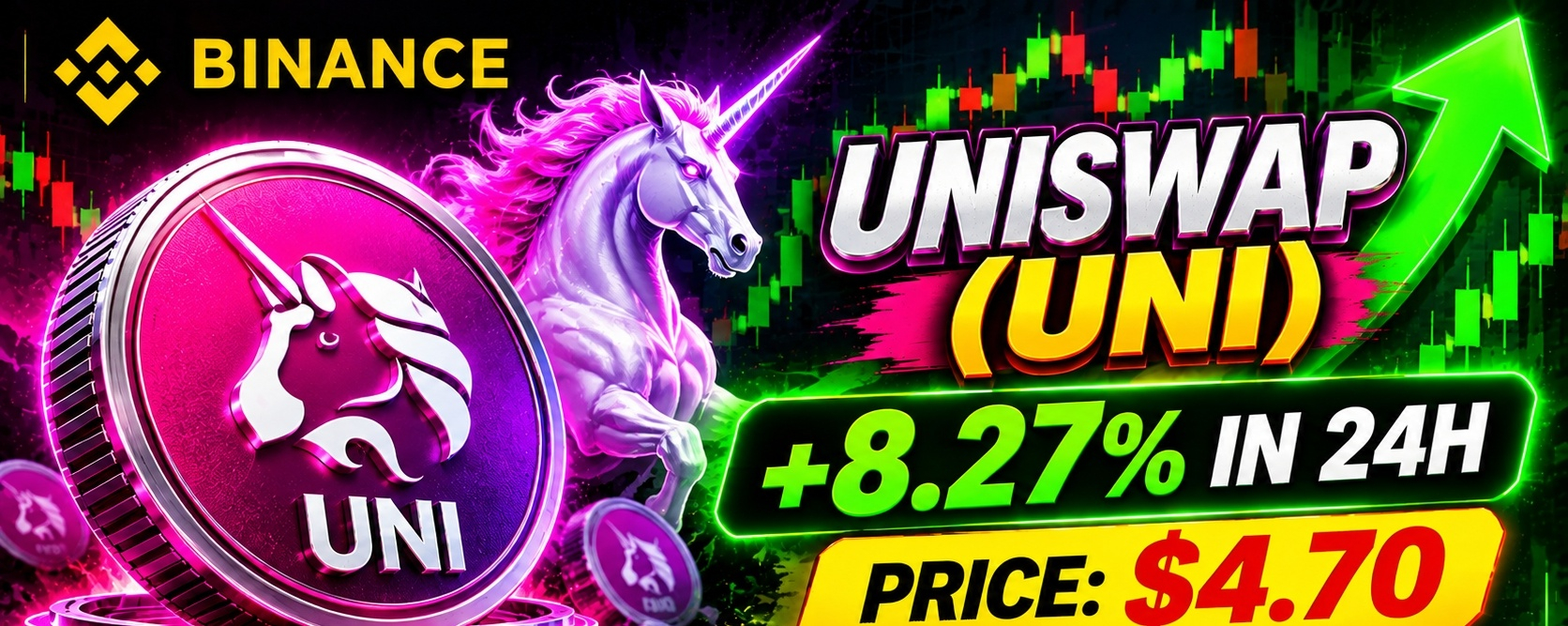
🚀 UNISWAP IS MAKING MOVES! 🔥TRADE IT NOW!$UNI Uniswap is showing strong momentum, with UNI gaining around 8.27% in 24 hours!
{spot}(UNIUSDT)
💰 Price: Around $4.70
Can $UNI continue this upward move? 👀
💬 What's your next target for $UNI
❤️ Follow me for daily crypto updates, trending coins and market opportunities. Like and comment to support my growing account!
#Uniswap #CryptoNews #ALTCOİNS #btc70k #BinanceSquare
🚀 UNISWAP IS MAKING MOVES! 🔥TRADE IT NOW!
$UNI Uniswap is showing strong momentum, with UNI gaining around 8.27% in 24 hours!
💰 Price: Around $4.70
Can $UNI continue this upward move? 👀
💬 What's your next target for $UNI
❤️ Follow me for daily crypto updates, trending coins and market opportunities. Like and comment to support my growing account!
#Uniswap #CryptoNews #ALTCOİNS #btc70k #BinanceSquare
💰 Price: Around $4.70
Can $UNI continue this upward move? 👀
💬 What's your next target for $UNI
❤️ Follow me for daily crypto updates, trending coins and market opportunities. Like and comment to support my growing account!
#Uniswap #CryptoNews #ALTCOİNS #btc70k #BinanceSquare
2
337
·
--
UNI is today's strongest major at about +5% while DOT sits at the bottom near -2%. Relative strength inside a down month often shows where buyers return first. $UNI #uniswap #WriteToEarn NFA
UNI is today's strongest major at about +5% while DOT sits at the bottom near -2%. Relative strength inside a down month often shows where buyers return first. $UNI #uniswap #WriteToEarn NFA
11

🚨 $UNI CRUSHING TOKENIZED STOCKS VOLUME WHILE SITTING 24% BELOW SEPTEMBER HIGHS! 💥
Entry: 7.28 ⚡
Target: 7.70 🚀
Smart money accumulation is printing clear institutional footprints as $UNI dominates decentralized stock-token trading with over twenty billion in cumulative volume. 📊
Order flow shows positive net inflows and heavy spot absorption driving aggressive four-hour momentum from the lows. ⚡ While active addresses remain consolidated, this structural liquidity shift highlights a major inefficiency waiting for expansion. 💡
Are you positioning ahead of the retest or waiting for a confirmed range breakout? 👇
⚠️ Not financial advice. Always manage your risk. 🛡️
🏷️ #UNI #Uniswap #DeFi #Tokenization
🔥 💎

4

·
--
$UNI is reflecting broader DeFi rotation.
Price: ~$4.8 | 24h: mixed to softer | 1h: mild | Volume: elevated | Liquidations: specific recent figures not available from public aggregate sources
Uniswap continues to trade with active volume while the daily print remains mixed. The token stays one of the more watched names within the DeFi segment.
Context remains short-term and volume-supported rather than structural.
#Avi #Uniswap #Crypto
Tracking with Avi on Binance Square.
#FH4817A241
26

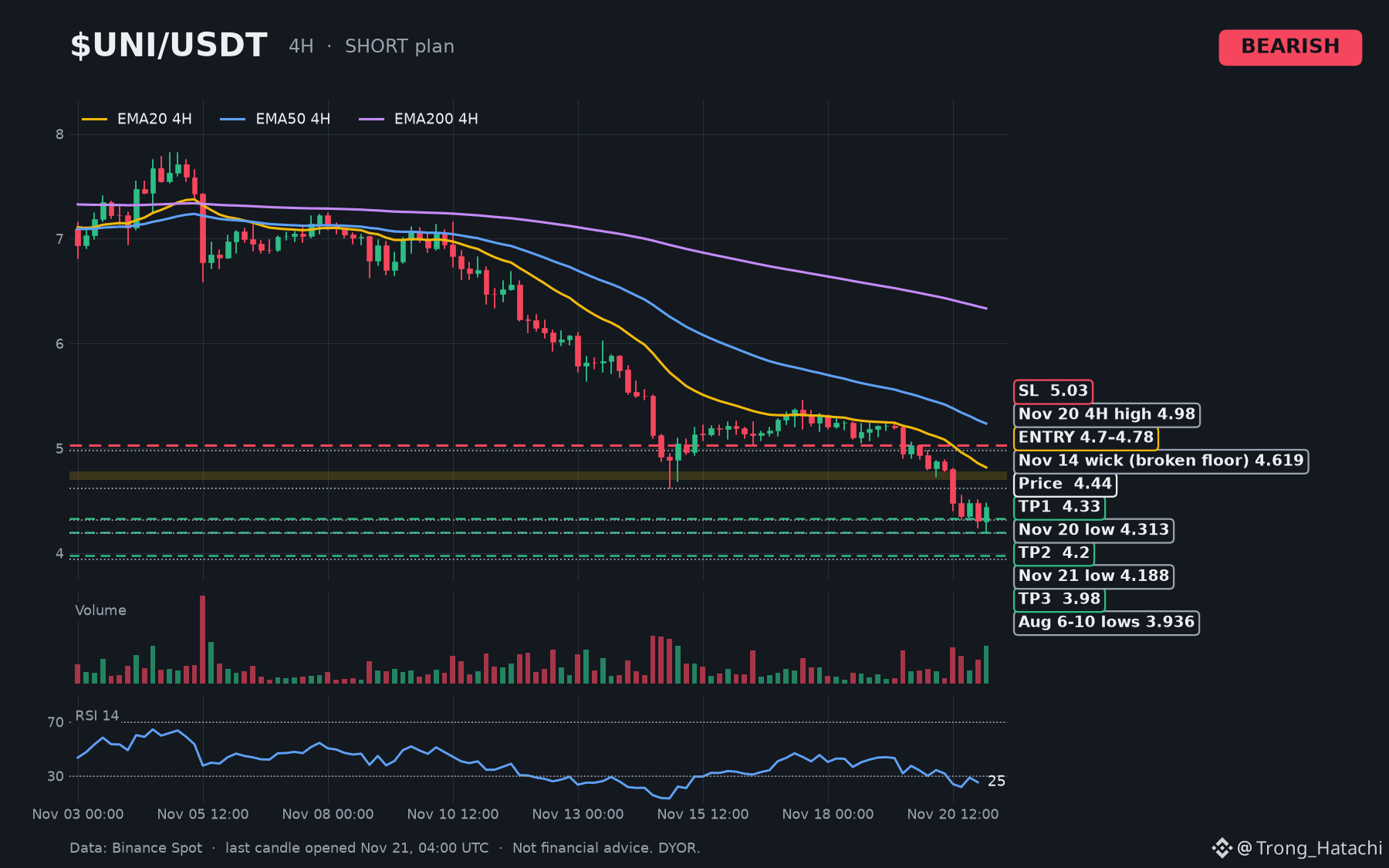
$UNI lost 23% in a week (5.748 to 4.43). The 4.62-4.80 floor it held since Nov 14 broke on Nov 20. Now it's the ceiling.
Trend: Bearish on 4H, 1D below all EMAs. Plan: short a bounce, not the hole.
🎯 Entry short: 4.70 – 4.78 (limit; valid to Nov 22, 12:00 UTC)
✅ TP1: 4.33 (above Nov 20 low 4.313)
✅ TP2: 4.20 (above today's 4.188 low)
✅ TP3: 3.98 (Aug 6-10 lows, 3.91-3.96)
🛑 SL: 5.03 (from 4.74: TP1 1.4R, TP2 1.9R)
📊 Logic:
• Zone: Nov 20 4H lows 4.73-4.80, then a 4.48 4H close. 4H EMA20 4.86 above. SL clears the Nov 20 4H high, 4.98.
• Macro: $BTC lost $60K on Nov 20 (Bitcoin Magazine, Decrypt), now 58.3K. No UNI-specific news found in 48h. UNI -8.3%/24h vs BTC -5.6%: high-beta selling.
• OI -6%/24h, funding ~0%: shorts not crowded.
• Risk: 4H RSI 25, F&G 12. Bounces can be sharp. 1D ATR 12%: size small.
⚠️ Invalidation: 4H close above 5.03. If 4.18 breaks before a fill, skip.
$UNI bounces to 4.74: SELL or BUY? 👇
#UNI #Uniswap #AltcoinAnalysis
Not financial advice. DYOR.
5
982

·
--
UNI pulls back after a sharp rise, with weak short-term range-bound trading 📉
Nov 24, 07:23 (Beijing time): Binance UNIUSDT USDT-margined perpetual was quoted at 4.825 USDT, up 3.12% over the past 24 hours, with trading volume of approximately 184 million USDT and a range of 4.628–5.310. Over the past 4 hours, net aggressive buying/selling as a share of trading volume was −6.4% for spot and −0.5% for perpetuals, indicating more pronounced selling pressure in spot markets. In the same snapshot, the perpetual funding rate was +0.0026%, settled every 8 hours.
At 07:29, the notional value of open interest in this Binance contract was approximately $79.89 million, down 4.14% over 24 hours. The price still posted an intraday gain but had retreated from its high to the lower half of the range, while open interest had not expanded in tandem, suggesting weak signals for a sustained rebound.
Over the next 4–24 hours, the price is expected to trade weakly within a range of 4.628–4.969. The 4.969 level is the midpoint of the 24-hour range. If the 1-hour candle closes above 4.969 on increased volume, the weak outlook is invalidated, with the previous high of 5.310 as the next level to watch. If the 1-hour candle closes below 4.628 and a rebound fails to reclaim it, the next downside target is around 4.56, based on the previous low in Binance spot trading.
#UNI #UNIUSDT #Uniswap #Futures Market
117
Log in to explore more content
Join global crypto users on Binance Square
⚡️ Get latest and useful information about crypto.
💬 Trusted by the world’s largest crypto exchange.
👍 Discover real insights from verified creators.
Email / Phone number
Trending Topics
1
#AnthropicFallsBelow$83IPOPricePremarket
0 views
0 Discussing
2
#NVDASoarsOnJensenReturn
19,500 views
292 Discussing
3
#Bitcoin'sReboundFadesBelow$60K
22,063 views
183 Discussing
4
#NVIDIAReinstatesJensenHuangasCEO
325,907 views
1,976 Discussing
5
#WillMarketsStageAThanksgivingReliefRally?
381,402 views
2,659 Discussing
6
#EthereumFoundationPlansShiftToHashBasedSignaturesBy2028
0 views
0 Discussing
7
#WillOctCorePCEShiftFedHikeExpectations?
143,491 views
1,360 Discussing
8
#EvolveAtBinanceBlockchainWeek
271,784 views
1,684 Discussing
9
#BlackRockLaunchesAsiaPacificFirstTokenizedMoneyMarketFund
1,133 views
9 Discussing
10
#SouthKoreaBeginsCryptoProviderShareholderReviews
9,300 views
158 Discussing