
#ukinflation
ukinflation
2,269 views
17 Discussing
Hot
Latest


Verified
📈 🇬🇧 UK Inflation Accelerates to 3.1% in August: The Real Signal Is Beneath the Headline
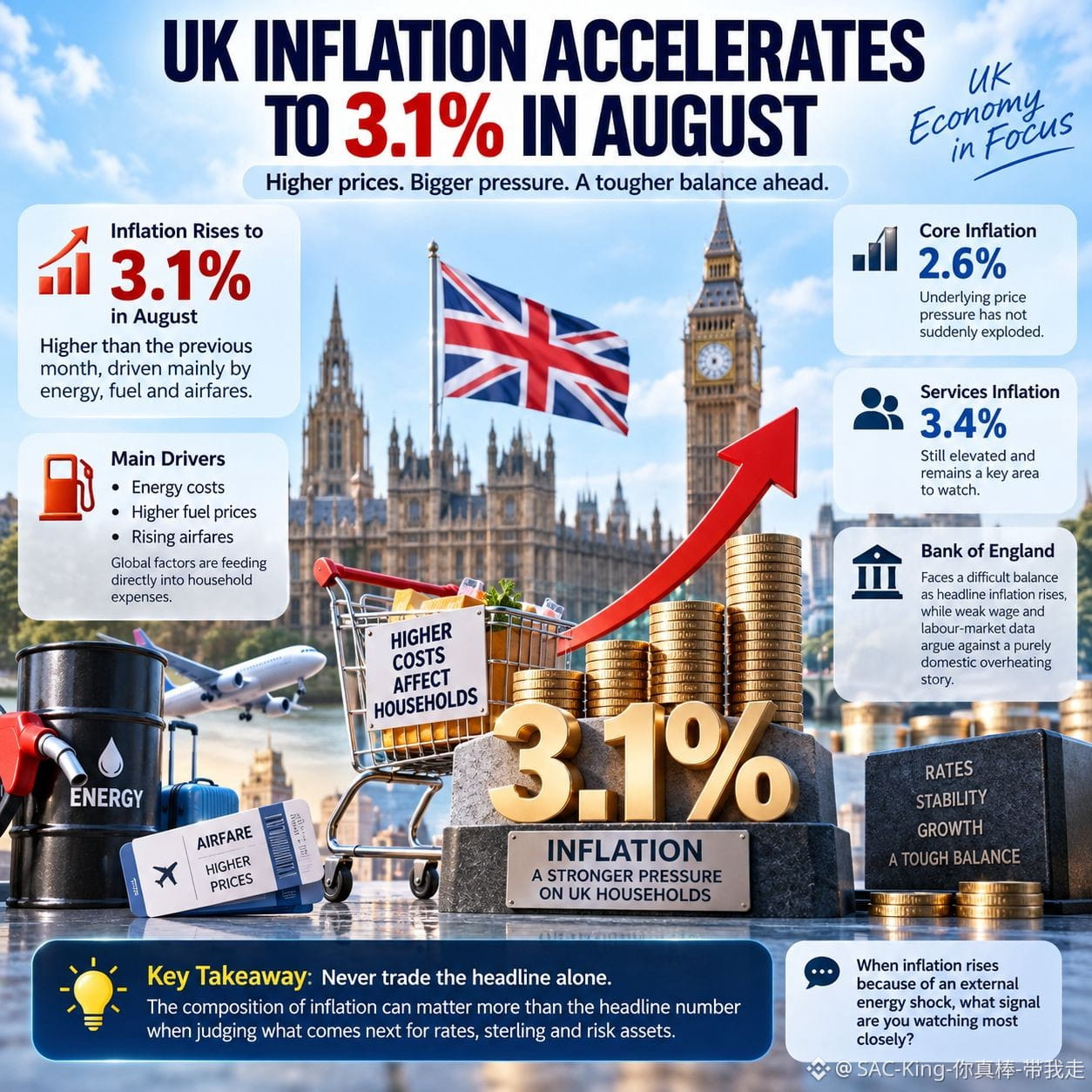
Inflation climbing to 3.1% is uncomfortable, but the more interesting detail is why it happened. August’s increase was driven largely by energy, fuel and airfares, rather than a broad acceleration across underlying prices.
Higher global energy costs are feeding directly into household expenses, reminding markets how quickly geopolitical shocks can reach everyday prices.
Yet core inflation held at 2.6%, while services inflation stayed at 3.4%. That matters because it suggests underlying price pressure has not suddenly exploded.
For the Bank of England, this creates a difficult balance: headline inflation is moving higher, but weak wage and labour-market data argue against treating the rise as purely domestic overheating.
My takeaway: never trade the headline alone. The composition of inflation can matter more than the headline number when judging what comes next for rates, sterling and risk assets.
When inflation rises because of an external energy shock, what signal are you watching most closely?
Educational purposes only, not financial advice.
#UKInflation #Inflation #GrowWithSAC $SYN $ARB $BEB
📈 🇬🇧 UK Inflation Accelerates to 3.1% in August: The Real Signal Is Beneath the Headline
Inflation climbing to 3.1% is uncomfortable, but the more interesting detail is why it happened. August’s increase was driven largely by energy, fuel and airfares, rather than a broad acceleration across underlying prices.
Higher global energy costs are feeding directly into household expenses, reminding markets how quickly geopolitical shocks can reach everyday prices.
Yet core inflation held at 2.6%, while services inflation stayed at 3.4%. That matters because it suggests underlying price pressure has not suddenly exploded.
For the Bank of England, this creates a difficult balance: headline inflation is moving higher, but weak wage and labour-market data argue against treating the rise as purely domestic overheating.
My takeaway: never trade the headline alone. The composition of inflation can matter more than the headline number when judging what comes next for rates, sterling and risk assets.
When inflation rises because of an external energy shock, what signal are you watching most closely?
Educational purposes only, not financial advice.
#UKInflation #Inflation #GrowWithSAC $SYN $ARB $BEB
Inflation climbing to 3.1% is uncomfortable, but the more interesting detail is why it happened. August’s increase was driven largely by energy, fuel and airfares, rather than a broad acceleration across underlying prices.
Higher global energy costs are feeding directly into household expenses, reminding markets how quickly geopolitical shocks can reach everyday prices.
Yet core inflation held at 2.6%, while services inflation stayed at 3.4%. That matters because it suggests underlying price pressure has not suddenly exploded.
For the Bank of England, this creates a difficult balance: headline inflation is moving higher, but weak wage and labour-market data argue against treating the rise as purely domestic overheating.
My takeaway: never trade the headline alone. The composition of inflation can matter more than the headline number when judging what comes next for rates, sterling and risk assets.
When inflation rises because of an external energy shock, what signal are you watching most closely?
Educational purposes only, not financial advice.
#UKInflation #Inflation #GrowWithSAC $SYN $ARB $BEB
155

·
--
Bullish
UK inflation rises to 3.1%, but oil-driven pressures may matter more ahead
📌 UK CPI rose to 3.1% year-on-year in August from 2.9% previously, above the Bank of England’s earlier 2.8% forecast. However, the figure matched market expectations, leaving sterling largely unchanged.
🔎 Price pressures were still concentrated in energy and transport. Core CPI remained at 2.6% for a fourth consecutive month, while services inflation held at 3.4%, suggesting no clear sign yet of a broader domestic inflation rebound.
⚠️ Producer prices may be more important for the outlook, with input prices up 6.1% and output prices rising 3.7% year-on-year. Higher crude oil costs are adding further pressure across the production chain.
⏱️ August CPI data were collected before the sharp rise in oil prices during September, meaning the latest energy shock has not yet been fully reflected. Attention now turns to the BoE meeting on September 17 and its assessment of inflation risks ahead.
#UKInflation $LSK
UK inflation rises to 3.1%, but oil-driven pressures may matter more ahead
📌 UK CPI rose to 3.1% year-on-year in August from 2.9% previously, above the Bank of England’s earlier 2.8% forecast. However, the figure matched market expectations, leaving sterling largely unchanged.
🔎 Price pressures were still concentrated in energy and transport. Core CPI remained at 2.6% for a fourth consecutive month, while services inflation held at 3.4%, suggesting no clear sign yet of a broader domestic inflation rebound.
⚠️ Producer prices may be more important for the outlook, with input prices up 6.1% and output prices rising 3.7% year-on-year. Higher crude oil costs are adding further pressure across the production chain.
⏱️ August CPI data were collected before the sharp rise in oil prices during September, meaning the latest energy shock has not yet been fully reflected. Attention now turns to the BoE meeting on September 17 and its assessment of inflation risks ahead.
#UKInflation $LSK
📌 UK CPI rose to 3.1% year-on-year in August from 2.9% previously, above the Bank of England’s earlier 2.8% forecast. However, the figure matched market expectations, leaving sterling largely unchanged.
🔎 Price pressures were still concentrated in energy and transport. Core CPI remained at 2.6% for a fourth consecutive month, while services inflation held at 3.4%, suggesting no clear sign yet of a broader domestic inflation rebound.
⚠️ Producer prices may be more important for the outlook, with input prices up 6.1% and output prices rising 3.7% year-on-year. Higher crude oil costs are adding further pressure across the production chain.
⏱️ August CPI data were collected before the sharp rise in oil prices during September, meaning the latest energy shock has not yet been fully reflected. Attention now turns to the BoE meeting on September 17 and its assessment of inflation risks ahead.
#UKInflation $LSK

103

Verified
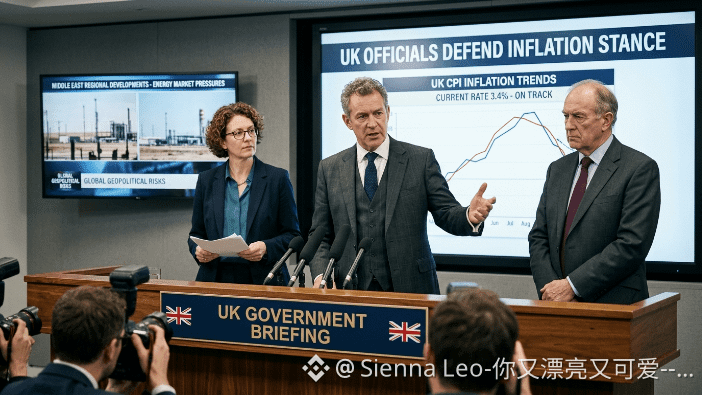
📊🇬🇧 UK Officials Defend Inflation Stance as Middle East Risks Keep Pressure in the Background 🇬🇧📉
📈 In the early policy updates coming out of London, the tone felt steady but carefully constructed, as if every sentence had been weighed against both domestic numbers and global uncertainty.
Officials at the Bank of England continued to defend their current inflation approach, emphasizing that decisions are being shaped by long-term stability rather than short-term fluctuations.
At the same time, external risks linked to the Middle East remain part of the wider conversation, quietly influencing expectations even when they are not directly referenced in domestic data.
What stands out is how inflation management is no longer a purely internal exercise. Energy markets, shipping routes, and regional stability all feed into pricing pressures in ways that are harder to isolate than before.
Inside policy discussions, there seems to be a consistent effort to separate signal from noise, especially when global headlines shift faster than economic indicators can adjust.
It feels like a balancing act where patience is not passive, but intentional. Rates, forecasts, and guidance are all being shaped with an awareness that external shocks can reappear without much warning.
The broader environment remains sensitive, and that sensitivity is reflected in how carefully language is chosen, especially when describing future paths.
There is no sense of urgency to overcorrect, but also no comfort in assuming stability will hold without interruption.
And that is where the current stance sits, between measured confidence and quiet caution, with both domestic and global pressures moving in the background.
Sometimes policy is less about direction, and more about timing what not to change too quickly.
#UKInflation #BankOfEngland #MacroEconomy #Write2Earn #GrowWithSAC
📊🇬🇧 UK Officials Defend Inflation Stance as Middle East Risks Keep Pressure in the Background 🇬🇧📉
📈 In the early policy updates coming out of London, the tone felt steady but carefully constructed, as if every sentence had been weighed against both domestic numbers and global uncertainty.
Officials at the Bank of England continued to defend their current inflation approach, emphasizing that decisions are being shaped by long-term stability rather than short-term fluctuations.
At the same time, external risks linked to the Middle East remain part of the wider conversation, quietly influencing expectations even when they are not directly referenced in domestic data.
What stands out is how inflation management is no longer a purely internal exercise. Energy markets, shipping routes, and regional stability all feed into pricing pressures in ways that are harder to isolate than before.
Inside policy discussions, there seems to be a consistent effort to separate signal from noise, especially when global headlines shift faster than economic indicators can adjust.
It feels like a balancing act where patience is not passive, but intentional. Rates, forecasts, and guidance are all being shaped with an awareness that external shocks can reappear without much warning.
The broader environment remains sensitive, and that sensitivity is reflected in how carefully language is chosen, especially when describing future paths.
There is no sense of urgency to overcorrect, but also no comfort in assuming stability will hold without interruption.
And that is where the current stance sits, between measured confidence and quiet caution, with both domestic and global pressures moving in the background.
Sometimes policy is less about direction, and more about timing what not to change too quickly.
#UKInflation #BankOfEngland #MacroEconomy #Write2Earn #GrowWithSAC
📈 In the early policy updates coming out of London, the tone felt steady but carefully constructed, as if every sentence had been weighed against both domestic numbers and global uncertainty.
Officials at the Bank of England continued to defend their current inflation approach, emphasizing that decisions are being shaped by long-term stability rather than short-term fluctuations.
At the same time, external risks linked to the Middle East remain part of the wider conversation, quietly influencing expectations even when they are not directly referenced in domestic data.
What stands out is how inflation management is no longer a purely internal exercise. Energy markets, shipping routes, and regional stability all feed into pricing pressures in ways that are harder to isolate than before.
Inside policy discussions, there seems to be a consistent effort to separate signal from noise, especially when global headlines shift faster than economic indicators can adjust.
It feels like a balancing act where patience is not passive, but intentional. Rates, forecasts, and guidance are all being shaped with an awareness that external shocks can reappear without much warning.
The broader environment remains sensitive, and that sensitivity is reflected in how carefully language is chosen, especially when describing future paths.
There is no sense of urgency to overcorrect, but also no comfort in assuming stability will hold without interruption.
And that is where the current stance sits, between measured confidence and quiet caution, with both domestic and global pressures moving in the background.
Sometimes policy is less about direction, and more about timing what not to change too quickly.
#UKInflation #BankOfEngland #MacroEconomy #Write2Earn #GrowWithSAC
799

·
--
UK inflation expectations climb to 5% in latest BoE survey.
• Median estimate for current inflation rose to 5% in June 2026
• One-year inflation expectations increased to a median of 4%
• More respondents see faster price rises as harmful to the economy
#CryptoNews #MarketUpdate #BinanceSquare #UKInflation #BoE
UK inflation expectations climb to 5% in latest BoE survey.
• Median estimate for current inflation rose to 5% in June 2026
• One-year inflation expectations increased to a median of 4%
• More respondents see faster price rises as harmful to the economy
#CryptoNews #MarketUpdate #BinanceSquare #UKInflation #BoE
• Median estimate for current inflation rose to 5% in June 2026
• One-year inflation expectations increased to a median of 4%
• More respondents see faster price rises as harmful to the economy
#CryptoNews #MarketUpdate #BinanceSquare #UKInflation #BoE
24

·
--

Article
UK Inflation Faces AI-Driven Memory Chip Shortage, Higher Energy CostsUK consumer prices are poised to be a key focus in the coming week as inflation data is expected to reflect ongoing pressures from a combination of factors. According to Bloomberg, the Bank of England remains cautious amid concerns over a shortage of AI-driven memory chips and rising energy costs, which are contributing to inflationary pressures in the economy.
The shortage of memory chips, driven by global supply chain disruptions and increased demand for AI and data center hardware, is impacting production and pricing across various sectors. This chip scarcity is adding upward pressure on prices for electronic goods and components, which in turn influences consumer prices and inflation figures.
In addition to supply chain issues, higher energy costs are also playing a significant role in keeping inflation elevated. The increasing costs of electricity and fuel are affecting both businesses and consumers, further complicating the Bank of England’s efforts to manage inflation targets without stifling economic growth.
Market watchers are closely monitoring upcoming inflation data, which could influence monetary policy decisions. The combination of supply constraints and rising costs underscores the complex environment policymakers face as they balance inflation control with economic stability. More details are available in the official Binance Square post. #UKInflation #EnergyCosts #SupplyChain
UK Inflation Faces AI-Driven Memory Chip Shortage, Higher Energy Costs
UK consumer prices are poised to be a key focus in the coming week as inflation data is expected to reflect ongoing pressures from a combination of factors. According to Bloomberg, the Bank of England remains cautious amid concerns over a shortage of AI-driven memory chips and rising energy costs, which are contributing to inflationary pressures in the economy.
The shortage of memory chips, driven by global supply chain disruptions and increased demand for AI and data center hardware, is impacting production and pricing across various sectors. This chip scarcity is adding upward pressure on prices for electronic goods and components, which in turn influences consumer prices and inflation figures.
In addition to supply chain issues, higher energy costs are also playing a significant role in keeping inflation elevated. The increasing costs of electricity and fuel are affecting both businesses and consumers, further complicating the Bank of England’s efforts to manage inflation targets without stifling economic growth.
Market watchers are closely monitoring upcoming inflation data, which could influence monetary policy decisions. The combination of supply constraints and rising costs underscores the complex environment policymakers face as they balance inflation control with economic stability. More details are available in the official Binance Square post. #UKInflation #EnergyCosts #SupplyChain
The shortage of memory chips, driven by global supply chain disruptions and increased demand for AI and data center hardware, is impacting production and pricing across various sectors. This chip scarcity is adding upward pressure on prices for electronic goods and components, which in turn influences consumer prices and inflation figures.
In addition to supply chain issues, higher energy costs are also playing a significant role in keeping inflation elevated. The increasing costs of electricity and fuel are affecting both businesses and consumers, further complicating the Bank of England’s efforts to manage inflation targets without stifling economic growth.
Market watchers are closely monitoring upcoming inflation data, which could influence monetary policy decisions. The combination of supply constraints and rising costs underscores the complex environment policymakers face as they balance inflation control with economic stability. More details are available in the official Binance Square post. #UKInflation #EnergyCosts #SupplyChain
13
Log in to explore more content
Join global crypto users on Binance Square
⚡️ Get latest and useful information about crypto.
💬 Trusted by the world’s largest crypto exchange.
👍 Discover real insights from verified creators.
Email / Phone number
Trending Topics
1
#AIStocksWhatNext
809,794 views
6,257 Discussing
2
#BitcoinRejectedAt$87,300Twice
0 views
0 Discussing
3
#BCHJumps28%OnCMEFuturesListing
4,049 views
363 Discussing
4
#WallStreetEarningsRevisionsTurnBearish
3,043 views
257 Discussing
5
#DollarIndexReclaims101
2,347 views
223 Discussing
6
#21SharesLaunchesEuropesFirstZcashETP
32,852 views
1,000 Discussing
7
#CardanoJoinsX402PaymentStandard
21,338 views
723 Discussing
8
#BitcoinTops$87KAtEightMonthHigh
11,415 views
127 Discussing
9
#ZECBreaksAbove$1600AtRecordHigh
7,894 views
105 Discussing
10
#BitwiseNEARStakingETPAssetsTop$100M
36,799 views
105 Discussing