

#stinkmeanerinsights
stinkmeanerinsights
1,440 views
5 Discussing
Hot
Latest

·
--
Verified
🏦 The interesting part of SWIFT going on-chain isn't the blockchain. It's the control banks refuse to surrender...#chainlinklaunchesbankswiftledgerframework
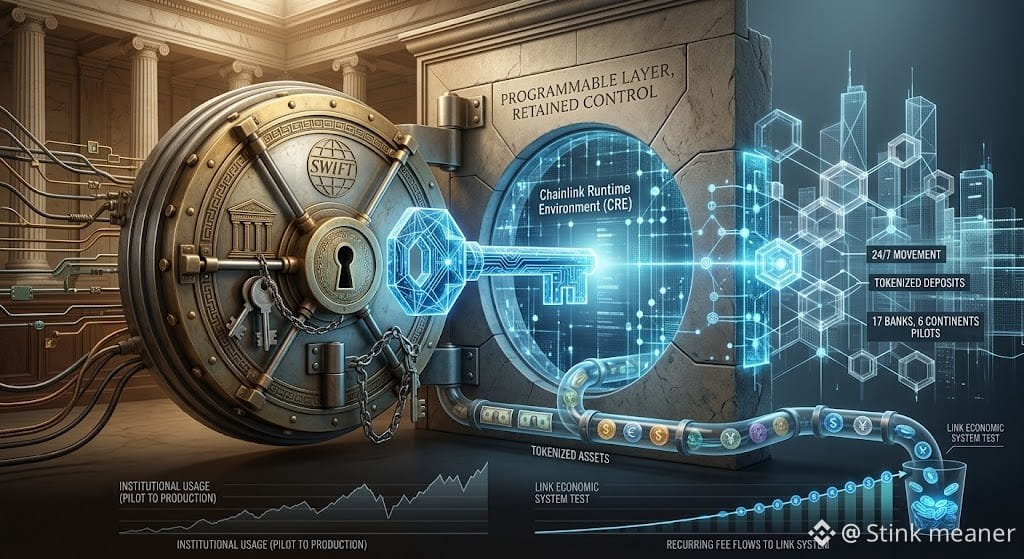
A new Chainlink framework uses its Chainlink Runtime Environment (CRE) to let financial institutions connect to SWIFT's blockchain ledger while retaining control of the keys used to sign transactions.
That's important because SWIFT's ledger is designed for 24/7 movement of tokenized bank deposits, with 17 banks across six continents preparing pilot transactions. Final settlement can still occur through existing payment infrastructure.
In other words, banks aren't being asked to abandon the system they trust.
They're adding a programmable layer to it.
And that's where $LINK gets interesting — but don't confuse integration with automatic token demand.
Chainlink says enterprise and on-chain service revenue can be programmatically converted into LINK through Payment Abstraction and accumulated in the Chainlink Reserve.
So the real test isn't another partnership announcement.
Does institutional usage produce recurring fee flows that actually reach the LINK economic system?
That's the number I'd watch as tokenized finance moves from pilot to production.
Not financial advice. SWIFT's ledger and Chainlink's connection framework are still part of an evolving institutional rollout; this does not establish guaranteed LINK demand or value capture.
$LINK $ONDO
{future}(ONDOUSDT)
{future}(LINKUSDT)
#ChainlinkLaunchesBankSWIFTLedgerFramework #TokenizedDeposits #Stinkmeanerinsights #EarningsSeason
🏦 The interesting part of SWIFT going on-chain isn't the blockchain. It's the control banks refuse to surrender...#chainlinklaunchesbankswiftledgerframework
A new Chainlink framework uses its Chainlink Runtime Environment (CRE) to let financial institutions connect to SWIFT's blockchain ledger while retaining control of the keys used to sign transactions.
That's important because SWIFT's ledger is designed for 24/7 movement of tokenized bank deposits, with 17 banks across six continents preparing pilot transactions. Final settlement can still occur through existing payment infrastructure.
In other words, banks aren't being asked to abandon the system they trust.
They're adding a programmable layer to it.
And that's where $LINK gets interesting — but don't confuse integration with automatic token demand.
Chainlink says enterprise and on-chain service revenue can be programmatically converted into LINK through Payment Abstraction and accumulated in the Chainlink Reserve.
So the real test isn't another partnership announcement.
Does institutional usage produce recurring fee flows that actually reach the LINK economic system?
That's the number I'd watch as tokenized finance moves from pilot to production.
Not financial advice. SWIFT's ledger and Chainlink's connection framework are still part of an evolving institutional rollout; this does not establish guaranteed LINK demand or value capture.
$LINK $ONDO
#ChainlinkLaunchesBankSWIFTLedgerFramework #TokenizedDeposits #Stinkmeanerinsights #EarningsSeason
A new Chainlink framework uses its Chainlink Runtime Environment (CRE) to let financial institutions connect to SWIFT's blockchain ledger while retaining control of the keys used to sign transactions.
That's important because SWIFT's ledger is designed for 24/7 movement of tokenized bank deposits, with 17 banks across six continents preparing pilot transactions. Final settlement can still occur through existing payment infrastructure.
In other words, banks aren't being asked to abandon the system they trust.
They're adding a programmable layer to it.
And that's where $LINK gets interesting — but don't confuse integration with automatic token demand.
Chainlink says enterprise and on-chain service revenue can be programmatically converted into LINK through Payment Abstraction and accumulated in the Chainlink Reserve.
So the real test isn't another partnership announcement.
Does institutional usage produce recurring fee flows that actually reach the LINK economic system?
That's the number I'd watch as tokenized finance moves from pilot to production.
Not financial advice. SWIFT's ledger and Chainlink's connection framework are still part of an evolving institutional rollout; this does not establish guaranteed LINK demand or value capture.
$LINK $ONDO
#ChainlinkLaunchesBankSWIFTLedgerFramework #TokenizedDeposits #Stinkmeanerinsights #EarningsSeason
2
2.7k
·
--
🚨 The SEC’s $75M crypto-fundraising headline hides the part that could matter more...
#sectoclarifyonchainfundraisingrules
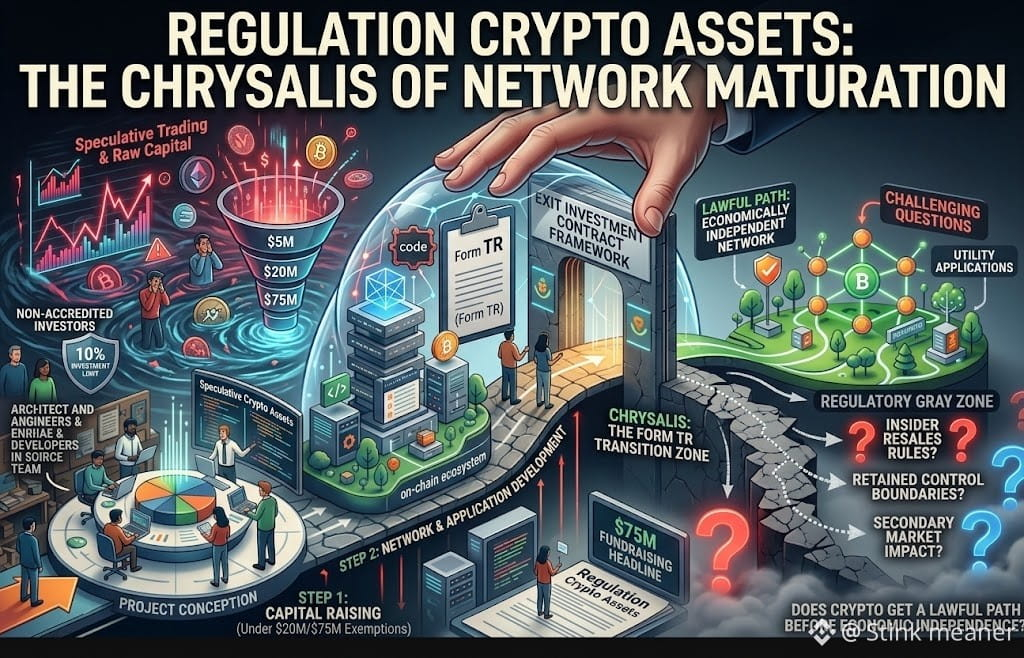
On Aug. 18, the SEC proposed Regulation Crypto Assets — but this is not yet a final rule. Comments are open until Oct. 20.
The headline: projects could potentially raise $5M over four years through a startup exemption, or $20M/$75M over 12 months under Tier 1/2 fundraising exemptions. Non-accredited investors would generally face a 10% of income-or-net-worth purchase limit.
But the deeper mechanism is a regulatory lifecycle:
Raise capital → build the network/application → complete or permanently cease promised “essential managerial efforts” → file Form TR → potentially exit the investment-contract framework.
And the SEC isn't treating crypto like ordinary securities paperwork. Proposed disclosures specifically address source code, network security, token supply/allocation, governance, ecosystem and ways to verify transaction history.
That could turn token launches from a legal gray zone into a defined capital-formation process — while leaving difficult questions around insider resales, retained control and secondary markets. Recent SEC comments are already challenging those gaps.
The real question: does crypto finally get a lawful path to fund a network before it becomes economically independent?
DYOR. This remains a proposal, not law, and any transition out of the investment-contract framework would depend on satisfying the SEC’s proposed conditions
$ETH $SOL $BNB
{future}(SOLUSDT)
#SECToClarifyOnChainFundraisingRules #CryptoRegulation #Stinkmeanerinsights #blockchain
🚨 The SEC’s $75M crypto-fundraising headline hides the part that could matter more...
#sectoclarifyonchainfundraisingrules
On Aug. 18, the SEC proposed Regulation Crypto Assets — but this is not yet a final rule. Comments are open until Oct. 20.
The headline: projects could potentially raise $5M over four years through a startup exemption, or $20M/$75M over 12 months under Tier 1/2 fundraising exemptions. Non-accredited investors would generally face a 10% of income-or-net-worth purchase limit.
But the deeper mechanism is a regulatory lifecycle:
Raise capital → build the network/application → complete or permanently cease promised “essential managerial efforts” → file Form TR → potentially exit the investment-contract framework.
And the SEC isn't treating crypto like ordinary securities paperwork. Proposed disclosures specifically address source code, network security, token supply/allocation, governance, ecosystem and ways to verify transaction history.
That could turn token launches from a legal gray zone into a defined capital-formation process — while leaving difficult questions around insider resales, retained control and secondary markets. Recent SEC comments are already challenging those gaps.
The real question: does crypto finally get a lawful path to fund a network before it becomes economically independent?
DYOR. This remains a proposal, not law, and any transition out of the investment-contract framework would depend on satisfying the SEC’s proposed conditions
$ETH $SOL $BNB
#SECToClarifyOnChainFundraisingRules #CryptoRegulation #Stinkmeanerinsights #blockchain
#sectoclarifyonchainfundraisingrules
On Aug. 18, the SEC proposed Regulation Crypto Assets — but this is not yet a final rule. Comments are open until Oct. 20.
The headline: projects could potentially raise $5M over four years through a startup exemption, or $20M/$75M over 12 months under Tier 1/2 fundraising exemptions. Non-accredited investors would generally face a 10% of income-or-net-worth purchase limit.
But the deeper mechanism is a regulatory lifecycle:
Raise capital → build the network/application → complete or permanently cease promised “essential managerial efforts” → file Form TR → potentially exit the investment-contract framework.
And the SEC isn't treating crypto like ordinary securities paperwork. Proposed disclosures specifically address source code, network security, token supply/allocation, governance, ecosystem and ways to verify transaction history.
That could turn token launches from a legal gray zone into a defined capital-formation process — while leaving difficult questions around insider resales, retained control and secondary markets. Recent SEC comments are already challenging those gaps.
The real question: does crypto finally get a lawful path to fund a network before it becomes economically independent?
DYOR. This remains a proposal, not law, and any transition out of the investment-contract framework would depend on satisfying the SEC’s proposed conditions
$ETH $SOL $BNB
#SECToClarifyOnChainFundraisingRules #CryptoRegulation #Stinkmeanerinsights #blockchain
1
2k
·
--
🍾🎇We are growing.
I earned 1.85 USDC in profits from Write to Earn last week.
Thank you fam🙏
$QNT $LINK $GRASS
{future}(GRASSUSDT)
{future}(LINKUSDT)
{future}(QNTUSDT)
#Stinkmeaner #Stinkmeanerinsights #Binance #binancesquarefamily
🍾🎇We are growing.
I earned 1.85 USDC in profits from Write to Earn last week.
Thank you fam🙏
$QNT $LINK $GRASS
#Stinkmeaner #Stinkmeanerinsights #Binance #binancesquarefamily
I earned 1.85 USDC in profits from Write to Earn last week.
Thank you fam🙏
$QNT $LINK $GRASS
#Stinkmeaner #Stinkmeanerinsights #Binance #binancesquarefamily
From Write to Earn
2
81
·
--
📊 AI is no longer just an earnings story. It's becoming a balance-sheet story...
#earningsseason
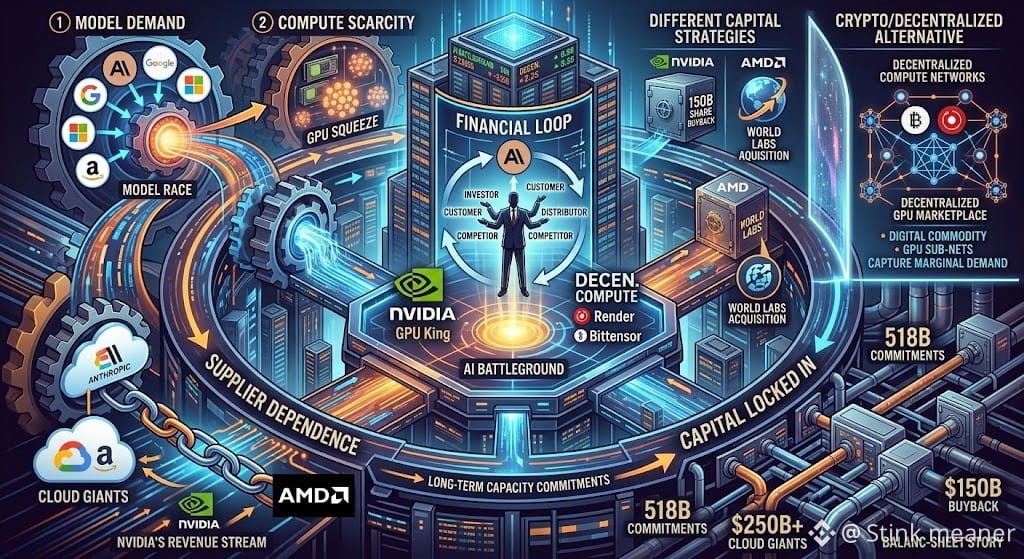
Anthropic's latest IPO filing reveals at least $518B of infrastructure commitments over the next decade, with roughly 80% non-cancelable or payable regardless of usage.
Google, Amazon and Microsoft alone account for more than $250B of those commitments.
And here's the uncomfortable part:
Anthropic says those same companies can simultaneously be investors, customers, cloud providers, distributors and competitors.
The AI race is therefore creating a strange financial loop:
model demand → compute scarcity → long-term capacity commitments → supplier dependence → more capital locked into the ecosystem.
Meanwhile, NVIDIA just authorized another $150B share-repurchase program, taking remaining authorization to $235B through fiscal 2028.
AMD, meanwhile, agreed to acquire World Labs for $8.2B in stock to deepen its position in physical AI and shape future hardware/software requirements.
So different winners are using radically different capital strategies:
lock in compute → acquire intelligence → return capital.
For crypto, the question is whether decentralized compute networks can capture some marginal demand without requiring the same enormous fixed commitments. Bittensor already treats compute as a digital commodity produced by subnets, while Render operates a decentralized GPU marketplace for AI and other workloads.
The AI opportunity may be expanding from models into the economics of compute itself.
Not financial advice. Decentralized compute is not a direct substitute for Anthropic's contracted infrastructure today; this is a forward-looking market-structure thesis.
$TAO $RENDER $MU
{future}(MUUSDT)
{future}(RENDERUSDT)
{future}(TAOUSDT)
#EarningsSeason #Binance #Stinkmeanerinsights #CryptoMarkets
📊 AI is no longer just an earnings story. It's becoming a balance-sheet story...
#earningsseason
Anthropic's latest IPO filing reveals at least $518B of infrastructure commitments over the next decade, with roughly 80% non-cancelable or payable regardless of usage.
Google, Amazon and Microsoft alone account for more than $250B of those commitments.
And here's the uncomfortable part:
Anthropic says those same companies can simultaneously be investors, customers, cloud providers, distributors and competitors.
The AI race is therefore creating a strange financial loop:
model demand → compute scarcity → long-term capacity commitments → supplier dependence → more capital locked into the ecosystem.
Meanwhile, NVIDIA just authorized another $150B share-repurchase program, taking remaining authorization to $235B through fiscal 2028.
AMD, meanwhile, agreed to acquire World Labs for $8.2B in stock to deepen its position in physical AI and shape future hardware/software requirements.
So different winners are using radically different capital strategies:
lock in compute → acquire intelligence → return capital.
For crypto, the question is whether decentralized compute networks can capture some marginal demand without requiring the same enormous fixed commitments. Bittensor already treats compute as a digital commodity produced by subnets, while Render operates a decentralized GPU marketplace for AI and other workloads.
The AI opportunity may be expanding from models into the economics of compute itself.
Not financial advice. Decentralized compute is not a direct substitute for Anthropic's contracted infrastructure today; this is a forward-looking market-structure thesis.
$TAO $RENDER $MU
#EarningsSeason #Binance #Stinkmeanerinsights #CryptoMarkets
#earningsseason
Anthropic's latest IPO filing reveals at least $518B of infrastructure commitments over the next decade, with roughly 80% non-cancelable or payable regardless of usage.
Google, Amazon and Microsoft alone account for more than $250B of those commitments.
And here's the uncomfortable part:
Anthropic says those same companies can simultaneously be investors, customers, cloud providers, distributors and competitors.
The AI race is therefore creating a strange financial loop:
model demand → compute scarcity → long-term capacity commitments → supplier dependence → more capital locked into the ecosystem.
Meanwhile, NVIDIA just authorized another $150B share-repurchase program, taking remaining authorization to $235B through fiscal 2028.
AMD, meanwhile, agreed to acquire World Labs for $8.2B in stock to deepen its position in physical AI and shape future hardware/software requirements.
So different winners are using radically different capital strategies:
lock in compute → acquire intelligence → return capital.
For crypto, the question is whether decentralized compute networks can capture some marginal demand without requiring the same enormous fixed commitments. Bittensor already treats compute as a digital commodity produced by subnets, while Render operates a decentralized GPU marketplace for AI and other workloads.
The AI opportunity may be expanding from models into the economics of compute itself.
Not financial advice. Decentralized compute is not a direct substitute for Anthropic's contracted infrastructure today; this is a forward-looking market-structure thesis.
$TAO $RENDER $MU
#EarningsSeason #Binance #Stinkmeanerinsights #CryptoMarkets
1
430
Log in to explore more content
Join global crypto users on Binance Square
⚡️ Get latest and useful information about crypto.
💬 Trusted by the world’s largest crypto exchange.
👍 Discover real insights from verified creators.
Email / Phone number
Trending Topics
1
#BitcoinClears$85200
508 views
66 Discussing
2
#AltcoinSeasonIndexHoldsAbove60For5Days
6,169 views
410 Discussing
3
#USADPAdds90000JobsInSeptember
1,361 views
189 Discussing
4
#USCorePCEEasesTo3%InAugust
1,338 views
166 Discussing
5
#KospiPostsWorstQuarterSince2020
2,247 views
220 Discussing
6
#SECToClarifyOnChainFundraisingRules
8,085 views
389 Discussing
7
#UKFCAOpensCryptoFirmAuthorization
11,619 views
363 Discussing
8
#JapanMOFStudyGroupOnTokenizedGovtBonds
10,043 views
306 Discussing
9
#QNTRises287%
51,208 views
700 Discussing
10
#TrumpRejectsAIRulesForVoluntaryAudits
33,775 views
620 Discussing