
#stonfi
stonfi
304,918 views
3,965 Discussing
Hot
Latest

·
--
Bullish
What Is STON.fi? A Simple Guide for Beginners
If you’re getting into the TON ecosystem, you may have come across STON.fi and wondered:
What exactly is it, and what can I use it for?
Let’s break it down simply. 👇
What is STON.fi?
STON.fi is a decentralized exchange (DEX) in the TON ecosystem that allows users to swap tokens from their wallets.
Unlike a centralized exchange where you deposit your assets into an exchange account, a DEX works with your self-custodial wallet.
The basic idea is:
Your Wallet → STON.fi → Token Swap
You connect your wallet, select the token you want to swap and the token you want to receive, review the transaction details, and confirm the swap from your wallet.
Why does self-custody matter?
With self-custody, your assets remain under the control of your wallet rather than being held in a centralized exchange account.
But self-custody also means responsibility.
Before confirming a transaction, you should always check:
• The network
• The token
• The amount
• The destination wallet
• Fees
• Price Impact
• Minimum Received
A few seconds of checking can prevent expensive mistakes.
What about swapping between different blockchains?
This is where things get more interesting.
Suppose you have USDT on TRON but want USDT on TON.
Even though both are called USDT, they exist on different blockchains.
A normal same-chain swap cannot solve that problem because TRON and TON maintain separate blockchain environments.
This is where cross-chain execution comes in.
Where does Omniston fit?
STON.fi works with Omniston, a cross-chain execution layer designed to coordinate swaps across supported networks.
For example:
TRON / USDT → TON / USDT
Instead of thinking only about the token name, you need to consider both:
Asset + Network
That distinction is extremely important in Web3.
STON.fi is more than just a “Swap” button
Understanding DeFi means understanding what happens around the swap too.
You should know what:
Liquidity means.
Price Impact means.
Minimum Received means.
#STONfi
What Is STON.fi? A Simple Guide for Beginners
If you’re getting into the TON ecosystem, you may have come across STON.fi and wondered:
What exactly is it, and what can I use it for?
Let’s break it down simply. 👇
What is STON.fi?
STON.fi is a decentralized exchange (DEX) in the TON ecosystem that allows users to swap tokens from their wallets.
Unlike a centralized exchange where you deposit your assets into an exchange account, a DEX works with your self-custodial wallet.
The basic idea is:
Your Wallet → STON.fi → Token Swap
You connect your wallet, select the token you want to swap and the token you want to receive, review the transaction details, and confirm the swap from your wallet.
Why does self-custody matter?
With self-custody, your assets remain under the control of your wallet rather than being held in a centralized exchange account.
But self-custody also means responsibility.
Before confirming a transaction, you should always check:
• The network
• The token
• The amount
• The destination wallet
• Fees
• Price Impact
• Minimum Received
A few seconds of checking can prevent expensive mistakes.
What about swapping between different blockchains?
This is where things get more interesting.
Suppose you have USDT on TRON but want USDT on TON.
Even though both are called USDT, they exist on different blockchains.
A normal same-chain swap cannot solve that problem because TRON and TON maintain separate blockchain environments.
This is where cross-chain execution comes in.
Where does Omniston fit?
STON.fi works with Omniston, a cross-chain execution layer designed to coordinate swaps across supported networks.
For example:
TRON / USDT → TON / USDT
Instead of thinking only about the token name, you need to consider both:
Asset + Network
That distinction is extremely important in Web3.
STON.fi is more than just a “Swap” button
Understanding DeFi means understanding what happens around the swap too.
You should know what:
Liquidity means.
Price Impact means.
Minimum Received means.
#STONfi
If you’re getting into the TON ecosystem, you may have come across STON.fi and wondered:
What exactly is it, and what can I use it for?
Let’s break it down simply. 👇
What is STON.fi?
STON.fi is a decentralized exchange (DEX) in the TON ecosystem that allows users to swap tokens from their wallets.
Unlike a centralized exchange where you deposit your assets into an exchange account, a DEX works with your self-custodial wallet.
The basic idea is:
Your Wallet → STON.fi → Token Swap
You connect your wallet, select the token you want to swap and the token you want to receive, review the transaction details, and confirm the swap from your wallet.
Why does self-custody matter?
With self-custody, your assets remain under the control of your wallet rather than being held in a centralized exchange account.
But self-custody also means responsibility.
Before confirming a transaction, you should always check:
• The network
• The token
• The amount
• The destination wallet
• Fees
• Price Impact
• Minimum Received
A few seconds of checking can prevent expensive mistakes.
What about swapping between different blockchains?
This is where things get more interesting.
Suppose you have USDT on TRON but want USDT on TON.
Even though both are called USDT, they exist on different blockchains.
A normal same-chain swap cannot solve that problem because TRON and TON maintain separate blockchain environments.
This is where cross-chain execution comes in.
Where does Omniston fit?
STON.fi works with Omniston, a cross-chain execution layer designed to coordinate swaps across supported networks.
For example:
TRON / USDT → TON / USDT
Instead of thinking only about the token name, you need to consider both:
Asset + Network
That distinction is extremely important in Web3.
STON.fi is more than just a “Swap” button
Understanding DeFi means understanding what happens around the swap too.
You should know what:
Liquidity means.
Price Impact means.
Minimum Received means.
#STONfi
67

·
--
Bullish
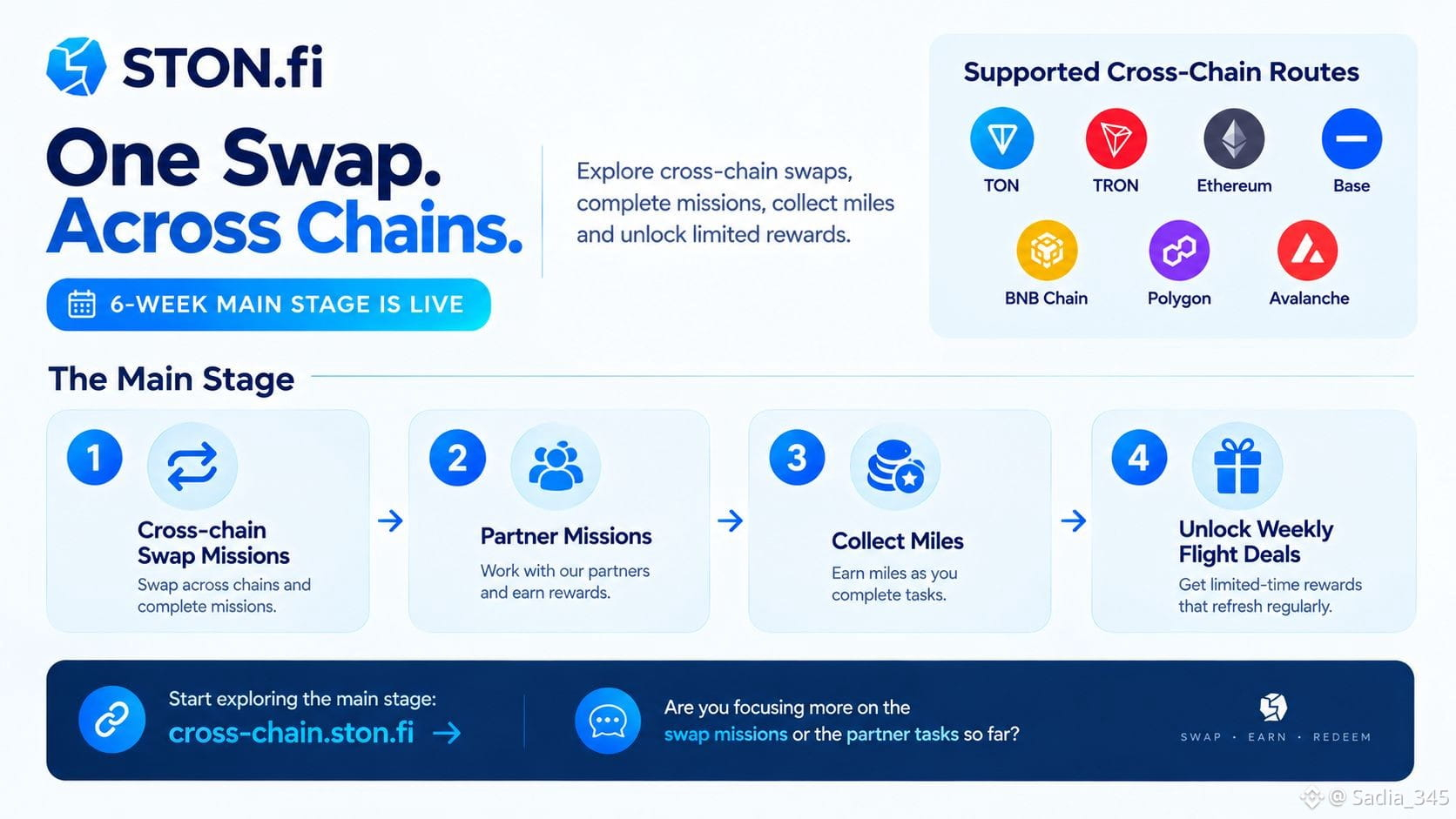
“One Swap. Across Chains” main stage is now live
The 6-week main stage of STONfi’s cross-chain campaign has started, and it brings a clearer structure for users who want to explore cross-chain swaps in a more guided way.
Here’s what the main stage includes:
• Cross-chain swap missions
• Partner missions
• Miles that you collect as you complete tasks
• Weekly limited Flight Deals that unlock rewards for a short period
The interesting part is how the campaign turns cross-chain activity into a progress-based experience. Instead of treating swaps as isolated actions, users move through missions, collect miles, and check limited deals that refresh regularly.
This approach makes it easier to stay engaged while actually using the cross-chain features. The short availability of Flight Deals also creates a reason to check in weekly rather than treating the campaign as a one-time activity.
💬 Are you focusing more on the swap missions or the partner tasks so far?
#STONfi #Web3 $GRAM
{spot}(GRAMUSDT)
“One Swap. Across Chains” main stage is now live
The 6-week main stage of STONfi’s cross-chain campaign has started, and it brings a clearer structure for users who want to explore cross-chain swaps in a more guided way.
Here’s what the main stage includes:
• Cross-chain swap missions
• Partner missions
• Miles that you collect as you complete tasks
• Weekly limited Flight Deals that unlock rewards for a short period
The interesting part is how the campaign turns cross-chain activity into a progress-based experience. Instead of treating swaps as isolated actions, users move through missions, collect miles, and check limited deals that refresh regularly.
This approach makes it easier to stay engaged while actually using the cross-chain features. The short availability of Flight Deals also creates a reason to check in weekly rather than treating the campaign as a one-time activity.
💬 Are you focusing more on the swap missions or the partner tasks so far?
#STONfi #Web3 $GRAM
The 6-week main stage of STONfi’s cross-chain campaign has started, and it brings a clearer structure for users who want to explore cross-chain swaps in a more guided way.
Here’s what the main stage includes:
• Cross-chain swap missions
• Partner missions
• Miles that you collect as you complete tasks
• Weekly limited Flight Deals that unlock rewards for a short period
The interesting part is how the campaign turns cross-chain activity into a progress-based experience. Instead of treating swaps as isolated actions, users move through missions, collect miles, and check limited deals that refresh regularly.
This approach makes it easier to stay engaged while actually using the cross-chain features. The short availability of Flight Deals also creates a reason to check in weekly rather than treating the campaign as a one-time activity.
💬 Are you focusing more on the swap missions or the partner tasks so far?
#STONfi #Web3 $GRAM
1
181

The first week of STON.fi’s 6-week “One Swap. Across Chains” main stage is complete, and new missions and Flight Deals are now live.
New opportunities include a cross-chain mission from Keeper, a special mission from XPocket, and the #2 AMA secret code, which will be revealed during the September 23 live AMA.
New Flight Deals are also available from SafePal, Getgems, My Wallet, Mira, WenLong, and Keeper.
Flight Deals are limited to 7 days, so check your eligibility and claim available rewards before they expire.#STONfi
The first week of STON.fi’s 6-week “One Swap. Across Chains” main stage is complete, and new missions and Flight Deals are now live.
New opportunities include a cross-chain mission from Keeper, a special mission from XPocket, and the #2 AMA secret code, which will be revealed during the September 23 live AMA.
New Flight Deals are also available from SafePal, Getgems, My Wallet, Mira, WenLong, and Keeper.
Flight Deals are limited to 7 days, so check your eligibility and claim available rewards before they expire.#STONfi
New opportunities include a cross-chain mission from Keeper, a special mission from XPocket, and the #2 AMA secret code, which will be revealed during the September 23 live AMA.
New Flight Deals are also available from SafePal, Getgems, My Wallet, Mira, WenLong, and Keeper.
Flight Deals are limited to 7 days, so check your eligibility and claim available rewards before they expire.#STONfi
84
STON.fi’s Future Could Extend Beyond TON
TON may have been the starting point for STON.fi, but its long term potential could reach much further.
The blockchain landscape is becoming increasingly connected, with users holding assets across different networks, protocols operating across multiple ecosystems, and liquidity spread across various chains.
This creates an important challenge: how can users access that fragmented liquidity without dealing with unnecessary complexity?
This is where cross chain infrastructure becomes increasingly important.
Through Omniston, STON.fi is developing liquidity aggregation and cross chain execution designed to bring different liquidity sources together.
The real focus is the experience users get.
Most people do not want to understand every technical process happening behind a transaction. They simply want to move assets and complete swaps as smoothly as possible.
For DeFi to reach more users, that simplicity will become increasingly important.
Instead of forcing users to understand complicated infrastructure, the infrastructure should handle more of that complexity in the background.
STON.fi began by making token swaps easier on TON.
Its broader opportunity could be helping create a DeFi environment where liquidity across different ecosystems feels more connected and accessible.
#stonfi #web3 #TON
$NVDAB $AAPLB $MSFTB
STON.fi’s Future Could Extend Beyond TON
TON may have been the starting point for STON.fi, but its long term potential could reach much further.
The blockchain landscape is becoming increasingly connected, with users holding assets across different networks, protocols operating across multiple ecosystems, and liquidity spread across various chains.
This creates an important challenge: how can users access that fragmented liquidity without dealing with unnecessary complexity?
This is where cross chain infrastructure becomes increasingly important.
Through Omniston, STON.fi is developing liquidity aggregation and cross chain execution designed to bring different liquidity sources together.
The real focus is the experience users get.
Most people do not want to understand every technical process happening behind a transaction. They simply want to move assets and complete swaps as smoothly as possible.
For DeFi to reach more users, that simplicity will become increasingly important.
Instead of forcing users to understand complicated infrastructure, the infrastructure should handle more of that complexity in the background.
STON.fi began by making token swaps easier on TON.
Its broader opportunity could be helping create a DeFi environment where liquidity across different ecosystems feels more connected and accessible.
#stonfi #web3 #TON
$NVDAB $AAPLB $MSFTB
TON may have been the starting point for STON.fi, but its long term potential could reach much further.
The blockchain landscape is becoming increasingly connected, with users holding assets across different networks, protocols operating across multiple ecosystems, and liquidity spread across various chains.
This creates an important challenge: how can users access that fragmented liquidity without dealing with unnecessary complexity?
This is where cross chain infrastructure becomes increasingly important.
Through Omniston, STON.fi is developing liquidity aggregation and cross chain execution designed to bring different liquidity sources together.
The real focus is the experience users get.
Most people do not want to understand every technical process happening behind a transaction. They simply want to move assets and complete swaps as smoothly as possible.
For DeFi to reach more users, that simplicity will become increasingly important.
Instead of forcing users to understand complicated infrastructure, the infrastructure should handle more of that complexity in the background.
STON.fi began by making token swaps easier on TON.
Its broader opportunity could be helping create a DeFi environment where liquidity across different ecosystems feels more connected and accessible.
#stonfi #web3 #TON
$NVDAB $AAPLB $MSFTB
1
77
·
--
What’s the real barrier holding cross-chain back?
I recently went through an interview with Andrey Fedorov, CMO & CBDO at STONfi Dev, and one point stood out: technology is improving, but the user experience still feels complicated for many people.
In the conversation, he explains why STONfi approached cross-chain differently. Instead of focusing on technical terms like atomic execution or resolver networks, they framed the experience around a simple idea moving assets between chains the way you’d take a direct flight between destinations. The goal was to make the process feel more intuitive.
The interview also digs into the idea of chain abstraction. According to Fedorov, true abstraction is when users stop thinking about blockchains altogether. The ideal experience becomes: I have this asset, I want that one, and I get it without managing networks, bridges, or multiple wallets.
He also pointed out that one of the remaining friction points is wallet-level fragmentation. Users still deal with balances across different networks, sometimes with assets that share the same name but live on separate chains. That confusion is still a real barrier for everyday users.
Overall, the interview gives a clear look at how STONfi is thinking about the experience side of cross-chain, not just the infrastructure.
💬 What do you think is still the hardest part of moving assets between chains for regular users?
#STONfi #Web3 $GRAM
{spot}(GRAMUSDT)
What’s the real barrier holding cross-chain back?
I recently went through an interview with Andrey Fedorov, CMO & CBDO at STONfi Dev, and one point stood out: technology is improving, but the user experience still feels complicated for many people.
In the conversation, he explains why STONfi approached cross-chain differently. Instead of focusing on technical terms like atomic execution or resolver networks, they framed the experience around a simple idea moving assets between chains the way you’d take a direct flight between destinations. The goal was to make the process feel more intuitive.
The interview also digs into the idea of chain abstraction. According to Fedorov, true abstraction is when users stop thinking about blockchains altogether. The ideal experience becomes: I have this asset, I want that one, and I get it without managing networks, bridges, or multiple wallets.
He also pointed out that one of the remaining friction points is wallet-level fragmentation. Users still deal with balances across different networks, sometimes with assets that share the same name but live on separate chains. That confusion is still a real barrier for everyday users.
Overall, the interview gives a clear look at how STONfi is thinking about the experience side of cross-chain, not just the infrastructure.
💬 What do you think is still the hardest part of moving assets between chains for regular users?
#STONfi #Web3 $GRAM
I recently went through an interview with Andrey Fedorov, CMO & CBDO at STONfi Dev, and one point stood out: technology is improving, but the user experience still feels complicated for many people.
In the conversation, he explains why STONfi approached cross-chain differently. Instead of focusing on technical terms like atomic execution or resolver networks, they framed the experience around a simple idea moving assets between chains the way you’d take a direct flight between destinations. The goal was to make the process feel more intuitive.
The interview also digs into the idea of chain abstraction. According to Fedorov, true abstraction is when users stop thinking about blockchains altogether. The ideal experience becomes: I have this asset, I want that one, and I get it without managing networks, bridges, or multiple wallets.
He also pointed out that one of the remaining friction points is wallet-level fragmentation. Users still deal with balances across different networks, sometimes with assets that share the same name but live on separate chains. That confusion is still a real barrier for everyday users.
Overall, the interview gives a clear look at how STONfi is thinking about the experience side of cross-chain, not just the infrastructure.
💬 What do you think is still the hardest part of moving assets between chains for regular users?
#STONfi #Web3 $GRAM

1
272

·
--
One Swap Across Chains Flight Begins
Stonfiers flight begins
The 6 week main stage of One Swap Across Chains is live
This is STON fi guided cross chain campaign You learn by doing one swap moves assets across chains
Missions are more advanced now
Explore real routes
Earn miles
Unlock weekly limited rewards
Open Flight Deals
Some of you already qualify
Deals refresh every 7 days next Tuesday the lineup changes
Qualifying swaps start at 10 dollars plus
Do not guess prizes check the live Flight Deals board
Take on new missions
Let your next swap earn miles
Enter the main stage at cross chain ston fi
Enjoy your flight
DEX Telegram Onboarding Guide Blog
X Discord Reddit LinkedIn YouTube Instagram Join the Club
Short X cut
Stonfiers flight begins
The 6 week main stage of One Swap Across Chains is live
Complete missions earn miles unlock 7 day Flight Deals
Next Tuesday the board refreshes
Start at cross chain ston fi
10 second hook
Main stage live
Missions plus miles
7 day Flight Deals
Open the board now
@ston_fi @toncoin
#STONFI #STONfi #Defi #Tonbuildes #omniston
One Swap Across Chains Flight Begins
Stonfiers flight begins
The 6 week main stage of One Swap Across Chains is live
This is STON fi guided cross chain campaign You learn by doing one swap moves assets across chains
Missions are more advanced now
Explore real routes
Earn miles
Unlock weekly limited rewards
Open Flight Deals
Some of you already qualify
Deals refresh every 7 days next Tuesday the lineup changes
Qualifying swaps start at 10 dollars plus
Do not guess prizes check the live Flight Deals board
Take on new missions
Let your next swap earn miles
Enter the main stage at cross chain ston fi
Enjoy your flight
DEX Telegram Onboarding Guide Blog
X Discord Reddit LinkedIn YouTube Instagram Join the Club
Short X cut
Stonfiers flight begins
The 6 week main stage of One Swap Across Chains is live
Complete missions earn miles unlock 7 day Flight Deals
Next Tuesday the board refreshes
Start at cross chain ston fi
10 second hook
Main stage live
Missions plus miles
7 day Flight Deals
Open the board now
@ston_fi @toncoin
#STONFI #STONfi #Defi #Tonbuildes #omniston
Stonfiers flight begins
The 6 week main stage of One Swap Across Chains is live
This is STON fi guided cross chain campaign You learn by doing one swap moves assets across chains
Missions are more advanced now
Explore real routes
Earn miles
Unlock weekly limited rewards
Open Flight Deals
Some of you already qualify
Deals refresh every 7 days next Tuesday the lineup changes
Qualifying swaps start at 10 dollars plus
Do not guess prizes check the live Flight Deals board
Take on new missions
Let your next swap earn miles
Enter the main stage at cross chain ston fi
Enjoy your flight
DEX Telegram Onboarding Guide Blog
X Discord Reddit LinkedIn YouTube Instagram Join the Club
Short X cut
Stonfiers flight begins
The 6 week main stage of One Swap Across Chains is live
Complete missions earn miles unlock 7 day Flight Deals
Next Tuesday the board refreshes
Start at cross chain ston fi
10 second hook
Main stage live
Missions plus miles
7 day Flight Deals
Open the board now
@ston_fi @toncoin
#STONFI #STONfi #Defi #Tonbuildes #omniston
86

·
--
Your Crypto Swap Has a Route. Do You Know What It Is?When you swap one token for another, it can feel like a simple process:
Choose token → Enter amount → Confirm
But behind that simple interface, there is another important question:
Where does your trade actually get executed?
Liquidity on DeFi isn't always concentrated in one place.
Different DEXs can have different liquidity levels, prices, and available routes for the same trading pair.
That means the route used for your swap can influence the execution you receive.
This is where liquidity aggregation matters
Instead of depending on a single liquidity source, an aggregator can look across multiple sources to find available execution paths.
STON.fi's Omniston is designed around this idea.
Omniston aggregates liquidity from connected sources and uses routing to help find executable paths for swaps.
The goal is simple:
Find liquidity → Compare available routes → Execute the swap
For traders, this can matter because execution isn't determined by the displayed token price alone.
You should also look at:
➜ Expected output
➜ Price impact
➜ Minimum received
➜ Slippage
➜ Fees
➜ The route being used
A simple example
Imagine two liquidity sources are available for the same swap.
One route may have a slightly better quoted price but insufficient liquidity for your trade size.
Another route may have deeper liquidity and provide a different execution outcome.
The important question isn't simply:
“Which price looks best?”
It's:
“Which route can actually execute my trade efficiently?”
That's why the infrastructure behind a swap matters.
The interface may only show a few buttons, but liquidity discovery, routing and execution are happening underneath.
As DeFi liquidity becomes increasingly fragmented across protocols, routing infrastructure becomes an important part of the trading experience.
The next time you swap, don't just look at the token pair. Look at the execution.
👉 Explore swapping on STON.fi: https://app.ston.fi
Educational content only. Always review the live quote, price impact, minimum received, fees and transaction details before confirming a swap.
#STONfi #Omniston #TON #DeFi #crypto
Your Crypto Swap Has a Route. Do You Know What It Is?
When you swap one token for another, it can feel like a simple process:
Choose token → Enter amount → Confirm
But behind that simple interface, there is another important question:
Where does your trade actually get executed?
Liquidity on DeFi isn't always concentrated in one place.
Different DEXs can have different liquidity levels, prices, and available routes for the same trading pair.
That means the route used for your swap can influence the execution you receive.
This is where liquidity aggregation matters
Instead of depending on a single liquidity source, an aggregator can look across multiple sources to find available execution paths.
STON.fi's Omniston is designed around this idea.
Omniston aggregates liquidity from connected sources and uses routing to help find executable paths for swaps.
The goal is simple:
Find liquidity → Compare available routes → Execute the swap
For traders, this can matter because execution isn't determined by the displayed token price alone.
You should also look at:
➜ Expected output
➜ Price impact
➜ Minimum received
➜ Slippage
➜ Fees
➜ The route being used
A simple example
Imagine two liquidity sources are available for the same swap.
One route may have a slightly better quoted price but insufficient liquidity for your trade size.
Another route may have deeper liquidity and provide a different execution outcome.
The important question isn't simply:
“Which price looks best?”
It's:
“Which route can actually execute my trade efficiently?”
That's why the infrastructure behind a swap matters.
The interface may only show a few buttons, but liquidity discovery, routing and execution are happening underneath.
As DeFi liquidity becomes increasingly fragmented across protocols, routing infrastructure becomes an important part of the trading experience.
The next time you swap, don't just look at the token pair. Look at the execution.
👉 Explore swapping on STON.fi: https://app.ston.fi
Educational content only. Always review the live quote, price impact, minimum received, fees and transaction details before confirming a swap.
#STONfi #Omniston #TON #DeFi #crypto
Choose token → Enter amount → Confirm
But behind that simple interface, there is another important question:
Where does your trade actually get executed?
Liquidity on DeFi isn't always concentrated in one place.
Different DEXs can have different liquidity levels, prices, and available routes for the same trading pair.
That means the route used for your swap can influence the execution you receive.
This is where liquidity aggregation matters
Instead of depending on a single liquidity source, an aggregator can look across multiple sources to find available execution paths.
STON.fi's Omniston is designed around this idea.
Omniston aggregates liquidity from connected sources and uses routing to help find executable paths for swaps.
The goal is simple:
Find liquidity → Compare available routes → Execute the swap
For traders, this can matter because execution isn't determined by the displayed token price alone.
You should also look at:
➜ Expected output
➜ Price impact
➜ Minimum received
➜ Slippage
➜ Fees
➜ The route being used
A simple example
Imagine two liquidity sources are available for the same swap.
One route may have a slightly better quoted price but insufficient liquidity for your trade size.
Another route may have deeper liquidity and provide a different execution outcome.
The important question isn't simply:
“Which price looks best?”
It's:
“Which route can actually execute my trade efficiently?”
That's why the infrastructure behind a swap matters.
The interface may only show a few buttons, but liquidity discovery, routing and execution are happening underneath.
As DeFi liquidity becomes increasingly fragmented across protocols, routing infrastructure becomes an important part of the trading experience.
The next time you swap, don't just look at the token pair. Look at the execution.
👉 Explore swapping on STON.fi: https://app.ston.fi
Educational content only. Always review the live quote, price impact, minimum received, fees and transaction details before confirming a swap.
#STONfi #Omniston #TON #DeFi #crypto
1
77
·
--
Bullish
A token having a price doesn’t mean you can actually trade it properly.
When I check a new TON token, I look beyond the chart.
First, I verify the contract.
Then I check if there’s an actual liquidity pool and look at its TVL, volume and pool balance.
After that, I enter the amount I’m considering on @ston_fi and check the quote and Price Impact.
That last part matters.
A small pool can make even a normal-sized swap move the price significantly. STON.fi shows the expected output and price impact before you confirm.
I also check for token warnings. Fake and Honeypot tokens, for example, can be restricted in the STON.fi interface.
So my checklist is simple:
Contract → Pool → Liquidity → Quote → Price Impact → Warnings
Having a token on-chain is one thing.
Having a usable market is another.
🌐 STON.fi: app.ston.fi
📝 STON.fi Blog: blog.ston.fi
#STONfi #TON #DeFi #DEX
$TRUMP $HYPE $BNB
A token having a price doesn’t mean you can actually trade it properly.
When I check a new TON token, I look beyond the chart.
First, I verify the contract.
Then I check if there’s an actual liquidity pool and look at its TVL, volume and pool balance.
After that, I enter the amount I’m considering on @ston_fi and check the quote and Price Impact.
That last part matters.
A small pool can make even a normal-sized swap move the price significantly. STON.fi shows the expected output and price impact before you confirm.
I also check for token warnings. Fake and Honeypot tokens, for example, can be restricted in the STON.fi interface.
So my checklist is simple:
Contract → Pool → Liquidity → Quote → Price Impact → Warnings
Having a token on-chain is one thing.
Having a usable market is another.
🌐 STON.fi: app.ston.fi
📝 STON.fi Blog: blog.ston.fi
#STONfi #TON #DeFi #DEX
$TRUMP $HYPE $BNB
When I check a new TON token, I look beyond the chart.
First, I verify the contract.
Then I check if there’s an actual liquidity pool and look at its TVL, volume and pool balance.
After that, I enter the amount I’m considering on @ston_fi and check the quote and Price Impact.
That last part matters.
A small pool can make even a normal-sized swap move the price significantly. STON.fi shows the expected output and price impact before you confirm.
I also check for token warnings. Fake and Honeypot tokens, for example, can be restricted in the STON.fi interface.
So my checklist is simple:
Contract → Pool → Liquidity → Quote → Price Impact → Warnings
Having a token on-chain is one thing.
Having a usable market is another.
🌐 STON.fi: app.ston.fi
📝 STON.fi Blog: blog.ston.fi
#STONfi #TON #DeFi #DEX
$TRUMP $HYPE $BNB
260

·
--
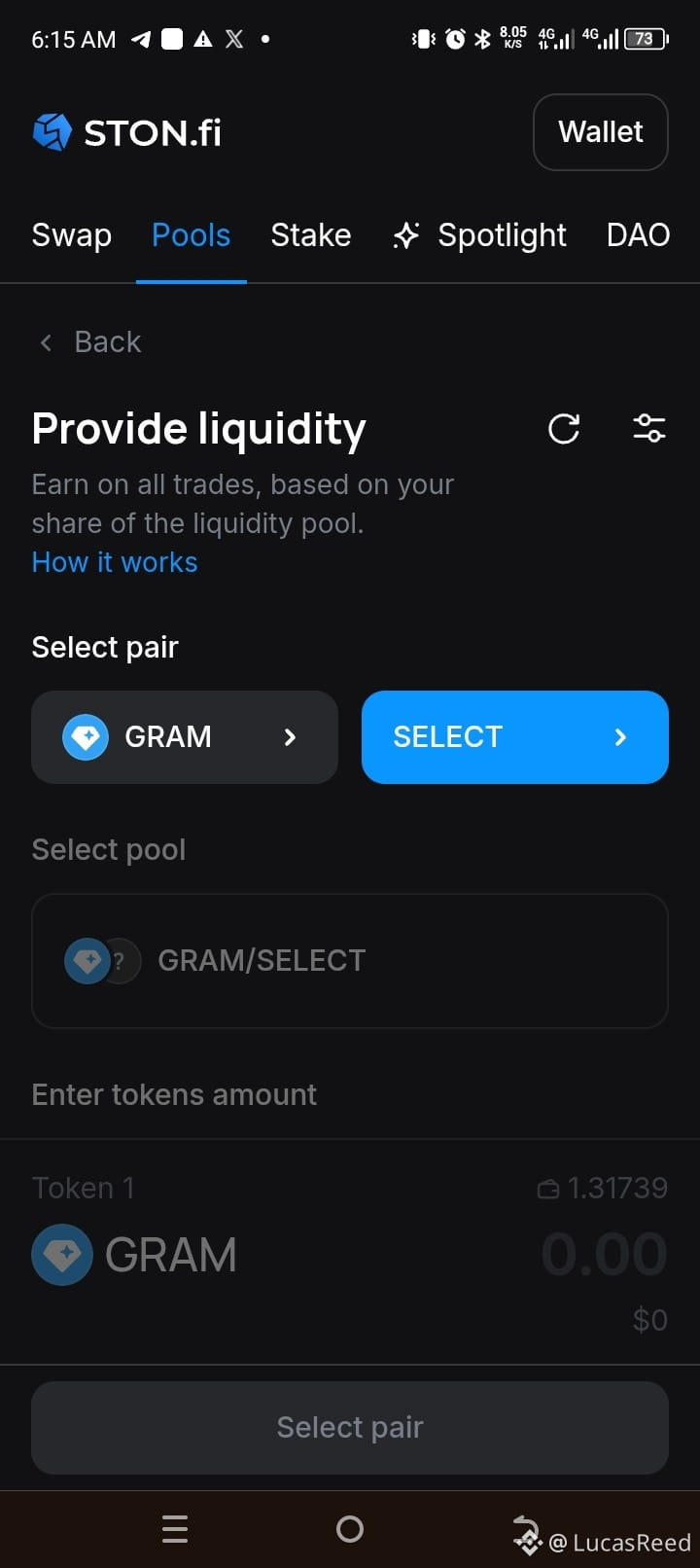
WHY SWAP GRAM FOR A TON JETTON DIRECTLY FROM YOUR WALLET?
On $TON, you can interact with a DEX directly from your wallet instead of adding a centralized platform as an extra step.
For example, STON.fi lets users explore swaps between assets available on TON.
If you're swapping GRAM → a TON jetton, don't focus only on the estimated output. Check:
🔹 Price impact
🔹 Estimated amount
🔹 Minimum received
🔹 Blockchain fee
🔹 The selected jetton address
GRAM is the native currency of TON, while jettons are tokens issued on the TON blockchain. Understanding that difference makes the swap interface much easier to read.
A simple rule: check the asset, quote, minimum received, and fee before confirming the wallet transaction.
#TON #DeFi #STONfi
$NVDAB $AAPLB
https://ston.fi/stonbassadors
WHY SWAP GRAM FOR A TON JETTON DIRECTLY FROM YOUR WALLET?
On $TON, you can interact with a DEX directly from your wallet instead of adding a centralized platform as an extra step.
For example, STON.fi lets users explore swaps between assets available on TON.
If you're swapping GRAM → a TON jetton, don't focus only on the estimated output. Check:
🔹 Price impact
🔹 Estimated amount
🔹 Minimum received
🔹 Blockchain fee
🔹 The selected jetton address
GRAM is the native currency of TON, while jettons are tokens issued on the TON blockchain. Understanding that difference makes the swap interface much easier to read.
A simple rule: check the asset, quote, minimum received, and fee before confirming the wallet transaction.
#TON #DeFi #STONfi
$NVDAB $AAPLB
https://ston.fi/stonbassadors
On $TON, you can interact with a DEX directly from your wallet instead of adding a centralized platform as an extra step.
For example, STON.fi lets users explore swaps between assets available on TON.
If you're swapping GRAM → a TON jetton, don't focus only on the estimated output. Check:
🔹 Price impact
🔹 Estimated amount
🔹 Minimum received
🔹 Blockchain fee
🔹 The selected jetton address
GRAM is the native currency of TON, while jettons are tokens issued on the TON blockchain. Understanding that difference makes the swap interface much easier to read.
A simple rule: check the asset, quote, minimum received, and fee before confirming the wallet transaction.
#TON #DeFi #STONfi
$NVDAB $AAPLB
https://ston.fi/stonbassadors
333
·
--
Why can a $TON swap show a different price from a centralized exchange?
It’s not necessarily a mistake.
On a DEX such as STON.fi, execution is influenced by liquidity, trade size, price impact, fees, and current pool conditions.
Before confirming a swap, I check:
📊 Expected output
📉 Price impact
⚡ Network fee
🔒 Minimum received
This is also why looking only at the token price can be misleading. The amount you actually receive for a specific transaction is what matters.
I tested the workflow on STON.fi and found the most useful habit is simple: review the quote before signing.
🔗 STON.fi: https://ston.fi
Would you check the price first, or the expected amount received?
#TON #DeFi #STONfi
$NVDAB
$NVDA.US
@stonfi
https://ston.fi/stonbassadors
Why can a $TON swap show a different price from a centralized exchange?
It’s not necessarily a mistake.
On a DEX such as STON.fi, execution is influenced by liquidity, trade size, price impact, fees, and current pool conditions.
Before confirming a swap, I check:
📊 Expected output
📉 Price impact
⚡ Network fee
🔒 Minimum received
This is also why looking only at the token price can be misleading. The amount you actually receive for a specific transaction is what matters.
I tested the workflow on STON.fi and found the most useful habit is simple: review the quote before signing.
🔗 STON.fi: https://ston.fi
Would you check the price first, or the expected amount received?
#TON #DeFi #STONfi
$NVDAB
$NVDA.US
@STONfi DEX
https://ston.fi/stonbassadors
It’s not necessarily a mistake.
On a DEX such as STON.fi, execution is influenced by liquidity, trade size, price impact, fees, and current pool conditions.
Before confirming a swap, I check:
📊 Expected output
📉 Price impact
⚡ Network fee
🔒 Minimum received
This is also why looking only at the token price can be misleading. The amount you actually receive for a specific transaction is what matters.
I tested the workflow on STON.fi and found the most useful habit is simple: review the quote before signing.
🔗 STON.fi: https://ston.fi
Would you check the price first, or the expected amount received?
#TON #DeFi #STONfi
$NVDAB
$NVDA.US
@STONfi DEX
https://ston.fi/stonbassadors
NVDAB+0.28%
NVDAUS+0.54%
113
·
--
Bullish
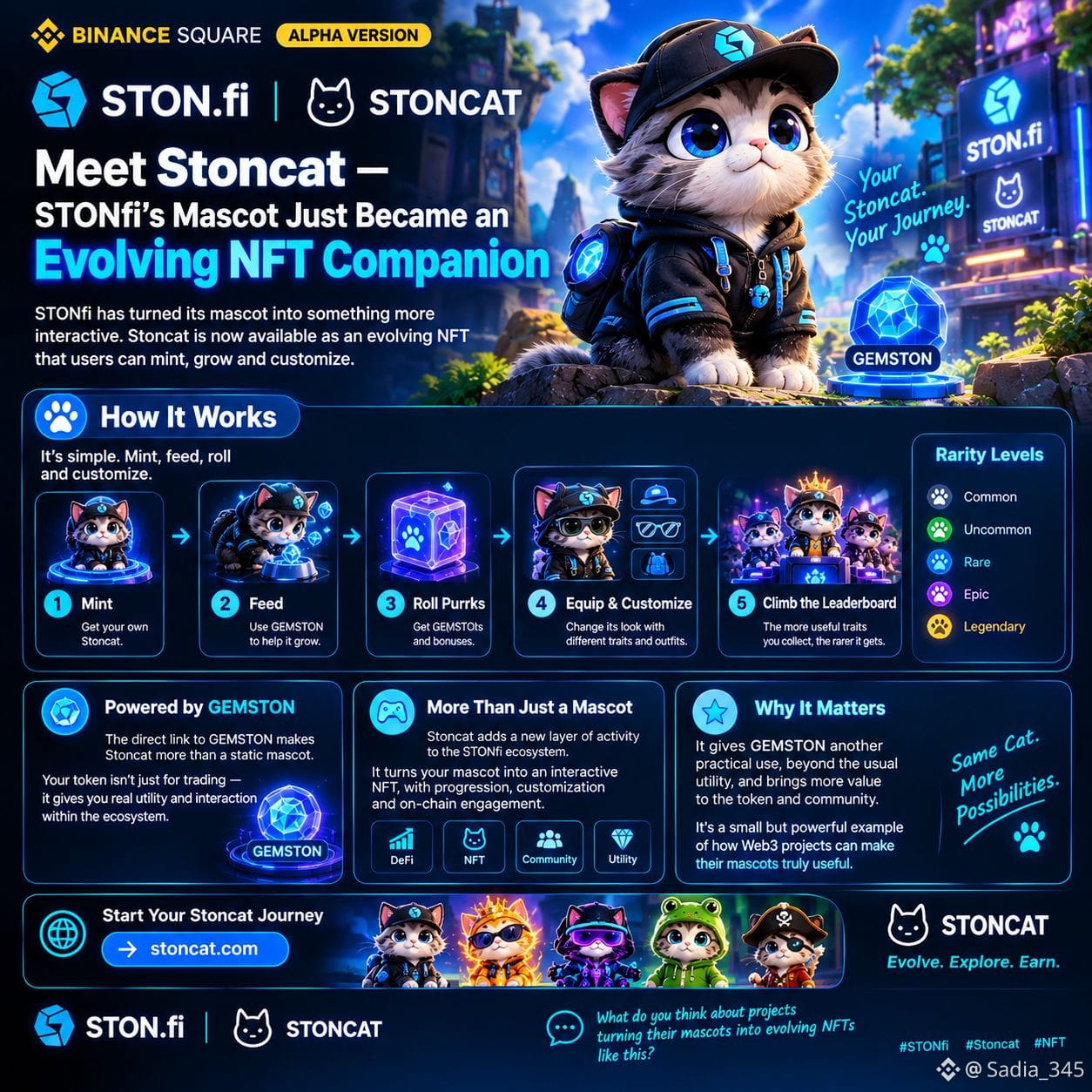
🔥 Meet Stoncat, STONfi’s Mascot Just Became an Evolving NFT Companion
STONfi has turned its mascot into something more interactive. Stoncat is now available as an evolving NFT that users can mint, grow, and customize.
Here’s how it works in simple terms:
You mint your own Stoncat, then feed it GEMSTON. Feeding helps it progress. Along the way you can roll for “Purrks” and equip different traits. The traits you collect and put on your Stoncat determine its look and rarity, and help it climb the rarity leaderboard.
What makes this interesting is the direct connection to GEMSTON. Instead of the mascot remaining a static brand image, it becomes an on-chain companion that users can actively shape using the token. The process of feeding, rolling traits, and equipping items gives the NFT a progressive layer rather than a one-time collectible.
For people already interacting with GEMSTON, this adds another practical use case. It sits alongside the core DeFi products and turns the project’s mascot into a small interactive activity.
💬 What do you think about projects turning their mascots into evolving NFTs like this?
#STONfi #defi $GRAM
{spot}(GRAMUSDT)
🔥 Meet Stoncat, STONfi’s Mascot Just Became an Evolving NFT Companion
STONfi has turned its mascot into something more interactive. Stoncat is now available as an evolving NFT that users can mint, grow, and customize.
Here’s how it works in simple terms:
You mint your own Stoncat, then feed it GEMSTON. Feeding helps it progress. Along the way you can roll for “Purrks” and equip different traits. The traits you collect and put on your Stoncat determine its look and rarity, and help it climb the rarity leaderboard.
What makes this interesting is the direct connection to GEMSTON. Instead of the mascot remaining a static brand image, it becomes an on-chain companion that users can actively shape using the token. The process of feeding, rolling traits, and equipping items gives the NFT a progressive layer rather than a one-time collectible.
For people already interacting with GEMSTON, this adds another practical use case. It sits alongside the core DeFi products and turns the project’s mascot into a small interactive activity.
💬 What do you think about projects turning their mascots into evolving NFTs like this?
#STONfi #defi $GRAM
STONfi has turned its mascot into something more interactive. Stoncat is now available as an evolving NFT that users can mint, grow, and customize.
Here’s how it works in simple terms:
You mint your own Stoncat, then feed it GEMSTON. Feeding helps it progress. Along the way you can roll for “Purrks” and equip different traits. The traits you collect and put on your Stoncat determine its look and rarity, and help it climb the rarity leaderboard.
What makes this interesting is the direct connection to GEMSTON. Instead of the mascot remaining a static brand image, it becomes an on-chain companion that users can actively shape using the token. The process of feeding, rolling traits, and equipping items gives the NFT a progressive layer rather than a one-time collectible.
For people already interacting with GEMSTON, this adds another practical use case. It sits alongside the core DeFi products and turns the project’s mascot into a small interactive activity.
💬 What do you think about projects turning their mascots into evolving NFTs like this?
#STONfi #defi $GRAM
2
352

·
--
What if the most important TON user isn’t the person constantly watching token prices?
It could be the person simply using the network as part of everyday digital activity.
Imagine someone spending $GRAM on services, paying creators, purchasing in-game items, and interacting with different Mini Apps throughout the month. They aren’t necessarily making a market bet. They’re using TON because it provides something they need.
That difference is important.
Speculative activity can slow down when market sentiment changes. Real utility has a different foundation: people can continue transacting because they still need the products, services, and applications around them.
As this kind of activity expands, so does the demand for infrastructure.
Balances need to move.
Creators need to receive payments.
Businesses may hold multiple assets.
Users may need to exchange one token for another.
This is where a DEX such as STON.fi can play a role.
Rather than having to generate the underlying economic activity itself, STON.fi can provide liquidity and swapping infrastructure that helps users move between assets after that activity has already taken place.
Long-term network growth is not only about how many people buy a token. It is also about how many people have a reason to use the network in the first place.
Utility creates transactions. Transactions create demand for infrastructure. And infrastructure helps an ecosystem keep moving.
#STONfi #Cryptoupdates #TON
What if the most important TON user isn’t the person constantly watching token prices?
It could be the person simply using the network as part of everyday digital activity.
Imagine someone spending $GRAM on services, paying creators, purchasing in-game items, and interacting with different Mini Apps throughout the month. They aren’t necessarily making a market bet. They’re using TON because it provides something they need.
That difference is important.
Speculative activity can slow down when market sentiment changes. Real utility has a different foundation: people can continue transacting because they still need the products, services, and applications around them.
As this kind of activity expands, so does the demand for infrastructure.
Balances need to move.
Creators need to receive payments.
Businesses may hold multiple assets.
Users may need to exchange one token for another.
This is where a DEX such as STON.fi can play a role.
Rather than having to generate the underlying economic activity itself, STON.fi can provide liquidity and swapping infrastructure that helps users move between assets after that activity has already taken place.
Long-term network growth is not only about how many people buy a token. It is also about how many people have a reason to use the network in the first place.
Utility creates transactions. Transactions create demand for infrastructure. And infrastructure helps an ecosystem keep moving.
#STONfi #Cryptoupdates #TON
It could be the person simply using the network as part of everyday digital activity.
Imagine someone spending $GRAM on services, paying creators, purchasing in-game items, and interacting with different Mini Apps throughout the month. They aren’t necessarily making a market bet. They’re using TON because it provides something they need.
That difference is important.
Speculative activity can slow down when market sentiment changes. Real utility has a different foundation: people can continue transacting because they still need the products, services, and applications around them.
As this kind of activity expands, so does the demand for infrastructure.
Balances need to move.
Creators need to receive payments.
Businesses may hold multiple assets.
Users may need to exchange one token for another.
This is where a DEX such as STON.fi can play a role.
Rather than having to generate the underlying economic activity itself, STON.fi can provide liquidity and swapping infrastructure that helps users move between assets after that activity has already taken place.
Long-term network growth is not only about how many people buy a token. It is also about how many people have a reason to use the network in the first place.
Utility creates transactions. Transactions create demand for infrastructure. And infrastructure helps an ecosystem keep moving.
#STONfi #Cryptoupdates #TON
41
·
--
Non-custodial should mean more than a label in a project’s marketing. With STON.fi, the concept is reflected directly in how its smart-contract architecture handles assets.
When users interact with STON.fi, their tokens aren’t deposited into a central account controlled by the router. Assets remain either in the user’s own Jetton wallet or within the isolated smart contracts responsible for liquidity pools.
The router acts more like a coordinator than a vault. It receives the swap request, determines the required route, and forwards instructions through TON’s internal message system. The actual token movement happens between the relevant Jetton wallets and pool contracts.
A typical swap therefore follows a defined sequence:
• Tokens leave the user’s Jetton wallet
• They enter the appropriate pool token wallet
• The pool executes the swap logic
• The resulting assets are sent back toward the user
• Built-in conditions and bounce handling help prevent failed operations from leaving assets stranded
Another important part of the design is how liquidity ownership is separated from administration. Administrative capabilities may allow certain protocol-level actions, but the pool and router logic does not provide a general mechanism for an administrator to simply take another user’s liquidity.
LP tokens represent ownership of a liquidity position. Control of those tokens determines who can claim the corresponding position.
That is what makes STON.fi’s non-custodial model more than a marketing phrase: the architecture is designed so that users retain control of their assets rather than handing them over to a central custodian.
#STONfi #TON #DeFi #Web3
Non-custodial should mean more than a label in a project’s marketing. With STON.fi, the concept is reflected directly in how its smart-contract architecture handles assets.
When users interact with STON.fi, their tokens aren’t deposited into a central account controlled by the router. Assets remain either in the user’s own Jetton wallet or within the isolated smart contracts responsible for liquidity pools.
The router acts more like a coordinator than a vault. It receives the swap request, determines the required route, and forwards instructions through TON’s internal message system. The actual token movement happens between the relevant Jetton wallets and pool contracts.
A typical swap therefore follows a defined sequence:
• Tokens leave the user’s Jetton wallet
• They enter the appropriate pool token wallet
• The pool executes the swap logic
• The resulting assets are sent back toward the user
• Built-in conditions and bounce handling help prevent failed operations from leaving assets stranded
Another important part of the design is how liquidity ownership is separated from administration. Administrative capabilities may allow certain protocol-level actions, but the pool and router logic does not provide a general mechanism for an administrator to simply take another user’s liquidity.
LP tokens represent ownership of a liquidity position. Control of those tokens determines who can claim the corresponding position.
That is what makes STON.fi’s non-custodial model more than a marketing phrase: the architecture is designed so that users retain control of their assets rather than handing them over to a central custodian.
#STONfi #TON #DeFi #Web3
When users interact with STON.fi, their tokens aren’t deposited into a central account controlled by the router. Assets remain either in the user’s own Jetton wallet or within the isolated smart contracts responsible for liquidity pools.
The router acts more like a coordinator than a vault. It receives the swap request, determines the required route, and forwards instructions through TON’s internal message system. The actual token movement happens between the relevant Jetton wallets and pool contracts.
A typical swap therefore follows a defined sequence:
• Tokens leave the user’s Jetton wallet
• They enter the appropriate pool token wallet
• The pool executes the swap logic
• The resulting assets are sent back toward the user
• Built-in conditions and bounce handling help prevent failed operations from leaving assets stranded
Another important part of the design is how liquidity ownership is separated from administration. Administrative capabilities may allow certain protocol-level actions, but the pool and router logic does not provide a general mechanism for an administrator to simply take another user’s liquidity.
LP tokens represent ownership of a liquidity position. Control of those tokens determines who can claim the corresponding position.
That is what makes STON.fi’s non-custodial model more than a marketing phrase: the architecture is designed so that users retain control of their assets rather than handing them over to a central custodian.
#STONfi #TON #DeFi #Web3
1
69
·
--
Bullish
One thing I’ve learned from using TON is that swapping assets doesn’t have to mean leaving your wallet or going through a complicated process.
If I want to swap GRAM for another TON Jetton, the basic flow is pretty straightforward.
GRAM is TON’s native currency, while Jettons are tokens issued on the TON blockchain.
So when I’m making a swap, I first connect my TON wallet to a DEX, then select GRAM as the token I’m selling and choose the Jetton I want to receive.
Before confirming anything, I don’t just look at the final amount.
I check the route, price impact, estimated amount, minimum received, and blockchain fees.
That small step matters, especially when the market is moving quickly.
For the practical execution, STON.fi gives me a simple way to connect my TON wallet, select GRAM and the target Jetton, review the swap details, and confirm the transaction directly from my wallet.
The process is basically:
GRAM → Select Jetton → Review the quote → Check fees & minimum received → Confirm.
Simple enough, but always take a few seconds to review the transaction before signing.
#STONfi #TON #DeFi #Web3
$BNB $G $HYPE
One thing I’ve learned from using TON is that swapping assets doesn’t have to mean leaving your wallet or going through a complicated process.
If I want to swap GRAM for another TON Jetton, the basic flow is pretty straightforward.
GRAM is TON’s native currency, while Jettons are tokens issued on the TON blockchain.
So when I’m making a swap, I first connect my TON wallet to a DEX, then select GRAM as the token I’m selling and choose the Jetton I want to receive.
Before confirming anything, I don’t just look at the final amount.
I check the route, price impact, estimated amount, minimum received, and blockchain fees.
That small step matters, especially when the market is moving quickly.
For the practical execution, STON.fi gives me a simple way to connect my TON wallet, select GRAM and the target Jetton, review the swap details, and confirm the transaction directly from my wallet.
The process is basically:
GRAM → Select Jetton → Review the quote → Check fees & minimum received → Confirm.
Simple enough, but always take a few seconds to review the transaction before signing.
#STONfi #TON #DeFi #Web3
$BNB $G $HYPE
If I want to swap GRAM for another TON Jetton, the basic flow is pretty straightforward.
GRAM is TON’s native currency, while Jettons are tokens issued on the TON blockchain.
So when I’m making a swap, I first connect my TON wallet to a DEX, then select GRAM as the token I’m selling and choose the Jetton I want to receive.
Before confirming anything, I don’t just look at the final amount.
I check the route, price impact, estimated amount, minimum received, and blockchain fees.
That small step matters, especially when the market is moving quickly.
For the practical execution, STON.fi gives me a simple way to connect my TON wallet, select GRAM and the target Jetton, review the swap details, and confirm the transaction directly from my wallet.
The process is basically:
GRAM → Select Jetton → Review the quote → Check fees & minimum received → Confirm.
Simple enough, but always take a few seconds to review the transaction before signing.
#STONfi #TON #DeFi #Web3
$BNB $G $HYPE
285

·
--
One thing I’m starting to appreciate about STON.fi is that it gives me a reason to look beyond the simple idea of “swap and go.”
The more I explore, the more I’m interested in what happens behind a swap liquidity, price impact, routing, and how different parts of DeFi work together.
I’ve also been learning more about the TON ecosystem along the way, and it’s interesting to see how DeFi is developing around it.
What I like most is the learning process.
I can start by checking a simple swap, then end up researching liquidity pools, farming, Omniston and other parts of the ecosystem. 😂
That’s how I want to approach Web3:
not just reposting information, but actually exploring, understanding, and sharing what I learn.
Still researching.
Still learning.
Still curious. 💙
What part of STON.fi or TON DeFi should I explore next? 👀
@ston_fi
#STONfi
#TON
One thing I’m starting to appreciate about STON.fi is that it gives me a reason to look beyond the simple idea of “swap and go.”
The more I explore, the more I’m interested in what happens behind a swap liquidity, price impact, routing, and how different parts of DeFi work together.
I’ve also been learning more about the TON ecosystem along the way, and it’s interesting to see how DeFi is developing around it.
What I like most is the learning process.
I can start by checking a simple swap, then end up researching liquidity pools, farming, Omniston and other parts of the ecosystem. 😂
That’s how I want to approach Web3:
not just reposting information, but actually exploring, understanding, and sharing what I learn.
Still researching.
Still learning.
Still curious. 💙
What part of STON.fi or TON DeFi should I explore next? 👀
@ston_fi
#STONfi
#TON
The more I explore, the more I’m interested in what happens behind a swap liquidity, price impact, routing, and how different parts of DeFi work together.
I’ve also been learning more about the TON ecosystem along the way, and it’s interesting to see how DeFi is developing around it.
What I like most is the learning process.
I can start by checking a simple swap, then end up researching liquidity pools, farming, Omniston and other parts of the ecosystem. 😂
That’s how I want to approach Web3:
not just reposting information, but actually exploring, understanding, and sharing what I learn.
Still researching.
Still learning.
Still curious. 💙
What part of STON.fi or TON DeFi should I explore next? 👀
@ston_fi
#STONfi
#TON
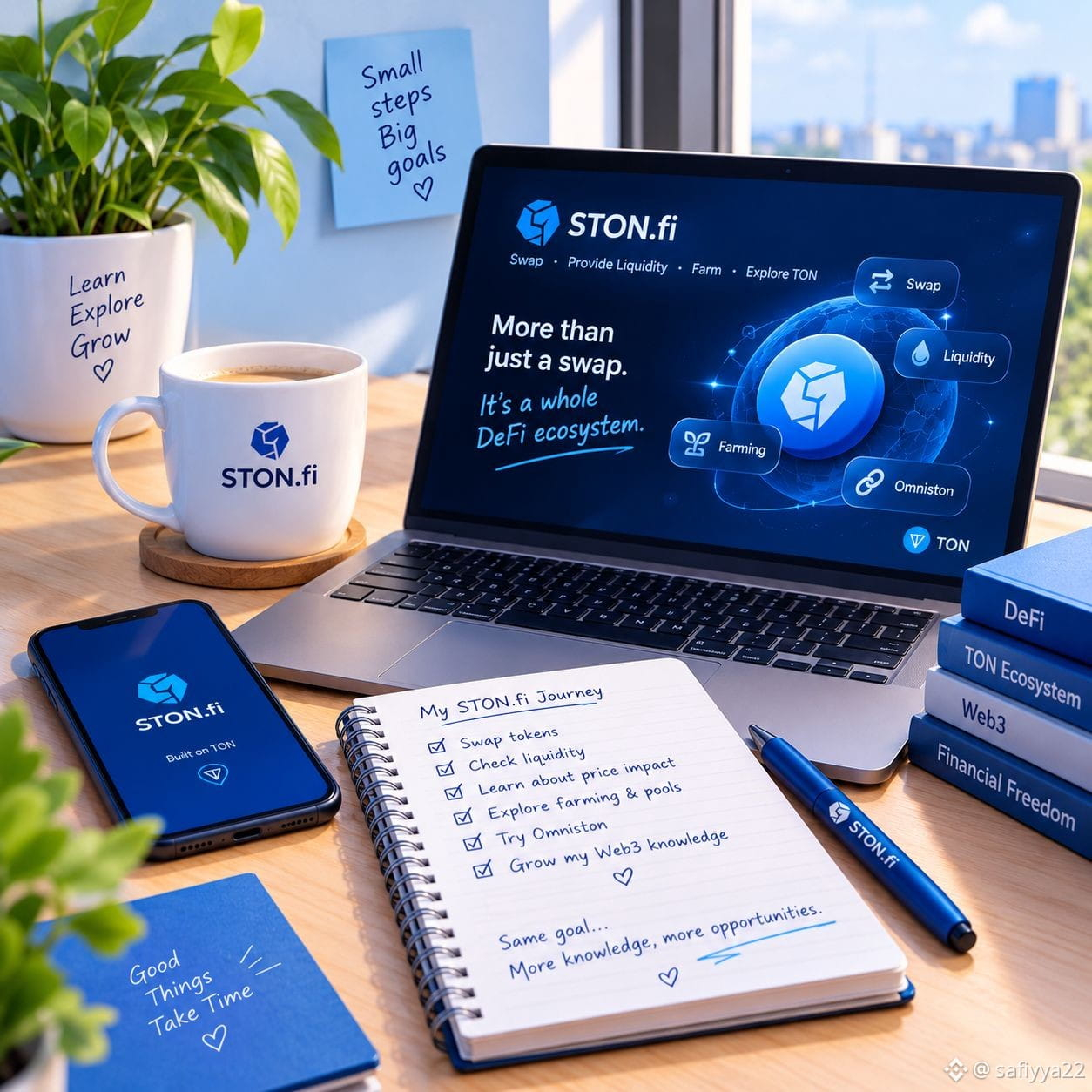
276
·
--
Bullish
Moving funds across chains can turn a simple rebalance into a maze of transactions.
I’ve found that the hard part isn’t deciding where the funds should go. It’s managing everything in between.
A manual route can mean:
Bridge → wait → receive an asset → swap → pay another gas fee → move again.
That creates more steps and more places to make a mistake.
With Omniston by @ston_fi, supported cross-chain swaps can compress that process into a simpler execution flow.
Before confirming, I still check the basics:
• Source and destination networks
• Assets being sent and received
• Route
• Total fees
• Final destination amount
• Gas requirements
I’m not choosing a chain or asset based on this.
I’m simply making sure that when I move existing funds between networks, I understand exactly what is happening and what I’ll receive.
Cross-chain rebalancing should be about execution, not unnecessary complexity.
📝 STON.fi Blog: blog.ston.fi
#STONfi #Omniston #DeFi #CrossChain #TON
$G $BTC $HYPE
{future}(HYPEUSDT)
Moving funds across chains can turn a simple rebalance into a maze of transactions.
I’ve found that the hard part isn’t deciding where the funds should go. It’s managing everything in between.
A manual route can mean:
Bridge → wait → receive an asset → swap → pay another gas fee → move again.
That creates more steps and more places to make a mistake.
With Omniston by @ston_fi, supported cross-chain swaps can compress that process into a simpler execution flow.
Before confirming, I still check the basics:
• Source and destination networks
• Assets being sent and received
• Route
• Total fees
• Final destination amount
• Gas requirements
I’m not choosing a chain or asset based on this.
I’m simply making sure that when I move existing funds between networks, I understand exactly what is happening and what I’ll receive.
Cross-chain rebalancing should be about execution, not unnecessary complexity.
📝 STON.fi Blog: blog.ston.fi
#STONfi #Omniston #DeFi #CrossChain #TON
$G $BTC $HYPE
I’ve found that the hard part isn’t deciding where the funds should go. It’s managing everything in between.
A manual route can mean:
Bridge → wait → receive an asset → swap → pay another gas fee → move again.
That creates more steps and more places to make a mistake.
With Omniston by @ston_fi, supported cross-chain swaps can compress that process into a simpler execution flow.
Before confirming, I still check the basics:
• Source and destination networks
• Assets being sent and received
• Route
• Total fees
• Final destination amount
• Gas requirements
I’m not choosing a chain or asset based on this.
I’m simply making sure that when I move existing funds between networks, I understand exactly what is happening and what I’ll receive.
Cross-chain rebalancing should be about execution, not unnecessary complexity.
📝 STON.fi Blog: blog.ston.fi
#STONfi #Omniston #DeFi #CrossChain #TON
$G $BTC $HYPE
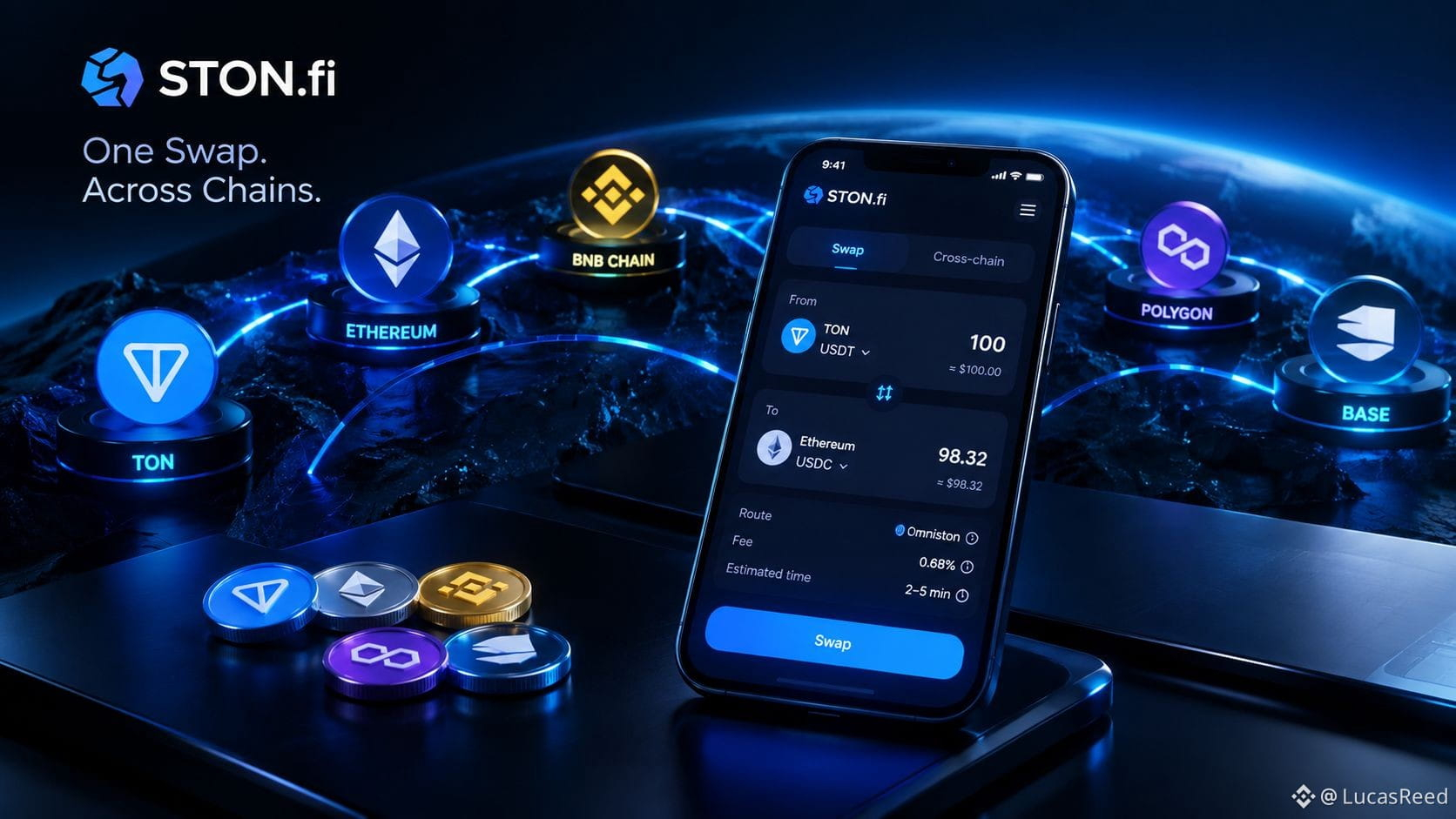
88

·
--
🔥 More Miles Through Stoncat? Here’s How It Works
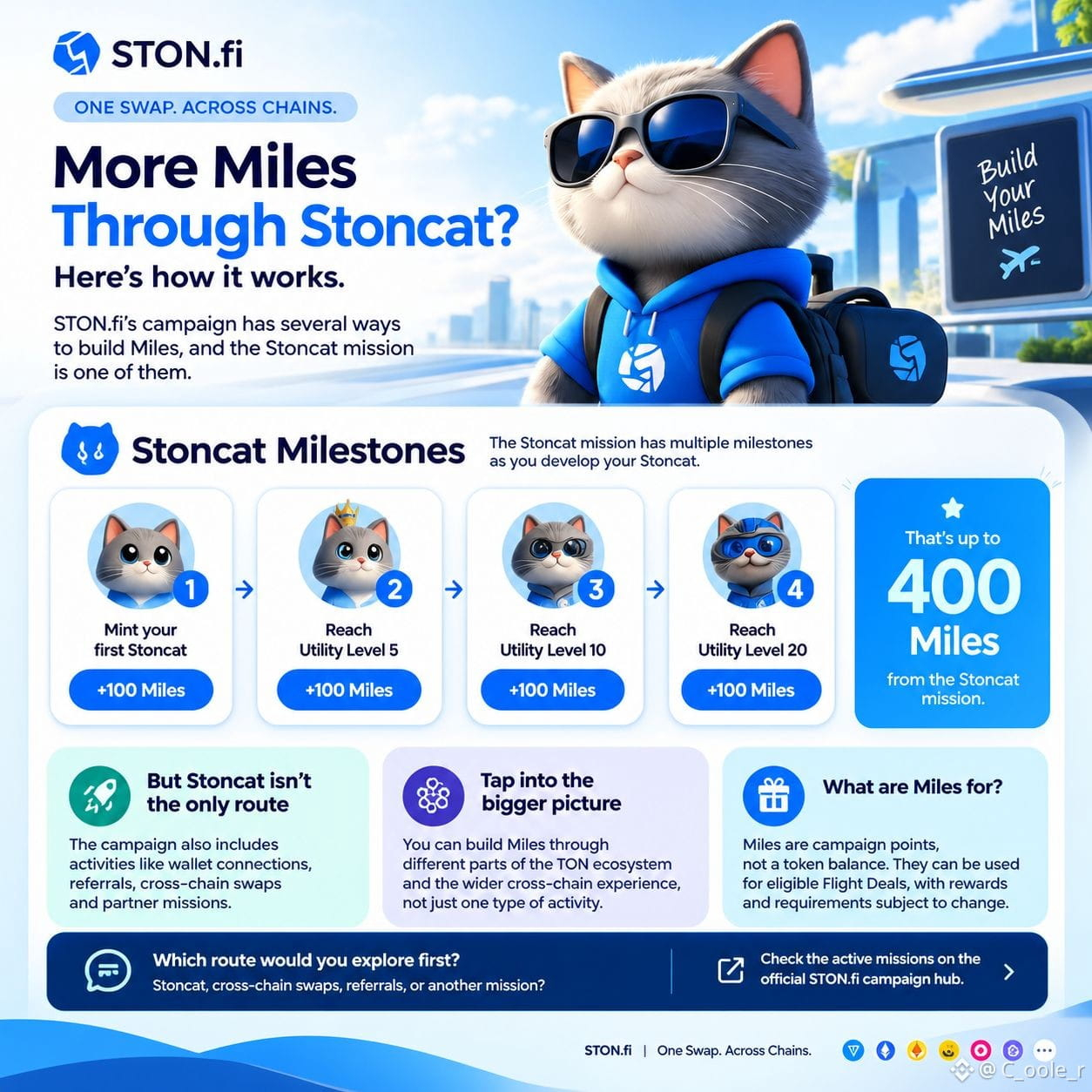
🐱 STONfi’s “One Swap. Across Chains.” campaign has several ways to build Miles, and Stoncat is one of them.
The interesting part? You don’t earn everything from a single action. The Stoncat mission has multiple milestones as you develop your Stoncat.
🧠 The Milestones
• Mint your first Stoncat → +100 Miles
• Reach Utility Level 5 → +100 Miles
• Reach Utility Level 10 → +100 Miles
• Reach Utility Level 20 → +100 Miles
That gives you up to 400 Miles from this mission.
🚀 But Stoncat isn’t the only route
The campaign also includes activities such as wallet connections, referrals, cross-chain swaps and partner missions.
That means you can build Miles through different parts of the TON ecosystem and the wider cross-chain experience, rather than relying on one type of activity.
✈️ What are Miles for?
Miles are campaign points, not a token balance. They can be used for eligible Flight Deals, with available rewards and requirements subject to change throughout the campaign.
💬 Which route would you explore first: Stoncat, cross-chain swaps, referrals, or another mission?
Check the active missions on the official STON.fi campaign hub.
Informational content only. Not financial advice. DYOR.
#STONfi #Web3 $GRAM
{spot}(GRAMUSDT)
🔥 More Miles Through Stoncat? Here’s How It Works
🐱 STONfi’s “One Swap. Across Chains.” campaign has several ways to build Miles, and Stoncat is one of them.
The interesting part? You don’t earn everything from a single action. The Stoncat mission has multiple milestones as you develop your Stoncat.
🧠 The Milestones
• Mint your first Stoncat → +100 Miles
• Reach Utility Level 5 → +100 Miles
• Reach Utility Level 10 → +100 Miles
• Reach Utility Level 20 → +100 Miles
That gives you up to 400 Miles from this mission.
🚀 But Stoncat isn’t the only route
The campaign also includes activities such as wallet connections, referrals, cross-chain swaps and partner missions.
That means you can build Miles through different parts of the TON ecosystem and the wider cross-chain experience, rather than relying on one type of activity.
✈️ What are Miles for?
Miles are campaign points, not a token balance. They can be used for eligible Flight Deals, with available rewards and requirements subject to change throughout the campaign.
💬 Which route would you explore first: Stoncat, cross-chain swaps, referrals, or another mission?
Check the active missions on the official STON.fi campaign hub.
Informational content only. Not financial advice. DYOR.
#STONfi #Web3 $GRAM
🐱 STONfi’s “One Swap. Across Chains.” campaign has several ways to build Miles, and Stoncat is one of them.
The interesting part? You don’t earn everything from a single action. The Stoncat mission has multiple milestones as you develop your Stoncat.
🧠 The Milestones
• Mint your first Stoncat → +100 Miles
• Reach Utility Level 5 → +100 Miles
• Reach Utility Level 10 → +100 Miles
• Reach Utility Level 20 → +100 Miles
That gives you up to 400 Miles from this mission.
🚀 But Stoncat isn’t the only route
The campaign also includes activities such as wallet connections, referrals, cross-chain swaps and partner missions.
That means you can build Miles through different parts of the TON ecosystem and the wider cross-chain experience, rather than relying on one type of activity.
✈️ What are Miles for?
Miles are campaign points, not a token balance. They can be used for eligible Flight Deals, with available rewards and requirements subject to change throughout the campaign.
💬 Which route would you explore first: Stoncat, cross-chain swaps, referrals, or another mission?
Check the active missions on the official STON.fi campaign hub.
Informational content only. Not financial advice. DYOR.
#STONfi #Web3 $GRAM
FEDAT - sport digital assets marketplace:
Разделение на вехи (Utility 5, 10, 20) — это очень умный ход от STONfi. Это удерживает пользователей в экосистеме на длинной дистанции, а не дает просто забрать награду и уйти (сделать dump). 🔥 Кроссчейн-активности сейчас в абсолютном приоритете, так как это реальный юзкейс для всего TON. Спасибо за четкий разбор!🤝👍
1
3
452
·
--
What Happens When a Cross-Chain Swap Fails?The first thing I learned about cross-chain swaps is that “failed” doesn’t automatically mean “lost.”
When something goes wrong, the important question is what the underlying architecture does next.
A bridge transfer and an atomic cross-chain swap can fail in completely different ways.
One may leave you trying to figure out whether a relay, destination transaction or refund step is still pending.
The other can be designed so that if the swap doesn't complete, the contracts automatically move toward an unwind.
That distinction is important when you’re moving real assets across chains.
Failure Depends on the Architecture
A cross-chain transaction isn't one single event.
There can be a source-chain transaction, confirmations, a destination-side transaction, liquidity or resolver execution, and settlement.
If one part doesn't complete, what happens next depends on how the system was designed.
In some bridge architectures, funds can remain locked in a contract, wait for a relay process, or require a manual refund or retry.
That doesn't necessarily mean the funds have disappeared. It means the route has entered an intermediate state that needs to be resolved.
This is why the architecture matters just as much when a transaction fails as when it succeeds.
The Difference Between “Stuck” and “Atomic”
This is where I find the idea of atomic execution interesting.
An open-ended cross-chain route can potentially leave the user asking:
Where did my funds stop?
Did the source transaction confirm?
Did the destination transaction fail?
Is a relayer still processing it?
Is there a refund available?
An atomic design tries to narrow those possibilities.
The goal is simple:
Either the agreed swap completes, or the assets return according to the protocol's refund conditions.
That doesn't mean failures never happen.
It means failure has been considered as part of the transaction design rather than treated as an unusual situation that requires someone to figure out what to do afterward.
How Omniston Handles the Failure Case
Omniston takes a resolver-based approach using paired Hashed Timelock Contracts (HTLCs).
For a cross-chain swap, there is an HTLC on the source side and another on the destination side.
Both are connected through the same cryptographic condition.
The resolver locks the destination-side asset.
The user's source-side asset is also locked.
When the required secret is revealed, the conditions allow the swap to settle: the user receives the destination asset, while the resolver can claim the source asset.
That's the successful path.
But the more interesting part is what happens when that path doesn't complete.
What If the Resolver Doesn't Respond?
Suppose I request a cross-chain swap and a resolver commits to the quote but doesn't complete its side of the transaction.
The system isn't supposed to leave my funds sitting there indefinitely.
The HTLC has a timelock.
If the required condition isn't fulfilled within the defined time window, the timelock allows the appropriate party to recover its locked funds.
For the user, that means the transaction can unwind instead of becoming an open-ended mystery.
What If the Secret Is Never Revealed?
The same principle applies if the secret needed to complete settlement is never disclosed.
Without the secret, the linked HTLCs cannot complete the normal settlement path.
Once the relevant timelock expires, the locked assets become refundable according to the contract logic.
This is what makes the design all-or-nothing.
The intended outcome is not:
«“The swap failed, so one side keeps the money.”»
It is:
«“The swap completed, or the relevant funds become recoverable through the timelock.”»
STON.fi describes Omniston's design as having three possible outcomes: both parties receive the quoted assets, the user is refunded if the resolver fails to respond, or the resolver is refunded if the secret is never disclosed.
An Unwind Isn't Your Money Disappearing
This is probably the most important part to understand.
When you see the word unwind, it can sound like something went terribly wrong.
But in this context, the unwind is actually a protection mechanism.
The assets were temporarily locked to make the cross-chain settlement possible.
If the settlement conditions aren't met, the timelock provides the path back to the original owner.
So the sequence is closer to:
Lock → attempt settlement → conditions met → complete
or
Lock → settlement doesn't complete → timelock → refund
The second path isn't a failure of the protection mechanism.
It is the protection mechanism working.
What Should You Check When a Swap Looks Stuck?
I wouldn't immediately submit another transaction.
First, I'd check the status of the original one.
1. Check the transaction status
Look at the status shown by the application handling the swap.
Is it pending?
Is the source transaction confirmed?
Is the destination leg still being processed?
Is there a failure message?
The status can tell you which part of the route you're actually waiting for.
2. Save the transaction hash
The transaction hash is one of the most useful pieces of information you can have.
It gives you a way to trace what happened on-chain.
If you eventually need support, sending the transaction hash is far more useful than simply saying:
«“My swap is stuck.”»
3. Check the relevant blockchain explorer
Don't rely only on the app interface.
Look at the source-chain transaction and, where applicable, the destination-side transaction.
You can verify whether the transaction was confirmed, reverted, or is still pending.
4. Check whether the timelock has expired
For an HTLC-based transaction, the timing of the refund condition matters.
If the swap hasn't completed and the relevant timelock has not expired, the funds may simply still be locked under the contract's conditions.
If it has expired, check the wallet and relevant contract state to confirm the refund path has completed.
What Information Should You Collect Before Contacting Support?
If I ever need to contact support about a cross-chain transaction, I'd collect everything first.
At minimum:
- Source wallet address
- Destination wallet address
- Transaction hash
- Source network
- Destination network
- Asset sent
- Asset expected
- Amount
- Approximate time the swap was initiated
- Current transaction status
- Any error message shown by the application
- Relevant explorer links
This makes it much easier to identify where the transaction stopped.
And importantly, never share your seed phrase or private key with anyone claiming to provide support.
A transaction hash is useful.
A private key is not something support should ever need.
Why This Matters
Cross-chain swaps are more complicated than normal same-chain swaps because multiple networks and settlement conditions are involved.
So failure handling deserves just as much attention as the successful transaction flow.
That's one reason the Omniston model interests me.
The paired HTLC architecture doesn't pretend that every cross-chain transaction will always go perfectly.
Instead, it builds a defined recovery path into the transaction itself.
Complete the quoted swap, or let the timelock logic unwind the locked funds.
For me, that's a much easier failure state to understand than simply wondering where my assets went.
A cross-chain system shouldn't only answer:
“How do I get my assets across?”
It should also answer:
“What happens to my assets if the swap doesn't complete?”
That second question is where the architecture really starts to matter.
🌐 STON.fi: app.ston.fi
📝 STON.fi Blog: blog.ston.fi
#STONfi #TON #Omniston #DeFi: #CrossChain $HYPE $TRUMP $G
{spot}(TRUMPUSDT)
What Happens When a Cross-Chain Swap Fails?
The first thing I learned about cross-chain swaps is that “failed” doesn’t automatically mean “lost.”
When something goes wrong, the important question is what the underlying architecture does next.
A bridge transfer and an atomic cross-chain swap can fail in completely different ways.
One may leave you trying to figure out whether a relay, destination transaction or refund step is still pending.
The other can be designed so that if the swap doesn't complete, the contracts automatically move toward an unwind.
That distinction is important when you’re moving real assets across chains.
Failure Depends on the Architecture
A cross-chain transaction isn't one single event.
There can be a source-chain transaction, confirmations, a destination-side transaction, liquidity or resolver execution, and settlement.
If one part doesn't complete, what happens next depends on how the system was designed.
In some bridge architectures, funds can remain locked in a contract, wait for a relay process, or require a manual refund or retry.
That doesn't necessarily mean the funds have disappeared. It means the route has entered an intermediate state that needs to be resolved.
This is why the architecture matters just as much when a transaction fails as when it succeeds.
The Difference Between “Stuck” and “Atomic”
This is where I find the idea of atomic execution interesting.
An open-ended cross-chain route can potentially leave the user asking:
Where did my funds stop?
Did the source transaction confirm?
Did the destination transaction fail?
Is a relayer still processing it?
Is there a refund available?
An atomic design tries to narrow those possibilities.
The goal is simple:
Either the agreed swap completes, or the assets return according to the protocol's refund conditions.
That doesn't mean failures never happen.
It means failure has been considered as part of the transaction design rather than treated as an unusual situation that requires someone to figure out what to do afterward.
How Omniston Handles the Failure Case
Omniston takes a resolver-based approach using paired Hashed Timelock Contracts (HTLCs).
For a cross-chain swap, there is an HTLC on the source side and another on the destination side.
Both are connected through the same cryptographic condition.
The resolver locks the destination-side asset.
The user's source-side asset is also locked.
When the required secret is revealed, the conditions allow the swap to settle: the user receives the destination asset, while the resolver can claim the source asset.
That's the successful path.
But the more interesting part is what happens when that path doesn't complete.
What If the Resolver Doesn't Respond?
Suppose I request a cross-chain swap and a resolver commits to the quote but doesn't complete its side of the transaction.
The system isn't supposed to leave my funds sitting there indefinitely.
The HTLC has a timelock.
If the required condition isn't fulfilled within the defined time window, the timelock allows the appropriate party to recover its locked funds.
For the user, that means the transaction can unwind instead of becoming an open-ended mystery.
What If the Secret Is Never Revealed?
The same principle applies if the secret needed to complete settlement is never disclosed.
Without the secret, the linked HTLCs cannot complete the normal settlement path.
Once the relevant timelock expires, the locked assets become refundable according to the contract logic.
This is what makes the design all-or-nothing.
The intended outcome is not:
«“The swap failed, so one side keeps the money.”»
It is:
«“The swap completed, or the relevant funds become recoverable through the timelock.”»
STON.fi describes Omniston's design as having three possible outcomes: both parties receive the quoted assets, the user is refunded if the resolver fails to respond, or the resolver is refunded if the secret is never disclosed.
An Unwind Isn't Your Money Disappearing
This is probably the most important part to understand.
When you see the word unwind, it can sound like something went terribly wrong.
But in this context, the unwind is actually a protection mechanism.
The assets were temporarily locked to make the cross-chain settlement possible.
If the settlement conditions aren't met, the timelock provides the path back to the original owner.
So the sequence is closer to:
Lock → attempt settlement → conditions met → complete
or
Lock → settlement doesn't complete → timelock → refund
The second path isn't a failure of the protection mechanism.
It is the protection mechanism working.
What Should You Check When a Swap Looks Stuck?
I wouldn't immediately submit another transaction.
First, I'd check the status of the original one.
1. Check the transaction status
Look at the status shown by the application handling the swap.
Is it pending?
Is the source transaction confirmed?
Is the destination leg still being processed?
Is there a failure message?
The status can tell you which part of the route you're actually waiting for.
2. Save the transaction hash
The transaction hash is one of the most useful pieces of information you can have.
It gives you a way to trace what happened on-chain.
If you eventually need support, sending the transaction hash is far more useful than simply saying:
«“My swap is stuck.”»
3. Check the relevant blockchain explorer
Don't rely only on the app interface.
Look at the source-chain transaction and, where applicable, the destination-side transaction.
You can verify whether the transaction was confirmed, reverted, or is still pending.
4. Check whether the timelock has expired
For an HTLC-based transaction, the timing of the refund condition matters.
If the swap hasn't completed and the relevant timelock has not expired, the funds may simply still be locked under the contract's conditions.
If it has expired, check the wallet and relevant contract state to confirm the refund path has completed.
What Information Should You Collect Before Contacting Support?
If I ever need to contact support about a cross-chain transaction, I'd collect everything first.
At minimum:
- Source wallet address
- Destination wallet address
- Transaction hash
- Source network
- Destination network
- Asset sent
- Asset expected
- Amount
- Approximate time the swap was initiated
- Current transaction status
- Any error message shown by the application
- Relevant explorer links
This makes it much easier to identify where the transaction stopped.
And importantly, never share your seed phrase or private key with anyone claiming to provide support.
A transaction hash is useful.
A private key is not something support should ever need.
Why This Matters
Cross-chain swaps are more complicated than normal same-chain swaps because multiple networks and settlement conditions are involved.
So failure handling deserves just as much attention as the successful transaction flow.
That's one reason the Omniston model interests me.
The paired HTLC architecture doesn't pretend that every cross-chain transaction will always go perfectly.
Instead, it builds a defined recovery path into the transaction itself.
Complete the quoted swap, or let the timelock logic unwind the locked funds.
For me, that's a much easier failure state to understand than simply wondering where my assets went.
A cross-chain system shouldn't only answer:
“How do I get my assets across?”
It should also answer:
“What happens to my assets if the swap doesn't complete?”
That second question is where the architecture really starts to matter.
🌐 STON.fi: app.ston.fi
📝 STON.fi Blog: blog.ston.fi
#STONfi #TON #Omniston #DeFi: #CrossChain $HYPE $TRUMP $G
When something goes wrong, the important question is what the underlying architecture does next.
A bridge transfer and an atomic cross-chain swap can fail in completely different ways.
One may leave you trying to figure out whether a relay, destination transaction or refund step is still pending.
The other can be designed so that if the swap doesn't complete, the contracts automatically move toward an unwind.
That distinction is important when you’re moving real assets across chains.
Failure Depends on the Architecture
A cross-chain transaction isn't one single event.
There can be a source-chain transaction, confirmations, a destination-side transaction, liquidity or resolver execution, and settlement.
If one part doesn't complete, what happens next depends on how the system was designed.
In some bridge architectures, funds can remain locked in a contract, wait for a relay process, or require a manual refund or retry.
That doesn't necessarily mean the funds have disappeared. It means the route has entered an intermediate state that needs to be resolved.
This is why the architecture matters just as much when a transaction fails as when it succeeds.
The Difference Between “Stuck” and “Atomic”
This is where I find the idea of atomic execution interesting.
An open-ended cross-chain route can potentially leave the user asking:
Where did my funds stop?
Did the source transaction confirm?
Did the destination transaction fail?
Is a relayer still processing it?
Is there a refund available?
An atomic design tries to narrow those possibilities.
The goal is simple:
Either the agreed swap completes, or the assets return according to the protocol's refund conditions.
That doesn't mean failures never happen.
It means failure has been considered as part of the transaction design rather than treated as an unusual situation that requires someone to figure out what to do afterward.
How Omniston Handles the Failure Case
Omniston takes a resolver-based approach using paired Hashed Timelock Contracts (HTLCs).
For a cross-chain swap, there is an HTLC on the source side and another on the destination side.
Both are connected through the same cryptographic condition.
The resolver locks the destination-side asset.
The user's source-side asset is also locked.
When the required secret is revealed, the conditions allow the swap to settle: the user receives the destination asset, while the resolver can claim the source asset.
That's the successful path.
But the more interesting part is what happens when that path doesn't complete.
What If the Resolver Doesn't Respond?
Suppose I request a cross-chain swap and a resolver commits to the quote but doesn't complete its side of the transaction.
The system isn't supposed to leave my funds sitting there indefinitely.
The HTLC has a timelock.
If the required condition isn't fulfilled within the defined time window, the timelock allows the appropriate party to recover its locked funds.
For the user, that means the transaction can unwind instead of becoming an open-ended mystery.
What If the Secret Is Never Revealed?
The same principle applies if the secret needed to complete settlement is never disclosed.
Without the secret, the linked HTLCs cannot complete the normal settlement path.
Once the relevant timelock expires, the locked assets become refundable according to the contract logic.
This is what makes the design all-or-nothing.
The intended outcome is not:
«“The swap failed, so one side keeps the money.”»
It is:
«“The swap completed, or the relevant funds become recoverable through the timelock.”»
STON.fi describes Omniston's design as having three possible outcomes: both parties receive the quoted assets, the user is refunded if the resolver fails to respond, or the resolver is refunded if the secret is never disclosed.
An Unwind Isn't Your Money Disappearing
This is probably the most important part to understand.
When you see the word unwind, it can sound like something went terribly wrong.
But in this context, the unwind is actually a protection mechanism.
The assets were temporarily locked to make the cross-chain settlement possible.
If the settlement conditions aren't met, the timelock provides the path back to the original owner.
So the sequence is closer to:
Lock → attempt settlement → conditions met → complete
or
Lock → settlement doesn't complete → timelock → refund
The second path isn't a failure of the protection mechanism.
It is the protection mechanism working.
What Should You Check When a Swap Looks Stuck?
I wouldn't immediately submit another transaction.
First, I'd check the status of the original one.
1. Check the transaction status
Look at the status shown by the application handling the swap.
Is it pending?
Is the source transaction confirmed?
Is the destination leg still being processed?
Is there a failure message?
The status can tell you which part of the route you're actually waiting for.
2. Save the transaction hash
The transaction hash is one of the most useful pieces of information you can have.
It gives you a way to trace what happened on-chain.
If you eventually need support, sending the transaction hash is far more useful than simply saying:
«“My swap is stuck.”»
3. Check the relevant blockchain explorer
Don't rely only on the app interface.
Look at the source-chain transaction and, where applicable, the destination-side transaction.
You can verify whether the transaction was confirmed, reverted, or is still pending.
4. Check whether the timelock has expired
For an HTLC-based transaction, the timing of the refund condition matters.
If the swap hasn't completed and the relevant timelock has not expired, the funds may simply still be locked under the contract's conditions.
If it has expired, check the wallet and relevant contract state to confirm the refund path has completed.
What Information Should You Collect Before Contacting Support?
If I ever need to contact support about a cross-chain transaction, I'd collect everything first.
At minimum:
- Source wallet address
- Destination wallet address
- Transaction hash
- Source network
- Destination network
- Asset sent
- Asset expected
- Amount
- Approximate time the swap was initiated
- Current transaction status
- Any error message shown by the application
- Relevant explorer links
This makes it much easier to identify where the transaction stopped.
And importantly, never share your seed phrase or private key with anyone claiming to provide support.
A transaction hash is useful.
A private key is not something support should ever need.
Why This Matters
Cross-chain swaps are more complicated than normal same-chain swaps because multiple networks and settlement conditions are involved.
So failure handling deserves just as much attention as the successful transaction flow.
That's one reason the Omniston model interests me.
The paired HTLC architecture doesn't pretend that every cross-chain transaction will always go perfectly.
Instead, it builds a defined recovery path into the transaction itself.
Complete the quoted swap, or let the timelock logic unwind the locked funds.
For me, that's a much easier failure state to understand than simply wondering where my assets went.
A cross-chain system shouldn't only answer:
“How do I get my assets across?”
It should also answer:
“What happens to my assets if the swap doesn't complete?”
That second question is where the architecture really starts to matter.
🌐 STON.fi: app.ston.fi
📝 STON.fi Blog: blog.ston.fi
#STONfi #TON #Omniston #DeFi: #CrossChain $HYPE $TRUMP $G
83
·
--
Good morning, family 💙
I’ve been spending more time exploring STON.fi lately, and one thing I’m realizing is that a DEX can offer much more than just swapping tokens.
Built on TON, STON.fi brings together different parts of the DeFi experience, including swaps, liquidity pools, farming, and more.
What interests me most is understanding how these pieces connect.
You can start with a simple swap, then gradually discover concepts like liquidity, trading pairs, price impact, pools, and different DeFi mechanisms.
I’ve also been exploring Omniston, which I find particularly interesting. Learning how liquidity can be accessed across different sources and how swap routes can be improved has given me another perspective on how DeFi infrastructure is evolving.
I’m still learning, so I’m taking my time to research, use the platform, understand each feature, and share what I genuinely discover along the way.
That’s what makes Web3 exciting for me.
You start with one simple question… and suddenly you’re exploring an entire ecosystem. 😂
Still learning.
Still exploring.
Still asking questions.
Still sharing the journey. 💙
If you’re exploring TON DeFi, what interests you most?
Swaps, liquidity, farming, or cross-chain technology?
@ston_fi
#STONfi
#TON
Good morning, family 💙
I’ve been spending more time exploring STON.fi lately, and one thing I’m realizing is that a DEX can offer much more than just swapping tokens.
Built on TON, STON.fi brings together different parts of the DeFi experience, including swaps, liquidity pools, farming, and more.
What interests me most is understanding how these pieces connect.
You can start with a simple swap, then gradually discover concepts like liquidity, trading pairs, price impact, pools, and different DeFi mechanisms.
I’ve also been exploring Omniston, which I find particularly interesting. Learning how liquidity can be accessed across different sources and how swap routes can be improved has given me another perspective on how DeFi infrastructure is evolving.
I’m still learning, so I’m taking my time to research, use the platform, understand each feature, and share what I genuinely discover along the way.
That’s what makes Web3 exciting for me.
You start with one simple question… and suddenly you’re exploring an entire ecosystem. 😂
Still learning.
Still exploring.
Still asking questions.
Still sharing the journey. 💙
If you’re exploring TON DeFi, what interests you most?
Swaps, liquidity, farming, or cross-chain technology?
@ston_fi
#STONfi
#TON
I’ve been spending more time exploring STON.fi lately, and one thing I’m realizing is that a DEX can offer much more than just swapping tokens.
Built on TON, STON.fi brings together different parts of the DeFi experience, including swaps, liquidity pools, farming, and more.
What interests me most is understanding how these pieces connect.
You can start with a simple swap, then gradually discover concepts like liquidity, trading pairs, price impact, pools, and different DeFi mechanisms.
I’ve also been exploring Omniston, which I find particularly interesting. Learning how liquidity can be accessed across different sources and how swap routes can be improved has given me another perspective on how DeFi infrastructure is evolving.
I’m still learning, so I’m taking my time to research, use the platform, understand each feature, and share what I genuinely discover along the way.
That’s what makes Web3 exciting for me.
You start with one simple question… and suddenly you’re exploring an entire ecosystem. 😂
Still learning.
Still exploring.
Still asking questions.
Still sharing the journey. 💙
If you’re exploring TON DeFi, what interests you most?
Swaps, liquidity, farming, or cross-chain technology?
@ston_fi
#STONfi
#TON
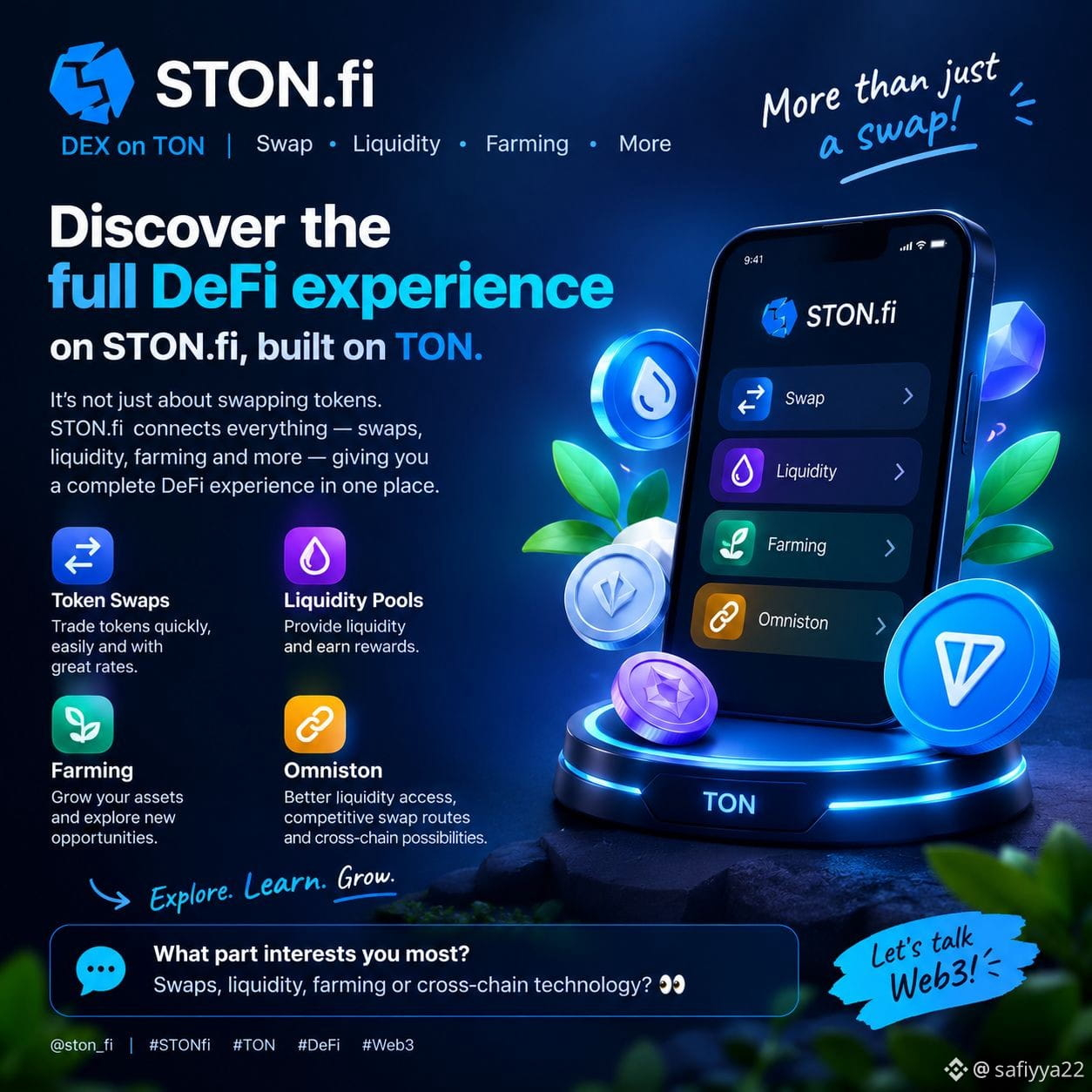
AngelOfCrypto_-:
nice
1
1
581


·
--
Why Cross-Chain Liquidity Needs Good Routing
As more blockchains develop their own liquidity, fragmentation becomes a bigger challenge.
A token may have liquidity on TON, TRON, Ethereum, Base, Polygon, or another network.
The user doesn't necessarily care where that liquidity sits.
They care about one thing:
“How much will I actually receive?”
That's where routing infrastructure becomes important.
With Omniston, STON.fi can coordinate available liquidity and routes across supported networks rather than making users manually search through different ecosystems.
The process can look simple from the user's side:
Choose what you have → choose what you need → review the route → confirm.
But underneath, there can be a lot more happening:
🔹 Finding available liquidity
🔹 Comparing possible routes
🔹 Considering execution conditions
🔹 Coordinating the swap
🔹 Completing the transaction across networks
This is an important part of cross-chain DeFi that users don't always see.
Connecting blockchains is one challenge.
Connecting their liquidity efficiently is another.
As more ecosystems grow independently, infrastructure that can help bring fragmented liquidity together becomes increasingly important.
The future of cross-chain DeFi isn't only about more chains. It's about making those chains easier to navigate.
#STONfi #Omniston #TON @stonfi $TON
Why Cross-Chain Liquidity Needs Good Routing
As more blockchains develop their own liquidity, fragmentation becomes a bigger challenge.
A token may have liquidity on TON, TRON, Ethereum, Base, Polygon, or another network.
The user doesn't necessarily care where that liquidity sits.
They care about one thing:
“How much will I actually receive?”
That's where routing infrastructure becomes important.
With Omniston, STON.fi can coordinate available liquidity and routes across supported networks rather than making users manually search through different ecosystems.
The process can look simple from the user's side:
Choose what you have → choose what you need → review the route → confirm.
But underneath, there can be a lot more happening:
🔹 Finding available liquidity
🔹 Comparing possible routes
🔹 Considering execution conditions
🔹 Coordinating the swap
🔹 Completing the transaction across networks
This is an important part of cross-chain DeFi that users don't always see.
Connecting blockchains is one challenge.
Connecting their liquidity efficiently is another.
As more ecosystems grow independently, infrastructure that can help bring fragmented liquidity together becomes increasingly important.
The future of cross-chain DeFi isn't only about more chains. It's about making those chains easier to navigate.
#STONfi #Omniston #TON @STONfi DEX $TON
As more blockchains develop their own liquidity, fragmentation becomes a bigger challenge.
A token may have liquidity on TON, TRON, Ethereum, Base, Polygon, or another network.
The user doesn't necessarily care where that liquidity sits.
They care about one thing:
“How much will I actually receive?”
That's where routing infrastructure becomes important.
With Omniston, STON.fi can coordinate available liquidity and routes across supported networks rather than making users manually search through different ecosystems.
The process can look simple from the user's side:
Choose what you have → choose what you need → review the route → confirm.
But underneath, there can be a lot more happening:
🔹 Finding available liquidity
🔹 Comparing possible routes
🔹 Considering execution conditions
🔹 Coordinating the swap
🔹 Completing the transaction across networks
This is an important part of cross-chain DeFi that users don't always see.
Connecting blockchains is one challenge.
Connecting their liquidity efficiently is another.
As more ecosystems grow independently, infrastructure that can help bring fragmented liquidity together becomes increasingly important.
The future of cross-chain DeFi isn't only about more chains. It's about making those chains easier to navigate.
#STONfi #Omniston #TON @STONfi DEX $TON
48
Log in to explore more content
Join global crypto users on Binance Square
⚡️ Get latest and useful information about crypto.
💬 Trusted by the world’s largest crypto exchange.
👍 Discover real insights from verified creators.
Email / Phone number
Trending Topics
1
#AIStocksWhatNext
381,686 views
3,037 Discussing
2
#BitcoinBreaksAboveMayHighNears$86K
15,852 views
195 Discussing
3
#DogecoinRises15%
50,582 views
1,011 Discussing
4
#$14BBitcoinOptionsExpireFriday
4,112 views
89 Discussing
5
#BNBMarketCapPassesBNYMellon
31,816 views
726 Discussing
6
#CryptoMarketCapReclaims$3Trillion
5,438 views
82 Discussing
7
#MuseOvertakesChatGPTAsTopFreeIOSApp
18,650 views
540 Discussing
8
#TokenizedStockPlatformsCouldLaunchNextQuarter
29,356 views
595 Discussing
9
#StrategyAdds950Bitcoin
36,795 views
691 Discussing
10
#CardanoAddedToX402KitForADAPayments
30,864 views
665 Discussing