
#runes
runes
389,660 views
609 Discussing
Hot
Latest

·
--
Uncommon Goods: The Evolution of Bitcoin Minting EfficiencyUncommon Goods is Rune #0, the genesis rune hardcoded by Casey Rodarmor, creator of both #ordinals and #runes . It is a pure fair-launch #memecoin with no premine or team allocation. Minting opened at the 2024 halving (block 840,000) and runs until the 2028 halving, under a strict rule of one mint per transaction. Its market price is structurally capped by the cost of a single mint transaction for the entire open-mint period.
The case from mononautical’s posts
Mononautical has documented an advanced and ongoing optimization campaign specifically targeting Uncommon Goods mints. The developments reveal how miners are engineering increasingly efficient ways to process high volumes of mint transactions.
1. Extreme transaction size reduction
Miners, initially AntPool, followed by ViaBTC and F2Pool, began packing thousands of mints using P2A (Pay-to-Anchor, BIP 433) outputs.
P2A is a minimal, keyless, anyone-can-spend output (OP_1 <0x4e73>, address bc1pfeessrawgf), originally designed for efficient CPFP fee bumping in Layer-2 systems. Its use in this context reduces individual mint transactions to approximately 80 virtual bytes.
2. Fee-chain engineering
The optimization goes beyond transaction size. These operations use chains of transactions that pay only 1 satoshi each, followed by a final high-fee child transaction that pays for the entire package through Child Pays for Parent (CPFP).
These transaction chains are not normally relayed by standard nodes. Instead, they are submitted out-of-band directly to miners.
3. Resulting block metrics
The results are particularly interesting.
Block 974557, mined by AntPool, contained 10,573 transactions, making it the second-highest transaction count in Bitcoin history, while using only approximately 1.2 MB / 3.99 MWU.
Earlier analysis by mononautical showed that Rune mints could account for approximately 81% of transaction count while consuming considerably less block space than inscriptions.
There are also potential side effects. These include possible dust-limit violations associated with the tiny P2A outputs and the risk that anyone can spend the keyless anchors, including any Runes attached to them, through a competing transaction.
What this says about Ordinals and Runes through successive improvements
The developments represent a clear evolutionary step in Bitcoin meta-protocol efficiency.
1. From inscriptions to Runes to P2A-optimized Runes
Early Ordinals inscriptions, particularly large media files, were space-intensive. Runes improved fungible-token design by attaching balances to UTXOs through compact OP_RETURN messages.
P2A takes this further by optimizing the highest-volume use case: repeated open mints. The result is denser transaction packing and lower costs per mint.
The same activity that once clogged blocks with large inscriptions can now generate extreme transaction counts while consuming relatively modest block space.
2. Protocol flexibility and repurposing
Features originally built for Layer-2 fee management, such as P2A, are being productively repurposed for Layer-1 token minting.
This demonstrates how Bitcoin's script and UTXO model continue to support unexpected optimizations without requiring changes to the underlying protocol.
3. Economic and systemic effects
The open mint creates a persistent low-fee demand floor. When fees fall below the effective cost of a mint, optimized Uncommon Goods activity can flood the mempool and blocks.
This increases UTXO set growth through numerous small outputs, highlights differences in miner policy (including out-of-band acceptance and possible dust flexibility) and demonstrates that high transaction throughput is achievable for certain workloads without necessarily filling the full block weight limit.
Rodarmor's reaction
Casey Rodarmor's own reaction to the P2A chains was characteristically dry:
"Well at least it'll all be over in a year and a half."
In conclusion Uncommon Goods has become a live laboratory for Bitcoin meta-protocol optimization.
Successive improvements, from Runes design to P2A size reduction and out-of-band fee-chain packaging, have made high-volume minting cheaper and denser.
What was once relatively inefficient "spam" has evolved into a highly engineered and economically rational activity that still generates fees while revealing both the flexibility and the frictions of Bitcoin's current design.
$UncommonGoods $ORDI $BTC
{future}(BTCUSDT)
{future}(ORDIUSDT)
Who is Mononautical?
Mononautical (@mononautical) is a Bitcoin developer who builds tools at mempool.space and BitfeedLive, with a particular focus on observing, analysing and visualising Bitcoin's on-chain activity.
Describing themselves as a “developer, spacefaring primate, international treasure hunter,” mononautical brings a distinctly technical and investigative approach to Bitcoin commentary.
Their posts function almost like real-time blockchain forensics. Rather than discussing Bitcoin primarily through market sentiment or high-level narratives, they examine what is actually happening on the network. This includes dissecting individual blocks, tracking transaction volumes and fee rates, identifying unusual spending patterns, examining mining pool behaviour and documenting historical on-chain movements.
Their analysis is particularly valuable because it makes complex blockchain activity observable. Through custom charts, block visualisations and transaction graphs, they illustrate how block space is consumed, how transaction fees are structured and how emerging meta-protocols such as Ordinals and Runes interact with Bitcoin's underlying infrastructure.
They also pay close attention to the economic and technical incentives shaping network behaviour, including miner policies, non-standard transactions, fee optimisation and the evolving debate around what constitutes spam.
The tone is characteristically technical, data-heavy and occasionally dry, combining precise explanations with wry commentary on broader Bitcoin debates.
In essence, mononautical is less a Bitcoin commentator and more an on-chain investigator. Their work offers a close-up view of Bitcoin's day-to-day mechanics, revealing developments that might otherwise remain buried in transaction data and individual block records.
Uncommon Goods: The Evolution of Bitcoin Minting Efficiency
Uncommon Goods is Rune #0, the genesis rune hardcoded by Casey Rodarmor, creator of both #ordinals and #runes . It is a pure fair-launch #memecoin with no premine or team allocation. Minting opened at the 2024 halving (block 840,000) and runs until the 2028 halving, under a strict rule of one mint per transaction. Its market price is structurally capped by the cost of a single mint transaction for the entire open-mint period.
The case from mononautical’s posts
Mononautical has documented an advanced and ongoing optimization campaign specifically targeting Uncommon Goods mints. The developments reveal how miners are engineering increasingly efficient ways to process high volumes of mint transactions.
1. Extreme transaction size reduction
Miners, initially AntPool, followed by ViaBTC and F2Pool, began packing thousands of mints using P2A (Pay-to-Anchor, BIP 433) outputs.
P2A is a minimal, keyless, anyone-can-spend output (OP_1 <0x4e73>, address bc1pfeessrawgf), originally designed for efficient CPFP fee bumping in Layer-2 systems. Its use in this context reduces individual mint transactions to approximately 80 virtual bytes.
2. Fee-chain engineering
The optimization goes beyond transaction size. These operations use chains of transactions that pay only 1 satoshi each, followed by a final high-fee child transaction that pays for the entire package through Child Pays for Parent (CPFP).
These transaction chains are not normally relayed by standard nodes. Instead, they are submitted out-of-band directly to miners.
3. Resulting block metrics
The results are particularly interesting.
Block 974557, mined by AntPool, contained 10,573 transactions, making it the second-highest transaction count in Bitcoin history, while using only approximately 1.2 MB / 3.99 MWU.
Earlier analysis by mononautical showed that Rune mints could account for approximately 81% of transaction count while consuming considerably less block space than inscriptions.
There are also potential side effects. These include possible dust-limit violations associated with the tiny P2A outputs and the risk that anyone can spend the keyless anchors, including any Runes attached to them, through a competing transaction.
What this says about Ordinals and Runes through successive improvements
The developments represent a clear evolutionary step in Bitcoin meta-protocol efficiency.
1. From inscriptions to Runes to P2A-optimized Runes
Early Ordinals inscriptions, particularly large media files, were space-intensive. Runes improved fungible-token design by attaching balances to UTXOs through compact OP_RETURN messages.
P2A takes this further by optimizing the highest-volume use case: repeated open mints. The result is denser transaction packing and lower costs per mint.
The same activity that once clogged blocks with large inscriptions can now generate extreme transaction counts while consuming relatively modest block space.
2. Protocol flexibility and repurposing
Features originally built for Layer-2 fee management, such as P2A, are being productively repurposed for Layer-1 token minting.
This demonstrates how Bitcoin's script and UTXO model continue to support unexpected optimizations without requiring changes to the underlying protocol.
3. Economic and systemic effects
The open mint creates a persistent low-fee demand floor. When fees fall below the effective cost of a mint, optimized Uncommon Goods activity can flood the mempool and blocks.
This increases UTXO set growth through numerous small outputs, highlights differences in miner policy (including out-of-band acceptance and possible dust flexibility) and demonstrates that high transaction throughput is achievable for certain workloads without necessarily filling the full block weight limit.
Rodarmor's reaction
Casey Rodarmor's own reaction to the P2A chains was characteristically dry:
"Well at least it'll all be over in a year and a half."
In conclusion Uncommon Goods has become a live laboratory for Bitcoin meta-protocol optimization.
Successive improvements, from Runes design to P2A size reduction and out-of-band fee-chain packaging, have made high-volume minting cheaper and denser.
What was once relatively inefficient "spam" has evolved into a highly engineered and economically rational activity that still generates fees while revealing both the flexibility and the frictions of Bitcoin's current design.
$UncommonGoods $ORDI $BTC
Who is Mononautical?
Mononautical (@mononautical) is a Bitcoin developer who builds tools at mempool.space and BitfeedLive, with a particular focus on observing, analysing and visualising Bitcoin's on-chain activity.
Describing themselves as a “developer, spacefaring primate, international treasure hunter,” mononautical brings a distinctly technical and investigative approach to Bitcoin commentary.
Their posts function almost like real-time blockchain forensics. Rather than discussing Bitcoin primarily through market sentiment or high-level narratives, they examine what is actually happening on the network. This includes dissecting individual blocks, tracking transaction volumes and fee rates, identifying unusual spending patterns, examining mining pool behaviour and documenting historical on-chain movements.
Their analysis is particularly valuable because it makes complex blockchain activity observable. Through custom charts, block visualisations and transaction graphs, they illustrate how block space is consumed, how transaction fees are structured and how emerging meta-protocols such as Ordinals and Runes interact with Bitcoin's underlying infrastructure.
They also pay close attention to the economic and technical incentives shaping network behaviour, including miner policies, non-standard transactions, fee optimisation and the evolving debate around what constitutes spam.
The tone is characteristically technical, data-heavy and occasionally dry, combining precise explanations with wry commentary on broader Bitcoin debates.
In essence, mononautical is less a Bitcoin commentator and more an on-chain investigator. Their work offers a close-up view of Bitcoin's day-to-day mechanics, revealing developments that might otherwise remain buried in transaction data and individual block records.
12
1
334

·
--
Bullish
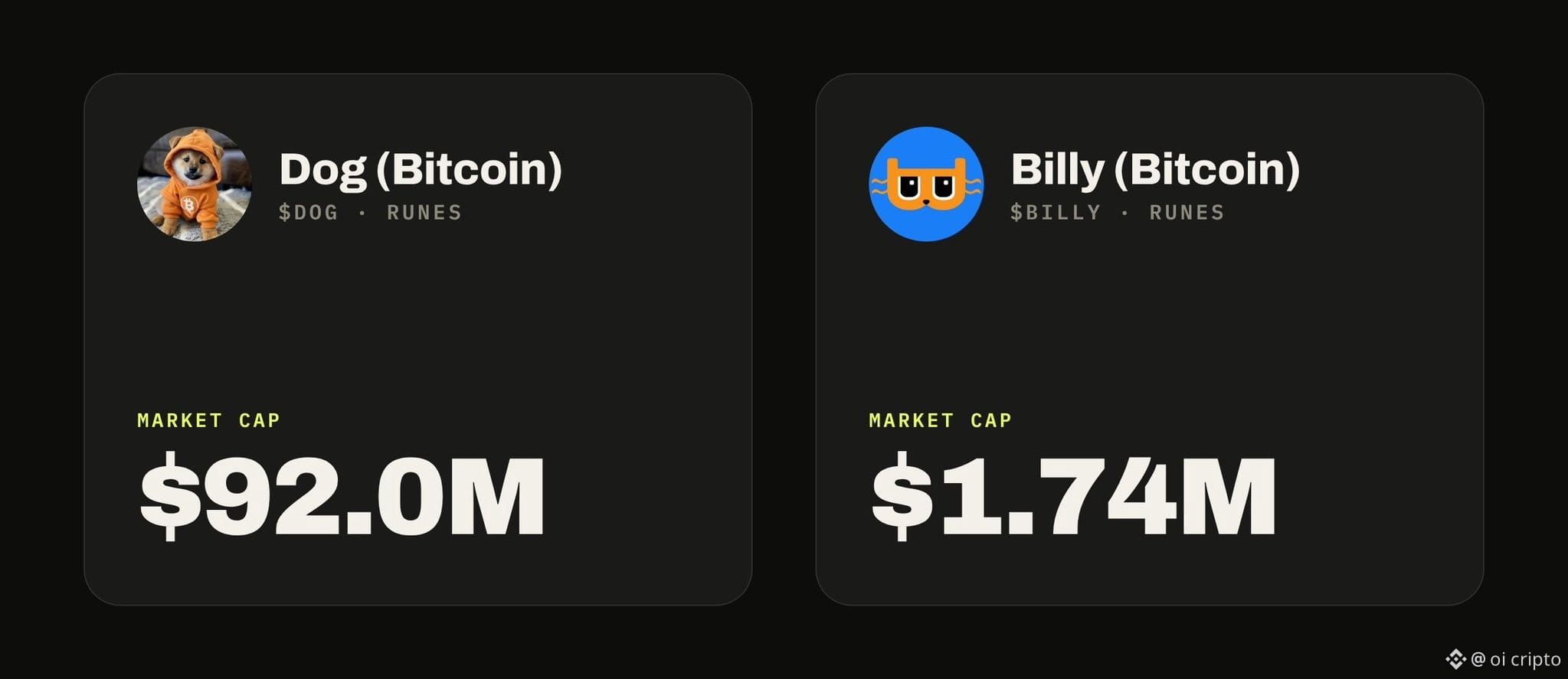
This might seem crazy
But if Runes ever get a 2nd chance.
These 2 will be the only ones worth paying attention to from now.
$billy & $DOG
you all agree?
#BILLY #dog
#memecoin #runes #RunesProtocol
$DOGS $DODO $CATI
This might seem crazy
But if Runes ever get a 2nd chance.
These 2 will be the only ones worth paying attention to from now.
$billy & $DOG
you all agree?
#BILLY #dog
#memecoin #runes #RunesProtocol
$DOGS $DODO $CATI
But if Runes ever get a 2nd chance.
These 2 will be the only ones worth paying attention to from now.
$billy & $DOG
you all agree?
#BILLY #dog
#memecoin #runes #RunesProtocol
$DOGS $DODO $CATI
1
577

·
--
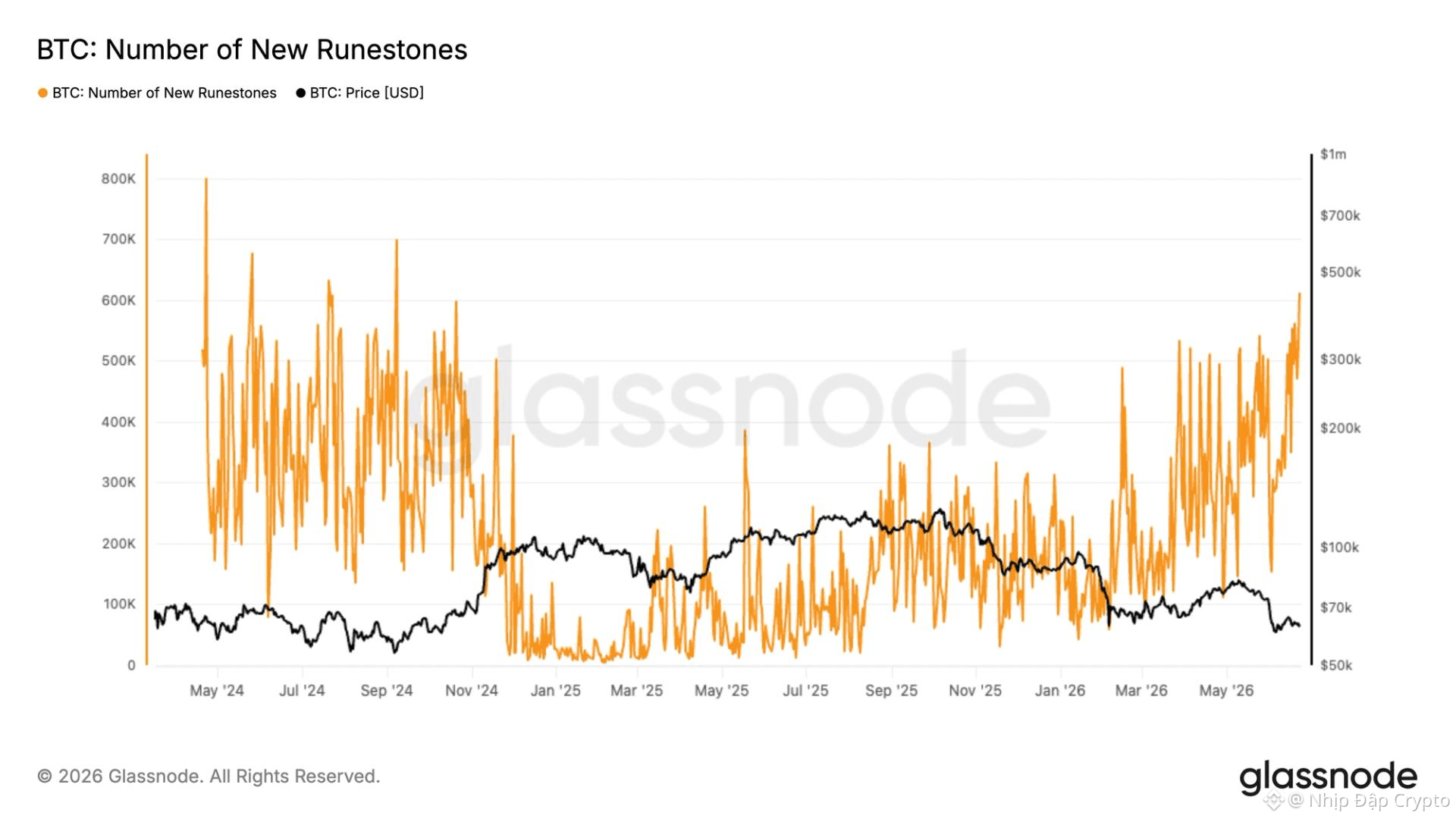
🧱 Bear market is still buzzing! Runes protocol pushes Bitcoin on-chain transactions to a new high of 820,000
BTC price has been cut in half to ~$60K, but on-chain activity is on fire 🔥
Glassnode data shows Bitcoin's daily transaction volume has surpassed 820,000, hitting a two-year high. The driving force isn’t whales moving coins but the Runes protocol—just the Runestone trades accounted for over 600,000 transactions, contributing about 25% of the fees.
Micro trades (<0.01 BTC) now make up 80% of daily network activity, and the structural change is visible to the naked eye. The Rainbow chart has already dropped into the "BTC is dead" zone, but miner fee revenue has benefited from the Runes revival.
A lively on-chain scene vs. a sluggish price is quite a dramatic contrast 😅 Some say this is a bottom signal, while others worry that block congestion will drive away regular users. What do you think?
#Bitcoin #Runes #BTC #OnChain
#Bitcoin
111

·
--
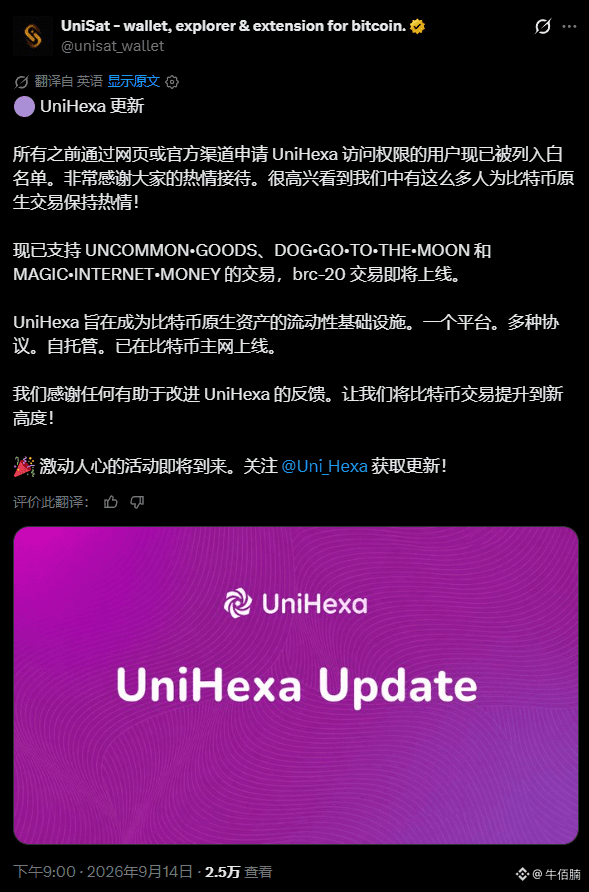
UniHexa has started letting people in this time.
Users who previously applied through the website or official channels have now all been added to the whitelist.
Currently, it supports 3 types of Runes:
UNCOMMON•GOODS, $DOG, and $MIM.
BRC-20 will be added later as well.
What UniHexa does is native Bitcoin asset trading. It supports multiple protocols, and the assets are controlled by users themselves.
We’re still in the early stage. If you’re on the whitelist, you can try running the process with a small amount first to see whether order placement, execution, and withdrawals are smooth.
What I’m most concerned about is when BRC-20 will go live, and which coins the first batch will support.
#unihexa #UniSat #bitcoin #Runes
190

·
--
Partly True
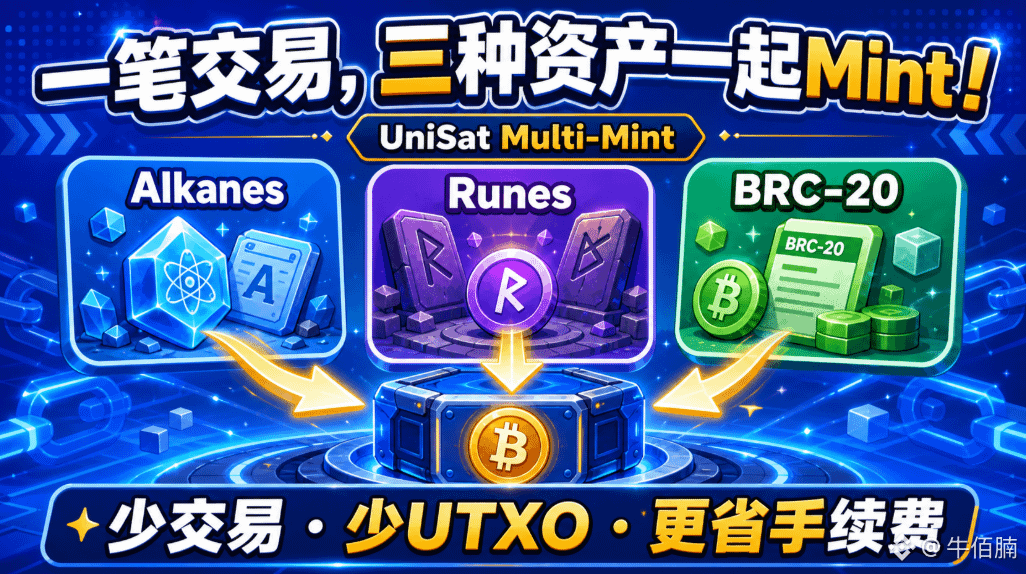
Finally you don’t have to point-cast Mints one by one.
UniSat has launched Multi-Mint—one transaction can handle Alkanes, Runes, and BRC-20 all at once.
It’s easier to operate, fewer transactions are needed, and both UTXOs and fees can be reduced as well. For people who frequently Mint in batches, this feature is really appealing.
Also, from August 20 to September 20, Mint UNCOMMON•GOODS and DIESEL are fee-free.
It looks like it’s only a few less taps, but in actual use it could be a lot more convenient.
UniSat really came through this time. 🍕
#Bitcoin #BRC20 #runes #Alkanes
{future}(ORDIUSDT)
{spot}(1000SATSUSDT)
Finally you don’t have to point-cast Mints one by one.
UniSat has launched Multi-Mint—one transaction can handle Alkanes, Runes, and BRC-20 all at once.
It’s easier to operate, fewer transactions are needed, and both UTXOs and fees can be reduced as well. For people who frequently Mint in batches, this feature is really appealing.
Also, from August 20 to September 20, Mint UNCOMMON•GOODS and DIESEL are fee-free.
It looks like it’s only a few less taps, but in actual use it could be a lot more convenient.
UniSat really came through this time. 🍕
#Bitcoin #BRC20 #runes #Alkanes

2
787
·
--
Bullish
Partly True
UniSat really is a bit awesome this time.
Alkanes, Runes, BRC-20—now a single transaction can Mint them all together, without having to do everything one by one.
With fewer transactions, there are fewer UTXOs, and you can save a bit on fees too. When Minting in bulk, the experience should feel noticeably smoother.
From August 20 to September 20, Mint UNCOMMON•GOODS and DIESEL will also be fee-free.
Earlier it was all about speed, now it’s about efficiency.
Bitcoin ecosystem tools are getting better and better—this is the real progress.
#bitcoin
{future}(ORDIUSDT)
{spot}(1000SATSUSDT)
#BRC20 #runes #Alkanes
UniSat really is a bit awesome this time.
Alkanes, Runes, BRC-20—now a single transaction can Mint them all together, without having to do everything one by one.
With fewer transactions, there are fewer UTXOs, and you can save a bit on fees too. When Minting in bulk, the experience should feel noticeably smoother.
From August 20 to September 20, Mint UNCOMMON•GOODS and DIESEL will also be fee-free.
Earlier it was all about speed, now it’s about efficiency.
Bitcoin ecosystem tools are getting better and better—this is the real progress.
#bitcoin
#BRC20 #runes #Alkanes
1
722

·
--
Bullish
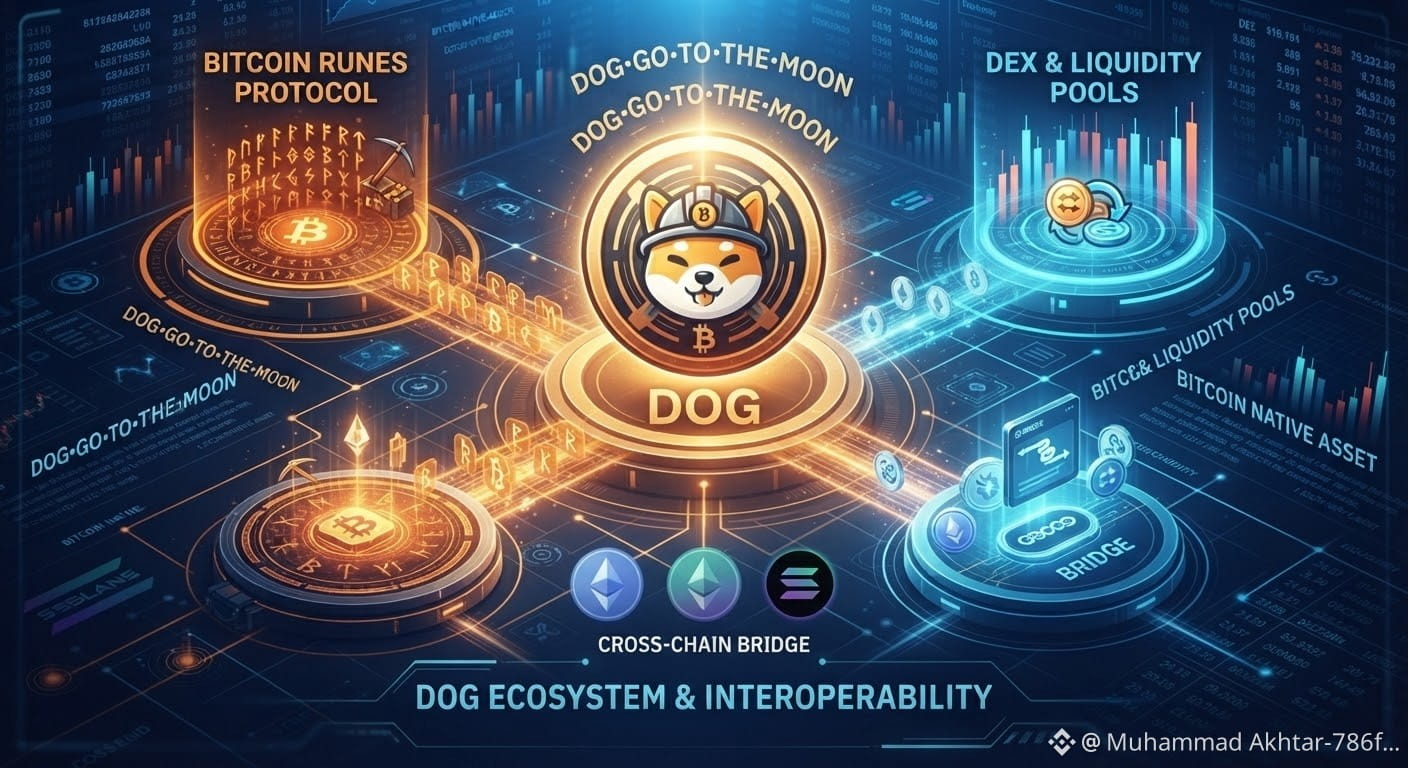
Dog (Bitcoin Runes - DOG) Market Analytics
Overview & Fundamentals
Asset Name: Dog (Bitcoin) / DOG (often referred to as Dog•Go•To•The•Moon)
Ecosystem/Protocol: Bitcoin Runes Protocol (Native fungible assets on Bitcoin without smart contracts)
Token Supply Structure: Fixed circulating and total supply capped at 100 Billion ($100B) DOG.
Market Capitalization: Hovers around $96M – $99M USD, placing it within the global top 250–300 crypto assets.
Key Market Metrics
Current Price Range: Trading consistently around the $0.00095 – $0.0010 USD threshold.
Recent 24H Performance: Demonstrating minor intraday stability with a slight upward drift of +0.5% to +2.9%.
Technical Signals: Short-term 4-hour indicators lean toward a Buy signal, while broader 1-day momentum trends indicate a Neutral consolidation phase.
All-Time High (ATH): Reached up to approximately $0.0099.
Scenario
Market Condition
Projected Price Band
Bullish
Renewed Bitcoin-native liquidity, expansion of Runes adoption, and broader meme-coin sector rallies.
$0.0018 – $0.0035
Neutral
Sideways range-bound trading as the market awaits macro catalysts for Bitcoin layer-1 ecosystems.
$0.00085 – $0.0012
Bearish
Risk-off macro sentiment or capital rotation away from Bitcoin-based meme tokens.
Below $0.00070
$DOGS
#DogCoin
#Runes
#BinanceLaunchesBinanceIntelligence
234

🐺 WoLF Alpha
Bitcoin network activity has surged to a two-year high, with transactions exceeding 820,000. This massive spike in traffic is being driven by a significant revival in the Runes protocol ecosystem.
$BTC #Runes #Bitcoin
🐺 WoLF Alpha
Bitcoin network activity has surged to a two-year high, with transactions exceeding 820,000. This massive spike in traffic is being driven by a significant revival in the Runes protocol ecosystem.
$BTC #Runes #Bitcoin
Bitcoin network activity has surged to a two-year high, with transactions exceeding 820,000. This massive spike in traffic is being driven by a significant revival in the Runes protocol ecosystem.
$BTC #Runes #Bitcoin
28
Over 820,000 Bitcoin transactions daily — the highest in two years — is being fueled by the resurgence of the Runes protocol, despite BTC price hovering around $62,000, nearly 50% lower than its all-time high.
Runes, similar to ERC-20 on Ethereum, accounts for over 600,000 transactions a day and generates about 25% of total network fees. This indicates that demand for block space is gradually decoupling from short-term price volatility. A positive signal for Bitcoin's on-chain utility, but is it sustainable?
For traders, this is a story to keep an eye on: increased network activity during a bear market often signals long-term interest, but it's not enough to pull prices from weak liquidity zones. Short-term risks remain as trading volume on CEX is low.
I believe this is a positive event for Bitcoin's fundamentals, but the price needs additional catalysts to break out. Risk management and patience are still key. DYOR.
#Bitcoin #Runes #OnChain #PhanTich #Crypto
183

Runes are back: Bitcoin trading hits a 2-year high, surpassing 820,000
- The Runes protocol activity is surging on the Bitcoin network.
- Bitcoin transaction volume has skyrocketed, reaching the highest level in two years.
- Daily transactions have surpassed 820,000, indicating a resurgence in the network's activity.
- This increase has also pushed Bitcoin transaction fees to a record high in years.
#BinanceSquare #CryptoNews #Bitcoin #Runes #BTC
$btc
vlikevn Titanbot
Source: CoinDesk
124

·
--
🚨 Bitcoin just hit a two-year high in on-chain transactions — and Runes is behind it 👇
The Runes protocol is driving a massive surge in Bitcoin network activity. Transaction counts recently blasted past 820,000, levels not seen since the height of the last NFT mania. This isn't just noise — it's a signal that Bitcoin's utility layer is evolving.
Fee generation is climbing alongside volume, which benefits miners directly. Higher on-chain demand means stronger security economics without relying solely on block rewards. It's a bullish feedback loop for the network's long-term health.
Some analysts argue this marks a turning point for Bitcoin's fee market — moving away from the block subsidy and toward organic demand-driven revenue. That's exactly what critics said would never happen.
Is this the beginning of Bitcoin's fee-based future, or a temporary spike? 👇
$BTC $ETH $SOL
#Runes #Bitcoin #OnChain #Crypto
22
·
--
Bullish
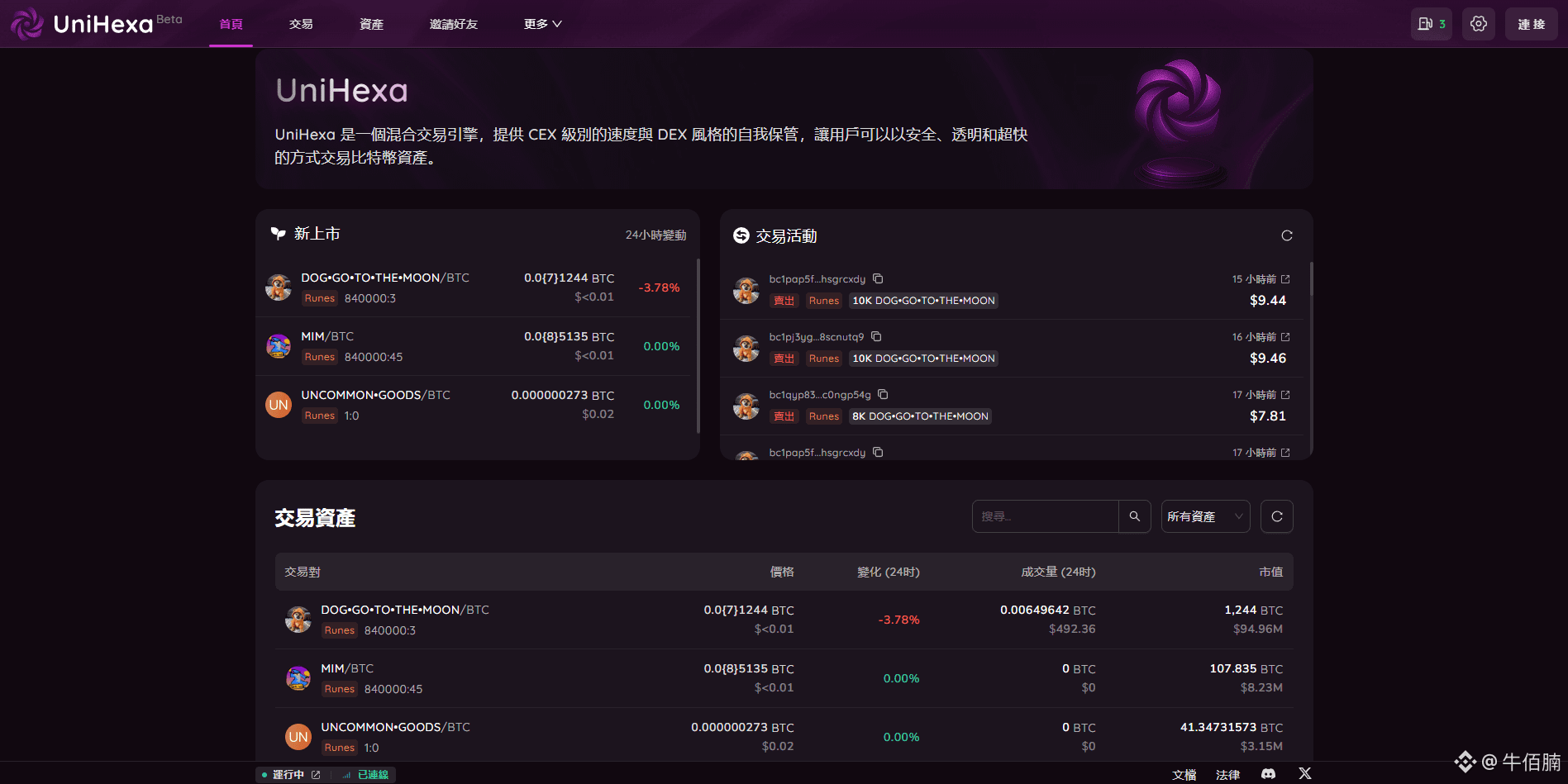
UniHexa has been expanding the whitelist for almost 3 days now.
I took a look at the current data. Here’s the conclusion straight away:
Trading is enabled, but the market hasn’t really taken off yet.
At the moment, there are only 3 Runes trading pairs.
$DOG’s 24-hour trading volume is 0.00649642 BTC, about $492, and the page shows a market cap close to $95M.
MIM and UNCOMMON•GOODS both have a 24-hour trading volume of 0.
In the screenshot, the most recent few trades of $DOG are only around $7 to $10.
This indicates that the product workflow really has been running and genuine trades are starting to appear.
But the problem is equally clear.
For an asset with a market cap close to $95M, there are only a few hundred dollars worth of trades in a day. With this level of liquidity, retail investors can buy in easily, but when they want to sell, there may not be someone to take the other side.
UniHexa can only be said to have completed the first step for now—it’s not fair to say the market has already been built.
The limited number of whitelisted users and the small number of trading pairs are objective reasons. Next, it still needs to continue opening up users and adding assets, and then bring in the project team and market-making funds.
If you’re in the whitelist, you can test with a small amount—there’s no need to go heavy.
Going forward, I’ll only watch three data points:
When BRC-20 goes live, how many trading pairs can be added, and whether the 24-hour trading volume can keep increasing continuously.
#unihexa #UniSat #bitcoin #runes
1
344
·
--
From #ordinals #inscriptions to #runes and now P2A-optimised Runes, #bitcoin meta-protocols keep evolving. What once required substantial block space can now generate enormous transaction counts with relatively modest space consumption.
From #ordinals #inscriptions to #runes and now P2A-optimised Runes, #bitcoin meta-protocols keep evolving. What once required substantial block space can now generate enormous transaction counts with relatively modest space consumption.
kaymyg
·
--
Uncommon Goods: The Evolution of Bitcoin Minting Efficiency
Uncommon Goods is Rune #0, the genesis rune hardcoded by Casey Rodarmor, creator of both #ordinals and #runes . It is a pure fair-launch #memecoin with no premine or team allocation. Minting opened at the 2024 halving (block 840,000) and runs until the 2028 halving, under a strict rule of one mint per transaction. Its market price is structurally capped by the cost of a single mint transaction for the entire open-mint period.
The case from mononautical’s posts
Mononautical has documented an advanced and ongoing optimization campaign specifically targeting Uncommon Goods mints. The developments reveal how miners are engineering increasingly efficient ways to process high volumes of mint transactions.
1. Extreme transaction size reduction
Miners, initially AntPool, followed by ViaBTC and F2Pool, began packing thousands of mints using P2A (Pay-to-Anchor, BIP 433) outputs.
P2A is a minimal, keyless, anyone-can-spend output (OP_1 <0x4e73>, address bc1pfeessrawgf), originally designed for efficient CPFP fee bumping in Layer-2 systems. Its use in this context reduces individual mint transactions to approximately 80 virtual bytes.
2. Fee-chain engineering
The optimization goes beyond transaction size. These operations use chains of transactions that pay only 1 satoshi each, followed by a final high-fee child transaction that pays for the entire package through Child Pays for Parent (CPFP).
These transaction chains are not normally relayed by standard nodes. Instead, they are submitted out-of-band directly to miners.
3. Resulting block metrics
The results are particularly interesting.
Block 974557, mined by AntPool, contained 10,573 transactions, making it the second-highest transaction count in Bitcoin history, while using only approximately 1.2 MB / 3.99 MWU.
Earlier analysis by mononautical showed that Rune mints could account for approximately 81% of transaction count while consuming considerably less block space than inscriptions.
There are also potential side effects. These include possible dust-limit violations associated with the tiny P2A outputs and the risk that anyone can spend the keyless anchors, including any Runes attached to them, through a competing transaction.
What this says about Ordinals and Runes through successive improvements
The developments represent a clear evolutionary step in Bitcoin meta-protocol efficiency.
1. From inscriptions to Runes to P2A-optimized Runes
Early Ordinals inscriptions, particularly large media files, were space-intensive. Runes improved fungible-token design by attaching balances to UTXOs through compact OP_RETURN messages.
P2A takes this further by optimizing the highest-volume use case: repeated open mints. The result is denser transaction packing and lower costs per mint.
The same activity that once clogged blocks with large inscriptions can now generate extreme transaction counts while consuming relatively modest block space.
2. Protocol flexibility and repurposing
Features originally built for Layer-2 fee management, such as P2A, are being productively repurposed for Layer-1 token minting.
This demonstrates how Bitcoin's script and UTXO model continue to support unexpected optimizations without requiring changes to the underlying protocol.
3. Economic and systemic effects
The open mint creates a persistent low-fee demand floor. When fees fall below the effective cost of a mint, optimized Uncommon Goods activity can flood the mempool and blocks.
This increases UTXO set growth through numerous small outputs, highlights differences in miner policy (including out-of-band acceptance and possible dust flexibility) and demonstrates that high transaction throughput is achievable for certain workloads without necessarily filling the full block weight limit.
Rodarmor's reaction
Casey Rodarmor's own reaction to the P2A chains was characteristically dry:
"Well at least it'll all be over in a year and a half."
In conclusion Uncommon Goods has become a live laboratory for Bitcoin meta-protocol optimization.
Successive improvements, from Runes design to P2A size reduction and out-of-band fee-chain packaging, have made high-volume minting cheaper and denser.
What was once relatively inefficient "spam" has evolved into a highly engineered and economically rational activity that still generates fees while revealing both the flexibility and the frictions of Bitcoin's current design.
$UncommonGoods $ORDI $BTC
Who is Mononautical?
Mononautical (@mononautical) is a Bitcoin developer who builds tools at mempool.space and BitfeedLive, with a particular focus on observing, analysing and visualising Bitcoin's on-chain activity.
Describing themselves as a “developer, spacefaring primate, international treasure hunter,” mononautical brings a distinctly technical and investigative approach to Bitcoin commentary.
Their posts function almost like real-time blockchain forensics. Rather than discussing Bitcoin primarily through market sentiment or high-level narratives, they examine what is actually happening on the network. This includes dissecting individual blocks, tracking transaction volumes and fee rates, identifying unusual spending patterns, examining mining pool behaviour and documenting historical on-chain movements.
Their analysis is particularly valuable because it makes complex blockchain activity observable. Through custom charts, block visualisations and transaction graphs, they illustrate how block space is consumed, how transaction fees are structured and how emerging meta-protocols such as Ordinals and Runes interact with Bitcoin's underlying infrastructure.
They also pay close attention to the economic and technical incentives shaping network behaviour, including miner policies, non-standard transactions, fee optimisation and the evolving debate around what constitutes spam.
The tone is characteristically technical, data-heavy and occasionally dry, combining precise explanations with wry commentary on broader Bitcoin debates.
In essence, mononautical is less a Bitcoin commentator and more an on-chain investigator. Their work offers a close-up view of Bitcoin's day-to-day mechanics, revealing developments that might otherwise remain buried in transaction data and individual block records.
The case from mononautical’s posts
Mononautical has documented an advanced and ongoing optimization campaign specifically targeting Uncommon Goods mints. The developments reveal how miners are engineering increasingly efficient ways to process high volumes of mint transactions.
1. Extreme transaction size reduction
Miners, initially AntPool, followed by ViaBTC and F2Pool, began packing thousands of mints using P2A (Pay-to-Anchor, BIP 433) outputs.
P2A is a minimal, keyless, anyone-can-spend output (OP_1 <0x4e73>, address bc1pfeessrawgf), originally designed for efficient CPFP fee bumping in Layer-2 systems. Its use in this context reduces individual mint transactions to approximately 80 virtual bytes.
2. Fee-chain engineering
The optimization goes beyond transaction size. These operations use chains of transactions that pay only 1 satoshi each, followed by a final high-fee child transaction that pays for the entire package through Child Pays for Parent (CPFP).
These transaction chains are not normally relayed by standard nodes. Instead, they are submitted out-of-band directly to miners.
3. Resulting block metrics
The results are particularly interesting.
Block 974557, mined by AntPool, contained 10,573 transactions, making it the second-highest transaction count in Bitcoin history, while using only approximately 1.2 MB / 3.99 MWU.
Earlier analysis by mononautical showed that Rune mints could account for approximately 81% of transaction count while consuming considerably less block space than inscriptions.
There are also potential side effects. These include possible dust-limit violations associated with the tiny P2A outputs and the risk that anyone can spend the keyless anchors, including any Runes attached to them, through a competing transaction.
What this says about Ordinals and Runes through successive improvements
The developments represent a clear evolutionary step in Bitcoin meta-protocol efficiency.
1. From inscriptions to Runes to P2A-optimized Runes
Early Ordinals inscriptions, particularly large media files, were space-intensive. Runes improved fungible-token design by attaching balances to UTXOs through compact OP_RETURN messages.
P2A takes this further by optimizing the highest-volume use case: repeated open mints. The result is denser transaction packing and lower costs per mint.
The same activity that once clogged blocks with large inscriptions can now generate extreme transaction counts while consuming relatively modest block space.
2. Protocol flexibility and repurposing
Features originally built for Layer-2 fee management, such as P2A, are being productively repurposed for Layer-1 token minting.
This demonstrates how Bitcoin's script and UTXO model continue to support unexpected optimizations without requiring changes to the underlying protocol.
3. Economic and systemic effects
The open mint creates a persistent low-fee demand floor. When fees fall below the effective cost of a mint, optimized Uncommon Goods activity can flood the mempool and blocks.
This increases UTXO set growth through numerous small outputs, highlights differences in miner policy (including out-of-band acceptance and possible dust flexibility) and demonstrates that high transaction throughput is achievable for certain workloads without necessarily filling the full block weight limit.
Rodarmor's reaction
Casey Rodarmor's own reaction to the P2A chains was characteristically dry:
"Well at least it'll all be over in a year and a half."
In conclusion Uncommon Goods has become a live laboratory for Bitcoin meta-protocol optimization.
Successive improvements, from Runes design to P2A size reduction and out-of-band fee-chain packaging, have made high-volume minting cheaper and denser.
What was once relatively inefficient "spam" has evolved into a highly engineered and economically rational activity that still generates fees while revealing both the flexibility and the frictions of Bitcoin's current design.
$UncommonGoods $ORDI $BTC
Who is Mononautical?
Mononautical (@mononautical) is a Bitcoin developer who builds tools at mempool.space and BitfeedLive, with a particular focus on observing, analysing and visualising Bitcoin's on-chain activity.
Describing themselves as a “developer, spacefaring primate, international treasure hunter,” mononautical brings a distinctly technical and investigative approach to Bitcoin commentary.
Their posts function almost like real-time blockchain forensics. Rather than discussing Bitcoin primarily through market sentiment or high-level narratives, they examine what is actually happening on the network. This includes dissecting individual blocks, tracking transaction volumes and fee rates, identifying unusual spending patterns, examining mining pool behaviour and documenting historical on-chain movements.
Their analysis is particularly valuable because it makes complex blockchain activity observable. Through custom charts, block visualisations and transaction graphs, they illustrate how block space is consumed, how transaction fees are structured and how emerging meta-protocols such as Ordinals and Runes interact with Bitcoin's underlying infrastructure.
They also pay close attention to the economic and technical incentives shaping network behaviour, including miner policies, non-standard transactions, fee optimisation and the evolving debate around what constitutes spam.
The tone is characteristically technical, data-heavy and occasionally dry, combining precise explanations with wry commentary on broader Bitcoin debates.
In essence, mononautical is less a Bitcoin commentator and more an on-chain investigator. Their work offers a close-up view of Bitcoin's day-to-day mechanics, revealing developments that might otherwise remain buried in transaction data and individual block records.
1
38
·
--
Bullish
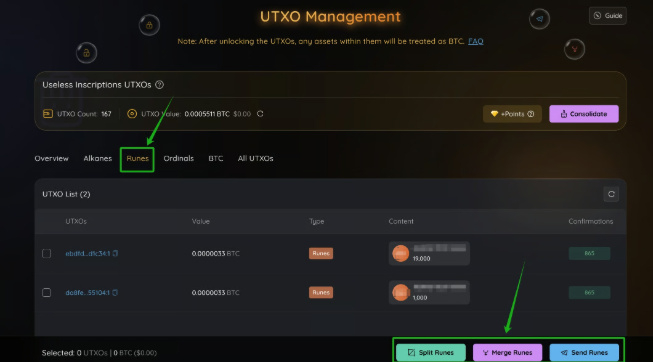
Usually, when people open their wallets, the first thing they check is the balance. UTXOs are something few people pay attention to unless something goes wrong.
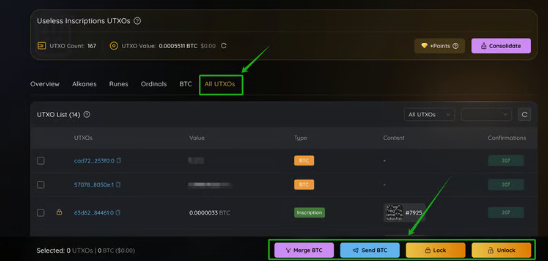
After spending a while using BRC-20, Runes, and Ordinals, Minting and transferring can leave behind a pile of scattered UTXOs. Some BTC or FB can get stuck in them, and over time, you may no longer know which ones are safe to spend and which could cause you to spend your assets along with them.
UniSat has built a dedicated UTXO management tool. You can split, merge, and lock scattered UTXOs in your wallet, and tidy up Mint and Transfer inscriptions that are no longer needed.
#UniSat #bitcoin #BRC20 #Runes
277
·
--
Bullish
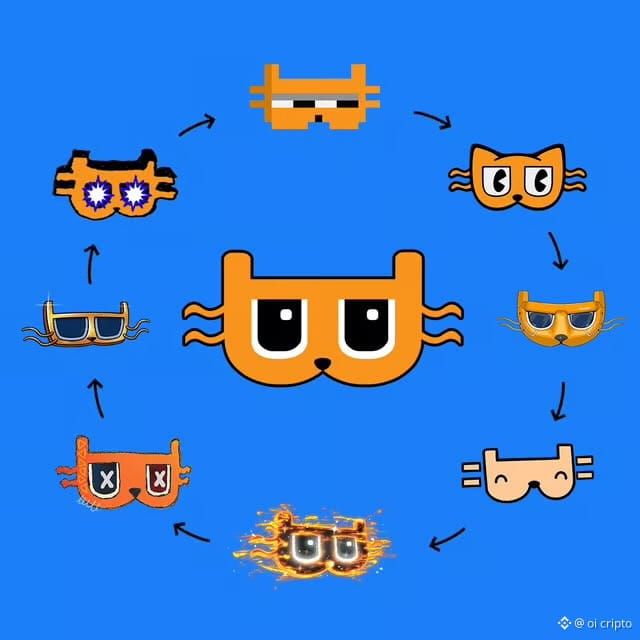
While the world chases after promises, $BILLY is already written in the sacred book of Bitcoin. A billionaire cat, born on Runes, protected by the most secure network on the planet. Fair. Pure. Impossible to erase. Billy to the Billions. 🐱₿ #BILLY
#runes #RunesProtocol #memecoin
$BILL $GIGGLE $1000CHEEMS
#runes #RunesProtocol #memecoin
$BILL $GIGGLE $1000CHEEMS

1
926

·
--
The core code of Bitcoin DOG Mode has just been merged, but this is not a “fork that spins off a new Bitcoin chain.”
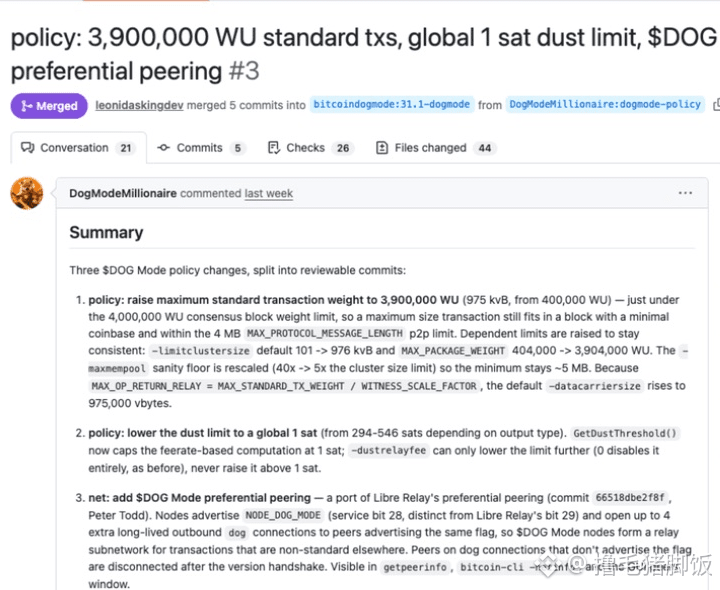
I just double-checked the project’s GitHub: PR #3 was merged at 06:27 Beijing time on September 3, with 26 checks passing. What it changes is the transaction relay strategy of the nodes, not Bitcoin consensus rules, and there still isn’t an official binary release version.
There are mainly three changes this time:
1. The standard transaction limit increases from 400k to 3.9 million WU.
2. The dust threshold drops to a global 1 sat.
3. DOG Mode nodes add priority interconnection, making it easier for them to relay transactions that other clients consider non-standard.
Why is it worth watching?
It shifts the debate around Ordinals, Runes, and large-payload data transactions from “whether the whole network will change consensus” to “which nodes are willing to relay, and which miners are willing to package.” This lowers the experimental barrier, but it doesn’t mean the transactions will necessarily get into blocks quickly.
For regular users, first look at three validation points: whether an official version has been released, how widely real nodes are adopting it, and whether mining pools accept these transactions. If any one is missing, a code merge doesn’t automatically translate into real network effects.
The risks are also straightforward: compatibility of alternative clients, resource usage, and the relay strategy still need to be tested on the live network. Also, the project has an interest connection to the DOG token—so you shouldn’t treat technical progress as a direct price signal.
Verification time: 2026-09-03 08:36 (Beijing time)
Source: bitcoindogmode/bitcoin GitHub PR #3
$BTC #比特币 #Ordinals #Runes
418
·
--
Bullish
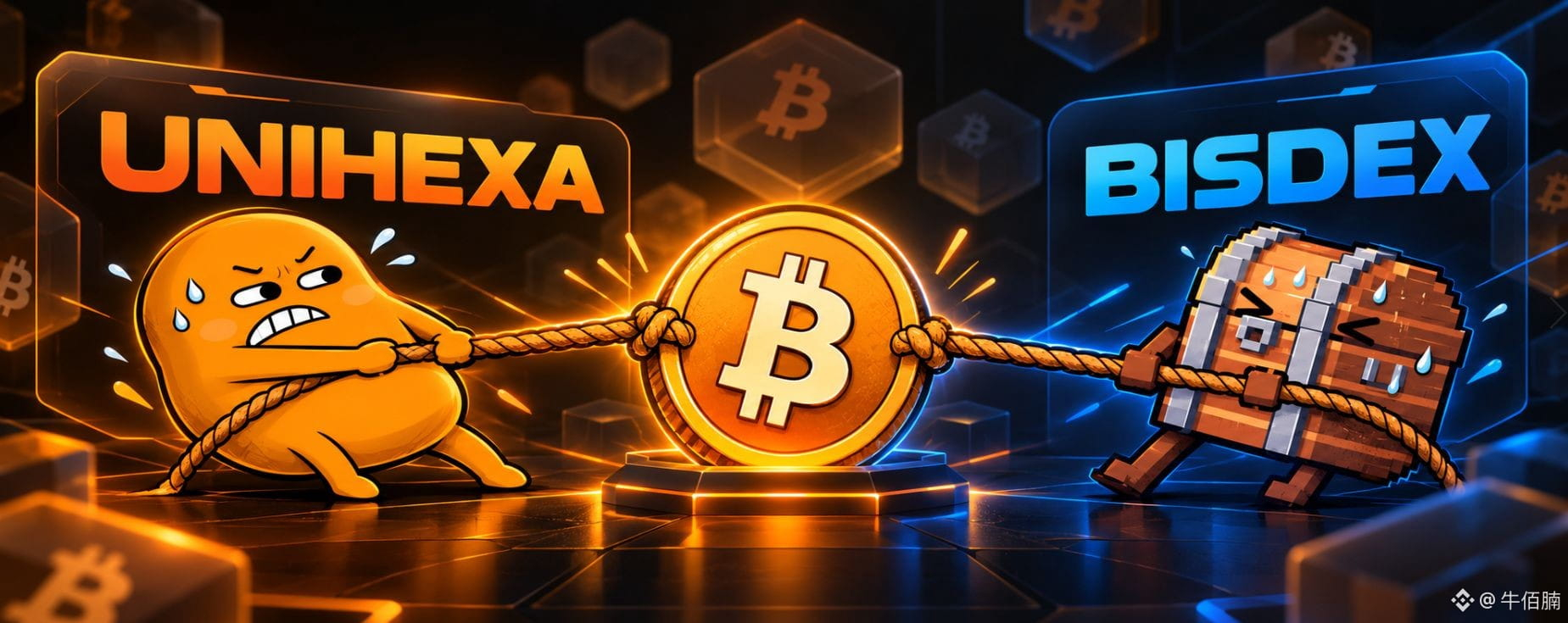
UniHexa and BISDEX are both talking about BRC20 liquidity, but they are not at the same stage right now.
UniHexa is backed by the Unisat ecosystem. It has already integrated assets such as BRC20 and Runes, and the product is live. Whether Taproot, multisig accounts, and off-chain order matching are actually effective—users can experience and verify it now.
BISDEX has not officially launched yet. Its BRC2.0, AMM, Token-to-Token trading, and the parameter of 40,000 operations per block mainly come from the official proposals and specifications. More directly, it is still in the “slide-deck (PPT) stage”—it has not yet been tested against real capital, trading peaks, and user exits.
Also, 40,000 operations per block is a parameter for the BRC2.0 execution module and cannot be equated with Bitcoin mainnet TPS. Indexing status, contract safety, liquidity depth, and the exit experience all need to be evaluated after launch.
So, at this stage, I’m more optimistic about UniHexa. One is already running, has user entry points, and a foundation of multi-protocol assets; the other has not entered the real market yet. BISDEX is worth keeping an eye on, but treating it as a peer-level competitor to UniHexa is still too early.
#bitcoin #BRC20 #runes #比特币生态
198
·
--
Bullish
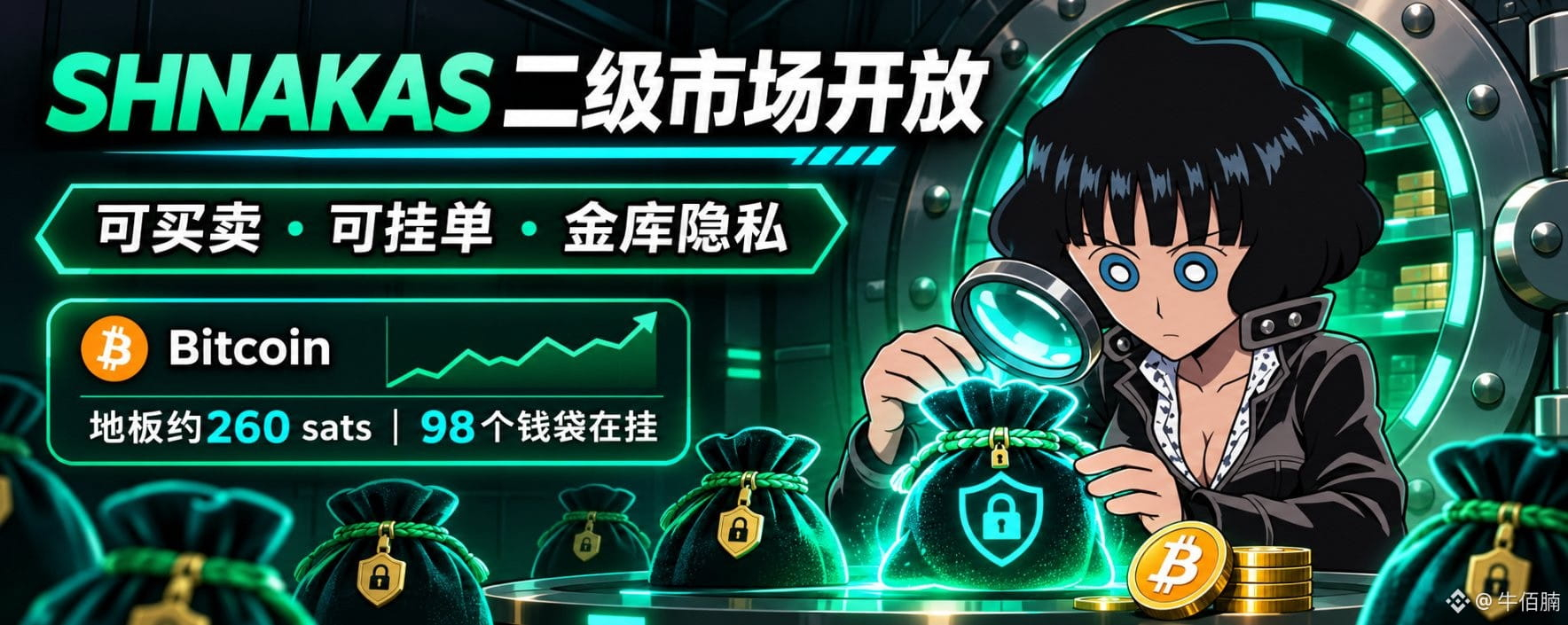
The SHNAKAS secondary market is open—you can now buy, sell, and place orders
Activity: ★★★★☆
@ShieldedNaka has opened secondary trading for $SHNAKAS on @Ord_Dropz.
Holders can list pouches from Shielded Vault, and buyers can also purchase them directly. On-chain transaction quantities and pouch numbers are public, while sellers’ identities and receiving vaults remain hidden.
When the project team published its data, it recorded:
• 60 purchases, 39 confirmed
• Recorded trading volume of 0.0492 BTC
• 18,188 SHNAKAS involved
• 98 pouches listed
• Floor price around 260 sats per token
• 688 tokens used in Snickets and burned
The market is live, but order book depth is still fairly thin. If you want to try it, check the number of pouches and the price per token first—don’t sweep the market with a large market order.
Sources:
https://x.com/ShieldedNaka/status/2118911201447186539
https://ord-dropz.xyz/secondary/collections/shnakas
#bitcoin #runes #SHNAKAS
161
·
--
Bullish
been adding liquidity to the $BILLY/SOL pool 🐈
liquidity is getting deeper. if you’ve been wanting to pick up some $BILLY on Solana, give it a shot.
$BILLY SOL/BTC
every swap helps strengthen the pool 🤝
BITCOIN RUNES 🐈
#BILLY #runes #memecoin #bitcoinrunes
$1000SATS $ORDI $MINA
been adding liquidity to the $BILLY/SOL pool 🐈
liquidity is getting deeper. if you’ve been wanting to pick up some $BILLY on Solana, give it a shot.
$BILLY SOL/BTC
every swap helps strengthen the pool 🤝
BITCOIN RUNES 🐈
#BILLY #runes #memecoin #bitcoinrunes
$1000SATS $ORDI $MINA
liquidity is getting deeper. if you’ve been wanting to pick up some $BILLY on Solana, give it a shot.
$BILLY SOL/BTC
every swap helps strengthen the pool 🤝
BITCOIN RUNES 🐈
#BILLY #runes #memecoin #bitcoinrunes
$1000SATS $ORDI $MINA
1
1.2k
·
--
Bullish
UniHexa uses an order-book trading model, and its operation is fairly similar to the exchanges most of us use.
After users connect their wallet, the system generates a dedicated Trading Address. Transfer assets such as BTC and Runes to this address, then submit a signed limit buy order or sell order.
Orders are matched by price priority first, then time priority. The order only gets filled if someone is willing to trade at your price.
For retail users, the benefits are that you can set your own price and also see how many buy orders and sell orders are in the market. Whether the order book is deep or whether this coin is easy to sell seems more direct.
#unihexa #bitcoin #Runes $BTC
{spot}(BTCUSDT)
UniHexa uses an order-book trading model, and its operation is fairly similar to the exchanges most of us use.
After users connect their wallet, the system generates a dedicated Trading Address. Transfer assets such as BTC and Runes to this address, then submit a signed limit buy order or sell order.
Orders are matched by price priority first, then time priority. The order only gets filled if someone is willing to trade at your price.
For retail users, the benefits are that you can set your own price and also see how many buy orders and sell orders are in the market. Whether the order book is deep or whether this coin is easy to sell seems more direct.
#unihexa #bitcoin #Runes $BTC

166
Log in to explore more content
Join global crypto users on Binance Square
⚡️ Get latest and useful information about crypto.
💬 Trusted by the world’s largest crypto exchange.
👍 Discover real insights from verified creators.
Email / Phone number
Trending Topics
1
#CPITestsDecemberRateOutlook
717,060 views
3,341 Discussing
2
#NvidiaInvestigatesAfterHuang’sAffairApology
275,258 views
2,142 Discussing
3
#AnthropicRejectsIPODelayValuationinQuestion
70,508 views
650 Discussing
4
#US-IranTalksFuelStrongStockMarketRebound
14,568 views
179 Discussing
5
#BitcoinFiveWeeklyLosses
300,215 views
2,489 Discussing
6
#AIChipSlumpNasdaq
169,529 views
1,509 Discussing
7
#BitcoinSpotETFsPost$201MNetOutflowForThirdStraightDay
0 views
0 Discussing
8
#CryptoLiquidationsReach$1.16BIn24Hours
28,218 views
61 Discussing
9
#StrategyBuys1037BTCLastWeek
7,015 views
82 Discussing
10
#NYSEToUseAvalancheToSettleTokenizedStocks
5,879 views
53 Discussing