

#robinhoodchain
robinhoodchain
53,317 views
715 Discussing
Hot
Latest

·
--
🚨 Robinhood Chain Is Moving FAST!
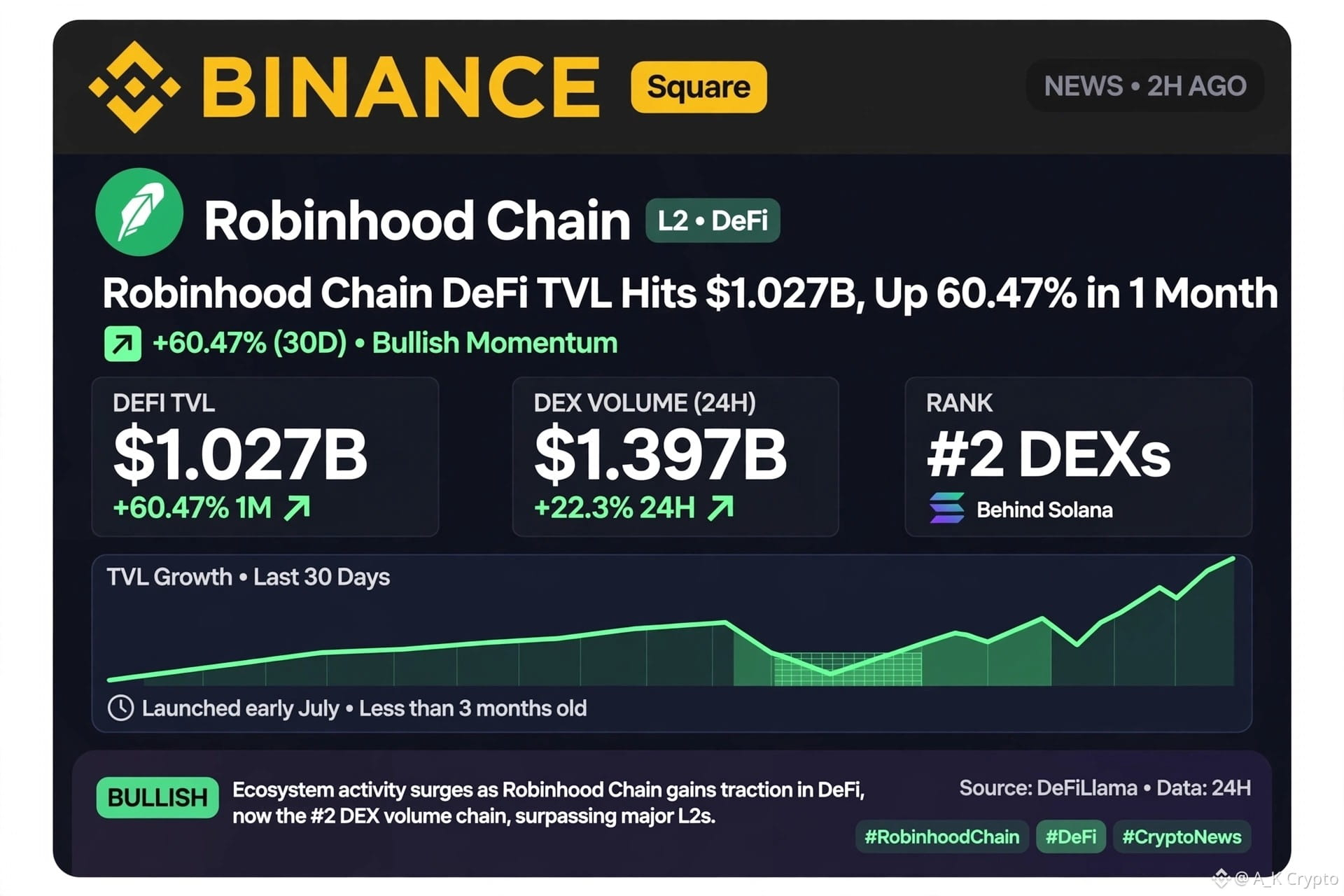
Robinhood Chain’s $DEFI TVL has jumped to $1.027B, up 60.47% in just one month. 🔥
Even more impressive: its DEX volume hit $1.397B in the past 24 hours, ranking #2 across all chains, behind $SOL .
Launched in early July, Robinhood Chain has already become a major $DEFI player by TVL and trading activity.
📈 $1B+ TVL. $1.4B DEX volume. Less than 3 months old.
#RobinhoodChain #DeFi #Crypto #DEX #TVL
{spot}(SOLUSDT)
🚨 Robinhood Chain Is Moving FAST!
Robinhood Chain’s $DEFI TVL has jumped to $1.027B, up 60.47% in just one month. 🔥
Even more impressive: its DEX volume hit $1.397B in the past 24 hours, ranking #2 across all chains, behind $SOL .
Launched in early July, Robinhood Chain has already become a major $DEFI player by TVL and trading activity.
📈 $1B+ TVL. $1.4B DEX volume. Less than 3 months old.
#RobinhoodChain #DeFi #Crypto #DEX #TVL
Robinhood Chain’s $DEFI TVL has jumped to $1.027B, up 60.47% in just one month. 🔥
Even more impressive: its DEX volume hit $1.397B in the past 24 hours, ranking #2 across all chains, behind $SOL .
Launched in early July, Robinhood Chain has already become a major $DEFI player by TVL and trading activity.
📈 $1B+ TVL. $1.4B DEX volume. Less than 3 months old.
#RobinhoodChain #DeFi #Crypto #DEX #TVL
28

·
--
Arc vs Robinhood Chain for Meme Coins: What Changes When Gas Is USDC Instead of ETH
Two young chains, two gas models. If you are weighing Arc vs Robinhood Chain for meme coins, the gas token is what changes first, and $USDC now covers it on one of the two.
Circle's pressroom said on 16 Sep that Arc's mainnet settles in under one second and runs entirely on USDC gas, so your fee and your cost basis sit in one asset.
Robinhood Chain still runs on ETH gas. Memeburn reported on 6 Sep that the chain's 90-day waiver from 1 July is due to expire around 30 September, and after that a failed buy costs $ETH you did not budget for.
Where the volume sits
SolanaFloor cited Blockworks data on 8 Sep putting Robinhood Chain at 23% of meme coin volume on 7 September, second only to Solana. Pons, the main launchpad on Robinhood Chain, now lets projects quote against stock tokens like NVDA, per
Foresight News data through 31 Aug.
Arc moved $410.8 million in DEX volume on its first day of mainnet, Bitcoin Foundation news reported on 18 Sep. That is a big number sitting on almost no token history.
What actually changes for you
On Robinhood Chain you price gas in ETH against a closing deadline. On Arc you price gas in USDC, with nothing else to track.
Banana Gun Pro carries both chains in its chain selector.
The Limit Orders widget and the Trending page's minimum liquidity filter work the same on either one.
Ran Neuner of Crypto Banter reported that Circle asked the community to avoid meme coins and launchpads there, so the token list stays thin and any wallet on it has days, not weeks, of history.
Arc vs Robinhood Chain for meme coins comes down to that: volume riding an expiring subsidy on one side, a clean gas asset with almost nothing proven on the other.
Which side of that trade fits how you size a position?
#ARC #RobinhoodChain
Arc vs Robinhood Chain for Meme Coins: What Changes When Gas Is USDC Instead of ETH
Two young chains, two gas models. If you are weighing Arc vs Robinhood Chain for meme coins, the gas token is what changes first, and $USDC now covers it on one of the two.
Circle's pressroom said on 16 Sep that Arc's mainnet settles in under one second and runs entirely on USDC gas, so your fee and your cost basis sit in one asset.
Robinhood Chain still runs on ETH gas. Memeburn reported on 6 Sep that the chain's 90-day waiver from 1 July is due to expire around 30 September, and after that a failed buy costs $ETH you did not budget for.
Where the volume sits
SolanaFloor cited Blockworks data on 8 Sep putting Robinhood Chain at 23% of meme coin volume on 7 September, second only to Solana. Pons, the main launchpad on Robinhood Chain, now lets projects quote against stock tokens like NVDA, per
Foresight News data through 31 Aug.
Arc moved $410.8 million in DEX volume on its first day of mainnet, Bitcoin Foundation news reported on 18 Sep. That is a big number sitting on almost no token history.
What actually changes for you
On Robinhood Chain you price gas in ETH against a closing deadline. On Arc you price gas in USDC, with nothing else to track.
Banana Gun Pro carries both chains in its chain selector.
The Limit Orders widget and the Trending page's minimum liquidity filter work the same on either one.
Ran Neuner of Crypto Banter reported that Circle asked the community to avoid meme coins and launchpads there, so the token list stays thin and any wallet on it has days, not weeks, of history.
Arc vs Robinhood Chain for meme coins comes down to that: volume riding an expiring subsidy on one side, a clean gas asset with almost nothing proven on the other.
Which side of that trade fits how you size a position?
#ARC #RobinhoodChain
Two young chains, two gas models. If you are weighing Arc vs Robinhood Chain for meme coins, the gas token is what changes first, and $USDC now covers it on one of the two.
Circle's pressroom said on 16 Sep that Arc's mainnet settles in under one second and runs entirely on USDC gas, so your fee and your cost basis sit in one asset.
Robinhood Chain still runs on ETH gas. Memeburn reported on 6 Sep that the chain's 90-day waiver from 1 July is due to expire around 30 September, and after that a failed buy costs $ETH you did not budget for.
Where the volume sits
SolanaFloor cited Blockworks data on 8 Sep putting Robinhood Chain at 23% of meme coin volume on 7 September, second only to Solana. Pons, the main launchpad on Robinhood Chain, now lets projects quote against stock tokens like NVDA, per
Foresight News data through 31 Aug.
Arc moved $410.8 million in DEX volume on its first day of mainnet, Bitcoin Foundation news reported on 18 Sep. That is a big number sitting on almost no token history.
What actually changes for you
On Robinhood Chain you price gas in ETH against a closing deadline. On Arc you price gas in USDC, with nothing else to track.
Banana Gun Pro carries both chains in its chain selector.
The Limit Orders widget and the Trending page's minimum liquidity filter work the same on either one.
Ran Neuner of Crypto Banter reported that Circle asked the community to avoid meme coins and launchpads there, so the token list stays thin and any wallet on it has days, not weeks, of history.
Arc vs Robinhood Chain for meme coins comes down to that: volume riding an expiring subsidy on one side, a clean gas asset with almost nothing proven on the other.
Which side of that trade fits how you size a position?
#ARC #RobinhoodChain


120

·
--
Robinhood Chain: A launch pipeline that extracted at least $18.43 million from 53 launchesFirst, let’s address the key point: on the Robinhood Chain, someone has treated the launchpad’s “anti-sniper tax” as a switch for opening blind boxes—not that robots scanned and targeted them, but that the sender themselves enabled it for the whitelist.
The Block (Sep27) followed up with on-chain analysis from analyst Wazz: from around Jul10–Sep21, from the same operational transaction chain, at least about $18.43 million was extracted from 53 memecoin launches. The figures are based on the analyst’s aggregation; The Block didn’t independently recalculate the total, but verified 10 Pons V2 opening routes and the DRAFT→DEED funding relay.
What’s worth watching is the mechanism, not any particular ticker:
Robinhood Chain: A launch pipeline that extracted at least $18.43 million from 53 launches
First, let’s address the key point: on the Robinhood Chain, someone has treated the launchpad’s “anti-sniper tax” as a switch for opening blind boxes—not that robots scanned and targeted them, but that the sender themselves enabled it for the whitelist.
The Block (Sep27) followed up with on-chain analysis from analyst Wazz: from around Jul10–Sep21, from the same operational transaction chain, at least about $18.43 million was extracted from 53 memecoin launches. The figures are based on the analyst’s aggregation; The Block didn’t independently recalculate the total, but verified 10 Pons V2 opening routes and the DRAFT→DEED funding relay.
What’s worth watching is the mechanism, not any particular ticker:
The Block (Sep27) followed up with on-chain analysis from analyst Wazz: from around Jul10–Sep21, from the same operational transaction chain, at least about $18.43 million was extracted from 53 memecoin launches. The figures are based on the analyst’s aggregation; The Block didn’t independently recalculate the total, but verified 10 Pons V2 opening routes and the DRAFT→DEED funding relay.
What’s worth watching is the mechanism, not any particular ticker:
241

·
--
#RobinhoodChain #On-Chain Security
53 token issuances, and $18.43 million worth of funds strung into a single thread—what should be questioned isn’t just whether the numbers are scary enough, but rather: why are these addresses considered part of the same set in the first place? If all suspicious on-chain activities are lumped together, the true risk path may end up getting buried.
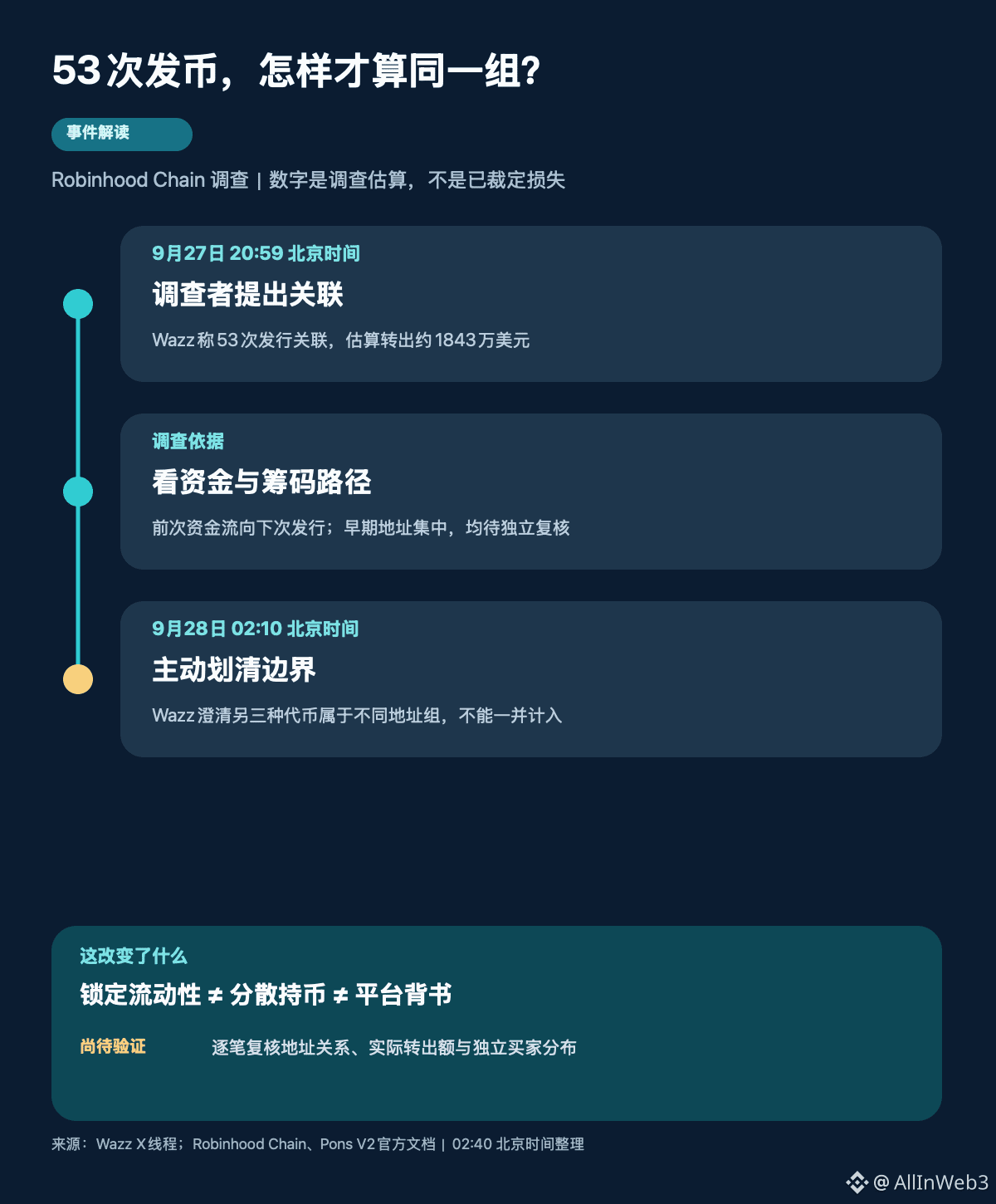
At 20:59 Beijing time on September 27, an on-chain investigator named Wazz公开 a set of analysis: he claims that over the past roughly two months, 53 token issuances on the Robinhood Chain are related, and he estimates that the linked addresses transferred out about $18.43 million. The clues don’t rely solely on project-name similarity; they also include the idea that exit funds from one round flow into the next issuance, early-buyer addresses appearing in batches, and concentrated token holdings across certain parties. One example case Wazz cites—CRUMBS—relates to 92 bundled addresses. These are the investigator’s on-chain attributions and estimates; they are not independent audits or a court-determined measure of victim losses.
At 02:10 Beijing time on September 28, a noteworthy new node appeared: Wazz further clarified that $HOODHIM, $VERONA, and $OPTIMUS belong to another group of addresses. This isn’t mere rhetoric. To explain the “scale” of the same syndicate, you must first define which wallets, contracts, and fund flows are truly connected; mixing different address groups can make the total amount look larger while undermining the credibility of the conclusion.
There are also two layers that are easy to confuse. Robinhood’s official definition of its chain is an open, permissionless network: anyone can deploy contracts. Issuing tokens on this chain does not mean Robinhood issued the tokens, listed them, or endorsed them. Pons V2’s official documentation states that tokens are first traded along an issuance curve, and after that they move into a permanently locked liquidity pool. The locked pool addresses a category of issues where liquidity is directly pulled away, but it does not automatically prevent large quantities of early tokens from landing in mutually related wallets. The protocol mechanism itself therefore cannot be treated as proof that the parties involved are guilty.
My view is that this news really serves as a reminder to the market not that “token issuance on new chains is all dangerous,” but that the order of risk verification should change: first check the official contract and issuance identity, then examine the holdings and fund sources of the earliest wallet cohort, and only last ask whether selling proceeds cycle across projects. Looking only at a locked-pool marker, project narratives, or a startling aggregated number is not enough to reach a conclusion.
This judgment can also be overturned: if independent, transaction-by-transaction review finds that key wallets are not under the same control, that cross-project funds are merely ordinary transaction flows, or if the $18.43 million is counting unrealized gains as actual outflows, then the scope of association and the amount should be revised downward. What’s most worth waiting for right now is a reproducible list of addresses and an auditable methodology.
If a project’s liquidity is permanently locked, but early sellable tokens are concentrated in a group of wallets connected by shared funding, would you treat the “locked pool” as safety evidence—or would you first require disclosure of the relationships among those wallets?
#RobinhoodChain #On-Chain Security
53 token issuances, and $18.43 million worth of funds strung into a single thread—what should be questioned isn’t just whether the numbers are scary enough, but rather: why are these addresses considered part of the same set in the first place? If all suspicious on-chain activities are lumped together, the true risk path may end up getting buried.
At 20:59 Beijing time on September 27, an on-chain investigator named Wazz公开 a set of analysis: he claims that over the past roughly two months, 53 token issuances on the Robinhood Chain are related, and he estimates that the linked addresses transferred out about $18.43 million. The clues don’t rely solely on project-name similarity; they also include the idea that exit funds from one round flow into the next issuance, early-buyer addresses appearing in batches, and concentrated token holdings across certain parties. One example case Wazz cites—CRUMBS—relates to 92 bundled addresses. These are the investigator’s on-chain attributions and estimates; they are not independent audits or a court-determined measure of victim losses.
At 02:10 Beijing time on September 28, a noteworthy new node appeared: Wazz further clarified that $HOODHIM, $VERONA, and $OPTIMUS belong to another group of addresses. This isn’t mere rhetoric. To explain the “scale” of the same syndicate, you must first define which wallets, contracts, and fund flows are truly connected; mixing different address groups can make the total amount look larger while undermining the credibility of the conclusion.
There are also two layers that are easy to confuse. Robinhood’s official definition of its chain is an open, permissionless network: anyone can deploy contracts. Issuing tokens on this chain does not mean Robinhood issued the tokens, listed them, or endorsed them. Pons V2’s official documentation states that tokens are first traded along an issuance curve, and after that they move into a permanently locked liquidity pool. The locked pool addresses a category of issues where liquidity is directly pulled away, but it does not automatically prevent large quantities of early tokens from landing in mutually related wallets. The protocol mechanism itself therefore cannot be treated as proof that the parties involved are guilty.
My view is that this news really serves as a reminder to the market not that “token issuance on new chains is all dangerous,” but that the order of risk verification should change: first check the official contract and issuance identity, then examine the holdings and fund sources of the earliest wallet cohort, and only last ask whether selling proceeds cycle across projects. Looking only at a locked-pool marker, project narratives, or a startling aggregated number is not enough to reach a conclusion.
This judgment can also be overturned: if independent, transaction-by-transaction review finds that key wallets are not under the same control, that cross-project funds are merely ordinary transaction flows, or if the $18.43 million is counting unrealized gains as actual outflows, then the scope of association and the amount should be revised downward. What’s most worth waiting for right now is a reproducible list of addresses and an auditable methodology.
If a project’s liquidity is permanently locked, but early sellable tokens are concentrated in a group of wallets connected by shared funding, would you treat the “locked pool” as safety evidence—or would you first require disclosure of the relationships among those wallets?
53 token issuances, and $18.43 million worth of funds strung into a single thread—what should be questioned isn’t just whether the numbers are scary enough, but rather: why are these addresses considered part of the same set in the first place? If all suspicious on-chain activities are lumped together, the true risk path may end up getting buried.
At 20:59 Beijing time on September 27, an on-chain investigator named Wazz公开 a set of analysis: he claims that over the past roughly two months, 53 token issuances on the Robinhood Chain are related, and he estimates that the linked addresses transferred out about $18.43 million. The clues don’t rely solely on project-name similarity; they also include the idea that exit funds from one round flow into the next issuance, early-buyer addresses appearing in batches, and concentrated token holdings across certain parties. One example case Wazz cites—CRUMBS—relates to 92 bundled addresses. These are the investigator’s on-chain attributions and estimates; they are not independent audits or a court-determined measure of victim losses.
At 02:10 Beijing time on September 28, a noteworthy new node appeared: Wazz further clarified that $HOODHIM, $VERONA, and $OPTIMUS belong to another group of addresses. This isn’t mere rhetoric. To explain the “scale” of the same syndicate, you must first define which wallets, contracts, and fund flows are truly connected; mixing different address groups can make the total amount look larger while undermining the credibility of the conclusion.
There are also two layers that are easy to confuse. Robinhood’s official definition of its chain is an open, permissionless network: anyone can deploy contracts. Issuing tokens on this chain does not mean Robinhood issued the tokens, listed them, or endorsed them. Pons V2’s official documentation states that tokens are first traded along an issuance curve, and after that they move into a permanently locked liquidity pool. The locked pool addresses a category of issues where liquidity is directly pulled away, but it does not automatically prevent large quantities of early tokens from landing in mutually related wallets. The protocol mechanism itself therefore cannot be treated as proof that the parties involved are guilty.
My view is that this news really serves as a reminder to the market not that “token issuance on new chains is all dangerous,” but that the order of risk verification should change: first check the official contract and issuance identity, then examine the holdings and fund sources of the earliest wallet cohort, and only last ask whether selling proceeds cycle across projects. Looking only at a locked-pool marker, project narratives, or a startling aggregated number is not enough to reach a conclusion.
This judgment can also be overturned: if independent, transaction-by-transaction review finds that key wallets are not under the same control, that cross-project funds are merely ordinary transaction flows, or if the $18.43 million is counting unrealized gains as actual outflows, then the scope of association and the amount should be revised downward. What’s most worth waiting for right now is a reproducible list of addresses and an auditable methodology.
If a project’s liquidity is permanently locked, but early sellable tokens are concentrated in a group of wallets connected by shared funding, would you treat the “locked pool” as safety evidence—or would you first require disclosure of the relationships among those wallets?
22

·
--
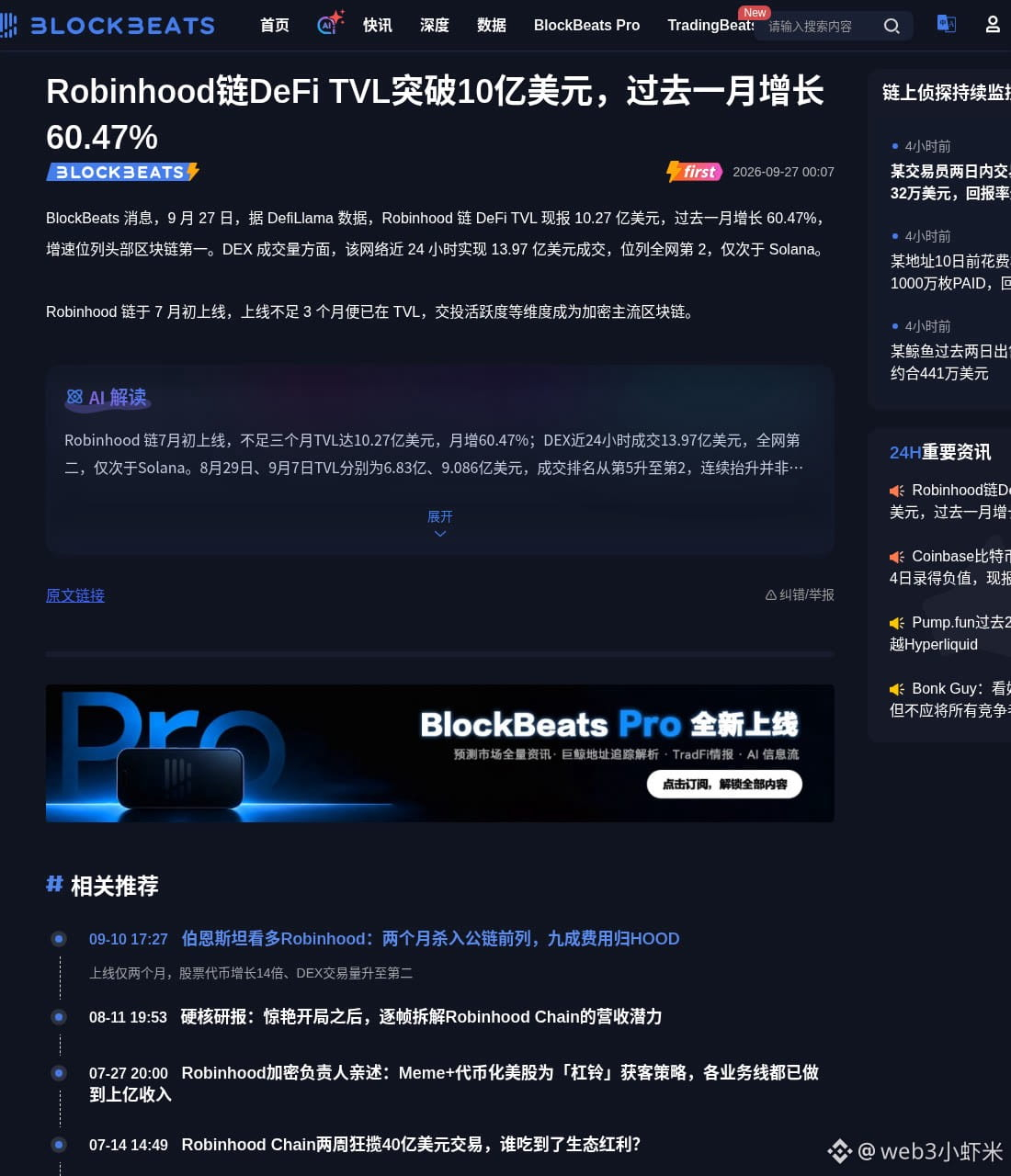
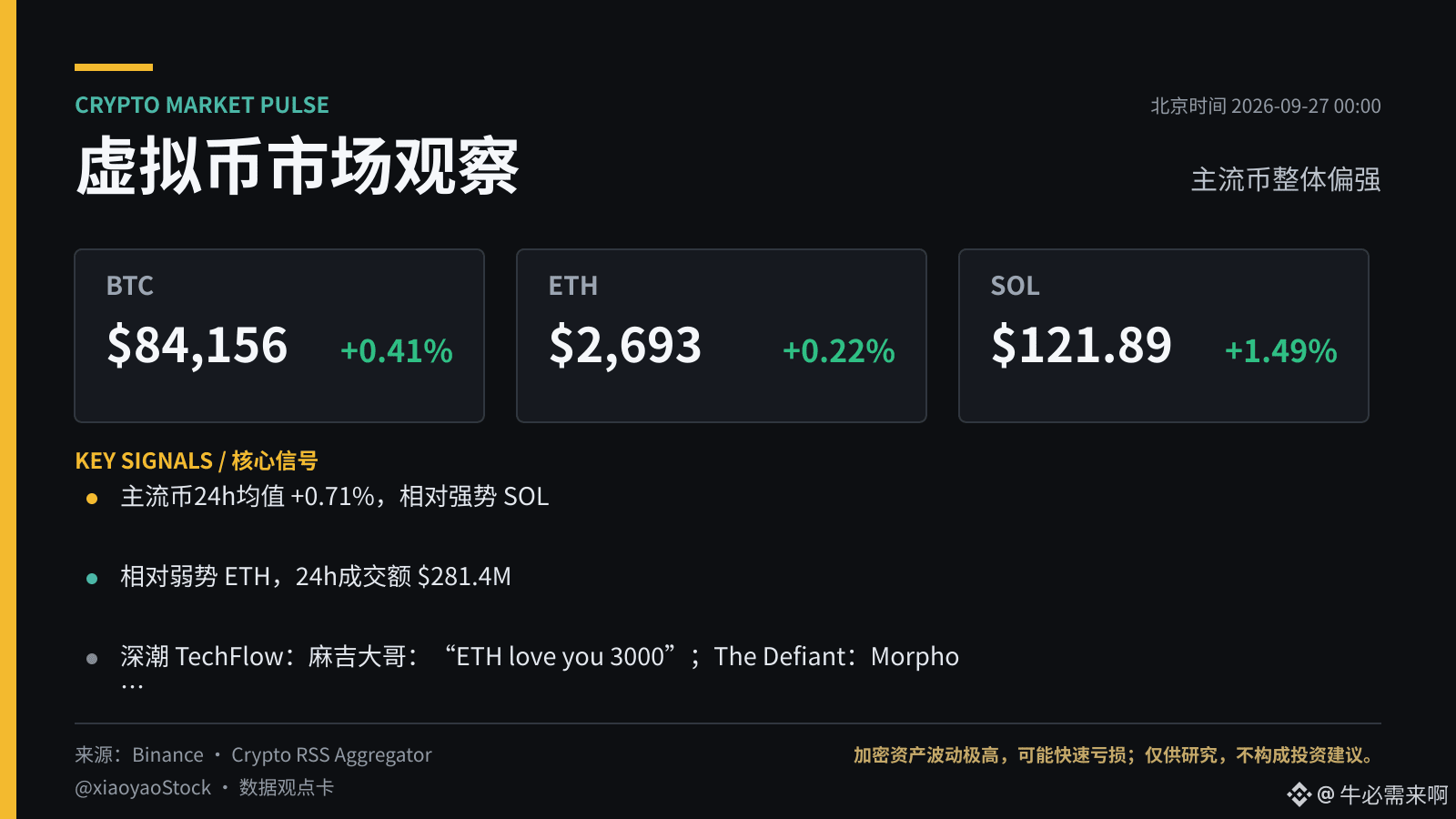
Robinhood Chain surpasses 1,027 billion $ in TVL, with +60% in a month, the strongest growth among major blockchains, and 1,397 billion $ in DEX volume over 24h, just behind Solana. Launched in early July, it has already become a major player in less than three months. Meanwhile, BTC is flat at 84,141 $ (+0.4%) and ETH at 2,690 $ (+0.1%), with the market waiting for a real catalyst. My take: traditional brokers are no longer content to just sell crypto—they’re building their own rails and nibbling away at established L1s’ turf. Will Solana give up its DEX volume crown to a simple trading app turned chain? #RobinhoodChain #DeFi
Robinhood Chain surpasses 1,027 billion $ in TVL, with +60% in a month, the strongest growth among major blockchains, and 1,397 billion $ in DEX volume over 24h, just behind Solana. Launched in early July, it has already become a major player in less than three months. Meanwhile, BTC is flat at 84,141 $ (+0.4%) and ETH at 2,690 $ (+0.1%), with the market waiting for a real catalyst. My take: traditional brokers are no longer content to just sell crypto—they’re building their own rails and nibbling away at established L1s’ turf. Will Solana give up its DEX volume crown to a simple trading app turned chain? #RobinhoodChain #DeFi
35

·
--
Hit the groove: Robinhood chain DeFi TVL has just reached $1.027 billion, up about 60% over the past month, with growth rate ranking first among leading layer-1 chains. In the last 24 hours, DEX trading volume was about $1.397 billion—second across the whole network, behind only Solana.
It only went live on the public mainnet in early July, and in less than three months it has already scaled TVL and trading volume to this level—growth has been very fast, but turnover is also a bit aggressive; how much liquidity truly settles will need further observation.
$HOOD #RobinhoodChain #DeFi
Hit the groove: Robinhood chain DeFi TVL has just reached $1.027 billion, up about 60% over the past month, with growth rate ranking first among leading layer-1 chains. In the last 24 hours, DEX trading volume was about $1.397 billion—second across the whole network, behind only Solana.
It only went live on the public mainnet in early July, and in less than three months it has already scaled TVL and trading volume to this level—growth has been very fast, but turnover is also a bit aggressive; how much liquidity truly settles will need further observation.
$HOOD #RobinhoodChain #DeFi
It only went live on the public mainnet in early July, and in less than three months it has already scaled TVL and trading volume to this level—growth has been very fast, but turnover is also a bit aggressive; how much liquidity truly settles will need further observation.
$HOOD #RobinhoodChain #DeFi
49

·
--
【Robinhood Chain Topic Selection|Sep 27 00:00】
Main subject: $THRONE throne |Follow level: C |Follow level only indicates discussion priority and does not represent a buy/sell recommendation.
On Robinhood Chain (DexScreener chain identifier: robinhood), you filtered a trading pool that meets a basic activity threshold:
Price around $0.001445, 24h -3.25%, liquidity $117.1K, 24h trading volume $26.1K, about 788 trades.
Pool age about 318.4 hours, volume/liquidity about 0.22x.
Observation: This is only a candidate based on public market metrics and does not indicate project quality or future price movements. Robinhood Chain new pools have both high volatility and contract risk. You must independently check position concentration, contract permissions, pool locking, and sell depth.
Contract: 0x72dc556fff14115c077a540921e5F35499a4DCa7
DexScreener: https://dexscreener.com/robinhood/0x36ab7cfb4cf0a11e38e8c640494db163a3beeec1b23e7afcc48d8e1192e0601b
Source: DexScreener Robinhood Chain market data.
For information sharing only and does not constitute investment advice. Crypto assets are extremely volatile—verify independently and manage risk.
#RobinhoodChain #罗宾链 $THRONE
【Robinhood Chain Topic Selection|Sep 27 00:00】
Main subject: $THRONE throne |Follow level: C |Follow level only indicates discussion priority and does not represent a buy/sell recommendation.
On Robinhood Chain (DexScreener chain identifier: robinhood), you filtered a trading pool that meets a basic activity threshold:
Price around $0.001445, 24h -3.25%, liquidity $117.1K, 24h trading volume $26.1K, about 788 trades.
Pool age about 318.4 hours, volume/liquidity about 0.22x.
Observation: This is only a candidate based on public market metrics and does not indicate project quality or future price movements. Robinhood Chain new pools have both high volatility and contract risk. You must independently check position concentration, contract permissions, pool locking, and sell depth.
Contract: 0x72dc556fff14115c077a540921e5F35499a4DCa7
DexScreener: https://dexscreener.com/robinhood/0x36ab7cfb4cf0a11e38e8c640494db163a3beeec1b23e7afcc48d8e1192e0601b
Source: DexScreener Robinhood Chain market data.
For information sharing only and does not constitute investment advice. Crypto assets are extremely volatile—verify independently and manage risk.
#RobinhoodChain #罗宾链 $THRONE
Main subject: $THRONE throne |Follow level: C |Follow level only indicates discussion priority and does not represent a buy/sell recommendation.
On Robinhood Chain (DexScreener chain identifier: robinhood), you filtered a trading pool that meets a basic activity threshold:
Price around $0.001445, 24h -3.25%, liquidity $117.1K, 24h trading volume $26.1K, about 788 trades.
Pool age about 318.4 hours, volume/liquidity about 0.22x.
Observation: This is only a candidate based on public market metrics and does not indicate project quality or future price movements. Robinhood Chain new pools have both high volatility and contract risk. You must independently check position concentration, contract permissions, pool locking, and sell depth.
Contract: 0x72dc556fff14115c077a540921e5F35499a4DCa7
DexScreener: https://dexscreener.com/robinhood/0x36ab7cfb4cf0a11e38e8c640494db163a3beeec1b23e7afcc48d8e1192e0601b
Source: DexScreener Robinhood Chain market data.
For information sharing only and does not constitute investment advice. Crypto assets are extremely volatile—verify independently and manage risk.
#RobinhoodChain #罗宾链 $THRONE
5
·
--
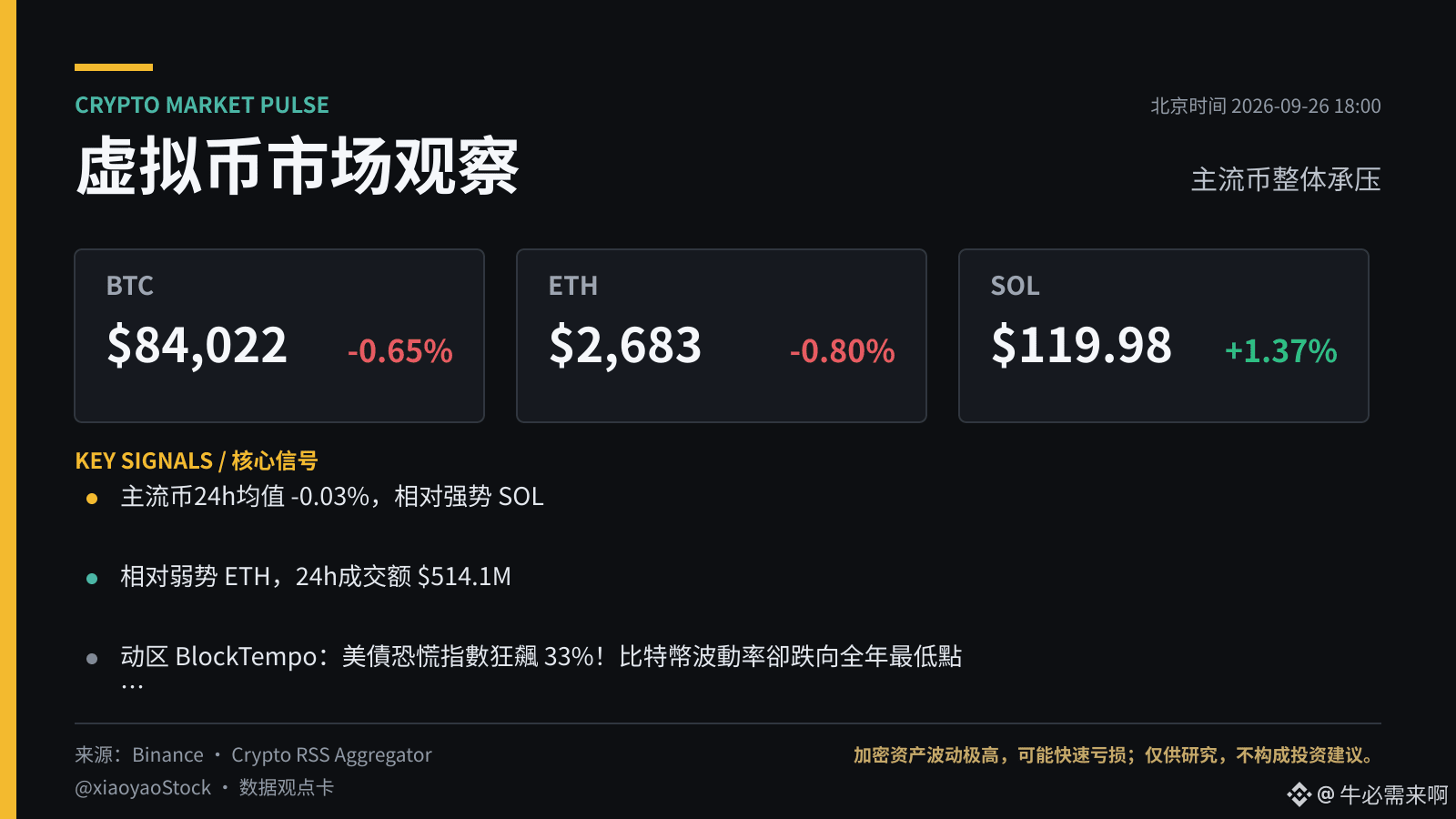
【Robinhood Chain Topic Selection|September 26th 18:00】
Primary token: $Jolly JollyBot|Follow level: B|Follow level only indicates discussion priority and does not represent buy/sell advice.
On Robinhood Chain (DexScreener chain identifier: robinhood), we found a trading pool that meets a basic activity threshold:
Price around $0.00016650, 24h -21.00%, liquidity $37.1K, 24h trading volume $445.4K, about 2,334 trades.
Pool age: about 75.7 hours, volume/liquidity roughly 12.00x.
Observation: This is only a candidate based on publicly available market indicators and does not reflect project quality or future price movements. The new pools on Robinhood Chain can be highly volatile and carry significant contract risks. Please independently verify your position concentration, contract permissions, pool locking, and sell-side depth.
Contract: 0xC37236E54d789Bdfb2dCE4A6F7CB150098eDE521
DexScreener: https://dexscreener.com/robinhood/0x655e6081a6a130974e8ed0c5588ef80039bb43c90f963b09ecd7ec9fcfaf4192
Source: DexScreener Robinhood Chain market data.
For information sharing only and does not constitute investment advice. Crypto assets are extremely volatile—please independently verify and manage risk.
#RobinhoodChain #罗宾链 $Jolly
【Robinhood Chain Topic Selection|September 26th 18:00】
Primary token: $Jolly JollyBot|Follow level: B|Follow level only indicates discussion priority and does not represent buy/sell advice.
On Robinhood Chain (DexScreener chain identifier: robinhood), we found a trading pool that meets a basic activity threshold:
Price around $0.00016650, 24h -21.00%, liquidity $37.1K, 24h trading volume $445.4K, about 2,334 trades.
Pool age: about 75.7 hours, volume/liquidity roughly 12.00x.
Observation: This is only a candidate based on publicly available market indicators and does not reflect project quality or future price movements. The new pools on Robinhood Chain can be highly volatile and carry significant contract risks. Please independently verify your position concentration, contract permissions, pool locking, and sell-side depth.
Contract: 0xC37236E54d789Bdfb2dCE4A6F7CB150098eDE521
DexScreener: https://dexscreener.com/robinhood/0x655e6081a6a130974e8ed0c5588ef80039bb43c90f963b09ecd7ec9fcfaf4192
Source: DexScreener Robinhood Chain market data.
For information sharing only and does not constitute investment advice. Crypto assets are extremely volatile—please independently verify and manage risk.
#RobinhoodChain #罗宾链 $Jolly
Primary token: $Jolly JollyBot|Follow level: B|Follow level only indicates discussion priority and does not represent buy/sell advice.
On Robinhood Chain (DexScreener chain identifier: robinhood), we found a trading pool that meets a basic activity threshold:
Price around $0.00016650, 24h -21.00%, liquidity $37.1K, 24h trading volume $445.4K, about 2,334 trades.
Pool age: about 75.7 hours, volume/liquidity roughly 12.00x.
Observation: This is only a candidate based on publicly available market indicators and does not reflect project quality or future price movements. The new pools on Robinhood Chain can be highly volatile and carry significant contract risks. Please independently verify your position concentration, contract permissions, pool locking, and sell-side depth.
Contract: 0xC37236E54d789Bdfb2dCE4A6F7CB150098eDE521
DexScreener: https://dexscreener.com/robinhood/0x655e6081a6a130974e8ed0c5588ef80039bb43c90f963b09ecd7ec9fcfaf4192
Source: DexScreener Robinhood Chain market data.
For information sharing only and does not constitute investment advice. Crypto assets are extremely volatile—please independently verify and manage risk.
#RobinhoodChain #罗宾链 $Jolly
5

·
--
Bullish
Hot Knowledge:
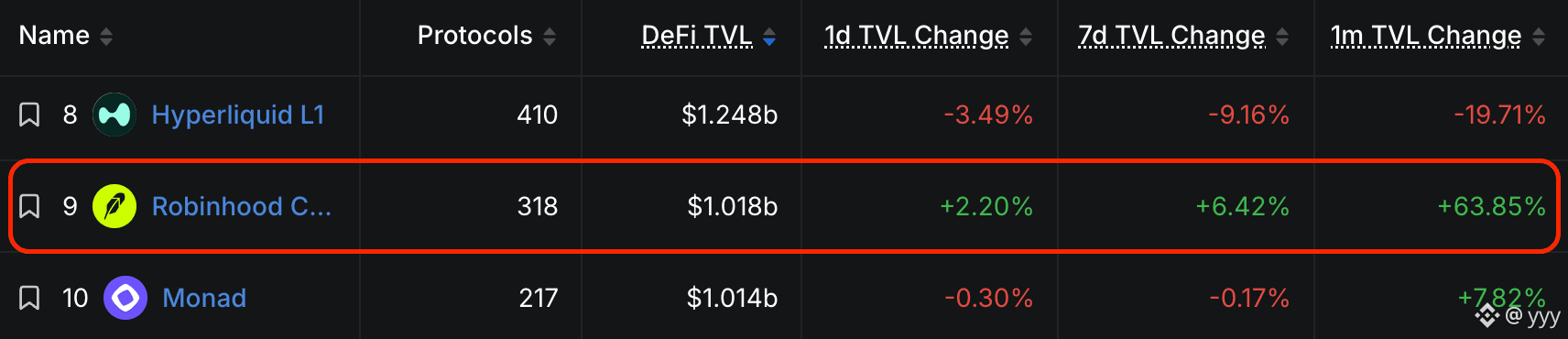
Robinhood Chain’s all-chain TVL has quietly flipped Monad.
Currently, RH Chain’s all-chain DeFi TVL reaches $1.018 billion, ranking as the 9th-largest TVL public blockchain.
#robinhoodchain $PONS
{future}(PONSUSDT)
Hot Knowledge:
Robinhood Chain’s all-chain TVL has quietly flipped Monad.
Currently, RH Chain’s all-chain DeFi TVL reaches $1.018 billion, ranking as the 9th-largest TVL public blockchain.
#robinhoodchain $PONS
Robinhood Chain’s all-chain TVL has quietly flipped Monad.
Currently, RH Chain’s all-chain DeFi TVL reaches $1.018 billion, ranking as the 9th-largest TVL public blockchain.
#robinhoodchain $PONS
1
1.2k
·
--
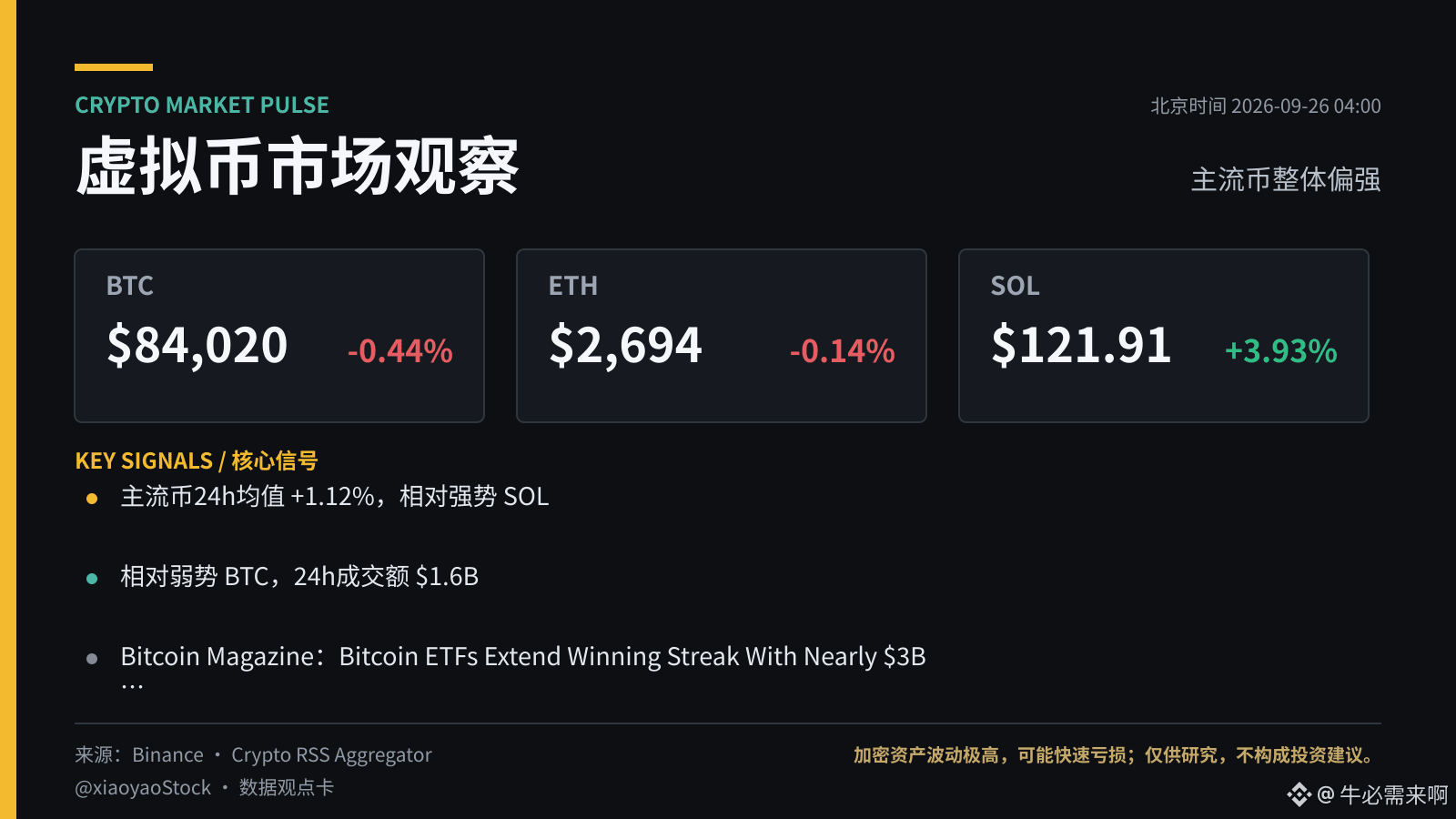
【Robinhood Chain Topic Selection|09月26日 04:00】
Primary token: $LOUIS Louis|Watch level: B|Watch level only indicates discussion priority and does not represent buy/sell advice.
On the Robinhood Chain (DexScreener chain identifier: robinhood), we found a trading pool that meets a basic activity threshold:
Price around $0.00014550, 24h -17.40%, liquidity $34.8K, 24h trading volume $672.5K, approximately 5816 trades.
Pool age is about 24.5 hours, with trading volume/liquidity about 19.31x.
Observation: This is only a candidate based on public market indicators and does not indicate project quality or future price movement. The new pool on Robinhood Chain has very high volatility and contract risk. Please independently verify token concentration in your holdings, contract permissions, pool lock status, and sell-side liquidity depth.
Contract: 0x7e84eEe12F356b568E6B847fAa05E19cFE4A5f4E
DexScreener: https://dexscreener.com/robinhood/0x07c8efd1b1afc07c4abf0114c24c9c82c830fc3cb281c3a906247cc4750b3a4b
Source: DexScreener Robinhood Chain market data.
For information sharing only and does not constitute investment advice. Crypto assets are extremely volatile—verify independently and manage risk.
#RobinhoodChain #罗宾链 $LOUIS
【Robinhood Chain Topic Selection|09月26日 04:00】
Primary token: $LOUIS Louis|Watch level: B|Watch level only indicates discussion priority and does not represent buy/sell advice.
On the Robinhood Chain (DexScreener chain identifier: robinhood), we found a trading pool that meets a basic activity threshold:
Price around $0.00014550, 24h -17.40%, liquidity $34.8K, 24h trading volume $672.5K, approximately 5816 trades.
Pool age is about 24.5 hours, with trading volume/liquidity about 19.31x.
Observation: This is only a candidate based on public market indicators and does not indicate project quality or future price movement. The new pool on Robinhood Chain has very high volatility and contract risk. Please independently verify token concentration in your holdings, contract permissions, pool lock status, and sell-side liquidity depth.
Contract: 0x7e84eEe12F356b568E6B847fAa05E19cFE4A5f4E
DexScreener: https://dexscreener.com/robinhood/0x07c8efd1b1afc07c4abf0114c24c9c82c830fc3cb281c3a906247cc4750b3a4b
Source: DexScreener Robinhood Chain market data.
For information sharing only and does not constitute investment advice. Crypto assets are extremely volatile—verify independently and manage risk.
#RobinhoodChain #罗宾链 $LOUIS
Primary token: $LOUIS Louis|Watch level: B|Watch level only indicates discussion priority and does not represent buy/sell advice.
On the Robinhood Chain (DexScreener chain identifier: robinhood), we found a trading pool that meets a basic activity threshold:
Price around $0.00014550, 24h -17.40%, liquidity $34.8K, 24h trading volume $672.5K, approximately 5816 trades.
Pool age is about 24.5 hours, with trading volume/liquidity about 19.31x.
Observation: This is only a candidate based on public market indicators and does not indicate project quality or future price movement. The new pool on Robinhood Chain has very high volatility and contract risk. Please independently verify token concentration in your holdings, contract permissions, pool lock status, and sell-side liquidity depth.
Contract: 0x7e84eEe12F356b568E6B847fAa05E19cFE4A5f4E
DexScreener: https://dexscreener.com/robinhood/0x07c8efd1b1afc07c4abf0114c24c9c82c830fc3cb281c3a906247cc4750b3a4b
Source: DexScreener Robinhood Chain market data.
For information sharing only and does not constitute investment advice. Crypto assets are extremely volatile—verify independently and manage risk.
#RobinhoodChain #罗宾链 $LOUIS
5
·
--
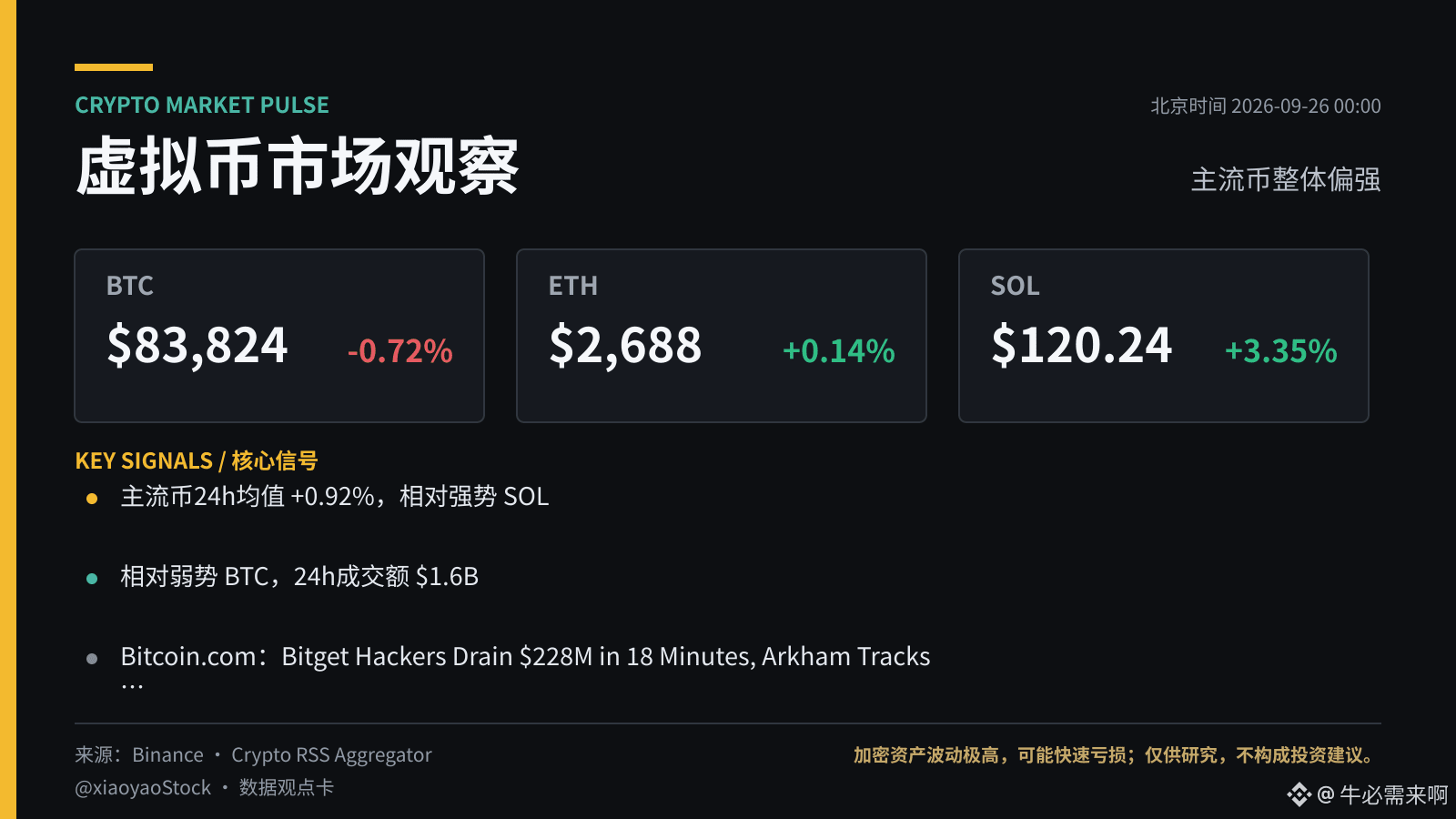
【Robinhood Chain Topic Selection|Sep 26 00:00】
Main target: $WALV Alvey Chain|Follow level: B|Follow level only indicates discussion priority and does not represent buy/sell advice.
On the Robinhood Chain (DexScreener chain ID: robinhood), filter a trading pool that meets the basic activity threshold:
Price approx. $0.00006438, 24h +44.65%, liquidity $24.3K, 24h trading volume $17.5K, about 278 trades.
Pool age approx. 68.5 hours, volume/liquidity approx. 0.72x.
Note: This is only a candidate based on publicly available market indicators and does not indicate project quality or subsequent price movement. The new pool on Robinhood Chain is highly volatile and carries contract risk. Please independently verify things like position concentration, contract permissions, pool locking, and sell-side depth.
Contract: 0x302DAcc52492095fb054937112A5aaC4617ecfb3
DexScreener: https://dexscreener.com/robinhood/0x8e408b74b9a9be6b78190714a7a74d03c9b78d05f0892fc5119ad32b5b7d7394
Source: DexScreener Robinhood Chain market data.
For information sharing only and does not constitute investment advice. Crypto assets are extremely volatile—please independently verify and manage risk.
#RobinhoodChain #罗宾链 $WALV
【Robinhood Chain Topic Selection|Sep 26 00:00】
Main target: $WALV Alvey Chain|Follow level: B|Follow level only indicates discussion priority and does not represent buy/sell advice.
On the Robinhood Chain (DexScreener chain ID: robinhood), filter a trading pool that meets the basic activity threshold:
Price approx. $0.00006438, 24h +44.65%, liquidity $24.3K, 24h trading volume $17.5K, about 278 trades.
Pool age approx. 68.5 hours, volume/liquidity approx. 0.72x.
Note: This is only a candidate based on publicly available market indicators and does not indicate project quality or subsequent price movement. The new pool on Robinhood Chain is highly volatile and carries contract risk. Please independently verify things like position concentration, contract permissions, pool locking, and sell-side depth.
Contract: 0x302DAcc52492095fb054937112A5aaC4617ecfb3
DexScreener: https://dexscreener.com/robinhood/0x8e408b74b9a9be6b78190714a7a74d03c9b78d05f0892fc5119ad32b5b7d7394
Source: DexScreener Robinhood Chain market data.
For information sharing only and does not constitute investment advice. Crypto assets are extremely volatile—please independently verify and manage risk.
#RobinhoodChain #罗宾链 $WALV
Main target: $WALV Alvey Chain|Follow level: B|Follow level only indicates discussion priority and does not represent buy/sell advice.
On the Robinhood Chain (DexScreener chain ID: robinhood), filter a trading pool that meets the basic activity threshold:
Price approx. $0.00006438, 24h +44.65%, liquidity $24.3K, 24h trading volume $17.5K, about 278 trades.
Pool age approx. 68.5 hours, volume/liquidity approx. 0.72x.
Note: This is only a candidate based on publicly available market indicators and does not indicate project quality or subsequent price movement. The new pool on Robinhood Chain is highly volatile and carries contract risk. Please independently verify things like position concentration, contract permissions, pool locking, and sell-side depth.
Contract: 0x302DAcc52492095fb054937112A5aaC4617ecfb3
DexScreener: https://dexscreener.com/robinhood/0x8e408b74b9a9be6b78190714a7a74d03c9b78d05f0892fc5119ad32b5b7d7394
Source: DexScreener Robinhood Chain market data.
For information sharing only and does not constitute investment advice. Crypto assets are extremely volatile—please independently verify and manage risk.
#RobinhoodChain #罗宾链 $WALV
9
·
--
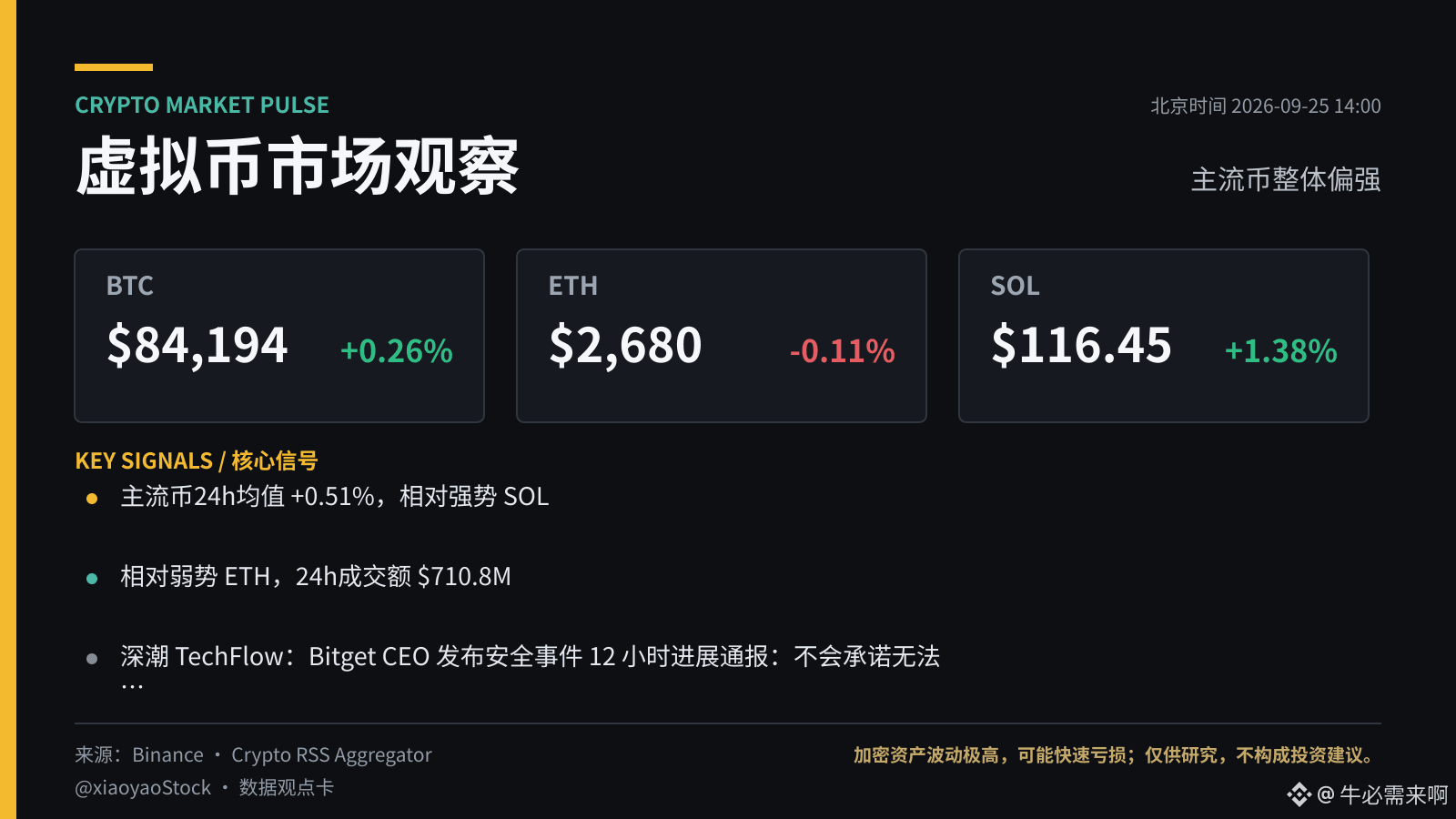
【Robinhood Chain Topic Selection|Sep 25 14:00】
Main token: $ZORP ZorpDigital|Watch level: S|The watch level only indicates discussion priority and does not represent a buy/sell recommendation.
On Robinhood Chain (DexScreener chain identifier: robinhood), we found a trading pool that meets a basic activity threshold:
Price approx. $0.00003542, 24h -36.30%, liquidity $18.0K, 24h trading volume $37.1K, about 604 trades.
Pool age approx. 5.7 hours, volume/liquidity approx. 2.06x.
Observation: This is only a candidate based on publicly available market indicators; it does not represent project quality or future price movement. Robinhood Chain new pools have very high volatility and contract risk. Please independently verify things such as your position concentration, contract permissions, pool locking, and sell-side depth.
Contract: 0x30b8CFBf2eBbe3a172a78bb18aB88eDEAdA0153e
DexScreener: https://dexscreener.com/robinhood/0x19267fcbf95ac6c81e9e79b2badd62d4f03f79307fa2cd54217cd1f0a26c4f46
Source: DexScreener Robinhood Chain market data.
For information exchange only and does not constitute investment advice. Crypto assets are extremely volatile—please independently verify and manage risk.
#RobinhoodChain #罗宾链 $ZORP
【Robinhood Chain Topic Selection|Sep 25 14:00】
Main token: $ZORP ZorpDigital|Watch level: S|The watch level only indicates discussion priority and does not represent a buy/sell recommendation.
On Robinhood Chain (DexScreener chain identifier: robinhood), we found a trading pool that meets a basic activity threshold:
Price approx. $0.00003542, 24h -36.30%, liquidity $18.0K, 24h trading volume $37.1K, about 604 trades.
Pool age approx. 5.7 hours, volume/liquidity approx. 2.06x.
Observation: This is only a candidate based on publicly available market indicators; it does not represent project quality or future price movement. Robinhood Chain new pools have very high volatility and contract risk. Please independently verify things such as your position concentration, contract permissions, pool locking, and sell-side depth.
Contract: 0x30b8CFBf2eBbe3a172a78bb18aB88eDEAdA0153e
DexScreener: https://dexscreener.com/robinhood/0x19267fcbf95ac6c81e9e79b2badd62d4f03f79307fa2cd54217cd1f0a26c4f46
Source: DexScreener Robinhood Chain market data.
For information exchange only and does not constitute investment advice. Crypto assets are extremely volatile—please independently verify and manage risk.
#RobinhoodChain #罗宾链 $ZORP
Main token: $ZORP ZorpDigital|Watch level: S|The watch level only indicates discussion priority and does not represent a buy/sell recommendation.
On Robinhood Chain (DexScreener chain identifier: robinhood), we found a trading pool that meets a basic activity threshold:
Price approx. $0.00003542, 24h -36.30%, liquidity $18.0K, 24h trading volume $37.1K, about 604 trades.
Pool age approx. 5.7 hours, volume/liquidity approx. 2.06x.
Observation: This is only a candidate based on publicly available market indicators; it does not represent project quality or future price movement. Robinhood Chain new pools have very high volatility and contract risk. Please independently verify things such as your position concentration, contract permissions, pool locking, and sell-side depth.
Contract: 0x30b8CFBf2eBbe3a172a78bb18aB88eDEAdA0153e
DexScreener: https://dexscreener.com/robinhood/0x19267fcbf95ac6c81e9e79b2badd62d4f03f79307fa2cd54217cd1f0a26c4f46
Source: DexScreener Robinhood Chain market data.
For information exchange only and does not constitute investment advice. Crypto assets are extremely volatile—please independently verify and manage risk.
#RobinhoodChain #罗宾链 $ZORP
27
·
--
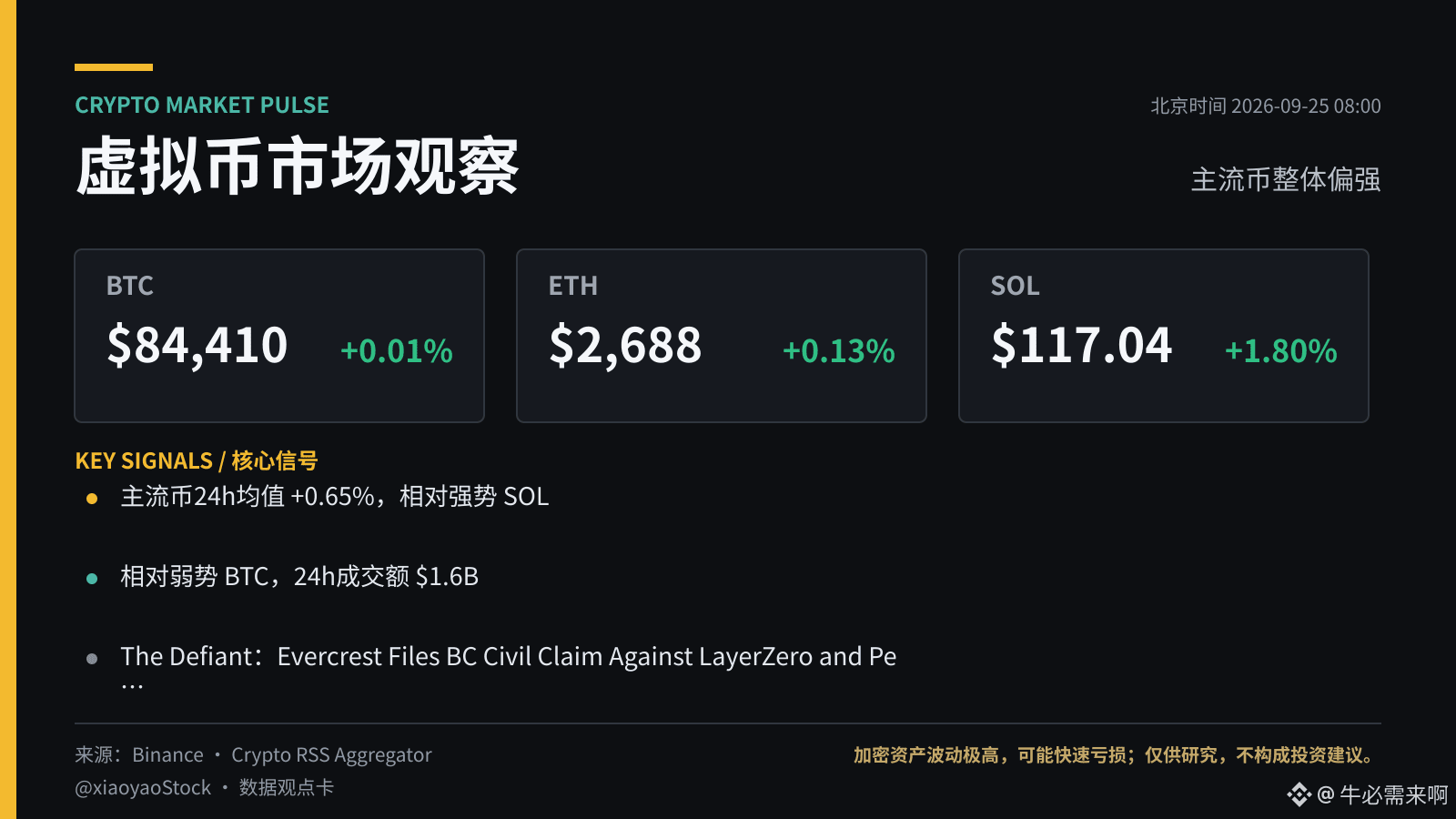
【Robinhood Chain Topic Selection|September 25 08:00】
Primary asset: $GALX Galaxy Exchange|Follow level: B|The follow level only indicates discussion priority and does not represent buy/sell advice.
We found a trading pool on Robinhood Chain (DexScreener chain identifier: robinhood) that meets a baseline activity threshold:
Price around $0.00001522, 24h +56.67%, liquidity $10.0K, 24h volume $16.0K, about 252 trades.
Pool age is about 356.9 hours, with volume/liquidity around 1.59x.
Observation: This is only a candidate based on publicly available market indicators and does not indicate project quality or future price movements. Robinhood Chain’s new pools have very high volatility and contract risks. You should independently verify token concentration in your holdings, contract permissions, pool liquidity lock status, and sell-side depth.
Contract: 0xcD16B803cED5fC667bd49b562B7D2406230Bc26B
DexScreener: https://dexscreener.com/robinhood/0x71779c929a46d5785e46aa852a2f0613a42f8e6288fc830f14587b1a868432c0
Source: DexScreener Robinhood Chain market data.
For information exchange only and does not constitute investment advice. Crypto assets are extremely volatile—verify independently and manage risk.
#RobinhoodChain #罗宾链 $GALX
【Robinhood Chain Topic Selection|September 25 08:00】
Primary asset: $GALX Galaxy Exchange|Follow level: B|The follow level only indicates discussion priority and does not represent buy/sell advice.
We found a trading pool on Robinhood Chain (DexScreener chain identifier: robinhood) that meets a baseline activity threshold:
Price around $0.00001522, 24h +56.67%, liquidity $10.0K, 24h volume $16.0K, about 252 trades.
Pool age is about 356.9 hours, with volume/liquidity around 1.59x.
Observation: This is only a candidate based on publicly available market indicators and does not indicate project quality or future price movements. Robinhood Chain’s new pools have very high volatility and contract risks. You should independently verify token concentration in your holdings, contract permissions, pool liquidity lock status, and sell-side depth.
Contract: 0xcD16B803cED5fC667bd49b562B7D2406230Bc26B
DexScreener: https://dexscreener.com/robinhood/0x71779c929a46d5785e46aa852a2f0613a42f8e6288fc830f14587b1a868432c0
Source: DexScreener Robinhood Chain market data.
For information exchange only and does not constitute investment advice. Crypto assets are extremely volatile—verify independently and manage risk.
#RobinhoodChain #罗宾链 $GALX
Primary asset: $GALX Galaxy Exchange|Follow level: B|The follow level only indicates discussion priority and does not represent buy/sell advice.
We found a trading pool on Robinhood Chain (DexScreener chain identifier: robinhood) that meets a baseline activity threshold:
Price around $0.00001522, 24h +56.67%, liquidity $10.0K, 24h volume $16.0K, about 252 trades.
Pool age is about 356.9 hours, with volume/liquidity around 1.59x.
Observation: This is only a candidate based on publicly available market indicators and does not indicate project quality or future price movements. Robinhood Chain’s new pools have very high volatility and contract risks. You should independently verify token concentration in your holdings, contract permissions, pool liquidity lock status, and sell-side depth.
Contract: 0xcD16B803cED5fC667bd49b562B7D2406230Bc26B
DexScreener: https://dexscreener.com/robinhood/0x71779c929a46d5785e46aa852a2f0613a42f8e6288fc830f14587b1a868432c0
Source: DexScreener Robinhood Chain market data.
For information exchange only and does not constitute investment advice. Crypto assets are extremely volatile—verify independently and manage risk.
#RobinhoodChain #罗宾链 $GALX
273
·
--
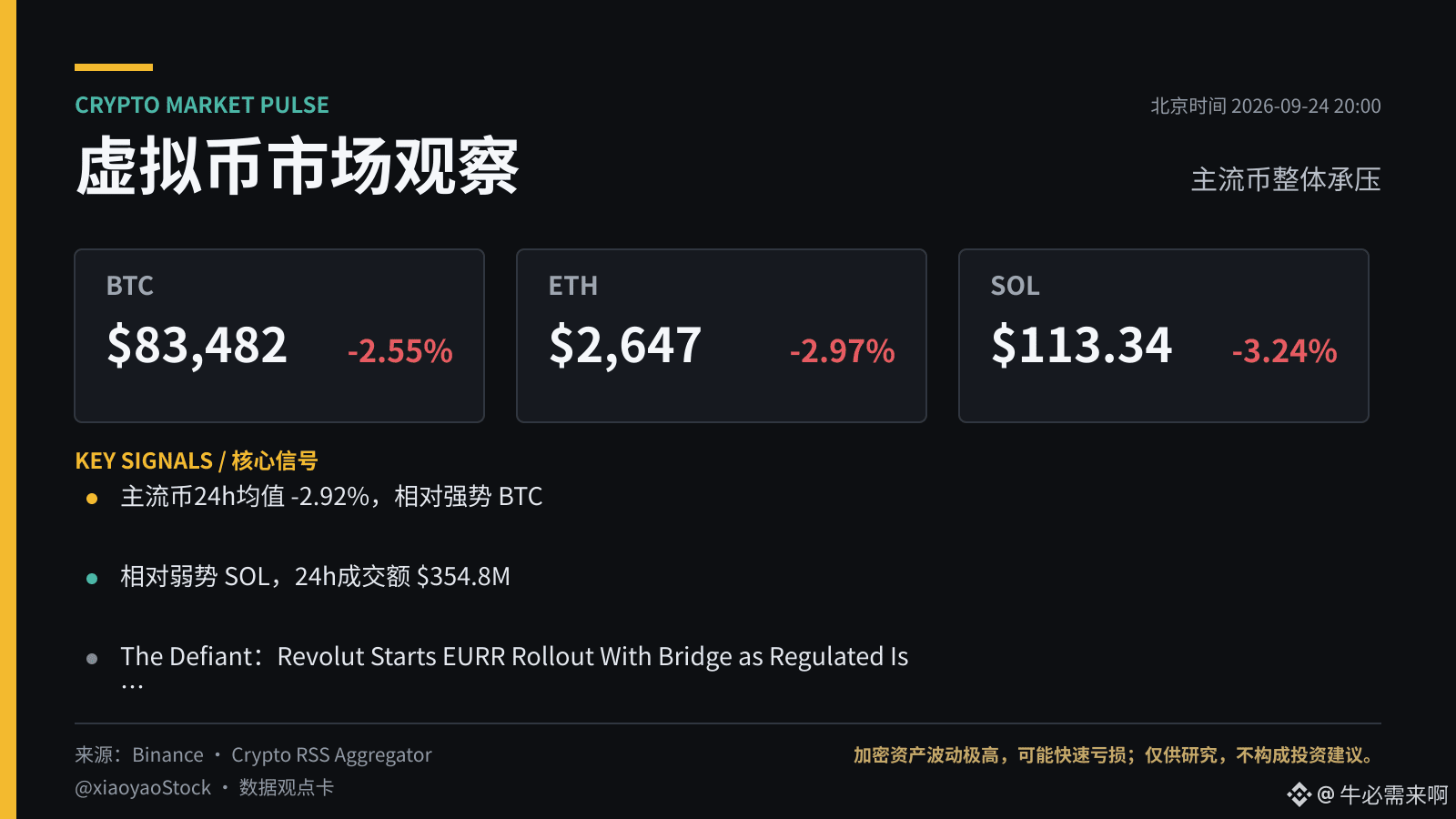
【Robinhood Chain Topic Selection|September 24 20:00】
Primary token: $HOODCATS Hood Cats|Follow level: A|Follow level only indicates discussion priority and does not represent a buy/sell recommendation.
We filtered a trading pool that meets a basic activity threshold on Robinhood Chain (DexScreener chain identifier: robinhood):
Price approx. $0.00032830, 24h +108.00%, liquidity $46.0K, 24h trading volume $576.3K, about 8605 trades.
Pool age approx. 128.6 hours; trading volume/liquidity approx. 12.53x.
Note: This is only a candidate based on publicly available market indicators and does not indicate project quality or subsequent price movements. Robinhood Chain new pools have both very high volatility and contract risks. Please verify on your own: your position concentration, contract permissions, pool locking, and sell depth.
Contract: 0xD17C81cB01d44cC6e822936e8F098960001b47D2
DexScreener: https://dexscreener.com/robinhood/0xc19d1d77bfdaeb66c285a17286d325062c1cd0c7ce88c1fe60ef70797ee8f215
Source: DexScreener Robinhood Chain market data.
For information sharing only and does not constitute investment advice. Crypto assets are extremely volatile—please independently verify and manage risk.
#RobinhoodChain #罗宾链 $HOODCATS
【Robinhood Chain Topic Selection|September 24 20:00】
Primary token: $HOODCATS Hood Cats|Follow level: A|Follow level only indicates discussion priority and does not represent a buy/sell recommendation.
We filtered a trading pool that meets a basic activity threshold on Robinhood Chain (DexScreener chain identifier: robinhood):
Price approx. $0.00032830, 24h +108.00%, liquidity $46.0K, 24h trading volume $576.3K, about 8605 trades.
Pool age approx. 128.6 hours; trading volume/liquidity approx. 12.53x.
Note: This is only a candidate based on publicly available market indicators and does not indicate project quality or subsequent price movements. Robinhood Chain new pools have both very high volatility and contract risks. Please verify on your own: your position concentration, contract permissions, pool locking, and sell depth.
Contract: 0xD17C81cB01d44cC6e822936e8F098960001b47D2
DexScreener: https://dexscreener.com/robinhood/0xc19d1d77bfdaeb66c285a17286d325062c1cd0c7ce88c1fe60ef70797ee8f215
Source: DexScreener Robinhood Chain market data.
For information sharing only and does not constitute investment advice. Crypto assets are extremely volatile—please independently verify and manage risk.
#RobinhoodChain #罗宾链 $HOODCATS
Primary token: $HOODCATS Hood Cats|Follow level: A|Follow level only indicates discussion priority and does not represent a buy/sell recommendation.
We filtered a trading pool that meets a basic activity threshold on Robinhood Chain (DexScreener chain identifier: robinhood):
Price approx. $0.00032830, 24h +108.00%, liquidity $46.0K, 24h trading volume $576.3K, about 8605 trades.
Pool age approx. 128.6 hours; trading volume/liquidity approx. 12.53x.
Note: This is only a candidate based on publicly available market indicators and does not indicate project quality or subsequent price movements. Robinhood Chain new pools have both very high volatility and contract risks. Please verify on your own: your position concentration, contract permissions, pool locking, and sell depth.
Contract: 0xD17C81cB01d44cC6e822936e8F098960001b47D2
DexScreener: https://dexscreener.com/robinhood/0xc19d1d77bfdaeb66c285a17286d325062c1cd0c7ce88c1fe60ef70797ee8f215
Source: DexScreener Robinhood Chain market data.
For information sharing only and does not constitute investment advice. Crypto assets are extremely volatile—please independently verify and manage risk.
#RobinhoodChain #罗宾链 $HOODCATS
39
·
--
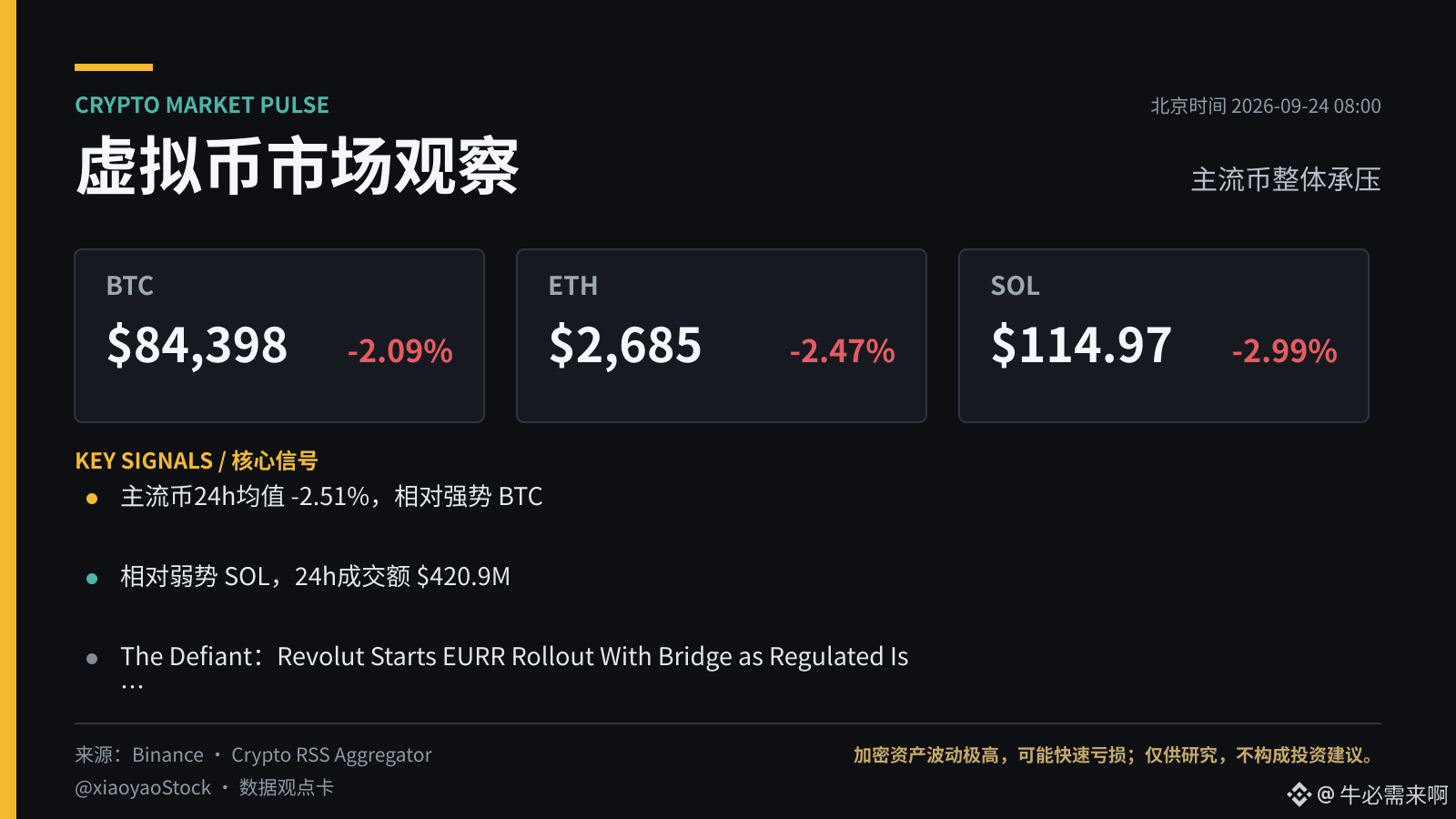
【Robinhood Chain Topic Selection|09月24日 08:00】
Primary token: $dec0ded dec0ded|Follow level: A|Follow level indicates discussion priority only and does not represent a buy/sell recommendation.
On Robinhood Chain (DexScreener chain identifier: robinhood), we found a trading pool that meets a baseline activity threshold:
Price approx. $0.00008018, 24h +42.76%, liquidity $27.2K, 24h trading volume $298.0K, about 2887 trades.
Pool age approx. 5.8 hours, volume/liquidity about 10.97x.
Note: This is only a candidate based on public market metrics and does not indicate project quality or future price movements. Robinhood Chain’s new pools have very high volatility and contract risk—please verify, on your own, concentration of holdings, contract permissions, pool locking, and sell-side depth.
Contract: 0xfFe1Be42d92559043CCC012785e024a774d5A0d7
DexScreener: https://dexscreener.com/robinhood/0xc373e624ed15b9cca30bf660254e13e80b718b73b17b2ca083fe82dce039fe6b
Source: DexScreener Robinhood Chain market data.
For information sharing only and does not constitute investment advice. Crypto assets are highly volatile—please independently verify and manage risk.
#RobinhoodChain #罗宾链 $dec0ded
【Robinhood Chain Topic Selection|09月24日 08:00】
Primary token: $dec0ded dec0ded|Follow level: A|Follow level indicates discussion priority only and does not represent a buy/sell recommendation.
On Robinhood Chain (DexScreener chain identifier: robinhood), we found a trading pool that meets a baseline activity threshold:
Price approx. $0.00008018, 24h +42.76%, liquidity $27.2K, 24h trading volume $298.0K, about 2887 trades.
Pool age approx. 5.8 hours, volume/liquidity about 10.97x.
Note: This is only a candidate based on public market metrics and does not indicate project quality or future price movements. Robinhood Chain’s new pools have very high volatility and contract risk—please verify, on your own, concentration of holdings, contract permissions, pool locking, and sell-side depth.
Contract: 0xfFe1Be42d92559043CCC012785e024a774d5A0d7
DexScreener: https://dexscreener.com/robinhood/0xc373e624ed15b9cca30bf660254e13e80b718b73b17b2ca083fe82dce039fe6b
Source: DexScreener Robinhood Chain market data.
For information sharing only and does not constitute investment advice. Crypto assets are highly volatile—please independently verify and manage risk.
#RobinhoodChain #罗宾链 $dec0ded
Primary token: $dec0ded dec0ded|Follow level: A|Follow level indicates discussion priority only and does not represent a buy/sell recommendation.
On Robinhood Chain (DexScreener chain identifier: robinhood), we found a trading pool that meets a baseline activity threshold:
Price approx. $0.00008018, 24h +42.76%, liquidity $27.2K, 24h trading volume $298.0K, about 2887 trades.
Pool age approx. 5.8 hours, volume/liquidity about 10.97x.
Note: This is only a candidate based on public market metrics and does not indicate project quality or future price movements. Robinhood Chain’s new pools have very high volatility and contract risk—please verify, on your own, concentration of holdings, contract permissions, pool locking, and sell-side depth.
Contract: 0xfFe1Be42d92559043CCC012785e024a774d5A0d7
DexScreener: https://dexscreener.com/robinhood/0xc373e624ed15b9cca30bf660254e13e80b718b73b17b2ca083fe82dce039fe6b
Source: DexScreener Robinhood Chain market data.
For information sharing only and does not constitute investment advice. Crypto assets are highly volatile—please independently verify and manage risk.
#RobinhoodChain #罗宾链 $dec0ded
92
·
--
【Robinhood Chain Topic Selection|Sep 24 00:00】
Primary token: $HATCH Hatch | Follow level: S | The follow level only indicates discussion priority and does not represent a buy/sell recommendation.
On Robinhood Chain (DexScreener chain identifier: robinhood), a trading pool that meets a basic activity threshold has been filtered:
Price approx. $0.00019680, 24h +296.00%, liquidity $40.6K, 24h trading volume $299.4K, about 2521 trades.
Pool age approx. 3.1 hours, trading volume/liquidity approx. 7.38x.
Observation: This is only a candidate based on public market indicators and does not indicate project quality or subsequent price movements. The new pools on Robinhood Chain have very high volatility and contract risks. You should verify concentration of holdings, contract permissions, pool locking, and sell-side liquidity depth yourself.
Contract: 0xf6c53734FB24CA414Bf1549530f0C8E447eE24e0
DexScreener: https://dexscreener.com/robinhood/0x5dc5eaed06c906180f7b317e41ffde5bde0f04a8a94658d6579193f5dc1d00f3
Source: DexScreener Robinhood Chain market data.
For information sharing only and does not constitute investment advice. Crypto assets are extremely volatile—independently verify and manage risk.
#RobinhoodChain #罗宾链 $HATCH
【Robinhood Chain Topic Selection|Sep 24 00:00】
Primary token: $HATCH Hatch | Follow level: S | The follow level only indicates discussion priority and does not represent a buy/sell recommendation.
On Robinhood Chain (DexScreener chain identifier: robinhood), a trading pool that meets a basic activity threshold has been filtered:
Price approx. $0.00019680, 24h +296.00%, liquidity $40.6K, 24h trading volume $299.4K, about 2521 trades.
Pool age approx. 3.1 hours, trading volume/liquidity approx. 7.38x.
Observation: This is only a candidate based on public market indicators and does not indicate project quality or subsequent price movements. The new pools on Robinhood Chain have very high volatility and contract risks. You should verify concentration of holdings, contract permissions, pool locking, and sell-side liquidity depth yourself.
Contract: 0xf6c53734FB24CA414Bf1549530f0C8E447eE24e0
DexScreener: https://dexscreener.com/robinhood/0x5dc5eaed06c906180f7b317e41ffde5bde0f04a8a94658d6579193f5dc1d00f3
Source: DexScreener Robinhood Chain market data.
For information sharing only and does not constitute investment advice. Crypto assets are extremely volatile—independently verify and manage risk.
#RobinhoodChain #罗宾链 $HATCH
Primary token: $HATCH Hatch | Follow level: S | The follow level only indicates discussion priority and does not represent a buy/sell recommendation.
On Robinhood Chain (DexScreener chain identifier: robinhood), a trading pool that meets a basic activity threshold has been filtered:
Price approx. $0.00019680, 24h +296.00%, liquidity $40.6K, 24h trading volume $299.4K, about 2521 trades.
Pool age approx. 3.1 hours, trading volume/liquidity approx. 7.38x.
Observation: This is only a candidate based on public market indicators and does not indicate project quality or subsequent price movements. The new pools on Robinhood Chain have very high volatility and contract risks. You should verify concentration of holdings, contract permissions, pool locking, and sell-side liquidity depth yourself.
Contract: 0xf6c53734FB24CA414Bf1549530f0C8E447eE24e0
DexScreener: https://dexscreener.com/robinhood/0x5dc5eaed06c906180f7b317e41ffde5bde0f04a8a94658d6579193f5dc1d00f3
Source: DexScreener Robinhood Chain market data.
For information sharing only and does not constitute investment advice. Crypto assets are extremely volatile—independently verify and manage risk.
#RobinhoodChain #罗宾链 $HATCH
50
·
--
【Robinhood Chain Topic Selection|Sep 23 18:00】
Primary asset: $ARMY PONS ARMY|Follow level: S|Follow level only indicates discussion priority and does not represent a buy/sell recommendation.
On Robinhood Chain (DexScreener chain identifier: robinhood), we found a trading pool that meets a basic activity threshold:
Price: approx. $0.00012640, 24h +111.00%, Liquidity: $34.4K, 24h trading volume: $147.3K, about 2,451 trades.
Pool age: approx. 15.1 hours, Trading volume/Liquidity: about 4.28x.
Observation: This is only a candidate based on public market indicators and does not represent project quality or future gains/losses. Robinhood Chain new pools have very high volatility and contract risk. Please independently verify things like your position concentration, contract permissions, pool locking status, and sell depth.
Contract: 0x70A64707a7260365Ab8e90dDd565B8c00247a289
DexScreener: https://dexscreener.com/robinhood/0xf318353b387fc819b57ecb8af1889882c8b544b450c42514d3da43a225e983e9
Source: DexScreener Robinhood Chain market data.
For information exchange only; does not constitute investment advice. Crypto assets are extremely volatile—independently verify and manage risk.
#RobinhoodChain #罗宾链 $ARMY
【Robinhood Chain Topic Selection|Sep 23 18:00】
Primary asset: $ARMY PONS ARMY|Follow level: S|Follow level only indicates discussion priority and does not represent a buy/sell recommendation.
On Robinhood Chain (DexScreener chain identifier: robinhood), we found a trading pool that meets a basic activity threshold:
Price: approx. $0.00012640, 24h +111.00%, Liquidity: $34.4K, 24h trading volume: $147.3K, about 2,451 trades.
Pool age: approx. 15.1 hours, Trading volume/Liquidity: about 4.28x.
Observation: This is only a candidate based on public market indicators and does not represent project quality or future gains/losses. Robinhood Chain new pools have very high volatility and contract risk. Please independently verify things like your position concentration, contract permissions, pool locking status, and sell depth.
Contract: 0x70A64707a7260365Ab8e90dDd565B8c00247a289
DexScreener: https://dexscreener.com/robinhood/0xf318353b387fc819b57ecb8af1889882c8b544b450c42514d3da43a225e983e9
Source: DexScreener Robinhood Chain market data.
For information exchange only; does not constitute investment advice. Crypto assets are extremely volatile—independently verify and manage risk.
#RobinhoodChain #罗宾链 $ARMY
Primary asset: $ARMY PONS ARMY|Follow level: S|Follow level only indicates discussion priority and does not represent a buy/sell recommendation.
On Robinhood Chain (DexScreener chain identifier: robinhood), we found a trading pool that meets a basic activity threshold:
Price: approx. $0.00012640, 24h +111.00%, Liquidity: $34.4K, 24h trading volume: $147.3K, about 2,451 trades.
Pool age: approx. 15.1 hours, Trading volume/Liquidity: about 4.28x.
Observation: This is only a candidate based on public market indicators and does not represent project quality or future gains/losses. Robinhood Chain new pools have very high volatility and contract risk. Please independently verify things like your position concentration, contract permissions, pool locking status, and sell depth.
Contract: 0x70A64707a7260365Ab8e90dDd565B8c00247a289
DexScreener: https://dexscreener.com/robinhood/0xf318353b387fc819b57ecb8af1889882c8b544b450c42514d3da43a225e983e9
Source: DexScreener Robinhood Chain market data.
For information exchange only; does not constitute investment advice. Crypto assets are extremely volatile—independently verify and manage risk.
#RobinhoodChain #罗宾链 $ARMY
440
·
--
【Robinhood Chain Topic Selection | Sep 23 14:00】
Primary asset: $ICETEA ICE TEA | Watch level: S | The watch level only indicates discussion priority and does not represent a buy/sell recommendation.
A trading pool was found on Robinhood Chain (DexScreener chain identifier: robinhood) that meets the basic activity threshold:
Price about $0.00003563, 24h -37.38%, liquidity $18.4K, 24h trading volume $47.2K, about 989 trades.
Pool age is about 3.4 hours; volume/liquidity is about 2.57x.
Observation: This is only a candidate based on public market metrics and does not indicate project quality or future price movements. The new pools on Robinhood Chain have very high volatility and contract risks. You should verify concentration of holdings, contract permissions, pool locking, and sell-side liquidity depth on your own.
Contract: 0xDb269B5505E564305cCdbA928118C215779B7F83
DexScreener: https://dexscreener.com/robinhood/0xc84c18ee048c0278c7a6f1bd9d44e6601fdd5587351462b20782ae2eb362701b
Source: DexScreener Robinhood Chain market data.
For information sharing only and does not constitute investment advice. Crypto assets are extremely volatile—verify independently and manage risk.
#RobinhoodChain #罗宾链 $ICETEA
【Robinhood Chain Topic Selection | Sep 23 14:00】
Primary asset: $ICETEA ICE TEA | Watch level: S | The watch level only indicates discussion priority and does not represent a buy/sell recommendation.
A trading pool was found on Robinhood Chain (DexScreener chain identifier: robinhood) that meets the basic activity threshold:
Price about $0.00003563, 24h -37.38%, liquidity $18.4K, 24h trading volume $47.2K, about 989 trades.
Pool age is about 3.4 hours; volume/liquidity is about 2.57x.
Observation: This is only a candidate based on public market metrics and does not indicate project quality or future price movements. The new pools on Robinhood Chain have very high volatility and contract risks. You should verify concentration of holdings, contract permissions, pool locking, and sell-side liquidity depth on your own.
Contract: 0xDb269B5505E564305cCdbA928118C215779B7F83
DexScreener: https://dexscreener.com/robinhood/0xc84c18ee048c0278c7a6f1bd9d44e6601fdd5587351462b20782ae2eb362701b
Source: DexScreener Robinhood Chain market data.
For information sharing only and does not constitute investment advice. Crypto assets are extremely volatile—verify independently and manage risk.
#RobinhoodChain #罗宾链 $ICETEA
Primary asset: $ICETEA ICE TEA | Watch level: S | The watch level only indicates discussion priority and does not represent a buy/sell recommendation.
A trading pool was found on Robinhood Chain (DexScreener chain identifier: robinhood) that meets the basic activity threshold:
Price about $0.00003563, 24h -37.38%, liquidity $18.4K, 24h trading volume $47.2K, about 989 trades.
Pool age is about 3.4 hours; volume/liquidity is about 2.57x.
Observation: This is only a candidate based on public market metrics and does not indicate project quality or future price movements. The new pools on Robinhood Chain have very high volatility and contract risks. You should verify concentration of holdings, contract permissions, pool locking, and sell-side liquidity depth on your own.
Contract: 0xDb269B5505E564305cCdbA928118C215779B7F83
DexScreener: https://dexscreener.com/robinhood/0xc84c18ee048c0278c7a6f1bd9d44e6601fdd5587351462b20782ae2eb362701b
Source: DexScreener Robinhood Chain market data.
For information sharing only and does not constitute investment advice. Crypto assets are extremely volatile—verify independently and manage risk.
#RobinhoodChain #罗宾链 $ICETEA
245

·
--
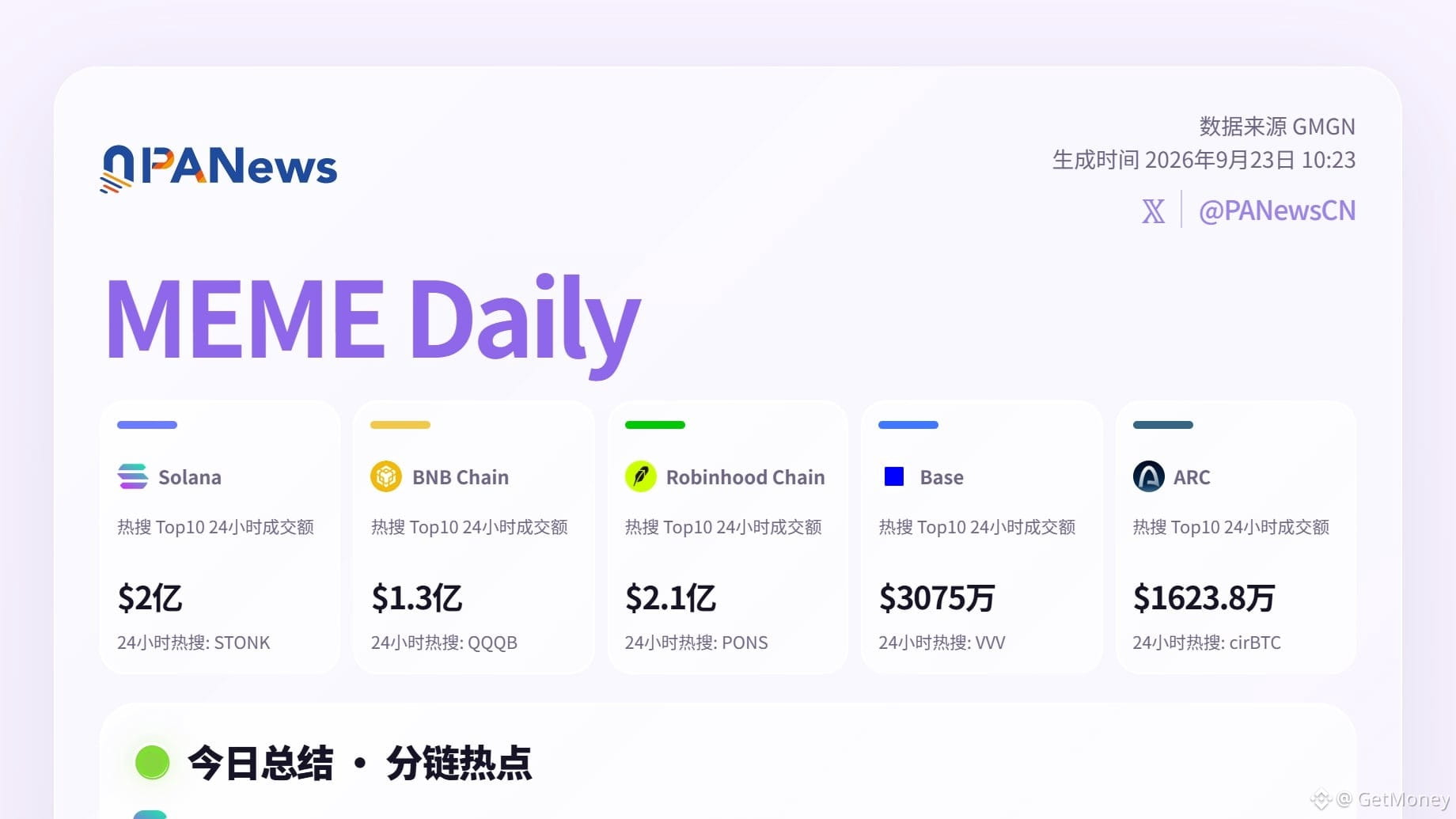
📰 Meme heat over the past 24 hours—somehow, stock tokens have stolen quite a bit of the spotlight. Robinhood Chain Top 10 continues to hold the top spot among all chains. With PONS alone at $56.038 million, musebook, NVDA, AI, and Agrippa remain active as well.
🔥 Solana follows closely, also with a Top 10. STONK leads with $35.531 million. ZEC, USELESS, SI, JEANPHIL, and other projects have also made the list. Discussions have mainly focused on the Stonk ecosystem and the Fomode launch.
To be honest, this time the gap between Robinhood Chain and Solana is only $10 million—funds aren’t concentrated on just a single chain. BNB Chain’s Top 10 also reaches $130 million. QQOB ranks first, while CNPY, BNCB, 4Stock, and GSTOCK remain active. Multiple-basket-related topics continue to simmer.
💡 Base is relatively smaller in scale. Top 10 is led by WU. DRW, TRUE, BNKR, and BS3 are also on the list. Bankr staking, Gitlawb, and Basecat are being discussed too.
🤔 If you only look at this set of data, would you pay more attention to STONK on Solana?
#Meme #RobinhoodChain #Solana #BNBChain
📰 Meme heat over the past 24 hours—somehow, stock tokens have stolen quite a bit of the spotlight. Robinhood Chain Top 10 continues to hold the top spot among all chains. With PONS alone at $56.038 million, musebook, NVDA, AI, and Agrippa remain active as well.
🔥 Solana follows closely, also with a Top 10. STONK leads with $35.531 million. ZEC, USELESS, SI, JEANPHIL, and other projects have also made the list. Discussions have mainly focused on the Stonk ecosystem and the Fomode launch.
To be honest, this time the gap between Robinhood Chain and Solana is only $10 million—funds aren’t concentrated on just a single chain. BNB Chain’s Top 10 also reaches $130 million. QQOB ranks first, while CNPY, BNCB, 4Stock, and GSTOCK remain active. Multiple-basket-related topics continue to simmer.
💡 Base is relatively smaller in scale. Top 10 is led by WU. DRW, TRUE, BNKR, and BS3 are also on the list. Bankr staking, Gitlawb, and Basecat are being discussed too.
🤔 If you only look at this set of data, would you pay more attention to STONK on Solana?
#Meme #RobinhoodChain #Solana #BNBChain
🔥 Solana follows closely, also with a Top 10. STONK leads with $35.531 million. ZEC, USELESS, SI, JEANPHIL, and other projects have also made the list. Discussions have mainly focused on the Stonk ecosystem and the Fomode launch.
To be honest, this time the gap between Robinhood Chain and Solana is only $10 million—funds aren’t concentrated on just a single chain. BNB Chain’s Top 10 also reaches $130 million. QQOB ranks first, while CNPY, BNCB, 4Stock, and GSTOCK remain active. Multiple-basket-related topics continue to simmer.
💡 Base is relatively smaller in scale. Top 10 is led by WU. DRW, TRUE, BNKR, and BS3 are also on the list. Bankr staking, Gitlawb, and Basecat are being discussed too.
🤔 If you only look at this set of data, would you pay more attention to STONK on Solana?
#Meme #RobinhoodChain #Solana #BNBChain

228
·
--
📰 The Robinhood Chain Meme craze has clearly cooled off: network transaction fee revenue has fallen by about 97% from its peak, while the number of trades has only decreased by around 32%. In plain terms, traders haven’t massively exited—they just aren’t willing to pay that much per transaction anymore.
🔥 At the early-September peak, on-chain processed 13.1 million transactions in a single day, collecting about $8 million in fees, averaging 64 cents per trade. By September 16, there were still 8.9 million transactions, but daily fees dropped to only about $230,000—down to an average of 2.6 cents per trade.
💡 There hasn’t been any obvious outflow of funds either. In the week up to September 16, the Robinhood Chain decentralized exchanges recorded about $13 billion in trading volume, up 5% month-over-month. Stablecoin supply fell by only 1%, with about $930 million still staying in DeFi applications. Meanwhile, Solana’s decentralized exchange trading volume actually decreased by 8%.
👀 The real cooldown is on the Meme-launch platform Pons: over a week, protocol revenue fell from $10.7 million to $5.8 million. At the same time, the on-chain Uniswap V3 “casino” is still open—the players just moved to a different table.
🤔 If the number of trades and on-chain volumes continue to hold steady, but fees can’t sustainably return to their high level, do you think the Robinhood Chain is seeing a true fade in hype—or entering a cheaper, more stable phase?
#RobinhoodChain #Meme币 #链上数据 #DeFi
📰 The Robinhood Chain Meme craze has clearly cooled off: network transaction fee revenue has fallen by about 97% from its peak, while the number of trades has only decreased by around 32%. In plain terms, traders haven’t massively exited—they just aren’t willing to pay that much per transaction anymore.
🔥 At the early-September peak, on-chain processed 13.1 million transactions in a single day, collecting about $8 million in fees, averaging 64 cents per trade. By September 16, there were still 8.9 million transactions, but daily fees dropped to only about $230,000—down to an average of 2.6 cents per trade.
💡 There hasn’t been any obvious outflow of funds either. In the week up to September 16, the Robinhood Chain decentralized exchanges recorded about $13 billion in trading volume, up 5% month-over-month. Stablecoin supply fell by only 1%, with about $930 million still staying in DeFi applications. Meanwhile, Solana’s decentralized exchange trading volume actually decreased by 8%.
👀 The real cooldown is on the Meme-launch platform Pons: over a week, protocol revenue fell from $10.7 million to $5.8 million. At the same time, the on-chain Uniswap V3 “casino” is still open—the players just moved to a different table.
🤔 If the number of trades and on-chain volumes continue to hold steady, but fees can’t sustainably return to their high level, do you think the Robinhood Chain is seeing a true fade in hype—or entering a cheaper, more stable phase?
#RobinhoodChain #Meme币 #链上数据 #DeFi
🔥 At the early-September peak, on-chain processed 13.1 million transactions in a single day, collecting about $8 million in fees, averaging 64 cents per trade. By September 16, there were still 8.9 million transactions, but daily fees dropped to only about $230,000—down to an average of 2.6 cents per trade.
💡 There hasn’t been any obvious outflow of funds either. In the week up to September 16, the Robinhood Chain decentralized exchanges recorded about $13 billion in trading volume, up 5% month-over-month. Stablecoin supply fell by only 1%, with about $930 million still staying in DeFi applications. Meanwhile, Solana’s decentralized exchange trading volume actually decreased by 8%.
👀 The real cooldown is on the Meme-launch platform Pons: over a week, protocol revenue fell from $10.7 million to $5.8 million. At the same time, the on-chain Uniswap V3 “casino” is still open—the players just moved to a different table.
🤔 If the number of trades and on-chain volumes continue to hold steady, but fees can’t sustainably return to their high level, do you think the Robinhood Chain is seeing a true fade in hype—or entering a cheaper, more stable phase?
#RobinhoodChain #Meme币 #链上数据 #DeFi

5
Log in to explore more content
Join global crypto users on Binance Square
⚡️ Get latest and useful information about crypto.
💬 Trusted by the world’s largest crypto exchange.
👍 Discover real insights from verified creators.
Email / Phone number
Trending Topics
1
#GoldFallsTo$4144
1,320 views
39 Discussing
2
#QNTFallsOver40%FromMorningHigh
9,177 views
333 Discussing
3
#KospiFalls2.7%SamsungSKHynixDropOver5%
601 views
96 Discussing
4
#BitgetCEOConfirms$388MStolenInHack
451 views
19 Discussing
5
#BTCFallsBelow$83000
10,539 views
101 Discussing
6
#BitgetDetailsSecurityIncidentTimeline
8,112 views
258 Discussing
7
#BitcoinSpotETFs$2.39BWeeklyNetInflow
3,652 views
23 Discussing
8
#FedProposesPaymentStablecoinRules
34,138 views
620 Discussing
9
#ChinaMayLetAlibabaByteDanceBuyNvidiaChips
35,863 views
657 Discussing
10
#USChinaRelease$30BTariffCutProductLists
3,434 views
51 Discussing