
AllInWeb3
1.7k Posts

AllInWeb3
Report
Block User
High-Frequency Trader
5.6 Years
65 Following
158 Followers
586 Liked
Posts
All
Quotes
·
--
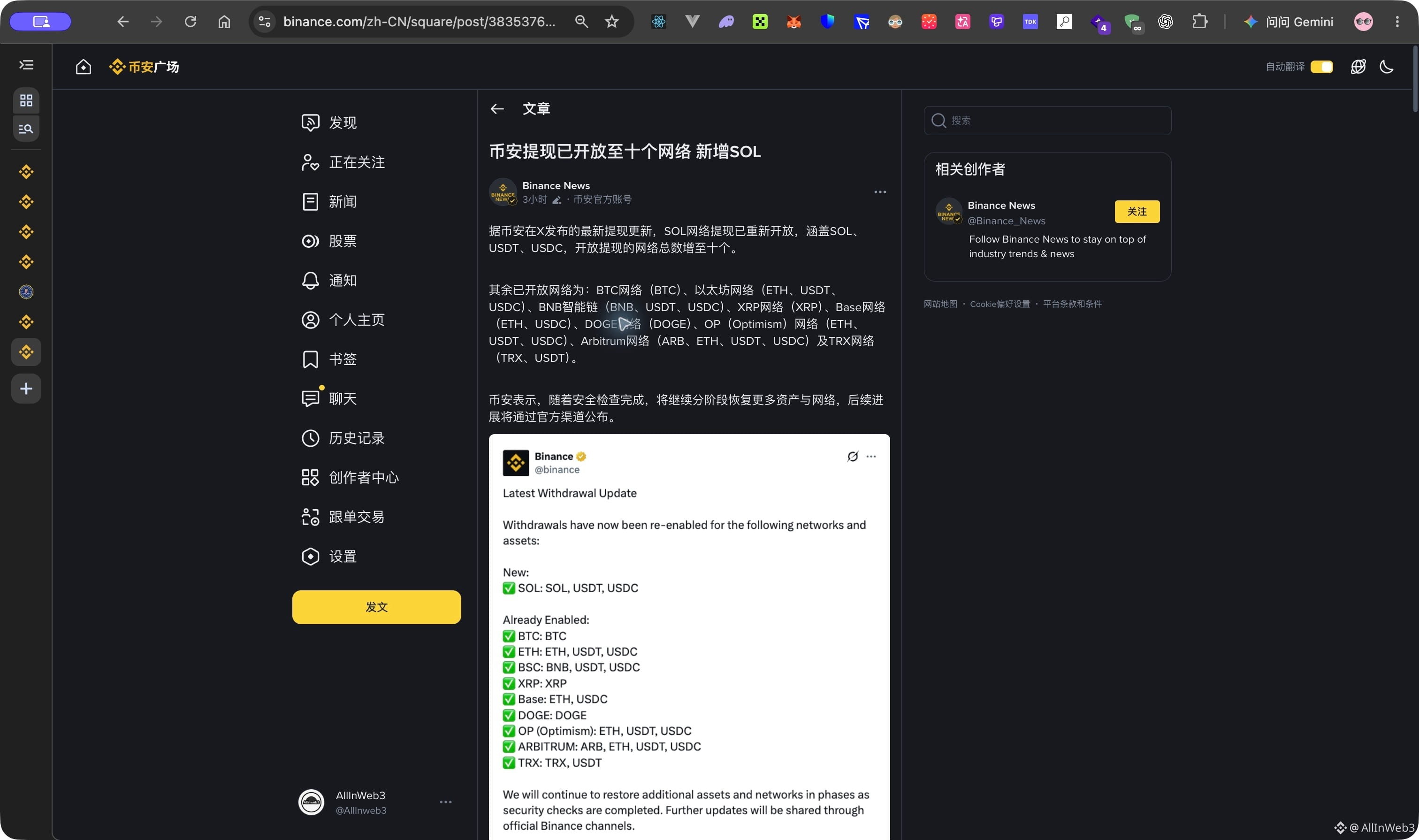
A recovery announcement has been made for three assets on the SOL chain. Next, we need to see whether the funds arrive smoothly.
The article published at noon said service was expected to resume between 14:00 and 17:00. Binance News has now officially announced that withdrawals of SOL, USDT, and USDC on the SOL network have reopened. For those waiting to transfer these three assets, progress has finally moved from a timetable to an available channel.
I haven’t tried making a withdrawal, so I haven’t verified whether funds actually arrive. To determine whether this channel is stable and usable, we still need to see whether withdrawals can be completed, confirmed on-chain, and credited by the receiving platform. If a withdrawal gets stuck or is suspended again, you shouldn’t plan your next steps based solely on the recovery announcement.
479
·
--
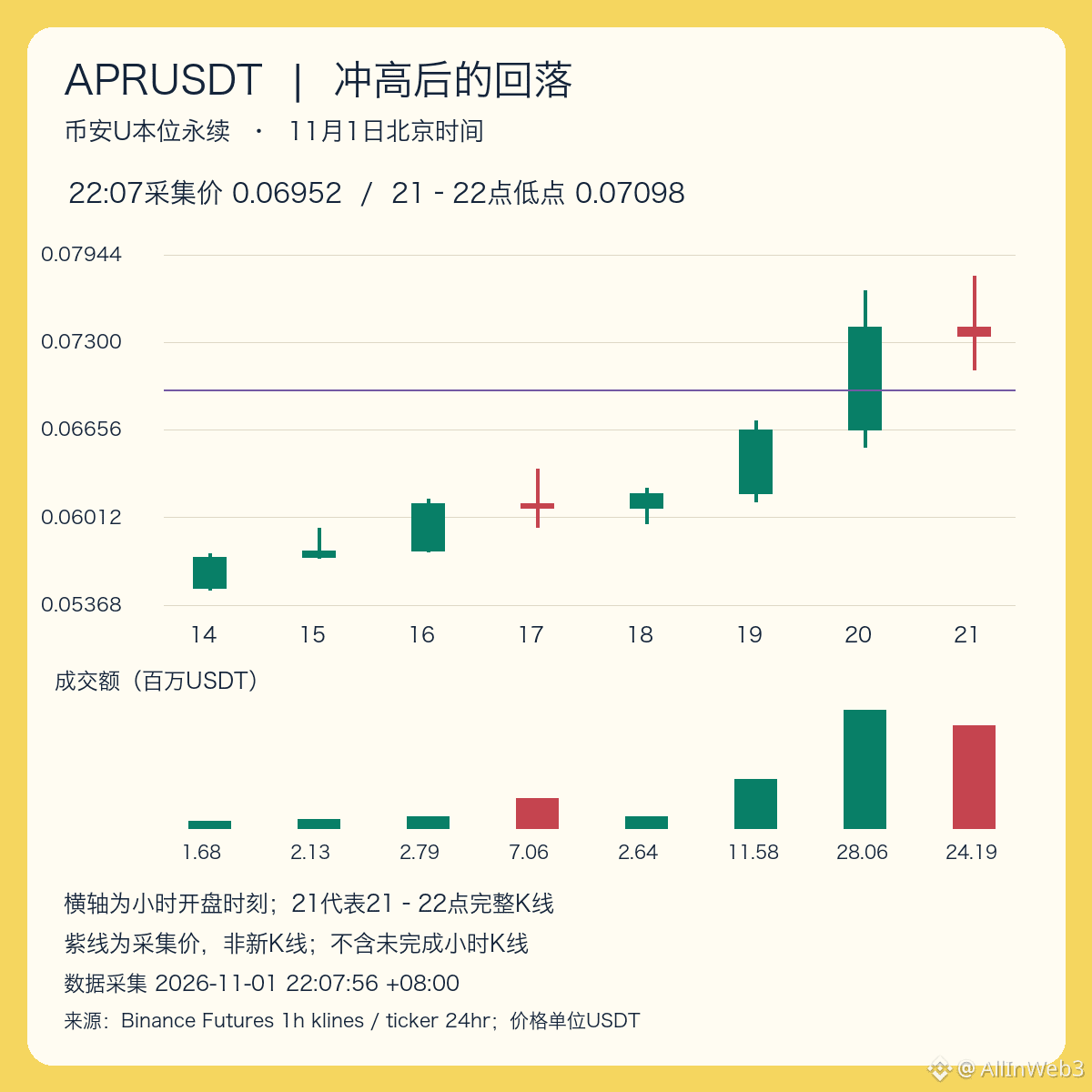
$APR After a high-volume surge, the price had fallen below the previous hour’s low by 22:07. I’ll wait for evidence that it can hold steady.
The bulls’ confidence comes from trading volume: 28.06 million USDT from 20:00 to 21:00, and still 24.19 million from 21:00 to 22:00. But in the latter hour, the price climbed to 0.07788 and closed at 0.07348. At 22:07 Beijing time on November 1, the Binance futures price had fallen back to 0.06952, below that hour’s low of 0.07098. Support at higher levels has yet to stand the test.
The 22:00–23:00 hour has not closed yet, so I’ll focus on the real-time pullback and avoid jumping to conclusions about a breakdown. Without a valid pullback pattern, I’ll wait. If the price recovers 0.07098 and holds above it for a full subsequent hour, I’ll reassess my bearish view. First, I’ll check the hourly close at 23:00.
293
·
--
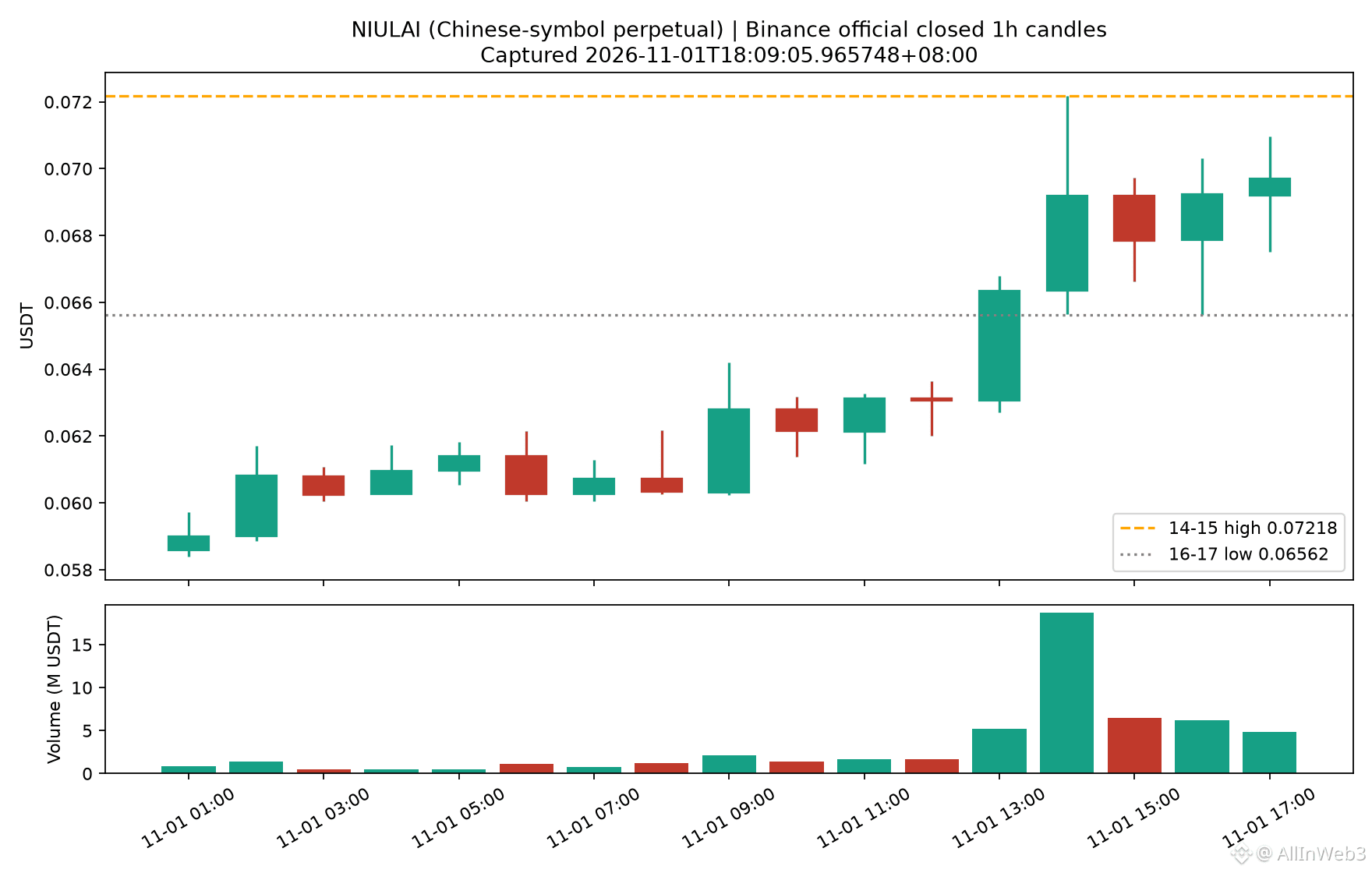
$牛来 has risen a lot, but that doesn’t mean chasing it now is worthwhile.
Using the Binance perpetual closing price of 0.06970 USDT at 18:00 on November 1 as a hypothetical: the previous high of 0.07218 is only 3.56% away, while the invalidation level at the 16:00–17:00 low of 0.06562 is 5.85% away. The nominal reward-to-risk ratio is about 0.61, before fees and slippage.
I’d wait for a more reasonable entry or a new structure rather than forcing a higher target just to make the reward-to-risk ratio look better. The previous high may not be reached either; recalculate if the price changes, and review at 20:00.
35
·
--
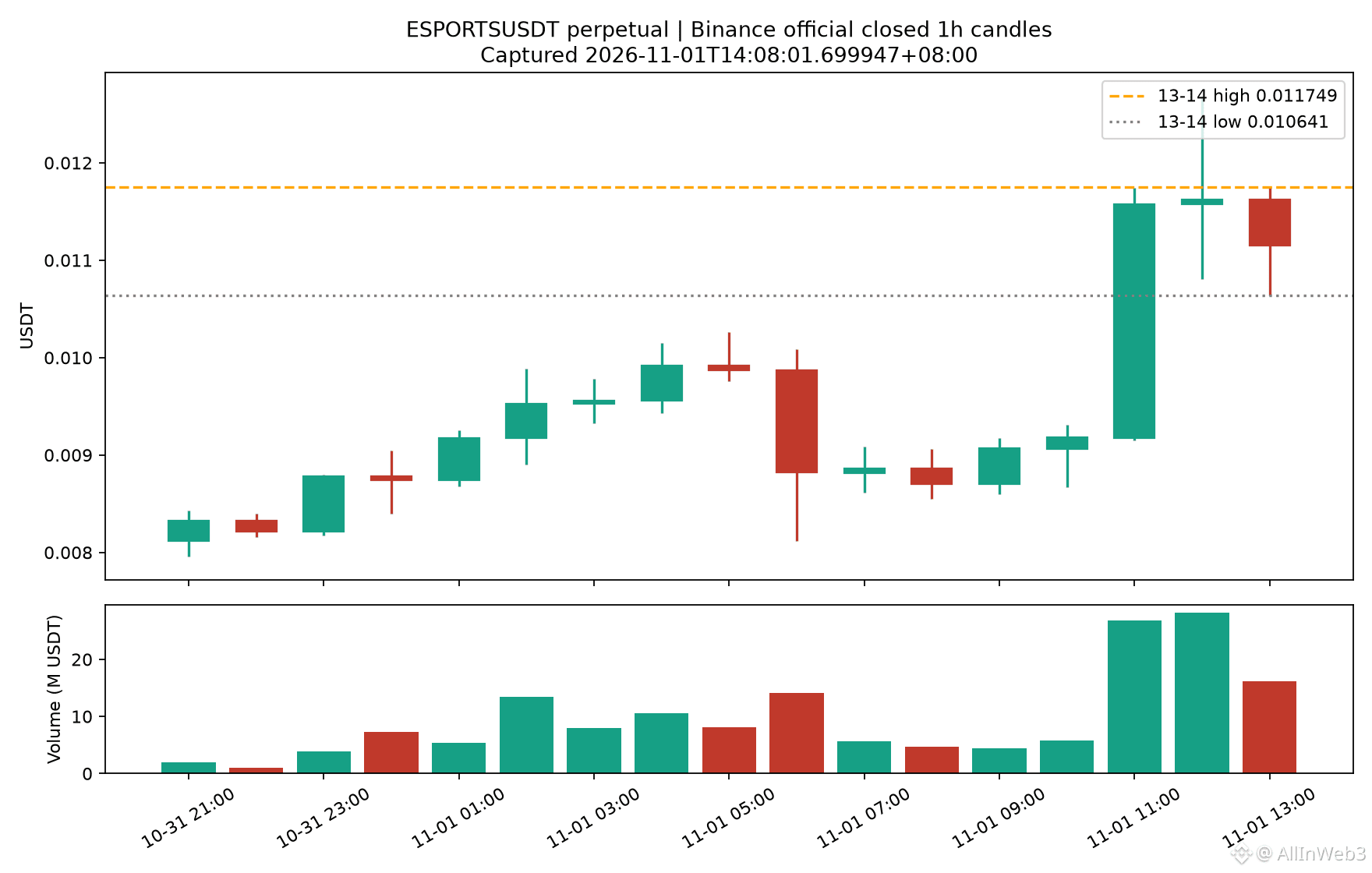
$ESPORTS This breakout is supported by trading volume, so I’m willing to turn bullish again—but it remains to be seen whether the new-high range can hold.
Trading volume on Binance Perpetuals from 11:00 to 12:00 was 4.66 times that of the previous hour, unlike the earlier new high on declining volume. The concern is what happened over the following two hours: the price gave back gains, while open interest rose by about 4.30%. Total positions continued to expand during the pullback.
I’ll wait for the hourly candle to close back above 0.011749 and for that level to hold on a retest before considering following the move. If it breaks below 0.010641, I’ll no longer treat it as a strong pullback. Units: USDT; data as of 14:00 Beijing time on November 1, to be reviewed at 16:00.
334
·
--
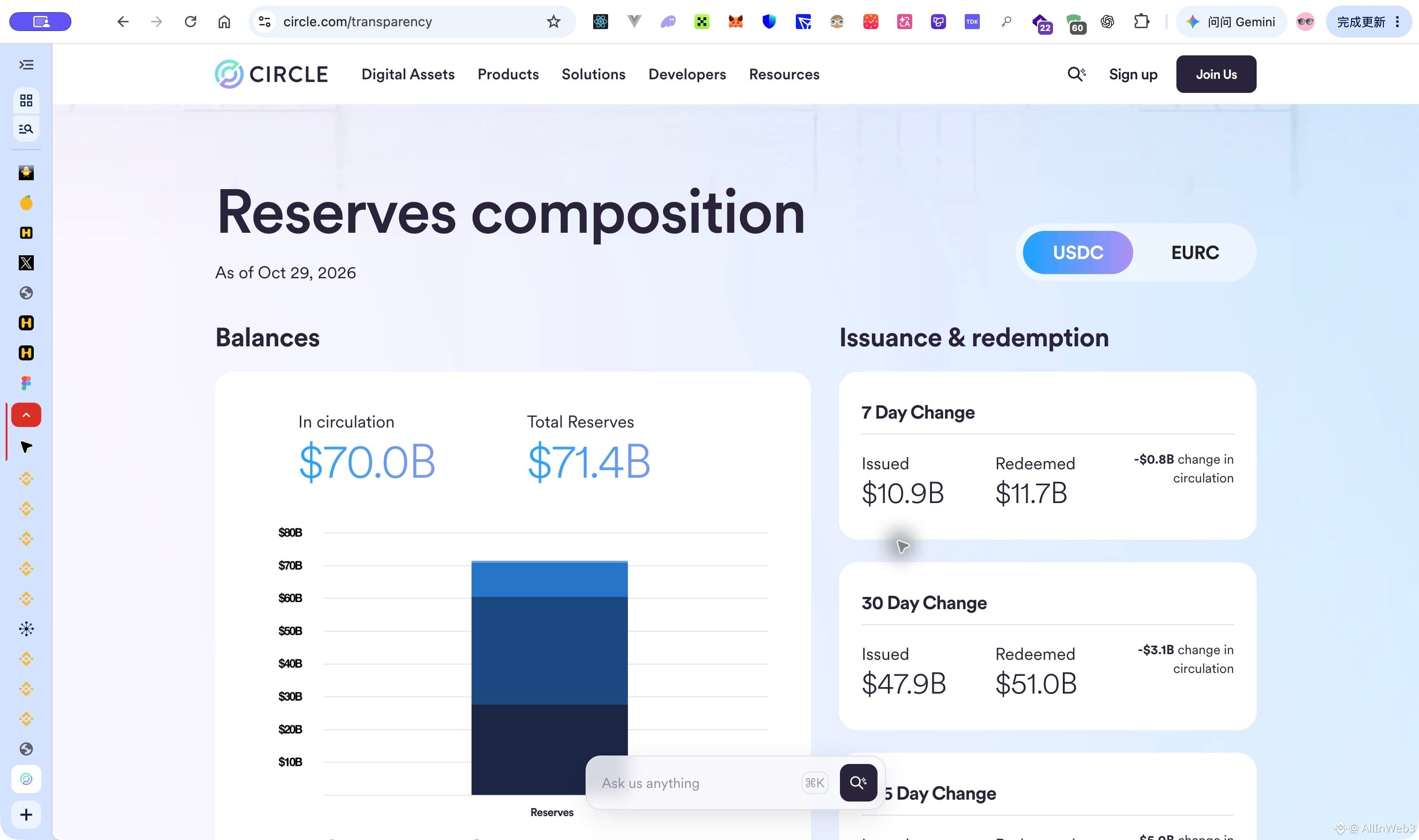
USDC redemptions exceeded issuance by about $800 million this week. Supply is indeed contracting, but where the funds went remains unclear.
Circle’s 7-day figures through October 29: about $10.9 billion issued and about $11.7 billion redeemed, both rounded.
Redeeming for dollars and switching to other stablecoins have different implications for the market; the original page does not say which was predominant. Treating this gap as a withdrawal of funds from the entire crypto market goes too far. To assess whether capital is flowing out, we need to also check the supply of other stablecoins and where the funds went; assessing a depeg also requires checking trading prices and whether redemptions are being honored.
1
361
·
--
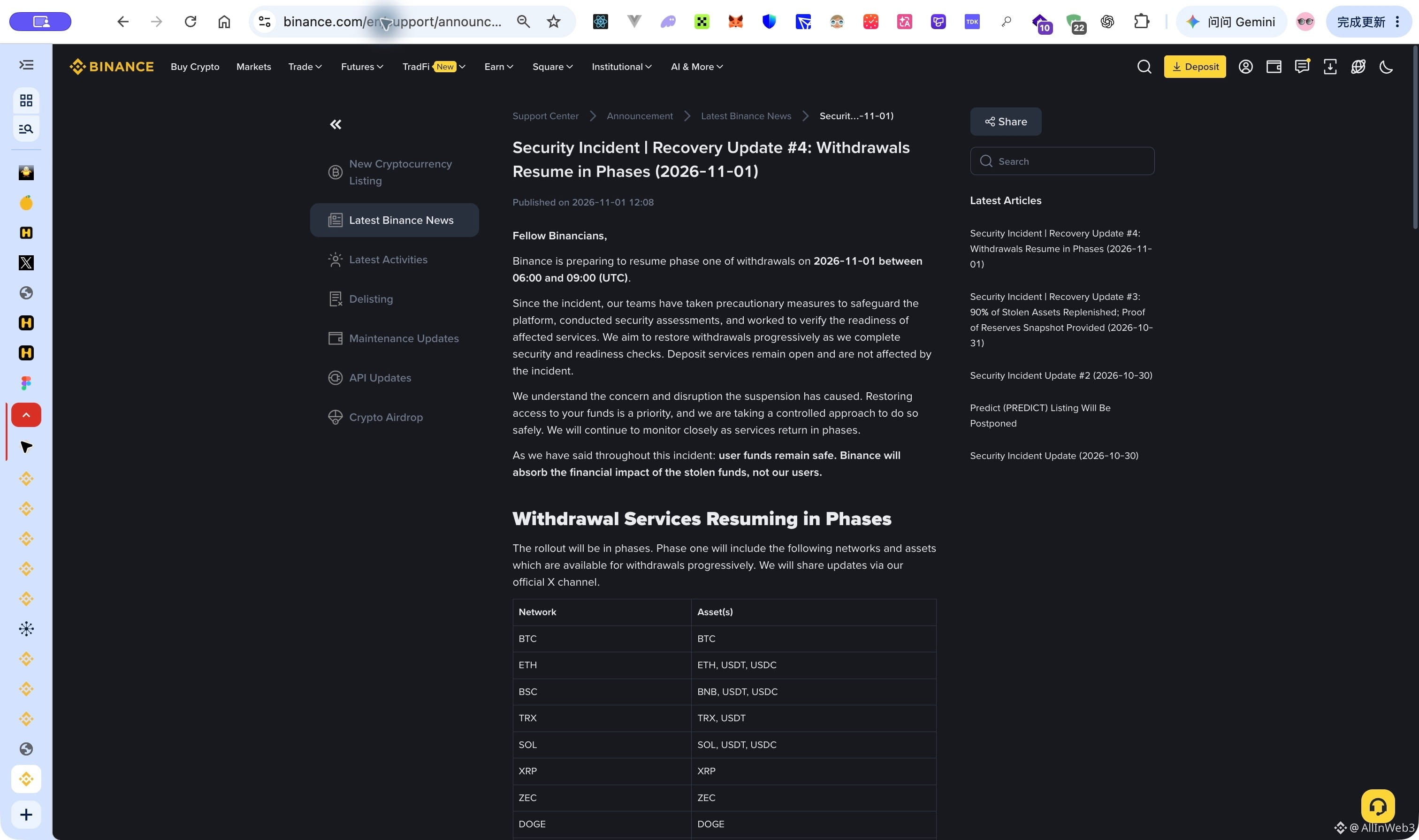
Binance is preparing to resume withdrawals. Don’t just check the coin name—make sure the network matches too.
The previous post discussed filling the gap. Today, official Update 4 provided a new plan: withdrawals in Phase 1 are scheduled to open in batches on November 1, from 14:00 to 17:00 Beijing time. The BSC list includes USDT, while Base lists only ETH and USDC. “USDT withdrawals are resuming” does not mean you can withdraw it on every chain.
What really determines whether you can transfer out is the status of the “coin + network” combination on the withdrawal page. The time window is only a plan; you still need to check whether withdrawals are open for each option.
208
·
--
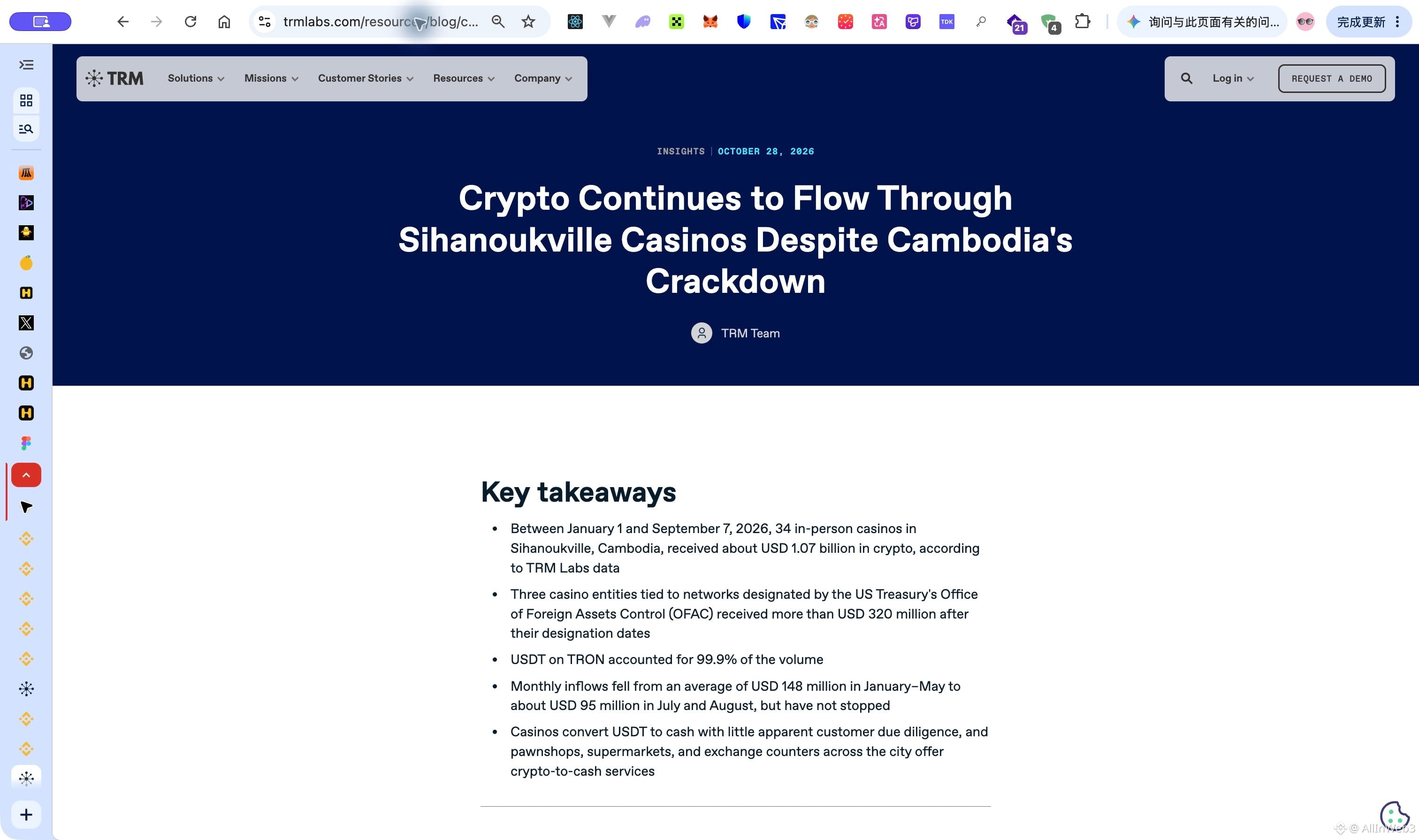
Casino inflows have declined, but some of the drop may be because tracking lists missed new wallets.
A report by TRM on October 28, 2026, said average monthly crypto inflows to casinos in Sihanoukville fell from $148 million in January–May to $95 million in July–August. But some operators may have shifted to wallets that have not yet been identified, potentially overstating the statistical decline.
To assess the effectiveness of the crackdown, looking only at old addresses is not enough: it is also necessary to confirm whether new wallets have been included in the data. Otherwise, funds received at new addresses could be misread as a retreat in inflows. Nor should all these inflows be classified as criminal proceeds.
1
42
·
--
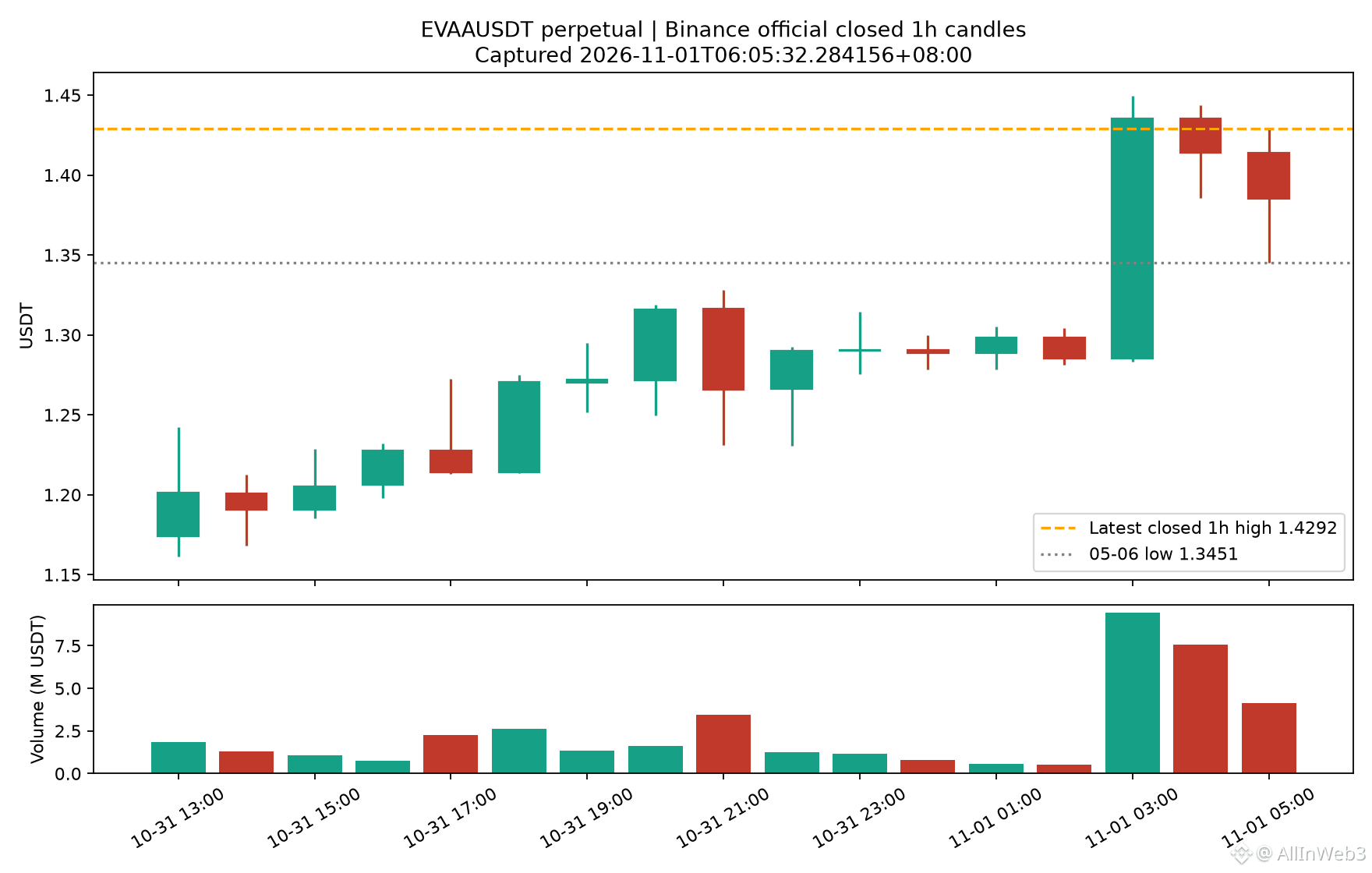
After $EVAA pulled back, open interest did not decline noticeably, so it is too early to conclude that leverage has been flushed out.
The breakout was not entirely unsupported: Binance perpetuals traded about 11.35 million USDT from 00:00 to 04:00, above the 7.49 million in the previous four hours. But closing prices then fell in each of the following two hours, while open interest declined by only about 0.43%. Price retreated, but positions remained; this alone does not establish which side has the upper hand.
Wait for the hourly candle to reclaim 1.4292 and hold it on a retest before reassessing the continuation. A break below 1.3451 would raise greater concerns about support. Prices are in USDT; data as of 06:00 Beijing time on November 1, with a review at 07:00.
272
·
--
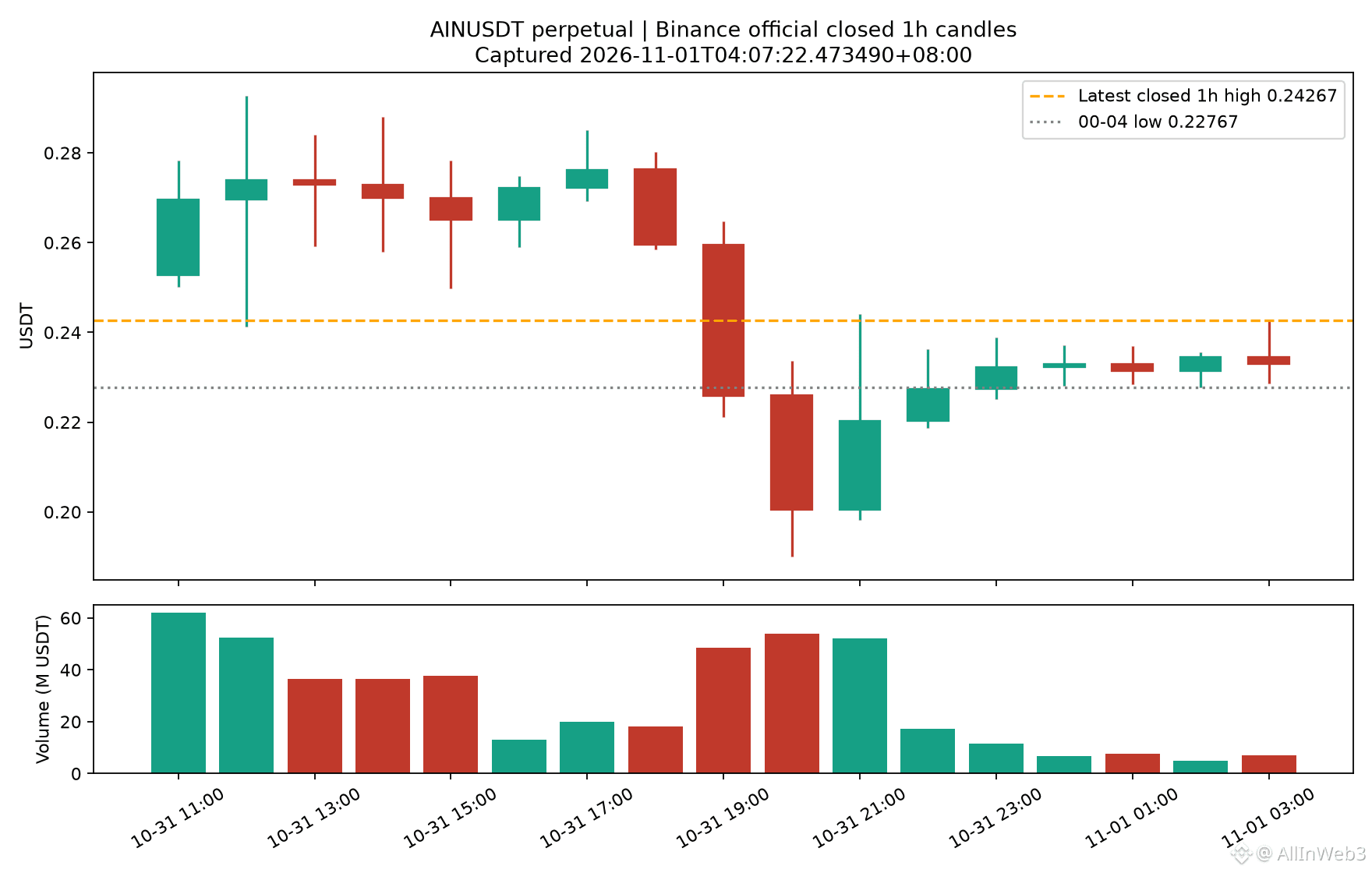
$AIN 's trading volume has cooled off, so the 24-hour gain shouldn't be taken to mean it's still accelerating.
The 0.27832 level noted in the previous update didn't hold. Binance perpetuals saw about 26.01 million USDT in trading volume from 00:00 to 04:00 on November 1, down 81% from the previous four hours. The price surged to 0.24267 from 03:00 to 04:00, but still closed back at 0.23287. Earlier, volume picked up but price struggled to advance; now trading activity has also subsided.
I'll wait for the hourly candle to close above 0.24267 and then hold on a retest before reassessing. A break below this four-hour low of 0.22767 would weaken support in the range. Lower volume alone doesn't indicate direction, but the current evidence isn't enough to justify chasing the price.
Prices are in USDT; data is as of 04:00 Beijing time. I'll review again at 05:00.
350
·
--
Verified
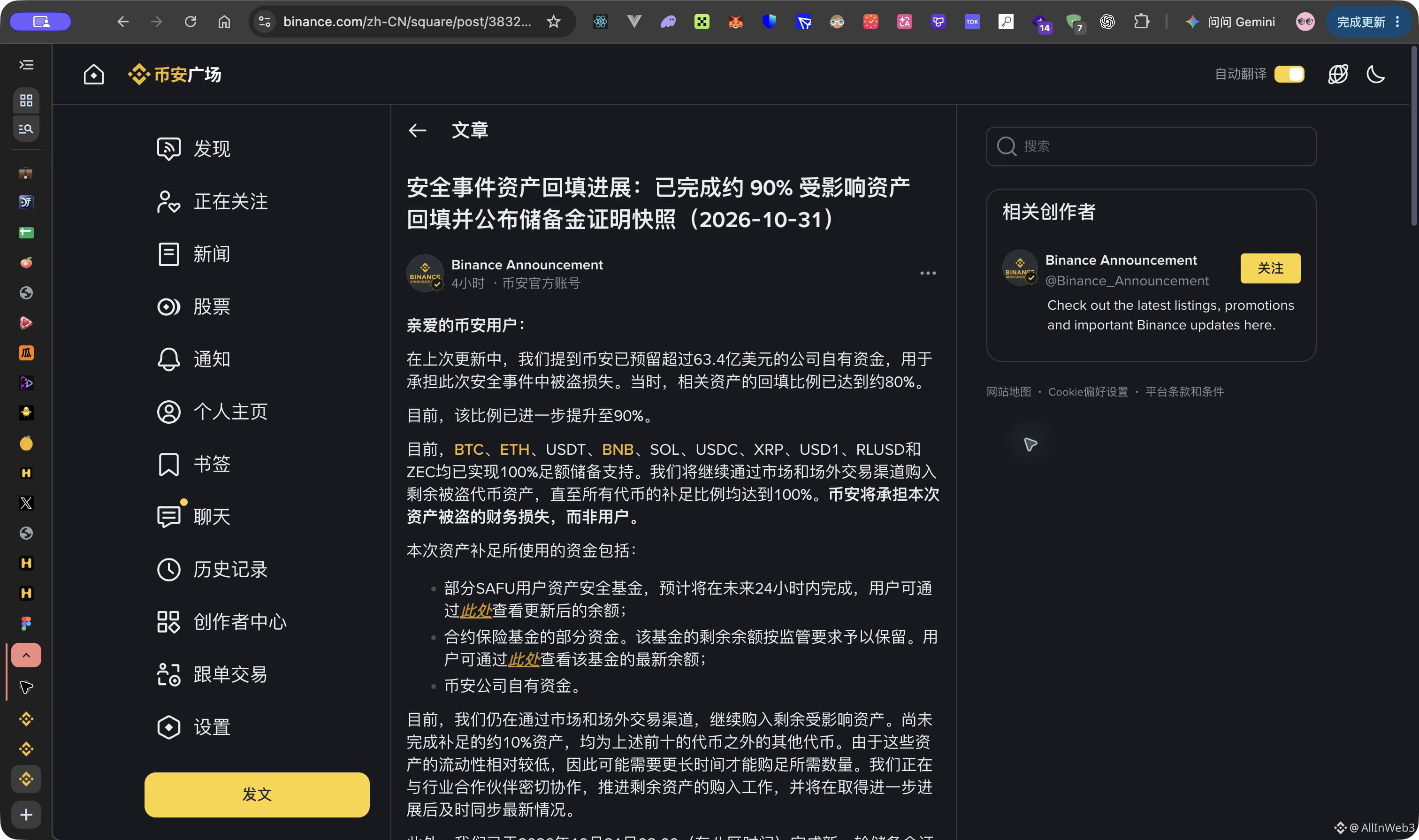
Proof of Reserves (PoR) does not show how much remains in the futures insurance fund. The previous article discussed replenishing assets; this time, we explain the difference between the two forms of protection.
In an announcement on October 31, Binance said that backfilling had used part of the futures insurance fund. The FAQ makes clear that the insurance fund is not a user asset and is not shown in PoR. It serves as a buffer against losses when positions are liquidated, while PoR verifies whether user assets are fully backed.
Futures users therefore need to check the fund’s public records separately. Binance says the remaining balance is above the level required by its risk framework; the amount transferred and the current balance have not been independently verified, so this alone does not justify concluding that ADL risk has increased.
478
·
--
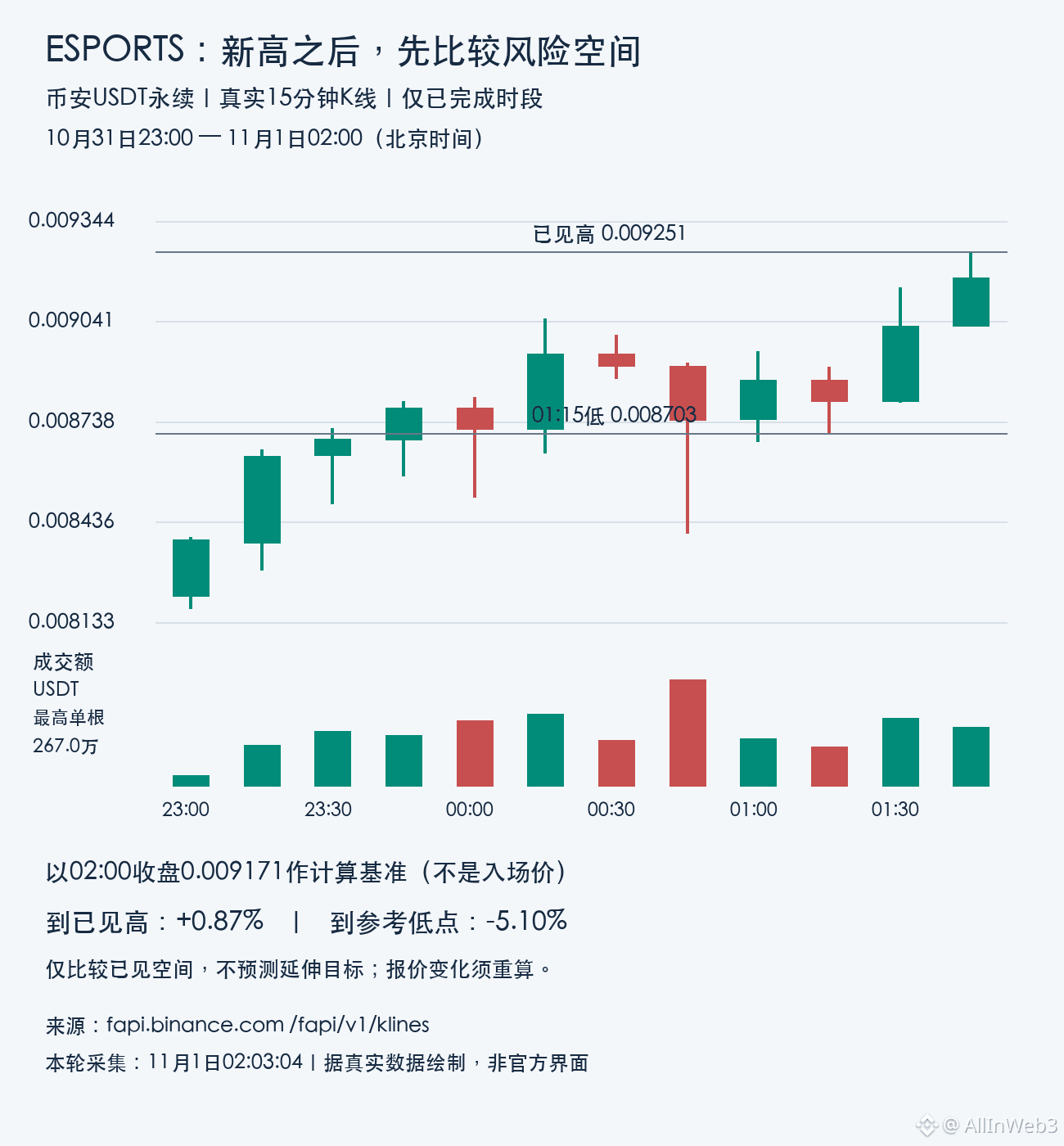
$ESPORTS hits another new high. My first calculation is how much room is left after entering, not a story to justify the rise.
From 01:00 to 02:00 on November 1, Binance perpetuals rose 4.88%, closing at 0.009171; trading volume was 5.34 million USDT, about 26% lower than the previous hour. A rise on declining volume does not mean an immediate reversal, but a new high alone is not enough to treat continuation as a sure thing.
Using this candle’s close as the reference point, the distance to the high reached so far, 0.009251, is only about 0.87%; the distance to the low of the completed 15-minute candle at 01:15, 0.008703, is about 5.10%. This is not an entry signal; it simply shows that using the current high as a target and that low as a reference for invalidation does not offer a favorable risk-reward range.
So for now, I’m waiting for a pullback and a new structure to form, rather than inventing an upside target. If price breaks below 0.008703, the original pullback setup should be discarded; if it continues to surge directly, recalculate first rather than chasing it and changing the rationale. No single news catalyst has been verified at this time. Data through 02:00 Beijing time; monitoring until 04:00, with recalculations if the price changes. Source: Binance public market data.
257
·
--
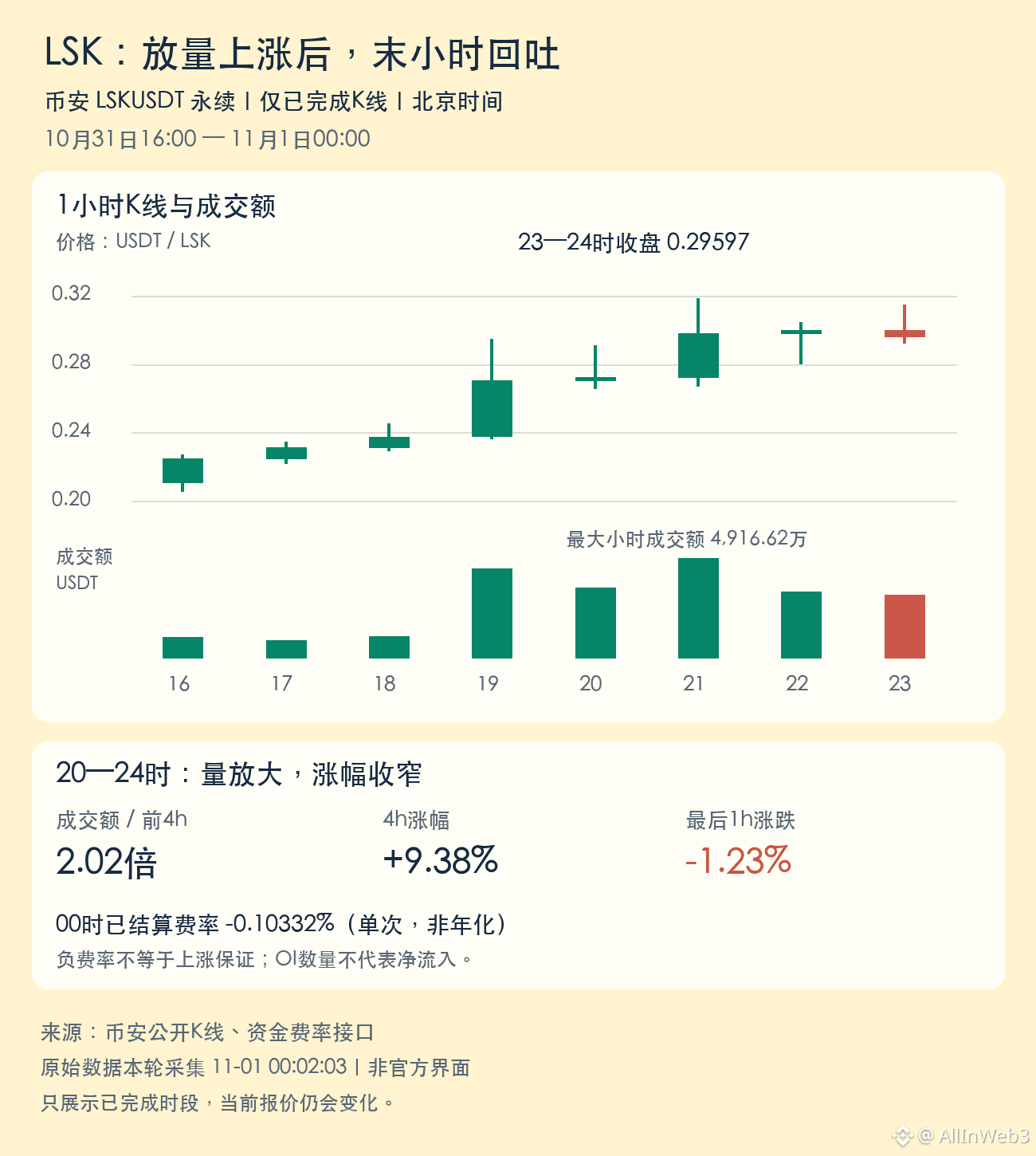
$LSK remains strong, but the evidence for chasing the rally has not caught up. Bulls can point to a surge on rising volume, while the cautious side can also point to a genuine spike and retreat; for now, I choose to wait.
Bullish evidence: From 20:00 to 24:00 on October 31, Binance LSKUSDT rose 9.38% over a complete 4-hour candle, with trading volume of 147 million USDT, about 2.02 times that of the previous 4 hours. Over the same period, open interest increased from 41.66 million to 49.36 million LSK, indicating broader participation, but this cannot be counted directly as new long positions.
Reasons for caution: The price spiked to 0.31494 in the final hour, but closed back at 0.29597, down 1.23%. The funding rate settled at 00:00 at -0.10332%; a negative rate also does not guarantee a short squeeze in the next move.
Range to watch: First, see whether the low at 0.29221 holds, then whether the price can reclaim and hold 0.31494. The higher level of 0.31879 is merely a previous high in this move; I will not force it into a high risk-reward target. Neither a pullback nor a breakout has been confirmed, so there is no qualified entry setup at present, and I am not recommending chasing the price. A break below the range low invalidates the recovery outlook.
The project had previously announced plans to shut down Lisk Chain on October 31, but LSK remains active. I have not verified when the shutdown was completed, and I am not treating the old plan as an upside catalyst. This analysis is based on the complete candle at 00:00 on November 1; if the price or structure changes before 02:00, the analysis must be recalculated. Sources: Binance market data and the official Lisk FAQ.
1
292
·
--
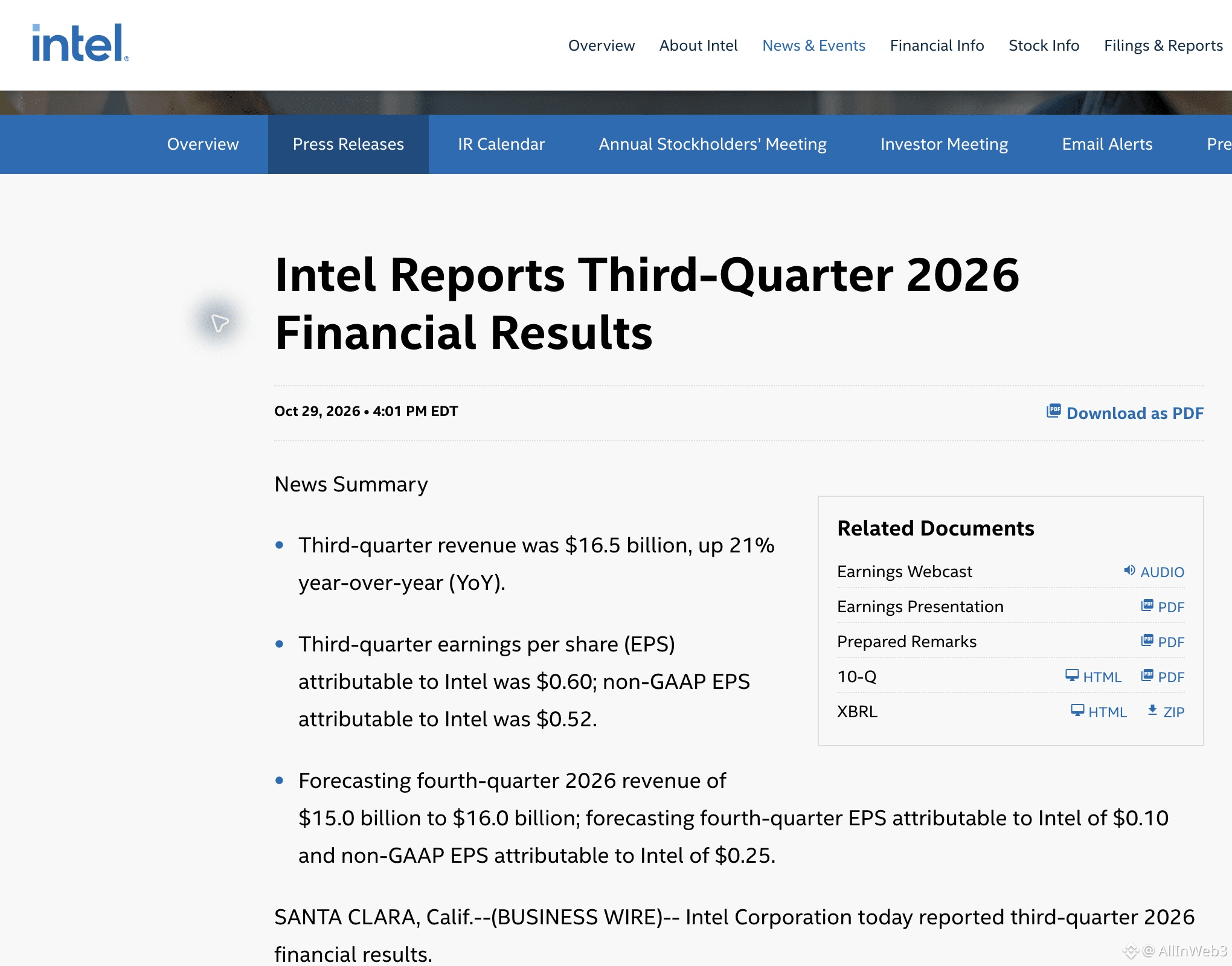
Growth in Intel’s earnings report did not shield traders from a hit to the share price. For those trading Intel stock perpetuals, an easy mistake is to translate “a good quarter” directly into “the price should rise.”
Intel’s official earnings report on October 29 showed third-quarter revenue of $16.5 billion, up 21% year over year. But its fourth-quarter revenue guidance was $15 billion to $16 billion. One is a result already delivered; the other is the company’s forecast for the next quarter. They should not be conflated as a single bullish indicator.
Year-over-year revenue growth alone does not prove that the current price is cheap; nor does a sharp drop by itself prove that all the bad news has been priced in. Before making a judgment, distinguish three things: realized results, forward guidance, and your own assumptions about valuation. If those assumptions change, the original rationale for the trade needs to be reassessed.
Lianchuanshe reported trading activity in Intel stock perpetuals on October 31. Hyperliquid’s public metadata also confirms the xyz:INTC contract. Changes in the company’s operations have entered the information set that participants in these contracts need to consider, but earnings reports alone cannot explain every price movement.
This does not provide a specific price to buy the dip. Next, watch whether subsequent operational updates support the guidance, then check whether the contract quote is consistent with the original assessment. Sources: Intel earnings report, Lianchuanshe, Hyperliquid; verified on the evening of October 31.
483
·
--
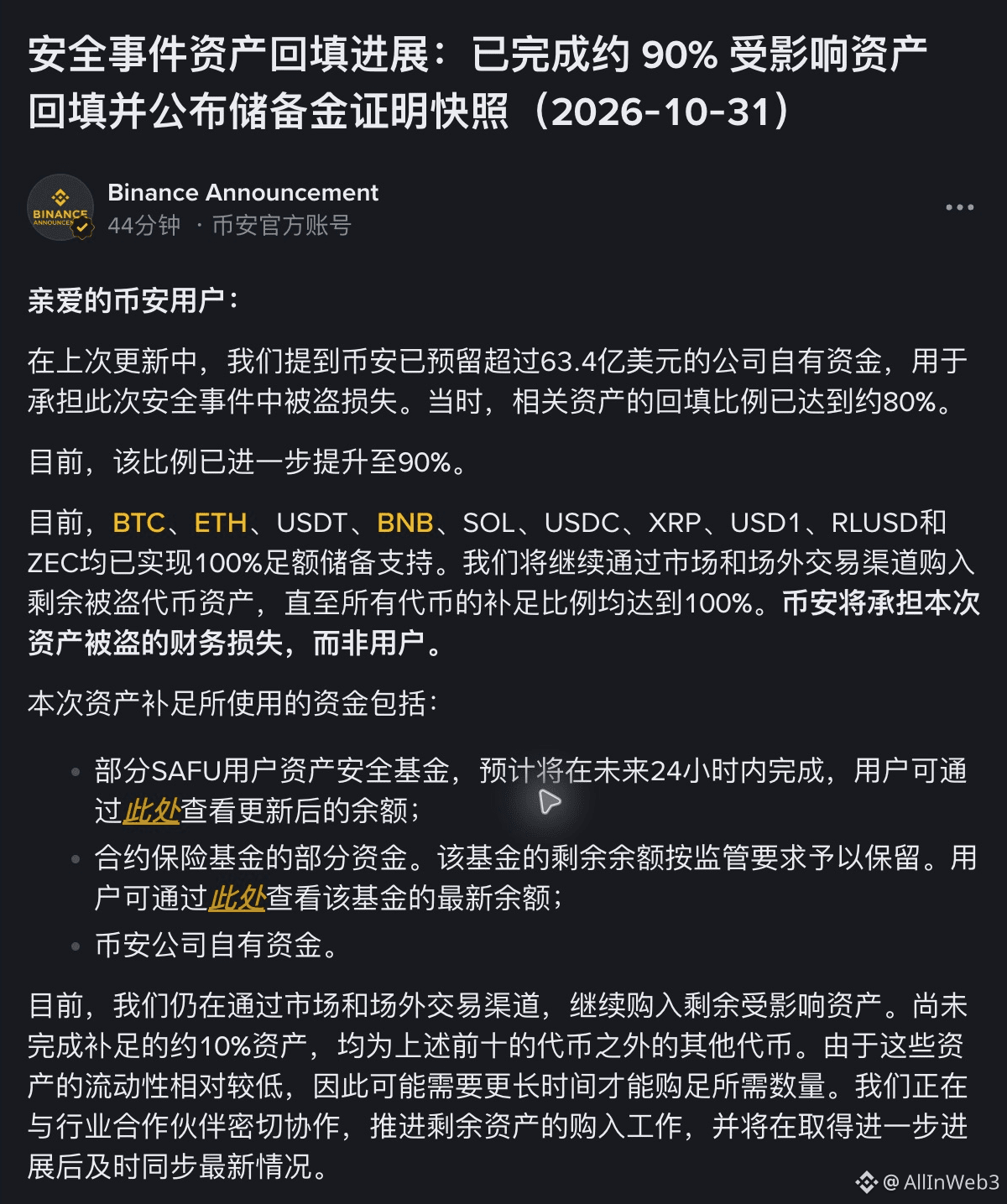
Binance has raised its asset replenishment ratio from about 80% to 90%, but the final 10% cannot be summed up with a single overall percentage. The more useful question for users is: Have the coins they hold been fully replenished?
The latest official announcement, dated October 31, says that ten tokens, including BTC, ETH, USDT, and BNB, now have 100% reserve backing. The roughly 10% that has yet to be replenished consists of tokens outside those ten. Because their liquidity is lower, acquiring the required amounts may take longer. Having funds ready and having purchased all the corresponding tokens are still two separate steps.
Yesterday, I focused on the difference between freezing and recovering assets. The new point to check this time is that replenishment is shifting from overall progress to coverage by token. The fact that ten tokens are fully backed cannot be used to draw conclusions about every token, nor does it justify promising that withdrawals have resumed.
The proof of reserves also needs to be assessed by stage: Binance says it has completed the snapshot as of 08:00 on October 31, while the full proof is expected to be generated on November 3 (UTC). Withdrawals are still expected to resume on November 1, with the specific arrangements yet to be confirmed. Completing the snapshot does not mean the full verification process is complete.
My assessment: The replenishment progress is worth tracking. The remaining token list, the full proof, and the actual resumption of withdrawals are the results that need to be checked one by one next. Source: Binance's October 31 asset replenishment announcement; as of 23:12 Beijing time.
331
·
--
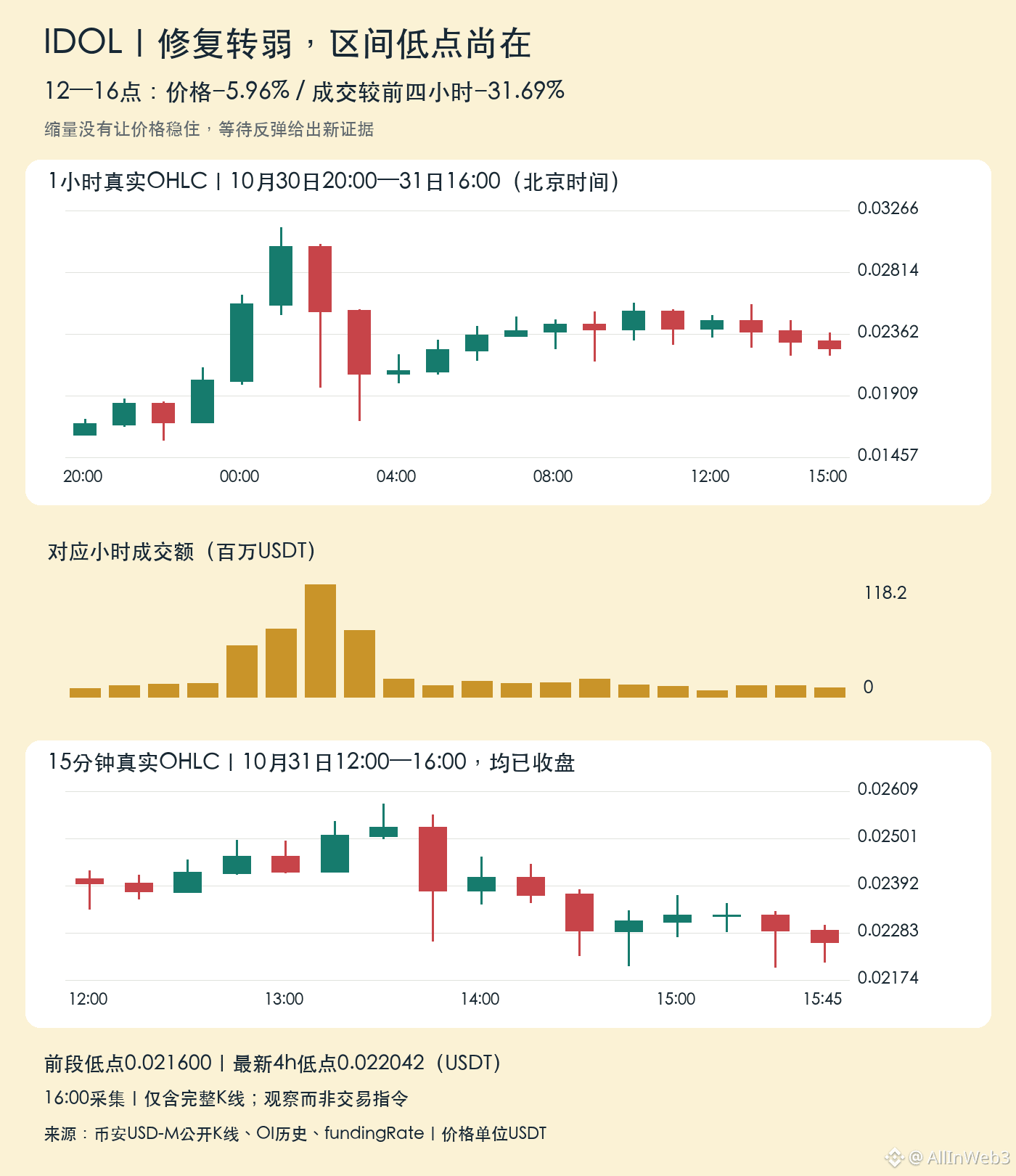
At $IDOL 14, debate was still underway over whether the range could break upward. Two hours later, price had moved toward the lower boundary. I’ve changed my assessment from “the recovery is still intact” to “the recovery is weakening,” but it’s still too early to declare the entire range lost.
The two complete hourly candles from 14:00–15:00 and 15:00–16:00 both closed lower. The four-hour candle from 12:00–16:00 closed at 0.022642, down 5.96% from 0.024078. Volume during this period was 39.599 million USDT, 31.69% lower than from 08:00–12:00. Lower volume didn’t stabilize the price, so we can’t take “there wasn’t as much selling” as proof that buyers stepped in.
The bullish case in the 14:00 post was that the lows were moving higher. The latest four-hour low is 0.022042, still above the previous low of 0.021600, so that argument hasn’t been completely overturned. But the high has fallen from 0.025860 to 0.025794, and the close has moved lower too. The bulls have less control than they did two hours ago.
Whether the rebound can recover lost ground matters more than the 24-hour gain. For now, I’m waiting—not entering on a chase or forcing a target. First, watch whether a complete 15-minute candle can reclaim the post-14:00 rebound high of 0.024575 and hold it on a retest. If price breaks below 0.021600, the premise of a range recovery must be discarded and the structure reassessed.
A decline on lower volume could mean selling pressure is easing, or that there isn’t enough buying support. The next price response will tell us which. Touching a price level is not a signal; reassess if the quote or structure changes. Source: Binance USDT perpetuals, data collected on October 31 at 16:00; monitoring through 17:00.
1
251
·
--
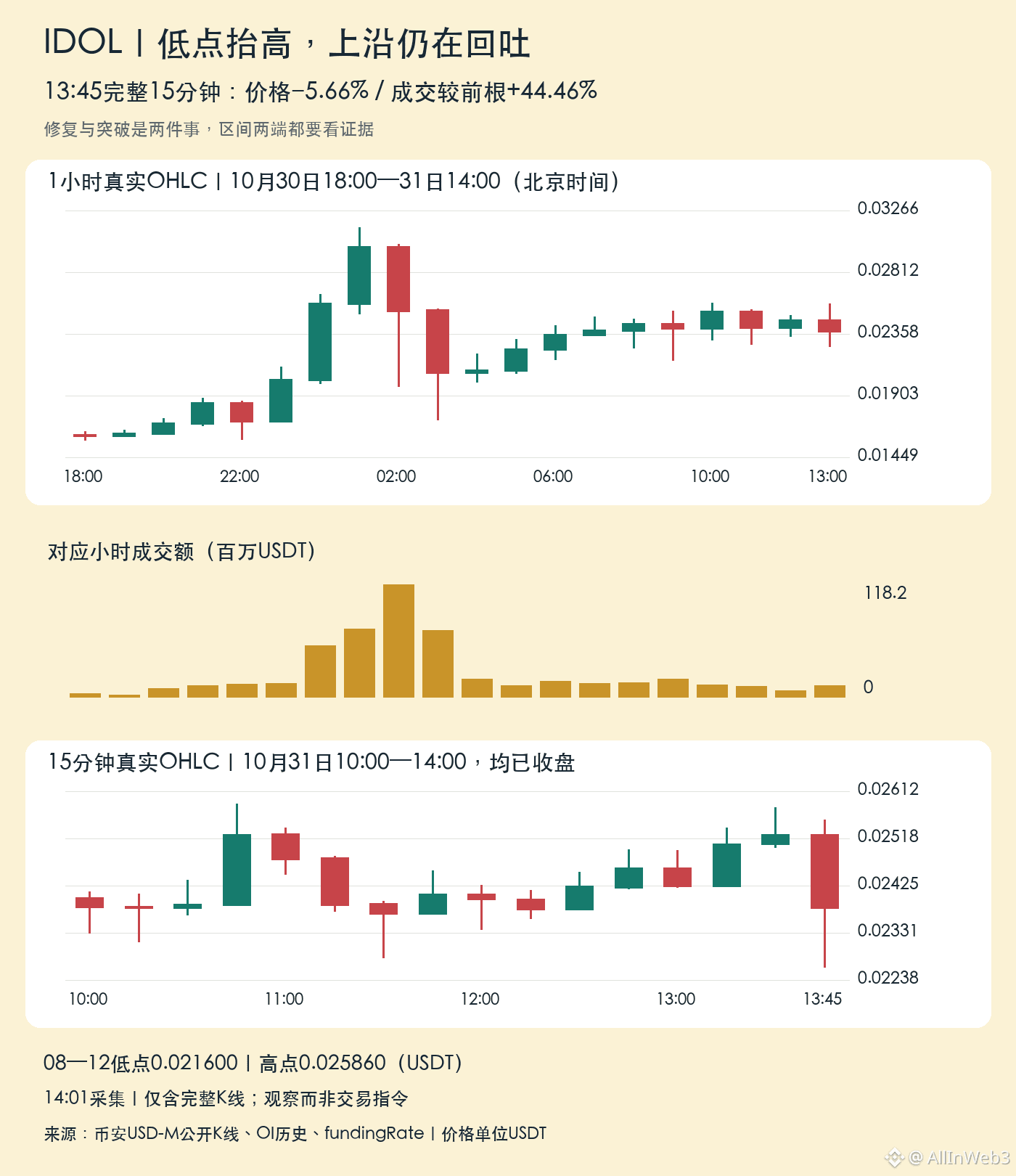
$IDOL Bulls say the recovery is intact; bears say the rebound was knocked back again. Both sides have evidence. I lean toward “the range is still intact; a breakout has yet to be confirmed.” The risk/reward of chasing a rise right now is unclear.
The bulls’ strongest argument: the 04:00 analysis focused on 0.022669, which was indeed reclaimed later. The full four-hour period from 08:00 to 12:00 had a low of 0.021600, clearly higher than the 0.017250 low from 00:00 to 04:00. Buyers stepped in after the sharp drop, so the overnight panic should not be applied directly to the current situation.
The bears are not just calling for a drop: at 13:30, price first surged to 0.025794, then the 13:45 15-minute candle closed at 0.023829, down 5.66%, on about 4.9 million USDT in volume—44.46% more than the previous candle. Price tested the upper boundary, only to give back the gains in the very next candle, showing that there is still price evidence of selling pressure overhead.
The dividing line in this debate is not how much the price is still up over 24 hours, but whether the next test can hold its gains. My main view is that the recovery is still underway, but I would not chase price on the assumption of a breakout just yet; there is currently no reliable entry-and-target setup, so I’m waiting.
If a full 15-minute candle later closes above the 08:00–12:00 high of 0.025860 and price holds that level on a retest, I’ll have more confidence in a breakout. If price falls below 0.021600, the bulls’ argument that lows are rising will need to be reassessed. A price touch alone is not a buy or sell signal; reassess after the structure changes.
Source: Binance USDT perpetual futures, collected October 31 at 14:01; monitoring through 15:00.
269
·
--
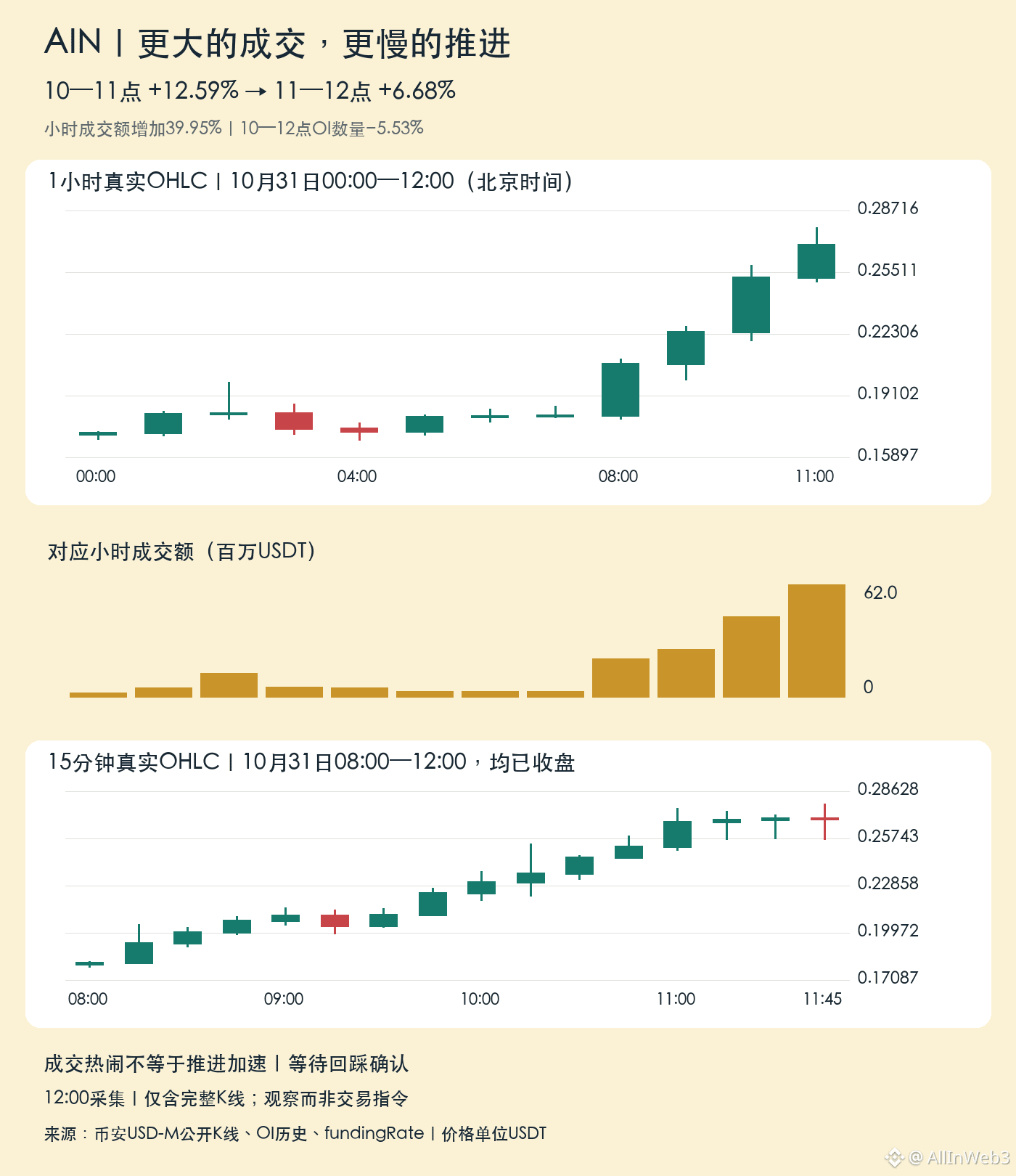
$AIN The more volume comes in, the more worth chasing it? The last two completed hourly candles offer a contrasting warning: trading volume increased, but price gains slowed. I’ll replace the urge to chase with a check of buying support.
From 10:00 to 11:00, the price rose 12.59% on 44.33 million USDT in volume. From 11:00 to 12:00, volume increased to 62.05 million, up 39.95%, while the gain fell to 6.68%. The price is still rising, so it’s too soon to call a top. But a larger volume producing a smaller gain no longer supports the simplistic view that “more volume means faster gains.”
Now look at open interest: from 10:00 to 12:00, it fell from 321 million to 303 million, a decrease of 5.53%. Trading volume is the sum of trades over a period; open interest is the number of contracts outstanding at a given point in time. They are not the same thing. A taller volume bar doesn’t mean new long positions are pouring in.
A more practical approach is to align the time windows first, then see whether the price holds after volume picks up. The 11:45 15-minute candle reached 0.27832, but ultimately closed back at 0.26965. Making a new high and holding that high are two different steps. Short covering and position rotation may both have played a part; the data doesn’t identify who was trading.
For now, I’m waiting for a fresh pullback, with no chase entry or forced target. If higher volume continues to bring sharp rallies that fade, the case for caution gets stronger. If the price holds above 0.27832 and then holds on a retest, I’ll reassess the conditions and costs. I haven’t verified a single new fundamental catalyst.
Source: Binance USDT perpetuals, data collected October 31 at 12:00; monitored until 13:00. Reassess if the market structure changes.
564
·
--
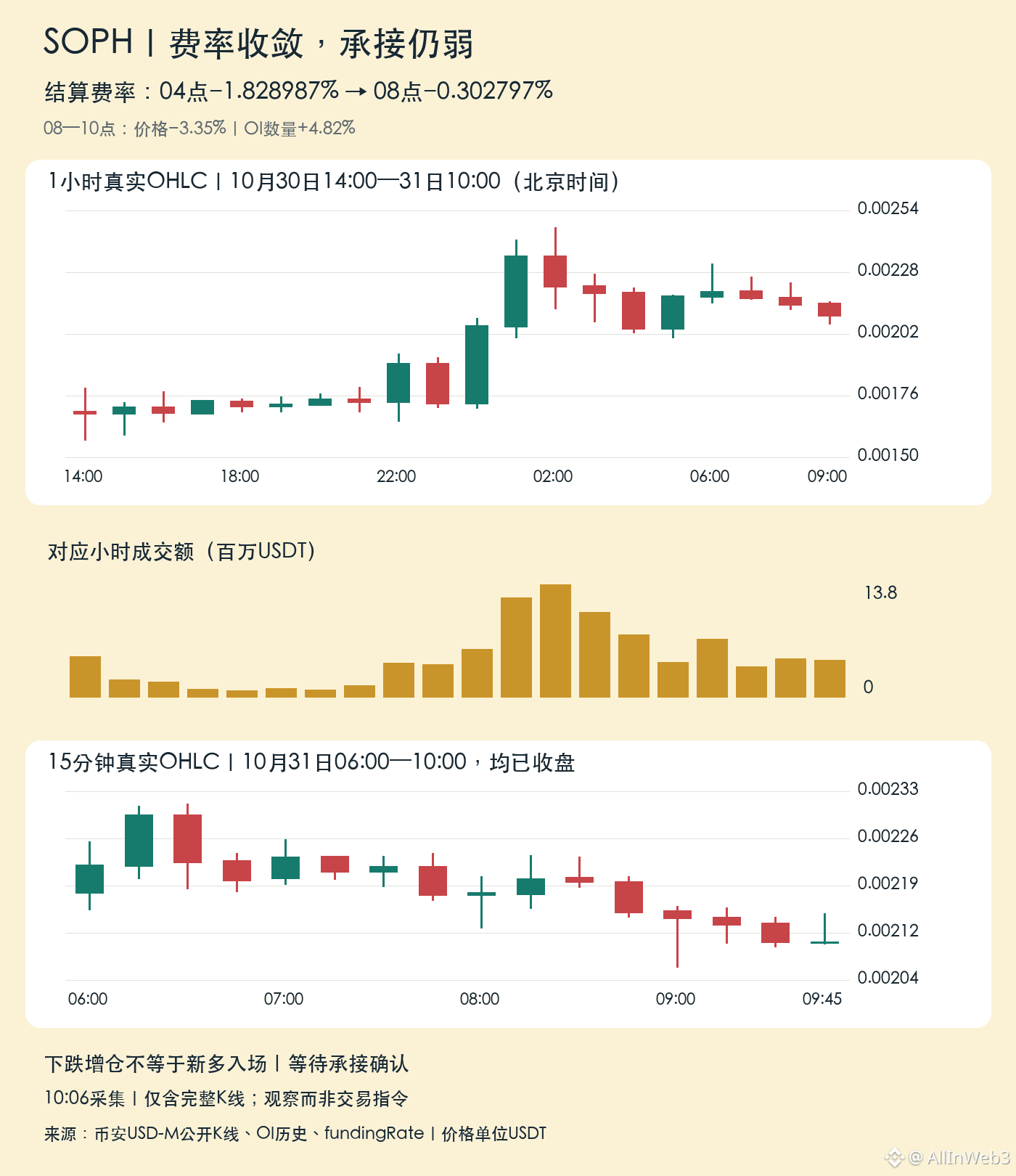
$SOPH Funding pressure on shorts has eased, but the price has not stabilized. The test condition laid out in the 06:00 post now has a new result: the case for longs relying on deeply negative funding rates is weakening.
The settled funding rate was -1.828987% at 04:00, narrowing to -0.302797% at 08:00. Shorts are still paying, but the cost for that settlement has clearly eased. This compares historical settlements; it is not a promise about how much the next payment will be, nor does it treat the funding-rate change as the cause of the price decline.
The price response is more direct: from 08:00 to 10:00, it fell from 0.002176 to 0.002103, down 3.35%; over the same period, open interest increased by 4.82%. Positions expanded during the decline, showing that disagreement continues to build. “Rising open interest” can no longer automatically be read as longs taking over, nor does it tell us who is adding shorts.
The 02:00 post discussed the momentum behind the sharp rally, and the 06:00 post shifted focus to funding costs and principal risk. This time, I’m focusing on whether buyers can step back in after cost pressure eases. Since the 08:15 high of 0.002235, the highs of subsequent completed 15-minute periods have generally moved lower, with no confirmation yet of a sustained recovery.
For now, I’m waiting and won’t give an entry for chasing the price or a target. First, watch whether it can reclaim 0.002235 and hold on a retest. If it breaks below the 04:00–08:00 low of 0.002004, the weak-recovery assessment needs to be revised further downward. Touching a price level is not a trading signal; reassess if the structure changes.
Source: Binance USDT perpetuals, data collected October 31 at 10:06; monitored through 11:00.
177
·
--
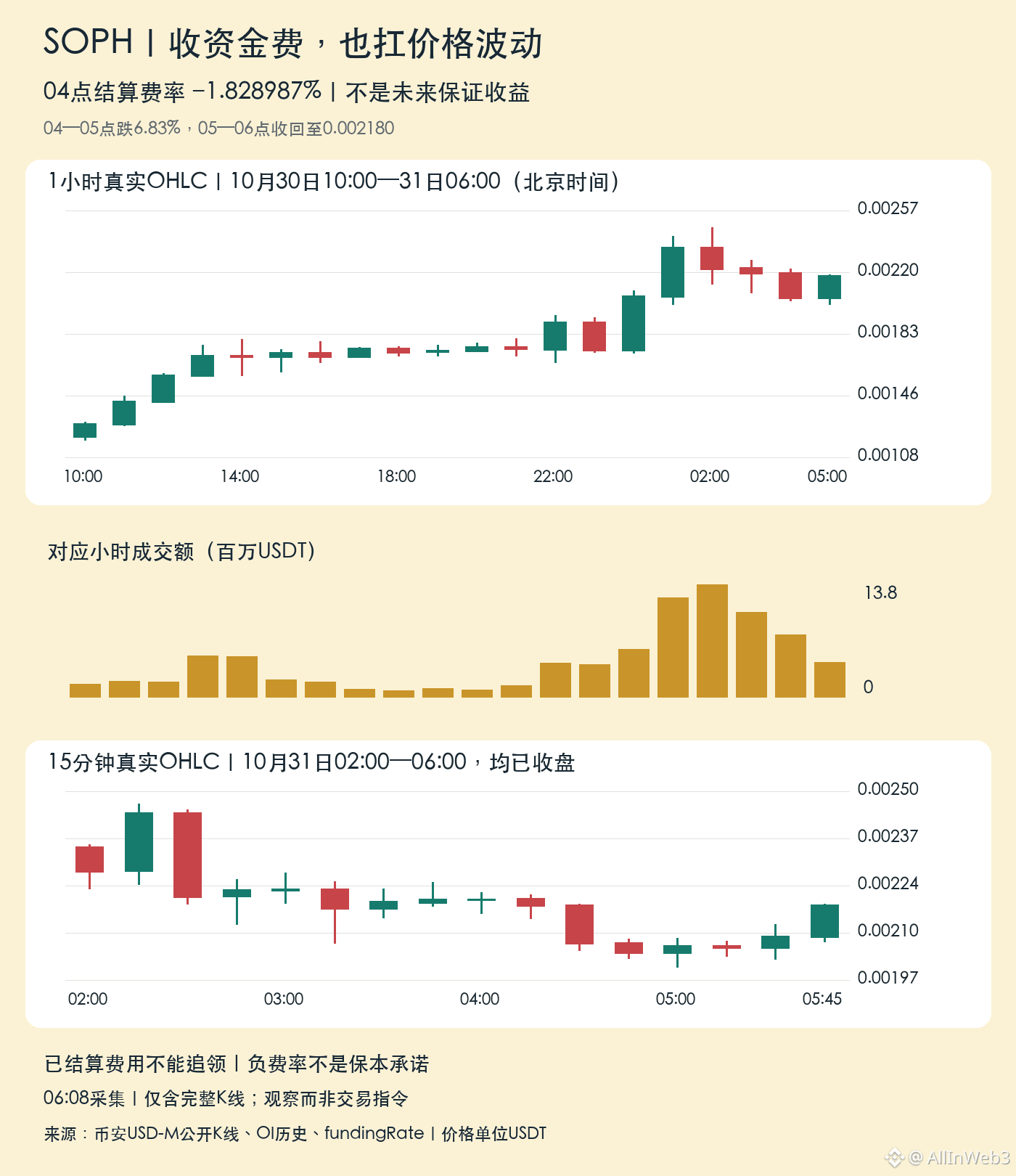
At $SOPH 04, a funding-rate settlement came in at -1.828987%. This makes holding a short position more expensive, but chasing longs just to collect the payment could also put your principal at risk.
The article at 02:00 cited the 00:00 rate of -0.194834%. The new figure is the settled value at 04:00, and its absolute magnitude is clearly larger. Under Binance rules, a negative rate means shorts pay longs, calculated on the notional position at settlement—not on the margin, and it is not a yield the exchange gives away for free.
Those who benefit are eligible longs at the time of settlement; the corresponding shorts bear the cost. But settlement has already passed, so opening a position now will not get you the 04:00 payment. Nor can you assume the next funding rate will match this figure. Annualizing a historical rate directly would make an anomaly look like a steady cash flow.
The price risk does not disappear just because you collect a payment. From 04:00 to 05:00, the price fell from 0.002197 to 0.002047, a 6.83% drop in one hour; over the following hour, it recovered to 0.002180. This is not an attempt to calculate anyone’s P&L using prices from different times, but rather to show that even if you are on the receiving end of the payment, price swings can still change the outcome.
My view: first, watch whether cost pressure and price support can hold up at the same time. Don’t treat a deeply negative funding rate as a buy signal. For now, I’m waiting and setting no chase-price target. If the absolute funding rate narrows while the price still fails to hold steady, the case for supporting longs on funding payments alone becomes even weaker.
Source: Binance funding-rate rules and USDT perpetual data, collected at 06:08 on October 31; observations through 07:00.
9
·
--
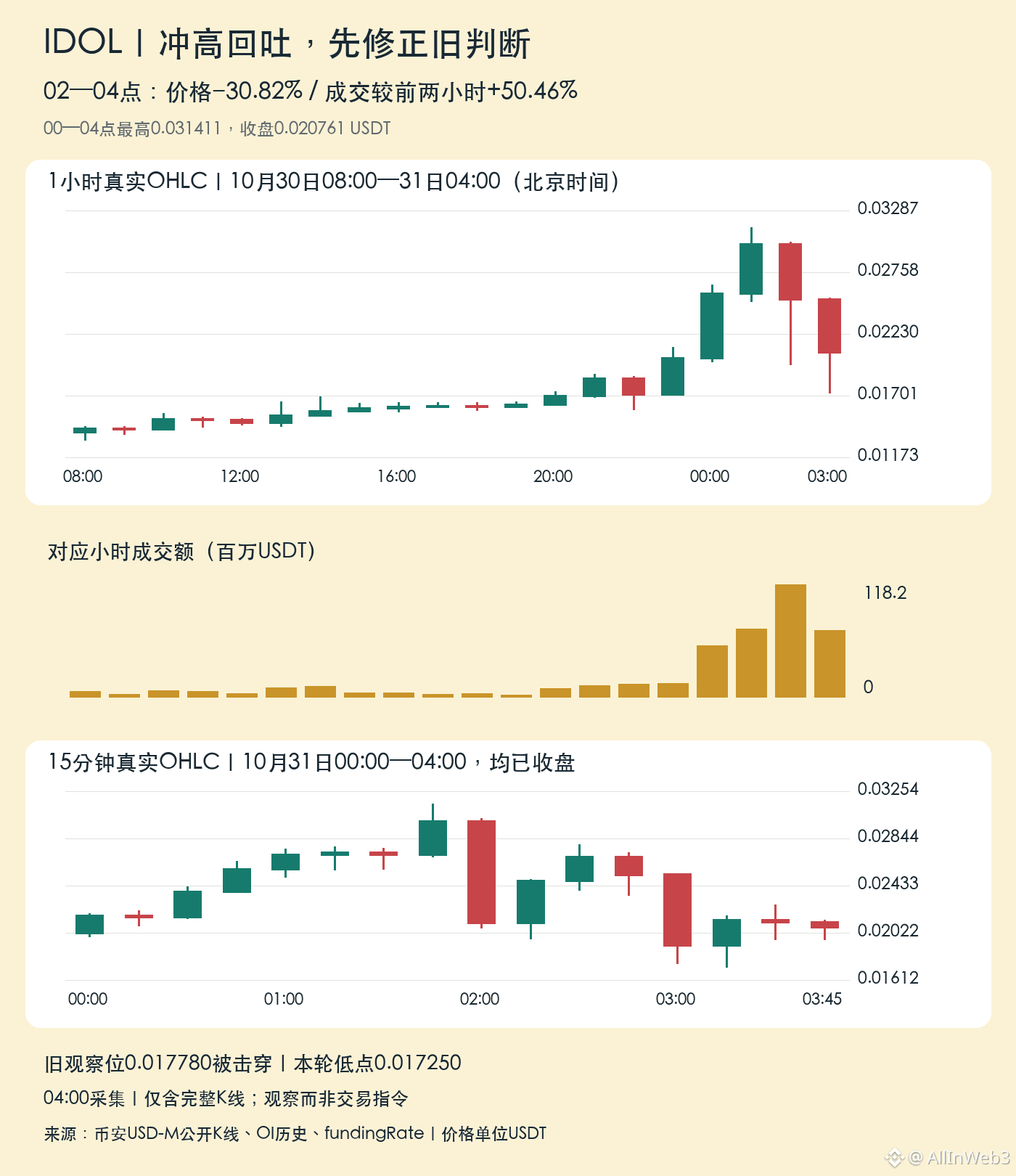
$IDOL The midnight post was still discussing whether the rise was backed by new positions. Now, a more immediate issue needs attention: the pullback after the spike has already happened, so we can't keep chasing prices based on the old bullish scenario.
From 00:00 to 04:00, the price reached a high of 0.031411 and closed at 0.020761. It was still up 2.51% from open to close over the four hours, but from 02:00 to 04:00 it fell 30.82%, from 0.030010 to 0.020761. It's the same market move, but viewed over a different window, the risk looks entirely different.
Trading volume didn't quietly contract either: volume in the final two hours was 188 million USDT, 50.46% higher than in the first two. The price drop came with increased trading activity, showing that disagreement at the highs had translated into price pressure. This isn't enough to prove that “the whales are selling,” but it is enough to abandon the optimistic assumption that we can simply wait for the price to hold at the highs.
The 0.017780 level flagged in the midnight post was breached when the price hit a low of 0.017250 this time, before recovering above it. Reclaiming the level doesn't mean the recovery is complete. I've updated my view to “first see whether support can be rebuilt after the sharp drop,” and won't treat a rebound as a reversal.
For now, I'm waiting: no chasing entries and no arbitrary targets. First, watch whether a full 15-minute candle can reclaim and hold above the 03:30 high of 0.022669, including on a retest. If 0.017250 is breached again, the recovery thesis is invalidated. Touching a price level alone isn't a buy signal; reassess once the structure changes.
Source: Binance USDT perpetuals, data collected at 04:00 on October 31; monitored until 05:00.
3
Log in to explore more content
Join global crypto users on Binance Square
⚡️ Get latest and useful information about crypto.
💬 Trusted by the world’s largest crypto exchange.
👍 Discover real insights from verified creators.
Email / Phone number
Trending Topics
BinanceReopensWithdrawalsForMoreAssets
621,070 views
3,012 Discussing
Security Incident | Recovery Update #8: Withdrawals for More Assets to Reopen (2026-11-05)
Binance Announcement
·157 Likes
·495.4k views
BTCRebounds80K
134,968 views
1,313 Discussing
Binance98PercentReplenished
70,889 views
916 Discussing