

#riskeducation
riskeducation
1,022 views
7 Discussing
Hot
Latest

·
--
Imagine a user named Ali who understands that futures trading is risky but does not yet have a clear strategy of his own. Instead of opening positions manually, he explores Binance Futures Copy Trading and reviews several lead-trader portfolios.
He does not immediately select the trader showing the highest recent return. He first examines the trader’s performance history, profit and loss, return on investment, maximum drawdown, trading frequency, and overall risk-taking style. After choosing a portfolio, he decides how much capital to allocate and reviews the available copy-trading settings.
When the selected lead trader opens or closes an eligible futures position, the system attempts to copy that action automatically according to Ali’s settings and available balance.
However, Ali’s result may not be exactly the same as the lead trader’s result. Entry prices, rapid market movements, slippage, trading fees, available margin, and order limits can create differences between the original and copied positions.
This example shows the main convenience of Futures Copy Trading: it can automate the execution of another trader’s strategy. But it does not remove responsibility or reduce futures trading to a guaranteed formula.
If the lead trader uses high leverage, enters a poor position, or experiences a large drawdown, the follower may also lose money. A strong historical record provides useful information, but it cannot predict future performance.
A responsible user should compare multiple portfolios, understand every copy setting, allocate only an amount they can afford to risk, and continue monitoring positions after copying begins.
Explore Futures Copy Trading to understand how different traders approach the market, but always study their risk management before following any strategy.
This content is for educational purposes only and does not constitute financial advice.
$AKE $1000XEC $ZEC
#FuturesCopyTrading #BinanceSquare #RiskEducation
Imagine a user named Ali who understands that futures trading is risky but does not yet have a clear strategy of his own. Instead of opening positions manually, he explores Binance Futures Copy Trading and reviews several lead-trader portfolios.
He does not immediately select the trader showing the highest recent return. He first examines the trader’s performance history, profit and loss, return on investment, maximum drawdown, trading frequency, and overall risk-taking style. After choosing a portfolio, he decides how much capital to allocate and reviews the available copy-trading settings.
When the selected lead trader opens or closes an eligible futures position, the system attempts to copy that action automatically according to Ali’s settings and available balance.
However, Ali’s result may not be exactly the same as the lead trader’s result. Entry prices, rapid market movements, slippage, trading fees, available margin, and order limits can create differences between the original and copied positions.
This example shows the main convenience of Futures Copy Trading: it can automate the execution of another trader’s strategy. But it does not remove responsibility or reduce futures trading to a guaranteed formula.
If the lead trader uses high leverage, enters a poor position, or experiences a large drawdown, the follower may also lose money. A strong historical record provides useful information, but it cannot predict future performance.
A responsible user should compare multiple portfolios, understand every copy setting, allocate only an amount they can afford to risk, and continue monitoring positions after copying begins.
Explore Futures Copy Trading to understand how different traders approach the market, but always study their risk management before following any strategy.
This content is for educational purposes only and does not constitute financial advice.
$AKE $1000XEC $ZEC
#FuturesCopyTrading #BinanceSquare #RiskEducation
He does not immediately select the trader showing the highest recent return. He first examines the trader’s performance history, profit and loss, return on investment, maximum drawdown, trading frequency, and overall risk-taking style. After choosing a portfolio, he decides how much capital to allocate and reviews the available copy-trading settings.
When the selected lead trader opens or closes an eligible futures position, the system attempts to copy that action automatically according to Ali’s settings and available balance.
However, Ali’s result may not be exactly the same as the lead trader’s result. Entry prices, rapid market movements, slippage, trading fees, available margin, and order limits can create differences between the original and copied positions.
This example shows the main convenience of Futures Copy Trading: it can automate the execution of another trader’s strategy. But it does not remove responsibility or reduce futures trading to a guaranteed formula.
If the lead trader uses high leverage, enters a poor position, or experiences a large drawdown, the follower may also lose money. A strong historical record provides useful information, but it cannot predict future performance.
A responsible user should compare multiple portfolios, understand every copy setting, allocate only an amount they can afford to risk, and continue monitoring positions after copying begins.
Explore Futures Copy Trading to understand how different traders approach the market, but always study their risk management before following any strategy.
This content is for educational purposes only and does not constitute financial advice.
$AKE $1000XEC $ZEC
#FuturesCopyTrading #BinanceSquare #RiskEducation
2.9k
·
--
A live look at bStocks today shows a product that feels familiar at first, but becomes more complex once the details are examined.
The main attraction is easy to understand: bStocks provide economic exposure to selected underlying shares through blockchain-based tokens. They can be traded on Binance Spot, including outside normal stock-market hours. That flexibility may appeal to users who are already comfortable with crypto markets.
The most important observation, however, is that a bStock is not the same as directly owning a company share. Holding the token does not automatically make someone a shareholder or provide direct voting rights. This distinction should be understood before focusing on convenience.
Another point that stands out is pricing. A bStock may follow the general movement of its underlying security, but its market price does not always have to match it exactly. Liquidity, supply and demand, spreads, fees, trading outside regular market hours, and market disruptions can create a premium or discount. This means checking only the traditional share price may not give the complete picture.
The product also carries more than ordinary price risk. Users should consider liquidity, custody, issuer, regulatory, technology, network, and tax-related risks. Availability is restricted to eligible users in permitted jurisdictions, so access should never be assumed.
My overall review from examining the product structure is that bStocks may offer an interesting bridge between traditional markets and blockchain trading, but the convenience should not distract from the legal structure and risk factors.
Before exploring bStocks, review the official terms, check local eligibility, compare the token price with the underlying market, and understand how buying, selling, custody, and corporate actions work.
This content is educational only and is not financial advice.
$AKE $ESPORTS $BANK
#bStocks #BinanceSquare #RiskEducation
A live look at bStocks today shows a product that feels familiar at first, but becomes more complex once the details are examined.
The main attraction is easy to understand: bStocks provide economic exposure to selected underlying shares through blockchain-based tokens. They can be traded on Binance Spot, including outside normal stock-market hours. That flexibility may appeal to users who are already comfortable with crypto markets.
The most important observation, however, is that a bStock is not the same as directly owning a company share. Holding the token does not automatically make someone a shareholder or provide direct voting rights. This distinction should be understood before focusing on convenience.
Another point that stands out is pricing. A bStock may follow the general movement of its underlying security, but its market price does not always have to match it exactly. Liquidity, supply and demand, spreads, fees, trading outside regular market hours, and market disruptions can create a premium or discount. This means checking only the traditional share price may not give the complete picture.
The product also carries more than ordinary price risk. Users should consider liquidity, custody, issuer, regulatory, technology, network, and tax-related risks. Availability is restricted to eligible users in permitted jurisdictions, so access should never be assumed.
My overall review from examining the product structure is that bStocks may offer an interesting bridge between traditional markets and blockchain trading, but the convenience should not distract from the legal structure and risk factors.
Before exploring bStocks, review the official terms, check local eligibility, compare the token price with the underlying market, and understand how buying, selling, custody, and corporate actions work.
This content is educational only and is not financial advice.
$AKE $ESPORTS $BANK
#bStocks #BinanceSquare #RiskEducation
The main attraction is easy to understand: bStocks provide economic exposure to selected underlying shares through blockchain-based tokens. They can be traded on Binance Spot, including outside normal stock-market hours. That flexibility may appeal to users who are already comfortable with crypto markets.
The most important observation, however, is that a bStock is not the same as directly owning a company share. Holding the token does not automatically make someone a shareholder or provide direct voting rights. This distinction should be understood before focusing on convenience.
Another point that stands out is pricing. A bStock may follow the general movement of its underlying security, but its market price does not always have to match it exactly. Liquidity, supply and demand, spreads, fees, trading outside regular market hours, and market disruptions can create a premium or discount. This means checking only the traditional share price may not give the complete picture.
The product also carries more than ordinary price risk. Users should consider liquidity, custody, issuer, regulatory, technology, network, and tax-related risks. Availability is restricted to eligible users in permitted jurisdictions, so access should never be assumed.
My overall review from examining the product structure is that bStocks may offer an interesting bridge between traditional markets and blockchain trading, but the convenience should not distract from the legal structure and risk factors.
Before exploring bStocks, review the official terms, check local eligibility, compare the token price with the underlying market, and understand how buying, selling, custody, and corporate actions work.
This content is educational only and is not financial advice.
$AKE $ESPORTS $BANK
#bStocks #BinanceSquare #RiskEducation
2
1.6k

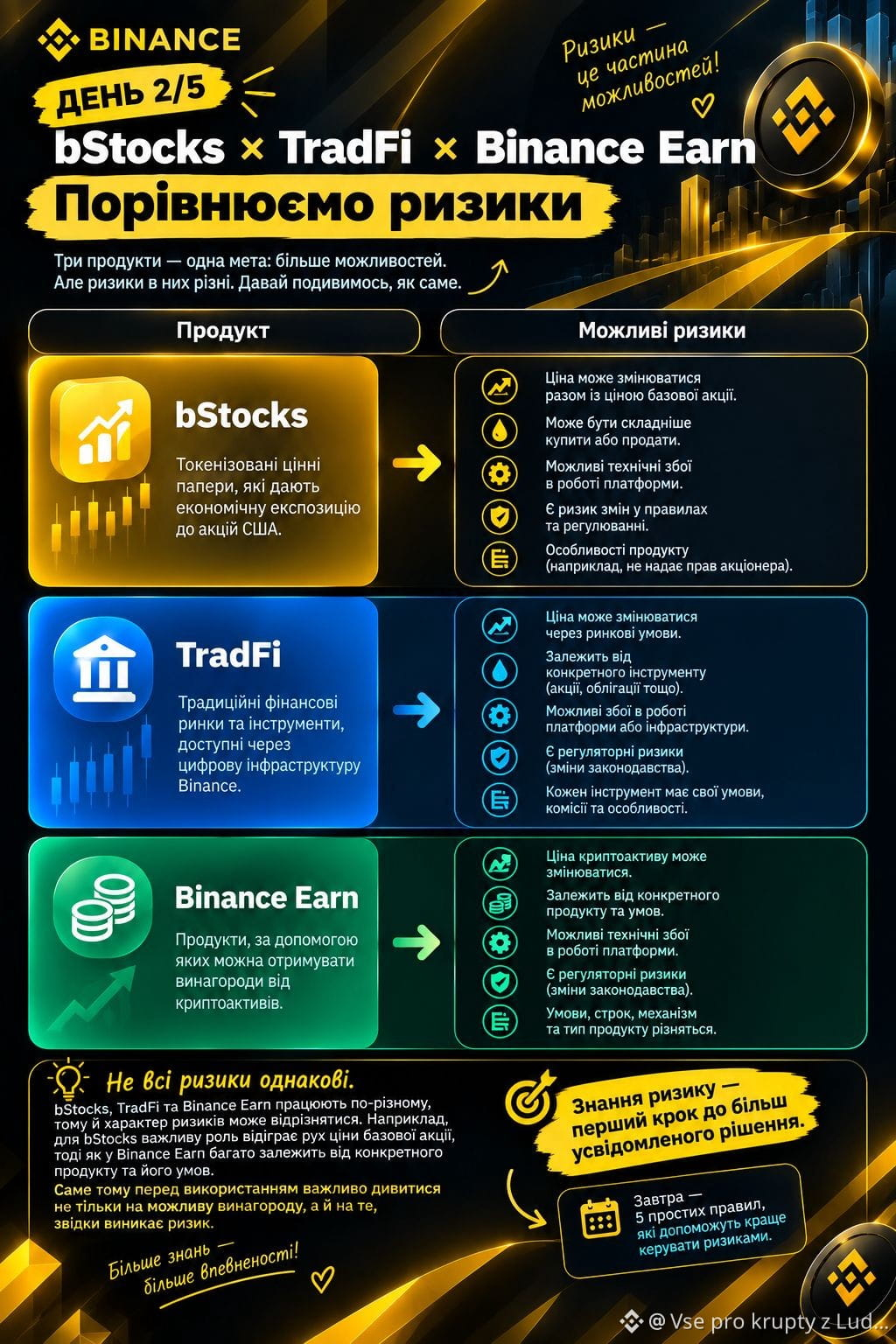
🟠DAY 2/5 — "Comparing risks"
Not all risks are the same.
Stocks, TradFi, and Binance Earn work differently, so the nature of risks may also differ. For example, with bStocks, the movement of the underlying stock price plays an important role, while with Binance Earn a lot depends on the specific product and its terms.
That’s why, before using anything, it’s important to look not only at the potential reward, but also at where the risk comes from.
Understanding risk is the first step toward a more informed decision.
Tomorrow — 5 simple rules to help you manage your risks better.
#Binance #BinanceCreate #RiskEducation
#RiskManagement #CryptoEducationCZ
🟠DAY 2/5 — "Comparing risks"
Not all risks are the same.
Stocks, TradFi, and Binance Earn work differently, so the nature of risks may also differ. For example, with bStocks, the movement of the underlying stock price plays an important role, while with Binance Earn a lot depends on the specific product and its terms.
That’s why, before using anything, it’s important to look not only at the potential reward, but also at where the risk comes from.
Understanding risk is the first step toward a more informed decision.
Tomorrow — 5 simple rules to help you manage your risks better.
#Binance #BinanceCreate #RiskEducation
#RiskManagement #CryptoEducationCZ
Not all risks are the same.
Stocks, TradFi, and Binance Earn work differently, so the nature of risks may also differ. For example, with bStocks, the movement of the underlying stock price plays an important role, while with Binance Earn a lot depends on the specific product and its terms.
That’s why, before using anything, it’s important to look not only at the potential reward, but also at where the risk comes from.
Understanding risk is the first step toward a more informed decision.
Tomorrow — 5 simple rules to help you manage your risks better.
#Binance #BinanceCreate #RiskEducation
#RiskManagement #CryptoEducationCZ
2
142
·
--
Article
Futures TradFi Is Not Stock Ownership: A Deep Beginner’s Guide to Trading Traditional MarketsTraditional assets and cryptocurrency markets are increasingly appearing on the same trading platforms. Binance Futures TradFi is one example of this development, allowing eligible users to trade perpetual futures linked to traditional-market assets such as precious metals, commodities, major ETFs, and individual company shares.
At first glance, the idea may appear simple: find a familiar asset, predict whether its price will rise or fall, and open a position.
However, the most important beginner lesson is that recognizing the underlying asset does not mean the product itself is simple.
A trader may understand what gold, Apple, NVIDIA, the S&P 500, or crude oil represents while still not understanding perpetual contracts, mark price, funding payments, margin, leverage, or liquidation.
Futures TradFi therefore requires two different types of knowledge: knowledge of the traditional asset and knowledge of the futures contract being used to trade it.
What is Binance Futures TradFi?
Binance Futures TradFi consists of perpetual futures contracts that track the prices of selected traditional financial assets. The available categories can include commodities, precious metals, ETF-linked market exposure, and individual equities. Examples Binance has discussed include gold, silver, crude oil, SPY, QQQ, Apple, Microsoft, and NVIDIA.
These products are derivatives.
When someone trades a stock-linked TradFi perpetual contract, they are not purchasing a share in the company. They do not become a shareholder, receive voting rights, or directly own the underlying security.
Similarly, trading XAUUSDT does not mean the user owns physical gold. The user is trading a USDT-settled contract designed to follow gold’s price movement.
This distinction matters because a derivative can behave differently from direct ownership.
A shareholder may decide to hold a stock for several years without facing liquidation simply because its price declined. A leveraged futures trader, however, may have the position liquidated if the market moves far enough against it and the available margin becomes insufficient.
What does “perpetual” mean?
Traditional futures contracts commonly have expiration dates. A perpetual futures contract does not have a fixed expiry date.
This means a trader does not have to close the position because a settlement date has arrived. The position may remain open as long as the trader maintains sufficient margin and follows the contract requirements.
However, “no expiry” does not mean “no ongoing cost.”
Perpetual futures commonly use funding payments to help keep the contract price connected to the price of the underlying market. Depending on the funding rate and the trader’s position, the trader may periodically pay funding or receive it.
Funding can therefore affect the result of a position even when the underlying asset’s price has not moved significantly.
A trade that appears slightly profitable based only on entry and exit prices may produce a smaller result after funding fees, trading fees, and slippage are included.
How Futures TradFi positions work
A trader generally chooses between two directions.
A long position expresses the view that the contract’s price may rise.
A short position expresses the view that the contract’s price may fall.
Suppose a trader expects gold to strengthen because of economic uncertainty. The trader may open a long position on XAUUSDT.
If the contract price rises after the position is opened, the long position may gain value. If the price falls, the position may lose value.
Another trader may believe a particular stock is overvalued before an earnings announcement. That trader may open a short position on a related TradFi perpetual contract.
If the price falls, the short position may gain value. If the company reports stronger-than-expected results and the price rises sharply, the short position may lose value.
This ability to trade in either direction provides flexibility, but it also creates risk. Short positions can suffer rapid losses when prices rise unexpectedly, while long positions can be damaged by sudden declines.
A realistic leverage example
Consider a simplified educational example.
A trader has 100 USDT available as margin and opens a 500 USDT gold-linked position using 5x leverage.
The trader is controlling a position five times larger than the margin committed.
If the contract rises by 2%, the gross gain on a 500 USDT position would be approximately 10 USDT.
That 10 USDT represents approximately 10% of the trader’s original 100 USDT margin.
But the same calculation works in the opposite direction.
If the contract falls by 2%, the gross loss would also be approximately 10 USDT, before fees, funding, and slippage.
The underlying market moved only 2%, but the effect on the trader’s committed margin was approximately 10%.
This is what leverage does. It does not make the trader’s prediction more accurate. It increases the financial effect of the price movement on the trader’s capital.
At 10x leverage, a 2% adverse movement on a similarly structured position could create a loss equal to approximately 20% of the committed margin, before additional costs.
The exact liquidation price cannot be calculated from leverage alone. It also depends on factors such as the entry price, position size, maintenance margin, margin mode, available balance, fees, and other account conditions.
The important lesson is that higher leverage leaves less room for the market to move against the position.
Why 24/7 TradFi trading requires special attention
One of the most distinctive features of Binance TradFi perpetuals is that the futures contracts can trade continuously even though the underlying traditional markets do not.
Cryptocurrency markets generally operate continuously. Traditional equity and commodity markets have regular sessions, extended sessions, maintenance periods, weekends, and holidays.
This creates an important challenge: how should a perpetual contract continue trading when the main underlying market is closed?
Binance uses specific Price Index and Mark Price mechanisms for TradFi perpetuals. During normal trading periods, external data vendors contribute to the Price Index. During periods when normal external price formation is unavailable or liquidity is limited, different calculation modes may apply, including order-book-based and smoothed pricing mechanisms.
The Mark Price is especially important because futures platforms generally use it for risk calculations and liquidation management rather than relying only on the most recent trade price.k
This means beginners should understand that three prices may not always be identical:
The price of the underlying traditional assetThe TradFi perpetual contract’s latest traded priceThe contract’s Mark Price
During active traditional-market hours, these prices may remain relatively close. During weekends, holidays, overnight periods, or moments of limited liquidity, differences may become more noticeable.
My main product observation
After examining how Binance designed TradFi perpetuals, the most important product observation is that off-hours trading should not be treated as merely “extra time to trade.”
It can represent a different pricing environment.
When the traditional market is open, the underlying asset benefits from active price discovery across its main venues. When that market is closed, the perpetual contract may continue reacting to Binance order-book activity, market expectations, related instruments, and available pricing mechanisms.
That does not automatically make off-hours trading unsuitable, but it means traders should be more careful about liquidity, spreads, volatility, and the difference between the perpetual price and the last widely recognized underlying-market price.
The ability to trade a stock-linked contract on a weekend may appear convenient. The more important question is whether the trader understands how that contract is being priced while the primary stock market is closed.
Binance itself warns that TradFi perpetuals can face high market risk and price volatility, particularly outside traditional market hours.
A realistic off-hours scenario
Imagine that a trader follows a technology company whose shares closed at $200 on Friday.
During the weekend, major news appears that could affect the company. The company’s main stock exchange is closed, but a related TradFi perpetual contract continues trading.
Buyers and sellers begin reacting to the news. The perpetual contract moves to a level equivalent to $208.
This does not necessarily mean the actual stock will open at exactly $208 on Monday.
When the traditional market reopens, new institutional orders, updated analyst views, liquidity, broader market conditions, and official price discovery may produce a different opening price.
The perpetual contract could have anticipated the move correctly, overreacted to the news, or underestimated it.
A trader entering during the weekend is therefore not simply trading the last official stock price. The trader is trading the market’s current expectation of where the asset may be valued when deeper traditional-market liquidity returns.
This is a useful feature for expressing a market view, but it introduces basis, liquidity, and repricing risks that beginners may overlook.
Price Index, Mark Price, and last price
The last price is the price at which the most recent trade occurred.
The Price Index is a calculated reference intended to represent the external value of the underlying asset using available pricing inputs.
The Mark Price is a risk-management reference designed to reduce the effect of short-term manipulation or abnormal contract-price movements on unrealized profit, loss, and liquidation calculations.
A trader may see the last price move sharply while the Mark Price moves less aggressively. Conversely, changes in the pricing mode or underlying reference can affect the Mark Price even when the trader is focused only on the visible candlestick chart.
For this reason, checking only the entry price and latest traded price is not enough. Futures traders should also know which price is used to calculate their liquidation risk.
Understanding funding
Funding is another mechanism that beginners can underestimate
When a perpetual contract trades at a premium or discount relative to its reference market, funding payments can help encourage the contract price to remain connected to the underlying asset.
If the funding rate is positive, long-position holders generally pay short-position holders.
If the rate is negative, short-position holders generally pay long-position holders.
Funding rates can change.
A trader who plans to hold a position for several days should therefore consider not only the expected price move but also the possible cost of maintaining the position.
For example, a trader may correctly predict that an asset will rise slowly over a week. However, repeated funding payments, trading fees, and an imprecise entry may reduce the final result.
Funding should not be treated as a small detail displayed near the order panel. It is part of the trade’s cost structure.
Cross margin versus isolated margin
Margin mode can significantly affect risk.
Under isolated margin, a specific amount of margin is assigned to one position. The potential damage is more contained because the position does not automatically use the entire available futures balance in the same way a cross-margin position might.
Under cross margin, available margin can be shared across positions. This may help a position remain open during temporary volatility, but it can also expose a larger portion of the account balance if the trade continues moving in the wrong direction.
Neither mode removes risk.
Isolated margin can still be fully lost if the position is liquidated. Cross margin can place more account capital at risk.
Beginners should understand the selected margin mode before submitting an order rather than discovering its effect after the market moves.
What moves TradFi perpetual prices?
The answer depends on the underlying asset.
Stock-linked contracts may react to:Company earningsRevenue and profit guidanceProduct announcementsManagement changesIndustry developmentsInterest-rate expectationsRegulatory decisionsBroader stock-market sentimentCommodity-linked contracts may react to:InflationCurrency movementsInterest ratesGeopolitical eventsSupply disruptionsProduction decisionsIndustrial demandWeather conditionsInventory reports
ETF-linked contracts may respond to the combined movement of many companies and broader economic expectations.
This means technical analysis alone may not provide enough context. A chart can show where price has moved, but traditional-market news often helps explain why it is moving.
Common beginner mistakes
The first mistake is confusing the contract with ownership.
Trading an Apple-linked perpetual does not mean owning Apple shares.
The second mistake is using high leverage because the underlying asset appears less volatile than cryptocurrency.
A stock or commodity does not need to move 20% in one day to cause serious damage to a highly leveraged position. A relatively small adverse move can have a large effect on margin.
The third mistake is ignoring funding and fees.
Frequent entries and exits or long holding periods can create costs that reduce performance.
The fourth mistake is trading major news without a plan.
Earnings reports, inflation releases, employment data, and central-bank decisions can produce rapid price changes and slippage.
The fifth mistake is assuming 24/7 access means equal liquidity throughout the entire week.
Trading conditions can vary significantly between active underlying-market hours and off-hours.
The sixth mistake is watching only the last price.
Mark Price is essential for understanding unrealized profit, loss, and liquidation risk.
Who may find Futures TradFi useful?
The product may interest experienced futures users who want to express views on traditional assets while using a familiar USDT-settled trading environment.
It may also be useful for traders who already follow commodities, equities, or major market ETFs and understand how economic events affect them.
However, the product may be unsuitable for someone who:
Does not understand leverageCannot explain liquidationHas no position-sizing methodUses money needed for essential expensesTrades primarily because of social-media excitementAssumes familiar assets are automatically safeIs unwilling to monitor funding and marginA beginner checklist before opening a positionBefore trading a TradFi perpetual contract, a user should be able to answer the following questions:
What exactly does this contract track?
Am I trading a derivative or purchasing the underlying asset?
Is the underlying traditional market currently open?
What is the contract’s Mark Price?
What leverage have I selected?
How much of my capital is actually at risk?
Am I using isolated or cross margin?
Where is my estimated liquidation price?
When is the next funding payment?
What news event could affect this asset?
Where will I exit if the trade is wrong?
Is the possible loss acceptable before I place the order?
If these questions cannot be answered, the user may need more education before opening the position.
Final perspective
Binance Futures TradFi creates a bridge between traditional financial markets and crypto-style perpetual trading.
Its v.lue is not simply that recognizable assets are available on a crypto platform. Its deeper value is that eligible traders can express long or short views on different global markets using USDT-settled perpetual contracts and continuous access.
But the same features that make the product flexible also create its main risks.
Leverage magnifies losses.
Funding affects holding costs.
Liquidation can close a position automatically.
Traditional markets do not provide equal price discovery at every hour.
A perpetual contract is not the same as the asset it tracks.
The responsible approach is to treat Futures TradFi as a derivatives product first and a familiar-asset product second.
Before trading, explore the TradFi section on Binance Futures, review the individual contract specifications, observe how the Mark Price behaves during different market sessions, and understand the full risk of the position before committing capital.
This content is for educational purposes only and does not constitute financial advice or a recommendation to trade. Futures and leveraged products involve significant risk and can result in partial or total loss of capital. Product availability, contract specifications, leverage limits, pricing mechanisms, and eligibility may vary by region and can change. Always review the latest official Binance information, conduct independent research, and consider your experience and risk tolerance before trading.
$AKE $BANK
#BinanceFutures #TradFi #RiskEducation $ESPORTS
Futures TradFi Is Not Stock Ownership: A Deep Beginner’s Guide to Trading Traditional Markets
Traditional assets and cryptocurrency markets are increasingly appearing on the same trading platforms. Binance Futures TradFi is one example of this development, allowing eligible users to trade perpetual futures linked to traditional-market assets such as precious metals, commodities, major ETFs, and individual company shares.
At first glance, the idea may appear simple: find a familiar asset, predict whether its price will rise or fall, and open a position.
However, the most important beginner lesson is that recognizing the underlying asset does not mean the product itself is simple.
A trader may understand what gold, Apple, NVIDIA, the S&P 500, or crude oil represents while still not understanding perpetual contracts, mark price, funding payments, margin, leverage, or liquidation.
Futures TradFi therefore requires two different types of knowledge: knowledge of the traditional asset and knowledge of the futures contract being used to trade it.
What is Binance Futures TradFi?
Binance Futures TradFi consists of perpetual futures contracts that track the prices of selected traditional financial assets. The available categories can include commodities, precious metals, ETF-linked market exposure, and individual equities. Examples Binance has discussed include gold, silver, crude oil, SPY, QQQ, Apple, Microsoft, and NVIDIA.
These products are derivatives.
When someone trades a stock-linked TradFi perpetual contract, they are not purchasing a share in the company. They do not become a shareholder, receive voting rights, or directly own the underlying security.
Similarly, trading XAUUSDT does not mean the user owns physical gold. The user is trading a USDT-settled contract designed to follow gold’s price movement.
This distinction matters because a derivative can behave differently from direct ownership.
A shareholder may decide to hold a stock for several years without facing liquidation simply because its price declined. A leveraged futures trader, however, may have the position liquidated if the market moves far enough against it and the available margin becomes insufficient.
What does “perpetual” mean?
Traditional futures contracts commonly have expiration dates. A perpetual futures contract does not have a fixed expiry date.
This means a trader does not have to close the position because a settlement date has arrived. The position may remain open as long as the trader maintains sufficient margin and follows the contract requirements.
However, “no expiry” does not mean “no ongoing cost.”
Perpetual futures commonly use funding payments to help keep the contract price connected to the price of the underlying market. Depending on the funding rate and the trader’s position, the trader may periodically pay funding or receive it.
Funding can therefore affect the result of a position even when the underlying asset’s price has not moved significantly.
A trade that appears slightly profitable based only on entry and exit prices may produce a smaller result after funding fees, trading fees, and slippage are included.
How Futures TradFi positions work
A trader generally chooses between two directions.
A long position expresses the view that the contract’s price may rise.
A short position expresses the view that the contract’s price may fall.
Suppose a trader expects gold to strengthen because of economic uncertainty. The trader may open a long position on XAUUSDT.
If the contract price rises after the position is opened, the long position may gain value. If the price falls, the position may lose value.
Another trader may believe a particular stock is overvalued before an earnings announcement. That trader may open a short position on a related TradFi perpetual contract.
If the price falls, the short position may gain value. If the company reports stronger-than-expected results and the price rises sharply, the short position may lose value.
This ability to trade in either direction provides flexibility, but it also creates risk. Short positions can suffer rapid losses when prices rise unexpectedly, while long positions can be damaged by sudden declines.
A realistic leverage example
Consider a simplified educational example.
A trader has 100 USDT available as margin and opens a 500 USDT gold-linked position using 5x leverage.
The trader is controlling a position five times larger than the margin committed.
If the contract rises by 2%, the gross gain on a 500 USDT position would be approximately 10 USDT.
That 10 USDT represents approximately 10% of the trader’s original 100 USDT margin.
But the same calculation works in the opposite direction.
If the contract falls by 2%, the gross loss would also be approximately 10 USDT, before fees, funding, and slippage.
The underlying market moved only 2%, but the effect on the trader’s committed margin was approximately 10%.
This is what leverage does. It does not make the trader’s prediction more accurate. It increases the financial effect of the price movement on the trader’s capital.
At 10x leverage, a 2% adverse movement on a similarly structured position could create a loss equal to approximately 20% of the committed margin, before additional costs.
The exact liquidation price cannot be calculated from leverage alone. It also depends on factors such as the entry price, position size, maintenance margin, margin mode, available balance, fees, and other account conditions.
The important lesson is that higher leverage leaves less room for the market to move against the position.
Why 24/7 TradFi trading requires special attention
One of the most distinctive features of Binance TradFi perpetuals is that the futures contracts can trade continuously even though the underlying traditional markets do not.
Cryptocurrency markets generally operate continuously. Traditional equity and commodity markets have regular sessions, extended sessions, maintenance periods, weekends, and holidays.
This creates an important challenge: how should a perpetual contract continue trading when the main underlying market is closed?
Binance uses specific Price Index and Mark Price mechanisms for TradFi perpetuals. During normal trading periods, external data vendors contribute to the Price Index. During periods when normal external price formation is unavailable or liquidity is limited, different calculation modes may apply, including order-book-based and smoothed pricing mechanisms.
The Mark Price is especially important because futures platforms generally use it for risk calculations and liquidation management rather than relying only on the most recent trade price.k
This means beginners should understand that three prices may not always be identical:
The price of the underlying traditional assetThe TradFi perpetual contract’s latest traded priceThe contract’s Mark Price
During active traditional-market hours, these prices may remain relatively close. During weekends, holidays, overnight periods, or moments of limited liquidity, differences may become more noticeable.
My main product observation
After examining how Binance designed TradFi perpetuals, the most important product observation is that off-hours trading should not be treated as merely “extra time to trade.”
It can represent a different pricing environment.
When the traditional market is open, the underlying asset benefits from active price discovery across its main venues. When that market is closed, the perpetual contract may continue reacting to Binance order-book activity, market expectations, related instruments, and available pricing mechanisms.
That does not automatically make off-hours trading unsuitable, but it means traders should be more careful about liquidity, spreads, volatility, and the difference between the perpetual price and the last widely recognized underlying-market price.
The ability to trade a stock-linked contract on a weekend may appear convenient. The more important question is whether the trader understands how that contract is being priced while the primary stock market is closed.
Binance itself warns that TradFi perpetuals can face high market risk and price volatility, particularly outside traditional market hours.
A realistic off-hours scenario
Imagine that a trader follows a technology company whose shares closed at $200 on Friday.
During the weekend, major news appears that could affect the company. The company’s main stock exchange is closed, but a related TradFi perpetual contract continues trading.
Buyers and sellers begin reacting to the news. The perpetual contract moves to a level equivalent to $208.
This does not necessarily mean the actual stock will open at exactly $208 on Monday.
When the traditional market reopens, new institutional orders, updated analyst views, liquidity, broader market conditions, and official price discovery may produce a different opening price.
The perpetual contract could have anticipated the move correctly, overreacted to the news, or underestimated it.
A trader entering during the weekend is therefore not simply trading the last official stock price. The trader is trading the market’s current expectation of where the asset may be valued when deeper traditional-market liquidity returns.
This is a useful feature for expressing a market view, but it introduces basis, liquidity, and repricing risks that beginners may overlook.
Price Index, Mark Price, and last price
The last price is the price at which the most recent trade occurred.
The Price Index is a calculated reference intended to represent the external value of the underlying asset using available pricing inputs.
The Mark Price is a risk-management reference designed to reduce the effect of short-term manipulation or abnormal contract-price movements on unrealized profit, loss, and liquidation calculations.
A trader may see the last price move sharply while the Mark Price moves less aggressively. Conversely, changes in the pricing mode or underlying reference can affect the Mark Price even when the trader is focused only on the visible candlestick chart.
For this reason, checking only the entry price and latest traded price is not enough. Futures traders should also know which price is used to calculate their liquidation risk.
Understanding funding
Funding is another mechanism that beginners can underestimate
When a perpetual contract trades at a premium or discount relative to its reference market, funding payments can help encourage the contract price to remain connected to the underlying asset.
If the funding rate is positive, long-position holders generally pay short-position holders.
If the rate is negative, short-position holders generally pay long-position holders.
Funding rates can change.
A trader who plans to hold a position for several days should therefore consider not only the expected price move but also the possible cost of maintaining the position.
For example, a trader may correctly predict that an asset will rise slowly over a week. However, repeated funding payments, trading fees, and an imprecise entry may reduce the final result.
Funding should not be treated as a small detail displayed near the order panel. It is part of the trade’s cost structure.
Cross margin versus isolated margin
Margin mode can significantly affect risk.
Under isolated margin, a specific amount of margin is assigned to one position. The potential damage is more contained because the position does not automatically use the entire available futures balance in the same way a cross-margin position might.
Under cross margin, available margin can be shared across positions. This may help a position remain open during temporary volatility, but it can also expose a larger portion of the account balance if the trade continues moving in the wrong direction.
Neither mode removes risk.
Isolated margin can still be fully lost if the position is liquidated. Cross margin can place more account capital at risk.
Beginners should understand the selected margin mode before submitting an order rather than discovering its effect after the market moves.
What moves TradFi perpetual prices?
The answer depends on the underlying asset.
Stock-linked contracts may react to:Company earningsRevenue and profit guidanceProduct announcementsManagement changesIndustry developmentsInterest-rate expectationsRegulatory decisionsBroader stock-market sentimentCommodity-linked contracts may react to:InflationCurrency movementsInterest ratesGeopolitical eventsSupply disruptionsProduction decisionsIndustrial demandWeather conditionsInventory reports
ETF-linked contracts may respond to the combined movement of many companies and broader economic expectations.
This means technical analysis alone may not provide enough context. A chart can show where price has moved, but traditional-market news often helps explain why it is moving.
Common beginner mistakes
The first mistake is confusing the contract with ownership.
Trading an Apple-linked perpetual does not mean owning Apple shares.
The second mistake is using high leverage because the underlying asset appears less volatile than cryptocurrency.
A stock or commodity does not need to move 20% in one day to cause serious damage to a highly leveraged position. A relatively small adverse move can have a large effect on margin.
The third mistake is ignoring funding and fees.
Frequent entries and exits or long holding periods can create costs that reduce performance.
The fourth mistake is trading major news without a plan.
Earnings reports, inflation releases, employment data, and central-bank decisions can produce rapid price changes and slippage.
The fifth mistake is assuming 24/7 access means equal liquidity throughout the entire week.
Trading conditions can vary significantly between active underlying-market hours and off-hours.
The sixth mistake is watching only the last price.
Mark Price is essential for understanding unrealized profit, loss, and liquidation risk.
Who may find Futures TradFi useful?
The product may interest experienced futures users who want to express views on traditional assets while using a familiar USDT-settled trading environment.
It may also be useful for traders who already follow commodities, equities, or major market ETFs and understand how economic events affect them.
However, the product may be unsuitable for someone who:
Does not understand leverageCannot explain liquidationHas no position-sizing methodUses money needed for essential expensesTrades primarily because of social-media excitementAssumes familiar assets are automatically safeIs unwilling to monitor funding and marginA beginner checklist before opening a positionBefore trading a TradFi perpetual contract, a user should be able to answer the following questions:
What exactly does this contract track?
Am I trading a derivative or purchasing the underlying asset?
Is the underlying traditional market currently open?
What is the contract’s Mark Price?
What leverage have I selected?
How much of my capital is actually at risk?
Am I using isolated or cross margin?
Where is my estimated liquidation price?
When is the next funding payment?
What news event could affect this asset?
Where will I exit if the trade is wrong?
Is the possible loss acceptable before I place the order?
If these questions cannot be answered, the user may need more education before opening the position.
Final perspective
Binance Futures TradFi creates a bridge between traditional financial markets and crypto-style perpetual trading.
Its v.lue is not simply that recognizable assets are available on a crypto platform. Its deeper value is that eligible traders can express long or short views on different global markets using USDT-settled perpetual contracts and continuous access.
But the same features that make the product flexible also create its main risks.
Leverage magnifies losses.
Funding affects holding costs.
Liquidation can close a position automatically.
Traditional markets do not provide equal price discovery at every hour.
A perpetual contract is not the same as the asset it tracks.
The responsible approach is to treat Futures TradFi as a derivatives product first and a familiar-asset product second.
Before trading, explore the TradFi section on Binance Futures, review the individual contract specifications, observe how the Mark Price behaves during different market sessions, and understand the full risk of the position before committing capital.
This content is for educational purposes only and does not constitute financial advice or a recommendation to trade. Futures and leveraged products involve significant risk and can result in partial or total loss of capital. Product availability, contract specifications, leverage limits, pricing mechanisms, and eligibility may vary by region and can change. Always review the latest official Binance information, conduct independent research, and consider your experience and risk tolerance before trading.
$AKE $BANK
#BinanceFutures #TradFi #RiskEducation $ESPORTS
At first glance, the idea may appear simple: find a familiar asset, predict whether its price will rise or fall, and open a position.
However, the most important beginner lesson is that recognizing the underlying asset does not mean the product itself is simple.
A trader may understand what gold, Apple, NVIDIA, the S&P 500, or crude oil represents while still not understanding perpetual contracts, mark price, funding payments, margin, leverage, or liquidation.
Futures TradFi therefore requires two different types of knowledge: knowledge of the traditional asset and knowledge of the futures contract being used to trade it.
What is Binance Futures TradFi?
Binance Futures TradFi consists of perpetual futures contracts that track the prices of selected traditional financial assets. The available categories can include commodities, precious metals, ETF-linked market exposure, and individual equities. Examples Binance has discussed include gold, silver, crude oil, SPY, QQQ, Apple, Microsoft, and NVIDIA.
These products are derivatives.
When someone trades a stock-linked TradFi perpetual contract, they are not purchasing a share in the company. They do not become a shareholder, receive voting rights, or directly own the underlying security.
Similarly, trading XAUUSDT does not mean the user owns physical gold. The user is trading a USDT-settled contract designed to follow gold’s price movement.
This distinction matters because a derivative can behave differently from direct ownership.
A shareholder may decide to hold a stock for several years without facing liquidation simply because its price declined. A leveraged futures trader, however, may have the position liquidated if the market moves far enough against it and the available margin becomes insufficient.
What does “perpetual” mean?
Traditional futures contracts commonly have expiration dates. A perpetual futures contract does not have a fixed expiry date.
This means a trader does not have to close the position because a settlement date has arrived. The position may remain open as long as the trader maintains sufficient margin and follows the contract requirements.
However, “no expiry” does not mean “no ongoing cost.”
Perpetual futures commonly use funding payments to help keep the contract price connected to the price of the underlying market. Depending on the funding rate and the trader’s position, the trader may periodically pay funding or receive it.
Funding can therefore affect the result of a position even when the underlying asset’s price has not moved significantly.
A trade that appears slightly profitable based only on entry and exit prices may produce a smaller result after funding fees, trading fees, and slippage are included.
How Futures TradFi positions work
A trader generally chooses between two directions.
A long position expresses the view that the contract’s price may rise.
A short position expresses the view that the contract’s price may fall.
Suppose a trader expects gold to strengthen because of economic uncertainty. The trader may open a long position on XAUUSDT.
If the contract price rises after the position is opened, the long position may gain value. If the price falls, the position may lose value.
Another trader may believe a particular stock is overvalued before an earnings announcement. That trader may open a short position on a related TradFi perpetual contract.
If the price falls, the short position may gain value. If the company reports stronger-than-expected results and the price rises sharply, the short position may lose value.
This ability to trade in either direction provides flexibility, but it also creates risk. Short positions can suffer rapid losses when prices rise unexpectedly, while long positions can be damaged by sudden declines.
A realistic leverage example
Consider a simplified educational example.
A trader has 100 USDT available as margin and opens a 500 USDT gold-linked position using 5x leverage.
The trader is controlling a position five times larger than the margin committed.
If the contract rises by 2%, the gross gain on a 500 USDT position would be approximately 10 USDT.
That 10 USDT represents approximately 10% of the trader’s original 100 USDT margin.
But the same calculation works in the opposite direction.
If the contract falls by 2%, the gross loss would also be approximately 10 USDT, before fees, funding, and slippage.
The underlying market moved only 2%, but the effect on the trader’s committed margin was approximately 10%.
This is what leverage does. It does not make the trader’s prediction more accurate. It increases the financial effect of the price movement on the trader’s capital.
At 10x leverage, a 2% adverse movement on a similarly structured position could create a loss equal to approximately 20% of the committed margin, before additional costs.
The exact liquidation price cannot be calculated from leverage alone. It also depends on factors such as the entry price, position size, maintenance margin, margin mode, available balance, fees, and other account conditions.
The important lesson is that higher leverage leaves less room for the market to move against the position.
Why 24/7 TradFi trading requires special attention
One of the most distinctive features of Binance TradFi perpetuals is that the futures contracts can trade continuously even though the underlying traditional markets do not.
Cryptocurrency markets generally operate continuously. Traditional equity and commodity markets have regular sessions, extended sessions, maintenance periods, weekends, and holidays.
This creates an important challenge: how should a perpetual contract continue trading when the main underlying market is closed?
Binance uses specific Price Index and Mark Price mechanisms for TradFi perpetuals. During normal trading periods, external data vendors contribute to the Price Index. During periods when normal external price formation is unavailable or liquidity is limited, different calculation modes may apply, including order-book-based and smoothed pricing mechanisms.
The Mark Price is especially important because futures platforms generally use it for risk calculations and liquidation management rather than relying only on the most recent trade price.k
This means beginners should understand that three prices may not always be identical:
The price of the underlying traditional assetThe TradFi perpetual contract’s latest traded priceThe contract’s Mark Price
During active traditional-market hours, these prices may remain relatively close. During weekends, holidays, overnight periods, or moments of limited liquidity, differences may become more noticeable.
My main product observation
After examining how Binance designed TradFi perpetuals, the most important product observation is that off-hours trading should not be treated as merely “extra time to trade.”
It can represent a different pricing environment.
When the traditional market is open, the underlying asset benefits from active price discovery across its main venues. When that market is closed, the perpetual contract may continue reacting to Binance order-book activity, market expectations, related instruments, and available pricing mechanisms.
That does not automatically make off-hours trading unsuitable, but it means traders should be more careful about liquidity, spreads, volatility, and the difference between the perpetual price and the last widely recognized underlying-market price.
The ability to trade a stock-linked contract on a weekend may appear convenient. The more important question is whether the trader understands how that contract is being priced while the primary stock market is closed.
Binance itself warns that TradFi perpetuals can face high market risk and price volatility, particularly outside traditional market hours.
A realistic off-hours scenario
Imagine that a trader follows a technology company whose shares closed at $200 on Friday.
During the weekend, major news appears that could affect the company. The company’s main stock exchange is closed, but a related TradFi perpetual contract continues trading.
Buyers and sellers begin reacting to the news. The perpetual contract moves to a level equivalent to $208.
This does not necessarily mean the actual stock will open at exactly $208 on Monday.
When the traditional market reopens, new institutional orders, updated analyst views, liquidity, broader market conditions, and official price discovery may produce a different opening price.
The perpetual contract could have anticipated the move correctly, overreacted to the news, or underestimated it.
A trader entering during the weekend is therefore not simply trading the last official stock price. The trader is trading the market’s current expectation of where the asset may be valued when deeper traditional-market liquidity returns.
This is a useful feature for expressing a market view, but it introduces basis, liquidity, and repricing risks that beginners may overlook.
Price Index, Mark Price, and last price
The last price is the price at which the most recent trade occurred.
The Price Index is a calculated reference intended to represent the external value of the underlying asset using available pricing inputs.
The Mark Price is a risk-management reference designed to reduce the effect of short-term manipulation or abnormal contract-price movements on unrealized profit, loss, and liquidation calculations.
A trader may see the last price move sharply while the Mark Price moves less aggressively. Conversely, changes in the pricing mode or underlying reference can affect the Mark Price even when the trader is focused only on the visible candlestick chart.
For this reason, checking only the entry price and latest traded price is not enough. Futures traders should also know which price is used to calculate their liquidation risk.
Understanding funding
Funding is another mechanism that beginners can underestimate
When a perpetual contract trades at a premium or discount relative to its reference market, funding payments can help encourage the contract price to remain connected to the underlying asset.
If the funding rate is positive, long-position holders generally pay short-position holders.
If the rate is negative, short-position holders generally pay long-position holders.
Funding rates can change.
A trader who plans to hold a position for several days should therefore consider not only the expected price move but also the possible cost of maintaining the position.
For example, a trader may correctly predict that an asset will rise slowly over a week. However, repeated funding payments, trading fees, and an imprecise entry may reduce the final result.
Funding should not be treated as a small detail displayed near the order panel. It is part of the trade’s cost structure.
Cross margin versus isolated margin
Margin mode can significantly affect risk.
Under isolated margin, a specific amount of margin is assigned to one position. The potential damage is more contained because the position does not automatically use the entire available futures balance in the same way a cross-margin position might.
Under cross margin, available margin can be shared across positions. This may help a position remain open during temporary volatility, but it can also expose a larger portion of the account balance if the trade continues moving in the wrong direction.
Neither mode removes risk.
Isolated margin can still be fully lost if the position is liquidated. Cross margin can place more account capital at risk.
Beginners should understand the selected margin mode before submitting an order rather than discovering its effect after the market moves.
What moves TradFi perpetual prices?
The answer depends on the underlying asset.
Stock-linked contracts may react to:Company earningsRevenue and profit guidanceProduct announcementsManagement changesIndustry developmentsInterest-rate expectationsRegulatory decisionsBroader stock-market sentimentCommodity-linked contracts may react to:InflationCurrency movementsInterest ratesGeopolitical eventsSupply disruptionsProduction decisionsIndustrial demandWeather conditionsInventory reports
ETF-linked contracts may respond to the combined movement of many companies and broader economic expectations.
This means technical analysis alone may not provide enough context. A chart can show where price has moved, but traditional-market news often helps explain why it is moving.
Common beginner mistakes
The first mistake is confusing the contract with ownership.
Trading an Apple-linked perpetual does not mean owning Apple shares.
The second mistake is using high leverage because the underlying asset appears less volatile than cryptocurrency.
A stock or commodity does not need to move 20% in one day to cause serious damage to a highly leveraged position. A relatively small adverse move can have a large effect on margin.
The third mistake is ignoring funding and fees.
Frequent entries and exits or long holding periods can create costs that reduce performance.
The fourth mistake is trading major news without a plan.
Earnings reports, inflation releases, employment data, and central-bank decisions can produce rapid price changes and slippage.
The fifth mistake is assuming 24/7 access means equal liquidity throughout the entire week.
Trading conditions can vary significantly between active underlying-market hours and off-hours.
The sixth mistake is watching only the last price.
Mark Price is essential for understanding unrealized profit, loss, and liquidation risk.
Who may find Futures TradFi useful?
The product may interest experienced futures users who want to express views on traditional assets while using a familiar USDT-settled trading environment.
It may also be useful for traders who already follow commodities, equities, or major market ETFs and understand how economic events affect them.
However, the product may be unsuitable for someone who:
Does not understand leverageCannot explain liquidationHas no position-sizing methodUses money needed for essential expensesTrades primarily because of social-media excitementAssumes familiar assets are automatically safeIs unwilling to monitor funding and marginA beginner checklist before opening a positionBefore trading a TradFi perpetual contract, a user should be able to answer the following questions:
What exactly does this contract track?
Am I trading a derivative or purchasing the underlying asset?
Is the underlying traditional market currently open?
What is the contract’s Mark Price?
What leverage have I selected?
How much of my capital is actually at risk?
Am I using isolated or cross margin?
Where is my estimated liquidation price?
When is the next funding payment?
What news event could affect this asset?
Where will I exit if the trade is wrong?
Is the possible loss acceptable before I place the order?
If these questions cannot be answered, the user may need more education before opening the position.
Final perspective
Binance Futures TradFi creates a bridge between traditional financial markets and crypto-style perpetual trading.
Its v.lue is not simply that recognizable assets are available on a crypto platform. Its deeper value is that eligible traders can express long or short views on different global markets using USDT-settled perpetual contracts and continuous access.
But the same features that make the product flexible also create its main risks.
Leverage magnifies losses.
Funding affects holding costs.
Liquidation can close a position automatically.
Traditional markets do not provide equal price discovery at every hour.
A perpetual contract is not the same as the asset it tracks.
The responsible approach is to treat Futures TradFi as a derivatives product first and a familiar-asset product second.
Before trading, explore the TradFi section on Binance Futures, review the individual contract specifications, observe how the Mark Price behaves during different market sessions, and understand the full risk of the position before committing capital.
This content is for educational purposes only and does not constitute financial advice or a recommendation to trade. Futures and leveraged products involve significant risk and can result in partial or total loss of capital. Product availability, contract specifications, leverage limits, pricing mechanisms, and eligibility may vary by region and can change. Always review the latest official Binance information, conduct independent research, and consider your experience and risk tolerance before trading.
$AKE $BANK
#BinanceFutures #TradFi #RiskEducation $ESPORTS
326
Log in to explore more content
Join global crypto users on Binance Square
⚡️ Get latest and useful information about crypto.
💬 Trusted by the world’s largest crypto exchange.
👍 Discover real insights from verified creators.
Email / Phone number
Trending Topics
1
#BitgetHackerFailsToMoveStolenFunds
116 views
52 Discussing
2
#BitMineETHHoldingsTop6Million
3,428 views
213 Discussing
3
#StrategyAdds1666BTCHoldingsReach847666
2,449 views
161 Discussing
4
#NvidiaApproves$150BBuyback
2,485 views
57 Discussing
5
#OpenAIDelaysGPT6.1OverSafetyIssues
14,137 views
486 Discussing
6
#AMDToAcquireWorldLabsFor$8.2B
1,272 views
47 Discussing
7
#AnthropicIPOProspectusCouldValueItOver$2T
4,302 views
73 Discussing
8
#HackersDrainOver12.4MXRPFromDCENTWallets
29,239 views
593 Discussing
9
#SECSaysDecentralizedTokenBuybacksNotInvestmentContracts
2,550 views
39 Discussing
10
#UKFCAWinsCourtOrderToRecover851400Pounds
85,455 views
1,433 Discussing