

#openusd
openusd
9,908 views
87 Discussing
Hot
Latest

·
--
📰 Open Standard launches the USD stablecoin Open USD, focusing not just on “pegging to the dollar,” but on redesigning how reserve yields are shared between reserves and users.
The model announced by the project is: shared reserve yields; developers pay a small per-transaction fee; and no redemption fees when enterprises convert to fiat. Open Standard says it will allocate interest-like returns similar to those from government bonds to institutions and developers using Open USD, based on each partner’s contribution.
🔥 This part is indeed a bit special. With many stablecoins today, the reserve yields mostly go to the issuer, while counterparties, enterprises, and developers bear the usage costs—without necessarily benefiting from the reserve yields. Open USD aims to solve exactly this incentive mismatch.
To be honest, the project’s goals are ambitious as well: Visa/Mastercard settlement, exchange collateral, enterprise cash management, and cross-border Fintech infrastructure all want to use Open USD to replace parts of fiat-based use cases.
💡 But whether it can truly enter these businesses depends on whether partners are willing to integrate, and whether the reserve-yield distribution mechanism can run smoothly over the long term. After all, enterprises care more about costs, redemption efficiency, and settlement reliability—not just “having yield,” before switching systems.
🤔 Do you think sharing reserve yields with institutions and developers will become a new draw for enterprise adoption of stablecoins?
#OpenUSD #稳定币 #RWA #加密支付
📰 Open Standard launches the USD stablecoin Open USD, focusing not just on “pegging to the dollar,” but on redesigning how reserve yields are shared between reserves and users.
The model announced by the project is: shared reserve yields; developers pay a small per-transaction fee; and no redemption fees when enterprises convert to fiat. Open Standard says it will allocate interest-like returns similar to those from government bonds to institutions and developers using Open USD, based on each partner’s contribution.
🔥 This part is indeed a bit special. With many stablecoins today, the reserve yields mostly go to the issuer, while counterparties, enterprises, and developers bear the usage costs—without necessarily benefiting from the reserve yields. Open USD aims to solve exactly this incentive mismatch.
To be honest, the project’s goals are ambitious as well: Visa/Mastercard settlement, exchange collateral, enterprise cash management, and cross-border Fintech infrastructure all want to use Open USD to replace parts of fiat-based use cases.
💡 But whether it can truly enter these businesses depends on whether partners are willing to integrate, and whether the reserve-yield distribution mechanism can run smoothly over the long term. After all, enterprises care more about costs, redemption efficiency, and settlement reliability—not just “having yield,” before switching systems.
🤔 Do you think sharing reserve yields with institutions and developers will become a new draw for enterprise adoption of stablecoins?
#OpenUSD #稳定币 #RWA #加密支付
The model announced by the project is: shared reserve yields; developers pay a small per-transaction fee; and no redemption fees when enterprises convert to fiat. Open Standard says it will allocate interest-like returns similar to those from government bonds to institutions and developers using Open USD, based on each partner’s contribution.
🔥 This part is indeed a bit special. With many stablecoins today, the reserve yields mostly go to the issuer, while counterparties, enterprises, and developers bear the usage costs—without necessarily benefiting from the reserve yields. Open USD aims to solve exactly this incentive mismatch.
To be honest, the project’s goals are ambitious as well: Visa/Mastercard settlement, exchange collateral, enterprise cash management, and cross-border Fintech infrastructure all want to use Open USD to replace parts of fiat-based use cases.
💡 But whether it can truly enter these businesses depends on whether partners are willing to integrate, and whether the reserve-yield distribution mechanism can run smoothly over the long term. After all, enterprises care more about costs, redemption efficiency, and settlement reliability—not just “having yield,” before switching systems.
🤔 Do you think sharing reserve yields with institutions and developers will become a new draw for enterprise adoption of stablecoins?
#OpenUSD #稳定币 #RWA #加密支付

3

OpenUSD: Circle’s Challenger Faces Major Difficulties in the Battle for Stablecoin Adoption
* OpenUSD, a stablecoin alliance backed by Stripe and Coinbase, is emerging as a potential rival to Circle (the issuer of USDC).
* Despite support from major names, analysts believe OpenUSD will face significant challenges in building its network and driving widespread adoption.
* Gathering large partners is far easier than convincing users and the market to accept a new stablecoin.
* This suggests that OpenUSD still has a long and arduous road ahead before it can genuinely threaten Circle’s position in the stablecoin market.
#OpenUSD #Circle #Stablecoin #USDC #CryptoNews BinanceSquare
$usdc
vlikevn Titanbot
Source: CoinDesk
OpenUSD: Circle’s Challenger Faces Major Difficulties in the Battle for Stablecoin Adoption
* OpenUSD, a stablecoin alliance backed by Stripe and Coinbase, is emerging as a potential rival to Circle (the issuer of USDC).
* Despite support from major names, analysts believe OpenUSD will face significant challenges in building its network and driving widespread adoption.
* Gathering large partners is far easier than convincing users and the market to accept a new stablecoin.
* This suggests that OpenUSD still has a long and arduous road ahead before it can genuinely threaten Circle’s position in the stablecoin market.
#OpenUSD #Circle #Stablecoin #USDC #CryptoNews BinanceSquare
$usdc
vlikevn Titanbot
Source: CoinDesk
* OpenUSD, a stablecoin alliance backed by Stripe and Coinbase, is emerging as a potential rival to Circle (the issuer of USDC).
* Despite support from major names, analysts believe OpenUSD will face significant challenges in building its network and driving widespread adoption.
* Gathering large partners is far easier than convincing users and the market to accept a new stablecoin.
* This suggests that OpenUSD still has a long and arduous road ahead before it can genuinely threaten Circle’s position in the stablecoin market.
#OpenUSD #Circle #Stablecoin #USDC #CryptoNews BinanceSquare
$usdc
vlikevn Titanbot
Source: CoinDesk
28

·
--
🔍 Why is Open USD making Circle so afraid? Explain the business logic clearly
First, here’s how USDC makes money right now:
Circle issues USDC, then takes the corresponding dollars and invests them in U.S. Treasuries. The interest from those Treasuries goes entirely to Circle and Coinbase.
If users hold USDC? Sorry, the interest has nothing to do with you.
If merchants accept USDC payments? Tough luck—the interest has nothing to do with you either.
How does Open USD work?
✅ Free minting and redemption, with no fees and no supply caps
✅ Reserve interest is distributed proportionally to all partner participants—not kept by a single party
✅ Governance belongs to all participants, not controlled by one company
Simply put: both are stablecoins, but with Open USD, the money is willing to be shared with the people who help promote it, while Circle isn’t.
If you were Visa or Mastercard, who would you promote?
Of course, this kind of alliance model has also failed in the past—USDG, the similar “alliance” stablecoin launched by Paxos, still has a supply of around $3 billion, far less than USDC’s $73.6 billion.
So how this will ultimately play out still needs time to be proven.
But this time, the scale and lineup of the alliance are stronger than in any previous instance.
Will you use Open USD?👇
#OpenUSD #稳定币 #BinanceSquare
🔍 Why is Open USD making Circle so afraid? Explain the business logic clearly
First, here’s how USDC makes money right now:
Circle issues USDC, then takes the corresponding dollars and invests them in U.S. Treasuries. The interest from those Treasuries goes entirely to Circle and Coinbase.
If users hold USDC? Sorry, the interest has nothing to do with you.
If merchants accept USDC payments? Tough luck—the interest has nothing to do with you either.
How does Open USD work?
✅ Free minting and redemption, with no fees and no supply caps
✅ Reserve interest is distributed proportionally to all partner participants—not kept by a single party
✅ Governance belongs to all participants, not controlled by one company
Simply put: both are stablecoins, but with Open USD, the money is willing to be shared with the people who help promote it, while Circle isn’t.
If you were Visa or Mastercard, who would you promote?
Of course, this kind of alliance model has also failed in the past—USDG, the similar “alliance” stablecoin launched by Paxos, still has a supply of around $3 billion, far less than USDC’s $73.6 billion.
So how this will ultimately play out still needs time to be proven.
But this time, the scale and lineup of the alliance are stronger than in any previous instance.
Will you use Open USD?👇
#OpenUSD #稳定币 #BinanceSquare
First, here’s how USDC makes money right now:
Circle issues USDC, then takes the corresponding dollars and invests them in U.S. Treasuries. The interest from those Treasuries goes entirely to Circle and Coinbase.
If users hold USDC? Sorry, the interest has nothing to do with you.
If merchants accept USDC payments? Tough luck—the interest has nothing to do with you either.
How does Open USD work?
✅ Free minting and redemption, with no fees and no supply caps
✅ Reserve interest is distributed proportionally to all partner participants—not kept by a single party
✅ Governance belongs to all participants, not controlled by one company
Simply put: both are stablecoins, but with Open USD, the money is willing to be shared with the people who help promote it, while Circle isn’t.
If you were Visa or Mastercard, who would you promote?
Of course, this kind of alliance model has also failed in the past—USDG, the similar “alliance” stablecoin launched by Paxos, still has a supply of around $3 billion, far less than USDC’s $73.6 billion.
So how this will ultimately play out still needs time to be proven.
But this time, the scale and lineup of the alliance are stronger than in any previous instance.
Will you use Open USD?👇
#OpenUSD #稳定币 #BinanceSquare
1
293

·
--
Article
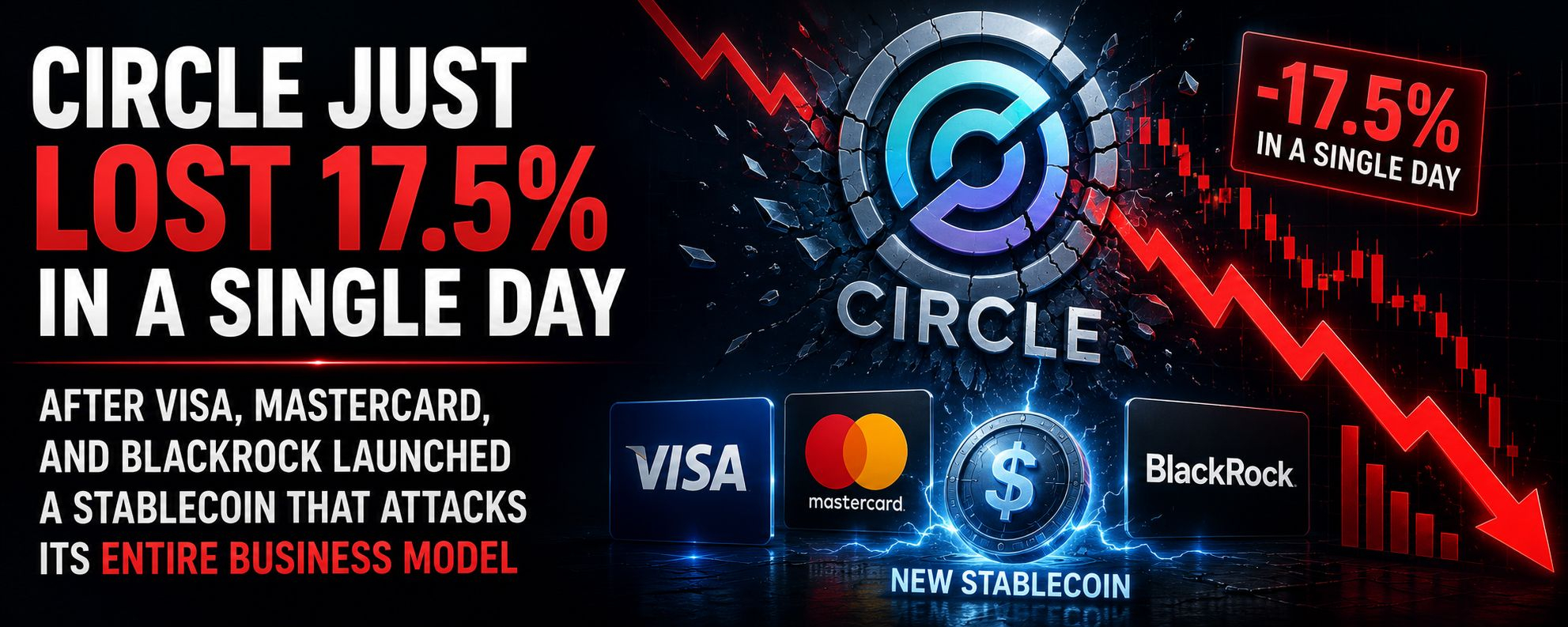
Circle Just Lost 17.5% in a Single Day After Visa, Mastercard, and BlackRock Launched a Stablecoin TCircle Internet Group — the company behind USDC and one of the most closely watched stablecoin stocks on Wall Street — just had its worst single trading day since going public. CRCL cratered more than 17% on June 30, closing near $62, after a consortium of 140+ companies launched a direct competitor to USDC called Open USD.
The list of backers is the actual story here. Visa. Mastercard. Stripe. Coinbase. BlackRock. BNY Mellon. American Express. Standard Chartern. BBVA. US Bank. These are not scrappy crypto startups trying to chip away at Circle's market share — these are the exact institutional partners Circle has spent years building relationships with, now backing a rival product simultaneously.
The mechanism explains why the market reacted this violently. Reserve interest generated 99% of Circle's revenue in 2024. Circle pays Coinbase — one of its own core distribution partners — $908 million a year just to help distribute USDC. Open USD flips that entire economic model: zero minting fees, zero redemption fees, no volume caps, and 100% of Treasury interest earned on reserves gets shared directly with partners instead of being captured by the issuer. For Visa, Mastercard, and Stripe — companies that move enormous transaction volume but have historically earned nothing from Circle's reserve income — Open USD offers them a direct cut of profits they were previously generating for someone else for free. Tether CEO Paolo Ardoino summed up the moment perfectly on X: "Welcome OUSD. Player 2 has entered the game."
Here's the honest complication that keeps this from being an automatic USDC death sentence: consortium-backed stablecoins have struggled before. PayPal's PYUSD has only reached $2.6 billion market cap after three years. Ripple's RLUSD sits at $1.6 billion after nearly two years. USDC currently commands roughly $73 billion, and USDT dominates at $145 billion. Network effects in stablecoins are brutal — liquidity, integrations, and trust compound over years, and a new consortium token doesn't inherit any of that automatically just because Visa's logo is attached.
CRCL had already shed 40% over the prior 30 days heading into this news, partly due to being removed from Russell Growth indices during June's reconstitution. William Blair maintains an Outperform rating, citing Circle's first-mover advantage. But the technical picture is ugly — the stock broke below its $84.37 double-top neckline and analysts are now watching $50, with $40 as the next downside target if that breaks.
The bigger picture for Binance Square readers: stablecoin competition just got dramatically more intense, with the biggest payment networks on earth now directly incentivized to push a rival token. Watch how fast OUSD actually gains real transaction volume versus USDC — that data, not the stock price reaction, will tell you whether this is a genuine threat or an overreaction.
Please subscribe, like, and share this article. It genuinely helps.
#Circle #USDC #stablecoin #OPENUSD #BinanceSquare
Circle Just Lost 17.5% in a Single Day After Visa, Mastercard, and BlackRock Launched a Stablecoin T
Circle Internet Group — the company behind USDC and one of the most closely watched stablecoin stocks on Wall Street — just had its worst single trading day since going public. CRCL cratered more than 17% on June 30, closing near $62, after a consortium of 140+ companies launched a direct competitor to USDC called Open USD.
The list of backers is the actual story here. Visa. Mastercard. Stripe. Coinbase. BlackRock. BNY Mellon. American Express. Standard Chartern. BBVA. US Bank. These are not scrappy crypto startups trying to chip away at Circle's market share — these are the exact institutional partners Circle has spent years building relationships with, now backing a rival product simultaneously.
The mechanism explains why the market reacted this violently. Reserve interest generated 99% of Circle's revenue in 2024. Circle pays Coinbase — one of its own core distribution partners — $908 million a year just to help distribute USDC. Open USD flips that entire economic model: zero minting fees, zero redemption fees, no volume caps, and 100% of Treasury interest earned on reserves gets shared directly with partners instead of being captured by the issuer. For Visa, Mastercard, and Stripe — companies that move enormous transaction volume but have historically earned nothing from Circle's reserve income — Open USD offers them a direct cut of profits they were previously generating for someone else for free. Tether CEO Paolo Ardoino summed up the moment perfectly on X: "Welcome OUSD. Player 2 has entered the game."
Here's the honest complication that keeps this from being an automatic USDC death sentence: consortium-backed stablecoins have struggled before. PayPal's PYUSD has only reached $2.6 billion market cap after three years. Ripple's RLUSD sits at $1.6 billion after nearly two years. USDC currently commands roughly $73 billion, and USDT dominates at $145 billion. Network effects in stablecoins are brutal — liquidity, integrations, and trust compound over years, and a new consortium token doesn't inherit any of that automatically just because Visa's logo is attached.
CRCL had already shed 40% over the prior 30 days heading into this news, partly due to being removed from Russell Growth indices during June's reconstitution. William Blair maintains an Outperform rating, citing Circle's first-mover advantage. But the technical picture is ugly — the stock broke below its $84.37 double-top neckline and analysts are now watching $50, with $40 as the next downside target if that breaks.
The bigger picture for Binance Square readers: stablecoin competition just got dramatically more intense, with the biggest payment networks on earth now directly incentivized to push a rival token. Watch how fast OUSD actually gains real transaction volume versus USDC — that data, not the stock price reaction, will tell you whether this is a genuine threat or an overreaction.
Please subscribe, like, and share this article. It genuinely helps.
#Circle #USDC #stablecoin #OPENUSD #BinanceSquare
The list of backers is the actual story here. Visa. Mastercard. Stripe. Coinbase. BlackRock. BNY Mellon. American Express. Standard Chartern. BBVA. US Bank. These are not scrappy crypto startups trying to chip away at Circle's market share — these are the exact institutional partners Circle has spent years building relationships with, now backing a rival product simultaneously.
The mechanism explains why the market reacted this violently. Reserve interest generated 99% of Circle's revenue in 2024. Circle pays Coinbase — one of its own core distribution partners — $908 million a year just to help distribute USDC. Open USD flips that entire economic model: zero minting fees, zero redemption fees, no volume caps, and 100% of Treasury interest earned on reserves gets shared directly with partners instead of being captured by the issuer. For Visa, Mastercard, and Stripe — companies that move enormous transaction volume but have historically earned nothing from Circle's reserve income — Open USD offers them a direct cut of profits they were previously generating for someone else for free. Tether CEO Paolo Ardoino summed up the moment perfectly on X: "Welcome OUSD. Player 2 has entered the game."
Here's the honest complication that keeps this from being an automatic USDC death sentence: consortium-backed stablecoins have struggled before. PayPal's PYUSD has only reached $2.6 billion market cap after three years. Ripple's RLUSD sits at $1.6 billion after nearly two years. USDC currently commands roughly $73 billion, and USDT dominates at $145 billion. Network effects in stablecoins are brutal — liquidity, integrations, and trust compound over years, and a new consortium token doesn't inherit any of that automatically just because Visa's logo is attached.
CRCL had already shed 40% over the prior 30 days heading into this news, partly due to being removed from Russell Growth indices during June's reconstitution. William Blair maintains an Outperform rating, citing Circle's first-mover advantage. But the technical picture is ugly — the stock broke below its $84.37 double-top neckline and analysts are now watching $50, with $40 as the next downside target if that breaks.
The bigger picture for Binance Square readers: stablecoin competition just got dramatically more intense, with the biggest payment networks on earth now directly incentivized to push a rival token. Watch how fast OUSD actually gains real transaction volume versus USDC — that data, not the stock price reaction, will tell you whether this is a genuine threat or an overreaction.
Please subscribe, like, and share this article. It genuinely helps.
#Circle #USDC #stablecoin #OPENUSD #BinanceSquare
CRCL+1.30%
CRCLUS+1.83%
107

🚨 Ripple joins OpenUSD while continuing to drive RLUSD.
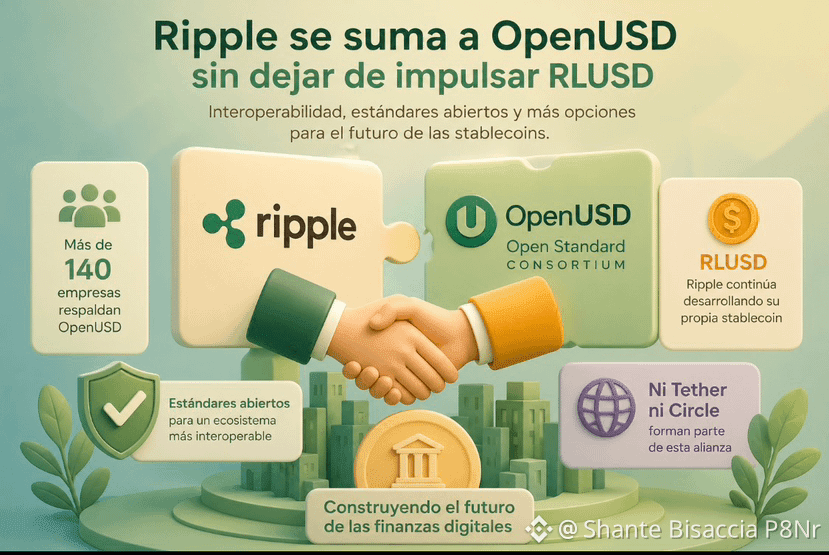
The company confirmed its incorporation into the Open Standard consortium as an integrator member of OpenUSD, a new stablecoin backed by more than 140 companies. Far from signaling an abandonment of RLUSD, Ripple has made it clear that it will continue developing its own stablecoin.
This decision shows that the company is betting on interoperability and on building open standards for the stablecoin ecosystem, actively participating in initiatives that could benefit the entire industry.
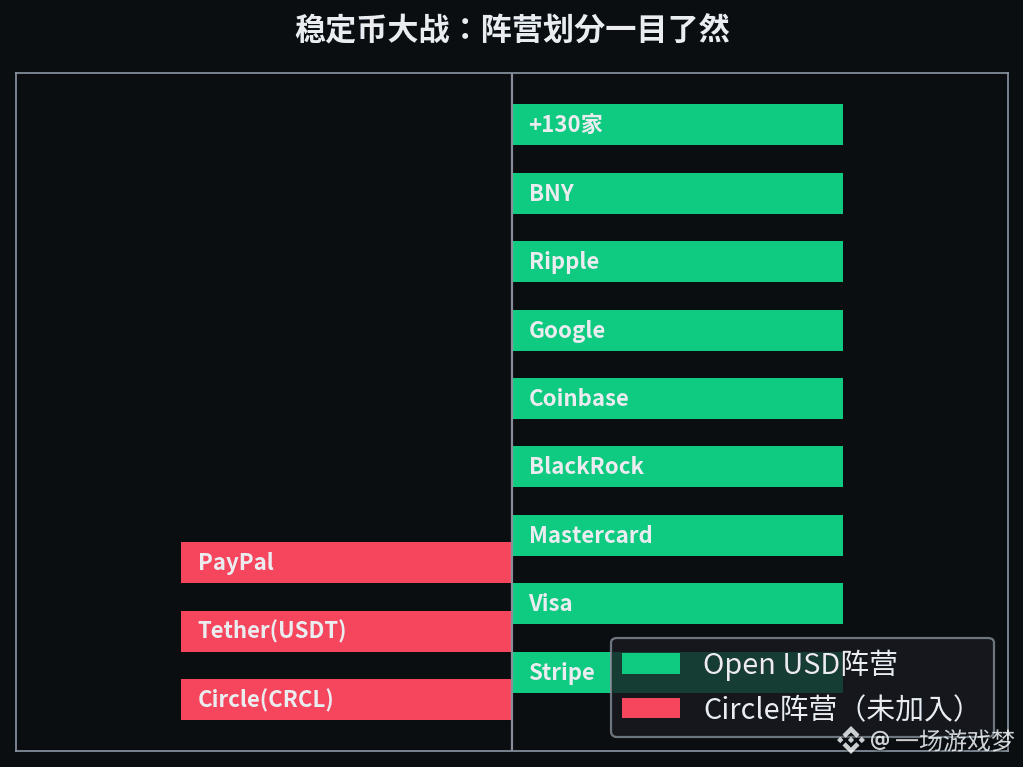
One striking detail is that neither Tether nor Circle, the two main stablecoin issuers in the market, are part of this alliance. Ripple’s participation could strengthen the adoption of OpenUSD and consolidate its role as one of the most influential players in the evolution of blockchain-based financial infrastructure.
This approach does not imply competition between OpenUSD and RLUSD, but rather a strategy to drive a more interoperable ecosystem, where different solutions can coexist and complement each other.
#Ripple $XRP $RLUSD #OpenUSD #Stablecoins
🚨 Ripple joins OpenUSD while continuing to drive RLUSD.
The company confirmed its incorporation into the Open Standard consortium as an integrator member of OpenUSD, a new stablecoin backed by more than 140 companies. Far from signaling an abandonment of RLUSD, Ripple has made it clear that it will continue developing its own stablecoin.
This decision shows that the company is betting on interoperability and on building open standards for the stablecoin ecosystem, actively participating in initiatives that could benefit the entire industry.
One striking detail is that neither Tether nor Circle, the two main stablecoin issuers in the market, are part of this alliance. Ripple’s participation could strengthen the adoption of OpenUSD and consolidate its role as one of the most influential players in the evolution of blockchain-based financial infrastructure.
This approach does not imply competition between OpenUSD and RLUSD, but rather a strategy to drive a more interoperable ecosystem, where different solutions can coexist and complement each other.
#Ripple $XRP $RLUSD #OpenUSD #Stablecoins
The company confirmed its incorporation into the Open Standard consortium as an integrator member of OpenUSD, a new stablecoin backed by more than 140 companies. Far from signaling an abandonment of RLUSD, Ripple has made it clear that it will continue developing its own stablecoin.
This decision shows that the company is betting on interoperability and on building open standards for the stablecoin ecosystem, actively participating in initiatives that could benefit the entire industry.
One striking detail is that neither Tether nor Circle, the two main stablecoin issuers in the market, are part of this alliance. Ripple’s participation could strengthen the adoption of OpenUSD and consolidate its role as one of the most influential players in the evolution of blockchain-based financial infrastructure.
This approach does not imply competition between OpenUSD and RLUSD, but rather a strategy to drive a more interoperable ecosystem, where different solutions can coexist and complement each other.
#Ripple $XRP $RLUSD #OpenUSD #Stablecoins
1
209
·
--
Article
Visa, Mastercard, Coinbase, and BlackRock Just Teamed Up to Launch a StablecoinThis is still the story trending across every crypto platform right now, and Binance's own search leaderboard has it ranked directly alongside MiCA's launch and Trump's $1.4 billion disclosure as one of this week's three biggest crypto stories. Open USD — a new dollar-pegged stablecoin — launched this week backed by a consortium of more than 140 companies including Visa, Mastercard, Stripe, Coinbase, and BlackRock.
I covered the immediate market impact yesterday — Circle's stock crashed 17.5% on the news, its worst single-day performance since going public. But it's worth stepping back today and understanding exactly why this specific coalition of backers makes Open USD structurally different from every other stablecoin challenger that's tried and failed to dent USDC or USDT's dominance.
Every previous consortium-backed stablecoin challenge — PayPal's $PYUSD after three years still sits at $2.6 billion market cap, Ripple's $RLUSD after nearly two years sits at $1.6 billion — has struggled precisely because a single company backing a stablecoin doesn't automatically bring genuine transaction volume with it. Open USD is different in one crucial structural way: Visa and Mastercard aren't just "supporting" this stablecoin, they're payment networks that literally control the rails through which a meaningful percentage of global commerce flows. If Visa and Mastercard start routing even a modest percentage of their existing transaction volume through Open USD instead of traditional card rails or competing stablecoins, that's not speculative adoption — that's forced volume from infrastructure these companies already own and control.
The economic model is the real disruption here, and it's worth understanding precisely. Circle currently pays Coinbase $908 million annually just to distribute USDC — meaning Circle's own key partner has been a major line-item cost rather than a profit center. Open USD flips this entirely: zero minting fees, zero redemption fees, no volume caps, and 100% of Treasury reserve interest earned gets shared directly with the partners generating that volume. For Visa, Mastercard, and Stripe, that means they finally capture economic upside from stablecoin volume they were previously helping generate for someone else's bottom line, for free.
The realistic timeline matters for anyone trying to trade this story rather than just read about it. Open USD faces the exact same cold-start adoption problem every stablecoin challenger faces — announcing 140 backers is very different from those backers actually routing meaningful daily transaction volume through the new token. William Blair maintains an Outperform rating on Circle specifically citing this first-mover advantage gap. Watch Open USD's actual on-chain transaction volume over the coming weeks, not just the headline backer list, to know whether this genuinely threatens USDC's $73 billion market position or fades like every consortium stablecoin before it.$SPCXB
Please subscribe, like, and share this article. It genuinely helps.$NVDAB
#OpenUSD #Stablecoin #Visa #Mastercard #Circle #BinanceSquare
Visa, Mastercard, Coinbase, and BlackRock Just Teamed Up to Launch a Stablecoin
This is still the story trending across every crypto platform right now, and Binance's own search leaderboard has it ranked directly alongside MiCA's launch and Trump's $1.4 billion disclosure as one of this week's three biggest crypto stories. Open USD — a new dollar-pegged stablecoin — launched this week backed by a consortium of more than 140 companies including Visa, Mastercard, Stripe, Coinbase, and BlackRock.
I covered the immediate market impact yesterday — Circle's stock crashed 17.5% on the news, its worst single-day performance since going public. But it's worth stepping back today and understanding exactly why this specific coalition of backers makes Open USD structurally different from every other stablecoin challenger that's tried and failed to dent USDC or USDT's dominance.
Every previous consortium-backed stablecoin challenge — PayPal's $PYUSD after three years still sits at $2.6 billion market cap, Ripple's $RLUSD after nearly two years sits at $1.6 billion — has struggled precisely because a single company backing a stablecoin doesn't automatically bring genuine transaction volume with it. Open USD is different in one crucial structural way: Visa and Mastercard aren't just "supporting" this stablecoin, they're payment networks that literally control the rails through which a meaningful percentage of global commerce flows. If Visa and Mastercard start routing even a modest percentage of their existing transaction volume through Open USD instead of traditional card rails or competing stablecoins, that's not speculative adoption — that's forced volume from infrastructure these companies already own and control.
The economic model is the real disruption here, and it's worth understanding precisely. Circle currently pays Coinbase $908 million annually just to distribute USDC — meaning Circle's own key partner has been a major line-item cost rather than a profit center. Open USD flips this entirely: zero minting fees, zero redemption fees, no volume caps, and 100% of Treasury reserve interest earned gets shared directly with the partners generating that volume. For Visa, Mastercard, and Stripe, that means they finally capture economic upside from stablecoin volume they were previously helping generate for someone else's bottom line, for free.
The realistic timeline matters for anyone trying to trade this story rather than just read about it. Open USD faces the exact same cold-start adoption problem every stablecoin challenger faces — announcing 140 backers is very different from those backers actually routing meaningful daily transaction volume through the new token. William Blair maintains an Outperform rating on Circle specifically citing this first-mover advantage gap. Watch Open USD's actual on-chain transaction volume over the coming weeks, not just the headline backer list, to know whether this genuinely threatens USDC's $73 billion market position or fades like every consortium stablecoin before it.$SPCXB
Please subscribe, like, and share this article. It genuinely helps.$NVDAB
#OpenUSD #Stablecoin #Visa #Mastercard #Circle #BinanceSquare
I covered the immediate market impact yesterday — Circle's stock crashed 17.5% on the news, its worst single-day performance since going public. But it's worth stepping back today and understanding exactly why this specific coalition of backers makes Open USD structurally different from every other stablecoin challenger that's tried and failed to dent USDC or USDT's dominance.
Every previous consortium-backed stablecoin challenge — PayPal's $PYUSD after three years still sits at $2.6 billion market cap, Ripple's $RLUSD after nearly two years sits at $1.6 billion — has struggled precisely because a single company backing a stablecoin doesn't automatically bring genuine transaction volume with it. Open USD is different in one crucial structural way: Visa and Mastercard aren't just "supporting" this stablecoin, they're payment networks that literally control the rails through which a meaningful percentage of global commerce flows. If Visa and Mastercard start routing even a modest percentage of their existing transaction volume through Open USD instead of traditional card rails or competing stablecoins, that's not speculative adoption — that's forced volume from infrastructure these companies already own and control.
The economic model is the real disruption here, and it's worth understanding precisely. Circle currently pays Coinbase $908 million annually just to distribute USDC — meaning Circle's own key partner has been a major line-item cost rather than a profit center. Open USD flips this entirely: zero minting fees, zero redemption fees, no volume caps, and 100% of Treasury reserve interest earned gets shared directly with the partners generating that volume. For Visa, Mastercard, and Stripe, that means they finally capture economic upside from stablecoin volume they were previously helping generate for someone else's bottom line, for free.
The realistic timeline matters for anyone trying to trade this story rather than just read about it. Open USD faces the exact same cold-start adoption problem every stablecoin challenger faces — announcing 140 backers is very different from those backers actually routing meaningful daily transaction volume through the new token. William Blair maintains an Outperform rating on Circle specifically citing this first-mover advantage gap. Watch Open USD's actual on-chain transaction volume over the coming weeks, not just the headline backer list, to know whether this genuinely threatens USDC's $73 billion market position or fades like every consortium stablecoin before it.$SPCXB
Please subscribe, like, and share this article. It genuinely helps.$NVDAB
#OpenUSD #Stablecoin #Visa #Mastercard #Circle #BinanceSquare
CRCL+1.30%
CRCLUS+1.83%
125

·
--
Why OpenLedger’s Verifiable Data Layer Is a Game Changer for AIA major unresolved challenge at the intersection of cryptocurrency and artificial intelligence is the issue of data provenance. How can one be certain that the dataset utilized for model training remains unaltered?
This is where @OpenLedger comes into play — a blockchain crafted specifically to address this concern. By utilizing a scalable and verifiable data layer, OpenLedger guarantees that every data element can be traced, is immutable, and can be audited. The era of opaque training datasets is over.
The ecosystem is driven by the native token $OPEN, which motivates data contributors, validators, and AI developers to engage in a transparent data marketplace.
What truly excites me is that OpenLedger is not merely a concept. Their testnet is actively handling verifiable data streams, and its architecture is designed to support practical AI applications — rather than just DeFi trends.
To achieve accountability in AI, infrastructure like #OpenLedger is essential. With strong foundations, a clear vision, and an expanding community of builders, this is certainly a project to keep an eye on in 2026.@Square-Creator-a1f131473399 #open $OPEN
{future}(OPENUSDT)
$BNB
{spot}(BNBUSDT)
#openusdt #OPENUSD #openladgechain #openladger
Why OpenLedger’s Verifiable Data Layer Is a Game Changer for AI
A major unresolved challenge at the intersection of cryptocurrency and artificial intelligence is the issue of data provenance. How can one be certain that the dataset utilized for model training remains unaltered?
This is where @OpenLedger comes into play — a blockchain crafted specifically to address this concern. By utilizing a scalable and verifiable data layer, OpenLedger guarantees that every data element can be traced, is immutable, and can be audited. The era of opaque training datasets is over.
The ecosystem is driven by the native token $OPEN , which motivates data contributors, validators, and AI developers to engage in a transparent data marketplace.
What truly excites me is that OpenLedger is not merely a concept. Their testnet is actively handling verifiable data streams, and its architecture is designed to support practical AI applications — rather than just DeFi trends.
To achieve accountability in AI, infrastructure like #OpenLedger is essential. With strong foundations, a clear vision, and an expanding community of builders, this is certainly a project to keep an eye on in 2026.@Open #open $OPEN
$BNB
#openusdt #OPENUSD #openladgechain #openladger
This is where @OpenLedger comes into play — a blockchain crafted specifically to address this concern. By utilizing a scalable and verifiable data layer, OpenLedger guarantees that every data element can be traced, is immutable, and can be audited. The era of opaque training datasets is over.
The ecosystem is driven by the native token $OPEN , which motivates data contributors, validators, and AI developers to engage in a transparent data marketplace.
What truly excites me is that OpenLedger is not merely a concept. Their testnet is actively handling verifiable data streams, and its architecture is designed to support practical AI applications — rather than just DeFi trends.
To achieve accountability in AI, infrastructure like #OpenLedger is essential. With strong foundations, a clear vision, and an expanding community of builders, this is certainly a project to keep an eye on in 2026.@Open #open $OPEN
$BNB
#openusdt #OPENUSD #openladgechain #openladger
1
34
Circle-related tokenized stocks $CRCL saw a 17.5% single-day plunge and hit a new intra-period low; what the market is truly worried about isn’t just one drop, but that the stablecoin’s moat is being repriced: 140 institutions are pushing OpenUSD, targeting the issuance and reserve-revenue model that Circle relies on. If the alliance brings stronger distribution and lower costs, the USDC growth premium could be squeezed; but implementation, compliance, and liquidity remain the key variables.#稳定币 #Circle #OpenUSD
Circle-related tokenized stocks $CRCL saw a 17.5% single-day plunge and hit a new intra-period low; what the market is truly worried about isn’t just one drop, but that the stablecoin’s moat is being repriced: 140 institutions are pushing OpenUSD, targeting the issuance and reserve-revenue model that Circle relies on. If the alliance brings stronger distribution and lower costs, the USDC growth premium could be squeezed; but implementation, compliance, and liquidity remain the key variables.#稳定币 #Circle #OpenUSD
169

·
--
Circle suffers a single-day plunge of 17.5%, setting a new low—what’s really worth watching isn’t the drawdown itself, but the fact that the stablecoin landscape is being repriced.
With 140 major players teaming up to launch OpenUSD, the goal is clear: to tap into the core chain of stablecoin issuance, reserve yields, and payment and settlement. For Circle, the pressure doesn’t just come from peer competition—it also comes from the trend of “stablecoin infrastructure becoming platformized.”
If OpenUSD can secure support from exchanges, payment networks, and institutional use cases, the growth narrative for $USDC may face higher hurdles. In the short term, it’s about sentiment; in the long term, it’s about distribution channels and regulatory barriers.
#稳定币 #Circle #OpenUSD
Circle suffers a single-day plunge of 17.5%, setting a new low—what’s really worth watching isn’t the drawdown itself, but the fact that the stablecoin landscape is being repriced.
With 140 major players teaming up to launch OpenUSD, the goal is clear: to tap into the core chain of stablecoin issuance, reserve yields, and payment and settlement. For Circle, the pressure doesn’t just come from peer competition—it also comes from the trend of “stablecoin infrastructure becoming platformized.”
If OpenUSD can secure support from exchanges, payment networks, and institutional use cases, the growth narrative for $USDC may face higher hurdles. In the short term, it’s about sentiment; in the long term, it’s about distribution channels and regulatory barriers.
#稳定币 #Circle #OpenUSD
With 140 major players teaming up to launch OpenUSD, the goal is clear: to tap into the core chain of stablecoin issuance, reserve yields, and payment and settlement. For Circle, the pressure doesn’t just come from peer competition—it also comes from the trend of “stablecoin infrastructure becoming platformized.”
If OpenUSD can secure support from exchanges, payment networks, and institutional use cases, the growth narrative for $USDC may face higher hurdles. In the short term, it’s about sentiment; in the long term, it’s about distribution channels and regulatory barriers.
#稳定币 #Circle #OpenUSD
34

Tech Giants Team Up to Launch Stablecoin OpenUSD, Circle’s Stock Plunges 18% in a Day!
As traditional finance and the crypto world accelerate their integration, the stablecoin arena welcomes another heavyweight player. Google, PayPal, and several other tech giants have teamed up to launch a new stablecoin, OpenUSD, and the news immediately shook the market.
As the issuer of USDC, Circle’s stock price promptly crashed 18%, with the market “voting with its feet” on its reaction to this new competitor. The stablecoin sector has long been a contested battleground. Now that mainstream tech giants have entered the fray, will they rewrite the existing landscape?
On one hand, the entry of big players brings further validation from mainstream capital. On the other hand, it also means competition will only intensify. For stablecoins, trust, scale, and compliance are core barriers to entry—can newcomers challenge the current order? Can Circle hold its ground?
Feel free to discuss your views on this new shift in the stablecoin sector in the comments.
#OpenUSD #稳定币 #Circle
Tech Giants Team Up to Launch Stablecoin OpenUSD, Circle’s Stock Plunges 18% in a Day!
As traditional finance and the crypto world accelerate their integration, the stablecoin arena welcomes another heavyweight player. Google, PayPal, and several other tech giants have teamed up to launch a new stablecoin, OpenUSD, and the news immediately shook the market.
As the issuer of USDC, Circle’s stock price promptly crashed 18%, with the market “voting with its feet” on its reaction to this new competitor. The stablecoin sector has long been a contested battleground. Now that mainstream tech giants have entered the fray, will they rewrite the existing landscape?
On one hand, the entry of big players brings further validation from mainstream capital. On the other hand, it also means competition will only intensify. For stablecoins, trust, scale, and compliance are core barriers to entry—can newcomers challenge the current order? Can Circle hold its ground?
Feel free to discuss your views on this new shift in the stablecoin sector in the comments.
#OpenUSD #稳定币 #Circle
As traditional finance and the crypto world accelerate their integration, the stablecoin arena welcomes another heavyweight player. Google, PayPal, and several other tech giants have teamed up to launch a new stablecoin, OpenUSD, and the news immediately shook the market.
As the issuer of USDC, Circle’s stock price promptly crashed 18%, with the market “voting with its feet” on its reaction to this new competitor. The stablecoin sector has long been a contested battleground. Now that mainstream tech giants have entered the fray, will they rewrite the existing landscape?
On one hand, the entry of big players brings further validation from mainstream capital. On the other hand, it also means competition will only intensify. For stablecoins, trust, scale, and compliance are core barriers to entry—can newcomers challenge the current order? Can Circle hold its ground?
Feel free to discuss your views on this new shift in the stablecoin sector in the comments.
#OpenUSD #稳定币 #Circle
CRCL+1.30%
CRCLUS+1.83%
25

·
--
Why OpenUSD's 'real threat' th
The stablecoin landscape faces a new challenger backed by tech giants. Stripe and major exchanges have joined forces to launch OpenUSD, positioning it as infrastructure-grade competition to Circle's USDC. On paper, the consortium brings unparalleled distribution networks and enterprise credibility.
But building a dominant stablecoin isn't about assembling big-name partners. It's about network effects, regulator trust, and user mindshare—three moats that don't collapse overnight. Circle spent years embedding USDC across DeFi protocols, custodians, and payment rails. That runway matters.
OpenUSD's structural challenge: yes, it has Stripe's checkout pipeline and exchange dominance. But adoption isn't switching costs for users—it's inertia for developers, compliance frameworks for institutions, and liquidity depth for traders. Each requires separate persuasion.
The market reaction—Circle stock diving 13%—signals fear of disruption. Yet history shows stablecoin dominance shifts slowly. Terra's collapse wiped out $40B in value overnight. Trust takes decades; loss happens in seconds.
What the Stripe alliance really tests: can consortium model outpace single-entity execution? Time-to-market favors the consortium. Network maturity favors incumbency. The winner need not be first—it need only be reliable when settlement windows close.
This dynamic matters beyond one stablecoin. Infrastructure battles reveal whether crypto achieves critical mass through fragmentation or consolidation. Distributed versus centralized in the settlement layer mirrors debates in consensus mechanisms themselves.
Will OpenUSD's backing convert to real-world liquidity, or remain a whitepaper projection? The next 12-18 months determine if consortium capital outweighs network inertia.
Could consortium backing overcome entrenched network effects, or does history favor incumbency? Drop your take below. 👇
#StablecoinCompetition #OpenUSD #CryptoInfrastructure
Why OpenUSD's 'real threat' th
The stablecoin landscape faces a new challenger backed by tech giants. Stripe and major exchanges have joined forces to launch OpenUSD, positioning it as infrastructure-grade competition to Circle's USDC. On paper, the consortium brings unparalleled distribution networks and enterprise credibility.
But building a dominant stablecoin isn't about assembling big-name partners. It's about network effects, regulator trust, and user mindshare—three moats that don't collapse overnight. Circle spent years embedding USDC across DeFi protocols, custodians, and payment rails. That runway matters.
OpenUSD's structural challenge: yes, it has Stripe's checkout pipeline and exchange dominance. But adoption isn't switching costs for users—it's inertia for developers, compliance frameworks for institutions, and liquidity depth for traders. Each requires separate persuasion.
The market reaction—Circle stock diving 13%—signals fear of disruption. Yet history shows stablecoin dominance shifts slowly. Terra's collapse wiped out $40B in value overnight. Trust takes decades; loss happens in seconds.
What the Stripe alliance really tests: can consortium model outpace single-entity execution? Time-to-market favors the consortium. Network maturity favors incumbency. The winner need not be first—it need only be reliable when settlement windows close.
This dynamic matters beyond one stablecoin. Infrastructure battles reveal whether crypto achieves critical mass through fragmentation or consolidation. Distributed versus centralized in the settlement layer mirrors debates in consensus mechanisms themselves.
Will OpenUSD's backing convert to real-world liquidity, or remain a whitepaper projection? The next 12-18 months determine if consortium capital outweighs network inertia.
Could consortium backing overcome entrenched network effects, or does history favor incumbency? Drop your take below. 👇
#StablecoinCompetition #OpenUSD #CryptoInfrastructure
The stablecoin landscape faces a new challenger backed by tech giants. Stripe and major exchanges have joined forces to launch OpenUSD, positioning it as infrastructure-grade competition to Circle's USDC. On paper, the consortium brings unparalleled distribution networks and enterprise credibility.
But building a dominant stablecoin isn't about assembling big-name partners. It's about network effects, regulator trust, and user mindshare—three moats that don't collapse overnight. Circle spent years embedding USDC across DeFi protocols, custodians, and payment rails. That runway matters.
OpenUSD's structural challenge: yes, it has Stripe's checkout pipeline and exchange dominance. But adoption isn't switching costs for users—it's inertia for developers, compliance frameworks for institutions, and liquidity depth for traders. Each requires separate persuasion.
The market reaction—Circle stock diving 13%—signals fear of disruption. Yet history shows stablecoin dominance shifts slowly. Terra's collapse wiped out $40B in value overnight. Trust takes decades; loss happens in seconds.
What the Stripe alliance really tests: can consortium model outpace single-entity execution? Time-to-market favors the consortium. Network maturity favors incumbency. The winner need not be first—it need only be reliable when settlement windows close.
This dynamic matters beyond one stablecoin. Infrastructure battles reveal whether crypto achieves critical mass through fragmentation or consolidation. Distributed versus centralized in the settlement layer mirrors debates in consensus mechanisms themselves.
Will OpenUSD's backing convert to real-world liquidity, or remain a whitepaper projection? The next 12-18 months determine if consortium capital outweighs network inertia.
Could consortium backing overcome entrenched network effects, or does history favor incumbency? Drop your take below. 👇
#StablecoinCompetition #OpenUSD #CryptoInfrastructure
USDC+0.01%
CRCLUS+1.83%
52

·
--
Bullish
140 Global Companies Launch "OpenUSD"
The most significant news comes from the stablecoin sector. A total of 140 global companies are collaborating to support the launch of OpenUSD, a new stablecoin designed to directly compete with Tether (USDT). This massive step marks a major shift in which multinational corporations are beginning to take over global digital payment infrastructure in order to reduce the dominance of a single player.
#OPENUSD
140 Global Companies Launch "OpenUSD"
The most significant news comes from the stablecoin sector. A total of 140 global companies are collaborating to support the launch of OpenUSD, a new stablecoin designed to directly compete with Tether (USDT). This massive step marks a major shift in which multinational corporations are beginning to take over global digital payment infrastructure in order to reduce the dominance of a single player.
#OPENUSD
The most significant news comes from the stablecoin sector. A total of 140 global companies are collaborating to support the launch of OpenUSD, a new stablecoin designed to directly compete with Tether (USDT). This massive step marks a major shift in which multinational corporations are beginning to take over global digital payment infrastructure in order to reduce the dominance of a single player.
#OPENUSD
14

·
--
Ethereum Institutional Announces Stablecoin Open USD Completes Ethereum Mainnet Deployment on Its First Day of Launch. The project disclosed that it has received support from more than 140 institutions, including traditional finance and payments giants such as Visa, Mastercard, Stripe, BlackRock, and Bank of New York Mellon.
All revenue generated from its reserves will be distributed to partners driving its growth, reflecting a cold-start strategy centered on institutional distribution. Unlike other stablecoin projects that rely on native crypto market circular flows, Open USD’s early participant structure is more focused on off-chain payments and traditional asset-management channels. If the rollout goes smoothly, it may introduce new on-chain settlement demand for the Ethereum network.
Next, it will be important to watch how quickly it is integrated into DeFi protocols and whether its liquidity depth can support its intended use cases.
For market observation only and does not constitute investment advice.
#稳定币 #以太坊 #OpenUSD
Ethereum Institutional Announces Stablecoin Open USD Completes Ethereum Mainnet Deployment on Its First Day of Launch. The project disclosed that it has received support from more than 140 institutions, including traditional finance and payments giants such as Visa, Mastercard, Stripe, BlackRock, and Bank of New York Mellon.
All revenue generated from its reserves will be distributed to partners driving its growth, reflecting a cold-start strategy centered on institutional distribution. Unlike other stablecoin projects that rely on native crypto market circular flows, Open USD’s early participant structure is more focused on off-chain payments and traditional asset-management channels. If the rollout goes smoothly, it may introduce new on-chain settlement demand for the Ethereum network.
Next, it will be important to watch how quickly it is integrated into DeFi protocols and whether its liquidity depth can support its intended use cases.
For market observation only and does not constitute investment advice.
#稳定币 #以太坊 #OpenUSD
All revenue generated from its reserves will be distributed to partners driving its growth, reflecting a cold-start strategy centered on institutional distribution. Unlike other stablecoin projects that rely on native crypto market circular flows, Open USD’s early participant structure is more focused on off-chain payments and traditional asset-management channels. If the rollout goes smoothly, it may introduce new on-chain settlement demand for the Ethereum network.
Next, it will be important to watch how quickly it is integrated into DeFi protocols and whether its liquidity depth can support its intended use cases.
For market observation only and does not constitute investment advice.
#稳定币 #以太坊 #OpenUSD
144

·
--
140 institutions team up to launch a new stablecoin—what game are the smart funds playing?I just saw a piece of data and I was completely stunned.
Visa, BlackRock, Stripe, Coinbase, Mastercard, American Express—140-plus institutions, working together to push a stablecoin called Open USD. 140— not 14, but 140. What does that even mean? Do you know how many years it took Circle, with just one company, to reach the current scale when USDC came out? Open USD launches with 140 partners, including your card-issuing bank.
Someone says, isn’t this just another USDT? Bigger-picture thinking, sisters.
Open USD’s design is different from all existing stablecoins. First, enterprises can mint and redeem at zero cost—major institutions don’t need to pay millions in fees. Second, the returns from the reserve assets are used to cover management fees and then everything is returned to partner institutions—meaning Visa takes the money users hold in OUSD to invest, earns profits, and shares them with Visa, not with Open Standard. Third, it’s not controlled by a single company; Open Standard and its partners form a board to govern together.
140 institutions team up to launch a new stablecoin—what game are the smart funds playing?
I just saw a piece of data and I was completely stunned.
Visa, BlackRock, Stripe, Coinbase, Mastercard, American Express—140-plus institutions, working together to push a stablecoin called Open USD. 140— not 14, but 140. What does that even mean? Do you know how many years it took Circle, with just one company, to reach the current scale when USDC came out? Open USD launches with 140 partners, including your card-issuing bank.
Someone says, isn’t this just another USDT? Bigger-picture thinking, sisters.
Open USD’s design is different from all existing stablecoins. First, enterprises can mint and redeem at zero cost—major institutions don’t need to pay millions in fees. Second, the returns from the reserve assets are used to cover management fees and then everything is returned to partner institutions—meaning Visa takes the money users hold in OUSD to invest, earns profits, and shares them with Visa, not with Open Standard. Third, it’s not controlled by a single company; Open Standard and its partners form a board to govern together.
Visa, BlackRock, Stripe, Coinbase, Mastercard, American Express—140-plus institutions, working together to push a stablecoin called Open USD. 140— not 14, but 140. What does that even mean? Do you know how many years it took Circle, with just one company, to reach the current scale when USDC came out? Open USD launches with 140 partners, including your card-issuing bank.
Someone says, isn’t this just another USDT? Bigger-picture thinking, sisters.
Open USD’s design is different from all existing stablecoins. First, enterprises can mint and redeem at zero cost—major institutions don’t need to pay millions in fees. Second, the returns from the reserve assets are used to cover management fees and then everything is returned to partner institutions—meaning Visa takes the money users hold in OUSD to invest, earns profits, and shares them with Visa, not with Open Standard. Third, it’s not controlled by a single company; Open Standard and its partners form a board to govern together.
71

Visa, Coinbase, and Stripe are launching the Open USD stablecoin!
#OpenUSD #CryptoNews #Visa #Stripe #USDT
A real bomb in the crypto market! The Open Standard organization has announced the launch of a new stablecoin, Open USD, and more than 140 giants have already come together around this project. Among the partners are Visa, Mastercard, American Express, Stripe, Coinbase, Ripple, Blackrock, BNY, Solana, and OKX. A full launch is planned for the end of 2026.
Why will this change the rules of the game? Open USD was created for big business that moves enormous volumes of dollars. The project's key features:
1. Issuance and redemption of the coin will be completely free and without any limits.
2. All partners will receive income from reserves (after deducting operating costs).
3. The asset will be managed by a board of partners, not by any one company.
Stripe has already stated that it will make Open USD the default coin on its platform.
Visa, Coinbase, and Stripe are launching the Open USD stablecoin!
#OpenUSD #CryptoNews #Visa #Stripe #USDT
A real bomb in the crypto market! The Open Standard organization has announced the launch of a new stablecoin, Open USD, and more than 140 giants have already come together around this project. Among the partners are Visa, Mastercard, American Express, Stripe, Coinbase, Ripple, Blackrock, BNY, Solana, and OKX. A full launch is planned for the end of 2026.
Why will this change the rules of the game? Open USD was created for big business that moves enormous volumes of dollars. The project's key features:
1. Issuance and redemption of the coin will be completely free and without any limits.
2. All partners will receive income from reserves (after deducting operating costs).
3. The asset will be managed by a board of partners, not by any one company.
Stripe has already stated that it will make Open USD the default coin on its platform.
#OpenUSD #CryptoNews #Visa #Stripe #USDT
A real bomb in the crypto market! The Open Standard organization has announced the launch of a new stablecoin, Open USD, and more than 140 giants have already come together around this project. Among the partners are Visa, Mastercard, American Express, Stripe, Coinbase, Ripple, Blackrock, BNY, Solana, and OKX. A full launch is planned for the end of 2026.
Why will this change the rules of the game? Open USD was created for big business that moves enormous volumes of dollars. The project's key features:
1. Issuance and redemption of the coin will be completely free and without any limits.
2. All partners will receive income from reserves (after deducting operating costs).
3. The asset will be managed by a board of partners, not by any one company.
Stripe has already stated that it will make Open USD the default coin on its platform.

143

·
--
Tech Giants Team Up to Launch Stablecoin OpenUSD, Circle Shares Plunge 18%
The moment the news broke that tech giants such as PayPal, Amazon, and Visa jointly launched the stablecoin OpenUSD, USDC issuer Circle’s stock immediately nosedived 18%.
The stablecoin market has always been a battleground for big players. Now that traditional finance and tech giants have personally entered the arena, it’s clear they’re eyeing this slice of the pie. With OpenUSD backed by major institutional resources, whether in terms of its user base or credibility endorsements, it can’t be underestimated—and for Circle, the impact is indeed significant.
As the stablecoin race heats up further, it will only get more intense. Who do you think will come out on top?
#稳定币 #OpenUSD #Circle
$USDC
Tech Giants Team Up to Launch Stablecoin OpenUSD, Circle Shares Plunge 18%
The moment the news broke that tech giants such as PayPal, Amazon, and Visa jointly launched the stablecoin OpenUSD, USDC issuer Circle’s stock immediately nosedived 18%.
The stablecoin market has always been a battleground for big players. Now that traditional finance and tech giants have personally entered the arena, it’s clear they’re eyeing this slice of the pie. With OpenUSD backed by major institutional resources, whether in terms of its user base or credibility endorsements, it can’t be underestimated—and for Circle, the impact is indeed significant.
As the stablecoin race heats up further, it will only get more intense. Who do you think will come out on top?
#稳定币 #OpenUSD #Circle
$USDC
The moment the news broke that tech giants such as PayPal, Amazon, and Visa jointly launched the stablecoin OpenUSD, USDC issuer Circle’s stock immediately nosedived 18%.
The stablecoin market has always been a battleground for big players. Now that traditional finance and tech giants have personally entered the arena, it’s clear they’re eyeing this slice of the pie. With OpenUSD backed by major institutional resources, whether in terms of its user base or credibility endorsements, it can’t be underestimated—and for Circle, the impact is indeed significant.
As the stablecoin race heats up further, it will only get more intense. Who do you think will come out on top?
#稳定币 #OpenUSD #Circle
$USDC
61

·
--
🤝🌐 Global Alliance: 140 tech giants join the initiative "Open USD" 🗺️🔒
None of the 140 members of the Open USD alliance managed to individually overcome the absolute dominance of Tether (USDT) and Circle (USDC).
This massive strategic agreement does not represent a show of strength, but rather a tactical admission that corporations could not compete on their own in the global stablecoin market ⚖️📉.
The move aims to unify infrastructure and standards to challenge the current duopoly, which financial experts have already dubbed "the dollar of the armistice" within the digital ecosystem 🏛️.
$BTC
{spot}(BTCUSDT)
$USDC
{spot}(USDCUSDT)
#BinanceSquare #OpenUSD #Tether #Circle #Stablecoins 🚀
🤝🌐 Global Alliance: 140 tech giants join the initiative "Open USD" 🗺️🔒
None of the 140 members of the Open USD alliance managed to individually overcome the absolute dominance of Tether (USDT) and Circle (USDC).
This massive strategic agreement does not represent a show of strength, but rather a tactical admission that corporations could not compete on their own in the global stablecoin market ⚖️📉.
The move aims to unify infrastructure and standards to challenge the current duopoly, which financial experts have already dubbed "the dollar of the armistice" within the digital ecosystem 🏛️.
$BTC
$USDC
#BinanceSquare #OpenUSD #Tether #Circle #Stablecoins 🚀
None of the 140 members of the Open USD alliance managed to individually overcome the absolute dominance of Tether (USDT) and Circle (USDC).
This massive strategic agreement does not represent a show of strength, but rather a tactical admission that corporations could not compete on their own in the global stablecoin market ⚖️📉.
The move aims to unify infrastructure and standards to challenge the current duopoly, which financial experts have already dubbed "the dollar of the armistice" within the digital ecosystem 🏛️.
$BTC
$USDC
#BinanceSquare #OpenUSD #Tether #Circle #Stablecoins 🚀

1
43

·
--

Article
More than 140 global giants convene: How will the new stablecoin Open USD reshape the underlying logic of cross-border payments?Digital financial infrastructure is set to undergo an epic turning point. As blockchain technology gradually matures, stablecoins—acting as the bridge between fiat currency and digital assets—are now quietly approaching the scale of traditional ACH (Automated Clearing House) systems in terms of global network transfer volume. However, when enterprise users embrace this technology, they consistently face business pain points such as costly exchange losses, uneven distribution of returns from underlying reserves, and highly centralized monopolistic dynamics.
Against this macro backdrop, a new stablecoin project aimed at reshaping the global funds transfer network—Open USD—has officially entered the public spotlight. Spearheaded by a newly established independent operating organization, Open Standard, the project is expected to be fully rolled out to the market in the second half of 2026.
More than 140 global giants convene: How will the new stablecoin Open USD reshape the underlying logic of cross-border payments?
Digital financial infrastructure is set to undergo an epic turning point. As blockchain technology gradually matures, stablecoins—acting as the bridge between fiat currency and digital assets—are now quietly approaching the scale of traditional ACH (Automated Clearing House) systems in terms of global network transfer volume. However, when enterprise users embrace this technology, they consistently face business pain points such as costly exchange losses, uneven distribution of returns from underlying reserves, and highly centralized monopolistic dynamics.
Against this macro backdrop, a new stablecoin project aimed at reshaping the global funds transfer network—Open USD—has officially entered the public spotlight. Spearheaded by a newly established independent operating organization, Open Standard, the project is expected to be fully rolled out to the market in the second half of 2026.
Against this macro backdrop, a new stablecoin project aimed at reshaping the global funds transfer network—Open USD—has officially entered the public spotlight. Spearheaded by a newly established independent operating organization, Open Standard, the project is expected to be fully rolled out to the market in the second half of 2026.
AAVE+6.22%
COINUS+0.81%
750


Verified
most stablecoins are one company's IOU.
𝗢𝗽𝗲𝗻 𝗨𝗦𝗗 just launched with 140 of them behind it.
the partner list is the whole story:
→ 𝟭𝟰𝟬+ founding partners signed on at launch
→ Visa, Mastercard, Stripe and American Express on board
→ BlackRock, BNY and Google Cloud too
→ native issuance on $SOL from day one
→ zero fees to mint or redeem, no volume caps
→ reserve yield shared across the network, not pocketed by one issuer
→ led by Zach Abrams, the Bridge founder Stripe bought in 2024
one issuer holds the float today.
𝗢𝗽𝗲𝗻 𝗨𝗦𝗗 spreads it across the whole network.
𝗽𝗮𝘆𝗺𝗲𝗻𝘁𝘀 𝗴𝗶𝗮𝗻𝘁𝘀 𝗱𝗼𝗻'𝘁 𝘀𝗶𝗴𝗻 𝘂𝗽 𝗳𝗼𝗿 𝗲𝘅𝗽𝗲𝗿𝗶𝗺𝗲𝗻𝘁𝘀.
not fully live yet. but a launch bench like this doesn't show up often. 👀
#OPENUSD #StablecoinRatings
most stablecoins are one company's IOU.
𝗢𝗽𝗲𝗻 𝗨𝗦𝗗 just launched with 140 of them behind it.
the partner list is the whole story:
→ 𝟭𝟰𝟬+ founding partners signed on at launch
→ Visa, Mastercard, Stripe and American Express on board
→ BlackRock, BNY and Google Cloud too
→ native issuance on $SOL from day one
→ zero fees to mint or redeem, no volume caps
→ reserve yield shared across the network, not pocketed by one issuer
→ led by Zach Abrams, the Bridge founder Stripe bought in 2024
one issuer holds the float today.
𝗢𝗽𝗲𝗻 𝗨𝗦𝗗 spreads it across the whole network.
𝗽𝗮𝘆𝗺𝗲𝗻𝘁𝘀 𝗴𝗶𝗮𝗻𝘁𝘀 𝗱𝗼𝗻'𝘁 𝘀𝗶𝗴𝗻 𝘂𝗽 𝗳𝗼𝗿 𝗲𝘅𝗽𝗲𝗿𝗶𝗺𝗲𝗻𝘁𝘀.
not fully live yet. but a launch bench like this doesn't show up often. 👀
#OPENUSD #StablecoinRatings
𝗢𝗽𝗲𝗻 𝗨𝗦𝗗 just launched with 140 of them behind it.
the partner list is the whole story:
→ 𝟭𝟰𝟬+ founding partners signed on at launch
→ Visa, Mastercard, Stripe and American Express on board
→ BlackRock, BNY and Google Cloud too
→ native issuance on $SOL from day one
→ zero fees to mint or redeem, no volume caps
→ reserve yield shared across the network, not pocketed by one issuer
→ led by Zach Abrams, the Bridge founder Stripe bought in 2024
one issuer holds the float today.
𝗢𝗽𝗲𝗻 𝗨𝗦𝗗 spreads it across the whole network.
𝗽𝗮𝘆𝗺𝗲𝗻𝘁𝘀 𝗴𝗶𝗮𝗻𝘁𝘀 𝗱𝗼𝗻'𝘁 𝘀𝗶𝗴𝗻 𝘂𝗽 𝗳𝗼𝗿 𝗲𝘅𝗽𝗲𝗿𝗶𝗺𝗲𝗻𝘁𝘀.
not fully live yet. but a launch bench like this doesn't show up often. 👀
#OPENUSD #StablecoinRatings
114

Article
OpenUSD Might Not Dethrone USDC: Circle's CEO Explains WhyThe launch of Open USD, the 140-plus company stablecoin consortium backed by Visa, Mastercard, Stripe, Coinbase, and BlackRock, drew a direct response from the person with a lot to lose.
Key Takeaways
Circle CEO Jeremy Allaire publicly argued Open USD won't dethrone USDC.He cites Artemis data putting USDC at 80% of on-chain dollar stablecoin volume.His sharpest point: consortium products have a "dismal" track record at scale.It's the incumbent's rebuttal, not neutral proof, and he has a clear stake.
Circle co-founder and CEO Jeremy Allaire, whose company issues USDC, laid out a methodical argument via post on X for why he isn't worried, which is itself a signal that the launch registered as a genuine competitive event worth answering.
The Market Is Already Asking the Question
The timing tracks with the data. Per Santiment's trending dashboard, the Open USD launch was one of crypto's top trending stories, sitting alongside whale activity and MiCA licensing, with social volume spiking sharply and sentiment leaning mixed-to-bearish. The dashboard framed the open question plainly: whether another major stablecoin can truly compete with USDC and USDT. Allaire's post is the incumbent's direct answer to exactly that question, and the accurate read is that the market hasn't resolved it, it has simply heard the market leader's strongest case for why the answer is no.
His Core Argument: Stablecoins Are Winner-Take-Most
Allaire's foundational claim is that stablecoin networks behave like internet platform utilities, tending toward winner-take-most market structures built over long periods. The strength, in his framing, isn't the token but the number and range of applications integrated to it. Every developer integration compounds network effects, which drives currency demand, which reinforces liquidity, a loop he argues a new entrant can't simply buy its way into with a big logo list. As he put it, stablecoin networks "tend towards winner-take-most market structures."
The Market-Share Numbers
His hardest weapon is usage data. Citing third-party info from Artemis , Allaire states that in Q1 2026, USDC handled nearly $30 trillion in on-chain transactions, which he frames as "80% of all dollar stablecoin transactions on blockchains," with USDT handling the remaining 20% and all other dollar stablecoins combined accounting for effectively zero, under half a percent. On the other hand Circle's report declares USDC onchain transaction volume in Q1’26 of $21.5 trillion grew 263%. His point is that other stablecoins may have circulation, but real usage is minimal because they lack liquidity and network utility. These are his cited figures via Artemis, not independently verified here, and they are the incumbent's strongest data point precisely because they measure usage rather than announcements.
The Liquidity Moat
Allaire extends that into a liquidity argument. He contends USDC is a top-three most liquid digital asset alongside Bitcoin and USDT, with liquidity falling off sharply after those three. The closest competing dollar stablecoins, in his telling, are roughly 10 times smaller, with liquidity concentrated in promotional order books on single exchanges rather than dispersed across dozens of venues the way USDC's is. It's a direct counter to Open USD's implicit pitch that a coalition of large companies can manufacture liquidity: his claim is that liquidity is earned over a decade, not assembled by consortium.
We’ve had lots of questions from our investor community looking for thoughts on OUSD, and so I thought I’d share my direct views here for anyone.Stablecoin networks are platform and network effect businesses that are established over a long period of time, tend towards…— Jeremy Allaire - jerallaire.arc (@jerallaire) July 1, 2026
The Consortium Critique
This is his sharpest and most pointed argument, and it targets Open USD's core differentiator directly. Allaire's claim is that the track record of consortium products achieving scale, product-market fit, or basic agility is, in his words, "absolutely dismal." Large groups of large companies, he argues, coordinate poorly, carry misaligned incentives, move slowly, and starve the venture out of self-interest. He notes Circle tried a consortium model in USDC's early days, even with a small group, and hit endless complexity.
From there he makes a prediction: smaller, tighter commercial partnerships with a market leader will outcompete large consortiums, and the same firms lending their logos to Open USD will, in practice, direct their operating units to partner with USDC because that serves their customers best. It's worth being precise that this is a forecast of how Open USD will struggle, not evidence that it has, but as a structural argument it's his most persuasive, because it reframes Open USD's main selling point, broad shared governance, as its main weakness.
His Rebuttals to Open USD's Selling Points
Allaire also pre-empts Open USD's three headline pitches:
On "free mint and burn": he argues the payments industry runs on small basis-point fees, and that a stablecoin with strong redemption facilities and no fees simply becomes the off-ramp for its competitors. Circle, he says, handles this through contractual mechanisms instead of blanket fee exemption.On "everybody shares the reserve income": he counters that giving away all reserve income starves infrastructure investment, and that Circle already shares the majority of its income with distribution partners while retaining enough to keep investing.On shared governance: the consortium critique above.
The Diplomatic Close
Notably, Allaire doesn't dismiss Open USD outright. He says Circle's partnership with Coinbase "remains as strong as ever," that Circle works closely with many Open USD founding members he expects will stay large USDC partners, and he welcomes Open USD "as a new member of the community." Welcoming a competitor rather than attacking it is a posture only the market leader can afford, and it's part of the message: confidence, not alarm.
The Honest Read
Allaire's argument is strong precisely because it leans on the two things Open USD can't replicate overnight: cited market-share dominance, 80% of on-chain dollar volume by his Artemis figures, and a decade of accumulated liquidity and regulatory licensing, including USDC's availability across all of Europe and Japan. The consortium critique is his most compelling point because it's structural rather than defensive.
But it should be read as the incumbent's perspective, not settled fact. Allaire has an obvious interest in dismissing a competitor backed by Visa, Mastercard, and BlackRock. The Artemis figures are his citation, and the consortium critique, however well-argued, is a prediction about how Open USD fails, not proof that it will. The Santiment data captures the real market uncertainty his confidence is designed to counter. The honest conclusion is that the question, can a new consortium stablecoin challenge USDC, remains open. What Allaire has provided is the clearest version of the market leader's case for why it can't.
#OpenUSD
OpenUSD Might Not Dethrone USDC: Circle's CEO Explains Why
The launch of Open USD, the 140-plus company stablecoin consortium backed by Visa, Mastercard, Stripe, Coinbase, and BlackRock, drew a direct response from the person with a lot to lose.
Key Takeaways
Circle CEO Jeremy Allaire publicly argued Open USD won't dethrone USDC.He cites Artemis data putting USDC at 80% of on-chain dollar stablecoin volume.His sharpest point: consortium products have a "dismal" track record at scale.It's the incumbent's rebuttal, not neutral proof, and he has a clear stake.
Circle co-founder and CEO Jeremy Allaire, whose company issues USDC, laid out a methodical argument via post on X for why he isn't worried, which is itself a signal that the launch registered as a genuine competitive event worth answering.
The Market Is Already Asking the Question
The timing tracks with the data. Per Santiment's trending dashboard, the Open USD launch was one of crypto's top trending stories, sitting alongside whale activity and MiCA licensing, with social volume spiking sharply and sentiment leaning mixed-to-bearish. The dashboard framed the open question plainly: whether another major stablecoin can truly compete with USDC and USDT. Allaire's post is the incumbent's direct answer to exactly that question, and the accurate read is that the market hasn't resolved it, it has simply heard the market leader's strongest case for why the answer is no.
His Core Argument: Stablecoins Are Winner-Take-Most
Allaire's foundational claim is that stablecoin networks behave like internet platform utilities, tending toward winner-take-most market structures built over long periods. The strength, in his framing, isn't the token but the number and range of applications integrated to it. Every developer integration compounds network effects, which drives currency demand, which reinforces liquidity, a loop he argues a new entrant can't simply buy its way into with a big logo list. As he put it, stablecoin networks "tend towards winner-take-most market structures."
The Market-Share Numbers
His hardest weapon is usage data. Citing third-party info from Artemis , Allaire states that in Q1 2026, USDC handled nearly $30 trillion in on-chain transactions, which he frames as "80% of all dollar stablecoin transactions on blockchains," with USDT handling the remaining 20% and all other dollar stablecoins combined accounting for effectively zero, under half a percent. On the other hand Circle's report declares USDC onchain transaction volume in Q1’26 of $21.5 trillion grew 263%. His point is that other stablecoins may have circulation, but real usage is minimal because they lack liquidity and network utility. These are his cited figures via Artemis, not independently verified here, and they are the incumbent's strongest data point precisely because they measure usage rather than announcements.
The Liquidity Moat
Allaire extends that into a liquidity argument. He contends USDC is a top-three most liquid digital asset alongside Bitcoin and USDT, with liquidity falling off sharply after those three. The closest competing dollar stablecoins, in his telling, are roughly 10 times smaller, with liquidity concentrated in promotional order books on single exchanges rather than dispersed across dozens of venues the way USDC's is. It's a direct counter to Open USD's implicit pitch that a coalition of large companies can manufacture liquidity: his claim is that liquidity is earned over a decade, not assembled by consortium.
We’ve had lots of questions from our investor community looking for thoughts on OUSD, and so I thought I’d share my direct views here for anyone.Stablecoin networks are platform and network effect businesses that are established over a long period of time, tend towards…— Jeremy Allaire - jerallaire.arc (@jerallaire) July 1, 2026
The Consortium Critique
This is his sharpest and most pointed argument, and it targets Open USD's core differentiator directly. Allaire's claim is that the track record of consortium products achieving scale, product-market fit, or basic agility is, in his words, "absolutely dismal." Large groups of large companies, he argues, coordinate poorly, carry misaligned incentives, move slowly, and starve the venture out of self-interest. He notes Circle tried a consortium model in USDC's early days, even with a small group, and hit endless complexity.
From there he makes a prediction: smaller, tighter commercial partnerships with a market leader will outcompete large consortiums, and the same firms lending their logos to Open USD will, in practice, direct their operating units to partner with USDC because that serves their customers best. It's worth being precise that this is a forecast of how Open USD will struggle, not evidence that it has, but as a structural argument it's his most persuasive, because it reframes Open USD's main selling point, broad shared governance, as its main weakness.
His Rebuttals to Open USD's Selling Points
Allaire also pre-empts Open USD's three headline pitches:
On "free mint and burn": he argues the payments industry runs on small basis-point fees, and that a stablecoin with strong redemption facilities and no fees simply becomes the off-ramp for its competitors. Circle, he says, handles this through contractual mechanisms instead of blanket fee exemption.On "everybody shares the reserve income": he counters that giving away all reserve income starves infrastructure investment, and that Circle already shares the majority of its income with distribution partners while retaining enough to keep investing.On shared governance: the consortium critique above.
The Diplomatic Close
Notably, Allaire doesn't dismiss Open USD outright. He says Circle's partnership with Coinbase "remains as strong as ever," that Circle works closely with many Open USD founding members he expects will stay large USDC partners, and he welcomes Open USD "as a new member of the community." Welcoming a competitor rather than attacking it is a posture only the market leader can afford, and it's part of the message: confidence, not alarm.
The Honest Read
Allaire's argument is strong precisely because it leans on the two things Open USD can't replicate overnight: cited market-share dominance, 80% of on-chain dollar volume by his Artemis figures, and a decade of accumulated liquidity and regulatory licensing, including USDC's availability across all of Europe and Japan. The consortium critique is his most compelling point because it's structural rather than defensive.
But it should be read as the incumbent's perspective, not settled fact. Allaire has an obvious interest in dismissing a competitor backed by Visa, Mastercard, and BlackRock. The Artemis figures are his citation, and the consortium critique, however well-argued, is a prediction about how Open USD fails, not proof that it will. The Santiment data captures the real market uncertainty his confidence is designed to counter. The honest conclusion is that the question, can a new consortium stablecoin challenge USDC, remains open. What Allaire has provided is the clearest version of the market leader's case for why it can't.
#OpenUSD
Key Takeaways
Circle CEO Jeremy Allaire publicly argued Open USD won't dethrone USDC.He cites Artemis data putting USDC at 80% of on-chain dollar stablecoin volume.His sharpest point: consortium products have a "dismal" track record at scale.It's the incumbent's rebuttal, not neutral proof, and he has a clear stake.
Circle co-founder and CEO Jeremy Allaire, whose company issues USDC, laid out a methodical argument via post on X for why he isn't worried, which is itself a signal that the launch registered as a genuine competitive event worth answering.
The Market Is Already Asking the Question
The timing tracks with the data. Per Santiment's trending dashboard, the Open USD launch was one of crypto's top trending stories, sitting alongside whale activity and MiCA licensing, with social volume spiking sharply and sentiment leaning mixed-to-bearish. The dashboard framed the open question plainly: whether another major stablecoin can truly compete with USDC and USDT. Allaire's post is the incumbent's direct answer to exactly that question, and the accurate read is that the market hasn't resolved it, it has simply heard the market leader's strongest case for why the answer is no.
His Core Argument: Stablecoins Are Winner-Take-Most
Allaire's foundational claim is that stablecoin networks behave like internet platform utilities, tending toward winner-take-most market structures built over long periods. The strength, in his framing, isn't the token but the number and range of applications integrated to it. Every developer integration compounds network effects, which drives currency demand, which reinforces liquidity, a loop he argues a new entrant can't simply buy its way into with a big logo list. As he put it, stablecoin networks "tend towards winner-take-most market structures."
The Market-Share Numbers
His hardest weapon is usage data. Citing third-party info from Artemis , Allaire states that in Q1 2026, USDC handled nearly $30 trillion in on-chain transactions, which he frames as "80% of all dollar stablecoin transactions on blockchains," with USDT handling the remaining 20% and all other dollar stablecoins combined accounting for effectively zero, under half a percent. On the other hand Circle's report declares USDC onchain transaction volume in Q1’26 of $21.5 trillion grew 263%. His point is that other stablecoins may have circulation, but real usage is minimal because they lack liquidity and network utility. These are his cited figures via Artemis, not independently verified here, and they are the incumbent's strongest data point precisely because they measure usage rather than announcements.
The Liquidity Moat
Allaire extends that into a liquidity argument. He contends USDC is a top-three most liquid digital asset alongside Bitcoin and USDT, with liquidity falling off sharply after those three. The closest competing dollar stablecoins, in his telling, are roughly 10 times smaller, with liquidity concentrated in promotional order books on single exchanges rather than dispersed across dozens of venues the way USDC's is. It's a direct counter to Open USD's implicit pitch that a coalition of large companies can manufacture liquidity: his claim is that liquidity is earned over a decade, not assembled by consortium.
We’ve had lots of questions from our investor community looking for thoughts on OUSD, and so I thought I’d share my direct views here for anyone.Stablecoin networks are platform and network effect businesses that are established over a long period of time, tend towards…— Jeremy Allaire - jerallaire.arc (@jerallaire) July 1, 2026
The Consortium Critique
This is his sharpest and most pointed argument, and it targets Open USD's core differentiator directly. Allaire's claim is that the track record of consortium products achieving scale, product-market fit, or basic agility is, in his words, "absolutely dismal." Large groups of large companies, he argues, coordinate poorly, carry misaligned incentives, move slowly, and starve the venture out of self-interest. He notes Circle tried a consortium model in USDC's early days, even with a small group, and hit endless complexity.
From there he makes a prediction: smaller, tighter commercial partnerships with a market leader will outcompete large consortiums, and the same firms lending their logos to Open USD will, in practice, direct their operating units to partner with USDC because that serves their customers best. It's worth being precise that this is a forecast of how Open USD will struggle, not evidence that it has, but as a structural argument it's his most persuasive, because it reframes Open USD's main selling point, broad shared governance, as its main weakness.
His Rebuttals to Open USD's Selling Points
Allaire also pre-empts Open USD's three headline pitches:
On "free mint and burn": he argues the payments industry runs on small basis-point fees, and that a stablecoin with strong redemption facilities and no fees simply becomes the off-ramp for its competitors. Circle, he says, handles this through contractual mechanisms instead of blanket fee exemption.On "everybody shares the reserve income": he counters that giving away all reserve income starves infrastructure investment, and that Circle already shares the majority of its income with distribution partners while retaining enough to keep investing.On shared governance: the consortium critique above.
The Diplomatic Close
Notably, Allaire doesn't dismiss Open USD outright. He says Circle's partnership with Coinbase "remains as strong as ever," that Circle works closely with many Open USD founding members he expects will stay large USDC partners, and he welcomes Open USD "as a new member of the community." Welcoming a competitor rather than attacking it is a posture only the market leader can afford, and it's part of the message: confidence, not alarm.
The Honest Read
Allaire's argument is strong precisely because it leans on the two things Open USD can't replicate overnight: cited market-share dominance, 80% of on-chain dollar volume by his Artemis figures, and a decade of accumulated liquidity and regulatory licensing, including USDC's availability across all of Europe and Japan. The consortium critique is his most compelling point because it's structural rather than defensive.
But it should be read as the incumbent's perspective, not settled fact. Allaire has an obvious interest in dismissing a competitor backed by Visa, Mastercard, and BlackRock. The Artemis figures are his citation, and the consortium critique, however well-argued, is a prediction about how Open USD fails, not proof that it will. The Santiment data captures the real market uncertainty his confidence is designed to counter. The honest conclusion is that the question, can a new consortium stablecoin challenge USDC, remains open. What Allaire has provided is the clearest version of the market leader's case for why it can't.
#OpenUSD
146
Log in to explore more content
Join global crypto users on Binance Square
⚡️ Get latest and useful information about crypto.
💬 Trusted by the world’s largest crypto exchange.
👍 Discover real insights from verified creators.
Email / Phone number
Trending Topics
1
#NYAndPolymarketSueEachOther
0 views
2 Discussing
2
#BinanceWillListHyperliquid(HYPE)
146,721 views
2,534 Discussing
3
#BrazilOrdersReportingOf$10KSelfCustodyTransfers
39 views
5 Discussing
4
#FedProposesRulesForBankIssuedStablecoins
531 views
49 Discussing
5
#OndoFinanceSoughtSaleAfterFoundersDeath
421 views
37 Discussing
6
#FedOctoberRateHikeOddsRiseTo69.7%
49,136 views
1,037 Discussing
7
#BitcoinFallsBelow$83,000
4,154 views
20 Discussing
8
#BitcoinFallsToAround$84,600ThisWeek
0 views
0 Discussing
9
#US30YearYieldHighestSince2004
37,948 views
807 Discussing
10
#ETHBreaksAbove$2,700
1,700 views
19 Discussing