

#newton
newton
113,362 views
1,315 Discussing
Hot
Latest

·
--
Article
Newton Protocol: Building the Future of Web3 ⭐Newton Protocol: Building the Future of Web3
Blockchain technology is evolving rapidly, and @NewtonProtocol is one of the projects that has captured my attention. With the launch of its Mainnet Beta, Newton Protocol is taking an important step toward creating a secure, scalable, and decentralized ecosystem for users and developers. Every successful blockchain starts with a strong vision, continuous innovation, and an active community, and Newton Protocol appears to be focused on all three. I believe the Mainnet Beta will help strengthen the network, encourage developer participation, and expand real-world use cases. As someone who enjoys learning about emerging Web3 projects, I’m excited to follow the future progress of Newton Protocol and see how the ecosystem grows over time. I’ll continue keeping an eye on updates about $NEWT and the project’s development. Wishing the entire Newton Protocol team continued success as they build the future of decentralized technology. #newton #Binance1B$inStocks #USADP98KMiss #Binance #BitcoinDunyamiz
Newton Protocol: Building the Future of Web3 ⭐
Newton Protocol: Building the Future of Web3
Blockchain technology is evolving rapidly, and @NewtonProtocol is one of the projects that has captured my attention. With the launch of its Mainnet Beta, Newton Protocol is taking an important step toward creating a secure, scalable, and decentralized ecosystem for users and developers. Every successful blockchain starts with a strong vision, continuous innovation, and an active community, and Newton Protocol appears to be focused on all three. I believe the Mainnet Beta will help strengthen the network, encourage developer participation, and expand real-world use cases. As someone who enjoys learning about emerging Web3 projects, I’m excited to follow the future progress of Newton Protocol and see how the ecosystem grows over time. I’ll continue keeping an eye on updates about $NEWT and the project’s development. Wishing the entire Newton Protocol team continued success as they build the future of decentralized technology. #newton #Binance1B$inStocks #USADP98KMiss #Binance #BitcoinDunyamiz
Blockchain technology is evolving rapidly, and @NewtonProtocol is one of the projects that has captured my attention. With the launch of its Mainnet Beta, Newton Protocol is taking an important step toward creating a secure, scalable, and decentralized ecosystem for users and developers. Every successful blockchain starts with a strong vision, continuous innovation, and an active community, and Newton Protocol appears to be focused on all three. I believe the Mainnet Beta will help strengthen the network, encourage developer participation, and expand real-world use cases. As someone who enjoys learning about emerging Web3 projects, I’m excited to follow the future progress of Newton Protocol and see how the ecosystem grows over time. I’ll continue keeping an eye on updates about $NEWT and the project’s development. Wishing the entire Newton Protocol team continued success as they build the future of decentralized technology. #newton #Binance1B$inStocks #USADP98KMiss #Binance #BitcoinDunyamiz
64


Article
Why I Hesitated Before Adding More to My $NEWT PositionThis morning I was really tempted to add to my $NEWT position, but I ended up holding off. It wasn’t that I suddenly turned negative on the project — I still believe in what they’re building. I just wanted to sit with one part of it a bit longer before putting more money in. That habit of pausing to really understand something has saved me from a few bad calls before, even if it’s also made me miss out on some quick wins.
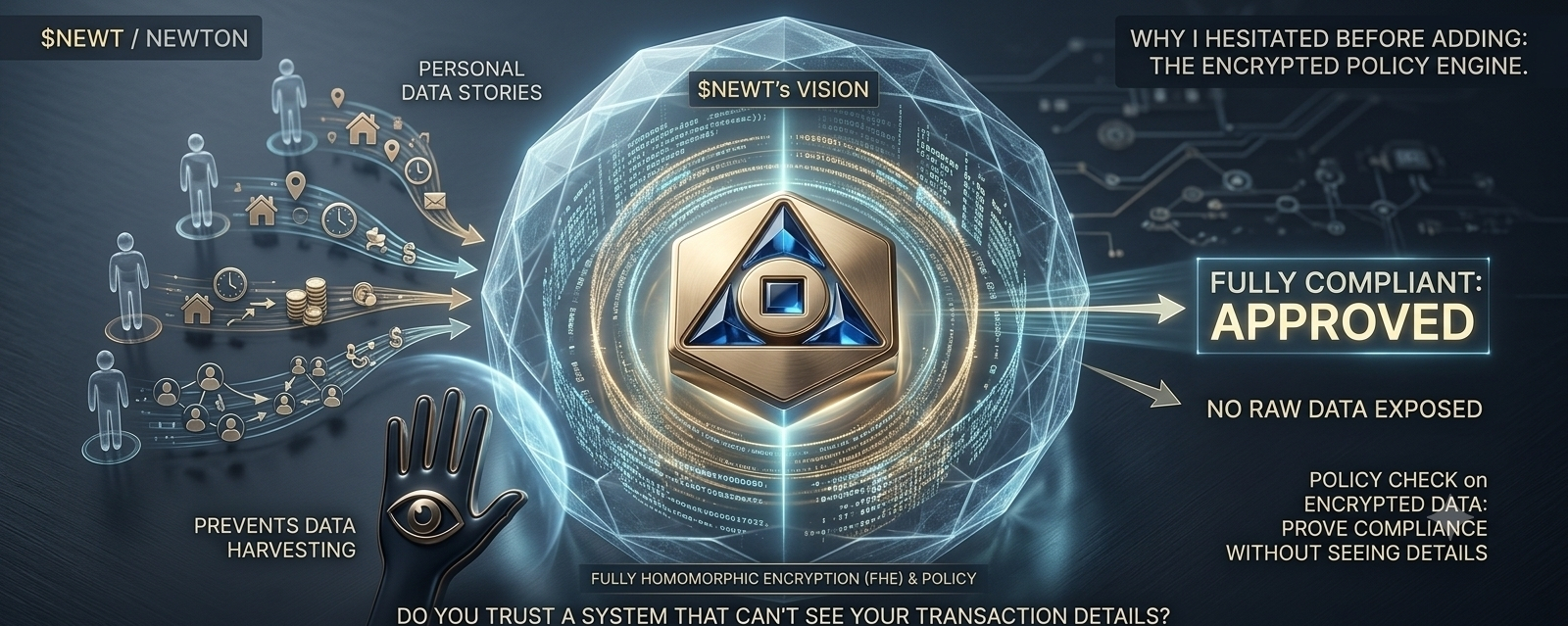
The piece that kept me thinking was Newton’s bigger vision around Fully Homomorphic Encryption, or FHE. At first glance, it sounds like the typical privacy play: keep your data encrypted so nobody can snoop. But the more I read, the more I realized the interesting part isn’t just hiding information. It’s the idea of a policy engine that can decide if a transaction is okay without ever seeing the actual financial details underneath.
Normally, these systems need to look at all sorts of things — how much you’re sending, who you’re dealing with, the timing, risk flags, where you’re located, and the context around it. Even if it’s for good reasons like compliance, that policy layer still ends up collecting a lot of sensitive stuff about how people behave with their money.
What Newton seems to be aiming for feels different. With FHE, you could check the rules on encrypted data and only get back a simple answer: approved, rejected, or needs something else. The raw details stay hidden the whole time. It’s not about seeing everything first and deciding later — it’s about proving the policy was followed without exposing the story behind the transaction.
I like that they already handle policy checks before anything executes. If this encrypted approach becomes workable down the line, it fits right where the decision is already happening.
Don’t get me wrong, I know it’s not going to be easy. FHE is heavy on resources, tough to get right, and there are real worries about speed and scaling. If every check slows things down too much, it could hurt the everyday user experience, which is why I’m still keeping my position thoughtful and measured instead of going all in.
Even so, one idea keeps sticking with me. Every financial move we make tells a deeper story — about our timing, our relationships, our pressures, and our strategies. When policies always need to open that up to work, compliance can quietly turn into just another way of collecting personal data.
Maybe the best policy system in the long run isn’t the one that sees the most. Maybe it’s the one that only learns what it absolutely has to — and nothing extra.
That’s what’s been on my mind with Newton lately, honestly more than the short-term price stuff. If this kind of encrypted policy check ever becomes practical, I’m curious what others think: would you feel comfortable trusting a system that can prove everything’s compliant without ever seeing the actual details of your transactions?
#USADP98KMiss #newton #NewToken #Newt @NewtonProtocol
#ALLO
{future}(ALLOUSDT)
{spot}(TLMUSDT)
$NEWT
{spot}(NEWTUSDT)
Why I Hesitated Before Adding More to My $NEWT Position
This morning I was really tempted to add to my $NEWT position, but I ended up holding off. It wasn’t that I suddenly turned negative on the project — I still believe in what they’re building. I just wanted to sit with one part of it a bit longer before putting more money in. That habit of pausing to really understand something has saved me from a few bad calls before, even if it’s also made me miss out on some quick wins.
The piece that kept me thinking was Newton’s bigger vision around Fully Homomorphic Encryption, or FHE. At first glance, it sounds like the typical privacy play: keep your data encrypted so nobody can snoop. But the more I read, the more I realized the interesting part isn’t just hiding information. It’s the idea of a policy engine that can decide if a transaction is okay without ever seeing the actual financial details underneath.
Normally, these systems need to look at all sorts of things — how much you’re sending, who you’re dealing with, the timing, risk flags, where you’re located, and the context around it. Even if it’s for good reasons like compliance, that policy layer still ends up collecting a lot of sensitive stuff about how people behave with their money.
What Newton seems to be aiming for feels different. With FHE, you could check the rules on encrypted data and only get back a simple answer: approved, rejected, or needs something else. The raw details stay hidden the whole time. It’s not about seeing everything first and deciding later — it’s about proving the policy was followed without exposing the story behind the transaction.
I like that they already handle policy checks before anything executes. If this encrypted approach becomes workable down the line, it fits right where the decision is already happening.
Don’t get me wrong, I know it’s not going to be easy. FHE is heavy on resources, tough to get right, and there are real worries about speed and scaling. If every check slows things down too much, it could hurt the everyday user experience, which is why I’m still keeping my position thoughtful and measured instead of going all in.
Even so, one idea keeps sticking with me. Every financial move we make tells a deeper story — about our timing, our relationships, our pressures, and our strategies. When policies always need to open that up to work, compliance can quietly turn into just another way of collecting personal data.
Maybe the best policy system in the long run isn’t the one that sees the most. Maybe it’s the one that only learns what it absolutely has to — and nothing extra.
That’s what’s been on my mind with Newton lately, honestly more than the short-term price stuff. If this kind of encrypted policy check ever becomes practical, I’m curious what others think: would you feel comfortable trusting a system that can prove everything’s compliant without ever seeing the actual details of your transactions?
#USADP98KMiss #newton #NewToken #Newt @NewtonProtocol
#ALLO
$NEWT
The piece that kept me thinking was Newton’s bigger vision around Fully Homomorphic Encryption, or FHE. At first glance, it sounds like the typical privacy play: keep your data encrypted so nobody can snoop. But the more I read, the more I realized the interesting part isn’t just hiding information. It’s the idea of a policy engine that can decide if a transaction is okay without ever seeing the actual financial details underneath.
Normally, these systems need to look at all sorts of things — how much you’re sending, who you’re dealing with, the timing, risk flags, where you’re located, and the context around it. Even if it’s for good reasons like compliance, that policy layer still ends up collecting a lot of sensitive stuff about how people behave with their money.
What Newton seems to be aiming for feels different. With FHE, you could check the rules on encrypted data and only get back a simple answer: approved, rejected, or needs something else. The raw details stay hidden the whole time. It’s not about seeing everything first and deciding later — it’s about proving the policy was followed without exposing the story behind the transaction.
I like that they already handle policy checks before anything executes. If this encrypted approach becomes workable down the line, it fits right where the decision is already happening.
Don’t get me wrong, I know it’s not going to be easy. FHE is heavy on resources, tough to get right, and there are real worries about speed and scaling. If every check slows things down too much, it could hurt the everyday user experience, which is why I’m still keeping my position thoughtful and measured instead of going all in.
Even so, one idea keeps sticking with me. Every financial move we make tells a deeper story — about our timing, our relationships, our pressures, and our strategies. When policies always need to open that up to work, compliance can quietly turn into just another way of collecting personal data.
Maybe the best policy system in the long run isn’t the one that sees the most. Maybe it’s the one that only learns what it absolutely has to — and nothing extra.
That’s what’s been on my mind with Newton lately, honestly more than the short-term price stuff. If this kind of encrypted policy check ever becomes practical, I’m curious what others think: would you feel comfortable trusting a system that can prove everything’s compliant without ever seeing the actual details of your transactions?
#USADP98KMiss #newton #NewToken #Newt @NewtonProtocol
#ALLO
$NEWT
29
10
273

Lately, I've been asking myself one question: am I investing in real products, or am I just following the latest trend?
I've seen many narratives attract a lot of money for a short time, then lose attention once the rewards slow down. That's why I'm much more careful with new investments now.
That thinking made me take a closer look at Newton Protocol instead of simply following the hype.
The interesting part for me wasn't just the AI story. It was the idea of giving AI-powered trading strategies a safer place to run. If more traders and developers start trusting AI with real money, the infrastructure behind it could become more important than any single strategy.
At the same time, I'm staying careful. AI is getting a lot of attention, but attention doesn't always turn into long-term users. If developers stop building or people don't find real value, liquidity can disappear quickly.
For now, I'm keeping my position small and watching a few things: Are users still active after the excitement fades? Are developers still building? Are people coming back because the product is useful, not just because of rewards?
One lesson I've learned is simple: trends can bring money, but real usage is what keeps it there.
What do you think? Will AI projects be valued by real user activity in the future, or will the market keep following the AI narrative first?
$T $EVAA
$NEWT #Newt #newton @NewtonProtocol
Lately, I've been asking myself one question: am I investing in real products, or am I just following the latest trend?
I've seen many narratives attract a lot of money for a short time, then lose attention once the rewards slow down. That's why I'm much more careful with new investments now.
That thinking made me take a closer look at Newton Protocol instead of simply following the hype.
The interesting part for me wasn't just the AI story. It was the idea of giving AI-powered trading strategies a safer place to run. If more traders and developers start trusting AI with real money, the infrastructure behind it could become more important than any single strategy.
At the same time, I'm staying careful. AI is getting a lot of attention, but attention doesn't always turn into long-term users. If developers stop building or people don't find real value, liquidity can disappear quickly.
For now, I'm keeping my position small and watching a few things: Are users still active after the excitement fades? Are developers still building? Are people coming back because the product is useful, not just because of rewards?
One lesson I've learned is simple: trends can bring money, but real usage is what keeps it there.
What do you think? Will AI projects be valued by real user activity in the future, or will the market keep following the AI narrative first?
$T $EVAA
$NEWT #Newt #newton @NewtonProtocol
I've seen many narratives attract a lot of money for a short time, then lose attention once the rewards slow down. That's why I'm much more careful with new investments now.
That thinking made me take a closer look at Newton Protocol instead of simply following the hype.
The interesting part for me wasn't just the AI story. It was the idea of giving AI-powered trading strategies a safer place to run. If more traders and developers start trusting AI with real money, the infrastructure behind it could become more important than any single strategy.
At the same time, I'm staying careful. AI is getting a lot of attention, but attention doesn't always turn into long-term users. If developers stop building or people don't find real value, liquidity can disappear quickly.
For now, I'm keeping my position small and watching a few things: Are users still active after the excitement fades? Are developers still building? Are people coming back because the product is useful, not just because of rewards?
One lesson I've learned is simple: trends can bring money, but real usage is what keeps it there.
What do you think? Will AI projects be valued by real user activity in the future, or will the market keep following the AI narrative first?
$T $EVAA
$NEWT #Newt #newton @NewtonProtocol
AI-powered Automation
0%
Verifiable AI Execution
0%
Developer Ecosystem Growth 💹
0%
Token Price Appreciation
0%
0 votes • Voting closed
463

·
--
Partly True
Article
Chasing Wicks and AI Rollups: Why I’m Keeping My Hype in Check for Newton Protocol ($NEWT)I spent the morning digging into the documentation for the Newton Protocol ($NEWT ). I needed a distraction because my actual PNL this week took a massive hit from a stupid trading mistake. I left a trailing stop too tight on an unoptimized market-making bot, and my position got completely wiped out during a sudden, aggressive wick. It’s brutal out there right now, which is precisely why the concept of a secure rollup specifically built for AI-driven strategies and automated trading caught my eye. The team is trying to build a decentralized marketplace where machine learning and AI devs can easily monetize their quantitative models. Honestly, it sounds exactly like what the market needs, but I’m forced to keep my hype firmly in check until we see actual mainnet execution.
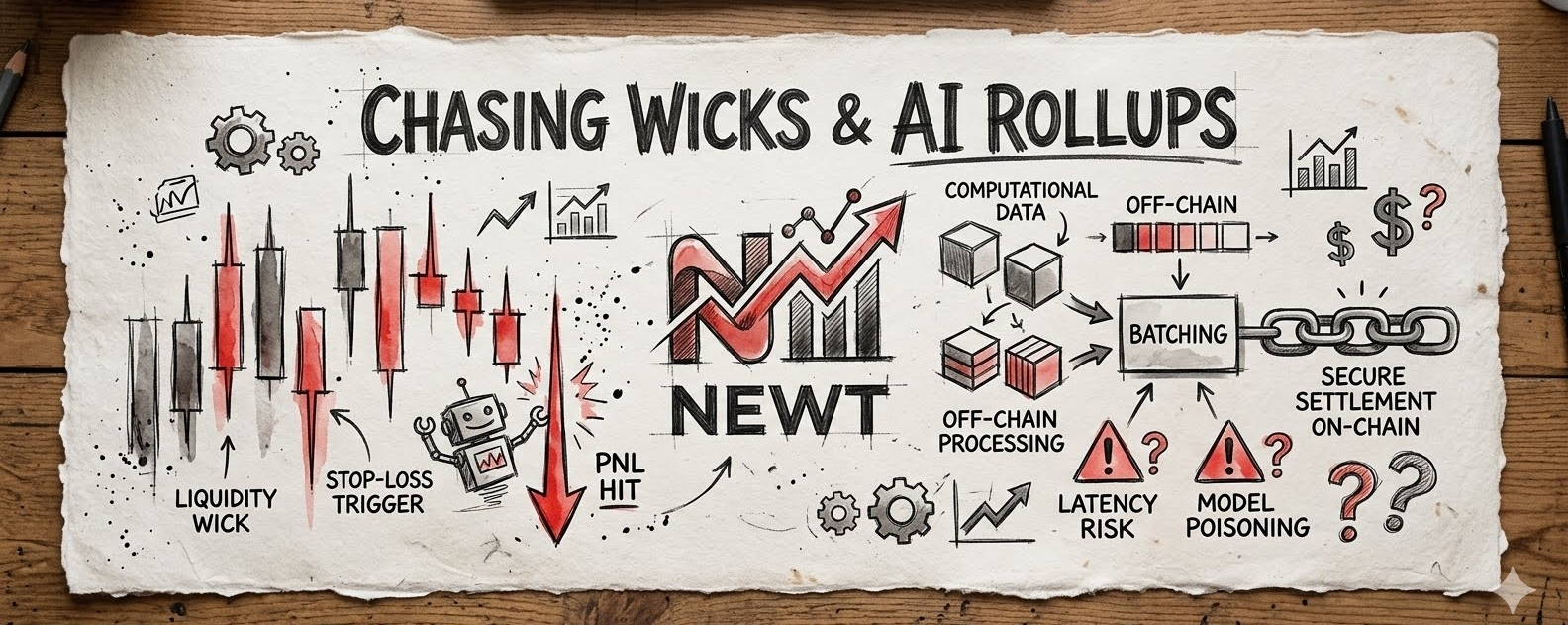
The underlying architecture relies on complex off-chain processing to handle high-frequency computational data streams before batching and settling them securely on-chain. This is pretty standard rollup stuff on paper, but they claim it is highly optimized specifically for machine learning execution. In theory, this framework eliminates manual execution risks by relying purely on programmatic conditional smart contract statements. Furthermore, the developer marketplace creates a neat, self-sustaining ecosystem for quant devs who want to rent out their algorithmic strategies. Furthermore, the seamless integration of these systems creates a cyclical environment where devs publish models, automated systems deploy them, and the rollup processes the transactions smoothly.
But let’s be real for a second—I see two massive, glaring red flags that make me incredibly nervous to deploy any serious capital here. First, there is the fundamental latency issue that plagues all rollup designs. Rollups inherently batch transactions, which introduces unavoidable millisecond delays. In highly volatile execution environments, that minor latency means instant death by slippage. Predatory MEV bots lurking on monolithic base layers will absolutely front-run these complex AI strategies before they settle. Second, the decentralized marketplace opens up a terrifying attack vector for model poisoning. A malicious developer could easily upload an algorithmic model that backtests beautifully during historical simulation but contains hidden triggers or backdoors. These triggers could be designed to intentionally drain user liquidity and redirect funds during a specific, engineered market anomaly.
In conclusion, Newton Protocol presents a super unique and attractive conceptual framework for decentralized financial intelligence. Furthermore, the network offers a clear infrastructure for automation and developer monetization. However, until they definitively solve execution lag and find a way to mitigate algorithmic security risks, I'm sticking to safe, broad plays rather than risking my remaining portfolio on unproven rollups.
@NewtonProtocol #newton
Chasing Wicks and AI Rollups: Why I’m Keeping My Hype in Check for Newton Protocol ($NEWT)
I spent the morning digging into the documentation for the Newton Protocol ($NEWT ). I needed a distraction because my actual PNL this week took a massive hit from a stupid trading mistake. I left a trailing stop too tight on an unoptimized market-making bot, and my position got completely wiped out during a sudden, aggressive wick. It’s brutal out there right now, which is precisely why the concept of a secure rollup specifically built for AI-driven strategies and automated trading caught my eye. The team is trying to build a decentralized marketplace where machine learning and AI devs can easily monetize their quantitative models. Honestly, it sounds exactly like what the market needs, but I’m forced to keep my hype firmly in check until we see actual mainnet execution.
The underlying architecture relies on complex off-chain processing to handle high-frequency computational data streams before batching and settling them securely on-chain. This is pretty standard rollup stuff on paper, but they claim it is highly optimized specifically for machine learning execution. In theory, this framework eliminates manual execution risks by relying purely on programmatic conditional smart contract statements. Furthermore, the developer marketplace creates a neat, self-sustaining ecosystem for quant devs who want to rent out their algorithmic strategies. Furthermore, the seamless integration of these systems creates a cyclical environment where devs publish models, automated systems deploy them, and the rollup processes the transactions smoothly.
But let’s be real for a second—I see two massive, glaring red flags that make me incredibly nervous to deploy any serious capital here. First, there is the fundamental latency issue that plagues all rollup designs. Rollups inherently batch transactions, which introduces unavoidable millisecond delays. In highly volatile execution environments, that minor latency means instant death by slippage. Predatory MEV bots lurking on monolithic base layers will absolutely front-run these complex AI strategies before they settle. Second, the decentralized marketplace opens up a terrifying attack vector for model poisoning. A malicious developer could easily upload an algorithmic model that backtests beautifully during historical simulation but contains hidden triggers or backdoors. These triggers could be designed to intentionally drain user liquidity and redirect funds during a specific, engineered market anomaly.
In conclusion, Newton Protocol presents a super unique and attractive conceptual framework for decentralized financial intelligence. Furthermore, the network offers a clear infrastructure for automation and developer monetization. However, until they definitively solve execution lag and find a way to mitigate algorithmic security risks, I'm sticking to safe, broad plays rather than risking my remaining portfolio on unproven rollups.
@NewtonProtocol #newton
The underlying architecture relies on complex off-chain processing to handle high-frequency computational data streams before batching and settling them securely on-chain. This is pretty standard rollup stuff on paper, but they claim it is highly optimized specifically for machine learning execution. In theory, this framework eliminates manual execution risks by relying purely on programmatic conditional smart contract statements. Furthermore, the developer marketplace creates a neat, self-sustaining ecosystem for quant devs who want to rent out their algorithmic strategies. Furthermore, the seamless integration of these systems creates a cyclical environment where devs publish models, automated systems deploy them, and the rollup processes the transactions smoothly.
But let’s be real for a second—I see two massive, glaring red flags that make me incredibly nervous to deploy any serious capital here. First, there is the fundamental latency issue that plagues all rollup designs. Rollups inherently batch transactions, which introduces unavoidable millisecond delays. In highly volatile execution environments, that minor latency means instant death by slippage. Predatory MEV bots lurking on monolithic base layers will absolutely front-run these complex AI strategies before they settle. Second, the decentralized marketplace opens up a terrifying attack vector for model poisoning. A malicious developer could easily upload an algorithmic model that backtests beautifully during historical simulation but contains hidden triggers or backdoors. These triggers could be designed to intentionally drain user liquidity and redirect funds during a specific, engineered market anomaly.
In conclusion, Newton Protocol presents a super unique and attractive conceptual framework for decentralized financial intelligence. Furthermore, the network offers a clear infrastructure for automation and developer monetization. However, until they definitively solve execution lag and find a way to mitigate algorithmic security risks, I'm sticking to safe, broad plays rather than risking my remaining portfolio on unproven rollups.
@NewtonProtocol #newton
2
86

·
--
Partly True
Article
The Frictionless Fallacy: Analyzing the Magic Labs Integration@NewtonProtocol
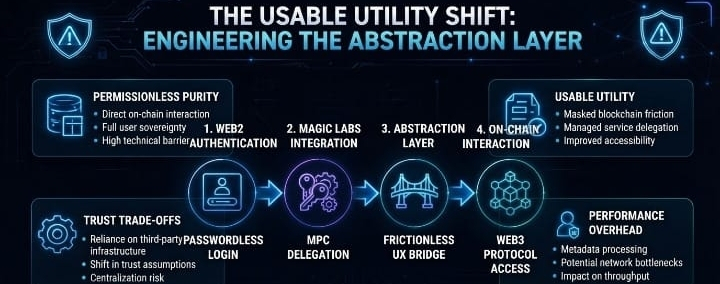
In the architecture of decentralized systems user experience is often a euphemism for hiding the complexity of private key management. The recent partnership with Magic Labs promises a seamless transition from Web2 authentication to Web3 interaction but as protocol engineers. We must look past the marketing layer to the on chain reality. The promise is a passwordless familiar login experience. The reality is an abstraction layer that introduces new dependencies.
At the technical core the integration operates by delegating key management to a managed service. While this effectively solves the bonboarding drop off problem moving users away from seed phrase management it forces a trade off in trust. In theory the whitepaper suggests full decentralization via non custodial Delegated Key Management System (DKMS) schemes. In practice the protocol must now account for the availability and integrity of the Magic Labs infrastructure. If the authentication provider experiences downtime or a security compromise, the on chain reality is that user assets while technically on chain become functionally inaccessible. We have swapped the risk of user negligence (losing a seed phrase) for the risk of centralized dependency (infrastructure failure).
Furthermore the abstraction of signing transactions adds a layer of metadata processing that, if not optimized, can bloat transaction validation times. While the onboarding flow looks sleek, the overhead of verifying the cryptographic proofs generated by the Magic Labs SDK must be processed by the network nodes. If this verification overhead scales linearly with user count the protocol faces a potential bottleneck that could increase gas costs or latency for all participants.
Market Context: $NEWT [+2.93%]
NEWT
The current market momentum shows that solid technology and real utility are finally getting the recognition they deserve.
#bullish #newton #MagicLabs #BlockchainEngineering
Conclusion
We are witnessing a shift from
permissionless purity to usable utility. The Magic Labs integration successfully masks the friction of blockchain interaction. But engineers should remain vigilant. Convenience is rarely free. It is usually paid for in either trust or performance overhead. Do not mistake a cleaner UI for a more decentralized protocol the abstraction layer is a bridge not the destination.
The Frictionless Fallacy: Analyzing the Magic Labs Integration
@NewtonProtocol
In the architecture of decentralized systems user experience is often a euphemism for hiding the complexity of private key management. The recent partnership with Magic Labs promises a seamless transition from Web2 authentication to Web3 interaction but as protocol engineers. We must look past the marketing layer to the on chain reality. The promise is a passwordless familiar login experience. The reality is an abstraction layer that introduces new dependencies.
At the technical core the integration operates by delegating key management to a managed service. While this effectively solves the bonboarding drop off problem moving users away from seed phrase management it forces a trade off in trust. In theory the whitepaper suggests full decentralization via non custodial Delegated Key Management System (DKMS) schemes. In practice the protocol must now account for the availability and integrity of the Magic Labs infrastructure. If the authentication provider experiences downtime or a security compromise, the on chain reality is that user assets while technically on chain become functionally inaccessible. We have swapped the risk of user negligence (losing a seed phrase) for the risk of centralized dependency (infrastructure failure).
Furthermore the abstraction of signing transactions adds a layer of metadata processing that, if not optimized, can bloat transaction validation times. While the onboarding flow looks sleek, the overhead of verifying the cryptographic proofs generated by the Magic Labs SDK must be processed by the network nodes. If this verification overhead scales linearly with user count the protocol faces a potential bottleneck that could increase gas costs or latency for all participants.
Market Context: $NEWT [+2.93%]
NEWT
The current market momentum shows that solid technology and real utility are finally getting the recognition they deserve.
#bullish #newton #MagicLabs #BlockchainEngineering
Conclusion
We are witnessing a shift from
permissionless purity to usable utility. The Magic Labs integration successfully masks the friction of blockchain interaction. But engineers should remain vigilant. Convenience is rarely free. It is usually paid for in either trust or performance overhead. Do not mistake a cleaner UI for a more decentralized protocol the abstraction layer is a bridge not the destination.
In the architecture of decentralized systems user experience is often a euphemism for hiding the complexity of private key management. The recent partnership with Magic Labs promises a seamless transition from Web2 authentication to Web3 interaction but as protocol engineers. We must look past the marketing layer to the on chain reality. The promise is a passwordless familiar login experience. The reality is an abstraction layer that introduces new dependencies.
At the technical core the integration operates by delegating key management to a managed service. While this effectively solves the bonboarding drop off problem moving users away from seed phrase management it forces a trade off in trust. In theory the whitepaper suggests full decentralization via non custodial Delegated Key Management System (DKMS) schemes. In practice the protocol must now account for the availability and integrity of the Magic Labs infrastructure. If the authentication provider experiences downtime or a security compromise, the on chain reality is that user assets while technically on chain become functionally inaccessible. We have swapped the risk of user negligence (losing a seed phrase) for the risk of centralized dependency (infrastructure failure).
Furthermore the abstraction of signing transactions adds a layer of metadata processing that, if not optimized, can bloat transaction validation times. While the onboarding flow looks sleek, the overhead of verifying the cryptographic proofs generated by the Magic Labs SDK must be processed by the network nodes. If this verification overhead scales linearly with user count the protocol faces a potential bottleneck that could increase gas costs or latency for all participants.
Market Context: $NEWT [+2.93%]
NEWT
The current market momentum shows that solid technology and real utility are finally getting the recognition they deserve.
#bullish #newton #MagicLabs #BlockchainEngineering
Conclusion
We are witnessing a shift from
permissionless purity to usable utility. The Magic Labs integration successfully masks the friction of blockchain interaction. But engineers should remain vigilant. Convenience is rarely free. It is usually paid for in either trust or performance overhead. Do not mistake a cleaner UI for a more decentralized protocol the abstraction layer is a bridge not the destination.
4
1
78

#newt $NEWT I’ve noticed that the smallest improvements often tell the biggest story. That’s why I keep revisiting Newton Protocol. Instead of looking for dramatic announcements, I pay attention to the details that quietly improve the overall experience. Those steady refinements give me confidence that the project is focused on building something practical. For me, thoughtful progress is always more meaningful than short-lived attention. @NewtonProtocol #newton
#newt $NEWT I’ve noticed that the smallest improvements often tell the biggest story. That’s why I keep revisiting Newton Protocol. Instead of looking for dramatic announcements, I pay attention to the details that quietly improve the overall experience. Those steady refinements give me confidence that the project is focused on building something practical. For me, thoughtful progress is always more meaningful than short-lived attention. @NewtonProtocol #newton
2
107

·
--
Newton Coin (NEWT) is a cryptocurrency designed to support decentralized finance and blockchain-based applications. It aims to create a secure, transparent, and efficient digital ecosystem where users can transfer value and access various financial services without relying on traditional intermediaries. The project focuses on community participation and seeks to make blockchain technology more accessible to ordinary users. Like many cryptocurrencies, Newton Coin's value can fluctuate significantly depending on market conditions, investor sentiment, and overall trends in the crypto industry. Before investing in Newton Coin or any other digital asset, it is important to conduct thorough research, understand the risks involved, and make informed financial decisions.
#newton #BitcoinPlansECashHardFork #IranSaysItClosedStraitOfHormuz #SpaceXAnthropicOpenAIIPOsMayTopVCExitsSince2000 BlackRockBUIDLTops$900MAUMOnAvalanche$NEWT
Newton Coin (NEWT) is a cryptocurrency designed to support decentralized finance and blockchain-based applications. It aims to create a secure, transparent, and efficient digital ecosystem where users can transfer value and access various financial services without relying on traditional intermediaries. The project focuses on community participation and seeks to make blockchain technology more accessible to ordinary users. Like many cryptocurrencies, Newton Coin's value can fluctuate significantly depending on market conditions, investor sentiment, and overall trends in the crypto industry. Before investing in Newton Coin or any other digital asset, it is important to conduct thorough research, understand the risks involved, and make informed financial decisions.
#newton #BitcoinPlansECashHardFork #IranSaysItClosedStraitOfHormuz #SpaceXAnthropicOpenAIIPOsMayTopVCExitsSince2000 BlackRockBUIDLTops$900MAUMOnAvalanche$NEWT
#newton #BitcoinPlansECashHardFork #IranSaysItClosedStraitOfHormuz #SpaceXAnthropicOpenAIIPOsMayTopVCExitsSince2000 BlackRockBUIDLTops$900MAUMOnAvalanche$NEWT
92

·
--
Bullish
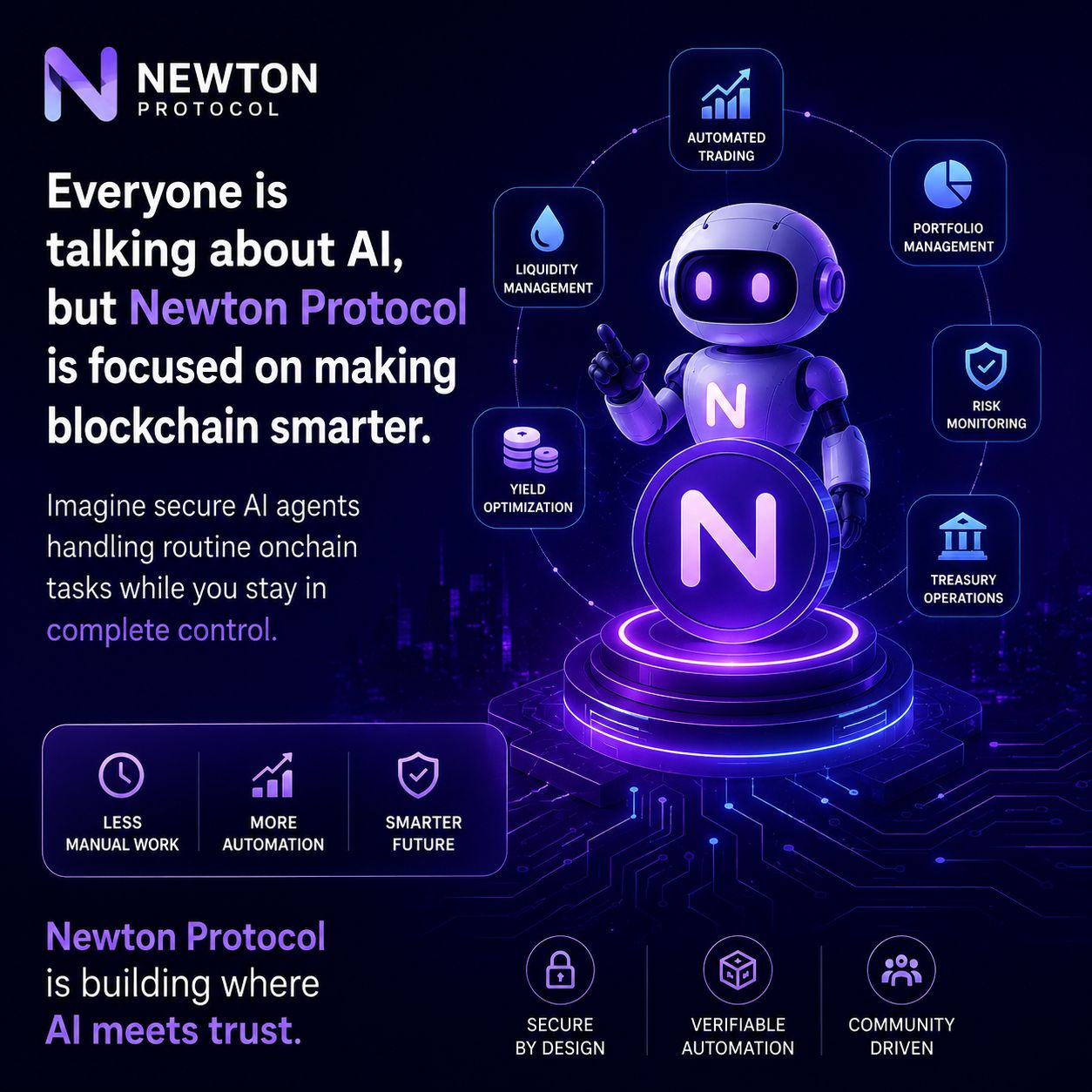
@NewtonProtocol Everyone is talking about AI, but #Newton Protocol is focused on making blockchain smarter.
Imagine secure AI agents handling routine onchain tasks while you stay in complete control.
Less manual work. More automation. A smarter future for blockchain.
Newton Protocol is building where AI meets trust.
$NEWT
{spot}(NEWTUSDT)
@NewtonProtocol Everyone is talking about AI, but #Newton Protocol is focused on making blockchain smarter.
Imagine secure AI agents handling routine onchain tasks while you stay in complete control.
Less manual work. More automation. A smarter future for blockchain.
Newton Protocol is building where AI meets trust.
$NEWT
Imagine secure AI agents handling routine onchain tasks while you stay in complete control.
Less manual work. More automation. A smarter future for blockchain.
Newton Protocol is building where AI meets trust.
$NEWT
28
36
5.4k

·
--
Newton Mainnet Beta: A Strong Foundation for the Next Stage of Web3 InnovationThe launch of the Newton Mainnet Beta marks an important step in the evolution of decentralized infrastructure. Congratulations to @NewtonProtocol for reaching this milestone and continuing to build a network focused on practical blockchain adoption. Mainnet Beta is more than a technical release—it is an opportunity for developers, validators, and community members to test new features, provide valuable feedback, and contribute to a stronger ecosystem.
I believe the most successful blockchain projects are those that actively involve their communities during key development stages. By opening Mainnet Beta participation, Newton Protocol can gather real-world insights that help improve security, performance, and usability before broader adoption. This collaborative approach benefits both builders and users while encouraging innovation across the ecosystem.
I'm looking forward to seeing how new applications, developer tools, and community initiatives grow around the network in the coming months. Wishing the entire @NewtonProtocol team continued success as the ecosystem expands. $NEWT has the potential to play an important role in supporting this next phase of growth and community participation. #newton
Newton Mainnet Beta: A Strong Foundation for the Next Stage of Web3 Innovation
The launch of the Newton Mainnet Beta marks an important step in the evolution of decentralized infrastructure. Congratulations to @NewtonProtocol for reaching this milestone and continuing to build a network focused on practical blockchain adoption. Mainnet Beta is more than a technical release—it is an opportunity for developers, validators, and community members to test new features, provide valuable feedback, and contribute to a stronger ecosystem.
I believe the most successful blockchain projects are those that actively involve their communities during key development stages. By opening Mainnet Beta participation, Newton Protocol can gather real-world insights that help improve security, performance, and usability before broader adoption. This collaborative approach benefits both builders and users while encouraging innovation across the ecosystem.
I'm looking forward to seeing how new applications, developer tools, and community initiatives grow around the network in the coming months. Wishing the entire @NewtonProtocol team continued success as the ecosystem expands. $NEWT has the potential to play an important role in supporting this next phase of growth and community participation. #newton
I believe the most successful blockchain projects are those that actively involve their communities during key development stages. By opening Mainnet Beta participation, Newton Protocol can gather real-world insights that help improve security, performance, and usability before broader adoption. This collaborative approach benefits both builders and users while encouraging innovation across the ecosystem.
I'm looking forward to seeing how new applications, developer tools, and community initiatives grow around the network in the coming months. Wishing the entire @NewtonProtocol team continued success as the ecosystem expands. $NEWT has the potential to play an important role in supporting this next phase of growth and community participation. #newton
55

·
--
NEWTONGood Project. Get ready to see the development of this project/coin become PAUS.
Buy and hold—big move soon👀👀👀👀🤑🤑🤑
The support area at 0.0400 becomes the benchmark for big buyers to enter.
Good Project
Good data
Business development
A protocol that will become an important assetThe main role for big coins.Ayoooo, stay motivated, cuan warriors 🤑🤑🤑🤑🤑🤑👀👀👀👀👀👀👀👀 $NEWT #newton @NewtonProtocol
NEWTON
Good Project. Get ready to see the development of this project/coin become PAUS.
Buy and hold—big move soon👀👀👀👀🤑🤑🤑
The support area at 0.0400 becomes the benchmark for big buyers to enter.
Good Project
Good data
Business development
A protocol that will become an important assetThe main role for big coins.Ayoooo, stay motivated, cuan warriors 🤑🤑🤑🤑🤑🤑👀👀👀👀👀👀👀👀 $NEWT #newton @NewtonProtocol
Buy and hold—big move soon👀👀👀👀🤑🤑🤑
The support area at 0.0400 becomes the benchmark for big buyers to enter.
Good Project
Good data
Business development
A protocol that will become an important assetThe main role for big coins.Ayoooo, stay motivated, cuan warriors 🤑🤑🤑🤑🤑🤑👀👀👀👀👀👀👀👀 $NEWT #newton @NewtonProtocol
12

Newton: Building the Future of Web3Newton: Building the Future of Web3
Newton is a blockchain project focused on improving the Web3 experience through practical innovation, scalability, and community participation. As the blockchain industry continues to grow, users increasingly value projects that emphasize usability, efficiency, and real-world applications. Newton aims to contribute to this vision by supporting a decentralized ecosystem where developers and users can interact more effectively. While the crypto market remains dynamic, long-term success often depends on continuous development, strong community engagement, and meaningful adoption. Keeping an eye on projects like Newton can help investors and blockchain enthusiasts better understand emerging trends in decentralized technology. As always, do your own research (DYOR) before making any investment decisions, and focus on projects with clear goals, active development, and sustainable growth potential.
#Newton #Web3 #Blockchain #Crypto #Innovation #Innovation
Newton: Building the Future of Web3
Newton: Building the Future of Web3
Newton is a blockchain project focused on improving the Web3 experience through practical innovation, scalability, and community participation. As the blockchain industry continues to grow, users increasingly value projects that emphasize usability, efficiency, and real-world applications. Newton aims to contribute to this vision by supporting a decentralized ecosystem where developers and users can interact more effectively. While the crypto market remains dynamic, long-term success often depends on continuous development, strong community engagement, and meaningful adoption. Keeping an eye on projects like Newton can help investors and blockchain enthusiasts better understand emerging trends in decentralized technology. As always, do your own research (DYOR) before making any investment decisions, and focus on projects with clear goals, active development, and sustainable growth potential.
#Newton #Web3 #Blockchain #Crypto #Innovation #Innovation
Newton is a blockchain project focused on improving the Web3 experience through practical innovation, scalability, and community participation. As the blockchain industry continues to grow, users increasingly value projects that emphasize usability, efficiency, and real-world applications. Newton aims to contribute to this vision by supporting a decentralized ecosystem where developers and users can interact more effectively. While the crypto market remains dynamic, long-term success often depends on continuous development, strong community engagement, and meaningful adoption. Keeping an eye on projects like Newton can help investors and blockchain enthusiasts better understand emerging trends in decentralized technology. As always, do your own research (DYOR) before making any investment decisions, and focus on projects with clear goals, active development, and sustainable growth potential.
#Newton #Web3 #Blockchain #Crypto #Innovation #Innovation
74

·
--
Article
The New Coin#Newton Coin ($NEWT ) Market Analytics
Newton Coin (NEWT) is showing renewed momentum as traders closely monitor its price action alongside improving sentiment across the broader cryptocurrency market. The token has recently defended a key support zone, indicating that buyers remain active despite short-term volatility. Technical indicators suggest that if NEWT maintains its current structure and breaks above the nearest resistance level with strong trading volume, it could target higher price levels in the coming sessions. However, a rejection at resistance may trigger a temporary pullback before another bullish attempt. Investors should also keep an eye on ecosystem developments, exchange activity, and overall Bitcoin market direction, as these factors continue to influence NEWT's short-term performance. As always, proper risk management and independent research are essential before making any investment decisions.#CircleRemovedFromRussellGrowthIndexes #OilPriceFalls #KoreanWonWeakestSince2009
{spot}(NEWTUSDT)
The New Coin
#Newton Coin ($NEWT ) Market Analytics
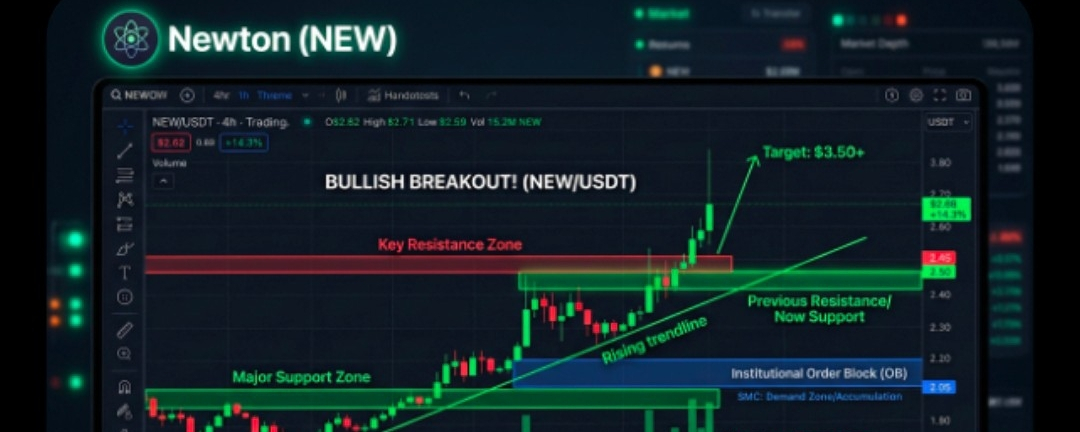
Newton Coin (NEWT) is showing renewed momentum as traders closely monitor its price action alongside improving sentiment across the broader cryptocurrency market. The token has recently defended a key support zone, indicating that buyers remain active despite short-term volatility. Technical indicators suggest that if NEWT maintains its current structure and breaks above the nearest resistance level with strong trading volume, it could target higher price levels in the coming sessions. However, a rejection at resistance may trigger a temporary pullback before another bullish attempt. Investors should also keep an eye on ecosystem developments, exchange activity, and overall Bitcoin market direction, as these factors continue to influence NEWT's short-term performance. As always, proper risk management and independent research are essential before making any investment decisions.#CircleRemovedFromRussellGrowthIndexes #OilPriceFalls #KoreanWonWeakestSince2009
Newton Coin (NEWT) is showing renewed momentum as traders closely monitor its price action alongside improving sentiment across the broader cryptocurrency market. The token has recently defended a key support zone, indicating that buyers remain active despite short-term volatility. Technical indicators suggest that if NEWT maintains its current structure and breaks above the nearest resistance level with strong trading volume, it could target higher price levels in the coming sessions. However, a rejection at resistance may trigger a temporary pullback before another bullish attempt. Investors should also keep an eye on ecosystem developments, exchange activity, and overall Bitcoin market direction, as these factors continue to influence NEWT's short-term performance. As always, proper risk management and independent research are essential before making any investment decisions.#CircleRemovedFromRussellGrowthIndexes #OilPriceFalls #KoreanWonWeakestSince2009
71

·
--
🚀 Exploring the Future with @NewtonProtocol
The launch of the Newton Mainnet Beta marks an excitin🚀 Exploring the Future with @NewtonProtocol
The launch of the #newton Mainnet Beta marks an exciting milestone for the Web3 ecosystem. @NewtonProtocol is focused on building a decentralized infrastructure that aims to improve efficiency, security, and scalability for blockchain applications. $With the Mainnet Beta now available, developers and community members have an opportunity to experience the network, provide valuable feedback, and help shape its future development.
Projects that encourage community participation during the beta stage often build stronger ecosystems over time. The Newton Mainnet Beta is an important step toward testing real-world performance, improving stability, and preparing for broader adoption. As the network continues to evolve, it could unlock new possibilities for developers, users, and decentralized applications.
I'm looking forward to seeing how the community contributes to the growth of the ecosystem and how the team continues to innovate in the coming months. Wishing the project continued success as it moves toward its long-term vision.
$NEWT #Newt
🚀 Exploring the Future with @NewtonProtocol The launch of the Newton Mainnet Beta marks an excitin
🚀 Exploring the Future with @NewtonProtocol
The launch of the #newton Mainnet Beta marks an exciting milestone for the Web3 ecosystem. @NewtonProtocol is focused on building a decentralized infrastructure that aims to improve efficiency, security, and scalability for blockchain applications. $With the Mainnet Beta now available, developers and community members have an opportunity to experience the network, provide valuable feedback, and help shape its future development.
Projects that encourage community participation during the beta stage often build stronger ecosystems over time. The Newton Mainnet Beta is an important step toward testing real-world performance, improving stability, and preparing for broader adoption. As the network continues to evolve, it could unlock new possibilities for developers, users, and decentralized applications.
I'm looking forward to seeing how the community contributes to the growth of the ecosystem and how the team continues to innovate in the coming months. Wishing the project continued success as it moves toward its long-term vision.
$NEWT #Newt
The launch of the #newton Mainnet Beta marks an exciting milestone for the Web3 ecosystem. @NewtonProtocol is focused on building a decentralized infrastructure that aims to improve efficiency, security, and scalability for blockchain applications. $With the Mainnet Beta now available, developers and community members have an opportunity to experience the network, provide valuable feedback, and help shape its future development.
Projects that encourage community participation during the beta stage often build stronger ecosystems over time. The Newton Mainnet Beta is an important step toward testing real-world performance, improving stability, and preparing for broader adoption. As the network continues to evolve, it could unlock new possibilities for developers, users, and decentralized applications.
I'm looking forward to seeing how the community contributes to the growth of the ecosystem and how the team continues to innovate in the coming months. Wishing the project continued success as it moves toward its long-term vision.
$NEWT #Newt
42

·
--
Newton Protocol Mainnet Beta: A New Era for Decentralized DataThe launch of the @NewtonProtocol Mainnet Beta marks an exciting step forward for the Web3 ecosystem. As blockchain technology continues to evolve, the need for accurate, secure, and decentralized real-world data is becoming more important than ever. Newton Protocol is working to solve this challenge by building a decentralized oracle network that connects blockchain applications with trusted external data sources.
The Mainnet Beta allows developers and community members to experience the network in a real environment while helping improve performance before wider adoption. This stage is important because it provides valuable feedback, enhances network security, and strengthens the overall ecosystem.
The $NEWT token plays a key role in the Newton Protocol ecosystem. It is designed to support network participation, incentivize contributors, and help maintain a transparent and decentralized infrastructure. As the ecosystem grows, $NEWT has the potential to become an important part of the protocol's long-term development.
One of the biggest advantages of Newton Protocol is its focus on transparency, reliability, and scalability. These qualities are essential for decentralized finance (DeFi), gaming, AI applications, and other Web3 projects that depend on trustworthy real-world information. By providing secure oracle services, Newton Protocol aims to reduce risks while improving the efficiency of decentralized applications.
I believe the Mainnet Beta is an important milestone that demonstrates the team's commitment to innovation and community-driven development. It will be interesting to watch how developers build on the platform and how the ecosystem expands over time.#newton
Newton Protocol Mainnet Beta: A New Era for Decentralized Data
The launch of the @NewtonProtocol Mainnet Beta marks an exciting step forward for the Web3 ecosystem. As blockchain technology continues to evolve, the need for accurate, secure, and decentralized real-world data is becoming more important than ever. Newton Protocol is working to solve this challenge by building a decentralized oracle network that connects blockchain applications with trusted external data sources.
The Mainnet Beta allows developers and community members to experience the network in a real environment while helping improve performance before wider adoption. This stage is important because it provides valuable feedback, enhances network security, and strengthens the overall ecosystem.
The $NEWT token plays a key role in the Newton Protocol ecosystem. It is designed to support network participation, incentivize contributors, and help maintain a transparent and decentralized infrastructure. As the ecosystem grows, $NEWT has the potential to become an important part of the protocol's long-term development.
One of the biggest advantages of Newton Protocol is its focus on transparency, reliability, and scalability. These qualities are essential for decentralized finance (DeFi), gaming, AI applications, and other Web3 projects that depend on trustworthy real-world information. By providing secure oracle services, Newton Protocol aims to reduce risks while improving the efficiency of decentralized applications.
I believe the Mainnet Beta is an important milestone that demonstrates the team's commitment to innovation and community-driven development. It will be interesting to watch how developers build on the platform and how the ecosystem expands over time.#newton
The Mainnet Beta allows developers and community members to experience the network in a real environment while helping improve performance before wider adoption. This stage is important because it provides valuable feedback, enhances network security, and strengthens the overall ecosystem.
The $NEWT token plays a key role in the Newton Protocol ecosystem. It is designed to support network participation, incentivize contributors, and help maintain a transparent and decentralized infrastructure. As the ecosystem grows, $NEWT has the potential to become an important part of the protocol's long-term development.
One of the biggest advantages of Newton Protocol is its focus on transparency, reliability, and scalability. These qualities are essential for decentralized finance (DeFi), gaming, AI applications, and other Web3 projects that depend on trustworthy real-world information. By providing secure oracle services, Newton Protocol aims to reduce risks while improving the efficiency of decentralized applications.
I believe the Mainnet Beta is an important milestone that demonstrates the team's commitment to innovation and community-driven development. It will be interesting to watch how developers build on the platform and how the ecosystem expands over time.#newton
73

·
--
Newton In topExcited to see the progress of @NewtonProtocol and the launch of the Newton Mainnet Beta. The project is focused on building a decentralized infrastructure that gives users more control while supporting secure and scalable on-chain applications. Looking forward to seeing the ecosystem grow and how developers and the community contribute to its future. $NEWT #Newt $NEWT The launch of the Newton Mainnet Beta is an exciting milestone for @NewtonProtocol and the broader Web3 ecosystem. As blockchain technology continues to evolve, users and developers are looking for networks that are secure, scalable, efficient, and easy to build on. Newton Protocol aims to address these needs by creating a decentralized infrastructure designed for the next generation of blockchain applications.
The Mainnet Beta represents an important step in the project's development. It allows the community to experience the network in a live environment while helping the team test performance, improve stability, and gather valuable feedback. A successful beta phase is essential because it enables developers to identify areas for improvement before the network reaches full maturity.
One of the most interesting aspects of Newton Protocol is its focus on building an ecosystem where developers can create decentralized applications with greater confidence. A reliable blockchain network is not only about speed but also about security, transparency, and long-term sustainability. These qualities are becoming increasingly important as more users and businesses explore blockchain technology.
Community participation is another key factor behind the success of Newton Protocol. During the Mainnet Beta, users have the opportunity to explore the network, learn about its features, and contribute feedback that can help shape future updates. This collaborative approach strengthens the ecosystem and encourages innovation from both developers and community members.
The native token, $NEWT, plays an important role within the Newton ecosystem. As the project grows, the token is expected to support various activities across the network while encouraging participation from users and builders. A healthy ecosystem depends on active engagement, and the continued development of Newton Protocol could create new opportunities for everyone involved.
The blockchain industry is becoming increasingly competitive, with many projects introducing new technologies and solutions. What makes Newton Protocol worth watching is its commitment to continuous improvement and the steady rollout of important milestones such as the Mainnet Beta. Strong technology combined with an active community often creates the foundation for long-term success.
As adoption of decentralized technologies continues to increase, projects that focus on usability, performance, and security will have greater opportunities to stand out. Newton Protocol appears to be moving in that direction by building a network that supports developers while remaining accessible to users. The Mainnet Beta is only the beginning, and it will be interesting to follow the project's progress as new features and improvements are introduced.
I look forward to seeing how @NewtonProtocol continues to expand its ecosystem, attract developers, and strengthen community participation. Every successful blockchain starts with a solid foundation, and the Mainnet Beta is an important milestone on that journey. Best wishes to the entire Newton community as they continue building the future of decentralized technolog$y. $NEWT #Newt #Newton
Newton In top
Excited to see the progress of @NewtonProtocol and the launch of the Newton Mainnet Beta. The project is focused on building a decentralized infrastructure that gives users more control while supporting secure and scalable on-chain applications. Looking forward to seeing the ecosystem grow and how developers and the community contribute to its future. $NEWT #Newt $NEWT The launch of the Newton Mainnet Beta is an exciting milestone for @NewtonProtocol and the broader Web3 ecosystem. As blockchain technology continues to evolve, users and developers are looking for networks that are secure, scalable, efficient, and easy to build on. Newton Protocol aims to address these needs by creating a decentralized infrastructure designed for the next generation of blockchain applications.
The Mainnet Beta represents an important step in the project's development. It allows the community to experience the network in a live environment while helping the team test performance, improve stability, and gather valuable feedback. A successful beta phase is essential because it enables developers to identify areas for improvement before the network reaches full maturity.
One of the most interesting aspects of Newton Protocol is its focus on building an ecosystem where developers can create decentralized applications with greater confidence. A reliable blockchain network is not only about speed but also about security, transparency, and long-term sustainability. These qualities are becoming increasingly important as more users and businesses explore blockchain technology.
Community participation is another key factor behind the success of Newton Protocol. During the Mainnet Beta, users have the opportunity to explore the network, learn about its features, and contribute feedback that can help shape future updates. This collaborative approach strengthens the ecosystem and encourages innovation from both developers and community members.
The native token, $NEWT , plays an important role within the Newton ecosystem. As the project grows, the token is expected to support various activities across the network while encouraging participation from users and builders. A healthy ecosystem depends on active engagement, and the continued development of Newton Protocol could create new opportunities for everyone involved.
The blockchain industry is becoming increasingly competitive, with many projects introducing new technologies and solutions. What makes Newton Protocol worth watching is its commitment to continuous improvement and the steady rollout of important milestones such as the Mainnet Beta. Strong technology combined with an active community often creates the foundation for long-term success.
As adoption of decentralized technologies continues to increase, projects that focus on usability, performance, and security will have greater opportunities to stand out. Newton Protocol appears to be moving in that direction by building a network that supports developers while remaining accessible to users. The Mainnet Beta is only the beginning, and it will be interesting to follow the project's progress as new features and improvements are introduced.
I look forward to seeing how @NewtonProtocol continues to expand its ecosystem, attract developers, and strengthen community participation. Every successful blockchain starts with a solid foundation, and the Mainnet Beta is an important milestone on that journey. Best wishes to the entire Newton community as they continue building the future of decentralized technolog$y. $NEWT #Newt #Newton
The Mainnet Beta represents an important step in the project's development. It allows the community to experience the network in a live environment while helping the team test performance, improve stability, and gather valuable feedback. A successful beta phase is essential because it enables developers to identify areas for improvement before the network reaches full maturity.
One of the most interesting aspects of Newton Protocol is its focus on building an ecosystem where developers can create decentralized applications with greater confidence. A reliable blockchain network is not only about speed but also about security, transparency, and long-term sustainability. These qualities are becoming increasingly important as more users and businesses explore blockchain technology.
Community participation is another key factor behind the success of Newton Protocol. During the Mainnet Beta, users have the opportunity to explore the network, learn about its features, and contribute feedback that can help shape future updates. This collaborative approach strengthens the ecosystem and encourages innovation from both developers and community members.
The native token, $NEWT , plays an important role within the Newton ecosystem. As the project grows, the token is expected to support various activities across the network while encouraging participation from users and builders. A healthy ecosystem depends on active engagement, and the continued development of Newton Protocol could create new opportunities for everyone involved.
The blockchain industry is becoming increasingly competitive, with many projects introducing new technologies and solutions. What makes Newton Protocol worth watching is its commitment to continuous improvement and the steady rollout of important milestones such as the Mainnet Beta. Strong technology combined with an active community often creates the foundation for long-term success.
As adoption of decentralized technologies continues to increase, projects that focus on usability, performance, and security will have greater opportunities to stand out. Newton Protocol appears to be moving in that direction by building a network that supports developers while remaining accessible to users. The Mainnet Beta is only the beginning, and it will be interesting to follow the project's progress as new features and improvements are introduced.
I look forward to seeing how @NewtonProtocol continues to expand its ecosystem, attract developers, and strengthen community participation. Every successful blockchain starts with a solid foundation, and the Mainnet Beta is an important milestone on that journey. Best wishes to the entire Newton community as they continue building the future of decentralized technolog$y. $NEWT #Newt #Newton
4

·
--
Newton#newton Newton (NEWT) is a cryptocurrency project focused on building a decentralized digital economy with fast, transparent, and community-driven value exchange. Like many crypto assets, its appeal depends on adoption, utility, tokenomics, and market sentiment. Before investing, always review its latest fundamentals, trading volume, roadmap, and risks, because crypto prices can be highly volatile.
Newton
#newton Newton (NEWT) is a cryptocurrency project focused on building a decentralized digital economy with fast, transparent, and community-driven value exchange. Like many crypto assets, its appeal depends on adoption, utility, tokenomics, and market sentiment. Before investing, always review its latest fundamentals, trading volume, roadmap, and risks, because crypto prices can be highly volatile.
85

🚀 Unlocking the Future of Verifiable On-Chain Automation with Newton ProtocolThe integration of Artificial Intelligence (AI) and blockchain technology is evolving rapidly, and newton protocol is leading this revolution from the front. With the recent launch of the Newton Mainnet Beta, the protocol is introducing a powerful, decentralized infrastructure layer designed to bring trust, security, and absolute transparency to AI-driven strategies and automated trading.
What Makes Newton Protocol Unique?
Unlike traditional centralized setups where AI operations happen behind closed doors, Newton protocol operates as an Actively Validated Service (AVS). It bridges the gap between transaction intent and final on-chain execution. By utilizing specialized tools like VaultKit, developers can create advanced trading and automation models while keeping the underlying logic completely protected through zero-knowledge parameters.
Why $NEWT Matters
At the core of this innovative ecosystem is the $NEWT token. It serves as the primary utility token powering the network, facilitating protocol service fees for all authorization and verification tasks. As real-world assets (RWAs) and institutional capital continue to migrate on-chain, having a private yet completely verifiable compliance layer becomes essential.
The Newton Mainnet Beta is a massive milestone that proves secure, policy-enforced on-chain automation is no longer just a theory—it is a reality. Keep a close eye on this project as it continues to reshape Web3 infrastructure!
#newton otocol
🚀 Unlocking the Future of Verifiable On-Chain Automation with Newton Protocol
The integration of Artificial Intelligence (AI) and blockchain technology is evolving rapidly, and newton protocol is leading this revolution from the front. With the recent launch of the Newton Mainnet Beta, the protocol is introducing a powerful, decentralized infrastructure layer designed to bring trust, security, and absolute transparency to AI-driven strategies and automated trading.
What Makes Newton Protocol Unique?
Unlike traditional centralized setups where AI operations happen behind closed doors, Newton protocol operates as an Actively Validated Service (AVS). It bridges the gap between transaction intent and final on-chain execution. By utilizing specialized tools like VaultKit, developers can create advanced trading and automation models while keeping the underlying logic completely protected through zero-knowledge parameters.
Why $NEWT Matters
At the core of this innovative ecosystem is the $NEWT token. It serves as the primary utility token powering the network, facilitating protocol service fees for all authorization and verification tasks. As real-world assets (RWAs) and institutional capital continue to migrate on-chain, having a private yet completely verifiable compliance layer becomes essential.
The Newton Mainnet Beta is a massive milestone that proves secure, policy-enforced on-chain automation is no longer just a theory—it is a reality. Keep a close eye on this project as it continues to reshape Web3 infrastructure!
#newton otocol
What Makes Newton Protocol Unique?
Unlike traditional centralized setups where AI operations happen behind closed doors, Newton protocol operates as an Actively Validated Service (AVS). It bridges the gap between transaction intent and final on-chain execution. By utilizing specialized tools like VaultKit, developers can create advanced trading and automation models while keeping the underlying logic completely protected through zero-knowledge parameters.
Why $NEWT Matters
At the core of this innovative ecosystem is the $NEWT token. It serves as the primary utility token powering the network, facilitating protocol service fees for all authorization and verification tasks. As real-world assets (RWAs) and institutional capital continue to migrate on-chain, having a private yet completely verifiable compliance layer becomes essential.
The Newton Mainnet Beta is a massive milestone that proves secure, policy-enforced on-chain automation is no longer just a theory—it is a reality. Keep a close eye on this project as it continues to reshape Web3 infrastructure!
#newton otocol
2
82

·
--
Article
NEWTON PROTOCOL#NEWTON IS BEST ASSET. it's good for our future and can get your wealth to its highest peak. Everytime it gives a best example of best asset and prove it's worth. $NEWT is ALL TIME HIGH ASSET IN BEST WAY. We should give it $NEWT a chance to give a boost to our wealth and can access all time high envourmental boost. It's protocol is always good and best. We should give it a try and it's all time high asset in all good way so what are we waiting for. Invest in it and give it a shot , rest it'll do the work for us and for itself . It is the best asset ever. It's newton protocol is always best and we should be lucky to have it. $NEWT always prove itself. We should be a part of it and by this we can grow our wealth also. It is best and can easiest way to invest in. Newton protocol always come in a best way and we should give it a try. Its a good and envourmental asset.
NEWTON PROTOCOL
#NEWTON IS BEST ASSET. it's good for our future and can get your wealth to its highest peak. Everytime it gives a best example of best asset and prove it's worth. $NEWT is ALL TIME HIGH ASSET IN BEST WAY. We should give it $NEWT a chance to give a boost to our wealth and can access all time high envourmental boost. It's protocol is always good and best. We should give it a try and it's all time high asset in all good way so what are we waiting for. Invest in it and give it a shot , rest it'll do the work for us and for itself . It is the best asset ever. It's newton protocol is always best and we should be lucky to have it. $NEWT always prove itself. We should be a part of it and by this we can grow our wealth also. It is best and can easiest way to invest in. Newton protocol always come in a best way and we should give it a try. Its a good and envourmental asset.
1
1
10

·
--
#newt $NEWT I just checked out Newton Protocol Mainnet Beta!
It looks promising for Web3 builders and users.
The gasless experience and AI agents are really cool. good project
Excited to see where @NewtonProtocol goes next!
@NewtonProtocol $NEWT #newton
#newt $NEWT I just checked out Newton Protocol Mainnet Beta!
It looks promising for Web3 builders and users.
The gasless experience and AI agents are really cool. good project
Excited to see where @NewtonProtocol goes next!
@NewtonProtocol $NEWT #newton
It looks promising for Web3 builders and users.
The gasless experience and AI agents are really cool. good project
Excited to see where @NewtonProtocol goes next!
@NewtonProtocol $NEWT #newton
1
82
I am incredibly excited about the potential of @NewtonProtocol and the recent launch of Newton Mainnet Beta! This advanced blockchain infrastructure is designed to solve major scalability issues while keeping gas fees low and affordable for everyone. The native token $NEWT plays a vital role within this growing ecosystem, serving as the essential fuel for transactions and decentralized applications. Whether you are a developer looking for a high-performance network or a Web3 enthusiast, keeping a close eye on Newton is highly recommended. Let's support the future of Web3! #Newt #Newton #Ad
I am incredibly excited about the potential of @NewtonProtocol and the recent launch of Newton Mainnet Beta! This advanced blockchain infrastructure is designed to solve major scalability issues while keeping gas fees low and affordable for everyone. The native token $NEWT plays a vital role within this growing ecosystem, serving as the essential fuel for transactions and decentralized applications. Whether you are a developer looking for a high-performance network or a Web3 enthusiast, keeping a close eye on Newton is highly recommended. Let's support the future of Web3! #Newt #Newton #Ad
1
63
Log in to explore more content
Join global crypto users on Binance Square
⚡️ Get latest and useful information about crypto.
💬 Trusted by the world’s largest crypto exchange.
👍 Discover real insights from verified creators.
Email / Phone number
Trending Topics
1
#BitcoinSpotETFsNetInflow$191M
2,412 views
114 Discussing
2
#CFTCUpdatesGuidanceOnTokenizedAssets
17,840 views
750 Discussing
3
#BitgetSays$352MAffectedInHack
5,196 views
68 Discussing
4
#BinanceWillListHyperliquid(HYPE)
210,022 views
3,323 Discussing
5
#BrazilOrdersReportingOf$10KSelfCustodyTransfers
2,252 views
47 Discussing
6
#FedProposesRulesForBankIssuedStablecoins
17,238 views
503 Discussing
7
#OndoFinanceSoughtSaleAfterFoundersDeath
10,725 views
321 Discussing
8
#FedOctoberRateHikeOddsRiseTo69.7%
85,428 views
1,451 Discussing
9
#BitcoinFallsBelow$83,000
5,370 views
19 Discussing
10
#BitcoinFallsToAround$84,600ThisWeek
0 views
0 Discussing