

Trade B8
1.2k Posts

Trade B8
Report
Block User
Crypto and Forex Trader | #BTC # BNB holder | Binance Kol | 2 years experience YouTube @TradeB8
Open Trade
Frequent Trader
2.5 Years
73 Following
20.3K+ Followers
3.0K+ Liked
Posts
Portfolio
All
Quotes
Videos
Live
·
--
China’s biggest banks are ending retail access to leveraged paper gold products on July 24.
What this means:
Today and tomorrow, Chinese retail traders may close positions before the deadline, which could create temporary selling pressure and volatility in gold, especially during the Asian session.
July 23 could be the most important liquidation day because many traders may exit early.
July 24 does not mean gold trading stops completely. Institutions, hedge funds, physical gold, ETFs and XAUUSD will continue normally.
My view: short-term bearish pressure is possible, but do not expect an automatic gold crash. If DXY and US yields rise too, the sell-off could become stronger. Otherwise, gold could drop first and then recover. ⚠️📉
China’s biggest banks are ending retail access to leveraged paper gold products on July 24.
What this means:
Today and tomorrow, Chinese retail traders may close positions before the deadline, which could create temporary selling pressure and volatility in gold, especially during the Asian session.
July 23 could be the most important liquidation day because many traders may exit early.
July 24 does not mean gold trading stops completely. Institutions, hedge funds, physical gold, ETFs and XAUUSD will continue normally.
My view: short-term bearish pressure is possible, but do not expect an automatic gold crash. If DXY and US yields rise too, the sell-off could become stronger. Otherwise, gold could drop first and then recover. ⚠️📉
What this means:
Today and tomorrow, Chinese retail traders may close positions before the deadline, which could create temporary selling pressure and volatility in gold, especially during the Asian session.
July 23 could be the most important liquidation day because many traders may exit early.
July 24 does not mean gold trading stops completely. Institutions, hedge funds, physical gold, ETFs and XAUUSD will continue normally.
My view: short-term bearish pressure is possible, but do not expect an automatic gold crash. If DXY and US yields rise too, the sell-off could become stronger. Otherwise, gold could drop first and then recover. ⚠️📉
4
253
·
--
Happy birthday
#Binance #BinanceTurns9
Celebrating 9 years of empowering millions worldwide. Thank you Binance for leading crypto with security, innovation, and community.
#BinanceTurns9 From 2017 to 2026, Binance built the future of finance. Proud to grow, trade, and believe together.
Cheers to us!
#BinanceSquareTG
Happy birthday
#Binance #BinanceTurns9
Celebrating 9 years of empowering millions worldwide. Thank you Binance for leading crypto with security, innovation, and community.
#BinanceTurns9 From 2017 to 2026, Binance built the future of finance. Proud to grow, trade, and believe together.
Cheers to us!
#BinanceSquareTG
#Binance #BinanceTurns9
Celebrating 9 years of empowering millions worldwide. Thank you Binance for leading crypto with security, innovation, and community.
#BinanceTurns9 From 2017 to 2026, Binance built the future of finance. Proud to grow, trade, and believe together.
Cheers to us!
#BinanceSquareTG

5
129
·
--
#BinanceTurns9 Binance Turns 9 - Built By You #BinanceTurns9 Happy 9th birthday
Binance! 9 years of innovation, trust, and crypto freedom. Here's to building the future together.
#BinanceTurns9 Binance Turns 9 - Built By You #BinanceTurns9 Happy 9th birthday
Binance! 9 years of innovation, trust, and crypto freedom. Here's to building the future together.
Binance! 9 years of innovation, trust, and crypto freedom. Here's to building the future together.

4
35
·
--
Policies as Public Infrastructure: Making Sense of Newton's Marketplace AmbitionBuried past the vault use case is Newton's more ambitious long-term framing: an "Internet of Policies," where compliance and risk rules become discoverable, reusable building blocks rather than logic each protocol writes and audits independently. It's worth taking seriously precisely because it's the part of the roadmap furthest from being built.
The underlying idea borrows a pattern that's already proven out elsewhere in crypto infrastructure: smart contracts became a shared execution primitive, oracles became a shared data primitive, and Newton is betting that policies — written in Rego, a declarative policy language already used in cloud infrastructure — can become a similarly shared and composable primitive for compliance and risk. In practice, that would mean a stablecoin issuer and a vault curator could draw on the same underlying sanctions-screening policy pack, rather than each building and maintaining a separate compliance stack from scratch.
If it works, the appeal is obvious: less duplicated compliance engineering across the industry, and rules that are auditable and versioned rather than buried in each protocol's individual, opaque backend logic. If a policy pack has a flaw, in theory it gets fixed once for everyone using it, rather than fixed one integration at a time.
The honest tension is that "marketplace for rules" is a governance problem dressed as an engineering one. Someone has to decide which policy packs are trustworthy, how disputes over incorrect or malicious policies get resolved, and who's accountable when a shared, reused policy fails across dozens of protocols simultaneously — a single bad policy pack reused widely could concentrate risk rather than reduce it. None of that is a smart contract problem; it's closer to standards-body work, and standards bodies are typically slow, political, and contentious for good reason.
Right now, "Internet of Policies" is closer to a stated direction than a functioning marketplace — the mainnet beta launch centers on vault-specific policy composition, not a general-purpose exchange of policies across arbitrary protocols. Whether the idea matures into real infrastructure or stays an aspirational framing in blog posts is genuinely unresolved, and worth revisiting once — or if — an actual marketplace ships.$NEWT #Newt @NewtonProtocol $LAB $DCR
Policies as Public Infrastructure: Making Sense of Newton's Marketplace Ambition
Buried past the vault use case is Newton's more ambitious long-term framing: an "Internet of Policies," where compliance and risk rules become discoverable, reusable building blocks rather than logic each protocol writes and audits independently. It's worth taking seriously precisely because it's the part of the roadmap furthest from being built.
The underlying idea borrows a pattern that's already proven out elsewhere in crypto infrastructure: smart contracts became a shared execution primitive, oracles became a shared data primitive, and Newton is betting that policies — written in Rego, a declarative policy language already used in cloud infrastructure — can become a similarly shared and composable primitive for compliance and risk. In practice, that would mean a stablecoin issuer and a vault curator could draw on the same underlying sanctions-screening policy pack, rather than each building and maintaining a separate compliance stack from scratch.
If it works, the appeal is obvious: less duplicated compliance engineering across the industry, and rules that are auditable and versioned rather than buried in each protocol's individual, opaque backend logic. If a policy pack has a flaw, in theory it gets fixed once for everyone using it, rather than fixed one integration at a time.
The honest tension is that "marketplace for rules" is a governance problem dressed as an engineering one. Someone has to decide which policy packs are trustworthy, how disputes over incorrect or malicious policies get resolved, and who's accountable when a shared, reused policy fails across dozens of protocols simultaneously — a single bad policy pack reused widely could concentrate risk rather than reduce it. None of that is a smart contract problem; it's closer to standards-body work, and standards bodies are typically slow, political, and contentious for good reason.
Right now, "Internet of Policies" is closer to a stated direction than a functioning marketplace — the mainnet beta launch centers on vault-specific policy composition, not a general-purpose exchange of policies across arbitrary protocols. Whether the idea matures into real infrastructure or stays an aspirational framing in blog posts is genuinely unresolved, and worth revisiting once — or if — an actual marketplace ships.$NEWT #Newt @NewtonProtocol $LAB $DCR
The underlying idea borrows a pattern that's already proven out elsewhere in crypto infrastructure: smart contracts became a shared execution primitive, oracles became a shared data primitive, and Newton is betting that policies — written in Rego, a declarative policy language already used in cloud infrastructure — can become a similarly shared and composable primitive for compliance and risk. In practice, that would mean a stablecoin issuer and a vault curator could draw on the same underlying sanctions-screening policy pack, rather than each building and maintaining a separate compliance stack from scratch.
If it works, the appeal is obvious: less duplicated compliance engineering across the industry, and rules that are auditable and versioned rather than buried in each protocol's individual, opaque backend logic. If a policy pack has a flaw, in theory it gets fixed once for everyone using it, rather than fixed one integration at a time.
The honest tension is that "marketplace for rules" is a governance problem dressed as an engineering one. Someone has to decide which policy packs are trustworthy, how disputes over incorrect or malicious policies get resolved, and who's accountable when a shared, reused policy fails across dozens of protocols simultaneously — a single bad policy pack reused widely could concentrate risk rather than reduce it. None of that is a smart contract problem; it's closer to standards-body work, and standards bodies are typically slow, political, and contentious for good reason.
Right now, "Internet of Policies" is closer to a stated direction than a functioning marketplace — the mainnet beta launch centers on vault-specific policy composition, not a general-purpose exchange of policies across arbitrary protocols. Whether the idea matures into real infrastructure or stays an aspirational framing in blog posts is genuinely unresolved, and worth revisiting once — or if — an actual marketplace ships.$NEWT #Newt @NewtonProtocol $LAB $DCR
6
5
330
·
--
Internet of Policies
The immediate use case for Newton is enforcing rules onchain, but the bigger idea sitting underneath it is more interesting — a marketplace where the policies themselves get published, reused, and composed across projects instead of locked inside one company's stack. They're framing it as an "Internet of Policies." Early, unproven, but worth watching if it actually plays out. #Newt $NEWT @NewtonProtocol $LAB
{future}(LABUSDT)
$BTC
Internet of Policies
The immediate use case for Newton is enforcing rules onchain, but the bigger idea sitting underneath it is more interesting — a marketplace where the policies themselves get published, reused, and composed across projects instead of locked inside one company's stack. They're framing it as an "Internet of Policies." Early, unproven, but worth watching if it actually plays out. #Newt $NEWT @NewtonProtocol $LAB
$BTC
The immediate use case for Newton is enforcing rules onchain, but the bigger idea sitting underneath it is more interesting — a marketplace where the policies themselves get published, reused, and composed across projects instead of locked inside one company's stack. They're framing it as an "Internet of Policies." Early, unproven, but worth watching if it actually plays out. #Newt $NEWT @NewtonProtocol $LAB
$BTC
1
4
246
·
--
Vaults Today, Everything Tomorrow: Reading Newton's Roadmap Literally@NewtonProtocol #Newt $NEWT
Newton's public materials are consistent on one point: vaults are described explicitly as the starting point, not the ceiling. The stated roadmap extends the same authorization layer toward real-world assets, stablecoins, and what the project calls agentic commerce — AI agents transacting onchain within enforced guardrails. Taken at face value, it's a sequencing bet worth examining on its own logic rather than dismissing as generic crypto roadmap language.
The throughline across all four domains is the same core mechanic: check a transaction against a policy before it settles, and produce a verifiable receipt either way. For stablecoins, that would mean transfers automatically screened against sanctioned addresses and jurisdictional restrictions at the point of execution rather than through backend monitoring after the fact. For RWAs, it would mean investor eligibility and transfer restrictions enforced directly in the asset's contract logic rather than managed through a permissioned ledger sitting outside public blockchain infrastructure. For AI agents, it would mean spending caps, approved payee lists, and defenses against prompt-injection-style manipulation enforced at the transaction layer, regardless of whether the agent's own decision-making was compromised.
The architectural reuse argument is genuinely coherent — if the underlying primitive really is "evaluate a transaction against policy before it settles," then in principle it shouldn't matter much whether the transaction is a vault withdrawal or a stablecoin transfer. The same operator network, the same attestation format, the same policy language could theoretically serve all four domains.
In practice, "in principle" is doing a lot of work in that sentence. Stablecoin compliance runs into securities and money-transmission law that varies by jurisdiction in ways a vault's leverage limit never has to. RWA transfer restrictions often depend on off-chain legal agreements that are hard to fully encode as a Rego policy. And AI agent guardrails introduce an entirely new threat category — adversarial manipulation of the agent itself — that vault risk management was never designed to address. Each expansion likely requires real domain-specific engineering and legal work, not just pointing an existing engine at a new use case. The roadmap is a reasonable statement of ambition. Whether execution keeps pace with it is something only time, not documentation, can confirm.
Vaults Today, Everything Tomorrow: Reading Newton's Roadmap Literally
@NewtonProtocol #Newt $NEWT
Newton's public materials are consistent on one point: vaults are described explicitly as the starting point, not the ceiling. The stated roadmap extends the same authorization layer toward real-world assets, stablecoins, and what the project calls agentic commerce — AI agents transacting onchain within enforced guardrails. Taken at face value, it's a sequencing bet worth examining on its own logic rather than dismissing as generic crypto roadmap language.
The throughline across all four domains is the same core mechanic: check a transaction against a policy before it settles, and produce a verifiable receipt either way. For stablecoins, that would mean transfers automatically screened against sanctioned addresses and jurisdictional restrictions at the point of execution rather than through backend monitoring after the fact. For RWAs, it would mean investor eligibility and transfer restrictions enforced directly in the asset's contract logic rather than managed through a permissioned ledger sitting outside public blockchain infrastructure. For AI agents, it would mean spending caps, approved payee lists, and defenses against prompt-injection-style manipulation enforced at the transaction layer, regardless of whether the agent's own decision-making was compromised.
The architectural reuse argument is genuinely coherent — if the underlying primitive really is "evaluate a transaction against policy before it settles," then in principle it shouldn't matter much whether the transaction is a vault withdrawal or a stablecoin transfer. The same operator network, the same attestation format, the same policy language could theoretically serve all four domains.
In practice, "in principle" is doing a lot of work in that sentence. Stablecoin compliance runs into securities and money-transmission law that varies by jurisdiction in ways a vault's leverage limit never has to. RWA transfer restrictions often depend on off-chain legal agreements that are hard to fully encode as a Rego policy. And AI agent guardrails introduce an entirely new threat category — adversarial manipulation of the agent itself — that vault risk management was never designed to address. Each expansion likely requires real domain-specific engineering and legal work, not just pointing an existing engine at a new use case. The roadmap is a reasonable statement of ambition. Whether execution keeps pace with it is something only time, not documentation, can confirm.
Newton's public materials are consistent on one point: vaults are described explicitly as the starting point, not the ceiling. The stated roadmap extends the same authorization layer toward real-world assets, stablecoins, and what the project calls agentic commerce — AI agents transacting onchain within enforced guardrails. Taken at face value, it's a sequencing bet worth examining on its own logic rather than dismissing as generic crypto roadmap language.
The throughline across all four domains is the same core mechanic: check a transaction against a policy before it settles, and produce a verifiable receipt either way. For stablecoins, that would mean transfers automatically screened against sanctioned addresses and jurisdictional restrictions at the point of execution rather than through backend monitoring after the fact. For RWAs, it would mean investor eligibility and transfer restrictions enforced directly in the asset's contract logic rather than managed through a permissioned ledger sitting outside public blockchain infrastructure. For AI agents, it would mean spending caps, approved payee lists, and defenses against prompt-injection-style manipulation enforced at the transaction layer, regardless of whether the agent's own decision-making was compromised.
The architectural reuse argument is genuinely coherent — if the underlying primitive really is "evaluate a transaction against policy before it settles," then in principle it shouldn't matter much whether the transaction is a vault withdrawal or a stablecoin transfer. The same operator network, the same attestation format, the same policy language could theoretically serve all four domains.
In practice, "in principle" is doing a lot of work in that sentence. Stablecoin compliance runs into securities and money-transmission law that varies by jurisdiction in ways a vault's leverage limit never has to. RWA transfer restrictions often depend on off-chain legal agreements that are hard to fully encode as a Rego policy. And AI agent guardrails introduce an entirely new threat category — adversarial manipulation of the agent itself — that vault risk management was never designed to address. Each expansion likely requires real domain-specific engineering and legal work, not just pointing an existing engine at a new use case. The roadmap is a reasonable statement of ambition. Whether execution keeps pace with it is something only time, not documentation, can confirm.
3
2
134
·
--
Layered security stack
Depending on one security layer means depending on one point of failure. Newton stacks several instead — EigenLayer for restaked economic security, Succinct for proof generation, Rhinestone and Octane covering account and execution infrastructure. Each layer is built independently and covers something the others don't touch. That kind of redundancy is what verifiable enforcement actually needs to hold up. #Newt $NEWT @NewtonProtocol
Layered security stack
Depending on one security layer means depending on one point of failure. Newton stacks several instead — EigenLayer for restaked economic security, Succinct for proof generation, Rhinestone and Octane covering account and execution infrastructure. Each layer is built independently and covers something the others don't touch. That kind of redundancy is what verifiable enforcement actually needs to hold up. #Newt $NEWT @NewtonProtocol
Depending on one security layer means depending on one point of failure. Newton stacks several instead — EigenLayer for restaked economic security, Succinct for proof generation, Rhinestone and Octane covering account and execution infrastructure. Each layer is built independently and covers something the others don't touch. That kind of redundancy is what verifiable enforcement actually needs to hold up. #Newt $NEWT @NewtonProtocol
1
2
147
·
--
How Newton Mainnet Beta Is Rethinking Onchain FinanceBased on the latest Mainnet Beta announcements, Newton Protocol is emphasizing pre-settlement policy enforcement, onchain attestations, and institutional vault infrastructure through VaultKit, with integrations for verified data feeds such as RedStone.
Here's an original Binance Square-style post inspired by those updates without copying source text:
Everyone talks about making blockchains faster, but speed alone doesn't solve trust.
What caught my attention about @NewtonProtocol's Mainnet Beta is its focus on making decisions before assets move. Instead of checking compliance or risk after settlement, the protocol evaluates predefined policies first and records a verifiable onchain attestation. That feels like a meaningful shift in how onchain finance could operate.
If this model proves reliable, it could reduce uncertainty for institutional vaults, automated strategies, and other applications where predictable execution matters. The interesting question is whether stronger authorization encourages more capital to participate or simply changes where complexity lives.
I'll be watching how policy enforcement, real-time data inputs, and transparent attestations influence user behavior as the ecosystem develops. Infrastructure is important, but confidence often determines adoption.
Curious to see how @NewtonProtocol continues building around the Newton Mainnet Beta and how $NEWT supports long-term network incentives.
#Newt
Paid Partnership. For Binance Square: @NewtonProtocol
How Newton Mainnet Beta Is Rethinking Onchain Finance
Based on the latest Mainnet Beta announcements, Newton Protocol is emphasizing pre-settlement policy enforcement, onchain attestations, and institutional vault infrastructure through VaultKit, with integrations for verified data feeds such as RedStone.
Here's an original Binance Square-style post inspired by those updates without copying source text:
Everyone talks about making blockchains faster, but speed alone doesn't solve trust.
What caught my attention about @NewtonProtocol's Mainnet Beta is its focus on making decisions before assets move. Instead of checking compliance or risk after settlement, the protocol evaluates predefined policies first and records a verifiable onchain attestation. That feels like a meaningful shift in how onchain finance could operate.
If this model proves reliable, it could reduce uncertainty for institutional vaults, automated strategies, and other applications where predictable execution matters. The interesting question is whether stronger authorization encourages more capital to participate or simply changes where complexity lives.
I'll be watching how policy enforcement, real-time data inputs, and transparent attestations influence user behavior as the ecosystem develops. Infrastructure is important, but confidence often determines adoption.
Curious to see how @NewtonProtocol continues building around the Newton Mainnet Beta and how $NEWT supports long-term network incentives.
#Newt
Paid Partnership. For Binance Square: @NewtonProtocol
Here's an original Binance Square-style post inspired by those updates without copying source text:
Everyone talks about making blockchains faster, but speed alone doesn't solve trust.
What caught my attention about @NewtonProtocol's Mainnet Beta is its focus on making decisions before assets move. Instead of checking compliance or risk after settlement, the protocol evaluates predefined policies first and records a verifiable onchain attestation. That feels like a meaningful shift in how onchain finance could operate.
If this model proves reliable, it could reduce uncertainty for institutional vaults, automated strategies, and other applications where predictable execution matters. The interesting question is whether stronger authorization encourages more capital to participate or simply changes where complexity lives.
I'll be watching how policy enforcement, real-time data inputs, and transparent attestations influence user behavior as the ecosystem develops. Infrastructure is important, but confidence often determines adoption.
Curious to see how @NewtonProtocol continues building around the Newton Mainnet Beta and how $NEWT supports long-term network incentives.
#Newt
Paid Partnership. For Binance Square: @NewtonProtocol
4
2
108
·
--
#newt $NEWT Here's a polished post that matches your requested style and includes the required mentions:
I thought better infrastructure would naturally create more demand. Lately, I've been noticing something different.
The projects holding my attention aren't just making transactions faster or cheaper. They're adding small decision points before value moves. That changes the flow more than I expected.
Looking at @NewtonProtocol and the Newton Mainnet Beta, it feels less like another DeFi layer and more like an authorization layer. Instead of recording what already happened, it checks whether a transaction satisfies active policies before settlement and leaves an onchain attestation. That shifts attention from reporting outcomes to enforcing rules.
What I'm still unsure about is where the real friction settles. If enforcement becomes easier, does that increase confidence enough to attract more activity, or does it simply move complexity somewhere else? Demand doesn't seem fixed—it reacts to how predictable and trustworthy the system feels.
I'm watching whether these small mechanics around timing, policy enforcement, and incentives change behavior over time, especially as vaults and other institutional use cases evolve. Curious to see how @NewtonProtocol approaches that with $NEWT. #Newt
Paid Partnership. For Binance Square: @NewtonProtocol
#newt $NEWT Here's a polished post that matches your requested style and includes the required mentions:
I thought better infrastructure would naturally create more demand. Lately, I've been noticing something different.
The projects holding my attention aren't just making transactions faster or cheaper. They're adding small decision points before value moves. That changes the flow more than I expected.
Looking at @NewtonProtocol and the Newton Mainnet Beta, it feels less like another DeFi layer and more like an authorization layer. Instead of recording what already happened, it checks whether a transaction satisfies active policies before settlement and leaves an onchain attestation. That shifts attention from reporting outcomes to enforcing rules.
What I'm still unsure about is where the real friction settles. If enforcement becomes easier, does that increase confidence enough to attract more activity, or does it simply move complexity somewhere else? Demand doesn't seem fixed—it reacts to how predictable and trustworthy the system feels.
I'm watching whether these small mechanics around timing, policy enforcement, and incentives change behavior over time, especially as vaults and other institutional use cases evolve. Curious to see how @NewtonProtocol approaches that with $NEWT. #Newt
Paid Partnership. For Binance Square: @NewtonProtocol
I thought better infrastructure would naturally create more demand. Lately, I've been noticing something different.
The projects holding my attention aren't just making transactions faster or cheaper. They're adding small decision points before value moves. That changes the flow more than I expected.
Looking at @NewtonProtocol and the Newton Mainnet Beta, it feels less like another DeFi layer and more like an authorization layer. Instead of recording what already happened, it checks whether a transaction satisfies active policies before settlement and leaves an onchain attestation. That shifts attention from reporting outcomes to enforcing rules.
What I'm still unsure about is where the real friction settles. If enforcement becomes easier, does that increase confidence enough to attract more activity, or does it simply move complexity somewhere else? Demand doesn't seem fixed—it reacts to how predictable and trustworthy the system feels.
I'm watching whether these small mechanics around timing, policy enforcement, and incentives change behavior over time, especially as vaults and other institutional use cases evolve. Curious to see how @NewtonProtocol approaches that with $NEWT. #Newt
Paid Partnership. For Binance Square: @NewtonProtocol
1
3
144
·
--
The Attestation Doesn't Prove Newton Was Right — It Proves Newton Ran: A Distinction Worth Making Before You Trust the Checkmark
Every compliance system in crypto today produces the same kind of artifact: a report, a dashboard, a PDF someone can point to after the fact. It's evidence that a process happened, sitting off-chain, unverifiable by anyone who wasn't in the room, and impossible for another smart contract to act on directly. If a vault wants to know whether a counterparty passed a sanctions check three protocols ago, it either trusts a claim on faith or redoes the work itself. That redundancy — everyone re-checking what someone else already checked — is the quiet tax underneath most "compliant" DeFi infrastructure.
Newton's answer is to make the result of a check into something a machine can consume: a signed attestation, written onchain, recording that a specific policy evaluated a specific transaction and returned pass or fail before that transaction settled. Other tools tell you what happened afterward. Newton's attestation is closer to a receipt issued at the moment of the decision itself, and because it lives onchain, another contract can read it without needing to trust the party that produced it — only the signature and the policy it references.
That's a genuine structural improvement, and it's worth being precise about what it actually buys you, because it's easy to overstate. An attestation proves that a policy ran and what it concluded. It does not prove the policy was well-designed, complete, or free of blind spots. If a risk policy fails to account for a specific kind of oracle manipulation, a transaction can pass Newton's check cleanly and still be a bad transaction — the attestation would be entirely accurate about a policy that was itself incomplete. This is the same gap that exists between "audited" and "correct" in traditional software: an audit log proves a process was followed, not that the process was the right one. Reading a Newton pass as "this is safe" rather than "this matched a specific, inspectable rule set" is a mistake worth actively guarding against.
The practical use case Newton is building around first is curated DeFi vaults, through a Vault SDK developed by Magic Labs that packages four enforcement domains — compliance, identity, security, and risk — into checks pulling data from partners including Chainalysis, Hexagate, Vaults.fyi, RedStone, and Credora, with the network itself secured through EigenLayer restaking alongside infrastructure partners like Succinct, Rhinestone, and Octane. Magic Labs' own track record is worth noting as context rather than endorsement: the company built embedded wallet infrastructure reportedly used across tens of millions of wallets, including Polymarket's wallet layer, which suggests real distribution experience even if it says nothing about how the newer attestation product will hold up under load.
If you're trying to evaluate any of this seriously, the attestation itself gives you a specific, answerable set of questions rather than a vague sense of trust: which policy version was this transaction checked against, is that policy publicly readable, and who has authority to change it before the next transaction runs. A pass/fail record is only as meaningful as your ability to inspect what it was checked against — and right now, for most users, that inspection step is the part still worth pressure-testing rather than assuming away.@NewtonProtocol #Newt $NEWT
{future}(NEWTUSDT)
The Attestation Doesn't Prove Newton Was Right — It Proves Newton Ran:
A Distinction Worth Making Before You Trust the Checkmark
Every compliance system in crypto today produces the same kind of artifact: a report, a dashboard, a PDF someone can point to after the fact. It's evidence that a process happened, sitting off-chain, unverifiable by anyone who wasn't in the room, and impossible for another smart contract to act on directly. If a vault wants to know whether a counterparty passed a sanctions check three protocols ago, it either trusts a claim on faith or redoes the work itself. That redundancy — everyone re-checking what someone else already checked — is the quiet tax underneath most "compliant" DeFi infrastructure.
Newton's answer is to make the result of a check into something a machine can consume: a signed attestation, written onchain, recording that a specific policy evaluated a specific transaction and returned pass or fail before that transaction settled. Other tools tell you what happened afterward. Newton's attestation is closer to a receipt issued at the moment of the decision itself, and because it lives onchain, another contract can read it without needing to trust the party that produced it — only the signature and the policy it references.
That's a genuine structural improvement, and it's worth being precise about what it actually buys you, because it's easy to overstate. An attestation proves that a policy ran and what it concluded. It does not prove the policy was well-designed, complete, or free of blind spots. If a risk policy fails to account for a specific kind of oracle manipulation, a transaction can pass Newton's check cleanly and still be a bad transaction — the attestation would be entirely accurate about a policy that was itself incomplete. This is the same gap that exists between "audited" and "correct" in traditional software: an audit log proves a process was followed, not that the process was the right one. Reading a Newton pass as "this is safe" rather than "this matched a specific, inspectable rule set" is a mistake worth actively guarding against.
The practical use case Newton is building around first is curated DeFi vaults, through a Vault SDK developed by Magic Labs that packages four enforcement domains — compliance, identity, security, and risk — into checks pulling data from partners including Chainalysis, Hexagate, Vaults.fyi, RedStone, and Credora, with the network itself secured through EigenLayer restaking alongside infrastructure partners like Succinct, Rhinestone, and Octane. Magic Labs' own track record is worth noting as context rather than endorsement: the company built embedded wallet infrastructure reportedly used across tens of millions of wallets, including Polymarket's wallet layer, which suggests real distribution experience even if it says nothing about how the newer attestation product will hold up under load.
If you're trying to evaluate any of this seriously, the attestation itself gives you a specific, answerable set of questions rather than a vague sense of trust: which policy version was this transaction checked against, is that policy publicly readable, and who has authority to change it before the next transaction runs. A pass/fail record is only as meaningful as your ability to inspect what it was checked against — and right now, for most users, that inspection step is the part still worth pressure-testing rather than assuming away.@NewtonProtocol #Newt $NEWT
Every compliance system in crypto today produces the same kind of artifact: a report, a dashboard, a PDF someone can point to after the fact. It's evidence that a process happened, sitting off-chain, unverifiable by anyone who wasn't in the room, and impossible for another smart contract to act on directly. If a vault wants to know whether a counterparty passed a sanctions check three protocols ago, it either trusts a claim on faith or redoes the work itself. That redundancy — everyone re-checking what someone else already checked — is the quiet tax underneath most "compliant" DeFi infrastructure.
Newton's answer is to make the result of a check into something a machine can consume: a signed attestation, written onchain, recording that a specific policy evaluated a specific transaction and returned pass or fail before that transaction settled. Other tools tell you what happened afterward. Newton's attestation is closer to a receipt issued at the moment of the decision itself, and because it lives onchain, another contract can read it without needing to trust the party that produced it — only the signature and the policy it references.
That's a genuine structural improvement, and it's worth being precise about what it actually buys you, because it's easy to overstate. An attestation proves that a policy ran and what it concluded. It does not prove the policy was well-designed, complete, or free of blind spots. If a risk policy fails to account for a specific kind of oracle manipulation, a transaction can pass Newton's check cleanly and still be a bad transaction — the attestation would be entirely accurate about a policy that was itself incomplete. This is the same gap that exists between "audited" and "correct" in traditional software: an audit log proves a process was followed, not that the process was the right one. Reading a Newton pass as "this is safe" rather than "this matched a specific, inspectable rule set" is a mistake worth actively guarding against.
The practical use case Newton is building around first is curated DeFi vaults, through a Vault SDK developed by Magic Labs that packages four enforcement domains — compliance, identity, security, and risk — into checks pulling data from partners including Chainalysis, Hexagate, Vaults.fyi, RedStone, and Credora, with the network itself secured through EigenLayer restaking alongside infrastructure partners like Succinct, Rhinestone, and Octane. Magic Labs' own track record is worth noting as context rather than endorsement: the company built embedded wallet infrastructure reportedly used across tens of millions of wallets, including Polymarket's wallet layer, which suggests real distribution experience even if it says nothing about how the newer attestation product will hold up under load.
If you're trying to evaluate any of this seriously, the attestation itself gives you a specific, answerable set of questions rather than a vague sense of trust: which policy version was this transaction checked against, is that policy publicly readable, and who has authority to change it before the next transaction runs. A pass/fail record is only as meaningful as your ability to inspect what it was checked against — and right now, for most users, that inspection step is the part still worth pressure-testing rather than assuming away.@NewtonProtocol #Newt $NEWT
4
4
150
·
--
couldn't shake one thought.
We usually judge crypto projects by what they make possible.
Maybe we should also judge them by what they make unnecessary.
Think about how most blockchain activity works today.
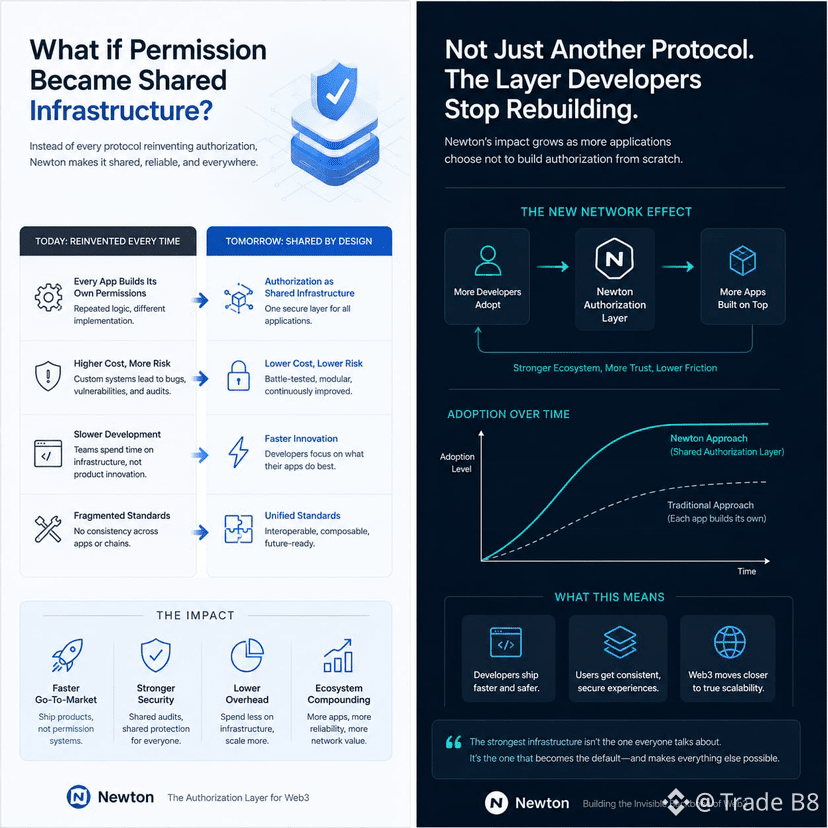
Every application has to build its own security checks, permission logic, and approval flow. The same problems get solved again and again by different teams.
It's repetitive.
It's expensive.
And every custom implementation creates another opportunity for mistakes.
Newton seems to be taking a different route.
Instead of every protocol reinventing authorization, it asks a simple question:
What if permission itself became shared infrastructure?
That idea feels more significant than any single feature.
Developers wouldn't have to constantly redesign the same trust mechanisms.
Applications could focus on what they actually do while relying on a common authorization framework underneath.
If that model gains traction, Newton's growth may not be measured by how many people hold $NEWT or open its interface.
It could be measured by how many applications quietly stop building authorization systems from scratch.
That's a very different kind of network effect.
Not one driven by users.
One driven by developers choosing not to repeat the same work.
Crypto has already standardized things like token formats and wallet connections.
Authorization could eventually follow the same path.
If that happens, Newton won't stand out because it's visible.
It will stand out because, after a while, building without it starts to feel inefficient.
That possibility feels more interesting to me than short-term market narratives.
The strongest infrastructure isn't always the one everyone talks about.
Sometimes it's the layer that slowly becomes the default way of doing things, until people forget there was ever another option.
#newt $NEWT @NewtonProtocol
couldn't shake one thought.
We usually judge crypto projects by what they make possible.
Maybe we should also judge them by what they make unnecessary.
Think about how most blockchain activity works today.
Every application has to build its own security checks, permission logic, and approval flow. The same problems get solved again and again by different teams.
It's repetitive.
It's expensive.
And every custom implementation creates another opportunity for mistakes.
Newton seems to be taking a different route.
Instead of every protocol reinventing authorization, it asks a simple question:
What if permission itself became shared infrastructure?
That idea feels more significant than any single feature.
Developers wouldn't have to constantly redesign the same trust mechanisms.
Applications could focus on what they actually do while relying on a common authorization framework underneath.
If that model gains traction, Newton's growth may not be measured by how many people hold $NEWT or open its interface.
It could be measured by how many applications quietly stop building authorization systems from scratch.
That's a very different kind of network effect.
Not one driven by users.
One driven by developers choosing not to repeat the same work.
Crypto has already standardized things like token formats and wallet connections.
Authorization could eventually follow the same path.
If that happens, Newton won't stand out because it's visible.
It will stand out because, after a while, building without it starts to feel inefficient.
That possibility feels more interesting to me than short-term market narratives.
The strongest infrastructure isn't always the one everyone talks about.
Sometimes it's the layer that slowly becomes the default way of doing things, until people forget there was ever another option.
#newt $NEWT @NewtonProtocol
We usually judge crypto projects by what they make possible.
Maybe we should also judge them by what they make unnecessary.
Think about how most blockchain activity works today.
Every application has to build its own security checks, permission logic, and approval flow. The same problems get solved again and again by different teams.
It's repetitive.
It's expensive.
And every custom implementation creates another opportunity for mistakes.
Newton seems to be taking a different route.
Instead of every protocol reinventing authorization, it asks a simple question:
What if permission itself became shared infrastructure?
That idea feels more significant than any single feature.
Developers wouldn't have to constantly redesign the same trust mechanisms.
Applications could focus on what they actually do while relying on a common authorization framework underneath.
If that model gains traction, Newton's growth may not be measured by how many people hold $NEWT or open its interface.
It could be measured by how many applications quietly stop building authorization systems from scratch.
That's a very different kind of network effect.
Not one driven by users.
One driven by developers choosing not to repeat the same work.
Crypto has already standardized things like token formats and wallet connections.
Authorization could eventually follow the same path.
If that happens, Newton won't stand out because it's visible.
It will stand out because, after a while, building without it starts to feel inefficient.
That possibility feels more interesting to me than short-term market narratives.
The strongest infrastructure isn't always the one everyone talks about.
Sometimes it's the layer that slowly becomes the default way of doing things, until people forget there was ever another option.
#newt $NEWT @NewtonProtocol
9
7
160
·
--
I keep coming back to one detail in Newton's mainnet beta launch that's easy to skip past: it didn't launch as a general-purpose product. It launched scoped to one thing — vaults, with a live reference integration on Euler across Base and Ethereum. Everything else — RWAs, stablecoins, agent commerce — is stated direction, not shipped surface area.
That's a smaller claim than most "mainnet beta" announcements make, and I think that's the point worth noticing. A policy-enforcement system that's wrong or too rigid in production doesn't fail quietly — it either blocks a transaction that should've gone through, or lets through one that shouldn't have. Starting narrow means the mistakes, if there are any, show up in a bounded place instead of across everything at once.
The part I'm actually watching isn't the announcement. It's whether "beta" here means real vaults with real capital are relying on it day to day, or whether volume stays thin while the surface area quietly expands elsewhere. Those are very different stories wearing the same headline.
#newt $NEWT @NewtonProtocol
I keep coming back to one detail in Newton's mainnet beta launch that's easy to skip past: it didn't launch as a general-purpose product. It launched scoped to one thing — vaults, with a live reference integration on Euler across Base and Ethereum. Everything else — RWAs, stablecoins, agent commerce — is stated direction, not shipped surface area.
That's a smaller claim than most "mainnet beta" announcements make, and I think that's the point worth noticing. A policy-enforcement system that's wrong or too rigid in production doesn't fail quietly — it either blocks a transaction that should've gone through, or lets through one that shouldn't have. Starting narrow means the mistakes, if there are any, show up in a bounded place instead of across everything at once.
The part I'm actually watching isn't the announcement. It's whether "beta" here means real vaults with real capital are relying on it day to day, or whether volume stays thin while the surface area quietly expands elsewhere. Those are very different stories wearing the same headline.
#newt $NEWT @NewtonProtocol
That's a smaller claim than most "mainnet beta" announcements make, and I think that's the point worth noticing. A policy-enforcement system that's wrong or too rigid in production doesn't fail quietly — it either blocks a transaction that should've gone through, or lets through one that shouldn't have. Starting narrow means the mistakes, if there are any, show up in a bounded place instead of across everything at once.
The part I'm actually watching isn't the announcement. It's whether "beta" here means real vaults with real capital are relying on it day to day, or whether volume stays thin while the surface area quietly expands elsewhere. Those are very different stories wearing the same headline.
#newt $NEWT @NewtonProtocol
1
4
81
·
--
Article
What Web3 Actually Needs From "Trusted AI" NewtonsThe Bots Weren't Broken — They Did Exactly What They Were Told: What Web3 Actually Needs From "Trusted AI"
There's a specific kind of failure that doesn't look like a failure while it's happening. In March, as a market move accelerated, monitoring systems across the industry lit up while allocation bots kept executing — buying, rebalancing, feeding capital into a position that was collapsing in real time. Nothing crashed. No code broke. Sean Li, co-founder of Magic Labs, described it plainly: the bots weren't broken, they did exactly what they were told. That sentence is worth sitting with longer than the incident itself, because it points at the actual problem Web3 has with automation, and it isn't the one most people are trying to solve.
Most "AI safety" conversation in crypto focuses on making agents smarter — better judgment, better context, fewer hallucinations. But the March episode wasn't a judgment failure. It was a permission failure. The bots had authority to keep acting inside boundaries nobody had updated for the situation actually unfolding. Better AI doesn't fix that. A different kind of infrastructure might: something that sits between an agent's decision and settlement, and checks whether the action still makes sense against a rule a human actually controls — not once at setup, but every single time.
That's the specific niche Newton occupies, and it's worth being precise about what it does and doesn't claim to do. Newton doesn't make agents smarter or safer at the model level. It enforces a policy at the transaction layer — compliance, identity, security, and risk — before a transaction settles, whether the actor initiating it is a human, a script, or an autonomous agent. The system produces a signed attestation onchain: proof a check ran and what it concluded, legible to an allocator or a regulator without exposing the underlying data. A recent addition, integration with identity provider Persona, extends this toward real-time jurisdictional compliance checks — relevant given that identity fraud losses in the tens of billions annually are part of the stated motivation, a figure that traces back to industry fraud-reporting sources rather than something independently verified here.
The honest tradeoff is that none of this prevents a badly written policy from producing the same March-style outcome — a stale rule enforced perfectly is still a stale rule. Enforcement infrastructure doesn't replace the judgment of whoever sets the boundary; it just guarantees the boundary that exists actually holds. That's a meaningfully different, narrower claim than "safe AI," and worth not conflating.
The bigger structural bet — an "Internet of Policies" where rules written for one vault or one application become discoverable and reusable elsewhere — is still mostly aspiration at this stage. Vaults are live, with a reference integration on Euler across Base and Ethereum; the stated expansion into RWAs, stablecoins, and agentic commerce is roadmap language, not shipped product, and should be read that way rather than as an existing capability.
If Web3's next phase really does depend on trusted AI infrastructure, the trust in question isn't "can the model be fooled." It's narrower and more mundane: can whoever is accountable for a policy update it fast enough to matter, and can anyone downstream actually verify that it was enforced. Everything else is a detail underneath that question.
@NewtonProtocol #Newt $NEWT
{future}(NEWTUSDT)
What Web3 Actually Needs From "Trusted AI" Newtons
The Bots Weren't Broken — They Did Exactly What They Were Told: What Web3 Actually Needs From "Trusted AI"
There's a specific kind of failure that doesn't look like a failure while it's happening. In March, as a market move accelerated, monitoring systems across the industry lit up while allocation bots kept executing — buying, rebalancing, feeding capital into a position that was collapsing in real time. Nothing crashed. No code broke. Sean Li, co-founder of Magic Labs, described it plainly: the bots weren't broken, they did exactly what they were told. That sentence is worth sitting with longer than the incident itself, because it points at the actual problem Web3 has with automation, and it isn't the one most people are trying to solve.
Most "AI safety" conversation in crypto focuses on making agents smarter — better judgment, better context, fewer hallucinations. But the March episode wasn't a judgment failure. It was a permission failure. The bots had authority to keep acting inside boundaries nobody had updated for the situation actually unfolding. Better AI doesn't fix that. A different kind of infrastructure might: something that sits between an agent's decision and settlement, and checks whether the action still makes sense against a rule a human actually controls — not once at setup, but every single time.
That's the specific niche Newton occupies, and it's worth being precise about what it does and doesn't claim to do. Newton doesn't make agents smarter or safer at the model level. It enforces a policy at the transaction layer — compliance, identity, security, and risk — before a transaction settles, whether the actor initiating it is a human, a script, or an autonomous agent. The system produces a signed attestation onchain: proof a check ran and what it concluded, legible to an allocator or a regulator without exposing the underlying data. A recent addition, integration with identity provider Persona, extends this toward real-time jurisdictional compliance checks — relevant given that identity fraud losses in the tens of billions annually are part of the stated motivation, a figure that traces back to industry fraud-reporting sources rather than something independently verified here.
The honest tradeoff is that none of this prevents a badly written policy from producing the same March-style outcome — a stale rule enforced perfectly is still a stale rule. Enforcement infrastructure doesn't replace the judgment of whoever sets the boundary; it just guarantees the boundary that exists actually holds. That's a meaningfully different, narrower claim than "safe AI," and worth not conflating.
The bigger structural bet — an "Internet of Policies" where rules written for one vault or one application become discoverable and reusable elsewhere — is still mostly aspiration at this stage. Vaults are live, with a reference integration on Euler across Base and Ethereum; the stated expansion into RWAs, stablecoins, and agentic commerce is roadmap language, not shipped product, and should be read that way rather than as an existing capability.
If Web3's next phase really does depend on trusted AI infrastructure, the trust in question isn't "can the model be fooled." It's narrower and more mundane: can whoever is accountable for a policy update it fast enough to matter, and can anyone downstream actually verify that it was enforced. Everything else is a detail underneath that question.
@NewtonProtocol #Newt $NEWT
There's a specific kind of failure that doesn't look like a failure while it's happening. In March, as a market move accelerated, monitoring systems across the industry lit up while allocation bots kept executing — buying, rebalancing, feeding capital into a position that was collapsing in real time. Nothing crashed. No code broke. Sean Li, co-founder of Magic Labs, described it plainly: the bots weren't broken, they did exactly what they were told. That sentence is worth sitting with longer than the incident itself, because it points at the actual problem Web3 has with automation, and it isn't the one most people are trying to solve.
Most "AI safety" conversation in crypto focuses on making agents smarter — better judgment, better context, fewer hallucinations. But the March episode wasn't a judgment failure. It was a permission failure. The bots had authority to keep acting inside boundaries nobody had updated for the situation actually unfolding. Better AI doesn't fix that. A different kind of infrastructure might: something that sits between an agent's decision and settlement, and checks whether the action still makes sense against a rule a human actually controls — not once at setup, but every single time.
That's the specific niche Newton occupies, and it's worth being precise about what it does and doesn't claim to do. Newton doesn't make agents smarter or safer at the model level. It enforces a policy at the transaction layer — compliance, identity, security, and risk — before a transaction settles, whether the actor initiating it is a human, a script, or an autonomous agent. The system produces a signed attestation onchain: proof a check ran and what it concluded, legible to an allocator or a regulator without exposing the underlying data. A recent addition, integration with identity provider Persona, extends this toward real-time jurisdictional compliance checks — relevant given that identity fraud losses in the tens of billions annually are part of the stated motivation, a figure that traces back to industry fraud-reporting sources rather than something independently verified here.
The honest tradeoff is that none of this prevents a badly written policy from producing the same March-style outcome — a stale rule enforced perfectly is still a stale rule. Enforcement infrastructure doesn't replace the judgment of whoever sets the boundary; it just guarantees the boundary that exists actually holds. That's a meaningfully different, narrower claim than "safe AI," and worth not conflating.
The bigger structural bet — an "Internet of Policies" where rules written for one vault or one application become discoverable and reusable elsewhere — is still mostly aspiration at this stage. Vaults are live, with a reference integration on Euler across Base and Ethereum; the stated expansion into RWAs, stablecoins, and agentic commerce is roadmap language, not shipped product, and should be read that way rather than as an existing capability.
If Web3's next phase really does depend on trusted AI infrastructure, the trust in question isn't "can the model be fooled." It's narrower and more mundane: can whoever is accountable for a policy update it fast enough to matter, and can anyone downstream actually verify that it was enforced. Everything else is a detail underneath that question.
@NewtonProtocol #Newt $NEWT
1
4
92
·
--
#BinanceTurns9 Nine years of Binance, and this anniversary event actually made me want to participate instead of just scrolling past it. It's built around completing landmarks rather than a straight giveaway — feels more like an event than a promo. If you haven't joined yet, it's live until July 24:
cf-workers-proxy-cyt.pages.dev/en/activity/anniversary
#BinanceTurns9
#BinanceTurns9 Nine years of Binance, and this anniversary event actually made me want to participate instead of just scrolling past it. It's built around completing landmarks rather than a straight giveaway — feels more like an event than a promo. If you haven't joined yet, it's live until July 24:
cf-workers-proxy-cyt.pages.dev/en/activity/anniversary
#BinanceTurns9
cf-workers-proxy-cyt.pages.dev/en/activity/anniversary
#BinanceTurns9
9
0%
7
0%
0 votes • Voting closed
11
5
65
·
--
I was watching a few of the @NewtonProtocol AI agent threads early on and assumed the missing piece was capability — better reasoning, longer context, more tools an agent could reach for. That's what most of the roadmap talk was about.
Then I noticed something smaller. The agents that actually got trusted with money weren't the most capable ones. They were the ones with the tightest leash — a spending cap here, an approved list there, something a person could point to and say "it can't go past this." Capability wasn't the bottleneck. Permission was.
#Newt
That reframes what Newton is actually doing. It's not making agents smarter. It's making the boundary around an agent something the chain checks, not something you hope the agent remembers. The transaction either fits the policy or it doesn't, regardless of how the agent got there.
The open question is whether that boundary gets treated as a feature people actually configure, or a checkbox nobody touches after setup. A spending cap set once and forgotten isn't much different from no cap at all — the enforcement is real, but the judgment behind it still has to stay current.
What I'm watching now isn't whether more agents get built. It's whether the permissions attached to them get maintained as carefully as the agents themselves, or whether "trust" quietly becomes another default nobody revisits.
#newt $NEWT $LDO
{future}(LDOUSDT)
$AGLD
{future}(AGLDUSDT)
I was watching a few of the @NewtonProtocol AI agent threads early on and assumed the missing piece was capability — better reasoning, longer context, more tools an agent could reach for. That's what most of the roadmap talk was about.
Then I noticed something smaller. The agents that actually got trusted with money weren't the most capable ones. They were the ones with the tightest leash — a spending cap here, an approved list there, something a person could point to and say "it can't go past this." Capability wasn't the bottleneck. Permission was.
#Newt
That reframes what Newton is actually doing. It's not making agents smarter. It's making the boundary around an agent something the chain checks, not something you hope the agent remembers. The transaction either fits the policy or it doesn't, regardless of how the agent got there.
The open question is whether that boundary gets treated as a feature people actually configure, or a checkbox nobody touches after setup. A spending cap set once and forgotten isn't much different from no cap at all — the enforcement is real, but the judgment behind it still has to stay current.
What I'm watching now isn't whether more agents get built. It's whether the permissions attached to them get maintained as carefully as the agents themselves, or whether "trust" quietly becomes another default nobody revisits.
#newt $NEWT $LDO
$AGLD
Then I noticed something smaller. The agents that actually got trusted with money weren't the most capable ones. They were the ones with the tightest leash — a spending cap here, an approved list there, something a person could point to and say "it can't go past this." Capability wasn't the bottleneck. Permission was.
#Newt
That reframes what Newton is actually doing. It's not making agents smarter. It's making the boundary around an agent something the chain checks, not something you hope the agent remembers. The transaction either fits the policy or it doesn't, regardless of how the agent got there.
The open question is whether that boundary gets treated as a feature people actually configure, or a checkbox nobody touches after setup. A spending cap set once and forgotten isn't much different from no cap at all — the enforcement is real, but the judgment behind it still has to stay current.
What I'm watching now isn't whether more agents get built. It's whether the permissions attached to them get maintained as carefully as the agents themselves, or whether "trust" quietly becomes another default nobody revisits.
#newt $NEWT $LDO
$AGLD
Buy
0%
Sell
0%
0 votes • Voting closed
8
7
175
·
--
The Trust Layer AI Has Been Missing - Inside Newton ProtocolAI agents that can spend money are no longer a thought experiment. They exist today, in limited but real forms — trading bots that rebalance positions, agents that harvest yield, systems that execute recurring payments without a human clicking "confirm" each time. The technology to let software move funds autonomously has arrived faster than the infrastructure to answer a much older question: how do you know an agent will only do what it was actually authorized to do?
That question is what @NewtonProtocol Newton Protocol is built around. Understanding it requires starting with the problem it's trying to solve, not the feature list.
The gap nobody built for
Traditional crypto wallets were designed for a human clicking "approve." Smart contract wallets improved this with session keys and spending limits, but those tend to be blunt instruments — an agent either has permission to act within a broad boundary or it doesn't. There's rarely a layer that evaluates each individual action against a nuanced, updatable policy before it settles.
#Newt That gap matters more as agents get more capable. An agent reading external content — a webpage, an API response, a document — can be manipulated by instructions embedded in that content, a failure mode generally called prompt injection. Model-level defenses try to make the agent resistant to this kind of manipulation. But no defense is perfect, and once an agent controls real funds, "mostly resistant" isn't a great security posture. Something needs to sit between the agent's decision and the blockchain and ask: does this specific action fall inside the boundaries a human actually set, regardless of what convinced the agent to attempt it?
What Newton actually checks
Newton positions itself as an authorization layer — it evaluates a transaction against an active policy before that transaction executes, and returns a signed attestation onchain recording that the check happened and what the result was. For AI agents specifically, the documented enforcement categories include spending caps, approved payee lists, mandate enforcement, and prompt-injection defense.#Newt
That last category is worth sitting with, because it reframes the problem usefully. Instead of trying to make the agent immune to manipulation, the policy operates one layer downstream: even a successfully manipulated agent that tries to send funds somewhere it shouldn't gets blocked at the transaction check, because the destination or amount falls outside the approved policy. The defense doesn't depend on the agent behaving correctly — it depends on the policy being correctly scoped.
It's worth separating this from a related but distinct feature: Newton's Human Passport Data Oracle, built with Human.tech, which checks whether a counterparty wallet represents a real, verified person rather than a bot. That solves a different problem — screening who's on the other end of a transaction — and it's easy to lump both features under a vague "AI safety" umbrella. One protects an agent from being manipulated into a bad action; the other protects a system from bot-driven abuse. They're complementary, not the same mechanism.
Technically, @NewtonProtocol Newton runs as a decentralized Actively Validated Service on EigenLayer, with operators evaluating transactions against policies written in Rego, a declarative policy language, pulling in data from partners like RedStone, Credora, and Chainalysis/Hexagate depending on the use case. It's worth noting that Newton's earlier technical documentation described a different architecture — a hybrid of trusted execution environments and zero-knowledge proofs, with a dedicated "keystore" rollup managing permissions. Both descriptions appear in public material, and it isn't fully clear from available sources how they reconcile, or whether the project's public framing shifted as it moved from concept to production. That's a detail worth asking about directly rather than assuming away, because TEE-based security and restaking-based economic security rest on materially different trust assumptions.
#Newt Who's building it, and how early this is
Newton's core development comes from Magic Labs, known for embedded wallet infrastructure — reportedly used across tens of millions of wallets and hundreds of thousands of developer integrations, including powering wallet infrastructure for Polymarket. That's a meaningful technical pedigree in the wallet space specifically, which is relevant given how much of Newton's value proposition depends on integrating cleanly at the wallet and smart-account layer.
Adoption claims for Newton itself, including figures around early signups and agent transaction volume in its first weeks, come from company statements or third-party summaries of those statements rather than independently audited data. They're worth noting as context, not treating as verified fact. The vault-focused product line, VaultKit, has a live reference integration with Euler on Base and Ethereum — real, but still early and narrow in scope relative to the broader vision of covering RWAs, stablecoins, and agent commerce.
Governance, tokenomics, and what's still unsettled
NEWT has a fixed supply of one billion tokens, used for staking, transaction fees, and governance. Governance itself is split: parameter-level changes go through token voting, while core protocol changes require validator coordination through a hard-fork process, similar to how Ethereum handles consensus-level upgrades — meaning token holders alone can't unilaterally change the deepest parts of the system. The validator set is still transitioning from foundation control toward broader decentralization, a process that isn't complete. A significant token unlock in early 2026 is also part of the project's near-term history worth being aware of if evaluating supply dynamics.
What to actually check before trusting the "trust layer"
A policy-enforcement claim is only as strong as three things: who can rewrite the policy and how visible that change is onchain, how diversified the data feeds behind the policy are (a single point of failure in an oracle undermines the whole check), and whether an attestation is independently verifiable rather than something you have to take on faith from the operator network. The label "AI agent protection" also isn't self-explanatory — it's worth asking whether a given integration supports something as specific as prompt-injection-aware policies, or just generic spending caps rebranded with newer language.$NEWT
None of this settles whether Newton succeeds. It settles what questions are worth asking while watching it try.
{future}(NEWTUSDT)
The Trust Layer AI Has Been Missing - Inside Newton Protocol
AI agents that can spend money are no longer a thought experiment. They exist today, in limited but real forms — trading bots that rebalance positions, agents that harvest yield, systems that execute recurring payments without a human clicking "confirm" each time. The technology to let software move funds autonomously has arrived faster than the infrastructure to answer a much older question: how do you know an agent will only do what it was actually authorized to do?
That question is what @NewtonProtocol Newton Protocol is built around. Understanding it requires starting with the problem it's trying to solve, not the feature list.
The gap nobody built for
Traditional crypto wallets were designed for a human clicking "approve." Smart contract wallets improved this with session keys and spending limits, but those tend to be blunt instruments — an agent either has permission to act within a broad boundary or it doesn't. There's rarely a layer that evaluates each individual action against a nuanced, updatable policy before it settles.
#Newt That gap matters more as agents get more capable. An agent reading external content — a webpage, an API response, a document — can be manipulated by instructions embedded in that content, a failure mode generally called prompt injection. Model-level defenses try to make the agent resistant to this kind of manipulation. But no defense is perfect, and once an agent controls real funds, "mostly resistant" isn't a great security posture. Something needs to sit between the agent's decision and the blockchain and ask: does this specific action fall inside the boundaries a human actually set, regardless of what convinced the agent to attempt it?
What Newton actually checks
Newton positions itself as an authorization layer — it evaluates a transaction against an active policy before that transaction executes, and returns a signed attestation onchain recording that the check happened and what the result was. For AI agents specifically, the documented enforcement categories include spending caps, approved payee lists, mandate enforcement, and prompt-injection defense.#Newt
That last category is worth sitting with, because it reframes the problem usefully. Instead of trying to make the agent immune to manipulation, the policy operates one layer downstream: even a successfully manipulated agent that tries to send funds somewhere it shouldn't gets blocked at the transaction check, because the destination or amount falls outside the approved policy. The defense doesn't depend on the agent behaving correctly — it depends on the policy being correctly scoped.
It's worth separating this from a related but distinct feature: Newton's Human Passport Data Oracle, built with Human.tech, which checks whether a counterparty wallet represents a real, verified person rather than a bot. That solves a different problem — screening who's on the other end of a transaction — and it's easy to lump both features under a vague "AI safety" umbrella. One protects an agent from being manipulated into a bad action; the other protects a system from bot-driven abuse. They're complementary, not the same mechanism.
Technically, @NewtonProtocol Newton runs as a decentralized Actively Validated Service on EigenLayer, with operators evaluating transactions against policies written in Rego, a declarative policy language, pulling in data from partners like RedStone, Credora, and Chainalysis/Hexagate depending on the use case. It's worth noting that Newton's earlier technical documentation described a different architecture — a hybrid of trusted execution environments and zero-knowledge proofs, with a dedicated "keystore" rollup managing permissions. Both descriptions appear in public material, and it isn't fully clear from available sources how they reconcile, or whether the project's public framing shifted as it moved from concept to production. That's a detail worth asking about directly rather than assuming away, because TEE-based security and restaking-based economic security rest on materially different trust assumptions.
#Newt Who's building it, and how early this is
Newton's core development comes from Magic Labs, known for embedded wallet infrastructure — reportedly used across tens of millions of wallets and hundreds of thousands of developer integrations, including powering wallet infrastructure for Polymarket. That's a meaningful technical pedigree in the wallet space specifically, which is relevant given how much of Newton's value proposition depends on integrating cleanly at the wallet and smart-account layer.
Adoption claims for Newton itself, including figures around early signups and agent transaction volume in its first weeks, come from company statements or third-party summaries of those statements rather than independently audited data. They're worth noting as context, not treating as verified fact. The vault-focused product line, VaultKit, has a live reference integration with Euler on Base and Ethereum — real, but still early and narrow in scope relative to the broader vision of covering RWAs, stablecoins, and agent commerce.
Governance, tokenomics, and what's still unsettled
NEWT has a fixed supply of one billion tokens, used for staking, transaction fees, and governance. Governance itself is split: parameter-level changes go through token voting, while core protocol changes require validator coordination through a hard-fork process, similar to how Ethereum handles consensus-level upgrades — meaning token holders alone can't unilaterally change the deepest parts of the system. The validator set is still transitioning from foundation control toward broader decentralization, a process that isn't complete. A significant token unlock in early 2026 is also part of the project's near-term history worth being aware of if evaluating supply dynamics.
What to actually check before trusting the "trust layer"
A policy-enforcement claim is only as strong as three things: who can rewrite the policy and how visible that change is onchain, how diversified the data feeds behind the policy are (a single point of failure in an oracle undermines the whole check), and whether an attestation is independently verifiable rather than something you have to take on faith from the operator network. The label "AI agent protection" also isn't self-explanatory — it's worth asking whether a given integration supports something as specific as prompt-injection-aware policies, or just generic spending caps rebranded with newer language.$NEWT
None of this settles whether Newton succeeds. It settles what questions are worth asking while watching it try.
That question is what @NewtonProtocol Newton Protocol is built around. Understanding it requires starting with the problem it's trying to solve, not the feature list.
The gap nobody built for
Traditional crypto wallets were designed for a human clicking "approve." Smart contract wallets improved this with session keys and spending limits, but those tend to be blunt instruments — an agent either has permission to act within a broad boundary or it doesn't. There's rarely a layer that evaluates each individual action against a nuanced, updatable policy before it settles.
#Newt That gap matters more as agents get more capable. An agent reading external content — a webpage, an API response, a document — can be manipulated by instructions embedded in that content, a failure mode generally called prompt injection. Model-level defenses try to make the agent resistant to this kind of manipulation. But no defense is perfect, and once an agent controls real funds, "mostly resistant" isn't a great security posture. Something needs to sit between the agent's decision and the blockchain and ask: does this specific action fall inside the boundaries a human actually set, regardless of what convinced the agent to attempt it?
What Newton actually checks
Newton positions itself as an authorization layer — it evaluates a transaction against an active policy before that transaction executes, and returns a signed attestation onchain recording that the check happened and what the result was. For AI agents specifically, the documented enforcement categories include spending caps, approved payee lists, mandate enforcement, and prompt-injection defense.#Newt
That last category is worth sitting with, because it reframes the problem usefully. Instead of trying to make the agent immune to manipulation, the policy operates one layer downstream: even a successfully manipulated agent that tries to send funds somewhere it shouldn't gets blocked at the transaction check, because the destination or amount falls outside the approved policy. The defense doesn't depend on the agent behaving correctly — it depends on the policy being correctly scoped.
It's worth separating this from a related but distinct feature: Newton's Human Passport Data Oracle, built with Human.tech, which checks whether a counterparty wallet represents a real, verified person rather than a bot. That solves a different problem — screening who's on the other end of a transaction — and it's easy to lump both features under a vague "AI safety" umbrella. One protects an agent from being manipulated into a bad action; the other protects a system from bot-driven abuse. They're complementary, not the same mechanism.
Technically, @NewtonProtocol Newton runs as a decentralized Actively Validated Service on EigenLayer, with operators evaluating transactions against policies written in Rego, a declarative policy language, pulling in data from partners like RedStone, Credora, and Chainalysis/Hexagate depending on the use case. It's worth noting that Newton's earlier technical documentation described a different architecture — a hybrid of trusted execution environments and zero-knowledge proofs, with a dedicated "keystore" rollup managing permissions. Both descriptions appear in public material, and it isn't fully clear from available sources how they reconcile, or whether the project's public framing shifted as it moved from concept to production. That's a detail worth asking about directly rather than assuming away, because TEE-based security and restaking-based economic security rest on materially different trust assumptions.
#Newt Who's building it, and how early this is
Newton's core development comes from Magic Labs, known for embedded wallet infrastructure — reportedly used across tens of millions of wallets and hundreds of thousands of developer integrations, including powering wallet infrastructure for Polymarket. That's a meaningful technical pedigree in the wallet space specifically, which is relevant given how much of Newton's value proposition depends on integrating cleanly at the wallet and smart-account layer.
Adoption claims for Newton itself, including figures around early signups and agent transaction volume in its first weeks, come from company statements or third-party summaries of those statements rather than independently audited data. They're worth noting as context, not treating as verified fact. The vault-focused product line, VaultKit, has a live reference integration with Euler on Base and Ethereum — real, but still early and narrow in scope relative to the broader vision of covering RWAs, stablecoins, and agent commerce.
Governance, tokenomics, and what's still unsettled
NEWT has a fixed supply of one billion tokens, used for staking, transaction fees, and governance. Governance itself is split: parameter-level changes go through token voting, while core protocol changes require validator coordination through a hard-fork process, similar to how Ethereum handles consensus-level upgrades — meaning token holders alone can't unilaterally change the deepest parts of the system. The validator set is still transitioning from foundation control toward broader decentralization, a process that isn't complete. A significant token unlock in early 2026 is also part of the project's near-term history worth being aware of if evaluating supply dynamics.
What to actually check before trusting the "trust layer"
A policy-enforcement claim is only as strong as three things: who can rewrite the policy and how visible that change is onchain, how diversified the data feeds behind the policy are (a single point of failure in an oracle undermines the whole check), and whether an attestation is independently verifiable rather than something you have to take on faith from the operator network. The label "AI agent protection" also isn't self-explanatory — it's worth asking whether a given integration supports something as specific as prompt-injection-aware policies, or just generic spending caps rebranded with newer language.$NEWT
None of this settles whether Newton succeeds. It settles what questions are worth asking while watching it try.
19
12
222
Log in to explore more content
Join global crypto users on Binance Square
⚡️ Get latest and useful information about crypto.
💬 Trusted by the world’s largest crypto exchange.
👍 Discover real insights from verified creators.
Email / Phone number
Trending Topics
BNBSurpasses$790
16,332 views
137 Discussing
$BNB strategic long plan -> FOCUS NOW
BNB has created 2 strong lows after taking out internal liquidity
I'm expecting a move towards swing high $815-$830 and looking for a long on a retest of the green box
#BNBSurpasses$790 #bnb
Ghost Writer
·6 Likes
·8k views
ZamaRises15.99%ToIntradayHigh$0.09
13,767 views
104 Discussing
BitcoinSpotETFsDraw$6.34BInflowsInQ3
5,448 views
88 Discussing