
#netusdt
netusdt
507 views
16 Discussing
Hot
Latest

🥔 A solid foundation has been established, ready to serve as the launchpad for a historic price leap.
🆙 LONG $NET
Entry: 314.49
TP: 330.214 | SL: 283.041
💎 Every quality project is a rough diamond that needs time to be cut.
📉 The supply pressure hanging overhead has been dealt with through a damping phase.
💎 Respect your time, because it is the most valuable resource on the floor.
💎 Wishing you become an investor with great influence in the community.
#NETUSDT $NETUSDT
🥔 A solid foundation has been established, ready to serve as the launchpad for a historic price leap.
🆙 LONG $NET
Entry: 314.49
TP: 330.214 | SL: 283.041
💎 Every quality project is a rough diamond that needs time to be cut.
📉 The supply pressure hanging overhead has been dealt with through a damping phase.
💎 Respect your time, because it is the most valuable resource on the floor.
💎 Wishing you become an investor with great influence in the community.
#NETUSDT $NETUSDT
🆙 LONG $NET
Entry: 314.49
TP: 330.214 | SL: 283.041
💎 Every quality project is a rough diamond that needs time to be cut.
📉 The supply pressure hanging overhead has been dealt with through a damping phase.
💎 Respect your time, because it is the most valuable resource on the floor.
💎 Wishing you become an investor with great influence in the community.
#NETUSDT $NETUSDT
36
🍠 The potential projects hidden deep beneath the surface, promising to burst brilliantly and bring great rewards in the future.
🏹 LONG $NET
Entry: 312.11
TP: 327.715 | SL: 280.899
🧬 Blockchain transparency is the new standard for every industry in the economy.
📊 The Chande Momentum Oscillator indicator shows that buying power is on the rise.
🧠 Train your critical thinking so you won’t be swept up by noisy crowds.
🌸 I hope you’ll always be the best version of yourself every trading day on the floor.
#NETUSDT $NETUSDT
🍠 The potential projects hidden deep beneath the surface, promising to burst brilliantly and bring great rewards in the future.
🏹 LONG $NET
Entry: 312.11
TP: 327.715 | SL: 280.899
🧬 Blockchain transparency is the new standard for every industry in the economy.
📊 The Chande Momentum Oscillator indicator shows that buying power is on the rise.
🧠 Train your critical thinking so you won’t be swept up by noisy crowds.
🌸 I hope you’ll always be the best version of yourself every trading day on the floor.
#NETUSDT $NETUSDT
🏹 LONG $NET
Entry: 312.11
TP: 327.715 | SL: 280.899
🧬 Blockchain transparency is the new standard for every industry in the economy.
📊 The Chande Momentum Oscillator indicator shows that buying power is on the rise.
🧠 Train your critical thinking so you won’t be swept up by noisy crowds.
🌸 I hope you’ll always be the best version of yourself every trading day on the floor.
#NETUSDT $NETUSDT
55

·
--
$NET USDT UPDATE: Pre-Market — trading opens in ~4h 17m. No current signal yet; wait for price discovery and volume after launch. #NETUSDT #BinanceSquare
$NET USDT UPDATE: Pre-Market — trading opens in ~4h 17m. No current signal yet; wait for price discovery and volume after launch. #NETUSDT #BinanceSquare
201

·
--
The old dog scanned the order book. In the past 24 hours, $NET surged 6.599%, but what really caught my attention is that its funding rate has been steady at 0.00%. At this price level, on the semiconductor AI track, it’s a bit eye-catching.
To put it bluntly, a 6.6% daily jump isn’t a small move in any US stock–mapped futures contract. But $NET is a little special: it falls under “Other” rather than being listed directly under the semiconductor or AI sector. This makes me want to dig deeper— is the market actually trading it for its legacy cloud business, or are they treating it as a new AI infrastructure leader? Unfortunately, in the data this time, comparable secondary tickers in the semiconductor space (like MU, NVDA, etc.) are completely missing, so I can’t do a direct side-by-side comparison. Just looking at $NET itself: it’s up, but the funding rate is zero. That implies neither longs nor shorts are paying each other right now—both sides lack a cost advantage, and the market’s one-sided speculation sentiment hasn’t been stoked.
With the funding rate at zero, combined with the open interest of 2047.85, I judge that the market has not yet formed an especially crowded consensus at this position. It’s rising, but not to the point where shorts would need to get liquidated and pay up; positions are there, but the size isn’t big enough to suggest huge money is making a bet. In this kind of state, either the market is in the early probing phase, or it’s a rebound lacking sustained momentum. I lean toward the first scenario being more likely, because price rising on volume is built with real money—at the very least, it shows buy-side demand is actively absorbing. Still, this is only a single signal judgment; without cross-validation from funding flows across the same sector, the confidence should be discounted.
So the old dog’s take is: I choose to wait, not chase. With this current zero-fee setup and moderate open interest, it suggests the fuel for the rally hasn’t truly been ignited yet. Either wait for it to break above today’s high on expanding volume, and simultaneously watch whether the funding rate starts turning positive to confirm longs are gaining strength; or wait for a pullback and see whether the funding rate turns negative during the drop—that would be a more comfortable left-side entry. For now, the action is observation, and keep positioning light.
Where am I most likely to be wrong in this thesis?
Trading tag: #BinanceFutures #TradFi #USDⓈM #NET #NETUSDT $NET
The old dog scanned the order book. In the past 24 hours, $NET surged 6.599%, but what really caught my attention is that its funding rate has been steady at 0.00%. At this price level, on the semiconductor AI track, it’s a bit eye-catching.
To put it bluntly, a 6.6% daily jump isn’t a small move in any US stock–mapped futures contract. But $NET is a little special: it falls under “Other” rather than being listed directly under the semiconductor or AI sector. This makes me want to dig deeper— is the market actually trading it for its legacy cloud business, or are they treating it as a new AI infrastructure leader? Unfortunately, in the data this time, comparable secondary tickers in the semiconductor space (like MU, NVDA, etc.) are completely missing, so I can’t do a direct side-by-side comparison. Just looking at $NET itself: it’s up, but the funding rate is zero. That implies neither longs nor shorts are paying each other right now—both sides lack a cost advantage, and the market’s one-sided speculation sentiment hasn’t been stoked.
With the funding rate at zero, combined with the open interest of 2047.85, I judge that the market has not yet formed an especially crowded consensus at this position. It’s rising, but not to the point where shorts would need to get liquidated and pay up; positions are there, but the size isn’t big enough to suggest huge money is making a bet. In this kind of state, either the market is in the early probing phase, or it’s a rebound lacking sustained momentum. I lean toward the first scenario being more likely, because price rising on volume is built with real money—at the very least, it shows buy-side demand is actively absorbing. Still, this is only a single signal judgment; without cross-validation from funding flows across the same sector, the confidence should be discounted.
So the old dog’s take is: I choose to wait, not chase. With this current zero-fee setup and moderate open interest, it suggests the fuel for the rally hasn’t truly been ignited yet. Either wait for it to break above today’s high on expanding volume, and simultaneously watch whether the funding rate starts turning positive to confirm longs are gaining strength; or wait for a pullback and see whether the funding rate turns negative during the drop—that would be a more comfortable left-side entry. For now, the action is observation, and keep positioning light.
Where am I most likely to be wrong in this thesis?
Trading tag: #BinanceFutures #TradFi #USDⓈM #NET #NETUSDT $NET
To put it bluntly, a 6.6% daily jump isn’t a small move in any US stock–mapped futures contract. But $NET is a little special: it falls under “Other” rather than being listed directly under the semiconductor or AI sector. This makes me want to dig deeper— is the market actually trading it for its legacy cloud business, or are they treating it as a new AI infrastructure leader? Unfortunately, in the data this time, comparable secondary tickers in the semiconductor space (like MU, NVDA, etc.) are completely missing, so I can’t do a direct side-by-side comparison. Just looking at $NET itself: it’s up, but the funding rate is zero. That implies neither longs nor shorts are paying each other right now—both sides lack a cost advantage, and the market’s one-sided speculation sentiment hasn’t been stoked.
With the funding rate at zero, combined with the open interest of 2047.85, I judge that the market has not yet formed an especially crowded consensus at this position. It’s rising, but not to the point where shorts would need to get liquidated and pay up; positions are there, but the size isn’t big enough to suggest huge money is making a bet. In this kind of state, either the market is in the early probing phase, or it’s a rebound lacking sustained momentum. I lean toward the first scenario being more likely, because price rising on volume is built with real money—at the very least, it shows buy-side demand is actively absorbing. Still, this is only a single signal judgment; without cross-validation from funding flows across the same sector, the confidence should be discounted.
So the old dog’s take is: I choose to wait, not chase. With this current zero-fee setup and moderate open interest, it suggests the fuel for the rally hasn’t truly been ignited yet. Either wait for it to break above today’s high on expanding volume, and simultaneously watch whether the funding rate starts turning positive to confirm longs are gaining strength; or wait for a pullback and see whether the funding rate turns negative during the drop—that would be a more comfortable left-side entry. For now, the action is observation, and keep positioning light.
Where am I most likely to be wrong in this thesis?
Trading tag: #BinanceFutures #TradFi #USDⓈM #NET #NETUSDT $NET
29
·
--
An old dog glanced at the order book; over the past 24 hours, $NET surged 8.477%. The quote is 330.55. As the price moves upward, the盘口 (order book) is getting a bit “hot.” The associated funding rate has reached 0.00085874—this is positive, which means that during funding settlement, long positions are paying shorts. If the funding rate is greater than zero, then long-side crowding is written into the rules.
This is the first real observation on the $NET chain (NETUSDT). Zoom out to the connection between Crypto and TradFi: this funding-rate structure is closely tied to the volatility rhythm of its U.S.-listed common stock counterpart. The price has risen nearly 8.5% in a single day, with open interest around 2,044.67 contracts, and the reported trading volume is just over 1.23 million. Plainly put, price gains paired with positive funding means the long positions driving this pump are currently absorbing extra capital costs. This isn’t cheap—it suggests that in the short-term long-vs-short battle, the force behind going long is actively using money to cast its vote, but it also puts itself in a position that’s vulnerable to being squeezed in the opposite direction.
My judgment is based on these two signals: as the price breaks upward, the funding rate is also significantly positive. This combination points to longs becoming crowded during the optimistic rally, and whether the buy orders remain sustainable depends on if capital keeps pouring in while maintaining that positive funding. The strongest counter-evidence is simple: if the price can ignore the funding rate and keep making new highs, it would force more shorts to liquidate/stop out, causing the funding rate to climb further and potentially trigger a second wave driven by short stop-outs. But the old dog’s experience is that rallies propped up by net longs paying for it—once the buying fails to persist—often retrace more sharply than what the technical picture alone would suggest.
The second-order impact is already planted. If the $NET price stalls here or pulls back, those long positions established at high funding will face closing pressure due to ongoing payments and the reversal of floating profit. After this liquidity drains away, market depth and support will thin out, making it easier for shorts to find opportunities to retaliate. As for who benefits—obviously, the longs who entered early and the shorts who already have take-profit/close orders placed; and who bears the cost is the crowded long side that’s currently paying.
In terms of action, the old dog is choosing to stand by. I’m not following this rally that comes with a positive funding rate, because the cost-benefit isn’t good enough.
Trading tag: #BinanceFutures #TradFi #USDⓈM #NET #NETUSDT $NET
An old dog glanced at the order book; over the past 24 hours, $NET surged 8.477%. The quote is 330.55. As the price moves upward, the盘口 (order book) is getting a bit “hot.” The associated funding rate has reached 0.00085874—this is positive, which means that during funding settlement, long positions are paying shorts. If the funding rate is greater than zero, then long-side crowding is written into the rules.
This is the first real observation on the $NET chain (NETUSDT). Zoom out to the connection between Crypto and TradFi: this funding-rate structure is closely tied to the volatility rhythm of its U.S.-listed common stock counterpart. The price has risen nearly 8.5% in a single day, with open interest around 2,044.67 contracts, and the reported trading volume is just over 1.23 million. Plainly put, price gains paired with positive funding means the long positions driving this pump are currently absorbing extra capital costs. This isn’t cheap—it suggests that in the short-term long-vs-short battle, the force behind going long is actively using money to cast its vote, but it also puts itself in a position that’s vulnerable to being squeezed in the opposite direction.
My judgment is based on these two signals: as the price breaks upward, the funding rate is also significantly positive. This combination points to longs becoming crowded during the optimistic rally, and whether the buy orders remain sustainable depends on if capital keeps pouring in while maintaining that positive funding. The strongest counter-evidence is simple: if the price can ignore the funding rate and keep making new highs, it would force more shorts to liquidate/stop out, causing the funding rate to climb further and potentially trigger a second wave driven by short stop-outs. But the old dog’s experience is that rallies propped up by net longs paying for it—once the buying fails to persist—often retrace more sharply than what the technical picture alone would suggest.
The second-order impact is already planted. If the $NET price stalls here or pulls back, those long positions established at high funding will face closing pressure due to ongoing payments and the reversal of floating profit. After this liquidity drains away, market depth and support will thin out, making it easier for shorts to find opportunities to retaliate. As for who benefits—obviously, the longs who entered early and the shorts who already have take-profit/close orders placed; and who bears the cost is the crowded long side that’s currently paying.
In terms of action, the old dog is choosing to stand by. I’m not following this rally that comes with a positive funding rate, because the cost-benefit isn’t good enough.
Trading tag: #BinanceFutures #TradFi #USDⓈM #NET #NETUSDT $NET
This is the first real observation on the $NET chain (NETUSDT). Zoom out to the connection between Crypto and TradFi: this funding-rate structure is closely tied to the volatility rhythm of its U.S.-listed common stock counterpart. The price has risen nearly 8.5% in a single day, with open interest around 2,044.67 contracts, and the reported trading volume is just over 1.23 million. Plainly put, price gains paired with positive funding means the long positions driving this pump are currently absorbing extra capital costs. This isn’t cheap—it suggests that in the short-term long-vs-short battle, the force behind going long is actively using money to cast its vote, but it also puts itself in a position that’s vulnerable to being squeezed in the opposite direction.
My judgment is based on these two signals: as the price breaks upward, the funding rate is also significantly positive. This combination points to longs becoming crowded during the optimistic rally, and whether the buy orders remain sustainable depends on if capital keeps pouring in while maintaining that positive funding. The strongest counter-evidence is simple: if the price can ignore the funding rate and keep making new highs, it would force more shorts to liquidate/stop out, causing the funding rate to climb further and potentially trigger a second wave driven by short stop-outs. But the old dog’s experience is that rallies propped up by net longs paying for it—once the buying fails to persist—often retrace more sharply than what the technical picture alone would suggest.
The second-order impact is already planted. If the $NET price stalls here or pulls back, those long positions established at high funding will face closing pressure due to ongoing payments and the reversal of floating profit. After this liquidity drains away, market depth and support will thin out, making it easier for shorts to find opportunities to retaliate. As for who benefits—obviously, the longs who entered early and the shorts who already have take-profit/close orders placed; and who bears the cost is the crowded long side that’s currently paying.
In terms of action, the old dog is choosing to stand by. I’m not following this rally that comes with a positive funding rate, because the cost-benefit isn’t good enough.
Trading tag: #BinanceFutures #TradFi #USDⓈM #NET #NETUSDT $NET
86
·
--
$NET 24 hours, it surged 9.421%, the price topped out at 313.6, yet the funding rate is hovering at a negative -0.00097676. The old dog glanced at the data—this combo is kind of interesting: shorts are paying money to longs, a classic prelude to a short squeeze.
Why is it still shorts paying when the price is going up? The funding-rate rule is ironclad: when funding is negative, shorts are crowded and longs are collecting rent. With the price rising and funding negative, it suggests shorts are stubbornly refusing to close positions, but the market is forcing them to get liquidated. The OI (open interest) for $NET is stuck at 1785.59 with no obvious expansion. The rally may be driven by short-covering sell orders rather than a frenzy of new long entries. Trading volume is 2.98 million—not exactly “wealth in torrents,” but enough to stir prices in the liquidity pool of on-chain US stocks.
My take: this spike is fundamentally shorts cutting losses and managing risk, not a fundamentals-driven move. The market might be overlooking one detail: as $NET is a perps contract for on-chain “US stocks,” when funding stays negative long-term, arbitrageurs step in to go long spot and short the contracts to lock in profits—but now the price is surging hard. The arbitrageurs may reverse and close their shorts, creating a second push. The strongest counterargument is: if overall crypto market sentiment cools off, $NET’s upside could be quickly swallowed, especially since OI isn’t keeping up and the price base isn’t solid.
So who gets forced to act next? If shorts keep on hard-fighting, liquidation orders will stack above 313.6 and trigger a cascade. Some profitable longs may also get off around 313, adding selling pressure. The cost is borne by the shorts; liquidity is temporarily tilted toward longs. But once funding flips positive, the game rules reverse.
My action is clear: if the price holds above 313.6 and funding stays negative, I’ll follow with a small position. If the price breaks below 313, or funding suddenly turns positive, I’m out immediately—I’m not betting on a rebound. The failure condition is simple: if either of these signals appears, the old dog immediately admits being wrong and leaves.
Trading tag: #BinanceFutures #TradFi #USDⓈM #NET #NETUSDT $NET
$NET 24 hours, it surged 9.421%, the price topped out at 313.6, yet the funding rate is hovering at a negative -0.00097676. The old dog glanced at the data—this combo is kind of interesting: shorts are paying money to longs, a classic prelude to a short squeeze.
Why is it still shorts paying when the price is going up? The funding-rate rule is ironclad: when funding is negative, shorts are crowded and longs are collecting rent. With the price rising and funding negative, it suggests shorts are stubbornly refusing to close positions, but the market is forcing them to get liquidated. The OI (open interest) for $NET is stuck at 1785.59 with no obvious expansion. The rally may be driven by short-covering sell orders rather than a frenzy of new long entries. Trading volume is 2.98 million—not exactly “wealth in torrents,” but enough to stir prices in the liquidity pool of on-chain US stocks.
My take: this spike is fundamentally shorts cutting losses and managing risk, not a fundamentals-driven move. The market might be overlooking one detail: as $NET is a perps contract for on-chain “US stocks,” when funding stays negative long-term, arbitrageurs step in to go long spot and short the contracts to lock in profits—but now the price is surging hard. The arbitrageurs may reverse and close their shorts, creating a second push. The strongest counterargument is: if overall crypto market sentiment cools off, $NET ’s upside could be quickly swallowed, especially since OI isn’t keeping up and the price base isn’t solid.
So who gets forced to act next? If shorts keep on hard-fighting, liquidation orders will stack above 313.6 and trigger a cascade. Some profitable longs may also get off around 313, adding selling pressure. The cost is borne by the shorts; liquidity is temporarily tilted toward longs. But once funding flips positive, the game rules reverse.
My action is clear: if the price holds above 313.6 and funding stays negative, I’ll follow with a small position. If the price breaks below 313, or funding suddenly turns positive, I’m out immediately—I’m not betting on a rebound. The failure condition is simple: if either of these signals appears, the old dog immediately admits being wrong and leaves.
Trading tag: #BinanceFutures #TradFi #USDⓈM #NET #NETUSDT $NET
Why is it still shorts paying when the price is going up? The funding-rate rule is ironclad: when funding is negative, shorts are crowded and longs are collecting rent. With the price rising and funding negative, it suggests shorts are stubbornly refusing to close positions, but the market is forcing them to get liquidated. The OI (open interest) for $NET is stuck at 1785.59 with no obvious expansion. The rally may be driven by short-covering sell orders rather than a frenzy of new long entries. Trading volume is 2.98 million—not exactly “wealth in torrents,” but enough to stir prices in the liquidity pool of on-chain US stocks.
My take: this spike is fundamentally shorts cutting losses and managing risk, not a fundamentals-driven move. The market might be overlooking one detail: as $NET is a perps contract for on-chain “US stocks,” when funding stays negative long-term, arbitrageurs step in to go long spot and short the contracts to lock in profits—but now the price is surging hard. The arbitrageurs may reverse and close their shorts, creating a second push. The strongest counterargument is: if overall crypto market sentiment cools off, $NET ’s upside could be quickly swallowed, especially since OI isn’t keeping up and the price base isn’t solid.
So who gets forced to act next? If shorts keep on hard-fighting, liquidation orders will stack above 313.6 and trigger a cascade. Some profitable longs may also get off around 313, adding selling pressure. The cost is borne by the shorts; liquidity is temporarily tilted toward longs. But once funding flips positive, the game rules reverse.
My action is clear: if the price holds above 313.6 and funding stays negative, I’ll follow with a small position. If the price breaks below 313, or funding suddenly turns positive, I’m out immediately—I’m not betting on a rebound. The failure condition is simple: if either of these signals appears, the old dog immediately admits being wrong and leaves.
Trading tag: #BinanceFutures #TradFi #USDⓈM #NET #NETUSDT $NET
42
·
--
The old dog glanced at the order book of $NET . In 24 hours it surged 9.606%, hitting 314.35. This bullish candle isn’t unusual—what’s unusual is the funding rate hanging underneath: -0.00167234. As the price moves up, the funding rate is paying shorts to longs, and that structure alone signals a problem.
In one sentence, the core call: This wave in $NET is a classic short squeeze scenario, not a straightforward long-led assault. The evidence chain is very clear: the price is up 9.606%—that’s a fact; the funding rate during the same period is negative—that’s also a fact. By the funding-rate iron law, a negative funding rate means shorts are paying longs. So as the price rises, shorts still have to fork out money—shorts are bleeding on two fronts at the same time. This kind of price–fee divergence usually isn’t because longs are particularly strong; it’s often because shorts are being forced to close, creating the reverse push. On a single dimension, you might think long momentum is strong; but when you combine it with the funding rate, it shows that the short-side liquidity is being squeezed out of the market.
What’s the strongest counter-evidence? If this rally is purely shorts being forced to liquidate, then longs’ own real buy orders may not be sustainable. Once the wave of short covering ends, and there’s no fresh long capital stepping in, the pullback can come very quickly. What the market may be overlooking is whether the current OI at 1569.38 (open interest) is structurally healthy after the squeeze.
If the newly entering longs are only coming for short-term squeeze profits—not genuinely bullish long-term—then when liquidity withdraws, who will be the one buying?
The old dog’s take: This is the phase where shorts are getting hurt and longs are benefiting from a liquidity handout. Trigger and actions: If price can hold above the current 314.35 and the funding rate recovers from negative toward zero and even turns positive, I’ll consider that the squeeze enters its second stage (longs take the lead), and I can continue to hold and observe. Conversely, if price quickly falls back below 314.35 while OI drops sharply, I judge the squeeze is over. Then short stop-loss orders and long take-profit orders would both retreat, and I would reduce position or exit.
The invalidation condition is exactly what I said above: if price can’t hold 314.35 and open interest/position volume declines, that proves the squeeze momentum has burned out, and the core squeeze thesis in this article fails. Plainly put, you’re moving upward with shorts’ flesh and blood—don’t pretend you’re the charging main force.
Trading tag: #BinanceFutures #TradFi #USDⓈM #NET #NETUSDT $NET
The old dog glanced at the order book of $NET . In 24 hours it surged 9.606%, hitting 314.35. This bullish candle isn’t unusual—what’s unusual is the funding rate hanging underneath: -0.00167234. As the price moves up, the funding rate is paying shorts to longs, and that structure alone signals a problem.
In one sentence, the core call: This wave in $NET is a classic short squeeze scenario, not a straightforward long-led assault. The evidence chain is very clear: the price is up 9.606%—that’s a fact; the funding rate during the same period is negative—that’s also a fact. By the funding-rate iron law, a negative funding rate means shorts are paying longs. So as the price rises, shorts still have to fork out money—shorts are bleeding on two fronts at the same time. This kind of price–fee divergence usually isn’t because longs are particularly strong; it’s often because shorts are being forced to close, creating the reverse push. On a single dimension, you might think long momentum is strong; but when you combine it with the funding rate, it shows that the short-side liquidity is being squeezed out of the market.
What’s the strongest counter-evidence? If this rally is purely shorts being forced to liquidate, then longs’ own real buy orders may not be sustainable. Once the wave of short covering ends, and there’s no fresh long capital stepping in, the pullback can come very quickly. What the market may be overlooking is whether the current OI at 1569.38 (open interest) is structurally healthy after the squeeze.
If the newly entering longs are only coming for short-term squeeze profits—not genuinely bullish long-term—then when liquidity withdraws, who will be the one buying?
The old dog’s take: This is the phase where shorts are getting hurt and longs are benefiting from a liquidity handout. Trigger and actions: If price can hold above the current 314.35 and the funding rate recovers from negative toward zero and even turns positive, I’ll consider that the squeeze enters its second stage (longs take the lead), and I can continue to hold and observe. Conversely, if price quickly falls back below 314.35 while OI drops sharply, I judge the squeeze is over. Then short stop-loss orders and long take-profit orders would both retreat, and I would reduce position or exit.
The invalidation condition is exactly what I said above: if price can’t hold 314.35 and open interest/position volume declines, that proves the squeeze momentum has burned out, and the core squeeze thesis in this article fails. Plainly put, you’re moving upward with shorts’ flesh and blood—don’t pretend you’re the charging main force.
Trading tag: #BinanceFutures #TradFi #USDⓈM #NET #NETUSDT $NET
In one sentence, the core call: This wave in $NET is a classic short squeeze scenario, not a straightforward long-led assault. The evidence chain is very clear: the price is up 9.606%—that’s a fact; the funding rate during the same period is negative—that’s also a fact. By the funding-rate iron law, a negative funding rate means shorts are paying longs. So as the price rises, shorts still have to fork out money—shorts are bleeding on two fronts at the same time. This kind of price–fee divergence usually isn’t because longs are particularly strong; it’s often because shorts are being forced to close, creating the reverse push. On a single dimension, you might think long momentum is strong; but when you combine it with the funding rate, it shows that the short-side liquidity is being squeezed out of the market.
What’s the strongest counter-evidence? If this rally is purely shorts being forced to liquidate, then longs’ own real buy orders may not be sustainable. Once the wave of short covering ends, and there’s no fresh long capital stepping in, the pullback can come very quickly. What the market may be overlooking is whether the current OI at 1569.38 (open interest) is structurally healthy after the squeeze.
If the newly entering longs are only coming for short-term squeeze profits—not genuinely bullish long-term—then when liquidity withdraws, who will be the one buying?
The old dog’s take: This is the phase where shorts are getting hurt and longs are benefiting from a liquidity handout. Trigger and actions: If price can hold above the current 314.35 and the funding rate recovers from negative toward zero and even turns positive, I’ll consider that the squeeze enters its second stage (longs take the lead), and I can continue to hold and observe. Conversely, if price quickly falls back below 314.35 while OI drops sharply, I judge the squeeze is over. Then short stop-loss orders and long take-profit orders would both retreat, and I would reduce position or exit.
The invalidation condition is exactly what I said above: if price can’t hold 314.35 and open interest/position volume declines, that proves the squeeze momentum has burned out, and the core squeeze thesis in this article fails. Plainly put, you’re moving upward with shorts’ flesh and blood—don’t pretend you’re the charging main force.
Trading tag: #BinanceFutures #TradFi #USDⓈM #NET #NETUSDT $NET
31
·
--
The old dog glanced at the data. In the past 24 hours, the price of $NET has jumped 10 points to 313.69, but the funding rate is firmly pinned at zero. Spot trading volume has surged to 2.08 million USD, yet the open interest (OI) in the leveraged market is only around 1230. Combined with the zero funding rate, this rally has a very light leveraged flavor.
The angle is M4_mover, meaning there’s unusual activity. But this move is a bit abnormal: price spikes hard, while funding is neutral. According to the iron rule of funding-rate direction, an up move together with a positive funding rate is a classic signal of crowded longs. Now the funding rate is zero, which suggests that leveraged long buyers aren’t really chasing the rally in large numbers. This 10-point surge is likely driven by direct spot buying rather than a perpetual-contract squeeze.
I didn’t compare against a secondary meme to gauge sector strength; looking at a single asset, $NET shows an independent spot行情 that’s decoupled from leverage sentiment.
My take is that this push lacks confirmation from the derivatives market, so the foundation isn’t solid. A zero funding rate during a rising trend isn’t a good sign—it means there’s no “fuel supply” from leveraged capital to keep the upside going. The strongest counter-evidence is this: institutions or large funds may be buying spot while hedging on the futures side, resulting in little net change in exposure, thereby suppressing the funding rate. In that case, prices rise but the funding rate doesn’t move—instead, it looks like a lock-up style build. But without specific OI increase/decrease data, this counter-evidence can’t be proven.
The second-order impact is: if spot buying suddenly dries up, and in a zero-funding environment there’s no liquidation/爆仓 momentum from either side to provide liquidity, then when price pulls back, support will be very thin. Those spot holders who just chased the rally will bear most of the cost.
As for actions, I’m not chasing right now. Price is up, but the derivatives indicators haven’t caught up—that’s not my cup of tea. The condition to add would be: the funding rate turns from zero to positive, and OI expands at the same time, indicating leveraged longs are stepping in to keep the行情 alive. For now, I’m choosing to watch.
The place where this view is most likely to be wrong is if $NET subsequently releases a specific source of news (e.g., a major partnership) that directly ignites spot demand and causes everything—including derivatives indicators—to be ignored as it keeps ripping higher. Then my structural analysis would fail in the short term.
Trading tag: #BinanceFutures #TradFi #USDⓈM #NET #NETUSDT $NET
The old dog glanced at the data. In the past 24 hours, the price of $NET has jumped 10 points to 313.69, but the funding rate is firmly pinned at zero. Spot trading volume has surged to 2.08 million USD, yet the open interest (OI) in the leveraged market is only around 1230. Combined with the zero funding rate, this rally has a very light leveraged flavor.
The angle is M4_mover, meaning there’s unusual activity. But this move is a bit abnormal: price spikes hard, while funding is neutral. According to the iron rule of funding-rate direction, an up move together with a positive funding rate is a classic signal of crowded longs. Now the funding rate is zero, which suggests that leveraged long buyers aren’t really chasing the rally in large numbers. This 10-point surge is likely driven by direct spot buying rather than a perpetual-contract squeeze.
I didn’t compare against a secondary meme to gauge sector strength; looking at a single asset, $NET shows an independent spot行情 that’s decoupled from leverage sentiment.
My take is that this push lacks confirmation from the derivatives market, so the foundation isn’t solid. A zero funding rate during a rising trend isn’t a good sign—it means there’s no “fuel supply” from leveraged capital to keep the upside going. The strongest counter-evidence is this: institutions or large funds may be buying spot while hedging on the futures side, resulting in little net change in exposure, thereby suppressing the funding rate. In that case, prices rise but the funding rate doesn’t move—instead, it looks like a lock-up style build. But without specific OI increase/decrease data, this counter-evidence can’t be proven.
The second-order impact is: if spot buying suddenly dries up, and in a zero-funding environment there’s no liquidation/爆仓 momentum from either side to provide liquidity, then when price pulls back, support will be very thin. Those spot holders who just chased the rally will bear most of the cost.
As for actions, I’m not chasing right now. Price is up, but the derivatives indicators haven’t caught up—that’s not my cup of tea. The condition to add would be: the funding rate turns from zero to positive, and OI expands at the same time, indicating leveraged longs are stepping in to keep the行情 alive. For now, I’m choosing to watch.
The place where this view is most likely to be wrong is if $NET subsequently releases a specific source of news (e.g., a major partnership) that directly ignites spot demand and causes everything—including derivatives indicators—to be ignored as it keeps ripping higher. Then my structural analysis would fail in the short term.
Trading tag: #BinanceFutures #TradFi #USDⓈM #NET #NETUSDT $NET
The angle is M4_mover, meaning there’s unusual activity. But this move is a bit abnormal: price spikes hard, while funding is neutral. According to the iron rule of funding-rate direction, an up move together with a positive funding rate is a classic signal of crowded longs. Now the funding rate is zero, which suggests that leveraged long buyers aren’t really chasing the rally in large numbers. This 10-point surge is likely driven by direct spot buying rather than a perpetual-contract squeeze.
I didn’t compare against a secondary meme to gauge sector strength; looking at a single asset, $NET shows an independent spot行情 that’s decoupled from leverage sentiment.
My take is that this push lacks confirmation from the derivatives market, so the foundation isn’t solid. A zero funding rate during a rising trend isn’t a good sign—it means there’s no “fuel supply” from leveraged capital to keep the upside going. The strongest counter-evidence is this: institutions or large funds may be buying spot while hedging on the futures side, resulting in little net change in exposure, thereby suppressing the funding rate. In that case, prices rise but the funding rate doesn’t move—instead, it looks like a lock-up style build. But without specific OI increase/decrease data, this counter-evidence can’t be proven.
The second-order impact is: if spot buying suddenly dries up, and in a zero-funding environment there’s no liquidation/爆仓 momentum from either side to provide liquidity, then when price pulls back, support will be very thin. Those spot holders who just chased the rally will bear most of the cost.
As for actions, I’m not chasing right now. Price is up, but the derivatives indicators haven’t caught up—that’s not my cup of tea. The condition to add would be: the funding rate turns from zero to positive, and OI expands at the same time, indicating leveraged longs are stepping in to keep the行情 alive. For now, I’m choosing to watch.
The place where this view is most likely to be wrong is if $NET subsequently releases a specific source of news (e.g., a major partnership) that directly ignites spot demand and causes everything—including derivatives indicators—to be ignored as it keeps ripping higher. Then my structural analysis would fail in the short term.
Trading tag: #BinanceFutures #TradFi #USDⓈM #NET #NETUSDT $NET
·
--
$NET In the past 24 hours, it surged more than 10%, hitting $312.61. Such a sudden rally usually sees funding rates get pushed higher, meaning longs pay the cost for their positions. But its funding rate is zero—so neither side has to pay the other. Combined with the open interest of 1,294.39, this rally hasn’t yet shown extreme one-sided pressure in either positions or funding costs.
My core view is that this kind of price spike paired with a neutral funding rate typically indicates that the rally’s main force isn’t being driven by hard pushing with high-leverage futures capital. Instead, spot or lower-leverage buying is more likely the driver. Price appreciation itself attracts attention, but funding being flat means either shorts haven’t entered at scale yet, or they’re also waiting—preparing to ambush at higher levels. This is a neutral-to-bullish signal, but it absolutely doesn’t mean the uptrend is solid.
The strongest counterpoint is: a funding rate of zero could also be a sign of insufficient momentum. If the bulls were truly overpowering, the funding rate should be pushed higher. This current zero-funding state looks more like both sides are probing, with the upward move lacking leveraged “fuel” to accelerate. Once price goes sideways or stalls, it can easily trigger a chain reaction of profit-taking.
The next second-order effect is that with funding neutral, both long and short positions have relatively low costs. That makes it more likely for capital to stay in the game and for volatility to remain. If price can hold steady on the current platform or break upward further, it could force the waiting shorts to take losses and close—potentially triggering another round of short-term push higher. But the other way around also holds: if price turns down, stop-losses for longs in a zero-funding environment also won’t be gentle, and the decline could be sharp.
Where is this view most likely wrong? In that I assumed spot is dominant. If subsequent data shows price rising but trading volume shrinking, or if there are large sell orders in futures contracts, that would indicate momentum may be fading. The invalidation conditions are also clear: if within the next 24 hours the $NET price can’t hold above the $300 level, or if the funding rate turns positive but price then goes nowhere, then the continuity of this rally becomes highly questionable—my thesis would fail.
Action-wise: at this position and with the current funding, I choose to observe. If price can break above the prior high on increased volume (the specific prior high wasn’t provided in the input; here it refers to the recent high-level zone), I’ll consider following the trend and testing a small long position. If price directly falls back and breaks below $300, I will completely give up tracking this move.
Trading tags: #BinanceFutures #TradFi #USDⓈM #NET #NETUSDT $NET
$NET In the past 24 hours, it surged more than 10%, hitting $312.61. Such a sudden rally usually sees funding rates get pushed higher, meaning longs pay the cost for their positions. But its funding rate is zero—so neither side has to pay the other. Combined with the open interest of 1,294.39, this rally hasn’t yet shown extreme one-sided pressure in either positions or funding costs.
My core view is that this kind of price spike paired with a neutral funding rate typically indicates that the rally’s main force isn’t being driven by hard pushing with high-leverage futures capital. Instead, spot or lower-leverage buying is more likely the driver. Price appreciation itself attracts attention, but funding being flat means either shorts haven’t entered at scale yet, or they’re also waiting—preparing to ambush at higher levels. This is a neutral-to-bullish signal, but it absolutely doesn’t mean the uptrend is solid.
The strongest counterpoint is: a funding rate of zero could also be a sign of insufficient momentum. If the bulls were truly overpowering, the funding rate should be pushed higher. This current zero-funding state looks more like both sides are probing, with the upward move lacking leveraged “fuel” to accelerate. Once price goes sideways or stalls, it can easily trigger a chain reaction of profit-taking.
The next second-order effect is that with funding neutral, both long and short positions have relatively low costs. That makes it more likely for capital to stay in the game and for volatility to remain. If price can hold steady on the current platform or break upward further, it could force the waiting shorts to take losses and close—potentially triggering another round of short-term push higher. But the other way around also holds: if price turns down, stop-losses for longs in a zero-funding environment also won’t be gentle, and the decline could be sharp.
Where is this view most likely wrong? In that I assumed spot is dominant. If subsequent data shows price rising but trading volume shrinking, or if there are large sell orders in futures contracts, that would indicate momentum may be fading. The invalidation conditions are also clear: if within the next 24 hours the $NET price can’t hold above the $300 level, or if the funding rate turns positive but price then goes nowhere, then the continuity of this rally becomes highly questionable—my thesis would fail.
Action-wise: at this position and with the current funding, I choose to observe. If price can break above the prior high on increased volume (the specific prior high wasn’t provided in the input; here it refers to the recent high-level zone), I’ll consider following the trend and testing a small long position. If price directly falls back and breaks below $300, I will completely give up tracking this move.
Trading tags: #BinanceFutures #TradFi #USDⓈM #NET #NETUSDT $NET
My core view is that this kind of price spike paired with a neutral funding rate typically indicates that the rally’s main force isn’t being driven by hard pushing with high-leverage futures capital. Instead, spot or lower-leverage buying is more likely the driver. Price appreciation itself attracts attention, but funding being flat means either shorts haven’t entered at scale yet, or they’re also waiting—preparing to ambush at higher levels. This is a neutral-to-bullish signal, but it absolutely doesn’t mean the uptrend is solid.
The strongest counterpoint is: a funding rate of zero could also be a sign of insufficient momentum. If the bulls were truly overpowering, the funding rate should be pushed higher. This current zero-funding state looks more like both sides are probing, with the upward move lacking leveraged “fuel” to accelerate. Once price goes sideways or stalls, it can easily trigger a chain reaction of profit-taking.
The next second-order effect is that with funding neutral, both long and short positions have relatively low costs. That makes it more likely for capital to stay in the game and for volatility to remain. If price can hold steady on the current platform or break upward further, it could force the waiting shorts to take losses and close—potentially triggering another round of short-term push higher. But the other way around also holds: if price turns down, stop-losses for longs in a zero-funding environment also won’t be gentle, and the decline could be sharp.
Where is this view most likely wrong? In that I assumed spot is dominant. If subsequent data shows price rising but trading volume shrinking, or if there are large sell orders in futures contracts, that would indicate momentum may be fading. The invalidation conditions are also clear: if within the next 24 hours the $NET price can’t hold above the $300 level, or if the funding rate turns positive but price then goes nowhere, then the continuity of this rally becomes highly questionable—my thesis would fail.
Action-wise: at this position and with the current funding, I choose to observe. If price can break above the prior high on increased volume (the specific prior high wasn’t provided in the input; here it refers to the recent high-level zone), I’ll consider following the trend and testing a small long position. If price directly falls back and breaks below $300, I will completely give up tracking this move.
Trading tags: #BinanceFutures #TradFi #USDⓈM #NET #NETUSDT $NET
40
·
--
Old Dog glanced at the order book. $NET has fallen 1.723% over the past 24 hours, the price is 277.71, open interest is stuck at 910.66 contracts, and the funding rate is 0. When the spot price of an asset falls, the contract funding rate goes to zero, and neither longs nor shorts are paying the other side for now. That means short-term speculative forces have dispersed, and no one is betting against the direction.
On the semiconductor/AI chain, $NET ’s move this time is a micro-cycle pullback. Other names in the same sector had no data today, but Old Dog knows these kinds of assets fear narrative vacuum periods the most. Now that price has pulled back, open interest hasn’t contracted, and the funding rate is flat, this is a classic state of longs waiting and shorts not yet launching an attack. The market is either waiting for the next catalyst or digesting the unrealized gains from the previous rally. From the iron rule of funding rates, a zero rate means there are no overcrowded longs forced to pay, and no pressure from shorts being squeezed; the market has temporarily entered a stalemate.
My judgment is that this area leans toward choppy consolidation that wears people down. If you have a position, 277.71 is a point to watch. If it breaks below 270, I may reduce some, because open interest is still there and further downside in price could easily trigger a chain of stop-losses. If it can break above 285 on volume, I’ll consider adding back, which would mean longs are re-entering. Before there is a second confirmation, I choose to observe with half a position, neither adding nor reducing. The contrarian view is that some may think zero funding is a healthy correction, but I believe that without external news, this balance can be broken by one large bearish candle, and reverse acceleration often comes quickly.
The most likely place this judgment could be wrong is a sudden positive catalyst. For example, if the semiconductor industry lands a major order, or AI compute demand unexpectedly surges and directly lifts $NET, then this consolidation would just be a continuation pattern in an uptrend. If such a signal appears, the earlier plan to reduce positions becomes void immediately, and I’ll switch to looking for opportunities to add.
Trading tags: #BinanceFutures #TradFi #USDⓈM #NET #NETUSDT $NET
Old Dog glanced at the order book. $NET has fallen 1.723% over the past 24 hours, the price is 277.71, open interest is stuck at 910.66 contracts, and the funding rate is 0. When the spot price of an asset falls, the contract funding rate goes to zero, and neither longs nor shorts are paying the other side for now. That means short-term speculative forces have dispersed, and no one is betting against the direction.
On the semiconductor/AI chain, $NET ’s move this time is a micro-cycle pullback. Other names in the same sector had no data today, but Old Dog knows these kinds of assets fear narrative vacuum periods the most. Now that price has pulled back, open interest hasn’t contracted, and the funding rate is flat, this is a classic state of longs waiting and shorts not yet launching an attack. The market is either waiting for the next catalyst or digesting the unrealized gains from the previous rally. From the iron rule of funding rates, a zero rate means there are no overcrowded longs forced to pay, and no pressure from shorts being squeezed; the market has temporarily entered a stalemate.
My judgment is that this area leans toward choppy consolidation that wears people down. If you have a position, 277.71 is a point to watch. If it breaks below 270, I may reduce some, because open interest is still there and further downside in price could easily trigger a chain of stop-losses. If it can break above 285 on volume, I’ll consider adding back, which would mean longs are re-entering. Before there is a second confirmation, I choose to observe with half a position, neither adding nor reducing. The contrarian view is that some may think zero funding is a healthy correction, but I believe that without external news, this balance can be broken by one large bearish candle, and reverse acceleration often comes quickly.
The most likely place this judgment could be wrong is a sudden positive catalyst. For example, if the semiconductor industry lands a major order, or AI compute demand unexpectedly surges and directly lifts $NET , then this consolidation would just be a continuation pattern in an uptrend. If such a signal appears, the earlier plan to reduce positions becomes void immediately, and I’ll switch to looking for opportunities to add.
Trading tags: #BinanceFutures #TradFi #USDⓈM #NET #NETUSDT $NET
On the semiconductor/AI chain, $NET ’s move this time is a micro-cycle pullback. Other names in the same sector had no data today, but Old Dog knows these kinds of assets fear narrative vacuum periods the most. Now that price has pulled back, open interest hasn’t contracted, and the funding rate is flat, this is a classic state of longs waiting and shorts not yet launching an attack. The market is either waiting for the next catalyst or digesting the unrealized gains from the previous rally. From the iron rule of funding rates, a zero rate means there are no overcrowded longs forced to pay, and no pressure from shorts being squeezed; the market has temporarily entered a stalemate.
My judgment is that this area leans toward choppy consolidation that wears people down. If you have a position, 277.71 is a point to watch. If it breaks below 270, I may reduce some, because open interest is still there and further downside in price could easily trigger a chain of stop-losses. If it can break above 285 on volume, I’ll consider adding back, which would mean longs are re-entering. Before there is a second confirmation, I choose to observe with half a position, neither adding nor reducing. The contrarian view is that some may think zero funding is a healthy correction, but I believe that without external news, this balance can be broken by one large bearish candle, and reverse acceleration often comes quickly.
The most likely place this judgment could be wrong is a sudden positive catalyst. For example, if the semiconductor industry lands a major order, or AI compute demand unexpectedly surges and directly lifts $NET , then this consolidation would just be a continuation pattern in an uptrend. If such a signal appears, the earlier plan to reduce positions becomes void immediately, and I’ll switch to looking for opportunities to add.
Trading tags: #BinanceFutures #TradFi #USDⓈM #NET #NETUSDT $NET
22
·
--
[M1_mag7]
In the past 24 hours, $NET has risen 5.499%. The price is 284.52, but the funding rate is 0—both long and short sides haven’t paid. The open interest (OI) is 989.67, showing liquidity is neutral. Old Dog’s take: as an on-chain TradFi-style contract, it will likely track the Mag7 index in the short term, but the neutral funding implies there’s no crowded positioning. The rally may be driven by spot buying. The counterpoint is that if SPY triggers a pullback, $NET would likely decline as well.
Trade tag: #BinanceFutures #TradFi #USDⓈM #NET #NETUSDT $NET
[M1_mag7]
In the past 24 hours, $NET has risen 5.499%. The price is 284.52, but the funding rate is 0—both long and short sides haven’t paid. The open interest (OI) is 989.67, showing liquidity is neutral. Old Dog’s take: as an on-chain TradFi-style contract, it will likely track the Mag7 index in the short term, but the neutral funding implies there’s no crowded positioning. The rally may be driven by spot buying. The counterpoint is that if SPY triggers a pullback, $NET would likely decline as well.
Trade tag: #BinanceFutures #TradFi #USDⓈM #NET #NETUSDT $NET
In the past 24 hours, $NET has risen 5.499%. The price is 284.52, but the funding rate is 0—both long and short sides haven’t paid. The open interest (OI) is 989.67, showing liquidity is neutral. Old Dog’s take: as an on-chain TradFi-style contract, it will likely track the Mag7 index in the short term, but the neutral funding implies there’s no crowded positioning. The rally may be driven by spot buying. The counterpoint is that if SPY triggers a pullback, $NET would likely decline as well.
Trade tag: #BinanceFutures #TradFi #USDⓈM #NET #NETUSDT $NET
19
·
--
$NET over the past 24 hours fell 7.068%, and the price reached 280.84. What’s interesting isn’t the drop itself, but that in the same period the funding rate was 0. In Binance TradFi perpetual futures, funding being 0 is a purely neutral signal—it means neither the long nor the short side has any willingness to pay the counterparty right now. The market’s leverage game has temporarily entered a relatively calm, watchful phase, rather than an excessively crowded condition on either side.
From the M2 Semiconductor/AI chain perspective, in theory, the volatility of assets like this should be influenced by broader tech-stock cycles and the AI investment narrative. But this time I’m missing a key reference sector. I don’t have同期 contract data for MU, NVDA, or AMD to use as a comparison, so I can’t tell whether NET’s drop is a sector-linked pullback or whether it’s relatively weak within M2’s microstructure on its own. The only thing I can confirm is its own price and position behavior: the drawdown isn’t small, but the change in open positions is extremely small. Total open interest is 886.09 contracts. By itself, without a longer time series or comparison within the same sector, it can’t be judged as light or heavy. What I do know is that when price falls but OI doesn’t decline in tandem, it usually suggests there are positions in the market that are “digging in,” or that new shorts have been opened to hedge. But this signal is too isolated—it only becomes meaningful when combined with funding.
Now funding is 0, and this combination is very interesting. Price is down, funding is neutral, and OI is barely moving. My read is that this round of selling hasn’t triggered obvious panic-driven liquidation or aggressive new shorting; market sentiment is kind of dulled. What’s the strongest counterargument? If next the price continues to probe lower, while funding suddenly turns positive, it would become the classic long squeeze scenario—price down + longs paying funding—meaning the decline is driven by levered longs stopping out, which would accelerate the move. But that signal hasn’t appeared right now.
So the old dog’s action is very clear: mostly observe. With funding staying neutral and OI not showing abnormal expansion, I’m not going to guess a bottom at 280.84. My trigger is: if the price breaks below the 280 level, and funding remains 0 or turns negative, I’ll consider that downside momentum is continuing—possibly trying short with a small position. When both sides have no cost burden, declines often carry the inertia of the trend itself.
Trading tag: #BinanceFutures #TradFi #USDⓈM #NET #NETUSDT $NET
$NET over the past 24 hours fell 7.068%, and the price reached 280.84. What’s interesting isn’t the drop itself, but that in the same period the funding rate was 0. In Binance TradFi perpetual futures, funding being 0 is a purely neutral signal—it means neither the long nor the short side has any willingness to pay the counterparty right now. The market’s leverage game has temporarily entered a relatively calm, watchful phase, rather than an excessively crowded condition on either side.
From the M2 Semiconductor/AI chain perspective, in theory, the volatility of assets like this should be influenced by broader tech-stock cycles and the AI investment narrative. But this time I’m missing a key reference sector. I don’t have同期 contract data for MU, NVDA, or AMD to use as a comparison, so I can’t tell whether NET’s drop is a sector-linked pullback or whether it’s relatively weak within M2’s microstructure on its own. The only thing I can confirm is its own price and position behavior: the drawdown isn’t small, but the change in open positions is extremely small. Total open interest is 886.09 contracts. By itself, without a longer time series or comparison within the same sector, it can’t be judged as light or heavy. What I do know is that when price falls but OI doesn’t decline in tandem, it usually suggests there are positions in the market that are “digging in,” or that new shorts have been opened to hedge. But this signal is too isolated—it only becomes meaningful when combined with funding.
Now funding is 0, and this combination is very interesting. Price is down, funding is neutral, and OI is barely moving. My read is that this round of selling hasn’t triggered obvious panic-driven liquidation or aggressive new shorting; market sentiment is kind of dulled. What’s the strongest counterargument? If next the price continues to probe lower, while funding suddenly turns positive, it would become the classic long squeeze scenario—price down + longs paying funding—meaning the decline is driven by levered longs stopping out, which would accelerate the move. But that signal hasn’t appeared right now.
So the old dog’s action is very clear: mostly observe. With funding staying neutral and OI not showing abnormal expansion, I’m not going to guess a bottom at 280.84. My trigger is: if the price breaks below the 280 level, and funding remains 0 or turns negative, I’ll consider that downside momentum is continuing—possibly trying short with a small position. When both sides have no cost burden, declines often carry the inertia of the trend itself.
Trading tag: #BinanceFutures #TradFi #USDⓈM #NET #NETUSDT $NET
From the M2 Semiconductor/AI chain perspective, in theory, the volatility of assets like this should be influenced by broader tech-stock cycles and the AI investment narrative. But this time I’m missing a key reference sector. I don’t have同期 contract data for MU, NVDA, or AMD to use as a comparison, so I can’t tell whether NET’s drop is a sector-linked pullback or whether it’s relatively weak within M2’s microstructure on its own. The only thing I can confirm is its own price and position behavior: the drawdown isn’t small, but the change in open positions is extremely small. Total open interest is 886.09 contracts. By itself, without a longer time series or comparison within the same sector, it can’t be judged as light or heavy. What I do know is that when price falls but OI doesn’t decline in tandem, it usually suggests there are positions in the market that are “digging in,” or that new shorts have been opened to hedge. But this signal is too isolated—it only becomes meaningful when combined with funding.
Now funding is 0, and this combination is very interesting. Price is down, funding is neutral, and OI is barely moving. My read is that this round of selling hasn’t triggered obvious panic-driven liquidation or aggressive new shorting; market sentiment is kind of dulled. What’s the strongest counterargument? If next the price continues to probe lower, while funding suddenly turns positive, it would become the classic long squeeze scenario—price down + longs paying funding—meaning the decline is driven by levered longs stopping out, which would accelerate the move. But that signal hasn’t appeared right now.
So the old dog’s action is very clear: mostly observe. With funding staying neutral and OI not showing abnormal expansion, I’m not going to guess a bottom at 280.84. My trigger is: if the price breaks below the 280 level, and funding remains 0 or turns negative, I’ll consider that downside momentum is continuing—possibly trying short with a small position. When both sides have no cost burden, declines often carry the inertia of the trend itself.
Trading tag: #BinanceFutures #TradFi #USDⓈM #NET #NETUSDT $NET
17
·
--
[M1_mag7]
$NET 24 hours down 6.588%, with open interest only 866.03. As one of the on-chain US Mag7 anchors, this drop and such a thin position look a bit out of place within the sector.
The funding rate is 0; the market is currently balanced between long and short. But the price is actually moving down, indicating that buy orders at the 286.28 level can’t absorb the sell pressure. Under the Mag7 anchor narrative, if other instruments hold steady, then $NET underperforming and falling could mean that capital is actively avoiding this asset—or that there is some specific negative news weighing on it.
Trading tag: #BinanceFutures #TradFi #USDⓈM #NET #NETUSDT $NET
[M1_mag7]
$NET 24 hours down 6.588%, with open interest only 866.03. As one of the on-chain US Mag7 anchors, this drop and such a thin position look a bit out of place within the sector.
The funding rate is 0; the market is currently balanced between long and short. But the price is actually moving down, indicating that buy orders at the 286.28 level can’t absorb the sell pressure. Under the Mag7 anchor narrative, if other instruments hold steady, then $NET underperforming and falling could mean that capital is actively avoiding this asset—or that there is some specific negative news weighing on it.
Trading tag: #BinanceFutures #TradFi #USDⓈM #NET #NETUSDT $NET
$NET 24 hours down 6.588%, with open interest only 866.03. As one of the on-chain US Mag7 anchors, this drop and such a thin position look a bit out of place within the sector.
The funding rate is 0; the market is currently balanced between long and short. But the price is actually moving down, indicating that buy orders at the 286.28 level can’t absorb the sell pressure. Under the Mag7 anchor narrative, if other instruments hold steady, then $NET underperforming and falling could mean that capital is actively avoiding this asset—or that there is some specific negative news weighing on it.
Trading tag: #BinanceFutures #TradFi #USDⓈM #NET #NETUSDT $NET
15

$NET
{future}(NETUSDT)
— New Listing Watch 🚨🔥
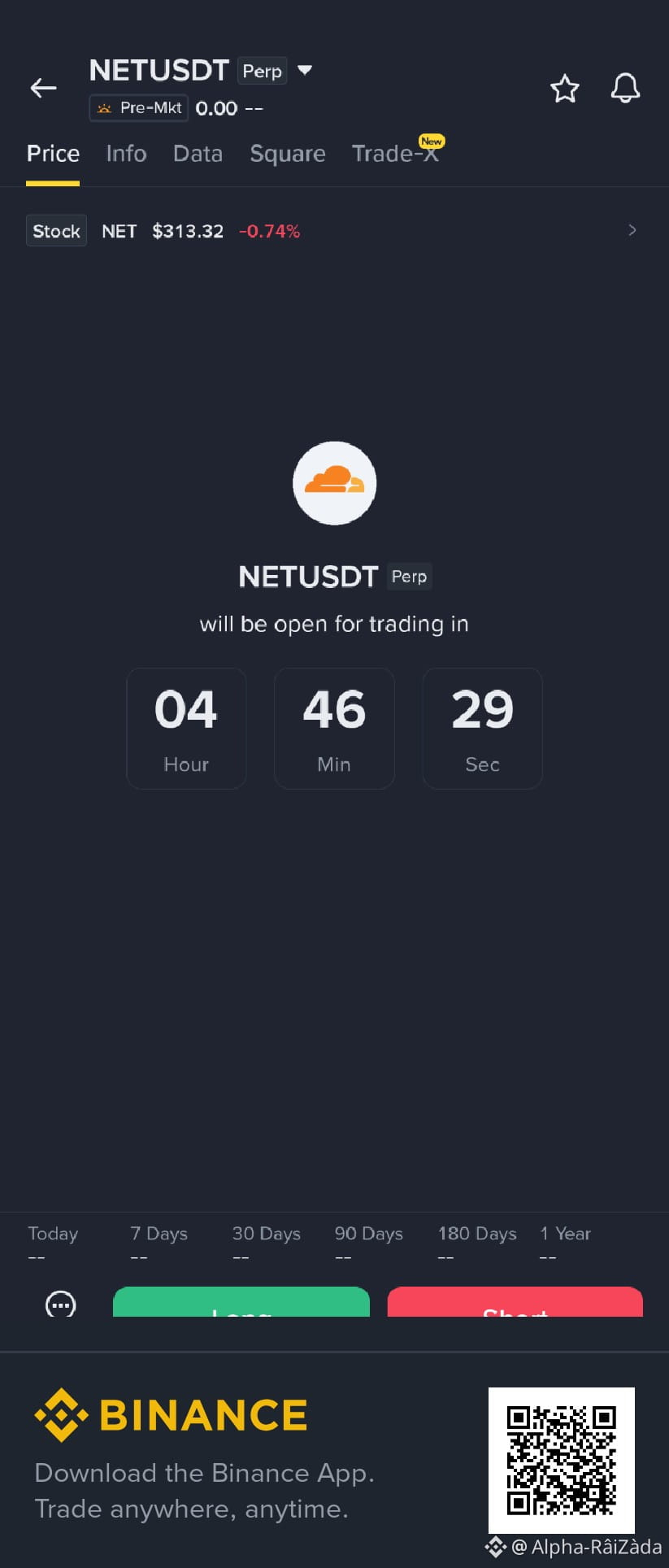
$NET (Cloudflare) is getting attention ahead of its upcoming contract listing, with around 4h 46m remaining.
The Cloudflare + A-share connectivity narrative could attract serious market attention, but new listings can be extremely volatile.
⚠️ Don’t rush the first candle. Watch the opening liquidity, spread and price structure before taking a position.
#NET #NETUSDT #Cloudflare #BİNANCE #cryptotrading
$NET
— New Listing Watch 🚨🔥
$NET (Cloudflare) is getting attention ahead of its upcoming contract listing, with around 4h 46m remaining.
The Cloudflare + A-share connectivity narrative could attract serious market attention, but new listings can be extremely volatile.
⚠️ Don’t rush the first candle. Watch the opening liquidity, spread and price structure before taking a position.
#NET #NETUSDT #Cloudflare #BİNANCE #cryptotrading
— New Listing Watch 🚨🔥
$NET (Cloudflare) is getting attention ahead of its upcoming contract listing, with around 4h 46m remaining.
The Cloudflare + A-share connectivity narrative could attract serious market attention, but new listings can be extremely volatile.
⚠️ Don’t rush the first candle. Watch the opening liquidity, spread and price structure before taking a position.
#NET #NETUSDT #Cloudflare #BİNANCE #cryptotrading
142
Log in to explore more content
Join global crypto users on Binance Square
⚡️ Get latest and useful information about crypto.
💬 Trusted by the world’s largest crypto exchange.
👍 Discover real insights from verified creators.
Email / Phone number
Trending Topics
1
#AIStocksWhatNext
423,578 views
3,250 Discussing
2
#BitwiseNEARStakingETPAssetsTop$100M
2,752 views
32 Discussing
3
#BitcoinBreaksAboveMayHighNears$86K
19,123 views
216 Discussing
4
#DogecoinRises15%
59,693 views
1,095 Discussing
5
#$14BBitcoinOptionsExpireFriday
5,202 views
100 Discussing
6
#BNBMarketCapPassesBNYMellon
37,158 views
797 Discussing
7
#CryptoMarketCapReclaims$3Trillion
7,203 views
87 Discussing
8
#MuseOvertakesChatGPTAsTopFreeIOSApp
21,464 views
590 Discussing
9
#TokenizedStockPlatformsCouldLaunchNextQuarter
33,429 views
642 Discussing
10
#StrategyAdds950Bitcoin
40,475 views
710 Discussing