

#marausdt
marausdt
609 views
14 Discussing
Hot
Latest

🌰 The investment seed I sowed has, in the blink of an eye, grown into a towering, strong tree—embracing the sunlight of prosperity.
🎯 LONG $MARA
Entry: 11.75
TP: 12.337 | SL: 10.575
🇹 The Learn-to-Earn (Learn-to-Earn) trend is attracting new users.
📈 Price breakout goes hand in hand with the surge in large buy orders on the exchange.
🤝 Be humble before the market, because it can punish arrogance.
🍀 A smooth trading session filled with plenty of great opportunities.
#MARAUSDT $MARAUSDT
🌰 The investment seed I sowed has, in the blink of an eye, grown into a towering, strong tree—embracing the sunlight of prosperity.
🎯 LONG $MARA
Entry: 11.75
TP: 12.337 | SL: 10.575
🇹 The Learn-to-Earn (Learn-to-Earn) trend is attracting new users.
📈 Price breakout goes hand in hand with the surge in large buy orders on the exchange.
🤝 Be humble before the market, because it can punish arrogance.
🍀 A smooth trading session filled with plenty of great opportunities.
#MARAUSDT $MARAUSDT
🎯 LONG $MARA
Entry: 11.75
TP: 12.337 | SL: 10.575
🇹 The Learn-to-Earn (Learn-to-Earn) trend is attracting new users.
📈 Price breakout goes hand in hand with the surge in large buy orders on the exchange.
🤝 Be humble before the market, because it can punish arrogance.
🍀 A smooth trading session filled with plenty of great opportunities.
#MARAUSDT $MARAUSDT
61


·
--
Bullish
Verified
🔥 A new 5 TradFi perpetual has arrived on Binance Futures!
On August 28, 2026, Binance Futures listed the following 5 new USDT-margined perpetual contracts (each with up to
20x leverage, 24/7 trading):
1. $TEM USDT – Tempus AI (artificial intelligence company)
2. $MRK USDT– Merck & Co. (pharmaceutical giant)
3.$IONQ USDT– IonQ (quantum computer technology)
4. #MARAUSDT – MARA Holdings (Bitcoin mining company)
5. #PDD USDT – PDD Holdings (Temu / Pinduoduo)
They’re already live for 24 hours and support Multi-Assets Mode. New listings are always lively—whoever is watching, sees the opportunity.
If you want to enter the market with these new tools too, 👇 follow my account—I share my real trading plans and risk management here.
🔥 A new 5 TradFi perpetual has arrived on Binance Futures!
On August 28, 2026, Binance Futures listed the following 5 new USDT-margined perpetual contracts (each with up to
20x leverage, 24/7 trading):
1. $TEM USDT – Tempus AI (artificial intelligence company)
2. $MRK USDT– Merck & Co. (pharmaceutical giant)
3.$IONQ USDT– IonQ (quantum computer technology)
4. #MARAUSDT – MARA Holdings (Bitcoin mining company)
5. #PDD USDT – PDD Holdings (Temu / Pinduoduo)
They’re already live for 24 hours and support Multi-Assets Mode. New listings are always lively—whoever is watching, sees the opportunity.
If you want to enter the market with these new tools too, 👇 follow my account—I share my real trading plans and risk management here.
On August 28, 2026, Binance Futures listed the following 5 new USDT-margined perpetual contracts (each with up to
20x leverage, 24/7 trading):
1. $TEM USDT – Tempus AI (artificial intelligence company)
2. $MRK USDT– Merck & Co. (pharmaceutical giant)
3.$IONQ USDT– IonQ (quantum computer technology)
4. #MARAUSDT – MARA Holdings (Bitcoin mining company)
5. #PDD USDT – PDD Holdings (Temu / Pinduoduo)
They’re already live for 24 hours and support Multi-Assets Mode. New listings are always lively—whoever is watching, sees the opportunity.
If you want to enter the market with these new tools too, 👇 follow my account—I share my real trading plans and risk management here.
3
321

·
--
[M1_mag7]
$MARA This underlying jumped 12 points in 24 hours, with the price set at 13.26, but when I glanced at the funding rate, it was steadily sitting at zero. Interesting. For an on-chain US stock perpetual contract that can outperform so much in a single day, the funding rate neither overpays shorts nor overpays longs. This suggests that the rally didn’t create crowded long positions, or that any short squeeze wasn’t severe.
From the perspective of on-chain TradFi-style perp contracts, $MARA is very typical. It has 12,777 open contracts, with volume slightly over $700k. It’s not a top-tier liquidity pool. With this size, price volatility can easily be amplified—but it also means liquidity depth isn’t sufficient, and large orders entering/exiting will noticeably affect the order book.
Compared with big index ETFs like SPY and QQQ, it’s theoretically high beta, but today’s zero funding rate tells me the market pricing is still hesitant. In plain terms, everyone is waiting for a clearer signal: there’s no frantic chasing longs, and no big wave of shorts getting buried and forced to liquidate. This kind of balance is fragile—it might also be quiet before a big move.
My take is: now isn’t the time to blindly chase. A zero funding rate means the cost of holding is the same for everyone, and the market hasn’t chosen a direction. If I think this is a beta-style move where an on-chain US contract is tracking the traditional market’s repair, then $MARA’s performance should correlate strongly with QQQ—but I don’t currently have real-time $QQQ data to compare. So I’m choosing to wait and observe until it picks a direction. For now, I won’t take action.
On the flip side: if BTC or the US market suddenly turns down, a high-beta asset like $MARA—one with liquidity that isn’t that deep—could drop harder than it rises. Its current price is tied to two forms of sentiment: on-chain speculation and the risk appetite of traditional markets. The strongest contrarian signal is this: if tonight SPY or QQQ prints a big bullish candle, $MARA could get another push higher thanks to the ease of zero funding. But until I can see the correlation data, I won’t bet on that.
The invalidation conditions are clear. If $MARA quickly falls below 12.5—meaning it gives back most of today’s gains—and the funding rate turns negative at the same time, I’ll conclude this rally was a failed false breakout, and I’ll switch to a bearish view. Conversely, if it can hold above 13.2, and even come with a mildly positive funding rate, and I can find evidence that it’s diverging from QQQ’s move, then my “wait-and-see” judgment would be wrong. At that point, I’d need to reassess whether to follow the trend and go long.
Trading tag: #BinanceFutures #TradFi #USDⓈM #MARA #MARAUSDT $MARA
[M1_mag7]
$MARA This underlying jumped 12 points in 24 hours, with the price set at 13.26, but when I glanced at the funding rate, it was steadily sitting at zero. Interesting. For an on-chain US stock perpetual contract that can outperform so much in a single day, the funding rate neither overpays shorts nor overpays longs. This suggests that the rally didn’t create crowded long positions, or that any short squeeze wasn’t severe.
From the perspective of on-chain TradFi-style perp contracts, $MARA is very typical. It has 12,777 open contracts, with volume slightly over $700k. It’s not a top-tier liquidity pool. With this size, price volatility can easily be amplified—but it also means liquidity depth isn’t sufficient, and large orders entering/exiting will noticeably affect the order book.
Compared with big index ETFs like SPY and QQQ, it’s theoretically high beta, but today’s zero funding rate tells me the market pricing is still hesitant. In plain terms, everyone is waiting for a clearer signal: there’s no frantic chasing longs, and no big wave of shorts getting buried and forced to liquidate. This kind of balance is fragile—it might also be quiet before a big move.
My take is: now isn’t the time to blindly chase. A zero funding rate means the cost of holding is the same for everyone, and the market hasn’t chosen a direction. If I think this is a beta-style move where an on-chain US contract is tracking the traditional market’s repair, then $MARA ’s performance should correlate strongly with QQQ—but I don’t currently have real-time $QQQ data to compare. So I’m choosing to wait and observe until it picks a direction. For now, I won’t take action.
On the flip side: if BTC or the US market suddenly turns down, a high-beta asset like $MARA —one with liquidity that isn’t that deep—could drop harder than it rises. Its current price is tied to two forms of sentiment: on-chain speculation and the risk appetite of traditional markets. The strongest contrarian signal is this: if tonight SPY or QQQ prints a big bullish candle, $MARA could get another push higher thanks to the ease of zero funding. But until I can see the correlation data, I won’t bet on that.
The invalidation conditions are clear. If $MARA quickly falls below 12.5—meaning it gives back most of today’s gains—and the funding rate turns negative at the same time, I’ll conclude this rally was a failed false breakout, and I’ll switch to a bearish view. Conversely, if it can hold above 13.2, and even come with a mildly positive funding rate, and I can find evidence that it’s diverging from QQQ’s move, then my “wait-and-see” judgment would be wrong. At that point, I’d need to reassess whether to follow the trend and go long.
Trading tag: #BinanceFutures #TradFi #USDⓈM #MARA #MARAUSDT $MARA
$MARA This underlying jumped 12 points in 24 hours, with the price set at 13.26, but when I glanced at the funding rate, it was steadily sitting at zero. Interesting. For an on-chain US stock perpetual contract that can outperform so much in a single day, the funding rate neither overpays shorts nor overpays longs. This suggests that the rally didn’t create crowded long positions, or that any short squeeze wasn’t severe.
From the perspective of on-chain TradFi-style perp contracts, $MARA is very typical. It has 12,777 open contracts, with volume slightly over $700k. It’s not a top-tier liquidity pool. With this size, price volatility can easily be amplified—but it also means liquidity depth isn’t sufficient, and large orders entering/exiting will noticeably affect the order book.
Compared with big index ETFs like SPY and QQQ, it’s theoretically high beta, but today’s zero funding rate tells me the market pricing is still hesitant. In plain terms, everyone is waiting for a clearer signal: there’s no frantic chasing longs, and no big wave of shorts getting buried and forced to liquidate. This kind of balance is fragile—it might also be quiet before a big move.
My take is: now isn’t the time to blindly chase. A zero funding rate means the cost of holding is the same for everyone, and the market hasn’t chosen a direction. If I think this is a beta-style move where an on-chain US contract is tracking the traditional market’s repair, then $MARA ’s performance should correlate strongly with QQQ—but I don’t currently have real-time $QQQ data to compare. So I’m choosing to wait and observe until it picks a direction. For now, I won’t take action.
On the flip side: if BTC or the US market suddenly turns down, a high-beta asset like $MARA —one with liquidity that isn’t that deep—could drop harder than it rises. Its current price is tied to two forms of sentiment: on-chain speculation and the risk appetite of traditional markets. The strongest contrarian signal is this: if tonight SPY or QQQ prints a big bullish candle, $MARA could get another push higher thanks to the ease of zero funding. But until I can see the correlation data, I won’t bet on that.
The invalidation conditions are clear. If $MARA quickly falls below 12.5—meaning it gives back most of today’s gains—and the funding rate turns negative at the same time, I’ll conclude this rally was a failed false breakout, and I’ll switch to a bearish view. Conversely, if it can hold above 13.2, and even come with a mildly positive funding rate, and I can find evidence that it’s diverging from QQQ’s move, then my “wait-and-see” judgment would be wrong. At that point, I’d need to reassess whether to follow the trend and go long.
Trading tag: #BinanceFutures #TradFi #USDⓈM #MARA #MARAUSDT $MARA
94

·
--
The old dog glanced at the data: in the past 24 hours, MARA surged 7.944%, pushing the price to 12.23, and contract open interest also climbed to 10985.54. It’s not exactly a wild rally, but coupled with the funding rate of 0.00000000, it’s got some interesting implications.
You need to understand that a zero funding rate means neither longs nor shorts have to pay the other right now. By the iron law, a funding rate above zero indicates crowded longs; below zero indicates shorts being forced to absorb pressure. At this point, it suggests the leveraged market’s sentiment has just come out of the earlier imbalance. In this MARA upswing, I didn’t see the corresponding shorts being pressured into paying high funding rates to hold their positions. In other words, the selling pressure behind the rise likely isn’t driven by contract-market short liquidations; it looks more like spot buying pushing the price upward. Open interest rises in sync, while the funding rate stays flat—this indicates that among the new entrants, there still aren’t that many people using contracts with leverage to chase the rally. More likely, cautious spot buying and a wait-and-see mood are the main factors.
This is somewhat different from the logic I had in mind for a semiconductor/AI-driven move. MARA’s main business is Bitcoin mining machine hardware; its link to chip demand is relatively limited. This rally feels more like a lagging follow-through after the broader Bitcoin market starts to recover, rather than an “alpha” move within the sector.
So my take is: there are signals of short-term strength for MARA, but the driving logic isn’t strong enough. Funding rate neutrality plus spot-led momentum makes this rally look a bit “well-behaved,” without the kind of frenzy you see from heavy leveraged positions. The strongest counterevidence is this: if Bitcoin’s price pulls back next, a highly correlated asset like MARA will likely fall harder. And with the current zero-funding-rate environment, the contract market isn’t providing any additional cushion. The second-order effect is that if the price keeps going sideways or dips slightly, these new spot buyers become the most unstable chips. Their costs are concentrated around 12.2; breaking below that level could trigger stop-losses.
My action is very clear: I’ll add to the position, but only after the price confirms and holds steady in the current range. Specifically, if MARA can continue consolidating above 12.2 and digest the sell pressure, I’ll add a bit more on the next pullback. But if it drops directly below 12.2 at this current price, I’ll switch to watching from the sidelines. I oppose chasing highs right now, because in a zero-funding-rate environment there’s no forced-short squeeze fuel, so the sustainability of the uptrend is questionable. My stance on position size is cautious—testing with a light allocation only, never betting heavily on a one-way move.
Trading tag: #BinanceFutures #TradFi #USDⓈM #MARA #MARAUSDT $MARA
The old dog glanced at the data: in the past 24 hours, MARA surged 7.944%, pushing the price to 12.23, and contract open interest also climbed to 10985.54. It’s not exactly a wild rally, but coupled with the funding rate of 0.00000000, it’s got some interesting implications.
You need to understand that a zero funding rate means neither longs nor shorts have to pay the other right now. By the iron law, a funding rate above zero indicates crowded longs; below zero indicates shorts being forced to absorb pressure. At this point, it suggests the leveraged market’s sentiment has just come out of the earlier imbalance. In this MARA upswing, I didn’t see the corresponding shorts being pressured into paying high funding rates to hold their positions. In other words, the selling pressure behind the rise likely isn’t driven by contract-market short liquidations; it looks more like spot buying pushing the price upward. Open interest rises in sync, while the funding rate stays flat—this indicates that among the new entrants, there still aren’t that many people using contracts with leverage to chase the rally. More likely, cautious spot buying and a wait-and-see mood are the main factors.
This is somewhat different from the logic I had in mind for a semiconductor/AI-driven move. MARA’s main business is Bitcoin mining machine hardware; its link to chip demand is relatively limited. This rally feels more like a lagging follow-through after the broader Bitcoin market starts to recover, rather than an “alpha” move within the sector.
So my take is: there are signals of short-term strength for MARA, but the driving logic isn’t strong enough. Funding rate neutrality plus spot-led momentum makes this rally look a bit “well-behaved,” without the kind of frenzy you see from heavy leveraged positions. The strongest counterevidence is this: if Bitcoin’s price pulls back next, a highly correlated asset like MARA will likely fall harder. And with the current zero-funding-rate environment, the contract market isn’t providing any additional cushion. The second-order effect is that if the price keeps going sideways or dips slightly, these new spot buyers become the most unstable chips. Their costs are concentrated around 12.2; breaking below that level could trigger stop-losses.
My action is very clear: I’ll add to the position, but only after the price confirms and holds steady in the current range. Specifically, if MARA can continue consolidating above 12.2 and digest the sell pressure, I’ll add a bit more on the next pullback. But if it drops directly below 12.2 at this current price, I’ll switch to watching from the sidelines. I oppose chasing highs right now, because in a zero-funding-rate environment there’s no forced-short squeeze fuel, so the sustainability of the uptrend is questionable. My stance on position size is cautious—testing with a light allocation only, never betting heavily on a one-way move.
Trading tag: #BinanceFutures #TradFi #USDⓈM #MARA #MARAUSDT $MARA
You need to understand that a zero funding rate means neither longs nor shorts have to pay the other right now. By the iron law, a funding rate above zero indicates crowded longs; below zero indicates shorts being forced to absorb pressure. At this point, it suggests the leveraged market’s sentiment has just come out of the earlier imbalance. In this MARA upswing, I didn’t see the corresponding shorts being pressured into paying high funding rates to hold their positions. In other words, the selling pressure behind the rise likely isn’t driven by contract-market short liquidations; it looks more like spot buying pushing the price upward. Open interest rises in sync, while the funding rate stays flat—this indicates that among the new entrants, there still aren’t that many people using contracts with leverage to chase the rally. More likely, cautious spot buying and a wait-and-see mood are the main factors.
This is somewhat different from the logic I had in mind for a semiconductor/AI-driven move. MARA’s main business is Bitcoin mining machine hardware; its link to chip demand is relatively limited. This rally feels more like a lagging follow-through after the broader Bitcoin market starts to recover, rather than an “alpha” move within the sector.
So my take is: there are signals of short-term strength for MARA, but the driving logic isn’t strong enough. Funding rate neutrality plus spot-led momentum makes this rally look a bit “well-behaved,” without the kind of frenzy you see from heavy leveraged positions. The strongest counterevidence is this: if Bitcoin’s price pulls back next, a highly correlated asset like MARA will likely fall harder. And with the current zero-funding-rate environment, the contract market isn’t providing any additional cushion. The second-order effect is that if the price keeps going sideways or dips slightly, these new spot buyers become the most unstable chips. Their costs are concentrated around 12.2; breaking below that level could trigger stop-losses.
My action is very clear: I’ll add to the position, but only after the price confirms and holds steady in the current range. Specifically, if MARA can continue consolidating above 12.2 and digest the sell pressure, I’ll add a bit more on the next pullback. But if it drops directly below 12.2 at this current price, I’ll switch to watching from the sidelines. I oppose chasing highs right now, because in a zero-funding-rate environment there’s no forced-short squeeze fuel, so the sustainability of the uptrend is questionable. My stance on position size is cautious—testing with a light allocation only, never betting heavily on a one-way move.
Trading tag: #BinanceFutures #TradFi #USDⓈM #MARA #MARAUSDT $MARA
19
·
--
$funding fee rate has gone to zero. This is not very common in perpetual contracts. During $MARA 24 hours, it rose 5.314%, and the price touched 11.89, but its perpetual contract funding rate is 0. On one side the price is rising, and on the other, neither longs nor shorts are paying each other. I glanced at the open interest: 18565.70. That number itself can’t be directly compared to the price in unit terms, but combined with the zero funding rate, it at least indicates that the current pull-up has not created a situation where longs end up paying shorts.
This angle (M2_semi) should have been a peer comparison on the semiconductor/AI chain, but this time I don’t have other coin data available in hand, which in itself points to a problem: the rally of $MARA did not receive a clear peer-price reaction in the usual semiconductor/AI sentiment sector. Its driver seems more like an isolated event, or a reason to lump it into the vague category called Other. With zero funding rate paired with price rising, my old-dog understanding is that inside the market, long and short forces are at a brief equilibrium point— the uptrend hasn’t immediately caused longs to overheat into paying a premium, and it also implies shorts haven’t been massively squeezed into surrendering and paying. It’s a signal that both sides are still probing, and the positioning structure is relatively neutral. The “fuel” to push upward (funding paid by shorts) isn’t obvious.
So my take is that for $MARA ’s 5.3% rise, we should put a big question mark over its strength and sustainability. It lacks the positive confirmation of the funding rate dimension and looks more like a rise without clearly supported counterparty losses. My plan is: wait. I’ll treat 11.89 as an observation benchmark. If the price can hold around here and even move higher, and at the same time I see whether the funding rate turns into a sustained positive number (which would mean longs are crowded—but also that the rise comes at the cost of confirmation), then I’ll consider trying a small long position. If the price turns down—especially if it falls below 11.89 and the funding rate remains zero or even turns negative—that would mean the upward momentum has quickly fizzled out, and I won’t touch it.
Where is this judgment most likely to be wrong? If $MARA suddenly has undisclosed fundamental news highly related to AI or the semiconductor industry that drives price away from pure contract-battle logic and keeps surging, then my framework fails. Or if the entire crypto market’s risk appetite suddenly spikes, bringing in huge incremental capital indiscriminately, then this single zero-funding-rate signal would be drowned out.
Trading tag: #BinanceFutures #TradFi #USDⓈM #MARA #MARAUSDT $MARA
$funding fee rate has gone to zero. This is not very common in perpetual contracts. During $MARA 24 hours, it rose 5.314%, and the price touched 11.89, but its perpetual contract funding rate is 0. On one side the price is rising, and on the other, neither longs nor shorts are paying each other. I glanced at the open interest: 18565.70. That number itself can’t be directly compared to the price in unit terms, but combined with the zero funding rate, it at least indicates that the current pull-up has not created a situation where longs end up paying shorts.
This angle (M2_semi) should have been a peer comparison on the semiconductor/AI chain, but this time I don’t have other coin data available in hand, which in itself points to a problem: the rally of $MARA did not receive a clear peer-price reaction in the usual semiconductor/AI sentiment sector. Its driver seems more like an isolated event, or a reason to lump it into the vague category called Other. With zero funding rate paired with price rising, my old-dog understanding is that inside the market, long and short forces are at a brief equilibrium point— the uptrend hasn’t immediately caused longs to overheat into paying a premium, and it also implies shorts haven’t been massively squeezed into surrendering and paying. It’s a signal that both sides are still probing, and the positioning structure is relatively neutral. The “fuel” to push upward (funding paid by shorts) isn’t obvious.
So my take is that for $MARA ’s 5.3% rise, we should put a big question mark over its strength and sustainability. It lacks the positive confirmation of the funding rate dimension and looks more like a rise without clearly supported counterparty losses. My plan is: wait. I’ll treat 11.89 as an observation benchmark. If the price can hold around here and even move higher, and at the same time I see whether the funding rate turns into a sustained positive number (which would mean longs are crowded—but also that the rise comes at the cost of confirmation), then I’ll consider trying a small long position. If the price turns down—especially if it falls below 11.89 and the funding rate remains zero or even turns negative—that would mean the upward momentum has quickly fizzled out, and I won’t touch it.
Where is this judgment most likely to be wrong? If $MARA suddenly has undisclosed fundamental news highly related to AI or the semiconductor industry that drives price away from pure contract-battle logic and keeps surging, then my framework fails. Or if the entire crypto market’s risk appetite suddenly spikes, bringing in huge incremental capital indiscriminately, then this single zero-funding-rate signal would be drowned out.
Trading tag: #BinanceFutures #TradFi #USDⓈM #MARA #MARAUSDT $MARA
This angle (M2_semi) should have been a peer comparison on the semiconductor/AI chain, but this time I don’t have other coin data available in hand, which in itself points to a problem: the rally of $MARA did not receive a clear peer-price reaction in the usual semiconductor/AI sentiment sector. Its driver seems more like an isolated event, or a reason to lump it into the vague category called Other. With zero funding rate paired with price rising, my old-dog understanding is that inside the market, long and short forces are at a brief equilibrium point— the uptrend hasn’t immediately caused longs to overheat into paying a premium, and it also implies shorts haven’t been massively squeezed into surrendering and paying. It’s a signal that both sides are still probing, and the positioning structure is relatively neutral. The “fuel” to push upward (funding paid by shorts) isn’t obvious.
So my take is that for $MARA ’s 5.3% rise, we should put a big question mark over its strength and sustainability. It lacks the positive confirmation of the funding rate dimension and looks more like a rise without clearly supported counterparty losses. My plan is: wait. I’ll treat 11.89 as an observation benchmark. If the price can hold around here and even move higher, and at the same time I see whether the funding rate turns into a sustained positive number (which would mean longs are crowded—but also that the rise comes at the cost of confirmation), then I’ll consider trying a small long position. If the price turns down—especially if it falls below 11.89 and the funding rate remains zero or even turns negative—that would mean the upward momentum has quickly fizzled out, and I won’t touch it.
Where is this judgment most likely to be wrong? If $MARA suddenly has undisclosed fundamental news highly related to AI or the semiconductor industry that drives price away from pure contract-battle logic and keeps surging, then my framework fails. Or if the entire crypto market’s risk appetite suddenly spikes, bringing in huge incremental capital indiscriminately, then this single zero-funding-rate signal would be drowned out.
Trading tag: #BinanceFutures #TradFi #USDⓈM #MARA #MARAUSDT $MARA
34
·
--
Over the past 24 hours it surged by more than ten percentage points, and the price $MARA has climbed above 11.5. Old Dog pulled up the data—it's not the size of the move itself that's key, but the underlying funding/positioning status. The funding rate for its capital has jumped to 0.00076865; in the perpetual futures market, this number is a classic signal of a crowded long position. Meanwhile, the entire network’s open interest remains high at 18,108.80 contracts. With the price rising, funding rising, and positions not being reduced, it suggests the long capital pushing the price up hasn’t exited—possibly it’s even adding more.
Why call it an M4_mover-level anomaly? If you look only at the percentage gain, a ten-plus-point move isn’t “explosive” in US-stock tokens terms, but when you combine the funding rate and open interest, the signal becomes clear. The funding rate stays positive and the value isn’t small, meaning in the contract market longs have been paying fees to shorts. That reflects longs’ willingness to bear the cost to maintain their positions, which often presages the continuation of the trend. Open interest stays elevated, paired with price moving higher, pointing to either sustained inflows of new capital or existing positions being increased—not just a simple short-covering bounce. With this kind of structure, the price is extremely sensitive to any positive news, making sharp rallies easier to trigger.
In contrast, during the same period there aren’t other secondary coins in the same sector showing comparable data; the independently strong characteristics of $MARA stand out more, with both capital and sentiment concentrated here.
So Old Dog’s view is: short-term momentum hasn’t faded, but the crowding is already on the high side. For execution, if the price can hold above 11.5 USD, I would consider following the trend with a light position, with the condition that I can accept the possibility of rapid pullbacks. The most counterintuitive part might be this: when the market sees continuous gains and a positive funding rate, the first instinct is that a correction should be coming—but in the perpetuals market, the long capital structure often has inertia. As long as the short-squeeze hasn’t finished, a pullback may actually be the “get in” opportunity. However, here it’s very clear who is paying the cost: the newly entered longs are paying both the older longs and the shorts. This situation can’t last too long.
Where is this judgment most likely to be wrong? Assuming the crowding in the funding rate won’t immediately trigger a reversal. If the $MARA price quickly drops back below 11 USD and the funding rate starts to decay and even turns negative, that would indicate the long capital is beginning to withdraw and the short-squeeze logic has failed—I would exit immediately. Until then, I temporarily treat 11 USD as the line between strength and weakness.
Trading tags: #BinanceFutures #TradFi #USDⓈM #MARA #MARAUSDT $MARA
Over the past 24 hours it surged by more than ten percentage points, and the price $MARA has climbed above 11.5. Old Dog pulled up the data—it's not the size of the move itself that's key, but the underlying funding/positioning status. The funding rate for its capital has jumped to 0.00076865; in the perpetual futures market, this number is a classic signal of a crowded long position. Meanwhile, the entire network’s open interest remains high at 18,108.80 contracts. With the price rising, funding rising, and positions not being reduced, it suggests the long capital pushing the price up hasn’t exited—possibly it’s even adding more.
Why call it an M4_mover-level anomaly? If you look only at the percentage gain, a ten-plus-point move isn’t “explosive” in US-stock tokens terms, but when you combine the funding rate and open interest, the signal becomes clear. The funding rate stays positive and the value isn’t small, meaning in the contract market longs have been paying fees to shorts. That reflects longs’ willingness to bear the cost to maintain their positions, which often presages the continuation of the trend. Open interest stays elevated, paired with price moving higher, pointing to either sustained inflows of new capital or existing positions being increased—not just a simple short-covering bounce. With this kind of structure, the price is extremely sensitive to any positive news, making sharp rallies easier to trigger.
In contrast, during the same period there aren’t other secondary coins in the same sector showing comparable data; the independently strong characteristics of $MARA stand out more, with both capital and sentiment concentrated here.
So Old Dog’s view is: short-term momentum hasn’t faded, but the crowding is already on the high side. For execution, if the price can hold above 11.5 USD, I would consider following the trend with a light position, with the condition that I can accept the possibility of rapid pullbacks. The most counterintuitive part might be this: when the market sees continuous gains and a positive funding rate, the first instinct is that a correction should be coming—but in the perpetuals market, the long capital structure often has inertia. As long as the short-squeeze hasn’t finished, a pullback may actually be the “get in” opportunity. However, here it’s very clear who is paying the cost: the newly entered longs are paying both the older longs and the shorts. This situation can’t last too long.
Where is this judgment most likely to be wrong? Assuming the crowding in the funding rate won’t immediately trigger a reversal. If the $MARA price quickly drops back below 11 USD and the funding rate starts to decay and even turns negative, that would indicate the long capital is beginning to withdraw and the short-squeeze logic has failed—I would exit immediately. Until then, I temporarily treat 11 USD as the line between strength and weakness.
Trading tags: #BinanceFutures #TradFi #USDⓈM #MARA #MARAUSDT $MARA
Why call it an M4_mover-level anomaly? If you look only at the percentage gain, a ten-plus-point move isn’t “explosive” in US-stock tokens terms, but when you combine the funding rate and open interest, the signal becomes clear. The funding rate stays positive and the value isn’t small, meaning in the contract market longs have been paying fees to shorts. That reflects longs’ willingness to bear the cost to maintain their positions, which often presages the continuation of the trend. Open interest stays elevated, paired with price moving higher, pointing to either sustained inflows of new capital or existing positions being increased—not just a simple short-covering bounce. With this kind of structure, the price is extremely sensitive to any positive news, making sharp rallies easier to trigger.
In contrast, during the same period there aren’t other secondary coins in the same sector showing comparable data; the independently strong characteristics of $MARA stand out more, with both capital and sentiment concentrated here.
So Old Dog’s view is: short-term momentum hasn’t faded, but the crowding is already on the high side. For execution, if the price can hold above 11.5 USD, I would consider following the trend with a light position, with the condition that I can accept the possibility of rapid pullbacks. The most counterintuitive part might be this: when the market sees continuous gains and a positive funding rate, the first instinct is that a correction should be coming—but in the perpetuals market, the long capital structure often has inertia. As long as the short-squeeze hasn’t finished, a pullback may actually be the “get in” opportunity. However, here it’s very clear who is paying the cost: the newly entered longs are paying both the older longs and the shorts. This situation can’t last too long.
Where is this judgment most likely to be wrong? Assuming the crowding in the funding rate won’t immediately trigger a reversal. If the $MARA price quickly drops back below 11 USD and the funding rate starts to decay and even turns negative, that would indicate the long capital is beginning to withdraw and the short-squeeze logic has failed—I would exit immediately. Until then, I temporarily treat 11 USD as the line between strength and weakness.
Trading tags: #BinanceFutures #TradFi #USDⓈM #MARA #MARAUSDT $MARA
16
·
--
The old dog scanned the order book. In $MARA 24 hours it surged 9.81%, and the price reached 11.53—pretty wild. But when you look at the funding rate, it’s 0.00179602, which is positive. In the perpetual futures market, funding greater than zero means longs are paying shorts—an unambiguous signal: the money used to pull the price up is partly coming straight out of the longs’ own pockets. The chart looks hot, but the longs’ positions may already be crowded.
From the angle of M2_semi, this is a semiconductor AI chain, yet MARA’s “sector” field is set to Other. This suggests the market isn’t labeling it as a core semiconductor player. The real semiconductor cycle is judged by companies like NVDA and AMD—their capital expenditures and orders. The on-chain underlying assets’ volatility logic is also tethered to that. MARA’s rise in this wave is more aligned with short-term hype driven by crypto traders’ capital for “US stock concepts” mapped onto the chain, rather than a direct reflection of the semiconductor industry cycle itself. When price rises and funding is positive, if open interest (OI) doesn’t jump sharply in sync, it can further confirm this may be a leveraged, crowded trade dominated by short-term capital—not the formation of consensus on fundamentals.
My take: in the short term, the long side is crowded, and the cost-effectiveness isn’t great. With the funding rate sitting high and positive, pushing higher means longs’ costs keep accumulating. If the price can’t quickly break out and move away from the current range, rallies driven by funding subsidies are likely to hit resistance. The action is clear: observe, don’t chase. If the price pulls back to around 11.5 and funding doesn’t drop significantly, I’d consider entering a small long position, because that would suggest sell pressure might be absorbed. Conversely, at this level, the old dog chooses to watch.
The strongest counter-proof is this: if MARA’s OI shows a jump in scale over the next 24 hours and the price holds above 11.6, that would indicate new capital is stepping in as a relay, and the “crowded longs” thesis would need revision. But right now, the data only supports that single “crowded” signal. The second-order effect is that once the price stalls, the longs holding at high levels while paying positive funding will feel pressure first. Partial liquidations/closing can trigger a chain reaction pullback, temporarily pulling liquidity out of this asset.
The invalidation conditions are simple: the price breaks above 11.6 directly and holds, or the funding rate quickly turns negative—either would mean my crowded-long assessment is wrong. Until then, the old dog stays put.
Trading tag: #BinanceFutures #TradFi #USDⓈM #MARA #MARAUSDT $MARA
The old dog scanned the order book. In $MARA 24 hours it surged 9.81%, and the price reached 11.53—pretty wild. But when you look at the funding rate, it’s 0.00179602, which is positive. In the perpetual futures market, funding greater than zero means longs are paying shorts—an unambiguous signal: the money used to pull the price up is partly coming straight out of the longs’ own pockets. The chart looks hot, but the longs’ positions may already be crowded.
From the angle of M2_semi, this is a semiconductor AI chain, yet MARA’s “sector” field is set to Other. This suggests the market isn’t labeling it as a core semiconductor player. The real semiconductor cycle is judged by companies like NVDA and AMD—their capital expenditures and orders. The on-chain underlying assets’ volatility logic is also tethered to that. MARA’s rise in this wave is more aligned with short-term hype driven by crypto traders’ capital for “US stock concepts” mapped onto the chain, rather than a direct reflection of the semiconductor industry cycle itself. When price rises and funding is positive, if open interest (OI) doesn’t jump sharply in sync, it can further confirm this may be a leveraged, crowded trade dominated by short-term capital—not the formation of consensus on fundamentals.
My take: in the short term, the long side is crowded, and the cost-effectiveness isn’t great. With the funding rate sitting high and positive, pushing higher means longs’ costs keep accumulating. If the price can’t quickly break out and move away from the current range, rallies driven by funding subsidies are likely to hit resistance. The action is clear: observe, don’t chase. If the price pulls back to around 11.5 and funding doesn’t drop significantly, I’d consider entering a small long position, because that would suggest sell pressure might be absorbed. Conversely, at this level, the old dog chooses to watch.
The strongest counter-proof is this: if MARA’s OI shows a jump in scale over the next 24 hours and the price holds above 11.6, that would indicate new capital is stepping in as a relay, and the “crowded longs” thesis would need revision. But right now, the data only supports that single “crowded” signal. The second-order effect is that once the price stalls, the longs holding at high levels while paying positive funding will feel pressure first. Partial liquidations/closing can trigger a chain reaction pullback, temporarily pulling liquidity out of this asset.
The invalidation conditions are simple: the price breaks above 11.6 directly and holds, or the funding rate quickly turns negative—either would mean my crowded-long assessment is wrong. Until then, the old dog stays put.
Trading tag: #BinanceFutures #TradFi #USDⓈM #MARA #MARAUSDT $MARA
From the angle of M2_semi, this is a semiconductor AI chain, yet MARA’s “sector” field is set to Other. This suggests the market isn’t labeling it as a core semiconductor player. The real semiconductor cycle is judged by companies like NVDA and AMD—their capital expenditures and orders. The on-chain underlying assets’ volatility logic is also tethered to that. MARA’s rise in this wave is more aligned with short-term hype driven by crypto traders’ capital for “US stock concepts” mapped onto the chain, rather than a direct reflection of the semiconductor industry cycle itself. When price rises and funding is positive, if open interest (OI) doesn’t jump sharply in sync, it can further confirm this may be a leveraged, crowded trade dominated by short-term capital—not the formation of consensus on fundamentals.
My take: in the short term, the long side is crowded, and the cost-effectiveness isn’t great. With the funding rate sitting high and positive, pushing higher means longs’ costs keep accumulating. If the price can’t quickly break out and move away from the current range, rallies driven by funding subsidies are likely to hit resistance. The action is clear: observe, don’t chase. If the price pulls back to around 11.5 and funding doesn’t drop significantly, I’d consider entering a small long position, because that would suggest sell pressure might be absorbed. Conversely, at this level, the old dog chooses to watch.
The strongest counter-proof is this: if MARA’s OI shows a jump in scale over the next 24 hours and the price holds above 11.6, that would indicate new capital is stepping in as a relay, and the “crowded longs” thesis would need revision. But right now, the data only supports that single “crowded” signal. The second-order effect is that once the price stalls, the longs holding at high levels while paying positive funding will feel pressure first. Partial liquidations/closing can trigger a chain reaction pullback, temporarily pulling liquidity out of this asset.
The invalidation conditions are simple: the price breaks above 11.6 directly and holds, or the funding rate quickly turns negative—either would mean my crowded-long assessment is wrong. Until then, the old dog stays put.
Trading tag: #BinanceFutures #TradFi #USDⓈM #MARA #MARAUSDT $MARA
18
·
--
An old dog glanced at the on-chain contract data of $MARA : over the past 24 hours it’s risen 11.505%, with the current price at 11.63 and a trading volume of 697,000. This kind of move is eye-catching in TradFi US-stock equivalents on-chain, but the funding rate 0.00090257 directly reveals the cards: longs are paying shorts, which suggests the long positions are already crowded.
From the perspective of M3_crypto_link, with $MARA as an on-chain US-stock contract, price fluctuations map directly to miners’ sentiment. However, since the input provides no BTC price reference, it can only be analyzed based on the data. A positive funding rate means longs continue to pay fees to maintain their positions; this cost gets overlooked during the rally. But if the price chops sideways or pulls back, long profits get squeezed. The OI at 13492.69 (open interest) combined with nearly 700k trading volume indicates the market participation isn’t low, yet lacking historical samples means the old dog can’t tell whether this is a peak.
The funding “law” is very clear here: funding>0 means longs pay shorts; when longs are crowded, a reversal move often becomes more likely.
The old dog’s assessment is that $MARA faces near-term pullback pressure. Trigger condition: if the price breaks below 11.00, I’ll reduce my position, because breaking the psychological level may trigger a chain reaction of long liquidations and stop-losses. The counter-consensus point is that while the market might see the 11.5% rally and want to chase, the funding structure shows this move is being hard-pushed by crowded longs. If buy pressure weakens, shorts can strike back at relatively low cost.
On positioning, I choose to stay light and observe—no chasing highs, and no opening a reverse position—unless the funding turns negative.
As for second-order effects: if crowded longs are forced out via liquidations, selling pressure will increase and liquidity may temporarily shift toward the short side. The invalidation condition is equally clear: if $MARA breaks above 12.50 and funding turns negative, it indicates shorts are becoming crowded or market sentiment has flipped. Then I would cancel the pullback thesis and switch to waiting-and-seeing. The current data only supports caution; the old dog won’t bet on the wrong side.
Trading tags: #BinanceFutures #TradFi #USDⓈM #MARA #MARAUSDT $MARA
An old dog glanced at the on-chain contract data of $MARA : over the past 24 hours it’s risen 11.505%, with the current price at 11.63 and a trading volume of 697,000. This kind of move is eye-catching in TradFi US-stock equivalents on-chain, but the funding rate 0.00090257 directly reveals the cards: longs are paying shorts, which suggests the long positions are already crowded.
From the perspective of M3_crypto_link, with $MARA as an on-chain US-stock contract, price fluctuations map directly to miners’ sentiment. However, since the input provides no BTC price reference, it can only be analyzed based on the data. A positive funding rate means longs continue to pay fees to maintain their positions; this cost gets overlooked during the rally. But if the price chops sideways or pulls back, long profits get squeezed. The OI at 13492.69 (open interest) combined with nearly 700k trading volume indicates the market participation isn’t low, yet lacking historical samples means the old dog can’t tell whether this is a peak.
The funding “law” is very clear here: funding>0 means longs pay shorts; when longs are crowded, a reversal move often becomes more likely.
The old dog’s assessment is that $MARA faces near-term pullback pressure. Trigger condition: if the price breaks below 11.00, I’ll reduce my position, because breaking the psychological level may trigger a chain reaction of long liquidations and stop-losses. The counter-consensus point is that while the market might see the 11.5% rally and want to chase, the funding structure shows this move is being hard-pushed by crowded longs. If buy pressure weakens, shorts can strike back at relatively low cost.
On positioning, I choose to stay light and observe—no chasing highs, and no opening a reverse position—unless the funding turns negative.
As for second-order effects: if crowded longs are forced out via liquidations, selling pressure will increase and liquidity may temporarily shift toward the short side. The invalidation condition is equally clear: if $MARA breaks above 12.50 and funding turns negative, it indicates shorts are becoming crowded or market sentiment has flipped. Then I would cancel the pullback thesis and switch to waiting-and-seeing. The current data only supports caution; the old dog won’t bet on the wrong side.
Trading tags: #BinanceFutures #TradFi #USDⓈM #MARA #MARAUSDT $MARA
From the perspective of M3_crypto_link, with $MARA as an on-chain US-stock contract, price fluctuations map directly to miners’ sentiment. However, since the input provides no BTC price reference, it can only be analyzed based on the data. A positive funding rate means longs continue to pay fees to maintain their positions; this cost gets overlooked during the rally. But if the price chops sideways or pulls back, long profits get squeezed. The OI at 13492.69 (open interest) combined with nearly 700k trading volume indicates the market participation isn’t low, yet lacking historical samples means the old dog can’t tell whether this is a peak.
The funding “law” is very clear here: funding>0 means longs pay shorts; when longs are crowded, a reversal move often becomes more likely.
The old dog’s assessment is that $MARA faces near-term pullback pressure. Trigger condition: if the price breaks below 11.00, I’ll reduce my position, because breaking the psychological level may trigger a chain reaction of long liquidations and stop-losses. The counter-consensus point is that while the market might see the 11.5% rally and want to chase, the funding structure shows this move is being hard-pushed by crowded longs. If buy pressure weakens, shorts can strike back at relatively low cost.
On positioning, I choose to stay light and observe—no chasing highs, and no opening a reverse position—unless the funding turns negative.
As for second-order effects: if crowded longs are forced out via liquidations, selling pressure will increase and liquidity may temporarily shift toward the short side. The invalidation condition is equally clear: if $MARA breaks above 12.50 and funding turns negative, it indicates shorts are becoming crowded or market sentiment has flipped. Then I would cancel the pullback thesis and switch to waiting-and-seeing. The current data only supports caution; the old dog won’t bet on the wrong side.
Trading tags: #BinanceFutures #TradFi #USDⓈM #MARA #MARAUSDT $MARA
9

📊 $MARA | LONG SETUP — BREAKOUT MOMENTUM
📍 Entry Zone: $11.30 – $11.45
🎯 Targets:
TP1: $11.60
TP2: $11.80
TP3: $12.00
🛑 Stop Loss: $11.08
💹 Trade this setup directly from here on Binance.
{future}(MARAUSDT)
$ZEC
{spot}(ZECUSDT)
📈 Trade Outlook:
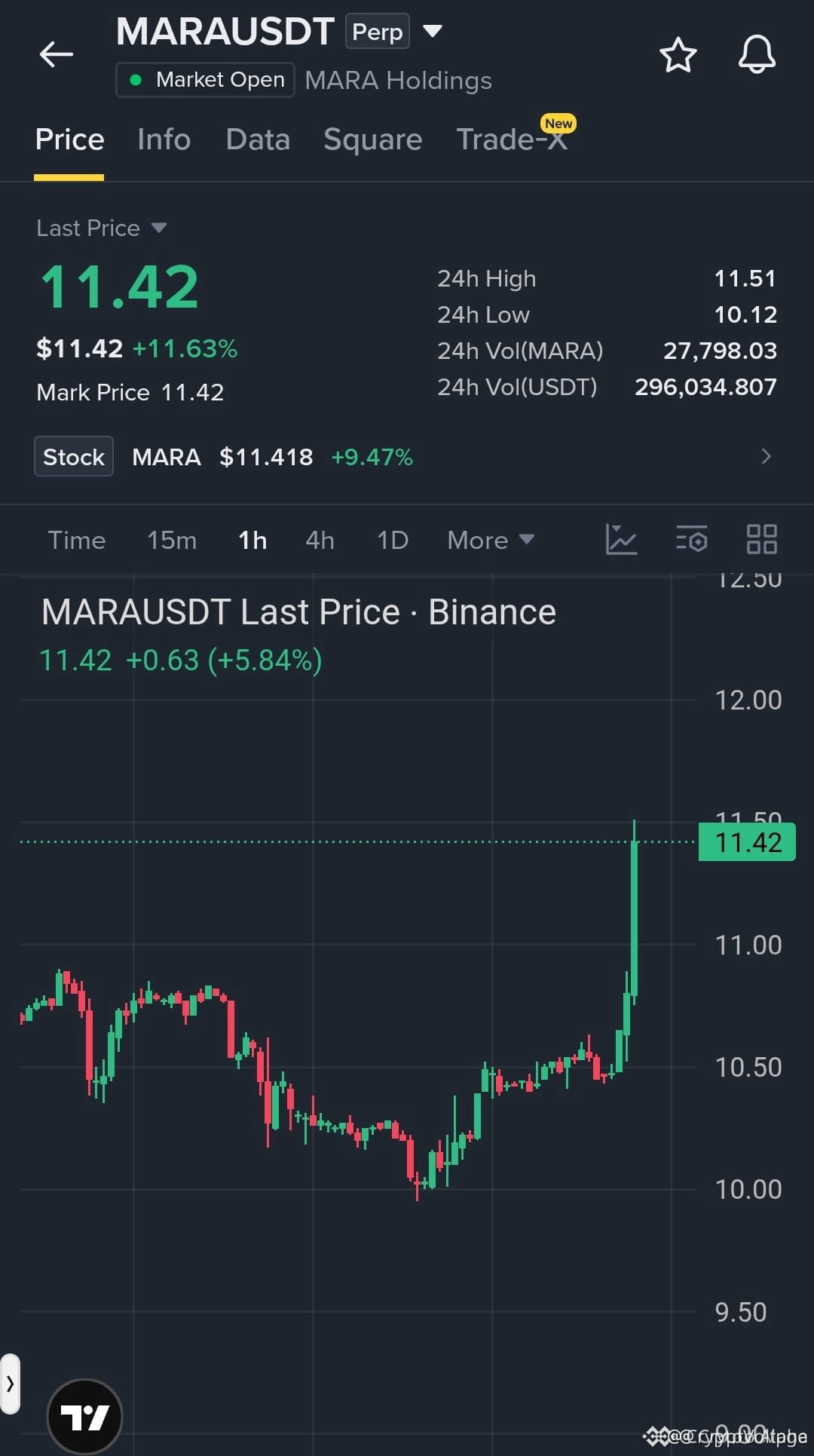
MARA is pushing through recent resistance with a strong 1H breakout and rising momentum, holding near $11.42 after a sharp move from the $10.50 area.
🔔 Follow me@QueenOfCharts for daily trade setups, real-time signals, and market breakdowns — stay ahead of the next move!
⚠️ Disclaimer: This is not financial advice. Always do your own research (DYOR) and trade responsibly.
#MARA #MARAUSDT #BreakoutTrade #BTC #Risk #StockTrade #TradeSetup
📊 $MARA | LONG SETUP — BREAKOUT MOMENTUM
📍 Entry Zone: $11.30 – $11.45
🎯 Targets:
TP1: $11.60
TP2: $11.80
TP3: $12.00
🛑 Stop Loss: $11.08
💹 Trade this setup directly from here on Binance.
$ZEC
📈 Trade Outlook:
MARA is pushing through recent resistance with a strong 1H breakout and rising momentum, holding near $11.42 after a sharp move from the $10.50 area.
🔔 Follow me@CryptoVoltage for daily trade setups, real-time signals, and market breakdowns — stay ahead of the next move!
⚠️ Disclaimer: This is not financial advice. Always do your own research (DYOR) and trade responsibly.
#MARA #MARAUSDT #BreakoutTrade #BTC #Risk #StockTrade #TradeSetup
📍 Entry Zone: $11.30 – $11.45
🎯 Targets:
TP1: $11.60
TP2: $11.80
TP3: $12.00
🛑 Stop Loss: $11.08
💹 Trade this setup directly from here on Binance.
$ZEC
📈 Trade Outlook:
MARA is pushing through recent resistance with a strong 1H breakout and rising momentum, holding near $11.42 after a sharp move from the $10.50 area.
🔔 Follow me@CryptoVoltage for daily trade setups, real-time signals, and market breakdowns — stay ahead of the next move!
⚠️ Disclaimer: This is not financial advice. Always do your own research (DYOR) and trade responsibly.
#MARA #MARAUSDT #BreakoutTrade #BTC #Risk #StockTrade #TradeSetup
251
·
--
$MARA In the past 24 hours, deadlifts surged by 15%; the price climbed to 11.73, yet the funding rate remains completely unchanged, stuck at 0. Open interest is also flat, holding at 5920.19. The price moved, but the derivatives market is cold. This combination suggests leverage capital hasn’t really entered; the rise is likely more about spot rotation.
Old dog’s view: this round of abnormal movement lacks derivative confirmation, so its continuity is questionable. Momentum signals like M4_mover usually need OI amplification or a shift in the funding rate to really “nail it down.” But right now, both are calm. Relying on price gains alone could easily turn into a fake breakout. The strongest counter-evidence is: if OI quickly rises afterward and the funding rate turns positive, it might develop into a real trend—but the current data doesn’t support that.
The second-order impact is simple: if the price continues to rise, shorts will cautiously probe by opening short positions, but their costs are nearly zero; the risk for longs chasing higher prices is that spot profit-taking could hit at any moment, and there aren’t crowded futures positions to provide support. The invalidation conditions are clear: if the funding rate breaks above 0.0005 or OI flips intraday to above 12000, I’ll admit I’m wrong and switch to following the signal. Under the current conditions, I choose to stand by—no chasing highs, no going short—waiting to decide once the contract market gains volume.
Trading tag: #BinanceFutures #TradFi #USDⓈM #MARA #MARAUSDT $MARA
$MARA In the past 24 hours, deadlifts surged by 15%; the price climbed to 11.73, yet the funding rate remains completely unchanged, stuck at 0. Open interest is also flat, holding at 5920.19. The price moved, but the derivatives market is cold. This combination suggests leverage capital hasn’t really entered; the rise is likely more about spot rotation.
Old dog’s view: this round of abnormal movement lacks derivative confirmation, so its continuity is questionable. Momentum signals like M4_mover usually need OI amplification or a shift in the funding rate to really “nail it down.” But right now, both are calm. Relying on price gains alone could easily turn into a fake breakout. The strongest counter-evidence is: if OI quickly rises afterward and the funding rate turns positive, it might develop into a real trend—but the current data doesn’t support that.
The second-order impact is simple: if the price continues to rise, shorts will cautiously probe by opening short positions, but their costs are nearly zero; the risk for longs chasing higher prices is that spot profit-taking could hit at any moment, and there aren’t crowded futures positions to provide support. The invalidation conditions are clear: if the funding rate breaks above 0.0005 or OI flips intraday to above 12000, I’ll admit I’m wrong and switch to following the signal. Under the current conditions, I choose to stand by—no chasing highs, no going short—waiting to decide once the contract market gains volume.
Trading tag: #BinanceFutures #TradFi #USDⓈM #MARA #MARAUSDT $MARA
Old dog’s view: this round of abnormal movement lacks derivative confirmation, so its continuity is questionable. Momentum signals like M4_mover usually need OI amplification or a shift in the funding rate to really “nail it down.” But right now, both are calm. Relying on price gains alone could easily turn into a fake breakout. The strongest counter-evidence is: if OI quickly rises afterward and the funding rate turns positive, it might develop into a real trend—but the current data doesn’t support that.
The second-order impact is simple: if the price continues to rise, shorts will cautiously probe by opening short positions, but their costs are nearly zero; the risk for longs chasing higher prices is that spot profit-taking could hit at any moment, and there aren’t crowded futures positions to provide support. The invalidation conditions are clear: if the funding rate breaks above 0.0005 or OI flips intraday to above 12000, I’ll admit I’m wrong and switch to following the signal. Under the current conditions, I choose to stand by—no chasing highs, no going short—waiting to decide once the contract market gains volume.
Trading tag: #BinanceFutures #TradFi #USDⓈM #MARA #MARAUSDT $MARA
15


Log in to explore more content
Join global crypto users on Binance Square
⚡️ Get latest and useful information about crypto.
💬 Trusted by the world’s largest crypto exchange.
👍 Discover real insights from verified creators.
Email / Phone number
Trending Topics
1
#CFTCUpdatesGuidanceOnTokenizedAssets
464 views
46 Discussing
2
#BitgetSays$352MAffectedInHack
37 views
3 Discussing
3
#NYAndPolymarketSueEachOther
85 views
12 Discussing
4
#BinanceWillListHyperliquid(HYPE)
154,451 views
2,606 Discussing
5
#BrazilOrdersReportingOf$10KSelfCustodyTransfers
324 views
13 Discussing
6
#FedProposesRulesForBankIssuedStablecoins
2,018 views
99 Discussing
7
#OndoFinanceSoughtSaleAfterFoundersDeath
1,510 views
74 Discussing
8
#FedOctoberRateHikeOddsRiseTo69.7%
53,747 views
1,085 Discussing
9
#BitcoinFallsBelow$83,000
4,319 views
20 Discussing
10
#BitcoinFallsToAround$84,600ThisWeek
0 views
0 Discussing