

#kraken
kraken
832,244 views
1,685 Discussing
Hot
Latest

Exchanges are evolving fast. Kraken's parent company Payward is moving beyond standard spot trading to build full-scale institutional financial infrastructure. By unifying trading, payments, and asset management onto shared rails, they are positioning themselves more like a traditional prime broker than a retail app. This structural pivot shows how mature crypto companies are capturing higher-value enterprise markets. #CryptoNews #Kraken #DeFi
Exchanges are evolving fast. Kraken's parent company Payward is moving beyond standard spot trading to build full-scale institutional financial infrastructure. By unifying trading, payments, and asset management onto shared rails, they are positioning themselves more like a traditional prime broker than a retail app. This structural pivot shows how mature crypto companies are capturing higher-value enterprise markets. #CryptoNews #Kraken #DeFi
1
·
--
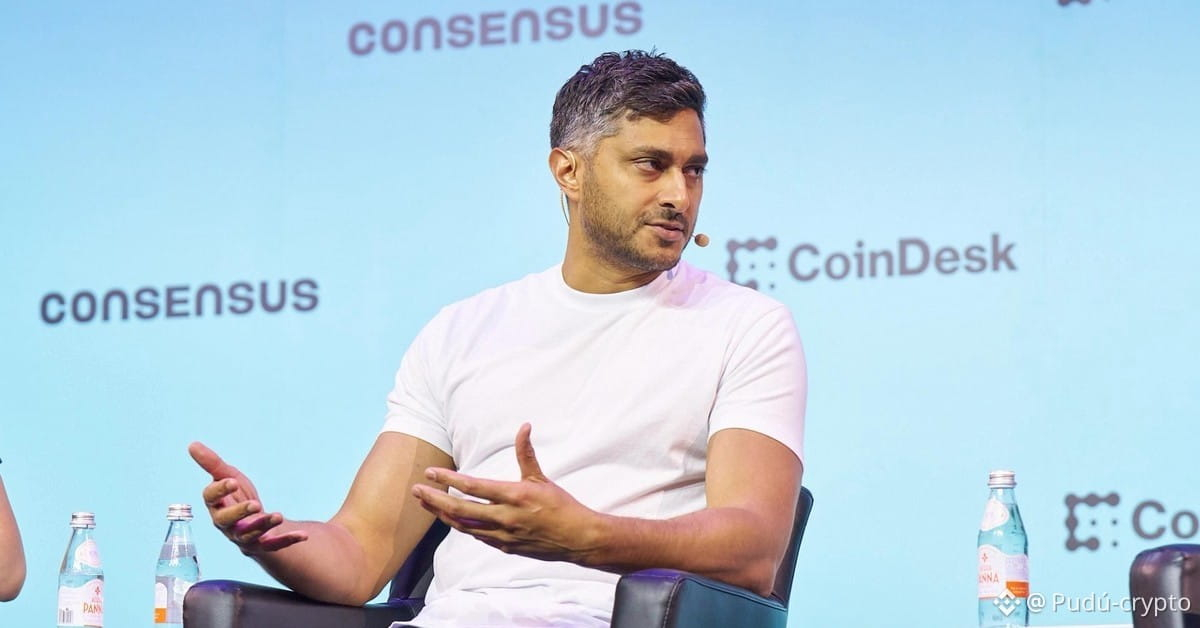
Kraken is moving pieces to change its business model.
The parent company, Payward, wants to stop being just an exchange. Its plan is to unify trading, payments, and asset management under a single financial infrastructure.
Co-CEO Arjun Sethi confirmed that they’re looking to build common rails for all their institutional services.
It’s a pretty ambitious shift in focus for a platform we primarily know for buying and selling $BTC.
Do you think this move puts them in a different league?
#Kraken #Crypto
Kraken is moving pieces to change its business model.
The parent company, Payward, wants to stop being just an exchange. Its plan is to unify trading, payments, and asset management under a single financial infrastructure.
Co-CEO Arjun Sethi confirmed that they’re looking to build common rails for all their institutional services.
It’s a pretty ambitious shift in focus for a platform we primarily know for buying and selling $BTC .
Do you think this move puts them in a different league?
#Kraken #Crypto
The parent company, Payward, wants to stop being just an exchange. Its plan is to unify trading, payments, and asset management under a single financial infrastructure.
Co-CEO Arjun Sethi confirmed that they’re looking to build common rails for all their institutional services.
It’s a pretty ambitious shift in focus for a platform we primarily know for buying and selling $BTC .
Do you think this move puts them in a different league?
#Kraken #Crypto
323
·
--
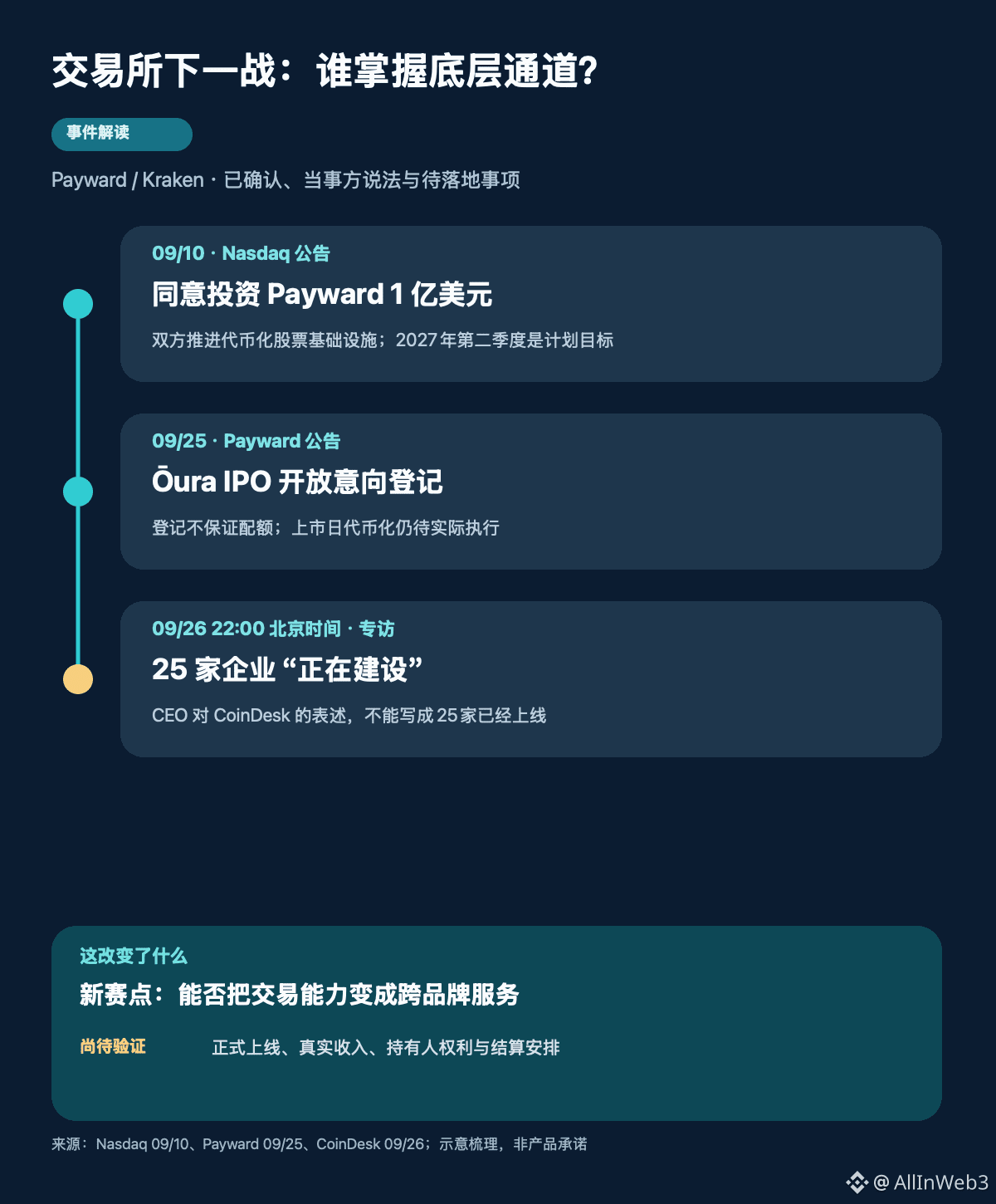
#代币化股票 #Kraken A company said, “At least 25 customers are building,” which is still far from “25 products have already gone live.” But the quote is still worth keeping an eye on: what Kraken’s parent company, Payward, wants to sell to other financial institutions is no longer just an exchange entry point—it’s the underlying capabilities it has used itself.
Let’s line up the timeline. On September 10, Nasdaq announced it had agreed to invest $100 million in Payward and, together with it, continue developing tokenized stock trading, distribution, and settlement infrastructure. Nasdaq Equity Tokens is expected to launch in the second quarter of 2027—this is the target, not a delivered product. A Payward website announcement published on September 25 said that through xStocks, it would open non-binding expressions of interest for Ōura’s proposed IPO. The allocation would be determined by the issuer and the underwriter. Applying does not guarantee getting shares, and tokenization still has to wait until the actual listing date to be executed.
In a CoinDesk interview published at 10:00 p.m. Beijing time on September 26, Payward’s co-CEOs said at least 25 companies are using its infrastructure to develop products and expect them to go live this year. Here, “in development” and “already live, with existing revenue” must be separated.
My view is that the next round of competition among exchanges is moving from “who gets more trades in whose app” to “who can turn custody, payments, compliance, and settlement into services that other brands are also willing to plug into.” Customers can keep users within their own interfaces, while the underlying provider gains another distribution channel. This is why Payward discusses Kraken, Payward Services, and tokenized stocks at the same time. But the claim about 25 customers comes from management interviews, and we still can’t use it to prove scaled revenue.
More easily overlooked is what holders actually receive. Payward’s explanation for xStocks in the European Economic Area makes clear that it provides price exposure, not direct ownership of shares—and it confers no voting or dividend rights. Transferable on-chain, round-the-clock trading, and traditional stock rights are not the same thing. If my view is to be upgraded, I would need to see formally launched partnered products, verifiable actual trades and service revenue, plus clear disclosures of rights and settlement. If trading can flow across platforms but holders only get price exposure, would you consider it truly mature tokenized stock—or more like a convenient tracking tool?
#代币化股票 #Kraken A company said, “At least 25 customers are building,” which is still far from “25 products have already gone live.” But the quote is still worth keeping an eye on: what Kraken’s parent company, Payward, wants to sell to other financial institutions is no longer just an exchange entry point—it’s the underlying capabilities it has used itself.
Let’s line up the timeline. On September 10, Nasdaq announced it had agreed to invest $100 million in Payward and, together with it, continue developing tokenized stock trading, distribution, and settlement infrastructure. Nasdaq Equity Tokens is expected to launch in the second quarter of 2027—this is the target, not a delivered product. A Payward website announcement published on September 25 said that through xStocks, it would open non-binding expressions of interest for Ōura’s proposed IPO. The allocation would be determined by the issuer and the underwriter. Applying does not guarantee getting shares, and tokenization still has to wait until the actual listing date to be executed.
In a CoinDesk interview published at 10:00 p.m. Beijing time on September 26, Payward’s co-CEOs said at least 25 companies are using its infrastructure to develop products and expect them to go live this year. Here, “in development” and “already live, with existing revenue” must be separated.
My view is that the next round of competition among exchanges is moving from “who gets more trades in whose app” to “who can turn custody, payments, compliance, and settlement into services that other brands are also willing to plug into.” Customers can keep users within their own interfaces, while the underlying provider gains another distribution channel. This is why Payward discusses Kraken, Payward Services, and tokenized stocks at the same time. But the claim about 25 customers comes from management interviews, and we still can’t use it to prove scaled revenue.
More easily overlooked is what holders actually receive. Payward’s explanation for xStocks in the European Economic Area makes clear that it provides price exposure, not direct ownership of shares—and it confers no voting or dividend rights. Transferable on-chain, round-the-clock trading, and traditional stock rights are not the same thing. If my view is to be upgraded, I would need to see formally launched partnered products, verifiable actual trades and service revenue, plus clear disclosures of rights and settlement. If trading can flow across platforms but holders only get price exposure, would you consider it truly mature tokenized stock—or more like a convenient tracking tool?
Let’s line up the timeline. On September 10, Nasdaq announced it had agreed to invest $100 million in Payward and, together with it, continue developing tokenized stock trading, distribution, and settlement infrastructure. Nasdaq Equity Tokens is expected to launch in the second quarter of 2027—this is the target, not a delivered product. A Payward website announcement published on September 25 said that through xStocks, it would open non-binding expressions of interest for Ōura’s proposed IPO. The allocation would be determined by the issuer and the underwriter. Applying does not guarantee getting shares, and tokenization still has to wait until the actual listing date to be executed.
In a CoinDesk interview published at 10:00 p.m. Beijing time on September 26, Payward’s co-CEOs said at least 25 companies are using its infrastructure to develop products and expect them to go live this year. Here, “in development” and “already live, with existing revenue” must be separated.
My view is that the next round of competition among exchanges is moving from “who gets more trades in whose app” to “who can turn custody, payments, compliance, and settlement into services that other brands are also willing to plug into.” Customers can keep users within their own interfaces, while the underlying provider gains another distribution channel. This is why Payward discusses Kraken, Payward Services, and tokenized stocks at the same time. But the claim about 25 customers comes from management interviews, and we still can’t use it to prove scaled revenue.
More easily overlooked is what holders actually receive. Payward’s explanation for xStocks in the European Economic Area makes clear that it provides price exposure, not direct ownership of shares—and it confers no voting or dividend rights. Transferable on-chain, round-the-clock trading, and traditional stock rights are not the same thing. If my view is to be upgraded, I would need to see formally launched partnered products, verifiable actual trades and service revenue, plus clear disclosures of rights and settlement. If trading can flow across platforms but holders only get price exposure, would you consider it truly mature tokenized stock—or more like a convenient tracking tool?
1
9

·
--
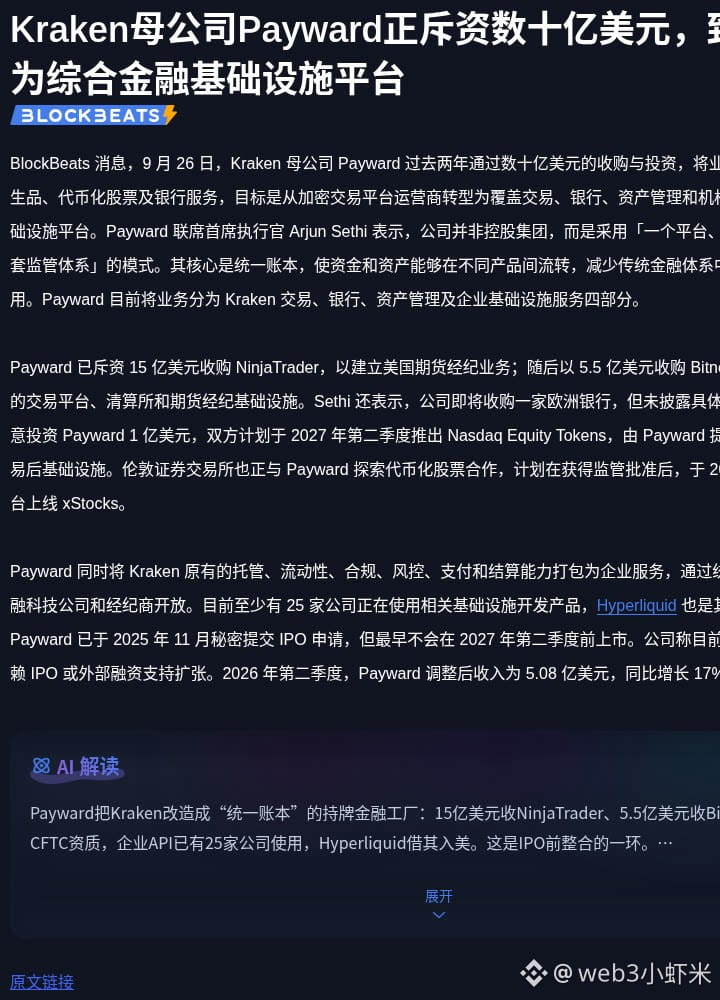
Rhythm at Your Fingertips: Kraken’s parent company Payward has poured tens of billions over the past two years to piece together futures, derivatives, tokenized stocks, and a bank—aiming not to control the whole patchwork, but to build a single foundation of trading + banking + asset management + institutional services.
Co-CEO Arjun Sethi puts it plainly: one platform, one balance sheet, one regulatory framework—the core is a unified ledger, where money and assets can flow directly between products. On acquisitions, it paid $1.5 billion to buy NinjaTrader for US futures brokerage, $550 million for Bitnomial to obtain regulated trading/clearing/FCM rights; and it’s also in talks with a European bank. Nasdaq invested $100 million, with plans to launch Nasdaq Equity Tokens by 2027 Q2; it’s also discussing LSE 24 with the London Stock Exchange for xStocks. At least 25 companies are already using its enterprise APIs, and Hyperliquid is also a partner.
It secretly filed for an IPO in November 2025, with the earliest possible timing in 2027 Q2. The company says it’s still profitable right now, so it’s in no rush to go public. After a 2026 Q2 adjustment, revenue came in at $508 million, up 17% year over year. It feels like it’s building a full backend for crypto trading according to traditional financial-licensing standards.
#Kraken #加密基建 $BTC
Rhythm at Your Fingertips: Kraken’s parent company Payward has poured tens of billions over the past two years to piece together futures, derivatives, tokenized stocks, and a bank—aiming not to control the whole patchwork, but to build a single foundation of trading + banking + asset management + institutional services.
Co-CEO Arjun Sethi puts it plainly: one platform, one balance sheet, one regulatory framework—the core is a unified ledger, where money and assets can flow directly between products. On acquisitions, it paid $1.5 billion to buy NinjaTrader for US futures brokerage, $550 million for Bitnomial to obtain regulated trading/clearing/FCM rights; and it’s also in talks with a European bank. Nasdaq invested $100 million, with plans to launch Nasdaq Equity Tokens by 2027 Q2; it’s also discussing LSE 24 with the London Stock Exchange for xStocks. At least 25 companies are already using its enterprise APIs, and Hyperliquid is also a partner.
It secretly filed for an IPO in November 2025, with the earliest possible timing in 2027 Q2. The company says it’s still profitable right now, so it’s in no rush to go public. After a 2026 Q2 adjustment, revenue came in at $508 million, up 17% year over year. It feels like it’s building a full backend for crypto trading according to traditional financial-licensing standards.
#Kraken #加密基建 $BTC
Co-CEO Arjun Sethi puts it plainly: one platform, one balance sheet, one regulatory framework—the core is a unified ledger, where money and assets can flow directly between products. On acquisitions, it paid $1.5 billion to buy NinjaTrader for US futures brokerage, $550 million for Bitnomial to obtain regulated trading/clearing/FCM rights; and it’s also in talks with a European bank. Nasdaq invested $100 million, with plans to launch Nasdaq Equity Tokens by 2027 Q2; it’s also discussing LSE 24 with the London Stock Exchange for xStocks. At least 25 companies are already using its enterprise APIs, and Hyperliquid is also a partner.
It secretly filed for an IPO in November 2025, with the earliest possible timing in 2027 Q2. The company says it’s still profitable right now, so it’s in no rush to go public. After a 2026 Q2 adjustment, revenue came in at $508 million, up 17% year over year. It feels like it’s building a full backend for crypto trading according to traditional financial-licensing standards.
#Kraken #加密基建 $BTC
101

Payward, formerly Kraken, invested billions of dollars to build a financial platform—more than just a crypto trading exchange
- Payward (formerly Kraken) is integrating trading, payments, asset management, and institutional services on a single platform.
- Co-CEO Arjun Sethi confirms the goal is to become financial infrastructure, not just a crypto exchange.
#BinanceSquare #CryptoNews #Kraken #Payward
$btc $eth
#vlikevn Titanbot
Source: CoinDesk
Payward, formerly Kraken, invested billions of dollars to build a financial platform—more than just a crypto trading exchange
- Payward (formerly Kraken) is integrating trading, payments, asset management, and institutional services on a single platform.
- Co-CEO Arjun Sethi confirms the goal is to become financial infrastructure, not just a crypto exchange.
#BinanceSquare #CryptoNews #Kraken #Payward
$btc $eth
#vlikevn Titanbot
Source: CoinDesk
- Payward (formerly Kraken) is integrating trading, payments, asset management, and institutional services on a single platform.
- Co-CEO Arjun Sethi confirms the goal is to become financial infrastructure, not just a crypto exchange.
#BinanceSquare #CryptoNews #Kraken #Payward
$btc $eth
#vlikevn Titanbot
Source: CoinDesk
1

·
--
Payward wants to put Hyperliquid perps into US licensesKraken’s parent company, Payward, throws a hardball: it plans to offer Hyperliquid on-chain perpetuals to US customers—and to do so through a CFTC-licensed structure, not just a “compliance narrative” in words.
The details are worth breaking down: it first moves in via the HIP-3 permissioned market. Bitnomial Exchange (DCM) acts as the deployer, responsible for creating, managing, and settling/clearing; NinjaTrader Clearing (FCM) opens the account and holds the positions. Matching and bookkeeping remain on Hyperliquid’s public chain order book, but the regulatory obligations fall on Bitnomial and NinjaTrader—meaning it does not equal the existing Hyperliquid order book being opened directly to Americans.
Payward acquired NinjaTrader Clearing with about $1.5 billion in 2025, and then in May 2026 it will acquire Bitnomial for about $550 million. This time, it’s about stuffing hot offshore/onchain products into US-registered structures. The launch date, fees, the underlying assets, and the revenue split on the $HYPE side have not been disclosed. Intention ≠ launch.
Payward wants to put Hyperliquid perps into US licenses
Kraken’s parent company, Payward, throws a hardball: it plans to offer Hyperliquid on-chain perpetuals to US customers—and to do so through a CFTC-licensed structure, not just a “compliance narrative” in words.
The details are worth breaking down: it first moves in via the HIP-3 permissioned market. Bitnomial Exchange (DCM) acts as the deployer, responsible for creating, managing, and settling/clearing; NinjaTrader Clearing (FCM) opens the account and holds the positions. Matching and bookkeeping remain on Hyperliquid’s public chain order book, but the regulatory obligations fall on Bitnomial and NinjaTrader—meaning it does not equal the existing Hyperliquid order book being opened directly to Americans.
Payward acquired NinjaTrader Clearing with about $1.5 billion in 2025, and then in May 2026 it will acquire Bitnomial for about $550 million. This time, it’s about stuffing hot offshore/onchain products into US-registered structures. The launch date, fees, the underlying assets, and the revenue split on the $HYPE side have not been disclosed. Intention ≠ launch.
The details are worth breaking down: it first moves in via the HIP-3 permissioned market. Bitnomial Exchange (DCM) acts as the deployer, responsible for creating, managing, and settling/clearing; NinjaTrader Clearing (FCM) opens the account and holds the positions. Matching and bookkeeping remain on Hyperliquid’s public chain order book, but the regulatory obligations fall on Bitnomial and NinjaTrader—meaning it does not equal the existing Hyperliquid order book being opened directly to Americans.
Payward acquired NinjaTrader Clearing with about $1.5 billion in 2025, and then in May 2026 it will acquire Bitnomial for about $550 million. This time, it’s about stuffing hot offshore/onchain products into US-registered structures. The launch date, fees, the underlying assets, and the revenue split on the $HYPE side have not been disclosed. Intention ≠ launch.
158

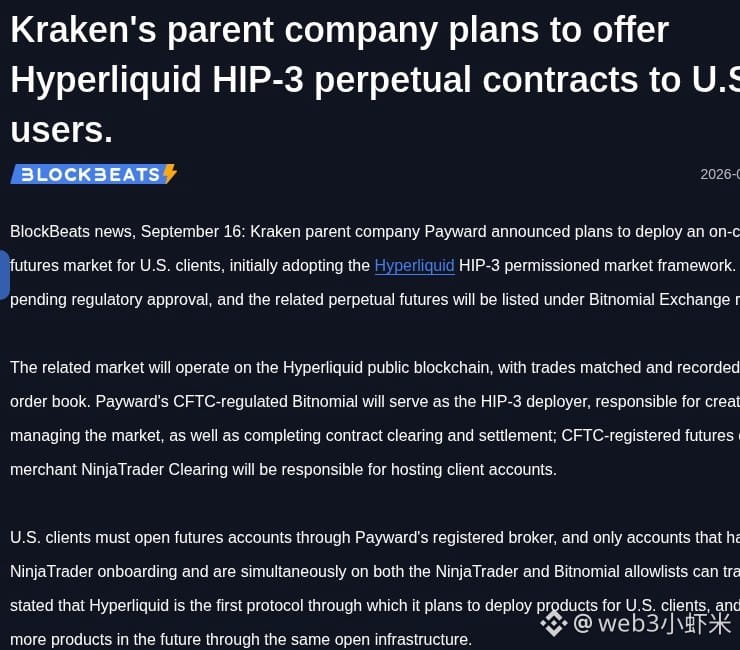
Kraken’s parent company Payward announced that it plans to bring Hyperliquid perpetual contracts to the U.S. The rollout won’t be a simple launch—instead, it will use a HIP-3 licensed-market architecture: Bitnomial Exchange, regulated by the CFTC, is responsible for deploying, managing the market, and handling clearing and settlement. During the registration period, the registered futures broker NinjaTrader Clearing will take on clients’ accounts. Users must complete onboarding with NinjaTrader and simultaneously join the whitelists of both NinjaTrader and Bitnomial to participate. The plan is still subject to regulatory approval.
This suggests that Hyperliquid could become the first protocol to be supported by Payward’s open infrastructure access, and also one of the first HIP-3 mechanism, license-based perpetual markets. Even more noteworthy is that the on-chain protocol is attempting to connect with U.S. derivatives users through a pipeline involving licensed exchanges and brokers. If it goes smoothly, it would indicate that the combination of “on-chain liquidity + a traditional compliant account system” is replicable—and more products may be onboarded later.
In the near term, the focus is the approval progress. In the long run, the key question is whether this model can open a compliant perpetual trading entry point for U.S. users.#Hyperliquid #Kraken #加密合规
Kraken’s parent company Payward announced that it plans to bring Hyperliquid perpetual contracts to the U.S. The rollout won’t be a simple launch—instead, it will use a HIP-3 licensed-market architecture: Bitnomial Exchange, regulated by the CFTC, is responsible for deploying, managing the market, and handling clearing and settlement. During the registration period, the registered futures broker NinjaTrader Clearing will take on clients’ accounts. Users must complete onboarding with NinjaTrader and simultaneously join the whitelists of both NinjaTrader and Bitnomial to participate. The plan is still subject to regulatory approval.
This suggests that Hyperliquid could become the first protocol to be supported by Payward’s open infrastructure access, and also one of the first HIP-3 mechanism, license-based perpetual markets. Even more noteworthy is that the on-chain protocol is attempting to connect with U.S. derivatives users through a pipeline involving licensed exchanges and brokers. If it goes smoothly, it would indicate that the combination of “on-chain liquidity + a traditional compliant account system” is replicable—and more products may be onboarded later.
In the near term, the focus is the approval progress. In the long run, the key question is whether this model can open a compliant perpetual trading entry point for U.S. users.#Hyperliquid #Kraken #加密合规
This suggests that Hyperliquid could become the first protocol to be supported by Payward’s open infrastructure access, and also one of the first HIP-3 mechanism, license-based perpetual markets. Even more noteworthy is that the on-chain protocol is attempting to connect with U.S. derivatives users through a pipeline involving licensed exchanges and brokers. If it goes smoothly, it would indicate that the combination of “on-chain liquidity + a traditional compliant account system” is replicable—and more products may be onboarded later.
In the near term, the focus is the approval progress. In the long run, the key question is whether this model can open a compliant perpetual trading entry point for U.S. users.#Hyperliquid #Kraken #加密合规
27
Kraken’s parent company Payward announced plans to launch a perpetual contract market for U.S. users based on the Hyperliquid HIP-3 mechanism. This will be one of the first licensed perpetual contract deployments under this mechanism.
Compliance architecture is at the core: Bitnomial Exchange, a designated contract market regulated by the CFTC, is responsible for market creation, management, and clearing and settlement; NinjaTrader Clearing, a CFTC-registered futures broker, will handle customers’ accounts. Users must complete account opening with NinjaTrader and, at the same time, be added to both the NinjaTrader and Bitnomial whitelists in order to trade. The entire plan still requires regulatory approval.
This means Hyperliquid is trying to enter the U.S. market via a licensed channel combining a DCM and an FCM, rather than continuing to rely on an offshore structure. If it rolls out smoothly, Payward may also connect more products based on the same open infrastructure later on. For the $HYPE ecosystem, a compliant on-ramp could bring new users and liquidity, but the approval timeline, whitelist thresholds, and real trading limitations still need to be watched.
#Hyperliquid #Kraken #crypto regulation
Kraken’s parent company Payward announced plans to launch a perpetual contract market for U.S. users based on the Hyperliquid HIP-3 mechanism. This will be one of the first licensed perpetual contract deployments under this mechanism.
Compliance architecture is at the core: Bitnomial Exchange, a designated contract market regulated by the CFTC, is responsible for market creation, management, and clearing and settlement; NinjaTrader Clearing, a CFTC-registered futures broker, will handle customers’ accounts. Users must complete account opening with NinjaTrader and, at the same time, be added to both the NinjaTrader and Bitnomial whitelists in order to trade. The entire plan still requires regulatory approval.
This means Hyperliquid is trying to enter the U.S. market via a licensed channel combining a DCM and an FCM, rather than continuing to rely on an offshore structure. If it rolls out smoothly, Payward may also connect more products based on the same open infrastructure later on. For the $HYPE ecosystem, a compliant on-ramp could bring new users and liquidity, but the approval timeline, whitelist thresholds, and real trading limitations still need to be watched.
#Hyperliquid #Kraken #crypto regulation
Compliance architecture is at the core: Bitnomial Exchange, a designated contract market regulated by the CFTC, is responsible for market creation, management, and clearing and settlement; NinjaTrader Clearing, a CFTC-registered futures broker, will handle customers’ accounts. Users must complete account opening with NinjaTrader and, at the same time, be added to both the NinjaTrader and Bitnomial whitelists in order to trade. The entire plan still requires regulatory approval.
This means Hyperliquid is trying to enter the U.S. market via a licensed channel combining a DCM and an FCM, rather than continuing to rely on an offshore structure. If it rolls out smoothly, Payward may also connect more products based on the same open infrastructure later on. For the $HYPE ecosystem, a compliant on-ramp could bring new users and liquidity, but the approval timeline, whitelist thresholds, and real trading limitations still need to be watched.
#Hyperliquid #Kraken #crypto regulation
41

·
--
Kraken parent company Payward announced plans to roll out perpetual contracts for U.S. users based on the Hyperliquid HIP-3 mechanism. This is not a simple listing—it involves integrating the on-chain protocol into the CFTC regulatory framework. Bitnomial Exchange will be responsible for market creation, management, and clearing and settlement, while NinjaTrader Clearing will handle customer accounts. Users must complete account opening and be added to both parties’ whitelists at the same time; the plan is still pending regulatory approval.
The highlight is that Hyperliquid becomes the first protocol Payward will deploy in the U.S. Going forward, more products will be connected using the same open infrastructure. If implemented, U.S. users will have an additional compliant pathway to participate in high-performance perpetual trading, and it can serve as a template for DeFi protocols to enter traditional regulated markets. In the short term, watch the approval timeline; in the medium term, focus on liquidity and product expansion. $HYPE
#Hyperliquid #Kraken #加密监管
Kraken parent company Payward announced plans to roll out perpetual contracts for U.S. users based on the Hyperliquid HIP-3 mechanism. This is not a simple listing—it involves integrating the on-chain protocol into the CFTC regulatory framework. Bitnomial Exchange will be responsible for market creation, management, and clearing and settlement, while NinjaTrader Clearing will handle customer accounts. Users must complete account opening and be added to both parties’ whitelists at the same time; the plan is still pending regulatory approval.
The highlight is that Hyperliquid becomes the first protocol Payward will deploy in the U.S. Going forward, more products will be connected using the same open infrastructure. If implemented, U.S. users will have an additional compliant pathway to participate in high-performance perpetual trading, and it can serve as a template for DeFi protocols to enter traditional regulated markets. In the short term, watch the approval timeline; in the medium term, focus on liquidity and product expansion. $HYPE
#Hyperliquid #Kraken #加密监管
The highlight is that Hyperliquid becomes the first protocol Payward will deploy in the U.S. Going forward, more products will be connected using the same open infrastructure. If implemented, U.S. users will have an additional compliant pathway to participate in high-performance perpetual trading, and it can serve as a template for DeFi protocols to enter traditional regulated markets. In the short term, watch the approval timeline; in the medium term, focus on liquidity and product expansion. $HYPE
#Hyperliquid #Kraken #加密监管
50
·
--
Click into the rhythm: Kraken’s parent company, Payward, plans to bring Hyperliquid HIP-3 licensing-perpetuals to U.S. users, using on-chain order books. Bitnomial will act as the deployer for creation and settlement, NinjaTrader Clearing will custody the account, and there will also need to be a bidirectional whitelist—overall, everything is still pending regulatory approval. Hyperliquid is the first protocol it plans to roll out for U.S. users.
$HYPE #Hyperliquid #Kraken
Click into the rhythm: Kraken’s parent company, Payward, plans to bring Hyperliquid HIP-3 licensing-perpetuals to U.S. users, using on-chain order books. Bitnomial will act as the deployer for creation and settlement, NinjaTrader Clearing will custody the account, and there will also need to be a bidirectional whitelist—overall, everything is still pending regulatory approval. Hyperliquid is the first protocol it plans to roll out for U.S. users.
$HYPE #Hyperliquid #Kraken
$HYPE #Hyperliquid #Kraken
120
·
--
Verified
The advantages of the three major US institution chains
The core advantage of Robinhood Chain is that it is close to the 30 million US stock-broker users and trading entry points it connects to. Arc’s core advantage is Circle—global’s largest compliant stablecoin issuer—along with USDC and TradFi. Ink’s core advantage lies in Kraken, centralized exchange (CEX) fund entry, the Superchain, and DeFi.
So the “traffic entry points” behind these three chains are actually different.
And what’s most worth关注 about Ink is not only the chain itself, but also how Kraken connects the DeFi pathway through Ink—meaning users, capital, and trading demand that previously stayed on the CEX are further brought onto-chain. Kraken’s positioning of Ink is, in itself, as the DeFi foundational layer of the Superchain, emphasizing Kraken’s security capabilities, brand, and user entry points.
In essence, Ink is an Ethereum Layer 2 built on the Optimism OP Stack, and it is also part of Optimism’s Superchain. The mainnet went live on December 18, 2024.
Kraken’s Ink ecosystem priorities are well worth watching:
1. UNI. Uniswap is an important DEX and liquidity infrastructure in the Ink ecosystem. Its core value is DEX, AMM, and liquidity. UNI is increasingly looking less like a standalone “DEX token,” and more like liquidity infrastructure behind different chains and different financial platforms.
2. VELO. Velodrome is an important DEX and AMM in the Ink ecosystem, and also a very important liquidity infrastructure for the Superchain ecosystem.
3. Nado. Its core products are spot trading, perpetual trading, and trading infrastructure, making it one of the more important trading applications in the Ink ecosystem.
4. Tydro. Its core product is lending—fundamentally rounding out Ink ecosystem’s lending capabilities and capital efficiency.
5. Even more worth关注 is INK itself. One of the biggest differences from Robinhood Chain is that Ink has its own token plan. The total supply of INK is 1 billion. The token has not yet launched TGE, but Ink has already introduced Ink Points. The first Points begin to be tracked on April 13, 2026, and Kraken Pro’s activities have been clearly included in the Points system.
Next, what needs to be重点关注 is: how will the INK token be ultimately allocated? How much weight will Kraken users have? How much weight will ecosystem projects such as Velodrome, Nado, and Tydro receive? Will on-chain interactions actually be incorporated into the final allocation model? These are the real variables to watch going forward.
$UNI $VELODROME
{future}(VELODROMEUSDT)
#Nado #Tydro #INK #Kraken
The advantages of the three major US institution chains
The core advantage of Robinhood Chain is that it is close to the 30 million US stock-broker users and trading entry points it connects to. Arc’s core advantage is Circle—global’s largest compliant stablecoin issuer—along with USDC and TradFi. Ink’s core advantage lies in Kraken, centralized exchange (CEX) fund entry, the Superchain, and DeFi.
So the “traffic entry points” behind these three chains are actually different.
And what’s most worth关注 about Ink is not only the chain itself, but also how Kraken connects the DeFi pathway through Ink—meaning users, capital, and trading demand that previously stayed on the CEX are further brought onto-chain. Kraken’s positioning of Ink is, in itself, as the DeFi foundational layer of the Superchain, emphasizing Kraken’s security capabilities, brand, and user entry points.
In essence, Ink is an Ethereum Layer 2 built on the Optimism OP Stack, and it is also part of Optimism’s Superchain. The mainnet went live on December 18, 2024.
Kraken’s Ink ecosystem priorities are well worth watching:
1. UNI. Uniswap is an important DEX and liquidity infrastructure in the Ink ecosystem. Its core value is DEX, AMM, and liquidity. UNI is increasingly looking less like a standalone “DEX token,” and more like liquidity infrastructure behind different chains and different financial platforms.
2. VELO. Velodrome is an important DEX and AMM in the Ink ecosystem, and also a very important liquidity infrastructure for the Superchain ecosystem.
3. Nado. Its core products are spot trading, perpetual trading, and trading infrastructure, making it one of the more important trading applications in the Ink ecosystem.
4. Tydro. Its core product is lending—fundamentally rounding out Ink ecosystem’s lending capabilities and capital efficiency.
5. Even more worth关注 is INK itself. One of the biggest differences from Robinhood Chain is that Ink has its own token plan. The total supply of INK is 1 billion. The token has not yet launched TGE, but Ink has already introduced Ink Points. The first Points begin to be tracked on April 13, 2026, and Kraken Pro’s activities have been clearly included in the Points system.
Next, what needs to be重点关注 is: how will the INK token be ultimately allocated? How much weight will Kraken users have? How much weight will ecosystem projects such as Velodrome, Nado, and Tydro receive? Will on-chain interactions actually be incorporated into the final allocation model? These are the real variables to watch going forward.
$UNI $VELODROME
#Nado #Tydro #INK #Kraken
The core advantage of Robinhood Chain is that it is close to the 30 million US stock-broker users and trading entry points it connects to. Arc’s core advantage is Circle—global’s largest compliant stablecoin issuer—along with USDC and TradFi. Ink’s core advantage lies in Kraken, centralized exchange (CEX) fund entry, the Superchain, and DeFi.
So the “traffic entry points” behind these three chains are actually different.
And what’s most worth关注 about Ink is not only the chain itself, but also how Kraken connects the DeFi pathway through Ink—meaning users, capital, and trading demand that previously stayed on the CEX are further brought onto-chain. Kraken’s positioning of Ink is, in itself, as the DeFi foundational layer of the Superchain, emphasizing Kraken’s security capabilities, brand, and user entry points.
In essence, Ink is an Ethereum Layer 2 built on the Optimism OP Stack, and it is also part of Optimism’s Superchain. The mainnet went live on December 18, 2024.
Kraken’s Ink ecosystem priorities are well worth watching:
1. UNI. Uniswap is an important DEX and liquidity infrastructure in the Ink ecosystem. Its core value is DEX, AMM, and liquidity. UNI is increasingly looking less like a standalone “DEX token,” and more like liquidity infrastructure behind different chains and different financial platforms.
2. VELO. Velodrome is an important DEX and AMM in the Ink ecosystem, and also a very important liquidity infrastructure for the Superchain ecosystem.
3. Nado. Its core products are spot trading, perpetual trading, and trading infrastructure, making it one of the more important trading applications in the Ink ecosystem.
4. Tydro. Its core product is lending—fundamentally rounding out Ink ecosystem’s lending capabilities and capital efficiency.
5. Even more worth关注 is INK itself. One of the biggest differences from Robinhood Chain is that Ink has its own token plan. The total supply of INK is 1 billion. The token has not yet launched TGE, but Ink has already introduced Ink Points. The first Points begin to be tracked on April 13, 2026, and Kraken Pro’s activities have been clearly included in the Points system.
Next, what needs to be重点关注 is: how will the INK token be ultimately allocated? How much weight will Kraken users have? How much weight will ecosystem projects such as Velodrome, Nado, and Tydro receive? Will on-chain interactions actually be incorporated into the final allocation model? These are the real variables to watch going forward.
$UNI $VELODROME
#Nado #Tydro #INK #Kraken
1
2.6k
·
--
Nasdaq has landed a deal: Nasdaq Ventures has agreed to invest about $100 million into Kraken’s parent company, Payward, to continue pushing Nasdaq Equity Tokens (NETs), and has signed a new market surveillance cooperation agreement. Both sides expect NETs to launch in Q2 2027, riding on Kraken’s xStocks ecosystem, aiming to run tokenized stocks on a “24/7” track while preserving shareholder rights and the risk controls of traditional markets. Payward will also roll Nasdaq’s surveillance technology out across crypto, stocks, tokenized assets, futures, and options—traditional exchanges are putting real money into crypto infrastructure, with a more grounded pace than slogans. #代币化股票 #Kraken #Nasdaq
Nasdaq has landed a deal: Nasdaq Ventures has agreed to invest about $100 million into Kraken’s parent company, Payward, to continue pushing Nasdaq Equity Tokens (NETs), and has signed a new market surveillance cooperation agreement. Both sides expect NETs to launch in Q2 2027, riding on Kraken’s xStocks ecosystem, aiming to run tokenized stocks on a “24/7” track while preserving shareholder rights and the risk controls of traditional markets. Payward will also roll Nasdaq’s surveillance technology out across crypto, stocks, tokenized assets, futures, and options—traditional exchanges are putting real money into crypto infrastructure, with a more grounded pace than slogans. #代币化股票 #Kraken #Nasdaq
7

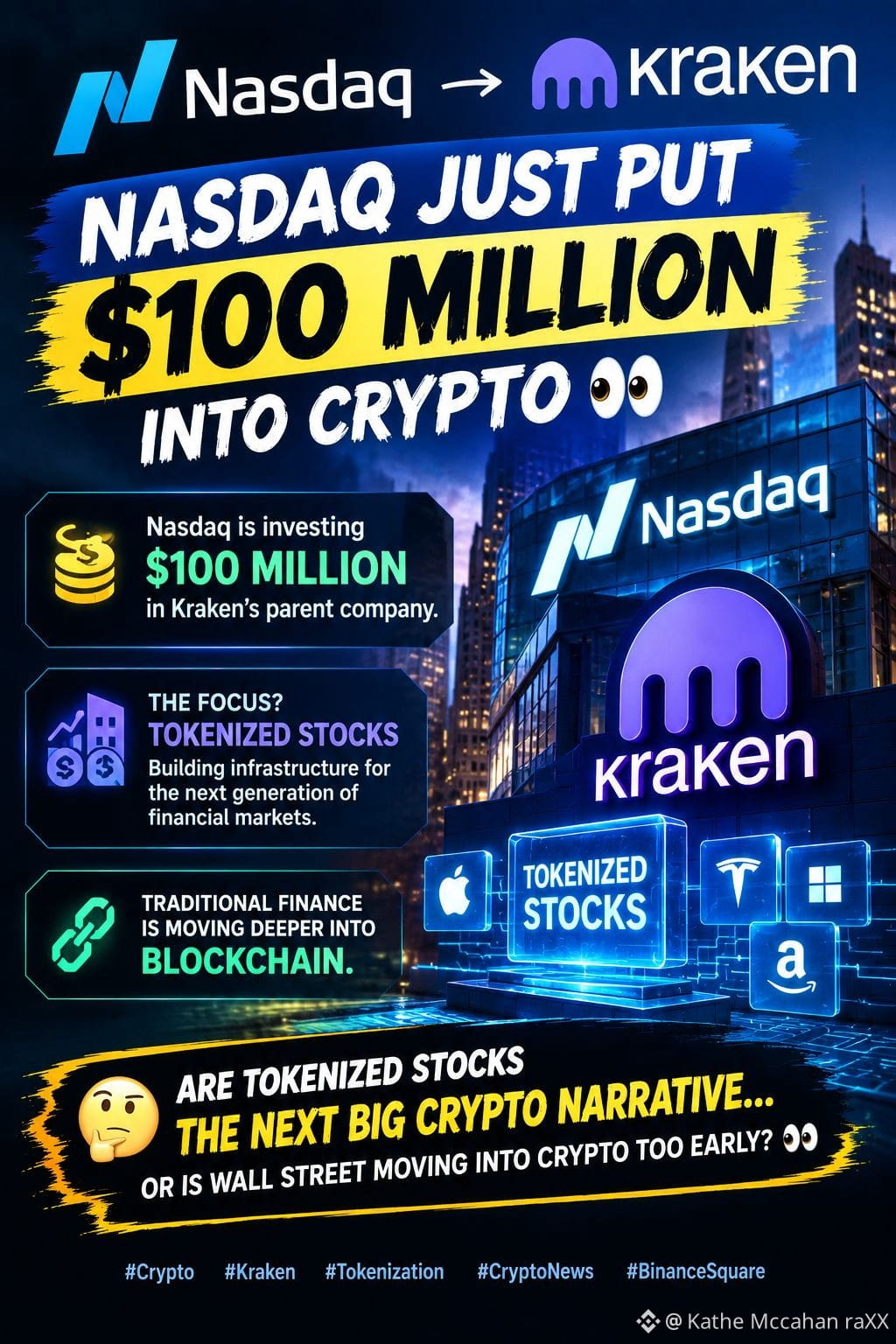
🚨 NASDAQ JUST PUT $100 MILLION INTO CRYPTO 👀
$Nasdaq is investing $100 MILLION in Kraken’s parent company.
But here’s the interesting part…
They’re not just buying crypto.
The partnership is focused on building infrastructure for TOKENIZED STOCKS. 📈
Traditional finance is slowly moving deeper into blockchain.
And now one of the world’s biggest stock exchanges is putting serious money behind it.
The question is:
Are tokenized stocks the next BIG crypto narrative…
or is Wall Street moving into crypto too early? 👀
#crypto #Kraken #Tokenization #CryptoNews #BinanceSquare
🚨 NASDAQ JUST PUT $100 MILLION INTO CRYPTO 👀
$Nasdaq is investing $100 MILLION in Kraken’s parent company.
But here’s the interesting part…
They’re not just buying crypto.
The partnership is focused on building infrastructure for TOKENIZED STOCKS. 📈
Traditional finance is slowly moving deeper into blockchain.
And now one of the world’s biggest stock exchanges is putting serious money behind it.
The question is:
Are tokenized stocks the next BIG crypto narrative…
or is Wall Street moving into crypto too early? 👀
#crypto #Kraken #Tokenization #CryptoNews #BinanceSquare
$Nasdaq is investing $100 MILLION in Kraken’s parent company.
But here’s the interesting part…
They’re not just buying crypto.
The partnership is focused on building infrastructure for TOKENIZED STOCKS. 📈
Traditional finance is slowly moving deeper into blockchain.
And now one of the world’s biggest stock exchanges is putting serious money behind it.
The question is:
Are tokenized stocks the next BIG crypto narrative…
or is Wall Street moving into crypto too early? 👀
#crypto #Kraken #Tokenization #CryptoNews #BinanceSquare
1
Nasdaq pours $100 million into Kraken to build tokenization infrastructure
- Nasdaq is investing $100 million into Kraken’s parent company, according to a report from Bloomberg.
- This deal will help build infrastructure for tokenization (asset encoding).
- The collaboration between Nasdaq and Kraken shows increased positivity from major corporations toward the blockchain technology industry.
#BinanceSquare #CryptoNews #BTC #ETH #Kraken Tokenization
$btc $eth
vlikevn Titanbot
Source: Bitcoin Magazine
Nasdaq pours $100 million into Kraken to build tokenization infrastructure
- Nasdaq is investing $100 million into Kraken’s parent company, according to a report from Bloomberg.
- This deal will help build infrastructure for tokenization (asset encoding).
- The collaboration between Nasdaq and Kraken shows increased positivity from major corporations toward the blockchain technology industry.
#BinanceSquare #CryptoNews #BTC #ETH #Kraken Tokenization
$btc $eth
vlikevn Titanbot
Source: Bitcoin Magazine
- Nasdaq is investing $100 million into Kraken’s parent company, according to a report from Bloomberg.
- This deal will help build infrastructure for tokenization (asset encoding).
- The collaboration between Nasdaq and Kraken shows increased positivity from major corporations toward the blockchain technology industry.
#BinanceSquare #CryptoNews #BTC #ETH #Kraken Tokenization
$btc $eth
vlikevn Titanbot
Source: Bitcoin Magazine
67
·
--
Nasdaq invests $100M in Kraken parent Payward at a $21B valuation, expanding a strategic partnership to bring tokenized, voting-enabled equities to crypto-exchange users. A bold bridge between traditional markets and on-chain ownership. #CryptoNews #TokenizedEquities #Kraken
Nasdaq invests $100M in Kraken parent Payward at a $21B valuation, expanding a strategic partnership to bring tokenized, voting-enabled equities to crypto-exchange users. A bold bridge between traditional markets and on-chain ownership. #CryptoNews #TokenizedEquities #Kraken

4

🗓️ Postponement of Payward’s First Public Offering to the parent company of Kraken
Payward, the parent company of the cryptocurrency trading platform Kraken, announced a further delay to its IPO. The company, headquartered in Wyoming, stated that it will not go public before the second quarter of 2027 at the very least. This delay is the company’s second.
━━━━━━━━━━━━━━
📊 Impact: 📈 High
🏷️ EXCHANGE
#Kraken #IPO #Cryptocurrency #Exchange #Market
📰 Source: biztoc.com
🗓️ Postponement of Payward’s First Public Offering to the parent company of Kraken
Payward, the parent company of the cryptocurrency trading platform Kraken, announced a further delay to its IPO. The company, headquartered in Wyoming, stated that it will not go public before the second quarter of 2027 at the very least. This delay is the company’s second.
━━━━━━━━━━━━━━
📊 Impact: 📈 High
🏷️ EXCHANGE
#Kraken #IPO #Cryptocurrency #Exchange #Market
📰 Source: biztoc.com
Payward, the parent company of the cryptocurrency trading platform Kraken, announced a further delay to its IPO. The company, headquartered in Wyoming, stated that it will not go public before the second quarter of 2027 at the very least. This delay is the company’s second.
━━━━━━━━━━━━━━
📊 Impact: 📈 High
🏷️ EXCHANGE
#Kraken #IPO #Cryptocurrency #Exchange #Market
📰 Source: biztoc.com
33
🗓️ Payward’s Parent Company for Kraken Delays Its IPO Again
Payward, the parent company of the cryptocurrency trading platform Kraken, has announced another delay in its plans for an initial public offering. This delay comes as the company continues to assess market conditions and ever-changing regulatory compliance requirements.
━━━━━━━━━━━━━━
📊 Impact: 📈 High
🏷️ EXCHANGE
#Kraken #IPO #Payward #Exchange #Market
📰 Source: cryptoprowl.com
🗓️ Payward’s Parent Company for Kraken Delays Its IPO Again
Payward, the parent company of the cryptocurrency trading platform Kraken, has announced another delay in its plans for an initial public offering. This delay comes as the company continues to assess market conditions and ever-changing regulatory compliance requirements.
━━━━━━━━━━━━━━
📊 Impact: 📈 High
🏷️ EXCHANGE
#Kraken #IPO #Payward #Exchange #Market
📰 Source: cryptoprowl.com
Payward, the parent company of the cryptocurrency trading platform Kraken, has announced another delay in its plans for an initial public offering. This delay comes as the company continues to assess market conditions and ever-changing regulatory compliance requirements.
━━━━━━━━━━━━━━
📊 Impact: 📈 High
🏷️ EXCHANGE
#Kraken #IPO #Payward #Exchange #Market
📰 Source: cryptoprowl.com
41
🤝 Strategic partnership between SoFi and the Kraken platform to connect financial services and digital currencies
The cryptocurrency trading platform Kraken announced a potential collaboration with the financial institution SoFi. This move aims to explore ways to integrate traditional financial services with the digital asset ecosystem, which could represent a development in how users interact with both sectors.
━━━━━━━━━━━━━━
📊 Impact: 📈 High
🏷️ EXCHANGE
#Kraken #SoFi #CryptoBanking #Partnership #Fintech
📰 Source: cryptobriefing.com
🤝 Strategic partnership between SoFi and the Kraken platform to connect financial services and digital currencies
The cryptocurrency trading platform Kraken announced a potential collaboration with the financial institution SoFi. This move aims to explore ways to integrate traditional financial services with the digital asset ecosystem, which could represent a development in how users interact with both sectors.
━━━━━━━━━━━━━━
📊 Impact: 📈 High
🏷️ EXCHANGE
#Kraken #SoFi #CryptoBanking #Partnership #Fintech
📰 Source: cryptobriefing.com
The cryptocurrency trading platform Kraken announced a potential collaboration with the financial institution SoFi. This move aims to explore ways to integrate traditional financial services with the digital asset ecosystem, which could represent a development in how users interact with both sectors.
━━━━━━━━━━━━━━
📊 Impact: 📈 High
🏷️ EXCHANGE
#Kraken #SoFi #CryptoBanking #Partnership #Fintech
📰 Source: cryptobriefing.com
12


Kraken’s parent company Payward announced that it has postponed its initial public offering (IPO) plans to the second quarter of 2027 at the earliest, due to challenging market conditions and strategic considerations. The company had previously submitted a confidential application to be listed in the U.S. last November, but current market dynamics have led to an extension of the process. This delay clearly highlights the cautious approach taken by major crypto platforms toward going public. #Kraken #IPO #Crypto
Kraken’s parent company Payward announced that it has postponed its initial public offering (IPO) plans to the second quarter of 2027 at the earliest, due to challenging market conditions and strategic considerations. The company had previously submitted a confidential application to be listed in the U.S. last November, but current market dynamics have led to an extension of the process. This delay clearly highlights the cautious approach taken by major crypto platforms toward going public. #Kraken #IPO #Crypto
29
·
--
Payward, Kraken’s parent, delays its U.S. IPO to Q2 2027 at the earliest, signaling ongoing headwinds for crypto listings. After confidentially filing last November, IPO plans have been paused amid difficult market conditions. What this means for liquidity and investor sentiment in crypto remains to be seen. $BTC #CryptoNews #IPO #Kraken
Payward, Kraken’s parent, delays its U.S. IPO to Q2 2027 at the earliest, signaling ongoing headwinds for crypto listings. After confidentially filing last November, IPO plans have been paused amid difficult market conditions. What this means for liquidity and investor sentiment in crypto remains to be seen. $BTC #CryptoNews #IPO #Kraken
28
Log in to explore more content
Join global crypto users on Binance Square
⚡️ Get latest and useful information about crypto.
💬 Trusted by the world’s largest crypto exchange.
👍 Discover real insights from verified creators.
Email / Phone number
Trending Topics
1
#BTCFallsBelow$83000
4,385 views
73 Discussing
2
#BitgetDetailsSecurityIncidentTimeline
249 views
45 Discussing
3
#BitcoinSpotETFs$2.39BWeeklyNetInflow
398 views
12 Discussing
4
#FedProposesPaymentStablecoinRules
19,102 views
417 Discussing
5
#ChinaMayLetAlibabaByteDanceBuyNvidiaChips
21,143 views
447 Discussing
6
#USChinaRelease$30BTariffCutProductLists
2,833 views
48 Discussing
7
#SKoreaFSCConsidersVirtualAssetMarketMaker
13,539 views
339 Discussing
8
#ChinaIndustrialProfitGrowthSlowsFourthMonth
13,151 views
331 Discussing
9
#BitwiseFilesFinalNEARSpotETFProspectus
132,183 views
1,929 Discussing
10
#BitgetHackerMoves$83MStolenXRP
42,380 views
186 Discussing