
#jev
jev
83 views
3 Discussing
Hot
Latest

·
--
📰 On September 15, TypeSafe AI released Jev. Surprisingly, within just 24 hours, about 13% of Vercel’s paying teams started using it, and Cloudflare, LangChain, and Langfuse also provided native support within a few days.
The most special thing about Jev is that it doesn’t handle chat at all. It doesn’t write articles or generate full answers—it only outputs probabilities, scores, and confidence levels. The question types are limited to true/false judgments, multiple choice, and rating.
🔥 This hits a common pain point in software automation: many systems only need to determine things like “Is this spam?” “Should we block it?” “Which route should we take?”—yet they first have to make the large model generate a paragraph, and then parse the result from it. Jev directly provides structured conclusions, reducing generation and parsing. That makes it better suited for high-volume calls in terms of speed, cost, and format consistency.
The official claim is that, for single-system tasks, Jev is 40 to 200 times faster than comparable large language models, with costs 40 to 400 times lower. In third-party tests, replacing the OpenAI model with Jev for safe command classification increased speed by 5 to 18 times. In another test, 60 AI Agents completed 13,200 decisions; Jev’s actual cost was $0.35, compared to $37.64 for leading models—a gap of about 107x.
💡 But it isn’t a replacement for chat models. Jev can only answer pre-designed judgment questions, and it provides stable output formats—but that doesn’t mean its judgments will always be correct. So-called “no hallucinations” is more about not generating unparseable content, rather than never mislabeling an email as spam.
TypeSafe AI was founded by former OpenAI researcher Diogo Almeida. The team also announced a $40 million seed round. Honestly, Jev feels more like a fast decision engine bolted onto software: it doesn’t need to be able to “talk”—it just needs to make fewer mistakes where decisions have to be made, and be cheap enough. In what kinds of products do you think this model will see large-scale adoption first?
#AI #Jev #大模型 #Developer Tools
📰 On September 15, TypeSafe AI released Jev. Surprisingly, within just 24 hours, about 13% of Vercel’s paying teams started using it, and Cloudflare, LangChain, and Langfuse also provided native support within a few days.
The most special thing about Jev is that it doesn’t handle chat at all. It doesn’t write articles or generate full answers—it only outputs probabilities, scores, and confidence levels. The question types are limited to true/false judgments, multiple choice, and rating.
🔥 This hits a common pain point in software automation: many systems only need to determine things like “Is this spam?” “Should we block it?” “Which route should we take?”—yet they first have to make the large model generate a paragraph, and then parse the result from it. Jev directly provides structured conclusions, reducing generation and parsing. That makes it better suited for high-volume calls in terms of speed, cost, and format consistency.
The official claim is that, for single-system tasks, Jev is 40 to 200 times faster than comparable large language models, with costs 40 to 400 times lower. In third-party tests, replacing the OpenAI model with Jev for safe command classification increased speed by 5 to 18 times. In another test, 60 AI Agents completed 13,200 decisions; Jev’s actual cost was $0.35, compared to $37.64 for leading models—a gap of about 107x.
💡 But it isn’t a replacement for chat models. Jev can only answer pre-designed judgment questions, and it provides stable output formats—but that doesn’t mean its judgments will always be correct. So-called “no hallucinations” is more about not generating unparseable content, rather than never mislabeling an email as spam.
TypeSafe AI was founded by former OpenAI researcher Diogo Almeida. The team also announced a $40 million seed round. Honestly, Jev feels more like a fast decision engine bolted onto software: it doesn’t need to be able to “talk”—it just needs to make fewer mistakes where decisions have to be made, and be cheap enough. In what kinds of products do you think this model will see large-scale adoption first?
#AI #Jev #大模型 #Developer Tools
The most special thing about Jev is that it doesn’t handle chat at all. It doesn’t write articles or generate full answers—it only outputs probabilities, scores, and confidence levels. The question types are limited to true/false judgments, multiple choice, and rating.
🔥 This hits a common pain point in software automation: many systems only need to determine things like “Is this spam?” “Should we block it?” “Which route should we take?”—yet they first have to make the large model generate a paragraph, and then parse the result from it. Jev directly provides structured conclusions, reducing generation and parsing. That makes it better suited for high-volume calls in terms of speed, cost, and format consistency.
The official claim is that, for single-system tasks, Jev is 40 to 200 times faster than comparable large language models, with costs 40 to 400 times lower. In third-party tests, replacing the OpenAI model with Jev for safe command classification increased speed by 5 to 18 times. In another test, 60 AI Agents completed 13,200 decisions; Jev’s actual cost was $0.35, compared to $37.64 for leading models—a gap of about 107x.
💡 But it isn’t a replacement for chat models. Jev can only answer pre-designed judgment questions, and it provides stable output formats—but that doesn’t mean its judgments will always be correct. So-called “no hallucinations” is more about not generating unparseable content, rather than never mislabeling an email as spam.
TypeSafe AI was founded by former OpenAI researcher Diogo Almeida. The team also announced a $40 million seed round. Honestly, Jev feels more like a fast decision engine bolted onto software: it doesn’t need to be able to “talk”—it just needs to make fewer mistakes where decisions have to be made, and be cheap enough. In what kinds of products do you think this model will see large-scale adoption first?
#AI #Jev #大模型 #Developer Tools

12
·
--
📰 Over the past two days, Jev has suddenly gone viral. It’s a bit unusual: it doesn’t chat, doesn’t write code, and doesn’t generate long answers—it only makes judgments.
Some people use it to analyze 724 real-time ads in 40 seconds and make 8,724 decisions. Others connect it to Claude Code to specifically clean up unnecessary context. They also use it to serve as a judge for an AI Agent, checking whether the task was actually completed.
🔥 Even more extreme are the speed and cost. TypeSafe testing shows that Jev can reduce costs by up to 444.6×, including end-to-end latency.
To be honest, this is a bit mind-bending. We used to think the smarter the AI, the better. But once Agents really start running, they may have to handle hundreds of thousands—or even millions—of tiny decisions every day: which tool to call next, where to click on a webpage, and whether a task needs to be redone.
💡 Jev’s approach is to hand simple judgments to a dedicated model, and complex problems to a large model. What it returns isn’t a long paragraph, but something like Yes or No, one option from a set, or a score—plus a probability.
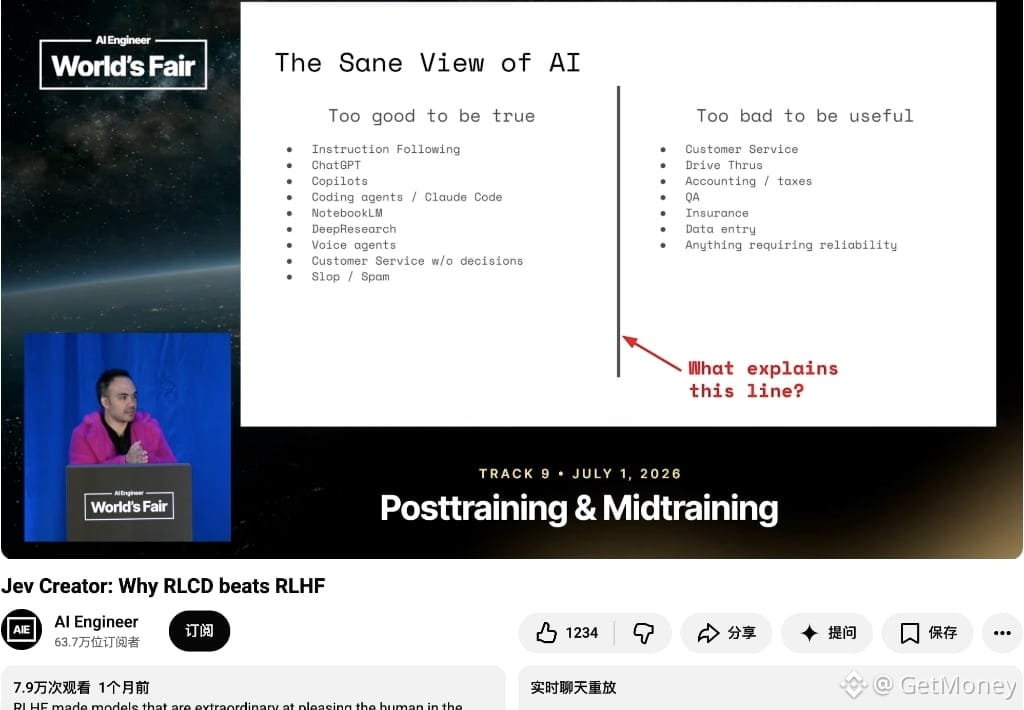
🤔 This also explains why the founders started reflecting on RLHF: AI is great at helping people, but still can’t fully do the work by itself. What true automation may need isn’t an even bigger brain, but a large number of fast, cheap judgments that also know how confident they are. Do you think Agents in the future will run first by relying on these “small judgment models”?
#Jev #AI Agent #人工智能 #Encrypted technology
📰 Over the past two days, Jev has suddenly gone viral. It’s a bit unusual: it doesn’t chat, doesn’t write code, and doesn’t generate long answers—it only makes judgments.
Some people use it to analyze 724 real-time ads in 40 seconds and make 8,724 decisions. Others connect it to Claude Code to specifically clean up unnecessary context. They also use it to serve as a judge for an AI Agent, checking whether the task was actually completed.
🔥 Even more extreme are the speed and cost. TypeSafe testing shows that Jev can reduce costs by up to 444.6×, including end-to-end latency.
To be honest, this is a bit mind-bending. We used to think the smarter the AI, the better. But once Agents really start running, they may have to handle hundreds of thousands—or even millions—of tiny decisions every day: which tool to call next, where to click on a webpage, and whether a task needs to be redone.
💡 Jev’s approach is to hand simple judgments to a dedicated model, and complex problems to a large model. What it returns isn’t a long paragraph, but something like Yes or No, one option from a set, or a score—plus a probability.
🤔 This also explains why the founders started reflecting on RLHF: AI is great at helping people, but still can’t fully do the work by itself. What true automation may need isn’t an even bigger brain, but a large number of fast, cheap judgments that also know how confident they are. Do you think Agents in the future will run first by relying on these “small judgment models”?
#Jev #AI Agent #人工智能 #Encrypted technology
Some people use it to analyze 724 real-time ads in 40 seconds and make 8,724 decisions. Others connect it to Claude Code to specifically clean up unnecessary context. They also use it to serve as a judge for an AI Agent, checking whether the task was actually completed.
🔥 Even more extreme are the speed and cost. TypeSafe testing shows that Jev can reduce costs by up to 444.6×, including end-to-end latency.
To be honest, this is a bit mind-bending. We used to think the smarter the AI, the better. But once Agents really start running, they may have to handle hundreds of thousands—or even millions—of tiny decisions every day: which tool to call next, where to click on a webpage, and whether a task needs to be redone.
💡 Jev’s approach is to hand simple judgments to a dedicated model, and complex problems to a large model. What it returns isn’t a long paragraph, but something like Yes or No, one option from a set, or a score—plus a probability.
🤔 This also explains why the founders started reflecting on RLHF: AI is great at helping people, but still can’t fully do the work by itself. What true automation may need isn’t an even bigger brain, but a large number of fast, cheap judgments that also know how confident they are. Do you think Agents in the future will run first by relying on these “small judgment models”?
#Jev #AI Agent #人工智能 #Encrypted technology



180
Log in to explore more content
Join global crypto users on Binance Square
⚡️ Get latest and useful information about crypto.
💬 Trusted by the world’s largest crypto exchange.
👍 Discover real insights from verified creators.
Email / Phone number
Trending Topics
1
#AIStocksWhatNext
207,321 views
2,272 Discussing
2
#BitcoinBreaksAboveMayHighNears$86K
6,946 views
124 Discussing
3
#DogecoinRises15%
17,423 views
672 Discussing
4
#$14BBitcoinOptionsExpireFriday
1,093 views
59 Discussing
5
#BNBMarketCapPassesBNYMellon
11,260 views
495 Discussing
6
#CryptoMarketCapReclaims$3Trillion
1,562 views
53 Discussing
7
#MuseOvertakesChatGPTAsTopFreeIOSApp
8,605 views
408 Discussing
8
#TokenizedStockPlatformsCouldLaunchNextQuarter
13,101 views
467 Discussing
9
#StrategyAdds950Bitcoin
18,177 views
522 Discussing
10
#CardanoAddedToX402KitForADAPayments
20,199 views
581 Discussing