

#globalstockfundssee
globalstockfundssee
606 views
23 Discussing
Hot
Latest

#GlobalStockFundsSee
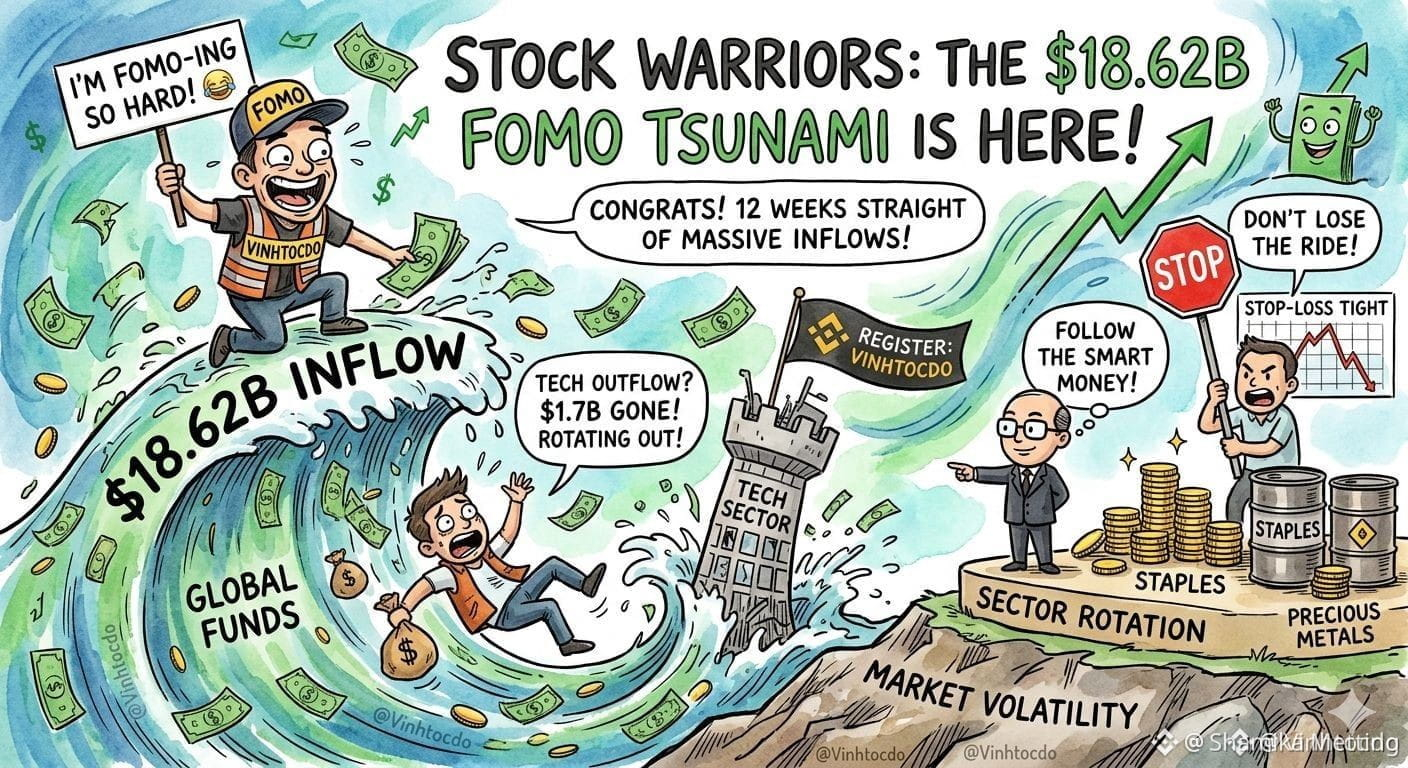
Congratulations to all stock warriors! 🎉 Global stock funds have just pulled in an additional $18.62 billion, marking 12 straight weeks of massive inflows! Total insanity recently: $237.57 billion! 💸
After a huge green week, even I couldn’t resist the ultimate FOMO! So it makes sense that global liquidity is exploding! 😂 But wait— the technology sector saw an outflow of $1.7 billion. Investors are leaving tech and moving into other sectors! 🔄
What should traders do?
1️⃣ Watch the shift: Money is moving. Don’t blindly buy the fall in technology; follow the smart capital as it heads toward consumer goods or precious metals! 🧭
2️⃣ Ride the momentum: Global stocks are at high record levels, but keep a tight stop-loss. Don’t let FOMO turn into losses! 📈
Not financial advice!
Please stay tuned
#stockmarket #FOMO #FinanceNews $SNDK
{future}(SNDKUSDT)
$SPCX
{future}(SPCXUSDT)
$BTC
{future}(BTCUSDT)
#GlobalStockFundsSee
Congratulations to all stock warriors! 🎉 Global stock funds have just pulled in an additional $18.62 billion, marking 12 straight weeks of massive inflows! Total insanity recently: $237.57 billion! 💸
After a huge green week, even I couldn’t resist the ultimate FOMO! So it makes sense that global liquidity is exploding! 😂 But wait— the technology sector saw an outflow of $1.7 billion. Investors are leaving tech and moving into other sectors! 🔄
What should traders do?
1️⃣ Watch the shift: Money is moving. Don’t blindly buy the fall in technology; follow the smart capital as it heads toward consumer goods or precious metals! 🧭
2️⃣ Ride the momentum: Global stocks are at high record levels, but keep a tight stop-loss. Don’t let FOMO turn into losses! 📈
Not financial advice!
Please stay tuned
#stockmarket #FOMO #FinanceNews $SNDK
$SPCX
$BTC
Congratulations to all stock warriors! 🎉 Global stock funds have just pulled in an additional $18.62 billion, marking 12 straight weeks of massive inflows! Total insanity recently: $237.57 billion! 💸
After a huge green week, even I couldn’t resist the ultimate FOMO! So it makes sense that global liquidity is exploding! 😂 But wait— the technology sector saw an outflow of $1.7 billion. Investors are leaving tech and moving into other sectors! 🔄
What should traders do?
1️⃣ Watch the shift: Money is moving. Don’t blindly buy the fall in technology; follow the smart capital as it heads toward consumer goods or precious metals! 🧭
2️⃣ Ride the momentum: Global stocks are at high record levels, but keep a tight stop-loss. Don’t let FOMO turn into losses! 📈
Not financial advice!
Please stay tuned
#stockmarket #FOMO #FinanceNews $SNDK
$SPCX
$BTC
1
137

·
--
Have you noticed how “global stock funds seeing inflows” is being treated as bullish, while crypto traders are still sitting in fear?
That gap is where people usually get chopped up. They sell $USDT into panic, chase late stock-market headlines, then come back to crypto only after the clean entries are gone.
Here’s the hot take: global stock fund demand is not automatically a green light for risk assets. It can also mean institutions are hiding in the most liquid, most defensible trade while uncertainty stays high. With the Fear & Greed Index around 38, crypto is not in euphoria mode. It’s in selective survival mode.
Look at the case study: when traditional markets pull attention, smaller crypto narratives often get ignored until liquidity rotates back. That’s why names like $POL and $MOVR can move quietly before the crowd notices. Not because every chart is bullish, but because attention is mispriced.
The mainstream narrative says money flowing into stocks means confidence is back. I think it means capital is being careful, and crypto traders should watch where liquidity is waiting, not just where headlines are loud.
Where do you think the next rotation goes from here? #GlobalStockFundsSee #SP500TopsRecord7800 #SECCancelsCryptoRulemakingMeeting
Have you noticed how “global stock funds seeing inflows” is being treated as bullish, while crypto traders are still sitting in fear?
That gap is where people usually get chopped up. They sell $USDT into panic, chase late stock-market headlines, then come back to crypto only after the clean entries are gone.
Here’s the hot take: global stock fund demand is not automatically a green light for risk assets. It can also mean institutions are hiding in the most liquid, most defensible trade while uncertainty stays high. With the Fear & Greed Index around 38, crypto is not in euphoria mode. It’s in selective survival mode.
Look at the case study: when traditional markets pull attention, smaller crypto narratives often get ignored until liquidity rotates back. That’s why names like $POL and $MOVR can move quietly before the crowd notices. Not because every chart is bullish, but because attention is mispriced.
The mainstream narrative says money flowing into stocks means confidence is back. I think it means capital is being careful, and crypto traders should watch where liquidity is waiting, not just where headlines are loud.
Where do you think the next rotation goes from here? #GlobalStockFundsSee #SP500TopsRecord7800 #SECCancelsCryptoRulemakingMeeting
That gap is where people usually get chopped up. They sell $USDT into panic, chase late stock-market headlines, then come back to crypto only after the clean entries are gone.
Here’s the hot take: global stock fund demand is not automatically a green light for risk assets. It can also mean institutions are hiding in the most liquid, most defensible trade while uncertainty stays high. With the Fear & Greed Index around 38, crypto is not in euphoria mode. It’s in selective survival mode.
Look at the case study: when traditional markets pull attention, smaller crypto narratives often get ignored until liquidity rotates back. That’s why names like $POL and $MOVR can move quietly before the crowd notices. Not because every chart is bullish, but because attention is mispriced.
The mainstream narrative says money flowing into stocks means confidence is back. I think it means capital is being careful, and crypto traders should watch where liquidity is waiting, not just where headlines are loud.
Where do you think the next rotation goes from here? #GlobalStockFundsSee #SP500TopsRecord7800 #SECCancelsCryptoRulemakingMeeting

187

·
--
Last week, the interesting part wasn’t crypto pumping, it was global stock funds quietly pulling attention while crypto traders sat in fear.
That’s the painful setup most investors know too well: you wait in $USDT because sentiment feels weak, then capital rotates somewhere else and you’re left wondering if you missed the real move. With the Fear & Greed Index around 38, the market is not euphoric. It’s cautious.
Case study: when traditional markets look safer, money often moves there first. We saw similar behavior during past risk-on cycles, where equities started leading before crypto caught a bid. In 2020 and parts of 2023, $BTC lagged at first, then followed once traders felt confident that liquidity was coming back.
The comparison matters because crypto is no longer trading in its own little bubble. If global stock funds keep attracting capital while $ETH and majors chop sideways, it may signal investors want risk, but with more “institutional comfort” first. That doesn’t kill the crypto thesis. It just changes the timing.
The lesson: watch rotation, not just candles. When stocks lead and stablecoin searches stay hot, the market may be telling us people are interested, but not fully deployed yet. Is this another delayed crypto catch-up setup, or is capital choosing equities over coins this time? #GlobalStockFundsSee #SP500TopsRecord7800 #SECCancelsCryptoRulemakingMeeting
Last week, the interesting part wasn’t crypto pumping, it was global stock funds quietly pulling attention while crypto traders sat in fear.
That’s the painful setup most investors know too well: you wait in $USDT because sentiment feels weak, then capital rotates somewhere else and you’re left wondering if you missed the real move. With the Fear & Greed Index around 38, the market is not euphoric. It’s cautious.
Case study: when traditional markets look safer, money often moves there first. We saw similar behavior during past risk-on cycles, where equities started leading before crypto caught a bid. In 2020 and parts of 2023, $BTC lagged at first, then followed once traders felt confident that liquidity was coming back.
The comparison matters because crypto is no longer trading in its own little bubble. If global stock funds keep attracting capital while $ETH and majors chop sideways, it may signal investors want risk, but with more “institutional comfort” first. That doesn’t kill the crypto thesis. It just changes the timing.
The lesson: watch rotation, not just candles. When stocks lead and stablecoin searches stay hot, the market may be telling us people are interested, but not fully deployed yet. Is this another delayed crypto catch-up setup, or is capital choosing equities over coins this time? #GlobalStockFundsSee #SP500TopsRecord7800 #SECCancelsCryptoRulemakingMeeting
That’s the painful setup most investors know too well: you wait in $USDT because sentiment feels weak, then capital rotates somewhere else and you’re left wondering if you missed the real move. With the Fear & Greed Index around 38, the market is not euphoric. It’s cautious.
Case study: when traditional markets look safer, money often moves there first. We saw similar behavior during past risk-on cycles, where equities started leading before crypto caught a bid. In 2020 and parts of 2023, $BTC lagged at first, then followed once traders felt confident that liquidity was coming back.
The comparison matters because crypto is no longer trading in its own little bubble. If global stock funds keep attracting capital while $ETH and majors chop sideways, it may signal investors want risk, but with more “institutional comfort” first. That doesn’t kill the crypto thesis. It just changes the timing.
The lesson: watch rotation, not just candles. When stocks lead and stablecoin searches stay hot, the market may be telling us people are interested, but not fully deployed yet. Is this another delayed crypto catch-up setup, or is capital choosing equities over coins this time? #GlobalStockFundsSee #SP500TopsRecord7800 #SECCancelsCryptoRulemakingMeeting

15
·
--
Why is nobody talking about global stock fund flows as a crypto signal instead of treating them like “TradFi noise”?
A lot of traders keep losing money because they only watch candles after the move has already happened. By the time $BTC pumps or dumps, the real rotation often started earlier in equities, bonds, and stablecoin positioning.
Here’s the hot take: if global stock funds are seeing pressure while the Fear & Greed Index sits at 39, crypto isn’t automatically “cheap.” It means capital is still cautious. In that environment, $USDT demand can matter more than hype, because sidelined liquidity tells you whether people are preparing to buy risk or just hiding from it.
Look at $BTC as the case study. Every time the market gets excited about a breakout, the bigger question is whether global risk appetite is actually improving. If stock funds are bleeding and rate-cut expectations keep shifting, crypto rallies can turn into exit liquidity fast. That doesn’t mean bearish forever. It means entries need patience, not FOMO.
The mainstream narrative says crypto moves on its own. I think that’s outdated. In 2026, crypto is part of the global liquidity map, and ignoring fund flows is like trading with one eye closed.
Are you watching global fund flows before entering crypto, or still trading only the chart? #GlobalStockFundsSee #BitcoinHoldsNear #CMESeptemberHikeOddsFallTo30
Why is nobody talking about global stock fund flows as a crypto signal instead of treating them like “TradFi noise”?
A lot of traders keep losing money because they only watch candles after the move has already happened. By the time $BTC pumps or dumps, the real rotation often started earlier in equities, bonds, and stablecoin positioning.
Here’s the hot take: if global stock funds are seeing pressure while the Fear & Greed Index sits at 39, crypto isn’t automatically “cheap.” It means capital is still cautious. In that environment, $USDT demand can matter more than hype, because sidelined liquidity tells you whether people are preparing to buy risk or just hiding from it.
Look at $BTC as the case study. Every time the market gets excited about a breakout, the bigger question is whether global risk appetite is actually improving. If stock funds are bleeding and rate-cut expectations keep shifting, crypto rallies can turn into exit liquidity fast. That doesn’t mean bearish forever. It means entries need patience, not FOMO.
The mainstream narrative says crypto moves on its own. I think that’s outdated. In 2026, crypto is part of the global liquidity map, and ignoring fund flows is like trading with one eye closed.
Are you watching global fund flows before entering crypto, or still trading only the chart? #GlobalStockFundsSee #BitcoinHoldsNear #CMESeptemberHikeOddsFallTo30
A lot of traders keep losing money because they only watch candles after the move has already happened. By the time $BTC pumps or dumps, the real rotation often started earlier in equities, bonds, and stablecoin positioning.
Here’s the hot take: if global stock funds are seeing pressure while the Fear & Greed Index sits at 39, crypto isn’t automatically “cheap.” It means capital is still cautious. In that environment, $USDT demand can matter more than hype, because sidelined liquidity tells you whether people are preparing to buy risk or just hiding from it.
Look at $BTC as the case study. Every time the market gets excited about a breakout, the bigger question is whether global risk appetite is actually improving. If stock funds are bleeding and rate-cut expectations keep shifting, crypto rallies can turn into exit liquidity fast. That doesn’t mean bearish forever. It means entries need patience, not FOMO.
The mainstream narrative says crypto moves on its own. I think that’s outdated. In 2026, crypto is part of the global liquidity map, and ignoring fund flows is like trading with one eye closed.
Are you watching global fund flows before entering crypto, or still trading only the chart? #GlobalStockFundsSee #BitcoinHoldsNear #CMESeptemberHikeOddsFallTo30

14

Global equity funds pulled in a net $18.62 billion for the week ending Aug 12, 2026, extended an impressive 12 week streak of consecutive positive inflow.
According to data tracked by LSEG Lipper, this ongoing risk on-wave has injected a Commutative $237.57 billion into global stock over the last three months, fueled by cooled inflation numbers and a resilient corporate earning season.
🌏 Geography of the Inflows
The latest Multi-million dollar influx was heavily led by international market, signalling a strong performance puts outside the United States.
📰✍🏼Europe: Captured the lion's share with +$13.52 billion in fresh capital.
📰✍🏼Asia: Placed second, attracting a net $4.13 billion.
📰✍🏼United States: Trialled behind with the modest
+$2.58 billion, reflecting a more cautious stance from domestic stock Buyers.
$G
{spot}(GUSDT)
$FF
{spot}(FFUSDT)
$ADA
{spot}(ADAUSDT)
#GlobalStockFundsSee
#GlobalStockFundsSee$18.62Binflow
🚨 follow me to remain updated 💖 🤩
Global equity funds pulled in a net $18.62 billion for the week ending Aug 12, 2026, extended an impressive 12 week streak of consecutive positive inflow.
According to data tracked by LSEG Lipper, this ongoing risk on-wave has injected a Commutative $237.57 billion into global stock over the last three months, fueled by cooled inflation numbers and a resilient corporate earning season.
🌏 Geography of the Inflows
The latest Multi-million dollar influx was heavily led by international market, signalling a strong performance puts outside the United States.
📰✍🏼Europe: Captured the lion's share with +$13.52 billion in fresh capital.
📰✍🏼Asia: Placed second, attracting a net $4.13 billion.
📰✍🏼United States: Trialled behind with the modest
+$2.58 billion, reflecting a more cautious stance from domestic stock Buyers.
$G
$FF
$ADA
#GlobalStockFundsSee
#GlobalStockFundsSee$18.62Binflow
🚨 follow me to remain updated 💖 🤩
According to data tracked by LSEG Lipper, this ongoing risk on-wave has injected a Commutative $237.57 billion into global stock over the last three months, fueled by cooled inflation numbers and a resilient corporate earning season.
🌏 Geography of the Inflows
The latest Multi-million dollar influx was heavily led by international market, signalling a strong performance puts outside the United States.
📰✍🏼Europe: Captured the lion's share with +$13.52 billion in fresh capital.
📰✍🏼Asia: Placed second, attracting a net $4.13 billion.
📰✍🏼United States: Trialled behind with the modest
+$2.58 billion, reflecting a more cautious stance from domestic stock Buyers.
$G
$FF
$ADA
#GlobalStockFundsSee
#GlobalStockFundsSee$18.62Binflow
🚨 follow me to remain updated 💖 🤩
1
18

·
--
The strange part about fearful markets is that big money often starts moving before retail feels safe again.
A lot of traders are sitting in $USDT right now, not because they have a plan, but because they got chopped up chasing green candles and panic-selling red ones. I’ve seen this movie before: when sentiment is fearful, people confuse “waiting for confirmation” with “waiting until the move is almost over.”
When global stock funds start seeing attention while crypto sentiment sits in Fear, it usually tells you one thing: capital is not dead, it’s rotating. In past cycles, risk didn’t return to everything at once. First came strong equities, then majors, then selective alts. That’s why watching macro flows matters even if you only trade $POL or $MOVR.
The lesson is simple but uncomfortable: your emotions lag liquidity. If the S&P is pushing records while crypto traders are hiding, the edge is not to blindly ape. The edge is to map where money could rotate next, keep dry powder, and stop treating every dip like the end of the world.
Are you staying defensive in $USDT, or starting to build positions before sentiment flips? #GlobalStockFundsSee #SP500TopsRecord7800 #SECCancelsCryptoRulemakingMeeting
The strange part about fearful markets is that big money often starts moving before retail feels safe again.
A lot of traders are sitting in $USDT right now, not because they have a plan, but because they got chopped up chasing green candles and panic-selling red ones. I’ve seen this movie before: when sentiment is fearful, people confuse “waiting for confirmation” with “waiting until the move is almost over.”
When global stock funds start seeing attention while crypto sentiment sits in Fear, it usually tells you one thing: capital is not dead, it’s rotating. In past cycles, risk didn’t return to everything at once. First came strong equities, then majors, then selective alts. That’s why watching macro flows matters even if you only trade $POL or $MOVR .
The lesson is simple but uncomfortable: your emotions lag liquidity. If the S&P is pushing records while crypto traders are hiding, the edge is not to blindly ape. The edge is to map where money could rotate next, keep dry powder, and stop treating every dip like the end of the world.
Are you staying defensive in $USDT, or starting to build positions before sentiment flips? #GlobalStockFundsSee #SP500TopsRecord7800 #SECCancelsCryptoRulemakingMeeting
A lot of traders are sitting in $USDT right now, not because they have a plan, but because they got chopped up chasing green candles and panic-selling red ones. I’ve seen this movie before: when sentiment is fearful, people confuse “waiting for confirmation” with “waiting until the move is almost over.”
When global stock funds start seeing attention while crypto sentiment sits in Fear, it usually tells you one thing: capital is not dead, it’s rotating. In past cycles, risk didn’t return to everything at once. First came strong equities, then majors, then selective alts. That’s why watching macro flows matters even if you only trade $POL or $MOVR .
The lesson is simple but uncomfortable: your emotions lag liquidity. If the S&P is pushing records while crypto traders are hiding, the edge is not to blindly ape. The edge is to map where money could rotate next, keep dry powder, and stop treating every dip like the end of the world.
Are you staying defensive in $USDT, or starting to build positions before sentiment flips? #GlobalStockFundsSee #SP500TopsRecord7800 #SECCancelsCryptoRulemakingMeeting

217
Global Stock Funds See $18.62B Inflow 🚀📈
A huge $18.62 billion just flowed into global stock funds — and that’s a signal smart traders should not ignore.
Why? Because when big money starts moving aggressively into risk assets, it often means market confidence is rising. And when confidence returns, capital doesn’t always stop at stocks — it can rotate into crypto, especially majors like $BTC and $ETH , and then into higher-volatility alts.
That doesn’t guarantee anything, but it does tell us one thing clearly: liquidity is entering the market, and traders should be paying attention.
Why this matters for crypto:
Strong equity inflows can reflect a broader risk-on mood
Risk-on sentiment can support crypto momentum
BTC often becomes a key asset to watch when macro confidence improves
If volume expands, short-term trading opportunities may increase
What I’m watching now:
Whether these inflows continue in the next few sessions
Whether BTC and ETH start responding with stronger momentum
Whether altcoins begin to attract faster rotation
Whether macro news supports or weakens this risk-on setup
Bottom line:
Capital is moving. When institutional money becomes more active, traders who spot the shift early usually gain the best perspective. This is the kind of macro signal worth keeping on your radar if you trade crypto seriously.
Question for the market:
Do you think this risk-on wave will push more money into $BTC first, or will altcoins react faster?
#GlobalStockFundsSee $18.62BInflow
{spot}(BTCUSDT)
{spot}(ETHUSDT)
Global Stock Funds See $18.62B Inflow 🚀📈
A huge $18.62 billion just flowed into global stock funds — and that’s a signal smart traders should not ignore.
Why? Because when big money starts moving aggressively into risk assets, it often means market confidence is rising. And when confidence returns, capital doesn’t always stop at stocks — it can rotate into crypto, especially majors like $BTC and $ETH , and then into higher-volatility alts.
That doesn’t guarantee anything, but it does tell us one thing clearly: liquidity is entering the market, and traders should be paying attention.
Why this matters for crypto:
Strong equity inflows can reflect a broader risk-on mood
Risk-on sentiment can support crypto momentum
BTC often becomes a key asset to watch when macro confidence improves
If volume expands, short-term trading opportunities may increase
What I’m watching now:
Whether these inflows continue in the next few sessions
Whether BTC and ETH start responding with stronger momentum
Whether altcoins begin to attract faster rotation
Whether macro news supports or weakens this risk-on setup
Bottom line:
Capital is moving. When institutional money becomes more active, traders who spot the shift early usually gain the best perspective. This is the kind of macro signal worth keeping on your radar if you trade crypto seriously.
Question for the market:
Do you think this risk-on wave will push more money into $BTC first, or will altcoins react faster?
#GlobalStockFundsSee $18.62BInflow
A huge $18.62 billion just flowed into global stock funds — and that’s a signal smart traders should not ignore.
Why? Because when big money starts moving aggressively into risk assets, it often means market confidence is rising. And when confidence returns, capital doesn’t always stop at stocks — it can rotate into crypto, especially majors like $BTC and $ETH , and then into higher-volatility alts.
That doesn’t guarantee anything, but it does tell us one thing clearly: liquidity is entering the market, and traders should be paying attention.
Why this matters for crypto:
Strong equity inflows can reflect a broader risk-on mood
Risk-on sentiment can support crypto momentum
BTC often becomes a key asset to watch when macro confidence improves
If volume expands, short-term trading opportunities may increase
What I’m watching now:
Whether these inflows continue in the next few sessions
Whether BTC and ETH start responding with stronger momentum
Whether altcoins begin to attract faster rotation
Whether macro news supports or weakens this risk-on setup
Bottom line:
Capital is moving. When institutional money becomes more active, traders who spot the shift early usually gain the best perspective. This is the kind of macro signal worth keeping on your radar if you trade crypto seriously.
Question for the market:
Do you think this risk-on wave will push more money into $BTC first, or will altcoins react faster?
#GlobalStockFundsSee $18.62BInflow
82

·
--
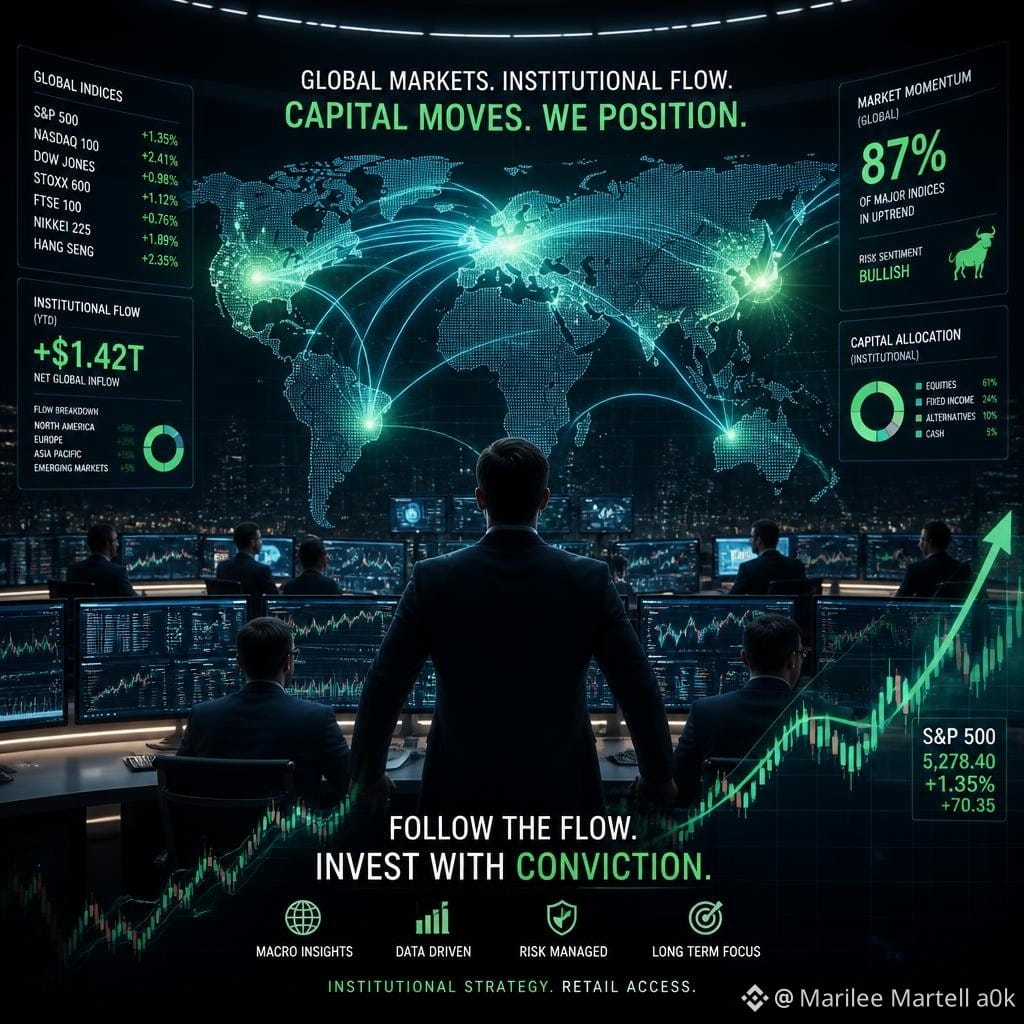
#GlobalStockFundsSee $18.62BInflowGlobal stock funds are seeing a strong $18.62B inflow, showing solid investor demand across equity markets. This fresh capital could support market momentum and boost confidence. 📈💰 #GlobalStocks #StockMarket #Investing #Markets #FinanceSector
#GlobalStockFundsSee $18.62BInflowGlobal stock funds are seeing a strong $18.62B inflow, showing solid investor demand across equity markets. This fresh capital could support market momentum and boost confidence. 📈💰 #GlobalStocks #StockMarket #Investing #Markets #FinanceSector
74
·
--
Most traders think strong S&P 500 earnings are automatically bullish for crypto, but in past cycles the real move often came days later, after liquidity decided where to flow.
I’ve seen people panic-sell $BTC on fear, then chase green candles after equities rally, only to get trapped in the middle. With market sentiment still in Fear territory, the danger is not just being wrong, it’s reacting too late.
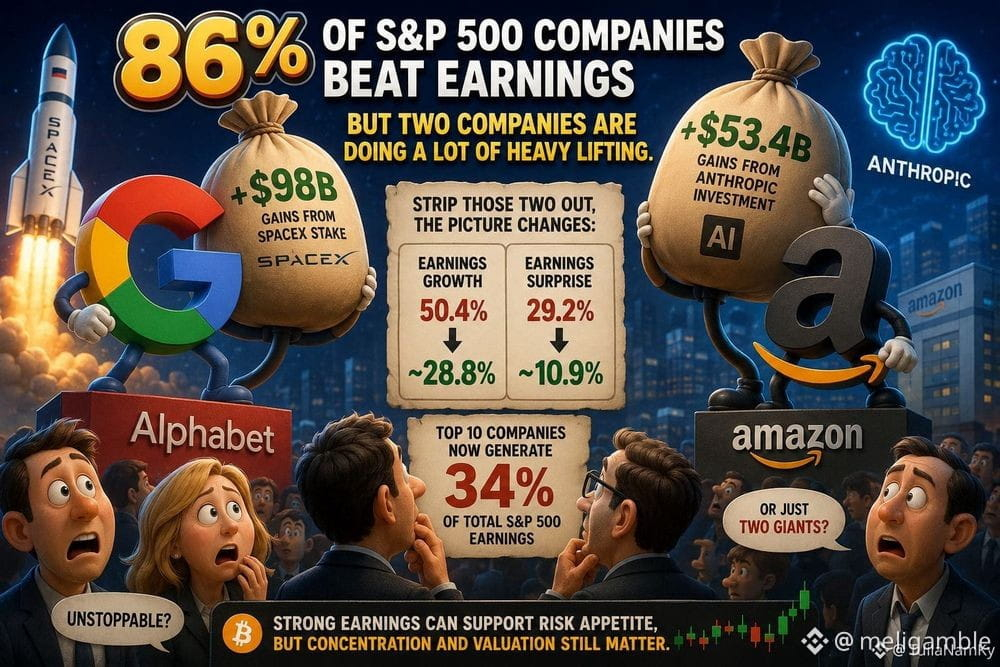
When S&P 500 companies beat earnings expectations, it tells us corporate profits are holding up better than feared. That can calm markets and bring risk appetite back, especially into assets like $ETH and high-beta crypto. But earnings beats are not the same as easy money. If bond yields rise or the dollar strengthens, crypto can still struggle even while stocks look healthy.
The lesson from older cycles is simple: crypto usually loves a “risk-on” environment, but it needs confirmation. Watch whether $BTC holds key support while equities grind higher. Watch whether stablecoin demand like $USDT rises or just sits idle. Real conviction shows up in flows, not headlines.
The smartest traders I knew in 2020 and 2021 didn’t buy every good news headline. They waited to see if the market absorbed the news and kept bidding. Hope is useful, greed is expensive.
Are you treating strong S&P earnings as a crypto tailwind, or waiting for confirmation first? #SP500EarningsBeatExpectations #GlobalStockFundsSee #SECCancelsCryptoRulemakingMeeting
Most traders think strong S&P 500 earnings are automatically bullish for crypto, but in past cycles the real move often came days later, after liquidity decided where to flow.
I’ve seen people panic-sell $BTC on fear, then chase green candles after equities rally, only to get trapped in the middle. With market sentiment still in Fear territory, the danger is not just being wrong, it’s reacting too late.
When S&P 500 companies beat earnings expectations, it tells us corporate profits are holding up better than feared. That can calm markets and bring risk appetite back, especially into assets like $ETH and high-beta crypto. But earnings beats are not the same as easy money. If bond yields rise or the dollar strengthens, crypto can still struggle even while stocks look healthy.
The lesson from older cycles is simple: crypto usually loves a “risk-on” environment, but it needs confirmation. Watch whether $BTC holds key support while equities grind higher. Watch whether stablecoin demand like $USDT rises or just sits idle. Real conviction shows up in flows, not headlines.
The smartest traders I knew in 2020 and 2021 didn’t buy every good news headline. They waited to see if the market absorbed the news and kept bidding. Hope is useful, greed is expensive.
Are you treating strong S&P earnings as a crypto tailwind, or waiting for confirmation first? #SP500EarningsBeatExpectations #GlobalStockFundsSee #SECCancelsCryptoRulemakingMeeting
I’ve seen people panic-sell $BTC on fear, then chase green candles after equities rally, only to get trapped in the middle. With market sentiment still in Fear territory, the danger is not just being wrong, it’s reacting too late.
When S&P 500 companies beat earnings expectations, it tells us corporate profits are holding up better than feared. That can calm markets and bring risk appetite back, especially into assets like $ETH and high-beta crypto. But earnings beats are not the same as easy money. If bond yields rise or the dollar strengthens, crypto can still struggle even while stocks look healthy.
The lesson from older cycles is simple: crypto usually loves a “risk-on” environment, but it needs confirmation. Watch whether $BTC holds key support while equities grind higher. Watch whether stablecoin demand like $USDT rises or just sits idle. Real conviction shows up in flows, not headlines.
The smartest traders I knew in 2020 and 2021 didn’t buy every good news headline. They waited to see if the market absorbed the news and kept bidding. Hope is useful, greed is expensive.
Are you treating strong S&P earnings as a crypto tailwind, or waiting for confirmation first? #SP500EarningsBeatExpectations #GlobalStockFundsSee #SECCancelsCryptoRulemakingMeeting
18
·
--
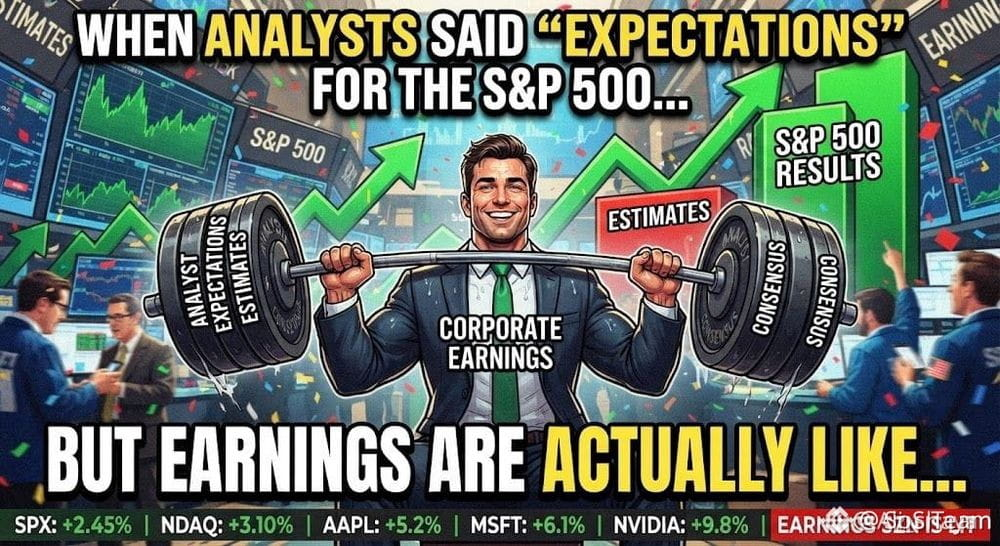
If you're still treating strong S&P 500 earnings like “just TradFi noise,” stop now.
Crypto traders get hurt when they stare only at candles and ignore the liquidity weather report. A good earnings season can pull risk appetite back into the room, but it can also bait late longs right before macro reality taps the mic.
The S&P 500 beating expectations feels a bit like those past “soft landing” rallies where $BTC and $ETH suddenly started acting like high-beta tech with worse sleep schedules. When equities look healthy, capital gets braver, stablecoins like $USDT stop hiding in the bunker, and narratives rotate faster than a memecoin Telegram admin after launch.
But comparison matters. In 2021, strong growth data added fuel to the party. In 2023, good earnings often meant “rates may stay higher,” which capped the upside. Now with Fear & Greed sitting in fear territory, the market is basically saying: “I want to believe, but I’ve been rugged by macro before.”
So is this earnings strength a real risk-on signal for crypto, or just another beautiful trap with a Wall Street suit on? #SP500EarningsBeatExpectations #GlobalStockFundsSee #SECCancelsCryptoRulemakingMeeting
If you're still treating strong S&P 500 earnings like “just TradFi noise,” stop now.
Crypto traders get hurt when they stare only at candles and ignore the liquidity weather report. A good earnings season can pull risk appetite back into the room, but it can also bait late longs right before macro reality taps the mic.
The S&P 500 beating expectations feels a bit like those past “soft landing” rallies where $BTC and $ETH suddenly started acting like high-beta tech with worse sleep schedules. When equities look healthy, capital gets braver, stablecoins like $USDT stop hiding in the bunker, and narratives rotate faster than a memecoin Telegram admin after launch.
But comparison matters. In 2021, strong growth data added fuel to the party. In 2023, good earnings often meant “rates may stay higher,” which capped the upside. Now with Fear & Greed sitting in fear territory, the market is basically saying: “I want to believe, but I’ve been rugged by macro before.”
So is this earnings strength a real risk-on signal for crypto, or just another beautiful trap with a Wall Street suit on? #SP500EarningsBeatExpectations #GlobalStockFundsSee #SECCancelsCryptoRulemakingMeeting
Crypto traders get hurt when they stare only at candles and ignore the liquidity weather report. A good earnings season can pull risk appetite back into the room, but it can also bait late longs right before macro reality taps the mic.
The S&P 500 beating expectations feels a bit like those past “soft landing” rallies where $BTC and $ETH suddenly started acting like high-beta tech with worse sleep schedules. When equities look healthy, capital gets braver, stablecoins like $USDT stop hiding in the bunker, and narratives rotate faster than a memecoin Telegram admin after launch.
But comparison matters. In 2021, strong growth data added fuel to the party. In 2023, good earnings often meant “rates may stay higher,” which capped the upside. Now with Fear & Greed sitting in fear territory, the market is basically saying: “I want to believe, but I’ve been rugged by macro before.”
So is this earnings strength a real risk-on signal for crypto, or just another beautiful trap with a Wall Street suit on? #SP500EarningsBeatExpectations #GlobalStockFundsSee #SECCancelsCryptoRulemakingMeeting
7
·
--
The strange thing about SpaceX share headlines is that they often say more about liquidity and risk appetite than about rockets.
I’ve seen traders chase “adjacent hype” before: a private-market valuation rises, then people start FOMO buying anything that feels connected to space, AI, or tech beta. That’s how late entries happen, especially when the Fear & Greed Index is sitting in Fear and everyone is desperate for a reason to believe.
Here’s the lesson from past cycles: strong private-market demand can signal that big capital is still willing to pay up for elite growth stories, but it does not automatically mean every risk asset pumps. In crypto, that usually shows up first in majors like $BTC, then liquidity rotates into narratives only if confidence holds.
Watch the reaction, not just the headline. If traders hide in $USDT after good news, the market is still defensive. If $BTC holds firm and higher-beta names start catching bids, then the SpaceX story may be part of a broader “risk-on” shift rather than just another headline people overtrade.
Where do you think this goes from here: real liquidity signal or just another hype trap? #SpaceXSharesRiseTo #BitcoinHoldsNear #GlobalStockFundsSee
The strange thing about SpaceX share headlines is that they often say more about liquidity and risk appetite than about rockets.
I’ve seen traders chase “adjacent hype” before: a private-market valuation rises, then people start FOMO buying anything that feels connected to space, AI, or tech beta. That’s how late entries happen, especially when the Fear & Greed Index is sitting in Fear and everyone is desperate for a reason to believe.
Here’s the lesson from past cycles: strong private-market demand can signal that big capital is still willing to pay up for elite growth stories, but it does not automatically mean every risk asset pumps. In crypto, that usually shows up first in majors like $BTC , then liquidity rotates into narratives only if confidence holds.
Watch the reaction, not just the headline. If traders hide in $USDT after good news, the market is still defensive. If $BTC holds firm and higher-beta names start catching bids, then the SpaceX story may be part of a broader “risk-on” shift rather than just another headline people overtrade.
Where do you think this goes from here: real liquidity signal or just another hype trap? #SpaceXSharesRiseTo #BitcoinHoldsNear #GlobalStockFundsSee
I’ve seen traders chase “adjacent hype” before: a private-market valuation rises, then people start FOMO buying anything that feels connected to space, AI, or tech beta. That’s how late entries happen, especially when the Fear & Greed Index is sitting in Fear and everyone is desperate for a reason to believe.
Here’s the lesson from past cycles: strong private-market demand can signal that big capital is still willing to pay up for elite growth stories, but it does not automatically mean every risk asset pumps. In crypto, that usually shows up first in majors like $BTC , then liquidity rotates into narratives only if confidence holds.
Watch the reaction, not just the headline. If traders hide in $USDT after good news, the market is still defensive. If $BTC holds firm and higher-beta names start catching bids, then the SpaceX story may be part of a broader “risk-on” shift rather than just another headline people overtrade.
Where do you think this goes from here: real liquidity signal or just another hype trap? #SpaceXSharesRiseTo #BitcoinHoldsNear #GlobalStockFundsSee

19
·
--
Last week, SpaceX private shares reportedly climbed again, and suddenly every “space economy” proxy started getting a second look.
The pain for crypto traders is that these headlines create messy FOMO. You see $BTC holding near key levels, $USDT searches rising, fear still sitting in the market, and it becomes tempting to chase anything that sounds connected.
Case study: SpaceX is not a publicly traded crypto asset, so most retail traders can’t directly buy the story. That creates a proxy effect. In past cycles, we saw similar behavior when Tesla headlines spilled into $DOGE, or when AI stock momentum pulled attention toward AI tokens. The asset in the headline and the asset people can actually trade are often not the same thing.
Why did it happen? SpaceX sits at the intersection of defense, satellites, launch infrastructure, and long-term tech optimism. When private shares rise, the market reads it as confidence in hard-tech growth. Crypto traders then start asking whether DePIN, satellite networks, and payment rails could benefit from the same narrative.
The lesson is simple: narratives travel faster than fundamentals. A strong SpaceX valuation can improve sentiment, but it doesn’t automatically validate every space-themed token or infrastructure play. The better comparison is not “what pumps next,” but “which projects actually have usage, revenue, or network demand when the hype fades.”
Is this a real signal for risk appetite, or just another proxy-trade trap? #SpaceXSharesRiseTo #BitcoinHoldsNear #GlobalStockFundsSee
Last week, SpaceX private shares reportedly climbed again, and suddenly every “space economy” proxy started getting a second look.
The pain for crypto traders is that these headlines create messy FOMO. You see $BTC holding near key levels, $USDT searches rising, fear still sitting in the market, and it becomes tempting to chase anything that sounds connected.
Case study: SpaceX is not a publicly traded crypto asset, so most retail traders can’t directly buy the story. That creates a proxy effect. In past cycles, we saw similar behavior when Tesla headlines spilled into $DOGE , or when AI stock momentum pulled attention toward AI tokens. The asset in the headline and the asset people can actually trade are often not the same thing.
Why did it happen? SpaceX sits at the intersection of defense, satellites, launch infrastructure, and long-term tech optimism. When private shares rise, the market reads it as confidence in hard-tech growth. Crypto traders then start asking whether DePIN, satellite networks, and payment rails could benefit from the same narrative.
The lesson is simple: narratives travel faster than fundamentals. A strong SpaceX valuation can improve sentiment, but it doesn’t automatically validate every space-themed token or infrastructure play. The better comparison is not “what pumps next,” but “which projects actually have usage, revenue, or network demand when the hype fades.”
Is this a real signal for risk appetite, or just another proxy-trade trap? #SpaceXSharesRiseTo #BitcoinHoldsNear #GlobalStockFundsSee
The pain for crypto traders is that these headlines create messy FOMO. You see $BTC holding near key levels, $USDT searches rising, fear still sitting in the market, and it becomes tempting to chase anything that sounds connected.
Case study: SpaceX is not a publicly traded crypto asset, so most retail traders can’t directly buy the story. That creates a proxy effect. In past cycles, we saw similar behavior when Tesla headlines spilled into $DOGE , or when AI stock momentum pulled attention toward AI tokens. The asset in the headline and the asset people can actually trade are often not the same thing.
Why did it happen? SpaceX sits at the intersection of defense, satellites, launch infrastructure, and long-term tech optimism. When private shares rise, the market reads it as confidence in hard-tech growth. Crypto traders then start asking whether DePIN, satellite networks, and payment rails could benefit from the same narrative.
The lesson is simple: narratives travel faster than fundamentals. A strong SpaceX valuation can improve sentiment, but it doesn’t automatically validate every space-themed token or infrastructure play. The better comparison is not “what pumps next,” but “which projects actually have usage, revenue, or network demand when the hype fades.”
Is this a real signal for risk appetite, or just another proxy-trade trap? #SpaceXSharesRiseTo #BitcoinHoldsNear #GlobalStockFundsSee

29
·
--
Everyone thinks AI-politics headlines only matter for tech stocks, but actually they can quietly move crypto liquidity before traders notice.
The mistake is chasing AI-related pumps like they live in a vacuum. When countries are pressured to pick sides between US and China AI coalitions, markets start repricing risk, and late buyers often become the exit liquidity.
1) Watch the “macro umbrella,” not just the candle. If global funds get nervous, capital usually runs toward safer parking spots first, which is why $USDT demand and $BTC dominance can tell you more than a random green AI token chart.
2) Don’t confuse narrative with confirmation. A headline can make anything with “AI” in the pitch look attractive for 24 hours, but if volume fades and the broader market is still in Fear around 37, that’s like buying an umbrella after the storm already passed.
3) Check who actually benefits. Infrastructure chains, data networks, and compliance-friendly projects may react differently than meme-style AI plays, while tokens like $POL can move more on ecosystem flows than the headline itself. Simple rule: if you can’t explain the link in one sentence, the market probably won’t hold the pump for long.
Are you treating this AI coalition story as a real crypto catalyst or just another short-term narrative trade? #USToPressNationsToPickUSOrChinaAICoalition #GlobalStockFundsSee #SECCancelsCryptoRulemakingMeeting
Everyone thinks AI-politics headlines only matter for tech stocks, but actually they can quietly move crypto liquidity before traders notice.
The mistake is chasing AI-related pumps like they live in a vacuum. When countries are pressured to pick sides between US and China AI coalitions, markets start repricing risk, and late buyers often become the exit liquidity.
1) Watch the “macro umbrella,” not just the candle. If global funds get nervous, capital usually runs toward safer parking spots first, which is why $USDT demand and $BTC dominance can tell you more than a random green AI token chart.
2) Don’t confuse narrative with confirmation. A headline can make anything with “AI” in the pitch look attractive for 24 hours, but if volume fades and the broader market is still in Fear around 37, that’s like buying an umbrella after the storm already passed.
3) Check who actually benefits. Infrastructure chains, data networks, and compliance-friendly projects may react differently than meme-style AI plays, while tokens like $POL can move more on ecosystem flows than the headline itself. Simple rule: if you can’t explain the link in one sentence, the market probably won’t hold the pump for long.
Are you treating this AI coalition story as a real crypto catalyst or just another short-term narrative trade? #USToPressNationsToPickUSOrChinaAICoalition #GlobalStockFundsSee #SECCancelsCryptoRulemakingMeeting
The mistake is chasing AI-related pumps like they live in a vacuum. When countries are pressured to pick sides between US and China AI coalitions, markets start repricing risk, and late buyers often become the exit liquidity.
1) Watch the “macro umbrella,” not just the candle. If global funds get nervous, capital usually runs toward safer parking spots first, which is why $USDT demand and $BTC dominance can tell you more than a random green AI token chart.
2) Don’t confuse narrative with confirmation. A headline can make anything with “AI” in the pitch look attractive for 24 hours, but if volume fades and the broader market is still in Fear around 37, that’s like buying an umbrella after the storm already passed.
3) Check who actually benefits. Infrastructure chains, data networks, and compliance-friendly projects may react differently than meme-style AI plays, while tokens like $POL can move more on ecosystem flows than the headline itself. Simple rule: if you can’t explain the link in one sentence, the market probably won’t hold the pump for long.
Are you treating this AI coalition story as a real crypto catalyst or just another short-term narrative trade? #USToPressNationsToPickUSOrChinaAICoalition #GlobalStockFundsSee #SECCancelsCryptoRulemakingMeeting

88
·
--
If you’re still treating weak China data like automatic “buy the dip” fuel, stop now.
A lot of traders get chopped up here because bad macro can mean stimulus hopes… or it can mean demand is actually cracking. FOMOing every red headline worked in some liquidity cycles, but in a Fear market, the market asks for receipts.
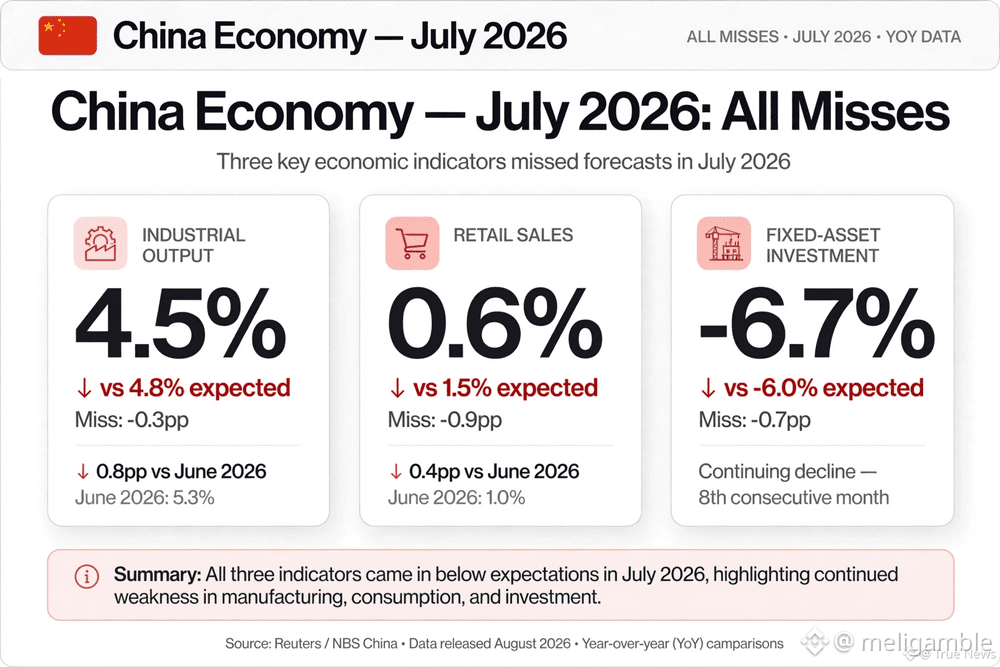
China’s July output, retail sales, and investment all missing expectations has that 2015/2018 vibe: everyone starts pricing rescue measures before asking whether consumers and factories are really slowing together. That matters for crypto because $BTC still trades like a liquidity barometer when global growth gets shaky, while $USDT demand often tells you whether people are rotating to risk or hiding in stables.
The comparison I’m watching is simple: if this turns into a stimulus narrative, high-beta alts like $POL can catch bids fast. If it turns into a “global growth is wobbling” narrative, then every bounce gets sold and the safest trade may be patience, not hero mode.
So is weak China data a bullish stimulus setup for crypto, or the early warning that risk assets are about to get less forgiving? #ChinaJulyOutputRetailInvestmentAllMiss #GlobalStockFundsSee #USToPressNationsToPickUSOrChinaAICoalition
If you’re still treating weak China data like automatic “buy the dip” fuel, stop now.
A lot of traders get chopped up here because bad macro can mean stimulus hopes… or it can mean demand is actually cracking. FOMOing every red headline worked in some liquidity cycles, but in a Fear market, the market asks for receipts.
China’s July output, retail sales, and investment all missing expectations has that 2015/2018 vibe: everyone starts pricing rescue measures before asking whether consumers and factories are really slowing together. That matters for crypto because $BTC still trades like a liquidity barometer when global growth gets shaky, while $USDT demand often tells you whether people are rotating to risk or hiding in stables.
The comparison I’m watching is simple: if this turns into a stimulus narrative, high-beta alts like $POL can catch bids fast. If it turns into a “global growth is wobbling” narrative, then every bounce gets sold and the safest trade may be patience, not hero mode.
So is weak China data a bullish stimulus setup for crypto, or the early warning that risk assets are about to get less forgiving? #ChinaJulyOutputRetailInvestmentAllMiss #GlobalStockFundsSee #USToPressNationsToPickUSOrChinaAICoalition
A lot of traders get chopped up here because bad macro can mean stimulus hopes… or it can mean demand is actually cracking. FOMOing every red headline worked in some liquidity cycles, but in a Fear market, the market asks for receipts.
China’s July output, retail sales, and investment all missing expectations has that 2015/2018 vibe: everyone starts pricing rescue measures before asking whether consumers and factories are really slowing together. That matters for crypto because $BTC still trades like a liquidity barometer when global growth gets shaky, while $USDT demand often tells you whether people are rotating to risk or hiding in stables.
The comparison I’m watching is simple: if this turns into a stimulus narrative, high-beta alts like $POL can catch bids fast. If it turns into a “global growth is wobbling” narrative, then every bounce gets sold and the safest trade may be patience, not hero mode.
So is weak China data a bullish stimulus setup for crypto, or the early warning that risk assets are about to get less forgiving? #ChinaJulyOutputRetailInvestmentAllMiss #GlobalStockFundsSee #USToPressNationsToPickUSOrChinaAICoalition
40
·
--
The first crypto move after a missile headline is often the wrong one.
When geopolitical fear hits, traders rush into $USDT, chase red candles, or panic-sell $BTC right into the wick. I’ve seen this movie across multiple cycles: the headline scares you, the market tests your emotions, then liquidity decides who survives.
With the Fear & Greed Index sitting in Fear around 38, the Israel-Lebanon escalation is not just “news.” It’s a volatility trigger. In moments like this, markets usually price uncertainty first and facts later, which is why the first reaction can be sharp but unreliable.
The lesson is simple: watch liquidity, not just headlines. If $BTC dumps while stablecoin demand rises and funding cools, that can be defensive positioning, not necessarily the start of a full breakdown. If $ETH and majors recover quickly after the initial shock, it often means bigger players used fear to fill bids.
Hard-won rule from old cycles: never let a headline force your entry or exit. Define levels before the candle moves, keep some dry powder in $USDT, and remember that fear feels most convincing near the worst possible selling points.
Are you reducing risk here, buying fear, or waiting for confirmation? #IsraelStrikesLebanonKillsHezbollahCommander #GlobalStockFundsSee #SP500TopsRecord7800
The first crypto move after a missile headline is often the wrong one.
When geopolitical fear hits, traders rush into $USDT, chase red candles, or panic-sell $BTC right into the wick. I’ve seen this movie across multiple cycles: the headline scares you, the market tests your emotions, then liquidity decides who survives.
With the Fear & Greed Index sitting in Fear around 38, the Israel-Lebanon escalation is not just “news.” It’s a volatility trigger. In moments like this, markets usually price uncertainty first and facts later, which is why the first reaction can be sharp but unreliable.
The lesson is simple: watch liquidity, not just headlines. If $BTC dumps while stablecoin demand rises and funding cools, that can be defensive positioning, not necessarily the start of a full breakdown. If $ETH and majors recover quickly after the initial shock, it often means bigger players used fear to fill bids.
Hard-won rule from old cycles: never let a headline force your entry or exit. Define levels before the candle moves, keep some dry powder in $USDT, and remember that fear feels most convincing near the worst possible selling points.
Are you reducing risk here, buying fear, or waiting for confirmation? #IsraelStrikesLebanonKillsHezbollahCommander #GlobalStockFundsSee #SP500TopsRecord7800
When geopolitical fear hits, traders rush into $USDT, chase red candles, or panic-sell $BTC right into the wick. I’ve seen this movie across multiple cycles: the headline scares you, the market tests your emotions, then liquidity decides who survives.
With the Fear & Greed Index sitting in Fear around 38, the Israel-Lebanon escalation is not just “news.” It’s a volatility trigger. In moments like this, markets usually price uncertainty first and facts later, which is why the first reaction can be sharp but unreliable.
The lesson is simple: watch liquidity, not just headlines. If $BTC dumps while stablecoin demand rises and funding cools, that can be defensive positioning, not necessarily the start of a full breakdown. If $ETH and majors recover quickly after the initial shock, it often means bigger players used fear to fill bids.
Hard-won rule from old cycles: never let a headline force your entry or exit. Define levels before the candle moves, keep some dry powder in $USDT, and remember that fear feels most convincing near the worst possible selling points.
Are you reducing risk here, buying fear, or waiting for confirmation? #IsraelStrikesLebanonKillsHezbollahCommander #GlobalStockFundsSee #SP500TopsRecord7800

1
19
·
--
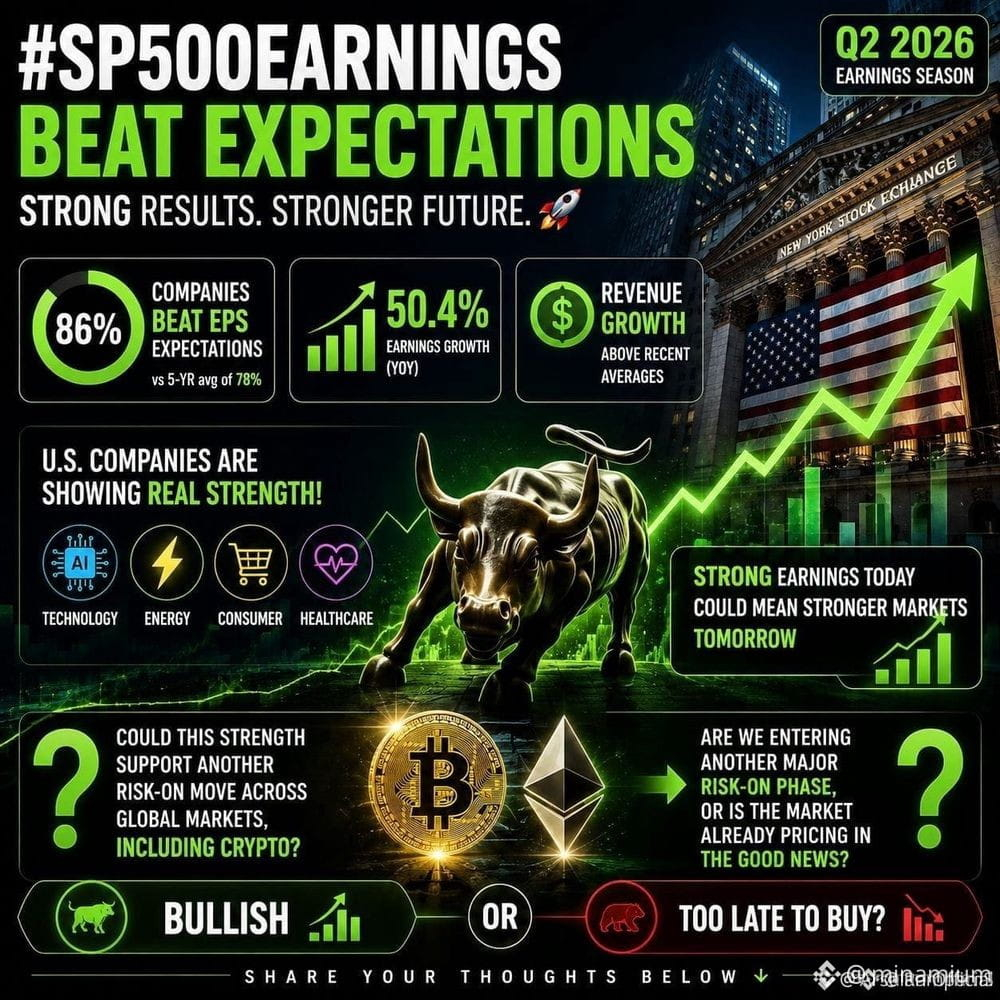
Here’s what happened when Wall Street earnings came in stronger than expected: crypto traders suddenly had to care about balance sheets again.
The pain is familiar. You sit in $USDT waiting for a clean crypto setup, then stocks rip, risk appetite shifts, and $BTC moves before you’ve decided whether the macro signal is real or just another head fake.
The case study here is simple: S&P 500 earnings beats are not just “stock market news.” They tell us whether big companies are still generating enough profit to keep investors comfortable taking risk. When earnings surprise to the upside, capital often becomes less defensive, and that can spill into crypto through $BTC and $ETH liquidity flows.
We’ve seen this before. In 2020-2021, strong tech earnings and cheap money helped create a risk-on environment where crypto benefited massively. In 2022, the opposite happened: earnings pressure, rate hikes, and tighter liquidity punished both growth stocks and crypto. The difference now is sentiment. Fear & Greed is sitting in Fear territory, which means traders are cautious even while traditional markets are showing strength.
That contrast matters. If equities keep beating expectations, crypto may not instantly moon, but it could reduce the “macro panic” discount hanging over the market. The better comparison might be early recovery phases, when stocks stabilize first and crypto follows once traders trust the trend.
With #SP500EarningsBeatExpectations, #GlobalStockFundsSee, and #SECCancelsCryptoRulemakingMeeting all in the background, do you think capital rotates into crypto next or stays parked in equities?
Here’s what happened when Wall Street earnings came in stronger than expected: crypto traders suddenly had to care about balance sheets again.
The pain is familiar. You sit in $USDT waiting for a clean crypto setup, then stocks rip, risk appetite shifts, and $BTC moves before you’ve decided whether the macro signal is real or just another head fake.
The case study here is simple: S&P 500 earnings beats are not just “stock market news.” They tell us whether big companies are still generating enough profit to keep investors comfortable taking risk. When earnings surprise to the upside, capital often becomes less defensive, and that can spill into crypto through $BTC and $ETH liquidity flows.
We’ve seen this before. In 2020-2021, strong tech earnings and cheap money helped create a risk-on environment where crypto benefited massively. In 2022, the opposite happened: earnings pressure, rate hikes, and tighter liquidity punished both growth stocks and crypto. The difference now is sentiment. Fear & Greed is sitting in Fear territory, which means traders are cautious even while traditional markets are showing strength.
That contrast matters. If equities keep beating expectations, crypto may not instantly moon, but it could reduce the “macro panic” discount hanging over the market. The better comparison might be early recovery phases, when stocks stabilize first and crypto follows once traders trust the trend.
With #SP500EarningsBeatExpectations, #GlobalStockFundsSee, and #SECCancelsCryptoRulemakingMeeting all in the background, do you think capital rotates into crypto next or stays parked in equities?
The pain is familiar. You sit in $USDT waiting for a clean crypto setup, then stocks rip, risk appetite shifts, and $BTC moves before you’ve decided whether the macro signal is real or just another head fake.
The case study here is simple: S&P 500 earnings beats are not just “stock market news.” They tell us whether big companies are still generating enough profit to keep investors comfortable taking risk. When earnings surprise to the upside, capital often becomes less defensive, and that can spill into crypto through $BTC and $ETH liquidity flows.
We’ve seen this before. In 2020-2021, strong tech earnings and cheap money helped create a risk-on environment where crypto benefited massively. In 2022, the opposite happened: earnings pressure, rate hikes, and tighter liquidity punished both growth stocks and crypto. The difference now is sentiment. Fear & Greed is sitting in Fear territory, which means traders are cautious even while traditional markets are showing strength.
That contrast matters. If equities keep beating expectations, crypto may not instantly moon, but it could reduce the “macro panic” discount hanging over the market. The better comparison might be early recovery phases, when stocks stabilize first and crypto follows once traders trust the trend.
With #SP500EarningsBeatExpectations, #GlobalStockFundsSee, and #SECCancelsCryptoRulemakingMeeting all in the background, do you think capital rotates into crypto next or stays parked in equities?
15
·
--
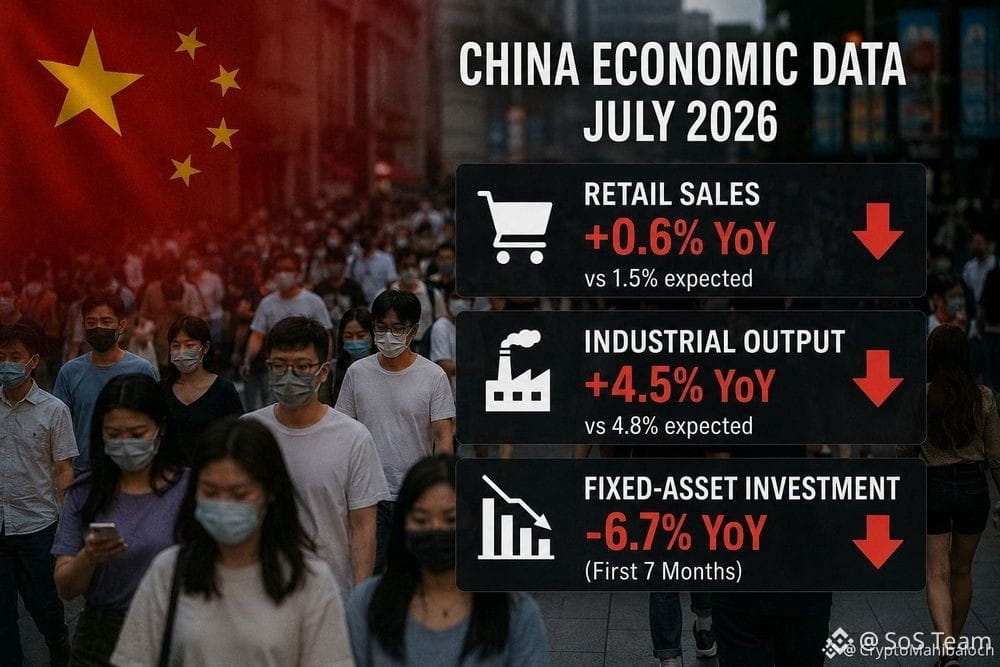
Have you noticed how every weak China data print gets treated as “bad news,” when it’s actually a trading filter?
The pain is simple: traders see output, retail sales, and investment miss expectations, then either panic-sell late or FOMO into the first bounce. That’s how you get chopped up, especially with Fear & Greed sitting in fear territory.
My take: weak China data is not automatically bearish for crypto. It means liquidity expectations start shifting. If markets believe Beijing has to support growth, risk assets can catch a bid before the real economy improves. That gap is where disciplined traders find setups, not certainty.
Here’s the guide I’d use: keep a higher $USDT balance until $BTC confirms strength above key resistance, watch whether alts like $POL follow with volume instead of just one candle pumps, and avoid buying “China stimulus” narratives after they’ve already run. Macro fear creates entries, but only if price confirms.
The mainstream view says bad data means run away. I think bad data means slow down, wait for liquidity signals, and let impatient traders donate their positions. What’s your take from here? #ChinaJulyOutputRetailInvestmentAllMiss #GlobalStockFundsSee #USToPressNationsToPickUSOrChinaAICoalition
Have you noticed how every weak China data print gets treated as “bad news,” when it’s actually a trading filter?
The pain is simple: traders see output, retail sales, and investment miss expectations, then either panic-sell late or FOMO into the first bounce. That’s how you get chopped up, especially with Fear & Greed sitting in fear territory.
My take: weak China data is not automatically bearish for crypto. It means liquidity expectations start shifting. If markets believe Beijing has to support growth, risk assets can catch a bid before the real economy improves. That gap is where disciplined traders find setups, not certainty.
Here’s the guide I’d use: keep a higher $USDT balance until $BTC confirms strength above key resistance, watch whether alts like $POL follow with volume instead of just one candle pumps, and avoid buying “China stimulus” narratives after they’ve already run. Macro fear creates entries, but only if price confirms.
The mainstream view says bad data means run away. I think bad data means slow down, wait for liquidity signals, and let impatient traders donate their positions. What’s your take from here? #ChinaJulyOutputRetailInvestmentAllMiss #GlobalStockFundsSee #USToPressNationsToPickUSOrChinaAICoalition
The pain is simple: traders see output, retail sales, and investment miss expectations, then either panic-sell late or FOMO into the first bounce. That’s how you get chopped up, especially with Fear & Greed sitting in fear territory.
My take: weak China data is not automatically bearish for crypto. It means liquidity expectations start shifting. If markets believe Beijing has to support growth, risk assets can catch a bid before the real economy improves. That gap is where disciplined traders find setups, not certainty.
Here’s the guide I’d use: keep a higher $USDT balance until $BTC confirms strength above key resistance, watch whether alts like $POL follow with volume instead of just one candle pumps, and avoid buying “China stimulus” narratives after they’ve already run. Macro fear creates entries, but only if price confirms.
The mainstream view says bad data means run away. I think bad data means slow down, wait for liquidity signals, and let impatient traders donate their positions. What’s your take from here? #ChinaJulyOutputRetailInvestmentAllMiss #GlobalStockFundsSee #USToPressNationsToPickUSOrChinaAICoalition
47
·
--
Why is nobody talking about SpaceX’s rising private valuation as a liquidity signal for risk assets?
Crypto traders keep getting trapped by the same mistake: waiting for confirmation after the move already happened. When fear is still visible in the market and everyone is hiding in $USDT, the best clues often come from outside crypto first.
SpaceX shares moving higher is not just a “space stock” story. It shows that serious capital is still willing to price long-duration, high-conviction growth aggressively, even while public markets act nervous. That matters for crypto because $BTC and major alts often benefit when investors start tolerating risk again.
The mainstream take is that private tech valuations are disconnected from crypto. I disagree. The same liquidity that chases scarce private equity can eventually rotate into scarce digital assets, especially when sentiment is weak and positioning is defensive.
Look at the setup: Fear & Greed sitting in fear, searches clustered around safety and rotation names like $USDT and $POL, while real-world growth assets keep attracting bids. That is usually when the market is quietly deciding who has conviction and who is just reacting.
Is SpaceX’s rise a warning that risk appetite is coming back before crypto traders notice it? #SpaceXSharesRiseTo #BitcoinHoldsNear #GlobalStockFundsSee
Why is nobody talking about SpaceX’s rising private valuation as a liquidity signal for risk assets?
Crypto traders keep getting trapped by the same mistake: waiting for confirmation after the move already happened. When fear is still visible in the market and everyone is hiding in $USDT, the best clues often come from outside crypto first.
SpaceX shares moving higher is not just a “space stock” story. It shows that serious capital is still willing to price long-duration, high-conviction growth aggressively, even while public markets act nervous. That matters for crypto because $BTC and major alts often benefit when investors start tolerating risk again.
The mainstream take is that private tech valuations are disconnected from crypto. I disagree. The same liquidity that chases scarce private equity can eventually rotate into scarce digital assets, especially when sentiment is weak and positioning is defensive.
Look at the setup: Fear & Greed sitting in fear, searches clustered around safety and rotation names like $USDT and $POL , while real-world growth assets keep attracting bids. That is usually when the market is quietly deciding who has conviction and who is just reacting.
Is SpaceX’s rise a warning that risk appetite is coming back before crypto traders notice it? #SpaceXSharesRiseTo #BitcoinHoldsNear #GlobalStockFundsSee
Crypto traders keep getting trapped by the same mistake: waiting for confirmation after the move already happened. When fear is still visible in the market and everyone is hiding in $USDT, the best clues often come from outside crypto first.
SpaceX shares moving higher is not just a “space stock” story. It shows that serious capital is still willing to price long-duration, high-conviction growth aggressively, even while public markets act nervous. That matters for crypto because $BTC and major alts often benefit when investors start tolerating risk again.
The mainstream take is that private tech valuations are disconnected from crypto. I disagree. The same liquidity that chases scarce private equity can eventually rotate into scarce digital assets, especially when sentiment is weak and positioning is defensive.
Look at the setup: Fear & Greed sitting in fear, searches clustered around safety and rotation names like $USDT and $POL , while real-world growth assets keep attracting bids. That is usually when the market is quietly deciding who has conviction and who is just reacting.
Is SpaceX’s rise a warning that risk appetite is coming back before crypto traders notice it? #SpaceXSharesRiseTo #BitcoinHoldsNear #GlobalStockFundsSee
41
·
--
Picture this: stocks are celebrating a record S&P 500 push toward 7,800 while crypto traders are still sitting in Fear mode, refreshing $USDT pairs like the party is happening in the wrong room.
That gap is painful because it creates the worst kind of FOMO. You see equities grinding higher, assume risk is back, then buy late into a crypto bounce that has no follow-through.
Case study: when the S&P makes fresh highs, crypto does not always move immediately. We saw this in past cycles too. In 2021, equities and Bitcoin climbed together until liquidity tightened. In parts of 2023 and 2024, tech stocks led first, then capital slowly rotated into majors and selective alts. The order matters.
Right now, the signal is mixed. A record stock market says institutions still want risk, but a Fear & Greed reading around 37 says crypto traders remain cautious. That is why $BTC strength, $USDT dominance, and whether mid-caps like $POL catch bids matter more than the headline itself.
The lesson is simple: equity highs can be a green light, but not an automatic entry. If liquidity keeps expanding, crypto may lag then sprint. If stocks are only being held up by a narrow group of names, crypto traders chasing every pump could get trapped again.
Where do you think the rotation goes next: Bitcoin first, alts later, or no rotation at all? #SP500TopsRecord7800 #GlobalStockFundsSee #SECCancelsCryptoRulemakingMeeting
Picture this: stocks are celebrating a record S&P 500 push toward 7,800 while crypto traders are still sitting in Fear mode, refreshing $USDT pairs like the party is happening in the wrong room.
That gap is painful because it creates the worst kind of FOMO. You see equities grinding higher, assume risk is back, then buy late into a crypto bounce that has no follow-through.
Case study: when the S&P makes fresh highs, crypto does not always move immediately. We saw this in past cycles too. In 2021, equities and Bitcoin climbed together until liquidity tightened. In parts of 2023 and 2024, tech stocks led first, then capital slowly rotated into majors and selective alts. The order matters.
Right now, the signal is mixed. A record stock market says institutions still want risk, but a Fear & Greed reading around 37 says crypto traders remain cautious. That is why $BTC strength, $USDT dominance, and whether mid-caps like $POL catch bids matter more than the headline itself.
The lesson is simple: equity highs can be a green light, but not an automatic entry. If liquidity keeps expanding, crypto may lag then sprint. If stocks are only being held up by a narrow group of names, crypto traders chasing every pump could get trapped again.
Where do you think the rotation goes next: Bitcoin first, alts later, or no rotation at all? #SP500TopsRecord7800 #GlobalStockFundsSee #SECCancelsCryptoRulemakingMeeting
That gap is painful because it creates the worst kind of FOMO. You see equities grinding higher, assume risk is back, then buy late into a crypto bounce that has no follow-through.
Case study: when the S&P makes fresh highs, crypto does not always move immediately. We saw this in past cycles too. In 2021, equities and Bitcoin climbed together until liquidity tightened. In parts of 2023 and 2024, tech stocks led first, then capital slowly rotated into majors and selective alts. The order matters.
Right now, the signal is mixed. A record stock market says institutions still want risk, but a Fear & Greed reading around 37 says crypto traders remain cautious. That is why $BTC strength, $USDT dominance, and whether mid-caps like $POL catch bids matter more than the headline itself.
The lesson is simple: equity highs can be a green light, but not an automatic entry. If liquidity keeps expanding, crypto may lag then sprint. If stocks are only being held up by a narrow group of names, crypto traders chasing every pump could get trapped again.
Where do you think the rotation goes next: Bitcoin first, alts later, or no rotation at all? #SP500TopsRecord7800 #GlobalStockFundsSee #SECCancelsCryptoRulemakingMeeting

57
·
--
Here's what happened when a geopolitical headline hit a market already sitting in Fear: traders didn’t just ask “what happened,” they asked “what do I sell first?”
That’s the pain point in crypto right now. When news like Israel striking Lebanon and killing a Hezbollah commander breaks, many traders panic into $USDT after the move has already started, then watch $BTC bounce without them.
The case study here is not only the event, but the market reaction. Crypto has seen this before: Middle East escalation headlines, Russia-Ukraine shocks, even sudden oil-risk narratives. The first move is usually de-risking, then the second move depends on whether the story becomes a wider conflict or fades into another weekend headline.
Compared with past geopolitical selloffs, $BTC now trades more like a macro asset than a purely crypto-native bet. If equities are calm and the S&P is pushing records, crypto may absorb the shock faster. But if oil, bonds, and the dollar start reacting hard, then $ETH and higher-beta alts usually feel the pressure before Bitcoin does.
The lesson is simple: headlines create volatility, but liquidity decides direction. In a Fear & Greed reading around 38, the crowd is already nervous, so one serious headline can turn caution into forced selling. The edge is not predicting war news, it’s knowing your invalidation before the candle does it for you.
What are you watching first if this escalates: $BTC structure, $USDT flows, or macro risk signals? #IsraelStrikesLebanonKillsHezbollahCommander #GlobalStockFundsSee #SP500TopsRecord7800
Here's what happened when a geopolitical headline hit a market already sitting in Fear: traders didn’t just ask “what happened,” they asked “what do I sell first?”
That’s the pain point in crypto right now. When news like Israel striking Lebanon and killing a Hezbollah commander breaks, many traders panic into $USDT after the move has already started, then watch $BTC bounce without them.
The case study here is not only the event, but the market reaction. Crypto has seen this before: Middle East escalation headlines, Russia-Ukraine shocks, even sudden oil-risk narratives. The first move is usually de-risking, then the second move depends on whether the story becomes a wider conflict or fades into another weekend headline.
Compared with past geopolitical selloffs, $BTC now trades more like a macro asset than a purely crypto-native bet. If equities are calm and the S&P is pushing records, crypto may absorb the shock faster. But if oil, bonds, and the dollar start reacting hard, then $ETH and higher-beta alts usually feel the pressure before Bitcoin does.
The lesson is simple: headlines create volatility, but liquidity decides direction. In a Fear & Greed reading around 38, the crowd is already nervous, so one serious headline can turn caution into forced selling. The edge is not predicting war news, it’s knowing your invalidation before the candle does it for you.
What are you watching first if this escalates: $BTC structure, $USDT flows, or macro risk signals? #IsraelStrikesLebanonKillsHezbollahCommander #GlobalStockFundsSee #SP500TopsRecord7800
That’s the pain point in crypto right now. When news like Israel striking Lebanon and killing a Hezbollah commander breaks, many traders panic into $USDT after the move has already started, then watch $BTC bounce without them.
The case study here is not only the event, but the market reaction. Crypto has seen this before: Middle East escalation headlines, Russia-Ukraine shocks, even sudden oil-risk narratives. The first move is usually de-risking, then the second move depends on whether the story becomes a wider conflict or fades into another weekend headline.
Compared with past geopolitical selloffs, $BTC now trades more like a macro asset than a purely crypto-native bet. If equities are calm and the S&P is pushing records, crypto may absorb the shock faster. But if oil, bonds, and the dollar start reacting hard, then $ETH and higher-beta alts usually feel the pressure before Bitcoin does.
The lesson is simple: headlines create volatility, but liquidity decides direction. In a Fear & Greed reading around 38, the crowd is already nervous, so one serious headline can turn caution into forced selling. The edge is not predicting war news, it’s knowing your invalidation before the candle does it for you.
What are you watching first if this escalates: $BTC structure, $USDT flows, or macro risk signals? #IsraelStrikesLebanonKillsHezbollahCommander #GlobalStockFundsSee #SP500TopsRecord7800

1
19
Log in to explore more content
Join global crypto users on Binance Square
⚡️ Get latest and useful information about crypto.
💬 Trusted by the world’s largest crypto exchange.
👍 Discover real insights from verified creators.
Email / Phone number
Trending Topics
1
#BinanceWillListHyperliquid(HYPE)
141,196 views
2,481 Discussing
2
#BrazilOrdersReportingOf$10KSelfCustodyTransfers
0 views
1 Discussing
3
#FedProposesRulesForBankIssuedStablecoins
0 views
20 Discussing
4
#OndoFinanceSoughtSaleAfterFoundersDeath
69 views
16 Discussing
5
#FedOctoberRateHikeOddsRiseTo69.7%
46,327 views
1,014 Discussing
6
#BitcoinFallsBelow$83,000
4,032 views
20 Discussing
7
#BitcoinFallsToAround$84,600ThisWeek
0 views
0 Discussing
8
#US30YearYieldHighestSince2004
36,179 views
788 Discussing
9
#ETHBreaksAbove$2,700
1,671 views
19 Discussing
10
#USWeighsPromotingDollarStablecoinsAbroad
71,892 views
1,685 Discussing