
#eip
eip
14,120 views
64 Discussing
Hot
Latest

·
--
A cleverly designed EIP draft has emerged in the Ethereum community: using “versioned opcodes” to reprice Gas without breaking any deployed contracts.
The core mechanism has three layers:
1|Separate tracks for old and new. Newly deployed contracts must use V2 opcodes and follow the new Gas schedule specified by EIP-8037/8038; existing contracts continue using the old schedule, preserving historical on-chain behavior.
2|Remove Gas introspection. The V2 opcode set excludes query opcodes such as GAS and GASLIMIT. If bytecode contains one, deployment is immediately reverted. This effectively prevents contracts from relying on “remaining Gas” for logic decisions, clearing the way for flexible repricing in the future.
3|Calls are versioned too. A new DELEGATECALL_V2 behaves similarly to DELEGATECALL, but requires the target contract’s code_version to be ≥ 2; otherwise, the call fails immediately, preventing new contracts from mistakenly calling old-version logic.
Essentially, this proposal turns “adjusting Gas costs” from a disruptive network-wide upgrade into a routine operation that can be phased in by contract version, with backward compatibility enforced at the protocol level. Ordinary users with account number $ETH will barely notice; contract developers, however, will need to keep an eye on the rollout pace of V2 tooling.
Original draft: https://github.com/ethereum/EIPs/pull/12638
#以太坊 #EIP #Gas fee
58

·
--
Ethereum wants to add “version numbers” to the EVM.
A new EIP draft proposes “versioned opcodes for gas repricing.” The core idea, in a nutshell: run opcode versions in parallel. Existing contracts continue using the old gas schedule, while newly deployed contracts must use V2 opcodes and follow the new schedules in EIP-8037/8038. The two sets of rules won’t interfere with each other, preserving backward compatibility.
A few details developers should keep an eye on:
1. The V2 opcode set removes gas introspection opcodes such as GAS and GASLIMIT. If a new contract includes one, deployment will revert. The reasoning is that if a contract makes decisions based on “how much gas is left,” any future repricing could break it.
2. A new DELEGATECALL_V2 behaves similarly to DELEGATECALL, but requires the target contract’s code_version to be ≥ 2; otherwise, it fails immediately. This effectively adds a version gate to cross-contract calls.
3. The overall goal is to let Ethereum adjust gas costs in the future without being overly cautious—using version isolation to separate room for upgrades from the safety of existing contracts, rather than having every price change affect the entire ecosystem.
At its core, this is the EVM catching up with the idea of an “evolvable software system.” The proposal is still in the draft stage, and inclusion in a mainnet upgrade is a long way off, but this direction is worth following over the long term.
#以太坊 #EIP #EVM
60

·
--
Ethereum has quietly released a draft EIP that could affect the lifecycle of contracts over the next decade: it lays the groundwork for repricing Gas with “versioned opcodes.”
The core logic has three layers:
1. Newly deployed contracts must use V2 opcodes and follow the new Gas schedule in EIP-8037/8038. Already-deployed contracts continue using the old schedule, preserving their behavior.
2. The V2 opcode set directly removes Gas introspection instructions such as GAS and GASLIMIT. If bytecode contains these opcodes, deployment will revert.
3. A new DELEGATECALL_V2 is introduced. Its semantics are similar to DELEGATECALL, but it requires the target contract’s code_version to be ≥ 2; otherwise, the call fails immediately.
Why should developers care? In the past, Ethereum’s biggest concern when adjusting Gas costs was that “repricing would change the behavior of existing contracts.” Protocols relying on hard-coded Gas assumptions have been burned more than once. With versioning, old contracts stay under the old rules while new logic follows the new ones—upgrades and compatibility finally have a clear boundary.
The trade-offs are just as clear: Gas introspection is being deliberately removed, so designs that rely on reading the remaining Gas on-chain in real time will need to be reworked in advance. The version requirement for DELEGATECALL_V2 will also force proxy contracts, multisigs, and smart wallets to review their entire call chain.
This is still a draft at the PR stage, with reviews, testing, and a hard fork still standing between it and mainnet. But the direction is clear: Ethereum is turning the “upgradable EVM” from a slogan into a mechanism. Holders of $ETH don’t need to take any action in the short term; developers are advised to read the original proposal soon and assess migration costs.
#以太坊 #EIP #Gas
65

The Ethereum core developer community has made another move: an EIP draft titled “Versioned Opcodes for Gas Repricing” has been formally posted on the forum for public comment. The core idea is to add version numbers to opcodes so that future adjustments to Gas costs won’t require hard-fork-style changes that break already-deployed contracts.
Specifically, the draft has several key points:
First, old and new versions run in parallel, with backward compatibility. Newly deployed contracts must use V2 opcodes and follow the new Gas schedule defined in EIP-8037/8038; existing contracts already deployed will continue using the old schedule, with their behavior unchanged. This effectively confines the impact of “price increases” to new contracts.
Second, the V2 opcode set deliberately removes Gas introspection opcodes such as GAS and GASLIMIT. If a new contract’s bytecode contains these opcodes, deployment will revert immediately. The developer community’s reasoning is that if a contract relies too heavily on precise checks of its remaining Gas, any future repricing could trigger cascading failures. It’s better to cut this coupling off at the source.
Third, DELEGATECALL_V2 is introduced. Its semantics are similar to those of classic DELEGATECALL, but it requires the target contract’s code_version to be at least 2; otherwise, the call fails immediately. This prevents new-version contracts from mistakenly calling old logic and relying on outdated Gas assumptions.
Overall, this is a foundational design intended to pave the way for Ethereum’s long-term upgradability: Gas pricing has never been a static parameter, and versioned opcodes give the protocol a smooth adjustment path that “affects only new contracts, without impacting old ones.” For developers, the next things to watch are when migration toolchains and auditing rules will catch up. For ordinary users, the short-term on-chain experience won’t feel any different, but this could profoundly shape how smart contracts are written over the next few years.
#以太坊 #EIP
56
Ethereum is going to give the EVM “version numbers.”
A new EIP draft proposes “versioned opcodes for gas repricing.” The core idea is that newly deployed contracts use V2 opcodes and a new gas schedule (EIP-8037/8038), while existing contracts continue to follow the old rules. The two systems won’t interfere with each other, preserving backward compatibility when gas costs are adjusted.
A few design details are worth noting:
1. The V2 opcode set directly removes gas introspection opcodes such as GAS and GASLIMIT. If a new contract contains these instructions, deployment will revert immediately—these are precisely the kinds of instructions that have made historical gas repricings so prone to accidentally affecting existing contracts.
2. A new DELEGATECALL_V2 is introduced. It behaves like DELEGATECALL, but requires the target contract’s code_version to be ≥ 2; otherwise, the call fails immediately, preventing semantic ambiguity in cross-version delegated calls.
3. The overall goal is simple: future adjustments to gas costs should no longer be “hard-fork-style, one-size-fits-all” changes, but instead enable a smooth transition by contract version, without breaking the assumptions of already-deployed contracts.
In other words, Ethereum is trying to establish an evolution mechanism for the EVM similar to software version management. If this draft is implemented, the EVM’s long-term upgradability will be significantly enhanced. For $ETH , this would also be a substantive improvement at the foundational infrastructure level.
Original draft: github.com/ethereum/EIPs/pull/12638
#以太坊 #EIP #EVM
53
Ethereum Foundation researcher frisitano has submitted an EIP draft aiming to upgrade PeerDAS with a “trustless setup + quantum resistance.”
Key change: Replace Blob KZG commitments and proofs with Keccak-256 Merkle commitments and authentication paths. LeanDA STARK proofs would then recompute the Merkle root, verify Reed-Solomon encoding relationships, and confirm that the commitment matches the data. This would eliminate reliance on a KZG trusted setup while improving security against future quantum computing.
The draft also introduces variable-size Blobs: their byte length must be between 2048 and 524288, be a power of 2, and be divisible by 128 columns. Execution-layer transactions would carry (merkle_root, byte_length) instead of using versioned hashes, with corresponding changes to the network layer and Gas accounting.
If adopted, this would make Rollup data submissions better suited to actual needs and enable more precise use of Blob resources. However, this is still a draft, and the parameter design, compatibility, and security require further discussion.$ETH #以太坊 #EIP #PeerDAS
15


·
--
EIP-7702 is a security upgrade for the Ethereum network that has been cited as one of the causes of the recent Binance hack. The upgrade aims to improve the security of transactions on the Ethereum network, but its implementation has raised some concerns among developers.
For traders, this news matters because it could affect the stability and security of transactions on the Ethereum network, potentially impacting the value of cryptocurrencies that use the network. Ethereum developers are working to implement the upgrade in a way that minimizes service disruptions.
But what measures do you think exchanges should take to protect themselves against future hacks?
#EIP-7702 #BinanceHack #Ethereum #CryptoSecurity
219
·
--
The Ethereum Foundation Protocol DevOps team has officially released the early testnet for the Glamsterdam upgrade, called Platåberget. The network fork is scheduled to be completed on August 20. Unlike previous short-lived devnets, Platåberget is expected to run stably for several months, and will come with one-click network configuration and a test ETH faucet, making it easier for developers and the community to continuously participate in validation.
The testing roadmap is also largely clear: within one month, a non-final devnet will be launched to test abnormal consensus scenarios; then long-running testnets such as Sepolia and Hoodi will sequentially complete the Glamsterdam fork, with the ultimate goal of upgrading the Ethereum mainnet.
Key changes worth paying close attention to in this upgrade include:
Embedded proposer-builder separation (ePBS), which writes the proposer-builder relationship into the protocol layer; block-level access lists (Block-Level Access Lists), optimizing on-chain data access efficiency; re-pricing of gas fees, with a target lower bound of around 200 million gas; and increases to the maximum contract and initcode sizes from 24KiB and 48KiB to 64KiB and 128KiB, respectively.
It is especially important to note that: any tools that depend on hard-coded maximum gas limits—such as wallets, indexers, gas estimators, and more—will be affected and will need to be updated accordingly. Related development teams are advised to evaluate compatibility as early as possible.
#以太坊 #Glamsterdam #EIP
25
·
--
Ethereum’s community has just introduced a new EIP deposit contract proposal aimed at securing against post-quantum computing. This marks another important step forward for Ethereum’s long-term security architecture.
The core of this proposal, numbered EIP-12235, includes:
✅ Introducing a new contract that supports variable-length public keys and credential metadata, along with clear scheme identifiers; the current BLS deposit retains scheme 0
✅ Moving away from the old deposit contract’s Merkle tree structure, and using EIP-7685’s log-derived execution requests to pass deposit information to the consensus layer
✅ Setting an irreversible timeline controlled by protocol system calls: deposits are initially disabled, then BLS deposits are enabled, and finally BLS deposits are permanently disabled
✅ During the migration phase, the client executing the process needs to merge deposit requests for both the new and old contracts
Post-quantum security has long been a key focus for the blockchain industry. The development of quantum computing poses a long-term potential threat to existing cryptographic algorithms. By laying the groundwork with an architectural upgrade in advance, Ethereum is preparing for future security needs and is well worth keeping an eye on.
$ETH
#以太坊 #EIP #Post-quantum security
60
The Ethereum community has submitted the latest proposal for a “deposit contract that supports post-quantum computing.” It’s a proactive move to prepare for the future security threats that quantum computing could pose to crypto assets—what do you think of this forward-looking upgrade?
The proposal’s key points include:
1️⃣ Introducing a new contract that supports variable-length public keys and credential metadata, along with adding a clear scheme identifier (scheme 0 is reserved for the current BLS deposits)
2️⃣ The new deposit contract no longer relies on the old deposit contract’s Merkle tree structure; instead, it uses EIP-7685’s log-derived execution requests to pass deposit information to the consensus layer, making the design clearer
3️⃣ It sets an irreversible switch mode controlled by the protocol system: deposits are initially disabled, then BLS deposits are enabled at a specified timestamp; later at a later timestamp, BLS deposits are permanently disabled and cannot be re-enabled, completing the upgrade and migration step by step
4️⃣ During the migration period, the execution client must merge deposit requests from both the new and old contracts to ensure a smooth transition
Against the backdrop of rapidly advancing quantum computing, upgrading the security standards of cryptographic infrastructure in advance is what’s necessary to protect users’ assets in the long run. Do you think an upgrade like this from the $ETH ecosystem is necessary?
#以太坊 #EIP #post-quantum security
83

·
--
📰 The Ethereum Foundation’s protocol team has already listed the priority for the Hegotá upgrade, with a very clear goal: by December 2029, complete quantum-safety preparation across the three layers of Ethereum’s Layer 1—execution, consensus, and data.
🔥 There are two key proposals marked as S-tier “must ship.” In the consensus layer, FOCIL—i.e., EIP-7805—plans to strengthen the network’s resistance to censorship by forcing the inclusion of public mempool transactions.
💡 In the execution layer, Frame Transactions—i.e., EIP-8141—also falls under the must-ship category. It will break transactions into several programmable “frames,” including verification, Gas payment, and execution. Going forward, native account abstraction, custom signatures, and sponsored Gas will have a more concrete technical foundation.
Honestly, quantum safety sounds far removed from everyday users, but this isn’t a temporary patch—it’s a long-term upgrade roadmap planned in advance by the protocol team. The team expects that starting with the Glamsterdam fork in Q4 2026, each subsequent fork will take about 7.2 months on average, aiming to complete this before the “Q-day” expected to arrive around 2030.
🤔 How many years will it take for Ethereum to do this? Do you think this kind of proactive upgrade is prudent, or will it make the protocol iteration too slow?
#以太坊 #Hegotá #量子安全 #EIP

24
·
--
EIP-8361 proposal officially released. The core idea is to “install a regulating valve” for Ethereum’s inflation:
· For each epoch, a portion is deducted from validator block rewards and burned
· When the network-wide staking rate reaches 50%, the burn rate is immediately ramped up to 100%
· The exact percentage of reward issuance cessation is determined by market dynamics, but it is strictly less than 50%
Simply put: the more people stake, the more aggressively rewards get burned. This is a design experiment that uses on-chain mechanisms to inversely curb ETH inflation. 50% is the key psychological threshold and also the warning line for “over-staking” as seen by the proposal’s author.
If implemented, it means Ethereum’s economic model will further shift toward a “deflation-first” stance. Long-term holders would benefit, but validators’ yield would be significantly compressed. Do you like this direction?
#Ethereum#EIP#Inflation
125
The Ethereum community has just introduced a brand-new deposit contract EIP proposal for the post-quantum computing era—an early move to upgrade cryptographic security. This kind of forward-looking approach deserves full marks 👏
Breakdown of the proposal’s core points:
▫️ Introduces a new contract that supports variable-length public keys and credential metadata, adds a clearly defined scheme identifier (scheme 0 is reserved for the current BLS deposits)
▫️ No longer relies on the old deposit contract’s Merkle tree structure; instead, uses the log-derived execution requests from EIP-7685 to pass deposit information to the consensus layer—making the architecture simpler and more efficient
▫️ Establishes an irreversible transition mechanism: deposits are initially disabled; BLS deposits are enabled first according to a time window; after expiry, BLS deposits are permanently disabled—the switch is clear and controllable
▫️ During the migration phase, client-side execution must merge and handle deposit requests for both the new and old contracts to ensure a smooth transition
With the threat from quantum computing getting closer step by step, the Ethereum community has proactively kicked off a foundational security upgrade early, laying the groundwork for long-term ecosystem security. This is exactly the kind of top-tier long-termism that should exist.
What do you think about Ethereum’s advance planning for the post-quantum era? Share your views in the comments below 👇
#以太坊 #EIP #post-quantum computing
69

·
--
Vitalik's Latest Speech Explained in Detail EIP-8288: Ethereum Scalability Is Set to Get the “Ultimate Solution”—Future Transactions Will Be Faster and Cheaper!
The Core Problem: Ethereum has long struggled to achieve all three at once: quantum safety, privacy protection, and scalability. A typical transaction consumes about 21,000 gas, and validating an ECDSA signature costs around 4,000 gas. However, quantum-safe signatures are much more expensive—about 100,000 to 300,000 gas. ZK privacy proofs require at least 350,000 gas (and sometimes over one million). If you combine them (quantum-safe + privacy STARK proofs), a single transaction may burn roughly 8 million gas—pushing Ethereum TPS from 25 down to 0.25, basically making it unusable.
V God’s Proposed Approach: The core of EIP-8288 is to move costly cryptographic computations off-chain. Before transactions are posted on-chain, nodes aggregate multiple users’ signatures/proofs in the mempool into a single STARK proof using a design featuring a “mini-frame structure.” On-chain, only dependency information of about 65–96 bytes is stored; the massive cryptographic data itself is not placed on-chain. The transaction is split into two parts: “business logic” and “verification work.” Verification is handled off-chain in parallel (via specialized sharding).
Key Highlights: This may be the first real scenario where Ethereum truly introduces the RISC-V instruction set. This proposal is built on the upcoming EIP-8141 (native account abstraction). After compression, block data can be kept within the 100–300KB range. There are no major changes to developer experience—Ethereum developers won’t need to do much adaptation.
Conclusion: If the plan is implemented, the cost of quantum-safe transactions could drop dramatically. Privacy-focused applications won’t be deterred by high gas fees anymore, and L2’s ZK-Rollup confirmation speed should also improve significantly. The community has already opened multiple participation channels—such as network simulation models, testnets, algorithm competitions, and prototype code repositories—placing this effort in an early co-building stage.
#以太坊扩容 #EIP #比特币现货ETF四日流入23.1亿美元
119

·
--
[News Roundup] Ethereum Researchers Propose EIP-8361: Use “Tapered Issuance Burn” to Cap the Staking Ratio
Recently, a group of Ethereum researchers (including Justin Drake, etc.) published a draft EIP-8361 (Tapered Issuance Burn).
In short, the mechanism is:
1. Validator rewards are determined by the network-wide staking ratio, and a portion is deducted and permanently destroyed
2. The more you stake, the higher the burn ratio
3. When active staking reaches 60.25 million ETH (about half of the supply), burning can reach 100%, and net issuance at the consensus layer approaches zero
4. To lessen the impact on existing stakers, an ~18-month transition period is designed (the transition period will also adjust the reward factor accordingly)
The proposal’s motivation leans toward the protocol layer: to avoid centralization and capture risks caused by infinitely increasing stake, and to preserve the neutral monetary role of unstaked ETH as much as possible. At present it is still a Draft; whether it can move into a subsequent network upgrade is not yet certain. The discussion is taking place on Eth Magicians / GitHub.
Sources:
The Block https://www.theblock.co/post/410643/ethereum-researchers-propose-burning-validator-rewards-cap-staking-50
CoinDesk https://www.coindesk.com/tech/2026/08/05/new-ethereum-proposal-would-cut-issuance-to-zero-if-staked-eth-reaches-usd112-billion
Draft https://github.com/pintail-xyz/EIPs/blob/edde78eb1feeb285906d5a8deb582c4feaecd6ba/EIPS/eip-draft_tapered_issuance_burn.md
#Ethereum #EIP
Information roundup only; not investment advice
111
·
--
The Ethereum community has recently submitted the EIP-12235 proposal, planning to introduce a brand-new deposit contract that supports post-quantum cryptography security—laying the groundwork for long-term security of Ethereum. This move is quite steady.
The core contents of the proposal include:
1️⃣ The new contract supports variable-length public keys and credential metadata, adding a clear scheme identifier, with scheme 0 reserved for the current BLS deposit mechanism.
2️⃣ It no longer relies on the Merkle tree structure of the old deposit contract; instead, it uses EIP-7685’s log-derived execution requests to pass deposit information to the consensus layer.
3️⃣ It introduces an irreversible transition mode controlled by the protocol system: in the initial state, the deposit functionality is disabled. Then, at a specified timestamp, BLS deposits are enabled; afterward, at a later timestamp, BLS deposits are permanently disabled—and cannot be re-enabled.
4️⃣ During the migration, the execution client needs to merge deposit requests from both the new and old contracts simultaneously.
Against the broader backdrop of advances in quantum computing technology, upgrading the cryptographic security infrastructure in advance is very necessary. After all, security is the lifeline of a blockchain.
$ETH
#以太坊 #后量子安全 #EIP
56

·
--
📰 Binance exploit tied to EIP-7702 delegation, preliminary losses mount
Fireblocks says a signed EIP-7702 delegation enabled withdrawals from Binance hot wallets; Binance’s preliminary update points to a compromised DevOps laptop. (Read More)
Source : Blockchain News
Time : 2026-10-30 19:59:28
Credit : tony kim
#lazarus_group #binance #crypto-security #news #eip-7702
$ARB $BTC $USDT
Share your opinion in the comment section below
74

·
--
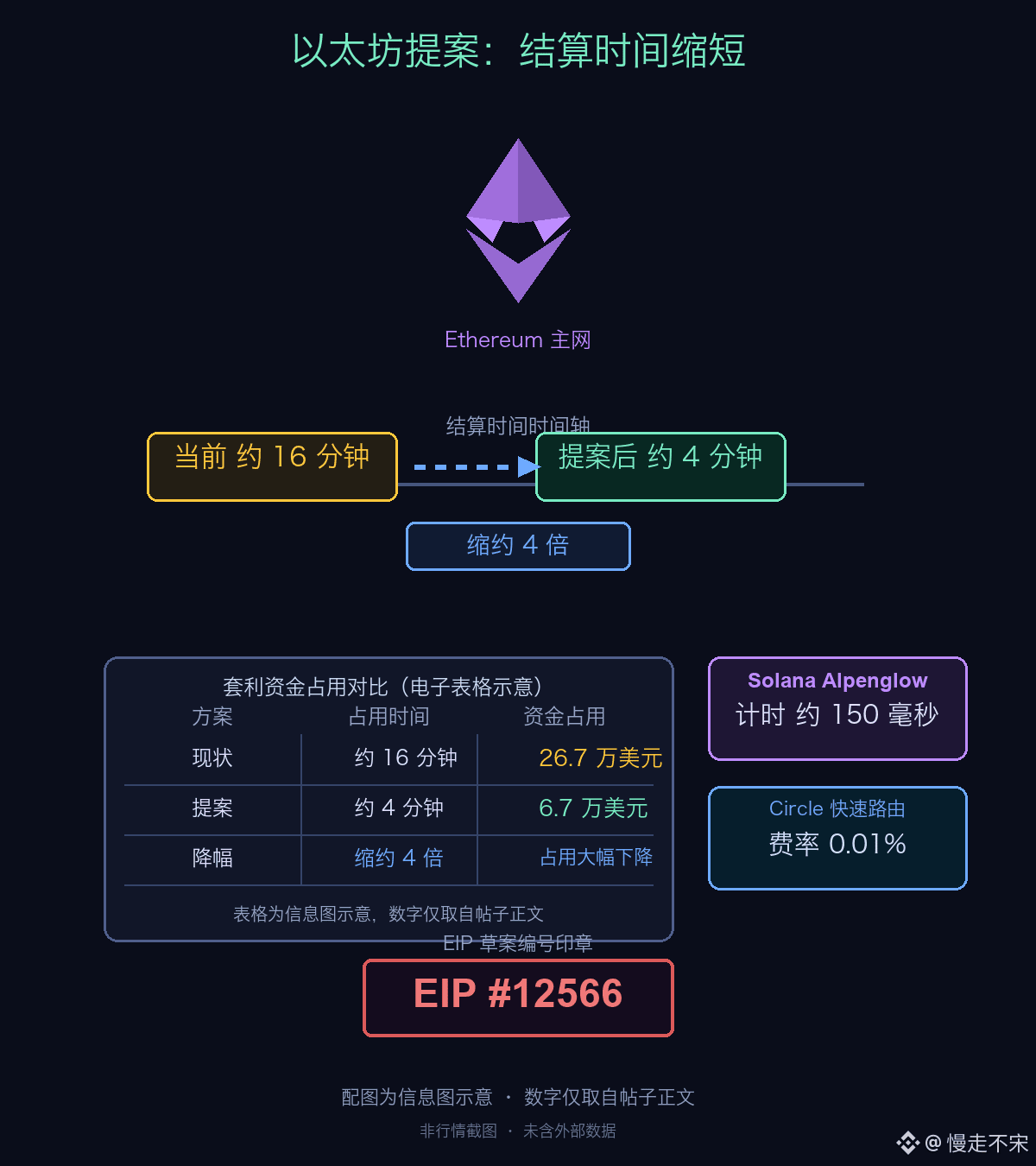
Ethereum wants to cut final settlement time from about 16 minutes to about 4 minutes. Ben Edgington, coordinator of Ethereum’s fast finality research, and Francesco D'Amato, Roberto Saltini, Yann Vonlanthen, and Mikhail Kalinin have submitted an EIP draft (number 12566, now in the formal process) aiming to make final confirmation about four times faster.
Why speed things up? Cross-chain remittance services have to front the funds while waiting for confirmation: at a steady $1 million advanced per hour, a 16-minute delay ties up about $267,000, while a 4-minute delay would bring that down to about $67,000.
The technical root cause is that validators’ votes serve two purposes: they select blocks and confirm older blocks, so confirmation speed is constrained by the validator rotation schedule. The draft separates the two votes, allowing confirmation to speed up independently and be tightened further over time. Splitting the votes also makes it easier to eventually switch to quantum-resistant signatures. The authors themselves say many aspects remain TBD. For now, the modest goal is simply to get a proposal number and enter Ethereum’s formal upgrade pipeline—the design is unfinished, and there’s no activation date, so don’t treat it as a done deal.
The comparison is even more interesting: Circle (CRCL) already charges based on speed for fast cross-chain USDC transfers—its Ethereum fast route costs 0.01% ($1 per $10,000), and there’s also a cap on the total amount that can be transferred quickly. On the competing side, Solana Alpenglow is targeting finality of about 150 milliseconds (it just launched yesterday). Even at 4 minutes, Ethereum would still be slow, but its advantages are mainnet security and scale.
Sources: CoinDesk and the EIP draft (github.com/ethereum/EIPs/pull/12566).
#ETH #以太坊 #EIP #跨链 #Circle
10

Article
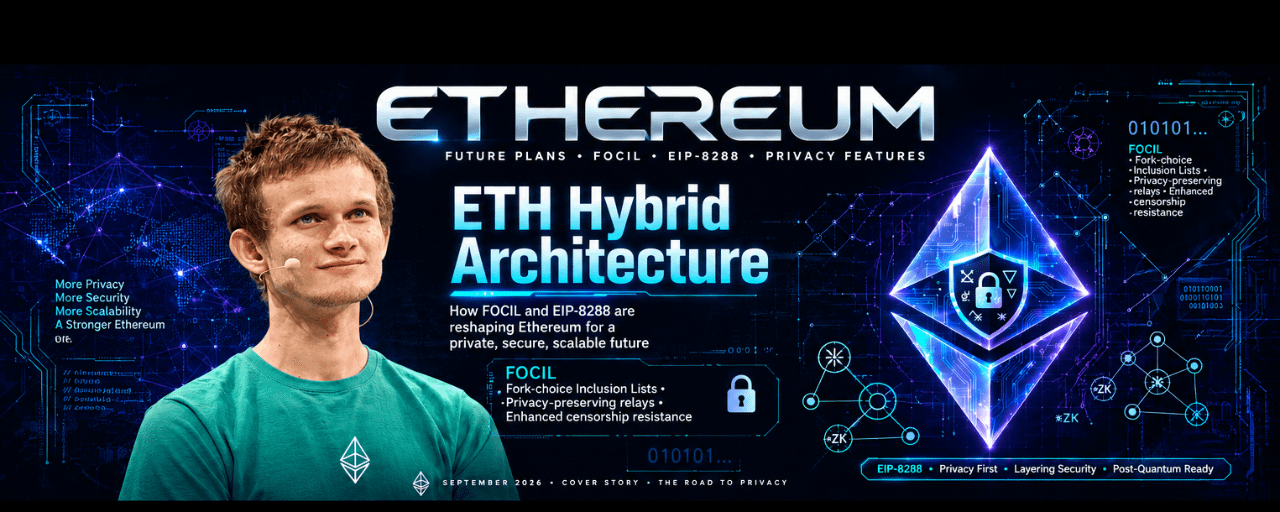
Vitalik Says Ethereum Will Become Hybrid Chain With FOCIL, EIP-8288 & Privacy$Ethereum founder Vitalik Buterin just revealed the most important update for Ethereum after the Hegota fork.He said Ethereum is no longer just a blockchain. It will become a hybrid architecture combining blockchain + modern cryptography like SNARKs, STARKs, FHE, and Obfuscation.What is FOCIL?🚀
FOCIL is coming in H-STARK upgrade. Currently one builder can censor your transaction. With FOCIL, 16 builders will co-create blocks. So if you send a transaction, it MUST be included in next slot. No single entity can delay it. This is huge for decentralization.What is EIP-8288?
This is about cheap private transactions. Today private tx costs 300k gas. With recursive STARKs, it will cost only 10k gas. 99% cheaper and quantum-safe. Vitalik says this will make privacy affordable for everyone.Privacy Future:
Vitalik says pseudonymity is dead because AI can track wallets. So we need programmable privacy. Future ETH will have formal verification, lean consensus, mempool privacy.He is 60% confident that by 2030, ZK tech will be as fast as normal transactions.If this happens, ETH will be the most private and secure chain.Bullish for ETH?
#ETH #VitalikBut erin #FOCIL #EIP 8288 #CryptoNews 🚀🚀
Vitalik Says Ethereum Will Become Hybrid Chain With FOCIL, EIP-8288 & Privacy
$Ethereum founder Vitalik Buterin just revealed the most important update for Ethereum after the Hegota fork.He said Ethereum is no longer just a blockchain. It will become a hybrid architecture combining blockchain + modern cryptography like SNARKs, STARKs, FHE, and Obfuscation.What is FOCIL?🚀
FOCIL is coming in H-STARK upgrade. Currently one builder can censor your transaction. With FOCIL, 16 builders will co-create blocks. So if you send a transaction, it MUST be included in next slot. No single entity can delay it. This is huge for decentralization.What is EIP-8288?
This is about cheap private transactions. Today private tx costs 300k gas. With recursive STARKs, it will cost only 10k gas. 99% cheaper and quantum-safe. Vitalik says this will make privacy affordable for everyone.Privacy Future:
Vitalik says pseudonymity is dead because AI can track wallets. So we need programmable privacy. Future ETH will have formal verification, lean consensus, mempool privacy.He is 60% confident that by 2030, ZK tech will be as fast as normal transactions.If this happens, ETH will be the most private and secure chain.Bullish for ETH?
#ETH #VitalikBut erin #FOCIL #EIP 8288 #CryptoNews 🚀🚀
1
68

·
--
Bullish
$BTC $ASTER
Have you ever been 'stabbed' by the sudden surge in Ethereum's Gas fees? Have you ever watched helplessly as a transaction fee exceeded the transfer amount during network congestion? 🤯 Don't worry, Vitalik just proposed a bold plan that could fundamentally change the game—establishing a Gas futures market for Ethereum! This isn’t for traders to speculate, but to allow you and me to lock in fuel prices in advance, bidding farewell to the era of terrifying volatility! 🚀
In simple terms, this concept allows users and developers to lock in future Gas prices, just like buying insurance. No more 'gambling' on your luck every time the network is busy! 📉
Why is this important?
Currently, the extreme volatility of Gas fees has been one of the biggest pain points for Ethereum. It's unpredictable, unbudgetable, and a nightmare during large-scale application operations. A futures-like market aims to turn Gas from a chaotic variable into a predictable stable cost.
If successful, what will this bring?
✅ Developers can confidently budget without worrying about runaway costs.
✅ DApp operations become more stable and reliable, leading to a significant increase in user experience.
✅ $ETH will resemble true infrastructure rather than just an experimental network.
💡 The core is: this isn’t about speculating on coins, but about ensuring that Ethereum remains usable and affordable when it needs stability the most—during real trading surges and network congestion. Currently, this is just an early proposal, but it sends a strong signal: Ethereum is still focused on tackling those tough, unglamorous yet fundamentally impactful issues that affect long-term adoption!
Do you think this 'Gas futures' concept can be successfully implemented? Will it become a key piece in the widespread adoption of Ethereum? 🤔 Join the comments section to share your views! ⬇️
#区块链 #Web3 #EIP #加密货币

5
375
Log in to explore more content
Join global crypto users on Binance Square
⚡️ Get latest and useful information about crypto.
💬 Trusted by the world’s largest crypto exchange.
👍 Discover real insights from verified creators.
Email / Phone number
Trending Topics
1
#NvidiaInvestigatesAfterHuang’sAffairApology
231,714 views
1,872 Discussing
2
#CPITestsDecemberRateOutlook
680,866 views
2,945 Discussing
3
#AnthropicRejectsIPODelayValuationinQuestion
51,596 views
496 Discussing
4
#US-IranTalksFuelStrongStockMarketRebound
341 views
39 Discussing
5
#BitcoinFiveWeeklyLosses
257,181 views
2,278 Discussing
6
#AIChipSlumpNasdaq
143,681 views
1,395 Discussing
7
#CryptoLiquidationsReach$1.16BIn24Hours
18,353 views
54 Discussing
8
#StrategyBuys1037BTCLastWeek
991 views
32 Discussing
9
#NYSEToUseAvalancheToSettleTokenizedStocks
460 views
23 Discussing
10
#TradFiForBeginners
371,942 views
2,646 Discussing