
#duskds
duskds
439 views
15 Discussing
Hot
Latest

·
--
Bearish
Verified
I kept getting one thing wrong while thinking through Moonlight and Phoenix: I was treating state shape as if it also determined finality.
That assumption started bothering me.
Moonlight arrives at #DuskVM carrying a public-account model: Balances, Sender, Receiver, Amount and Nonce Progression.
Phoenix is built around a completely different trail: Encrypted Notes, Shielded Outputs, Nullifiers and Private State.
My first instinct was that two such different systems should probably need two different ways to become final.
But maybe that's where I was adding complexity that isn't actually there.
Moonlight can remain account-shaped. Phoenix can remain note-shaped. #DuskVM doesn't need to flatten either one into some universal state format just to decide when execution is finished.
That also made me rethink #DuskDS .
I had been assuming it needed to create one shared $DUSK state underneath both models. I'm less convinced of that now.
The execution logic can stay specialized while Dusk L1 still gives the resulting state one deterministic finality boundary.
And honestly, that separation is more interesting to me than the individual state models.
Different ways of representing state don't necessarily require different answers to the question of when that state is finally done.
The thing I’m still wondering about is how cleanly this separation holds as Moonlight and Phoenix become more complex.
#dusk $DUSK @Dusk_Foundation
{future}(DUSKUSDT)
I kept getting one thing wrong while thinking through Moonlight and Phoenix: I was treating state shape as if it also determined finality.
That assumption started bothering me.
Moonlight arrives at #DuskVM carrying a public-account model: Balances, Sender, Receiver, Amount and Nonce Progression.
Phoenix is built around a completely different trail: Encrypted Notes, Shielded Outputs, Nullifiers and Private State.
My first instinct was that two such different systems should probably need two different ways to become final.
But maybe that's where I was adding complexity that isn't actually there.
Moonlight can remain account-shaped. Phoenix can remain note-shaped. #DuskVM doesn't need to flatten either one into some universal state format just to decide when execution is finished.
That also made me rethink #DuskDS .
I had been assuming it needed to create one shared $DUSK state underneath both models. I'm less convinced of that now.
The execution logic can stay specialized while Dusk L1 still gives the resulting state one deterministic finality boundary.
And honestly, that separation is more interesting to me than the individual state models.
Different ways of representing state don't necessarily require different answers to the question of when that state is finally done.
The thing I’m still wondering about is how cleanly this separation holds as Moonlight and Phoenix become more complex.
#dusk $DUSK @Dusk
That assumption started bothering me.
Moonlight arrives at #DuskVM carrying a public-account model: Balances, Sender, Receiver, Amount and Nonce Progression.
Phoenix is built around a completely different trail: Encrypted Notes, Shielded Outputs, Nullifiers and Private State.
My first instinct was that two such different systems should probably need two different ways to become final.
But maybe that's where I was adding complexity that isn't actually there.
Moonlight can remain account-shaped. Phoenix can remain note-shaped. #DuskVM doesn't need to flatten either one into some universal state format just to decide when execution is finished.
That also made me rethink #DuskDS .
I had been assuming it needed to create one shared $DUSK state underneath both models. I'm less convinced of that now.
The execution logic can stay specialized while Dusk L1 still gives the resulting state one deterministic finality boundary.
And honestly, that separation is more interesting to me than the individual state models.
Different ways of representing state don't necessarily require different answers to the question of when that state is finally done.
The thing I’m still wondering about is how cleanly this separation holds as Moonlight and Phoenix become more complex.
#dusk $DUSK @Dusk
37
23
299
·
--
Bullish
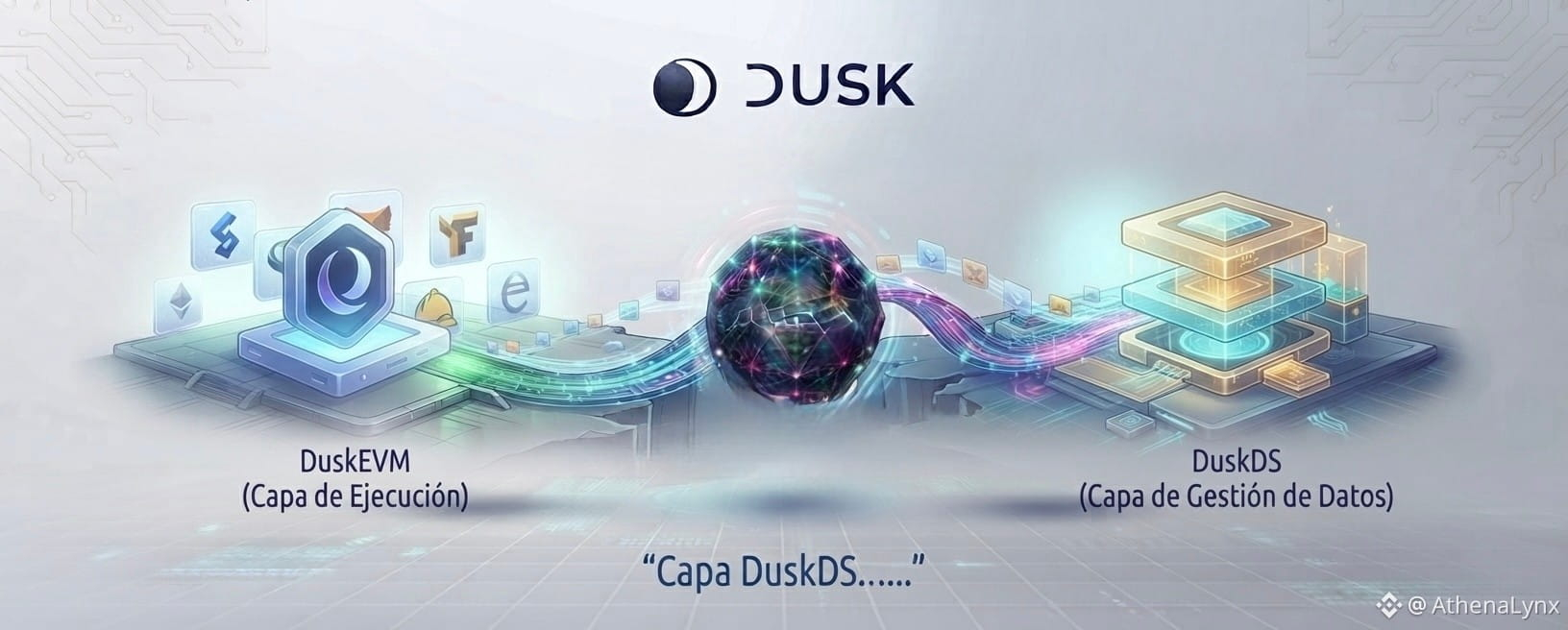
Today I’m stopping by to talk to you about DuskDS, perhaps one of the most confusing layers of the architecture of @Dusk_Foundation 🌒. But I’m going to try to explain it to you in the simplest way possible, without technical jargon.
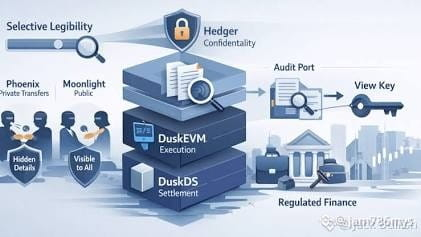
In the previous post, we saw that DuskEVM is the layer where EVM-compatible applications or smart contracts are developed and executed, while DuskDS is another infrastructure layer that makes it possible to manage the data and the operations carried out on DuskEVM.
In short, DuskDS helps ensure that the operations performed on DuskEVM can be recorded and connected to Dusk’s main infrastructure (Dusk L1), making it easier to settle them and to make the data available.
We need to keep in mind that DuskEVM and DuskDS are not two different tokens, nor two separate blockchains that compete with each other. They are different layers that serve different purposes within the architecture of $DUSK .
In the next post, we’ll talk about Dusk L1 and how it relates to the layers we discussed earlier.
#dusk #DuskEVM #DuskDS
Today I’m stopping by to talk to you about DuskDS, perhaps one of the most confusing layers of the architecture of @Dusk 🌒. But I’m going to try to explain it to you in the simplest way possible, without technical jargon.
In the previous post, we saw that DuskEVM is the layer where EVM-compatible applications or smart contracts are developed and executed, while DuskDS is another infrastructure layer that makes it possible to manage the data and the operations carried out on DuskEVM.
In short, DuskDS helps ensure that the operations performed on DuskEVM can be recorded and connected to Dusk’s main infrastructure (Dusk L1), making it easier to settle them and to make the data available.
We need to keep in mind that DuskEVM and DuskDS are not two different tokens, nor two separate blockchains that compete with each other. They are different layers that serve different purposes within the architecture of $DUSK .
In the next post, we’ll talk about Dusk L1 and how it relates to the layers we discussed earlier.
#dusk #DuskEVM #DuskDS
In the previous post, we saw that DuskEVM is the layer where EVM-compatible applications or smart contracts are developed and executed, while DuskDS is another infrastructure layer that makes it possible to manage the data and the operations carried out on DuskEVM.
In short, DuskDS helps ensure that the operations performed on DuskEVM can be recorded and connected to Dusk’s main infrastructure (Dusk L1), making it easier to settle them and to make the data available.
We need to keep in mind that DuskEVM and DuskDS are not two different tokens, nor two separate blockchains that compete with each other. They are different layers that serve different purposes within the architecture of $DUSK .
In the next post, we’ll talk about Dusk L1 and how it relates to the layers we discussed earlier.
#dusk #DuskEVM #DuskDS
441
·
--
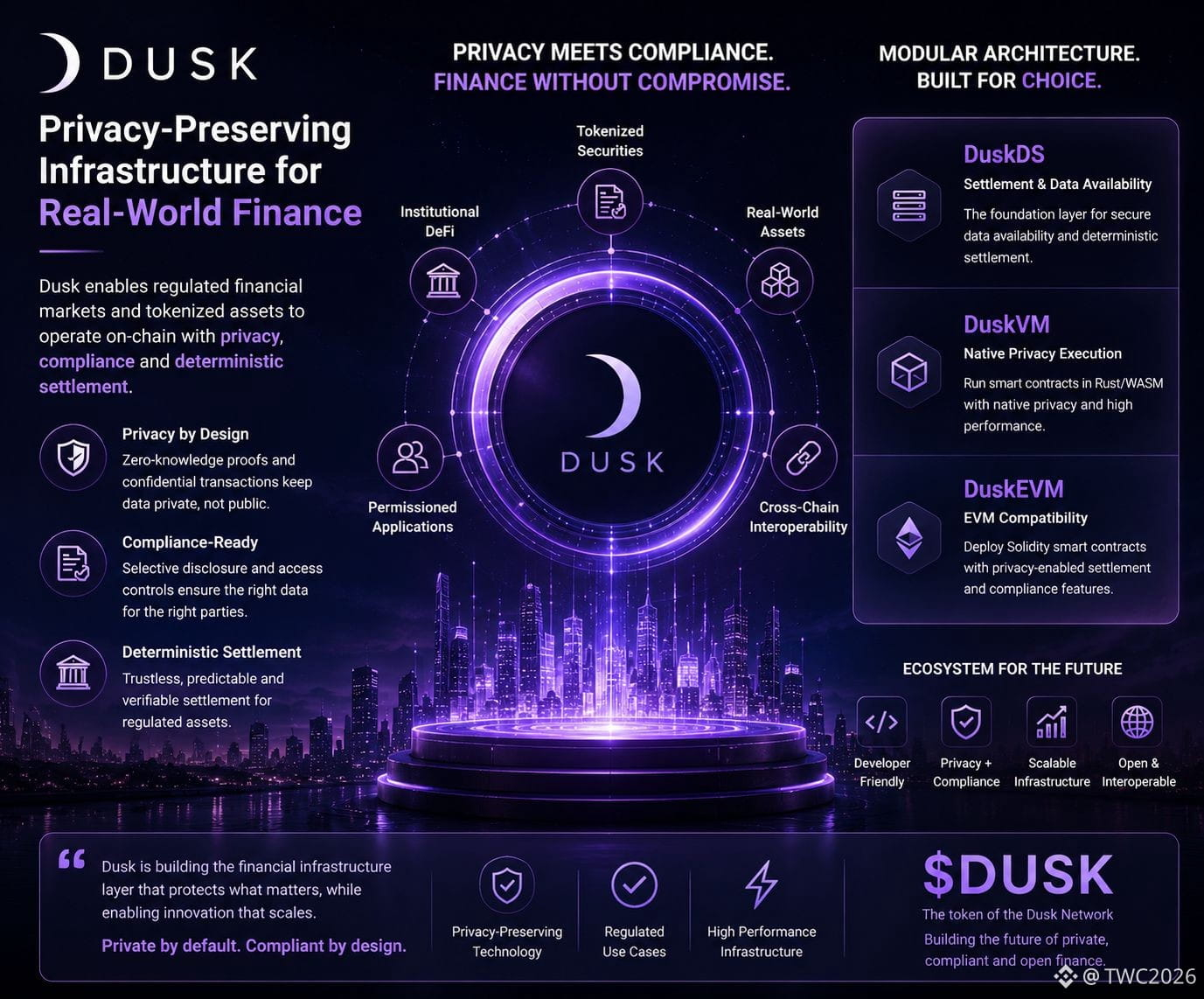
@Dusk_Foundation is building something DeFi and tokenized finance will increasingly need: privacy without losing compliance. Public blockchains are powerful because transactions can be transparent and verifiable, but regulated financial markets cannot expose every balance, position, investor detail, or transaction publicly. @Dusk_Foundation approaches this challenge by combining zero-knowledge technology, confidential transfers, selective disclosure, access controls, and deterministic settlement. �
Dusk +1
What makes this approach interesting is the idea that privacy does not have to mean hiding everything. Authorized participants can receive the information they need, while sensitive data remains protected from unnecessary public exposure. This can be especially relevant for tokenized securities, real-world assets, institutional DeFi, and other financial workflows where eligibility, reporting, transfer restrictions, and settlement rules matter. �
DOCS +1
Dusk also uses a modular architecture, with #DuskDS focused on settlement and data availability, #DuskVM for native Rust/WASM execution, and #DuskEVM for EVM-compatible applications. That gives developers different paths depending on whether an application prioritizes native privacy, familiar EVM tooling, or regulated settlement infrastructure. �
DOCS
For me, the interesting part of Dusk is not simply “privacy.” It is the combination of privacy, compliance and predictable settlement in one financial infrastructure. If more real-world assets and institutional markets move on-chain, these capabilities could become increasingly important. #dusk $DUSK
@Dusk is building something DeFi and tokenized finance will increasingly need: privacy without losing compliance. Public blockchains are powerful because transactions can be transparent and verifiable, but regulated financial markets cannot expose every balance, position, investor detail, or transaction publicly. @Dusk approaches this challenge by combining zero-knowledge technology, confidential transfers, selective disclosure, access controls, and deterministic settlement. �
Dusk +1
What makes this approach interesting is the idea that privacy does not have to mean hiding everything. Authorized participants can receive the information they need, while sensitive data remains protected from unnecessary public exposure. This can be especially relevant for tokenized securities, real-world assets, institutional DeFi, and other financial workflows where eligibility, reporting, transfer restrictions, and settlement rules matter. �
DOCS +1
Dusk also uses a modular architecture, with #DuskDS focused on settlement and data availability, #DuskVM for native Rust/WASM execution, and #DuskEVM for EVM-compatible applications. That gives developers different paths depending on whether an application prioritizes native privacy, familiar EVM tooling, or regulated settlement infrastructure. �
DOCS
For me, the interesting part of Dusk is not simply “privacy.” It is the combination of privacy, compliance and predictable settlement in one financial infrastructure. If more real-world assets and institutional markets move on-chain, these capabilities could become increasingly important. #dusk $DUSK
Dusk +1
What makes this approach interesting is the idea that privacy does not have to mean hiding everything. Authorized participants can receive the information they need, while sensitive data remains protected from unnecessary public exposure. This can be especially relevant for tokenized securities, real-world assets, institutional DeFi, and other financial workflows where eligibility, reporting, transfer restrictions, and settlement rules matter. �
DOCS +1
Dusk also uses a modular architecture, with #DuskDS focused on settlement and data availability, #DuskVM for native Rust/WASM execution, and #DuskEVM for EVM-compatible applications. That gives developers different paths depending on whether an application prioritizes native privacy, familiar EVM tooling, or regulated settlement infrastructure. �
DOCS
For me, the interesting part of Dusk is not simply “privacy.” It is the combination of privacy, compliance and predictable settlement in one financial infrastructure. If more real-world assets and institutional markets move on-chain, these capabilities could become increasingly important. #dusk $DUSK
63

Verified
I added a small $DUSK position today, but I’m watching DuskEVM differently now.
What caught me wasn’t just EVM compatibility—it’s how Hedger makes private transactions reviewable using homomorphic encryption and ZK proofs. I used to see privacy as a user feature; now I see it as an adoption mechanism for regulated apps.
@Dusk_Foundation also powers execution while DuskDS handles settlement and data availability. That separation feels important.
I’m still unsure how quickly real users will adopt it, but the architecture changed my view.
$ATM $BANK #DUSK #DUSKEVM #DuskDS #Web3
What do you think matters most for DUSK?
I added a small $DUSK position today, but I’m watching DuskEVM differently now.
What caught me wasn’t just EVM compatibility—it’s how Hedger makes private transactions reviewable using homomorphic encryption and ZK proofs. I used to see privacy as a user feature; now I see it as an adoption mechanism for regulated apps.
@Dusk also powers execution while DuskDS handles settlement and data availability. That separation feels important.
I’m still unsure how quickly real users will adopt it, but the architecture changed my view.
$ATM $BANK #DUSK #DUSKEVM #DuskDS #Web3
What do you think matters most for DUSK?
What caught me wasn’t just EVM compatibility—it’s how Hedger makes private transactions reviewable using homomorphic encryption and ZK proofs. I used to see privacy as a user feature; now I see it as an adoption mechanism for regulated apps.
@Dusk also powers execution while DuskDS handles settlement and data availability. That separation feels important.
I’m still unsure how quickly real users will adopt it, but the architecture changed my view.
$ATM $BANK #DUSK #DUSKEVM #DuskDS #Web3
What do you think matters most for DUSK?
Privacy 🔐
67%
EVM access
33%
Settlement
0%
6 votes • Voting closed
30
16
357
·
--
Bullish
Verified
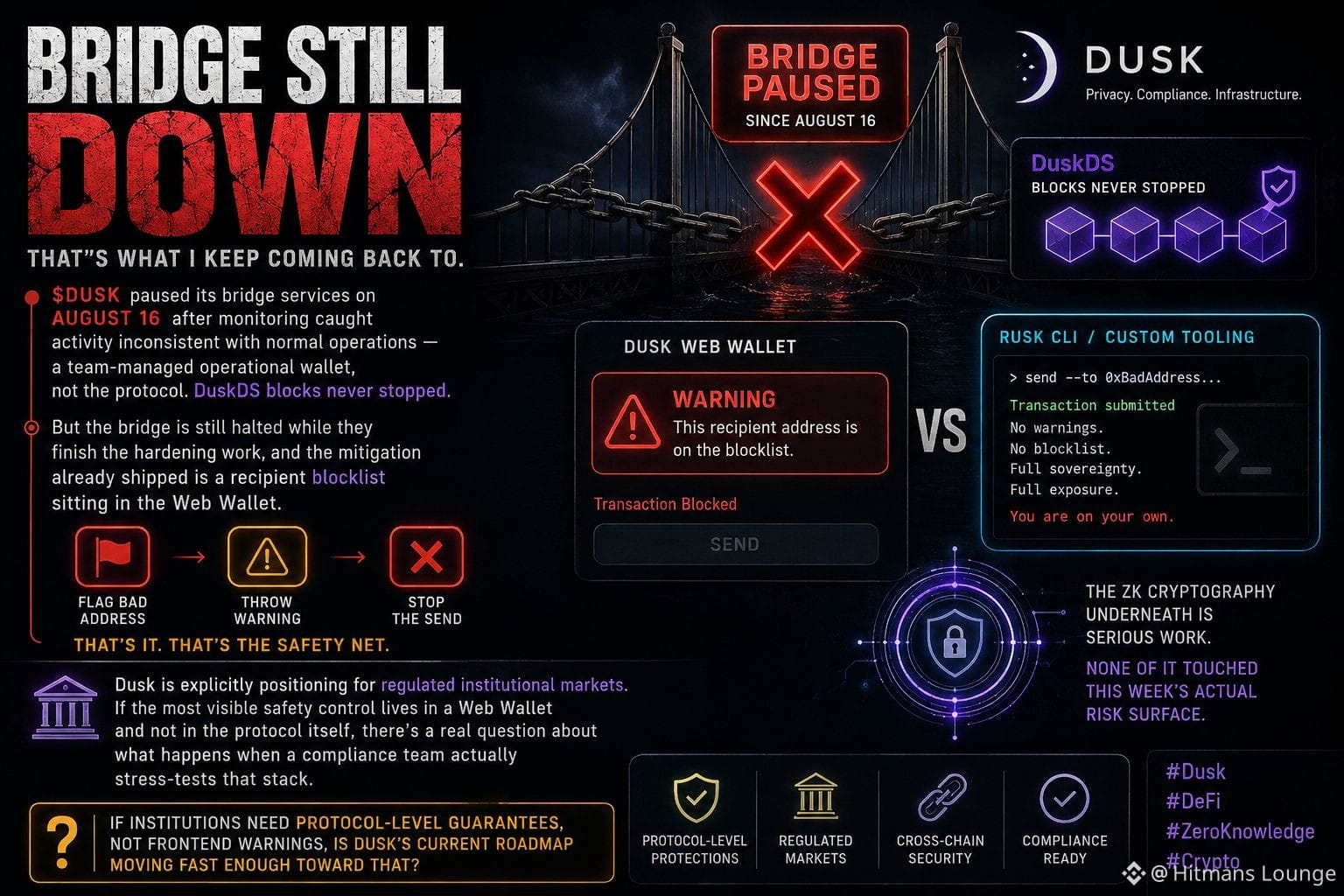
Bridge still down and that's what I keep coming back to for a period of time.
@Dusk_Foundation paused its bridge services on January 16 after monitoring caught activity inconsistent with normal operations — a team-managed operational wallet, not the protocol. DuskDS blocks never stopped. But the bridge is still halted while they finish the hardening work, and the mitigation already shipped is a recipient blocklist sitting in the Web Wallet. Flag a bad address, throw a warning, stop the send.
That's it. That's the safety net.
And here's what I can't stop thinking about: if you're running Rusk CLI or your own tooling, that warning never fires. You're fully sovereign — and fully exposed. The ZK cryptography underneath is genuinely serious work. None of it touched this week's actual risk surface.
I don't think the blocklist was a wrong call. Pragmatically it's correct — cover the most users fastest, fix the architecture later.
But $DUSK is explicitly positioning for regulated institutional markets. If the most visible safety control lives in a Web Wallet and not in the protocol itself, there's a real question about what happens when a compliance team actually stress-tests that stack.
That's the gap I'm watching. Not the cryptography — the governance of where protection actually lives.
If institutions need protocol-level guarantees, not frontend warnings, is Dusk's current roadmap moving fast enough toward that?
#Dusk #DeFi #ZeroKnowledge #Bridge #DuskDS
Bridge still down and that's what I keep coming back to for a period of time.
@Dusk paused its bridge services on January 16 after monitoring caught activity inconsistent with normal operations — a team-managed operational wallet, not the protocol. DuskDS blocks never stopped. But the bridge is still halted while they finish the hardening work, and the mitigation already shipped is a recipient blocklist sitting in the Web Wallet. Flag a bad address, throw a warning, stop the send.
That's it. That's the safety net.
And here's what I can't stop thinking about: if you're running Rusk CLI or your own tooling, that warning never fires. You're fully sovereign — and fully exposed. The ZK cryptography underneath is genuinely serious work. None of it touched this week's actual risk surface.
I don't think the blocklist was a wrong call. Pragmatically it's correct — cover the most users fastest, fix the architecture later.
But $DUSK is explicitly positioning for regulated institutional markets. If the most visible safety control lives in a Web Wallet and not in the protocol itself, there's a real question about what happens when a compliance team actually stress-tests that stack.
That's the gap I'm watching. Not the cryptography — the governance of where protection actually lives.
If institutions need protocol-level guarantees, not frontend warnings, is Dusk's current roadmap moving fast enough toward that?
#Dusk #DeFi #ZeroKnowledge #Bridge #DuskDS
@Dusk paused its bridge services on January 16 after monitoring caught activity inconsistent with normal operations — a team-managed operational wallet, not the protocol. DuskDS blocks never stopped. But the bridge is still halted while they finish the hardening work, and the mitigation already shipped is a recipient blocklist sitting in the Web Wallet. Flag a bad address, throw a warning, stop the send.
That's it. That's the safety net.
And here's what I can't stop thinking about: if you're running Rusk CLI or your own tooling, that warning never fires. You're fully sovereign — and fully exposed. The ZK cryptography underneath is genuinely serious work. None of it touched this week's actual risk surface.
I don't think the blocklist was a wrong call. Pragmatically it's correct — cover the most users fastest, fix the architecture later.
But $DUSK is explicitly positioning for regulated institutional markets. If the most visible safety control lives in a Web Wallet and not in the protocol itself, there's a real question about what happens when a compliance team actually stress-tests that stack.
That's the gap I'm watching. Not the cryptography — the governance of where protection actually lives.
If institutions need protocol-level guarantees, not frontend warnings, is Dusk's current roadmap moving fast enough toward that?
#Dusk #DeFi #ZeroKnowledge #Bridge #DuskDS
21
19
146
Log in to explore more content
Join global crypto users on Binance Square
⚡️ Get latest and useful information about crypto.
💬 Trusted by the world’s largest crypto exchange.
👍 Discover real insights from verified creators.
Email / Phone number
Trending Topics
1
#AIStocksWhatNext
904,587 views
6,709 Discussing
2
#BitcoinRejectedAt$87,300Twice
0 views
0 Discussing
3
#BCHJumps28%OnCMEFuturesListing
13,319 views
560 Discussing
4
#WallStreetEarningsRevisionsTurnBearish
10,072 views
410 Discussing
5
#DollarIndexReclaims101
8,167 views
354 Discussing
6
#21SharesLaunchesEuropesFirstZcashETP
43,938 views
1,141 Discussing
7
#CardanoJoinsX402PaymentStandard
27,312 views
805 Discussing
8
#BitcoinTops$87KAtEightMonthHigh
12,920 views
134 Discussing
9
#ZECBreaksAbove$1600AtRecordHigh
9,041 views
108 Discussing
10
#BitwiseNEARStakingETPAssetsTop$100M
43,848 views
108 Discussing