
#cryptoeducation
cryptoeducation
3.5M views
19,864 Discussing
Hot
Latest

·
--
📚 Crypto Education — RSI
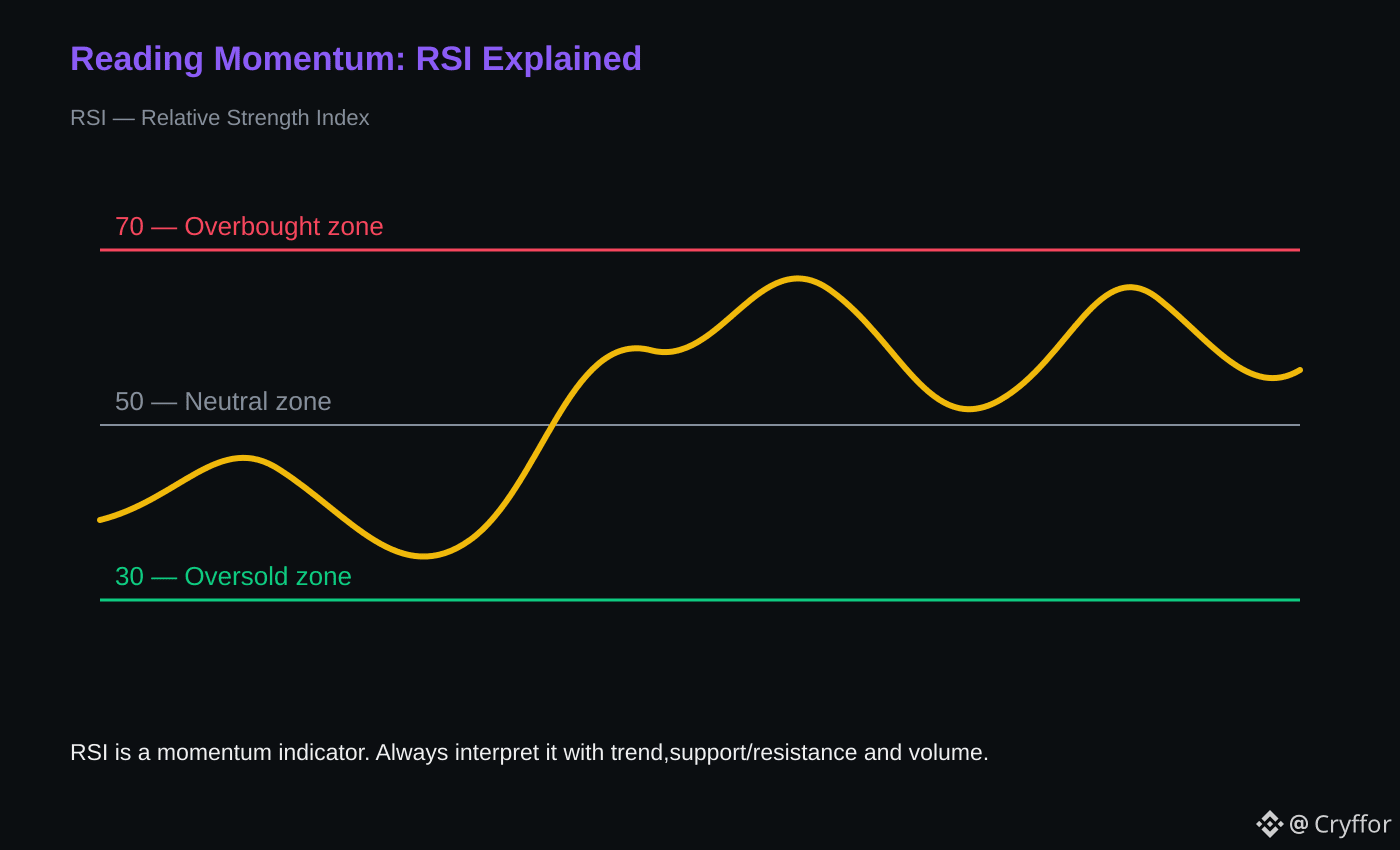
⚡ RSI measures momentum.
🟢 Above 70: strong momentum / potentially overextended
🟡 Around 50: balanced momentum
🔴 Below 30: weak momentum / potentially oversold
📊 RSI should not be used alone.
🔎 Price structure, volume and trend can provide confirmation.
👀 Context matters.
🤔 Do you combine RSI with another indicator?
#CryptoEducation #Binance #RSI #TechnicalAnalysis
📚 Crypto Education — RSI
⚡ RSI measures momentum.
🟢 Above 70: strong momentum / potentially overextended
🟡 Around 50: balanced momentum
🔴 Below 30: weak momentum / potentially oversold
📊 RSI should not be used alone.
🔎 Price structure, volume and trend can provide confirmation.
👀 Context matters.
🤔 Do you combine RSI with another indicator?
#CryptoEducation #Binance #RSI #TechnicalAnalysis
⚡ RSI measures momentum.
🟢 Above 70: strong momentum / potentially overextended
🟡 Around 50: balanced momentum
🔴 Below 30: weak momentum / potentially oversold
📊 RSI should not be used alone.
🔎 Price structure, volume and trend can provide confirmation.
👀 Context matters.
🤔 Do you combine RSI with another indicator?
#CryptoEducation #Binance #RSI #TechnicalAnalysis

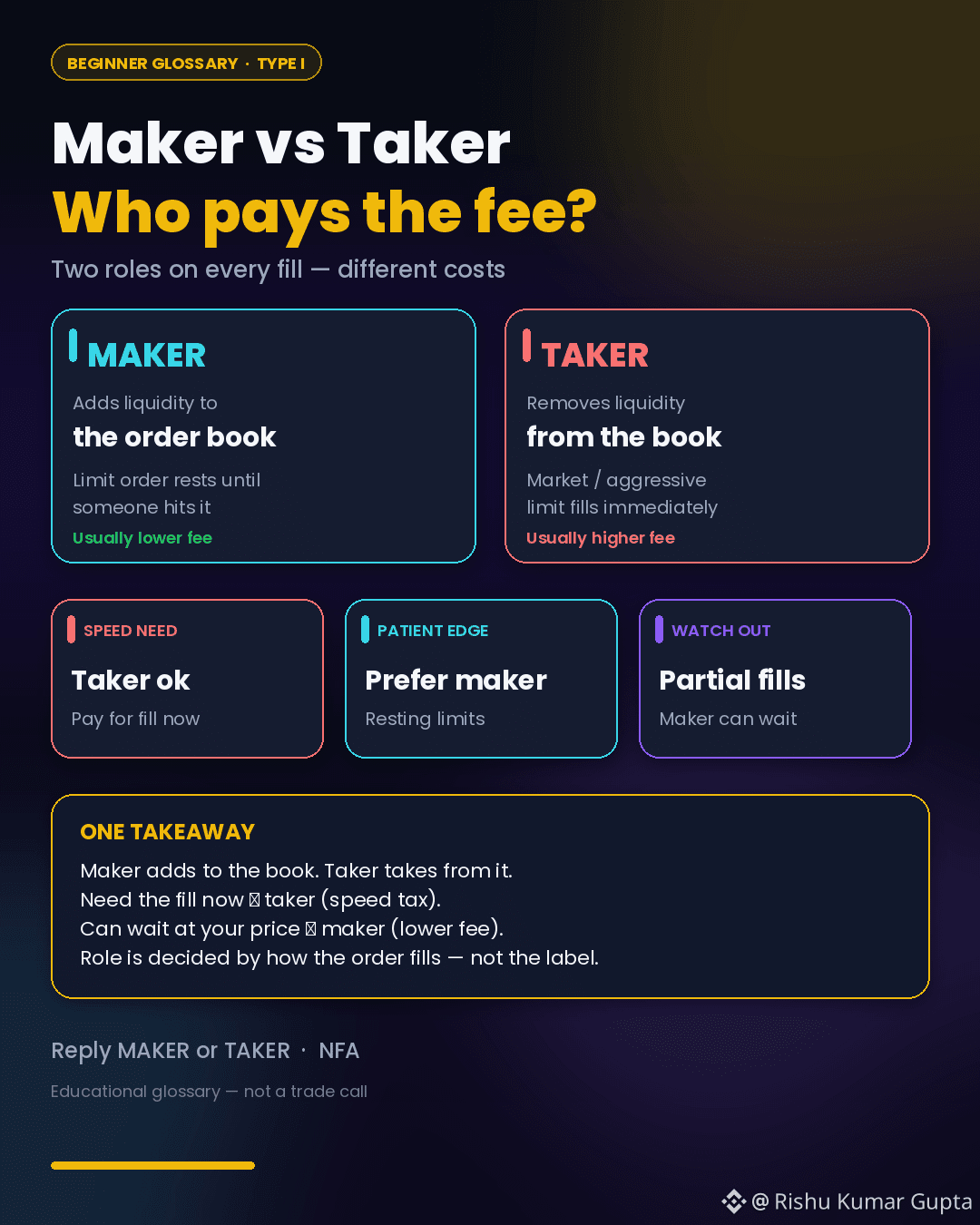
Maker vs Taker — who pays the fee?
Maker: your limit rests on the book and adds liquidity. Usually the lower fee.
Taker: you hit an existing order and remove liquidity (market or aggressive limit). Usually the higher fee — you pay for speed.
Need the fill now → taker is fine. Can wait at your price → prefer maker. The role is decided by how the order actually fills, not the button label.
Reply MAKER or TAKER.
NFA — education only.
$BTC $ETH #TradingBasics #Fees #CryptoEducation
Maker vs Taker — who pays the fee?
Maker: your limit rests on the book and adds liquidity. Usually the lower fee.
Taker: you hit an existing order and remove liquidity (market or aggressive limit). Usually the higher fee — you pay for speed.
Need the fill now → taker is fine. Can wait at your price → prefer maker. The role is decided by how the order actually fills, not the button label.
Reply MAKER or TAKER.
NFA — education only.
$BTC $ETH #TradingBasics #Fees #CryptoEducation
Maker: your limit rests on the book and adds liquidity. Usually the lower fee.
Taker: you hit an existing order and remove liquidity (market or aggressive limit). Usually the higher fee — you pay for speed.
Need the fill now → taker is fine. Can wait at your price → prefer maker. The role is decided by how the order actually fills, not the button label.
Reply MAKER or TAKER.
NFA — education only.
$BTC $ETH #TradingBasics #Fees #CryptoEducation
17

·
--
Article
What Is a DEX? A Beginner’s Guide to Decentralized ExchangesIf you are learning about DeFi, one term you will come across repeatedly is DEX.
DEX stands for Decentralized Exchange.
But what makes an exchange decentralized, and how is it different from a traditional centralized exchange?
Let’s break it down.
What Is a DEX?
A decentralized exchange is a blockchain-based platform that allows users to trade crypto assets directly through smart contracts.
Instead of depositing your assets into an exchange-controlled account, you generally connect your own crypto wallet and interact with the DEX through a blockchain transaction.
This introduces a different model of trading:
Wallet → Smart Contract → Blockchain
The exchange logic is handled by blockchain-based smart contracts rather than relying entirely on a centralized company to execute and custody trades.
DEX vs CEX
The easiest way to understand a DEX is to compare it with a centralized exchange, or CEX.
A centralized exchange typically operates through a company that manages the trading platform and, depending on the service, may hold users’ assets.
DEX is designed around smart contracts and self-custody.
With a DEX, the user generally keeps control of their wallet and authorizes transactions themselves.
This difference is important because custody and execution work differently in the two models.
How Does a DEX Work?
Most modern DEXs use smart contracts to facilitate trading.
A simplified process looks like this:
1. Connect Your Wallet
You connect a compatible crypto wallet to the DEX.
Your assets remain in your wallet until you approve a transaction.
2. Choose Your Trading Pair
You select the asset you want to trade and the asset you want to receive.
For example:
Token A → Token B
3. Check the Trade
Before confirming, the interface may show information such as:
- Exchange rate
- Network fee
- Price impact
- Slippage
- Minimum amount received
4. Approve the Transaction
You authorize the transaction from your wallet.
The blockchain then processes the interaction with the DEX's smart contract.
5. Receive the Asset
If the transaction executes successfully, the swapped asset arrives in your wallet.
The entire process can happen without creating a traditional exchange account.
Where Does the Liquidity Come From?
This is one of the most important concepts in DeFi.
Many DEXs use liquidity pools.
A liquidity pool contains crypto assets supplied by users known as liquidity providers.
For example, a pool could contain two assets that traders can swap between.
When someone makes a trade, the smart contract interacts with the available liquidity in the pool.
Liquidity providers may receive a portion of trading fees according to the rules of the protocol.
This creates an ecosystem where:
Traders use liquidity → Liquidity providers supply liquidity → The protocol facilitates the swap
We will explore liquidity pools and liquidity providers in more detail later in this series.
What Is an AMM?
Many DEXs use a mechanism called an Automated Market Maker, or AMM.
An AMM uses mathematical rules and liquidity pools to determine how trades are executed instead of relying on a traditional order book.
This is one of the major innovations behind modern decentralized trading.
Rather than waiting for a specific buyer and seller to match, users can trade against available liquidity.
But AMMs also introduce concepts such as price impact, slippage, and impermanent loss.
These are important topics for anyone using DeFi.
Advantages of DEXs
DEXs can provide several important features.
Self-Custody
Users can generally maintain control of their assets through their own wallets.
On-Chain Transparency
Transactions and smart-contract activity can often be verified on the blockchain.
Open Access
Depending on the blockchain and protocol, users may be able to interact with a DEX without opening a traditional exchange account.
DeFi Integration
DEXs can interact with other decentralized applications and smart contracts, making them an important part of the broader DeFi ecosystem.
What Are the Risks?
Decentralized does not mean risk-free.
Users should understand several risks before trading on a DEX.
Smart Contract Risk
A vulnerability in a smart contract can potentially lead to loss of funds.
Slippage
The final execution price may differ from the expected price, especially when liquidity is limited or markets move quickly.
Price Impact
Large trades can move the price within a liquidity pool.
Network Fees
Every blockchain transaction may require a network fee.
Irreversible Transactions
Blockchain transactions are generally difficult or impossible to reverse once confirmed.
Fake Tokens and Malicious Contracts
Users must verify token addresses and interact with legitimate protocols. A DEX does not automatically make every token or contract safe.
Why DEXs Matter
DEXs represent a major shift in how digital assets can be exchanged.
Instead of relying entirely on a centralized intermediary, decentralized exchanges use:
Wallets + Smart Contracts + Blockchain + Liquidity
This model is one of the foundations of decentralized finance.
But understanding what a DEX is only gives us the starting point.
The next question is even more important:
How does a DEX actually determine the price of a token and execute a swap?
That takes us to the next topic in this series:
What Is an AMM? — Understanding Automated Market Makers
Stay tuned as we continue breaking down DeFi, one concept at a time.
#CryptoEducation #DeFi #DEX #Blockchain
What Is a DEX? A Beginner’s Guide to Decentralized Exchanges
If you are learning about DeFi, one term you will come across repeatedly is DEX.
DEX stands for Decentralized Exchange.
But what makes an exchange decentralized, and how is it different from a traditional centralized exchange?
Let’s break it down.
What Is a DEX?
A decentralized exchange is a blockchain-based platform that allows users to trade crypto assets directly through smart contracts.
Instead of depositing your assets into an exchange-controlled account, you generally connect your own crypto wallet and interact with the DEX through a blockchain transaction.
This introduces a different model of trading:
Wallet → Smart Contract → Blockchain
The exchange logic is handled by blockchain-based smart contracts rather than relying entirely on a centralized company to execute and custody trades.
DEX vs CEX
The easiest way to understand a DEX is to compare it with a centralized exchange, or CEX.
A centralized exchange typically operates through a company that manages the trading platform and, depending on the service, may hold users’ assets.
DEX is designed around smart contracts and self-custody.
With a DEX, the user generally keeps control of their wallet and authorizes transactions themselves.
This difference is important because custody and execution work differently in the two models.
How Does a DEX Work?
Most modern DEXs use smart contracts to facilitate trading.
A simplified process looks like this:
1. Connect Your Wallet
You connect a compatible crypto wallet to the DEX.
Your assets remain in your wallet until you approve a transaction.
2. Choose Your Trading Pair
You select the asset you want to trade and the asset you want to receive.
For example:
Token A → Token B
3. Check the Trade
Before confirming, the interface may show information such as:
- Exchange rate
- Network fee
- Price impact
- Slippage
- Minimum amount received
4. Approve the Transaction
You authorize the transaction from your wallet.
The blockchain then processes the interaction with the DEX's smart contract.
5. Receive the Asset
If the transaction executes successfully, the swapped asset arrives in your wallet.
The entire process can happen without creating a traditional exchange account.
Where Does the Liquidity Come From?
This is one of the most important concepts in DeFi.
Many DEXs use liquidity pools.
A liquidity pool contains crypto assets supplied by users known as liquidity providers.
For example, a pool could contain two assets that traders can swap between.
When someone makes a trade, the smart contract interacts with the available liquidity in the pool.
Liquidity providers may receive a portion of trading fees according to the rules of the protocol.
This creates an ecosystem where:
Traders use liquidity → Liquidity providers supply liquidity → The protocol facilitates the swap
We will explore liquidity pools and liquidity providers in more detail later in this series.
What Is an AMM?
Many DEXs use a mechanism called an Automated Market Maker, or AMM.
An AMM uses mathematical rules and liquidity pools to determine how trades are executed instead of relying on a traditional order book.
This is one of the major innovations behind modern decentralized trading.
Rather than waiting for a specific buyer and seller to match, users can trade against available liquidity.
But AMMs also introduce concepts such as price impact, slippage, and impermanent loss.
These are important topics for anyone using DeFi.
Advantages of DEXs
DEXs can provide several important features.
Self-Custody
Users can generally maintain control of their assets through their own wallets.
On-Chain Transparency
Transactions and smart-contract activity can often be verified on the blockchain.
Open Access
Depending on the blockchain and protocol, users may be able to interact with a DEX without opening a traditional exchange account.
DeFi Integration
DEXs can interact with other decentralized applications and smart contracts, making them an important part of the broader DeFi ecosystem.
What Are the Risks?
Decentralized does not mean risk-free.
Users should understand several risks before trading on a DEX.
Smart Contract Risk
A vulnerability in a smart contract can potentially lead to loss of funds.
Slippage
The final execution price may differ from the expected price, especially when liquidity is limited or markets move quickly.
Price Impact
Large trades can move the price within a liquidity pool.
Network Fees
Every blockchain transaction may require a network fee.
Irreversible Transactions
Blockchain transactions are generally difficult or impossible to reverse once confirmed.
Fake Tokens and Malicious Contracts
Users must verify token addresses and interact with legitimate protocols. A DEX does not automatically make every token or contract safe.
Why DEXs Matter
DEXs represent a major shift in how digital assets can be exchanged.
Instead of relying entirely on a centralized intermediary, decentralized exchanges use:
Wallets + Smart Contracts + Blockchain + Liquidity
This model is one of the foundations of decentralized finance.
But understanding what a DEX is only gives us the starting point.
The next question is even more important:
How does a DEX actually determine the price of a token and execute a swap?
That takes us to the next topic in this series:
What Is an AMM? — Understanding Automated Market Makers
Stay tuned as we continue breaking down DeFi, one concept at a time.
#CryptoEducation #DeFi #DEX #Blockchain
DEX stands for Decentralized Exchange.
But what makes an exchange decentralized, and how is it different from a traditional centralized exchange?
Let’s break it down.
What Is a DEX?
A decentralized exchange is a blockchain-based platform that allows users to trade crypto assets directly through smart contracts.
Instead of depositing your assets into an exchange-controlled account, you generally connect your own crypto wallet and interact with the DEX through a blockchain transaction.
This introduces a different model of trading:
Wallet → Smart Contract → Blockchain
The exchange logic is handled by blockchain-based smart contracts rather than relying entirely on a centralized company to execute and custody trades.
DEX vs CEX
The easiest way to understand a DEX is to compare it with a centralized exchange, or CEX.
A centralized exchange typically operates through a company that manages the trading platform and, depending on the service, may hold users’ assets.
DEX is designed around smart contracts and self-custody.
With a DEX, the user generally keeps control of their wallet and authorizes transactions themselves.
This difference is important because custody and execution work differently in the two models.
How Does a DEX Work?
Most modern DEXs use smart contracts to facilitate trading.
A simplified process looks like this:
1. Connect Your Wallet
You connect a compatible crypto wallet to the DEX.
Your assets remain in your wallet until you approve a transaction.
2. Choose Your Trading Pair
You select the asset you want to trade and the asset you want to receive.
For example:
Token A → Token B
3. Check the Trade
Before confirming, the interface may show information such as:
- Exchange rate
- Network fee
- Price impact
- Slippage
- Minimum amount received
4. Approve the Transaction
You authorize the transaction from your wallet.
The blockchain then processes the interaction with the DEX's smart contract.
5. Receive the Asset
If the transaction executes successfully, the swapped asset arrives in your wallet.
The entire process can happen without creating a traditional exchange account.
Where Does the Liquidity Come From?
This is one of the most important concepts in DeFi.
Many DEXs use liquidity pools.
A liquidity pool contains crypto assets supplied by users known as liquidity providers.
For example, a pool could contain two assets that traders can swap between.
When someone makes a trade, the smart contract interacts with the available liquidity in the pool.
Liquidity providers may receive a portion of trading fees according to the rules of the protocol.
This creates an ecosystem where:
Traders use liquidity → Liquidity providers supply liquidity → The protocol facilitates the swap
We will explore liquidity pools and liquidity providers in more detail later in this series.
What Is an AMM?
Many DEXs use a mechanism called an Automated Market Maker, or AMM.
An AMM uses mathematical rules and liquidity pools to determine how trades are executed instead of relying on a traditional order book.
This is one of the major innovations behind modern decentralized trading.
Rather than waiting for a specific buyer and seller to match, users can trade against available liquidity.
But AMMs also introduce concepts such as price impact, slippage, and impermanent loss.
These are important topics for anyone using DeFi.
Advantages of DEXs
DEXs can provide several important features.
Self-Custody
Users can generally maintain control of their assets through their own wallets.
On-Chain Transparency
Transactions and smart-contract activity can often be verified on the blockchain.
Open Access
Depending on the blockchain and protocol, users may be able to interact with a DEX without opening a traditional exchange account.
DeFi Integration
DEXs can interact with other decentralized applications and smart contracts, making them an important part of the broader DeFi ecosystem.
What Are the Risks?
Decentralized does not mean risk-free.
Users should understand several risks before trading on a DEX.
Smart Contract Risk
A vulnerability in a smart contract can potentially lead to loss of funds.
Slippage
The final execution price may differ from the expected price, especially when liquidity is limited or markets move quickly.
Price Impact
Large trades can move the price within a liquidity pool.
Network Fees
Every blockchain transaction may require a network fee.
Irreversible Transactions
Blockchain transactions are generally difficult or impossible to reverse once confirmed.
Fake Tokens and Malicious Contracts
Users must verify token addresses and interact with legitimate protocols. A DEX does not automatically make every token or contract safe.
Why DEXs Matter
DEXs represent a major shift in how digital assets can be exchanged.
Instead of relying entirely on a centralized intermediary, decentralized exchanges use:
Wallets + Smart Contracts + Blockchain + Liquidity
This model is one of the foundations of decentralized finance.
But understanding what a DEX is only gives us the starting point.
The next question is even more important:
How does a DEX actually determine the price of a token and execute a swap?
That takes us to the next topic in this series:
What Is an AMM? — Understanding Automated Market Makers
Stay tuned as we continue breaking down DeFi, one concept at a time.
#CryptoEducation #DeFi #DEX #Blockchain
75
💡 CRYPTO TIP
New to crypto?
Spot trading means buying/selling the actual asset, while Futures involve contracts based on an asset's price.
Always understand the risks before trading.
#CryptoEducation #Binance #Trading
💡 CRYPTO TIP
New to crypto?
Spot trading means buying/selling the actual asset, while Futures involve contracts based on an asset's price.
Always understand the risks before trading.
#CryptoEducation #Binance #Trading
New to crypto?
Spot trading means buying/selling the actual asset, while Futures involve contracts based on an asset's price.
Always understand the risks before trading.
#CryptoEducation #Binance #Trading
23

📚 Crypto Tip: Don’t Trade With Emotions
Crypto markets can move quickly, and FOMO can lead to rushed decisions.
Before entering a trade, consider:
🔹 What is my entry price?
🔹 Where will I take profit?
🔹 Where will I exit if the trade goes against me?
🔹 How much am I willing to risk?
🔹 Have I checked the project and market conditions?
For example, when researching $BTC, don't look only at the current price. Check the trend, volume, support/resistance levels, and overall market sentiment.
💡 Remember: No strategy guarantees profit. Always do your own research and manage risk carefully.
#crypto #bitcoin #BTC #trading #cryptoeducation
📚 Crypto Tip: Don’t Trade With Emotions
Crypto markets can move quickly, and FOMO can lead to rushed decisions.
Before entering a trade, consider:
🔹 What is my entry price?
🔹 Where will I take profit?
🔹 Where will I exit if the trade goes against me?
🔹 How much am I willing to risk?
🔹 Have I checked the project and market conditions?
For example, when researching $BTC, don't look only at the current price. Check the trend, volume, support/resistance levels, and overall market sentiment.
💡 Remember: No strategy guarantees profit. Always do your own research and manage risk carefully.
#crypto #bitcoin #BTC #trading #cryptoeducation
Crypto markets can move quickly, and FOMO can lead to rushed decisions.
Before entering a trade, consider:
🔹 What is my entry price?
🔹 Where will I take profit?
🔹 Where will I exit if the trade goes against me?
🔹 How much am I willing to risk?
🔹 Have I checked the project and market conditions?
For example, when researching $BTC, don't look only at the current price. Check the trend, volume, support/resistance levels, and overall market sentiment.
💡 Remember: No strategy guarantees profit. Always do your own research and manage risk carefully.
#crypto #bitcoin #BTC #trading #cryptoeducation
46

·
--
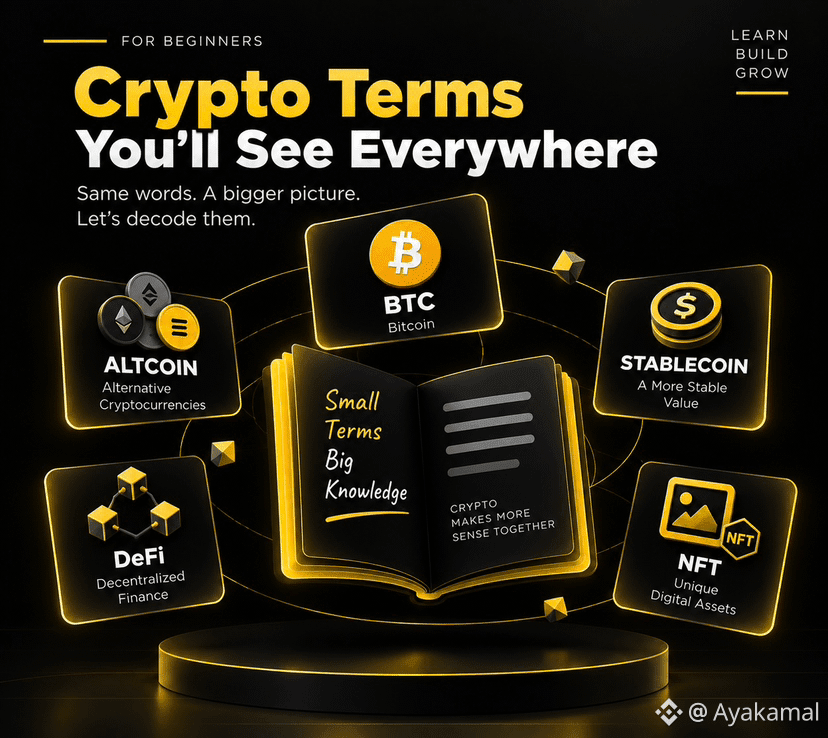
CRYPTO TERMS YOU’LL SEE EVERYWHERE
New to crypto? These are five terms you’ll come across again and again.
🟠 BTC — Bitcoin
Bitcoin was the first cryptocurrency, introduced in 2008 and launched in 2009. It operates on a decentralized network and enables peer-to-peer transfers without a central intermediary.
🔹 Altcoin
An altcoin generally refers to any cryptocurrency other than Bitcoin. Altcoins can have very different purposes, technologies, and supply designs.
💵 Stablecoin
A stablecoin is a crypto asset designed to maintain a relatively stable value, often by being linked to a reference asset such as a fiat currency.
🌐 DeFi — Decentralized Finance
DeFi refers to financial services built using blockchain technology and smart contracts. These can include activities such as decentralized trading, lending, and borrowing.
🖼️ NFT — Non-Fungible Token
An NFT is a unique digital asset recorded on a blockchain. Unlike interchangeable cryptocurrencies, NFTs have distinct properties and can be used for things such as digital art, collectibles, and gaming.
Why do these terms matter?
Because understanding crypto isn’t only about knowing how to buy or sell.
It starts with understanding the language of the ecosystem.
📚 Keep learning with Binance Academy.
Educational content only, not financial advice. DYOR and use official Binance sources.
#Binance #CryptoEducation #crypto #BTC
CRYPTO TERMS YOU’LL SEE EVERYWHERE
New to crypto? These are five terms you’ll come across again and again.
🟠 BTC — Bitcoin
Bitcoin was the first cryptocurrency, introduced in 2008 and launched in 2009. It operates on a decentralized network and enables peer-to-peer transfers without a central intermediary.
🔹 Altcoin
An altcoin generally refers to any cryptocurrency other than Bitcoin. Altcoins can have very different purposes, technologies, and supply designs.
💵 Stablecoin
A stablecoin is a crypto asset designed to maintain a relatively stable value, often by being linked to a reference asset such as a fiat currency.
🌐 DeFi — Decentralized Finance
DeFi refers to financial services built using blockchain technology and smart contracts. These can include activities such as decentralized trading, lending, and borrowing.
🖼️ NFT — Non-Fungible Token
An NFT is a unique digital asset recorded on a blockchain. Unlike interchangeable cryptocurrencies, NFTs have distinct properties and can be used for things such as digital art, collectibles, and gaming.
Why do these terms matter?
Because understanding crypto isn’t only about knowing how to buy or sell.
It starts with understanding the language of the ecosystem.
📚 Keep learning with Binance Academy.
Educational content only, not financial advice. DYOR and use official Binance sources.
#Binance #CryptoEducation #crypto #BTC
New to crypto? These are five terms you’ll come across again and again.
🟠 BTC — Bitcoin
Bitcoin was the first cryptocurrency, introduced in 2008 and launched in 2009. It operates on a decentralized network and enables peer-to-peer transfers without a central intermediary.
🔹 Altcoin
An altcoin generally refers to any cryptocurrency other than Bitcoin. Altcoins can have very different purposes, technologies, and supply designs.
💵 Stablecoin
A stablecoin is a crypto asset designed to maintain a relatively stable value, often by being linked to a reference asset such as a fiat currency.
🌐 DeFi — Decentralized Finance
DeFi refers to financial services built using blockchain technology and smart contracts. These can include activities such as decentralized trading, lending, and borrowing.
🖼️ NFT — Non-Fungible Token
An NFT is a unique digital asset recorded on a blockchain. Unlike interchangeable cryptocurrencies, NFTs have distinct properties and can be used for things such as digital art, collectibles, and gaming.
Why do these terms matter?
Because understanding crypto isn’t only about knowing how to buy or sell.
It starts with understanding the language of the ecosystem.
📚 Keep learning with Binance Academy.
Educational content only, not financial advice. DYOR and use official Binance sources.
#Binance #CryptoEducation #crypto #BTC
2
121

·
--
📊 5 Trading Mistakes Beginners Should Avoid
❌ Trading with money you can’t afford to lose
❌ Using high leverage without understanding the risk
❌ Following random signals blindly
❌ Entering trades without a plan
❌ Trading emotionally after a loss
Learn → Practice → Build a strategy → Manage risk
What was the first trading lesson you learned?
$BTC $ETH $BNB
#Trading #CryptoTrading #Binance #cryptoeducation
📊 5 Trading Mistakes Beginners Should Avoid
❌ Trading with money you can’t afford to lose
❌ Using high leverage without understanding the risk
❌ Following random signals blindly
❌ Entering trades without a plan
❌ Trading emotionally after a loss
Learn → Practice → Build a strategy → Manage risk
What was the first trading lesson you learned?
$BTC $ETH $BNB
#Trading #CryptoTrading #Binance #cryptoeducation
❌ Trading with money you can’t afford to lose
❌ Using high leverage without understanding the risk
❌ Following random signals blindly
❌ Entering trades without a plan
❌ Trading emotionally after a loss
Learn → Practice → Build a strategy → Manage risk
What was the first trading lesson you learned?
$BTC $ETH $BNB
#Trading #CryptoTrading #Binance #cryptoeducation
41

·
--
DeFi ecosystem: finance rebuilt with programmable infrastructure.
Decentralized finance (DeFi) uses smart contracts to provide financial services without relying on a single traditional intermediary.
The ecosystem includes:
• Decentralized exchanges (DEXs): users trade through liquidity pools and automated market makers.
• Lending markets: users supply assets to earn variable returns or borrow against collateral.
• Stablecoins: on-chain units designed to reduce price volatility and support settlement.
• Liquid staking: users receive a tradable representation of staked assets while maintaining capital utility.
• Derivatives: protocols create permissionless exposure to futures, options or synthetic assets.
• Bridges and interoperability: connect liquidity across different blockchains.
• Governance: token holders may vote on parameters, upgrades and treasury decisions.
The trade-off is clear: DeFi can improve access, transparency and composability, but users assume risks that banks normally manage.
Before using a protocol, check:
1. Smart-contract audits and exploit history
2. Oracle design and liquidation mechanics
3. Total value locked versus actual liquidity
4. Admin keys, upgradeability and governance concentration
5. Bridge, stablecoin and counterparty exposure
6. Fees, slippage and withdrawal conditions
High APY is not free yield. It may compensate users for smart-contract, market, liquidity or incentive risk.
Start with small amounts, use official links, verify contract addresses and never share a seed phrase or private key.
Educational content only. Not financial advice.
#DeFi #Web3 #CryptoEducation #BinanceAngels
DeFi ecosystem: finance rebuilt with programmable infrastructure.
Decentralized finance (DeFi) uses smart contracts to provide financial services without relying on a single traditional intermediary.
The ecosystem includes:
• Decentralized exchanges (DEXs): users trade through liquidity pools and automated market makers.
• Lending markets: users supply assets to earn variable returns or borrow against collateral.
• Stablecoins: on-chain units designed to reduce price volatility and support settlement.
• Liquid staking: users receive a tradable representation of staked assets while maintaining capital utility.
• Derivatives: protocols create permissionless exposure to futures, options or synthetic assets.
• Bridges and interoperability: connect liquidity across different blockchains.
• Governance: token holders may vote on parameters, upgrades and treasury decisions.
The trade-off is clear: DeFi can improve access, transparency and composability, but users assume risks that banks normally manage.
Before using a protocol, check:
1. Smart-contract audits and exploit history
2. Oracle design and liquidation mechanics
3. Total value locked versus actual liquidity
4. Admin keys, upgradeability and governance concentration
5. Bridge, stablecoin and counterparty exposure
6. Fees, slippage and withdrawal conditions
High APY is not free yield. It may compensate users for smart-contract, market, liquidity or incentive risk.
Start with small amounts, use official links, verify contract addresses and never share a seed phrase or private key.
Educational content only. Not financial advice.
#DeFi #Web3 #CryptoEducation #BinanceAngels
Decentralized finance (DeFi) uses smart contracts to provide financial services without relying on a single traditional intermediary.
The ecosystem includes:
• Decentralized exchanges (DEXs): users trade through liquidity pools and automated market makers.
• Lending markets: users supply assets to earn variable returns or borrow against collateral.
• Stablecoins: on-chain units designed to reduce price volatility and support settlement.
• Liquid staking: users receive a tradable representation of staked assets while maintaining capital utility.
• Derivatives: protocols create permissionless exposure to futures, options or synthetic assets.
• Bridges and interoperability: connect liquidity across different blockchains.
• Governance: token holders may vote on parameters, upgrades and treasury decisions.
The trade-off is clear: DeFi can improve access, transparency and composability, but users assume risks that banks normally manage.
Before using a protocol, check:
1. Smart-contract audits and exploit history
2. Oracle design and liquidation mechanics
3. Total value locked versus actual liquidity
4. Admin keys, upgradeability and governance concentration
5. Bridge, stablecoin and counterparty exposure
6. Fees, slippage and withdrawal conditions
High APY is not free yield. It may compensate users for smart-contract, market, liquidity or incentive risk.
Start with small amounts, use official links, verify contract addresses and never share a seed phrase or private key.
Educational content only. Not financial advice.
#DeFi #Web3 #CryptoEducation #BinanceAngels
24
Article
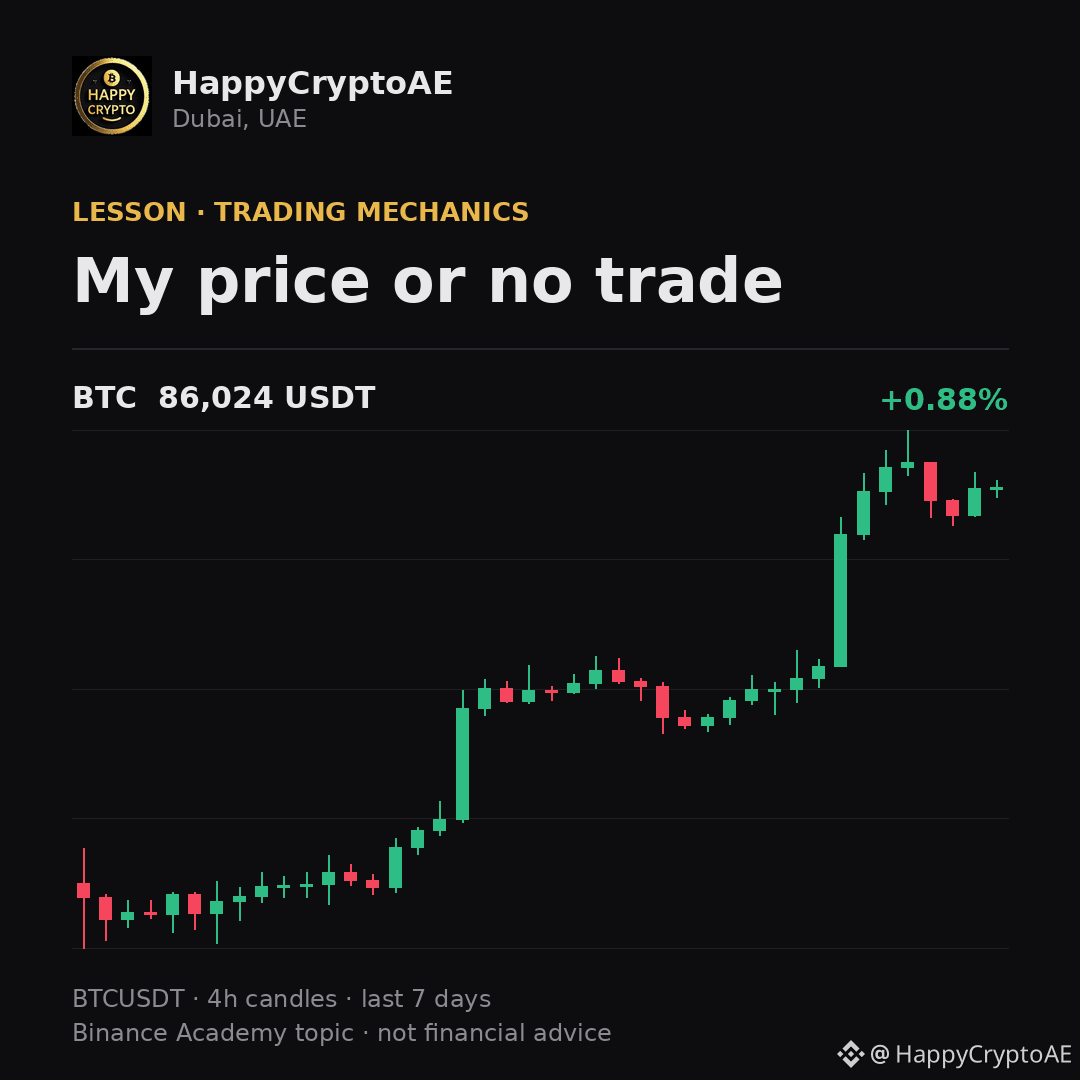
My price or no tradeA limit order specifies the worst price you will accept and waits. It will not fill beyond that price, which also means it may not fill at all.
So the trade-off is the mirror image of a market order: full control over price, no guarantee of execution. Neither type is the smarter choice in general. They answer different questions, and the honest test is which regret you would rather risk - paying more than you wanted, or watching the market leave without you.
Binance Academy covers this in more depth: https://www.binance.com/en/academy/glossary/limit-order
Trading crypto from Dubai since 2019.
$BTC $ETH
#Crypto #CryptoEducation #Binance
My price or no trade
A limit order specifies the worst price you will accept and waits. It will not fill beyond that price, which also means it may not fill at all.
So the trade-off is the mirror image of a market order: full control over price, no guarantee of execution. Neither type is the smarter choice in general. They answer different questions, and the honest test is which regret you would rather risk - paying more than you wanted, or watching the market leave without you.
Binance Academy covers this in more depth: https://www.binance.com/en/academy/glossary/limit-order
Trading crypto from Dubai since 2019.
$BTC $ETH
#Crypto #CryptoEducation #Binance
So the trade-off is the mirror image of a market order: full control over price, no guarantee of execution. Neither type is the smarter choice in general. They answer different questions, and the honest test is which regret you would rather risk - paying more than you wanted, or watching the market leave without you.
Binance Academy covers this in more depth: https://www.binance.com/en/academy/glossary/limit-order
Trading crypto from Dubai since 2019.
$BTC $ETH
#Crypto #CryptoEducation #Binance
41
🚀 BINANCE FOR BEGINNERS — LESSON 1
📱 WHAT IS BINANCE?
Welcome to our Binance Beginner Training.
In this lesson, we start with the basics before touching any trading button.
1️⃣ What is Binance?
Binance is a cryptocurrency platform/app for buying, selling, converting and trading digital assets.
You can use Binance with cryptocurrencies such as:
🟠 BTC — Bitcoin
🔵 ETH — Ethereum
🟡 BNB — BNB
🟢 USDT — Tether
2️⃣ What is Cryptocurrency?
Cryptocurrency is a digital asset that uses cryptographic technology and operates on blockchain networks.
Unlike ordinary money such as US Dollars (USD), cryptocurrencies are digital assets.
3️⃣ What is USDT?
USDT (Tether) is a stablecoin designed to maintain a value close to 1 US dollar.
Many Binance trading pairs use USDT.
Example:
BTC/USDT
This means you are trading Bitcoin against USDT.
4️⃣ What is P2P?
P2P = Peer-to-Peer
On Binance P2P, users can buy or sell cryptocurrency with other users using supported payment methods.
Example:
🇺🇸 You have USD
⬇️
You buy USDT through P2P
⬇️
USDT goes to your Binance account
5️⃣ What is Spot Trading?
Spot trading means buying or selling cryptocurrency in the spot market.
Example:
You have USDT and want to buy BTC:
USDT → BTC
If you later sell:
BTC → USDT
⚠️ IMPORTANT
Binance is not a guaranteed-money-making platform.
Crypto prices can rise or fall significantly.
Before trading real money, learn:
✅ How the Binance app works
✅ How orders work
✅ Fees
✅ P2P safety
✅ Risk management
✅ Account security
🔐 Never give anyone your Binance password, OTP, 2FA code or recovery information.
📝 LESSON 1 HOMEWORK
Open the Binance app and identify:
📍 Home
📍 Markets
📍 Trade
📍 P2P
📍 Assets/Wallet
Don't place a trade yet.
📚 NEXT LESSON:
🔐 How to create, verify and secure a Binance account.
#BinanceForBeginners #BinanceTutorial #CryptoEducation #Bitcoin #USDT #P2P
🚀 BINANCE FOR BEGINNERS — LESSON 1
📱 WHAT IS BINANCE?
Welcome to our Binance Beginner Training.
In this lesson, we start with the basics before touching any trading button.
1️⃣ What is Binance?
Binance is a cryptocurrency platform/app for buying, selling, converting and trading digital assets.
You can use Binance with cryptocurrencies such as:
🟠 BTC — Bitcoin
🔵 ETH — Ethereum
🟡 BNB — BNB
🟢 USDT — Tether
2️⃣ What is Cryptocurrency?
Cryptocurrency is a digital asset that uses cryptographic technology and operates on blockchain networks.
Unlike ordinary money such as US Dollars (USD), cryptocurrencies are digital assets.
3️⃣ What is USDT?
USDT (Tether) is a stablecoin designed to maintain a value close to 1 US dollar.
Many Binance trading pairs use USDT.
Example:
BTC/USDT
This means you are trading Bitcoin against USDT.
4️⃣ What is P2P?
P2P = Peer-to-Peer
On Binance P2P, users can buy or sell cryptocurrency with other users using supported payment methods.
Example:
🇺🇸 You have USD
⬇️
You buy USDT through P2P
⬇️
USDT goes to your Binance account
5️⃣ What is Spot Trading?
Spot trading means buying or selling cryptocurrency in the spot market.
Example:
You have USDT and want to buy BTC:
USDT → BTC
If you later sell:
BTC → USDT
⚠️ IMPORTANT
Binance is not a guaranteed-money-making platform.
Crypto prices can rise or fall significantly.
Before trading real money, learn:
✅ How the Binance app works
✅ How orders work
✅ Fees
✅ P2P safety
✅ Risk management
✅ Account security
🔐 Never give anyone your Binance password, OTP, 2FA code or recovery information.
📝 LESSON 1 HOMEWORK
Open the Binance app and identify:
📍 Home
📍 Markets
📍 Trade
📍 P2P
📍 Assets/Wallet
Don't place a trade yet.
📚 NEXT LESSON:
🔐 How to create, verify and secure a Binance account.
#BinanceForBeginners #BinanceTutorial #CryptoEducation #Bitcoin #USDT #P2P
📱 WHAT IS BINANCE?
Welcome to our Binance Beginner Training.
In this lesson, we start with the basics before touching any trading button.
1️⃣ What is Binance?
Binance is a cryptocurrency platform/app for buying, selling, converting and trading digital assets.
You can use Binance with cryptocurrencies such as:
🟠 BTC — Bitcoin
🔵 ETH — Ethereum
🟡 BNB — BNB
🟢 USDT — Tether
2️⃣ What is Cryptocurrency?
Cryptocurrency is a digital asset that uses cryptographic technology and operates on blockchain networks.
Unlike ordinary money such as US Dollars (USD), cryptocurrencies are digital assets.
3️⃣ What is USDT?
USDT (Tether) is a stablecoin designed to maintain a value close to 1 US dollar.
Many Binance trading pairs use USDT.
Example:
BTC/USDT
This means you are trading Bitcoin against USDT.
4️⃣ What is P2P?
P2P = Peer-to-Peer
On Binance P2P, users can buy or sell cryptocurrency with other users using supported payment methods.
Example:
🇺🇸 You have USD
⬇️
You buy USDT through P2P
⬇️
USDT goes to your Binance account
5️⃣ What is Spot Trading?
Spot trading means buying or selling cryptocurrency in the spot market.
Example:
You have USDT and want to buy BTC:
USDT → BTC
If you later sell:
BTC → USDT
⚠️ IMPORTANT
Binance is not a guaranteed-money-making platform.
Crypto prices can rise or fall significantly.
Before trading real money, learn:
✅ How the Binance app works
✅ How orders work
✅ Fees
✅ P2P safety
✅ Risk management
✅ Account security
🔐 Never give anyone your Binance password, OTP, 2FA code or recovery information.
📝 LESSON 1 HOMEWORK
Open the Binance app and identify:
📍 Home
📍 Markets
📍 Trade
📍 P2P
📍 Assets/Wallet
Don't place a trade yet.
📚 NEXT LESSON:
🔐 How to create, verify and secure a Binance account.
#BinanceForBeginners #BinanceTutorial #CryptoEducation #Bitcoin #USDT #P2P
1
1
73

·
--
Learn More. Trade Smarter. Grow Consistently.
The crypto market moves fast, but good decisions start with knowledge. 📚
🔹 Do your own research
🔹 Manage your risk
🔹 Stay disciplined
🔹 Keep learning every day
Don’t chase quick profits. Build your knowledge and make informed decisions.
#Crypto #web3兼职 #BinanceSquareTalks #cryptoeducation #trading
Learn More. Trade Smarter. Grow Consistently.
The crypto market moves fast, but good decisions start with knowledge. 📚
🔹 Do your own research
🔹 Manage your risk
🔹 Stay disciplined
🔹 Keep learning every day
Don’t chase quick profits. Build your knowledge and make informed decisions.
#Crypto #web3兼职 #BinanceSquareTalks #cryptoeducation #trading
The crypto market moves fast, but good decisions start with knowledge. 📚
🔹 Do your own research
🔹 Manage your risk
🔹 Stay disciplined
🔹 Keep learning every day
Don’t chase quick profits. Build your knowledge and make informed decisions.
#Crypto #web3兼职 #BinanceSquareTalks #cryptoeducation #trading
1
41
·
--
Bullish
🚀 Keep Learning, Keep Growing with Crypto
Success in the crypto market comes not only from trading, but also from knowledge and discipline. 📚
💡 Learn before you invest
📊 Do your own research
🔐 Protect your account
💰 Never invest more than you can afford to lose
Stay consistent and keep learning! 🚀
#BİNANCE #Crypto #Web3 #blockchain #cryptoeducation
🚀 Keep Learning, Keep Growing with Crypto
Success in the crypto market comes not only from trading, but also from knowledge and discipline. 📚
💡 Learn before you invest
📊 Do your own research
🔐 Protect your account
💰 Never invest more than you can afford to lose
Stay consistent and keep learning! 🚀
#BİNANCE #Crypto #Web3 #blockchain #cryptoeducation
Success in the crypto market comes not only from trading, but also from knowledge and discipline. 📚
💡 Learn before you invest
📊 Do your own research
🔐 Protect your account
💰 Never invest more than you can afford to lose
Stay consistent and keep learning! 🚀
#BİNANCE #Crypto #Web3 #blockchain #cryptoeducation
1
52

·
--
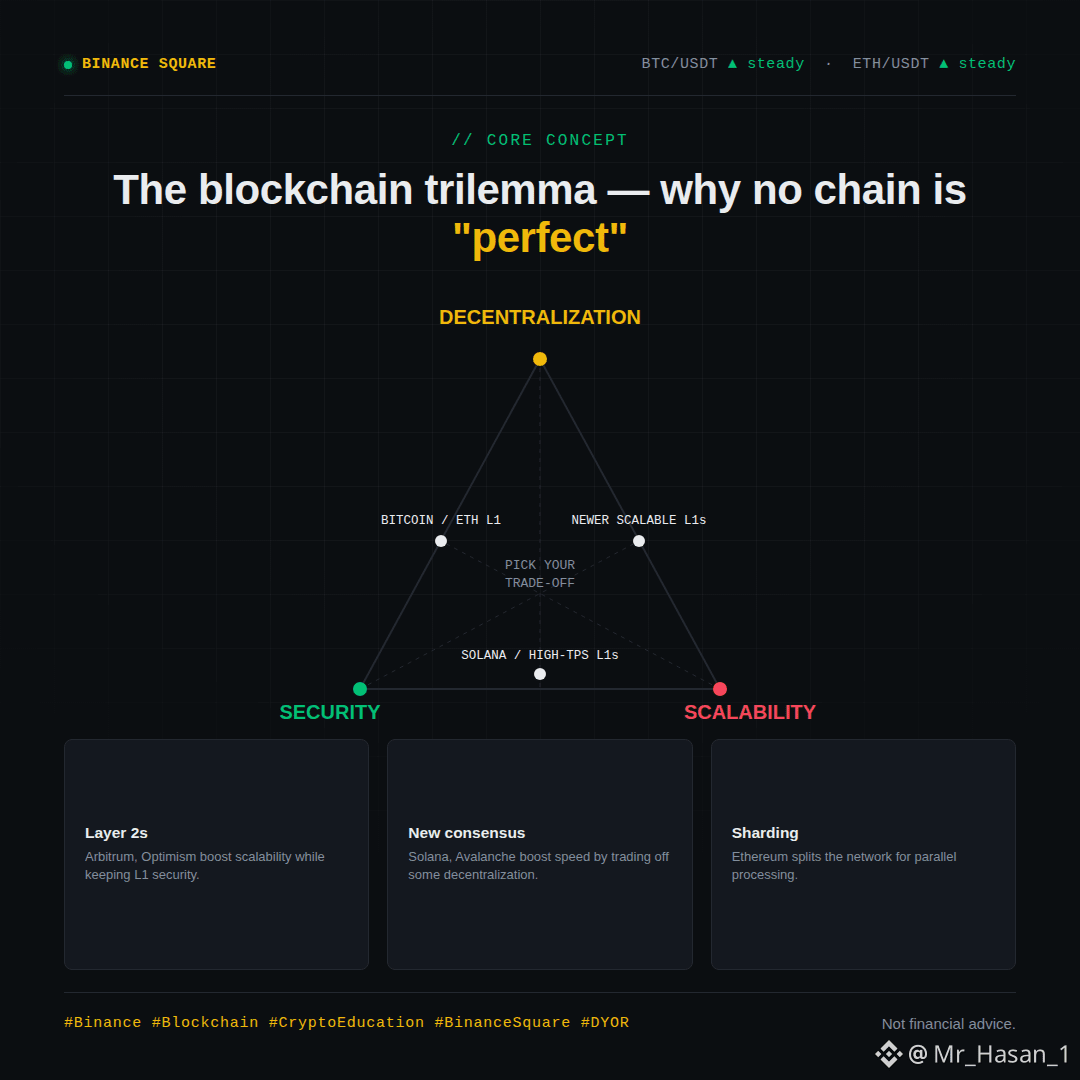
🔺 The Blockchain Trilemma: Why No Chain Is "Perfect"
Heard someone claim "this blockchain is the best"? In reality, every blockchain runs into a fundamental trade-off.
🔹 What is the blockchain trilemma?
A concept introduced by Ethereum founder Vitalik Buterin — the idea that it's hard for a blockchain to fully optimize all three of these at once:
1️⃣ Decentralization — running the network without control by any single party
2️⃣ Security — the ability to resist attacks and manipulation
3️⃣ Scalability — the ability to process transactions fast and at high volume
🔹 Why is it hard to have all three?
✅ More decentralization means more nodes verifying — which slows things down
✅ Pushing for more scalability often means compromising on node count or security
✅ Bitcoin and early Ethereum: high security + decentralization, but low scalability
🔹 How are projects trying to solve it?
📊 Layer 2s (Arbitrum, Optimism) — boost scalability while keeping the main chain's security
📊 New consensus mechanisms (Solana, Avalanche) — boost speed, trading off some decentralization
📊 Sharding (Ethereum 2.0) — split the network for parallel processing
⚠️ Next time you see a new chain claiming to be "the best at everything," ask yourself — which trade-off did they actually accept?
Which blockchain do you think balances the trilemma best? Let us know in the comments 👇
#Binance #Blockchain #CryptoEducation #BinanceSquare #DYOR
🔺 The Blockchain Trilemma: Why No Chain Is "Perfect"
Heard someone claim "this blockchain is the best"? In reality, every blockchain runs into a fundamental trade-off.
🔹 What is the blockchain trilemma?
A concept introduced by Ethereum founder Vitalik Buterin — the idea that it's hard for a blockchain to fully optimize all three of these at once:
1️⃣ Decentralization — running the network without control by any single party
2️⃣ Security — the ability to resist attacks and manipulation
3️⃣ Scalability — the ability to process transactions fast and at high volume
🔹 Why is it hard to have all three?
✅ More decentralization means more nodes verifying — which slows things down
✅ Pushing for more scalability often means compromising on node count or security
✅ Bitcoin and early Ethereum: high security + decentralization, but low scalability
🔹 How are projects trying to solve it?
📊 Layer 2s (Arbitrum, Optimism) — boost scalability while keeping the main chain's security
📊 New consensus mechanisms (Solana, Avalanche) — boost speed, trading off some decentralization
📊 Sharding (Ethereum 2.0) — split the network for parallel processing
⚠️ Next time you see a new chain claiming to be "the best at everything," ask yourself — which trade-off did they actually accept?
Which blockchain do you think balances the trilemma best? Let us know in the comments 👇
#Binance #Blockchain #CryptoEducation #BinanceSquare #DYOR
Heard someone claim "this blockchain is the best"? In reality, every blockchain runs into a fundamental trade-off.
🔹 What is the blockchain trilemma?
A concept introduced by Ethereum founder Vitalik Buterin — the idea that it's hard for a blockchain to fully optimize all three of these at once:
1️⃣ Decentralization — running the network without control by any single party
2️⃣ Security — the ability to resist attacks and manipulation
3️⃣ Scalability — the ability to process transactions fast and at high volume
🔹 Why is it hard to have all three?
✅ More decentralization means more nodes verifying — which slows things down
✅ Pushing for more scalability often means compromising on node count or security
✅ Bitcoin and early Ethereum: high security + decentralization, but low scalability
🔹 How are projects trying to solve it?
📊 Layer 2s (Arbitrum, Optimism) — boost scalability while keeping the main chain's security
📊 New consensus mechanisms (Solana, Avalanche) — boost speed, trading off some decentralization
📊 Sharding (Ethereum 2.0) — split the network for parallel processing
⚠️ Next time you see a new chain claiming to be "the best at everything," ask yourself — which trade-off did they actually accept?
Which blockchain do you think balances the trilemma best? Let us know in the comments 👇
#Binance #Blockchain #CryptoEducation #BinanceSquare #DYOR
76

The biggest mistake beginners make in crypto isn’t choosing the “wrong coin”…
It’s buying something they don’t understand.
Before putting money into any crypto project, ask yourself 5 simple questions:
1️⃣ What problem does this project actually solve?
2️⃣ Why does its token need to exist?
3️⃣ Who is building and using it?
4️⃣ How many tokens exist, and how are new tokens released?
5️⃣ What would make the project fail?
A green candle can attract attention.
A strong understanding can protect you from making decisions you later regret.
Crypto isn’t only about finding the next 100x.
Sometimes the smartest move is simply learning how the asset works BEFORE touching the buy button.
What is one crypto project you think deserves deeper research?
$BTC $ETH $BNB
#Web3 #bitcoin #Ethereum #cryptoeducation #DYOR
The biggest mistake beginners make in crypto isn’t choosing the “wrong coin”…
It’s buying something they don’t understand.
Before putting money into any crypto project, ask yourself 5 simple questions:
1️⃣ What problem does this project actually solve?
2️⃣ Why does its token need to exist?
3️⃣ Who is building and using it?
4️⃣ How many tokens exist, and how are new tokens released?
5️⃣ What would make the project fail?
A green candle can attract attention.
A strong understanding can protect you from making decisions you later regret.
Crypto isn’t only about finding the next 100x.
Sometimes the smartest move is simply learning how the asset works BEFORE touching the buy button.
What is one crypto project you think deserves deeper research?
$BTC $ETH $BNB
#Web3 #bitcoin #Ethereum #cryptoeducation #DYOR
It’s buying something they don’t understand.
Before putting money into any crypto project, ask yourself 5 simple questions:
1️⃣ What problem does this project actually solve?
2️⃣ Why does its token need to exist?
3️⃣ Who is building and using it?
4️⃣ How many tokens exist, and how are new tokens released?
5️⃣ What would make the project fail?
A green candle can attract attention.
A strong understanding can protect you from making decisions you later regret.
Crypto isn’t only about finding the next 100x.
Sometimes the smartest move is simply learning how the asset works BEFORE touching the buy button.
What is one crypto project you think deserves deeper research?
$BTC $ETH $BNB
#Web3 #bitcoin #Ethereum #cryptoeducation #DYOR
1
88

·
--
Bullish
$BNB 👀 CRYPTO COMMUNITY
If you could teach a complete beginner ONE crypto lesson, what would it be?
A️⃣ Bitcoin
B️⃣ Blockchain
C️⃣ Trading
D️⃣ Wallet security
E️⃣ Risk management
Comment your answer and explain why. 👇
Let's help beginners learn together. 🤝
#BinanceSquare #CryptoCommunity #cryptoeducation
$BNB 👀 CRYPTO COMMUNITY
If you could teach a complete beginner ONE crypto lesson, what would it be?
A️⃣ Bitcoin
B️⃣ Blockchain
C️⃣ Trading
D️⃣ Wallet security
E️⃣ Risk management
Comment your answer and explain why. 👇
Let's help beginners learn together. 🤝
#BinanceSquare #CryptoCommunity #cryptoeducation
If you could teach a complete beginner ONE crypto lesson, what would it be?
A️⃣ Bitcoin
B️⃣ Blockchain
C️⃣ Trading
D️⃣ Wallet security
E️⃣ Risk management
Comment your answer and explain why. 👇
Let's help beginners learn together. 🤝
#BinanceSquare #CryptoCommunity #cryptoeducation
Ibrahim Al-Dubai:
15
6
1
6
Article
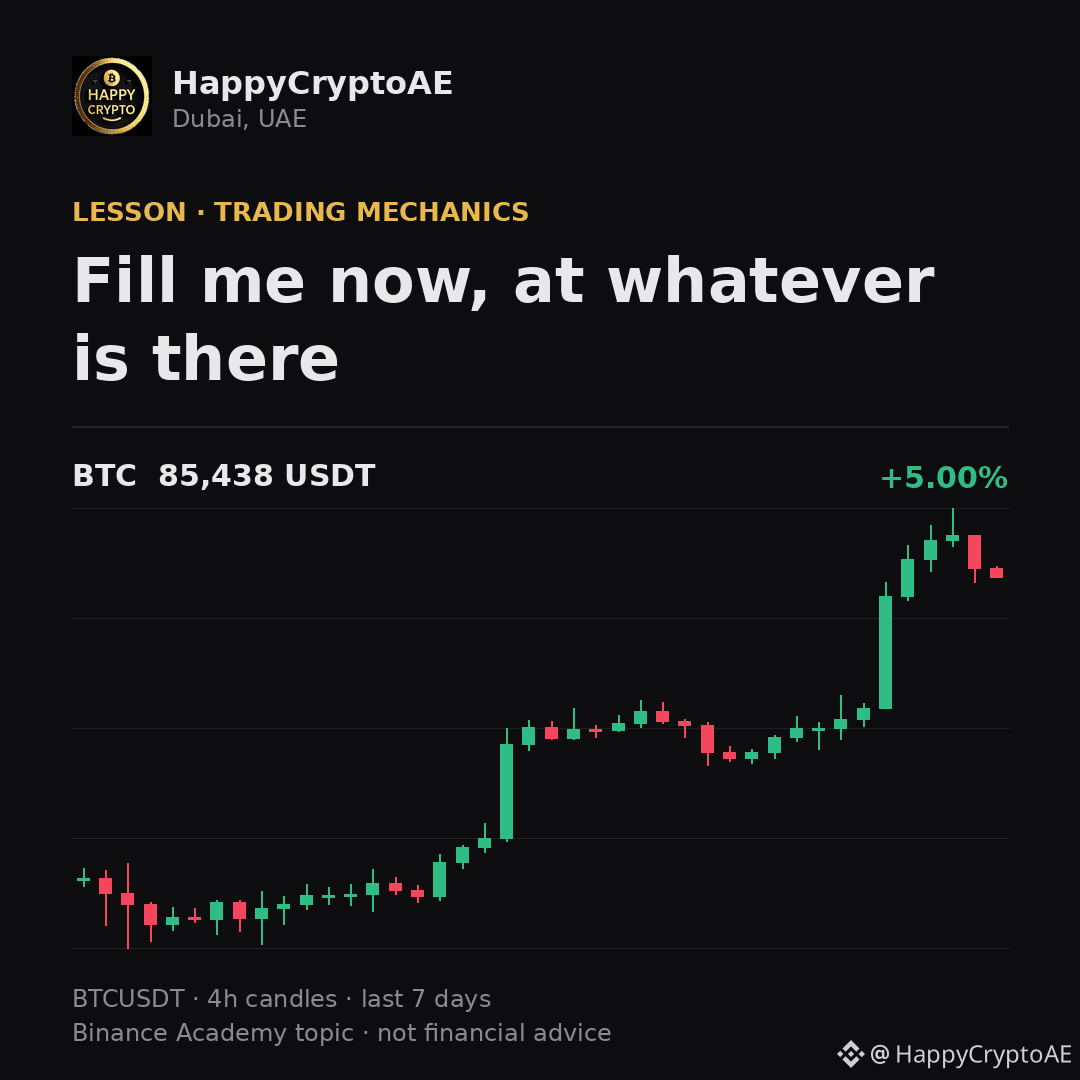
Fill me now, at whatever is thereA market order takes the best prices currently available until it is filled. It trades price certainty for execution certainty: you will almost always get done, and you accept whatever the book offers.
In a deep market that is barely noticeable. In a thin one it is expensive, because your order eats through several price levels to find enough size. This is why the same market order behaves very differently on a major pair than on a quiet one, and why "the price moved against me instantly" is usually a description of thin depth rather than bad luck.
Binance Academy covers this in more depth: https://www.binance.com/en/academy/glossary/market-order
Trading crypto from Dubai since 2019.
$BTC $ETH
#Crypto #CryptoEducation #Binance
Fill me now, at whatever is there
A market order takes the best prices currently available until it is filled. It trades price certainty for execution certainty: you will almost always get done, and you accept whatever the book offers.
In a deep market that is barely noticeable. In a thin one it is expensive, because your order eats through several price levels to find enough size. This is why the same market order behaves very differently on a major pair than on a quiet one, and why "the price moved against me instantly" is usually a description of thin depth rather than bad luck.
Binance Academy covers this in more depth: https://www.binance.com/en/academy/glossary/market-order
Trading crypto from Dubai since 2019.
$BTC $ETH
#Crypto #CryptoEducation #Binance
In a deep market that is barely noticeable. In a thin one it is expensive, because your order eats through several price levels to find enough size. This is why the same market order behaves very differently on a major pair than on a quiet one, and why "the price moved against me instantly" is usually a description of thin depth rather than bad luck.
Binance Academy covers this in more depth: https://www.binance.com/en/academy/glossary/market-order
Trading crypto from Dubai since 2019.
$BTC $ETH
#Crypto #CryptoEducation #Binance
77

Bitcoin: More Than Just a Cryptocurrency 🟠
Bitcoin (BTC) is the first decentralized cryptocurrency, introduced in 2009. Unlike traditional currencies controlled by a central authority, Bitcoin operates on a decentralized network of computers.
One of Bitcoin’s key features is its limited supply: the protocol is designed so that no more than 21 million BTC can ever exist.
Bitcoin transactions are recorded on a public blockchain, allowing anyone to verify the network’s activity without relying on a single central institution.
Whether you're new to crypto or already familiar with blockchain technology, understanding how Bitcoin works is a useful starting point for learning about the wider digital-asset ecosystem.
#BTC #Crypto #BinanceSquare #Web3 #Blockchain #CryptoEducation $BTC
Bitcoin: More Than Just a Cryptocurrency 🟠
Bitcoin (BTC) is the first decentralized cryptocurrency, introduced in 2009. Unlike traditional currencies controlled by a central authority, Bitcoin operates on a decentralized network of computers.
One of Bitcoin’s key features is its limited supply: the protocol is designed so that no more than 21 million BTC can ever exist.
Bitcoin transactions are recorded on a public blockchain, allowing anyone to verify the network’s activity without relying on a single central institution.
Whether you're new to crypto or already familiar with blockchain technology, understanding how Bitcoin works is a useful starting point for learning about the wider digital-asset ecosystem.
#BTC #Crypto #BinanceSquare #Web3 #Blockchain #CryptoEducation $BTC
Bitcoin (BTC) is the first decentralized cryptocurrency, introduced in 2009. Unlike traditional currencies controlled by a central authority, Bitcoin operates on a decentralized network of computers.
One of Bitcoin’s key features is its limited supply: the protocol is designed so that no more than 21 million BTC can ever exist.
Bitcoin transactions are recorded on a public blockchain, allowing anyone to verify the network’s activity without relying on a single central institution.
Whether you're new to crypto or already familiar with blockchain technology, understanding how Bitcoin works is a useful starting point for learning about the wider digital-asset ecosystem.
#BTC #Crypto #BinanceSquare #Web3 #Blockchain #CryptoEducation $BTC
33


·
--
A liquidity pool is more than two tokens sitting together.
When you see a pair like STON/USDT on STON.fi, it is easy to think the pool is simply a place where two assets are stored.
But the pool is actually part of the mechanism that allows users to trade without relying on a traditional order book.
Here’s the simple idea:
Liquidity providers deposit the required assets → the pool holds that liquidity → traders interact with the pool when swapping → the pool’s token balances change after each trade.
This creates an important relationship between traders and liquidity providers.
🔹 Traders need liquidity
Without sufficient liquidity, larger swaps can move the pool price significantly.
That can lead to higher price impact for the trader.
🔹 Liquidity providers supply the trading environment
LPs contribute assets to the pool and receive LP tokens representing their share of that pool.
Their liquidity helps make swaps possible.
🔹 Trading changes the pool
Every swap changes the proportion of assets inside the pool.
That means the pool is constantly responding to trading activity rather than simply sitting there holding tokens.
This is one reason volume, liquidity depth and pool composition matter when researching a pool.
The bigger lesson
DeFi isn't only about the person making the swap.
There is an entire system working underneath:
Trader → needs liquidity
Liquidity provider → supplies liquidity
Pool → facilitates the swap
Protocol → coordinates the mechanism
Understanding these relationships makes it much easier to understand why DEXs work the way they do.
So the next time you see a liquidity pool on STON.fi, don't just look at the token pair.
Ask:
How much liquidity is available?
How active is the pool?
What assets am I exposing myself to?
What are the potential risks and rewards?
That is where meaningful DeFi research begins.
#STONfi #TON #DeFi #Liquidity #CryptoEducation @stonfi $TON
A liquidity pool is more than two tokens sitting together.
When you see a pair like STON/USDT on STON.fi, it is easy to think the pool is simply a place where two assets are stored.
But the pool is actually part of the mechanism that allows users to trade without relying on a traditional order book.
Here’s the simple idea:
Liquidity providers deposit the required assets → the pool holds that liquidity → traders interact with the pool when swapping → the pool’s token balances change after each trade.
This creates an important relationship between traders and liquidity providers.
🔹 Traders need liquidity
Without sufficient liquidity, larger swaps can move the pool price significantly.
That can lead to higher price impact for the trader.
🔹 Liquidity providers supply the trading environment
LPs contribute assets to the pool and receive LP tokens representing their share of that pool.
Their liquidity helps make swaps possible.
🔹 Trading changes the pool
Every swap changes the proportion of assets inside the pool.
That means the pool is constantly responding to trading activity rather than simply sitting there holding tokens.
This is one reason volume, liquidity depth and pool composition matter when researching a pool.
The bigger lesson
DeFi isn't only about the person making the swap.
There is an entire system working underneath:
Trader → needs liquidity
Liquidity provider → supplies liquidity
Pool → facilitates the swap
Protocol → coordinates the mechanism
Understanding these relationships makes it much easier to understand why DEXs work the way they do.
So the next time you see a liquidity pool on STON.fi, don't just look at the token pair.
Ask:
How much liquidity is available?
How active is the pool?
What assets am I exposing myself to?
What are the potential risks and rewards?
That is where meaningful DeFi research begins.
#STONfi #TON #DeFi #Liquidity #CryptoEducation @STONfi DEX $TON
When you see a pair like STON/USDT on STON.fi, it is easy to think the pool is simply a place where two assets are stored.
But the pool is actually part of the mechanism that allows users to trade without relying on a traditional order book.
Here’s the simple idea:
Liquidity providers deposit the required assets → the pool holds that liquidity → traders interact with the pool when swapping → the pool’s token balances change after each trade.
This creates an important relationship between traders and liquidity providers.
🔹 Traders need liquidity
Without sufficient liquidity, larger swaps can move the pool price significantly.
That can lead to higher price impact for the trader.
🔹 Liquidity providers supply the trading environment
LPs contribute assets to the pool and receive LP tokens representing their share of that pool.
Their liquidity helps make swaps possible.
🔹 Trading changes the pool
Every swap changes the proportion of assets inside the pool.
That means the pool is constantly responding to trading activity rather than simply sitting there holding tokens.
This is one reason volume, liquidity depth and pool composition matter when researching a pool.
The bigger lesson
DeFi isn't only about the person making the swap.
There is an entire system working underneath:
Trader → needs liquidity
Liquidity provider → supplies liquidity
Pool → facilitates the swap
Protocol → coordinates the mechanism
Understanding these relationships makes it much easier to understand why DEXs work the way they do.
So the next time you see a liquidity pool on STON.fi, don't just look at the token pair.
Ask:
How much liquidity is available?
How active is the pool?
What assets am I exposing myself to?
What are the potential risks and rewards?
That is where meaningful DeFi research begins.
#STONfi #TON #DeFi #Liquidity #CryptoEducation @STONfi DEX $TON
5

·
--
- No markdown (so plain text, no formatting like **, *, #? Actually hashtags are allowed at end, but they are part of text. No markdown formatting like bold, italics, code blocks.)
- Start with "Crypto Term of the Day:"
- 120-160 words total (including everything? Likely total word count). Must be within that range.
- Use one simple analogy from everyday life.
- Explain why a crypto investor needs to understand this.
- End with: "Save this post and share it with your crypto friends!"
- Final line: "#CryptoCommunity #Web3Gaming #CryptoEducation #Blockchain"
- No extra punctuation? The final line includes hashtags separated by spaces. Must be exactly that line.
We must count words. Let's plan.
We need to produce a post of 120-160 words. Let's target around 140 words.
We need to start with "Crypto Term of the Day:" (that's 4 words? Actually "Crypto" "Term" "of" "the" "Day:" = 5 words? "Day:" counts as a word). We'll count later.
We need to include analogy: e.g., "like buying apples at a market where price changes while you wait in line."
Explain slippage, how to avoid on DEXes: set slippage tolerance, use limit orders, trade during high liquidity, split large orders, use aggregator.
Explain why investor needs to understand: to avoid unexpected costs, protect profits, manage risk.
End with required sentence and
- No markdown (so plain text, no formatting like **, *, #? Actually hashtags are allowed at end, but they are part of text. No markdown formatting like bold, italics, code blocks.)
- Start with "Crypto Term of the Day:"
- 120-160 words total (including everything? Likely total word count). Must be within that range.
- Use one simple analogy from everyday life.
- Explain why a crypto investor needs to understand this.
- End with: "Save this post and share it with your crypto friends!"
- Final line: "#CryptoCommunity #Web3Gaming #CryptoEducation #Blockchain"
- No extra punctuation? The final line includes hashtags separated by spaces. Must be exactly that line.
We must count words. Let's plan.
We need to produce a post of 120-160 words. Let's target around 140 words.
We need to start with "Crypto Term of the Day:" (that's 4 words? Actually "Crypto" "Term" "of" "the" "Day:" = 5 words? "Day:" counts as a word). We'll count later.
We need to include analogy: e.g., "like buying apples at a market where price changes while you wait in line."
Explain slippage, how to avoid on DEXes: set slippage tolerance, use limit orders, trade during high liquidity, split large orders, use aggregator.
Explain why investor needs to understand: to avoid unexpected costs, protect profits, manage risk.
End with required sentence and
- Start with "Crypto Term of the Day:"
- 120-160 words total (including everything? Likely total word count). Must be within that range.
- Use one simple analogy from everyday life.
- Explain why a crypto investor needs to understand this.
- End with: "Save this post and share it with your crypto friends!"
- Final line: "#CryptoCommunity #Web3Gaming #CryptoEducation #Blockchain"
- No extra punctuation? The final line includes hashtags separated by spaces. Must be exactly that line.
We must count words. Let's plan.
We need to produce a post of 120-160 words. Let's target around 140 words.
We need to start with "Crypto Term of the Day:" (that's 4 words? Actually "Crypto" "Term" "of" "the" "Day:" = 5 words? "Day:" counts as a word). We'll count later.
We need to include analogy: e.g., "like buying apples at a market where price changes while you wait in line."
Explain slippage, how to avoid on DEXes: set slippage tolerance, use limit orders, trade during high liquidity, split large orders, use aggregator.
Explain why investor needs to understand: to avoid unexpected costs, protect profits, manage risk.
End with required sentence and
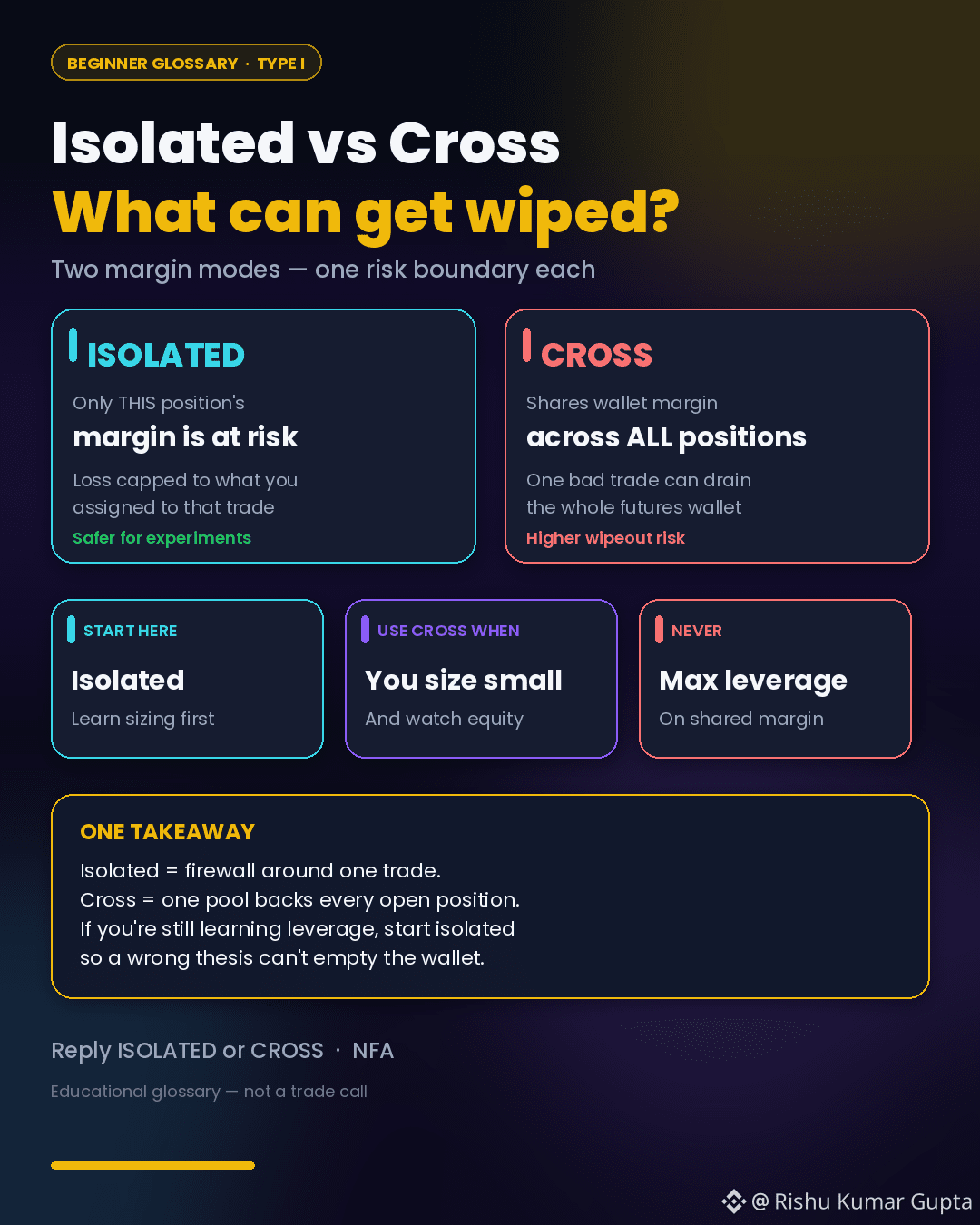
Isolated vs Cross — what can actually get wiped?
Isolated: only the margin you assigned to THAT position is at risk. A wrong thesis dies inside its own box.
Cross: one shared futures wallet backs every open position. One blow-up can drain the pool.
If you are still learning leverage, start Isolated so a single bad idea cannot empty the wallet. Size from risk $, not from “how much buying power Cross shows.”
Reply ISOLATED or CROSS.
NFA — education only.
$BTC $ETH #Futures #RiskManagement #CryptoEducation
Isolated vs Cross — what can actually get wiped?
Isolated: only the margin you assigned to THAT position is at risk. A wrong thesis dies inside its own box.
Cross: one shared futures wallet backs every open position. One blow-up can drain the pool.
If you are still learning leverage, start Isolated so a single bad idea cannot empty the wallet. Size from risk $, not from “how much buying power Cross shows.”
Reply ISOLATED or CROSS.
NFA — education only.
$BTC $ETH #Futures #RiskManagement #CryptoEducation
Isolated: only the margin you assigned to THAT position is at risk. A wrong thesis dies inside its own box.
Cross: one shared futures wallet backs every open position. One blow-up can drain the pool.
If you are still learning leverage, start Isolated so a single bad idea cannot empty the wallet. Size from risk $, not from “how much buying power Cross shows.”
Reply ISOLATED or CROSS.
NFA — education only.
$BTC $ETH #Futures #RiskManagement #CryptoEducation
35
Log in to explore more content
Join global crypto users on Binance Square
⚡️ Get latest and useful information about crypto.
💬 Trusted by the world’s largest crypto exchange.
👍 Discover real insights from verified creators.
Email / Phone number
Trending Topics
1
#AIStocksWhatNext
398,758 views
3,119 Discussing
2
#BitwiseNEARStakingETPAssetsTop$100M
176 views
22 Discussing
3
#MUBARAKRisesOver66%In24Hours
0 views
5 Discussing
4
#BitcoinBreaksAboveMayHighNears$86K
17,038 views
206 Discussing
5
#DogecoinRises15%
54,454 views
1,045 Discussing
6
#$14BBitcoinOptionsExpireFriday
4,508 views
94 Discussing
7
#BNBMarketCapPassesBNYMellon
34,066 views
750 Discussing
8
#CryptoMarketCapReclaims$3Trillion
5,972 views
86 Discussing
9
#MuseOvertakesChatGPTAsTopFreeIOSApp
19,647 views
555 Discussing
10
#TokenizedStockPlatformsCouldLaunchNextQuarter
30,989 views
611 Discussing