
#ccip
ccip
151,007 views
425 Discussing
Hot
Latest

·
--
CHAINLINK Adoption Is Growing. $LINK Isn’t. 👀
ApeChain reportedly moved $APE and $USDC to Chainlink CCIP, while Asian stock feeds now cover 6 exchanges representing $40T+.
Even Aave reportedly uses Chainlink prices on weekends.
Yet $LINK sits near $11, still 79% below its peak.
🐂 Bulls see growing adoption as a long-term catalyst.
🐻 Bears argue real-world usage doesn't automatically translate into token price appreciation.
My take: Infrastructure success and token performance aren't always synchronized.
Is undervalued, or is adoption already priced differently?
#LINK #Chainlink #Crypto #DeFi #CCIP
1
232

ApeChain is changing its cross-chain route.
ApeCoin says ApeChain will migrate from LayerZero to Chainlink CCIP as the canonical cross-chain stack across the Yuga Labs ecosystem. The announced plan includes upgrading $APE, $USDC and other key assets to Chainlink Cross-Chain Tokens (CCTs).
This is a planned transition—not a completed migration. The announcements do not specify holder migration steps or a legacy-bridge shutdown date.
Sources: ApeCoin (primary): https://x.com/apecoin/status/2118018082635657463 | Chainlink: https://x.com/chainlink/status/2118018588800069930 | The Defiant: https://thedefiant.io/news/infrastructure/apechain-plans-switch-from-layerzero-to-chainlink-ccip | Crypto Briefing: https://cryptobriefing.com/apechain-migrates-chainlink-ccip-cross-chain/
Conclusion: The next useful update is how token migration and timing will work. $APE chart: https://www.binance.com/en/trade/APE_USDT. Check the chart for yourself, do your own research, and trade responsibly.
#ApeChain #Chainlink #CCIP #CryptoInfrastructure
ApeChain is changing its cross-chain route.
ApeCoin says ApeChain will migrate from LayerZero to Chainlink CCIP as the canonical cross-chain stack across the Yuga Labs ecosystem. The announced plan includes upgrading $APE , $USDC and other key assets to Chainlink Cross-Chain Tokens (CCTs).
This is a planned transition—not a completed migration. The announcements do not specify holder migration steps or a legacy-bridge shutdown date.
Sources: ApeCoin (primary): https://x.com/apecoin/status/2118018082635657463 | Chainlink: https://x.com/chainlink/status/2118018588800069930 | The Defiant: https://thedefiant.io/news/infrastructure/apechain-plans-switch-from-layerzero-to-chainlink-ccip | Crypto Briefing: https://cryptobriefing.com/apechain-migrates-chainlink-ccip-cross-chain/
Conclusion: The next useful update is how token migration and timing will work. $APE chart: https://www.binance.com/en/trade/APE_USDT. Check the chart for yourself, do your own research, and trade responsibly.
#ApeChain #Chainlink #CCIP #CryptoInfrastructure

106

·
--
Came across OlympusDAO: its cross-chain bridge has officially switched from LayerZero to Chainlink CCIP.
Ethereum, Arbitrum, Base, Optimism, Berachain, Solana, and Robinhood Chain—all seven chains now use CCIP as their single official channel. Governance proposal OIP-198 passed a few days ago, and the change went live today.
Users barely need to do anything: OHM contract addresses on each chain remain unchanged, with no need to swap tokens or migrate. The Olympus bridge entry point is still the same. The reason for the switch is practical: LayerZero V1 is no longer available on several L2s, and rather than force an upgrade to V2, the DAO decided to consolidate cross-chain transfers and its existing price feeds with Chainlink.
The main Ethereum pool will still use lock/release, while destination chains use burn/mint, with the total supply anchored to the mainnet treasury. Some EVM routes also have one-way limits (around 100,000 OHM, for example), so larger transfers may need to be split into several transactions.
Infrastructure changes like this don’t make much noise, but they matter to holders and integrators—one fewer bridge, and one less layer of fork risk. $OHM #OlympusDAO #CCIP



Article
ApeChain Replaces LayerZero with Chainlink CCIP: What Changes for Yuga Labs Assets?ApeChain will replace LayerZero with Chainlink CCIP across the Yuga Labs ecosystem, in a move that includes upgrading APE, USDC, and other major assets to the CCT standard. $LINK
The move means replacing LayerZero with Chainlink CCIP for transferring assets within the Yuga Labs ecosystem, rather than relying on the previous infrastructure for this function.
The upgrade includes APE and USDC, along with other assets described as major. The available information does not name all the other assets or specify a complete timeline.
ApeChain Replaces LayerZero with Chainlink CCIP: What Changes for Yuga Labs Assets?
ApeChain will replace LayerZero with Chainlink CCIP across the Yuga Labs ecosystem, in a move that includes upgrading APE, USDC, and other major assets to the CCT standard. $LINK
The move means replacing LayerZero with Chainlink CCIP for transferring assets within the Yuga Labs ecosystem, rather than relying on the previous infrastructure for this function.
The upgrade includes APE and USDC, along with other assets described as major. The available information does not name all the other assets or specify a complete timeline.
85

·
--
Chainlink gains another institutional partner in the RWA sector.
Hanwha Investment & Securities has partnered with Chainlink to build a global platform for tokenizing real-world assets (RWAs).
Here’s what the partnership involves:
Chainlink Data Standard: Providing pricing and Net Asset Value (NAV) data.
CCIP: Connecting public and private blockchains so tokenized assets and liquidity can move between networks.
Institutional adoption: Exploring ways to use tokenized real-world assets as collateral.
Joint working group: Developing standards for valuation, reserve verification, compliance, and custody.
The bigger picture is that tokenization is moving beyond experiments. Financial institutions are working on the infrastructure needed to connect traditional assets with blockchain networks.
The platform is still under development, but this partnership is an interesting step for the RWA ecosystem.
Do you think institutional RWA adoption will become one of the biggest use cases for blockchain technology?
#Chainlink #RWA #Tokenization #CCIP $LINK
1
185

$LINK UNLOCKS 16 TRILLION DOLLAR BANKING PIPELINE WITH BOTTLINE PARTNERSHIP 🦈 🚀
Smart money isn’t waiting for retail to catch on while Chainlink quietly hooks its CCIP engine directly into global Swift infrastructure. Bottomline processes a staggering $16 trillion annually across 600-plus banks, and they just selected $LINK to orchestrate cross-border on-chain settlements without forcing institutions to abandon their native ISO 20022 messaging formats. 📊
This isn't just another integration announcement—it is institutional validation at the absolute highest level. 💡 By turning legacy banking rails into direct on-chain liquidity highways, CCIP is cementing its position as the primary settlement backbone for real-world finance. 🏦
💬 Will $LINK consolidate its grip as the mandatory bridge for global banking capital, or can competing interoperability protocols capture market share? 👇
⚠️ Not financial advice. Always manage your risk. 🛡️
🏷️ #LINK #Chainlink #CCIP #Crypto
🔥 💎
5

Picture this: the price on your screen and the price your contract acts on drift apart, and you only notice once the exit is already gone.
That gap is how traders lose money without ever being wrong on direction. A late feed, a stuck cross-chain message, or an exit that never clears leaves the position open long after you thought you were out.
Chainlink’s oracle layer exists so smart contracts can read prices and events they cannot see on their own chain. CCIP is built to carry messages and token transfers between networks, so an app is not locked to a single ledger. Both target a real constraint. Contracts need outside information they can trust, and anything running across chains needs a channel that is not just another informal bridge.
The risk sits in the dependency. A delayed or disputed read can liquidate $ETH collateral while the chart still looks calm. A transfer that hangs between networks can freeze the exit you planned around $LINK rails you never set up yourself. Interoperability only helps if those failure modes are part of the position, because automated contracts do not pause for a second look.
Where do you actually put oracle and cross-chain risk when you size a trade?
#Chainlink #CCIP #DeFi

1

·
--
Chainlink’s Q3 review says CCIP 2.0 is now officially live, and assets worth more than $15 billion moved to it during 2026 🔗 It also secured over $85 billion in total cross-chain value 🛡️📊 Which metric do you think matters most? ✅
$LINK #Chainlink #CCIP
Chainlink’s Q3 review says CCIP 2.0 is now officially live, and assets worth more than $15 billion moved to it during 2026 🔗 It also secured over $85 billion in total cross-chain value 🛡️📊 Which metric do you think matters most? ✅
$LINK #Chainlink #CCIP
$LINK #Chainlink #CCIP
1
137

🔗 Chainlink’s Q3 report card: business is growing, but what about the token price?
On October 21, Chainlink published its Q3 recap. Here are a few highlights:
🔹 CCIP 2.0 launched
🔹 More than $15 billion in token value migrated to CCIP
🔹 A cumulative $140 billion in value secured across onchain finance
🔹 In traditional finance, it mentioned DTCC and Swift; on the enterprise side, Infosys and Robinhood
🔹 Ongoing discussions with policymakers in the US, UK, and Hong Kong
There was another item in the quarterly report shared by the community: the Chainlink Reserve now holds more than 6 million LINK. Also, according to a news roundup on X, Schwab’s head of crypto research called Chainlink a “pure-play” on RWA tokenization.
Someone in the comments put it bluntly: Chainlink is the kind of project where the token price and the business seem like two separate stories.
My take: this is the hardest part for infrastructure tokens. Banks use its oracle and cross-chain pipelines, but they don’t necessarily need to hold LINK. So there’s a gap between “business growth” and “token price appreciation.” The key question is how much the Reserve mechanism—which turns revenue into LINK buying pressure—can scale. The $15 billion in migrations and $140 billion in secured value are real progress, but don’t mistake a quarterly report for a signal that the price is about to pump. Before chasing a rally, be clear about whether you’re betting on the narrative or the cash flow.
What do you think about “backend infrastructure” tokens like LINK? Will institutional adoption eventually drive the price up, or will it remain a good project with a sluggish token price? 👇
#LINK #Chainlink #RWA #CCIP
78

·
--
【Market Update】Chainlink’s cross-chain interoperability protocol CCIP 2.0 officially launched on September 28. It is seen as a more robust cross-chain infrastructure, but $LINK did not rally in response.
On launch day, the token price retreated from $14.02, falling 8.12% intraday. The pullback was driven mainly by weakness across the broader market. Analysts caution that LINK has broken below the neckline of a 4-hour head-and-shoulders pattern. If it fails to reclaim $13.56, it could fall toward the $12.39–$11.98 range. However, on higher timeframes, the bullish trend structure remains intact, and the foundation for the Q4 cycle is already in place.
#Chainlink #CCIP
(Source: AMBCrypto)
⚠️Risk warning: The above is for informational purposes only and does not constitute investment advice. Investing involves risk; please exercise caution.
116

·
--
Chainlink launches CCIP Vault Adapters, enabling one-click deposits into DeFi vaults across 80+ chains and simplifying multi-chain liquidity management.
#Chainlink #CCIP #DeFi #Cross-chain
Chainlink launches CCIP Vault Adapters, enabling one-click deposits into DeFi vaults across 80+ chains and simplifying multi-chain liquidity management.
#Chainlink #CCIP #DeFi #Cross-chain
#Chainlink #CCIP #DeFi #Cross-chain
49

·
--
Bullish
🔥 Institutional private chain closed-loop has a fatal shortcoming. VanEck’s report hides the logic of a $LINK long-term bull market!
Bank-built permissioned chains are isolated “islands,” unable to interoperate across networks, lacking external market data and compliance frameworks;
Chainlink’s four core products perfectly fill the gaps: oracle price feeds, CCIP cross-chain interoperability, ACE+CCID compliant identity, and CRE end-to-end orchestration.
Since a neutral interoperability layer can’t be developed in-house, all institutions can only purchase Chainlink services, and long-term value continues to concentrate on $LINK
{future}(LINKUSDT)
#LINK #RWA机构链 #CCIP
🔥 Institutional private chain closed-loop has a fatal shortcoming. VanEck’s report hides the logic of a $LINK long-term bull market!
Bank-built permissioned chains are isolated “islands,” unable to interoperate across networks, lacking external market data and compliance frameworks;
Chainlink’s four core products perfectly fill the gaps: oracle price feeds, CCIP cross-chain interoperability, ACE+CCID compliant identity, and CRE end-to-end orchestration.
Since a neutral interoperability layer can’t be developed in-house, all institutions can only purchase Chainlink services, and long-term value continues to concentrate on $LINK
#LINK #RWA机构链 #CCIP

153

·
--
Let me ask a hard-hitting question: if you have USDT on Ethereum, how do you move it to Arbitrum? Through a bridge. How many times has that bridge been hacked? Over the past few years, the amount stolen from cross-chain bridges has exceeded $2 billion—each time something goes wrong, hundreds of millions of dollars just vanish into thin air. Why? Because the bridges you use are basically controlled by a handful of validators—if they turn traitor, your money is gone. 😱
CCIP is the answer from Chainlink. The full name is Cross-Chain Interoperability Protocol—translated into plain language, it means "cross-chain interoperability protocol." Its core logic isn’t building another new bridge; instead, it standardizes cross-chain communication so it works like sending a text message. Any chain, any asset, any data—can be securely transferred using a unified protocol.
So why is it safer than traditional bridges? The key is three things. First, it uses Chainlink’s decentralized oracle network, which has been running for years. Nodes are distributed worldwide, with no single point of failure. Second, it has an independent "risk management network" that specifically monitors abnormal transactions—once suspicious activity is detected, it pauses immediately, like installing an emergency brake for cross-chain transfers. Third, it doesn’t rely on a multi-sig wallet controlled by some project team; it uses cryptographic verification—code decides, people don’t. 🔐
Let’s use an analogy: a traditional cross-chain bridge is like a private courier company—if the boss runs off, your package is gone. CCIP is like connecting to a global postal system—every step has independent audits and tracking. That’s also why SWIFT—yes, the global bank transfer system—chooses to partner with Chainlink to test cross-chain settlement.
Now look at the market. $LINK is currently quoted at $11.52, down slightly 0.55% over the past 24 hours. It touched a high of $12.22 and a low of $11.25, with trading volume around 3.41 million tokens. The funding rate is +0.0057%—longs have a slight edge, but overall sentiment is calm. In a sideways market like this, it’s actually the best time to study fundamentals—price isn’t moving, but the underlying technology is progressing. 📊
To be honest, the cross-chain space is currently a mixed bag, and most projects are still in the story-telling phase. CCIP already has real-world deployment cases, and its partners include several traditional financial institutions. Of course, that doesn’t mean the $LINK price will fly tomorrow—there’s always a timing gap between technical value and market price.
Finally, a question for you: in terms of cross-chain interoperability, do you think it will ultimately be $LINK’s CCIP that unifies everything, or will each L1/L2 blockchain build its own native bridges? Drop your pick in the comments—longs +1, shorts +2 👇
#Chainlink #CCIP #cross-chain interoperability
Let me ask a hard-hitting question: if you have USDT on Ethereum, how do you move it to Arbitrum? Through a bridge. How many times has that bridge been hacked? Over the past few years, the amount stolen from cross-chain bridges has exceeded $2 billion—each time something goes wrong, hundreds of millions of dollars just vanish into thin air. Why? Because the bridges you use are basically controlled by a handful of validators—if they turn traitor, your money is gone. 😱
CCIP is the answer from Chainlink. The full name is Cross-Chain Interoperability Protocol—translated into plain language, it means "cross-chain interoperability protocol." Its core logic isn’t building another new bridge; instead, it standardizes cross-chain communication so it works like sending a text message. Any chain, any asset, any data—can be securely transferred using a unified protocol.
So why is it safer than traditional bridges? The key is three things. First, it uses Chainlink’s decentralized oracle network, which has been running for years. Nodes are distributed worldwide, with no single point of failure. Second, it has an independent "risk management network" that specifically monitors abnormal transactions—once suspicious activity is detected, it pauses immediately, like installing an emergency brake for cross-chain transfers. Third, it doesn’t rely on a multi-sig wallet controlled by some project team; it uses cryptographic verification—code decides, people don’t. 🔐
Let’s use an analogy: a traditional cross-chain bridge is like a private courier company—if the boss runs off, your package is gone. CCIP is like connecting to a global postal system—every step has independent audits and tracking. That’s also why SWIFT—yes, the global bank transfer system—chooses to partner with Chainlink to test cross-chain settlement.
Now look at the market. $LINK is currently quoted at $11.52, down slightly 0.55% over the past 24 hours. It touched a high of $12.22 and a low of $11.25, with trading volume around 3.41 million tokens. The funding rate is +0.0057%—longs have a slight edge, but overall sentiment is calm. In a sideways market like this, it’s actually the best time to study fundamentals—price isn’t moving, but the underlying technology is progressing. 📊
To be honest, the cross-chain space is currently a mixed bag, and most projects are still in the story-telling phase. CCIP already has real-world deployment cases, and its partners include several traditional financial institutions. Of course, that doesn’t mean the $LINK price will fly tomorrow—there’s always a timing gap between technical value and market price.
Finally, a question for you: in terms of cross-chain interoperability, do you think it will ultimately be $LINK ’s CCIP that unifies everything, or will each L1/L2 blockchain build its own native bridges? Drop your pick in the comments—longs +1, shorts +2 👇
#Chainlink #CCIP #cross-chain interoperability

211
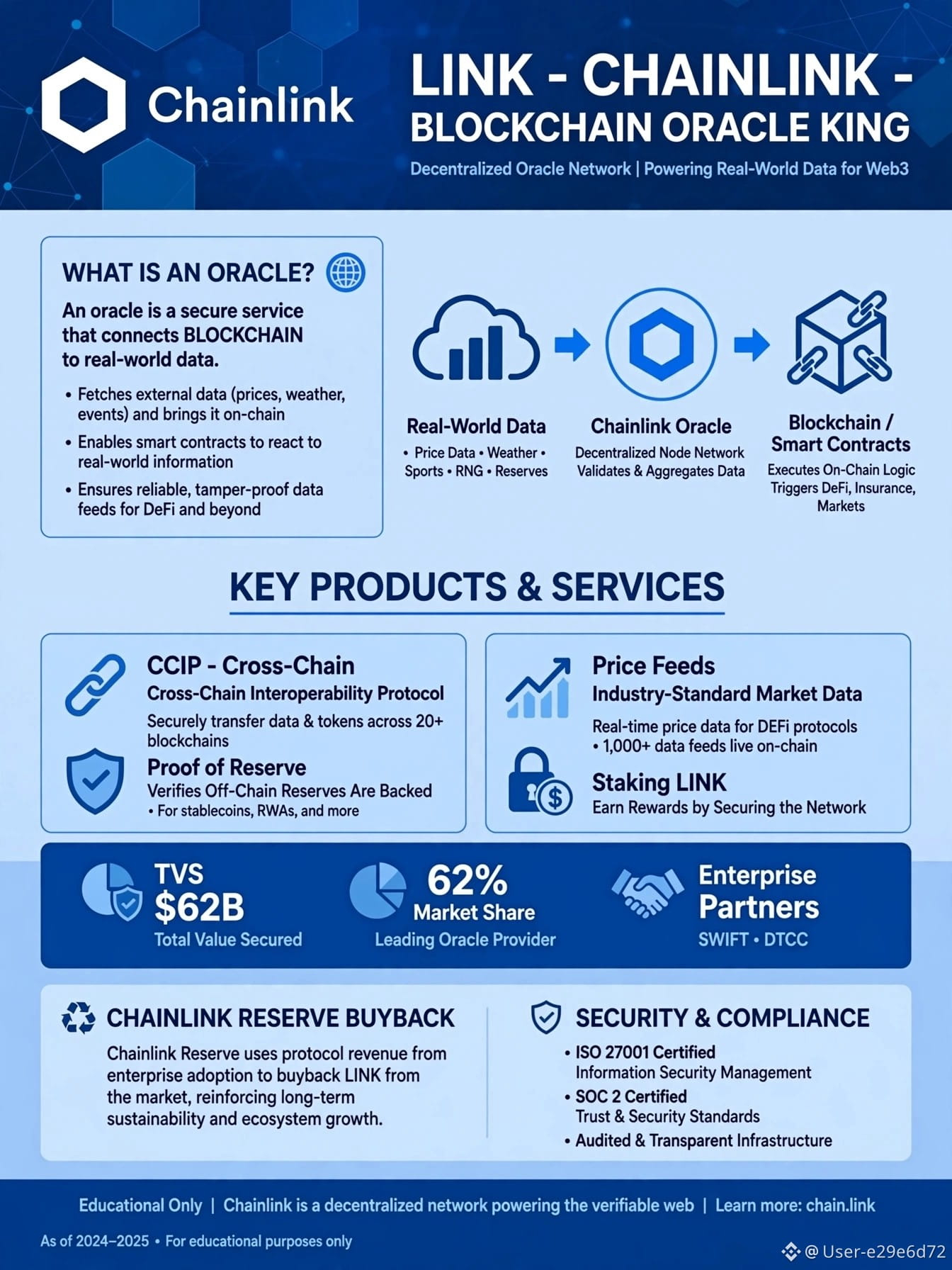
$LINK - CHAINLINK - THE ORACLE KING OF BLOCKCHAIN 👑
{spot}(LINKUSDT)
*What is an Oracle?*
Blockchain doesn’t look out to the real world by itself. An Oracle is the bridge that brings real-world data (price, weather, sports) onto the blockchain!
*What does Chainlink do?*
- *Real Data → Chainlink Oracle → Smart Contract*
- Without Chainlink, DeFi can’t even run!
*Key Products:*
1. *CCIP* - Cross-Chain Protocol - Securely transfers tokens & data across 20+ blockchains
2. *Price Feeds* - 1000+ live feeds; every DeFi protocol uses this (Aave, Synthetix, etc.)
3. *Proof of Reserve* - Verifies whether the Stablecoin/RWA backing is truly there or not
4. *Staking LINK* - Stake LINK, secure the network, and earn rewards. If you submit bad data, there’s slashing!
*Numbers that speak:*
- *$62B TVS* - Total Value Secured - Pure DeFi, and Chainlink alone has a 62% market share!
- *$11M Chainlink Reserve* - Using protocol earnings, they buy back LINK from the market—like share buybacks!
*Big Partners:*
*SWIFT* (global banking), *DTCC*, *Euroclear*, *US Dept of Commerce* - Everyone is using Chainlink! Even working with the SEC on tokenization!
Security: ISO 27001 + SOC 2 Certified by Deloitte — the first oracle to get this!
*Caption for FB:*
> Without LINK, DeFi is blind! 🔗👁️
> Chainlink = Real World Data for Blockchain
> $62B Secured | 62% Market Share | SWIFT + DTCC Partner
> Reserve is buying LINK with real revenue!
> The backbone of tokenization!
> #LUNC✅ INK #china ainlink #CCIP P #Oracle #Dogecoin eFi #Ripple WA
$LINK - CHAINLINK - THE ORACLE KING OF BLOCKCHAIN 👑
*What is an Oracle?*
Blockchain doesn’t look out to the real world by itself. An Oracle is the bridge that brings real-world data (price, weather, sports) onto the blockchain!
*What does Chainlink do?*
- *Real Data → Chainlink Oracle → Smart Contract*
- Without Chainlink, DeFi can’t even run!
*Key Products:*
1. *CCIP* - Cross-Chain Protocol - Securely transfers tokens & data across 20+ blockchains
2. *Price Feeds* - 1000+ live feeds; every DeFi protocol uses this (Aave, Synthetix, etc.)
3. *Proof of Reserve* - Verifies whether the Stablecoin/RWA backing is truly there or not
4. *Staking LINK* - Stake LINK, secure the network, and earn rewards. If you submit bad data, there’s slashing!
*Numbers that speak:*
- *$62B TVS* - Total Value Secured - Pure DeFi, and Chainlink alone has a 62% market share!
- *$11M Chainlink Reserve* - Using protocol earnings, they buy back LINK from the market—like share buybacks!
*Big Partners:*
*SWIFT* (global banking), *DTCC*, *Euroclear*, *US Dept of Commerce* - Everyone is using Chainlink! Even working with the SEC on tokenization!
Security: ISO 27001 + SOC 2 Certified by Deloitte — the first oracle to get this!
*Caption for FB:*
> Without LINK, DeFi is blind! 🔗👁️
> Chainlink = Real World Data for Blockchain
> $62B Secured | 62% Market Share | SWIFT + DTCC Partner
> Reserve is buying LINK with real revenue!
> The backbone of tokenization!
> #LUNC✅ INK #china ainlink #CCIP P #Oracle #Dogecoin eFi #Ripple WA
97

·
--
#Chainlink上线CCIP2支持企业验证
$LINK Today up +10%, with 24-hour trading volume of $1.15 billion, up 239% from the previous day. The market is buying CCIP 2.0, but don’t rush to read the “2.0” as a safety doubling.
In the updated version, the default is still verified jointly by 16 independent node operators. Institutions can also add their own-built or third-party CCVs; once they’re set as a required condition, both sides sign off before cross-chain transactions are released. KYC, anti-money-laundering, and settlement speed can also be written into the process—this really does look like a banking-grade system.
However, the official documentation also states that the automated off-chain checks of the original Risk Management Network have been stopped, while on-chain emergency circuit breakers remain. Without an additional CCV onboarding counterparty, participants typically only use the default committee. Core security hasn’t disappeared, but extra checks have become optional.
So this rally is really betting that institutions will seriously add these optional checks and generate real usage. The next valuable performance report won’t be a longer list of partners, but who enabled CCV and how many cross-chain transactions were actually processed.
#LINK #Chainlink #CCIP
{future}(LINKUSDT)
#Chainlink上线CCIP2支持企业验证
$LINK Today up +10%, with 24-hour trading volume of $1.15 billion, up 239% from the previous day. The market is buying CCIP 2.0, but don’t rush to read the “2.0” as a safety doubling.
In the updated version, the default is still verified jointly by 16 independent node operators. Institutions can also add their own-built or third-party CCVs; once they’re set as a required condition, both sides sign off before cross-chain transactions are released. KYC, anti-money-laundering, and settlement speed can also be written into the process—this really does look like a banking-grade system.
However, the official documentation also states that the automated off-chain checks of the original Risk Management Network have been stopped, while on-chain emergency circuit breakers remain. Without an additional CCV onboarding counterparty, participants typically only use the default committee. Core security hasn’t disappeared, but extra checks have become optional.
So this rally is really betting that institutions will seriously add these optional checks and generate real usage. The next valuable performance report won’t be a longer list of partners, but who enabled CCV and how many cross-chain transactions were actually processed.
#LINK #Chainlink #CCIP

2
305

Verified
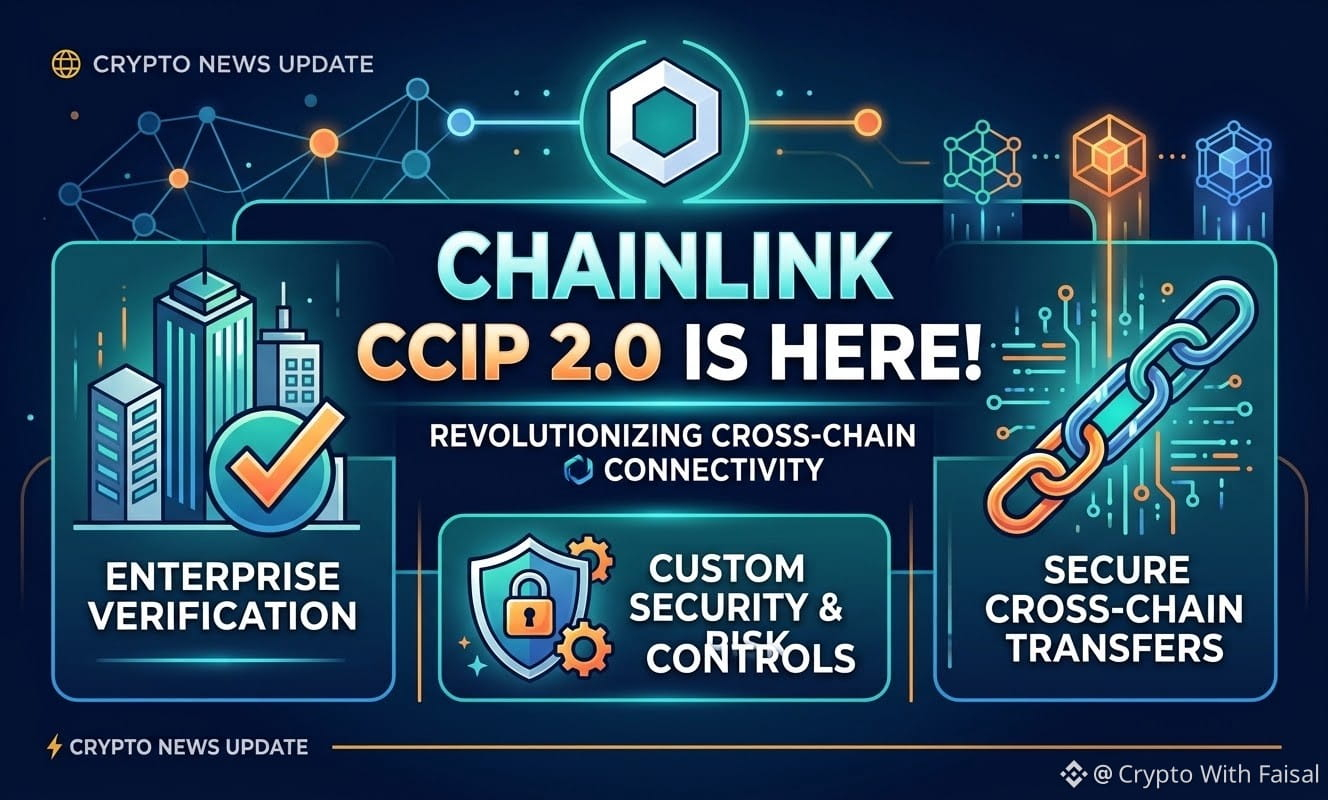
#chainlinklaunchesccip2withenterpriseverification
Chainlink has officially launched CCIP 2.0, bringing a major upgrade to its cross-chain interoperability protocol.
Why it matters:
Following a massive $292 million cross-chain bridge hack back in April, security is the main focus. CCIP 2.0 allows token issuers to add their own custom security verification checks on top of Chainlink’s default 16-node network.
Enterprises can now run their own validators or hire third parties like Infosys and Nethermind without needing Chainlink's approval. It’s a massive step for institutional adoption and custom risk control.
Additionally, top DeFi protocols like Aave and Maple have already adopted the update to utilize new "faster-than-finality" token transfers.
Will this open the floodgates for institutional capital on-chain? Share your thoughts below! 👇
$LINK
{future}(LINKUSDT)
$ETH
{future}(ETHUSDT)
$BTC
{future}(BTCUSDT)
#Chainlink #CCIP #CryptoNews
#chainlinklaunchesccip2withenterpriseverification
Chainlink has officially launched CCIP 2.0, bringing a major upgrade to its cross-chain interoperability protocol.
Why it matters:
Following a massive $292 million cross-chain bridge hack back in April, security is the main focus. CCIP 2.0 allows token issuers to add their own custom security verification checks on top of Chainlink’s default 16-node network.
Enterprises can now run their own validators or hire third parties like Infosys and Nethermind without needing Chainlink's approval. It’s a massive step for institutional adoption and custom risk control.
Additionally, top DeFi protocols like Aave and Maple have already adopted the update to utilize new "faster-than-finality" token transfers.
Will this open the floodgates for institutional capital on-chain? Share your thoughts below! 👇
$LINK
$ETH
$BTC
#Chainlink #CCIP #CryptoNews
65


Article
tital Chainlink CCIP 2.0 Will Institutions Adopt It?🔗 Chainlink Makes Cross Chain Transfers Safer
CCIP 2.0 gives institutions more control over transaction verification. 👀
Now companies can add their own security checks before transfers execute.
Will institutions adopt it?
#Chainlink #CCIP #LINK #Tokenization
{spot}(LINKUSDT)
tital Chainlink CCIP 2.0 Will Institutions Adopt It?
🔗 Chainlink Makes Cross Chain Transfers Safer
CCIP 2.0 gives institutions more control over transaction verification. 👀
Now companies can add their own security checks before transfers execute.
Will institutions adopt it?
#Chainlink #CCIP #LINK #Tokenization
CCIP 2.0 gives institutions more control over transaction verification. 👀
Now companies can add their own security checks before transfers execute.
Will institutions adopt it?
#Chainlink #CCIP #LINK #Tokenization
35

$LINK K — Chainlink
🔗 CHAINLINK JUST UPGRADED ITS CROSS-CHAIN INFRASTRUCTURE
Chainlink has launched CCIP 2.0, introducing more customizable security controls for applications using its cross-chain infrastructure.
The upgrade comes as cross-chain applications continue growing and security remains one of the biggest issues in blockchain interoperability.
For $LINK, the important story isn't simply the token—it’s whether CCIP becomes increasingly embedded in financial and Web3 infrastructure.
$LINK #Chainlink #CCIP #RWA #DeFi #Crypto
$LINK K — Chainlink
🔗 CHAINLINK JUST UPGRADED ITS CROSS-CHAIN INFRASTRUCTURE
Chainlink has launched CCIP 2.0, introducing more customizable security controls for applications using its cross-chain infrastructure.
The upgrade comes as cross-chain applications continue growing and security remains one of the biggest issues in blockchain interoperability.
For $LINK , the important story isn't simply the token—it’s whether CCIP becomes increasingly embedded in financial and Web3 infrastructure.
$LINK #Chainlink #CCIP #RWA #DeFi #Crypto
1
21

·
--
The sense of security in cross-chain bridges just got an extra layer.
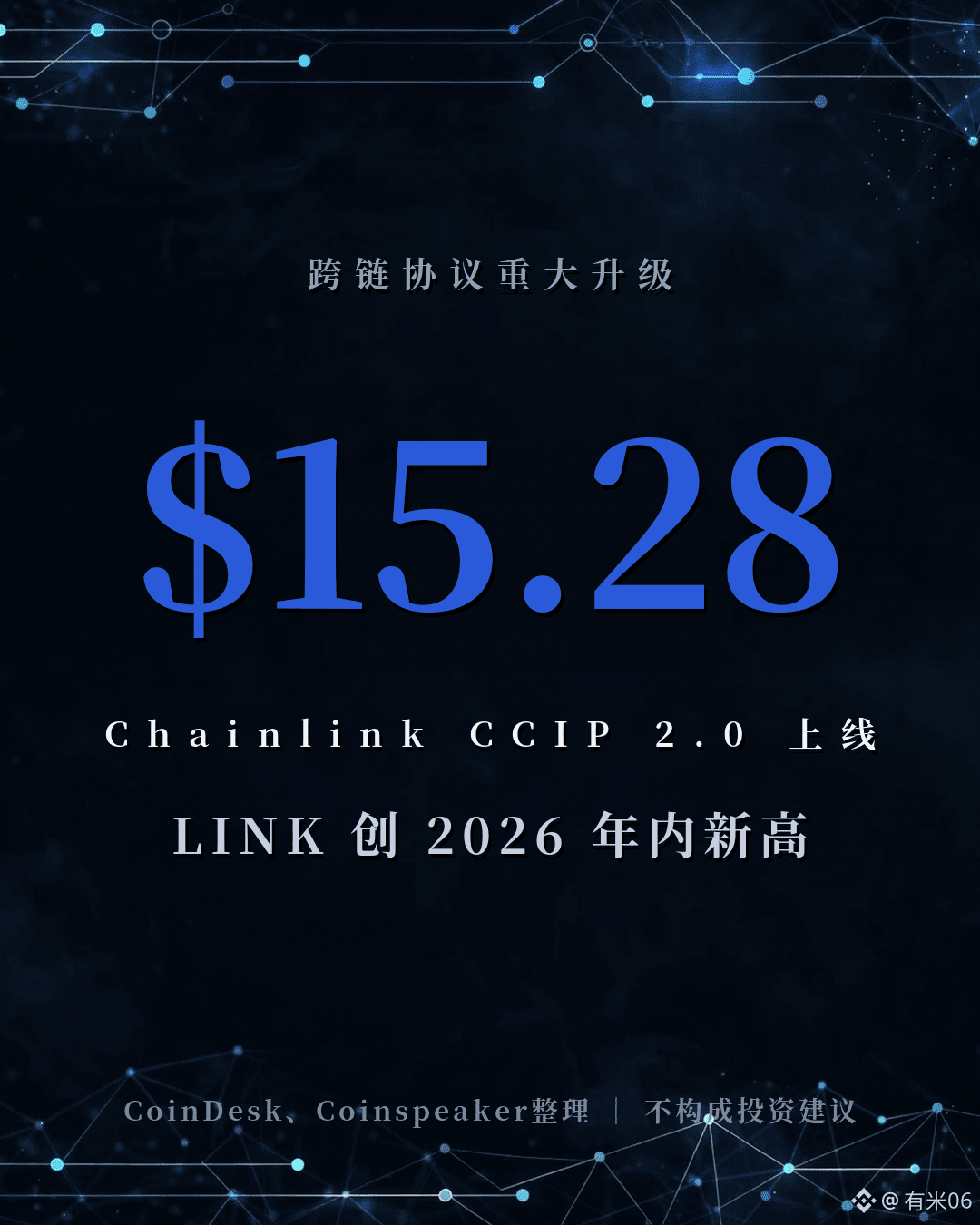
On September 28, Chainlink officially launched CCIP 2.0: in addition to the default 16-node committee verification, institutions and project teams can now layer on their own cross-chain validators (CCVs). It also comes with compliant modules for KYC/anti-money laundering/sanctions screening—essentially putting “double insurance” on cross-chain transactions. The background for this upgrade is also pretty straightforward: in April this year, the Kelp DAO cross-chain bridge was hacked for $292 million because it relied on a single validator.
After the news broke, LINK surged intraday to about $15.28, setting a new intrayear high for 2026; the 24-hour increase was roughly 7.8%–12%.
Data as of: 2026-09-28 13:50 UTC
Source: CoinDesk (2026-09-28); Coinspeaker (citing Chainlink’s official announcement and CoinGecko market data)
For information sharing only and does not constitute investment advice.
#LINK #Chainlink #CCIP
190


·
--
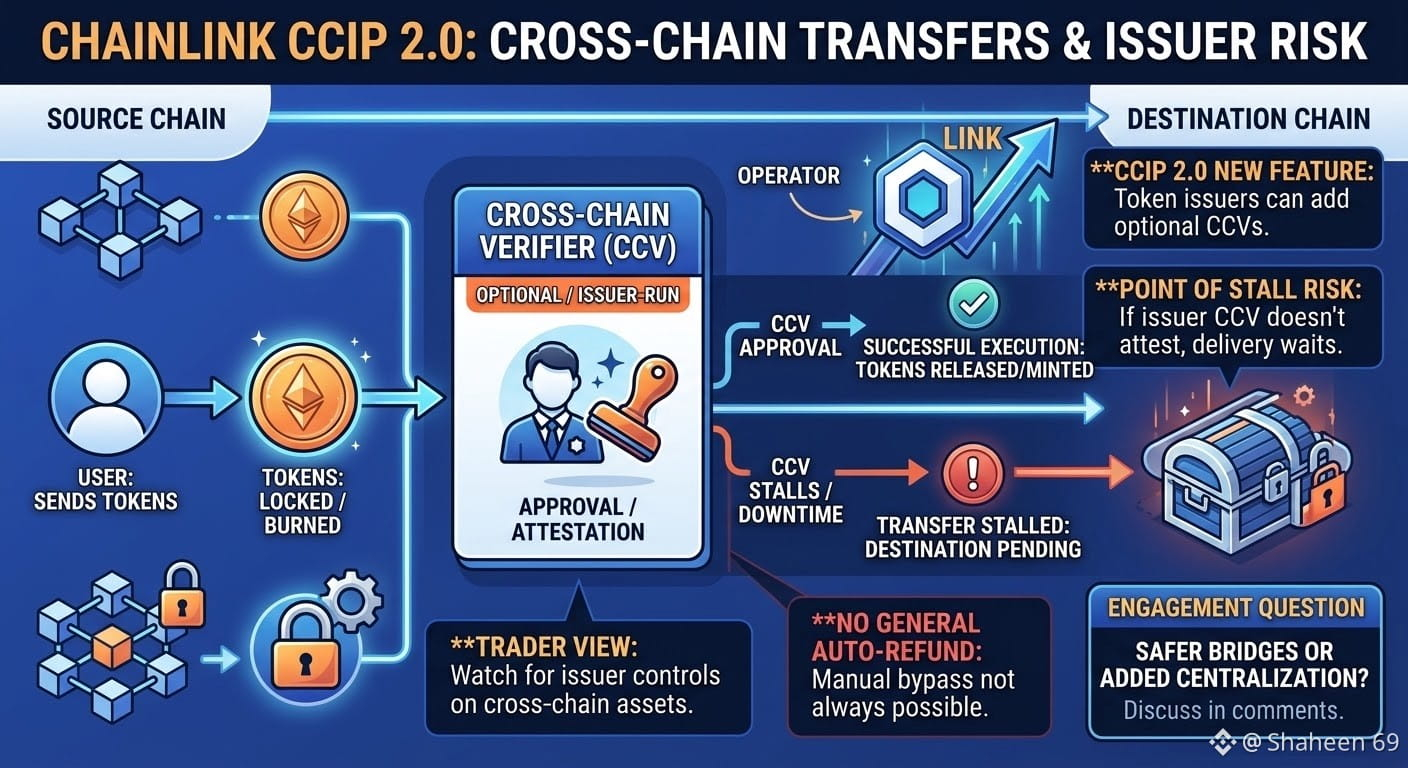
Chainlink has officially introduced CCIP 2.0, featuring a new Cross-Chain Verifier (CCV) system that allows token issuers to require extra verification step before tokens complete a transfer across blockchains.
Under this setup, tokens can be locked or burned on the source chain before the extra verifier gives approval. If that third-party verifier experiences downtime or fails to issue a proof, destination delivery stalls—leaving funds pending with no general automatic refund option.
While this feature adds an extra layer of control and compliance for token creators, it also introduces a potential single point of failure. If an issuer-run verifier goes offline, user funds could end up temporarily stuck in transit.
For traders and DeFi users, moving funds across chains requires paying closer attention to which protocol-level risks and issuer controls exist on specific token bridges.
Will optional issuer verifiers make cross-chain bridges safer, or does this add unnecessary centralization to DeFi?
#Chainlink #CCIP #DeFi #CryptoNews
$LINK
$HBAR
2
395
Log in to explore more content
Join global crypto users on Binance Square
⚡️ Get latest and useful information about crypto.
💬 Trusted by the world’s largest crypto exchange.
👍 Discover real insights from verified creators.
Email / Phone number
Trending Topics
1
#JobsReportRaisesHikeOdds
222,916 views
1,818 Discussing
2
#CPITestsDecemberRateOutlook
11,831 views
178 Discussing
3
#BitcoinRebounds$75KAsChipsLead
19,377 views
210 Discussing
4
#US Data Center Rules May Constrain AI Expansion
35,550 views
148 Discussing
5
#ARKPlans14ThematicETFsCoveringAIAndTokenizedMarkets
0 views
2 Discussing
6
#WillAnthropicListOnTime
53,084 views
686 Discussing
7
#WillUS-IranTensionsBoostSafe-HavenDemand?
5,842 views
56 Discussing
8
#BitcoinETFsSee$412MNetOutflows
1,878 views
43 Discussing
9
#HKSFCPlansToRestrictCryptoAndExchangeTerms
9,634 views
181 Discussing
10
#TradFiForBeginners
35,488 views
541 Discussing