

#bitcoinminingdifficultymayfall1.2%
bitcoinminingdifficultymayfall1.2%
281,640 views
1,810 Discussing
Hot
Latest

·
--
🚨 #BitcoinMiningDifficultyMayFall1.2%
Bullish or Bearish for BTC? 📊
The Bitcoin network just completed its latest difficulty adjustment with a -1.2% drop. Is this a warning sign of miner stress, or a healthy reset for the next move up?
Here is the breakdown of what this means for $BTC and how you should trade it! 👇
🟢 The Bullish Case (Why it's Good)
Relief for Miners & Lower Selling Pressure:
A drop in difficulty lowers the cost and computing power needed to mine a block. This helps struggling miners stay profitable without being forced to dump their BTC holdings on the market to cover operational expenses.
Network Self-Healing in Action:
It demonstrates Bitcoin's core design strength: the protocol automatically recalibrates to maintain 10-minute block times regardless of global hash rate fluctuations.
Historical Bottom Sign:
Minor difficulty drops often mark the tail-end of miner capitulation, signaling that a price floor/support base is forming.
🔴 The Bearish Case (Why to Be Cautious)
Decline in Hash Rate:
Difficulty drops only when global computing power (hash rate) decreases. This means some mining rigs were turned off due to rising energy costs or dropping profit margins.
Short-Term Sentiment Pressure:
Skeptical traders often view falling difficulty as a sign of weakening network sentiment or temporary miner distress.
📈 Impact on Trading
Short-Term: A -1.2% drop is small and routine, suggesting stabilization rather than a crisis. Expect range-bound/sideways price action while the hash rate rebalances.
Medium-Term: Neutral-to-Bullish. By easing pressure on miners, it prevents aggressive structural sell-offs from mining desks.
💡 Quick Tips for Traders:
Keep leverage low and trade key support/resistance levels rather than reacting to minor difficulty drops. Monitor hash rate recovery over the next two weeks to confirm network stability before opening major spot or DCA positions.
#btc #FirstNightWithoutUSStrikesOnIranInTwoWeeks #BinanceSquare #analysys
$PIEVERSE $EUL
{future}(BTCUSDT)
🚨 #BitcoinMiningDifficultyMayFall1.2%
Bullish or Bearish for BTC? 📊
The Bitcoin network just completed its latest difficulty adjustment with a -1.2% drop. Is this a warning sign of miner stress, or a healthy reset for the next move up?
Here is the breakdown of what this means for $BTC and how you should trade it! 👇
🟢 The Bullish Case (Why it's Good)
Relief for Miners & Lower Selling Pressure:
A drop in difficulty lowers the cost and computing power needed to mine a block. This helps struggling miners stay profitable without being forced to dump their BTC holdings on the market to cover operational expenses.
Network Self-Healing in Action:
It demonstrates Bitcoin's core design strength: the protocol automatically recalibrates to maintain 10-minute block times regardless of global hash rate fluctuations.
Historical Bottom Sign:
Minor difficulty drops often mark the tail-end of miner capitulation, signaling that a price floor/support base is forming.
🔴 The Bearish Case (Why to Be Cautious)
Decline in Hash Rate:
Difficulty drops only when global computing power (hash rate) decreases. This means some mining rigs were turned off due to rising energy costs or dropping profit margins.
Short-Term Sentiment Pressure:
Skeptical traders often view falling difficulty as a sign of weakening network sentiment or temporary miner distress.
📈 Impact on Trading
Short-Term: A -1.2% drop is small and routine, suggesting stabilization rather than a crisis. Expect range-bound/sideways price action while the hash rate rebalances.
Medium-Term: Neutral-to-Bullish. By easing pressure on miners, it prevents aggressive structural sell-offs from mining desks.
💡 Quick Tips for Traders:
Keep leverage low and trade key support/resistance levels rather than reacting to minor difficulty drops. Monitor hash rate recovery over the next two weeks to confirm network stability before opening major spot or DCA positions.
#btc #FirstNightWithoutUSStrikesOnIranInTwoWeeks #BinanceSquare #analysys
$PIEVERSE $EUL
Bullish or Bearish for BTC? 📊
The Bitcoin network just completed its latest difficulty adjustment with a -1.2% drop. Is this a warning sign of miner stress, or a healthy reset for the next move up?
Here is the breakdown of what this means for $BTC and how you should trade it! 👇
🟢 The Bullish Case (Why it's Good)
Relief for Miners & Lower Selling Pressure:
A drop in difficulty lowers the cost and computing power needed to mine a block. This helps struggling miners stay profitable without being forced to dump their BTC holdings on the market to cover operational expenses.
Network Self-Healing in Action:
It demonstrates Bitcoin's core design strength: the protocol automatically recalibrates to maintain 10-minute block times regardless of global hash rate fluctuations.
Historical Bottom Sign:
Minor difficulty drops often mark the tail-end of miner capitulation, signaling that a price floor/support base is forming.
🔴 The Bearish Case (Why to Be Cautious)
Decline in Hash Rate:
Difficulty drops only when global computing power (hash rate) decreases. This means some mining rigs were turned off due to rising energy costs or dropping profit margins.
Short-Term Sentiment Pressure:
Skeptical traders often view falling difficulty as a sign of weakening network sentiment or temporary miner distress.
📈 Impact on Trading
Short-Term: A -1.2% drop is small and routine, suggesting stabilization rather than a crisis. Expect range-bound/sideways price action while the hash rate rebalances.
Medium-Term: Neutral-to-Bullish. By easing pressure on miners, it prevents aggressive structural sell-offs from mining desks.
💡 Quick Tips for Traders:
Keep leverage low and trade key support/resistance levels rather than reacting to minor difficulty drops. Monitor hash rate recovery over the next two weeks to confirm network stability before opening major spot or DCA positions.
#btc #FirstNightWithoutUSStrikesOnIranInTwoWeeks #BinanceSquare #analysys
$PIEVERSE $EUL
1
1
140

#BitcoinMiningDifficultyMayFall1.2% ... (1K discussing)
A potential drop in Bitcoin mining difficulty could improve miners' profitability. If that happens, it will be interesting to monitor the impact on hashrate and market sentiment. $BTC #Bitcoin
#BitcoinMiningDifficultyMayFall1.2% ... (1K discussing)
A potential drop in Bitcoin mining difficulty could improve miners' profitability. If that happens, it will be interesting to monitor the impact on hashrate and market sentiment. $BTC #Bitcoin
A potential drop in Bitcoin mining difficulty could improve miners' profitability. If that happens, it will be interesting to monitor the impact on hashrate and market sentiment. $BTC #Bitcoin
1
137

🚀🌍 A Small Network Shift Could Set the Stage for Bigger Moves
If Bitcoin mining difficulty falls by approximately 1.2%, it may signal changing network dynamics following recent hash rate fluctuations. Although the adjustment itself is modest, a healthier balance between mining activity and network demand could support stable blockchain operations. If broader market conditions remain constructive, continued institutional interest and steady on-chain activity could help keep $BTC in focus, with $ETH and $BNB also benefiting from improving overall crypto sentiment.
#bitcoinminingdifficultymayfall1.2%
🚀🌍 A Small Network Shift Could Set the Stage for Bigger Moves
If Bitcoin mining difficulty falls by approximately 1.2%, it may signal changing network dynamics following recent hash rate fluctuations. Although the adjustment itself is modest, a healthier balance between mining activity and network demand could support stable blockchain operations. If broader market conditions remain constructive, continued institutional interest and steady on-chain activity could help keep $BTC in focus, with $ETH and $BNB also benefiting from improving overall crypto sentiment.
#bitcoinminingdifficultymayfall1.2%
If Bitcoin mining difficulty falls by approximately 1.2%, it may signal changing network dynamics following recent hash rate fluctuations. Although the adjustment itself is modest, a healthier balance between mining activity and network demand could support stable blockchain operations. If broader market conditions remain constructive, continued institutional interest and steady on-chain activity could help keep $BTC in focus, with $ETH and $BNB also benefiting from improving overall crypto sentiment.
#bitcoinminingdifficultymayfall1.2%
190

·
--
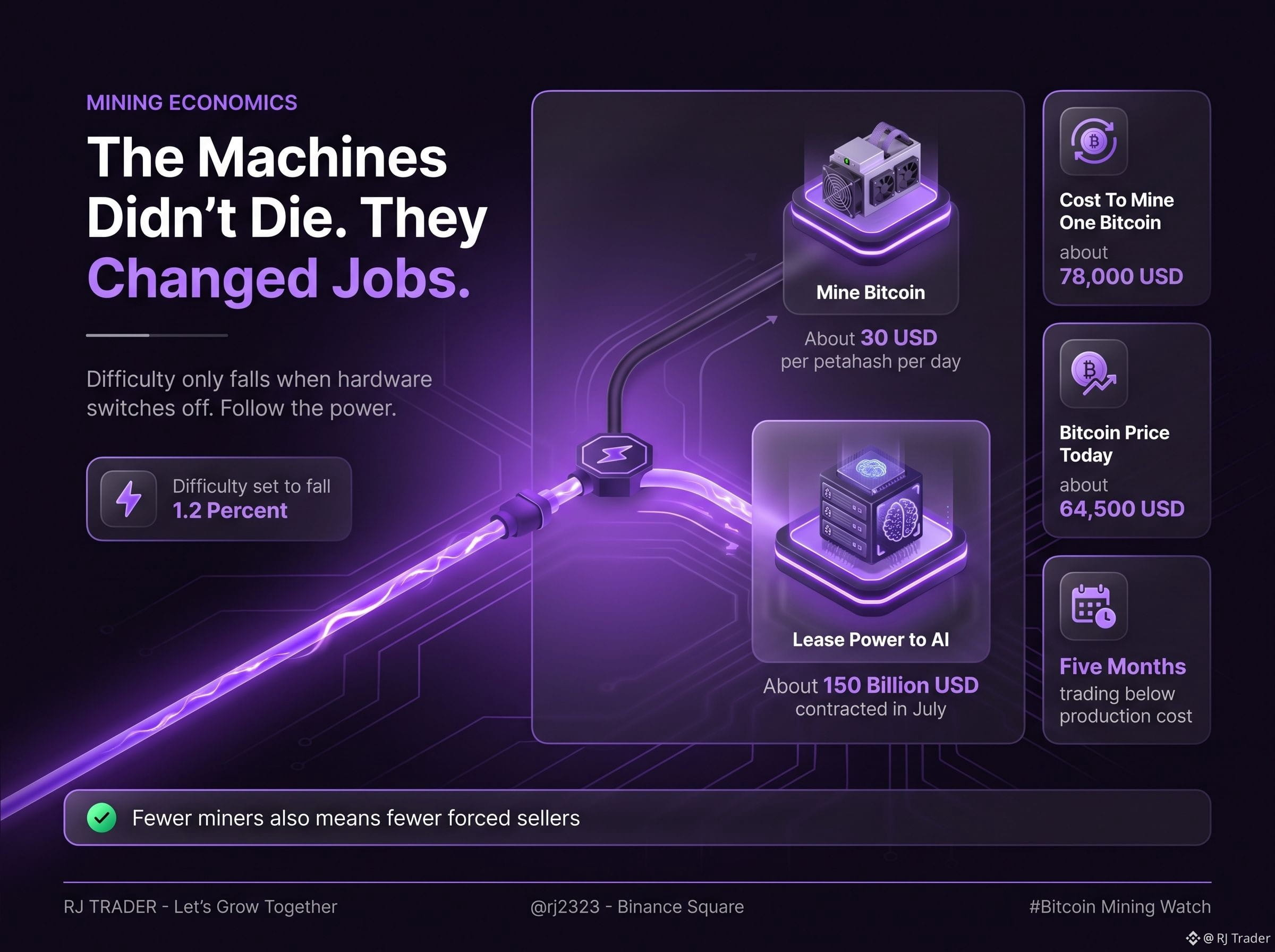
⛏️ Bitcoin's difficulty is about to fall 1.2%, and every post in this hashtag is calling it "relief for miners."
It isn't relief. It's an exit sign.
Difficulty only falls when machines switch OFF. So the real question isn't what the number means — it's where those machines went. 👇
First, why they're switching off:
💸 Hashprice — what one petahash of mining power earns per day — is down around $30.88
🏦 JPMorgan puts the all-in cost to mine one Bitcoin near $78,000. Bitcoin is $64,500.
🔻 That's roughly 20% of the network mining at a loss — and BTC has traded UNDER production cost for five straight months
📉 Public miners dumped 32,000+ BTC in Q1 alone just to pay the bills. More than they sold in all of 2025.
⚰️ Poolin — once ~20% of the entire network — filed Chapter 11 days ago
Now the part nobody in this hashtag is saying out loud.
Those machines aren't moving to a rival pool. Their POWER is moving to AI. 🤖
Bernstein logged a new AI data-centre deal from a Bitcoin miner every single week this month — over 7.5 gigawatts, around $150 BILLION in multi-year contracts. TeraWulf signed $19B. Hut 8 signed $9.8B. IREN signed $2.8B.
Do the math a miner does:
⛏️ Mine Bitcoin → about $30 a day per petahash, and you're underwater at today's price
🧠 Lease that same megawatt to AI → guaranteed rent, 15 to 20 years, signed
My take: the 1.2% isn't the story. The DIRECTION is. Bitcoin has stopped competing with other coins for capital — it's now competing with AI for electricity. At $64,500, AI is outbidding it.
And here's the twist that's actually bullish: a miner who signs an AI lease stops being a forced seller. No more dumping coins to make payroll. Fewer miners, less structural sell pressure, tighter float.
The network gets smaller. The sellers leave with it. 🤷
Difficulty falling — miner relief, or miner capitulation? 👇
NFA · DYOR
$BTC #BitcoinMiningDifficultyMayFall1.2%
⛏️ Bitcoin's difficulty is about to fall 1.2%, and every post in this hashtag is calling it "relief for miners."
It isn't relief. It's an exit sign.
Difficulty only falls when machines switch OFF. So the real question isn't what the number means — it's where those machines went. 👇
First, why they're switching off:
💸 Hashprice — what one petahash of mining power earns per day — is down around $30.88
🏦 JPMorgan puts the all-in cost to mine one Bitcoin near $78,000. Bitcoin is $64,500.
🔻 That's roughly 20% of the network mining at a loss — and BTC has traded UNDER production cost for five straight months
📉 Public miners dumped 32,000+ BTC in Q1 alone just to pay the bills. More than they sold in all of 2025.
⚰️ Poolin — once ~20% of the entire network — filed Chapter 11 days ago
Now the part nobody in this hashtag is saying out loud.
Those machines aren't moving to a rival pool. Their POWER is moving to AI. 🤖
Bernstein logged a new AI data-centre deal from a Bitcoin miner every single week this month — over 7.5 gigawatts, around $150 BILLION in multi-year contracts. TeraWulf signed $19B. Hut 8 signed $9.8B. IREN signed $2.8B.
Do the math a miner does:
⛏️ Mine Bitcoin → about $30 a day per petahash, and you're underwater at today's price
🧠 Lease that same megawatt to AI → guaranteed rent, 15 to 20 years, signed
My take: the 1.2% isn't the story. The DIRECTION is. Bitcoin has stopped competing with other coins for capital — it's now competing with AI for electricity. At $64,500, AI is outbidding it.
And here's the twist that's actually bullish: a miner who signs an AI lease stops being a forced seller. No more dumping coins to make payroll. Fewer miners, less structural sell pressure, tighter float.
The network gets smaller. The sellers leave with it. 🤷
Difficulty falling — miner relief, or miner capitulation? 👇
NFA · DYOR
$BTC #BitcoinMiningDifficultyMayFall1.2%
It isn't relief. It's an exit sign.
Difficulty only falls when machines switch OFF. So the real question isn't what the number means — it's where those machines went. 👇
First, why they're switching off:
💸 Hashprice — what one petahash of mining power earns per day — is down around $30.88
🏦 JPMorgan puts the all-in cost to mine one Bitcoin near $78,000. Bitcoin is $64,500.
🔻 That's roughly 20% of the network mining at a loss — and BTC has traded UNDER production cost for five straight months
📉 Public miners dumped 32,000+ BTC in Q1 alone just to pay the bills. More than they sold in all of 2025.
⚰️ Poolin — once ~20% of the entire network — filed Chapter 11 days ago
Now the part nobody in this hashtag is saying out loud.
Those machines aren't moving to a rival pool. Their POWER is moving to AI. 🤖
Bernstein logged a new AI data-centre deal from a Bitcoin miner every single week this month — over 7.5 gigawatts, around $150 BILLION in multi-year contracts. TeraWulf signed $19B. Hut 8 signed $9.8B. IREN signed $2.8B.
Do the math a miner does:
⛏️ Mine Bitcoin → about $30 a day per petahash, and you're underwater at today's price
🧠 Lease that same megawatt to AI → guaranteed rent, 15 to 20 years, signed
My take: the 1.2% isn't the story. The DIRECTION is. Bitcoin has stopped competing with other coins for capital — it's now competing with AI for electricity. At $64,500, AI is outbidding it.
And here's the twist that's actually bullish: a miner who signs an AI lease stops being a forced seller. No more dumping coins to make payroll. Fewer miners, less structural sell pressure, tighter float.
The network gets smaller. The sellers leave with it. 🤷
Difficulty falling — miner relief, or miner capitulation? 👇
NFA · DYOR
$BTC #BitcoinMiningDifficultyMayFall1.2%
171

#bitcoinminingdifficultymayfall1.2%
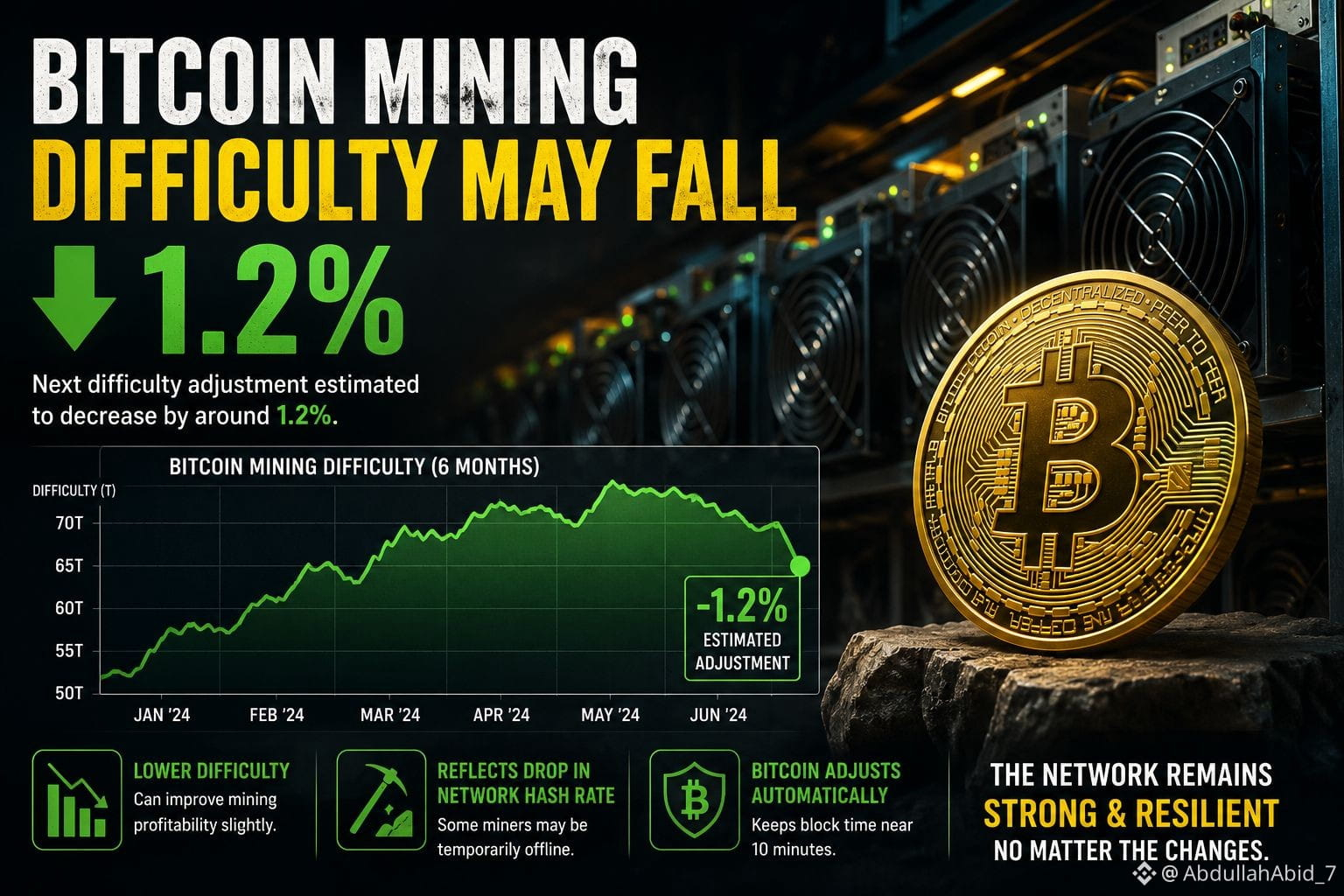
Bitcoin's mining difficulty is expected to decrease by around 1.2% in the next adjustment. While the change isn't massive, it could slightly reduce the computational effort required to mine new blocks.
A lower mining difficulty often happens when some miners temporarily leave the network or overall hash rate declines. For miners, this can mean slightly improved chances of earning block rewards with the same hardware. For investors, it's another reminder that the $BTC network automatically adjusts to maintain an average block time of about 10 minutes.
This adjustment doesn't directly affect Bitcoin's long-term value, but it highlights how the network remains resilient and self-balancing, even as mining conditions change.
Key Takeaways:
Expected difficulty adjustment: -1.2%
Could slightly improve mining profitability.
Reflects a minor drop in network hash rate.
Bitcoin's automatic difficulty adjustment keeps the network stable.
#bitcoin #BTC #crypto #Write2Earn
#bitcoinminingdifficultymayfall1.2%
Bitcoin's mining difficulty is expected to decrease by around 1.2% in the next adjustment. While the change isn't massive, it could slightly reduce the computational effort required to mine new blocks.
A lower mining difficulty often happens when some miners temporarily leave the network or overall hash rate declines. For miners, this can mean slightly improved chances of earning block rewards with the same hardware. For investors, it's another reminder that the $BTC network automatically adjusts to maintain an average block time of about 10 minutes.
This adjustment doesn't directly affect Bitcoin's long-term value, but it highlights how the network remains resilient and self-balancing, even as mining conditions change.
Key Takeaways:
Expected difficulty adjustment: -1.2%
Could slightly improve mining profitability.
Reflects a minor drop in network hash rate.
Bitcoin's automatic difficulty adjustment keeps the network stable.
#bitcoin #BTC #crypto #Write2Earn
Bitcoin's mining difficulty is expected to decrease by around 1.2% in the next adjustment. While the change isn't massive, it could slightly reduce the computational effort required to mine new blocks.
A lower mining difficulty often happens when some miners temporarily leave the network or overall hash rate declines. For miners, this can mean slightly improved chances of earning block rewards with the same hardware. For investors, it's another reminder that the $BTC network automatically adjusts to maintain an average block time of about 10 minutes.
This adjustment doesn't directly affect Bitcoin's long-term value, but it highlights how the network remains resilient and self-balancing, even as mining conditions change.
Key Takeaways:
Expected difficulty adjustment: -1.2%
Could slightly improve mining profitability.
Reflects a minor drop in network hash rate.
Bitcoin's automatic difficulty adjustment keeps the network stable.
#bitcoin #BTC #crypto #Write2Earn
244

·
--
Bullish
#bitcoinminingdifficultymayfall1.2%
Bitcoin mining difficulty
dropped by -0.74% on July 25, with total network hash rate falling by roughly 25 EH/s.
Assuming an average efficiency of 200 TH/s per unit, that implies approximately 125,000 rigs went dark globally.
For the miners who stayed plugged in, output just ticked up by ~1%.
⚡️⛏️
$BTC
{future}(BTCUSDT)
$NEO
{future}(NEOUSDT)
$ETH
{future}(ETHUSDT)
#bitcoinminingdifficultymayfall1.2%
Bitcoin mining difficulty
dropped by -0.74% on July 25, with total network hash rate falling by roughly 25 EH/s.
Assuming an average efficiency of 200 TH/s per unit, that implies approximately 125,000 rigs went dark globally.
For the miners who stayed plugged in, output just ticked up by ~1%.
⚡️⛏️
$BTC
$NEO
$ETH
Bitcoin mining difficulty
dropped by -0.74% on July 25, with total network hash rate falling by roughly 25 EH/s.
Assuming an average efficiency of 200 TH/s per unit, that implies approximately 125,000 rigs went dark globally.
For the miners who stayed plugged in, output just ticked up by ~1%.
⚡️⛏️
$BTC
$NEO
$ETH

244

·
--
Partly True
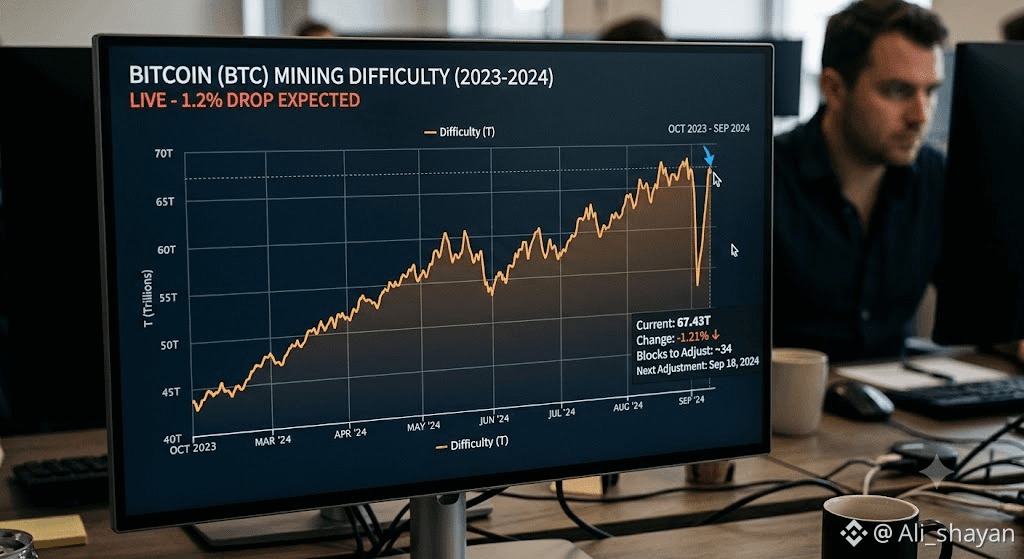
#bitcoinminingdifficultymayfall1.2% Bitcoin's network difficulty is projected to fall by roughly 1.2% in its next adjustment. This small dip reflects slight fluctuations in total hash rate as block production temporarily slowed down. To keep block creation right around the ten-minute mark, Bitcoin automatically recalculates difficulty every 2,016 blocks. A lower difficulty slightly eases the math for miners competing to validate blocks, demonstrating how the network seamlessly adapts to changing conditions behind the scenes.
CLICK BELOW TO TRADE : $BTC $BANK
{spot}(BANKUSDT)
{spot}(BTCUSDT)
#bitcoinminingdifficultymayfall1.2% Bitcoin's network difficulty is projected to fall by roughly 1.2% in its next adjustment. This small dip reflects slight fluctuations in total hash rate as block production temporarily slowed down. To keep block creation right around the ten-minute mark, Bitcoin automatically recalculates difficulty every 2,016 blocks. A lower difficulty slightly eases the math for miners competing to validate blocks, demonstrating how the network seamlessly adapts to changing conditions behind the scenes.
CLICK BELOW TO TRADE : $BTC $BANK
CLICK BELOW TO TRADE : $BTC $BANK
1.9k

·
--
Bullish
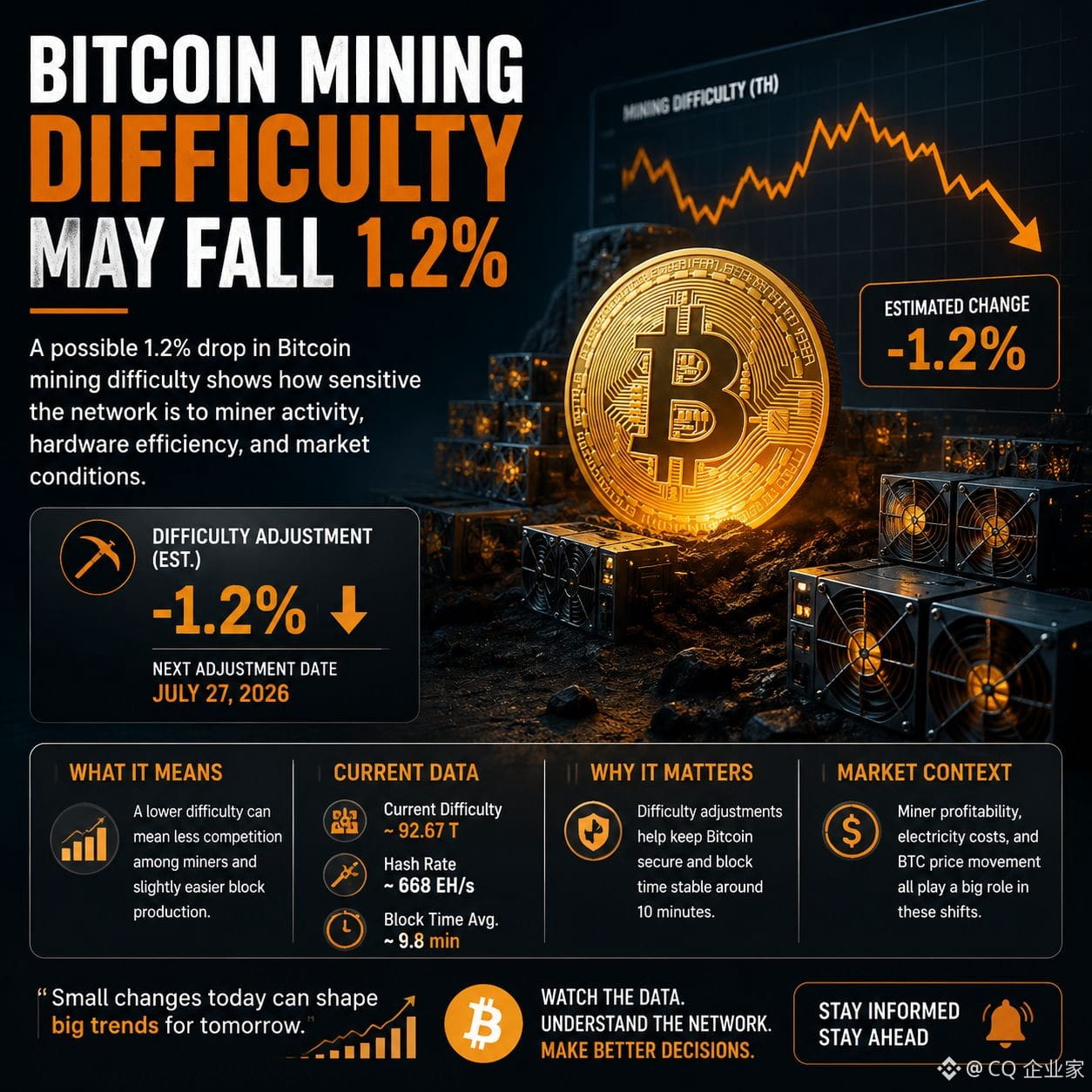
I started looking at Bitcoin mining difficulty differently when I noticed how small changes can reveal bigger shifts in network conditions. A possible 1.2% difficulty drop may seem minor, but it reflects the balance between miner participation, hardware efficiency, and market pressure. When difficulty rises, it usually shows stronger competition and confidence among miners. A decline can signal reduced activity or temporary adjustments after challenging conditions. My view is that difficulty changes alone do not define Bitcoin’s future, but they provide valuable clues about miner health. I will become more bullish if difficulty stabilizes alongside rising hash rate and stronger miner profitability.
$BTC
{future}(BTCUSDT)
#bitcoinminingdifficultymayfall1.2%
I started looking at Bitcoin mining difficulty differently when I noticed how small changes can reveal bigger shifts in network conditions. A possible 1.2% difficulty drop may seem minor, but it reflects the balance between miner participation, hardware efficiency, and market pressure. When difficulty rises, it usually shows stronger competition and confidence among miners. A decline can signal reduced activity or temporary adjustments after challenging conditions. My view is that difficulty changes alone do not define Bitcoin’s future, but they provide valuable clues about miner health. I will become more bullish if difficulty stabilizes alongside rising hash rate and stronger miner profitability.
$BTC
#bitcoinminingdifficultymayfall1.2%
$BTC
#bitcoinminingdifficultymayfall1.2%
1
8
4k
·
--
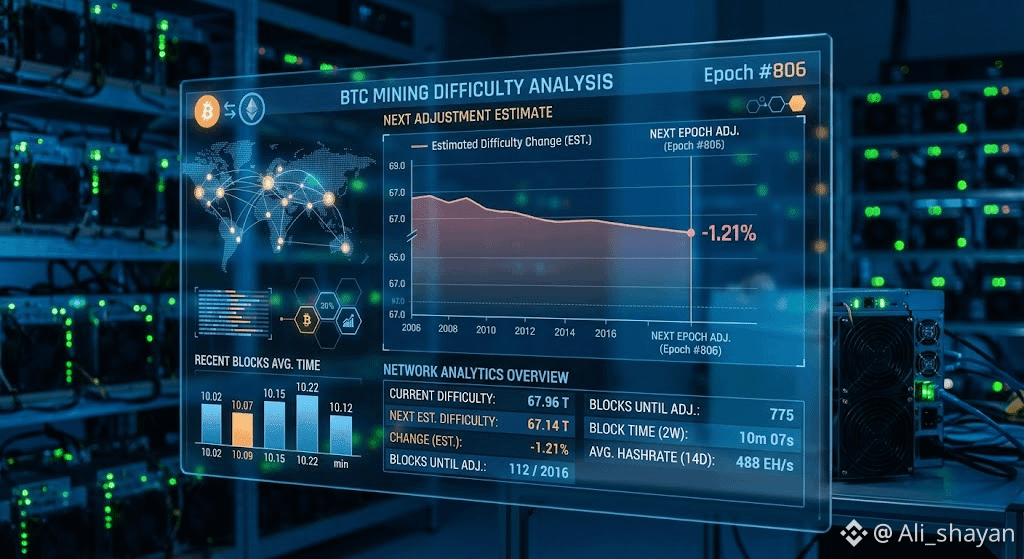
#bitcoinminingdifficultymayfall1.2% Bitcoin’s mining difficulty is on track for a modest 1.2% decline in its upcoming adjustment. This subtle dip comes as computing power briefly slowed down, pushing block times past the network's target 10-minute mark. To restore optimal speed, the protocol automatically lowers the mathematical barrier. It offers miners a brief window of improved operational efficiency and highlights Bitcoin's automated, self-balancing design at work.
CLICK BELOW TO TRADE :$BTC $SOL
{spot}(SOLUSDT)
{spot}(BTCUSDT)
#bitcoinminingdifficultymayfall1.2% Bitcoin’s mining difficulty is on track for a modest 1.2% decline in its upcoming adjustment. This subtle dip comes as computing power briefly slowed down, pushing block times past the network's target 10-minute mark. To restore optimal speed, the protocol automatically lowers the mathematical barrier. It offers miners a brief window of improved operational efficiency and highlights Bitcoin's automated, self-balancing design at work.
CLICK BELOW TO TRADE :$BTC $SOL
CLICK BELOW TO TRADE :$BTC $SOL
1
165

📉$BTC MINERS ARE FEELING THE PRESSURE AGAIN.
Early data shows Bitcoin mining difficulty is projected to fall by 1.2% in the upcoming adjustment.
Here is what is happening behind the scenes:
⚡ 1. Miner Migration: Many miners are switching hash power to AI and High-Performance Computing (HPC) workloads for better profit margins.
📉 2. Margin Squeeze: Lower hash rate means weaker miners are capitulating or pausing operations.
🟢 3. Historical Sign: Difficulty drops often clear out sell pressure, setting up local market bottoms.
Is this a bullish signal for a $BTC bounce, or are we going lower first? 👇
Drop your target price for $BTC below — Bullish or Bearish?
#BitcoinMiningDifficultyMayFall1.2% #BTC #bitcoin
📉$BTC MINERS ARE FEELING THE PRESSURE AGAIN.
Early data shows Bitcoin mining difficulty is projected to fall by 1.2% in the upcoming adjustment.
Here is what is happening behind the scenes:
⚡ 1. Miner Migration: Many miners are switching hash power to AI and High-Performance Computing (HPC) workloads for better profit margins.
📉 2. Margin Squeeze: Lower hash rate means weaker miners are capitulating or pausing operations.
🟢 3. Historical Sign: Difficulty drops often clear out sell pressure, setting up local market bottoms.
Is this a bullish signal for a $BTC bounce, or are we going lower first? 👇
Drop your target price for $BTC below — Bullish or Bearish?
#BitcoinMiningDifficultyMayFall1.2% #BTC #bitcoin
Early data shows Bitcoin mining difficulty is projected to fall by 1.2% in the upcoming adjustment.
Here is what is happening behind the scenes:
⚡ 1. Miner Migration: Many miners are switching hash power to AI and High-Performance Computing (HPC) workloads for better profit margins.
📉 2. Margin Squeeze: Lower hash rate means weaker miners are capitulating or pausing operations.
🟢 3. Historical Sign: Difficulty drops often clear out sell pressure, setting up local market bottoms.
Is this a bullish signal for a $BTC bounce, or are we going lower first? 👇
Drop your target price for $BTC below — Bullish or Bearish?
#BitcoinMiningDifficultyMayFall1.2% #BTC #bitcoin
1
1
89

·
--
#BitcoinMiningDifficultyMayFall1.2%
Bitcoin mining difficulty is projected to decline by around 1.2%, signaling a potential easing of network pressure after recent hash rate fluctuations. A lower difficulty adjustment can improve short-term profitability for miners, especially those operating with higher energy costs.
📊 Why it matters: • Mining becomes slightly easier for participants • Some miners may regain operational margins • Hash rate trends remain a key indicator of network health and miner confidence
Historically, difficulty declines often reflect changing mining economics rather than a weakening of Bitcoin itself. Many analysts are now watching whether hash power quickly rebounds or continues to consolidate ahead of the next major market move.
⚡ The big question: Will this difficulty drop encourage miners to accumulate more BTC, or will they continue selling to cover costs?
💬 Join the discussion: Is a 1.2% difficulty decline a bullish signal for Bitcoin, or just a temporary network adjustment?
#Bitcoin #BTC #Crypto #BitcoinMining #MiningDifficulty #HashRate #BinanceSquare #CryptoNewss #blockchain #MarketUpdate
#BitcoinMiningDifficultyMayFall1.2%
Bitcoin mining difficulty is projected to decline by around 1.2%, signaling a potential easing of network pressure after recent hash rate fluctuations. A lower difficulty adjustment can improve short-term profitability for miners, especially those operating with higher energy costs.
📊 Why it matters: • Mining becomes slightly easier for participants • Some miners may regain operational margins • Hash rate trends remain a key indicator of network health and miner confidence
Historically, difficulty declines often reflect changing mining economics rather than a weakening of Bitcoin itself. Many analysts are now watching whether hash power quickly rebounds or continues to consolidate ahead of the next major market move.
⚡ The big question: Will this difficulty drop encourage miners to accumulate more BTC, or will they continue selling to cover costs?
💬 Join the discussion: Is a 1.2% difficulty decline a bullish signal for Bitcoin, or just a temporary network adjustment?
#Bitcoin #BTC #Crypto #BitcoinMining #MiningDifficulty #HashRate #BinanceSquare #CryptoNewss #blockchain #MarketUpdate
Bitcoin mining difficulty is projected to decline by around 1.2%, signaling a potential easing of network pressure after recent hash rate fluctuations. A lower difficulty adjustment can improve short-term profitability for miners, especially those operating with higher energy costs.
📊 Why it matters: • Mining becomes slightly easier for participants • Some miners may regain operational margins • Hash rate trends remain a key indicator of network health and miner confidence
Historically, difficulty declines often reflect changing mining economics rather than a weakening of Bitcoin itself. Many analysts are now watching whether hash power quickly rebounds or continues to consolidate ahead of the next major market move.
⚡ The big question: Will this difficulty drop encourage miners to accumulate more BTC, or will they continue selling to cover costs?
💬 Join the discussion: Is a 1.2% difficulty decline a bullish signal for Bitcoin, or just a temporary network adjustment?
#Bitcoin #BTC #Crypto #BitcoinMining #MiningDifficulty #HashRate #BinanceSquare #CryptoNewss #blockchain #MarketUpdate

1
79

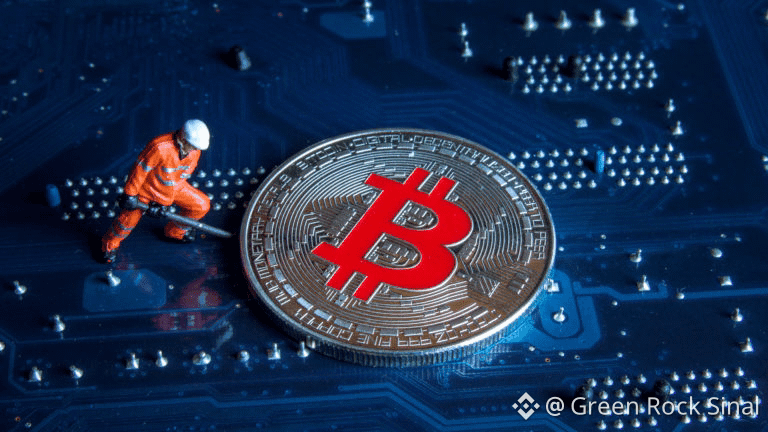
📊 #bitcoinminingdifficultymayfall1.2% | STAYING IN DIFFICULTY AND THE IMPACT ON THE MARKET
💥 Difficulty drops 1.2%, are miners breathing out or holding everything for AI? 🤖
🔍 WHAT DOES A 1.2% DROP MEAN?
• Less competition among miners
• Possible relief for those operating at the limit
• But the BTC price could react in unpredictable ways
📌 THE REAL CONTEXT:
Large mining companies were hit earlier this year by winter storms and are now “adjusting” their data centers to run AI workloads just to survive.
📊 WHAT SHOULD TRADERS DO?
Wait and see the bulls 🐂 and the bears 🐻 fight it out!
⚠️ This is not financial advice.
#BTC #Aİ
$BTC
📊 #bitcoinminingdifficultymayfall1.2% | STAYING IN DIFFICULTY AND THE IMPACT ON THE MARKET
💥 Difficulty drops 1.2%, are miners breathing out or holding everything for AI? 🤖
🔍 WHAT DOES A 1.2% DROP MEAN?
• Less competition among miners
• Possible relief for those operating at the limit
• But the BTC price could react in unpredictable ways
📌 THE REAL CONTEXT:
Large mining companies were hit earlier this year by winter storms and are now “adjusting” their data centers to run AI workloads just to survive.
📊 WHAT SHOULD TRADERS DO?
Wait and see the bulls 🐂 and the bears 🐻 fight it out!
⚠️ This is not financial advice.
#BTC #Aİ
$BTC
💥 Difficulty drops 1.2%, are miners breathing out or holding everything for AI? 🤖
🔍 WHAT DOES A 1.2% DROP MEAN?
• Less competition among miners
• Possible relief for those operating at the limit
• But the BTC price could react in unpredictable ways
📌 THE REAL CONTEXT:
Large mining companies were hit earlier this year by winter storms and are now “adjusting” their data centers to run AI workloads just to survive.
📊 WHAT SHOULD TRADERS DO?
Wait and see the bulls 🐂 and the bears 🐻 fight it out!
⚠️ This is not financial advice.
#BTC #Aİ
$BTC
1
257

·
--
🚨 #BitcoinMiningDifficultyMayFall1.2%
The pressure on miners could finally ease! A potential 1.2% drop in Bitcoin mining difficulty may improve mining efficiency and strengthen miner confidence. Historically, shifts in mining conditions often attract close attention from the market. Is this another sign that $BTC is preparing for its next big move? 👀📈
#Bitcoin #Write2Earn #KausarAyan
🚨 #BitcoinMiningDifficultyMayFall1.2%
The pressure on miners could finally ease! A potential 1.2% drop in Bitcoin mining difficulty may improve mining efficiency and strengthen miner confidence. Historically, shifts in mining conditions often attract close attention from the market. Is this another sign that $BTC is preparing for its next big move? 👀📈
#Bitcoin #Write2Earn #KausarAyan
The pressure on miners could finally ease! A potential 1.2% drop in Bitcoin mining difficulty may improve mining efficiency and strengthen miner confidence. Historically, shifts in mining conditions often attract close attention from the market. Is this another sign that $BTC is preparing for its next big move? 👀📈
#Bitcoin #Write2Earn #KausarAyan
58

·
--
Bullish
Partly True
Bitcoin mining difficulty drops 1.2%, restoring balance to the BTC network ⛏️₿
Recent data shows that Bitcoin mining difficulty may decrease by about 1.2% in the upcoming adjustment, reflecting natural changes in hash power and miners’ activity on the network.
This drop means miners will face slightly less competition when processing blocks, which may help some mining operations improve efficiency and profitability.
Despite the decline in difficulty, the Bitcoin network remains supported by one of the highest levels of security in the blockchain world, as the automatic adjustment mechanism calibrates the mining level to maintain network stability.
{future}(BTCUSDT)
#BitcoinMiningDifficultyMayFall1.2%
Bitcoin mining difficulty drops 1.2%, restoring balance to the BTC network ⛏️₿
Recent data shows that Bitcoin mining difficulty may decrease by about 1.2% in the upcoming adjustment, reflecting natural changes in hash power and miners’ activity on the network.
This drop means miners will face slightly less competition when processing blocks, which may help some mining operations improve efficiency and profitability.
Despite the decline in difficulty, the Bitcoin network remains supported by one of the highest levels of security in the blockchain world, as the automatic adjustment mechanism calibrates the mining level to maintain network stability.
#BitcoinMiningDifficultyMayFall1.2%
Recent data shows that Bitcoin mining difficulty may decrease by about 1.2% in the upcoming adjustment, reflecting natural changes in hash power and miners’ activity on the network.
This drop means miners will face slightly less competition when processing blocks, which may help some mining operations improve efficiency and profitability.
Despite the decline in difficulty, the Bitcoin network remains supported by one of the highest levels of security in the blockchain world, as the automatic adjustment mechanism calibrates the mining level to maintain network stability.
#BitcoinMiningDifficultyMayFall1.2%
1
551

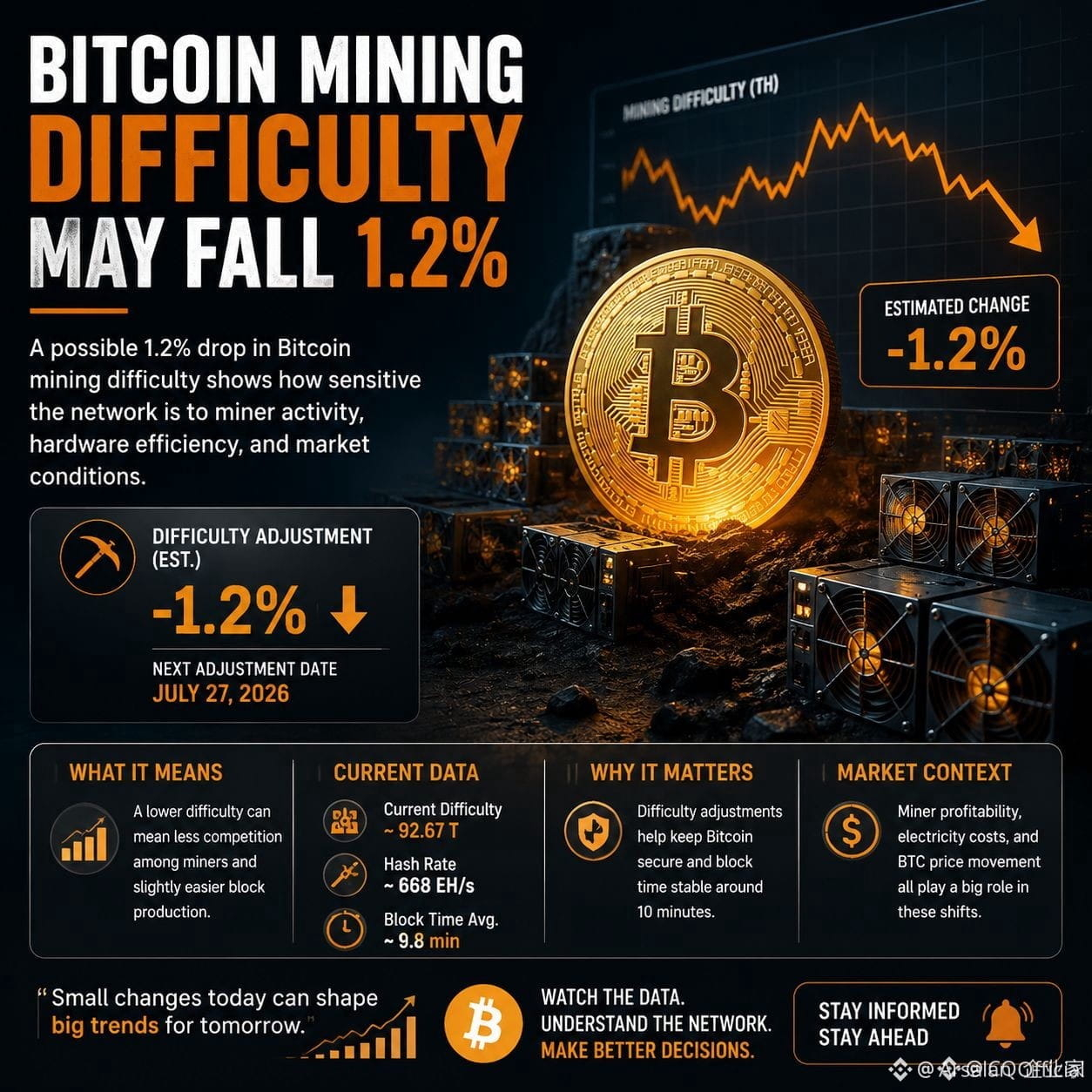
#BitcoinMiningDifficultyMayFall1.2% That means Bitcoin mining difficulty is expected to decrease by about 1.2% at the next adjustment.
In simple terms:
mining difficulty = how hard it is for miners to find a new Bitcoin block
if difficulty falls, mining becomes a bit easier
a 1.2% drop is relatively small, not a dramatic network shock
What usually causes that:
some miners may have gone offline
global hashrate may have dipped
margins may be tighter due to lower BTC price, higher energy costs, or weaker miner economics
What it means for the market:
for miners: slightly better economics for those still online
for the network: not a major concern by itself
for BTC price: usually neutral to mildly informative, not a strong standalone trading signal
How to interpret it:
small difficulty drop = normal network adjustment
large repeated drops = could suggest miner stress
rising difficulty over time = usually reflects stronger competition and network strength
So the headline is basically saying:
Bitcoin’s network is expected to get slightly easier to mine, likely because hashrate softened a bit.$BTC
{spot}(BTCUSDT)
#BitcoinMiningDifficultyMayFall1.2% That means Bitcoin mining difficulty is expected to decrease by about 1.2% at the next adjustment.
In simple terms:
mining difficulty = how hard it is for miners to find a new Bitcoin block
if difficulty falls, mining becomes a bit easier
a 1.2% drop is relatively small, not a dramatic network shock
What usually causes that:
some miners may have gone offline
global hashrate may have dipped
margins may be tighter due to lower BTC price, higher energy costs, or weaker miner economics
What it means for the market:
for miners: slightly better economics for those still online
for the network: not a major concern by itself
for BTC price: usually neutral to mildly informative, not a strong standalone trading signal
How to interpret it:
small difficulty drop = normal network adjustment
large repeated drops = could suggest miner stress
rising difficulty over time = usually reflects stronger competition and network strength
So the headline is basically saying:
Bitcoin’s network is expected to get slightly easier to mine, likely because hashrate softened a bit.$BTC
In simple terms:
mining difficulty = how hard it is for miners to find a new Bitcoin block
if difficulty falls, mining becomes a bit easier
a 1.2% drop is relatively small, not a dramatic network shock
What usually causes that:
some miners may have gone offline
global hashrate may have dipped
margins may be tighter due to lower BTC price, higher energy costs, or weaker miner economics
What it means for the market:
for miners: slightly better economics for those still online
for the network: not a major concern by itself
for BTC price: usually neutral to mildly informative, not a strong standalone trading signal
How to interpret it:
small difficulty drop = normal network adjustment
large repeated drops = could suggest miner stress
rising difficulty over time = usually reflects stronger competition and network strength
So the headline is basically saying:
Bitcoin’s network is expected to get slightly easier to mine, likely because hashrate softened a bit.$BTC
1
68

·
--
Bearish
♨️Bitcoin Mining Difficulty May Fall 1.2%♨️
Bitcoin’s next mining-difficulty adjustment is estimated to bring a decline of approximately 1.2%. A lower difficulty would make blocks slightly easier to
mine, potentially providing modest relief to miners dealing with high electricity costs and competitive operating conditions. #BitcoinMiningDifficultyMayFall1.2% #Bitcoinmining
{spot}(BTCUSDT)
♨️Bitcoin Mining Difficulty May Fall 1.2%♨️
Bitcoin’s next mining-difficulty adjustment is estimated to bring a decline of approximately 1.2%. A lower difficulty would make blocks slightly easier to
mine, potentially providing modest relief to miners dealing with high electricity costs and competitive operating conditions. #BitcoinMiningDifficultyMayFall1.2% #Bitcoinmining
Bitcoin’s next mining-difficulty adjustment is estimated to bring a decline of approximately 1.2%. A lower difficulty would make blocks slightly easier to
mine, potentially providing modest relief to miners dealing with high electricity costs and competitive operating conditions. #BitcoinMiningDifficultyMayFall1.2% #Bitcoinmining

72

·
--
Article
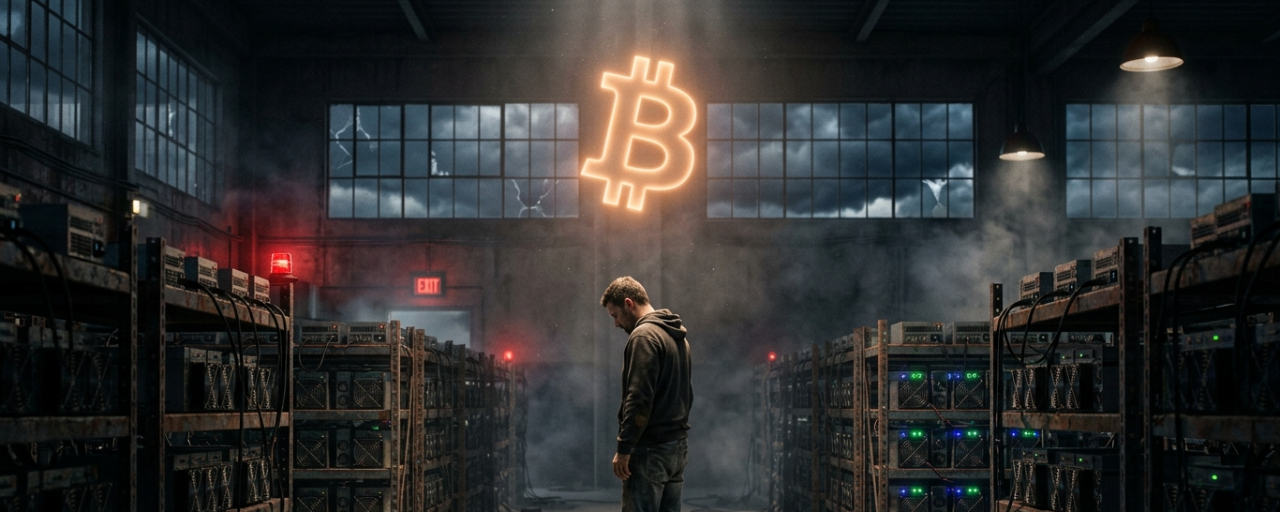
Bitcoin Mining Difficulty Eases — A Relief for Miners, Not Yet a Bullish Signal#BitcoinMiningDifficultyMayFall1.2%
Bitcoin's latest 1.2% mining difficulty adjustment offers a small reprieve for miners, but on its own, it does not signal the start of a new bull market. Instead, it reflects the network's built-in self-correcting mechanism as less profitable miners gradually exit.
📊 Why It Matters
Mining profitability has been under significant pressure. With $BTC trading near $65,000 while estimated all-in mining costs are around $87,000 (according to JPMorgan estimates), many miners continue operating under tight margins. Recent industry events, including Poolin's bankruptcy and Bitcoin Depot's liquidation, highlight the financial strain facing parts of the mining sector.
⚡ What the Difficulty Drop Signals
A decline in mining difficulty usually means some hashrate has left the network. As miners disconnect, Bitcoin automatically lowers mining difficulty to maintain its target block production time.
It's worth noting that the four largest mining pools—Foundry, AntPool, ViaBTC, and F2Pool—control more than 70% of the network's hashrate. If additional miners or major pools reduce operations, larger difficulty adjustments could follow.
👀 What Traders Should Watch
Bitcoin's 1-year realized volatility has fallen to around 42%, near multi-year lows. Historically, prolonged periods of compressed volatility have often been followed by significant price expansion, although the direction cannot be predicted from volatility alone.
🎯 Market Takeaway
A 1.2% difficulty decline is relatively modest and should be viewed as a sign of network adjustment rather than miner capitulation. If future reductions accelerate toward 5% or more, it could indicate broader stress across the mining industry. For now, the network appears to be moving toward a new equilibrium, making this a metric worth monitoring rather than a standalone trading signal.
{spot}(BTCUSDT)
{spot}(ETHUSDT)
{spot}(BNBUSDT)
Disclaimer: This content is for informational purposes only and should not be considered financial or investment advice.
Bitcoin Mining Difficulty Eases — A Relief for Miners, Not Yet a Bullish Signal
#BitcoinMiningDifficultyMayFall1.2%
Bitcoin's latest 1.2% mining difficulty adjustment offers a small reprieve for miners, but on its own, it does not signal the start of a new bull market. Instead, it reflects the network's built-in self-correcting mechanism as less profitable miners gradually exit.
📊 Why It Matters
Mining profitability has been under significant pressure. With $BTC trading near $65,000 while estimated all-in mining costs are around $87,000 (according to JPMorgan estimates), many miners continue operating under tight margins. Recent industry events, including Poolin's bankruptcy and Bitcoin Depot's liquidation, highlight the financial strain facing parts of the mining sector.
⚡ What the Difficulty Drop Signals
A decline in mining difficulty usually means some hashrate has left the network. As miners disconnect, Bitcoin automatically lowers mining difficulty to maintain its target block production time.
It's worth noting that the four largest mining pools—Foundry, AntPool, ViaBTC, and F2Pool—control more than 70% of the network's hashrate. If additional miners or major pools reduce operations, larger difficulty adjustments could follow.
👀 What Traders Should Watch
Bitcoin's 1-year realized volatility has fallen to around 42%, near multi-year lows. Historically, prolonged periods of compressed volatility have often been followed by significant price expansion, although the direction cannot be predicted from volatility alone.
🎯 Market Takeaway
A 1.2% difficulty decline is relatively modest and should be viewed as a sign of network adjustment rather than miner capitulation. If future reductions accelerate toward 5% or more, it could indicate broader stress across the mining industry. For now, the network appears to be moving toward a new equilibrium, making this a metric worth monitoring rather than a standalone trading signal.
Disclaimer: This content is for informational purposes only and should not be considered financial or investment advice.
Bitcoin's latest 1.2% mining difficulty adjustment offers a small reprieve for miners, but on its own, it does not signal the start of a new bull market. Instead, it reflects the network's built-in self-correcting mechanism as less profitable miners gradually exit.
📊 Why It Matters
Mining profitability has been under significant pressure. With $BTC trading near $65,000 while estimated all-in mining costs are around $87,000 (according to JPMorgan estimates), many miners continue operating under tight margins. Recent industry events, including Poolin's bankruptcy and Bitcoin Depot's liquidation, highlight the financial strain facing parts of the mining sector.
⚡ What the Difficulty Drop Signals
A decline in mining difficulty usually means some hashrate has left the network. As miners disconnect, Bitcoin automatically lowers mining difficulty to maintain its target block production time.
It's worth noting that the four largest mining pools—Foundry, AntPool, ViaBTC, and F2Pool—control more than 70% of the network's hashrate. If additional miners or major pools reduce operations, larger difficulty adjustments could follow.
👀 What Traders Should Watch
Bitcoin's 1-year realized volatility has fallen to around 42%, near multi-year lows. Historically, prolonged periods of compressed volatility have often been followed by significant price expansion, although the direction cannot be predicted from volatility alone.
🎯 Market Takeaway
A 1.2% difficulty decline is relatively modest and should be viewed as a sign of network adjustment rather than miner capitulation. If future reductions accelerate toward 5% or more, it could indicate broader stress across the mining industry. For now, the network appears to be moving toward a new equilibrium, making this a metric worth monitoring rather than a standalone trading signal.
Disclaimer: This content is for informational purposes only and should not be considered financial or investment advice.
60

Partly True
📊 #bitcoinminingdifficultymayfall1.2%
| What does the difficulty in mining mean in times of hardship?
Bitcoin mining difficulty has decreased since the Q4 2025 peak of 142 tera to around 127 tera today. It’s important to clarify what that means.
🔍 What’s happening?
➔ Difficulty decreases when mining devices go offline from the network.
Three consecutive downward adjustments— the first such streak since July 2022—while hashprice fell to about US$29 per terahash per day, pushing an estimated 15% to 20% of the network below the profitability threshold.
💡 THE UPSIDE FOR THOSE WHO KEEP MINING:
The non-obvious part is that for miners who continue operating, lower difficulty is positive.
The block reward is fixed; so when the hash rate leaves the network, the same reward is split among fewer devices.
➔ Revenue per unit of hash is recovered even if the price of Bitcoin stays unchanged.
📌 What do you think?
⚠️ Not financial advice.
Please follow up
$NVDA.US
{stock_us}(NVDA.US)
📊 #bitcoinminingdifficultymayfall1.2%
| What does the difficulty in mining mean in times of hardship?
Bitcoin mining difficulty has decreased since the Q4 2025 peak of 142 tera to around 127 tera today. It’s important to clarify what that means.
🔍 What’s happening?
➔ Difficulty decreases when mining devices go offline from the network.
Three consecutive downward adjustments— the first such streak since July 2022—while hashprice fell to about US$29 per terahash per day, pushing an estimated 15% to 20% of the network below the profitability threshold.
💡 THE UPSIDE FOR THOSE WHO KEEP MINING:
The non-obvious part is that for miners who continue operating, lower difficulty is positive.
The block reward is fixed; so when the hash rate leaves the network, the same reward is split among fewer devices.
➔ Revenue per unit of hash is recovered even if the price of Bitcoin stays unchanged.
📌 What do you think?
⚠️ Not financial advice.
Please follow up
$NVDA.US
| What does the difficulty in mining mean in times of hardship?
Bitcoin mining difficulty has decreased since the Q4 2025 peak of 142 tera to around 127 tera today. It’s important to clarify what that means.
🔍 What’s happening?
➔ Difficulty decreases when mining devices go offline from the network.
Three consecutive downward adjustments— the first such streak since July 2022—while hashprice fell to about US$29 per terahash per day, pushing an estimated 15% to 20% of the network below the profitability threshold.
💡 THE UPSIDE FOR THOSE WHO KEEP MINING:
The non-obvious part is that for miners who continue operating, lower difficulty is positive.
The block reward is fixed; so when the hash rate leaves the network, the same reward is split among fewer devices.
➔ Revenue per unit of hash is recovered even if the price of Bitcoin stays unchanged.
📌 What do you think?
⚠️ Not financial advice.
Please follow up
$NVDA.US


NVDAUS+0.34%
2
1.6k

#bitcoinminingdifficultymayfall1.2%
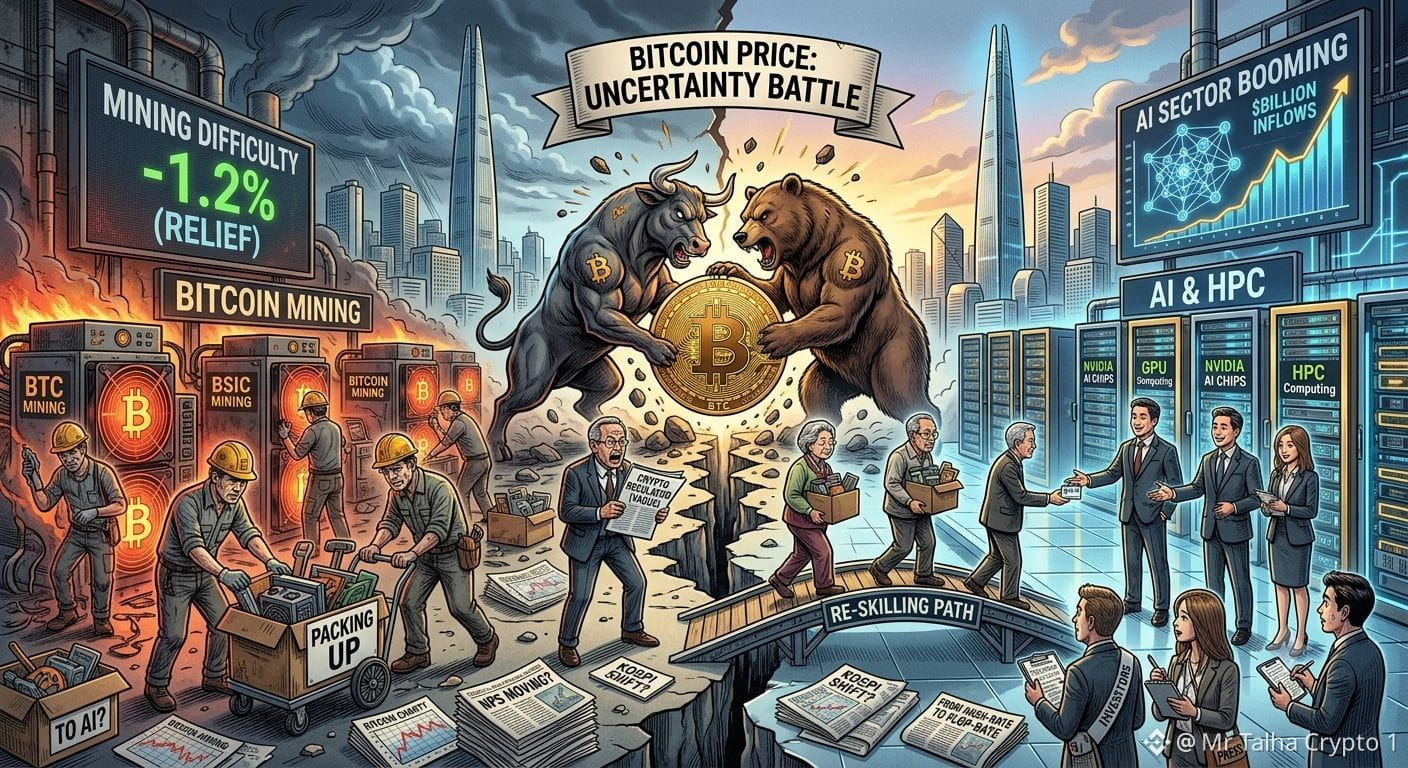
⛏️ Bitcoin Mining Difficulty Drops 1.2% — Relief for Miners or a Bigger Shift Ahead? 🤖⚡
Bitcoin's mining difficulty has eased by 1.2%, giving miners a little breathing room after months of intense competition. Lower difficulty can reduce the computing power needed to mine new blocks—but it doesn't guarantee bigger profits.
Meanwhile, the industry is evolving fast.
🏭 Several major mining companies are expanding beyond Bitcoin by converting parts of their data centers to power AI and high-performance computing (HPC) workloads, creating new revenue streams as mining economics become more challenging.
What should traders watch?
📉 Will miners sell more BTC to cover costs?
🤖 Can AI infrastructure become a major profit driver for mining firms?
⚡ Will lower mining difficulty improve network profitability if Bitcoin's price remains strong?
Trading takeaway:
✅ Watch Bitcoin price action alongside miner behavior.
✅ Monitor mining companies diversifying into AI.
✅ Stay patient—market trends matter more than short-term headlines.
💬 Do you think AI will become more profitable than Bitcoin mining for major mining companies, or is this just a temporary strategy?
#Bitcoin #BTC #Crypto #BitcoinMining
$BTC
$ETH
{spot}(ETHUSDT)
{spot}(BTCUSDT)
#bitcoinminingdifficultymayfall1.2%
⛏️ Bitcoin Mining Difficulty Drops 1.2% — Relief for Miners or a Bigger Shift Ahead? 🤖⚡
Bitcoin's mining difficulty has eased by 1.2%, giving miners a little breathing room after months of intense competition. Lower difficulty can reduce the computing power needed to mine new blocks—but it doesn't guarantee bigger profits.
Meanwhile, the industry is evolving fast.
🏭 Several major mining companies are expanding beyond Bitcoin by converting parts of their data centers to power AI and high-performance computing (HPC) workloads, creating new revenue streams as mining economics become more challenging.
What should traders watch?
📉 Will miners sell more BTC to cover costs?
🤖 Can AI infrastructure become a major profit driver for mining firms?
⚡ Will lower mining difficulty improve network profitability if Bitcoin's price remains strong?
Trading takeaway:
✅ Watch Bitcoin price action alongside miner behavior.
✅ Monitor mining companies diversifying into AI.
✅ Stay patient—market trends matter more than short-term headlines.
💬 Do you think AI will become more profitable than Bitcoin mining for major mining companies, or is this just a temporary strategy?
#Bitcoin #BTC #Crypto #BitcoinMining
$BTC
$ETH
⛏️ Bitcoin Mining Difficulty Drops 1.2% — Relief for Miners or a Bigger Shift Ahead? 🤖⚡
Bitcoin's mining difficulty has eased by 1.2%, giving miners a little breathing room after months of intense competition. Lower difficulty can reduce the computing power needed to mine new blocks—but it doesn't guarantee bigger profits.
Meanwhile, the industry is evolving fast.
🏭 Several major mining companies are expanding beyond Bitcoin by converting parts of their data centers to power AI and high-performance computing (HPC) workloads, creating new revenue streams as mining economics become more challenging.
What should traders watch?
📉 Will miners sell more BTC to cover costs?
🤖 Can AI infrastructure become a major profit driver for mining firms?
⚡ Will lower mining difficulty improve network profitability if Bitcoin's price remains strong?
Trading takeaway:
✅ Watch Bitcoin price action alongside miner behavior.
✅ Monitor mining companies diversifying into AI.
✅ Stay patient—market trends matter more than short-term headlines.
💬 Do you think AI will become more profitable than Bitcoin mining for major mining companies, or is this just a temporary strategy?
#Bitcoin #BTC #Crypto #BitcoinMining
$BTC
$ETH
1
119
·
--
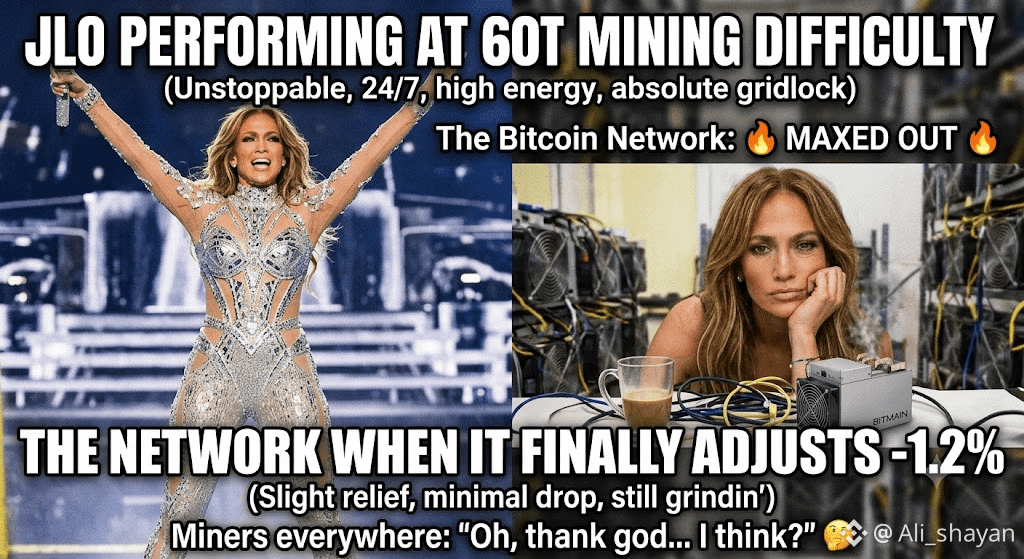
#bitcoinminingdifficultymayfall1.2% Bitcoin's built-in self-correction feature is gearing up for a minor downward adjustment of around 1.2%. When computing power across the network cools off slightly, block times can drag past the ideal ten-minute target. To keep transactions flowing smoothly, the protocol automatically recalibrates its math puzzle every 2,016 blocks. This upcoming dip gives miners a tiny bit of breathing room and offers a great real-time example of how Bitcoin stays balanced without any central authority pulling the levers.
CLICK BELOW TO TRADE : $BTC $ETH
{spot}(ETHUSDT)
{spot}(BTCUSDT)
#bitcoinminingdifficultymayfall1.2% Bitcoin's built-in self-correction feature is gearing up for a minor downward adjustment of around 1.2%. When computing power across the network cools off slightly, block times can drag past the ideal ten-minute target. To keep transactions flowing smoothly, the protocol automatically recalibrates its math puzzle every 2,016 blocks. This upcoming dip gives miners a tiny bit of breathing room and offers a great real-time example of how Bitcoin stays balanced without any central authority pulling the levers.
CLICK BELOW TO TRADE : $BTC $ETH
CLICK BELOW TO TRADE : $BTC $ETH
1
218
Log in to explore more content
Join global crypto users on Binance Square
⚡️ Get latest and useful information about crypto.
💬 Trusted by the world’s largest crypto exchange.
👍 Discover real insights from verified creators.
Email / Phone number
Trending Topics
1
#SECToClarifyOnChainFundraisingRules
0 views
0 Discussing
2
#UKFCAOpensCryptoFirmAuthorization
600 views
52 Discussing
3
#JapanMOFStudyGroupOnTokenizedGovtBonds
1,061 views
93 Discussing
4
#QNTRises287%
19,062 views
376 Discussing
5
#TrumpRejectsAIRulesForVoluntaryAudits
17,432 views
470 Discussing
6
#BitgetHotWalletBreachTiedToThirdPartySecurityFlaw
8,876 views
326 Discussing
7
#OpenAIUnveilsAlwaysOnAgentDots
8,416 views
348 Discussing
8
#ChainlinkLaunchesBankSWIFTLedgerFramework
8,852 views
269 Discussing
9
#EarningsSeason
522,547 views
3,759 Discussing
10
#ZcashApproves$1.5MBugBounty
101 views
3 Discussing