
#bitcoinholds
bitcoinholds
3,213 views
86 Discussing
Hot
Latest

·
--
If you're still treating Bitcoin as the only crypto exposed to macro shocks, stop now.
A disruption around the Strait of Hormuz can hit energy prices, risk appetite, and liquidity at once, which is exactly when traders FOMO into the first green candle or panic-sell strong positions. With greed already elevated, bad entries get expensive fast.
The bearish case is obvious: higher oil and geopolitical risk could pressure equities and drag $BTC lower with the broader risk market. But I lean toward volatility before direction, not an automatic crypto collapse. Bitcoin's ability to hold key levels during external shocks is becoming part of the narrative, while stablecoin demand through $USDT could rise as traders wait for clarity.
The bigger question is whether this becomes a short-lived headline trade or a sustained inflation concern that forces markets to reprice. $ONDO and other higher-beta tokens may move harder than Bitcoin in either direction.
Is this a risk-off trigger for crypto, or another moment where $BTC proves it can hold through macro chaos? #TankerHitsMinesInStraitOfHormuz #BitcoinHolds #BitcoinUp23
If you're still treating Bitcoin as the only crypto exposed to macro shocks, stop now.
A disruption around the Strait of Hormuz can hit energy prices, risk appetite, and liquidity at once, which is exactly when traders FOMO into the first green candle or panic-sell strong positions. With greed already elevated, bad entries get expensive fast.
The bearish case is obvious: higher oil and geopolitical risk could pressure equities and drag $BTC lower with the broader risk market. But I lean toward volatility before direction, not an automatic crypto collapse. Bitcoin's ability to hold key levels during external shocks is becoming part of the narrative, while stablecoin demand through $USDT could rise as traders wait for clarity.
The bigger question is whether this becomes a short-lived headline trade or a sustained inflation concern that forces markets to reprice. $ONDO and other higher-beta tokens may move harder than Bitcoin in either direction.
Is this a risk-off trigger for crypto, or another moment where $BTC proves it can hold through macro chaos? #TankerHitsMinesInStraitOfHormuz #BitcoinHolds #BitcoinUp23
A disruption around the Strait of Hormuz can hit energy prices, risk appetite, and liquidity at once, which is exactly when traders FOMO into the first green candle or panic-sell strong positions. With greed already elevated, bad entries get expensive fast.
The bearish case is obvious: higher oil and geopolitical risk could pressure equities and drag $BTC lower with the broader risk market. But I lean toward volatility before direction, not an automatic crypto collapse. Bitcoin's ability to hold key levels during external shocks is becoming part of the narrative, while stablecoin demand through $USDT could rise as traders wait for clarity.
The bigger question is whether this becomes a short-lived headline trade or a sustained inflation concern that forces markets to reprice. $ONDO and other higher-beta tokens may move harder than Bitcoin in either direction.
Is this a risk-off trigger for crypto, or another moment where $BTC proves it can hold through macro chaos? #TankerHitsMinesInStraitOfHormuz #BitcoinHolds #BitcoinUp23
98

If you're treating LNG tankers staying out of Hormuz as a headline to fade, stop now.
The costly mistake is chasing $BTC on the first spike, then discovering that a prolonged energy shock can drain liquidity and trigger forced exits. Traders who buy the fear narrative late may also end up trapped when shipping routes normalize.
The bullish case is clear: geopolitical tension can push investors toward scarce assets, and $BTC holding firm while traditional markets wobble would strengthen that argument. But with Fear & Greed at 75, the market is already leaning optimistic.
My view is cautious. A sustained Hormuz disruption would likely pressure inflation, rates, and risk appetite before it becomes a clean crypto bullish catalyst. Watch $USDT flows and whether Bitcoin can hold support without relying on another burst of leverage.
Do you see this as a bullish safe-haven setup for Bitcoin, or the start of a broader risk-off move?
#LNGTankersStayOutOfHormuz #BitcoinHolds #BitcoinUp23
If you're treating LNG tankers staying out of Hormuz as a headline to fade, stop now.
The costly mistake is chasing $BTC on the first spike, then discovering that a prolonged energy shock can drain liquidity and trigger forced exits. Traders who buy the fear narrative late may also end up trapped when shipping routes normalize.
The bullish case is clear: geopolitical tension can push investors toward scarce assets, and $BTC holding firm while traditional markets wobble would strengthen that argument. But with Fear & Greed at 75, the market is already leaning optimistic.
My view is cautious. A sustained Hormuz disruption would likely pressure inflation, rates, and risk appetite before it becomes a clean crypto bullish catalyst. Watch $USDT flows and whether Bitcoin can hold support without relying on another burst of leverage.
Do you see this as a bullish safe-haven setup for Bitcoin, or the start of a broader risk-off move?
#LNGTankersStayOutOfHormuz #BitcoinHolds #BitcoinUp23
The costly mistake is chasing $BTC on the first spike, then discovering that a prolonged energy shock can drain liquidity and trigger forced exits. Traders who buy the fear narrative late may also end up trapped when shipping routes normalize.
The bullish case is clear: geopolitical tension can push investors toward scarce assets, and $BTC holding firm while traditional markets wobble would strengthen that argument. But with Fear & Greed at 75, the market is already leaning optimistic.
My view is cautious. A sustained Hormuz disruption would likely pressure inflation, rates, and risk appetite before it becomes a clean crypto bullish catalyst. Watch $USDT flows and whether Bitcoin can hold support without relying on another burst of leverage.
Do you see this as a bullish safe-haven setup for Bitcoin, or the start of a broader risk-off move?
#LNGTankersStayOutOfHormuz #BitcoinHolds #BitcoinUp23

37

·
--
If you’re still treating every Saylor hint as an automatic buy signal, stop now.
The expensive mistake is confusing a company’s long-term treasury strategy with your own risk tolerance. Strategy can sit through brutal drawdowns, while FOMO buyers often panic-sell $BTC after one ugly candle.
Saylor’s latest signals feel familiar because Strategy has repeatedly used weakness to build its Bitcoin position, turning volatility into accumulation. But the market is different now: spot demand, macro liquidity, and competing corporate treasury plays all influence price instead of one loud buyer dominating the narrative.
With Fear & Greed at 75, the crowd is already leaning greedy. That makes the comparison with past Bitcoin rallies uncomfortable: strong conviction can fuel upside, but crowded conviction can also create the exit liquidity nobody wants to discuss. Even traders rotating through $USDT or watching $ONDO are asking the same question: is this accumulation, or just narrative chasing?
Is Saylor’s approach still the smartest Bitcoin treasury strategy, or are investors overestimating how much one buyer can move this market? #SaylorHintsStrategyBitcoinBuy #BitcoinHolds #BitcoinUp23
If you’re still treating every Saylor hint as an automatic buy signal, stop now.
The expensive mistake is confusing a company’s long-term treasury strategy with your own risk tolerance. Strategy can sit through brutal drawdowns, while FOMO buyers often panic-sell $BTC after one ugly candle.
Saylor’s latest signals feel familiar because Strategy has repeatedly used weakness to build its Bitcoin position, turning volatility into accumulation. But the market is different now: spot demand, macro liquidity, and competing corporate treasury plays all influence price instead of one loud buyer dominating the narrative.
With Fear & Greed at 75, the crowd is already leaning greedy. That makes the comparison with past Bitcoin rallies uncomfortable: strong conviction can fuel upside, but crowded conviction can also create the exit liquidity nobody wants to discuss. Even traders rotating through $USDT or watching $ONDO are asking the same question: is this accumulation, or just narrative chasing?
Is Saylor’s approach still the smartest Bitcoin treasury strategy, or are investors overestimating how much one buyer can move this market? #SaylorHintsStrategyBitcoinBuy #BitcoinHolds #BitcoinUp23
The expensive mistake is confusing a company’s long-term treasury strategy with your own risk tolerance. Strategy can sit through brutal drawdowns, while FOMO buyers often panic-sell $BTC after one ugly candle.
Saylor’s latest signals feel familiar because Strategy has repeatedly used weakness to build its Bitcoin position, turning volatility into accumulation. But the market is different now: spot demand, macro liquidity, and competing corporate treasury plays all influence price instead of one loud buyer dominating the narrative.
With Fear & Greed at 75, the crowd is already leaning greedy. That makes the comparison with past Bitcoin rallies uncomfortable: strong conviction can fuel upside, but crowded conviction can also create the exit liquidity nobody wants to discuss. Even traders rotating through $USDT or watching $ONDO are asking the same question: is this accumulation, or just narrative chasing?
Is Saylor’s approach still the smartest Bitcoin treasury strategy, or are investors overestimating how much one buyer can move this market? #SaylorHintsStrategyBitcoinBuy #BitcoinHolds #BitcoinUp23
2
104

Most retail traders still believe Michael Saylor buys the dip, yet his largest corporate accumulations have historically happened right into local strength.
Every cycle, I watch people sit on cash waiting for the mythical bottom, only to panic buy the exact moment a headline confirms an institutional buy. That hesitation costs more capital than any drawdown ever will, leaving you holding bags when the market takes a breather.
When institutional treasuries acquire $BTC, they are not trading candle wicks or looking for a quick flip into $USDT. They operate on debt-financed balance sheet strategies designed for multi-decade horizons. If you are tracking their moves, looking at daily price action completely misses the point.
Back in 2020 and 2021, the same playbook played out where every corporate announcement sparked frantic retail chasing, while the real game was simply accumulating core positions or real-world asset infrastructure like $ONDO before liquidity fully rotated. The hardest lesson the market teaches us is that copy-trading balance sheet titans on short timeframes will only drain your conviction.
How are you positioning your own accumulation strategy while institutions keep stacking?
#SaylorHintsStrategyBitcoinBuy #BitcoinHolds
Most retail traders still believe Michael Saylor buys the dip, yet his largest corporate accumulations have historically happened right into local strength.
Every cycle, I watch people sit on cash waiting for the mythical bottom, only to panic buy the exact moment a headline confirms an institutional buy. That hesitation costs more capital than any drawdown ever will, leaving you holding bags when the market takes a breather.
When institutional treasuries acquire $BTC , they are not trading candle wicks or looking for a quick flip into $USDT. They operate on debt-financed balance sheet strategies designed for multi-decade horizons. If you are tracking their moves, looking at daily price action completely misses the point.
Back in 2020 and 2021, the same playbook played out where every corporate announcement sparked frantic retail chasing, while the real game was simply accumulating core positions or real-world asset infrastructure like $ONDO before liquidity fully rotated. The hardest lesson the market teaches us is that copy-trading balance sheet titans on short timeframes will only drain your conviction.
How are you positioning your own accumulation strategy while institutions keep stacking?
#SaylorHintsStrategyBitcoinBuy #BitcoinHolds
Every cycle, I watch people sit on cash waiting for the mythical bottom, only to panic buy the exact moment a headline confirms an institutional buy. That hesitation costs more capital than any drawdown ever will, leaving you holding bags when the market takes a breather.
When institutional treasuries acquire $BTC , they are not trading candle wicks or looking for a quick flip into $USDT. They operate on debt-financed balance sheet strategies designed for multi-decade horizons. If you are tracking their moves, looking at daily price action completely misses the point.
Back in 2020 and 2021, the same playbook played out where every corporate announcement sparked frantic retail chasing, while the real game was simply accumulating core positions or real-world asset infrastructure like $ONDO before liquidity fully rotated. The hardest lesson the market teaches us is that copy-trading balance sheet titans on short timeframes will only drain your conviction.
How are you positioning your own accumulation strategy while institutions keep stacking?
#SaylorHintsStrategyBitcoinBuy #BitcoinHolds
68
Have you noticed how retail traders always rush into high-risk alts the moment market sentiment turns greedy, while institutions quietly execute the exact opposite playbook?
Most investors keep losing capital because they chase short-term pumps on volatile assets like $ICP or $ONDO, constantly stressing over local tops instead of building high-conviction positions with a clear exit timeframe.
MicroStrategy’s relentless accumulation strategy serves as the ultimate case study in institutional conviction versus retail impatience. While the crowd gets distracted by daily volatility and debates short-term pullbacks, Michael Saylor continues to turn corporate debt into hard collateral by steadily absorbing spot supply. This is not about timing local price action; it is a structural supply squeeze designed to outperform fiat debasement over multi-year cycles.
When corporate balance sheets consistently treat $BTC as primary reserve capital, every dip below key resistance levels becomes an institutional accumulation zone rather than a distribution phase. Retail tries to outsmart the market with leverage, but balance sheet mechanics win every time.
Are institutional balance sheets effectively setting the new macro floor for this cycle, or will macro liquidity shocks eventually test their leverage?
#SaylorHintsStrategyBitcoinBuy #BitcoinHolds
Have you noticed how retail traders always rush into high-risk alts the moment market sentiment turns greedy, while institutions quietly execute the exact opposite playbook?
Most investors keep losing capital because they chase short-term pumps on volatile assets like $ICP or $ONDO , constantly stressing over local tops instead of building high-conviction positions with a clear exit timeframe.
MicroStrategy’s relentless accumulation strategy serves as the ultimate case study in institutional conviction versus retail impatience. While the crowd gets distracted by daily volatility and debates short-term pullbacks, Michael Saylor continues to turn corporate debt into hard collateral by steadily absorbing spot supply. This is not about timing local price action; it is a structural supply squeeze designed to outperform fiat debasement over multi-year cycles.
When corporate balance sheets consistently treat $BTC as primary reserve capital, every dip below key resistance levels becomes an institutional accumulation zone rather than a distribution phase. Retail tries to outsmart the market with leverage, but balance sheet mechanics win every time.
Are institutional balance sheets effectively setting the new macro floor for this cycle, or will macro liquidity shocks eventually test their leverage?
#SaylorHintsStrategyBitcoinBuy #BitcoinHolds
Most investors keep losing capital because they chase short-term pumps on volatile assets like $ICP or $ONDO , constantly stressing over local tops instead of building high-conviction positions with a clear exit timeframe.
MicroStrategy’s relentless accumulation strategy serves as the ultimate case study in institutional conviction versus retail impatience. While the crowd gets distracted by daily volatility and debates short-term pullbacks, Michael Saylor continues to turn corporate debt into hard collateral by steadily absorbing spot supply. This is not about timing local price action; it is a structural supply squeeze designed to outperform fiat debasement over multi-year cycles.
When corporate balance sheets consistently treat $BTC as primary reserve capital, every dip below key resistance levels becomes an institutional accumulation zone rather than a distribution phase. Retail tries to outsmart the market with leverage, but balance sheet mechanics win every time.
Are institutional balance sheets effectively setting the new macro floor for this cycle, or will macro liquidity shocks eventually test their leverage?
#SaylorHintsStrategyBitcoinBuy #BitcoinHolds

164

·
--
Everyone thinks that when the market stays flat during high greed, it is safe to accumulate blindly, but actually, these quiet consolidation phases often trap more capital than sudden crashes. Watching your portfolio bleed out slowly while waiting for an explosive breakout can tempt you into chasing high-beta pumps like $CATI or rotating prematurely into tokens like $ONDO, only to get caught on the wrong side of liquidity.
Think of market consolidation like a crowded elevator holding its breath. When sentiment sits firmly in greed while $BTC holds its ground, the market is simply transferring risk from impatient retail participants to structured liquidity providers.
Three quiet traps usually unfold during these ranges. First, traders mistake a tight trading range for absolute safety and over-leverage their positions right before volatility spikes. Second, capital rapidly rotates into trending speculative assets in search of quick returns, leaving standard spot bags vulnerable when macro shifts hit. Third, most market participants forget that patience is a full position in itself, leading to unnecessary overtrading during low-conviction chop.
Where do you think liquidity moves next if this range continues to hold?
#BitcoinHolds #BitcoinUp23 #SaylorHintsStrategyBitcoinBuy
Everyone thinks that when the market stays flat during high greed, it is safe to accumulate blindly, but actually, these quiet consolidation phases often trap more capital than sudden crashes. Watching your portfolio bleed out slowly while waiting for an explosive breakout can tempt you into chasing high-beta pumps like $CATI or rotating prematurely into tokens like $ONDO , only to get caught on the wrong side of liquidity.
Think of market consolidation like a crowded elevator holding its breath. When sentiment sits firmly in greed while $BTC holds its ground, the market is simply transferring risk from impatient retail participants to structured liquidity providers.
Three quiet traps usually unfold during these ranges. First, traders mistake a tight trading range for absolute safety and over-leverage their positions right before volatility spikes. Second, capital rapidly rotates into trending speculative assets in search of quick returns, leaving standard spot bags vulnerable when macro shifts hit. Third, most market participants forget that patience is a full position in itself, leading to unnecessary overtrading during low-conviction chop.
Where do you think liquidity moves next if this range continues to hold?
#BitcoinHolds #BitcoinUp23 #SaylorHintsStrategyBitcoinBuy
Think of market consolidation like a crowded elevator holding its breath. When sentiment sits firmly in greed while $BTC holds its ground, the market is simply transferring risk from impatient retail participants to structured liquidity providers.
Three quiet traps usually unfold during these ranges. First, traders mistake a tight trading range for absolute safety and over-leverage their positions right before volatility spikes. Second, capital rapidly rotates into trending speculative assets in search of quick returns, leaving standard spot bags vulnerable when macro shifts hit. Third, most market participants forget that patience is a full position in itself, leading to unnecessary overtrading during low-conviction chop.
Where do you think liquidity moves next if this range continues to hold?
#BitcoinHolds #BitcoinUp23 #SaylorHintsStrategyBitcoinBuy

120
Picture this: Bitcoin drops hard, everyone predicts the cycle is over, and then $BTC quietly holds the level that mattered most.
That is where many traders get trapped. They either panic-sell the support or FOMO back in after the recovery, turning a manageable drawdown into a permanent loss.
The current Bitcoin hold is less about one green candle and more about market structure. In past corrections, like the 2021 mid-cycle pullback and the 2022 liquidity unwind, failed support often triggered weeks of forced selling. This time, buyers are defending the range while Fear & Greed sits at 75, which shows confidence is strong but also raises the risk of late entries.
The comparison with $ETH is useful. Ethereum often needs broader altcoin momentum to sustain a breakout, while Bitcoin can attract defensive capital when traders are uncertain. Even searches around $USDT tell the same story: liquidity and optionality still matter when the market is greedy.
The lesson is simple: a hold is confirmation, not a guarantee. The next test is whether Bitcoin can build above resistance without relying on leverage and FOMO. Where do you think $BTC goes from here?
#BitcoinHolds #BitcoinUp23 #SaylorHintsStrategyBitcoinBuy
Picture this: Bitcoin drops hard, everyone predicts the cycle is over, and then $BTC quietly holds the level that mattered most.
That is where many traders get trapped. They either panic-sell the support or FOMO back in after the recovery, turning a manageable drawdown into a permanent loss.
The current Bitcoin hold is less about one green candle and more about market structure. In past corrections, like the 2021 mid-cycle pullback and the 2022 liquidity unwind, failed support often triggered weeks of forced selling. This time, buyers are defending the range while Fear & Greed sits at 75, which shows confidence is strong but also raises the risk of late entries.
The comparison with $ETH is useful. Ethereum often needs broader altcoin momentum to sustain a breakout, while Bitcoin can attract defensive capital when traders are uncertain. Even searches around $USDT tell the same story: liquidity and optionality still matter when the market is greedy.
The lesson is simple: a hold is confirmation, not a guarantee. The next test is whether Bitcoin can build above resistance without relying on leverage and FOMO. Where do you think $BTC goes from here?
#BitcoinHolds #BitcoinUp23 #SaylorHintsStrategyBitcoinBuy
That is where many traders get trapped. They either panic-sell the support or FOMO back in after the recovery, turning a manageable drawdown into a permanent loss.
The current Bitcoin hold is less about one green candle and more about market structure. In past corrections, like the 2021 mid-cycle pullback and the 2022 liquidity unwind, failed support often triggered weeks of forced selling. This time, buyers are defending the range while Fear & Greed sits at 75, which shows confidence is strong but also raises the risk of late entries.
The comparison with $ETH is useful. Ethereum often needs broader altcoin momentum to sustain a breakout, while Bitcoin can attract defensive capital when traders are uncertain. Even searches around $USDT tell the same story: liquidity and optionality still matter when the market is greedy.
The lesson is simple: a hold is confirmation, not a guarantee. The next test is whether Bitcoin can build above resistance without relying on leverage and FOMO. Where do you think $BTC goes from here?
#BitcoinHolds #BitcoinUp23 #SaylorHintsStrategyBitcoinBuy

24
·
--
One of Bitcoin's most dangerous moments is not a crash, but a stubborn hold while the Fear & Greed Index reads 75.
That is where FOMO quietly takes over. Traders see every dip getting bought, move their stops farther away, and enter after the easy opportunity has already passed, only to panic when a normal pullback arrives.
The lesson from previous cycles is simple: “holding” is a condition to verify, not a signal to blindly buy. A healthy hold usually means BTC stays above a reclaimed resistance level, selling volume fades, spot demand remains present, and the next dip forms a higher low. If price is holding only because leverage is stacked on one side, the first move below support can trigger liquidations and turn confidence into fear quickly.
I also watch what happens beneath Bitcoin. Expanding $USDT liquidity and steady rotation into names like $ONDO can support a broader risk-on move. But if traders chase $NEIRO while BTC barely advances, the market may be distributing excitement rather than building strength. After enough painful cycles, my rule is simple: define invalidation before entering, scale in instead of chasing, and decide where to take profit while you still feel calm.
Is Bitcoin holding because real demand is strengthening, or because traders are simply afraid to sell?
#BitcoinHolds #BitcoinUp23 #SaylorHintsStrategyBitcoinBuy
One of Bitcoin's most dangerous moments is not a crash, but a stubborn hold while the Fear & Greed Index reads 75.
That is where FOMO quietly takes over. Traders see every dip getting bought, move their stops farther away, and enter after the easy opportunity has already passed, only to panic when a normal pullback arrives.
The lesson from previous cycles is simple: “holding” is a condition to verify, not a signal to blindly buy. A healthy hold usually means BTC stays above a reclaimed resistance level, selling volume fades, spot demand remains present, and the next dip forms a higher low. If price is holding only because leverage is stacked on one side, the first move below support can trigger liquidations and turn confidence into fear quickly.
I also watch what happens beneath Bitcoin. Expanding $USDT liquidity and steady rotation into names like $ONDO can support a broader risk-on move. But if traders chase $NEIRO while BTC barely advances, the market may be distributing excitement rather than building strength. After enough painful cycles, my rule is simple: define invalidation before entering, scale in instead of chasing, and decide where to take profit while you still feel calm.
Is Bitcoin holding because real demand is strengthening, or because traders are simply afraid to sell?
#BitcoinHolds #BitcoinUp23 #SaylorHintsStrategyBitcoinBuy
That is where FOMO quietly takes over. Traders see every dip getting bought, move their stops farther away, and enter after the easy opportunity has already passed, only to panic when a normal pullback arrives.
The lesson from previous cycles is simple: “holding” is a condition to verify, not a signal to blindly buy. A healthy hold usually means BTC stays above a reclaimed resistance level, selling volume fades, spot demand remains present, and the next dip forms a higher low. If price is holding only because leverage is stacked on one side, the first move below support can trigger liquidations and turn confidence into fear quickly.
I also watch what happens beneath Bitcoin. Expanding $USDT liquidity and steady rotation into names like $ONDO can support a broader risk-on move. But if traders chase $NEIRO while BTC barely advances, the market may be distributing excitement rather than building strength. After enough painful cycles, my rule is simple: define invalidation before entering, scale in instead of chasing, and decide where to take profit while you still feel calm.
Is Bitcoin holding because real demand is strengthening, or because traders are simply afraid to sell?
#BitcoinHolds #BitcoinUp23 #SaylorHintsStrategyBitcoinBuy

336
If you're still chasing every green Bitcoin candle after it has already moved, stop now.
That mistake has bled traders for years. In greedy conditions, people confuse confirmation with entry and end up buying the local top while the market is still deciding whether to extend or breathe.
This is the part most people forget from the last big runs. Bitcoin usually leads first, then everyone rushes to rotate into $ETH, $ONDO, or whatever the loudest narrative is that week. Sometimes that works. A lot of the time, it just turns into a very expensive lesson in timing.
What makes this stretch interesting is how much it feels like the old playbook with a new coat of paint. The crowd sees a strong $BTC move, searches spike, and suddenly every dip looks like a gift. But when greed is already running hot, the better question is not whether Bitcoin can keep grinding. It is whether you are buying strength or just paying up for someone else’s exit.
I still think the smarter trade is usually the one that leaves you room to be wrong. Chasing $BTC after a breakout can work, but so can waiting for the market to prove it deserves your size instead of your hope. Where are you leaning here, into $BTC strength or waiting for the next rotation into alts? #BitcoinUp23 #BitcoinHolds #SaylorHintsStrategyBitcoinBuy
If you're still chasing every green Bitcoin candle after it has already moved, stop now.
That mistake has bled traders for years. In greedy conditions, people confuse confirmation with entry and end up buying the local top while the market is still deciding whether to extend or breathe.
This is the part most people forget from the last big runs. Bitcoin usually leads first, then everyone rushes to rotate into $ETH , $ONDO , or whatever the loudest narrative is that week. Sometimes that works. A lot of the time, it just turns into a very expensive lesson in timing.
What makes this stretch interesting is how much it feels like the old playbook with a new coat of paint. The crowd sees a strong $BTC move, searches spike, and suddenly every dip looks like a gift. But when greed is already running hot, the better question is not whether Bitcoin can keep grinding. It is whether you are buying strength or just paying up for someone else’s exit.
I still think the smarter trade is usually the one that leaves you room to be wrong. Chasing $BTC after a breakout can work, but so can waiting for the market to prove it deserves your size instead of your hope. Where are you leaning here, into $BTC strength or waiting for the next rotation into alts? #BitcoinUp23 #BitcoinHolds #SaylorHintsStrategyBitcoinBuy
That mistake has bled traders for years. In greedy conditions, people confuse confirmation with entry and end up buying the local top while the market is still deciding whether to extend or breathe.
This is the part most people forget from the last big runs. Bitcoin usually leads first, then everyone rushes to rotate into $ETH , $ONDO , or whatever the loudest narrative is that week. Sometimes that works. A lot of the time, it just turns into a very expensive lesson in timing.
What makes this stretch interesting is how much it feels like the old playbook with a new coat of paint. The crowd sees a strong $BTC move, searches spike, and suddenly every dip looks like a gift. But when greed is already running hot, the better question is not whether Bitcoin can keep grinding. It is whether you are buying strength or just paying up for someone else’s exit.
I still think the smarter trade is usually the one that leaves you room to be wrong. Chasing $BTC after a breakout can work, but so can waiting for the market to prove it deserves your size instead of your hope. Where are you leaning here, into $BTC strength or waiting for the next rotation into alts? #BitcoinUp23 #BitcoinHolds #SaylorHintsStrategyBitcoinBuy

53

·
--
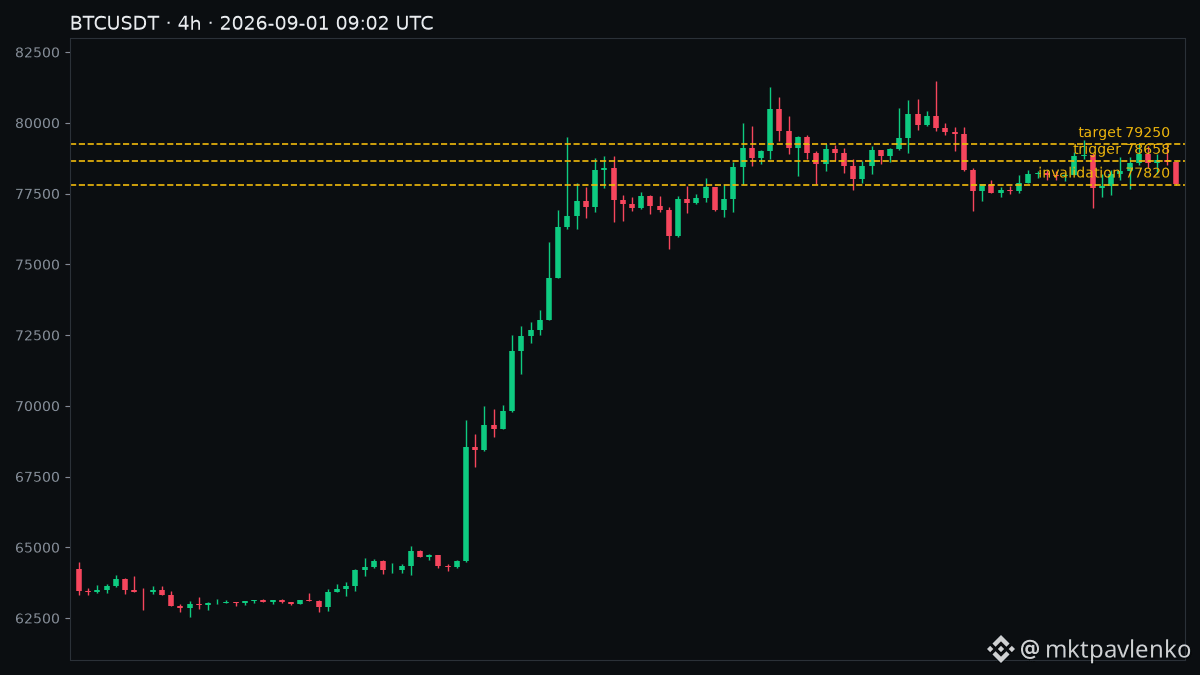
$BTC dip-buying is not the signal here; acceptance is. Price is near $77,900 after a 24h range of $77,675 to $79,250, and the latest 4h candle has already traded from $78,632 down to $77,820. The contrarian tell is simple: a green bounce that cannot reclaim the broken 4h high at $78,658 is still just range noise. I enter only on a 4h close above $78,658, invalidate below $77,820, and set $79,250 as the target during the next US session; the rule is reclaim first, risk second. #BitcoinUp23%InAugustOutperformingGoldAndStocks #BitcoinHolds$78K
$BTC dip-buying is not the signal here; acceptance is. Price is near $77,900 after a 24h range of $77,675 to $79,250, and the latest 4h candle has already traded from $78,632 down to $77,820. The contrarian tell is simple: a green bounce that cannot reclaim the broken 4h high at $78,658 is still just range noise. I enter only on a 4h close above $78,658, invalidate below $77,820, and set $79,250 as the target during the next US session; the rule is reclaim first, risk second. #BitcoinUp23%InAugustOutperformingGoldAndStocks #BitcoinHolds$78K
54
·
--
Everyone thinks holding through high volatility is just about patience, but actually blind holding without managing risk is how most portfolios get drained.
Watching the market fluctuate while the greed meter climbs leaves many traders trapped in disbelief, freezing up instead of taking profits and eventually panic selling at the absolute bottom.
Think of holding like driving on an icy highway. When $BTC consolidates and the structure holds, it feels safe to accelerate, but ignoring macro warning signs is like speeding with worn-out tires. You might see liquidity rotate into assets like $ICP or real-world asset plays like $ONDO, yet many mistake a temporary bounce for guaranteed continuation.
Holding is only a strategy when you have clear invalidation levels and an exit plan. Without risk management, holding isn't conviction, it is just hoping for the best while the market decides your outcome.
How are you adjusting your stop-loss and profit targets while the market holds this range?
#BitcoinHolds #BitcoinUp23
Everyone thinks holding through high volatility is just about patience, but actually blind holding without managing risk is how most portfolios get drained.
Watching the market fluctuate while the greed meter climbs leaves many traders trapped in disbelief, freezing up instead of taking profits and eventually panic selling at the absolute bottom.
Think of holding like driving on an icy highway. When $BTC consolidates and the structure holds, it feels safe to accelerate, but ignoring macro warning signs is like speeding with worn-out tires. You might see liquidity rotate into assets like $ICP or real-world asset plays like $ONDO , yet many mistake a temporary bounce for guaranteed continuation.
Holding is only a strategy when you have clear invalidation levels and an exit plan. Without risk management, holding isn't conviction, it is just hoping for the best while the market decides your outcome.
How are you adjusting your stop-loss and profit targets while the market holds this range?
#BitcoinHolds #BitcoinUp23
Watching the market fluctuate while the greed meter climbs leaves many traders trapped in disbelief, freezing up instead of taking profits and eventually panic selling at the absolute bottom.
Think of holding like driving on an icy highway. When $BTC consolidates and the structure holds, it feels safe to accelerate, but ignoring macro warning signs is like speeding with worn-out tires. You might see liquidity rotate into assets like $ICP or real-world asset plays like $ONDO , yet many mistake a temporary bounce for guaranteed continuation.
Holding is only a strategy when you have clear invalidation levels and an exit plan. Without risk management, holding isn't conviction, it is just hoping for the best while the market decides your outcome.
How are you adjusting your stop-loss and profit targets while the market holds this range?
#BitcoinHolds #BitcoinUp23

57
If you are still panic-selling every time the market dips into local support, you are practically donating your liquidity to patient whales. Most traders get crushed not because they picked the wrong asset, but because they mistake a healthy consolidation phase for the start of a multi-year bear market.
We have seen this movie play out before. Back in early 2021 and again during the pre-halving chop of late 2023, price action repeatedly tested key resistance levels while retail dumped their bags into $USDT out of pure exhaustion. Every cycle, the crowd waits for a deeper collapse that never arrives, only to end up FOMO buying near the top while capital quietly rotates into majors like $BTC and high-momentum plays like $ONDO.
When macro sentiment flashes greed and leverage gets wiped out, sideways price action is usually accumulation disguised as boredom. The real question is whether you have the patience to sit on your hands while the order books reset.
Are we looking at a textbook breakout continuation here, or do you expect another fakeout before the real move begins?
#BitcoinHolds #BitcoinUp23
If you are still panic-selling every time the market dips into local support, you are practically donating your liquidity to patient whales. Most traders get crushed not because they picked the wrong asset, but because they mistake a healthy consolidation phase for the start of a multi-year bear market.
We have seen this movie play out before. Back in early 2021 and again during the pre-halving chop of late 2023, price action repeatedly tested key resistance levels while retail dumped their bags into $USDT out of pure exhaustion. Every cycle, the crowd waits for a deeper collapse that never arrives, only to end up FOMO buying near the top while capital quietly rotates into majors like $BTC and high-momentum plays like $ONDO .
When macro sentiment flashes greed and leverage gets wiped out, sideways price action is usually accumulation disguised as boredom. The real question is whether you have the patience to sit on your hands while the order books reset.
Are we looking at a textbook breakout continuation here, or do you expect another fakeout before the real move begins?
#BitcoinHolds #BitcoinUp23
We have seen this movie play out before. Back in early 2021 and again during the pre-halving chop of late 2023, price action repeatedly tested key resistance levels while retail dumped their bags into $USDT out of pure exhaustion. Every cycle, the crowd waits for a deeper collapse that never arrives, only to end up FOMO buying near the top while capital quietly rotates into majors like $BTC and high-momentum plays like $ONDO .
When macro sentiment flashes greed and leverage gets wiped out, sideways price action is usually accumulation disguised as boredom. The real question is whether you have the patience to sit on your hands while the order books reset.
Are we looking at a textbook breakout continuation here, or do you expect another fakeout before the real move begins?
#BitcoinHolds #BitcoinUp23

49
Picture this: geopolitical headlines rattle global markets, traditional assets wobble, yet Bitcoin refuses to give up its range.
Most traders get chopped up right here, panicking into $USDT during the initial dip only to FOMO back in at the local top. It is the classic trap of reacting to headline noise instead of watching structural liquidity.
Think back to previous macro shocks where crypto simply bled in tandem with legacy markets. What makes this current setup distinct is the absorption capacity. While high-beta assets like $ONDO experience sharp volatility, $BTC is behaving much more like an institutional balance sheet asset than a speculative risk-on play. Capital is not rushing toward the exits; it is rotating internally and consolidating across key support levels.
The underlying order book dynamics tell a clear story. Spot buyers continue to soak up aggressive sell-offs while derivatives markets systematically flush out over-leveraged positions. When price defends major levels despite macro turbulence, history shows that patient positioning usually outperforms reactive trading.
Do you think this floor holds through the upcoming weekly close, or are we due for a deeper liquidity sweep?
#BitcoinHolds #BitcoinUp23
Picture this: geopolitical headlines rattle global markets, traditional assets wobble, yet Bitcoin refuses to give up its range.
Most traders get chopped up right here, panicking into $USDT during the initial dip only to FOMO back in at the local top. It is the classic trap of reacting to headline noise instead of watching structural liquidity.
Think back to previous macro shocks where crypto simply bled in tandem with legacy markets. What makes this current setup distinct is the absorption capacity. While high-beta assets like $ONDO experience sharp volatility, $BTC is behaving much more like an institutional balance sheet asset than a speculative risk-on play. Capital is not rushing toward the exits; it is rotating internally and consolidating across key support levels.
The underlying order book dynamics tell a clear story. Spot buyers continue to soak up aggressive sell-offs while derivatives markets systematically flush out over-leveraged positions. When price defends major levels despite macro turbulence, history shows that patient positioning usually outperforms reactive trading.
Do you think this floor holds through the upcoming weekly close, or are we due for a deeper liquidity sweep?
#BitcoinHolds #BitcoinUp23
Most traders get chopped up right here, panicking into $USDT during the initial dip only to FOMO back in at the local top. It is the classic trap of reacting to headline noise instead of watching structural liquidity.
Think back to previous macro shocks where crypto simply bled in tandem with legacy markets. What makes this current setup distinct is the absorption capacity. While high-beta assets like $ONDO experience sharp volatility, $BTC is behaving much more like an institutional balance sheet asset than a speculative risk-on play. Capital is not rushing toward the exits; it is rotating internally and consolidating across key support levels.
The underlying order book dynamics tell a clear story. Spot buyers continue to soak up aggressive sell-offs while derivatives markets systematically flush out over-leveraged positions. When price defends major levels despite macro turbulence, history shows that patient positioning usually outperforms reactive trading.
Do you think this floor holds through the upcoming weekly close, or are we due for a deeper liquidity sweep?
#BitcoinHolds #BitcoinUp23

34
·
--
Have you noticed how retail traders keep jumping into low-cap hype while Bitcoin quietly consolidates at key support levels?
Most investors bleed their portfolios dry trying to catch 50x pumps on tokens like $CATI or chase sudden momentum on $NEIRO, only to find themselves holding heavy bags the moment liquidity dries up. The real pain isn't missing the next meme run, but giving back months of hard-earned gains right before the macro market makes its decisive move.
Look at the price action over the past few weeks as $ICP and other altcoins struggle to maintain sustained momentum. While social feeds chase every minor breakout, large hands are clearly absorbing sell pressure around current ranges, allowing volatility to reset while sentiment remains overly speculative.
This consolidation phase is a classic case study of liquidity rotation. When major spot volume defends these levels, it builds the structural base required for the next leg rather than creating an immediate retail trap.
Are you positioning for spot continuation here, or still chasing short-term momentum across alts?
#BitcoinHolds #BitcoinUp23
Have you noticed how retail traders keep jumping into low-cap hype while Bitcoin quietly consolidates at key support levels?
Most investors bleed their portfolios dry trying to catch 50x pumps on tokens like $CATI or chase sudden momentum on $NEIRO , only to find themselves holding heavy bags the moment liquidity dries up. The real pain isn't missing the next meme run, but giving back months of hard-earned gains right before the macro market makes its decisive move.
Look at the price action over the past few weeks as $ICP and other altcoins struggle to maintain sustained momentum. While social feeds chase every minor breakout, large hands are clearly absorbing sell pressure around current ranges, allowing volatility to reset while sentiment remains overly speculative.
This consolidation phase is a classic case study of liquidity rotation. When major spot volume defends these levels, it builds the structural base required for the next leg rather than creating an immediate retail trap.
Are you positioning for spot continuation here, or still chasing short-term momentum across alts?
#BitcoinHolds #BitcoinUp23
Most investors bleed their portfolios dry trying to catch 50x pumps on tokens like $CATI or chase sudden momentum on $NEIRO , only to find themselves holding heavy bags the moment liquidity dries up. The real pain isn't missing the next meme run, but giving back months of hard-earned gains right before the macro market makes its decisive move.
Look at the price action over the past few weeks as $ICP and other altcoins struggle to maintain sustained momentum. While social feeds chase every minor breakout, large hands are clearly absorbing sell pressure around current ranges, allowing volatility to reset while sentiment remains overly speculative.
This consolidation phase is a classic case study of liquidity rotation. When major spot volume defends these levels, it builds the structural base required for the next leg rather than creating an immediate retail trap.
Are you positioning for spot continuation here, or still chasing short-term momentum across alts?
#BitcoinHolds #BitcoinUp23

47
·
--
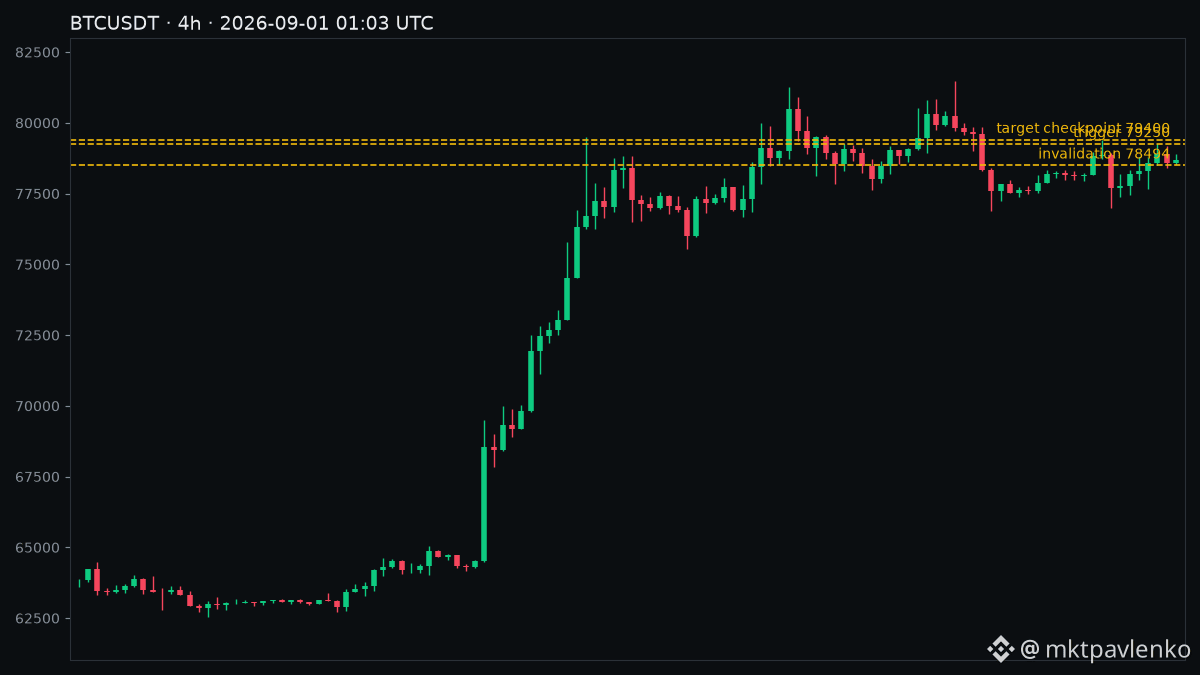
$BTC has one clean Asia-session fork: reclaim the 79,250 high, or keep trading inside the pullback range. Binance shows 78,736 now, after a 4h low of 78,494 and a broader intraday low of 77,392. That makes the next close more informative than another intraday wick. Above the high, momentum can test the observed 79,400 print; below 78,494, the reclaim thesis is off and patience is the better signal. My conversion setup is a 4h close above 79,250, invalidation below 78,494, and a 79,400 target checkpoint within this session - which side gets the close?
#BitcoinUp23%InAugustOutperformingGoldAndStocks #BitcoinHolds$78K #TankerHitsMinesInStraitOfHormuz
$BTC has one clean Asia-session fork: reclaim the 79,250 high, or keep trading inside the pullback range. Binance shows 78,736 now, after a 4h low of 78,494 and a broader intraday low of 77,392. That makes the next close more informative than another intraday wick. Above the high, momentum can test the observed 79,400 print; below 78,494, the reclaim thesis is off and patience is the better signal. My conversion setup is a 4h close above 79,250, invalidation below 78,494, and a 79,400 target checkpoint within this session - which side gets the close?
#BitcoinUp23%InAugustOutperformingGoldAndStocks #BitcoinHolds$78K #TankerHitsMinesInStraitOfHormuz
#BitcoinUp23%InAugustOutperformingGoldAndStocks #BitcoinHolds$78K #TankerHitsMinesInStraitOfHormuz
85

#BitcoinHolds $78K
#BitcoinHolds $78K
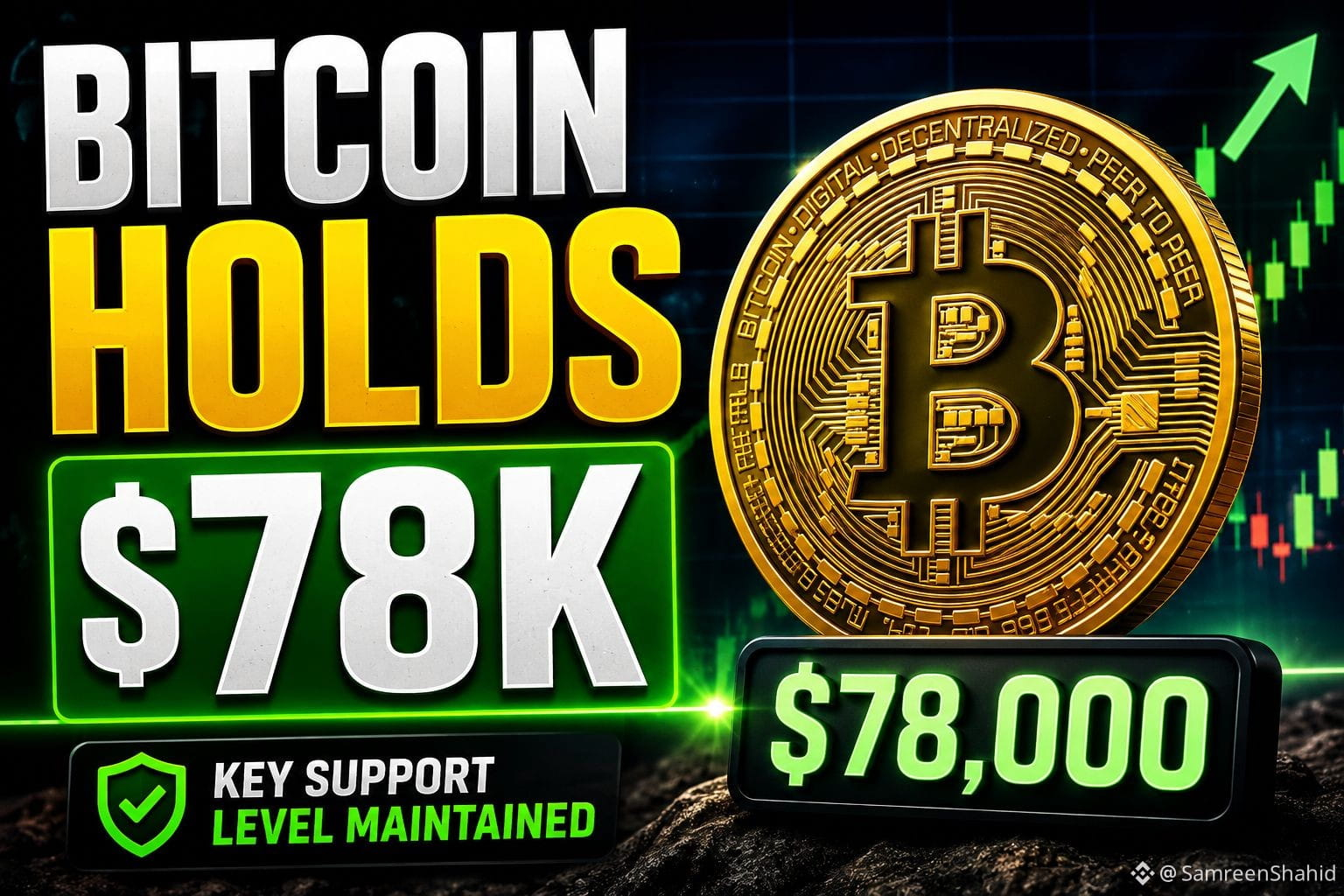
Bitcoin continues to hold around the $78,000 level, showing resilience despite recent market volatility.
Holding this key price zone could help maintain bullish sentiment and potentially support a move toward higher levels if buying pressure strengthens.
Traders are closely watching whether BTC can build a solid base above $78K and regain upward momentum.
A sustained hold could keep the broader market optimistic, while a break below this level may bring increased volatility and caution.
#BitcoinHolds $78K
#BitcoinHolds $78K
#BitcoinHolds $78K
Bitcoin continues to hold around the $78,000 level, showing resilience despite recent market volatility.
Holding this key price zone could help maintain bullish sentiment and potentially support a move toward higher levels if buying pressure strengthens.
Traders are closely watching whether BTC can build a solid base above $78K and regain upward momentum.
A sustained hold could keep the broader market optimistic, while a break below this level may bring increased volatility and caution.
#BitcoinHolds $78K
#BitcoinHolds $78K
Bitcoin continues to hold around the $78,000 level, showing resilience despite recent market volatility.
Holding this key price zone could help maintain bullish sentiment and potentially support a move toward higher levels if buying pressure strengthens.
Traders are closely watching whether BTC can build a solid base above $78K and regain upward momentum.
A sustained hold could keep the broader market optimistic, while a break below this level may bring increased volatility and caution.
#BitcoinHolds $78K
60
·
--
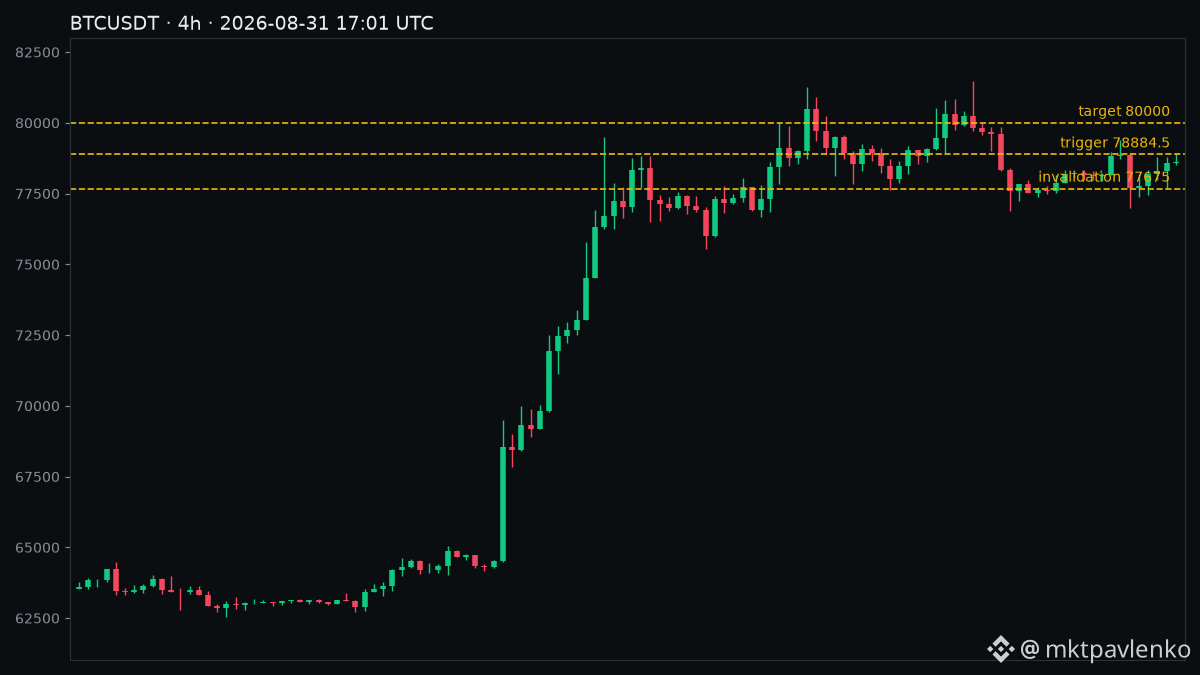
$BTC is not showing a confirmed breakout just because it recovered from $77,000. The contrarian tell is the failed follow-through under $78,884.48: price is around $78,649, while the latest 4h candle has traded between $77,675.04 and $78,884.48. A recovery can be constructive without being confirmation. The rule I am using: strength only counts after a close above $78,884.48; below $77,675.04 the setup is invalid, with a target of $80,000 during this US session.
#BitcoinUp23%InAugustOutperformingGoldAndStocks #BitcoinHolds$78K
$BTC is not showing a confirmed breakout just because it recovered from $77,000. The contrarian tell is the failed follow-through under $78,884.48: price is around $78,649, while the latest 4h candle has traded between $77,675.04 and $78,884.48. A recovery can be constructive without being confirmation. The rule I am using: strength only counts after a close above $78,884.48; below $77,675.04 the setup is invalid, with a target of $80,000 during this US session.
#BitcoinUp23%InAugustOutperformingGoldAndStocks #BitcoinHolds$78K
#BitcoinUp23%InAugustOutperformingGoldAndStocks #BitcoinHolds$78K
88

·
--
#BitcoinUp23%InAugustOutperformingGoldAndStocks
#BitcoinHolds $78k
What a month for $BTC! Bitcoin closed out August with a stellar ~23% to 26% monthly surge, comfortably outperforming traditional heavyweights like gold and major stock indices.
Despite macroeconomic headwinds and market pullbacks, #Bitcoin Holds$78K with remarkable resilience. Supported by strong institutional ETF inflows and robust on-chain activity, the king of crypto continues to prove its strength as a premier store of value
$BTC
{spot}(BTCUSDT)
#BitcoinUp23%InAugustOutperformingGoldAndStocks
#BitcoinHolds $78k
What a month for $BTC ! Bitcoin closed out August with a stellar ~23% to 26% monthly surge, comfortably outperforming traditional heavyweights like gold and major stock indices.
Despite macroeconomic headwinds and market pullbacks, #Bitcoin Holds$78K with remarkable resilience. Supported by strong institutional ETF inflows and robust on-chain activity, the king of crypto continues to prove its strength as a premier store of value
$BTC
#BitcoinHolds $78k
What a month for $BTC ! Bitcoin closed out August with a stellar ~23% to 26% monthly surge, comfortably outperforming traditional heavyweights like gold and major stock indices.
Despite macroeconomic headwinds and market pullbacks, #Bitcoin Holds$78K with remarkable resilience. Supported by strong institutional ETF inflows and robust on-chain activity, the king of crypto continues to prove its strength as a premier store of value
$BTC
1
1
99
·
--
Here's what happened when a tariff dispute between Washington and Ottawa started looking less like politics and more like a liquidity risk.
The pain for traders is that macro headlines rarely arrive with a clean entry or exit signal. A market already sitting at Fear and Greed 75 can turn a small pullback into forced selling, especially for anyone who bought $BTC after the first headline.
The overlooked risk is the transmission path. Deeper trade restrictions can pressure the Canadian dollar, weaken risk appetite, lift uncertainty around growth, and push investors toward cash. Crypto often gets sold alongside other high-beta assets before the market decides whether the shock is temporary.
That does not automatically mean Bitcoin breaks down. But it does mean $BTC holding up may hide weakness underneath, while thinner altcoin liquidity takes the hit first. Demand for $USDT can rise as traders reduce exposure, and tokens such as $ONDO may face pressure if yields, liquidity, or institutional risk appetite shift quickly.
The lesson is simple: a strong chart can still sit inside a fragile macro backdrop, so where do you think the next real stress point appears? #USCanadaTradeWarDeepens #BitcoinHolds #BitcoinUp23
Here's what happened when a tariff dispute between Washington and Ottawa started looking less like politics and more like a liquidity risk.
The pain for traders is that macro headlines rarely arrive with a clean entry or exit signal. A market already sitting at Fear and Greed 75 can turn a small pullback into forced selling, especially for anyone who bought $BTC after the first headline.
The overlooked risk is the transmission path. Deeper trade restrictions can pressure the Canadian dollar, weaken risk appetite, lift uncertainty around growth, and push investors toward cash. Crypto often gets sold alongside other high-beta assets before the market decides whether the shock is temporary.
That does not automatically mean Bitcoin breaks down. But it does mean $BTC holding up may hide weakness underneath, while thinner altcoin liquidity takes the hit first. Demand for $USDT can rise as traders reduce exposure, and tokens such as $ONDO may face pressure if yields, liquidity, or institutional risk appetite shift quickly.
The lesson is simple: a strong chart can still sit inside a fragile macro backdrop, so where do you think the next real stress point appears? #USCanadaTradeWarDeepens #BitcoinHolds #BitcoinUp23
The pain for traders is that macro headlines rarely arrive with a clean entry or exit signal. A market already sitting at Fear and Greed 75 can turn a small pullback into forced selling, especially for anyone who bought $BTC after the first headline.
The overlooked risk is the transmission path. Deeper trade restrictions can pressure the Canadian dollar, weaken risk appetite, lift uncertainty around growth, and push investors toward cash. Crypto often gets sold alongside other high-beta assets before the market decides whether the shock is temporary.
That does not automatically mean Bitcoin breaks down. But it does mean $BTC holding up may hide weakness underneath, while thinner altcoin liquidity takes the hit first. Demand for $USDT can rise as traders reduce exposure, and tokens such as $ONDO may face pressure if yields, liquidity, or institutional risk appetite shift quickly.
The lesson is simple: a strong chart can still sit inside a fragile macro backdrop, so where do you think the next real stress point appears? #USCanadaTradeWarDeepens #BitcoinHolds #BitcoinUp23
130
If you're still buying every crypto dip just because a trade-war headline is trending, stop now.
Tariff headlines can trigger FOMO one minute and forced exits the next. Traders who enter without a plan often discover too late that the real damage comes from leverage, not the initial move.
The deepening US-Canada dispute matters for crypto because it can hit currencies, inflation expectations, and global risk appetite at the same time. The bullish case is clear: more pressure on fiat and cross-border settlement could strengthen the long-term case for $BTC and stablecoins like $USDT.
But the near-term bearish case is stronger in my view. Trade shocks usually push investors toward cash, tighten liquidity, and punish high-beta altcoins before the “crypto as a hedge” narrative has time to play out. With the Fear & Greed Index at 75, chasing $ONDO or other momentum names into bad headlines looks less like conviction and more like crowded positioning. I would rather protect capital and wait for price confirmation than confuse volatility with opportunity.
Is this trade war a long-term catalyst for Bitcoin, or the next risk-off event crypto traders are underestimating?
#USCanadaTradeWarDeepens #BitcoinHolds #BitcoinUp23
If you're still buying every crypto dip just because a trade-war headline is trending, stop now.
Tariff headlines can trigger FOMO one minute and forced exits the next. Traders who enter without a plan often discover too late that the real damage comes from leverage, not the initial move.
The deepening US-Canada dispute matters for crypto because it can hit currencies, inflation expectations, and global risk appetite at the same time. The bullish case is clear: more pressure on fiat and cross-border settlement could strengthen the long-term case for $BTC and stablecoins like $USDT.
But the near-term bearish case is stronger in my view. Trade shocks usually push investors toward cash, tighten liquidity, and punish high-beta altcoins before the “crypto as a hedge” narrative has time to play out. With the Fear & Greed Index at 75, chasing $ONDO or other momentum names into bad headlines looks less like conviction and more like crowded positioning. I would rather protect capital and wait for price confirmation than confuse volatility with opportunity.
Is this trade war a long-term catalyst for Bitcoin, or the next risk-off event crypto traders are underestimating?
#USCanadaTradeWarDeepens #BitcoinHolds #BitcoinUp23
Tariff headlines can trigger FOMO one minute and forced exits the next. Traders who enter without a plan often discover too late that the real damage comes from leverage, not the initial move.
The deepening US-Canada dispute matters for crypto because it can hit currencies, inflation expectations, and global risk appetite at the same time. The bullish case is clear: more pressure on fiat and cross-border settlement could strengthen the long-term case for $BTC and stablecoins like $USDT.
But the near-term bearish case is stronger in my view. Trade shocks usually push investors toward cash, tighten liquidity, and punish high-beta altcoins before the “crypto as a hedge” narrative has time to play out. With the Fear & Greed Index at 75, chasing $ONDO or other momentum names into bad headlines looks less like conviction and more like crowded positioning. I would rather protect capital and wait for price confirmation than confuse volatility with opportunity.
Is this trade war a long-term catalyst for Bitcoin, or the next risk-off event crypto traders are underestimating?
#USCanadaTradeWarDeepens #BitcoinHolds #BitcoinUp23

48
Log in to explore more content
Join global crypto users on Binance Square
⚡️ Get latest and useful information about crypto.
💬 Trusted by the world’s largest crypto exchange.
👍 Discover real insights from verified creators.
Email / Phone number
Trending Topics
1
#SaylorHintsStrategyBitcoinBuy
2.2M views
11,135 Discussing
2
#BOJRaisesRatesTo31YearHigh
166,206 views
2,532 Discussing
3
#BuffettStepsDownAsBerkshireChairman
80,895 views
1,303 Discussing
4
#XRPExchangeReservesHitSevenYearLow
87,386 views
1,165 Discussing
5
#HKCompletesFirstHKDStablecoinUseCase
121,380 views
1,560 Discussing
6
#VietnamPlansFirstCryptoLicensesIn2026
75,028 views
1,087 Discussing
7
#BTCBreaks80K
455,123 views
5,276 Discussing
8
#BitcoinMarketCapTopsTesla
107,739 views
1,273 Discussing
9
#SOLJumpsAbout10%
109,191 views
1,162 Discussing
10
#EthereumReclaims$2600
9,457 views
130 Discussing