

#binanceburmese
binanceburmese
5,824 views
104 Discussing
Hot
Latest


Article
📈 Why did people become interested in Crypto toward US Stocks?Over time in the crypto market, there’s one point that I started thinking about on my own.
“Instead of only studying Crypto, wouldn’t it be better if you also understood the Traditional Market—US Stocks?”
From this question, I started learning the US stock market.
📈 Why did people become interested in Crypto toward US Stocks?
Over time in the crypto market, there’s one point that I started thinking about on my own.
“Instead of only studying Crypto, wouldn’t it be better if you also understood the Traditional Market—US Stocks?”
From this question, I started learning the US stock market.
“Instead of only studying Crypto, wouldn’t it be better if you also understood the Traditional Market—US Stocks?”
From this question, I started learning the US stock market.
Tonyjo:
great 🍀🍀
73
3
43
129

How to Start Accessing and Investing in US Stocks and BStocks on BinanceIn today’s global investment market, along with crypto assets, the U.S. stock market (US Stocks) has also become popular among investors. Binance, a leading crypto platform, has introduced the BStocks service so that users can easily access traditional stock markets as well. In this article, we will explain in detail how to start learning about and investing in US Stocks through Binance.
How to Start Accessing and Investing in US Stocks and BStocks on Binance
In today’s global investment market, along with crypto assets, the U.S. stock market (US Stocks) has also become popular among investors. Binance, a leading crypto platform, has introduced the BStocks service so that users can easily access traditional stock markets as well. In this article, we will explain in detail how to start learning about and investing in US Stocks through Binance.
爆仓克星:
Good
11
22
179

·
--
🌱 A Cleaner Tomorrow Starts With Us
Today, I joined Clean Up Day with Binance here in Mandalay, Myanmar. As someone who spends a lot of time on the road as a taxi driver, I see our streets and public spaces every day. I have noticed how quickly small pieces of litter can make a clean place look messy.
So today, I decided to do something simple.
Sometimes, positive change starts with one person, one small action, and one piece of trash.
A clean environment is important for everyone. Clean streets make our communities healthier, safer, and more enjoyable. They also show respect for the people who live, work, and travel around these places.
As a taxi driver, I spend many hours moving around the city. I see children going to school, families visiting different places, workers going to work, and visitors exploring Mandalay. I believe that everyone deserves to enjoy a clean and beautiful environment.
But keeping our city clean is not only the responsibility of cleaning workers or the government. It is a shared responsibility. Each of us can contribute in small ways — by not throwing rubbish on the street, reducing unnecessary waste, using trash bins, recycling when possible, and encouraging others to do the same.
Today’s activity also reminded me that small actions can create a bigger impact when many people participate.
I am grateful to take part in Clean Up Day with Binance and to share this message with my community. I hope more people will see that protecting our environment does not have to be difficult. We can start with something as simple as picking up one piece of trash.
For me, cleanliness should not be something we think about only during special campaigns. It should become a daily habit.
Mandalay is our home, and keeping our home clean is something we can all be proud of.
🌱 Small Actions. Shared Responsibility. Bigger Impact. ❤️
Let’s start today and build a cleaner, healthier, and brighter tomorrow together.
#CleanUpDayWithBinance
#BinanceBurmese
#CleanEnvironment
#SustainabilityContent
🌱 A Cleaner Tomorrow Starts With Us
Today, I joined Clean Up Day with Binance here in Mandalay, Myanmar. As someone who spends a lot of time on the road as a taxi driver, I see our streets and public spaces every day. I have noticed how quickly small pieces of litter can make a clean place look messy.
So today, I decided to do something simple.
Sometimes, positive change starts with one person, one small action, and one piece of trash.
A clean environment is important for everyone. Clean streets make our communities healthier, safer, and more enjoyable. They also show respect for the people who live, work, and travel around these places.
As a taxi driver, I spend many hours moving around the city. I see children going to school, families visiting different places, workers going to work, and visitors exploring Mandalay. I believe that everyone deserves to enjoy a clean and beautiful environment.
But keeping our city clean is not only the responsibility of cleaning workers or the government. It is a shared responsibility. Each of us can contribute in small ways — by not throwing rubbish on the street, reducing unnecessary waste, using trash bins, recycling when possible, and encouraging others to do the same.
Today’s activity also reminded me that small actions can create a bigger impact when many people participate.
I am grateful to take part in Clean Up Day with Binance and to share this message with my community. I hope more people will see that protecting our environment does not have to be difficult. We can start with something as simple as picking up one piece of trash.
For me, cleanliness should not be something we think about only during special campaigns. It should become a daily habit.
Mandalay is our home, and keeping our home clean is something we can all be proud of.
🌱 Small Actions. Shared Responsibility. Bigger Impact. ❤️
Let’s start today and build a cleaner, healthier, and brighter tomorrow together.
#CleanUpDayWithBinance
#BinanceBurmese
#CleanEnvironment
#SustainabilityContent
Today, I joined Clean Up Day with Binance here in Mandalay, Myanmar. As someone who spends a lot of time on the road as a taxi driver, I see our streets and public spaces every day. I have noticed how quickly small pieces of litter can make a clean place look messy.
So today, I decided to do something simple.
Sometimes, positive change starts with one person, one small action, and one piece of trash.
A clean environment is important for everyone. Clean streets make our communities healthier, safer, and more enjoyable. They also show respect for the people who live, work, and travel around these places.
As a taxi driver, I spend many hours moving around the city. I see children going to school, families visiting different places, workers going to work, and visitors exploring Mandalay. I believe that everyone deserves to enjoy a clean and beautiful environment.
But keeping our city clean is not only the responsibility of cleaning workers or the government. It is a shared responsibility. Each of us can contribute in small ways — by not throwing rubbish on the street, reducing unnecessary waste, using trash bins, recycling when possible, and encouraging others to do the same.
Today’s activity also reminded me that small actions can create a bigger impact when many people participate.
I am grateful to take part in Clean Up Day with Binance and to share this message with my community. I hope more people will see that protecting our environment does not have to be difficult. We can start with something as simple as picking up one piece of trash.
For me, cleanliness should not be something we think about only during special campaigns. It should become a daily habit.
Mandalay is our home, and keeping our home clean is something we can all be proud of.
🌱 Small Actions. Shared Responsibility. Bigger Impact. ❤️
Let’s start today and build a cleaner, healthier, and brighter tomorrow together.
#CleanUpDayWithBinance
#BinanceBurmese
#CleanEnvironment
#SustainabilityContent

3
165

·
--
BStocks 101: Learn US Stocks through Binance and understand the differences between stocks and cryptoIn today’s world of finance and investment, cryptocurrency and the stock market are topics that are extremely popular among young people and investors. As financial technologies continue to advance, the boundary between the crypto world and traditional finance has also become increasingly blurred. Major global crypto exchanges such as Binance are also creating opportunities for investors to learn more about US stocks and explore prospects like BStocks.
BStocks 101: Learn US Stocks through Binance and understand the differences between stocks and crypto
In today’s world of finance and investment, cryptocurrency and the stock market are topics that are extremely popular among young people and investors. As financial technologies continue to advance, the boundary between the crypto world and traditional finance has also become increasingly blurred. Major global crypto exchanges such as Binance are also creating opportunities for investors to learn more about US stocks and explore prospects like BStocks.
2
6
105

·
--
Share your Crypto journey and claim rewards from the $500 USDC Prize Pool!🎁
#MM #BinanceBurmese #campaigns
Share your Crypto journey and claim rewards from the $500 USDC Prize Pool!🎁
#MM #BinanceBurmese #campaigns
#MM #BinanceBurmese #campaigns

3
184

·
--
Why is the market up today?The crypto market rose by 0.68% to as high as $2.64T within 24 hours, mainly due to institutional adoption. It has a strong correlation with gold (81%), indicating a stance on inflation protection.
Why is the market up today?
The crypto market rose by 0.68% to as high as $2.64T within 24 hours, mainly due to institutional adoption. It has a strong correlation with gold (81%), indicating a stance on inflation protection.
147

·
--

Article
My Crypto Journey: FROM MISTAKE TO GROWTHAround the end of October 2024, a friend at work told me that "if you buy crypto, you can make money even while you're on vacation," so I downloaded the Binance App. I didn't know anything about trading terminology at the time, so I didn't even understand the difference between Spot and Futures. I simply wanted to buy coins and opened an account.
The first lesson — the dangers of leverage
I first encountered the term "leverage" when I had no trading knowledge at all. I opened a position with 30x leverage, and within a short time, the entire position was liquidated. I still can't forget the feeling I had at that time — "How can money disappear so quickly?" I was surprised. But this mistake taught me why "Risk Management" is so important.
After that incident, I didn't quit trading at all. Instead, I opened Binance Academy and started learning from the Basic Courses. Only after practicing with demo trading did I start trading with real money. I learned the DCA (Dollar Cost Averaging) method and started buying Bitcoin systematically, not investing all my money at once, but by accumulating a small amount of Bitcoin every month.
Learning the lesson and getting good results
When I saw the value of my BTC portfolio built using DCA during the 2025 Bull Run, I didn’t panic like I used to. I was able to be patient during the price fluctuations, and Binance’s Price Alert Feature and Portfolio Tracker also helped me a lot in my decision-making. From that moment on, I realized that trading is not a “get rich quick” method, but a “long-term journey that requires disciplined management.”
In conclusion, this journey from the day of Liquidation to building a stable portfolio using DCA over the past 1.8 years has taught me a lot. I have come to believe that the most important thing in Crypto Trading is not “get rich quick” but “continue to study and understand and manage risk.”
#ShareYourStoryWithBinanceAugust
@BinanceBurmese #BinanceBurmese
My Crypto Journey: FROM MISTAKE TO GROWTH
Around the end of October 2024, a friend at work told me that "if you buy crypto, you can make money even while you're on vacation," so I downloaded the Binance App. I didn't know anything about trading terminology at the time, so I didn't even understand the difference between Spot and Futures. I simply wanted to buy coins and opened an account.
The first lesson — the dangers of leverage
I first encountered the term "leverage" when I had no trading knowledge at all. I opened a position with 30x leverage, and within a short time, the entire position was liquidated. I still can't forget the feeling I had at that time — "How can money disappear so quickly?" I was surprised. But this mistake taught me why "Risk Management" is so important.
After that incident, I didn't quit trading at all. Instead, I opened Binance Academy and started learning from the Basic Courses. Only after practicing with demo trading did I start trading with real money. I learned the DCA (Dollar Cost Averaging) method and started buying Bitcoin systematically, not investing all my money at once, but by accumulating a small amount of Bitcoin every month.
Learning the lesson and getting good results
When I saw the value of my BTC portfolio built using DCA during the 2025 Bull Run, I didn’t panic like I used to. I was able to be patient during the price fluctuations, and Binance’s Price Alert Feature and Portfolio Tracker also helped me a lot in my decision-making. From that moment on, I realized that trading is not a “get rich quick” method, but a “long-term journey that requires disciplined management.”
In conclusion, this journey from the day of Liquidation to building a stable portfolio using DCA over the past 1.8 years has taught me a lot. I have come to believe that the most important thing in Crypto Trading is not “get rich quick” but “continue to study and understand and manage risk.”
#ShareYourStoryWithBinanceAugust
@Binance Burmese #BinanceBurmese
The first lesson — the dangers of leverage
I first encountered the term "leverage" when I had no trading knowledge at all. I opened a position with 30x leverage, and within a short time, the entire position was liquidated. I still can't forget the feeling I had at that time — "How can money disappear so quickly?" I was surprised. But this mistake taught me why "Risk Management" is so important.
After that incident, I didn't quit trading at all. Instead, I opened Binance Academy and started learning from the Basic Courses. Only after practicing with demo trading did I start trading with real money. I learned the DCA (Dollar Cost Averaging) method and started buying Bitcoin systematically, not investing all my money at once, but by accumulating a small amount of Bitcoin every month.
Learning the lesson and getting good results
When I saw the value of my BTC portfolio built using DCA during the 2025 Bull Run, I didn’t panic like I used to. I was able to be patient during the price fluctuations, and Binance’s Price Alert Feature and Portfolio Tracker also helped me a lot in my decision-making. From that moment on, I realized that trading is not a “get rich quick” method, but a “long-term journey that requires disciplined management.”
In conclusion, this journey from the day of Liquidation to building a stable portfolio using DCA over the past 1.8 years has taught me a lot. I have come to believe that the most important thing in Crypto Trading is not “get rich quick” but “continue to study and understand and manage risk.”
#ShareYourStoryWithBinanceAugust
@Binance Burmese #BinanceBurmese
2
3
196

·
--
Article
Bridging Traditional Wealth and Crypto: A Beginner’s Strategic Guide to Trading BStocks on BinanceThe financial landscape is evolving at a unprecedented pace. For years, retail investors had to keep their portfolios strictly divided: crypto assets on digital exchanges, and traditional equities like US stocks in traditional brokerage accounts. However, the border between Web3 and legacy markets is dissolving. With the introduction of tokenized assets and modern trading products like BStocks on Binance, investors now have the power to diversify across multiple asset classes without ever leaving the ecosystem.
Whether you are a seasoned crypto trader looking to hedge against volatility or a beginner exploring US stocks for the first time, understanding how Stocks and BStocks function is key to building a resilient investment portfolio.
1. What Are BStocks and How Do They Work?
At its core, BStocks bridge the gap between equity markets and decentralized technology. Traditional stock trading often comes with barriers such as foreign exchange conversion fees, restricted trading hours, and complex broker onboarding processes for international investors.
BStocks streamline this experience by allowing users to gain exposure to global markets using digital asset infrastructure.
Fractional Ownership: You don’t need thousands of dollars to own high-value shares like Apple, Tesla, or Nvidia. BStocks allow fractional entry, making global equities accessible to everyone.
Seamless Integration: Instead of off-ramping your crypto to fiat currency just to buy stocks, you can manage your digital and traditional exposure within a single, unified interface.
2. Crypto vs. Traditional Stocks: Key Differences and Complementary Roles
Understanding the dynamic between crypto and traditional stock markets helps in managing risk effectively:
Market Volatility: Crypto markets operate 24/7 and are known for rapid price swings driven by market sentiment and tech innovation. Traditional stocks, on the other hand, usually align with corporate earnings, macroeconomics, and regulatory frameworks, offering a different volatility profile.
Trading Hours: Crypto never sleeps, while stock markets run on structured exchange hours.
Portfolio Balancing: Combining both assets creates a powerful synergy. When the crypto market undergoes consolidation, equity exposure through BStocks can provide strategic diversification, balancing overall portfolio drawdown.
3. A Beginner's Roadmap: Getting Started Safely
Entering the stock market through Binance requires a disciplined approach. Here is a quick checklist for new traders:
Do Your Own Research (DYOR): Never invest based solely on social media hype. Study company fundamental metrics, quarterly earnings reports, and broader economic trends before opening a position.
Start Small & DCA: Dollar-Cost Averaging (DCA) is a proven strategy for mitigating market timing risk. Allocate small, regular amounts into well-established companies or index-based exposure rather than deploying all your capital at once.
Risk Management First: Always set clear entry and exit points. Define your risk tolerance before placing any trade.
4. The Future of Unified Portfolio Management
The convergence of Web3 and traditional finance is not just a trend—it is the foundation of modern wealth creation. By leveraging Binance's innovative platform, traders are no longer restricted by geographic boundaries or cumbersome traditional financial rails. Expanding your investment journey from crypto into BStocks gives you a front-row seat to global economic opportunities.
As the financial ecosystem continues to mature, staying educated and maintaining a well-hedged portfolio remains the single most effective strategy for long-term growth.
#SEAstock #SEABstock #BinanceBurmese
@BinanceBurmese
Bridging Traditional Wealth and Crypto: A Beginner’s Strategic Guide to Trading BStocks on Binance
The financial landscape is evolving at a unprecedented pace. For years, retail investors had to keep their portfolios strictly divided: crypto assets on digital exchanges, and traditional equities like US stocks in traditional brokerage accounts. However, the border between Web3 and legacy markets is dissolving. With the introduction of tokenized assets and modern trading products like BStocks on Binance, investors now have the power to diversify across multiple asset classes without ever leaving the ecosystem.
Whether you are a seasoned crypto trader looking to hedge against volatility or a beginner exploring US stocks for the first time, understanding how Stocks and BStocks function is key to building a resilient investment portfolio.
1. What Are BStocks and How Do They Work?
At its core, BStocks bridge the gap between equity markets and decentralized technology. Traditional stock trading often comes with barriers such as foreign exchange conversion fees, restricted trading hours, and complex broker onboarding processes for international investors.
BStocks streamline this experience by allowing users to gain exposure to global markets using digital asset infrastructure.
Fractional Ownership: You don’t need thousands of dollars to own high-value shares like Apple, Tesla, or Nvidia. BStocks allow fractional entry, making global equities accessible to everyone.
Seamless Integration: Instead of off-ramping your crypto to fiat currency just to buy stocks, you can manage your digital and traditional exposure within a single, unified interface.
2. Crypto vs. Traditional Stocks: Key Differences and Complementary Roles
Understanding the dynamic between crypto and traditional stock markets helps in managing risk effectively:
Market Volatility: Crypto markets operate 24/7 and are known for rapid price swings driven by market sentiment and tech innovation. Traditional stocks, on the other hand, usually align with corporate earnings, macroeconomics, and regulatory frameworks, offering a different volatility profile.
Trading Hours: Crypto never sleeps, while stock markets run on structured exchange hours.
Portfolio Balancing: Combining both assets creates a powerful synergy. When the crypto market undergoes consolidation, equity exposure through BStocks can provide strategic diversification, balancing overall portfolio drawdown.
3. A Beginner's Roadmap: Getting Started Safely
Entering the stock market through Binance requires a disciplined approach. Here is a quick checklist for new traders:
Do Your Own Research (DYOR): Never invest based solely on social media hype. Study company fundamental metrics, quarterly earnings reports, and broader economic trends before opening a position.
Start Small & DCA: Dollar-Cost Averaging (DCA) is a proven strategy for mitigating market timing risk. Allocate small, regular amounts into well-established companies or index-based exposure rather than deploying all your capital at once.
Risk Management First: Always set clear entry and exit points. Define your risk tolerance before placing any trade.
4. The Future of Unified Portfolio Management
The convergence of Web3 and traditional finance is not just a trend—it is the foundation of modern wealth creation. By leveraging Binance's innovative platform, traders are no longer restricted by geographic boundaries or cumbersome traditional financial rails. Expanding your investment journey from crypto into BStocks gives you a front-row seat to global economic opportunities.
As the financial ecosystem continues to mature, staying educated and maintaining a well-hedged portfolio remains the single most effective strategy for long-term growth.
#SEAstock #SEABstock #BinanceBurmese
@Binance Burmese
Whether you are a seasoned crypto trader looking to hedge against volatility or a beginner exploring US stocks for the first time, understanding how Stocks and BStocks function is key to building a resilient investment portfolio.
1. What Are BStocks and How Do They Work?
At its core, BStocks bridge the gap between equity markets and decentralized technology. Traditional stock trading often comes with barriers such as foreign exchange conversion fees, restricted trading hours, and complex broker onboarding processes for international investors.
BStocks streamline this experience by allowing users to gain exposure to global markets using digital asset infrastructure.
Fractional Ownership: You don’t need thousands of dollars to own high-value shares like Apple, Tesla, or Nvidia. BStocks allow fractional entry, making global equities accessible to everyone.
Seamless Integration: Instead of off-ramping your crypto to fiat currency just to buy stocks, you can manage your digital and traditional exposure within a single, unified interface.
2. Crypto vs. Traditional Stocks: Key Differences and Complementary Roles
Understanding the dynamic between crypto and traditional stock markets helps in managing risk effectively:
Market Volatility: Crypto markets operate 24/7 and are known for rapid price swings driven by market sentiment and tech innovation. Traditional stocks, on the other hand, usually align with corporate earnings, macroeconomics, and regulatory frameworks, offering a different volatility profile.
Trading Hours: Crypto never sleeps, while stock markets run on structured exchange hours.
Portfolio Balancing: Combining both assets creates a powerful synergy. When the crypto market undergoes consolidation, equity exposure through BStocks can provide strategic diversification, balancing overall portfolio drawdown.
3. A Beginner's Roadmap: Getting Started Safely
Entering the stock market through Binance requires a disciplined approach. Here is a quick checklist for new traders:
Do Your Own Research (DYOR): Never invest based solely on social media hype. Study company fundamental metrics, quarterly earnings reports, and broader economic trends before opening a position.
Start Small & DCA: Dollar-Cost Averaging (DCA) is a proven strategy for mitigating market timing risk. Allocate small, regular amounts into well-established companies or index-based exposure rather than deploying all your capital at once.
Risk Management First: Always set clear entry and exit points. Define your risk tolerance before placing any trade.
4. The Future of Unified Portfolio Management
The convergence of Web3 and traditional finance is not just a trend—it is the foundation of modern wealth creation. By leveraging Binance's innovative platform, traders are no longer restricted by geographic boundaries or cumbersome traditional financial rails. Expanding your investment journey from crypto into BStocks gives you a front-row seat to global economic opportunities.
As the financial ecosystem continues to mature, staying educated and maintaining a well-hedged portfolio remains the single most effective strategy for long-term growth.
#SEAstock #SEABstock #BinanceBurmese
@Binance Burmese
Kokyaw 2025:
ok
29
27
320


Article
Comparing Traditional Stock Trading and Crypto Trading: A Strategic Guide for Modern Investors 📈🌐🚀As financial technology expands rapidly across global markets, retail investors today enjoy unprecedented access to diverse asset classes. For years, individual market participants had to choose strictly between conventional capital markets or digital asset ecosystems. Today, platforms like Binance are narrowing this divide by offering seamless access to both cryptocurrencies and stock-linked products such as BStocks.
However, transitioning between these two financial worlds—or managing a combined portfolio—requires more than just technical familiarity with an exchange interface. It demands a clear understanding of the fundamental differences, unique risk profiles, and operational dynamics that govern traditional stock trading versus cryptocurrency trading. This analytical guide explores how these two markets differ and how investors can build a balanced, well-researched market perspective.
1. Market Fundamentals and Value Drivers 📊🔍
Understanding what drives prices in each market is the critical first step for any disciplined investor.
• Traditional Stock Market 🏢: Publicly traded stocks represent fractional ownership in real-world corporate entities. Their valuation is primarily anchored in concrete metrics: earnings reports, balance sheets, cash flow, revenue growth, profit margins, and broader macroeconomic conditions (such as interest rates and inflation). When you evaluate a stock, you are evaluating a company's business model and operational health.
• Cryptocurrency Market 🪙: Cryptocurrencies and decentralized protocol tokens derive value from network utility, adoption rates, cryptographic security, monetary policy (such as supply caps or burn mechanisms), and technological innovation. While some crypto assets generate protocol revenue, sentiment, narrative cycles, and liquidity shifts play a noticeably larger role in short-term price movements compared to traditional equities.
2. Market Structure, Hours, and Volatility ⏰⚡
The environment in which trades take place varies significantly between the two asset classes:
1. Trading Hours 🕒: Traditional stock exchanges (such as the NYSE or Nasdaq) operate on fixed schedules with dedicated opening and closing bells, observing weekends and national holidays. In contrast, cryptocurrency markets operate 24 hours a day, 7 days a week, 365 days a year without pause.
2. Volatility Profiles 📉📈: Cryptocurrencies are renowned for high intraday volatility, creating both rapid opportunity and elevated risk. Stock markets generally exhibit lower standard volatility, though individual growth stocks or news-driven events can still cause sharp fluctuations.
3. Liquidity Settlement ⚡: Traditional stock trades historically required settlement periods (such as T+1), whereas crypto-native transactions and tokenized stocks settle near-instantly via blockchain rails or internal exchange ledgers.
3. Risk Management Strategies for Cross-Asset Trading 🛡️💡
Whether trading Bitcoin or analyzing tokenized US equities, maintaining strict risk discipline is paramount. Here is a practical strategy framework:
• Separate Business Analysis from Market Hype 🧠: Liking a company’s products does not automatically make its stock a buy. Conduct thorough fundamental research into financial statements before committing capital.
• Understand Fractional Assets 🧩: Products like BStocks allow users to buy fractions of high-priced shares using stablecoins. This enables precise capital allocation without over-exposing your portfolio.
• Never Risk Unaffordable Capital ⚠️: Market movements in both equities and crypto can be unforgiving. Always trade within a structured risk budget and avoid over-leveraging positions.
4. Bridging the Gap with Binance BStocks 🌉✨
For crypto-native investors looking to diversify into traditional finance without leaving the blockchain ecosystem, BStocks provide an innovative solution. By using stablecoin balances (USDT/USDC), users can gain direct exposure to leading global companies smoothly and efficiently.
This hybrid access empowers users to construct resilient portfolios that combine the growth potential of digital assets with the fundamental stability of established corporate equities.
🎯Trading stocks and trading crypto should not be viewed as competing philosophies; rather, they are complementary components of a comprehensive investment strategy. By understanding the underlying drivers, respecting market differences, and committing to continuous learning, investors can navigate both traditional equities and digital assets with confidence and discipline.
@BinanceBurmese #BinanceBurmese
#SEABstock #SEAstock
Comparing Traditional Stock Trading and Crypto Trading: A Strategic Guide for Modern Investors 📈🌐
🚀As financial technology expands rapidly across global markets, retail investors today enjoy unprecedented access to diverse asset classes. For years, individual market participants had to choose strictly between conventional capital markets or digital asset ecosystems. Today, platforms like Binance are narrowing this divide by offering seamless access to both cryptocurrencies and stock-linked products such as BStocks.
However, transitioning between these two financial worlds—or managing a combined portfolio—requires more than just technical familiarity with an exchange interface. It demands a clear understanding of the fundamental differences, unique risk profiles, and operational dynamics that govern traditional stock trading versus cryptocurrency trading. This analytical guide explores how these two markets differ and how investors can build a balanced, well-researched market perspective.
1. Market Fundamentals and Value Drivers 📊🔍
Understanding what drives prices in each market is the critical first step for any disciplined investor.
• Traditional Stock Market 🏢: Publicly traded stocks represent fractional ownership in real-world corporate entities. Their valuation is primarily anchored in concrete metrics: earnings reports, balance sheets, cash flow, revenue growth, profit margins, and broader macroeconomic conditions (such as interest rates and inflation). When you evaluate a stock, you are evaluating a company's business model and operational health.
• Cryptocurrency Market 🪙: Cryptocurrencies and decentralized protocol tokens derive value from network utility, adoption rates, cryptographic security, monetary policy (such as supply caps or burn mechanisms), and technological innovation. While some crypto assets generate protocol revenue, sentiment, narrative cycles, and liquidity shifts play a noticeably larger role in short-term price movements compared to traditional equities.
2. Market Structure, Hours, and Volatility ⏰⚡
The environment in which trades take place varies significantly between the two asset classes:
1. Trading Hours 🕒: Traditional stock exchanges (such as the NYSE or Nasdaq) operate on fixed schedules with dedicated opening and closing bells, observing weekends and national holidays. In contrast, cryptocurrency markets operate 24 hours a day, 7 days a week, 365 days a year without pause.
2. Volatility Profiles 📉📈: Cryptocurrencies are renowned for high intraday volatility, creating both rapid opportunity and elevated risk. Stock markets generally exhibit lower standard volatility, though individual growth stocks or news-driven events can still cause sharp fluctuations.
3. Liquidity Settlement ⚡: Traditional stock trades historically required settlement periods (such as T+1), whereas crypto-native transactions and tokenized stocks settle near-instantly via blockchain rails or internal exchange ledgers.
3. Risk Management Strategies for Cross-Asset Trading 🛡️💡
Whether trading Bitcoin or analyzing tokenized US equities, maintaining strict risk discipline is paramount. Here is a practical strategy framework:
• Separate Business Analysis from Market Hype 🧠: Liking a company’s products does not automatically make its stock a buy. Conduct thorough fundamental research into financial statements before committing capital.
• Understand Fractional Assets 🧩: Products like BStocks allow users to buy fractions of high-priced shares using stablecoins. This enables precise capital allocation without over-exposing your portfolio.
• Never Risk Unaffordable Capital ⚠️: Market movements in both equities and crypto can be unforgiving. Always trade within a structured risk budget and avoid over-leveraging positions.
4. Bridging the Gap with Binance BStocks 🌉✨
For crypto-native investors looking to diversify into traditional finance without leaving the blockchain ecosystem, BStocks provide an innovative solution. By using stablecoin balances (USDT/USDC), users can gain direct exposure to leading global companies smoothly and efficiently.
This hybrid access empowers users to construct resilient portfolios that combine the growth potential of digital assets with the fundamental stability of established corporate equities.
🎯Trading stocks and trading crypto should not be viewed as competing philosophies; rather, they are complementary components of a comprehensive investment strategy. By understanding the underlying drivers, respecting market differences, and committing to continuous learning, investors can navigate both traditional equities and digital assets with confidence and discipline.
@Binance Burmese #BinanceBurmese
#SEABstock #SEAstock
However, transitioning between these two financial worlds—or managing a combined portfolio—requires more than just technical familiarity with an exchange interface. It demands a clear understanding of the fundamental differences, unique risk profiles, and operational dynamics that govern traditional stock trading versus cryptocurrency trading. This analytical guide explores how these two markets differ and how investors can build a balanced, well-researched market perspective.
1. Market Fundamentals and Value Drivers 📊🔍
Understanding what drives prices in each market is the critical first step for any disciplined investor.
• Traditional Stock Market 🏢: Publicly traded stocks represent fractional ownership in real-world corporate entities. Their valuation is primarily anchored in concrete metrics: earnings reports, balance sheets, cash flow, revenue growth, profit margins, and broader macroeconomic conditions (such as interest rates and inflation). When you evaluate a stock, you are evaluating a company's business model and operational health.
• Cryptocurrency Market 🪙: Cryptocurrencies and decentralized protocol tokens derive value from network utility, adoption rates, cryptographic security, monetary policy (such as supply caps or burn mechanisms), and technological innovation. While some crypto assets generate protocol revenue, sentiment, narrative cycles, and liquidity shifts play a noticeably larger role in short-term price movements compared to traditional equities.
2. Market Structure, Hours, and Volatility ⏰⚡
The environment in which trades take place varies significantly between the two asset classes:
1. Trading Hours 🕒: Traditional stock exchanges (such as the NYSE or Nasdaq) operate on fixed schedules with dedicated opening and closing bells, observing weekends and national holidays. In contrast, cryptocurrency markets operate 24 hours a day, 7 days a week, 365 days a year without pause.
2. Volatility Profiles 📉📈: Cryptocurrencies are renowned for high intraday volatility, creating both rapid opportunity and elevated risk. Stock markets generally exhibit lower standard volatility, though individual growth stocks or news-driven events can still cause sharp fluctuations.
3. Liquidity Settlement ⚡: Traditional stock trades historically required settlement periods (such as T+1), whereas crypto-native transactions and tokenized stocks settle near-instantly via blockchain rails or internal exchange ledgers.
3. Risk Management Strategies for Cross-Asset Trading 🛡️💡
Whether trading Bitcoin or analyzing tokenized US equities, maintaining strict risk discipline is paramount. Here is a practical strategy framework:
• Separate Business Analysis from Market Hype 🧠: Liking a company’s products does not automatically make its stock a buy. Conduct thorough fundamental research into financial statements before committing capital.
• Understand Fractional Assets 🧩: Products like BStocks allow users to buy fractions of high-priced shares using stablecoins. This enables precise capital allocation without over-exposing your portfolio.
• Never Risk Unaffordable Capital ⚠️: Market movements in both equities and crypto can be unforgiving. Always trade within a structured risk budget and avoid over-leveraging positions.
4. Bridging the Gap with Binance BStocks 🌉✨
For crypto-native investors looking to diversify into traditional finance without leaving the blockchain ecosystem, BStocks provide an innovative solution. By using stablecoin balances (USDT/USDC), users can gain direct exposure to leading global companies smoothly and efficiently.
This hybrid access empowers users to construct resilient portfolios that combine the growth potential of digital assets with the fundamental stability of established corporate equities.
🎯Trading stocks and trading crypto should not be viewed as competing philosophies; rather, they are complementary components of a comprehensive investment strategy. By understanding the underlying drivers, respecting market differences, and committing to continuous learning, investors can navigate both traditional equities and digital assets with confidence and discipline.
@Binance Burmese #BinanceBurmese
#SEABstock #SEAstock
1
142

·
--
Article
Rethinking Asset Allocation: How Binance BStocks Empowers the Modern Barbell StrategyIn the world of investment, sticking strictly to a single asset class is a gamble against macroeconomic shifts. Crypto investors have built unprecedented wealth through digital assets, but maintaining that wealth requires a different toolset—one that balances high-conviction growth with structural stability.
To achieve long-term financial survival and growth, elite fund managers often employ what Nassim Taleb calls the Barbell Strategy: pairing ultra-safe/traditional assets on one end with high-risk, high-reward assets on the other, while minimizing exposure to the speculative middle. Through Binance BStocks (Binance Stocks), crypto investors now have the ideal ecosystem to execute this strategy seamlessly under a unified interface.
1. The Anatomy of a Barbell Portfolio: Crypto Meets US Equities
Why do crypto investors need traditional US stocks to complete their wealth-building toolkit? Let's break down the comparative dynamics:
High-Beta Asymmetry (Crypto Side): Cryptocurrencies represent unprecedented technological upside and high alpha generation. However, digital assets are subject to liquidity contraction cycles and systemic market shocks.
Cash-Flow Stability & Defensive Moats (US Equities Side): Established publicly traded companies (such as Apple, Microsoft, or Nvidia) represent tangible equity backed by real-world revenue, dividend distributions, and institutional sponsorship.
Cycle Hedging: When crypto sentiment enters a consolidation or cooling phase, holding high-quality US equities provides portfolio stability and consistent value retention without having to exit entirely into fiat currency.
2. Why BStocks is a Game-Changer for Global Investors
Before BStocks, crypto users seeking exposure to the US equity market faced significant structural hurdles—ranging from international banking restrictions and high wire-transfer fees to multi-platform fragmentation. BStocks removes these barriers completely.
Core Advantages of BStocks:
Direct On-Chain Equity Exposure: Allocate capital directly from your Binance wallet into top-tier global stock products without leaving the platform or managing complex broker transfers.
Precision Fractional Ownership: High-value stocks often trade at hefty price points per share. BStocks enables fractional share allocation, allowing investors to invest precise dollar amounts tailored to their exact risk parameters.
Optimized Portfolio Velocity: Instantly rebalance capital between digital assets, stablecoins, and global equities in response to real-time macroeconomic news.
3. Step-by-Step Checklist for Launching Your BStocks Journey
Transitioning into a multi-asset investor requires a structured execution framework. Follow this quick checklist before taking your first position:
[ ] Map Your Risk Distribution: Determine your Barbell allocation ratio (e.g., 70% Core Crypto / 20% Growth & Tech Equities / 10% Cash Reserve).
[ ] Evaluate Corporate Balance Sheets: Look at company metrics like Price-to-Earnings (P/E) ratios, free cash flow, and debt levels alongside technical chart setups.
[ ] Implement Staggered Entry (DCA): Avoid timing market peaks or troughs. Use Dollar-Cost Averaging to scale into equity positions gradually.
[ ] Align with Market Hours & Macro Events: Monitor key economic indicators (such as inflation data, Fed interest rate decisions, and corporate earnings releases) that influence US equity trading hours.
4. Essential Risk Governance for BStocks Investors
While US equities generally present lower downside volatility than micro-cap altcoins, stock trading is not without risk. Market downturns, regulatory changes, and corporate earnings misses can impact share prices. Always maintain strict position sizing, set target profit/loss parameters, and never invest funds required for short-term liquidity needs.
5. Final Thoughts
True financial resilience isn't about choosing between Crypto or Stocks—it is about orchestrating both in harmony. By incorporating BStocks into your wealth creation toolkit, Binance bridges the gap between Web3 innovation and traditional capital markets, giving you total control over your financial destiny.
Upgrade your portfolio strategy today!
#BinanceBurmese
#SEABstock #SEAstock
Rethinking Asset Allocation: How Binance BStocks Empowers the Modern Barbell Strategy
In the world of investment, sticking strictly to a single asset class is a gamble against macroeconomic shifts. Crypto investors have built unprecedented wealth through digital assets, but maintaining that wealth requires a different toolset—one that balances high-conviction growth with structural stability.
To achieve long-term financial survival and growth, elite fund managers often employ what Nassim Taleb calls the Barbell Strategy: pairing ultra-safe/traditional assets on one end with high-risk, high-reward assets on the other, while minimizing exposure to the speculative middle. Through Binance BStocks (Binance Stocks), crypto investors now have the ideal ecosystem to execute this strategy seamlessly under a unified interface.
1. The Anatomy of a Barbell Portfolio: Crypto Meets US Equities
Why do crypto investors need traditional US stocks to complete their wealth-building toolkit? Let's break down the comparative dynamics:
High-Beta Asymmetry (Crypto Side): Cryptocurrencies represent unprecedented technological upside and high alpha generation. However, digital assets are subject to liquidity contraction cycles and systemic market shocks.
Cash-Flow Stability & Defensive Moats (US Equities Side): Established publicly traded companies (such as Apple, Microsoft, or Nvidia) represent tangible equity backed by real-world revenue, dividend distributions, and institutional sponsorship.
Cycle Hedging: When crypto sentiment enters a consolidation or cooling phase, holding high-quality US equities provides portfolio stability and consistent value retention without having to exit entirely into fiat currency.
2. Why BStocks is a Game-Changer for Global Investors
Before BStocks, crypto users seeking exposure to the US equity market faced significant structural hurdles—ranging from international banking restrictions and high wire-transfer fees to multi-platform fragmentation. BStocks removes these barriers completely.
Core Advantages of BStocks:
Direct On-Chain Equity Exposure: Allocate capital directly from your Binance wallet into top-tier global stock products without leaving the platform or managing complex broker transfers.
Precision Fractional Ownership: High-value stocks often trade at hefty price points per share. BStocks enables fractional share allocation, allowing investors to invest precise dollar amounts tailored to their exact risk parameters.
Optimized Portfolio Velocity: Instantly rebalance capital between digital assets, stablecoins, and global equities in response to real-time macroeconomic news.
3. Step-by-Step Checklist for Launching Your BStocks Journey
Transitioning into a multi-asset investor requires a structured execution framework. Follow this quick checklist before taking your first position:
[ ] Map Your Risk Distribution: Determine your Barbell allocation ratio (e.g., 70% Core Crypto / 20% Growth & Tech Equities / 10% Cash Reserve).
[ ] Evaluate Corporate Balance Sheets: Look at company metrics like Price-to-Earnings (P/E) ratios, free cash flow, and debt levels alongside technical chart setups.
[ ] Implement Staggered Entry (DCA): Avoid timing market peaks or troughs. Use Dollar-Cost Averaging to scale into equity positions gradually.
[ ] Align with Market Hours & Macro Events: Monitor key economic indicators (such as inflation data, Fed interest rate decisions, and corporate earnings releases) that influence US equity trading hours.
4. Essential Risk Governance for BStocks Investors
While US equities generally present lower downside volatility than micro-cap altcoins, stock trading is not without risk. Market downturns, regulatory changes, and corporate earnings misses can impact share prices. Always maintain strict position sizing, set target profit/loss parameters, and never invest funds required for short-term liquidity needs.
5. Final Thoughts
True financial resilience isn't about choosing between Crypto or Stocks—it is about orchestrating both in harmony. By incorporating BStocks into your wealth creation toolkit, Binance bridges the gap between Web3 innovation and traditional capital markets, giving you total control over your financial destiny.
Upgrade your portfolio strategy today!
#BinanceBurmese
#SEABstock #SEAstock
To achieve long-term financial survival and growth, elite fund managers often employ what Nassim Taleb calls the Barbell Strategy: pairing ultra-safe/traditional assets on one end with high-risk, high-reward assets on the other, while minimizing exposure to the speculative middle. Through Binance BStocks (Binance Stocks), crypto investors now have the ideal ecosystem to execute this strategy seamlessly under a unified interface.
1. The Anatomy of a Barbell Portfolio: Crypto Meets US Equities
Why do crypto investors need traditional US stocks to complete their wealth-building toolkit? Let's break down the comparative dynamics:
High-Beta Asymmetry (Crypto Side): Cryptocurrencies represent unprecedented technological upside and high alpha generation. However, digital assets are subject to liquidity contraction cycles and systemic market shocks.
Cash-Flow Stability & Defensive Moats (US Equities Side): Established publicly traded companies (such as Apple, Microsoft, or Nvidia) represent tangible equity backed by real-world revenue, dividend distributions, and institutional sponsorship.
Cycle Hedging: When crypto sentiment enters a consolidation or cooling phase, holding high-quality US equities provides portfolio stability and consistent value retention without having to exit entirely into fiat currency.
2. Why BStocks is a Game-Changer for Global Investors
Before BStocks, crypto users seeking exposure to the US equity market faced significant structural hurdles—ranging from international banking restrictions and high wire-transfer fees to multi-platform fragmentation. BStocks removes these barriers completely.
Core Advantages of BStocks:
Direct On-Chain Equity Exposure: Allocate capital directly from your Binance wallet into top-tier global stock products without leaving the platform or managing complex broker transfers.
Precision Fractional Ownership: High-value stocks often trade at hefty price points per share. BStocks enables fractional share allocation, allowing investors to invest precise dollar amounts tailored to their exact risk parameters.
Optimized Portfolio Velocity: Instantly rebalance capital between digital assets, stablecoins, and global equities in response to real-time macroeconomic news.
3. Step-by-Step Checklist for Launching Your BStocks Journey
Transitioning into a multi-asset investor requires a structured execution framework. Follow this quick checklist before taking your first position:
[ ] Map Your Risk Distribution: Determine your Barbell allocation ratio (e.g., 70% Core Crypto / 20% Growth & Tech Equities / 10% Cash Reserve).
[ ] Evaluate Corporate Balance Sheets: Look at company metrics like Price-to-Earnings (P/E) ratios, free cash flow, and debt levels alongside technical chart setups.
[ ] Implement Staggered Entry (DCA): Avoid timing market peaks or troughs. Use Dollar-Cost Averaging to scale into equity positions gradually.
[ ] Align with Market Hours & Macro Events: Monitor key economic indicators (such as inflation data, Fed interest rate decisions, and corporate earnings releases) that influence US equity trading hours.
4. Essential Risk Governance for BStocks Investors
While US equities generally present lower downside volatility than micro-cap altcoins, stock trading is not without risk. Market downturns, regulatory changes, and corporate earnings misses can impact share prices. Always maintain strict position sizing, set target profit/loss parameters, and never invest funds required for short-term liquidity needs.
5. Final Thoughts
True financial resilience isn't about choosing between Crypto or Stocks—it is about orchestrating both in harmony. By incorporating BStocks into your wealth creation toolkit, Binance bridges the gap between Web3 innovation and traditional capital markets, giving you total control over your financial destiny.
Upgrade your portfolio strategy today!
#BinanceBurmese
#SEABstock #SEAstock
凌宇 M:
good
41
3
42
318

·
--
Article
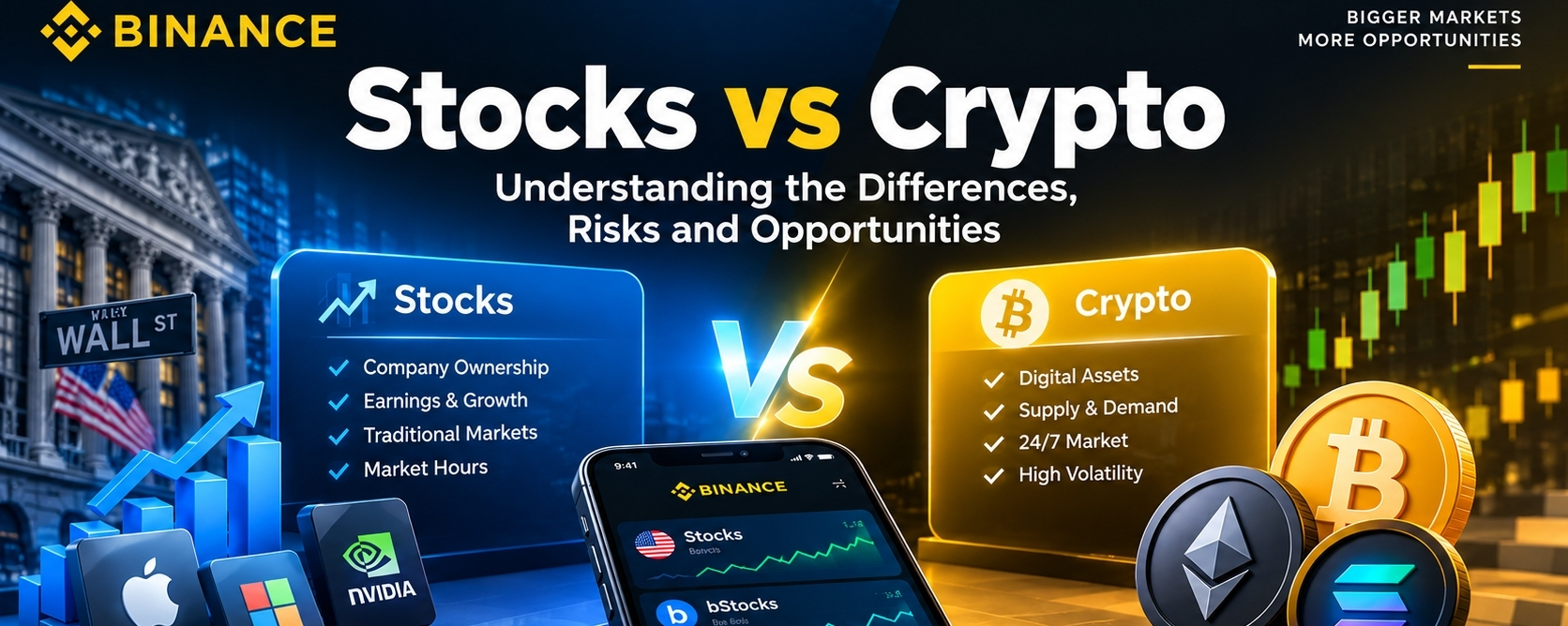
Stocks vs Crypto: Understanding the Differences, Risks and OpportunitiesFor many crypto users, exploring the world of traditional stocks can be an interesting next step. Both stocks and crypto are popular financial markets, but they work in very different ways.
With Binance continuing to provide access to different financial products, beginners may come across terms such as Stocks, US Stocks, and bStocks. Understanding what these products are, how they differ from crypto, and what risks are involved is important before making any investment decision.
In this article, I want to share some basic information for beginners who are interested in learning about Stocks and bStocks.
🔹 1. What Are Stocks?
A stock represents an ownership interest in a publicly traded company.
For example, when an investor purchases shares of a public company, they are purchasing an ownership interest in that company. The value of a stock can be affected by many factors, including company earnings, business performance, economic conditions, industry developments, interest rates, and investor expectations.
Stock markets also operate under established market rules and trading schedules. Unlike crypto markets, traditional stock exchanges generally have specific trading hours.
This is one of the first differences that crypto users should understand when learning about Stocks.
🔹 2. How Are Stocks Different From Crypto?
Stocks and crypto are both tradable assets, but their underlying structures are different.
Stocks are connected to publicly traded companies and traditional financial markets. Investors may analyze financial statements, earnings reports, company growth, competitive advantages, and industry trends when researching a stock.
Crypto assets, on the other hand, are digital assets that can be built on blockchain networks. Their prices can be influenced by factors such as supply and demand, adoption, network activity, market sentiment, liquidity, technological developments, and broader market conditions.
Another major difference is market availability.
Crypto markets generally operate 24/7, meaning prices can move at any time, including weekends. Traditional stock markets generally follow specific trading sessions and market holidays.
For someone who is used to crypto trading, this difference in market structure is important to understand.
🔹 3. What Are bStocks?
This is where things become particularly interesting for crypto users.
bStocks are blockchain-based tokenized securities available through Binance. They are designed to provide exposure to the price performance of corresponding listed equities.
According to Binance's official information, bStocks are backed 1:1 by corresponding U.S. shares and can be traded on Binance Spot markets 24/7.
However, there is an important distinction that beginners should understand.
Holding a bStock does not mean that you directly own the underlying company's share in the same way as holding the traditional stock through a conventional brokerage account.
bStocks are structured as tokenized securities and represent financial instruments linked to the underlying asset. Therefore, users should carefully understand the ownership structure, rights, terms, and risks before using the product.
This is one of the most important points for anyone moving from crypto into tokenized stock products.
🔹 4. Why Should Crypto Users Learn About Stocks?
Crypto users already have experience following market movements, analyzing projects, monitoring news, and understanding market sentiment.
Learning about Stocks can expand that knowledge into traditional financial markets.
For example, someone interested in artificial intelligence may want to understand not only AI-related crypto projects but also companies involved in semiconductors, cloud computing, software, and other parts of the technology industry.
Learning about Stocks can therefore provide another perspective when studying global markets.
It is not necessarily about choosing Stocks over Crypto or Crypto over Stocks.
Instead, it is about understanding how different financial markets work and what factors influence their prices.
🔹 5. Risks You Should Understand
Stocks and Crypto both involve risk.
Crypto can experience significant price volatility, and individual tokens can be affected by market sentiment, liquidity, technology, regulation, and other factors.
Stocks also carry risks. A company's stock price can decline because of weak earnings, changing economic conditions, industry competition, unexpected company events, or broader market movements.
bStocks also have their own risks. Binance has highlighted risks associated with tokenized stock products, including liquidity, issuer, custody, regulatory, technology, and tax-related risks.
Therefore, investors should not assume that a product is automatically safer simply because it is connected to a traditional stock.
Understanding the product before using it is essential.
🔹 6. A Beginner's Checklist
If you are new to Stocks or bStocks, here are some areas worth learning about before trading:
1️⃣ How the stock market works
2️⃣ What company earnings and financial statements mean
3️⃣ What factors influence stock prices
4️⃣ The differences between Stocks and Crypto
5️⃣ How tokenized stocks such as bStocks are structured
6️⃣ Trading fees and liquidity
7️⃣ Market hours and trading rules
8️⃣ Product availability in your country or region
9️⃣ The risks associated with the specific product
🔟 Binance's official product information, Terms, and Risk Warnings
Taking time to learn these basics can help beginners make more informed decisions.
💡 Final Thoughts
Stocks and Crypto may look similar because both can be traded and both experience price movements, but the underlying systems are very different.
Stocks are connected to traditional companies and financial markets.
Crypto assets are based on blockchain technology and have their own unique market structures.
bStocks introduce another interesting concept by combining blockchain technology with exposure to traditional listed equities.
For crypto users, learning about Stocks can be an opportunity to expand their understanding of global financial markets. But learning about a product does not automatically mean that someone should buy it.
Before trading, it is important to understand the product, research the underlying asset, consider the risks, and check whether the product is available and suitable for your jurisdiction and personal circumstances.
The more we understand about different markets, the better we can evaluate opportunities and risks for ourselves.
If you are a Crypto user who is starting to explore US Stocks, which difference between Stocks and Crypto do you find the most interesting?
@BinanceBurmese
#SEABstock
#SEAstock
#Stocks
#bStocks
#BinanceBurmese
Stocks vs Crypto: Understanding the Differences, Risks and Opportunities
For many crypto users, exploring the world of traditional stocks can be an interesting next step. Both stocks and crypto are popular financial markets, but they work in very different ways.
With Binance continuing to provide access to different financial products, beginners may come across terms such as Stocks, US Stocks, and bStocks. Understanding what these products are, how they differ from crypto, and what risks are involved is important before making any investment decision.
In this article, I want to share some basic information for beginners who are interested in learning about Stocks and bStocks.
🔹 1. What Are Stocks?
A stock represents an ownership interest in a publicly traded company.
For example, when an investor purchases shares of a public company, they are purchasing an ownership interest in that company. The value of a stock can be affected by many factors, including company earnings, business performance, economic conditions, industry developments, interest rates, and investor expectations.
Stock markets also operate under established market rules and trading schedules. Unlike crypto markets, traditional stock exchanges generally have specific trading hours.
This is one of the first differences that crypto users should understand when learning about Stocks.
🔹 2. How Are Stocks Different From Crypto?
Stocks and crypto are both tradable assets, but their underlying structures are different.
Stocks are connected to publicly traded companies and traditional financial markets. Investors may analyze financial statements, earnings reports, company growth, competitive advantages, and industry trends when researching a stock.
Crypto assets, on the other hand, are digital assets that can be built on blockchain networks. Their prices can be influenced by factors such as supply and demand, adoption, network activity, market sentiment, liquidity, technological developments, and broader market conditions.
Another major difference is market availability.
Crypto markets generally operate 24/7, meaning prices can move at any time, including weekends. Traditional stock markets generally follow specific trading sessions and market holidays.
For someone who is used to crypto trading, this difference in market structure is important to understand.
🔹 3. What Are bStocks?
This is where things become particularly interesting for crypto users.
bStocks are blockchain-based tokenized securities available through Binance. They are designed to provide exposure to the price performance of corresponding listed equities.
According to Binance's official information, bStocks are backed 1:1 by corresponding U.S. shares and can be traded on Binance Spot markets 24/7.
However, there is an important distinction that beginners should understand.
Holding a bStock does not mean that you directly own the underlying company's share in the same way as holding the traditional stock through a conventional brokerage account.
bStocks are structured as tokenized securities and represent financial instruments linked to the underlying asset. Therefore, users should carefully understand the ownership structure, rights, terms, and risks before using the product.
This is one of the most important points for anyone moving from crypto into tokenized stock products.
🔹 4. Why Should Crypto Users Learn About Stocks?
Crypto users already have experience following market movements, analyzing projects, monitoring news, and understanding market sentiment.
Learning about Stocks can expand that knowledge into traditional financial markets.
For example, someone interested in artificial intelligence may want to understand not only AI-related crypto projects but also companies involved in semiconductors, cloud computing, software, and other parts of the technology industry.
Learning about Stocks can therefore provide another perspective when studying global markets.
It is not necessarily about choosing Stocks over Crypto or Crypto over Stocks.
Instead, it is about understanding how different financial markets work and what factors influence their prices.
🔹 5. Risks You Should Understand
Stocks and Crypto both involve risk.
Crypto can experience significant price volatility, and individual tokens can be affected by market sentiment, liquidity, technology, regulation, and other factors.
Stocks also carry risks. A company's stock price can decline because of weak earnings, changing economic conditions, industry competition, unexpected company events, or broader market movements.
bStocks also have their own risks. Binance has highlighted risks associated with tokenized stock products, including liquidity, issuer, custody, regulatory, technology, and tax-related risks.
Therefore, investors should not assume that a product is automatically safer simply because it is connected to a traditional stock.
Understanding the product before using it is essential.
🔹 6. A Beginner's Checklist
If you are new to Stocks or bStocks, here are some areas worth learning about before trading:
1️⃣ How the stock market works
2️⃣ What company earnings and financial statements mean
3️⃣ What factors influence stock prices
4️⃣ The differences between Stocks and Crypto
5️⃣ How tokenized stocks such as bStocks are structured
6️⃣ Trading fees and liquidity
7️⃣ Market hours and trading rules
8️⃣ Product availability in your country or region
9️⃣ The risks associated with the specific product
🔟 Binance's official product information, Terms, and Risk Warnings
Taking time to learn these basics can help beginners make more informed decisions.
💡 Final Thoughts
Stocks and Crypto may look similar because both can be traded and both experience price movements, but the underlying systems are very different.
Stocks are connected to traditional companies and financial markets.
Crypto assets are based on blockchain technology and have their own unique market structures.
bStocks introduce another interesting concept by combining blockchain technology with exposure to traditional listed equities.
For crypto users, learning about Stocks can be an opportunity to expand their understanding of global financial markets. But learning about a product does not automatically mean that someone should buy it.
Before trading, it is important to understand the product, research the underlying asset, consider the risks, and check whether the product is available and suitable for your jurisdiction and personal circumstances.
The more we understand about different markets, the better we can evaluate opportunities and risks for ourselves.
If you are a Crypto user who is starting to explore US Stocks, which difference between Stocks and Crypto do you find the most interesting?
@Binance Burmese
#SEABstock
#SEAstock
#Stocks
#bStocks
#BinanceBurmese
With Binance continuing to provide access to different financial products, beginners may come across terms such as Stocks, US Stocks, and bStocks. Understanding what these products are, how they differ from crypto, and what risks are involved is important before making any investment decision.
In this article, I want to share some basic information for beginners who are interested in learning about Stocks and bStocks.
🔹 1. What Are Stocks?
A stock represents an ownership interest in a publicly traded company.
For example, when an investor purchases shares of a public company, they are purchasing an ownership interest in that company. The value of a stock can be affected by many factors, including company earnings, business performance, economic conditions, industry developments, interest rates, and investor expectations.
Stock markets also operate under established market rules and trading schedules. Unlike crypto markets, traditional stock exchanges generally have specific trading hours.
This is one of the first differences that crypto users should understand when learning about Stocks.
🔹 2. How Are Stocks Different From Crypto?
Stocks and crypto are both tradable assets, but their underlying structures are different.
Stocks are connected to publicly traded companies and traditional financial markets. Investors may analyze financial statements, earnings reports, company growth, competitive advantages, and industry trends when researching a stock.
Crypto assets, on the other hand, are digital assets that can be built on blockchain networks. Their prices can be influenced by factors such as supply and demand, adoption, network activity, market sentiment, liquidity, technological developments, and broader market conditions.
Another major difference is market availability.
Crypto markets generally operate 24/7, meaning prices can move at any time, including weekends. Traditional stock markets generally follow specific trading sessions and market holidays.
For someone who is used to crypto trading, this difference in market structure is important to understand.
🔹 3. What Are bStocks?
This is where things become particularly interesting for crypto users.
bStocks are blockchain-based tokenized securities available through Binance. They are designed to provide exposure to the price performance of corresponding listed equities.
According to Binance's official information, bStocks are backed 1:1 by corresponding U.S. shares and can be traded on Binance Spot markets 24/7.
However, there is an important distinction that beginners should understand.
Holding a bStock does not mean that you directly own the underlying company's share in the same way as holding the traditional stock through a conventional brokerage account.
bStocks are structured as tokenized securities and represent financial instruments linked to the underlying asset. Therefore, users should carefully understand the ownership structure, rights, terms, and risks before using the product.
This is one of the most important points for anyone moving from crypto into tokenized stock products.
🔹 4. Why Should Crypto Users Learn About Stocks?
Crypto users already have experience following market movements, analyzing projects, monitoring news, and understanding market sentiment.
Learning about Stocks can expand that knowledge into traditional financial markets.
For example, someone interested in artificial intelligence may want to understand not only AI-related crypto projects but also companies involved in semiconductors, cloud computing, software, and other parts of the technology industry.
Learning about Stocks can therefore provide another perspective when studying global markets.
It is not necessarily about choosing Stocks over Crypto or Crypto over Stocks.
Instead, it is about understanding how different financial markets work and what factors influence their prices.
🔹 5. Risks You Should Understand
Stocks and Crypto both involve risk.
Crypto can experience significant price volatility, and individual tokens can be affected by market sentiment, liquidity, technology, regulation, and other factors.
Stocks also carry risks. A company's stock price can decline because of weak earnings, changing economic conditions, industry competition, unexpected company events, or broader market movements.
bStocks also have their own risks. Binance has highlighted risks associated with tokenized stock products, including liquidity, issuer, custody, regulatory, technology, and tax-related risks.
Therefore, investors should not assume that a product is automatically safer simply because it is connected to a traditional stock.
Understanding the product before using it is essential.
🔹 6. A Beginner's Checklist
If you are new to Stocks or bStocks, here are some areas worth learning about before trading:
1️⃣ How the stock market works
2️⃣ What company earnings and financial statements mean
3️⃣ What factors influence stock prices
4️⃣ The differences between Stocks and Crypto
5️⃣ How tokenized stocks such as bStocks are structured
6️⃣ Trading fees and liquidity
7️⃣ Market hours and trading rules
8️⃣ Product availability in your country or region
9️⃣ The risks associated with the specific product
🔟 Binance's official product information, Terms, and Risk Warnings
Taking time to learn these basics can help beginners make more informed decisions.
💡 Final Thoughts
Stocks and Crypto may look similar because both can be traded and both experience price movements, but the underlying systems are very different.
Stocks are connected to traditional companies and financial markets.
Crypto assets are based on blockchain technology and have their own unique market structures.
bStocks introduce another interesting concept by combining blockchain technology with exposure to traditional listed equities.
For crypto users, learning about Stocks can be an opportunity to expand their understanding of global financial markets. But learning about a product does not automatically mean that someone should buy it.
Before trading, it is important to understand the product, research the underlying asset, consider the risks, and check whether the product is available and suitable for your jurisdiction and personal circumstances.
The more we understand about different markets, the better we can evaluate opportunities and risks for ourselves.
If you are a Crypto user who is starting to explore US Stocks, which difference between Stocks and Crypto do you find the most interesting?
@Binance Burmese
#SEABstock
#SEAstock
#Stocks
#bStocks
#BinanceBurmese
206 Atlas:
Comparing stocks to crypto is basic education, not trading analysis. This article adds no actionable edge for active traders managing risk or entries.
33
1
17
557

·
--
Stocks & BStocks: Exploring Global Investment OpportunitiesThe world of investing is changing quickly. Today, people can learn about global companies, financial markets, and new investment products more easily than before. Stocks and BStocks are two areas that can help people explore opportunities connected to global markets. However, understanding what you are investing in is always more important than simply following market trends.
1. What Are Stocks and BStocks?
A stock represents ownership in a company. When investors buy shares of a public company, they gain exposure to that company’s business performance and share-price movements. Companies such as Apple, Tesla, Microsoft, and NVIDIA are well-known examples of publicly traded businesses.
Stock prices can move up or down because of many factors, including company earnings, economic conditions, interest rates, industry developments, and market sentiment. Therefore, investing in stocks involves risk, and past performance does not guarantee future results.
BStocks, depending on the specific product and structure, can refer to blockchain-based or tokenized representations connected to traditional stocks or their market prices. These products may combine concepts from traditional financial markets with blockchain technology. However, tokenized products may have different rights, rules, fees, and risks compared with traditional shares. Investors should always read the official product information carefully before making a decision.
2. Why Learn About Stocks and BStocks?
One of the most interesting parts of investing is discovering businesses from different countries and industries. Technology, artificial intelligence, electric vehicles, finance, healthcare, and consumer industries all offer different opportunities to research and understand.
For people already interested in digital assets, learning about stock-related products can also provide a broader understanding of financial markets. Platforms such as Binance may offer access to different products depending on the user's location and eligibility. Availability, trading conditions, fees, and product features can vary, so checking official information is important.
The goal should not be to make quick profits. A better approach is to learn, research, manage risk, and invest responsibly.
3. Potential Benefits of Learning About Stocks & BStocks
🌍 Global Exposure: Investors can research companies and industries from different parts of the world.
📊 Diversification: Exploring different sectors and assets can help investors avoid depending entirely on one company or market.
📈 Long-Term Perspective: Some investors focus on long-term growth instead of reacting to every short-term price movement.
💡 Financial Education: Studying stocks can improve knowledge about businesses, economics, markets, and investment risk.
💰 Flexible Starting Point: Beginners can focus on learning first and only use an amount that fits their personal financial situation.
4. My Personal Take
For me, investing is not simply about seeing a price go up. It is about knowledge, patience, discipline, and responsible decision-making.
Before investing, I would research the company, business model, financial performance, industry, competition, and potential risks. For BStocks or other tokenized products, I would also check exactly what the product represents, what rights are provided, how its price is determined, and what risks may apply.
The most important lesson for beginners is simple: never invest just because everyone else is investing. Markets can move quickly, and even well-known assets can experience significant price declines.
My approach is:
Learn → Research → Manage Risk → Invest Responsibly
Stocks and BStocks can be interesting ways to learn more about global markets and financial technology. But every investment carries risk. Always do your own research, understand the product before trading, and invest only according to your own financial situation.
“Invest in knowledge. Invest in your future.”
#BinanceBurmese
#Binance
#Stocks #BStocks
#BinanceSquare
Stocks & BStocks: Exploring Global Investment Opportunities
The world of investing is changing quickly. Today, people can learn about global companies, financial markets, and new investment products more easily than before. Stocks and BStocks are two areas that can help people explore opportunities connected to global markets. However, understanding what you are investing in is always more important than simply following market trends.
1. What Are Stocks and BStocks?
A stock represents ownership in a company. When investors buy shares of a public company, they gain exposure to that company’s business performance and share-price movements. Companies such as Apple, Tesla, Microsoft, and NVIDIA are well-known examples of publicly traded businesses.
Stock prices can move up or down because of many factors, including company earnings, economic conditions, interest rates, industry developments, and market sentiment. Therefore, investing in stocks involves risk, and past performance does not guarantee future results.
BStocks, depending on the specific product and structure, can refer to blockchain-based or tokenized representations connected to traditional stocks or their market prices. These products may combine concepts from traditional financial markets with blockchain technology. However, tokenized products may have different rights, rules, fees, and risks compared with traditional shares. Investors should always read the official product information carefully before making a decision.
2. Why Learn About Stocks and BStocks?
One of the most interesting parts of investing is discovering businesses from different countries and industries. Technology, artificial intelligence, electric vehicles, finance, healthcare, and consumer industries all offer different opportunities to research and understand.
For people already interested in digital assets, learning about stock-related products can also provide a broader understanding of financial markets. Platforms such as Binance may offer access to different products depending on the user's location and eligibility. Availability, trading conditions, fees, and product features can vary, so checking official information is important.
The goal should not be to make quick profits. A better approach is to learn, research, manage risk, and invest responsibly.
3. Potential Benefits of Learning About Stocks & BStocks
🌍 Global Exposure: Investors can research companies and industries from different parts of the world.
📊 Diversification: Exploring different sectors and assets can help investors avoid depending entirely on one company or market.
📈 Long-Term Perspective: Some investors focus on long-term growth instead of reacting to every short-term price movement.
💡 Financial Education: Studying stocks can improve knowledge about businesses, economics, markets, and investment risk.
💰 Flexible Starting Point: Beginners can focus on learning first and only use an amount that fits their personal financial situation.
4. My Personal Take
For me, investing is not simply about seeing a price go up. It is about knowledge, patience, discipline, and responsible decision-making.
Before investing, I would research the company, business model, financial performance, industry, competition, and potential risks. For BStocks or other tokenized products, I would also check exactly what the product represents, what rights are provided, how its price is determined, and what risks may apply.
The most important lesson for beginners is simple: never invest just because everyone else is investing. Markets can move quickly, and even well-known assets can experience significant price declines.
My approach is:
Learn → Research → Manage Risk → Invest Responsibly
Stocks and BStocks can be interesting ways to learn more about global markets and financial technology. But every investment carries risk. Always do your own research, understand the product before trading, and invest only according to your own financial situation.
“Invest in knowledge. Invest in your future.”
#BinanceBurmese
#Binance
#Stocks #BStocks
#BinanceSquare
1. What Are Stocks and BStocks?
A stock represents ownership in a company. When investors buy shares of a public company, they gain exposure to that company’s business performance and share-price movements. Companies such as Apple, Tesla, Microsoft, and NVIDIA are well-known examples of publicly traded businesses.
Stock prices can move up or down because of many factors, including company earnings, economic conditions, interest rates, industry developments, and market sentiment. Therefore, investing in stocks involves risk, and past performance does not guarantee future results.
BStocks, depending on the specific product and structure, can refer to blockchain-based or tokenized representations connected to traditional stocks or their market prices. These products may combine concepts from traditional financial markets with blockchain technology. However, tokenized products may have different rights, rules, fees, and risks compared with traditional shares. Investors should always read the official product information carefully before making a decision.
2. Why Learn About Stocks and BStocks?
One of the most interesting parts of investing is discovering businesses from different countries and industries. Technology, artificial intelligence, electric vehicles, finance, healthcare, and consumer industries all offer different opportunities to research and understand.
For people already interested in digital assets, learning about stock-related products can also provide a broader understanding of financial markets. Platforms such as Binance may offer access to different products depending on the user's location and eligibility. Availability, trading conditions, fees, and product features can vary, so checking official information is important.
The goal should not be to make quick profits. A better approach is to learn, research, manage risk, and invest responsibly.
3. Potential Benefits of Learning About Stocks & BStocks
🌍 Global Exposure: Investors can research companies and industries from different parts of the world.
📊 Diversification: Exploring different sectors and assets can help investors avoid depending entirely on one company or market.
📈 Long-Term Perspective: Some investors focus on long-term growth instead of reacting to every short-term price movement.
💡 Financial Education: Studying stocks can improve knowledge about businesses, economics, markets, and investment risk.
💰 Flexible Starting Point: Beginners can focus on learning first and only use an amount that fits their personal financial situation.
4. My Personal Take
For me, investing is not simply about seeing a price go up. It is about knowledge, patience, discipline, and responsible decision-making.
Before investing, I would research the company, business model, financial performance, industry, competition, and potential risks. For BStocks or other tokenized products, I would also check exactly what the product represents, what rights are provided, how its price is determined, and what risks may apply.
The most important lesson for beginners is simple: never invest just because everyone else is investing. Markets can move quickly, and even well-known assets can experience significant price declines.
My approach is:
Learn → Research → Manage Risk → Invest Responsibly
Stocks and BStocks can be interesting ways to learn more about global markets and financial technology. But every investment carries risk. Always do your own research, understand the product before trading, and invest only according to your own financial situation.
“Invest in knowledge. Invest in your future.”
#BinanceBurmese
#Binance
#Stocks #BStocks
#BinanceSquare
1
77

·
--

Article
What Every Crypto User Should Know About BStocksFrom Crypto to Stocks: My Investment Learning Journey 📈
Hello Binance Square family! 👋
Like many people in the crypto community, I started my Binance journey mainly by learning about crypto. At first, I spent a lot of time looking at charts, learning about different coins, watching market movements, and trying to understand why prices could move so quickly. Over time, I realized that there is a much bigger financial world outside crypto too.
That is why Binance BStocks caught my attention.
🤔 What are BStocks?
BStocks is Binance’s tokenized stock product. Binance describes BStocks as a way to buy well-known public companies using crypto.
This is interesting because crypto users are already familiar with digital assets, wallets, trading interfaces, and market charts. BStocks introduces another type of market exposure into an environment that may feel more familiar to people who already use Binance.
But there is an important point: understanding what you are buying is still necessary.
A stock represents an investment related to a company, while a crypto asset can have very different characteristics. So, I don't think the right approach is simply saying, "I already understand crypto, therefore I automatically understand stocks."
📊 Stocks vs. Crypto: What's the Difference?
Every market has its own behavior and characteristics.
Crypto markets can experience large price movements and high volatility.
Stock markets are connected to companies, financial results, business conditions, economic developments, and investor expectations.
When looking at a company stock, a beginner may want to ask:
• What does the company actually do?
• How does the company make money?
• What are its major products or services?
• How have its revenues and profits changed?
• What risks could affect the business?
📝 My Beginner Checklist
Understand the company - Popularity alone does not explain a company's financial condition.
Understand the product - Learn how BStocks works, including its terms, availability, and limitations.
Look beyond the chart - A green chart does not tell the entire story; check company news and performance.
Think about risk - Never assume a stock will automatically rise just because a company is famous.
Manage your risk - Avoid using money you cannot afford to lose.
🌍 From Crypto Trader to Broader Investor Mindset
Exploring BStocks is not about leaving crypto behind. It is about learning something new.
When I see a company that I personally like, I want to separate "I like this company" from "I understand this investment." Liking a company's products does not automatically mean its stock will rise.
📚 What I Want to Learn Next
My next step is not to search for a "perfect stock," but to become better at asking questions. I want to understand company earnings, revenue growth, and economic cycles more deeply.
Especially for people coming from crypto, it is crucial to verify information and make independent decisions rather than relying entirely on others.
💡 A Small Reminder for Beginners ❤️
You don't need to understand everything in one day.
Start with the basics.
Learn what BStocks is and read the relevant terms.
Study companies before focusing on their prices.
Binance regularly provides educational content around stocks trading through Binance Academy. For users in Myanmar, I also recommend following the official Binance Burmese account on Binance Square for relevant local-language updates.
I’m not here to tell you what to buy. I’m here to keep learning, keep asking questions, and share what I discover along the way. 🌱📈
What are you most interested in learning about BStocks — how BStocks work, how stocks differ from crypto, or how beginners can research a company? 👇
@BinanceBurmese
#SEABstock
#SEAstock
#BinanceBurmese
What Every Crypto User Should Know About BStocks
From Crypto to Stocks: My Investment Learning Journey 📈
Hello Binance Square family! 👋
Like many people in the crypto community, I started my Binance journey mainly by learning about crypto. At first, I spent a lot of time looking at charts, learning about different coins, watching market movements, and trying to understand why prices could move so quickly. Over time, I realized that there is a much bigger financial world outside crypto too.
That is why Binance BStocks caught my attention.
🤔 What are BStocks?
BStocks is Binance’s tokenized stock product. Binance describes BStocks as a way to buy well-known public companies using crypto.
This is interesting because crypto users are already familiar with digital assets, wallets, trading interfaces, and market charts. BStocks introduces another type of market exposure into an environment that may feel more familiar to people who already use Binance.
But there is an important point: understanding what you are buying is still necessary.
A stock represents an investment related to a company, while a crypto asset can have very different characteristics. So, I don't think the right approach is simply saying, "I already understand crypto, therefore I automatically understand stocks."
📊 Stocks vs. Crypto: What's the Difference?
Every market has its own behavior and characteristics.
Crypto markets can experience large price movements and high volatility.
Stock markets are connected to companies, financial results, business conditions, economic developments, and investor expectations.
When looking at a company stock, a beginner may want to ask:
• What does the company actually do?
• How does the company make money?
• What are its major products or services?
• How have its revenues and profits changed?
• What risks could affect the business?
📝 My Beginner Checklist
Understand the company - Popularity alone does not explain a company's financial condition.
Understand the product - Learn how BStocks works, including its terms, availability, and limitations.
Look beyond the chart - A green chart does not tell the entire story; check company news and performance.
Think about risk - Never assume a stock will automatically rise just because a company is famous.
Manage your risk - Avoid using money you cannot afford to lose.
🌍 From Crypto Trader to Broader Investor Mindset
Exploring BStocks is not about leaving crypto behind. It is about learning something new.
When I see a company that I personally like, I want to separate "I like this company" from "I understand this investment." Liking a company's products does not automatically mean its stock will rise.
📚 What I Want to Learn Next
My next step is not to search for a "perfect stock," but to become better at asking questions. I want to understand company earnings, revenue growth, and economic cycles more deeply.
Especially for people coming from crypto, it is crucial to verify information and make independent decisions rather than relying entirely on others.
💡 A Small Reminder for Beginners ❤️
You don't need to understand everything in one day.
Start with the basics.
Learn what BStocks is and read the relevant terms.
Study companies before focusing on their prices.
Binance regularly provides educational content around stocks trading through Binance Academy. For users in Myanmar, I also recommend following the official Binance Burmese account on Binance Square for relevant local-language updates.
I’m not here to tell you what to buy. I’m here to keep learning, keep asking questions, and share what I discover along the way. 🌱📈
What are you most interested in learning about BStocks — how BStocks work, how stocks differ from crypto, or how beginners can research a company? 👇
@Binance Burmese
#SEABstock
#SEAstock
#BinanceBurmese
Hello Binance Square family! 👋
Like many people in the crypto community, I started my Binance journey mainly by learning about crypto. At first, I spent a lot of time looking at charts, learning about different coins, watching market movements, and trying to understand why prices could move so quickly. Over time, I realized that there is a much bigger financial world outside crypto too.
That is why Binance BStocks caught my attention.
🤔 What are BStocks?
BStocks is Binance’s tokenized stock product. Binance describes BStocks as a way to buy well-known public companies using crypto.
This is interesting because crypto users are already familiar with digital assets, wallets, trading interfaces, and market charts. BStocks introduces another type of market exposure into an environment that may feel more familiar to people who already use Binance.
But there is an important point: understanding what you are buying is still necessary.
A stock represents an investment related to a company, while a crypto asset can have very different characteristics. So, I don't think the right approach is simply saying, "I already understand crypto, therefore I automatically understand stocks."
📊 Stocks vs. Crypto: What's the Difference?
Every market has its own behavior and characteristics.
Crypto markets can experience large price movements and high volatility.
Stock markets are connected to companies, financial results, business conditions, economic developments, and investor expectations.
When looking at a company stock, a beginner may want to ask:
• What does the company actually do?
• How does the company make money?
• What are its major products or services?
• How have its revenues and profits changed?
• What risks could affect the business?
📝 My Beginner Checklist
Understand the company - Popularity alone does not explain a company's financial condition.
Understand the product - Learn how BStocks works, including its terms, availability, and limitations.
Look beyond the chart - A green chart does not tell the entire story; check company news and performance.
Think about risk - Never assume a stock will automatically rise just because a company is famous.
Manage your risk - Avoid using money you cannot afford to lose.
🌍 From Crypto Trader to Broader Investor Mindset
Exploring BStocks is not about leaving crypto behind. It is about learning something new.
When I see a company that I personally like, I want to separate "I like this company" from "I understand this investment." Liking a company's products does not automatically mean its stock will rise.
📚 What I Want to Learn Next
My next step is not to search for a "perfect stock," but to become better at asking questions. I want to understand company earnings, revenue growth, and economic cycles more deeply.
Especially for people coming from crypto, it is crucial to verify information and make independent decisions rather than relying entirely on others.
💡 A Small Reminder for Beginners ❤️
You don't need to understand everything in one day.
Start with the basics.
Learn what BStocks is and read the relevant terms.
Study companies before focusing on their prices.
Binance regularly provides educational content around stocks trading through Binance Academy. For users in Myanmar, I also recommend following the official Binance Burmese account on Binance Square for relevant local-language updates.
I’m not here to tell you what to buy. I’m here to keep learning, keep asking questions, and share what I discover along the way. 🌱📈
What are you most interested in learning about BStocks — how BStocks work, how stocks differ from crypto, or how beginners can research a company? 👇
@Binance Burmese
#SEABstock
#SEAstock
#BinanceBurmese
ulpahdyan:
it's good
31
5
45
428

·
--

Article
Beyond Crypto Volatility: Building a Macro-Resilient Portfolio with Binance BStocksFor years, digital assets have redefined how we think about liquidity, yield, and financial independence. The crypto market offers unmatched dynamism and speed, but operating purely within crypto leaves an investor exposed to single-asset-class risk. As the global macroeconomic landscape evolves, smart capital doesn't just chase short-term momentum—it moves toward balance and structural resilience.
Transitioning from a crypto-native mindset to a global macro perspective requires bridging the gap between decentralized finance and traditional equities. Historically, accessing US stock markets from emerging regions meant dealing with traditional broker restrictions, complex wire transfers, and currency conversion frictions. Binance BStocks (Binance Stocks) solves this systemic barrier, allowing Web3 investors to seamlessly allocate capital into traditional financial markets without ever leaving the crypto ecosystem.
1. The Macro Thesis: Why Crypto Investors Need Exposure to US Equities
Understanding the interplay between Crypto and Traditional Equities is the foundation of modern portfolio management:
Correlation & Liquidity Dynamics: While crypto often reacts aggressively to shifts in global liquidity and interest rate expectations, US equities (such as the S&P 500 or Big Tech) reflect institutional cash flows, corporate balance sheets, and real-world consumer demand. Holding both allows investors to smooth out equity curve fluctuations.
Fundamental Value Drivers: Crypto valuation relies heavily on network activity, adoption curves, and protocol tokenomics. In contrast, US stocks are backed by audited cash flows, dividend yields, and tangible corporate revenue.
Hedge Against Market Cycles: Crypto markets experience deep multi-month bear cycles (Crypto Winters). During these phases, reallocating realized gains into dividend-paying or defensive US equities creates a stabilizing cash-flow reserve.
2. Strategic Advantages of BStocks for Modern Investors
BStocks isn't just a trading tool; it is a portfolio management solution designed for the modern multi-asset investor.
Frictionless Capital Efficiency: Convert stablecoins or digital assets into equity exposure instantly. There is no need for traditional banking intermediaries, off-ramping delays, or external broker fees.
Fractional Allocation (Micro-Investing): Institutional-grade US equities often trade at high per-share price points. BStocks enables fractional share investing, allowing traders to execute precision position sizing (e.g., allocating exact dollar amounts rather than full share increments).
Unified Risk & Asset Management: Tracking assets across multiple platforms increases operational overhead. BStocks keeps your digital assets, stablecoins, and traditional equity exposure visible within a single, secure interface.
3. A 4-Step Checklist for Transitioning into BStocks
If you are ready to expand your capital allocation beyond crypto, follow this operational checklist:
[ ] Define Asset Allocation: Determine your target portfolio split (e.g., 60% Core Crypto, 30% Growth/Tech Stocks, 10% Cash/Stablecoins) based on your risk tolerance.
[ ] Analyze Corporate Fundamentals: Evaluate key financial metrics such as P/E ratio, quarterly revenue growth, and debt-to-equity ratios before taking position in any US equity.
[ ] Execute Dollar-Cost Averaging (DCA): Rather than entering with a lump sum, stagger your buys across key market cycles to mitigate short-term volatility.
[ ] Monitor Macro Indicators: Keep track of Federal Reserve interest rate announcements, inflation metrics (CPI/PCE), and quarterly earnings reports to adjust your allocations proactively.
4. Risk Governance & Mindset Shift
Exposure to traditional equities reduces portfolio beta, but it does not eliminate risk. Stock markets are subject to macroeconomic cycles, regulatory shifts, and earnings surprises. Managing risk effectively requires clear stop-loss boundaries, position-sizing discipline, and a long-term compound growth mindset rather than chasing short-term speculative pumps.
5. Conclusion
Financial maturity isn't about choosing Crypto over Stocks—it's about leveraging the best of both worlds. By integrating BStocks into your daily asset management strategy, Binance empowers you to build a dynamic, diversified, and macro-resilient portfolio fit for long-term success.
Take the next step in your financial evolution today!
@BinanceBurmese
#SEABstock
#SEAstock
#Stocks
#bStocks
#BinanceBurmese
Beyond Crypto Volatility: Building a Macro-Resilient Portfolio with Binance BStocks
For years, digital assets have redefined how we think about liquidity, yield, and financial independence. The crypto market offers unmatched dynamism and speed, but operating purely within crypto leaves an investor exposed to single-asset-class risk. As the global macroeconomic landscape evolves, smart capital doesn't just chase short-term momentum—it moves toward balance and structural resilience.
Transitioning from a crypto-native mindset to a global macro perspective requires bridging the gap between decentralized finance and traditional equities. Historically, accessing US stock markets from emerging regions meant dealing with traditional broker restrictions, complex wire transfers, and currency conversion frictions. Binance BStocks (Binance Stocks) solves this systemic barrier, allowing Web3 investors to seamlessly allocate capital into traditional financial markets without ever leaving the crypto ecosystem.
1. The Macro Thesis: Why Crypto Investors Need Exposure to US Equities
Understanding the interplay between Crypto and Traditional Equities is the foundation of modern portfolio management:
Correlation & Liquidity Dynamics: While crypto often reacts aggressively to shifts in global liquidity and interest rate expectations, US equities (such as the S&P 500 or Big Tech) reflect institutional cash flows, corporate balance sheets, and real-world consumer demand. Holding both allows investors to smooth out equity curve fluctuations.
Fundamental Value Drivers: Crypto valuation relies heavily on network activity, adoption curves, and protocol tokenomics. In contrast, US stocks are backed by audited cash flows, dividend yields, and tangible corporate revenue.
Hedge Against Market Cycles: Crypto markets experience deep multi-month bear cycles (Crypto Winters). During these phases, reallocating realized gains into dividend-paying or defensive US equities creates a stabilizing cash-flow reserve.
2. Strategic Advantages of BStocks for Modern Investors
BStocks isn't just a trading tool; it is a portfolio management solution designed for the modern multi-asset investor.
Frictionless Capital Efficiency: Convert stablecoins or digital assets into equity exposure instantly. There is no need for traditional banking intermediaries, off-ramping delays, or external broker fees.
Fractional Allocation (Micro-Investing): Institutional-grade US equities often trade at high per-share price points. BStocks enables fractional share investing, allowing traders to execute precision position sizing (e.g., allocating exact dollar amounts rather than full share increments).
Unified Risk & Asset Management: Tracking assets across multiple platforms increases operational overhead. BStocks keeps your digital assets, stablecoins, and traditional equity exposure visible within a single, secure interface.
3. A 4-Step Checklist for Transitioning into BStocks
If you are ready to expand your capital allocation beyond crypto, follow this operational checklist:
[ ] Define Asset Allocation: Determine your target portfolio split (e.g., 60% Core Crypto, 30% Growth/Tech Stocks, 10% Cash/Stablecoins) based on your risk tolerance.
[ ] Analyze Corporate Fundamentals: Evaluate key financial metrics such as P/E ratio, quarterly revenue growth, and debt-to-equity ratios before taking position in any US equity.
[ ] Execute Dollar-Cost Averaging (DCA): Rather than entering with a lump sum, stagger your buys across key market cycles to mitigate short-term volatility.
[ ] Monitor Macro Indicators: Keep track of Federal Reserve interest rate announcements, inflation metrics (CPI/PCE), and quarterly earnings reports to adjust your allocations proactively.
4. Risk Governance & Mindset Shift
Exposure to traditional equities reduces portfolio beta, but it does not eliminate risk. Stock markets are subject to macroeconomic cycles, regulatory shifts, and earnings surprises. Managing risk effectively requires clear stop-loss boundaries, position-sizing discipline, and a long-term compound growth mindset rather than chasing short-term speculative pumps.
5. Conclusion
Financial maturity isn't about choosing Crypto over Stocks—it's about leveraging the best of both worlds. By integrating BStocks into your daily asset management strategy, Binance empowers you to build a dynamic, diversified, and macro-resilient portfolio fit for long-term success.
Take the next step in your financial evolution today!
@Binance Burmese
#SEABstock
#SEAstock
#Stocks
#bStocks
#BinanceBurmese
Transitioning from a crypto-native mindset to a global macro perspective requires bridging the gap between decentralized finance and traditional equities. Historically, accessing US stock markets from emerging regions meant dealing with traditional broker restrictions, complex wire transfers, and currency conversion frictions. Binance BStocks (Binance Stocks) solves this systemic barrier, allowing Web3 investors to seamlessly allocate capital into traditional financial markets without ever leaving the crypto ecosystem.
1. The Macro Thesis: Why Crypto Investors Need Exposure to US Equities
Understanding the interplay between Crypto and Traditional Equities is the foundation of modern portfolio management:
Correlation & Liquidity Dynamics: While crypto often reacts aggressively to shifts in global liquidity and interest rate expectations, US equities (such as the S&P 500 or Big Tech) reflect institutional cash flows, corporate balance sheets, and real-world consumer demand. Holding both allows investors to smooth out equity curve fluctuations.
Fundamental Value Drivers: Crypto valuation relies heavily on network activity, adoption curves, and protocol tokenomics. In contrast, US stocks are backed by audited cash flows, dividend yields, and tangible corporate revenue.
Hedge Against Market Cycles: Crypto markets experience deep multi-month bear cycles (Crypto Winters). During these phases, reallocating realized gains into dividend-paying or defensive US equities creates a stabilizing cash-flow reserve.
2. Strategic Advantages of BStocks for Modern Investors
BStocks isn't just a trading tool; it is a portfolio management solution designed for the modern multi-asset investor.
Frictionless Capital Efficiency: Convert stablecoins or digital assets into equity exposure instantly. There is no need for traditional banking intermediaries, off-ramping delays, or external broker fees.
Fractional Allocation (Micro-Investing): Institutional-grade US equities often trade at high per-share price points. BStocks enables fractional share investing, allowing traders to execute precision position sizing (e.g., allocating exact dollar amounts rather than full share increments).
Unified Risk & Asset Management: Tracking assets across multiple platforms increases operational overhead. BStocks keeps your digital assets, stablecoins, and traditional equity exposure visible within a single, secure interface.
3. A 4-Step Checklist for Transitioning into BStocks
If you are ready to expand your capital allocation beyond crypto, follow this operational checklist:
[ ] Define Asset Allocation: Determine your target portfolio split (e.g., 60% Core Crypto, 30% Growth/Tech Stocks, 10% Cash/Stablecoins) based on your risk tolerance.
[ ] Analyze Corporate Fundamentals: Evaluate key financial metrics such as P/E ratio, quarterly revenue growth, and debt-to-equity ratios before taking position in any US equity.
[ ] Execute Dollar-Cost Averaging (DCA): Rather than entering with a lump sum, stagger your buys across key market cycles to mitigate short-term volatility.
[ ] Monitor Macro Indicators: Keep track of Federal Reserve interest rate announcements, inflation metrics (CPI/PCE), and quarterly earnings reports to adjust your allocations proactively.
4. Risk Governance & Mindset Shift
Exposure to traditional equities reduces portfolio beta, but it does not eliminate risk. Stock markets are subject to macroeconomic cycles, regulatory shifts, and earnings surprises. Managing risk effectively requires clear stop-loss boundaries, position-sizing discipline, and a long-term compound growth mindset rather than chasing short-term speculative pumps.
5. Conclusion
Financial maturity isn't about choosing Crypto over Stocks—it's about leveraging the best of both worlds. By integrating BStocks into your daily asset management strategy, Binance empowers you to build a dynamic, diversified, and macro-resilient portfolio fit for long-term success.
Take the next step in your financial evolution today!
@Binance Burmese
#SEABstock
#SEAstock
#Stocks
#bStocks
#BinanceBurmese
秦始皇-Qin Shi Huang:
thanks
20
21
84

·
--
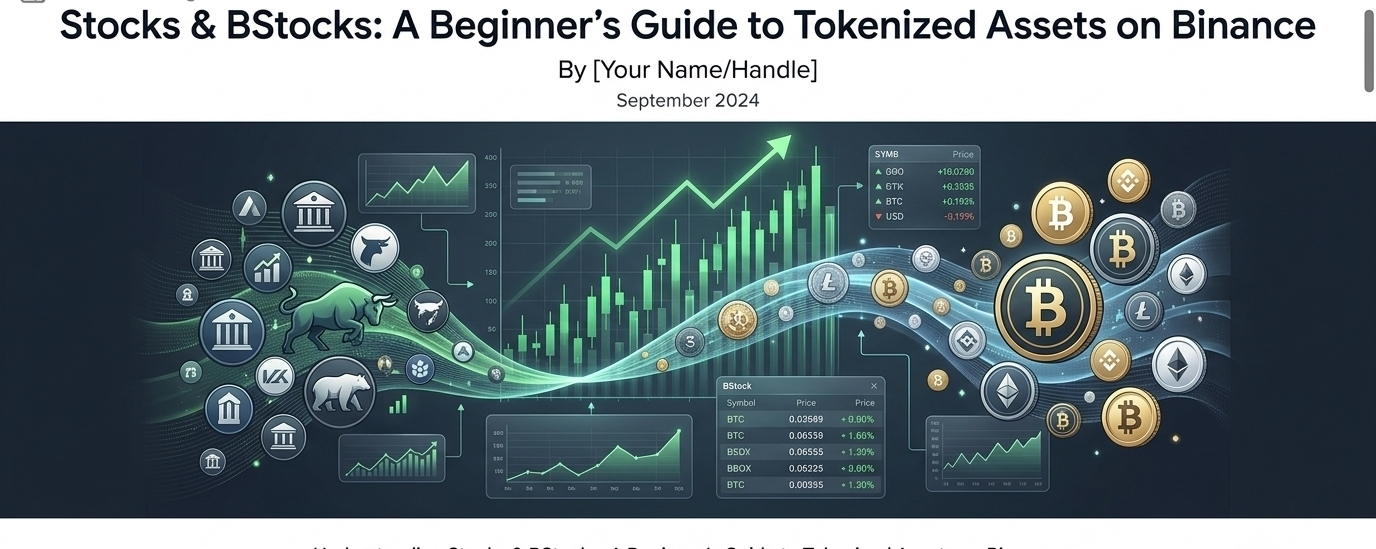
Article
Understanding Stocks & BStocks: A Beginner’s Guide to Tokenized Assets on BinanceUnderstanding Stocks & BStocks: A Beginner’s Guide to Tokenized Assets on Binance
Introduction
In recent years, the intersection of traditional finance (TradFi) and decentralized finance (DeFi) has created unprecedented opportunities for investors worldwide. One of the most exciting developments in this space is the introduction of tokenized stocks, often referred to as BStocks on crypto platforms like Binance. Whether you are a seasoned stock market investor or a crypto enthusiast looking to diversify your portfolio, understanding how Stocks and BStocks work is essential for navigating the modern financial landscape.
What Are Traditional Stocks?
A stock represents fractional ownership in a company. When you purchase a share of a corporation, such as Apple, Tesla, or Microsoft, you own a small percentage of that business. Historically, trading traditional stocks required going through traditional brokerage firms, adhering to standard stock market operating hours, and dealing with geographical or financial barriers. While traditional stock markets have built the global economy for decades, they often lack the flexibility, accessibility, and speed that modern digital native investors demand.
What Are BStocks (Tokenized Stocks)?
BStocks, or tokenized stocks, bridge the gap between traditional equity markets and blockchain technology. A BStock is essentially a digital token on a blockchain that represents the value of an underlying real-world stock or equity.
Here is how BStocks transform the investment experience:
24/7 Market Access: Traditional stock markets operate on fixed business hours. BStocks and crypto markets, on the other hand, allow users to trade, monitor, and manage their positions around the clock.
Fractional Ownership: High-value stocks can sometimes be expensive for retail investors. Tokenization enables fractional ownership, meaning you can buy a fraction of a high-priced share with a lower capital outlay.
Seamless Liquidity & Speed: Trading stocks on a crypto platform like Binance allows investors to instantly move funds between cryptocurrencies, stablecoins, and tokenized assets without waiting for lengthy settlement periods.
Global Accessibility: Investors from regions with limited access to international stock brokerages can gain exposure to global markets through tokenized offerings.
Why Traditional Investors and Crypto Users Should Care
For Crypto Traders: Cryptocurrency markets are notoriously volatile. Incorporating BStocks into a crypto portfolio provides exposure to real-world corporate performance, offering a strategic way to hedge against crypto market fluctuations without off-ramping into fiat currency.
For Stock Investors: Traditional investors gain exposure to the efficiency, speed, and cross-border capabilities of blockchain technology, streamlining asset movement and reducing administrative friction.
Conclusion & Final Thoughts
The fusion of traditional equities with blockchain technology through BStocks marks a significant milestone in modern finance. It democratizes access to global assets, enhances liquidity, and offers strategic portfolio diversification for all types of investors. As Binance continues to innovate and expand its ecosystem, learning about and utilizing BStocks allows users to stay ahead of the curve in the evolving world of Web3 finance.
Disclaimer: This article is for educational and informational purposes only and should not be considered financial advice. Always conduct your own research (DYOR) before making any investment decisions.
@BinanceBurmese
#SEABstock
#SEAstock
#BinanceBurmese
Understanding Stocks & BStocks: A Beginner’s Guide to Tokenized Assets on Binance
Understanding Stocks & BStocks: A Beginner’s Guide to Tokenized Assets on Binance
Introduction
In recent years, the intersection of traditional finance (TradFi) and decentralized finance (DeFi) has created unprecedented opportunities for investors worldwide. One of the most exciting developments in this space is the introduction of tokenized stocks, often referred to as BStocks on crypto platforms like Binance. Whether you are a seasoned stock market investor or a crypto enthusiast looking to diversify your portfolio, understanding how Stocks and BStocks work is essential for navigating the modern financial landscape.
What Are Traditional Stocks?
A stock represents fractional ownership in a company. When you purchase a share of a corporation, such as Apple, Tesla, or Microsoft, you own a small percentage of that business. Historically, trading traditional stocks required going through traditional brokerage firms, adhering to standard stock market operating hours, and dealing with geographical or financial barriers. While traditional stock markets have built the global economy for decades, they often lack the flexibility, accessibility, and speed that modern digital native investors demand.
What Are BStocks (Tokenized Stocks)?
BStocks, or tokenized stocks, bridge the gap between traditional equity markets and blockchain technology. A BStock is essentially a digital token on a blockchain that represents the value of an underlying real-world stock or equity.
Here is how BStocks transform the investment experience:
24/7 Market Access: Traditional stock markets operate on fixed business hours. BStocks and crypto markets, on the other hand, allow users to trade, monitor, and manage their positions around the clock.
Fractional Ownership: High-value stocks can sometimes be expensive for retail investors. Tokenization enables fractional ownership, meaning you can buy a fraction of a high-priced share with a lower capital outlay.
Seamless Liquidity & Speed: Trading stocks on a crypto platform like Binance allows investors to instantly move funds between cryptocurrencies, stablecoins, and tokenized assets without waiting for lengthy settlement periods.
Global Accessibility: Investors from regions with limited access to international stock brokerages can gain exposure to global markets through tokenized offerings.
Why Traditional Investors and Crypto Users Should Care
For Crypto Traders: Cryptocurrency markets are notoriously volatile. Incorporating BStocks into a crypto portfolio provides exposure to real-world corporate performance, offering a strategic way to hedge against crypto market fluctuations without off-ramping into fiat currency.
For Stock Investors: Traditional investors gain exposure to the efficiency, speed, and cross-border capabilities of blockchain technology, streamlining asset movement and reducing administrative friction.
Conclusion & Final Thoughts
The fusion of traditional equities with blockchain technology through BStocks marks a significant milestone in modern finance. It democratizes access to global assets, enhances liquidity, and offers strategic portfolio diversification for all types of investors. As Binance continues to innovate and expand its ecosystem, learning about and utilizing BStocks allows users to stay ahead of the curve in the evolving world of Web3 finance.
Disclaimer: This article is for educational and informational purposes only and should not be considered financial advice. Always conduct your own research (DYOR) before making any investment decisions.
@Binance Burmese
#SEABstock
#SEAstock
#BinanceBurmese
Introduction
In recent years, the intersection of traditional finance (TradFi) and decentralized finance (DeFi) has created unprecedented opportunities for investors worldwide. One of the most exciting developments in this space is the introduction of tokenized stocks, often referred to as BStocks on crypto platforms like Binance. Whether you are a seasoned stock market investor or a crypto enthusiast looking to diversify your portfolio, understanding how Stocks and BStocks work is essential for navigating the modern financial landscape.
What Are Traditional Stocks?
A stock represents fractional ownership in a company. When you purchase a share of a corporation, such as Apple, Tesla, or Microsoft, you own a small percentage of that business. Historically, trading traditional stocks required going through traditional brokerage firms, adhering to standard stock market operating hours, and dealing with geographical or financial barriers. While traditional stock markets have built the global economy for decades, they often lack the flexibility, accessibility, and speed that modern digital native investors demand.
What Are BStocks (Tokenized Stocks)?
BStocks, or tokenized stocks, bridge the gap between traditional equity markets and blockchain technology. A BStock is essentially a digital token on a blockchain that represents the value of an underlying real-world stock or equity.
Here is how BStocks transform the investment experience:
24/7 Market Access: Traditional stock markets operate on fixed business hours. BStocks and crypto markets, on the other hand, allow users to trade, monitor, and manage their positions around the clock.
Fractional Ownership: High-value stocks can sometimes be expensive for retail investors. Tokenization enables fractional ownership, meaning you can buy a fraction of a high-priced share with a lower capital outlay.
Seamless Liquidity & Speed: Trading stocks on a crypto platform like Binance allows investors to instantly move funds between cryptocurrencies, stablecoins, and tokenized assets without waiting for lengthy settlement periods.
Global Accessibility: Investors from regions with limited access to international stock brokerages can gain exposure to global markets through tokenized offerings.
Why Traditional Investors and Crypto Users Should Care
For Crypto Traders: Cryptocurrency markets are notoriously volatile. Incorporating BStocks into a crypto portfolio provides exposure to real-world corporate performance, offering a strategic way to hedge against crypto market fluctuations without off-ramping into fiat currency.
For Stock Investors: Traditional investors gain exposure to the efficiency, speed, and cross-border capabilities of blockchain technology, streamlining asset movement and reducing administrative friction.
Conclusion & Final Thoughts
The fusion of traditional equities with blockchain technology through BStocks marks a significant milestone in modern finance. It democratizes access to global assets, enhances liquidity, and offers strategic portfolio diversification for all types of investors. As Binance continues to innovate and expand its ecosystem, learning about and utilizing BStocks allows users to stay ahead of the curve in the evolving world of Web3 finance.
Disclaimer: This article is for educational and informational purposes only and should not be considered financial advice. Always conduct your own research (DYOR) before making any investment decisions.
@Binance Burmese
#SEABstock
#SEAstock
#BinanceBurmese
waigyipku:
ok
21
3
24
182

·
--

Article
BStocks 101: Curious About US Stocks on Binance? Here’s My Beginner Journey 📈✨Hello Binance Square family! 👋
I’m Jihsu, and like many people in the crypto community, I started my Binance journey mainly by learning about crypto. At first, I spent a lot of time looking at charts, learning about different coins, watching market movements, and trying to understand why prices could move so quickly. Over time, I realized that there is a much bigger financial world outside crypto too.
That is why Binance BStocks caught my attention.
For someone who is already familiar with crypto but has never seriously studied traditional stocks, the idea of exploring stocks through a platform I already know feels interesting. However, I also think it is important to slow down and learn before putting money into any new product.
So today I want to share what I have been learning about BStocks and some simple things I think beginners should understand.
What are BStocks? 🤔
BStocks is Binance’s tokenized stock product. Binance describes BStocks as a way to buy well-known public companies using crypto.
This is interesting because crypto users are already familiar with digital assets, wallets, trading interfaces, and market charts. BStocks introduces another type of market exposure into an environment that may feel more familiar to people who already use Binance.
But there is an important point: understanding what you are buying is still necessary.
A stock represents an investment related to a company, while a crypto asset can have very different characteristics. Tokenized stock products can also have their own terms, availability, risks, and restrictions.
So I don't think the right approach is simply saying, “I already understand crypto, therefore I automatically understand stocks.”
Instead, I would say:
Learn the product first, then decide whether it fits your own goals and risk tolerance.
Stocks and Crypto are not the same 📊
One of the biggest lessons I have learned from exploring different markets is that every market has its own behavior.
Crypto markets can operate differently from traditional stock markets. Crypto assets may experience large price movements, while stocks are connected to companies, financial results, business conditions, economic developments, and investor expectations.
For example, when looking at a company stock, a beginner may want to learn about:
• What does the company actually do?
• How does the company make money?
• What are its major products or services?
• How have its revenues and profits changed?
• What risks could affect the business?
• What is happening in the industry?
• How could broader economic conditions affect the company?
These questions are very different from simply asking whether a coin's chart is going up or down.
That is why I want to approach stocks with a learning mindset rather than treating them exactly like crypto.
My beginner checklist before exploring a stock 📝
If I am interested in a company, I would first create a simple checklist.
1. Understand the company
Before looking at the price, I want to know what the business actually does. A company can be popular online, but popularity alone does not explain its financial condition.
2. Understand the product
If I am using BStocks, I want to understand how the specific BStocks product works, including its terms, availability, trading conditions, and any limitations that apply to my region.
3. Look beyond the chart
A green chart can be exciting, but a chart does not tell the entire story. I would also want to learn about company news, earnings, business performance, and broader market conditions.
4. Think about risk
Every investment involves risk. I should never assume that a stock will automatically increase just because a company is famous.
5. Avoid using money I cannot afford to lose
This is something I learned from my own experience in trading. When I entered markets without enough preparation, I sometimes focused too much on the potential profit and not enough on the potential loss.
That experience changed the way I think about learning.
From crypto trader to broader investor mindset 🌍
For me, exploring BStocks is not about leaving crypto behind.
It is about learning something new.
Crypto introduced me to digital markets, trading psychology, charts, volatility, and risk management. Now stocks give me another opportunity to learn about companies, financial statements, business models, and traditional markets.
I think this is one of the most interesting parts of having access to different financial products: you can compare how different markets work instead of assuming that one market behaves exactly like another.
For example, when I see a company that I personally like, I want to separate “I like this company” from “I understand this investment.”
Those are two completely different statements.
Liking a company's products does not automatically mean its stock will rise. Similarly, seeing a stock price fall does not automatically mean the underlying company is becoming worthless.
There are many factors involved.
What I want to learn next 📚
My next step is not to search for a “perfect stock.”
Instead, I want to become better at asking questions.
I want to understand company earnings, revenue growth, valuation concepts, market capitalization, dividends, economic cycles, and the relationship between company performance and stock prices.
I also want to improve my ability to read financial information without relying entirely on someone else's opinion.
This is especially important for people who are coming from crypto.
Crypto communities can move very quickly. People often share charts, predictions, narratives, and trading ideas. Those can be useful for learning, but I believe beginners should still verify information and make their own decisions.
The same principle applies when learning about stocks.
A small reminder for beginners ❤️
If you are a crypto user who is curious about stocks or BStocks, you don't need to understand everything in one day.
Start with the basics.
Learn what a stock is.
Learn what BStocks is.
Learn how the specific product works.
Read the relevant terms and availability information.
Study companies before focusing on their prices.
Understand the risks.
And most importantly, don't confuse education with a guarantee of profit.
Binance has recently been introducing educational content around Stocks Trading, including Binance Academy sessions discussing Binance Stocks Trading.
For users in Myanmar, I also recommend following the official Binance Burmese account on Binance Square for relevant local-language updates and educational content.
For me, this is the beginning of another learning journey.
I started with crypto.
Now I am curious about stocks.
And with BStocks, I have another opportunity to learn how these two worlds can be different while still teaching me important lessons about markets, discipline, research, and risk.
I’m Jihsu, and I’m not here to tell you what to buy.
I’m here to keep learning, keep asking questions, and share what I discover along the way. 🌱📈
What are you most interested in learning about BStocks — how BStocks work, how stocks differ from crypto, or how beginners can research a company? 👇
@BinanceBurmese
#SEABstock
#SEAstock
#BinanceBurmese
BStocks 101: Curious About US Stocks on Binance? Here’s My Beginner Journey 📈✨
Hello Binance Square family! 👋
I’m Jihsu, and like many people in the crypto community, I started my Binance journey mainly by learning about crypto. At first, I spent a lot of time looking at charts, learning about different coins, watching market movements, and trying to understand why prices could move so quickly. Over time, I realized that there is a much bigger financial world outside crypto too.
That is why Binance BStocks caught my attention.
For someone who is already familiar with crypto but has never seriously studied traditional stocks, the idea of exploring stocks through a platform I already know feels interesting. However, I also think it is important to slow down and learn before putting money into any new product.
So today I want to share what I have been learning about BStocks and some simple things I think beginners should understand.
What are BStocks? 🤔
BStocks is Binance’s tokenized stock product. Binance describes BStocks as a way to buy well-known public companies using crypto.
This is interesting because crypto users are already familiar with digital assets, wallets, trading interfaces, and market charts. BStocks introduces another type of market exposure into an environment that may feel more familiar to people who already use Binance.
But there is an important point: understanding what you are buying is still necessary.
A stock represents an investment related to a company, while a crypto asset can have very different characteristics. Tokenized stock products can also have their own terms, availability, risks, and restrictions.
So I don't think the right approach is simply saying, “I already understand crypto, therefore I automatically understand stocks.”
Instead, I would say:
Learn the product first, then decide whether it fits your own goals and risk tolerance.
Stocks and Crypto are not the same 📊
One of the biggest lessons I have learned from exploring different markets is that every market has its own behavior.
Crypto markets can operate differently from traditional stock markets. Crypto assets may experience large price movements, while stocks are connected to companies, financial results, business conditions, economic developments, and investor expectations.
For example, when looking at a company stock, a beginner may want to learn about:
• What does the company actually do?
• How does the company make money?
• What are its major products or services?
• How have its revenues and profits changed?
• What risks could affect the business?
• What is happening in the industry?
• How could broader economic conditions affect the company?
These questions are very different from simply asking whether a coin's chart is going up or down.
That is why I want to approach stocks with a learning mindset rather than treating them exactly like crypto.
My beginner checklist before exploring a stock 📝
If I am interested in a company, I would first create a simple checklist.
1. Understand the company
Before looking at the price, I want to know what the business actually does. A company can be popular online, but popularity alone does not explain its financial condition.
2. Understand the product
If I am using BStocks, I want to understand how the specific BStocks product works, including its terms, availability, trading conditions, and any limitations that apply to my region.
3. Look beyond the chart
A green chart can be exciting, but a chart does not tell the entire story. I would also want to learn about company news, earnings, business performance, and broader market conditions.
4. Think about risk
Every investment involves risk. I should never assume that a stock will automatically increase just because a company is famous.
5. Avoid using money I cannot afford to lose
This is something I learned from my own experience in trading. When I entered markets without enough preparation, I sometimes focused too much on the potential profit and not enough on the potential loss.
That experience changed the way I think about learning.
From crypto trader to broader investor mindset 🌍
For me, exploring BStocks is not about leaving crypto behind.
It is about learning something new.
Crypto introduced me to digital markets, trading psychology, charts, volatility, and risk management. Now stocks give me another opportunity to learn about companies, financial statements, business models, and traditional markets.
I think this is one of the most interesting parts of having access to different financial products: you can compare how different markets work instead of assuming that one market behaves exactly like another.
For example, when I see a company that I personally like, I want to separate “I like this company” from “I understand this investment.”
Those are two completely different statements.
Liking a company's products does not automatically mean its stock will rise. Similarly, seeing a stock price fall does not automatically mean the underlying company is becoming worthless.
There are many factors involved.
What I want to learn next 📚
My next step is not to search for a “perfect stock.”
Instead, I want to become better at asking questions.
I want to understand company earnings, revenue growth, valuation concepts, market capitalization, dividends, economic cycles, and the relationship between company performance and stock prices.
I also want to improve my ability to read financial information without relying entirely on someone else's opinion.
This is especially important for people who are coming from crypto.
Crypto communities can move very quickly. People often share charts, predictions, narratives, and trading ideas. Those can be useful for learning, but I believe beginners should still verify information and make their own decisions.
The same principle applies when learning about stocks.
A small reminder for beginners ❤️
If you are a crypto user who is curious about stocks or BStocks, you don't need to understand everything in one day.
Start with the basics.
Learn what a stock is.
Learn what BStocks is.
Learn how the specific product works.
Read the relevant terms and availability information.
Study companies before focusing on their prices.
Understand the risks.
And most importantly, don't confuse education with a guarantee of profit.
Binance has recently been introducing educational content around Stocks Trading, including Binance Academy sessions discussing Binance Stocks Trading.
For users in Myanmar, I also recommend following the official Binance Burmese account on Binance Square for relevant local-language updates and educational content.
For me, this is the beginning of another learning journey.
I started with crypto.
Now I am curious about stocks.
And with BStocks, I have another opportunity to learn how these two worlds can be different while still teaching me important lessons about markets, discipline, research, and risk.
I’m Jihsu, and I’m not here to tell you what to buy.
I’m here to keep learning, keep asking questions, and share what I discover along the way. 🌱📈
What are you most interested in learning about BStocks — how BStocks work, how stocks differ from crypto, or how beginners can research a company? 👇
@Binance Burmese
#SEABstock
#SEAstock
#BinanceBurmese
I’m Jihsu, and like many people in the crypto community, I started my Binance journey mainly by learning about crypto. At first, I spent a lot of time looking at charts, learning about different coins, watching market movements, and trying to understand why prices could move so quickly. Over time, I realized that there is a much bigger financial world outside crypto too.
That is why Binance BStocks caught my attention.
For someone who is already familiar with crypto but has never seriously studied traditional stocks, the idea of exploring stocks through a platform I already know feels interesting. However, I also think it is important to slow down and learn before putting money into any new product.
So today I want to share what I have been learning about BStocks and some simple things I think beginners should understand.
What are BStocks? 🤔
BStocks is Binance’s tokenized stock product. Binance describes BStocks as a way to buy well-known public companies using crypto.
This is interesting because crypto users are already familiar with digital assets, wallets, trading interfaces, and market charts. BStocks introduces another type of market exposure into an environment that may feel more familiar to people who already use Binance.
But there is an important point: understanding what you are buying is still necessary.
A stock represents an investment related to a company, while a crypto asset can have very different characteristics. Tokenized stock products can also have their own terms, availability, risks, and restrictions.
So I don't think the right approach is simply saying, “I already understand crypto, therefore I automatically understand stocks.”
Instead, I would say:
Learn the product first, then decide whether it fits your own goals and risk tolerance.
Stocks and Crypto are not the same 📊
One of the biggest lessons I have learned from exploring different markets is that every market has its own behavior.
Crypto markets can operate differently from traditional stock markets. Crypto assets may experience large price movements, while stocks are connected to companies, financial results, business conditions, economic developments, and investor expectations.
For example, when looking at a company stock, a beginner may want to learn about:
• What does the company actually do?
• How does the company make money?
• What are its major products or services?
• How have its revenues and profits changed?
• What risks could affect the business?
• What is happening in the industry?
• How could broader economic conditions affect the company?
These questions are very different from simply asking whether a coin's chart is going up or down.
That is why I want to approach stocks with a learning mindset rather than treating them exactly like crypto.
My beginner checklist before exploring a stock 📝
If I am interested in a company, I would first create a simple checklist.
1. Understand the company
Before looking at the price, I want to know what the business actually does. A company can be popular online, but popularity alone does not explain its financial condition.
2. Understand the product
If I am using BStocks, I want to understand how the specific BStocks product works, including its terms, availability, trading conditions, and any limitations that apply to my region.
3. Look beyond the chart
A green chart can be exciting, but a chart does not tell the entire story. I would also want to learn about company news, earnings, business performance, and broader market conditions.
4. Think about risk
Every investment involves risk. I should never assume that a stock will automatically increase just because a company is famous.
5. Avoid using money I cannot afford to lose
This is something I learned from my own experience in trading. When I entered markets without enough preparation, I sometimes focused too much on the potential profit and not enough on the potential loss.
That experience changed the way I think about learning.
From crypto trader to broader investor mindset 🌍
For me, exploring BStocks is not about leaving crypto behind.
It is about learning something new.
Crypto introduced me to digital markets, trading psychology, charts, volatility, and risk management. Now stocks give me another opportunity to learn about companies, financial statements, business models, and traditional markets.
I think this is one of the most interesting parts of having access to different financial products: you can compare how different markets work instead of assuming that one market behaves exactly like another.
For example, when I see a company that I personally like, I want to separate “I like this company” from “I understand this investment.”
Those are two completely different statements.
Liking a company's products does not automatically mean its stock will rise. Similarly, seeing a stock price fall does not automatically mean the underlying company is becoming worthless.
There are many factors involved.
What I want to learn next 📚
My next step is not to search for a “perfect stock.”
Instead, I want to become better at asking questions.
I want to understand company earnings, revenue growth, valuation concepts, market capitalization, dividends, economic cycles, and the relationship between company performance and stock prices.
I also want to improve my ability to read financial information without relying entirely on someone else's opinion.
This is especially important for people who are coming from crypto.
Crypto communities can move very quickly. People often share charts, predictions, narratives, and trading ideas. Those can be useful for learning, but I believe beginners should still verify information and make their own decisions.
The same principle applies when learning about stocks.
A small reminder for beginners ❤️
If you are a crypto user who is curious about stocks or BStocks, you don't need to understand everything in one day.
Start with the basics.
Learn what a stock is.
Learn what BStocks is.
Learn how the specific product works.
Read the relevant terms and availability information.
Study companies before focusing on their prices.
Understand the risks.
And most importantly, don't confuse education with a guarantee of profit.
Binance has recently been introducing educational content around Stocks Trading, including Binance Academy sessions discussing Binance Stocks Trading.
For users in Myanmar, I also recommend following the official Binance Burmese account on Binance Square for relevant local-language updates and educational content.
For me, this is the beginning of another learning journey.
I started with crypto.
Now I am curious about stocks.
And with BStocks, I have another opportunity to learn how these two worlds can be different while still teaching me important lessons about markets, discipline, research, and risk.
I’m Jihsu, and I’m not here to tell you what to buy.
I’m here to keep learning, keep asking questions, and share what I discover along the way. 🌱📈
What are you most interested in learning about BStocks — how BStocks work, how stocks differ from crypto, or how beginners can research a company? 👇
@Binance Burmese
#SEABstock
#SEAstock
#BinanceBurmese
Soe Nyein Htwe:
🪝🪝🪝🪝
120
10
143
373

·
--
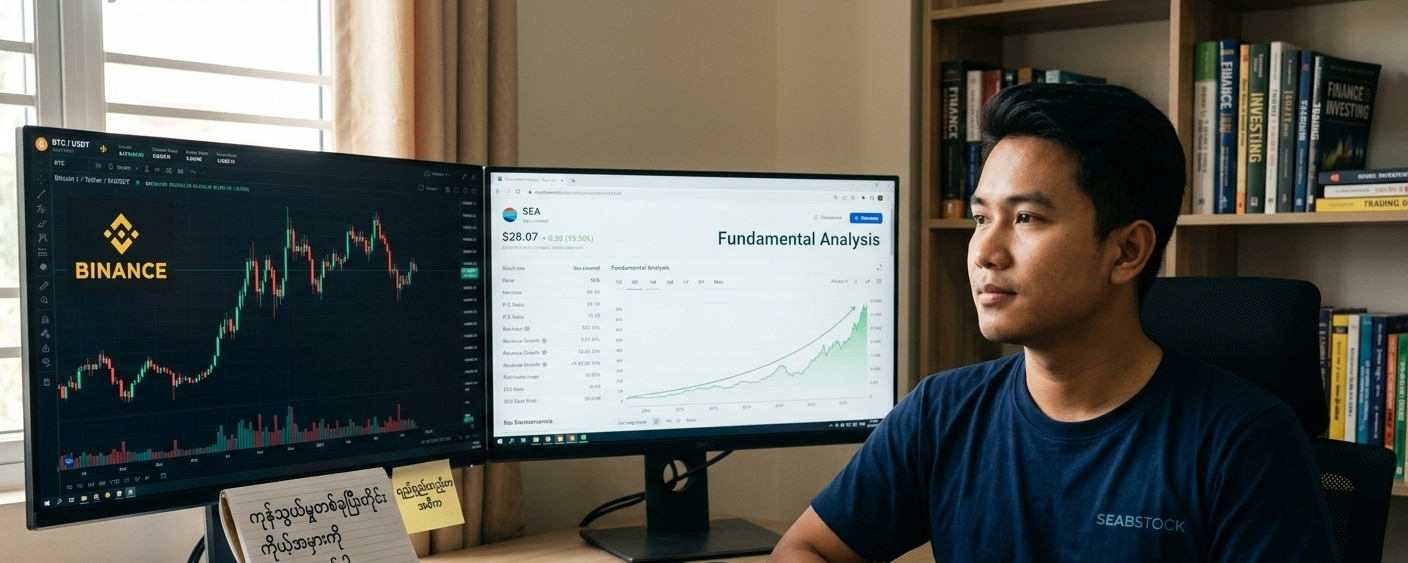
Article
From Crypto to US Stocks — A Trader’s ExperienceAs a crypto trader, when I tried stocks, I learned things like…
I’m someone who has been trading crypto.
At first, I thought crypto and the stock market were two separate worlds. Crypto can be traded 24/7, price movements are fast, and volatility is high. The stock market seemed more traditional to me, with companies, earnings, and financial reports.
From Crypto to US Stocks — A Trader’s Experience
As a crypto trader, when I tried stocks, I learned things like…
I’m someone who has been trading crypto.
At first, I thought crypto and the stock market were two separate worlds. Crypto can be traded 24/7, price movements are fast, and volatility is high. The stock market seemed more traditional to me, with companies, earnings, and financial reports.
I’m someone who has been trading crypto.
At first, I thought crypto and the stock market were two separate worlds. Crypto can be traded 24/7, price movements are fast, and volatility is high. The stock market seemed more traditional to me, with companies, earnings, and financial reports.
Lisabeth Ruzzo Egx2:
very good
40
3
39
109

·
--
Bullish
What do you think Bro and sis? How much you totally lost in Binance ?Win or Lose Say Everything $AMZNB $BTC $SOL
#SaylorHintsStrategyBitcoinBuy #BOJRaisesRatesTo31YearHigh #BTCBreaks80K #BinanceSquareFamily #BinanceBurmese GO To The Moon and Crypto GO To The Upper Way
So I Need Support of my pin Post 📯 📯 📯
What do you think Bro and sis? How much you totally lost in Binance ?Win or Lose Say Everything $AMZNB $BTC $SOL
#SaylorHintsStrategyBitcoinBuy #BOJRaisesRatesTo31YearHigh #BTCBreaks80K #BinanceSquareFamily #BinanceBurmese GO To The Moon and Crypto GO To The Upper Way
So I Need Support of my pin Post 📯 📯 📯
#SaylorHintsStrategyBitcoinBuy #BOJRaisesRatesTo31YearHigh #BTCBreaks80K #BinanceSquareFamily #BinanceBurmese GO To The Moon and Crypto GO To The Upper Way
So I Need Support of my pin Post 📯 📯 📯
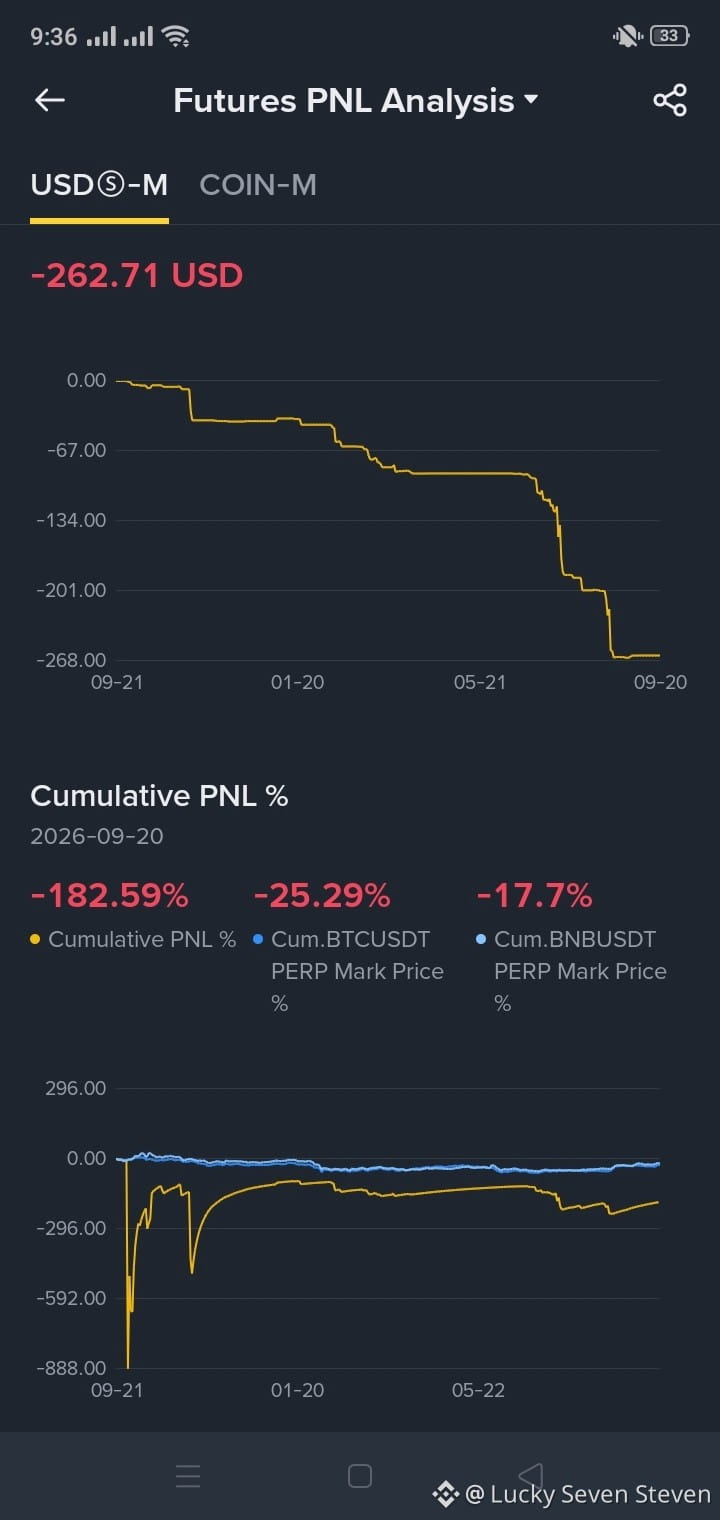
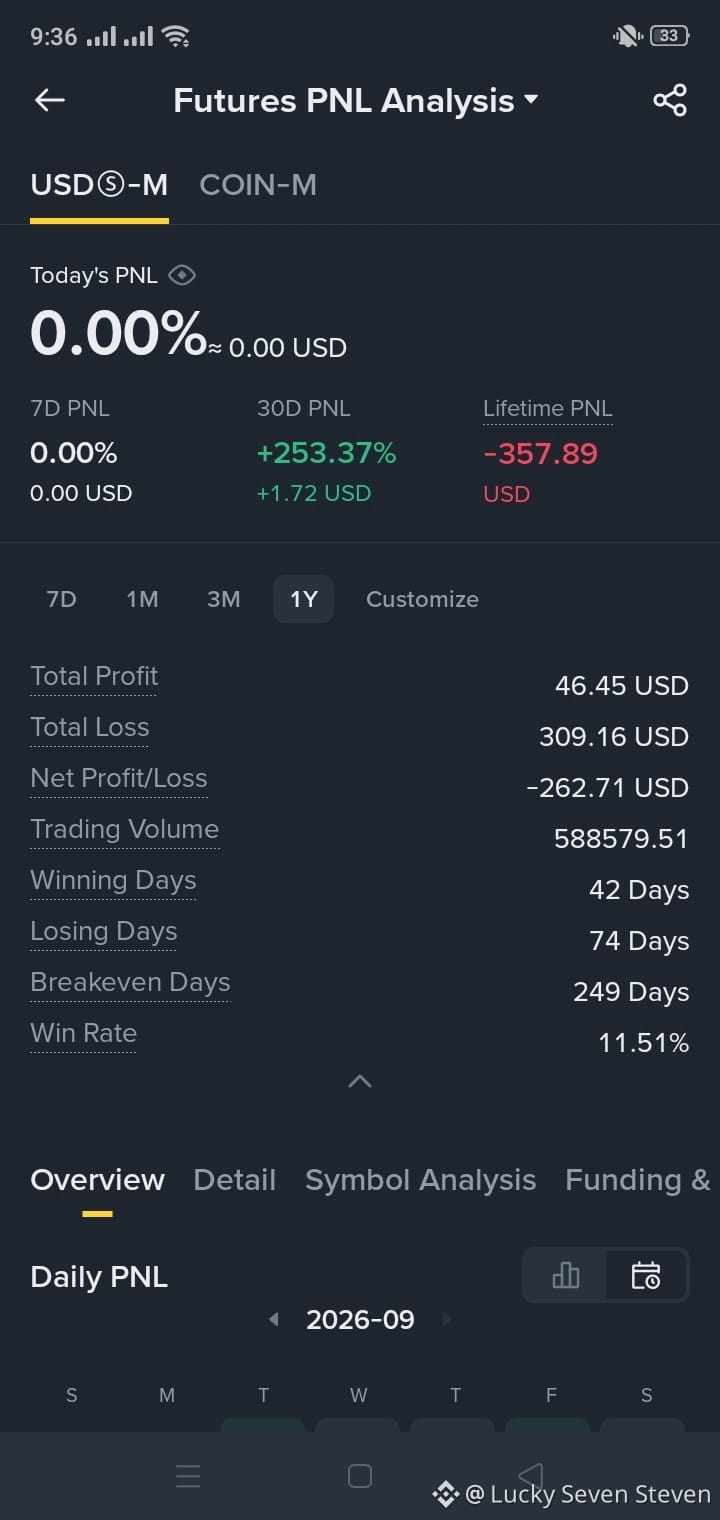
92
Religion in a scientific Age"Religion without science is crippled, while science without religion is blind"
Today we live in a scientific Age in which almost every aspect of our lives has been affected by science. Since the scientific revolution during the seventh century, science had continued to exert tremendous influence on what we think and do.
The impact of science has been particularly strong on traditional religious belief.Many religious concepts are crumbling under the pressure of modern science and are no longer acceptable to the intellectual and the well informed man. No longer is it possible to assert truth derived merely through theological speculations or based on the authority of religious scriptures in isolation to scientific consideration. For example, the finding of modern psychologists indicate that the human mind, like a physical body, work according to natural causal laws without the presence of an unchanging soul as taught by some religious.
Some religious person choose to disregard scientific discoveries which conflict with their religious dogmas.The modern man also refuses to believe anything blingly, even though it had been traditionally accepted.On the other hand, some religion have found it necessary to accommodate popularly accepted scientific theories by giving new interpretations to their religious dogmas.
#BinanceBurmese #BinanceSquareFamily
#God #religion #BinanceSquareTalks
Religion in a scientific Age
"Religion without science is crippled, while science without religion is blind"
Today we live in a scientific Age in which almost every aspect of our lives has been affected by science. Since the scientific revolution during the seventh century, science had continued to exert tremendous influence on what we think and do.
The impact of science has been particularly strong on traditional religious belief.Many religious concepts are crumbling under the pressure of modern science and are no longer acceptable to the intellectual and the well informed man. No longer is it possible to assert truth derived merely through theological speculations or based on the authority of religious scriptures in isolation to scientific consideration. For example, the finding of modern psychologists indicate that the human mind, like a physical body, work according to natural causal laws without the presence of an unchanging soul as taught by some religious.
Some religious person choose to disregard scientific discoveries which conflict with their religious dogmas.The modern man also refuses to believe anything blingly, even though it had been traditionally accepted.On the other hand, some religion have found it necessary to accommodate popularly accepted scientific theories by giving new interpretations to their religious dogmas.
#BinanceBurmese #BinanceSquareFamily
#God #religion #BinanceSquareTalks
Today we live in a scientific Age in which almost every aspect of our lives has been affected by science. Since the scientific revolution during the seventh century, science had continued to exert tremendous influence on what we think and do.
The impact of science has been particularly strong on traditional religious belief.Many religious concepts are crumbling under the pressure of modern science and are no longer acceptable to the intellectual and the well informed man. No longer is it possible to assert truth derived merely through theological speculations or based on the authority of religious scriptures in isolation to scientific consideration. For example, the finding of modern psychologists indicate that the human mind, like a physical body, work according to natural causal laws without the presence of an unchanging soul as taught by some religious.
Some religious person choose to disregard scientific discoveries which conflict with their religious dogmas.The modern man also refuses to believe anything blingly, even though it had been traditionally accepted.On the other hand, some religion have found it necessary to accommodate popularly accepted scientific theories by giving new interpretations to their religious dogmas.
#BinanceBurmese #BinanceSquareFamily
#God #religion #BinanceSquareTalks
95
·
--
Crypto market brief — September 3
BTC: $77,823.99, up ~0.2% over the past 24 hours. It traded between $76,264 and $77,900.
ETH: $2,405.89, down ~0.7%. Its 24-hour range was $2,356–$2,429.
BNB: $695.35, up ~0.9%, near the top of its daily range.
Market tone: mixed and fairly cautious. Bitcoin is holding close to $78K, while ETH and several major altcoins are softer. The latest session appears influenced by broader macro sensitivity—especially interest-rate expectations and risk appetite—alongside uneven institutional-flow signals.
What else is moving the narrative: stablecoin adoption remains in focus, with a group of major financial institutions reportedly planning a dollar-stablecoin initiative; regulatory developments in Thailand are also drawing attention after new crypto transfer-compliance rules.
Bottom line: majors are consolidating rather than showing a broad, unified move. Short-term volatility can remain elevated, especially around macro headlines and fund-flow updates. This is market information, not investment advice.
#CryptoMarket #BinanceSquare
#BinanceBurmese #DYOR🟢
Crypto market brief — September 3
BTC: $77,823.99, up ~0.2% over the past 24 hours. It traded between $76,264 and $77,900.
ETH: $2,405.89, down ~0.7%. Its 24-hour range was $2,356–$2,429.
BNB: $695.35, up ~0.9%, near the top of its daily range.
Market tone: mixed and fairly cautious. Bitcoin is holding close to $78K, while ETH and several major altcoins are softer. The latest session appears influenced by broader macro sensitivity—especially interest-rate expectations and risk appetite—alongside uneven institutional-flow signals.
What else is moving the narrative: stablecoin adoption remains in focus, with a group of major financial institutions reportedly planning a dollar-stablecoin initiative; regulatory developments in Thailand are also drawing attention after new crypto transfer-compliance rules.
Bottom line: majors are consolidating rather than showing a broad, unified move. Short-term volatility can remain elevated, especially around macro headlines and fund-flow updates. This is market information, not investment advice.
#CryptoMarket #BinanceSquare
#BinanceBurmese #DYOR🟢
BTC: $77,823.99, up ~0.2% over the past 24 hours. It traded between $76,264 and $77,900.
ETH: $2,405.89, down ~0.7%. Its 24-hour range was $2,356–$2,429.
BNB: $695.35, up ~0.9%, near the top of its daily range.
Market tone: mixed and fairly cautious. Bitcoin is holding close to $78K, while ETH and several major altcoins are softer. The latest session appears influenced by broader macro sensitivity—especially interest-rate expectations and risk appetite—alongside uneven institutional-flow signals.
What else is moving the narrative: stablecoin adoption remains in focus, with a group of major financial institutions reportedly planning a dollar-stablecoin initiative; regulatory developments in Thailand are also drawing attention after new crypto transfer-compliance rules.
Bottom line: majors are consolidating rather than showing a broad, unified move. Short-term volatility can remain elevated, especially around macro headlines and fund-flow updates. This is market information, not investment advice.
#CryptoMarket #BinanceSquare
#BinanceBurmese #DYOR🟢
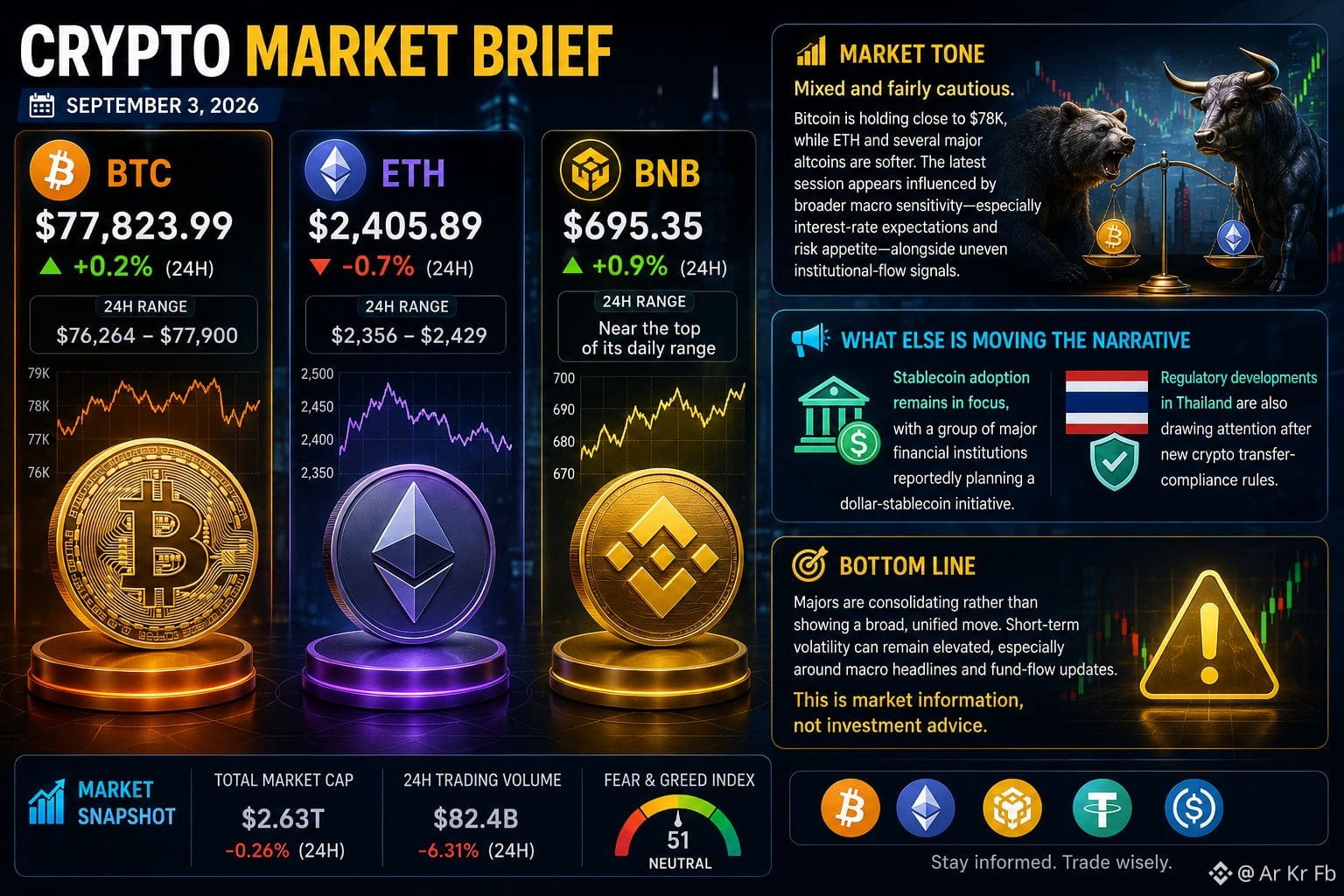
93
Log in to explore more content
Join global crypto users on Binance Square
⚡️ Get latest and useful information about crypto.
💬 Trusted by the world’s largest crypto exchange.
👍 Discover real insights from verified creators.
Email / Phone number
Trending Topics
1
#BinanceWillListHyperliquid(HYPE)
135,116 views
2,416 Discussing
2
#FedOctoberRateHikeOddsRiseTo69.7%
43,105 views
978 Discussing
3
#BitcoinFallsBelow$83,000
3,913 views
20 Discussing
4
#BitcoinFallsToAround$84,600ThisWeek
0 views
0 Discussing
5
#US30YearYieldHighestSince2004
34,273 views
759 Discussing
6
#ETHBreaksAbove$2,700
1,642 views
19 Discussing
7
#USWeighsPromotingDollarStablecoinsAbroad
70,229 views
1,661 Discussing
8
#US10YTreasuryYieldHits19YearHigh
71,992 views
1,335 Discussing
9
#SpotBitcoinETFsInflow$2.31BInFourDays
8,001 views
80 Discussing
10
#BitcoinRejectedAt$87,300Twice
0 views
0 Discussing