

#berachain
berachain
1.9M views
2,375 Discussing
Hot
Latest

🚨 $BERA BEFORE KOREA BLOCKCHAIN WEEK — COULD THIS BE THE NEXT GAINER? 👀
$BERA — Berachain | +1.65% 🚀
Why is $BERA interesting right now?
• Berachain is scheduled to participate in The Bridge Summit in Seoul on September 28, during Korea Blockchain Week 2026.
• The event brings projects, institutions, builders and Korean retail participants together, giving Berachain an upcoming exposure/community catalyst.
• Berachain is actively expanding its presence in Korea, including dedicated ecosystem/community efforts.
• A new Minimum Incentive Rates mechanism is also going live on Berachain mainnet, tying WBERA emissions to vault incentives.
Potential:
With BERA still around +1.65% in the Gainers list and multiple ecosystem catalysts ahead, increased volume around the Korea Blockchain Week event could put BERA back on traders' radar. A breakout would still require strong buying volume.
What to watch 👀
🔥 Sep 28 Bridge Summit
🔥 Korea Blockchain Week attention
🔥 Berachain ecosystem activity
🔥 BERA trading volume
🔥 WBERA incentive changes
⚠️ Risk:
An event does not guarantee a price increase. BERA can remain volatile, and traders may also sell into the event if expectations become crowded.
⚠️ DYOR — Do Your Own Research. This is not financial advice.
#Binance #BERA #Berachain #KBW2026 #Crypto #BeforeGainer #BinanceSquare
{spot}(BERAUSDT)
🚨 $BERA BEFORE KOREA BLOCKCHAIN WEEK — COULD THIS BE THE NEXT GAINER? 👀
$BERA — Berachain | +1.65% 🚀
Why is $BERA interesting right now?
• Berachain is scheduled to participate in The Bridge Summit in Seoul on September 28, during Korea Blockchain Week 2026.
• The event brings projects, institutions, builders and Korean retail participants together, giving Berachain an upcoming exposure/community catalyst.
• Berachain is actively expanding its presence in Korea, including dedicated ecosystem/community efforts.
• A new Minimum Incentive Rates mechanism is also going live on Berachain mainnet, tying WBERA emissions to vault incentives.
Potential:
With BERA still around +1.65% in the Gainers list and multiple ecosystem catalysts ahead, increased volume around the Korea Blockchain Week event could put BERA back on traders' radar. A breakout would still require strong buying volume.
What to watch 👀
🔥 Sep 28 Bridge Summit
🔥 Korea Blockchain Week attention
🔥 Berachain ecosystem activity
🔥 BERA trading volume
🔥 WBERA incentive changes
⚠️ Risk:
An event does not guarantee a price increase. BERA can remain volatile, and traders may also sell into the event if expectations become crowded.
⚠️ DYOR — Do Your Own Research. This is not financial advice.
#Binance #BERA #Berachain #KBW2026 #Crypto #BeforeGainer #BinanceSquare
$BERA — Berachain | +1.65% 🚀
Why is $BERA interesting right now?
• Berachain is scheduled to participate in The Bridge Summit in Seoul on September 28, during Korea Blockchain Week 2026.
• The event brings projects, institutions, builders and Korean retail participants together, giving Berachain an upcoming exposure/community catalyst.
• Berachain is actively expanding its presence in Korea, including dedicated ecosystem/community efforts.
• A new Minimum Incentive Rates mechanism is also going live on Berachain mainnet, tying WBERA emissions to vault incentives.
Potential:
With BERA still around +1.65% in the Gainers list and multiple ecosystem catalysts ahead, increased volume around the Korea Blockchain Week event could put BERA back on traders' radar. A breakout would still require strong buying volume.
What to watch 👀
🔥 Sep 28 Bridge Summit
🔥 Korea Blockchain Week attention
🔥 Berachain ecosystem activity
🔥 BERA trading volume
🔥 WBERA incentive changes
⚠️ Risk:
An event does not guarantee a price increase. BERA can remain volatile, and traders may also sell into the event if expectations become crowded.
⚠️ DYOR — Do Your Own Research. This is not financial advice.
#Binance #BERA #Berachain #KBW2026 #Crypto #BeforeGainer #BinanceSquare
1
171

BERA — NEXT 24H OUTLOOK 🚨
Berachain is seeing heavy spot and futures turnover following a double-digit percent surge. The next 4H candles will determine whether momentum sustains toward fresh highs or executes a mean-reversion retest.
📍 Key Resistance: 0.205 to 0.218
🟢 Breakout Target: 0.245
🔴 Key Support: 0.182
⚠️ Major Support: 0.168
🔥 BULLISH SCENARIO
If BERA breaks and holds above 0.205:
➡️ 0.218
➡️ 0.245
🐻 BEARISH SCENARIO
If BERA gets rejected and loses 0.182:
➡️ 0.174
➡️ 0.168
🎯 24H BIAS:
🟢 BULLISH above 0.205
⚪ NEUTRAL between 0.182–0.205
🔴 BEARISH below 0.182
Watch the 4H candle close.
Trade with a plan. ⚠️
$BERA
{spot}(BERAUSDT)
#Berachain #BİNANCESQUARE #cryptotrading #futures
BERA — NEXT 24H OUTLOOK 🚨
Berachain is seeing heavy spot and futures turnover following a double-digit percent surge. The next 4H candles will determine whether momentum sustains toward fresh highs or executes a mean-reversion retest.
📍 Key Resistance: 0.205 to 0.218
🟢 Breakout Target: 0.245
🔴 Key Support: 0.182
⚠️ Major Support: 0.168
🔥 BULLISH SCENARIO
If BERA breaks and holds above 0.205:
➡️ 0.218
➡️ 0.245
🐻 BEARISH SCENARIO
If BERA gets rejected and loses 0.182:
➡️ 0.174
➡️ 0.168
🎯 24H BIAS:
🟢 BULLISH above 0.205
⚪ NEUTRAL between 0.182–0.205
🔴 BEARISH below 0.182
Watch the 4H candle close.
Trade with a plan. ⚠️
$BERA
#Berachain #BİNANCESQUARE #cryptotrading #futures
Berachain is seeing heavy spot and futures turnover following a double-digit percent surge. The next 4H candles will determine whether momentum sustains toward fresh highs or executes a mean-reversion retest.
📍 Key Resistance: 0.205 to 0.218
🟢 Breakout Target: 0.245
🔴 Key Support: 0.182
⚠️ Major Support: 0.168
🔥 BULLISH SCENARIO
If BERA breaks and holds above 0.205:
➡️ 0.218
➡️ 0.245
🐻 BEARISH SCENARIO
If BERA gets rejected and loses 0.182:
➡️ 0.174
➡️ 0.168
🎯 24H BIAS:
🟢 BULLISH above 0.205
⚪ NEUTRAL between 0.182–0.205
🔴 BEARISH below 0.182
Watch the 4H candle close.
Trade with a plan. ⚠️
$BERA
#Berachain #BİNANCESQUARE #cryptotrading #futures
74

·
--
Hey millionaire let's trade 👋
🚨 BERA/USDT LONG SETUP 🚨
$BERA
{spot}(BERAUSDT)
Entry Zone: $0.1880 – $0.1900
Take Profit Targets:
• TP1: $0.1920
• TP2: $0.1945
• TP3: $0.1980
Stop Loss: $0.1850#BERA #Berachain
Hey millionaire let's trade 👋
🚨 BERA/USDT LONG SETUP 🚨
$BERA
Entry Zone: $0.1880 – $0.1900
Take Profit Targets:
• TP1: $0.1920
• TP2: $0.1945
• TP3: $0.1980
Stop Loss: $0.1850#BERA #Berachain
🚨 BERA/USDT LONG SETUP 🚨
$BERA
Entry Zone: $0.1880 – $0.1900
Take Profit Targets:
• TP1: $0.1920
• TP2: $0.1945
• TP3: $0.1980
Stop Loss: $0.1850#BERA #Berachain
117

·
--
Bearish
BERA longs were cleared at this level.
The print shows fresh downside liquidity.
$BERA
{future}(BERAUSDT)
🔴 LIQUIDITY ZONE HIT 🔴
Long liquidation spotted 🧨
$5.0024K cleared at $0.178
Downside liquidity swept — watch reaction 👀
🎯 TP Targets:
TP1: ~$0.178
TP2: ~$0.178
TP3: ~$0.178
#Berachain
BERA longs were cleared at this level.
The print shows fresh downside liquidity.
$BERA
🔴 LIQUIDITY ZONE HIT 🔴
Long liquidation spotted 🧨
$5.0024K cleared at $0.178
Downside liquidity swept — watch reaction 👀
🎯 TP Targets:
TP1: ~$0.178
TP2: ~$0.178
TP3: ~$0.178
#Berachain
The print shows fresh downside liquidity.
$BERA
🔴 LIQUIDITY ZONE HIT 🔴
Long liquidation spotted 🧨
$5.0024K cleared at $0.178
Downside liquidity swept — watch reaction 👀
🎯 TP Targets:
TP1: ~$0.178
TP2: ~$0.178
TP3: ~$0.178
#Berachain
248

·
--
$BERA
{future}(BERAUSDT)
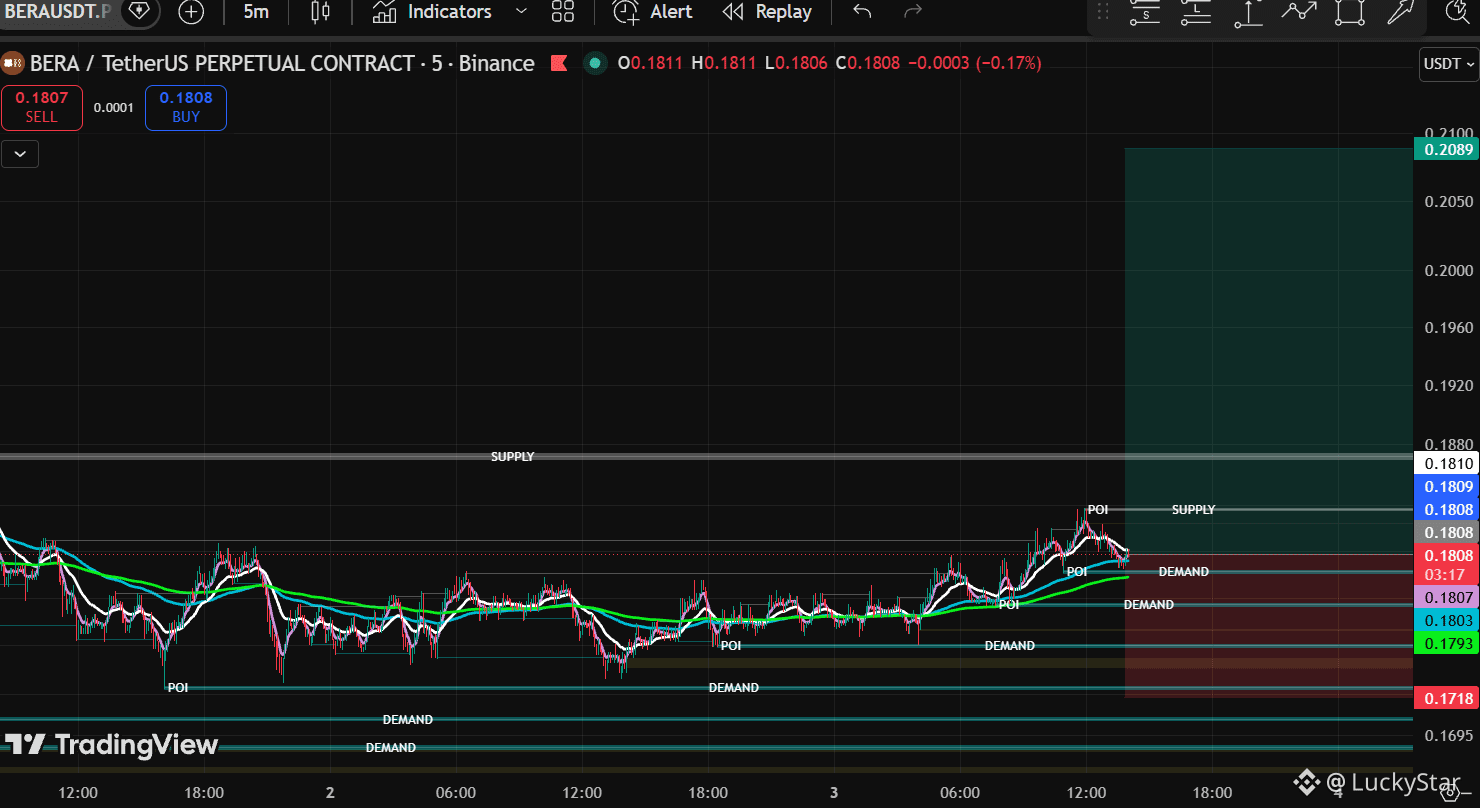
🚀 READY TO CATCH THE NEXT UPWARD MOMENTUM?
🐂 BUYERS CONTINUE TO CONTROL KEY DEMAND AREA.
🎯 AFTER CONFIRMATION, ATTENTION MAY MOVE TO NEXT TARGETS.
#trading #BERA #Berachain #ETH
$BERA
🚀 READY TO CATCH THE NEXT UPWARD MOMENTUM?
🐂 BUYERS CONTINUE TO CONTROL KEY DEMAND AREA.
🎯 AFTER CONFIRMATION, ATTENTION MAY MOVE TO NEXT TARGETS.
#trading #BERA #Berachain #ETH
🚀 READY TO CATCH THE NEXT UPWARD MOMENTUM?
🐂 BUYERS CONTINUE TO CONTROL KEY DEMAND AREA.
🎯 AFTER CONFIRMATION, ATTENTION MAY MOVE TO NEXT TARGETS.
#trading #BERA #Berachain #ETH
185

$BERA is moving like a genius.
BERA Price: ~$0.18
24H Change: 🟢 +5–8%
24H High: ~$0.1875
24H Low: ~$0.1622
24H Volume: ~$20–30M
📊 Analysis: BERA is showing short-term bullish momentum, with price recovering from the recent low around $0.138 and currently holding near $0.18. The key resistance is around $0.187–$0.19; a clean breakout could strengthen the bullish move. On the downside, $0.162 is an important near-term support.
🔥 Trader View: Bullish short-term.
#LNGTankersStayOutOfHormuz #RussiaStartsLargeScaleDigitalRubleRolloutSep1 #BERA #Berachain
{spot}(BERAUSDT)
$BERA is moving like a genius.
BERA Price: ~$0.18
24H Change: 🟢 +5–8%
24H High: ~$0.1875
24H Low: ~$0.1622
24H Volume: ~$20–30M
📊 Analysis: BERA is showing short-term bullish momentum, with price recovering from the recent low around $0.138 and currently holding near $0.18. The key resistance is around $0.187–$0.19; a clean breakout could strengthen the bullish move. On the downside, $0.162 is an important near-term support.
🔥 Trader View: Bullish short-term.
#LNGTankersStayOutOfHormuz #RussiaStartsLargeScaleDigitalRubleRolloutSep1 #BERA #Berachain
BERA Price: ~$0.18
24H Change: 🟢 +5–8%
24H High: ~$0.1875
24H Low: ~$0.1622
24H Volume: ~$20–30M
📊 Analysis: BERA is showing short-term bullish momentum, with price recovering from the recent low around $0.138 and currently holding near $0.18. The key resistance is around $0.187–$0.19; a clean breakout could strengthen the bullish move. On the downside, $0.162 is an important near-term support.
🔥 Trader View: Bullish short-term.
#LNGTankersStayOutOfHormuz #RussiaStartsLargeScaleDigitalRubleRolloutSep1 #BERA #Berachain
109

·
--
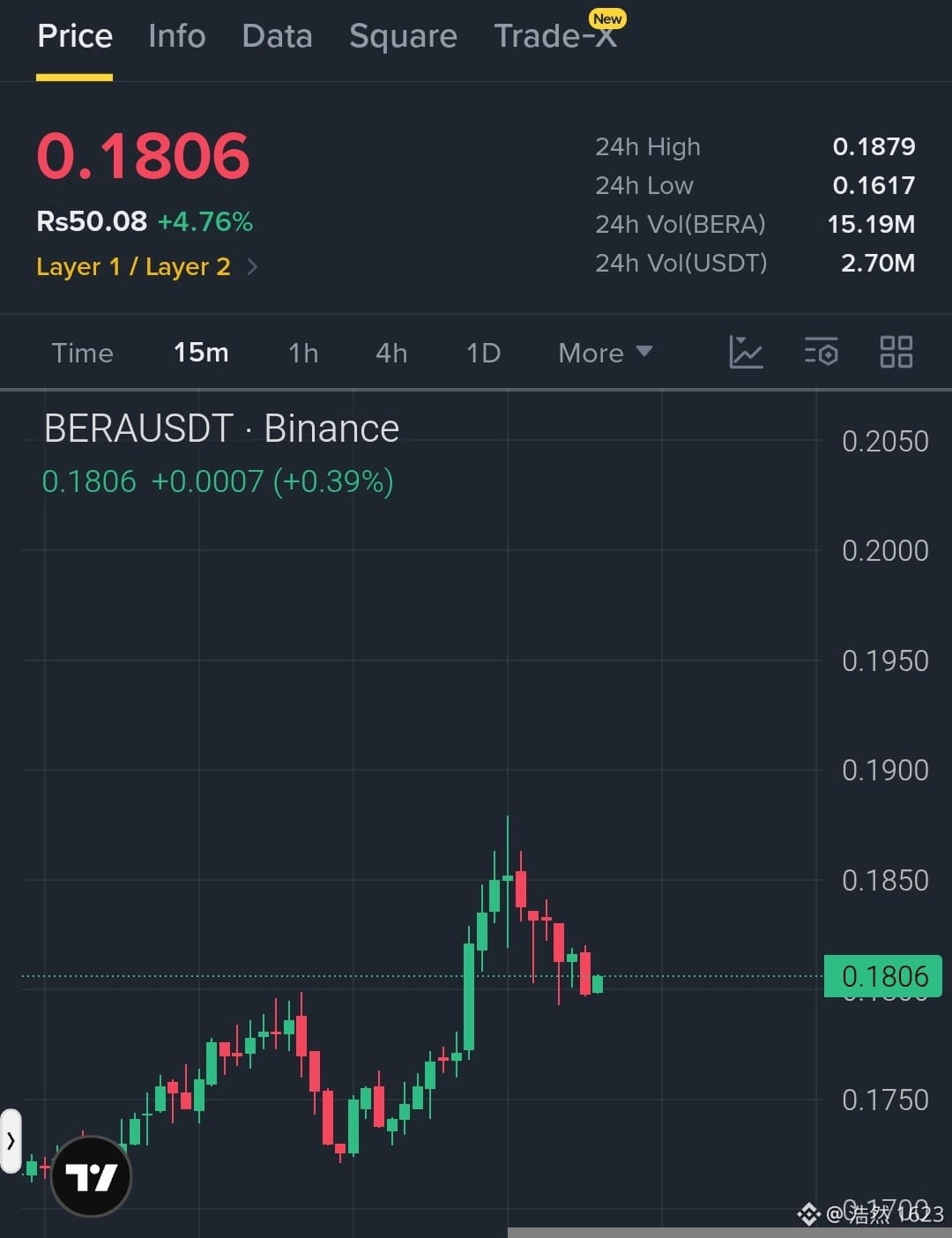
$BERA (Berachain) is showing healthy price action on the 15m chart after climbing from its 24h low of 0.1617 to a high of 0.1879. Currently trading around 0.1806 with a +4.76% daily gain, price action is consolidating constructively above local support following a brief pullback. Holding above current structural support paves the way for a retest of upper resistance levels.
Target 1: 0.1880 Target 2: 0.1950 Target 3: 0.2050
#BERA #Berachain #Crypto #Trading #Binance
$TUT
{future}(TUTUSDT)
$BTR
{alpha}(560xfed13d0c40790220fbde712987079eda1ed75c51)
{future}(BERAUSDT)
$BERA (Berachain) is showing healthy price action on the 15m chart after climbing from its 24h low of 0.1617 to a high of 0.1879. Currently trading around 0.1806 with a +4.76% daily gain, price action is consolidating constructively above local support following a brief pullback. Holding above current structural support paves the way for a retest of upper resistance levels.
Target 1: 0.1880 Target 2: 0.1950 Target 3: 0.2050
#BERA #Berachain #Crypto #Trading #Binance
$TUT
$BTR
Target 1: 0.1880 Target 2: 0.1950 Target 3: 0.2050
#BERA #Berachain #Crypto #Trading #Binance
$TUT
$BTR
1
350

·
--
Bullish
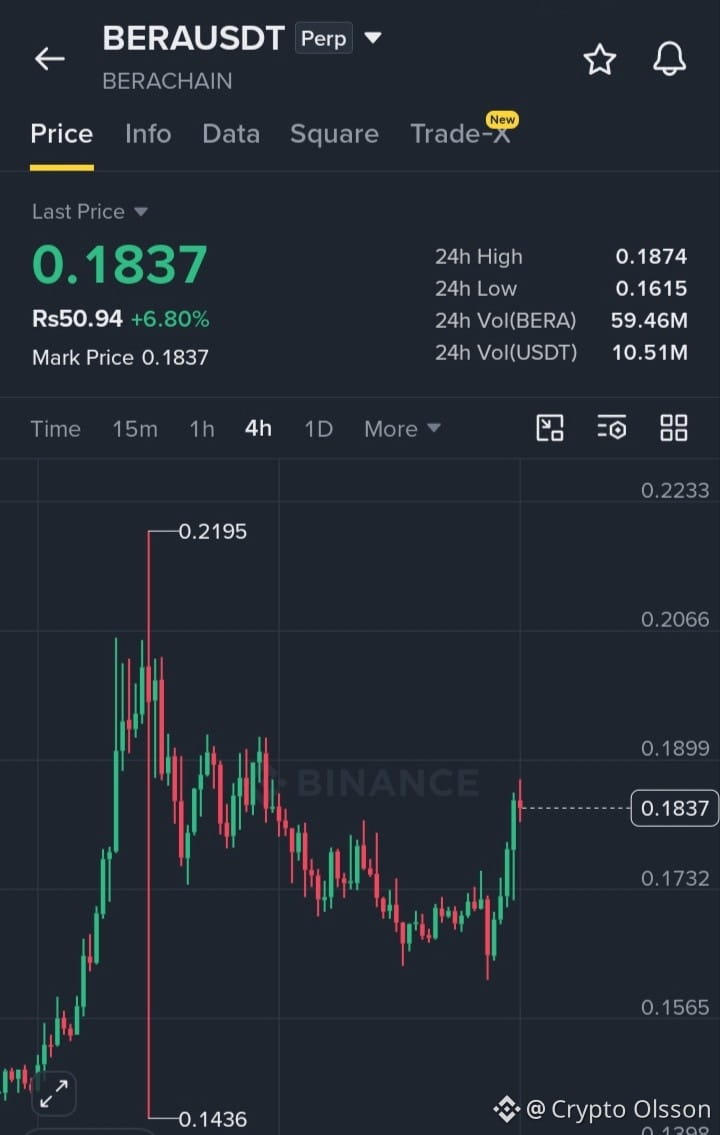
🚀 $BERA Long Setup — Momentum Watch
Entry: 0.1825–0.1840 TP1: 0.1900 TP2: 0.1980 TP3: 0.2060 SL: 0.1730
$BERA
{future}(BERAUSDT)
is showing strong momentum with rising volume. Manage risk and avoid chasing the move. 📈
#BERA #BERACHAIN #Crypto
🚀 $BERA Long Setup — Momentum Watch
Entry: 0.1825–0.1840 TP1: 0.1900 TP2: 0.1980 TP3: 0.2060 SL: 0.1730
$BERA
is showing strong momentum with rising volume. Manage risk and avoid chasing the move. 📈
#BERA #BERACHAIN #Crypto
Entry: 0.1825–0.1840 TP1: 0.1900 TP2: 0.1980 TP3: 0.2060 SL: 0.1730
$BERA
is showing strong momentum with rising volume. Manage risk and avoid chasing the move. 📈
#BERA #BERACHAIN #Crypto
1
226

·
--
Bullish
🔥 **BERA/USDT (BERACHAIN) BULLISH BREAKOUT SIGNAL** 🚀
The single correct signal for **BERA/USDT** based on price action and heavy volume momentum is **BULLISH** 🐂🟢. **BERACHAIN (BERA)** has surged **+8.21%** today, breaking out strongly from its daily low of **$0.1617**. With over **2.07M+ USDT** in trading volume driving price toward resistance at **$0.1863**, buyers are actively accumulating on key support.
💥 **Signal Type:** **STRONG BULLISH** 🐂🟢
📍 **Current Price:** $0.18460000
📊 **24h High:** $0.18630000
📉 **24h Low:** $0.16170000
💰 **24h Volume (USDT):** $2,070,410.12
⚡ **24h Volume (BERA):** 11.77M+ BERA
🏷️ **Category:** Layer 1 / Layer 2 / Launchpool Gainer
---
### 📊 Technical Setup & Key Drivers
1. **Demand Support Defense:** BERA defended the critical **$0.1617** support floor with high buying pressure, creating a clean upward momentum trend.
2. **Breakout Retest:** Price is pushing directly against local resistance at **$0.1863**. A sustained 1-hour/4-hour candle close above **$0.1863** will clear the path for a fast expansion rally toward **$0.2100+**.
3. **Ecosystem Capital Inflow:** As a prominent Proof-of-Liquidity Layer 1 project, solid Launchpool backing and high 24h trading activity indicate fresh retail interest.
---$BERA
{future}(BERAUSDT)
### 🎯 Trade Parameters
* **Best Entry Zone:** $0.17800000 – $0.18460000
* **Target 1 (TP1):** $0.18630000 *(24h High Retest)* 🎯
* **Target 2 (TP2):** $0.19800000 🎯
* **Target 3 (TP3):** $0.21500000 🚀
* **Stop Loss (SL):** $0.16000000 *(Below 24h Low Support)* 🛑
---
### 💡 Strategy & Risk Management
Maintain strict position management and stick to safe leverage (3x to 5x maximum for futures). Set your Stop Loss firmly at **$0.16000000**. Once price clears Target 1 ($0.1863), move your Stop Loss to entry to secure a risk-free position! 📈✨
---
#BERA #Berachain #cryptosignals
🔥 **BERA/USDT (BERACHAIN) BULLISH BREAKOUT SIGNAL** 🚀
The single correct signal for **BERA/USDT** based on price action and heavy volume momentum is **BULLISH** 🐂🟢. **BERACHAIN (BERA)** has surged **+8.21%** today, breaking out strongly from its daily low of **$0.1617**. With over **2.07M+ USDT** in trading volume driving price toward resistance at **$0.1863**, buyers are actively accumulating on key support.
💥 **Signal Type:** **STRONG BULLISH** 🐂🟢
📍 **Current Price:** $0.18460000
📊 **24h High:** $0.18630000
📉 **24h Low:** $0.16170000
💰 **24h Volume (USDT):** $2,070,410.12
⚡ **24h Volume (BERA):** 11.77M+ BERA
🏷️ **Category:** Layer 1 / Layer 2 / Launchpool Gainer
---
### 📊 Technical Setup & Key Drivers
1. **Demand Support Defense:** BERA defended the critical **$0.1617** support floor with high buying pressure, creating a clean upward momentum trend.
2. **Breakout Retest:** Price is pushing directly against local resistance at **$0.1863**. A sustained 1-hour/4-hour candle close above **$0.1863** will clear the path for a fast expansion rally toward **$0.2100+**.
3. **Ecosystem Capital Inflow:** As a prominent Proof-of-Liquidity Layer 1 project, solid Launchpool backing and high 24h trading activity indicate fresh retail interest.
---$BERA
### 🎯 Trade Parameters
* **Best Entry Zone:** $0.17800000 – $0.18460000
* **Target 1 (TP1):** $0.18630000 *(24h High Retest)* 🎯
* **Target 2 (TP2):** $0.19800000 🎯
* **Target 3 (TP3):** $0.21500000 🚀
* **Stop Loss (SL):** $0.16000000 *(Below 24h Low Support)* 🛑
---
### 💡 Strategy & Risk Management
Maintain strict position management and stick to safe leverage (3x to 5x maximum for futures). Set your Stop Loss firmly at **$0.16000000**. Once price clears Target 1 ($0.1863), move your Stop Loss to entry to secure a risk-free position! 📈✨
---
#BERA #Berachain #cryptosignals
The single correct signal for **BERA/USDT** based on price action and heavy volume momentum is **BULLISH** 🐂🟢. **BERACHAIN (BERA)** has surged **+8.21%** today, breaking out strongly from its daily low of **$0.1617**. With over **2.07M+ USDT** in trading volume driving price toward resistance at **$0.1863**, buyers are actively accumulating on key support.
💥 **Signal Type:** **STRONG BULLISH** 🐂🟢
📍 **Current Price:** $0.18460000
📊 **24h High:** $0.18630000
📉 **24h Low:** $0.16170000
💰 **24h Volume (USDT):** $2,070,410.12
⚡ **24h Volume (BERA):** 11.77M+ BERA
🏷️ **Category:** Layer 1 / Layer 2 / Launchpool Gainer
---
### 📊 Technical Setup & Key Drivers
1. **Demand Support Defense:** BERA defended the critical **$0.1617** support floor with high buying pressure, creating a clean upward momentum trend.
2. **Breakout Retest:** Price is pushing directly against local resistance at **$0.1863**. A sustained 1-hour/4-hour candle close above **$0.1863** will clear the path for a fast expansion rally toward **$0.2100+**.
3. **Ecosystem Capital Inflow:** As a prominent Proof-of-Liquidity Layer 1 project, solid Launchpool backing and high 24h trading activity indicate fresh retail interest.
---$BERA
### 🎯 Trade Parameters
* **Best Entry Zone:** $0.17800000 – $0.18460000
* **Target 1 (TP1):** $0.18630000 *(24h High Retest)* 🎯
* **Target 2 (TP2):** $0.19800000 🎯
* **Target 3 (TP3):** $0.21500000 🚀
* **Stop Loss (SL):** $0.16000000 *(Below 24h Low Support)* 🛑
---
### 💡 Strategy & Risk Management
Maintain strict position management and stick to safe leverage (3x to 5x maximum for futures). Set your Stop Loss firmly at **$0.16000000**. Once price clears Target 1 ($0.1863), move your Stop Loss to entry to secure a risk-free position! 📈✨
---
#BERA #Berachain #cryptosignals
1
98

·
--
$BERA Recent market performance is indeed disappointing. The fully diluted valuation is still below $100 million, and there is little support for upward price movement. Project momentum appears to be fading, community discussions have clearly cooled, and in the short term there is a lack of tangible positive catalysts—so a weak market sentiment is understandable. Current price is around $0.17, with about $9.32 million in 24-hour trading volume, a market cap of roughly $55.14 million, and liquidity that is also relatively thin. This kind of phase often tests holders’ patience—whether to keep waiting for ecosystem progress, or gradually build positions near the sentiment low point depends on whether you still have confidence in Berachain’s long-term narrative. Worth noting is that once meaningful outputs are delivered later on, the lackluster popularity could also reverse quickly.#Berachain #crypto market
$BERA Recent market performance is indeed disappointing. The fully diluted valuation is still below $100 million, and there is little support for upward price movement. Project momentum appears to be fading, community discussions have clearly cooled, and in the short term there is a lack of tangible positive catalysts—so a weak market sentiment is understandable. Current price is around $0.17, with about $9.32 million in 24-hour trading volume, a market cap of roughly $55.14 million, and liquidity that is also relatively thin. This kind of phase often tests holders’ patience—whether to keep waiting for ecosystem progress, or gradually build positions near the sentiment low point depends on whether you still have confidence in Berachain’s long-term narrative. Worth noting is that once meaningful outputs are delivered later on, the lackluster popularity could also reverse quickly.#Berachain #crypto market
122

·
--
Bullish
🐻 A major tokenomics shift is coming to Berachain.
Berachain is set to activate a hard fork that will fundamentally change how incentives work across its ecosystem. The upgrade will end all new emissions of the Bera Governance Token (BGT) and transition the network's reward system to Wrapped BERA (WBERA), placing the native BERA asset at the center of the protocol's incentive model.
According to the Berachain Foundation, the hard fork is scheduled for Wednesday at 4:00 PM UTC. The move is designed to simplify the network's dual-token structure, improve capital efficiency, and better align validator, user, and ecosystem incentives around a single core asset.
Tokenomics upgrades like this are closely watched because they can influence staking behavior, liquidity flows, governance participation, and long-term network sustainability. While the market's reaction will ultimately depend on adoption and execution, this marks one of the most significant protocol changes in Berachain's history.
As always, major blockchain upgrades are worth monitoring closely—not just for price action, but for what they signal about a project's long-term vision and ecosystem strategy.
#Berachain #BERA #WBERA #DeFi $BERA
{spot}(BERAUSDT)
#Tokenomics #Blockchain #CryptoNews #BinanceSquare
🐻 A major tokenomics shift is coming to Berachain.
Berachain is set to activate a hard fork that will fundamentally change how incentives work across its ecosystem. The upgrade will end all new emissions of the Bera Governance Token (BGT) and transition the network's reward system to Wrapped BERA (WBERA), placing the native BERA asset at the center of the protocol's incentive model.
According to the Berachain Foundation, the hard fork is scheduled for Wednesday at 4:00 PM UTC. The move is designed to simplify the network's dual-token structure, improve capital efficiency, and better align validator, user, and ecosystem incentives around a single core asset.
Tokenomics upgrades like this are closely watched because they can influence staking behavior, liquidity flows, governance participation, and long-term network sustainability. While the market's reaction will ultimately depend on adoption and execution, this marks one of the most significant protocol changes in Berachain's history.
As always, major blockchain upgrades are worth monitoring closely—not just for price action, but for what they signal about a project's long-term vision and ecosystem strategy.
#Berachain #BERA #WBERA #DeFi $BERA
#Tokenomics #Blockchain #CryptoNews #BinanceSquare
Berachain is set to activate a hard fork that will fundamentally change how incentives work across its ecosystem. The upgrade will end all new emissions of the Bera Governance Token (BGT) and transition the network's reward system to Wrapped BERA (WBERA), placing the native BERA asset at the center of the protocol's incentive model.
According to the Berachain Foundation, the hard fork is scheduled for Wednesday at 4:00 PM UTC. The move is designed to simplify the network's dual-token structure, improve capital efficiency, and better align validator, user, and ecosystem incentives around a single core asset.
Tokenomics upgrades like this are closely watched because they can influence staking behavior, liquidity flows, governance participation, and long-term network sustainability. While the market's reaction will ultimately depend on adoption and execution, this marks one of the most significant protocol changes in Berachain's history.
As always, major blockchain upgrades are worth monitoring closely—not just for price action, but for what they signal about a project's long-term vision and ecosystem strategy.
#Berachain #BERA #WBERA #DeFi $BERA
#Tokenomics #Blockchain #CryptoNews #BinanceSquare
2
326

·
--
Partly True
the thing that stopped me was not the yield percentage. it was a clause suggesting that providing liquidity here was not just earning from a system but participating in deciding which protocols on the chain get sustained.
berachain pol treats liquidity as participation in network security, not just yield generation. validators produce blocks, earn bgt emissions, and direct those into reward vaults of protocols they choose. users deposit into those vaults, collect bgt, and either burn it for bera or delegate it further.
the asymmetry is between who carries capital risk and who decides where bgt flows. depositors provide the asset and take on price exposure. validators hold the routing power. those are not symmetric roles, and only one of them determines which protocols earn sustained backing on this chain.
unibtc entered this system during the bedrock boyco campaign, pulling roughly 1,000 unibtc, $86.57m in total value locked, 8.99% apy, and 75 million bedrock diamonds distributed within two weeks. berachain reached $5.3b in total tvl, entering the top five chains inside two months of mainnet.
if bgt flows determine which protocols scale, competition shifts upstream from users toward validators. a protocol with validator backing earns more bgt, draws more depositors, and reinforces that backing in a loop. it reads as organic adoption but runs closer to coordinated allocation.
most yield infrastructure treats security and returns as separate concerns, one resolved at consensus, the other at the application layer. pol merges those two at the base level. what the protocol inserted itself into is not a passive yield position but a structural role in how this chain decides which applications earn sustained support.
whether unibtc holders end up as passive earners or something more embedded in chain governance becomes clearer only once validator behavior starts drifting from early expectations. that drift has not happened yet, but the architecture for it already exists.
@Bedrock $BR #Bedrock #Berachain #BTCFi
$VELVET $H
the thing that stopped me was not the yield percentage. it was a clause suggesting that providing liquidity here was not just earning from a system but participating in deciding which protocols on the chain get sustained.
berachain pol treats liquidity as participation in network security, not just yield generation. validators produce blocks, earn bgt emissions, and direct those into reward vaults of protocols they choose. users deposit into those vaults, collect bgt, and either burn it for bera or delegate it further.
the asymmetry is between who carries capital risk and who decides where bgt flows. depositors provide the asset and take on price exposure. validators hold the routing power. those are not symmetric roles, and only one of them determines which protocols earn sustained backing on this chain.
unibtc entered this system during the bedrock boyco campaign, pulling roughly 1,000 unibtc, $86.57m in total value locked, 8.99% apy, and 75 million bedrock diamonds distributed within two weeks. berachain reached $5.3b in total tvl, entering the top five chains inside two months of mainnet.
if bgt flows determine which protocols scale, competition shifts upstream from users toward validators. a protocol with validator backing earns more bgt, draws more depositors, and reinforces that backing in a loop. it reads as organic adoption but runs closer to coordinated allocation.
most yield infrastructure treats security and returns as separate concerns, one resolved at consensus, the other at the application layer. pol merges those two at the base level. what the protocol inserted itself into is not a passive yield position but a structural role in how this chain decides which applications earn sustained support.
whether unibtc holders end up as passive earners or something more embedded in chain governance becomes clearer only once validator behavior starts drifting from early expectations. that drift has not happened yet, but the architecture for it already exists.
@Bedrock $BR #Bedrock #Berachain #BTCFi
$VELVET $H
berachain pol treats liquidity as participation in network security, not just yield generation. validators produce blocks, earn bgt emissions, and direct those into reward vaults of protocols they choose. users deposit into those vaults, collect bgt, and either burn it for bera or delegate it further.
the asymmetry is between who carries capital risk and who decides where bgt flows. depositors provide the asset and take on price exposure. validators hold the routing power. those are not symmetric roles, and only one of them determines which protocols earn sustained backing on this chain.
unibtc entered this system during the bedrock boyco campaign, pulling roughly 1,000 unibtc, $86.57m in total value locked, 8.99% apy, and 75 million bedrock diamonds distributed within two weeks. berachain reached $5.3b in total tvl, entering the top five chains inside two months of mainnet.
if bgt flows determine which protocols scale, competition shifts upstream from users toward validators. a protocol with validator backing earns more bgt, draws more depositors, and reinforces that backing in a loop. it reads as organic adoption but runs closer to coordinated allocation.
most yield infrastructure treats security and returns as separate concerns, one resolved at consensus, the other at the application layer. pol merges those two at the base level. what the protocol inserted itself into is not a passive yield position but a structural role in how this chain decides which applications earn sustained support.
whether unibtc holders end up as passive earners or something more embedded in chain governance becomes clearer only once validator behavior starts drifting from early expectations. that drift has not happened yet, but the architecture for it already exists.
@Bedrock $BR #Bedrock #Berachain #BTCFi
$VELVET $H

43
19
3.5k
·
--
$BERA
{future}(BERAUSDT)
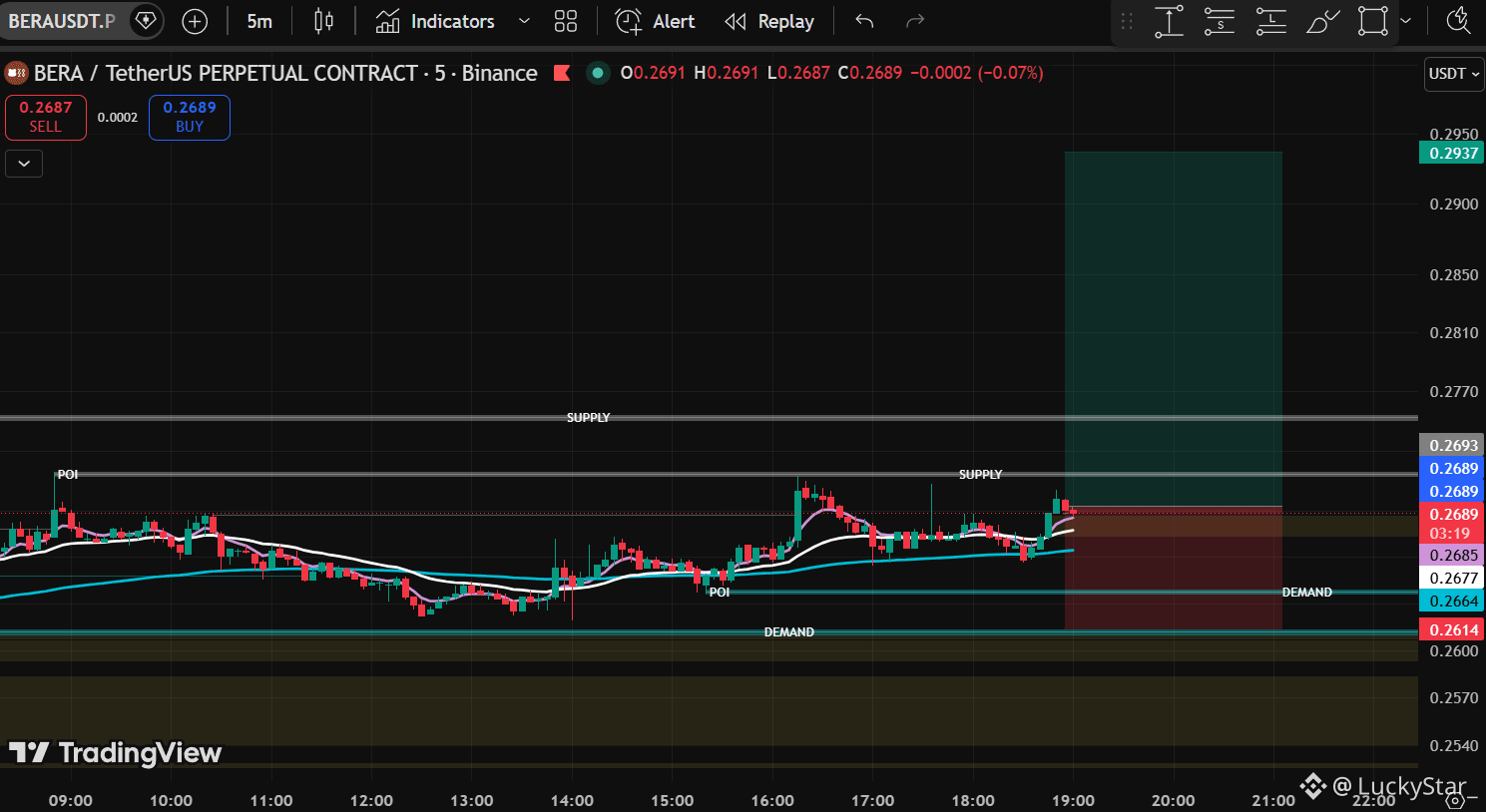
After confirming the support, the market showed the first signs of momentum. A long was opened to work out a potential upward movement.
#BERA #Berachain #TradingTales
$BERA
After confirming the support, the market showed the first signs of momentum. A long was opened to work out a potential upward movement.
#BERA #Berachain #TradingTales
After confirming the support, the market showed the first signs of momentum. A long was opened to work out a potential upward movement.
#BERA #Berachain #TradingTales
1
383

·
--
Berachain is gearing up for a major upgrade! The PoL Next upgrade is set to officially hit the mainnet from July 7th to 8th, and this change will completely reshape its economic model.
The most eye-catching news is that the BGT token will be phased out, with the governance tokens and related Boost mechanisms from the original liquidity proof model gradually exiting the scene. Instead, BERA will become the primary economic unit, with sWBERA serving as a new value accumulation layer, providing more concentrated protocol rewards for long-term participants.
Additionally, a new ERAs mechanism will be introduced, requiring projects to prove real on-chain revenue and utility to earn token emission incentives, rather than competing through Boost voting. This marks a significant shift from "voting games" to "actual value creation."
What do you all think about this overhaul? Is it a bullish sign or a challenge for the Berachain ecosystem?
#Berachain #DeFi #publicChain
Berachain is gearing up for a major upgrade! The PoL Next upgrade is set to officially hit the mainnet from July 7th to 8th, and this change will completely reshape its economic model.
The most eye-catching news is that the BGT token will be phased out, with the governance tokens and related Boost mechanisms from the original liquidity proof model gradually exiting the scene. Instead, BERA will become the primary economic unit, with sWBERA serving as a new value accumulation layer, providing more concentrated protocol rewards for long-term participants.
Additionally, a new ERAs mechanism will be introduced, requiring projects to prove real on-chain revenue and utility to earn token emission incentives, rather than competing through Boost voting. This marks a significant shift from "voting games" to "actual value creation."
What do you all think about this overhaul? Is it a bullish sign or a challenge for the Berachain ecosystem?
#Berachain #DeFi #publicChain
The most eye-catching news is that the BGT token will be phased out, with the governance tokens and related Boost mechanisms from the original liquidity proof model gradually exiting the scene. Instead, BERA will become the primary economic unit, with sWBERA serving as a new value accumulation layer, providing more concentrated protocol rewards for long-term participants.
Additionally, a new ERAs mechanism will be introduced, requiring projects to prove real on-chain revenue and utility to earn token emission incentives, rather than competing through Boost voting. This marks a significant shift from "voting games" to "actual value creation."
What do you all think about this overhaul? Is it a bullish sign or a challenge for the Berachain ecosystem?
#Berachain #DeFi #publicChain
91

·
--
Berachain Official Schedule: PoL Next Upgrade to Launch on July 7, 2026, and the $BGT Token Will Officially Make Its Exit.
This is not a routine iteration, but a structural reshaping of the Proof of Liquidity model. BGT’s historical mission as a dual-purpose token for both governance and incentives will come to an end. Validator incentives, Vault distribution logic, and the ecosystem revenue pathways will all be rewritten.
A few key points to watch in advance:
- For addresses holding BGT, the post-deprecation exchange/migration plan is crucial—don’t wait until the switch day to check the announcement
- Protocol TVL and yield rates that depend on BGT emissions will almost certainly be repriced; review your DeFi positions accordingly
- After PoL Next goes live, the new incentive tokens will become the anchor for capital flows across the entire Berachain ecosystem
There’s still a window of time before the upgrade. The official team will continue to release migration details and timelines. Whether you hold positions, mine in the ecosystem, or run strategies, it’s recommended to mark July 7 on your calendar first.
Narrative shifts are often the beginning of a reshuffling. Rather than chasing what’s new, it’s more important to understand how the old one reaches its end.
#Berachain #PoLNext #BGT
Berachain Official Schedule: PoL Next Upgrade to Launch on July 7, 2026, and the $BGT Token Will Officially Make Its Exit.
This is not a routine iteration, but a structural reshaping of the Proof of Liquidity model. BGT’s historical mission as a dual-purpose token for both governance and incentives will come to an end. Validator incentives, Vault distribution logic, and the ecosystem revenue pathways will all be rewritten.
A few key points to watch in advance:
- For addresses holding BGT, the post-deprecation exchange/migration plan is crucial—don’t wait until the switch day to check the announcement
- Protocol TVL and yield rates that depend on BGT emissions will almost certainly be repriced; review your DeFi positions accordingly
- After PoL Next goes live, the new incentive tokens will become the anchor for capital flows across the entire Berachain ecosystem
There’s still a window of time before the upgrade. The official team will continue to release migration details and timelines. Whether you hold positions, mine in the ecosystem, or run strategies, it’s recommended to mark July 7 on your calendar first.
Narrative shifts are often the beginning of a reshuffling. Rather than chasing what’s new, it’s more important to understand how the old one reaches its end.
#Berachain #PoLNext #BGT
This is not a routine iteration, but a structural reshaping of the Proof of Liquidity model. BGT’s historical mission as a dual-purpose token for both governance and incentives will come to an end. Validator incentives, Vault distribution logic, and the ecosystem revenue pathways will all be rewritten.
A few key points to watch in advance:
- For addresses holding BGT, the post-deprecation exchange/migration plan is crucial—don’t wait until the switch day to check the announcement
- Protocol TVL and yield rates that depend on BGT emissions will almost certainly be repriced; review your DeFi positions accordingly
- After PoL Next goes live, the new incentive tokens will become the anchor for capital flows across the entire Berachain ecosystem
There’s still a window of time before the upgrade. The official team will continue to release migration details and timelines. Whether you hold positions, mine in the ecosystem, or run strategies, it’s recommended to mark July 7 on your calendar first.
Narrative shifts are often the beginning of a reshuffling. Rather than chasing what’s new, it’s more important to understand how the old one reaches its end.
#Berachain #PoLNext #BGT
24


In the current market, going long feels like a trap, while going short risks getting liquidated. From a trading perspective, the risk-reward ratio for most assets right now is pretty terrible.
A truly mature trading strategy would pivot towards finding asymmetrical opportunities where downside is limited but upside returns are guaranteed.
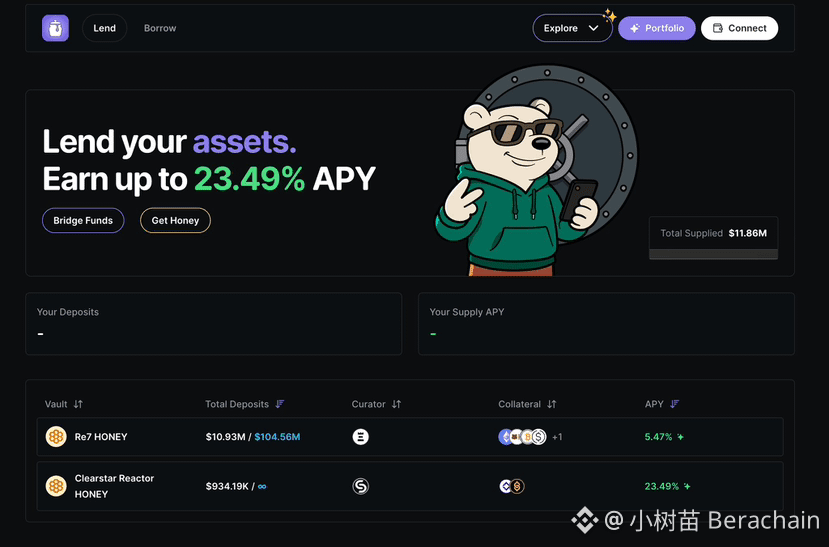
The Berachain official lending platform Bend’s stablecoin mining initiative, Clearstar Reactor HONEY Vault, seems to be a solid defensive tool on-chain right now.
Looking at downside risk (extremely low):
You're depositing $HONEY, super collateralized with quality assets like USDC, so there’s no chance of a price crash. Plus, the platform is a core infrastructure of the bear chain, not some sketchy project.
Looking at upside returns (extremely high):
The vault offers an annualized return of up to 23%, smashing 99% of traditional finance products.
Even better, if you use institutional-grade yield-bearing assets like sUSN or savUSD as collateral, you not only earn from the native asset but also snag that 38% cash flow.
In a choppy market, being able to protect your principal while squeezing out 23% in risk-free passive income, this is what we call a smart play. Don’t be sending fees to exchanges in contracts; build a solid base for defense instead:
Link: https://bend.berachain.com/lend
#Berachain $BERA
In the current market, going long feels like a trap, while going short risks getting liquidated. From a trading perspective, the risk-reward ratio for most assets right now is pretty terrible.
A truly mature trading strategy would pivot towards finding asymmetrical opportunities where downside is limited but upside returns are guaranteed.
The Berachain official lending platform Bend’s stablecoin mining initiative, Clearstar Reactor HONEY Vault, seems to be a solid defensive tool on-chain right now.
Looking at downside risk (extremely low):
You're depositing $HONEY, super collateralized with quality assets like USDC, so there’s no chance of a price crash. Plus, the platform is a core infrastructure of the bear chain, not some sketchy project.
Looking at upside returns (extremely high):
The vault offers an annualized return of up to 23%, smashing 99% of traditional finance products.
Even better, if you use institutional-grade yield-bearing assets like sUSN or savUSD as collateral, you not only earn from the native asset but also snag that 38% cash flow.
In a choppy market, being able to protect your principal while squeezing out 23% in risk-free passive income, this is what we call a smart play. Don’t be sending fees to exchanges in contracts; build a solid base for defense instead:
Link: https://bend.berachain.com/lend
#Berachain $BERA
A truly mature trading strategy would pivot towards finding asymmetrical opportunities where downside is limited but upside returns are guaranteed.
The Berachain official lending platform Bend’s stablecoin mining initiative, Clearstar Reactor HONEY Vault, seems to be a solid defensive tool on-chain right now.
Looking at downside risk (extremely low):
You're depositing $HONEY, super collateralized with quality assets like USDC, so there’s no chance of a price crash. Plus, the platform is a core infrastructure of the bear chain, not some sketchy project.
Looking at upside returns (extremely high):
The vault offers an annualized return of up to 23%, smashing 99% of traditional finance products.
Even better, if you use institutional-grade yield-bearing assets like sUSN or savUSD as collateral, you not only earn from the native asset but also snag that 38% cash flow.
In a choppy market, being able to protect your principal while squeezing out 23% in risk-free passive income, this is what we call a smart play. Don’t be sending fees to exchanges in contracts; build a solid base for defense instead:
Link: https://bend.berachain.com/lend
#Berachain $BERA
2
2k

Verified
Final Post
Most DeFi vaults make you choose.
Ethereum or Berachain.
One chain.
One reward stream.
One protocol at a time.
@Bedrock approached the uniBTC vault design for $BR and the wider #Bedrock community differently. Instead of forcing capital to pick a chain, the vault maintained an Ethereum-side position and represented it simultaneously on #Berachain , pulling reward streams from both blockchains at once. This is the #BTCFi architecture the Boyco campaign results put on record.
Here is what running inside that structure looked like in practice.
On the Ethereum side, the same deposit ran these reward streams at once.
🔵 3x Bedrock Diamonds
🔵 2x CIAN Points
🔵 Babylon Points
🔵 FBTC Sparks
🔵 Partner protocol rewards
On the Berachain side, the same capital generated independently in parallel.
🟡 Native BERA tokens
🟡 Kodiak bonuses
🟡 Dolomite bonuses
🟡 Goldilocks bonuses
🟡 BeraBorrow bonuses
The vault did not split deposits between chains or force a trade-off. One receipt token, yluniBTC.bera, preserved the Ethereum position while the Berachain side accumulated separately.
Four yield layers ran concurrently.
🟣 Berachain native rewards
🟣 Bera DeFi protocol allocations across four partner protocols
🟣 CIAN yield stack incentives including Bedrock Diamonds, Babylon Points, and additional DeFi rewards
🟣 CIAN point accruals as a fourth independent stream on top
Each layer drew from a different source without competing with the others. The structure was not additive in the traditional sense. It was parallel. Each stream ran independently, which is what made the count reach 10-plus without any single reward cannibalizing another.
The two-week Boyco campaign closed at $86.57M TVL with 8.99% APY and 75 million Diamonds distributed across participants.
10-plus streams. 10-plus protocols. Two blockchains. One deposit action.
What the design leaves open is whether reward density at this level holds when ecosystem bootstrapping incentives cycle out and only the underlying cross-chain yield mechanics carry the weight.
$H $BEAT
Final Post
Most DeFi vaults make you choose.
Ethereum or Berachain.
One chain.
One reward stream.
One protocol at a time.
@Bedrock approached the uniBTC vault design for $BR and the wider #Bedrock community differently. Instead of forcing capital to pick a chain, the vault maintained an Ethereum-side position and represented it simultaneously on #Berachain , pulling reward streams from both blockchains at once. This is the #BTCFi architecture the Boyco campaign results put on record.
Here is what running inside that structure looked like in practice.
On the Ethereum side, the same deposit ran these reward streams at once.
🔵 3x Bedrock Diamonds
🔵 2x CIAN Points
🔵 Babylon Points
🔵 FBTC Sparks
🔵 Partner protocol rewards
On the Berachain side, the same capital generated independently in parallel.
🟡 Native BERA tokens
🟡 Kodiak bonuses
🟡 Dolomite bonuses
🟡 Goldilocks bonuses
🟡 BeraBorrow bonuses
The vault did not split deposits between chains or force a trade-off. One receipt token, yluniBTC.bera, preserved the Ethereum position while the Berachain side accumulated separately.
Four yield layers ran concurrently.
🟣 Berachain native rewards
🟣 Bera DeFi protocol allocations across four partner protocols
🟣 CIAN yield stack incentives including Bedrock Diamonds, Babylon Points, and additional DeFi rewards
🟣 CIAN point accruals as a fourth independent stream on top
Each layer drew from a different source without competing with the others. The structure was not additive in the traditional sense. It was parallel. Each stream ran independently, which is what made the count reach 10-plus without any single reward cannibalizing another.
The two-week Boyco campaign closed at $86.57M TVL with 8.99% APY and 75 million Diamonds distributed across participants.
10-plus streams. 10-plus protocols. Two blockchains. One deposit action.
What the design leaves open is whether reward density at this level holds when ecosystem bootstrapping incentives cycle out and only the underlying cross-chain yield mechanics carry the weight.
$H $BEAT
Most DeFi vaults make you choose.
Ethereum or Berachain.
One chain.
One reward stream.
One protocol at a time.
@Bedrock approached the uniBTC vault design for $BR and the wider #Bedrock community differently. Instead of forcing capital to pick a chain, the vault maintained an Ethereum-side position and represented it simultaneously on #Berachain , pulling reward streams from both blockchains at once. This is the #BTCFi architecture the Boyco campaign results put on record.
Here is what running inside that structure looked like in practice.
On the Ethereum side, the same deposit ran these reward streams at once.
🔵 3x Bedrock Diamonds
🔵 2x CIAN Points
🔵 Babylon Points
🔵 FBTC Sparks
🔵 Partner protocol rewards
On the Berachain side, the same capital generated independently in parallel.
🟡 Native BERA tokens
🟡 Kodiak bonuses
🟡 Dolomite bonuses
🟡 Goldilocks bonuses
🟡 BeraBorrow bonuses
The vault did not split deposits between chains or force a trade-off. One receipt token, yluniBTC.bera, preserved the Ethereum position while the Berachain side accumulated separately.
Four yield layers ran concurrently.
🟣 Berachain native rewards
🟣 Bera DeFi protocol allocations across four partner protocols
🟣 CIAN yield stack incentives including Bedrock Diamonds, Babylon Points, and additional DeFi rewards
🟣 CIAN point accruals as a fourth independent stream on top
Each layer drew from a different source without competing with the others. The structure was not additive in the traditional sense. It was parallel. Each stream ran independently, which is what made the count reach 10-plus without any single reward cannibalizing another.
The two-week Boyco campaign closed at $86.57M TVL with 8.99% APY and 75 million Diamonds distributed across participants.
10-plus streams. 10-plus protocols. Two blockchains. One deposit action.
What the design leaves open is whether reward density at this level holds when ecosystem bootstrapping incentives cycle out and only the underlying cross-chain yield mechanics carry the weight.
$H $BEAT

32
12
869

Berachain has just hard forked, officially removing the governance token BGT and moving all rewards to WBERA. This is a straightforward move to simplify the two-token model that has been criticized as cumbersome and inefficient.
Merging BGT into WBERA helps users manage just a single token, improving liquidity and integration capabilities for cross-chain use with Ethereum or Polygon. The community has enthusiastically supported it, but the 1:1 conversion during the transition period could cause short-term price volatility.
Personally, I think this is a smart strategic move: it resolves an experience bottleneck and paves the way for liquid staking and other advanced DeFi products. But don’t rush into FOMO—always monitor governance risks and do your own research carefully (DYOR).
#Côngnghệ #Altcoin #Berachain #DeFi #Layer1
Berachain has just hard forked, officially removing the governance token BGT and moving all rewards to WBERA. This is a straightforward move to simplify the two-token model that has been criticized as cumbersome and inefficient.
Merging BGT into WBERA helps users manage just a single token, improving liquidity and integration capabilities for cross-chain use with Ethereum or Polygon. The community has enthusiastically supported it, but the 1:1 conversion during the transition period could cause short-term price volatility.
Personally, I think this is a smart strategic move: it resolves an experience bottleneck and paves the way for liquid staking and other advanced DeFi products. But don’t rush into FOMO—always monitor governance risks and do your own research carefully (DYOR).
#Côngnghệ #Altcoin #Berachain #DeFi #Layer1
Merging BGT into WBERA helps users manage just a single token, improving liquidity and integration capabilities for cross-chain use with Ethereum or Polygon. The community has enthusiastically supported it, but the 1:1 conversion during the transition period could cause short-term price volatility.
Personally, I think this is a smart strategic move: it resolves an experience bottleneck and paves the way for liquid staking and other advanced DeFi products. But don’t rush into FOMO—always monitor governance risks and do your own research carefully (DYOR).
#Côngnghệ #Altcoin #Berachain #DeFi #Layer1
202
Berachain’s recent market conditions have continued to deteriorate, and the $BERA price has already crashed by 98.5%. Overall ecosystem confidence has been severely dragged down, and downward pressure on prices is massive.
The core reasons behind the current situation mainly come down to three points:
1. Greenlane has suffered a large impairment, directly exposing the portfolio risk of ecosystem projects and triggering market panic.
2. The BUSD renaming event caused fluctuations in community trust, disrupting the stablecoin narrative that had been previously tied to it.
3. The launch of derivatives has been delayed. The market’s earlier high expectations have been dashed, dealing another blow to long positions sentiment.
At present, the $BERA price is 0.15759, with a 24h trading volume of 16.37M and a market cap of 50.06M. The overall trend is still downward. Whether the situation can be reversed in the future will depend on whether the ecosystem has any new positive catalysts.
$BERA #Berachain #币安广场
Berachain’s recent market conditions have continued to deteriorate, and the $BERA price has already crashed by 98.5%. Overall ecosystem confidence has been severely dragged down, and downward pressure on prices is massive.
The core reasons behind the current situation mainly come down to three points:
1. Greenlane has suffered a large impairment, directly exposing the portfolio risk of ecosystem projects and triggering market panic.
2. The BUSD renaming event caused fluctuations in community trust, disrupting the stablecoin narrative that had been previously tied to it.
3. The launch of derivatives has been delayed. The market’s earlier high expectations have been dashed, dealing another blow to long positions sentiment.
At present, the $BERA price is 0.15759, with a 24h trading volume of 16.37M and a market cap of 50.06M. The overall trend is still downward. Whether the situation can be reversed in the future will depend on whether the ecosystem has any new positive catalysts.
$BERA #Berachain #币安广场
The core reasons behind the current situation mainly come down to three points:
1. Greenlane has suffered a large impairment, directly exposing the portfolio risk of ecosystem projects and triggering market panic.
2. The BUSD renaming event caused fluctuations in community trust, disrupting the stablecoin narrative that had been previously tied to it.
3. The launch of derivatives has been delayed. The market’s earlier high expectations have been dashed, dealing another blow to long positions sentiment.
At present, the $BERA price is 0.15759, with a 24h trading volume of 16.37M and a market cap of 50.06M. The overall trend is still downward. Whether the situation can be reversed in the future will depend on whether the ecosystem has any new positive catalysts.
$BERA #Berachain #币安广场
1
69

·
--
Berachain has recently completed the PoL Next mainnet upgrade. BGT emissions have officially stopped, and the new incentive model has been fully rolled out. Today I saw an official tweet confirming that this upgrade has gone live on the mainnet, and they’ve also switched to a new visual style and information architecture.
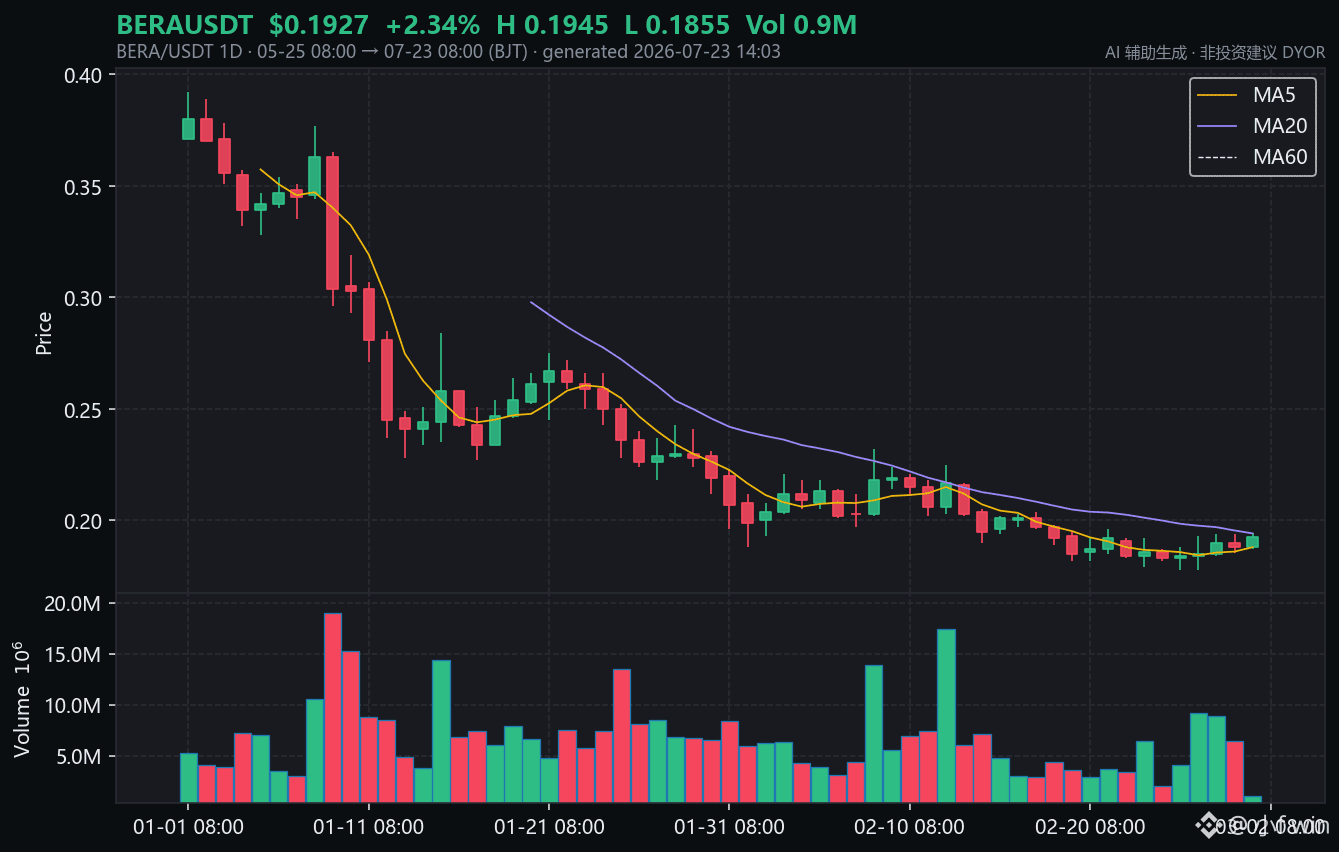
From the chart, $BERA has been grinding back and forth over the past couple of days within the 0.185–0.195 range. On the 1D chart, the 30-day moving average is just pressing right around the 0.20 line (the pink line in the image appears to be in the 0.198–0.20 area). Over the past 60 days, most of the time the price has been capped by this moving average. Recently, in the last 24 hours, 4.83 million BERA were traded; the quoteVolume is roughly 910k USDT—neither hot nor cold, more like a state of “waiting for the news to be realized.”
My own recap is: when the underlying logic changes, like with PoL Next, it’s narratively bullish in the short term. In the long run, though, it depends on whether actual TVL and validator participation really follow through. If it’s just that BGT is stopped and the new incentives haven’t yet been accepted by validators, then that W-shaped neckline below 0.18 is likely to get tested again. For the short term, I’m more inclined to first see whether 0.185 can hold; if it breaks down, I’ll wait and observe. To the upside, I’d wait until 0.20 is established with accompanying volume before considering anything further. I’m still tracking on-chain data and official documentation. My suggestion for friends who want to act is: read the relevant part of the whitepaper first before deciding on your position.
⚠️ Not investment advice—DYOR. Please do not treat this as the sole basis for any decision.
#BinanceSquare $BERA $BNB #Berachain #On-chain data
——
This post was generated/assisted by AI. AI-generated content may include third-party opinions, errors, biases, or outdated information. Binance is not responsible for any losses resulting from this, and it does not constitute investment, financial, or trading advice.
Berachain has recently completed the PoL Next mainnet upgrade. BGT emissions have officially stopped, and the new incentive model has been fully rolled out. Today I saw an official tweet confirming that this upgrade has gone live on the mainnet, and they’ve also switched to a new visual style and information architecture.
From the chart, $BERA has been grinding back and forth over the past couple of days within the 0.185–0.195 range. On the 1D chart, the 30-day moving average is just pressing right around the 0.20 line (the pink line in the image appears to be in the 0.198–0.20 area). Over the past 60 days, most of the time the price has been capped by this moving average. Recently, in the last 24 hours, 4.83 million BERA were traded; the quoteVolume is roughly 910k USDT—neither hot nor cold, more like a state of “waiting for the news to be realized.”
My own recap is: when the underlying logic changes, like with PoL Next, it’s narratively bullish in the short term. In the long run, though, it depends on whether actual TVL and validator participation really follow through. If it’s just that BGT is stopped and the new incentives haven’t yet been accepted by validators, then that W-shaped neckline below 0.18 is likely to get tested again. For the short term, I’m more inclined to first see whether 0.185 can hold; if it breaks down, I’ll wait and observe. To the upside, I’d wait until 0.20 is established with accompanying volume before considering anything further. I’m still tracking on-chain data and official documentation. My suggestion for friends who want to act is: read the relevant part of the whitepaper first before deciding on your position.
⚠️ Not investment advice—DYOR. Please do not treat this as the sole basis for any decision.
#BinanceSquare $BERA $BNB #Berachain #On-chain data
——
This post was generated/assisted by AI. AI-generated content may include third-party opinions, errors, biases, or outdated information. Binance is not responsible for any losses resulting from this, and it does not constitute investment, financial, or trading advice.
From the chart, $BERA has been grinding back and forth over the past couple of days within the 0.185–0.195 range. On the 1D chart, the 30-day moving average is just pressing right around the 0.20 line (the pink line in the image appears to be in the 0.198–0.20 area). Over the past 60 days, most of the time the price has been capped by this moving average. Recently, in the last 24 hours, 4.83 million BERA were traded; the quoteVolume is roughly 910k USDT—neither hot nor cold, more like a state of “waiting for the news to be realized.”
My own recap is: when the underlying logic changes, like with PoL Next, it’s narratively bullish in the short term. In the long run, though, it depends on whether actual TVL and validator participation really follow through. If it’s just that BGT is stopped and the new incentives haven’t yet been accepted by validators, then that W-shaped neckline below 0.18 is likely to get tested again. For the short term, I’m more inclined to first see whether 0.185 can hold; if it breaks down, I’ll wait and observe. To the upside, I’d wait until 0.20 is established with accompanying volume before considering anything further. I’m still tracking on-chain data and official documentation. My suggestion for friends who want to act is: read the relevant part of the whitepaper first before deciding on your position.
⚠️ Not investment advice—DYOR. Please do not treat this as the sole basis for any decision.
#BinanceSquare $BERA $BNB #Berachain #On-chain data
——
This post was generated/assisted by AI. AI-generated content may include third-party opinions, errors, biases, or outdated information. Binance is not responsible for any losses resulting from this, and it does not constitute investment, financial, or trading advice.
220
Log in to explore more content
Join global crypto users on Binance Square
⚡️ Get latest and useful information about crypto.
💬 Trusted by the world’s largest crypto exchange.
👍 Discover real insights from verified creators.
Email / Phone number
Trending Topics
1
#UKFCAWinsCourtOrderToRecover851400Pounds
28,138 views
736 Discussing
2
#ChainlinkLaunchesCCIP2WithEnterpriseVerification
42,487 views
918 Discussing
3
#GoldFallsTo$4144
14,949 views
156 Discussing
4
#QNTFallsOver40%FromMorningHigh
87,596 views
1,334 Discussing
5
#USDTAdds845900HoldersInPast7Days
16,946 views
402 Discussing
6
#KospiFalls2.7%SamsungSKHynixDropOver5%
28,942 views
581 Discussing
7
#BitgetCEOConfirms$388MStolenInHack
5,304 views
42 Discussing
8
#BTCFallsBelow$83000
31,914 views
167 Discussing
9
#BitgetDetailsSecurityIncidentTimeline
49,209 views
734 Discussing
10
#BitcoinSpotETFs$2.39BWeeklyNetInflow
15,071 views
49 Discussing