

小树苗 Berachain
1.8k Posts

小树苗 Berachain
 Square Verified
Report
Block User
专注于分享 Berachain 链上项目的信息资讯、跟踪 Ai、DeFi、GameFi、NFT 等不同领域动态,为用户提供新手教程、玩法攻略、项目分析、行业研报等专业内容,与用户共同成长,创造社区价值!

原创之星

Level 1 Creator
Open Trade

ETH Holder
Occasional Trader
6.6 Years
29 Following
28.8K+ Followers
17.9K+ Liked
2 Badges
Posts
Portfolio
All
Quotes
Videos
Live
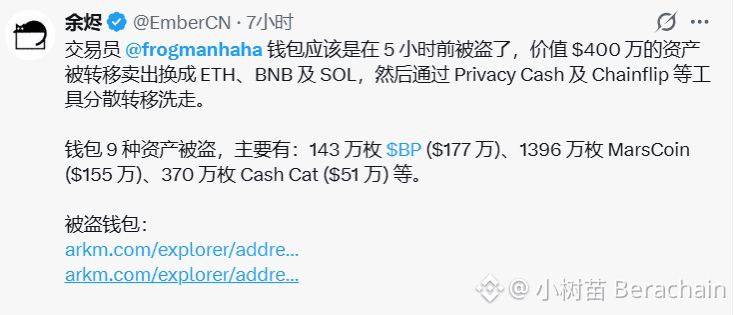
Another devastating wallet theft.
Trader @frogmanhaha lost $4 million while fast asleep.
Based on tracking data from @EmberCN, the hacker was highly skilled.
They sold off all the stolen altcoins and converted them into major assets.
Then they dispersed and transferred the funds through Privacy Cash and Chainflip.
Once funds enter these privacy-focused cross-chain tools, the chances of recovering them are basically zero.
The victim is currently in Singapore, completely bewildered and caught off guard.
Many teams and individuals are already helping with the investigation. $NVDAB
Another devastating wallet theft.
Trader @frogmanhaha lost $4 million while fast asleep.
Based on tracking data from @EmberCN, the hacker was highly skilled.
They sold off all the stolen altcoins and converted them into major assets.
Then they dispersed and transferred the funds through Privacy Cash and Chainflip.
Once funds enter these privacy-focused cross-chain tools, the chances of recovering them are basically zero.
The victim is currently in Singapore, completely bewildered and caught off guard.
Many teams and individuals are already helping with the investigation. $NVDAB
Trader @frogmanhaha lost $4 million while fast asleep.
Based on tracking data from @EmberCN, the hacker was highly skilled.
They sold off all the stolen altcoins and converted them into major assets.
Then they dispersed and transferred the funds through Privacy Cash and Chainflip.
Once funds enter these privacy-focused cross-chain tools, the chances of recovering them are basically zero.
The victim is currently in Singapore, completely bewildered and caught off guard.
Many teams and individuals are already helping with the investigation. $NVDAB
414
Holy crap, that's terrifying!
A Russian lab worker infected with the plague has died, and thousands of people are being quarantined as an emergency measure.
The WHO has issued a grave warning: pneumonic plague is extremely contagious and could very well trigger a pandemic.
Grok also confirmed that pneumonic plague is indeed more transmissible and has a higher fatality rate.
I hope Russia can contain the source this time and make absolutely sure it doesn't spread.
No one can handle the strain of a second global shutdown.
$MSFTB
Holy crap, that's terrifying!
A Russian lab worker infected with the plague has died, and thousands of people are being quarantined as an emergency measure.
The WHO has issued a grave warning: pneumonic plague is extremely contagious and could very well trigger a pandemic.
Grok also confirmed that pneumonic plague is indeed more transmissible and has a higher fatality rate.
I hope Russia can contain the source this time and make absolutely sure it doesn't spread.
No one can handle the strain of a second global shutdown.
$MSFTB
A Russian lab worker infected with the plague has died, and thousands of people are being quarantined as an emergency measure.
The WHO has issued a grave warning: pneumonic plague is extremely contagious and could very well trigger a pandemic.
Grok also confirmed that pneumonic plague is indeed more transmissible and has a higher fatality rate.
I hope Russia can contain the source this time and make absolutely sure it doesn't spread.
No one can handle the strain of a second global shutdown.
$MSFTB

1.1k
Foreigners are once again saying Web3 is dead. A while ago, we saw a lot of this sentiment in Chinese-speaking circles too.
From a retail investor’s perspective, things really do feel hopeless right now.
During the last bear market, we could still hang in there, grind for airdrops, or buy the dip on altcoins and bet on a 100x.
As long as you weren’t lazy, there was always some unconventional way to make money.
Now, those obvious, sure-fire opportunities have completely disappeared.
During this dead period, you can stay in cash and sit out crypto, but absolutely don’t leave for good or stop paying attention.
The underlying infrastructure is still evolving, and capital is still flowing.
The next cycle’s opportunities could emerge in an entirely new form at any moment.
Keep your hands in check, and be realistic about the size of your capital.
If you want to play it safe, dollar-cost average into BTC and steadily earn the industry’s beta returns.
If you want to aim for outsized gains with a small stake, lie low completely.
Hold onto your cash and patiently wait for the next truly major trend to take shape.
$MSFTB
Foreigners are once again saying Web3 is dead. A while ago, we saw a lot of this sentiment in Chinese-speaking circles too.
From a retail investor’s perspective, things really do feel hopeless right now.
During the last bear market, we could still hang in there, grind for airdrops, or buy the dip on altcoins and bet on a 100x.
As long as you weren’t lazy, there was always some unconventional way to make money.
Now, those obvious, sure-fire opportunities have completely disappeared.
During this dead period, you can stay in cash and sit out crypto, but absolutely don’t leave for good or stop paying attention.
The underlying infrastructure is still evolving, and capital is still flowing.
The next cycle’s opportunities could emerge in an entirely new form at any moment.
Keep your hands in check, and be realistic about the size of your capital.
If you want to play it safe, dollar-cost average into BTC and steadily earn the industry’s beta returns.
If you want to aim for outsized gains with a small stake, lie low completely.
Hold onto your cash and patiently wait for the next truly major trend to take shape.
$MSFTB
From a retail investor’s perspective, things really do feel hopeless right now.
During the last bear market, we could still hang in there, grind for airdrops, or buy the dip on altcoins and bet on a 100x.
As long as you weren’t lazy, there was always some unconventional way to make money.
Now, those obvious, sure-fire opportunities have completely disappeared.
During this dead period, you can stay in cash and sit out crypto, but absolutely don’t leave for good or stop paying attention.
The underlying infrastructure is still evolving, and capital is still flowing.
The next cycle’s opportunities could emerge in an entirely new form at any moment.
Keep your hands in check, and be realistic about the size of your capital.
If you want to play it safe, dollar-cost average into BTC and steadily earn the industry’s beta returns.
If you want to aim for outsized gains with a small stake, lie low completely.
Hold onto your cash and patiently wait for the next truly major trend to take shape.
$MSFTB
1
1
1.4k
Verified
I recently looked around at on-chain yields. Things have generally cooled off on the stablecoin side, and there are fewer and fewer opportunities that can sustain double-digit returns.
As for LPs, there are still some things worth digging into.
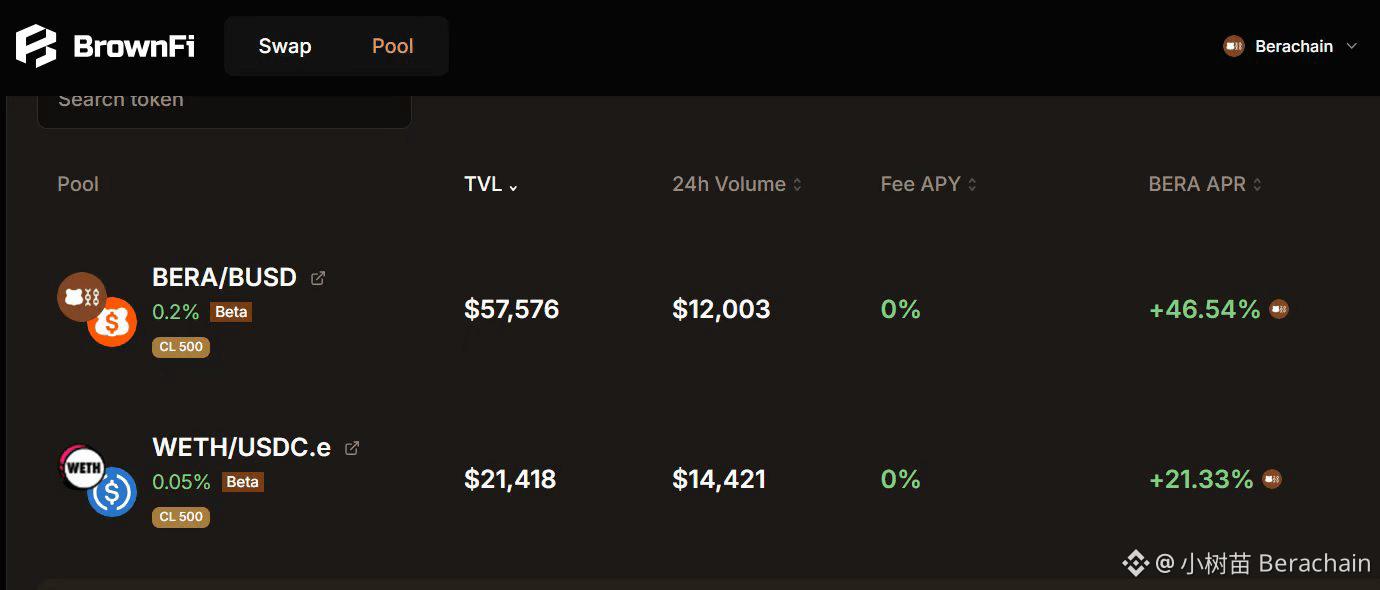
On @BerachainCN, @brownfiamm has two pools with pretty impressive data:
BERA/BUSD: 46.54% APR
WETH/USDC.e: 21.33% APR
The incentives all come from BERA emissions—this isn’t a short-term game propped up by a newly issued token.
For LPs, pools where you can directly capture WBERA emissions have long been a fairly solid choice on the bear chain.
BrownFi itself has also been moving pretty fast lately: TVL has surpassed 1 million, cumulative trading volume has broken $300 million, and it spans 5 chains. You can find it on both CoinGecko and GeckoTerminal.
Oracle-based AMM and CLAMM pools have also officially launched.
After PoL Next, Berachain’s emission efficiency has continued to improve. Pools like BrownFi’s—where incentives can be absorbed—will likely show even more clearly in terms of capital efficiency.
APR changes all the time. If you’re interested, go check the latest numbers—DYOR.
$BERA
I recently looked around at on-chain yields. Things have generally cooled off on the stablecoin side, and there are fewer and fewer opportunities that can sustain double-digit returns.
As for LPs, there are still some things worth digging into.
On @BerachainCN, @brownfiamm has two pools with pretty impressive data:
BERA/BUSD: 46.54% APR
WETH/USDC.e: 21.33% APR
The incentives all come from BERA emissions—this isn’t a short-term game propped up by a newly issued token.
For LPs, pools where you can directly capture WBERA emissions have long been a fairly solid choice on the bear chain.
BrownFi itself has also been moving pretty fast lately: TVL has surpassed 1 million, cumulative trading volume has broken $300 million, and it spans 5 chains. You can find it on both CoinGecko and GeckoTerminal.
Oracle-based AMM and CLAMM pools have also officially launched.
After PoL Next, Berachain’s emission efficiency has continued to improve. Pools like BrownFi’s—where incentives can be absorbed—will likely show even more clearly in terms of capital efficiency.
APR changes all the time. If you’re interested, go check the latest numbers—DYOR.
$BERA
As for LPs, there are still some things worth digging into.
On @BerachainCN, @brownfiamm has two pools with pretty impressive data:
BERA/BUSD: 46.54% APR
WETH/USDC.e: 21.33% APR
The incentives all come from BERA emissions—this isn’t a short-term game propped up by a newly issued token.
For LPs, pools where you can directly capture WBERA emissions have long been a fairly solid choice on the bear chain.
BrownFi itself has also been moving pretty fast lately: TVL has surpassed 1 million, cumulative trading volume has broken $300 million, and it spans 5 chains. You can find it on both CoinGecko and GeckoTerminal.
Oracle-based AMM and CLAMM pools have also officially launched.
After PoL Next, Berachain’s emission efficiency has continued to improve. Pools like BrownFi’s—where incentives can be absorbed—will likely show even more clearly in terms of capital efficiency.
APR changes all the time. If you’re interested, go check the latest numbers—DYOR.
$BERA
2
1.2k
Partly True
Recently, gold has been jumping up and down, and many friends are panicking.
Actually, look at it from another angle—over the past two years, central banks around the world have been buying up 30% of the newly mined gold every year, setting a record high. They aren’t betting on short-term price swings; they’re using gold to replace currencies whose purchasing power has been “overly diluted.”
Gold’s role in an account has never been to be an “advance unit” for aggressive gains. Instead, it’s the “goalkeeper” during extreme market conditions:
🔺 Low correlation with stocks and bonds; provides cushioning in extreme times
🔺 Counteracts excessive money printing—acting as a “value-preservation anchor” in the portfolio
🔺 When geopolitical conflicts or inflation pick up, its safe-haven value becomes more prominent
So a dip in the short term doesn’t affect its long-term positioning in the portfolio. A truly mature allocation isn’t just buying assets that are rising—it’s letting stocks, bonds, and commodities each do their part: some push forward, some provide a safety net, and some hedge against black swan events.
$MSFTB
Recently, gold has been jumping up and down, and many friends are panicking.
Actually, look at it from another angle—over the past two years, central banks around the world have been buying up 30% of the newly mined gold every year, setting a record high. They aren’t betting on short-term price swings; they’re using gold to replace currencies whose purchasing power has been “overly diluted.”
Gold’s role in an account has never been to be an “advance unit” for aggressive gains. Instead, it’s the “goalkeeper” during extreme market conditions:
🔺 Low correlation with stocks and bonds; provides cushioning in extreme times
🔺 Counteracts excessive money printing—acting as a “value-preservation anchor” in the portfolio
🔺 When geopolitical conflicts or inflation pick up, its safe-haven value becomes more prominent
So a dip in the short term doesn’t affect its long-term positioning in the portfolio. A truly mature allocation isn’t just buying assets that are rising—it’s letting stocks, bonds, and commodities each do their part: some push forward, some provide a safety net, and some hedge against black swan events.
$MSFTB
Actually, look at it from another angle—over the past two years, central banks around the world have been buying up 30% of the newly mined gold every year, setting a record high. They aren’t betting on short-term price swings; they’re using gold to replace currencies whose purchasing power has been “overly diluted.”
Gold’s role in an account has never been to be an “advance unit” for aggressive gains. Instead, it’s the “goalkeeper” during extreme market conditions:
🔺 Low correlation with stocks and bonds; provides cushioning in extreme times
🔺 Counteracts excessive money printing—acting as a “value-preservation anchor” in the portfolio
🔺 When geopolitical conflicts or inflation pick up, its safe-haven value becomes more prominent
So a dip in the short term doesn’t affect its long-term positioning in the portfolio. A truly mature allocation isn’t just buying assets that are rising—it’s letting stocks, bonds, and commodities each do their part: some push forward, some provide a safety net, and some hedge against black swan events.
$MSFTB
732
So cool—when the hacker cracked, NERA Intents was stolen, and the full $3.8 million was returned, every cent.
Watching the NEAR team carry out their seamless recovery operation is almost as good as a short-country爽剧.
When will the industry build a standardized, everyday system for regular users: confirmation of theft, on-chain investigation, fund freezing, and recovery?
Or will there be an organization that can truly stand up to hackers on behalf of ordinary people?
After all, for most retail users, when they get stolen from, they can only blame their bad luck—nobody seems to care.
Let’s replay this extremely suffocating cyber offense-and-defense battle.
The hacker exploited a vulnerability in Omni’s interaction with NEAR smart contracts and pocketed the USDT on BSC.
After it happened, the Intents lead Alex issued a 48-hour final warning directly in a tweet.
The opening line was a direct instant kill: Sir, we’ve already found you.
Then the follow-up shot: You’re even more aware than most people of how the vulnerability disclosure process should go.
Those few sentences made it clear—this party knows who you are in real life, and that you’re an internal “leaker” in the security circle.
If you don’t refund, get ready to go to jail.
A few hours after the warning, the hacker sent a small test payment from the stolen address and left an on-chain note: Willing to cooperate—please give me a Signal contact.
In response to the hacker’s private-chat request, Alex didn’t add the hacker.
Instead, Alex publicly posted two pieces of ciphertext on Twitter that only the hacker’s private key could decrypt (ECIES encryption).
They took control of the negotiation and cranked the pressure to the extreme.
In under 24 hours, the entire $3.8 million was returned along the same route.
In the final transfer, the hacker even left a remark with very dark humor: Thanks to the Near team for maintaining a respectful, constructive, and friendly attitude throughout the refund process. Please remember to always use the vulnerability bounty!
With AI, protecting against high-IQ criminals can’t rely on on-chain smart contracts and audits alone anymore. AI can scan vulnerabilities 24/7 without stopping.
The encrypted space is entering an era of extremely complex AI attacks.
Powerful off-chain tracking and physical localization capabilities are indispensable.
$NEAR
So cool—when the hacker cracked, NERA Intents was stolen, and the full $3.8 million was returned, every cent.
Watching the NEAR team carry out their seamless recovery operation is almost as good as a short-country爽剧.
When will the industry build a standardized, everyday system for regular users: confirmation of theft, on-chain investigation, fund freezing, and recovery?
Or will there be an organization that can truly stand up to hackers on behalf of ordinary people?
After all, for most retail users, when they get stolen from, they can only blame their bad luck—nobody seems to care.
Let’s replay this extremely suffocating cyber offense-and-defense battle.
The hacker exploited a vulnerability in Omni’s interaction with NEAR smart contracts and pocketed the USDT on BSC.
After it happened, the Intents lead Alex issued a 48-hour final warning directly in a tweet.
The opening line was a direct instant kill: Sir, we’ve already found you.
Then the follow-up shot: You’re even more aware than most people of how the vulnerability disclosure process should go.
Those few sentences made it clear—this party knows who you are in real life, and that you’re an internal “leaker” in the security circle.
If you don’t refund, get ready to go to jail.
A few hours after the warning, the hacker sent a small test payment from the stolen address and left an on-chain note: Willing to cooperate—please give me a Signal contact.
In response to the hacker’s private-chat request, Alex didn’t add the hacker.
Instead, Alex publicly posted two pieces of ciphertext on Twitter that only the hacker’s private key could decrypt (ECIES encryption).
They took control of the negotiation and cranked the pressure to the extreme.
In under 24 hours, the entire $3.8 million was returned along the same route.
In the final transfer, the hacker even left a remark with very dark humor: Thanks to the Near team for maintaining a respectful, constructive, and friendly attitude throughout the refund process. Please remember to always use the vulnerability bounty!
With AI, protecting against high-IQ criminals can’t rely on on-chain smart contracts and audits alone anymore. AI can scan vulnerabilities 24/7 without stopping.
The encrypted space is entering an era of extremely complex AI attacks.
Powerful off-chain tracking and physical localization capabilities are indispensable.
$NEAR
Watching the NEAR team carry out their seamless recovery operation is almost as good as a short-country爽剧.
When will the industry build a standardized, everyday system for regular users: confirmation of theft, on-chain investigation, fund freezing, and recovery?
Or will there be an organization that can truly stand up to hackers on behalf of ordinary people?
After all, for most retail users, when they get stolen from, they can only blame their bad luck—nobody seems to care.
Let’s replay this extremely suffocating cyber offense-and-defense battle.
The hacker exploited a vulnerability in Omni’s interaction with NEAR smart contracts and pocketed the USDT on BSC.
After it happened, the Intents lead Alex issued a 48-hour final warning directly in a tweet.
The opening line was a direct instant kill: Sir, we’ve already found you.
Then the follow-up shot: You’re even more aware than most people of how the vulnerability disclosure process should go.
Those few sentences made it clear—this party knows who you are in real life, and that you’re an internal “leaker” in the security circle.
If you don’t refund, get ready to go to jail.
A few hours after the warning, the hacker sent a small test payment from the stolen address and left an on-chain note: Willing to cooperate—please give me a Signal contact.
In response to the hacker’s private-chat request, Alex didn’t add the hacker.
Instead, Alex publicly posted two pieces of ciphertext on Twitter that only the hacker’s private key could decrypt (ECIES encryption).
They took control of the negotiation and cranked the pressure to the extreme.
In under 24 hours, the entire $3.8 million was returned along the same route.
In the final transfer, the hacker even left a remark with very dark humor: Thanks to the Near team for maintaining a respectful, constructive, and friendly attitude throughout the refund process. Please remember to always use the vulnerability bounty!
With AI, protecting against high-IQ criminals can’t rely on on-chain smart contracts and audits alone anymore. AI can scan vulnerabilities 24/7 without stopping.
The encrypted space is entering an era of extremely complex AI attacks.
Powerful off-chain tracking and physical localization capabilities are indispensable.
$NEAR
7
4.4k
Lately, everyone in the scene has been going back and forth, tearing each other apart over one lousy meme after another.
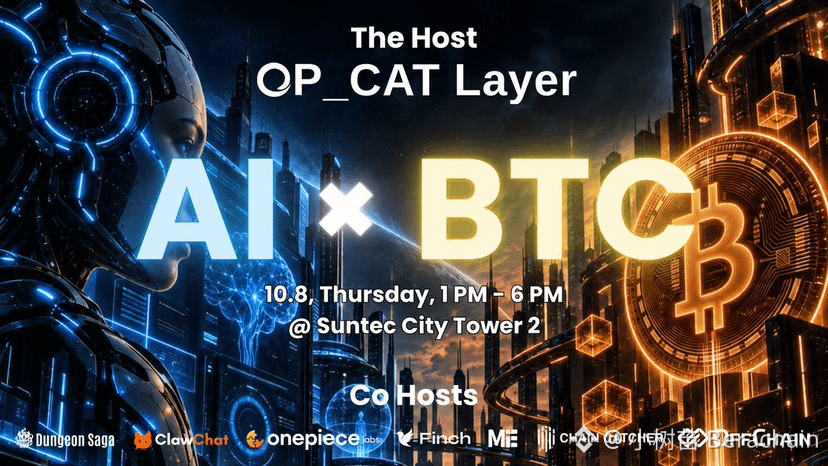
Today I was scrolling X and saw a preview from @OPCATLayerCN about a new in-person event in Singapore.
Finally, I’m seeing some hard-core logic that can genuinely push the industry forward.
The event theme is Bitcoin combined with AI Agents.
This is a classic case of a dimensionality reduction attack.
Right now, AI projects are everywhere, and most still remain at the stage of issuing “concept coins” to trick funding.
In a real AI era, AI Agents will become independent economic entities.
They’ll need payment mechanisms to buy compute power, storage, and data.
For a long time, Bitcoin has only been treated as digital gold.
The emergence of OP_CAT breaks this deadlock.
By restoring this simple opcode, Bitcoin’s mainnet gains native smart contract capabilities.
It can securely verify the complex instructions issued by AI Agents and complete seamless settlement.
The most appealing part of this event for me is the demonstration of real-world applications.
They’re planning to directly showcase the innovative product they’ve built within the Bitcoin ecosystem.
An event bold enough to show its cards—during TOKEN2049, that definitely counts as a breath of fresh air.
Escaping the anxiety of watching the charts every day.
Go listen to what the core developers think about how to plan the future machine economy.
This is the real Alpha signal.
$MSFTB
Lately, everyone in the scene has been going back and forth, tearing each other apart over one lousy meme after another.
Today I was scrolling X and saw a preview from @OPCATLayerCN about a new in-person event in Singapore.
Finally, I’m seeing some hard-core logic that can genuinely push the industry forward.
The event theme is Bitcoin combined with AI Agents.
This is a classic case of a dimensionality reduction attack.
Right now, AI projects are everywhere, and most still remain at the stage of issuing “concept coins” to trick funding.
In a real AI era, AI Agents will become independent economic entities.
They’ll need payment mechanisms to buy compute power, storage, and data.
For a long time, Bitcoin has only been treated as digital gold.
The emergence of OP_CAT breaks this deadlock.
By restoring this simple opcode, Bitcoin’s mainnet gains native smart contract capabilities.
It can securely verify the complex instructions issued by AI Agents and complete seamless settlement.
The most appealing part of this event for me is the demonstration of real-world applications.
They’re planning to directly showcase the innovative product they’ve built within the Bitcoin ecosystem.
An event bold enough to show its cards—during TOKEN2049, that definitely counts as a breath of fresh air.
Escaping the anxiety of watching the charts every day.
Go listen to what the core developers think about how to plan the future machine economy.
This is the real Alpha signal.
$MSFTB
Today I was scrolling X and saw a preview from @OPCATLayerCN about a new in-person event in Singapore.
Finally, I’m seeing some hard-core logic that can genuinely push the industry forward.
The event theme is Bitcoin combined with AI Agents.
This is a classic case of a dimensionality reduction attack.
Right now, AI projects are everywhere, and most still remain at the stage of issuing “concept coins” to trick funding.
In a real AI era, AI Agents will become independent economic entities.
They’ll need payment mechanisms to buy compute power, storage, and data.
For a long time, Bitcoin has only been treated as digital gold.
The emergence of OP_CAT breaks this deadlock.
By restoring this simple opcode, Bitcoin’s mainnet gains native smart contract capabilities.
It can securely verify the complex instructions issued by AI Agents and complete seamless settlement.
The most appealing part of this event for me is the demonstration of real-world applications.
They’re planning to directly showcase the innovative product they’ve built within the Bitcoin ecosystem.
An event bold enough to show its cards—during TOKEN2049, that definitely counts as a breath of fresh air.
Escaping the anxiety of watching the charts every day.
Go listen to what the core developers think about how to plan the future machine economy.
This is the real Alpha signal.
$MSFTB
527
Did the announcement from @MetaMask leave you totally confused?
An infrastructure security incident, exiting validator nodes—what exactly happened?
Based on a review of on-chain data shared by overseas experts, I’ve sorted out the truth behind this sudden announcement.
First, ordinary wallet users don’t need to panic; the issue this time involved non-custodial staking infrastructure.
What actually happened is that hackers breached the permissions of some ETH validators and changed the payout address for block rewards to their own wallet address.
Although the stolen profit was tiny, only 0.36 ETH, the hidden systemic risk was extremely high.
The hackers couldn’t move the staked ETH, but by controlling the node’s signing authority, they could issue commands at will.
This could directly trigger Ethereum’s Slashing penalty, causing the mainnet to confiscate and burn the node’s staked ETH.
MetaMask urgently shut down 17,000 nodes overnight and removed 520,000 ETH, cutting off the slashing risk in advance.
This crisis response was extremely decisive.
At present, several hundred abnormal nodes are still lingering, so keep an eye on further updates!
$AMZNB
Did the announcement from @MetaMask leave you totally confused?
An infrastructure security incident, exiting validator nodes—what exactly happened?
Based on a review of on-chain data shared by overseas experts, I’ve sorted out the truth behind this sudden announcement.
First, ordinary wallet users don’t need to panic; the issue this time involved non-custodial staking infrastructure.
What actually happened is that hackers breached the permissions of some ETH validators and changed the payout address for block rewards to their own wallet address.
Although the stolen profit was tiny, only 0.36 ETH, the hidden systemic risk was extremely high.
The hackers couldn’t move the staked ETH, but by controlling the node’s signing authority, they could issue commands at will.
This could directly trigger Ethereum’s Slashing penalty, causing the mainnet to confiscate and burn the node’s staked ETH.
MetaMask urgently shut down 17,000 nodes overnight and removed 520,000 ETH, cutting off the slashing risk in advance.
This crisis response was extremely decisive.
At present, several hundred abnormal nodes are still lingering, so keep an eye on further updates!
$AMZNB
An infrastructure security incident, exiting validator nodes—what exactly happened?
Based on a review of on-chain data shared by overseas experts, I’ve sorted out the truth behind this sudden announcement.
First, ordinary wallet users don’t need to panic; the issue this time involved non-custodial staking infrastructure.
What actually happened is that hackers breached the permissions of some ETH validators and changed the payout address for block rewards to their own wallet address.
Although the stolen profit was tiny, only 0.36 ETH, the hidden systemic risk was extremely high.
The hackers couldn’t move the staked ETH, but by controlling the node’s signing authority, they could issue commands at will.
This could directly trigger Ethereum’s Slashing penalty, causing the mainnet to confiscate and burn the node’s staked ETH.
MetaMask urgently shut down 17,000 nodes overnight and removed 520,000 ETH, cutting off the slashing risk in advance.
This crisis response was extremely decisive.
At present, several hundred abnormal nodes are still lingering, so keep an eye on further updates!
$AMZNB

1
1.2k
🇨🇳 The splendid rivers and mountains, with years singing along.
In the October breeze, drifting across ten thousand miles of the land, it also connects every longing from afar.
May each Beras, during this holiday, have beautiful scenery to accompany you, get to reunite with loved ones, and also find your own little joys.
Wishing everyone a Happy National Day—peace and joy always.🐻✨
$BERA
🇨🇳 The splendid rivers and mountains, with years singing along.
In the October breeze, drifting across ten thousand miles of the land, it also connects every longing from afar.
May each Beras, during this holiday, have beautiful scenery to accompany you, get to reunite with loved ones, and also find your own little joys.
Wishing everyone a Happy National Day—peace and joy always.🐻✨
$BERA
In the October breeze, drifting across ten thousand miles of the land, it also connects every longing from afar.
May each Beras, during this holiday, have beautiful scenery to accompany you, get to reunite with loved ones, and also find your own little joys.
Wishing everyone a Happy National Day—peace and joy always.🐻✨
$BERA

3
1.1k
Last night, AMD acquired Li Feifei’s team.
The company was founded just a little over 2 years ago, and AMD bought it for more than $8 billion.
Needless to say, the founders; even ordinary employees who joined early are basically not out of the question to have a net worth of over 100 million this time.
If your profession and abilities allow it.
Don’t hesitate—go into an AI-related industry right now, immediately.
This is the first chance in your life to break through to the next social class.
$MSFTB
Last night, AMD acquired Li Feifei’s team.
The company was founded just a little over 2 years ago, and AMD bought it for more than $8 billion.
Needless to say, the founders; even ordinary employees who joined early are basically not out of the question to have a net worth of over 100 million this time.
If your profession and abilities allow it.
Don’t hesitate—go into an AI-related industry right now, immediately.
This is the first chance in your life to break through to the next social class.
$MSFTB
The company was founded just a little over 2 years ago, and AMD bought it for more than $8 billion.
Needless to say, the founders; even ordinary employees who joined early are basically not out of the question to have a net worth of over 100 million this time.
If your profession and abilities allow it.
Don’t hesitate—go into an AI-related industry right now, immediately.
This is the first chance in your life to break through to the next social class.
$MSFTB
1
1
3.8k
Does subsidized interest benefit the real estate market? That’s unquestionable.
Right now, mortgage interest is 3%. If it drops to 2%, it will attract a wave of purchasing power—especially for people who already have a home-buying need.
But it won’t stimulate much investment demand. Take me for example: I wouldn’t buy a house for investment unless the rental-to-sale ratio can reach a reasonable range, and unless economic data shows clear improvement. Otherwise, I pay no attention at all.
For real estate—this kind of heavy asset—personal effort doesn’t matter much in the face of the times. A few days ago, I was still calculating with a friend: a few years back, we spent a lot of effort and at a big cost to buy a place. We hadn’t even lived in it for a day, and after figuring it out, we realized we’d already lost several million.
Wouldn’t turning those several million into cash to line mattresses be better? So sometimes you can’t be too driven—don’t spend your whole life grinding and just getting by. If you suddenly start trying to “stir things up” and do more experiments, you find that life starts to become increasingly difficult.
This includes entrepreneurship, buying a house, investing, and so on.
$AAPLB
Does subsidized interest benefit the real estate market? That’s unquestionable.
Right now, mortgage interest is 3%. If it drops to 2%, it will attract a wave of purchasing power—especially for people who already have a home-buying need.
But it won’t stimulate much investment demand. Take me for example: I wouldn’t buy a house for investment unless the rental-to-sale ratio can reach a reasonable range, and unless economic data shows clear improvement. Otherwise, I pay no attention at all.
For real estate—this kind of heavy asset—personal effort doesn’t matter much in the face of the times. A few days ago, I was still calculating with a friend: a few years back, we spent a lot of effort and at a big cost to buy a place. We hadn’t even lived in it for a day, and after figuring it out, we realized we’d already lost several million.
Wouldn’t turning those several million into cash to line mattresses be better? So sometimes you can’t be too driven—don’t spend your whole life grinding and just getting by. If you suddenly start trying to “stir things up” and do more experiments, you find that life starts to become increasingly difficult.
This includes entrepreneurship, buying a house, investing, and so on.
$AAPLB
Right now, mortgage interest is 3%. If it drops to 2%, it will attract a wave of purchasing power—especially for people who already have a home-buying need.
But it won’t stimulate much investment demand. Take me for example: I wouldn’t buy a house for investment unless the rental-to-sale ratio can reach a reasonable range, and unless economic data shows clear improvement. Otherwise, I pay no attention at all.
For real estate—this kind of heavy asset—personal effort doesn’t matter much in the face of the times. A few days ago, I was still calculating with a friend: a few years back, we spent a lot of effort and at a big cost to buy a place. We hadn’t even lived in it for a day, and after figuring it out, we realized we’d already lost several million.
Wouldn’t turning those several million into cash to line mattresses be better? So sometimes you can’t be too driven—don’t spend your whole life grinding and just getting by. If you suddenly start trying to “stir things up” and do more experiments, you find that life starts to become increasingly difficult.
This includes entrepreneurship, buying a house, investing, and so on.
$AAPLB
983
Before there wasn’t a single ghost or shadow on the Arc mainnet.
A bunch of people started疯狂(recklessly)overpaying to buy the U on the chain and blindly rush into some dirt-cheap memecoin.
I couldn’t figure it out at the time.
If the chain doesn’t exist, what are you buying—tokens from the underworld?
When I saw that yesterday @GIWA_by_Upbit’s mainnet didn’t go live, the “fake chain” crowd rushed in first and got away with $2 million.
Case closed.
Let me put it bluntly: once FOMO hits this space, parts of people’s brains just collectively shut down.
Someone casually writes a single-player, standalone version of a webpage, and people will eagerly pour real money in.
The windier the place, the sharper the scythe.
Keep your wallet tightly shut—only by protecting your principal do you have a chance to turn things around.
$AMZNB
Before there wasn’t a single ghost or shadow on the Arc mainnet.
A bunch of people started疯狂(recklessly)overpaying to buy the U on the chain and blindly rush into some dirt-cheap memecoin.
I couldn’t figure it out at the time.
If the chain doesn’t exist, what are you buying—tokens from the underworld?
When I saw that yesterday @GIWA_by_Upbit’s mainnet didn’t go live, the “fake chain” crowd rushed in first and got away with $2 million.
Case closed.
Let me put it bluntly: once FOMO hits this space, parts of people’s brains just collectively shut down.
Someone casually writes a single-player, standalone version of a webpage, and people will eagerly pour real money in.
The windier the place, the sharper the scythe.
Keep your wallet tightly shut—only by protecting your principal do you have a chance to turn things around.
$AMZNB
A bunch of people started疯狂(recklessly)overpaying to buy the U on the chain and blindly rush into some dirt-cheap memecoin.
I couldn’t figure it out at the time.
If the chain doesn’t exist, what are you buying—tokens from the underworld?
When I saw that yesterday @GIWA_by_Upbit’s mainnet didn’t go live, the “fake chain” crowd rushed in first and got away with $2 million.
Case closed.
Let me put it bluntly: once FOMO hits this space, parts of people’s brains just collectively shut down.
Someone casually writes a single-player, standalone version of a webpage, and people will eagerly pour real money in.
The windier the place, the sharper the scythe.
Keep your wallet tightly shut—only by protecting your principal do you have a chance to turn things around.
$AMZNB
1
700
In recent years, I’ve also been held back by a question: how much money do you need in your hand before you don’t have to worry about money anymore.
I used to be stubborn too. I believed that if you saved up to a specific number, life would feel stable and you’d have more freedom.
Only recently did I figure this out: it’s an endless goal—someone wants 300,000 to reach a million; once they have a million, they want five million. It feels like your wallet keeps growing, but the places you spend money are also increasing, and that stone in your heart never really gets lighter.
When I looked at my bills, line by line, it finally hit me: the number I set before, and the effort I put in to reach it, was actually chasing someone else’s approval—not building my own life.
What I’ve truly managed to do in this period is bring my spending down by one level. When there’s no need, I don’t keep checking shopping apps. I cancel unused membership subscriptions. I cut back on delivery and go to the supermarket to buy vegetables. If I can walk, I don’t take a ride. At the end of the month, looking at the bill, I don’t feel panicked anymore.
It’s actually very simple: meals are taken care of, and my family members are healthy. And now, at night, I still manage to free up two hours to learn things I want to learn myself. I think this is the kind of modest security that ordinary people can hold on to.
So if you ask me how much money I need to not worry, my answer is: enough to live simply.
What number did you set for yourself?
$AAPLB
In recent years, I’ve also been held back by a question: how much money do you need in your hand before you don’t have to worry about money anymore.
I used to be stubborn too. I believed that if you saved up to a specific number, life would feel stable and you’d have more freedom.
Only recently did I figure this out: it’s an endless goal—someone wants 300,000 to reach a million; once they have a million, they want five million. It feels like your wallet keeps growing, but the places you spend money are also increasing, and that stone in your heart never really gets lighter.
When I looked at my bills, line by line, it finally hit me: the number I set before, and the effort I put in to reach it, was actually chasing someone else’s approval—not building my own life.
What I’ve truly managed to do in this period is bring my spending down by one level. When there’s no need, I don’t keep checking shopping apps. I cancel unused membership subscriptions. I cut back on delivery and go to the supermarket to buy vegetables. If I can walk, I don’t take a ride. At the end of the month, looking at the bill, I don’t feel panicked anymore.
It’s actually very simple: meals are taken care of, and my family members are healthy. And now, at night, I still manage to free up two hours to learn things I want to learn myself. I think this is the kind of modest security that ordinary people can hold on to.
So if you ask me how much money I need to not worry, my answer is: enough to live simply.
What number did you set for yourself?
$AAPLB
I used to be stubborn too. I believed that if you saved up to a specific number, life would feel stable and you’d have more freedom.
Only recently did I figure this out: it’s an endless goal—someone wants 300,000 to reach a million; once they have a million, they want five million. It feels like your wallet keeps growing, but the places you spend money are also increasing, and that stone in your heart never really gets lighter.
When I looked at my bills, line by line, it finally hit me: the number I set before, and the effort I put in to reach it, was actually chasing someone else’s approval—not building my own life.
What I’ve truly managed to do in this period is bring my spending down by one level. When there’s no need, I don’t keep checking shopping apps. I cancel unused membership subscriptions. I cut back on delivery and go to the supermarket to buy vegetables. If I can walk, I don’t take a ride. At the end of the month, looking at the bill, I don’t feel panicked anymore.
It’s actually very simple: meals are taken care of, and my family members are healthy. And now, at night, I still manage to free up two hours to learn things I want to learn myself. I think this is the kind of modest security that ordinary people can hold on to.
So if you ask me how much money I need to not worry, my answer is: enough to live simply.
What number did you set for yourself?
$AAPLB
1
1
2k
Tesla China has lowered prices again, but this time it’s doing it in a different promotional way.
On September 7, it had already rolled out a round of incentives: for orders placed and delivered before September 30, the entire Model 3 lineup got a 5,000 yuan subsidy, and the entire Model Y lineup got a 10,000 yuan subsidy.
By September 25, a new policy arrived: for orders placed before October 31, the final payment for the entire Model 3 lineup is reduced by 5,000 yuan, while certain Model Y variants get 7,000 yuan off. Combined with perks such as 5 years of 0% interest, the Model 3 starts at 222,500 yuan, and the Model Y starts at 256,500 yuan.
Note that this is not a “discount on top of a discount.” The Model 3’s 5,000 yuan reduction has stayed the same, but the Model Y has been cut from 10,000 yuan to 7,000 yuan; the timeline has also been relaxed from “delivery before September 30” to “order before October 31,” and it is no longer limited to inventory cars.
In plain terms, the official guide price has not changed. What’s being lowered is the final payment and the financing barrier. This avoids the brand devaluation and backlash from existing owners that can come with an official price cut, while still giving sales a boost.
So this round of “price cuts” may sound exciting, but in essence it’s just a change in the promotional strategy.
For those who want to buy, the upfront cost is indeed a bit lower, but bargain hunters will probably keep waiting. What do you think?
$TSMB
Tesla China has lowered prices again, but this time it’s doing it in a different promotional way.
On September 7, it had already rolled out a round of incentives: for orders placed and delivered before September 30, the entire Model 3 lineup got a 5,000 yuan subsidy, and the entire Model Y lineup got a 10,000 yuan subsidy.
By September 25, a new policy arrived: for orders placed before October 31, the final payment for the entire Model 3 lineup is reduced by 5,000 yuan, while certain Model Y variants get 7,000 yuan off. Combined with perks such as 5 years of 0% interest, the Model 3 starts at 222,500 yuan, and the Model Y starts at 256,500 yuan.
Note that this is not a “discount on top of a discount.” The Model 3’s 5,000 yuan reduction has stayed the same, but the Model Y has been cut from 10,000 yuan to 7,000 yuan; the timeline has also been relaxed from “delivery before September 30” to “order before October 31,” and it is no longer limited to inventory cars.
In plain terms, the official guide price has not changed. What’s being lowered is the final payment and the financing barrier. This avoids the brand devaluation and backlash from existing owners that can come with an official price cut, while still giving sales a boost.
So this round of “price cuts” may sound exciting, but in essence it’s just a change in the promotional strategy.
For those who want to buy, the upfront cost is indeed a bit lower, but bargain hunters will probably keep waiting. What do you think?
$TSMB
On September 7, it had already rolled out a round of incentives: for orders placed and delivered before September 30, the entire Model 3 lineup got a 5,000 yuan subsidy, and the entire Model Y lineup got a 10,000 yuan subsidy.
By September 25, a new policy arrived: for orders placed before October 31, the final payment for the entire Model 3 lineup is reduced by 5,000 yuan, while certain Model Y variants get 7,000 yuan off. Combined with perks such as 5 years of 0% interest, the Model 3 starts at 222,500 yuan, and the Model Y starts at 256,500 yuan.
Note that this is not a “discount on top of a discount.” The Model 3’s 5,000 yuan reduction has stayed the same, but the Model Y has been cut from 10,000 yuan to 7,000 yuan; the timeline has also been relaxed from “delivery before September 30” to “order before October 31,” and it is no longer limited to inventory cars.
In plain terms, the official guide price has not changed. What’s being lowered is the final payment and the financing barrier. This avoids the brand devaluation and backlash from existing owners that can come with an official price cut, while still giving sales a boost.
So this round of “price cuts” may sound exciting, but in essence it’s just a change in the promotional strategy.
For those who want to buy, the upfront cost is indeed a bit lower, but bargain hunters will probably keep waiting. What do you think?
$TSMB
1
1.3k
They say that people can’t earn money beyond their cognition. In truth, it’s even more terrifying: people can’t earn money beyond their qi and blood.
We must pay attention to our bodies. Many times, getting sick is not a bad thing—it’s your body doing everything it can to pull you back from an overspent, off-track life. For many people, awakening begins with an illness.
The brain always just stares at its goal and charges forward. To achieve its purpose, it automatically blocks out every uncomfortable feeling.
People who are extremely rational and have a strong sense of purpose are the most likely to live as a machine that only runs forward—eyes only on performance, KPIs, and the next project to conquer—completely forgetting what their body is feeling.
This isn’t about having strong willpower. It’s forgetting that the body isn’t a perpetual motion machine.
Every late night you push through, every hard-fought drinking session you endure, every emotion you swallow down—are quietly consuming your qi and blood. As your qi and blood is drained little by little, your energy, judgment, and capacity will collapse along with it. Even if opportunity is right in front of you, you won’t be able to grab it.
Many people clearly hold good projects and good resources, but in the end, due to a sudden severe illness, they end up handing back all the money they earned to the hospital—without even the chance to rise again.
That’s why people are said to never be able to earn money beyond their qi and blood. Cognition can tell you where the road is, but qi and blood are the two legs that help you reach the end.
Without enough qi and blood to support you, no matter how good the opportunities are, you can’t take them. No matter how much wealth you have, you can’t keep it.
Don’t wait until your headache gets so bad you can’t even lift your head, until your body’s red light is completely flashing, and then only remember to stop and look at your own feelings. Starting today, don’t just stare at the goal and charge forward. Every day, take a few minutes to quietly feel your body.
Your body won’t lie. The pain that makes you stop isn’t an enemy blocking your success—it’s heaven giving you a lifeline.
$MSFTB
They say that people can’t earn money beyond their cognition. In truth, it’s even more terrifying: people can’t earn money beyond their qi and blood.
We must pay attention to our bodies. Many times, getting sick is not a bad thing—it’s your body doing everything it can to pull you back from an overspent, off-track life. For many people, awakening begins with an illness.
The brain always just stares at its goal and charges forward. To achieve its purpose, it automatically blocks out every uncomfortable feeling.
People who are extremely rational and have a strong sense of purpose are the most likely to live as a machine that only runs forward—eyes only on performance, KPIs, and the next project to conquer—completely forgetting what their body is feeling.
This isn’t about having strong willpower. It’s forgetting that the body isn’t a perpetual motion machine.
Every late night you push through, every hard-fought drinking session you endure, every emotion you swallow down—are quietly consuming your qi and blood. As your qi and blood is drained little by little, your energy, judgment, and capacity will collapse along with it. Even if opportunity is right in front of you, you won’t be able to grab it.
Many people clearly hold good projects and good resources, but in the end, due to a sudden severe illness, they end up handing back all the money they earned to the hospital—without even the chance to rise again.
That’s why people are said to never be able to earn money beyond their qi and blood. Cognition can tell you where the road is, but qi and blood are the two legs that help you reach the end.
Without enough qi and blood to support you, no matter how good the opportunities are, you can’t take them. No matter how much wealth you have, you can’t keep it.
Don’t wait until your headache gets so bad you can’t even lift your head, until your body’s red light is completely flashing, and then only remember to stop and look at your own feelings. Starting today, don’t just stare at the goal and charge forward. Every day, take a few minutes to quietly feel your body.
Your body won’t lie. The pain that makes you stop isn’t an enemy blocking your success—it’s heaven giving you a lifeline.
$MSFTB
We must pay attention to our bodies. Many times, getting sick is not a bad thing—it’s your body doing everything it can to pull you back from an overspent, off-track life. For many people, awakening begins with an illness.
The brain always just stares at its goal and charges forward. To achieve its purpose, it automatically blocks out every uncomfortable feeling.
People who are extremely rational and have a strong sense of purpose are the most likely to live as a machine that only runs forward—eyes only on performance, KPIs, and the next project to conquer—completely forgetting what their body is feeling.
This isn’t about having strong willpower. It’s forgetting that the body isn’t a perpetual motion machine.
Every late night you push through, every hard-fought drinking session you endure, every emotion you swallow down—are quietly consuming your qi and blood. As your qi and blood is drained little by little, your energy, judgment, and capacity will collapse along with it. Even if opportunity is right in front of you, you won’t be able to grab it.
Many people clearly hold good projects and good resources, but in the end, due to a sudden severe illness, they end up handing back all the money they earned to the hospital—without even the chance to rise again.
That’s why people are said to never be able to earn money beyond their qi and blood. Cognition can tell you where the road is, but qi and blood are the two legs that help you reach the end.
Without enough qi and blood to support you, no matter how good the opportunities are, you can’t take them. No matter how much wealth you have, you can’t keep it.
Don’t wait until your headache gets so bad you can’t even lift your head, until your body’s red light is completely flashing, and then only remember to stop and look at your own feelings. Starting today, don’t just stare at the goal and charge forward. Every day, take a few minutes to quietly feel your body.
Your body won’t lie. The pain that makes you stop isn’t an enemy blocking your success—it’s heaven giving you a lifeline.
$MSFTB
3
2
1.6k
Verified
The last day before the Mid-Autumn Festival, the A-shares market crashed. Coincidentally, today is 924;
Two years ago, China rolled out the “924 policy package.” That day, the Shanghai Composite surged by +4.15% to 2863.13 points, marking its biggest single-day gain in about 4 years; about 5,000 stocks rose, and more than 90% of them were in the green.
Two years later, today the Shanghai Composite fell 1.22%, with more than 4,300 companies declining.
Times have changed!
After reading a round of comments online, it’s clear that people have become increasingly disappointed with the A-shares market. When the global market rises, we don’t; when the global market falls, we’re guaranteed to fall. Every day, it either opens high then sells off, or opens low and keeps sliding.
The global consensus in capital markets is to study fundamentals, macroeconomic conditions, and company performance—these are key factors that drive stock price gains and losses. But in the A-shares market, these have become secondary.
What matters most, surprisingly, is liquidity.
Why, in A-shares investing, people often say they can’t make money? Because everyone has a habit of frequent trading.
In a market like this with heavy volatility, the more you trade, the higher the probability of making mistakes—so it becomes hard to profit.
On top of that, another feature of the A-shares market is that holding for too long also doesn’t make money.
Over the past 10 years, the A-shares have gone through several bull markets—real estate, new energy, healthcare, liquor, and now technology. It’s typically a cycle of just 2–3 years per sector. If you’re even slightly too complacent, you end up with “paper wealth.”
So for many ordinary investors, buying funds often doesn’t make money either, because they can’t keep up with shifts in sector hotspots.
$AMZNB
The last day before the Mid-Autumn Festival, the A-shares market crashed. Coincidentally, today is 924;
Two years ago, China rolled out the “924 policy package.” That day, the Shanghai Composite surged by +4.15% to 2863.13 points, marking its biggest single-day gain in about 4 years; about 5,000 stocks rose, and more than 90% of them were in the green.
Two years later, today the Shanghai Composite fell 1.22%, with more than 4,300 companies declining.
Times have changed!
After reading a round of comments online, it’s clear that people have become increasingly disappointed with the A-shares market. When the global market rises, we don’t; when the global market falls, we’re guaranteed to fall. Every day, it either opens high then sells off, or opens low and keeps sliding.
The global consensus in capital markets is to study fundamentals, macroeconomic conditions, and company performance—these are key factors that drive stock price gains and losses. But in the A-shares market, these have become secondary.
What matters most, surprisingly, is liquidity.
Why, in A-shares investing, people often say they can’t make money? Because everyone has a habit of frequent trading.
In a market like this with heavy volatility, the more you trade, the higher the probability of making mistakes—so it becomes hard to profit.
On top of that, another feature of the A-shares market is that holding for too long also doesn’t make money.
Over the past 10 years, the A-shares have gone through several bull markets—real estate, new energy, healthcare, liquor, and now technology. It’s typically a cycle of just 2–3 years per sector. If you’re even slightly too complacent, you end up with “paper wealth.”
So for many ordinary investors, buying funds often doesn’t make money either, because they can’t keep up with shifts in sector hotspots.
$AMZNB
Two years ago, China rolled out the “924 policy package.” That day, the Shanghai Composite surged by +4.15% to 2863.13 points, marking its biggest single-day gain in about 4 years; about 5,000 stocks rose, and more than 90% of them were in the green.
Two years later, today the Shanghai Composite fell 1.22%, with more than 4,300 companies declining.
Times have changed!
After reading a round of comments online, it’s clear that people have become increasingly disappointed with the A-shares market. When the global market rises, we don’t; when the global market falls, we’re guaranteed to fall. Every day, it either opens high then sells off, or opens low and keeps sliding.
The global consensus in capital markets is to study fundamentals, macroeconomic conditions, and company performance—these are key factors that drive stock price gains and losses. But in the A-shares market, these have become secondary.
What matters most, surprisingly, is liquidity.
Why, in A-shares investing, people often say they can’t make money? Because everyone has a habit of frequent trading.
In a market like this with heavy volatility, the more you trade, the higher the probability of making mistakes—so it becomes hard to profit.
On top of that, another feature of the A-shares market is that holding for too long also doesn’t make money.
Over the past 10 years, the A-shares have gone through several bull markets—real estate, new energy, healthcare, liquor, and now technology. It’s typically a cycle of just 2–3 years per sector. If you’re even slightly too complacent, you end up with “paper wealth.”
So for many ordinary investors, buying funds often doesn’t make money either, because they can’t keep up with shifts in sector hotspots.
$AMZNB
807
Verified
First, let’s look at the key points in the market’s next round of game-playing: there’s a 55% probability of a rate hike in October. Right now, it’s a fifty-fifty situation, and going forward, these expectations will be continuously contested as the overall macro environment evolves—for example, geopolitical conflicts and how U.S. inflation performs.
And in terms of the real situation, the thing that ultimately determines the “stopping point” of this round of U.S. rate hikes is actually geopolitical conflict.
At present, tensions around the secondary conflict (U.S.-Iran) have somewhat eased—Saudi Arabia has said it is stepping up efforts to repair the oil pipelines. However, before the midterm elections, that is, before November 3, it may be difficult for any major changes to occur in these two months. In other words, oil prices will likely remain at high levels.
High oil prices → inflation won’t cool down → another rate hike may still be needed going forward → not until next year (2027) will there possibly be any easing in conditions such as rate tightening and global tightening.
So what should we do ourselves?
Let’s state the conclusion upfront: from now to the fourth quarter of this year, based on the information we currently know, our investment environment is still in an externally relatively tight one.
Under such a tightening environment, it’s hard for the market to sustain a run of consistently good performance. Especially now that the 10-year Treasury yield has already risen above 5%, which is an absolute high-yield zone. The financial markets will show a certain fragility, and unexpected events could happen at any time.
$MSFTB
First, let’s look at the key points in the market’s next round of game-playing: there’s a 55% probability of a rate hike in October. Right now, it’s a fifty-fifty situation, and going forward, these expectations will be continuously contested as the overall macro environment evolves—for example, geopolitical conflicts and how U.S. inflation performs.
And in terms of the real situation, the thing that ultimately determines the “stopping point” of this round of U.S. rate hikes is actually geopolitical conflict.
At present, tensions around the secondary conflict (U.S.-Iran) have somewhat eased—Saudi Arabia has said it is stepping up efforts to repair the oil pipelines. However, before the midterm elections, that is, before November 3, it may be difficult for any major changes to occur in these two months. In other words, oil prices will likely remain at high levels.
High oil prices → inflation won’t cool down → another rate hike may still be needed going forward → not until next year (2027) will there possibly be any easing in conditions such as rate tightening and global tightening.
So what should we do ourselves?
Let’s state the conclusion upfront: from now to the fourth quarter of this year, based on the information we currently know, our investment environment is still in an externally relatively tight one.
Under such a tightening environment, it’s hard for the market to sustain a run of consistently good performance. Especially now that the 10-year Treasury yield has already risen above 5%, which is an absolute high-yield zone. The financial markets will show a certain fragility, and unexpected events could happen at any time.
$MSFTB
And in terms of the real situation, the thing that ultimately determines the “stopping point” of this round of U.S. rate hikes is actually geopolitical conflict.
At present, tensions around the secondary conflict (U.S.-Iran) have somewhat eased—Saudi Arabia has said it is stepping up efforts to repair the oil pipelines. However, before the midterm elections, that is, before November 3, it may be difficult for any major changes to occur in these two months. In other words, oil prices will likely remain at high levels.
High oil prices → inflation won’t cool down → another rate hike may still be needed going forward → not until next year (2027) will there possibly be any easing in conditions such as rate tightening and global tightening.
So what should we do ourselves?
Let’s state the conclusion upfront: from now to the fourth quarter of this year, based on the information we currently know, our investment environment is still in an externally relatively tight one.
Under such a tightening environment, it’s hard for the market to sustain a run of consistently good performance. Especially now that the 10-year Treasury yield has already risen above 5%, which is an absolute high-yield zone. The financial markets will show a certain fragility, and unexpected events could happen at any time.
$MSFTB
2
4.7k
Recently, Chen Guanxi suddenly dropped into a Douyin livestream and started selling his own brand, CLOT.
He didn’t say much about the clothes, but his long hair and beard were the first things netizens noticed—some joked that he looked like Zhao Benshan.
Smiling, he said that being handsome is an attitude, not just an appearance, and even dug up the old gag about “transferring 300 yuan” to have a bit of fun.
As lively as it was, the merchandise was also really sold: the entire livestream lasted about two hours, and within less than ten minutes of going live, the number of viewers online surpassed 100,000.
He climbed to No. 1 on the men’s fashion chart and No. 2 on the livestream sales chart. Judging from the platform’s sales figures and average unit price, the single-session transactions reached the tens of millions—on the order of a million-level scale.
It may look sudden, but it’s actually the result of timing falling into place. CLOT has been operating for 23 years: its mainline focuses on design collaborations while protecting exclusivity, and its sub-line, CLOTTEE, is priced more affordably—perfect for a livestream setting.
In the early years, he tested e-commerce; now he’s moved to Douyin—simply bringing product display, interaction, and checkout together.
Chen Guanxi’s name can draw attention, but what truly makes people open their wallets is the products and channels he’s built up over the years.
Though the “ten-million” figure still lacks official confirmation, the saying “even if the Ferrari gets old, it’s still a Ferrari” fits him to a certain extent.
$AMZNB
Recently, Chen Guanxi suddenly dropped into a Douyin livestream and started selling his own brand, CLOT.
He didn’t say much about the clothes, but his long hair and beard were the first things netizens noticed—some joked that he looked like Zhao Benshan.
Smiling, he said that being handsome is an attitude, not just an appearance, and even dug up the old gag about “transferring 300 yuan” to have a bit of fun.
As lively as it was, the merchandise was also really sold: the entire livestream lasted about two hours, and within less than ten minutes of going live, the number of viewers online surpassed 100,000.
He climbed to No. 1 on the men’s fashion chart and No. 2 on the livestream sales chart. Judging from the platform’s sales figures and average unit price, the single-session transactions reached the tens of millions—on the order of a million-level scale.
It may look sudden, but it’s actually the result of timing falling into place. CLOT has been operating for 23 years: its mainline focuses on design collaborations while protecting exclusivity, and its sub-line, CLOTTEE, is priced more affordably—perfect for a livestream setting.
In the early years, he tested e-commerce; now he’s moved to Douyin—simply bringing product display, interaction, and checkout together.
Chen Guanxi’s name can draw attention, but what truly makes people open their wallets is the products and channels he’s built up over the years.
Though the “ten-million” figure still lacks official confirmation, the saying “even if the Ferrari gets old, it’s still a Ferrari” fits him to a certain extent.
$AMZNB
He didn’t say much about the clothes, but his long hair and beard were the first things netizens noticed—some joked that he looked like Zhao Benshan.
Smiling, he said that being handsome is an attitude, not just an appearance, and even dug up the old gag about “transferring 300 yuan” to have a bit of fun.
As lively as it was, the merchandise was also really sold: the entire livestream lasted about two hours, and within less than ten minutes of going live, the number of viewers online surpassed 100,000.
He climbed to No. 1 on the men’s fashion chart and No. 2 on the livestream sales chart. Judging from the platform’s sales figures and average unit price, the single-session transactions reached the tens of millions—on the order of a million-level scale.
It may look sudden, but it’s actually the result of timing falling into place. CLOT has been operating for 23 years: its mainline focuses on design collaborations while protecting exclusivity, and its sub-line, CLOTTEE, is priced more affordably—perfect for a livestream setting.
In the early years, he tested e-commerce; now he’s moved to Douyin—simply bringing product display, interaction, and checkout together.
Chen Guanxi’s name can draw attention, but what truly makes people open their wallets is the products and channels he’s built up over the years.
Though the “ten-million” figure still lacks official confirmation, the saying “even if the Ferrari gets old, it’s still a Ferrari” fits him to a certain extent.
$AMZNB

3
1
5.2k
US stock after-hours trading plunged, and Korean stocks also plunged. They might not rise when A-share stocks rise, but they will definitely fall when A-shares fall. I don’t know whether the funds that sold today can be made to understand what happened. Last night, the Americans surged violently—indices were up more than one percent. The result? After-hours trading then plunged a little and immediately flipped into a decline.
With the Mid-Autumn Festival and the National Day holiday coming up, I guess there won’t be much opportunity next. The reason is that the holidays are too close. A-share capital will be highly competitive and “crowded.” Sell before the Mid-Autumn Festival, and sell again before National Day—so there are only 3 real trading days.
It’s impossible for it to surge. Actually, after seeing last night’s US stocks, I even felt a bit hopeful that today’s A-shares would slap back with thousands of stocks hitting the daily limit up. But I was overthinking.
Even a little disappointed. I expected today wouldn’t surge much, but I didn’t expect it to drop so insanely. Still, I underestimated the nature of the funds.
The day after tomorrow is when the holiday starts. Today has to be sold early; tomorrow needs to be left with cash so you can withdraw it. The day after tomorrow is for staying on the safe side against the holiday. Then next week, we’ll have to guard against external negative news because the National Day holiday is too long.
I think I finally get it: US stocks are having a “collapse-style” rally, while A-shares are “precaution-style” falling. One doesn’t know what it’s collapsing from, and the other doesn’t know what it’s trying to prevent…
Actually, it’s understandable. When there’s no market trend, A-shares are almost always driven by capital. With such a long holiday, the speculators will definitely retreat, quant funds will cut positions, and many small retail investors trading short-term will clear out their holdings.
In the end, there are still some funds doing medium-to-long term investments and institutional funds. But the problem is they don’t trade, so they can’t change the trend. At this stage, big money won’t suddenly buy in huge quantities.
Meanwhile, short-term funds mainly focus on defense, so naturally they end up dominating the kind of market action that leads to plunges.
I really feel that in A-shares, a lot of funds are “allergic” to making just a little money and then they’re done…
$TSMB
US stock after-hours trading plunged, and Korean stocks also plunged. They might not rise when A-share stocks rise, but they will definitely fall when A-shares fall. I don’t know whether the funds that sold today can be made to understand what happened. Last night, the Americans surged violently—indices were up more than one percent. The result? After-hours trading then plunged a little and immediately flipped into a decline.
With the Mid-Autumn Festival and the National Day holiday coming up, I guess there won’t be much opportunity next. The reason is that the holidays are too close. A-share capital will be highly competitive and “crowded.” Sell before the Mid-Autumn Festival, and sell again before National Day—so there are only 3 real trading days.
It’s impossible for it to surge. Actually, after seeing last night’s US stocks, I even felt a bit hopeful that today’s A-shares would slap back with thousands of stocks hitting the daily limit up. But I was overthinking.
Even a little disappointed. I expected today wouldn’t surge much, but I didn’t expect it to drop so insanely. Still, I underestimated the nature of the funds.
The day after tomorrow is when the holiday starts. Today has to be sold early; tomorrow needs to be left with cash so you can withdraw it. The day after tomorrow is for staying on the safe side against the holiday. Then next week, we’ll have to guard against external negative news because the National Day holiday is too long.
I think I finally get it: US stocks are having a “collapse-style” rally, while A-shares are “precaution-style” falling. One doesn’t know what it’s collapsing from, and the other doesn’t know what it’s trying to prevent…
Actually, it’s understandable. When there’s no market trend, A-shares are almost always driven by capital. With such a long holiday, the speculators will definitely retreat, quant funds will cut positions, and many small retail investors trading short-term will clear out their holdings.
In the end, there are still some funds doing medium-to-long term investments and institutional funds. But the problem is they don’t trade, so they can’t change the trend. At this stage, big money won’t suddenly buy in huge quantities.
Meanwhile, short-term funds mainly focus on defense, so naturally they end up dominating the kind of market action that leads to plunges.
I really feel that in A-shares, a lot of funds are “allergic” to making just a little money and then they’re done…
$TSMB
With the Mid-Autumn Festival and the National Day holiday coming up, I guess there won’t be much opportunity next. The reason is that the holidays are too close. A-share capital will be highly competitive and “crowded.” Sell before the Mid-Autumn Festival, and sell again before National Day—so there are only 3 real trading days.
It’s impossible for it to surge. Actually, after seeing last night’s US stocks, I even felt a bit hopeful that today’s A-shares would slap back with thousands of stocks hitting the daily limit up. But I was overthinking.
Even a little disappointed. I expected today wouldn’t surge much, but I didn’t expect it to drop so insanely. Still, I underestimated the nature of the funds.
The day after tomorrow is when the holiday starts. Today has to be sold early; tomorrow needs to be left with cash so you can withdraw it. The day after tomorrow is for staying on the safe side against the holiday. Then next week, we’ll have to guard against external negative news because the National Day holiday is too long.
I think I finally get it: US stocks are having a “collapse-style” rally, while A-shares are “precaution-style” falling. One doesn’t know what it’s collapsing from, and the other doesn’t know what it’s trying to prevent…
Actually, it’s understandable. When there’s no market trend, A-shares are almost always driven by capital. With such a long holiday, the speculators will definitely retreat, quant funds will cut positions, and many small retail investors trading short-term will clear out their holdings.
In the end, there are still some funds doing medium-to-long term investments and institutional funds. But the problem is they don’t trade, so they can’t change the trend. At this stage, big money won’t suddenly buy in huge quantities.
Meanwhile, short-term funds mainly focus on defense, so naturally they end up dominating the kind of market action that leads to plunges.
I really feel that in A-shares, a lot of funds are “allergic” to making just a little money and then they’re done…
$TSMB
1
1.1k
Partly True
Continuing updates on liquidity incentives on Berachain.
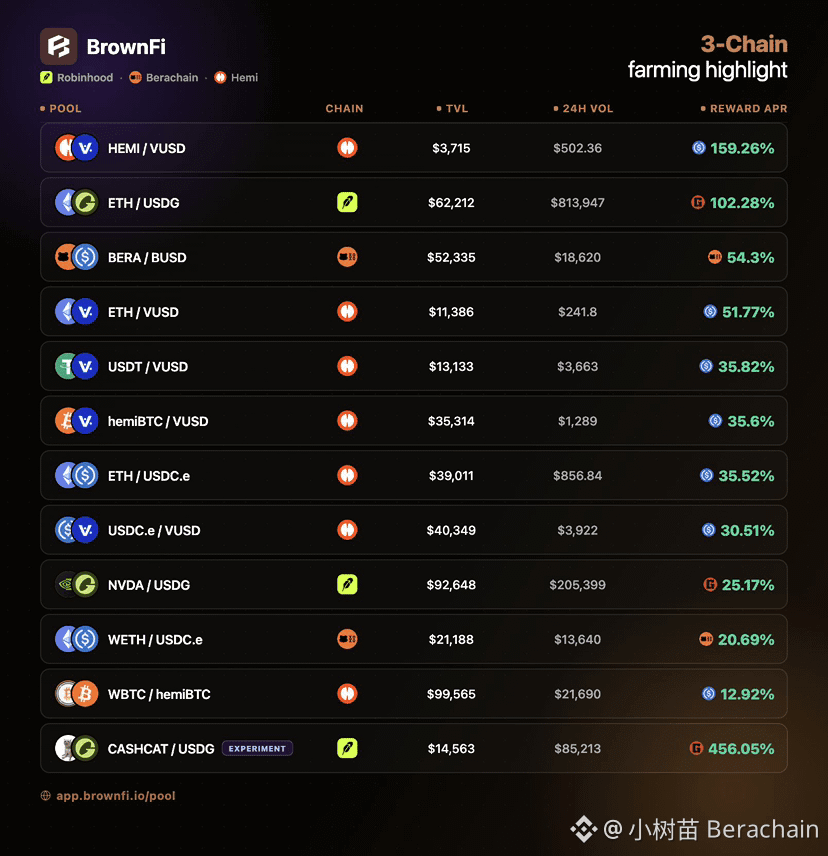
@brownfiamm has compiled several recent high-incentive pools across different ecosystems. Currently, there are two pools on Berachain worth paying attention to:
• BERA/BUSD:54.3% APR
• WETH/USDC.e:20.69% APR
The incentives for both pools come from $BERA.
If you’re looking for liquidity incentive opportunities on Berachain, keep an eye on the latest data for these two pools.
$BERA
Continuing updates on liquidity incentives on Berachain.
@brownfiamm has compiled several recent high-incentive pools across different ecosystems. Currently, there are two pools on Berachain worth paying attention to:
• BERA/BUSD:54.3% APR
• WETH/USDC.e:20.69% APR
The incentives for both pools come from $BERA .
If you’re looking for liquidity incentive opportunities on Berachain, keep an eye on the latest data for these two pools.
$BERA
@brownfiamm has compiled several recent high-incentive pools across different ecosystems. Currently, there are two pools on Berachain worth paying attention to:
• BERA/BUSD:54.3% APR
• WETH/USDC.e:20.69% APR
The incentives for both pools come from $BERA .
If you’re looking for liquidity incentive opportunities on Berachain, keep an eye on the latest data for these two pools.
$BERA
3.1k
Log in to explore more content
Join global crypto users on Binance Square
⚡️ Get latest and useful information about crypto.
💬 Trusted by the world’s largest crypto exchange.
👍 Discover real insights from verified creators.
Email / Phone number
Trending Topics
FedMinutesFocusOnOctoberPause
215,747 views
1,456 Discussing
🚨 HIGH ALERT ‼️ PLEASE DON’T TRADE BLINDLY FOR THE NEXT HOUR 🚨
Guys, we have FOMC Minutes coming in less than 1 hour.
And after the kind of volatility we already saw today, I really don’t want anyone opening random high-leverage positions just before this release.
The biggest reaction I’m watching will be in Gold (XAU), Silver (XAG), BTC and ETH. Then coins like SOL and other highly leveraged mid/low-cap alts can exaggerate whatever move BTC makes.
Gold and Silver are especially sensitive tonight because the market is already reacting to the US dollar + Treasury yields, and both metals have been under heavy pressure ahead of the Fed minutes.
Briefly speaking
📉Hawkish Fed Minutes → Dollar/yields can push higher → pressure on BTC, crypto, Gold & silver
📈Dovish Fed Minutes → Dollar/yields can cool → BTC, Gold, Silver and risk assets can bounce hard.
And please remember the first candle can be a trap. We can get a pump, immediate dump, liquidations on both sides, and then the real direction.
So for now, protect your positions, reduce unnecessary leverage and don’t FOMO into the first move.
Tonight I’m watching $XAU , $XAG and $BTC first. These will tell us very quickly how the market is reading the Fed.
I will Update you guys on time
Follow @Panda Traders and Turn on Your notifications right now
#FedMinutesFocusOnOctoberPause
Panda Traders
·19 Likes
·4.3k views
BinanceLaunchesBinanceIntelligence
1.2M views
6,629 Discussing
EvernorthDelaysNasdaqDebutToOct12
20,513 views
341 Discussing