
#behavioralfinance
behavioralfinance
8,221 views
43 Discussing
Hot
Latest

·
--
1.7.4
Why does paying with cash sometimes feel worse than paying with a card?
Because the act of paying makes the loss feel real
You hand over $50
You see it leave your wallet
With a card, there's no physical money disappearing:
- You tap
- Approved
- Done
The money is still gone
But psychologically, the payment can feel less immediate
And online, it can become even more abstract.
- You don't see money leaving
- You see a number on a screen change.
That's why sometimes the hardest part of spending isn't the price
It's feeling the payment
~ Think before you act
#BinanceSquare #ThinkBeforeYouAct #MoneyPsychology #BehavioralFinance
1.7.4
Why does paying with cash sometimes feel worse than paying with a card?
Because the act of paying makes the loss feel real
You hand over $50
You see it leave your wallet
With a card, there's no physical money disappearing:
- You tap
- Approved
- Done
The money is still gone
But psychologically, the payment can feel less immediate
And online, it can become even more abstract.
- You don't see money leaving
- You see a number on a screen change.
That's why sometimes the hardest part of spending isn't the price
It's feeling the payment
~ Think before you act
#BinanceSquare #ThinkBeforeYouAct #MoneyPsychology #BehavioralFinance
Why does paying with cash sometimes feel worse than paying with a card?
Because the act of paying makes the loss feel real
You hand over $50
You see it leave your wallet
With a card, there's no physical money disappearing:
- You tap
- Approved
- Done
The money is still gone
But psychologically, the payment can feel less immediate
And online, it can become even more abstract.
- You don't see money leaving
- You see a number on a screen change.
That's why sometimes the hardest part of spending isn't the price
It's feeling the payment
~ Think before you act
#BinanceSquare #ThinkBeforeYouAct #MoneyPsychology #BehavioralFinance

Mr Latif king:
it's abstract
1.3k
5
82
1.3k
·
--
1.7.2
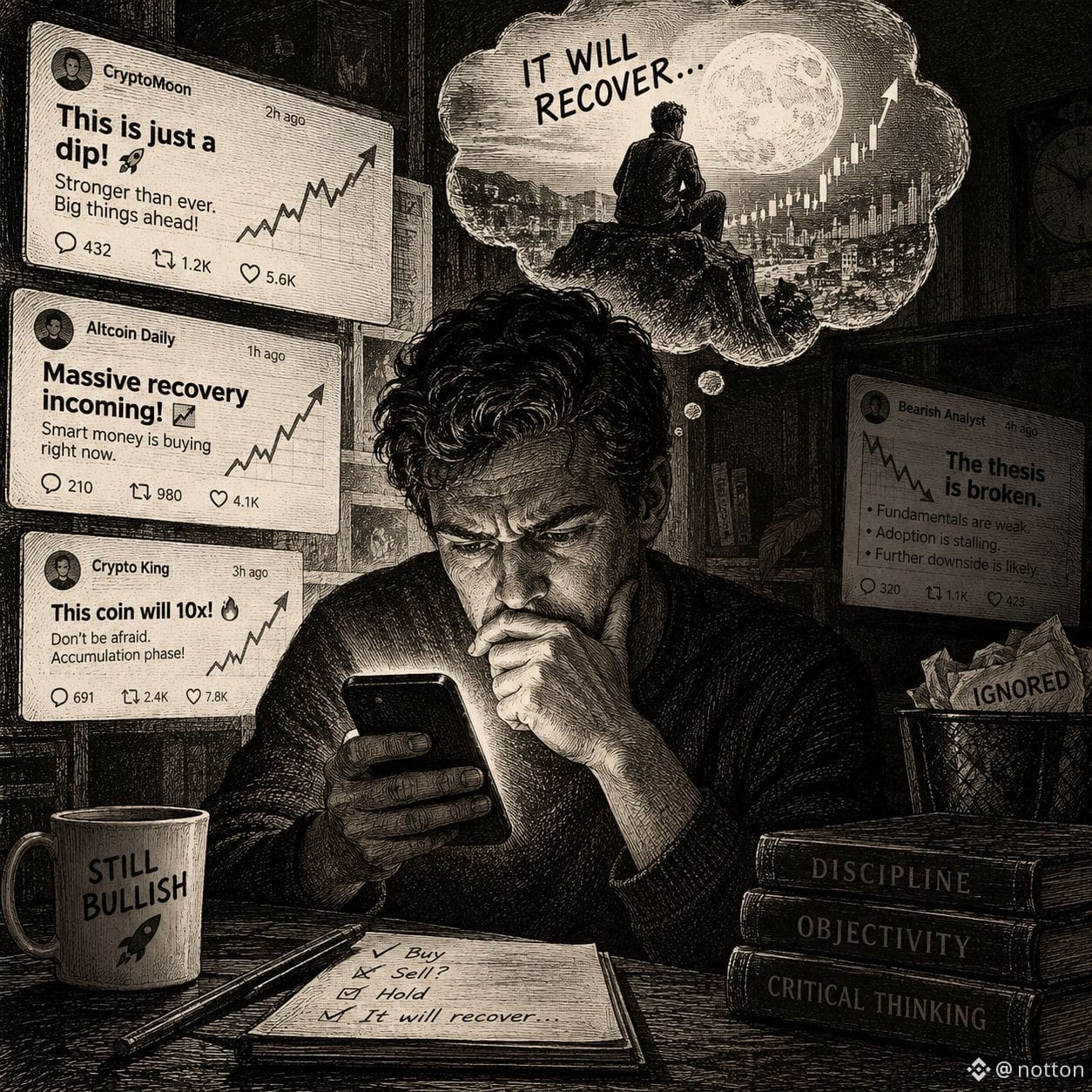
Why do we look for information that agrees with us?
- You buy a coin
- It starts falling
You search:
“Why will it recover?”
- You find someone bullish
- You feel better
- You ignore the analyst saying the thesis is broken
That's CONFIRMATION BIAS
We don't always search for the truth
Sometimes we search for evidence that makes us feel right
And the more money we've committed, the harder it can become to hear anything else
The dangerous question isn't:
“Am I right?”
It's:
“What would prove me wrong?”
~ Think before you act
#BinanceSquare #ThinkBeforeYouAct #Psychology #BehavioralFinance
1.7.2
Why do we look for information that agrees with us?
- You buy a coin
- It starts falling
You search:
“Why will it recover?”
- You find someone bullish
- You feel better
- You ignore the analyst saying the thesis is broken
That's CONFIRMATION BIAS
We don't always search for the truth
Sometimes we search for evidence that makes us feel right
And the more money we've committed, the harder it can become to hear anything else
The dangerous question isn't:
“Am I right?”
It's:
“What would prove me wrong?”
~ Think before you act
#BinanceSquare #ThinkBeforeYouAct #Psychology #BehavioralFinance
Why do we look for information that agrees with us?
- You buy a coin
- It starts falling
You search:
“Why will it recover?”
- You find someone bullish
- You feel better
- You ignore the analyst saying the thesis is broken
That's CONFIRMATION BIAS
We don't always search for the truth
Sometimes we search for evidence that makes us feel right
And the more money we've committed, the harder it can become to hear anything else
The dangerous question isn't:
“Am I right?”
It's:
“What would prove me wrong?”
~ Think before you act
#BinanceSquare #ThinkBeforeYouAct #Psychology #BehavioralFinance
Subodh Kumar Malviya:
contradictions
987
3
52
987

·
--
The Behavioral Finance Trap Most Crypto Investors Fall Into
Crypto markets are uniquely brutal for behavioral finance mistakes. The same cognitive biases that cost stock investors 1-2% annually can cost crypto investors entire cycles.
The three most dangerous:
Recency bias: After a rally, most portfolios drift toward the assets that already ran. You end up maximally long at peak exposure. The assets worth rotating into are the ones that look boring right now.
Disposition effect: Selling winners too early because gains feel fragile, holding losers too long because selling means admitting a mistake. In crypto, this inverts your actual edge. Your winners often have stronger fundamentals. Your losers often have weaker ones.
Narrative anchoring: Holding a thesis formed at a different price, different market structure, and different macro environment. Conviction is valuable. Stubbornness is expensive. The honest question is not whether your thesis is still valid. It is whether you would build this position today at today's price.
The fix is not willpower. It is process. Pre-set rebalancing triggers, forced thesis revisits at major price moves, and position size rules that do not require in-the-moment discipline.
Your edge in crypto is not information. It is behavior.
$BTC $ETH $BNB
#CryptoTrading #BehavioralFinance #RiskManagement #CryptoInvesting
The Behavioral Finance Trap Most Crypto Investors Fall Into
Crypto markets are uniquely brutal for behavioral finance mistakes. The same cognitive biases that cost stock investors 1-2% annually can cost crypto investors entire cycles.
The three most dangerous:
Recency bias: After a rally, most portfolios drift toward the assets that already ran. You end up maximally long at peak exposure. The assets worth rotating into are the ones that look boring right now.
Disposition effect: Selling winners too early because gains feel fragile, holding losers too long because selling means admitting a mistake. In crypto, this inverts your actual edge. Your winners often have stronger fundamentals. Your losers often have weaker ones.
Narrative anchoring: Holding a thesis formed at a different price, different market structure, and different macro environment. Conviction is valuable. Stubbornness is expensive. The honest question is not whether your thesis is still valid. It is whether you would build this position today at today's price.
The fix is not willpower. It is process. Pre-set rebalancing triggers, forced thesis revisits at major price moves, and position size rules that do not require in-the-moment discipline.
Your edge in crypto is not information. It is behavior.
$BTC $ETH $BNB
#CryptoTrading #BehavioralFinance #RiskManagement #CryptoInvesting
Crypto markets are uniquely brutal for behavioral finance mistakes. The same cognitive biases that cost stock investors 1-2% annually can cost crypto investors entire cycles.
The three most dangerous:
Recency bias: After a rally, most portfolios drift toward the assets that already ran. You end up maximally long at peak exposure. The assets worth rotating into are the ones that look boring right now.
Disposition effect: Selling winners too early because gains feel fragile, holding losers too long because selling means admitting a mistake. In crypto, this inverts your actual edge. Your winners often have stronger fundamentals. Your losers often have weaker ones.
Narrative anchoring: Holding a thesis formed at a different price, different market structure, and different macro environment. Conviction is valuable. Stubbornness is expensive. The honest question is not whether your thesis is still valid. It is whether you would build this position today at today's price.
The fix is not willpower. It is process. Pre-set rebalancing triggers, forced thesis revisits at major price moves, and position size rules that do not require in-the-moment discipline.
Your edge in crypto is not information. It is behavior.
$BTC $ETH $BNB
#CryptoTrading #BehavioralFinance #RiskManagement #CryptoInvesting
78

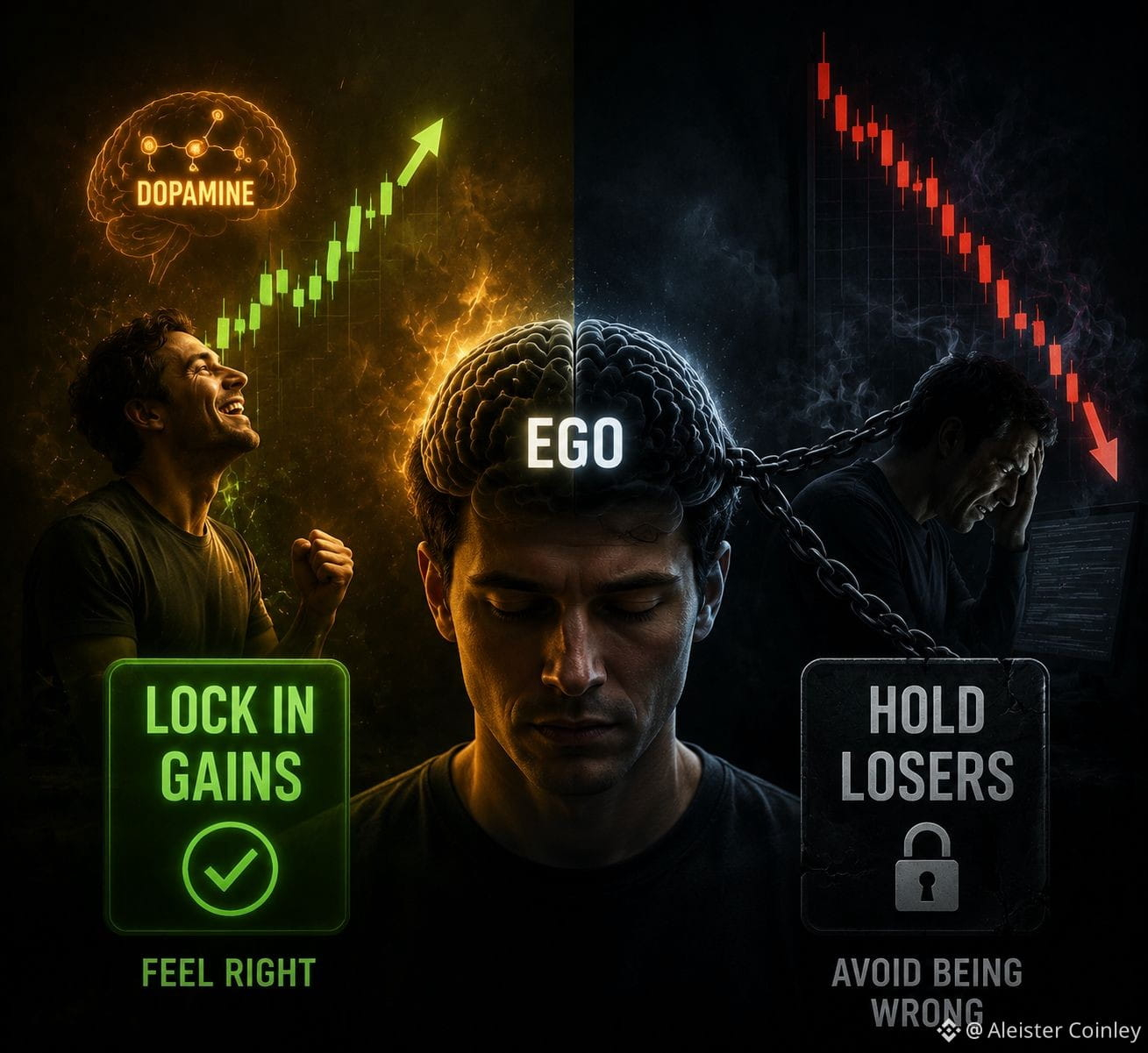
The 'Disposition Effect' is the silent account killer. We are psychologically wired to lock in gains to feel a dopamine hit of 'being right,' while we cling to losers to avoid the painful realization of 'being wrong.' In trading, your ego is your most expensive liability. $USDT #Trading #PsychologyInCrypto #BehavioralFinance #bitcoin #PsychologyOfMarket
The 'Disposition Effect' is the silent account killer. We are psychologically wired to lock in gains to feel a dopamine hit of 'being right,' while we cling to losers to avoid the painful realization of 'being wrong.' In trading, your ego is your most expensive liability. $USDT #Trading #PsychologyInCrypto #BehavioralFinance #bitcoin #PsychologyOfMarket
102

·
--
No matter how good the system, once it's handed over to 'human default settings', the long-term chart will look ugly.
First, lock in 5–8 high-frequency traps:
- Overconfidence: The more you lose, the more you want to stack;
- Loss aversion: Holding onto losses way too long;
- Anchoring: Fixating on the entry price and refusing to admit mistakes;
- FOMO: Fear of missing out, blindly following the crowd;
- Disposition effect: Taking small profits quickly but holding onto losses;
- Confirmation bias: Only looking at information that supports your viewpoint.
Write one counter-rule for each bias and stick it on your Checklist; it's worth more than an extra indicator.
#behavioralfinance #BTC #BTC暴跌原因 #可以抄底了码
No matter how good the system, once it's handed over to 'human default settings', the long-term chart will look ugly.
First, lock in 5–8 high-frequency traps:
- Overconfidence: The more you lose, the more you want to stack;
- Loss aversion: Holding onto losses way too long;
- Anchoring: Fixating on the entry price and refusing to admit mistakes;
- FOMO: Fear of missing out, blindly following the crowd;
- Disposition effect: Taking small profits quickly but holding onto losses;
- Confirmation bias: Only looking at information that supports your viewpoint.
Write one counter-rule for each bias and stick it on your Checklist; it's worth more than an extra indicator.
#behavioralfinance #BTC #BTC暴跌原因 #可以抄底了码
First, lock in 5–8 high-frequency traps:
- Overconfidence: The more you lose, the more you want to stack;
- Loss aversion: Holding onto losses way too long;
- Anchoring: Fixating on the entry price and refusing to admit mistakes;
- FOMO: Fear of missing out, blindly following the crowd;
- Disposition effect: Taking small profits quickly but holding onto losses;
- Confirmation bias: Only looking at information that supports your viewpoint.
Write one counter-rule for each bias and stick it on your Checklist; it's worth more than an extra indicator.
#behavioralfinance #BTC #BTC暴跌原因 #可以抄底了码
171
Log in to explore more content
Join global crypto users on Binance Square
⚡️ Get latest and useful information about crypto.
💬 Trusted by the world’s largest crypto exchange.
👍 Discover real insights from verified creators.
Email / Phone number
Trending Topics
1
#SouthAfricaProposesCryptoExchangeControls
584 views
115 Discussing
2
#SolanaCutsTargetSlotTimeTo250ms
2,404 views
138 Discussing
3
#EthereumSurpasses$2700
6,240 views
152 Discussing
4
#CanaryFilesSecondAmendmentForStakedSEIETF
24,607 views
570 Discussing
5
#SaylorHintsStrategyBitcoinBuy
2.3M views
13,358 Discussing
6
#BOJRaisesRatesTo31YearHigh
326,833 views
3,819 Discussing
7
#BuffettStepsDownAsBerkshireChairman
157,509 views
2,098 Discussing
8
#XRPExchangeReservesHitSevenYearLow
180,422 views
1,892 Discussing
9
#HKCompletesFirstHKDStablecoinUseCase
180,780 views
2,114 Discussing
10
#VietnamPlansFirstCryptoLicensesIn2026
117,900 views
1,425 Discussing