

#bchjumps28
bchjumps28
1,264 views
17 Discussing
Hot
Latest

·
--
If you're still buying the top of every sudden pump like this one, stop now.
Too many traders are getting crushed chasing these 28% moves, loading up on FOMO and then watching their bags bleed as soon as the volume dries up. You never know when to exit because the greed just keeps whispering that it will go higher.
Bitcoin Cash just jumped 28% and discussions are everywhere. Some see it as $BCH finally getting recognition as a faster payments option compared to Bitcoin, especially with ETF inflows potentially spilling over. Others call it a classic overbought bounce in a market already sitting at 73 on the fear and greed index.
I've seen this pattern too many times.
The second view makes more sense to me. These parabolic moves often trap late buyers. Volume is pouring from $USDT into $BCH, but $AAVE and similar plays aren't seeing the same rush, which tells me this is isolated speculation.
Where do you think this goes from here?
#BCHJumps28 #SpotBitcoinETFsInflow #BitcoinRejectedAt
If you're still buying the top of every sudden pump like this one, stop now.
Too many traders are getting crushed chasing these 28% moves, loading up on FOMO and then watching their bags bleed as soon as the volume dries up. You never know when to exit because the greed just keeps whispering that it will go higher.
Bitcoin Cash just jumped 28% and discussions are everywhere. Some see it as $BCH finally getting recognition as a faster payments option compared to Bitcoin, especially with ETF inflows potentially spilling over. Others call it a classic overbought bounce in a market already sitting at 73 on the fear and greed index.
I've seen this pattern too many times.
The second view makes more sense to me. These parabolic moves often trap late buyers. Volume is pouring from $USDT into $BCH , but $AAVE and similar plays aren't seeing the same rush, which tells me this is isolated speculation.
Where do you think this goes from here?
#BCHJumps28 #SpotBitcoinETFsInflow #BitcoinRejectedAt
Too many traders are getting crushed chasing these 28% moves, loading up on FOMO and then watching their bags bleed as soon as the volume dries up. You never know when to exit because the greed just keeps whispering that it will go higher.
Bitcoin Cash just jumped 28% and discussions are everywhere. Some see it as $BCH finally getting recognition as a faster payments option compared to Bitcoin, especially with ETF inflows potentially spilling over. Others call it a classic overbought bounce in a market already sitting at 73 on the fear and greed index.
I've seen this pattern too many times.
The second view makes more sense to me. These parabolic moves often trap late buyers. Volume is pouring from $USDT into $BCH , but $AAVE and similar plays aren't seeing the same rush, which tells me this is isolated speculation.
Where do you think this goes from here?
#BCHJumps28 #SpotBitcoinETFsInflow #BitcoinRejectedAt

16

Have you noticed $BCH just jumped 28% while the rest of the market is still chasing whatever is trending in search?
Most traders will buy this green candle at the worst possible time. That is how you lose money in a greed market sitting at 73.
The lazy narrative is that Bitcoin Cash lost years ago and nobody should care. I disagree. $BCH is still one of the few chains built for actual payments, and it just woke up while $BTC takes all the ETF inflows. Moves like this do not happen in isolation. They happen when attention is elsewhere and liquidity rotates fast.
If you caught it, do not get greedy. Peel profits into $USDT and let a runner work with a stop. If you missed it, wait for the retest. Buying the 28% candle after it prints is how you become someone else's exit.
Where do you think this goes from here?
#BCHJumps28 #SpotBitcoinETFsInflow #BitcoinRejectedAt
Have you noticed $BCH just jumped 28% while the rest of the market is still chasing whatever is trending in search?
Most traders will buy this green candle at the worst possible time. That is how you lose money in a greed market sitting at 73.
The lazy narrative is that Bitcoin Cash lost years ago and nobody should care. I disagree. $BCH is still one of the few chains built for actual payments, and it just woke up while $BTC takes all the ETF inflows. Moves like this do not happen in isolation. They happen when attention is elsewhere and liquidity rotates fast.
If you caught it, do not get greedy. Peel profits into $USDT and let a runner work with a stop. If you missed it, wait for the retest. Buying the 28% candle after it prints is how you become someone else's exit.
Where do you think this goes from here?
#BCHJumps28 #SpotBitcoinETFsInflow #BitcoinRejectedAt
Most traders will buy this green candle at the worst possible time. That is how you lose money in a greed market sitting at 73.
The lazy narrative is that Bitcoin Cash lost years ago and nobody should care. I disagree. $BCH is still one of the few chains built for actual payments, and it just woke up while $BTC takes all the ETF inflows. Moves like this do not happen in isolation. They happen when attention is elsewhere and liquidity rotates fast.
If you caught it, do not get greedy. Peel profits into $USDT and let a runner work with a stop. If you missed it, wait for the retest. Buying the 28% candle after it prints is how you become someone else's exit.
Where do you think this goes from here?
#BCHJumps28 #SpotBitcoinETFsInflow #BitcoinRejectedAt

20


Verified
Bitcoin Cash (BCH) experienced a significant price surge of 28% shortly after the announcement of its listing on CME futures. This development signals increased institutional interest and potential for greater market accessibility for BCH. The substantial jump indicates strong positive sentiment among traders and investors, anticipating higher trading volumes and liquidity. This event could set a precedent for other cryptocurrencies seeking mainstream financial product integration, potentially driving further adoption and price appreciation across the broader market.
Disclaimer: This content is for informational purposes only and does not constitute investment advice.
#BCHJumps28%OnCMEFuturesListing $BTC $BCH
Bitcoin Cash (BCH) experienced a significant price surge of 28% shortly after the announcement of its listing on CME futures. This development signals increased institutional interest and potential for greater market accessibility for BCH. The substantial jump indicates strong positive sentiment among traders and investors, anticipating higher trading volumes and liquidity. This event could set a precedent for other cryptocurrencies seeking mainstream financial product integration, potentially driving further adoption and price appreciation across the broader market.
Disclaimer: This content is for informational purposes only and does not constitute investment advice.
#BCHJumps28%OnCMEFuturesListing $BTC $BCH
Disclaimer: This content is for informational purposes only and does not constitute investment advice.
#BCHJumps28%OnCMEFuturesListing $BTC $BCH
1
883

·
--
$BCH popping 28% on CME futures isn’t a breakout it’s a liquidity trap.
The move is all noise from new futures listing, not demand.
CME listing doesn’t change fundamentals.
It just lets hedge funds short it easier.
Traders chasing this are buying FOMO, not conviction.
I’m watching from the side.
No entry. No exit. Just waiting for volume to confirm real interest.
If $BCH holds above $360 for 48 hours with rising volume, I’ll reconsider.
Until then, this is a flash in the pan.
You think it’s real?
#BCHJumps28%OnCMEFuturesListing #BCH #CryptoNews
$BCH popping 28% on CME futures isn’t a breakout it’s a liquidity trap.
The move is all noise from new futures listing, not demand.
CME listing doesn’t change fundamentals.
It just lets hedge funds short it easier.
Traders chasing this are buying FOMO, not conviction.
I’m watching from the side.
No entry. No exit. Just waiting for volume to confirm real interest.
If $BCH holds above $360 for 48 hours with rising volume, I’ll reconsider.
Until then, this is a flash in the pan.
You think it’s real?
#BCHJumps28%OnCMEFuturesListing #BCH #CryptoNews
The move is all noise from new futures listing, not demand.
CME listing doesn’t change fundamentals.
It just lets hedge funds short it easier.
Traders chasing this are buying FOMO, not conviction.
I’m watching from the side.
No entry. No exit. Just waiting for volume to confirm real interest.
If $BCH holds above $360 for 48 hours with rising volume, I’ll reconsider.
Until then, this is a flash in the pan.
You think it’s real?
#BCHJumps28%OnCMEFuturesListing #BCH #CryptoNews
14

·
--
Yesterday in a coffee shop, I noticed a cryptocurrency trader at the next table suddenly gasping at his phone. The screen showed Bitcoin Cash (BCH) futures prices at the Chicago Mercantile Exchange (CME) jumping 28%. It left him flustered—clearly he hadn’t expected such a dramatic move. I quickly looked it up online and found that this really is a big deal. According to the latest news, the listing of BCH futures contracts not only adds new trading instruments to the market, but also reflects widespread attention to the future development of Bitcoin Cash. Analysts say that this high level of volatility may be related to speculative activity around the newly listed contract, as well as the Bitcoin Cash community’s anticipation of technical upgrades. As a globally well-known futures trading platform, CME’s introduction of BCH futures undoubtedly boosts the asset’s international recognition, but it may also intensify market uncertainty in the short term. It seems that for crypto players, having one more tool also means one more challenge. #BCHJumps28%OnCMEFuturesListing
#BTC $BTC
Yesterday in a coffee shop, I noticed a cryptocurrency trader at the next table suddenly gasping at his phone. The screen showed Bitcoin Cash (BCH) futures prices at the Chicago Mercantile Exchange (CME) jumping 28%. It left him flustered—clearly he hadn’t expected such a dramatic move. I quickly looked it up online and found that this really is a big deal. According to the latest news, the listing of BCH futures contracts not only adds new trading instruments to the market, but also reflects widespread attention to the future development of Bitcoin Cash. Analysts say that this high level of volatility may be related to speculative activity around the newly listed contract, as well as the Bitcoin Cash community’s anticipation of technical upgrades. As a globally well-known futures trading platform, CME’s introduction of BCH futures undoubtedly boosts the asset’s international recognition, but it may also intensify market uncertainty in the short term. It seems that for crypto players, having one more tool also means one more challenge. #BCHJumps28%OnCMEFuturesListing
#BTC $BTC
#BTC $BTC
131

·
--
Be cautious when following the BCH futures hot list|CME’s plans don’t equal fresh buy pressure for BTC|At 84,000, I’ll wait
My stance is: I acknowledge the long-term significance of expanding compliant derivatives, but today I won’t place a BTC order using BCH’s heat. Binance Square’s #BCHJumps28%OnCMEFuturesListing is being discussed—separate the facts from the market chatter first. A CME Group announcement on September 22 said it plans to launch Bitcoin Cash and Uniswap futures on October 19, subject to completion of regulatory review. The BCH standard contract is 250 coins, while the mini contract is 25. CME’s product page also says it is “about to be launched,” not already live. This is futures—not a BCH spot ETF, and not an addition to BTC’s fund net inflows. “28%” is a stage-based gain referenced in the topic title; it can’t be treated as the current 24-hour gain.
Why do BTC traders also look at it? New compliant futures give institutions more ways to express a BCH view and hedge risk. That could split attention and short-term liquidity away from BTC, or it could warm overall market risk appetite—these are opposite directions, so you can’t just pick only the bullish angle. Especially because futures can be shorted and used for hedging: rising contract trading volume doesn’t necessarily mean spot is being continuously bought. If someone claims “institutions are buying BTC” based on this, I think the evidence isn’t enough; we need BTC’s own price, spot trading volumes, and independent capital flow data to line up.
Market reaction also doesn’t support a simple “straight up” narrative. When I checked KuCoin spot quotes while writing: BTC is about $83,989; 24-hour high $87,277, low $83,517; change about -3.29%. BCH is about $340.16; 24-hour high $366, low $324.62; change about -0.12%. These are rolling quotes over different time windows; you can’t directly attribute the current pullback to the CME announcement. For BTC, I treat around 83,500 as the risk boundary. 84,600 to 85,000 is the first confirmation zone for regaining strength. 87,200 is overhead resistance. If BTC breaks below 83,500 and the rebound lacks strength, my short-term bullish read gets invalidated.
If I were trading myself, I wouldn’t participate right now. I’d only consider spot long after confirmation—no chasing and no switching to “long by shorting.” I’d wait until two complete 15-minute candlesticks both close above 85,000, then see whether the pullback from 84,600 to 85,000 can hold. I would only use up to 0.5% of total capital for a position if the BCH hype is not accompanied by BTC continuing to break down to new lows. After entering, I’d cut half at 85,800 and close the rest between 87,000 and 87,200. If after entry the 15-minute close falls back below 84,300, I’d cut the position by half again. If 83,500 breaks, I’d fully exit. If before the trigger price first breaks 83,500, I’d cancel the plan. If the price just spikes instantly on the news without a pullback confirmation, I’d rather miss it than take other coins’ futures plans as a buy signal for BTC.
#BCHJumps28%OnCMEFuturesListing #BTC #BCH
The above is only my personal market observation and does not constitute investment advice.
Be cautious when following the BCH futures hot list|CME’s plans don’t equal fresh buy pressure for BTC|At 84,000, I’ll wait
My stance is: I acknowledge the long-term significance of expanding compliant derivatives, but today I won’t place a BTC order using BCH’s heat. Binance Square’s #BCHJumps28%OnCMEFuturesListing is being discussed—separate the facts from the market chatter first. A CME Group announcement on September 22 said it plans to launch Bitcoin Cash and Uniswap futures on October 19, subject to completion of regulatory review. The BCH standard contract is 250 coins, while the mini contract is 25. CME’s product page also says it is “about to be launched,” not already live. This is futures—not a BCH spot ETF, and not an addition to BTC’s fund net inflows. “28%” is a stage-based gain referenced in the topic title; it can’t be treated as the current 24-hour gain.
Why do BTC traders also look at it? New compliant futures give institutions more ways to express a BCH view and hedge risk. That could split attention and short-term liquidity away from BTC, or it could warm overall market risk appetite—these are opposite directions, so you can’t just pick only the bullish angle. Especially because futures can be shorted and used for hedging: rising contract trading volume doesn’t necessarily mean spot is being continuously bought. If someone claims “institutions are buying BTC” based on this, I think the evidence isn’t enough; we need BTC’s own price, spot trading volumes, and independent capital flow data to line up.
Market reaction also doesn’t support a simple “straight up” narrative. When I checked KuCoin spot quotes while writing: BTC is about $83,989; 24-hour high $87,277, low $83,517; change about -3.29%. BCH is about $340.16; 24-hour high $366, low $324.62; change about -0.12%. These are rolling quotes over different time windows; you can’t directly attribute the current pullback to the CME announcement. For BTC, I treat around 83,500 as the risk boundary. 84,600 to 85,000 is the first confirmation zone for regaining strength. 87,200 is overhead resistance. If BTC breaks below 83,500 and the rebound lacks strength, my short-term bullish read gets invalidated.
If I were trading myself, I wouldn’t participate right now. I’d only consider spot long after confirmation—no chasing and no switching to “long by shorting.” I’d wait until two complete 15-minute candlesticks both close above 85,000, then see whether the pullback from 84,600 to 85,000 can hold. I would only use up to 0.5% of total capital for a position if the BCH hype is not accompanied by BTC continuing to break down to new lows. After entering, I’d cut half at 85,800 and close the rest between 87,000 and 87,200. If after entry the 15-minute close falls back below 84,300, I’d cut the position by half again. If 83,500 breaks, I’d fully exit. If before the trigger price first breaks 83,500, I’d cancel the plan. If the price just spikes instantly on the news without a pullback confirmation, I’d rather miss it than take other coins’ futures plans as a buy signal for BTC.
#BCHJumps28%OnCMEFuturesListing #BTC #BCH
The above is only my personal market observation and does not constitute investment advice.
My stance is: I acknowledge the long-term significance of expanding compliant derivatives, but today I won’t place a BTC order using BCH’s heat. Binance Square’s #BCHJumps28%OnCMEFuturesListing is being discussed—separate the facts from the market chatter first. A CME Group announcement on September 22 said it plans to launch Bitcoin Cash and Uniswap futures on October 19, subject to completion of regulatory review. The BCH standard contract is 250 coins, while the mini contract is 25. CME’s product page also says it is “about to be launched,” not already live. This is futures—not a BCH spot ETF, and not an addition to BTC’s fund net inflows. “28%” is a stage-based gain referenced in the topic title; it can’t be treated as the current 24-hour gain.
Why do BTC traders also look at it? New compliant futures give institutions more ways to express a BCH view and hedge risk. That could split attention and short-term liquidity away from BTC, or it could warm overall market risk appetite—these are opposite directions, so you can’t just pick only the bullish angle. Especially because futures can be shorted and used for hedging: rising contract trading volume doesn’t necessarily mean spot is being continuously bought. If someone claims “institutions are buying BTC” based on this, I think the evidence isn’t enough; we need BTC’s own price, spot trading volumes, and independent capital flow data to line up.
Market reaction also doesn’t support a simple “straight up” narrative. When I checked KuCoin spot quotes while writing: BTC is about $83,989; 24-hour high $87,277, low $83,517; change about -3.29%. BCH is about $340.16; 24-hour high $366, low $324.62; change about -0.12%. These are rolling quotes over different time windows; you can’t directly attribute the current pullback to the CME announcement. For BTC, I treat around 83,500 as the risk boundary. 84,600 to 85,000 is the first confirmation zone for regaining strength. 87,200 is overhead resistance. If BTC breaks below 83,500 and the rebound lacks strength, my short-term bullish read gets invalidated.
If I were trading myself, I wouldn’t participate right now. I’d only consider spot long after confirmation—no chasing and no switching to “long by shorting.” I’d wait until two complete 15-minute candlesticks both close above 85,000, then see whether the pullback from 84,600 to 85,000 can hold. I would only use up to 0.5% of total capital for a position if the BCH hype is not accompanied by BTC continuing to break down to new lows. After entering, I’d cut half at 85,800 and close the rest between 87,000 and 87,200. If after entry the 15-minute close falls back below 84,300, I’d cut the position by half again. If 83,500 breaks, I’d fully exit. If before the trigger price first breaks 83,500, I’d cancel the plan. If the price just spikes instantly on the news without a pullback confirmation, I’d rather miss it than take other coins’ futures plans as a buy signal for BTC.
#BCHJumps28%OnCMEFuturesListing #BTC #BCH
The above is only my personal market observation and does not constitute investment advice.

149
Traditional Finance and the Crypto World Accelerate Their Integration: Tokenized US Stocks Break the $1 Billion Market Value Mark as Hawkish Fed Signals Spark Market Turbulence
1. Milestone in Tokenized US Stocks: BNB Chain Leads the Way
The Binance ecosystem has reached a historic moment. The total market capitalization of tokenized US stocks on BNB Chain has officially surpassed the $1 billion threshold, overtaking Ethereum to become the leader in this track. Binance has currently listed 77 tokenized stock instruments and 196 traditional finance perpetual contracts, building a full-spectrum trading ecosystem that connects crypto finance with traditional capital markets.
At the same time, the New York Stock Exchange and Blockchain.com have signed a memorandum of understanding, planning to enable around-the-clock on-chain trading of US-listed stocks and ETFs via the digital ATS platform currently being prepared by the NYSE. A newly introduced innovative exemption policy by the US Securities and Exchange Commission provides a compliance pathway for tokenized securities. BlackRock’s Grayscale described it as a milestone event for a compliant on-chain US stock market. Major traditional finance players are moving in one after another, signaling that tokenized assets are transitioning from the experimental stage to mainstream use.
2. Hawkish Fed Stance Hits Global Markets
On the macro front, US 10-year Treasury yields surged to 5.08%, the highest level since 2007. Federal Reserve Governor Barr released signals implying that further rate hikes may be needed to bring inflation back to the 2% target level. Simultaneously, the 30-year Treasury yield climbed to 5.35%, while mortgage rates edged toward 7.5%.
As a result, Bitcoin dropped below $84,000 within hours after the data release. More than $500 million in positions across the market were liquidated, and risk assets saw a broad-based sell-off. This round of hawkish signals not only pressured the crypto market but also weighed on US stock technology sectors, as investors reassess asset allocation strategies in a high-interest-rate environment.
3. Institutional Capital Accelerates Into Crypto Assets
Despite uncertainty in the macro environment, institutional capital is still positioning itself against the trend. BlackRock’s Bitcoin ETF IBIT recorded inflows of more than $1 billion in just four days, setting the largest short-term inflow record since the end of 2025. BlackRock also released a white paper stating that the market has seriously underestimated the potential demand for crypto assets driven by artificial intelligence, and that autonomous AI agents could become an important catalyst for the large-scale adoption of digital assets.
Binance is also making frequent moves: it bought 1,237,011 shares of Circle at $80.84 per share, for a total investment of $100 million, along with a five-year commercial cooperation agreement. This investment deepens Binance’s ties with USDC and the broader stablecoin infrastructure, positioning it more favorably in the institutional-grade stablecoin payments market.
4. CME Futures Listing Plan Sparks the Altcoin Rally
The Chicago Mercantile Exchange announced plans to launch BCH and UNI futures contracts on October 19. After the news broke, BCH surged more than 34%, while UNI rose more than 16%. Together, they recorded cumulative gains of over 60% in the past week. The entry of CME futures implies deeper liquidity and more robust institutional hedging tools, and market attention toward these two assets has continued to heat up.
According to data from the Plaza, SOL led the hot token rankings with 5,165 mentions. BTC and ETH followed with 4,373 and 1,978 mentions, respectively. The hashtag AIStocksWhatNext garnered more than 830,000 views, reflecting the community’s strong interest in the intersection of AI and stocks.
5. Outlook
The market is currently at a crucial inflection point where traditional finance and the crypto ecosystem are deeply integrating. The rapid development of tokenized US stocks, continued inflows of institutional capital, and the gradual strengthening of compliance frameworks all lay a foundation for long-term industry growth. However, the Fed’s hawkish stance and the high-interest-rate environment remain the biggest uncertainties in the short term. Investors need to seize structural opportunities while staying alert to volatility risks brought by macro policy.
#AIStocksWhatNext #BCHJumps28%OnCMEFuturesListing #TokenizedStocks
Traditional Finance and the Crypto World Accelerate Their Integration: Tokenized US Stocks Break the $1 Billion Market Value Mark as Hawkish Fed Signals Spark Market Turbulence
1. Milestone in Tokenized US Stocks: BNB Chain Leads the Way
The Binance ecosystem has reached a historic moment. The total market capitalization of tokenized US stocks on BNB Chain has officially surpassed the $1 billion threshold, overtaking Ethereum to become the leader in this track. Binance has currently listed 77 tokenized stock instruments and 196 traditional finance perpetual contracts, building a full-spectrum trading ecosystem that connects crypto finance with traditional capital markets.
At the same time, the New York Stock Exchange and Blockchain.com have signed a memorandum of understanding, planning to enable around-the-clock on-chain trading of US-listed stocks and ETFs via the digital ATS platform currently being prepared by the NYSE. A newly introduced innovative exemption policy by the US Securities and Exchange Commission provides a compliance pathway for tokenized securities. BlackRock’s Grayscale described it as a milestone event for a compliant on-chain US stock market. Major traditional finance players are moving in one after another, signaling that tokenized assets are transitioning from the experimental stage to mainstream use.
2. Hawkish Fed Stance Hits Global Markets
On the macro front, US 10-year Treasury yields surged to 5.08%, the highest level since 2007. Federal Reserve Governor Barr released signals implying that further rate hikes may be needed to bring inflation back to the 2% target level. Simultaneously, the 30-year Treasury yield climbed to 5.35%, while mortgage rates edged toward 7.5%.
As a result, Bitcoin dropped below $84,000 within hours after the data release. More than $500 million in positions across the market were liquidated, and risk assets saw a broad-based sell-off. This round of hawkish signals not only pressured the crypto market but also weighed on US stock technology sectors, as investors reassess asset allocation strategies in a high-interest-rate environment.
3. Institutional Capital Accelerates Into Crypto Assets
Despite uncertainty in the macro environment, institutional capital is still positioning itself against the trend. BlackRock’s Bitcoin ETF IBIT recorded inflows of more than $1 billion in just four days, setting the largest short-term inflow record since the end of 2025. BlackRock also released a white paper stating that the market has seriously underestimated the potential demand for crypto assets driven by artificial intelligence, and that autonomous AI agents could become an important catalyst for the large-scale adoption of digital assets.
Binance is also making frequent moves: it bought 1,237,011 shares of Circle at $80.84 per share, for a total investment of $100 million, along with a five-year commercial cooperation agreement. This investment deepens Binance’s ties with USDC and the broader stablecoin infrastructure, positioning it more favorably in the institutional-grade stablecoin payments market.
4. CME Futures Listing Plan Sparks the Altcoin Rally
The Chicago Mercantile Exchange announced plans to launch BCH and UNI futures contracts on October 19. After the news broke, BCH surged more than 34%, while UNI rose more than 16%. Together, they recorded cumulative gains of over 60% in the past week. The entry of CME futures implies deeper liquidity and more robust institutional hedging tools, and market attention toward these two assets has continued to heat up.
According to data from the Plaza, SOL led the hot token rankings with 5,165 mentions. BTC and ETH followed with 4,373 and 1,978 mentions, respectively. The hashtag AIStocksWhatNext garnered more than 830,000 views, reflecting the community’s strong interest in the intersection of AI and stocks.
5. Outlook
The market is currently at a crucial inflection point where traditional finance and the crypto ecosystem are deeply integrating. The rapid development of tokenized US stocks, continued inflows of institutional capital, and the gradual strengthening of compliance frameworks all lay a foundation for long-term industry growth. However, the Fed’s hawkish stance and the high-interest-rate environment remain the biggest uncertainties in the short term. Investors need to seize structural opportunities while staying alert to volatility risks brought by macro policy.
#AIStocksWhatNext #BCHJumps28%OnCMEFuturesListing #TokenizedStocks
1. Milestone in Tokenized US Stocks: BNB Chain Leads the Way
The Binance ecosystem has reached a historic moment. The total market capitalization of tokenized US stocks on BNB Chain has officially surpassed the $1 billion threshold, overtaking Ethereum to become the leader in this track. Binance has currently listed 77 tokenized stock instruments and 196 traditional finance perpetual contracts, building a full-spectrum trading ecosystem that connects crypto finance with traditional capital markets.
At the same time, the New York Stock Exchange and Blockchain.com have signed a memorandum of understanding, planning to enable around-the-clock on-chain trading of US-listed stocks and ETFs via the digital ATS platform currently being prepared by the NYSE. A newly introduced innovative exemption policy by the US Securities and Exchange Commission provides a compliance pathway for tokenized securities. BlackRock’s Grayscale described it as a milestone event for a compliant on-chain US stock market. Major traditional finance players are moving in one after another, signaling that tokenized assets are transitioning from the experimental stage to mainstream use.
2. Hawkish Fed Stance Hits Global Markets
On the macro front, US 10-year Treasury yields surged to 5.08%, the highest level since 2007. Federal Reserve Governor Barr released signals implying that further rate hikes may be needed to bring inflation back to the 2% target level. Simultaneously, the 30-year Treasury yield climbed to 5.35%, while mortgage rates edged toward 7.5%.
As a result, Bitcoin dropped below $84,000 within hours after the data release. More than $500 million in positions across the market were liquidated, and risk assets saw a broad-based sell-off. This round of hawkish signals not only pressured the crypto market but also weighed on US stock technology sectors, as investors reassess asset allocation strategies in a high-interest-rate environment.
3. Institutional Capital Accelerates Into Crypto Assets
Despite uncertainty in the macro environment, institutional capital is still positioning itself against the trend. BlackRock’s Bitcoin ETF IBIT recorded inflows of more than $1 billion in just four days, setting the largest short-term inflow record since the end of 2025. BlackRock also released a white paper stating that the market has seriously underestimated the potential demand for crypto assets driven by artificial intelligence, and that autonomous AI agents could become an important catalyst for the large-scale adoption of digital assets.
Binance is also making frequent moves: it bought 1,237,011 shares of Circle at $80.84 per share, for a total investment of $100 million, along with a five-year commercial cooperation agreement. This investment deepens Binance’s ties with USDC and the broader stablecoin infrastructure, positioning it more favorably in the institutional-grade stablecoin payments market.
4. CME Futures Listing Plan Sparks the Altcoin Rally
The Chicago Mercantile Exchange announced plans to launch BCH and UNI futures contracts on October 19. After the news broke, BCH surged more than 34%, while UNI rose more than 16%. Together, they recorded cumulative gains of over 60% in the past week. The entry of CME futures implies deeper liquidity and more robust institutional hedging tools, and market attention toward these two assets has continued to heat up.
According to data from the Plaza, SOL led the hot token rankings with 5,165 mentions. BTC and ETH followed with 4,373 and 1,978 mentions, respectively. The hashtag AIStocksWhatNext garnered more than 830,000 views, reflecting the community’s strong interest in the intersection of AI and stocks.
5. Outlook
The market is currently at a crucial inflection point where traditional finance and the crypto ecosystem are deeply integrating. The rapid development of tokenized US stocks, continued inflows of institutional capital, and the gradual strengthening of compliance frameworks all lay a foundation for long-term industry growth. However, the Fed’s hawkish stance and the high-interest-rate environment remain the biggest uncertainties in the short term. Investors need to seize structural opportunities while staying alert to volatility risks brought by macro policy.
#AIStocksWhatNext #BCHJumps28%OnCMEFuturesListing #TokenizedStocks
8

·
--
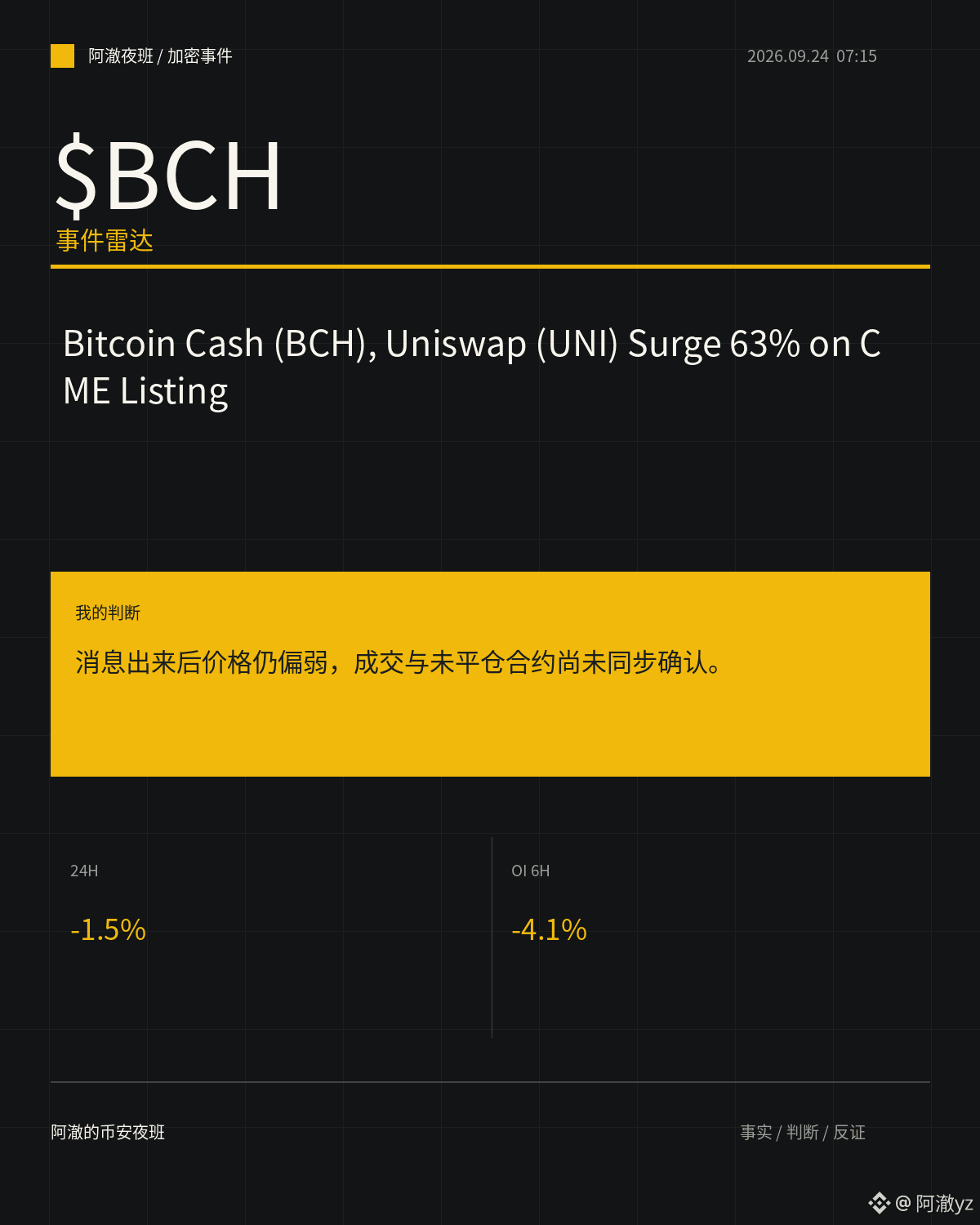
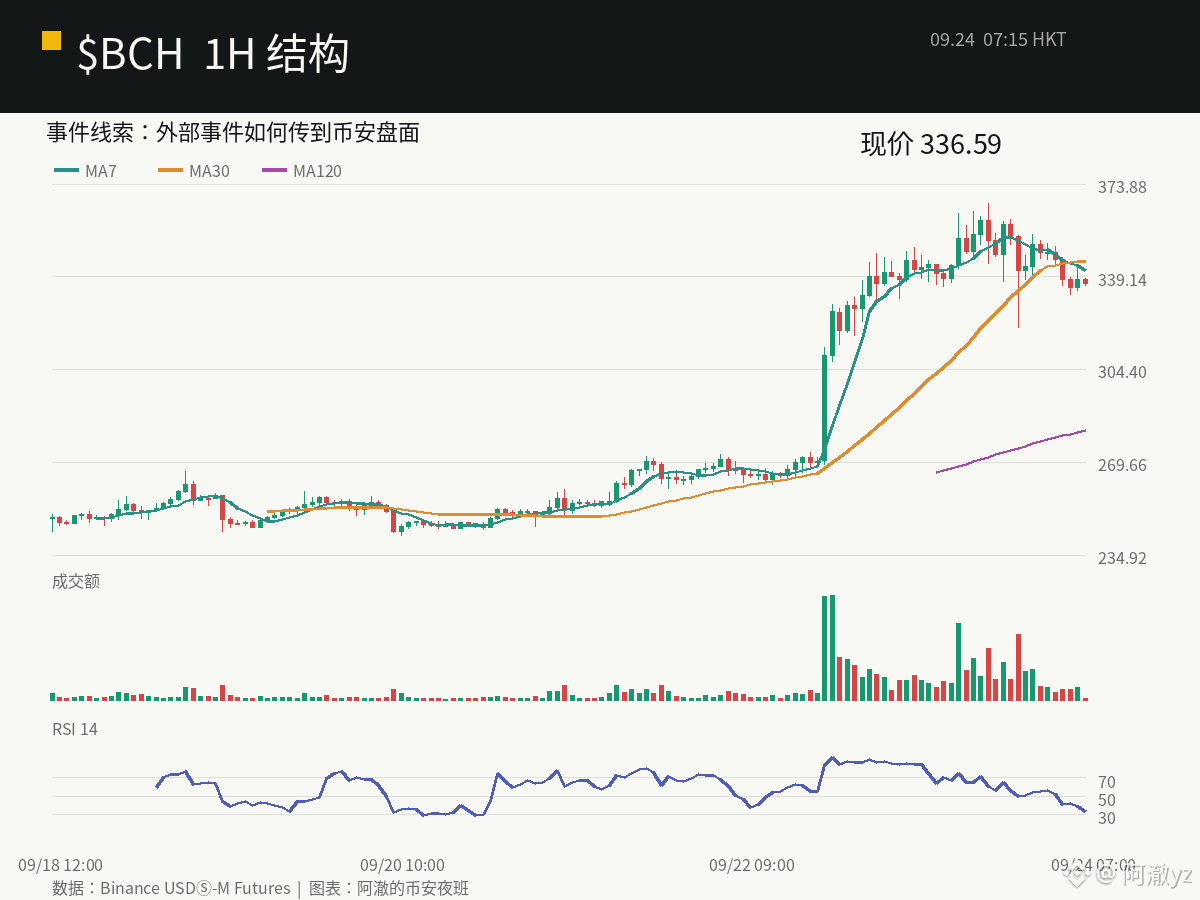
News that a derivatives platform received orders on the $BCH perpetual contract has spread widely, yet Binance’s 24-hour order book has only moved -1.5%.
Listing news usually steers expectations toward a more compliant and more institutional channel, but with Binance’s $961.3M in trading volume sitting right there, the price barely budges—more like a round of large-volume turnover has already happened, but no direction has formed yet.
The order flow isn’t cooperating either: open positions over the past 6 hours are still net decreasing, it only ticks back a little in the past hour, and the fee rate is nearly zero. Contract accounts overall are positioned net long, yet the share of aggressive buy orders is falling. The money comes in first to turnover, not to push the price up right away.
The news is new, but the market hasn’t caught up. To overturn this read, we’d need to see price and 1-hour open positions both expanding with volume to the upside. Right now it looks like there’s volume without direction.
#BCHJumps28%OnCMEFuturesListing
News that a derivatives platform received orders on the $BCH perpetual contract has spread widely, yet Binance’s 24-hour order book has only moved -1.5%.
Listing news usually steers expectations toward a more compliant and more institutional channel, but with Binance’s $961.3M in trading volume sitting right there, the price barely budges—more like a round of large-volume turnover has already happened, but no direction has formed yet.
The order flow isn’t cooperating either: open positions over the past 6 hours are still net decreasing, it only ticks back a little in the past hour, and the fee rate is nearly zero. Contract accounts overall are positioned net long, yet the share of aggressive buy orders is falling. The money comes in first to turnover, not to push the price up right away.
The news is new, but the market hasn’t caught up. To overturn this read, we’d need to see price and 1-hour open positions both expanding with volume to the upside. Right now it looks like there’s volume without direction.
#BCHJumps28%OnCMEFuturesListing
Listing news usually steers expectations toward a more compliant and more institutional channel, but with Binance’s $961.3M in trading volume sitting right there, the price barely budges—more like a round of large-volume turnover has already happened, but no direction has formed yet.
The order flow isn’t cooperating either: open positions over the past 6 hours are still net decreasing, it only ticks back a little in the past hour, and the fee rate is nearly zero. Contract accounts overall are positioned net long, yet the share of aggressive buy orders is falling. The money comes in first to turnover, not to push the price up right away.
The news is new, but the market hasn’t caught up. To overturn this read, we’d need to see price and 1-hour open positions both expanding with volume to the upside. Right now it looks like there’s volume without direction.
#BCHJumps28%OnCMEFuturesListing
119
The tokenization of U.S. stocks sweeps across Wall Street: BNB Chain breaks the $1 billion market cap mark, and the NYSE steps in to usher in an around-the-clock trading era
I. Tokenized U.S. stocks reach a historic moment
In September 2026, global financial markets are witnessing a profound shift. The total market value of tokenized U.S. stocks has surpassed the $1 billion threshold. Among them, BNB Chain has overtaken Ethereum by leading market capitalization, becoming the biggest winner in the tokenized stocks track. Binance founder Zhao Changpeng reposted this milestone on social media, showing strong confidence in the development of the ecosystem.
Meanwhile, the New York Stock Exchange and Blockchain.com have officially signed a memorandum of cooperation. They plan to use the NYSE’s digital ATS platform to offer tokenized U.S.-listed stocks and ETF products to crypto-native investors, enabling continuous, uninterrupted trading around the clock. This partnership marks that traditional financial giants have officially embraced the wave of blockchain-based securities tokenization, and it also means that the barriers between Wall Street and the crypto world are accelerating toward dissolution.
II. Regulatory ice-breaking speeds up integration
The rapid rise of tokenized stocks cannot be separated from regulatory easing. The U.S. Securities and Exchange Commission has recently launched a five-year innovative exemption program, providing a compliance framework for tokenized securities. Asset manager Grayscale has also publicly confirmed that on-chain stock trading can fully operate in a compliant manner, further reducing market concerns about legal risks.
Against this backdrop, Binance has launched 77 tokenized U.S. stock offerings and 196 traditional financial perpetual contract products, working to build an all-encompassing trading platform covering spot, derivatives, and tokenized securities. This comprehensive layout—from crypto-native to traditional finance—gives Binance a distinct niche in industry competition.
III. Hawkish signals from the Federal Reserve trigger market turbulence
However, macro-level uncertainty continues to disrupt markets. U.S. 10-year Treasury yields have surged to 5.13%, the highest level since July 2007. Federal Reserve Governor Michael Barr hinted that further rate hikes may still be needed to bring inflation down to the 2% target level. Simultaneously, U.S. 30-year Treasury yields climbed to around 5.4%, and mortgage rates have exceeded 7%.
Rising yields have strengthened the U.S. dollar, putting pressure on risk assets. After breaking $86,000, Bitcoin saw a pullback. Previously, spot Bitcoin ETF inflows exceeding $17 billion—including BlackRock’s IBIT, which absorbed $1 billion within four days—had boosted market sentiment. But technical indicators show that the RSI once reached the overbought zone of 83.7; the MACD turned negative, and more than $500 million in crypto positions across the market were liquidated. The risk of a near-term pullback cannot be ignored.
IV. Predictions market and stablecoin layout advance in parallel
In terms of product innovation, the Binance Wallet launched the world’s first 15-minute stock rise/fall prediction market. Users can make real-time predictions on the price direction of major technology stocks and AI stocks. The product was rolled out simultaneously via the Binance App and the web, further expanding the platform’s business map into the field of traditional-finance-related prediction markets.
On the strategic front, Binance purchased 1,237,001 shares of Circle at a price of $80.84 per share, for a total investment of $100 million, and signed a five-year commercial cooperation agreement with Circle. This investment deepens Binance’s ties to USDC and the broader stablecoin infrastructure, positioning the platform more favorably in the institutional-grade stablecoin payment market.
V. Outlook for the future
The market is currently at a critical juncture for the deep integration of traditional finance and the crypto ecosystem. The explosive growth of tokenized U.S. stocks, the entry of legacy institutions such as the NYSE, and the gradual clarification of the regulatory framework are injecting long-term momentum into this track. However, in the short term, the Fed’s hawkish stance and elevated Treasury yields will still weigh on risk assets. Investors need to seize structural opportunities while closely monitoring shifts in macro policy and managing position sizing and risk exposure appropriately.
#AIStocksWhatNext #BCHJumps28%OnCMEFuturesListing #TokenizedStocks
The tokenization of U.S. stocks sweeps across Wall Street: BNB Chain breaks the $1 billion market cap mark, and the NYSE steps in to usher in an around-the-clock trading era
I. Tokenized U.S. stocks reach a historic moment
In September 2026, global financial markets are witnessing a profound shift. The total market value of tokenized U.S. stocks has surpassed the $1 billion threshold. Among them, BNB Chain has overtaken Ethereum by leading market capitalization, becoming the biggest winner in the tokenized stocks track. Binance founder Zhao Changpeng reposted this milestone on social media, showing strong confidence in the development of the ecosystem.
Meanwhile, the New York Stock Exchange and Blockchain.com have officially signed a memorandum of cooperation. They plan to use the NYSE’s digital ATS platform to offer tokenized U.S.-listed stocks and ETF products to crypto-native investors, enabling continuous, uninterrupted trading around the clock. This partnership marks that traditional financial giants have officially embraced the wave of blockchain-based securities tokenization, and it also means that the barriers between Wall Street and the crypto world are accelerating toward dissolution.
II. Regulatory ice-breaking speeds up integration
The rapid rise of tokenized stocks cannot be separated from regulatory easing. The U.S. Securities and Exchange Commission has recently launched a five-year innovative exemption program, providing a compliance framework for tokenized securities. Asset manager Grayscale has also publicly confirmed that on-chain stock trading can fully operate in a compliant manner, further reducing market concerns about legal risks.
Against this backdrop, Binance has launched 77 tokenized U.S. stock offerings and 196 traditional financial perpetual contract products, working to build an all-encompassing trading platform covering spot, derivatives, and tokenized securities. This comprehensive layout—from crypto-native to traditional finance—gives Binance a distinct niche in industry competition.
III. Hawkish signals from the Federal Reserve trigger market turbulence
However, macro-level uncertainty continues to disrupt markets. U.S. 10-year Treasury yields have surged to 5.13%, the highest level since July 2007. Federal Reserve Governor Michael Barr hinted that further rate hikes may still be needed to bring inflation down to the 2% target level. Simultaneously, U.S. 30-year Treasury yields climbed to around 5.4%, and mortgage rates have exceeded 7%.
Rising yields have strengthened the U.S. dollar, putting pressure on risk assets. After breaking $86,000, Bitcoin saw a pullback. Previously, spot Bitcoin ETF inflows exceeding $17 billion—including BlackRock’s IBIT, which absorbed $1 billion within four days—had boosted market sentiment. But technical indicators show that the RSI once reached the overbought zone of 83.7; the MACD turned negative, and more than $500 million in crypto positions across the market were liquidated. The risk of a near-term pullback cannot be ignored.
IV. Predictions market and stablecoin layout advance in parallel
In terms of product innovation, the Binance Wallet launched the world’s first 15-minute stock rise/fall prediction market. Users can make real-time predictions on the price direction of major technology stocks and AI stocks. The product was rolled out simultaneously via the Binance App and the web, further expanding the platform’s business map into the field of traditional-finance-related prediction markets.
On the strategic front, Binance purchased 1,237,001 shares of Circle at a price of $80.84 per share, for a total investment of $100 million, and signed a five-year commercial cooperation agreement with Circle. This investment deepens Binance’s ties to USDC and the broader stablecoin infrastructure, positioning the platform more favorably in the institutional-grade stablecoin payment market.
V. Outlook for the future
The market is currently at a critical juncture for the deep integration of traditional finance and the crypto ecosystem. The explosive growth of tokenized U.S. stocks, the entry of legacy institutions such as the NYSE, and the gradual clarification of the regulatory framework are injecting long-term momentum into this track. However, in the short term, the Fed’s hawkish stance and elevated Treasury yields will still weigh on risk assets. Investors need to seize structural opportunities while closely monitoring shifts in macro policy and managing position sizing and risk exposure appropriately.
#AIStocksWhatNext #BCHJumps28%OnCMEFuturesListing #TokenizedStocks
I. Tokenized U.S. stocks reach a historic moment
In September 2026, global financial markets are witnessing a profound shift. The total market value of tokenized U.S. stocks has surpassed the $1 billion threshold. Among them, BNB Chain has overtaken Ethereum by leading market capitalization, becoming the biggest winner in the tokenized stocks track. Binance founder Zhao Changpeng reposted this milestone on social media, showing strong confidence in the development of the ecosystem.
Meanwhile, the New York Stock Exchange and Blockchain.com have officially signed a memorandum of cooperation. They plan to use the NYSE’s digital ATS platform to offer tokenized U.S.-listed stocks and ETF products to crypto-native investors, enabling continuous, uninterrupted trading around the clock. This partnership marks that traditional financial giants have officially embraced the wave of blockchain-based securities tokenization, and it also means that the barriers between Wall Street and the crypto world are accelerating toward dissolution.
II. Regulatory ice-breaking speeds up integration
The rapid rise of tokenized stocks cannot be separated from regulatory easing. The U.S. Securities and Exchange Commission has recently launched a five-year innovative exemption program, providing a compliance framework for tokenized securities. Asset manager Grayscale has also publicly confirmed that on-chain stock trading can fully operate in a compliant manner, further reducing market concerns about legal risks.
Against this backdrop, Binance has launched 77 tokenized U.S. stock offerings and 196 traditional financial perpetual contract products, working to build an all-encompassing trading platform covering spot, derivatives, and tokenized securities. This comprehensive layout—from crypto-native to traditional finance—gives Binance a distinct niche in industry competition.
III. Hawkish signals from the Federal Reserve trigger market turbulence
However, macro-level uncertainty continues to disrupt markets. U.S. 10-year Treasury yields have surged to 5.13%, the highest level since July 2007. Federal Reserve Governor Michael Barr hinted that further rate hikes may still be needed to bring inflation down to the 2% target level. Simultaneously, U.S. 30-year Treasury yields climbed to around 5.4%, and mortgage rates have exceeded 7%.
Rising yields have strengthened the U.S. dollar, putting pressure on risk assets. After breaking $86,000, Bitcoin saw a pullback. Previously, spot Bitcoin ETF inflows exceeding $17 billion—including BlackRock’s IBIT, which absorbed $1 billion within four days—had boosted market sentiment. But technical indicators show that the RSI once reached the overbought zone of 83.7; the MACD turned negative, and more than $500 million in crypto positions across the market were liquidated. The risk of a near-term pullback cannot be ignored.
IV. Predictions market and stablecoin layout advance in parallel
In terms of product innovation, the Binance Wallet launched the world’s first 15-minute stock rise/fall prediction market. Users can make real-time predictions on the price direction of major technology stocks and AI stocks. The product was rolled out simultaneously via the Binance App and the web, further expanding the platform’s business map into the field of traditional-finance-related prediction markets.
On the strategic front, Binance purchased 1,237,001 shares of Circle at a price of $80.84 per share, for a total investment of $100 million, and signed a five-year commercial cooperation agreement with Circle. This investment deepens Binance’s ties to USDC and the broader stablecoin infrastructure, positioning the platform more favorably in the institutional-grade stablecoin payment market.
V. Outlook for the future
The market is currently at a critical juncture for the deep integration of traditional finance and the crypto ecosystem. The explosive growth of tokenized U.S. stocks, the entry of legacy institutions such as the NYSE, and the gradual clarification of the regulatory framework are injecting long-term momentum into this track. However, in the short term, the Fed’s hawkish stance and elevated Treasury yields will still weigh on risk assets. Investors need to seize structural opportunities while closely monitoring shifts in macro policy and managing position sizing and risk exposure appropriately.
#AIStocksWhatNext #BCHJumps28%OnCMEFuturesListing #TokenizedStocks
277
The Tokenization of US Stocks Sweeps Wall Street: The Line Between Traditional Finance and Crypto Is Disappearing
1. Milestone Moment: Tokenized US Stocks Market Cap Breaks One Billion
In September 2026, global capital markets reached a historic turning point. The total market cap of tokenized stocks on BNB Chain officially surpassed the one-billion-dollar mark, overtaking Ethereum to become the leader in this track. Behind this figure lies a snapshot of traditional finance and blockchain technology accelerating integration within a compliant framework. Binance has already launched 77 tokenized US stocks and 196 traditional finance perpetual contract products, covering nearly all mainstream underlying assets that investors care about most. Meanwhile, the New York Stock Exchange and Blockchain.com signed a memorandum of understanding, planning to enable 24/7 on-chain trading of US stocks and ETFs through a digital ATS platform. The five-year innovation exemption previously granted by the U.S. Securities and Exchange Commission cleared regulatory hurdles for this collaboration. Grayscale called it a milestone event for blockchain compliance entering the US capital markets.
2. Macro Storm: Rising US Treasury Yields Trigger Market Turbulence
As tokenized US stocks soar, the traditional macro market is still brewing behind the scenes. The yield on the US 10-year Treasury surged to 5.08%, the highest level since 2007; the 30-year Treasury yield also touched 5.35%. A Federal Reserve official, Bair, stated publicly that further rate hikes may be needed to bring inflation back to the 2% target. Higher yields strengthened the US dollar, while risk assets faced pressure. Bitcoin briefly fell below $84,000, and the total crypto liquidation across the market exceeded $500 million. Notably, even in such an environment, BlackRock’s IBIT Bitcoin ETF still recorded a $1 billion inflow in just four days, showing that institutional investors’ long-term confidence in crypto assets has not wavered. This divergence—institutions buying while short-term prices fall—actually signals that the market is undergoing a deep structural adjustment.
3. Binance’s Comprehensive Layout: From Exchange to Full-Spectrum Financial Platform
Binance’s recent moves are worth close attention. In addition to the continued expansion of tokenized US stocks, Binance Wallet has launched the world’s first 15-minute stock price up/down prediction market. Users can make real-time predictions about the price direction of major technology stocks and AI-themed stocks. This product combines traditional stock trading with crypto prediction markets, further blurring the boundary between TradFi and DeFi. In addition, Binance invested $100 million to buy Circle shares at $80.84 per share and signed a five-year commercial cooperation agreement. This investment not only deepens Binance’s connection to the USDC ecosystem, but also positions it more favorably within global stablecoin payment infrastructure. From tokenized stocks to prediction markets, from stablecoin investments to perpetual contracts, Binance is transforming from a single digital asset exchange into a full-spectrum platform covering both traditional finance and crypto finance.
4. Outlook: The Fusion of Traditional and Crypto Will Reshape How We Invest
The current market landscape sends a clear signal: tokenization is no longer just a conceptual experiment—it is becoming real through upgraded financial infrastructure. When legacy exchanges like the NYSE actively embrace blockchain technology, when asset management giants like BlackRock continue to increase their crypto allocation, and when regulators begin to make room for innovation, we have every reason to believe that over the next five to ten years, global capital market trading methods, settlement efficiency, and investor access thresholds will all undergo fundamental changes. For ordinary investors, focusing on the compliant progress of tokenized US stocks, the Federal Reserve’s interest-rate path, and the flow of institutional capital will be key to capturing the next wave of opportunities.
#AIStocksWhatNext #代币化美股 #BCHJumps28%OnCMEFuturesListing
The Tokenization of US Stocks Sweeps Wall Street: The Line Between Traditional Finance and Crypto Is Disappearing
1. Milestone Moment: Tokenized US Stocks Market Cap Breaks One Billion
In September 2026, global capital markets reached a historic turning point. The total market cap of tokenized stocks on BNB Chain officially surpassed the one-billion-dollar mark, overtaking Ethereum to become the leader in this track. Behind this figure lies a snapshot of traditional finance and blockchain technology accelerating integration within a compliant framework. Binance has already launched 77 tokenized US stocks and 196 traditional finance perpetual contract products, covering nearly all mainstream underlying assets that investors care about most. Meanwhile, the New York Stock Exchange and Blockchain.com signed a memorandum of understanding, planning to enable 24/7 on-chain trading of US stocks and ETFs through a digital ATS platform. The five-year innovation exemption previously granted by the U.S. Securities and Exchange Commission cleared regulatory hurdles for this collaboration. Grayscale called it a milestone event for blockchain compliance entering the US capital markets.
2. Macro Storm: Rising US Treasury Yields Trigger Market Turbulence
As tokenized US stocks soar, the traditional macro market is still brewing behind the scenes. The yield on the US 10-year Treasury surged to 5.08%, the highest level since 2007; the 30-year Treasury yield also touched 5.35%. A Federal Reserve official, Bair, stated publicly that further rate hikes may be needed to bring inflation back to the 2% target. Higher yields strengthened the US dollar, while risk assets faced pressure. Bitcoin briefly fell below $84,000, and the total crypto liquidation across the market exceeded $500 million. Notably, even in such an environment, BlackRock’s IBIT Bitcoin ETF still recorded a $1 billion inflow in just four days, showing that institutional investors’ long-term confidence in crypto assets has not wavered. This divergence—institutions buying while short-term prices fall—actually signals that the market is undergoing a deep structural adjustment.
3. Binance’s Comprehensive Layout: From Exchange to Full-Spectrum Financial Platform
Binance’s recent moves are worth close attention. In addition to the continued expansion of tokenized US stocks, Binance Wallet has launched the world’s first 15-minute stock price up/down prediction market. Users can make real-time predictions about the price direction of major technology stocks and AI-themed stocks. This product combines traditional stock trading with crypto prediction markets, further blurring the boundary between TradFi and DeFi. In addition, Binance invested $100 million to buy Circle shares at $80.84 per share and signed a five-year commercial cooperation agreement. This investment not only deepens Binance’s connection to the USDC ecosystem, but also positions it more favorably within global stablecoin payment infrastructure. From tokenized stocks to prediction markets, from stablecoin investments to perpetual contracts, Binance is transforming from a single digital asset exchange into a full-spectrum platform covering both traditional finance and crypto finance.
4. Outlook: The Fusion of Traditional and Crypto Will Reshape How We Invest
The current market landscape sends a clear signal: tokenization is no longer just a conceptual experiment—it is becoming real through upgraded financial infrastructure. When legacy exchanges like the NYSE actively embrace blockchain technology, when asset management giants like BlackRock continue to increase their crypto allocation, and when regulators begin to make room for innovation, we have every reason to believe that over the next five to ten years, global capital market trading methods, settlement efficiency, and investor access thresholds will all undergo fundamental changes. For ordinary investors, focusing on the compliant progress of tokenized US stocks, the Federal Reserve’s interest-rate path, and the flow of institutional capital will be key to capturing the next wave of opportunities.
#AIStocksWhatNext #代币化美股 #BCHJumps28%OnCMEFuturesListing
1. Milestone Moment: Tokenized US Stocks Market Cap Breaks One Billion
In September 2026, global capital markets reached a historic turning point. The total market cap of tokenized stocks on BNB Chain officially surpassed the one-billion-dollar mark, overtaking Ethereum to become the leader in this track. Behind this figure lies a snapshot of traditional finance and blockchain technology accelerating integration within a compliant framework. Binance has already launched 77 tokenized US stocks and 196 traditional finance perpetual contract products, covering nearly all mainstream underlying assets that investors care about most. Meanwhile, the New York Stock Exchange and Blockchain.com signed a memorandum of understanding, planning to enable 24/7 on-chain trading of US stocks and ETFs through a digital ATS platform. The five-year innovation exemption previously granted by the U.S. Securities and Exchange Commission cleared regulatory hurdles for this collaboration. Grayscale called it a milestone event for blockchain compliance entering the US capital markets.
2. Macro Storm: Rising US Treasury Yields Trigger Market Turbulence
As tokenized US stocks soar, the traditional macro market is still brewing behind the scenes. The yield on the US 10-year Treasury surged to 5.08%, the highest level since 2007; the 30-year Treasury yield also touched 5.35%. A Federal Reserve official, Bair, stated publicly that further rate hikes may be needed to bring inflation back to the 2% target. Higher yields strengthened the US dollar, while risk assets faced pressure. Bitcoin briefly fell below $84,000, and the total crypto liquidation across the market exceeded $500 million. Notably, even in such an environment, BlackRock’s IBIT Bitcoin ETF still recorded a $1 billion inflow in just four days, showing that institutional investors’ long-term confidence in crypto assets has not wavered. This divergence—institutions buying while short-term prices fall—actually signals that the market is undergoing a deep structural adjustment.
3. Binance’s Comprehensive Layout: From Exchange to Full-Spectrum Financial Platform
Binance’s recent moves are worth close attention. In addition to the continued expansion of tokenized US stocks, Binance Wallet has launched the world’s first 15-minute stock price up/down prediction market. Users can make real-time predictions about the price direction of major technology stocks and AI-themed stocks. This product combines traditional stock trading with crypto prediction markets, further blurring the boundary between TradFi and DeFi. In addition, Binance invested $100 million to buy Circle shares at $80.84 per share and signed a five-year commercial cooperation agreement. This investment not only deepens Binance’s connection to the USDC ecosystem, but also positions it more favorably within global stablecoin payment infrastructure. From tokenized stocks to prediction markets, from stablecoin investments to perpetual contracts, Binance is transforming from a single digital asset exchange into a full-spectrum platform covering both traditional finance and crypto finance.
4. Outlook: The Fusion of Traditional and Crypto Will Reshape How We Invest
The current market landscape sends a clear signal: tokenization is no longer just a conceptual experiment—it is becoming real through upgraded financial infrastructure. When legacy exchanges like the NYSE actively embrace blockchain technology, when asset management giants like BlackRock continue to increase their crypto allocation, and when regulators begin to make room for innovation, we have every reason to believe that over the next five to ten years, global capital market trading methods, settlement efficiency, and investor access thresholds will all undergo fundamental changes. For ordinary investors, focusing on the compliant progress of tokenized US stocks, the Federal Reserve’s interest-rate path, and the flow of institutional capital will be key to capturing the next wave of opportunities.
#AIStocksWhatNext #代币化美股 #BCHJumps28%OnCMEFuturesListing
1
Tokenized U.S. stocks break through the $1 billion mark as Wall Street and the crypto world accelerate their integration
I. BNB Chain tokenized U.S. stock market capitalization exceeds $1 billion
On September 23, 2026, the cryptocurrency market reached a milestone moment. The total market capitalization of tokenized U.S. stocks on BNB Chain officially surpassed $1 billion, overtaking Ethereum to become the leading player in this sector. Binance founder CZ reposted the news on social media, signaling strong recognition of the ecosystem’s development.
At present, the Binance platform has listed 77 tokenized U.S. stocks and 196 traditional finance perpetual contracts, building an all-around trading ecosystem connecting traditional finance and crypto finance. Meanwhile, the New York Stock Exchange has also signed a memorandum of understanding with Blockchain.com, planning to offer tokenized U.S. stock and ETF products traded around the clock via its digital ATS platform, covering more than 44 million users on Blockchain.com. Canada’s six largest banks jointly launched a tokenized deposit network, and Korea’s KB Securities partnered with Securitize and Optimism to launch tokenized funds on the OP Mainnet.
II. Fed hawkish signals trigger market turbulence
While tokenized U.S. stocks are booming, macroeconomic undercurrents tell a different story. Fed Governor Baal said that further rate hikes may be needed to bring inflation back to the 2% target. At present, the federal funds rate has risen to a range of 3.75% to 4%. On Polymarket, the probability of a pause in rate hikes in October dropped sharply from 45.5% to 30.5%.
As a result, U.S. 10-year Treasury yields surged to 5.05%, hitting a new 19-year high. U.S. 30-year Treasury yields also touched 5.35%. Mortgage rates are nearing 7.5%, putting significant downside pressure on risk assets. Bitcoin fell from an $87,000 high to below $84,000, and the total amount liquidated across the market in 24 hours exceeded $500 million.
III. Institutional funds move in against the tide; BTC ETF sees nearly $1 billion in daily inflows
Despite the market pullback, institutional investors’ buying power has been striking. U.S. spot Bitcoin ETFs recorded $999 million in net inflows on Monday, setting the largest single-day record since October 2025. On Tuesday, inflows added another $714 million. BlackRock’s IBIT product attracted more than $1 billion within four days, pushing BTC briefly to a new high not seen since the past month.
However, it’s worth noting that on-chain data shows whale addresses have transferred more than 7,000 BTC to exchanges, and some long-dormant wallets have been reactivated. This suggests that large holders may be taking profits at elevated levels. In the short term, the market faces intensified battles between bulls and bears.
IV. CME launches BCH and UNI futures, sparking a surge
The Chicago Mercantile Exchange announced that on October 19 it will launch Bitcoin Cash and Uniswap futures contracts, including both standard and micro contract specifications. After the news was released, BCH skyrocketed by 34% within 24 hours, while UNI rose more than 16%. Both assets have cumulatively gained more than 60% over the past week. The exchange’s futures listing means institutional investors gain a more convenient compliant entry channel, which is significant for long-term price support of the related tokens.
V. Binance launches a 15-minute U.S. stock prediction market
On product innovation, Binance Wallet has launched what is claimed to be the industry’s first 15-minute U.S. stock涨跌 (up/down) prediction market. Users can make real-time predictions on the price direction of major technology stocks and AI stocks. The product supports both the Binance App and web access, further expanding Binance’s presence in the traditional finance prediction market space.
Overall, the market is currently at a critical juncture where traditional finance and the crypto ecosystem are deeply integrating. The rapid development of tokenized U.S. stocks, ongoing inflows of institutional funds, and the continuous acceleration of product innovation are all reshaping the underlying logic of the crypto market. However, the Fed’s hawkish stance and persistently high U.S. Treasury yields also bring pressure that cannot be ignored. Investors will need to strike a balance between opportunities and risks.
#AIStocksWhatNext #BCHJumps28%OnCMEFuturesListing #TokenizedStocks
Tokenized U.S. stocks break through the $1 billion mark as Wall Street and the crypto world accelerate their integration
I. BNB Chain tokenized U.S. stock market capitalization exceeds $1 billion
On September 23, 2026, the cryptocurrency market reached a milestone moment. The total market capitalization of tokenized U.S. stocks on BNB Chain officially surpassed $1 billion, overtaking Ethereum to become the leading player in this sector. Binance founder CZ reposted the news on social media, signaling strong recognition of the ecosystem’s development.
At present, the Binance platform has listed 77 tokenized U.S. stocks and 196 traditional finance perpetual contracts, building an all-around trading ecosystem connecting traditional finance and crypto finance. Meanwhile, the New York Stock Exchange has also signed a memorandum of understanding with Blockchain.com, planning to offer tokenized U.S. stock and ETF products traded around the clock via its digital ATS platform, covering more than 44 million users on Blockchain.com. Canada’s six largest banks jointly launched a tokenized deposit network, and Korea’s KB Securities partnered with Securitize and Optimism to launch tokenized funds on the OP Mainnet.
II. Fed hawkish signals trigger market turbulence
While tokenized U.S. stocks are booming, macroeconomic undercurrents tell a different story. Fed Governor Baal said that further rate hikes may be needed to bring inflation back to the 2% target. At present, the federal funds rate has risen to a range of 3.75% to 4%. On Polymarket, the probability of a pause in rate hikes in October dropped sharply from 45.5% to 30.5%.
As a result, U.S. 10-year Treasury yields surged to 5.05%, hitting a new 19-year high. U.S. 30-year Treasury yields also touched 5.35%. Mortgage rates are nearing 7.5%, putting significant downside pressure on risk assets. Bitcoin fell from an $87,000 high to below $84,000, and the total amount liquidated across the market in 24 hours exceeded $500 million.
III. Institutional funds move in against the tide; BTC ETF sees nearly $1 billion in daily inflows
Despite the market pullback, institutional investors’ buying power has been striking. U.S. spot Bitcoin ETFs recorded $999 million in net inflows on Monday, setting the largest single-day record since October 2025. On Tuesday, inflows added another $714 million. BlackRock’s IBIT product attracted more than $1 billion within four days, pushing BTC briefly to a new high not seen since the past month.
However, it’s worth noting that on-chain data shows whale addresses have transferred more than 7,000 BTC to exchanges, and some long-dormant wallets have been reactivated. This suggests that large holders may be taking profits at elevated levels. In the short term, the market faces intensified battles between bulls and bears.
IV. CME launches BCH and UNI futures, sparking a surge
The Chicago Mercantile Exchange announced that on October 19 it will launch Bitcoin Cash and Uniswap futures contracts, including both standard and micro contract specifications. After the news was released, BCH skyrocketed by 34% within 24 hours, while UNI rose more than 16%. Both assets have cumulatively gained more than 60% over the past week. The exchange’s futures listing means institutional investors gain a more convenient compliant entry channel, which is significant for long-term price support of the related tokens.
V. Binance launches a 15-minute U.S. stock prediction market
On product innovation, Binance Wallet has launched what is claimed to be the industry’s first 15-minute U.S. stock涨跌 (up/down) prediction market. Users can make real-time predictions on the price direction of major technology stocks and AI stocks. The product supports both the Binance App and web access, further expanding Binance’s presence in the traditional finance prediction market space.
Overall, the market is currently at a critical juncture where traditional finance and the crypto ecosystem are deeply integrating. The rapid development of tokenized U.S. stocks, ongoing inflows of institutional funds, and the continuous acceleration of product innovation are all reshaping the underlying logic of the crypto market. However, the Fed’s hawkish stance and persistently high U.S. Treasury yields also bring pressure that cannot be ignored. Investors will need to strike a balance between opportunities and risks.
#AIStocksWhatNext #BCHJumps28%OnCMEFuturesListing #TokenizedStocks
I. BNB Chain tokenized U.S. stock market capitalization exceeds $1 billion
On September 23, 2026, the cryptocurrency market reached a milestone moment. The total market capitalization of tokenized U.S. stocks on BNB Chain officially surpassed $1 billion, overtaking Ethereum to become the leading player in this sector. Binance founder CZ reposted the news on social media, signaling strong recognition of the ecosystem’s development.
At present, the Binance platform has listed 77 tokenized U.S. stocks and 196 traditional finance perpetual contracts, building an all-around trading ecosystem connecting traditional finance and crypto finance. Meanwhile, the New York Stock Exchange has also signed a memorandum of understanding with Blockchain.com, planning to offer tokenized U.S. stock and ETF products traded around the clock via its digital ATS platform, covering more than 44 million users on Blockchain.com. Canada’s six largest banks jointly launched a tokenized deposit network, and Korea’s KB Securities partnered with Securitize and Optimism to launch tokenized funds on the OP Mainnet.
II. Fed hawkish signals trigger market turbulence
While tokenized U.S. stocks are booming, macroeconomic undercurrents tell a different story. Fed Governor Baal said that further rate hikes may be needed to bring inflation back to the 2% target. At present, the federal funds rate has risen to a range of 3.75% to 4%. On Polymarket, the probability of a pause in rate hikes in October dropped sharply from 45.5% to 30.5%.
As a result, U.S. 10-year Treasury yields surged to 5.05%, hitting a new 19-year high. U.S. 30-year Treasury yields also touched 5.35%. Mortgage rates are nearing 7.5%, putting significant downside pressure on risk assets. Bitcoin fell from an $87,000 high to below $84,000, and the total amount liquidated across the market in 24 hours exceeded $500 million.
III. Institutional funds move in against the tide; BTC ETF sees nearly $1 billion in daily inflows
Despite the market pullback, institutional investors’ buying power has been striking. U.S. spot Bitcoin ETFs recorded $999 million in net inflows on Monday, setting the largest single-day record since October 2025. On Tuesday, inflows added another $714 million. BlackRock’s IBIT product attracted more than $1 billion within four days, pushing BTC briefly to a new high not seen since the past month.
However, it’s worth noting that on-chain data shows whale addresses have transferred more than 7,000 BTC to exchanges, and some long-dormant wallets have been reactivated. This suggests that large holders may be taking profits at elevated levels. In the short term, the market faces intensified battles between bulls and bears.
IV. CME launches BCH and UNI futures, sparking a surge
The Chicago Mercantile Exchange announced that on October 19 it will launch Bitcoin Cash and Uniswap futures contracts, including both standard and micro contract specifications. After the news was released, BCH skyrocketed by 34% within 24 hours, while UNI rose more than 16%. Both assets have cumulatively gained more than 60% over the past week. The exchange’s futures listing means institutional investors gain a more convenient compliant entry channel, which is significant for long-term price support of the related tokens.
V. Binance launches a 15-minute U.S. stock prediction market
On product innovation, Binance Wallet has launched what is claimed to be the industry’s first 15-minute U.S. stock涨跌 (up/down) prediction market. Users can make real-time predictions on the price direction of major technology stocks and AI stocks. The product supports both the Binance App and web access, further expanding Binance’s presence in the traditional finance prediction market space.
Overall, the market is currently at a critical juncture where traditional finance and the crypto ecosystem are deeply integrating. The rapid development of tokenized U.S. stocks, ongoing inflows of institutional funds, and the continuous acceleration of product innovation are all reshaping the underlying logic of the crypto market. However, the Fed’s hawkish stance and persistently high U.S. Treasury yields also bring pressure that cannot be ignored. Investors will need to strike a balance between opportunities and risks.
#AIStocksWhatNext #BCHJumps28%OnCMEFuturesListing #TokenizedStocks
1
748
Log in to explore more content
Join global crypto users on Binance Square
⚡️ Get latest and useful information about crypto.
💬 Trusted by the world’s largest crypto exchange.
👍 Discover real insights from verified creators.
Email / Phone number
Trending Topics
1
#QNTRises39%
608 views
108 Discussing
2
#EthereumBreaksAbove$2700
193 views
33 Discussing
3
#BitgetBreachForgedRequestsNotStolenKeys
361 views
77 Discussing
4
#BitcoinSpotETFsTurnNetPositiveYTD
320 views
51 Discussing
5
#GrayscaleZcashETFHits$1BNetAssets
491 views
27 Discussing
6
#BitcoinSpotETFsNetInflow$191M
4,576 views
154 Discussing
7
#CFTCUpdatesGuidanceOnTokenizedAssets
29,740 views
1,077 Discussing
8
#BitgetSays$352MAffectedInHack
11,814 views
86 Discussing
9
#NYAndPolymarketSueEachOther
2,319 views
101 Discussing
10
#BinanceWillListHyperliquid(HYPE)
231,816 views
3,626 Discussing