
#786cryptowolf
786cryptowolf
1,320 views
5 Discussing
Hot
Latest


·
--
Bearish
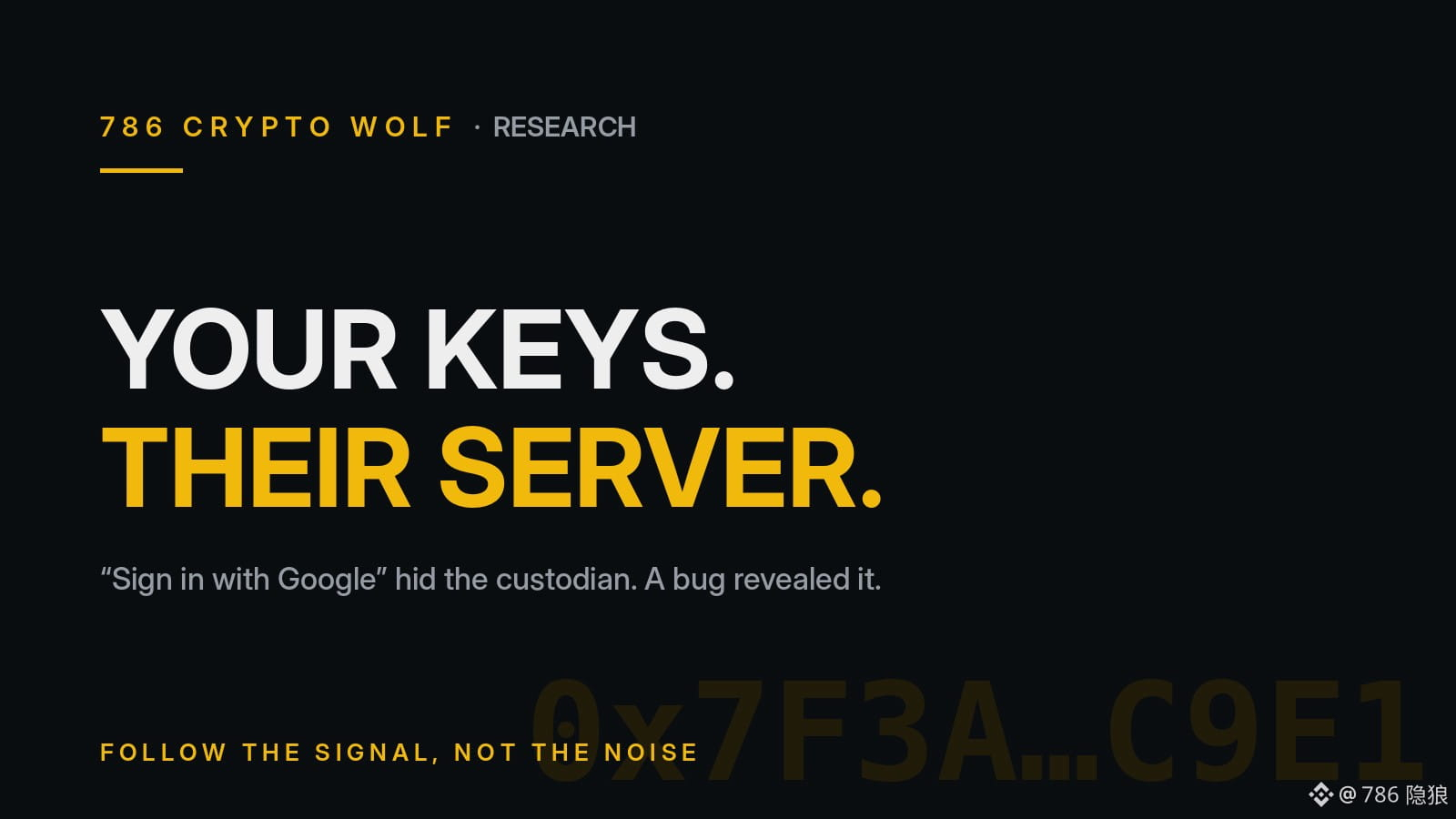
𝒀𝒐𝒖 𝒕𝒉𝒐𝒖𝒈𝒉𝒕 𝒚𝒐𝒖 𝒉𝒆𝒍𝒅 𝒚𝒐𝒖𝒓 𝒌𝒆𝒚𝒔. 𝑨 𝒃𝒖𝒈 𝒋𝒖𝒔𝒕 𝒑𝒓𝒐𝒗𝒆𝒅 𝒚𝒐𝒖 𝒅𝒊𝒅𝒏’𝒕.
This week, a flaw in Web3Auth exposed the private keys of users who signed into their wallets with a 𝐬𝐨𝐜𝐢𝐚𝐥 𝐥𝐨𝐠𝐢𝐧.Keplr told them to move their funds immediately.
No phishing. No leaked seed phrase. No careless click. Just a bug — in the “convenience” layer everyone told you was safe.
When a wallet lets you “sign in with Google,” it doesn’t remove the private key. 𝐈𝐭 𝐡𝐢𝐝𝐞𝐬 𝐢𝐭 —derived and managed through a company’s infrastructure you never audited.
You felt self-custodial. You were 𝐜𝐮𝐬𝐭𝐨𝐝𝐢𝐚𝐥 𝐰𝐢𝐭𝐡 𝐞𝐱𝐭𝐫𝐚 𝐬𝐭𝐞𝐩𝐬.
The seed phrase scared newcomers away, so the industry solved it by 𝐛𝐮𝐫𝐲𝐢𝐧𝐠 𝐭𝐡𝐞 𝐜𝐮𝐬𝐭𝐨𝐝𝐢𝐚𝐧, 𝐧𝐨𝐭 𝐫𝐞𝐦𝐨𝐯𝐢𝐧𝐠 𝐢𝐭.“Be your own bank” quietly became “trust our login.” And when their server has a bad week, the user who did everything right still has to race to save their own funds.
Self-custody protects your keys — 𝘰𝘯𝘭𝘺 𝘪𝘧 𝘵𝘩𝘦 𝘬𝘦𝘺𝘴 𝘸𝘦𝘳𝘦 𝘦𝘷𝘦𝘳 𝘢𝘤𝘵𝘶𝘢𝘭𝘭𝘺 𝘺𝘰𝘶𝘳𝘴.
𝐈𝐟 𝐚 𝐥𝐨𝐠𝐢𝐧 𝐛𝐮𝐠 𝐜𝐚𝐧 𝐥𝐞𝐚𝐤 𝐲𝐨𝐮𝐫 𝐩𝐫𝐢𝐯𝐚𝐭𝐞 𝐤𝐞𝐲, 𝐰𝐞𝐫𝐞 𝐲𝐨𝐮 𝐞𝐯𝐞𝐫 𝐬𝐞𝐥𝐟-𝐜𝐮𝐬𝐭𝐨𝐝𝐢𝐚𝐥 — 𝐨𝐫 𝐣𝐮𝐬𝐭 𝐜𝐮𝐬𝐭𝐨𝐝𝐢𝐚𝐥, 𝐰𝐢𝐭𝐡 𝐚 𝐧𝐢𝐜𝐞𝐫 𝐢𝐧𝐭𝐞𝐫𝐟𝐚𝐜𝐞?
🐺 𝟕𝟖𝟔 𝐂𝐑𝐘𝐏𝐓𝐎 𝐖𝐎𝐋𝐅 · 𝐑𝐄𝐒𝐄𝐀𝐑𝐂𝐇
Follow the signal, not the noise.
$BTC $ETH
#KeplrAdvisesSocialLoginUsersToTransferAssets
#SelfCustody #CryptoSecurity #Web3Auth #786CryptoWolf
100
·
--
Article
The $2 Billion Was Never Hidden. That’s the Part Nobody Wants to Admit.t some point this year, a transaction left a compromised exchange wallet. It confirmed in seconds, wrote itself to a public ledger, and became visible to anyone on earth with a block explorer. No disguise. No shredder. No offshore vault — just a line of data that will exist forever.
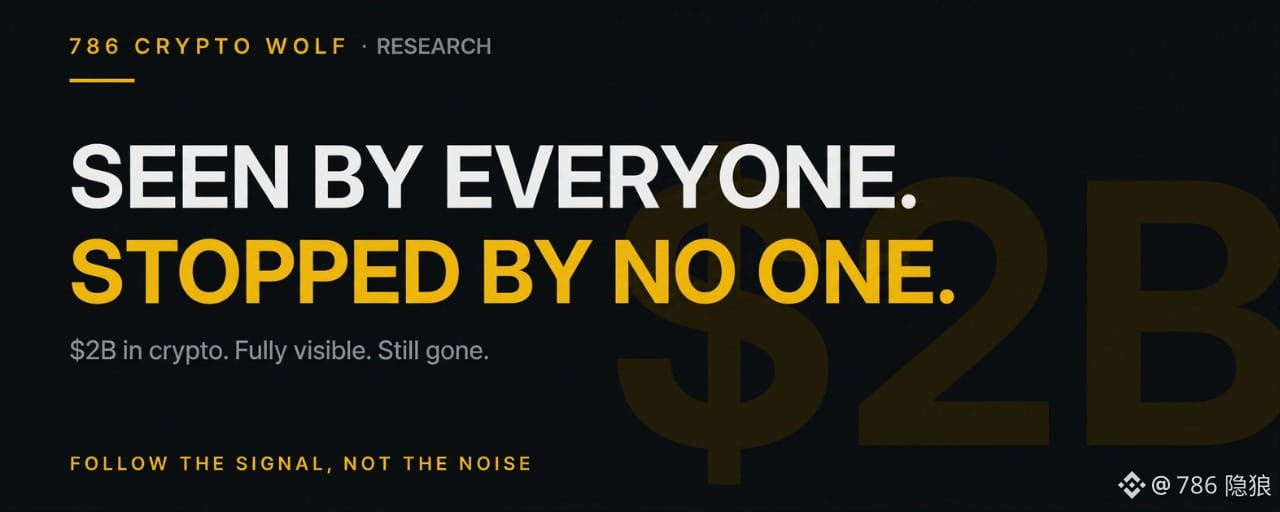
That transaction was part of the roughly $2 billion North Korea is estimated to have taken from crypto in 2025. And here is the truth buried under every “how do they hack us” headline: the money was never hidden. We watched it leave. We watched it move. And we couldn’t stop it.
Tracing was never the hard part.
The industry trained itself to treat tracing as the problem. It isn’t. On-chain, everything is visible by default — the opposite of cash. The hard problem is the one nobody markets: seeing a theft and being able to stop it are two completely different systems.
Freezing stolen funds is not a button. It needs a specific actor — a centralized exchange, a stablecoin issuer, a bridge operator — to decide, with legal cover and technical access, to act on a specific address. That decision lives across different companies, jurisdictions, and incentives. None is obligated to move first. All of them move slowly.
The fallout doesn’t land where the theft happened.
North Korea’s operators understand this gap better than most defenders do. Stolen funds don’t sit still waiting to be frozen. Within hours they’re split across chains, routed through bridges, and run through mixers built to break the link between source and destination.
By the time a freeze is authorized, the money has often already settled into liquidity that ordinary users touch — a pool, a swap, a “clean” wallet two hops away. The operation was North Korean. The loss lands on a trader in Karachi or Lagos whose only mistake was providing liquidity to the wrong pool at the wrong time.
The real architecture of the problem:
Detection — solved. The ledger remembers everything.Attribution — largely solved. Firms flag Lazarus-linked addresses within days.Response — broken. Fragmented, voluntary, slow action by actors who each have a reason to wait.
The gap between attribution and response is where two billion dollars disappears — not into secrecy, but into delay.
This reframes the whole conversation.
The question for exchanges, protocols, and regulators is no longer “can we see it?” We can. It’s: who is authorized to act on what we see, and how fast?
That’s a governance problem, not a surveillance one. It’s about pre-agreed response — standards for who freezes, under what proof, within what window — the way traditional finance eventually built (imperfect) rails to stop a wire. Crypto has perfect memory and almost no reflexes.
North Korea isn’t exposing a weakness in crypto’s privacy. It’s exposing a weakness in crypto’s response. We built a system that records every crime in permanent, public detail — and then leaves the decision to react to no one in particular.
So here’s the question the industry keeps avoiding: if every stolen dollar is visible to all of us, whose job is it to freeze it — the exchange, the protocol, or no one?
#AlphaWolfHQ #786CryptoWolf #northkorea #LazarusGroup #CryptoSecurity
🐺 786 CRYPTO WOLF · RESEARCH
Follow the signal, not the noise.
The $2 Billion Was Never Hidden. That’s the Part Nobody Wants to Admit.
t some point this year, a transaction left a compromised exchange wallet. It confirmed in seconds, wrote itself to a public ledger, and became visible to anyone on earth with a block explorer. No disguise. No shredder. No offshore vault — just a line of data that will exist forever.
That transaction was part of the roughly $2 billion North Korea is estimated to have taken from crypto in 2025. And here is the truth buried under every “how do they hack us” headline: the money was never hidden. We watched it leave. We watched it move. And we couldn’t stop it.
Tracing was never the hard part.
The industry trained itself to treat tracing as the problem. It isn’t. On-chain, everything is visible by default — the opposite of cash. The hard problem is the one nobody markets: seeing a theft and being able to stop it are two completely different systems.
Freezing stolen funds is not a button. It needs a specific actor — a centralized exchange, a stablecoin issuer, a bridge operator — to decide, with legal cover and technical access, to act on a specific address. That decision lives across different companies, jurisdictions, and incentives. None is obligated to move first. All of them move slowly.
The fallout doesn’t land where the theft happened.
North Korea’s operators understand this gap better than most defenders do. Stolen funds don’t sit still waiting to be frozen. Within hours they’re split across chains, routed through bridges, and run through mixers built to break the link between source and destination.
By the time a freeze is authorized, the money has often already settled into liquidity that ordinary users touch — a pool, a swap, a “clean” wallet two hops away. The operation was North Korean. The loss lands on a trader in Karachi or Lagos whose only mistake was providing liquidity to the wrong pool at the wrong time.
The real architecture of the problem:
Detection — solved. The ledger remembers everything.Attribution — largely solved. Firms flag Lazarus-linked addresses within days.Response — broken. Fragmented, voluntary, slow action by actors who each have a reason to wait.
The gap between attribution and response is where two billion dollars disappears — not into secrecy, but into delay.
This reframes the whole conversation.
The question for exchanges, protocols, and regulators is no longer “can we see it?” We can. It’s: who is authorized to act on what we see, and how fast?
That’s a governance problem, not a surveillance one. It’s about pre-agreed response — standards for who freezes, under what proof, within what window — the way traditional finance eventually built (imperfect) rails to stop a wire. Crypto has perfect memory and almost no reflexes.
North Korea isn’t exposing a weakness in crypto’s privacy. It’s exposing a weakness in crypto’s response. We built a system that records every crime in permanent, public detail — and then leaves the decision to react to no one in particular.
So here’s the question the industry keeps avoiding: if every stolen dollar is visible to all of us, whose job is it to freeze it — the exchange, the protocol, or no one?
#AlphaWolfHQ #786CryptoWolf #northkorea #LazarusGroup #CryptoSecurity
🐺 786 CRYPTO WOLF · RESEARCH
Follow the signal, not the noise.
3
2.4k
·
--
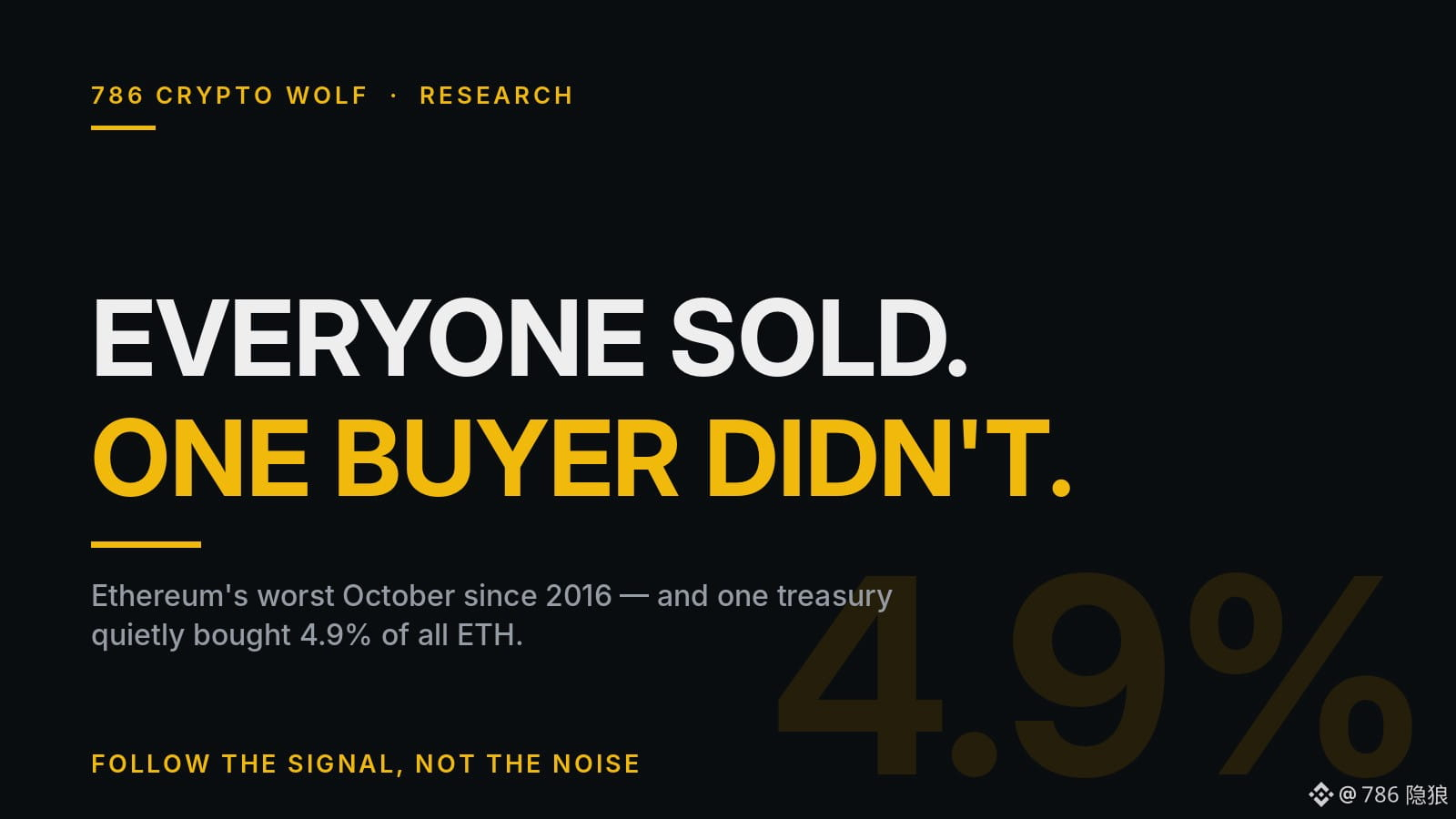
October was Ethereum’s second-worst October since 2016. Down 16.1%.
The exits were loud. BlackRock’s ETH fund bled roughly $1.32 billion in a month. Headlines called it capitulation.
But capitulation is only half a transaction.
While retail and ETFs were selling, one company — BitMine
— quietly accumulated. As of November 1, it holds 6,060,506 ETH.
That’s about 4.9% of every Ether in existence, sitting in a single treasury.
Read that again. During the fear, supply didn’t disappear. It changed hands — from people who needed to get out, to someone building a position measured in percentages of the entire network.
That’s the part the red candles never show you. Every panic sell has a buyer on the other side — and that buyer almost never shares your time horizon. You’re reacting to a month. They’re positioning for years.
This is how supply quietly concentrates during fear — not in a crash, in a transfer.
So before your next fear-driven exit, ask the question the chart won’t answer:
𝑾𝒉𝒐 𝒊𝒔 𝒐𝒏 𝒕𝒉𝒆 𝒐𝒕𝒉𝒆𝒓 𝒔𝒊𝒅𝒆 𝒐𝒇 𝒚𝒐𝒖𝒓 𝒕𝒓𝒂𝒅𝒆 — 𝒂𝒏𝒅 𝒘𝒉𝒂𝒕 𝒅𝒐 𝒕𝒉𝒆𝒚 𝒌𝒏𝒐𝒘 𝒕𝒉𝒂𝒕 𝒚𝒐𝒖𝒓 𝒑𝒂𝒏𝒊𝒄 𝒅𝒐𝒆𝒔𝒏’𝒕?
$ETH #Ethereum #crypto #786CryptoWolf
𝑭𝒐𝒍𝒍𝒐𝒘 𝒕𝒉𝒆 𝒔𝒊𝒈𝒏𝒂𝒍, 𝒏𝒐𝒕 𝒕𝒉𝒆 𝒏𝒐𝒊𝒔𝒆. 🐺
168
·
--
An exchange holds billions behind code that has never been broken.
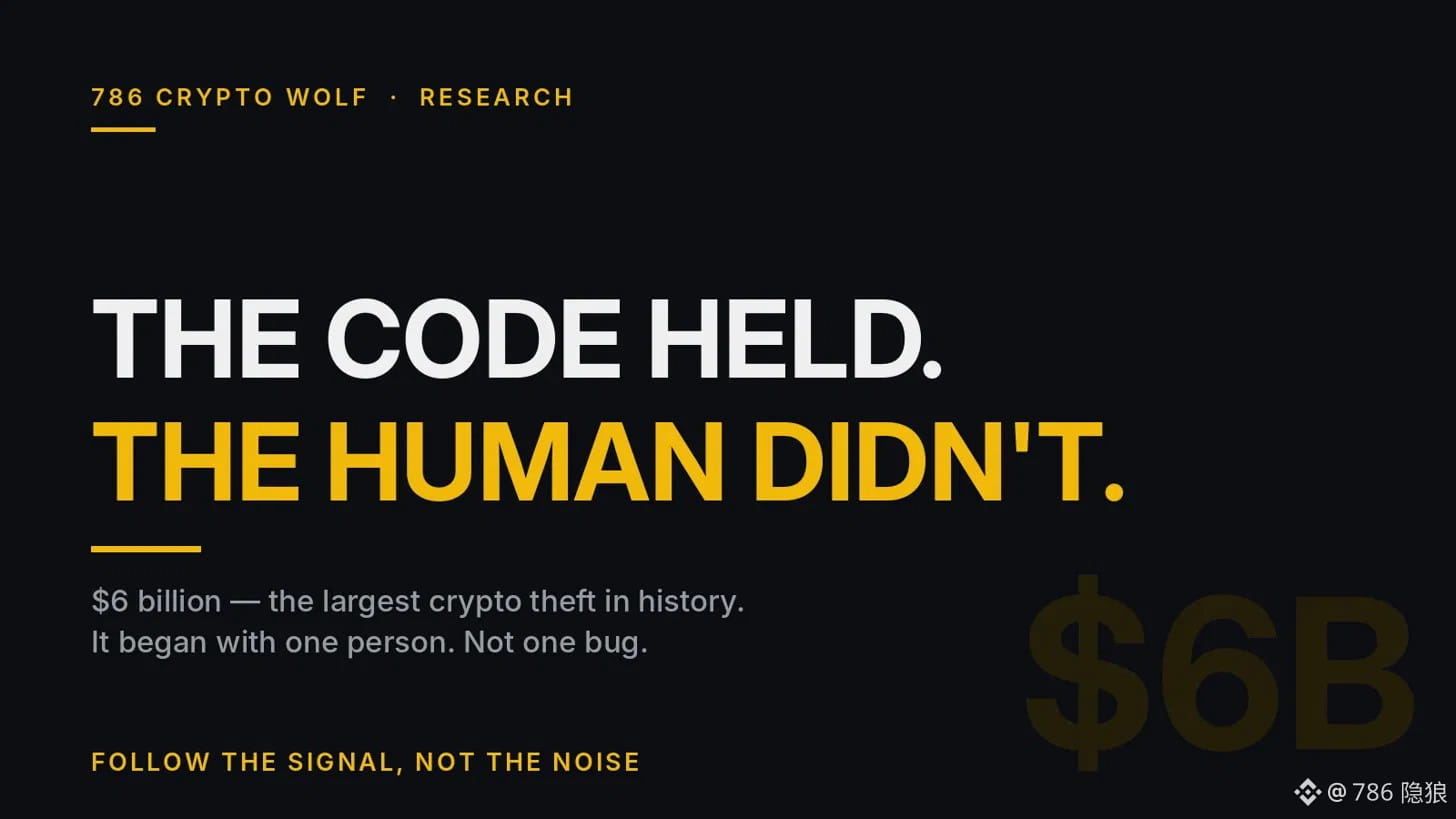
Last week, more than $6 billion walked out of Binance anyway — the largest crypto theft in history.
The code held. The human didn’t.
The FBI traced it to North Korea’s TraderTraitor group. The entry point wasn’t a flaw in the blockchain or a crack in the cryptography. It reportedly began with a single compromised laptop — one person, socially engineered.
Here’s what most people are missing while they check if their funds are safe:
The most fortified exchange on earth fell through the same door that drains ordinary users every day — a human manipulated into trusting the wrong message.
I’ve seen that door up close. A fake “support” account once walked me through a “fix.” Same technique. Different zeros.
Even now, fake “$150 compensation” tasks are circulating — riding this very hack. That’s the door.
Cryptography protects your keys. It doesn’t protect your attention.
No security engineering saves you in the moment your own judgment is hijacked. The strongest wall still has a human gate — and attackers have stopped attacking walls.
𝑺𝒐 𝒕𝒉𝒆 𝒓𝒆𝒂𝒍 𝒒𝒖𝒆𝒔𝒕𝒊𝒐𝒏 𝒊𝒔𝒏’𝒕 “𝒊𝒔 𝒎𝒚 𝒆𝒙𝒄𝒉𝒂𝒏𝒈𝒆 𝒔𝒂𝒇𝒆?”
It’s: when the next message arrives looking exactly like help — are you?
$BNB #Binance #CryptoSecurity #786CryptoWolf
𝑭𝒐𝒍𝒍𝒐𝒘 𝒕𝒉𝒆 𝒔𝒊𝒈𝒏𝒂𝒍, 𝒏𝒐𝒕 𝒕𝒉𝒆 𝒏𝒐𝒊𝒔𝒆. 🐺
بنت المغرب:
yes reel
4
1
372
Log in to explore more content
Join global crypto users on Binance Square
⚡️ Get latest and useful information about crypto.
💬 Trusted by the world’s largest crypto exchange.
👍 Discover real insights from verified creators.
Email / Phone number
Trending Topics
1
#NvidiaInvestigatesAfterHuang’sAffairApology
27,176 views
352 Discussing
2
#BitcoinFiveWeeklyLosses
42,637 views
784 Discussing
3
#AIChipSlumpNasdaq
23,985 views
440 Discussing
4
#SouthKoreaSupremeCourtClarifiesVirtualAssetSeizureRules
84 views
9 Discussing
5
#EthereumSpotETFsPost$365MWeeklyOutflow
1,066 views
33 Discussing
6
#TradFiForBeginners
264,966 views
2,358 Discussing
7
#GalxeToIntegrateIntoGravityGraduallyCloseQuest
157 views
24 Discussing
8
#KeplrAdvisesSocialLoginUsersToTransferAssets
91,603 views
685 Discussing
9
#TetherPlans€28.8MForJuventusCapitalIncrease
61,167 views
499 Discussing
10
#JobsReportRaisesHikeOdds
1M views
4,696 Discussing