
Infinite Zero
24 Posts

Infinite Zero
Report
Block User
better better Best
Open Trade

LTC Holder
Frequent Trader
2.1 Years
0 Following
0 Followers
0 Liked
Posts
Portfolio
All
Videos
$BTC is at $77,169, down 0.89%, and $ETH sits at $2,269, down 0.72%.
✅ Last quiz answer: A. 2009, The genesis block was mined in January 2009.
🧠 Crypto Quiz
A stop-loss is used to...
A. Limit losses
B. Increase leverage
C. Avoid fees
I always set a stop-loss just to keep my downside in check 🤔
What's your go-to stop-loss strategy? 😏
#CryptoQuiz #LearnCrypto
✅ Last quiz answer: A. 2009, The genesis block was mined in January 2009.
🧠 Crypto Quiz
A stop-loss is used to...
A. Limit losses
B. Increase leverage
C. Avoid fees
I always set a stop-loss just to keep my downside in check 🤔
What's your go-to stop-loss strategy? 😏
#CryptoQuiz #LearnCrypto
66
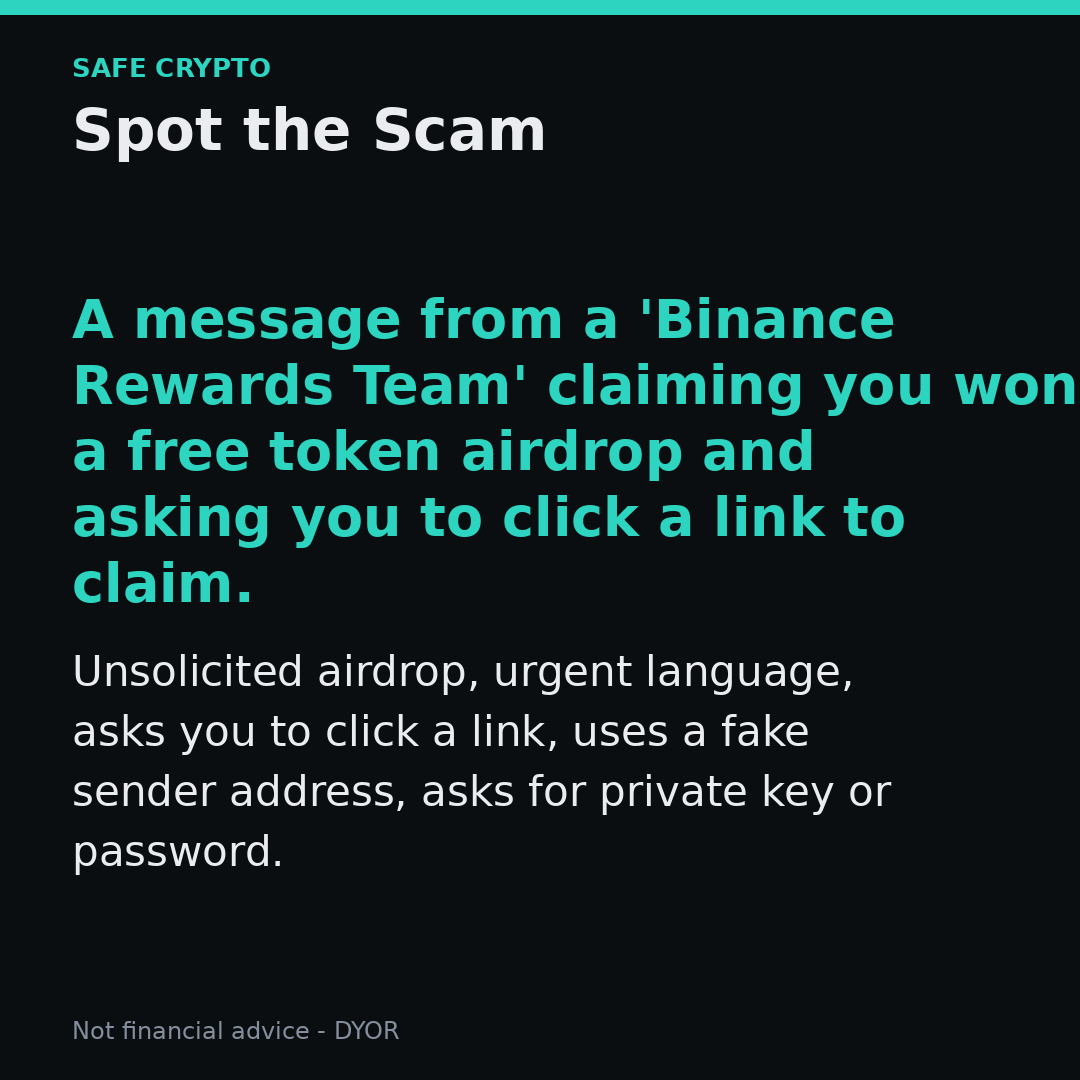
🚨 Ugh, another fake Binance Rewards DM, feels like they're testing how fast we click.
Red flags: unsolicited airdrop, urgent language, link to click, fake sender, asks for private key or password.
$BTC $76,522 down 2.33%
$ETH $2,251 down 2.16%
Ever gotten one of these? Which part scares you most?
#ScamAlert #CryptoSafety
Red flags: unsolicited airdrop, urgent language, link to click, fake sender, asks for private key or password.
$BTC $76,522 down 2.33%
$ETH $2,251 down 2.16%
Ever gotten one of these? Which part scares you most?
#ScamAlert #CryptoSafety
🕵️ I've heard the claim that Bitcoin is completely anonymous. That's a myth. In reality it's pseudonymous, every transaction lives on the blockchain forever and many addresses can be traced back to real people. Right now $BTC sits at $76,497 down 2.31% and $BNB at $694.10 down 2.17%. I was surprised how often a simple address link reveals an exchange account. Did you think it was fully private or already knew the truth?
#MythVsFact #Crypto
#MythVsFact #Crypto
85
Article
How to Spot a Fake Wallet App and Keep Your Coins SafeScams get louder when markets wobble. Yesterday $BTC dropped 2.31% and $ETH slipped 2.05%, and I've seen a surge in fake wallet downloads promising "instant protection." I've been burned before, so I'm sharing the exact steps I use to stay out of the trap.
Fake App Red Flags
A counterfeit wallet will mimic the real UI down to the logo, but the download source is usually a third-party site or an obscure app store. If the rating is empty or the developer name looks like a random string, walk away. The real $BTC, $ETH, $BNB, and SOL apps are only on official stores.
Message Tricks
Scammers often send a message that says "Your $BTC balance is at risk, click here to secure it." They attach a link that looks like a login page but the URL has extra characters or a misspelling. Remember: legitimate services never ask for your private key.
What the Fear & Greed Index Tells Us
Today the index sits at 26, deep in fear territory. When fear spikes, social engineering attacks rise because people are more anxious and less likely to double-check. Use that as a mental cue to be extra skeptical.
Protective Habits
- Always verify the app's publisher before installing.
- Enable two-factor authentication on every exchange and wallet.
- Keep your recovery phrase offline, never type it into a website.
- Use a hardware wallet for amounts larger than a few hundred dollars.
Quick Checklist
1. Is the app from the official store?
2. Does the developer name match the official team?
3. Is the URL exactly the official domain?
4. Have you enabled 2FA?
5. Is your seed phrase stored offline?
I've survived a few close calls by following this list, and it's saved me from losing thousands. What other tricks have you seen?
Not financial advice.
#CryptoSecurity #Phishing #SafetyFirst #CryptoTips
How to Spot a Fake Wallet App and Keep Your Coins Safe
Scams get louder when markets wobble. Yesterday $BTC dropped 2.31% and $ETH slipped 2.05%, and I've seen a surge in fake wallet downloads promising "instant protection." I've been burned before, so I'm sharing the exact steps I use to stay out of the trap.
Fake App Red Flags
A counterfeit wallet will mimic the real UI down to the logo, but the download source is usually a third-party site or an obscure app store. If the rating is empty or the developer name looks like a random string, walk away. The real $BTC , $ETH , $BNB , and SOL apps are only on official stores.
Message Tricks
Scammers often send a message that says "Your $BTC balance is at risk, click here to secure it." They attach a link that looks like a login page but the URL has extra characters or a misspelling. Remember: legitimate services never ask for your private key.
What the Fear & Greed Index Tells Us
Today the index sits at 26, deep in fear territory. When fear spikes, social engineering attacks rise because people are more anxious and less likely to double-check. Use that as a mental cue to be extra skeptical.
Protective Habits
- Always verify the app's publisher before installing.
- Enable two-factor authentication on every exchange and wallet.
- Keep your recovery phrase offline, never type it into a website.
- Use a hardware wallet for amounts larger than a few hundred dollars.
Quick Checklist
1. Is the app from the official store?
2. Does the developer name match the official team?
3. Is the URL exactly the official domain?
4. Have you enabled 2FA?
5. Is your seed phrase stored offline?
I've survived a few close calls by following this list, and it's saved me from losing thousands. What other tricks have you seen?
Not financial advice.
#CryptoSecurity #Phishing #SafetyFirst #CryptoTips
117
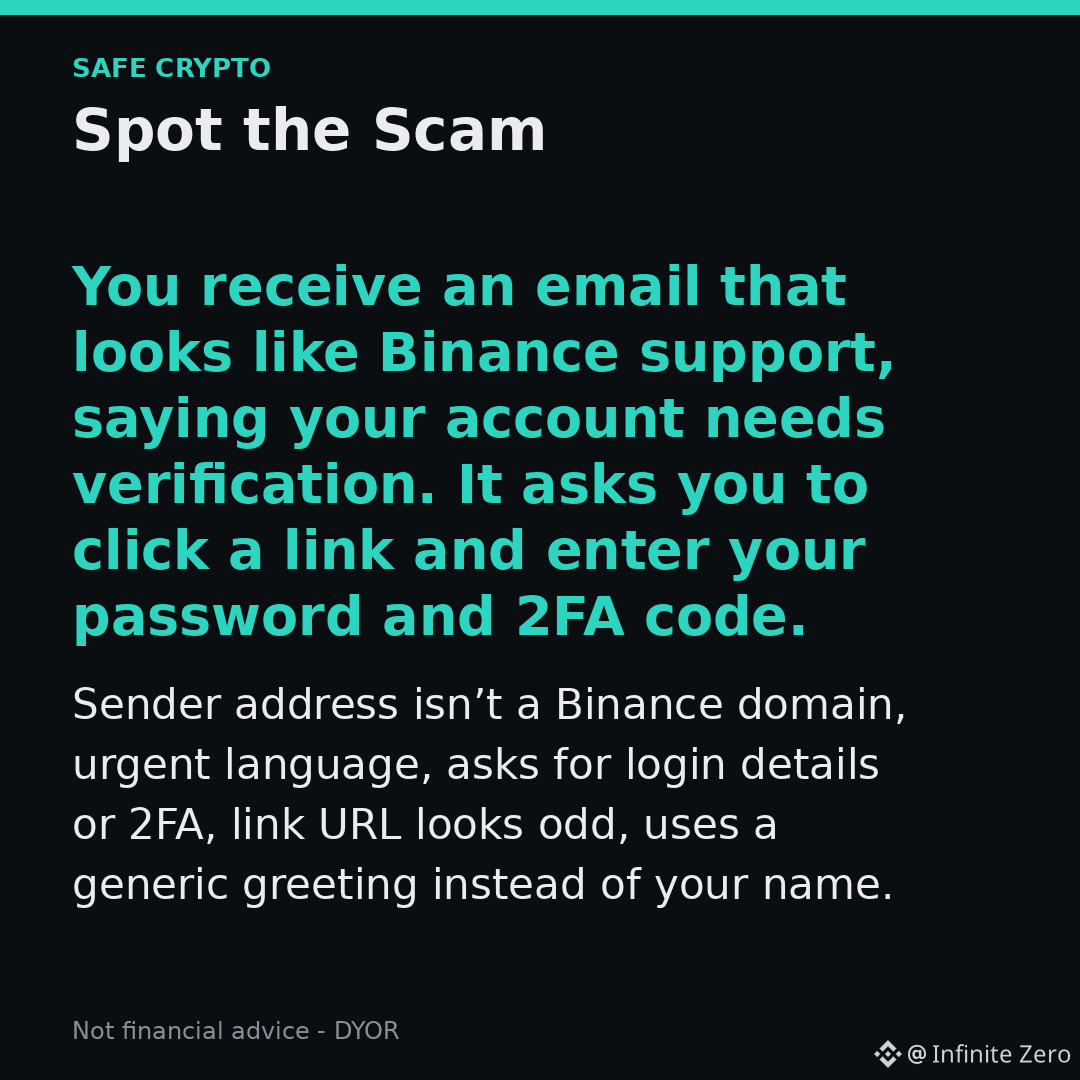
I keep seeing these fake Binance emails pop up in my inbox, so I thought I'd remind everyone what to watch for. They'll claim your account needs verification, push a "click here" link and ask for your password and 2FA code.
Red flags are the sender not using a Binance domain, urgent wording, a generic greeting, a weird link URL and any request for login details or 2FA.
Right now $BTC $78,220 (0.00%) and $ETH $2,295 (up 0.93%). Have you ever gotten something like this?
#ScamAlert #CryptoSafety
Red flags are the sender not using a Binance domain, urgent wording, a generic greeting, a weird link URL and any request for login details or 2FA.
Right now $BTC $78,220 (0.00%) and $ETH $2,295 (up 0.93%). Have you ever gotten something like this?
#ScamAlert #CryptoSafety
87
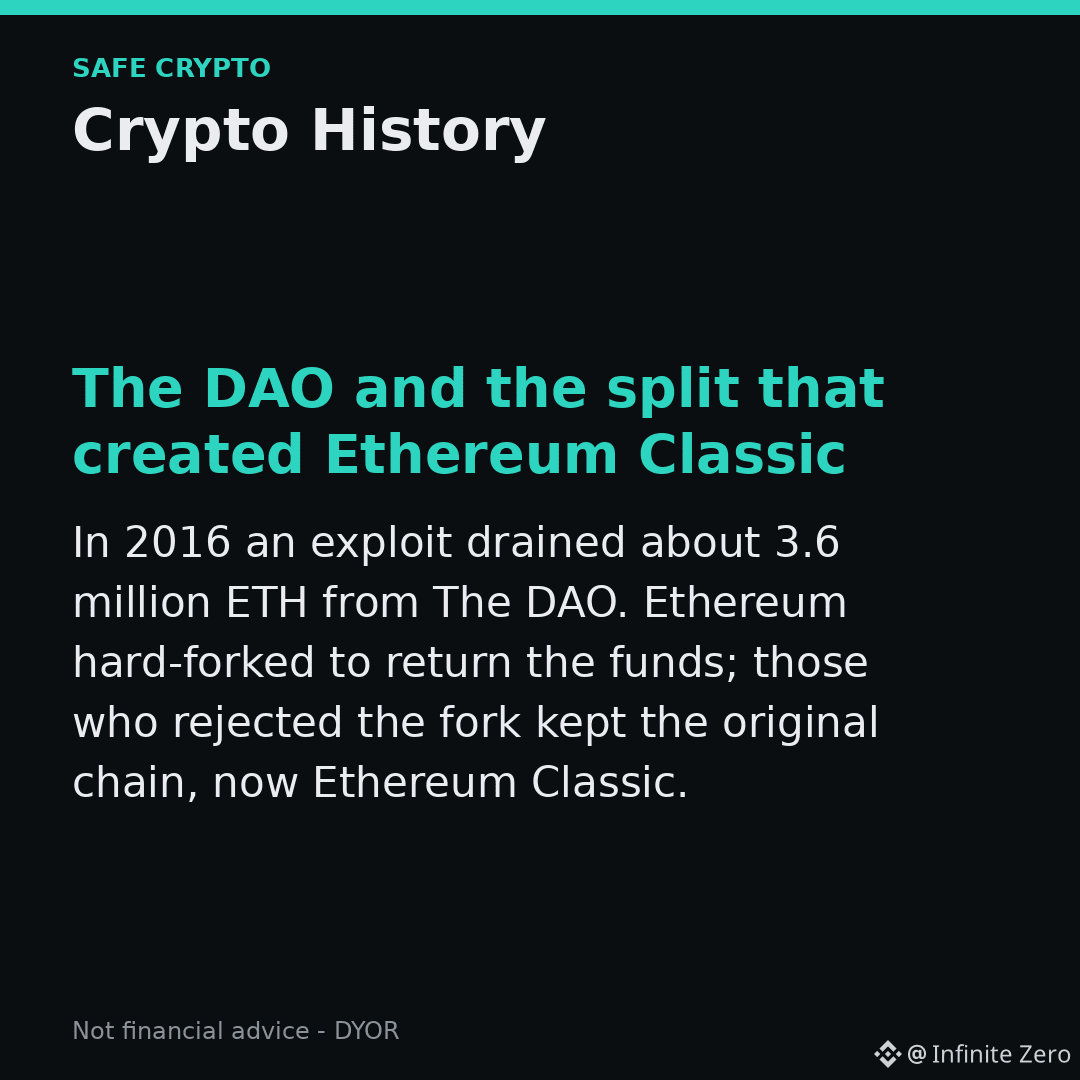
just read up on that 2016 DAO hack, about 3.6 million ETH vanished. the community split, hard-forked to return the funds, while the dissenters kept the original chain as Ethereum Classic. 🤔
now $BTC $78,392 up 0.73% and $BNB $710.96 up 0.80%. what do you think about that split?
#CryptoHistory #Bitcoin
now $BTC $78,392 up 0.73% and $BNB $710.96 up 0.80%. what do you think about that split?
#CryptoHistory #Bitcoin
84
$BTC $78,458 up 0.92% while $SOL $95.01 down 0.50%. Last quiz answer: A. Write it on paper and store it in a safe., Paper and a safe keep the key offline, away from hackers.
Crypto Quiz
Bitcoin's genesis block was mined in...
A. 2009
B. 2013
C. 2015
Answer in the comments, no googling. The answer comes with the next quiz. When do you think the genesis block was mined?
#CryptoQuiz #LearnCrypto
Crypto Quiz
Bitcoin's genesis block was mined in...
A. 2009
B. 2013
C. 2015
Answer in the comments, no googling. The answer comes with the next quiz. When do you think the genesis block was mined?
#CryptoQuiz #LearnCrypto
1
105
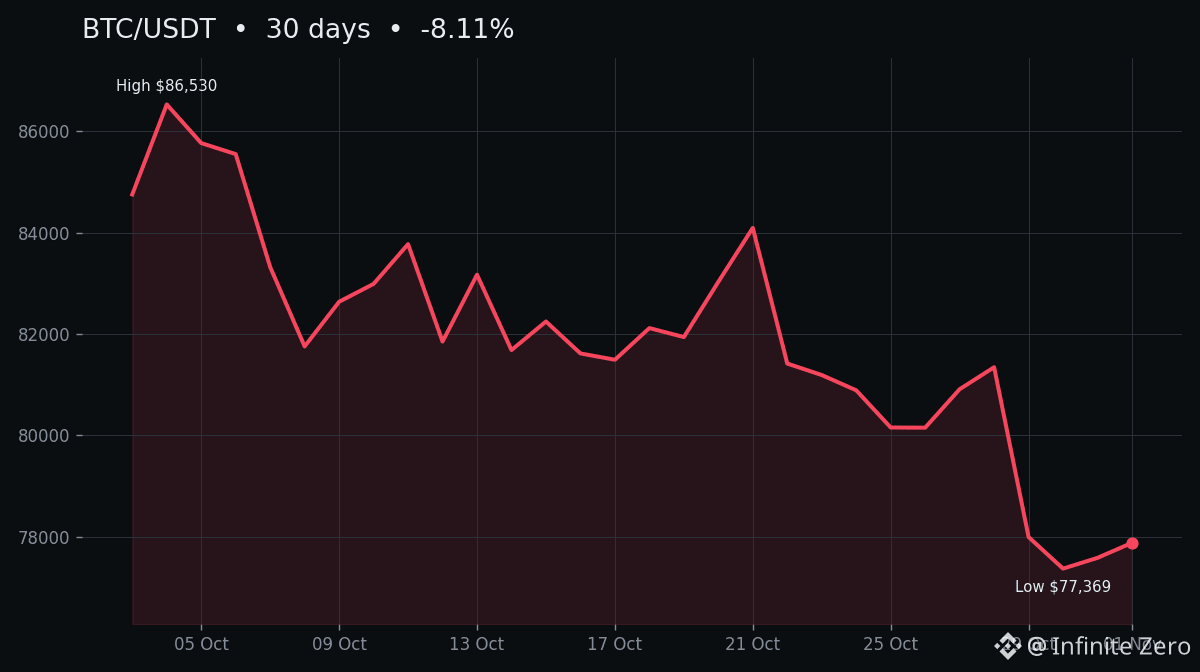
Looks like $BTC fell 8.11% over the last 30 days. High hit $86,530, low $77,369, and it's trading near $77,878 now.
I'm trying to spot the nearest support. Where would you place it?
Not a buy/sell signal. Do your own research.
#BTC #Chart
Looks like $BTC fell 8.11% over the last 30 days. High hit $86,530, low $77,369, and it's trading near $77,878 now.
I'm trying to spot the nearest support. Where would you place it?
Not a buy/sell signal. Do your own research.
#BTC #Chart
I'm trying to spot the nearest support. Where would you place it?
Not a buy/sell signal. Do your own research.
#BTC #Chart
78
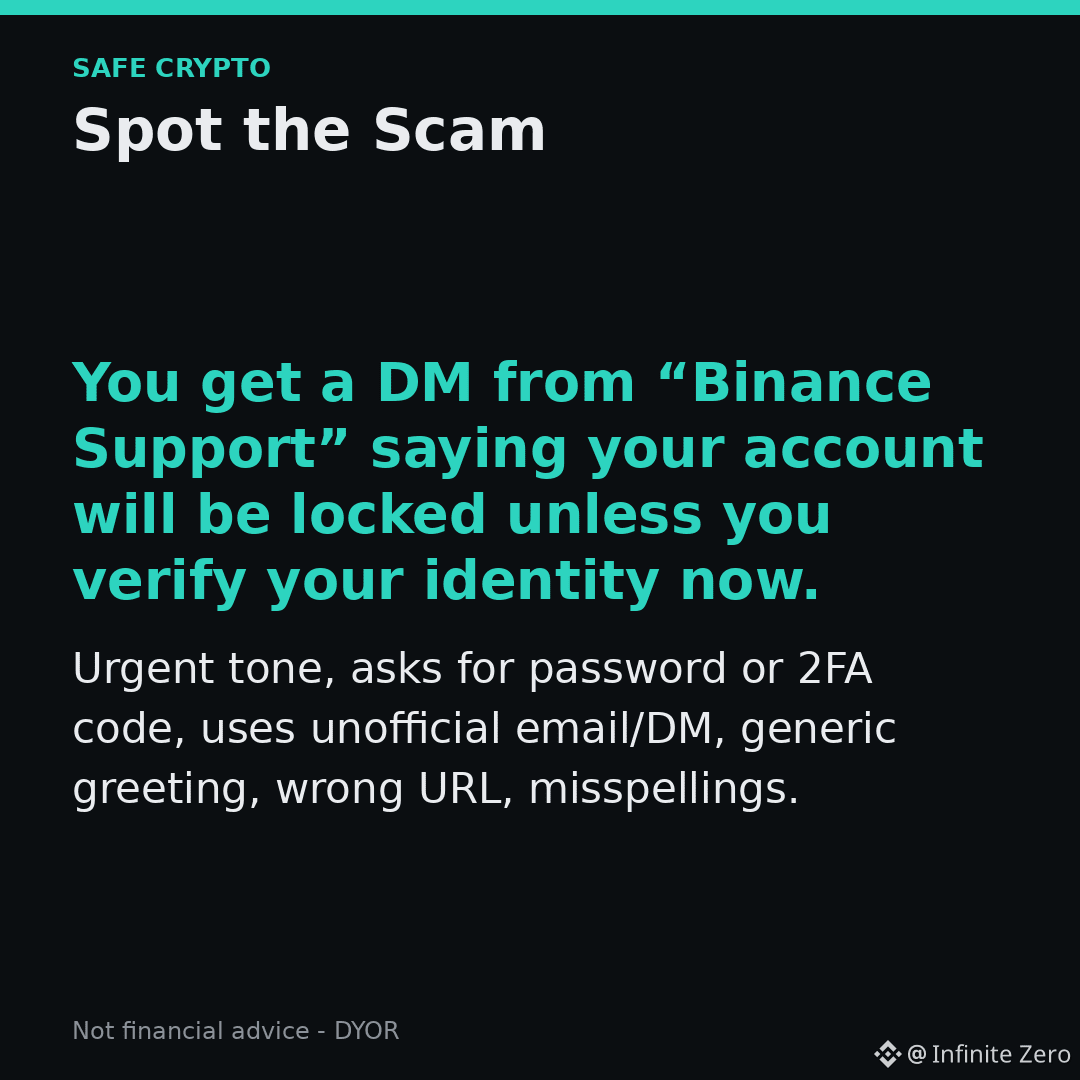
I just got a DM that made my skin crawl, someone pretended to be Binance Support and warned my account would be locked unless I verified now.
⚠️ red flags: urgent tone, asks for password or 2FA code, uses an unofficial DM, generic greeting, wrong URL, misspellings.
$BTC $78,107 (+0.84%) and $ETH $2,271 (+1.14%) are steady, but these scams keep popping up. Has anyone seen the same thing?
#ScamAlert #CryptoSafety
⚠️ red flags: urgent tone, asks for password or 2FA code, uses an unofficial DM, generic greeting, wrong URL, misspellings.
$BTC $78,107 (+0.84%) and $ETH $2,271 (+1.14%) are steady, but these scams keep popping up. Has anyone seen the same thing?
#ScamAlert #CryptoSafety
89
Looks like a rough week for the big guys.
$BTC down 2.71% → $77,981
$ETH down 2.49% → $2,272
$BNB down 4.39% → $706.29
SOL down 5.42% → $95.90
ETH held up the best among them. How did your week end - profit, break-even, or rekt?
#WeeklyRecap #Crypto
Looks like a rough week for the big guys.
$BTC down 2.71% → $77,981
$ETH down 2.49% → $2,272
$BNB down 4.39% → $706.29
SOL down 5.42% → $95.90
ETH held up the best among them. How did your week end - profit, break-even, or rekt?
#WeeklyRecap #Crypto
$BTC down 2.71% → $77,981
$ETH down 2.49% → $2,272
$BNB down 4.39% → $706.29
SOL down 5.42% → $95.90
ETH held up the best among them. How did your week end - profit, break-even, or rekt?
#WeeklyRecap #Crypto
59
Last quiz answer: B. Market order - fills instantly, but can slip.
Crypto Quiz: Best way to keep your private key safe?
A. Write it on paper and store it in a safe.
B. Save it in a cloud note app.
C. Post it on a public forum.
Market side: $BTC $77,730 up 0.36% and $BNB $702.51 down 0.46%. How would you store yours?
#CryptoQuiz #LearnCrypto
Crypto Quiz: Best way to keep your private key safe?
A. Write it on paper and store it in a safe.
B. Save it in a cloud note app.
C. Post it on a public forum.
Market side: $BTC $77,730 up 0.36% and $BNB $702.51 down 0.46%. How would you store yours?
#CryptoQuiz #LearnCrypto
76
Article
Crypto Phishing Scams: How to Spot the Bait and Keep Your Wallet SafeThe market is trembling under a Fear index of 30, and that nervous energy makes scammers bolder than ever. I've seen friends lose $BTC and $ETH because a single click felt harmless. Let's turn that fear into a clear set of actions you can take right now.
What the Scam Looks Like
A fake app or website promises "instant $BTC earnings" or "secure $ETH storage." The design mirrors official wallets, and the URL may contain a tiny typo. Once you enter your seed phrase, the thief walks away with your funds. I once opened an "$SOL wallet" that asked for my private key, the moment I typed it, the balance vanished.
Red Flags to Watch
- The site asks for your seed phrase, private key, or password. Legitimate services never do.
- URLs that end in .net.info, or have extra characters like "wallet-secure.com-login."
- Promises of guaranteed returns, especially when the market shows a 24h +0.31% move for $BTC and a 24h +0.68% rise for $ETH, real assets are volatile, not certain.
- Poor grammar or rushed language. Scammers rely on urgency, not professionalism.
How to Protect Yourself
1. Bookmark the official wallet page and use that link every time.
2. Enable two-factor authentication on every exchange and wallet that offers it.
3. Keep your seed phrase offline, write it on paper and store it in a safe place.
4. Verify the app's publisher on the official app store; don't download from third-party links.
Quick Checklist
- [ ] Did I enter my seed phrase on a site that asked for it?
- [ ] Is the URL exactly what I expect, with no extra characters?
- [ ] Have I enabled 2FA on the platform?
- [ ] Is the claim of guaranteed profit realistic given the current market volatility?
What's the most convincing phishing message you've ever received, and how did you handle it?
Not financial advice
#crypto #security #phishing #wallets
Crypto Phishing Scams: How to Spot the Bait and Keep Your Wallet Safe
The market is trembling under a Fear index of 30, and that nervous energy makes scammers bolder than ever. I've seen friends lose $BTC and $ETH because a single click felt harmless. Let's turn that fear into a clear set of actions you can take right now.
What the Scam Looks Like
A fake app or website promises "instant $BTC earnings" or "secure $ETH storage." The design mirrors official wallets, and the URL may contain a tiny typo. Once you enter your seed phrase, the thief walks away with your funds. I once opened an "$SOL wallet" that asked for my private key, the moment I typed it, the balance vanished.
Red Flags to Watch
- The site asks for your seed phrase, private key, or password. Legitimate services never do.
- URLs that end in .net.info, or have extra characters like "wallet-secure.com-login."
- Promises of guaranteed returns, especially when the market shows a 24h +0.31% move for $BTC and a 24h +0.68% rise for $ETH , real assets are volatile, not certain.
- Poor grammar or rushed language. Scammers rely on urgency, not professionalism.
How to Protect Yourself
1. Bookmark the official wallet page and use that link every time.
2. Enable two-factor authentication on every exchange and wallet that offers it.
3. Keep your seed phrase offline, write it on paper and store it in a safe place.
4. Verify the app's publisher on the official app store; don't download from third-party links.
Quick Checklist
- [ ] Did I enter my seed phrase on a site that asked for it?
- [ ] Is the URL exactly what I expect, with no extra characters?
- [ ] Have I enabled 2FA on the platform?
- [ ] Is the claim of guaranteed profit realistic given the current market volatility?
What's the most convincing phishing message you've ever received, and how did you handle it?
Not financial advice
#crypto #security #phishing #wallets
88
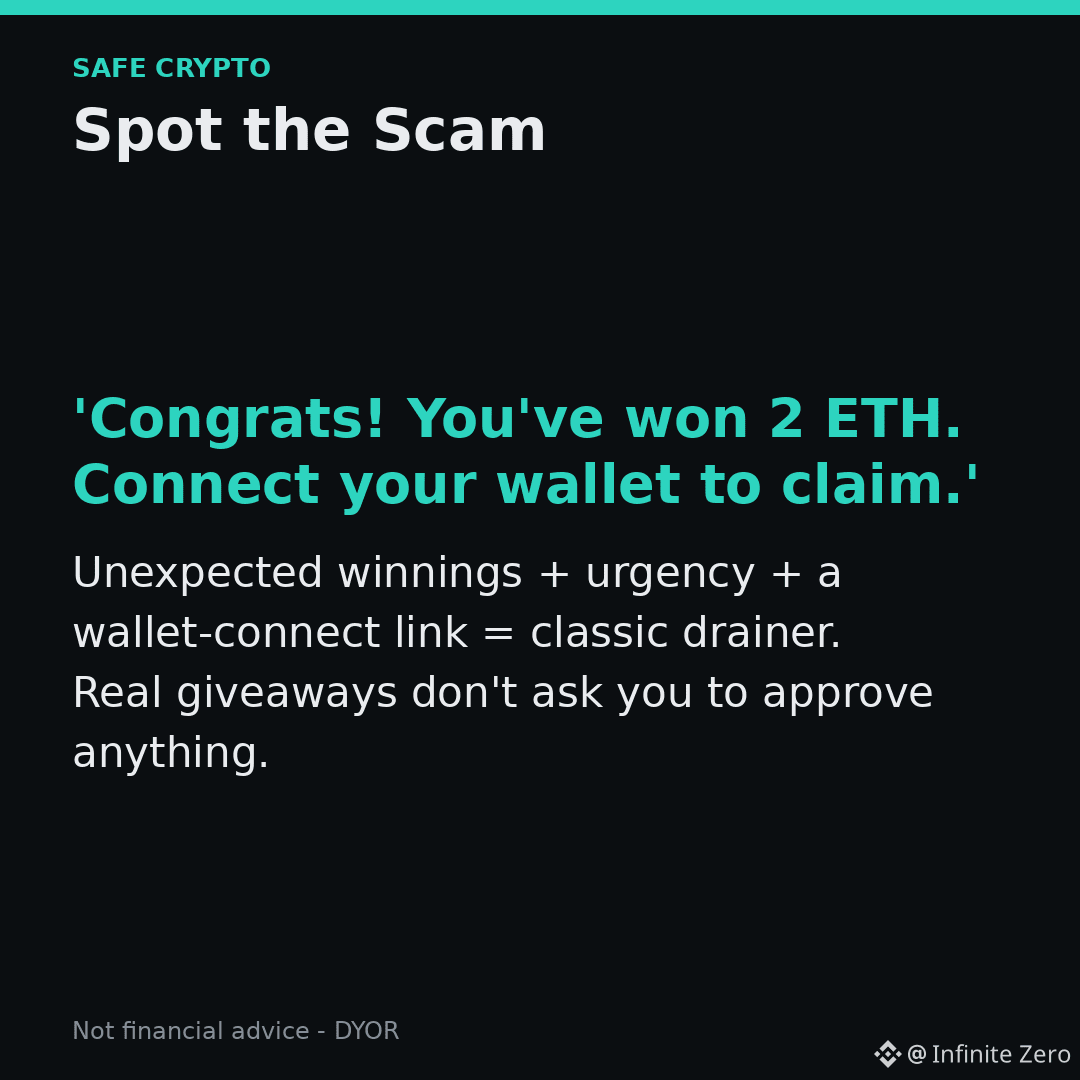
Just saw that message again, "Congrats! You've won 2 ETH. Connect your wallet to claim." It screams scam: unexpected prize, urgency and a wallet-connect link. Real giveaways never ask you to approve anything.
I'm always scanning my DMs for this kind of thing. For context, $BTC $77,336 down 0.80% and $BNB $700.14 down 0.76%.
What weird offers have you spotted lately?
#ScamAlert #CryptoSafety
I'm always scanning my DMs for this kind of thing. For context, $BTC $77,336 down 0.80% and $BNB $700.14 down 0.76%.
What weird offers have you spotted lately?
#ScamAlert #CryptoSafety
293
Down 8.49% over the past month, $BNB slipped from a high of $795.43 • Low $698.46 • Now $703.04.
I'm watching the swing and wondering if we're seeing a fresh bullish move, a bearish pull, or just a sideways pause. One word in the comments below.
NFA, always DYOR.
#BNB #Chart
Down 8.49% over the past month, $BNB slipped from a high of $795.43 • Low $698.46 • Now $703.04.
I'm watching the swing and wondering if we're seeing a fresh bullish move, a bearish pull, or just a sideways pause. One word in the comments below.
NFA, always DYOR.
#BNB #Chart
I'm watching the swing and wondering if we're seeing a fresh bullish move, a bearish pull, or just a sideways pause. One word in the comments below.
NFA, always DYOR.
#BNB #Chart
82
Honestly, that question feels too easy. 🧠 An order that fills instantly at market price is a...
A. Limit order
B. Market order
C. Stop order
By the way, $BTC $77,536 (-3.16%) and $SOL $96.76 (-3.61%). Which one do you pick?
#CryptoQuiz #LearnCrypto
Honestly, that question feels too easy. 🧠 An order that fills instantly at market price is a...
A. Limit order
B. Market order
C. Stop order
By the way, $BTC $77,536 (-3.16%) and $SOL $96.76 (-3.61%). Which one do you pick?
#CryptoQuiz #LearnCrypto
A. Limit order
B. Market order
C. Stop order
By the way, $BTC $77,536 (-3.16%) and $SOL $96.76 (-3.61%). Which one do you pick?
#CryptoQuiz #LearnCrypto

57
just checked $ETH, it's at $2,224 right now.
which level will hit first?
🅰️ $2,325
🅱️ $2,125
reply A or B with a one-line reason, I'll post the results in the next poll 😄
what do you think?
#ETH #Poll
just checked $ETH , it's at $2,224 right now.
which level will hit first?
🅰️ $2,325
🅱️ $2,125
reply A or B with a one-line reason, I'll post the results in the next poll 😄
what do you think?
#ETH #Poll
which level will hit first?
🅰️ $2,325
🅱️ $2,125
reply A or B with a one-line reason, I'll post the results in the next poll 😄
what do you think?
#ETH #Poll
57
Seeing $SOL dip made me pause and check the chart.
$SOL is down 17.27% over the last 30 days, now at $97.96 after a high of $121.60 and a low of $95.64.
Where is the nearest support in your view? Drop a number 👇
Not financial advice. DYOR 🙏
#SOL #Chart
Seeing $SOL dip made me pause and check the chart.
$SOL is down 17.27% over the last 30 days, now at $97.96 after a high of $121.60 and a low of $95.64.
Where is the nearest support in your view? Drop a number 👇
Not financial advice. DYOR 🙏
#SOL #Chart
$SOL is down 17.27% over the last 30 days, now at $97.96 after a high of $121.60 and a low of $95.64.
Where is the nearest support in your view? Drop a number 👇
Not financial advice. DYOR 🙏
#SOL #Chart
104
Just a quick heads up, I'm watching $BTC $77,398 (-3.23%) and $SOL $95.47 (-4.62%) right now.
🔐 Simple safety steps: 1) hardware wallet for big sums. 2) write your seed on paper, not phone. 3) keep that paper safe from fire. 4) never share the seed.
What habit will you add today?
#CryptoTips #BinanceSquare
🔐 Simple safety steps: 1) hardware wallet for big sums. 2) write your seed on paper, not phone. 3) keep that paper safe from fire. 4) never share the seed.
What habit will you add today?
#CryptoTips #BinanceSquare
140
🔍 Let’s clear up a common worry about blockchain privacy.
❌ Myth: Crypto transactions are anonymous and untraceable
✅ Fact: Every transaction lives on a public ledger. With the right tools you can trace the flow, even though addresses don’t reveal your name.
📊 Today’s prices
$BTC $80,426 (-0.11%)
$ETH $2,329 (+0.07%)
🛡️ As your security coach, I suggest a simple checklist: use a new address for each transfer, consider mixing coins when needed, and keep on‑chain activity separate from personal info. What privacy steps do you include in your crypto routine?
#MythVsFact #Crypto
67
Log in to explore more content
Join global crypto users on Binance Square
⚡️ Get latest and useful information about crypto.
💬 Trusted by the world’s largest crypto exchange.
👍 Discover real insights from verified creators.
Email / Phone number
Trending Topics
BinanceIncidentReport
18,487 views
405 Discussing
29 October 2026 Binance Security Incident: Initial Findings and Response Update
Binance Blog
·221 Likes
·598.3k views
BinanceReopensWithdrawalsForMoreAssets
120,391 views
1,648 Discussing
BinanceHourlyDepositsExceedWithdrawals
57,978 views
748 Discussing