

Millie Smitte
39 Posts

Millie Smitte
Report
Block User
Binance square# square creator
12 Following
7 Followers
68 Liked
Posts
PINNED
Verified
I've been seeing people talk about Babylon's Fast Unstaking, and almost every discussion seemed to treat it as a shortcut for bypassing Bitcoin's security. That didn't sound right, so I spent some time reading through @babylonlabs_io documentation to understand what "fast" actually means.
The misconception is easy to make.
When people hear "Fast unstaking," they often imagine that Bitcoin's security rules are somehow being skipped. After digging deeper, I realized that's not the design at all.
Babylon separates economic liquidity from Bitcoin settlement. Instead of changing how Bitcoin itself works, Fast unstaking is designed to let eligible users regain usable liquidity sooner while the underlying Bitcoin security process continues to be respected. In other words, it's not about weakening Bitcoin's finality—it's about improving the user experience around waiting.
That difference completely changed how I looked at it. The goal isn't to make Bitcoin settle faster. The goal is to reduce the practical friction of participating in Bitcoin staking without asking users to compromise on self-custody or trust assumptions.
Another detail that caught my attention was the ecosystem's scale. Babylon now secures more than 56,800 BTC in its staking ecosystem, representing billions of dollars in self-custodied Bitcoin. That level of participation suggests many users value infrastructure that improves usability without fundamentally changing Bitcoin's security model.
I went into this assuming Fast unstaking was simply a convenience feature. After researching it, I think it's better understood as an attempt to solve a user experience problem while keeping Bitcoin's security guarantees intact—a much more nuanced objective than the name initially suggests.
#baby How should Bitcoin infrastructure balance convenience with preserving the security properties that make Bitcoin valuable in the first place?
@babylonlabs_io $BABY #baby
I've been seeing people talk about Babylon's Fast Unstaking, and almost every discussion seemed to treat it as a shortcut for bypassing Bitcoin's security. That didn't sound right, so I spent some time reading through @BabylonLabs_io documentation to understand what "fast" actually means.
The misconception is easy to make.
When people hear "Fast unstaking," they often imagine that Bitcoin's security rules are somehow being skipped. After digging deeper, I realized that's not the design at all.
Babylon separates economic liquidity from Bitcoin settlement. Instead of changing how Bitcoin itself works, Fast unstaking is designed to let eligible users regain usable liquidity sooner while the underlying Bitcoin security process continues to be respected. In other words, it's not about weakening Bitcoin's finality—it's about improving the user experience around waiting.
That difference completely changed how I looked at it. The goal isn't to make Bitcoin settle faster. The goal is to reduce the practical friction of participating in Bitcoin staking without asking users to compromise on self-custody or trust assumptions.
Another detail that caught my attention was the ecosystem's scale. Babylon now secures more than 56,800 BTC in its staking ecosystem, representing billions of dollars in self-custodied Bitcoin. That level of participation suggests many users value infrastructure that improves usability without fundamentally changing Bitcoin's security model.
I went into this assuming Fast unstaking was simply a convenience feature. After researching it, I think it's better understood as an attempt to solve a user experience problem while keeping Bitcoin's security guarantees intact—a much more nuanced objective than the name initially suggests.
#baby How should Bitcoin infrastructure balance convenience with preserving the security properties that make Bitcoin valuable in the first place?
@BabylonLabs_io $BABY #baby
The misconception is easy to make.
When people hear "Fast unstaking," they often imagine that Bitcoin's security rules are somehow being skipped. After digging deeper, I realized that's not the design at all.
Babylon separates economic liquidity from Bitcoin settlement. Instead of changing how Bitcoin itself works, Fast unstaking is designed to let eligible users regain usable liquidity sooner while the underlying Bitcoin security process continues to be respected. In other words, it's not about weakening Bitcoin's finality—it's about improving the user experience around waiting.
That difference completely changed how I looked at it. The goal isn't to make Bitcoin settle faster. The goal is to reduce the practical friction of participating in Bitcoin staking without asking users to compromise on self-custody or trust assumptions.
Another detail that caught my attention was the ecosystem's scale. Babylon now secures more than 56,800 BTC in its staking ecosystem, representing billions of dollars in self-custodied Bitcoin. That level of participation suggests many users value infrastructure that improves usability without fundamentally changing Bitcoin's security model.
I went into this assuming Fast unstaking was simply a convenience feature. After researching it, I think it's better understood as an attempt to solve a user experience problem while keeping Bitcoin's security guarantees intact—a much more nuanced objective than the name initially suggests.
#baby How should Bitcoin infrastructure balance convenience with preserving the security properties that make Bitcoin valuable in the first place?
@BabylonLabs_io $BABY #baby
A) Security should come first
0%
B) Better liquidity matters
0%
C) Both need equal priority
100%
D) It depends on the use case
0%
1 votes • Voting closed
2
125
The real test for trust-minimized infrastructure isn't during a bull market—it's when markets become volatile. That's when users discover whether they truly control their assets or whether they were relying on assumptions they never questioned.
The real test for trust-minimized infrastructure isn't during a bull market—it's when markets become volatile. That's when users discover whether they truly control their assets or whether they were relying on assumptions they never questioned.
1
68
Partly True
What are you doing with $MYX at current prices?
🚨 $MYX went from $0.046 ➜ $19.05 and is now trading back near its early accumulation zone.
{future}(MYXUSDT)
According to @Black Nova's trading data, accumulation has started again. Is this another opportunity, or just a dead-cat bounce?
💬 Share your reasoning in the comments.
#MYX #Crypto #Altcoins #Binance
What are you doing with $MYX at current prices?
🚨 $MYX went from $0.046 ➜ $19.05 and is now trading back near its early accumulation zone.
According to @Black Nova's trading data, accumulation has started again. Is this another opportunity, or just a dead-cat bounce?
💬 Share your reasoning in the comments.
#MYX #Crypto #Altcoins #Binance
🚨 $MYX went from $0.046 ➜ $19.05 and is now trading back near its early accumulation zone.
According to @Black Nova's trading data, accumulation has started again. Is this another opportunity, or just a dead-cat bounce?
💬 Share your reasoning in the comments.
#MYX #Crypto #Altcoins #Binance
🔘 Still accumulating
39%
🔘 Holding my bags
39%
🔘 Waiting for confirmation
17%
🔘 Already sold
5%
18 votes • Voting closed
1
1.1k
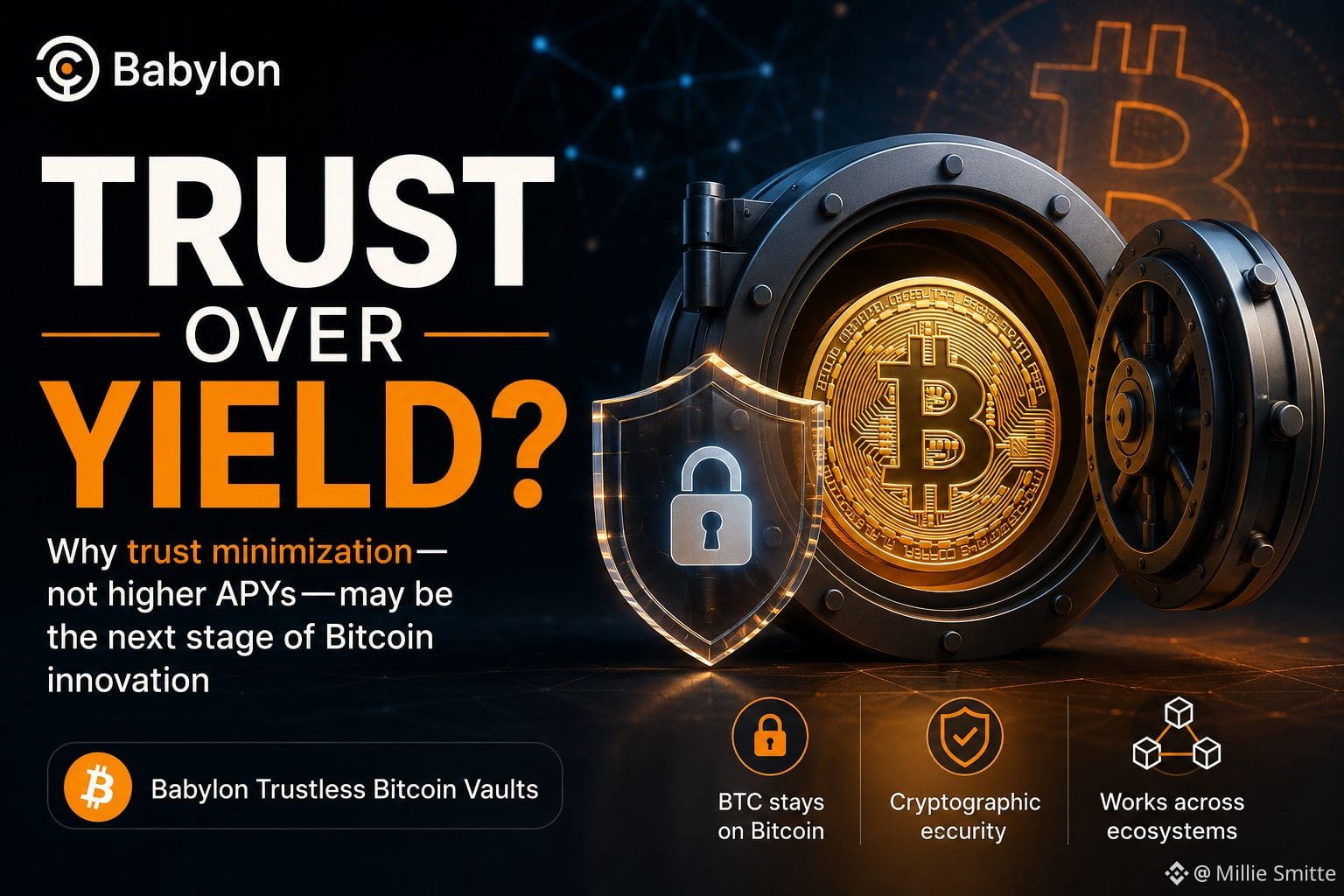
Most Bitcoin conversations eventually come back to yield. How much can I earn? Which platform pays more? But I think the more important question is: what do I have to trust to earn that yield?
Instead of asking users to hand their BTC to a custodian or rely on a wrapped version of Bitcoin, the idea is to keep native BTC locked on Bitcoin while cryptographic proofs coordinate how it can be used elsewhere. The goal is to reduce reliance on trusted intermediaries rather than simply create another higher-yield product.
A simple analogy is storing important documents. Most people would rather keep the originals in a personal safe and present verified copies only when needed, instead of giving the originals to someone else. Trust minimization follows the same mindset: reduce the number of parties that can make a mistake—or abuse your confidence.
Personally, I think this is where Bitcoin innovation may be heading. Bigger APYs can always attract attention, but trust assumptions often become visible only when markets are under stress.
If infrastructure allows Bitcoin holders to access broader financial applications without giving up control of their assets, that changes the conversation from chasing returns to managing risk more intelligently.
@babylonlabs_io $BABY #baby
Do you believe the next major Bitcoin breakthrough will come from reducing trust rather than increasing yield?
#baby $BABY
Most Bitcoin conversations eventually come back to yield. How much can I earn? Which platform pays more? But I think the more important question is: what do I have to trust to earn that yield?
Instead of asking users to hand their BTC to a custodian or rely on a wrapped version of Bitcoin, the idea is to keep native BTC locked on Bitcoin while cryptographic proofs coordinate how it can be used elsewhere. The goal is to reduce reliance on trusted intermediaries rather than simply create another higher-yield product.
A simple analogy is storing important documents. Most people would rather keep the originals in a personal safe and present verified copies only when needed, instead of giving the originals to someone else. Trust minimization follows the same mindset: reduce the number of parties that can make a mistake—or abuse your confidence.
Personally, I think this is where Bitcoin innovation may be heading. Bigger APYs can always attract attention, but trust assumptions often become visible only when markets are under stress.
If infrastructure allows Bitcoin holders to access broader financial applications without giving up control of their assets, that changes the conversation from chasing returns to managing risk more intelligently.
@BabylonLabs_io $BABY #baby
Do you believe the next major Bitcoin breakthrough will come from reducing trust rather than increasing yield?
#baby $BABY
Instead of asking users to hand their BTC to a custodian or rely on a wrapped version of Bitcoin, the idea is to keep native BTC locked on Bitcoin while cryptographic proofs coordinate how it can be used elsewhere. The goal is to reduce reliance on trusted intermediaries rather than simply create another higher-yield product.
A simple analogy is storing important documents. Most people would rather keep the originals in a personal safe and present verified copies only when needed, instead of giving the originals to someone else. Trust minimization follows the same mindset: reduce the number of parties that can make a mistake—or abuse your confidence.
Personally, I think this is where Bitcoin innovation may be heading. Bigger APYs can always attract attention, but trust assumptions often become visible only when markets are under stress.
If infrastructure allows Bitcoin holders to access broader financial applications without giving up control of their assets, that changes the conversation from chasing returns to managing risk more intelligently.
@BabylonLabs_io $BABY #baby
Do you believe the next major Bitcoin breakthrough will come from reducing trust rather than increasing yield?
#baby $BABY
1
125
TBV highlights an interesting design philosophy: make Bitcoin more useful by reducing trust assumptions instead of adding new intermediaries. Adoption will depend on execution, but the direction is worth watching.
TBV highlights an interesting design philosophy: make Bitcoin more useful by reducing trust assumptions instead of adding new intermediaries. Adoption will depend on execution, but the direction is worth watching.
1
40
Verified
South Korea's markets just reminded everyone how quickly fear can spread. After sharp declines in the KOSPI and KOSDAQ, the Korea Exchange activated a sell-side sidecar—a temporary measure that pauses certain automated sell orders to slow panic, not shut down the market.
The trigger came as heavy selling in technology and semiconductor stocks weighed on overall sentiment. While investors could still trade normally, the brief pause was designed to reduce extreme volatility and give the market time to stabilize.
For crypto traders, this matters because market sentiment often moves across asset classes. When risk appetite weakens in equities, Bitcoin and other digital assets can also face short-term pressure as investors become more cautious.
Watching traditional financial markets alongside crypto can provide valuable context for understanding broader investor behavior.
Do you think stock market volatility will spill over into crypto, or are digital assets becoming more independent?
#KRX #bitcoin #Trading #MarketSentimentToday
$SAMSUNG
$SKHYNIX
$SKYAI
{future}(SAMSUNGUSDT)
{future}(SKHYNIXUSDT)
{future}(SKYAIUSDT)
South Korea's markets just reminded everyone how quickly fear can spread. After sharp declines in the KOSPI and KOSDAQ, the Korea Exchange activated a sell-side sidecar—a temporary measure that pauses certain automated sell orders to slow panic, not shut down the market.
The trigger came as heavy selling in technology and semiconductor stocks weighed on overall sentiment. While investors could still trade normally, the brief pause was designed to reduce extreme volatility and give the market time to stabilize.
For crypto traders, this matters because market sentiment often moves across asset classes. When risk appetite weakens in equities, Bitcoin and other digital assets can also face short-term pressure as investors become more cautious.
Watching traditional financial markets alongside crypto can provide valuable context for understanding broader investor behavior.
Do you think stock market volatility will spill over into crypto, or are digital assets becoming more independent?
#KRX #bitcoin #Trading #MarketSentimentToday
$SAMSUNG
$SKHYNIX
$SKYAI
The trigger came as heavy selling in technology and semiconductor stocks weighed on overall sentiment. While investors could still trade normally, the brief pause was designed to reduce extreme volatility and give the market time to stabilize.
For crypto traders, this matters because market sentiment often moves across asset classes. When risk appetite weakens in equities, Bitcoin and other digital assets can also face short-term pressure as investors become more cautious.
Watching traditional financial markets alongside crypto can provide valuable context for understanding broader investor behavior.
Do you think stock market volatility will spill over into crypto, or are digital assets becoming more independent?
#KRX #bitcoin #Trading #MarketSentimentToday
$SAMSUNG
$SKHYNIX
$SKYAI

1
200
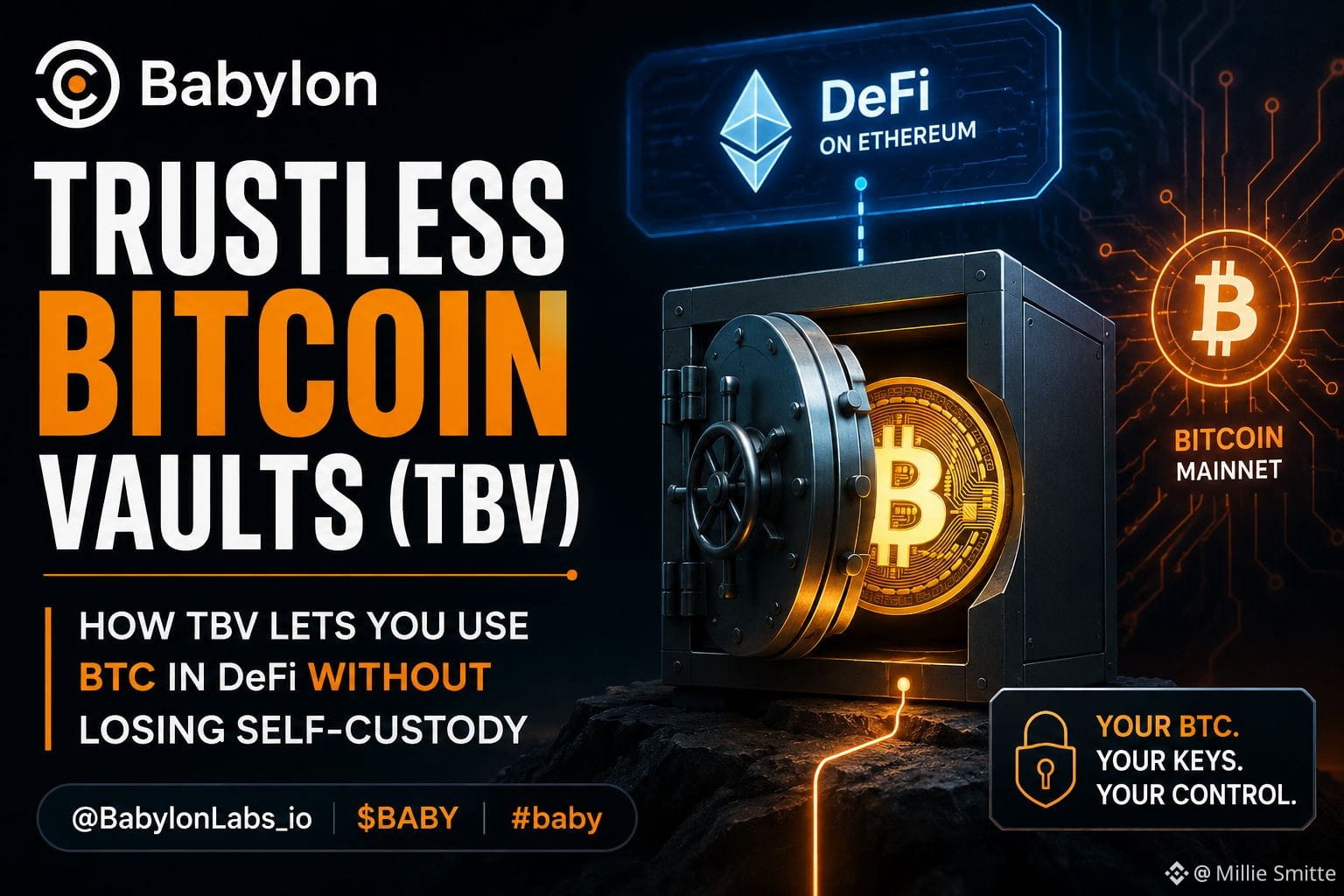
Most conversations about Bitcoin DeFi focus on yield, but I think the more interesting question is what you have to give up to participate.
That is why I’ve been reading about @babylonlabs_io Trustless Bitcoin Vaults (TBV). Instead of asking users to wrap BTC, bridge it to another chain, or hand custody to a third party, TBV is designed to let native Bitcoin remain under the owner’s control while being used as collateral for supported DeFi applications through cryptographic verification.
The borrowing logic runs on Ethereum, while the BTC itself stays secured on Bitcoin.
A simple analogy is storing an important document in your own home safe while using it to secure a bank loan. The bank recognizes the document as collateral, but it never takes the document away from you. That separation between ownership and utility is what makes this approach worth paying attention to.
Personally, I think this addresses a long-standing hesitation among Bitcoin holders. Many people are interested in putting idle BTC to work, but not if it means replacing Bitcoin’s security assumptions with new trust risks. Whether TBV becomes widely adopted will depend on how it performs in practice, but the design itself pushes the conversation in an interesting direction: increasing Bitcoin’s utility without changing its core principles.
@babylonlabs_io $BABY #baby
Do you think Bitcoin users will embrace DeFi only if self-custody remains uncompromised, or are existing trade-offs already acceptable?
#baby $BABY
Most conversations about Bitcoin DeFi focus on yield, but I think the more interesting question is what you have to give up to participate.
That is why I’ve been reading about @BabylonLabs_io Trustless Bitcoin Vaults (TBV). Instead of asking users to wrap BTC, bridge it to another chain, or hand custody to a third party, TBV is designed to let native Bitcoin remain under the owner’s control while being used as collateral for supported DeFi applications through cryptographic verification.
The borrowing logic runs on Ethereum, while the BTC itself stays secured on Bitcoin.
A simple analogy is storing an important document in your own home safe while using it to secure a bank loan. The bank recognizes the document as collateral, but it never takes the document away from you. That separation between ownership and utility is what makes this approach worth paying attention to.
Personally, I think this addresses a long-standing hesitation among Bitcoin holders. Many people are interested in putting idle BTC to work, but not if it means replacing Bitcoin’s security assumptions with new trust risks. Whether TBV becomes widely adopted will depend on how it performs in practice, but the design itself pushes the conversation in an interesting direction: increasing Bitcoin’s utility without changing its core principles.
@BabylonLabs_io $BABY #baby
Do you think Bitcoin users will embrace DeFi only if self-custody remains uncompromised, or are existing trade-offs already acceptable?
#baby $BABY
That is why I’ve been reading about @BabylonLabs_io Trustless Bitcoin Vaults (TBV). Instead of asking users to wrap BTC, bridge it to another chain, or hand custody to a third party, TBV is designed to let native Bitcoin remain under the owner’s control while being used as collateral for supported DeFi applications through cryptographic verification.
The borrowing logic runs on Ethereum, while the BTC itself stays secured on Bitcoin.
A simple analogy is storing an important document in your own home safe while using it to secure a bank loan. The bank recognizes the document as collateral, but it never takes the document away from you. That separation between ownership and utility is what makes this approach worth paying attention to.
Personally, I think this addresses a long-standing hesitation among Bitcoin holders. Many people are interested in putting idle BTC to work, but not if it means replacing Bitcoin’s security assumptions with new trust risks. Whether TBV becomes widely adopted will depend on how it performs in practice, but the design itself pushes the conversation in an interesting direction: increasing Bitcoin’s utility without changing its core principles.
@BabylonLabs_io $BABY #baby
Do you think Bitcoin users will embrace DeFi only if self-custody remains uncompromised, or are existing trade-offs already acceptable?
#baby $BABY
4
3
247
Partly True
📊 Tech Rebound or Temporary Bounce?
Chip stocks are lifting Wall Street as Nasdaq 100 futures +1.2%, with S&P 500 +0.5% and Dow +0.4% ahead of Alphabet & Tesla earnings.
Meanwhile:
🟢 $BULLA +6.15%
🟢 $GENIUS +8.94%
🟢 $BILL +8.10%
What's driving today's move?
📊 Tech Rebound or Temporary Bounce?
Chip stocks are lifting Wall Street as Nasdaq 100 futures +1.2%, with S&P 500 +0.5% and Dow +0.4% ahead of Alphabet & Tesla earnings.
Meanwhile:
🟢 $BULLA +6.15%
🟢 $GENIUS +8.94%
🟢 $BILL +8.10%
What's driving today's move?
Chip stocks are lifting Wall Street as Nasdaq 100 futures +1.2%, with S&P 500 +0.5% and Dow +0.4% ahead of Alphabet & Tesla earnings.
Meanwhile:
🟢 $BULLA +6.15%
🟢 $GENIUS +8.94%
🟢 $BILL +8.10%
What's driving today's move?
🔘 Strong chip sector momentum
58%
🔘 Earnings optimism
17%
🔘 Ceasefire boosting assets
0%
🔘 Just a short-term relief
25%
12 votes • Voting closed
3
4.5k
📈 Chip stocks are leading the rebound as Nasdaq 100 futures climb 1.2%, lifting broader market sentiment ahead of Alphabet and Tesla earnings. Meanwhile, #BULLA , #GENIUS , and #BILL are all posting strong gains. Is this the start of a broader risk-on move, or just a relief rally?
#Nasdaq100
#BULLA
#GENIUS
#BILL
📈 Chip stocks are leading the rebound as Nasdaq 100 futures climb 1.2%, lifting broader market sentiment ahead of Alphabet and Tesla earnings. Meanwhile, #BULLA , #GENIUS , and #BILL are all posting strong gains. Is this the start of a broader risk-on move, or just a relief rally?
#Nasdaq100
#BULLA
#GENIUS
#BILL
#Nasdaq100
#BULLA
#GENIUS
#BILL

1
338
🏴#England finish the 2026 FIFA World Cup with the 🥉 bronze medal under Thomas Tuchel.
6 goals in the third-place playoff.
$29M in FIFA prize money.
But with this talented squad... should England have reached the final?
🔥 Was this a successful tournament or a missed opportunity?
👇 Vote & explain.
#FootballSeason2026 #England #WorldCup2026 $ARIA $PHA $ALLO
🏴#England finish the 2026 FIFA World Cup with the 🥉 bronze medal under Thomas Tuchel.
6 goals in the third-place playoff.
$29M in FIFA prize money.
But with this talented squad... should England have reached the final?
🔥 Was this a successful tournament or a missed opportunity?
👇 Vote & explain.
#FootballSeason2026 #England #WorldCup2026 $ARIA $PHA $ALLO
6 goals in the third-place playoff.
$29M in FIFA prize money.
But with this talented squad... should England have reached the final?
🔥 Was this a successful tournament or a missed opportunity?
👇 Vote & explain.
#FootballSeason2026 #England #WorldCup2026 $ARIA $PHA $ALLO

1
308
✅ Yes, cut the loss
46%
📉 Bear trend still intact
31%
⏳ Exit was too early
8%
🤔 Need more confirmation
15%
13 votes • Voting closed
1
537
Verified
🚀 Cardano's Van Rossem Hard Fork is here. Will Protocol Version 11 strengthen ADA's long-term ecosystem?
#Cardano #ADA #Voltaire #Blockchain
🚀 Cardano's Van Rossem Hard Fork is here. Will Protocol Version 11 strengthen ADA's long-term ecosystem?
#Cardano #ADA #Voltaire #Blockchain
#Cardano #ADA #Voltaire #Blockchain
🟢 Major bullish catalyst
67%
🔵 Gradual impact
10%
🟡 Too early to tell
14%
🔴 Little effect
9%
21 votes • Voting closed
2
411
Verified
📊 SK Hynix & Samsung slipped in offshore markets after a strong AI-driven rally. Is this healthy profit-taking or an early warning for chip stocks?
#Semiconductors #Aİ #Samsung #SKHYNIX #stocks
📊 SK Hynix & Samsung slipped in offshore markets after a strong AI-driven rally. Is this healthy profit-taking or an early warning for chip stocks?
#Semiconductors #Aİ #Samsung #SKHYNIX #stocks
#Semiconductors #Aİ #Samsung #SKHYNIX #stocks
🔴 Buy the dip
66%
⚖️ Wait for confirmation
0%
📉 More downside ahead
17%
💎 Hold long-term
17%
18 votes • Voting closed
1
3.4k
🔘 Sustainable bullish trend
30%
🔘 Bull trap before reversal
40%
🔘 Range before next move
10%
🔘 Need more confirmation
20%
10 votes • Voting closed
2
399
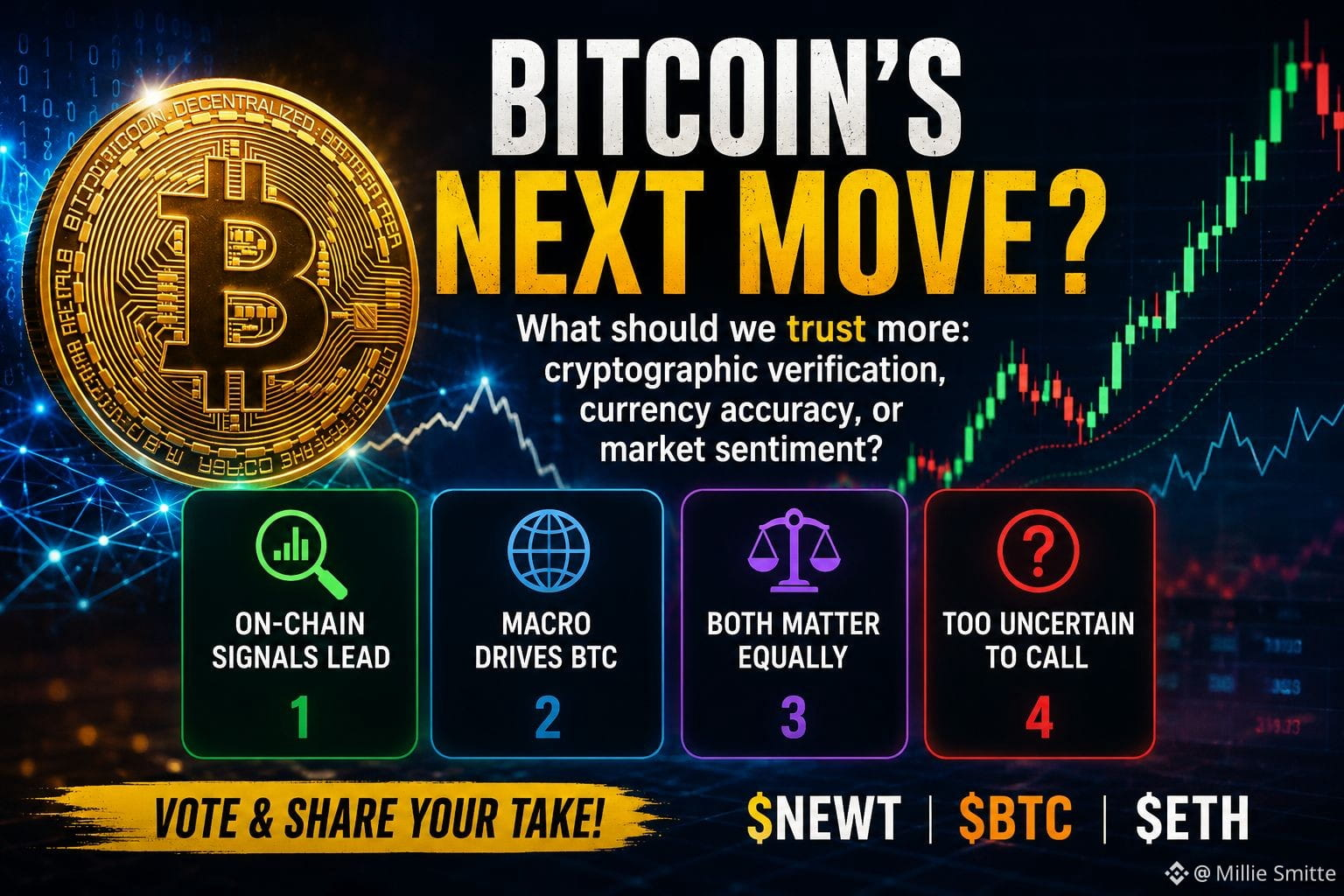
🧠 What decides Bitcoin's next move: market conviction or verifiable data? As cryptographic verification and price accuracy improve, what should traders trust most?
On-chain signals lead
Macro drives BTC
Both matter equally
Too uncertain to call
$NEWT $BTC $ETH #Bitcoin #Crypto
🧠 What decides Bitcoin's next move: market conviction or verifiable data? As cryptographic verification and price accuracy improve, what should traders trust most?
On-chain signals lead
Macro drives BTC
Both matter equally
Too uncertain to call
$NEWT $BTC $ETH #Bitcoin #Crypto
On-chain signals lead
Macro drives BTC
Both matter equally
Too uncertain to call
$NEWT $BTC $ETH #Bitcoin #Crypto
1
127
🤔 If every AI agent action is @NewtonProtocol DeFi were cryptographically verifiable, what would still stop you from using on-chain automation?
• Full trust with verification
• Limited to low-risk tasks
• Human oversight is essential
• I don't trust AI with funds yet
#Newt $NEWT $BTC $ETH
🤔 If every AI agent action is @NewtonProtocol DeFi were cryptographically verifiable, what would still stop you from using on-chain automation?
• Full trust with verification
• Limited to low-risk tasks
• Human oversight is essential
• I don't trust AI with funds yet
#Newt $NEWT $BTC $ETH
• Full trust with verification
• Limited to low-risk tasks
• Human oversight is essential
• I don't trust AI with funds yet
#Newt $NEWT $BTC $ETH
1
185
Fragmentation doesn't just affect users—it divides liquidity, developer resources, and network effects. Projects that reduce coordination costs could create more long-term value than projects focused only on higher TPS.
Fragmentation doesn't just affect users—it divides liquidity, developer resources, and network effects. Projects that reduce coordination costs could create more long-term value than projects focused only on higher TPS.
2
62
Every successful technology eventually hides its complexity. People don't think about TCP/IP when browsing the web. I think crypto reaches mainstream adoption only when blockchain becomes just as invisible to the end user.
Every successful technology eventually hides its complexity. People don't think about TCP/IP when browsing the web. I think crypto reaches mainstream adoption only when blockchain becomes just as invisible to the end user.
2
54
The real test for crypto UX isn't adding more features—it's reducing the number of decisions users have to make without reducing transparency. That's a much harder engineering problem than most people realize.
The real test for crypto UX isn't adding more features—it's reducing the number of decisions users have to make without reducing transparency. That's a much harder engineering problem than most people realize.
2
93
Why Automation Without Accountability Is DangerousA few days ago, I watched a self-checkout machine charge the wrong customer for someone else's groceries. Nobody argued with the machine at first because everyone assumed automation must be right. Eventually, an employee corrected the mistake, but it reminded me of something I keep noticing in crypto.
We spend a lot of time asking whether automation can do more.
We spend far less time asking who is responsible when automation gets something wrong.
That question became much more interesting as I looked into @NewtonProtocol . I expected another discussion about AI agents, automated strategies, and faster execution. Instead, I found myself thinking about accountability.
For me, that is a much bigger topic than automation itself.
Automation is easy to admire when everything works perfectly. The difficult part begins when markets become volatile, data feeds fail, or an AI agent makes a poor decision that costs real money.
In traditional finance, mistakes usually have someone attached to them. A portfolio manager answers to clients. A bank answers to regulators. A company answers to shareholders.
Crypto often removes that human layer.
That creates efficiency, but it can also create distance between actions and consequences.
Imagine hiring a delivery driver.
If they know they are responsible for every package, they drive carefully. If they know nobody can identify them after a mistake, their incentives change immediately.
Automation works in much the same way.
The technology itself isn't honest or dishonest. It simply follows incentives.
That is why I think accountability deserves more attention than automation speed.
Many crypto discussions focus on how intelligent AI agents will become. I think the more important question is whether those agents operate inside systems where bad behavior actually has consequences.
Without consequences, automation simply scales mistakes.
One broken process can become thousands of broken transactions in minutes.
We've already seen smaller versions of this across crypto.
Trading bots have accidentally amplified flash crashes.
Poorly configured liquidation systems have triggered unnecessary losses.
Oracle failures have caused protocols to react to incorrect information.
None of these problems happened because automation is inherently bad.
They happened because automated systems executed exactly what they were designed to do—even when those instructions produced terrible outcomes.
That distinction matters.
People often imagine AI as something capable of independent judgment.
Most automated systems are actually very literal.
Give them imperfect rules, and they will perfectly execute imperfect decisions.
That reminds me of GPS navigation.
Most drivers have experienced GPS sending them down an impossible road or into unexpected traffic.
The GPS isn't trying to make bad decisions.
It simply follows available information.
Good drivers recognize when they should stop trusting automation.
Bad drivers continue because "the computer said so."
Crypto faces a similar challenge.
As AI agents become capable of managing assets, executing trades, interacting across chains, and making financial decisions, users may begin trusting them without understanding their limitations.
That creates a dangerous illusion.
Automation can reduce effort.
It cannot eliminate responsibility.
One aspect of @NewtonProtocol that caught my attention is its attempt to think beyond pure automation by introducing mechanisms intended to align incentives between operators and the actions performed on behalf of users.
Whether every implementation succeeds is something only real adoption will prove.
Whitepapers rarely reveal how systems behave under pressure.
Markets do.
That is why I remain cautiously interested rather than completely convinced.
Real accountability is tested during failures, not during successful demo videos.
Suppose, in the future, an AI agent manages an investment portfolio.
It automatically rebalances assets, claims staking rewards, moves liquidity between protocols, and searches for yield opportunities.
Everything looks impressive.
Then one market event produces unexpected conditions.
The AI follows its programmed logic and loses significant capital.
Who carries the responsibility?
The user?
The developer?
The operator?
The protocol?
Without a clear answer, automation becomes difficult to trust at scale.
Now imagine another scenario.
A decentralized business hires AI agents to handle supplier payments, payroll, and treasury management.
The system saves hours every week.
But one faulty software update sends payments to incorrect addresses.
The efficiency gained over months disappears in minutes.
Again, accountability becomes more valuable than automation itself.
This is why I believe infrastructure matters more than flashy AI demonstrations.
The crypto industry often celebrates what automation can accomplish.
I think we should equally celebrate systems that create consequences when automation behaves irresponsibly.
Otherwise, we risk building incredibly fast systems that simply make expensive mistakes faster.
There is another psychological factor that deserves attention.
Humans naturally trust machines that appear intelligent.
We assume software is objective.
We assume algorithms remove bias.
Neither assumption is always true.
Algorithms inherit assumptions from the people who design them.
AI inherits limitations from its training data.
Automation inherits risks from its surrounding infrastructure.
None of these technologies exist in isolation.
That is why accountability cannot be added later as an optional feature.
It has to exist from the beginning.
Otherwise, every improvement in automation also increases the speed at which problems spread.
Looking ahead, I can imagine AI agents becoming normal participants in decentralized finance.
They may negotiate transactions, optimize liquidity, manage subscriptions, execute governance instructions, and coordinate across multiple blockchains.
That future seems increasingly realistic.
But I don't think users will trust autonomous agents simply because they are intelligent.
People will trust them when they know responsibility still exists if something goes wrong.
For me, that is the more interesting long-term question surrounding $NEWT and the broader vision behind #Newt .
The technology itself is exciting.
The governance around the technology may ultimately prove even more important.
Crypto has spent years proving that automation is possible.
The next challenge is proving that automation can remain accountable when billions of dollars depend on it.
If that challenge is solved, autonomous finance could become far more practical than many people expect.
If it isn't, we may simply automate the same old problems at a much larger scale.
Discussion question: As AI agents become more autonomous in crypto, what matters more to you: smarter automation or stronger accountability when things go wrong?
Why Automation Without Accountability Is Dangerous
A few days ago, I watched a self-checkout machine charge the wrong customer for someone else's groceries. Nobody argued with the machine at first because everyone assumed automation must be right. Eventually, an employee corrected the mistake, but it reminded me of something I keep noticing in crypto.
We spend a lot of time asking whether automation can do more.
We spend far less time asking who is responsible when automation gets something wrong.
That question became much more interesting as I looked into @NewtonProtocol . I expected another discussion about AI agents, automated strategies, and faster execution. Instead, I found myself thinking about accountability.
For me, that is a much bigger topic than automation itself.
Automation is easy to admire when everything works perfectly. The difficult part begins when markets become volatile, data feeds fail, or an AI agent makes a poor decision that costs real money.
In traditional finance, mistakes usually have someone attached to them. A portfolio manager answers to clients. A bank answers to regulators. A company answers to shareholders.
Crypto often removes that human layer.
That creates efficiency, but it can also create distance between actions and consequences.
Imagine hiring a delivery driver.
If they know they are responsible for every package, they drive carefully. If they know nobody can identify them after a mistake, their incentives change immediately.
Automation works in much the same way.
The technology itself isn't honest or dishonest. It simply follows incentives.
That is why I think accountability deserves more attention than automation speed.
Many crypto discussions focus on how intelligent AI agents will become. I think the more important question is whether those agents operate inside systems where bad behavior actually has consequences.
Without consequences, automation simply scales mistakes.
One broken process can become thousands of broken transactions in minutes.
We've already seen smaller versions of this across crypto.
Trading bots have accidentally amplified flash crashes.
Poorly configured liquidation systems have triggered unnecessary losses.
Oracle failures have caused protocols to react to incorrect information.
None of these problems happened because automation is inherently bad.
They happened because automated systems executed exactly what they were designed to do—even when those instructions produced terrible outcomes.
That distinction matters.
People often imagine AI as something capable of independent judgment.
Most automated systems are actually very literal.
Give them imperfect rules, and they will perfectly execute imperfect decisions.
That reminds me of GPS navigation.
Most drivers have experienced GPS sending them down an impossible road or into unexpected traffic.
The GPS isn't trying to make bad decisions.
It simply follows available information.
Good drivers recognize when they should stop trusting automation.
Bad drivers continue because "the computer said so."
Crypto faces a similar challenge.
As AI agents become capable of managing assets, executing trades, interacting across chains, and making financial decisions, users may begin trusting them without understanding their limitations.
That creates a dangerous illusion.
Automation can reduce effort.
It cannot eliminate responsibility.
One aspect of @NewtonProtocol that caught my attention is its attempt to think beyond pure automation by introducing mechanisms intended to align incentives between operators and the actions performed on behalf of users.
Whether every implementation succeeds is something only real adoption will prove.
Whitepapers rarely reveal how systems behave under pressure.
Markets do.
That is why I remain cautiously interested rather than completely convinced.
Real accountability is tested during failures, not during successful demo videos.
Suppose, in the future, an AI agent manages an investment portfolio.
It automatically rebalances assets, claims staking rewards, moves liquidity between protocols, and searches for yield opportunities.
Everything looks impressive.
Then one market event produces unexpected conditions.
The AI follows its programmed logic and loses significant capital.
Who carries the responsibility?
The user?
The developer?
The operator?
The protocol?
Without a clear answer, automation becomes difficult to trust at scale.
Now imagine another scenario.
A decentralized business hires AI agents to handle supplier payments, payroll, and treasury management.
The system saves hours every week.
But one faulty software update sends payments to incorrect addresses.
The efficiency gained over months disappears in minutes.
Again, accountability becomes more valuable than automation itself.
This is why I believe infrastructure matters more than flashy AI demonstrations.
The crypto industry often celebrates what automation can accomplish.
I think we should equally celebrate systems that create consequences when automation behaves irresponsibly.
Otherwise, we risk building incredibly fast systems that simply make expensive mistakes faster.
There is another psychological factor that deserves attention.
Humans naturally trust machines that appear intelligent.
We assume software is objective.
We assume algorithms remove bias.
Neither assumption is always true.
Algorithms inherit assumptions from the people who design them.
AI inherits limitations from its training data.
Automation inherits risks from its surrounding infrastructure.
None of these technologies exist in isolation.
That is why accountability cannot be added later as an optional feature.
It has to exist from the beginning.
Otherwise, every improvement in automation also increases the speed at which problems spread.
Looking ahead, I can imagine AI agents becoming normal participants in decentralized finance.
They may negotiate transactions, optimize liquidity, manage subscriptions, execute governance instructions, and coordinate across multiple blockchains.
That future seems increasingly realistic.
But I don't think users will trust autonomous agents simply because they are intelligent.
People will trust them when they know responsibility still exists if something goes wrong.
For me, that is the more interesting long-term question surrounding $NEWT and the broader vision behind #Newt .
The technology itself is exciting.
The governance around the technology may ultimately prove even more important.
Crypto has spent years proving that automation is possible.
The next challenge is proving that automation can remain accountable when billions of dollars depend on it.
If that challenge is solved, autonomous finance could become far more practical than many people expect.
If it isn't, we may simply automate the same old problems at a much larger scale.
Discussion question: As AI agents become more autonomous in crypto, what matters more to you: smarter automation or stronger accountability when things go wrong?
We spend a lot of time asking whether automation can do more.
We spend far less time asking who is responsible when automation gets something wrong.
That question became much more interesting as I looked into @NewtonProtocol . I expected another discussion about AI agents, automated strategies, and faster execution. Instead, I found myself thinking about accountability.
For me, that is a much bigger topic than automation itself.
Automation is easy to admire when everything works perfectly. The difficult part begins when markets become volatile, data feeds fail, or an AI agent makes a poor decision that costs real money.
In traditional finance, mistakes usually have someone attached to them. A portfolio manager answers to clients. A bank answers to regulators. A company answers to shareholders.
Crypto often removes that human layer.
That creates efficiency, but it can also create distance between actions and consequences.
Imagine hiring a delivery driver.
If they know they are responsible for every package, they drive carefully. If they know nobody can identify them after a mistake, their incentives change immediately.
Automation works in much the same way.
The technology itself isn't honest or dishonest. It simply follows incentives.
That is why I think accountability deserves more attention than automation speed.
Many crypto discussions focus on how intelligent AI agents will become. I think the more important question is whether those agents operate inside systems where bad behavior actually has consequences.
Without consequences, automation simply scales mistakes.
One broken process can become thousands of broken transactions in minutes.
We've already seen smaller versions of this across crypto.
Trading bots have accidentally amplified flash crashes.
Poorly configured liquidation systems have triggered unnecessary losses.
Oracle failures have caused protocols to react to incorrect information.
None of these problems happened because automation is inherently bad.
They happened because automated systems executed exactly what they were designed to do—even when those instructions produced terrible outcomes.
That distinction matters.
People often imagine AI as something capable of independent judgment.
Most automated systems are actually very literal.
Give them imperfect rules, and they will perfectly execute imperfect decisions.
That reminds me of GPS navigation.
Most drivers have experienced GPS sending them down an impossible road or into unexpected traffic.
The GPS isn't trying to make bad decisions.
It simply follows available information.
Good drivers recognize when they should stop trusting automation.
Bad drivers continue because "the computer said so."
Crypto faces a similar challenge.
As AI agents become capable of managing assets, executing trades, interacting across chains, and making financial decisions, users may begin trusting them without understanding their limitations.
That creates a dangerous illusion.
Automation can reduce effort.
It cannot eliminate responsibility.
One aspect of @NewtonProtocol that caught my attention is its attempt to think beyond pure automation by introducing mechanisms intended to align incentives between operators and the actions performed on behalf of users.
Whether every implementation succeeds is something only real adoption will prove.
Whitepapers rarely reveal how systems behave under pressure.
Markets do.
That is why I remain cautiously interested rather than completely convinced.
Real accountability is tested during failures, not during successful demo videos.
Suppose, in the future, an AI agent manages an investment portfolio.
It automatically rebalances assets, claims staking rewards, moves liquidity between protocols, and searches for yield opportunities.
Everything looks impressive.
Then one market event produces unexpected conditions.
The AI follows its programmed logic and loses significant capital.
Who carries the responsibility?
The user?
The developer?
The operator?
The protocol?
Without a clear answer, automation becomes difficult to trust at scale.
Now imagine another scenario.
A decentralized business hires AI agents to handle supplier payments, payroll, and treasury management.
The system saves hours every week.
But one faulty software update sends payments to incorrect addresses.
The efficiency gained over months disappears in minutes.
Again, accountability becomes more valuable than automation itself.
This is why I believe infrastructure matters more than flashy AI demonstrations.
The crypto industry often celebrates what automation can accomplish.
I think we should equally celebrate systems that create consequences when automation behaves irresponsibly.
Otherwise, we risk building incredibly fast systems that simply make expensive mistakes faster.
There is another psychological factor that deserves attention.
Humans naturally trust machines that appear intelligent.
We assume software is objective.
We assume algorithms remove bias.
Neither assumption is always true.
Algorithms inherit assumptions from the people who design them.
AI inherits limitations from its training data.
Automation inherits risks from its surrounding infrastructure.
None of these technologies exist in isolation.
That is why accountability cannot be added later as an optional feature.
It has to exist from the beginning.
Otherwise, every improvement in automation also increases the speed at which problems spread.
Looking ahead, I can imagine AI agents becoming normal participants in decentralized finance.
They may negotiate transactions, optimize liquidity, manage subscriptions, execute governance instructions, and coordinate across multiple blockchains.
That future seems increasingly realistic.
But I don't think users will trust autonomous agents simply because they are intelligent.
People will trust them when they know responsibility still exists if something goes wrong.
For me, that is the more interesting long-term question surrounding $NEWT and the broader vision behind #Newt .
The technology itself is exciting.
The governance around the technology may ultimately prove even more important.
Crypto has spent years proving that automation is possible.
The next challenge is proving that automation can remain accountable when billions of dollars depend on it.
If that challenge is solved, autonomous finance could become far more practical than many people expect.
If it isn't, we may simply automate the same old problems at a much larger scale.
Discussion question: As AI agents become more autonomous in crypto, what matters more to you: smarter automation or stronger accountability when things go wrong?
2
3
166
Log in to explore more content
Join global crypto users on Binance Square
⚡️ Get latest and useful information about crypto.
💬 Trusted by the world’s largest crypto exchange.
👍 Discover real insights from verified creators.
Email / Phone number
Trending Topics
FedMinutesFocusOnOctoberPause
3,740 views
224 Discussing
#fedminutesfocusonoctoberpause
🚨 FED MINUTES PUT OCTOBER PAUSE IN FOCUS! 🇺🇸
The latest Federal Reserve minutes are putting fresh attention on the possibility of an October rate pause. 👀
Markets are now watching closely for clues about what the Fed could do next.
Why crypto traders care:
🔹 A rate pause could support risk assets
🔹 Lower rate expectations can boost liquidity sentiment
🔹 Bitcoin and altcoins could react sharply to Fed signals
🔹 The dollar and Treasury yields remain key factors
🔥 If the Fed signals a pause while inflation continues cooling, could this become another catalyst for crypto?
WHAT DO YOU THINK HAPPENS NEXT? 👇
🟢 Fed pauses → BTC rallies 🚀
🟡 Fed stays cautious
🔴 Hawkish Fed → crypto dumps
#Fed #bitcoin #crypto
Faizan Crypto Learner
·1 Likes
·1.1k views
BinanceLaunchesBinanceIntelligence
900,809 views
5,497 Discussing
RobinhoodAdds$25MInBitcoinToBalanceSheet
417 views
22 Discussing