

Солька-парасолька
37 Posts
Солька-парасолька
Report
Block User
3 Following
22 Followers
46 Liked
Posts
All
Quotes
·
--
Bullish
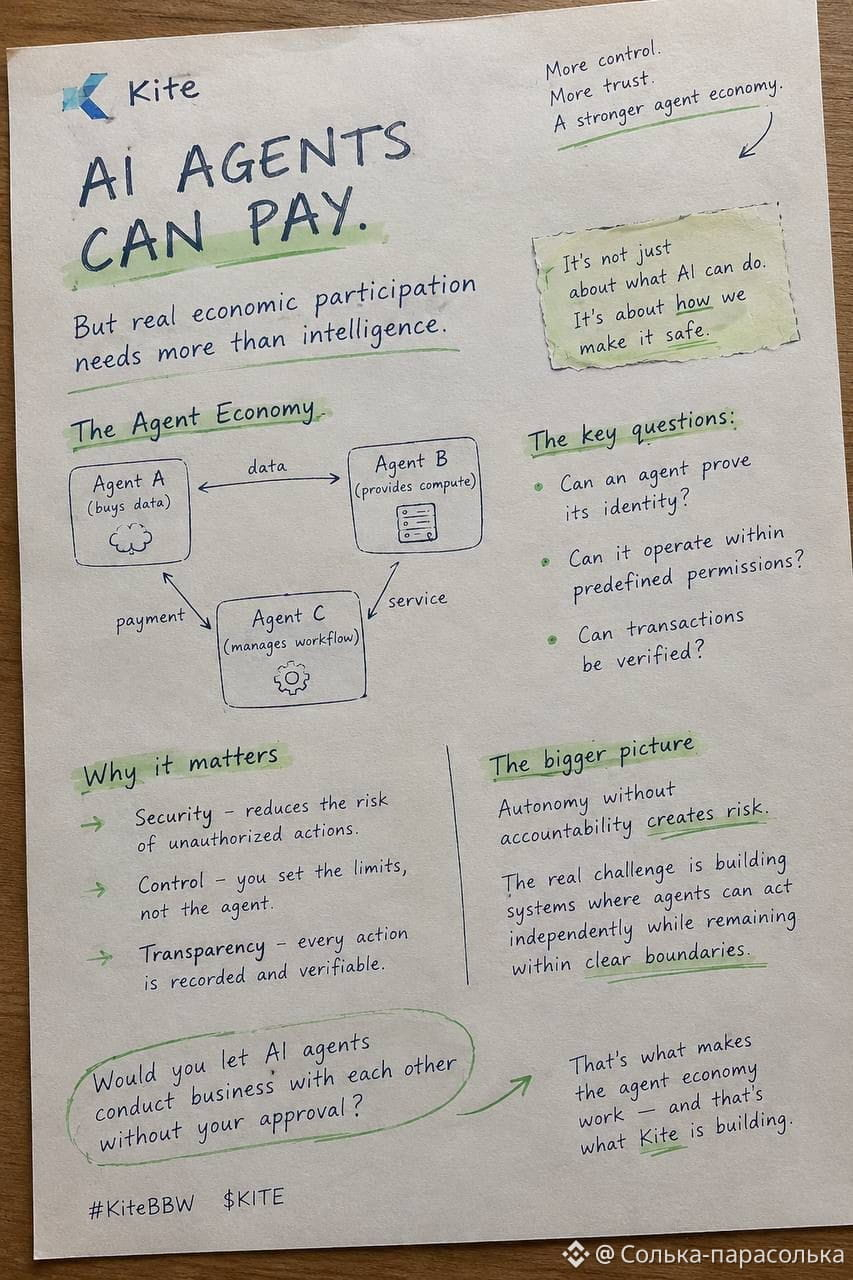
What if your AI assistant could do more than recommend things?
Imagine asking an agent to organize a research project.
It finds the right data provider, pays for access within your budget, and coordinates with other digital services — without requiring you to manage every transaction manually.
This is one possible direction for the agent economy.
But making it work requires more than a capable AI model. Agents need ways to identify themselves, operate under clear permissions, and interact economically.
That’s the infrastructure challenge that makes Kite worth watching.
Of course, this future depends on security, reliable execution, and meaningful user control. Autonomous payments should never mean unlimited permissions.
What would you delegate first: buying digital services, managing research, or coordinating other AI agents?
#KiteBBW $KITE
117
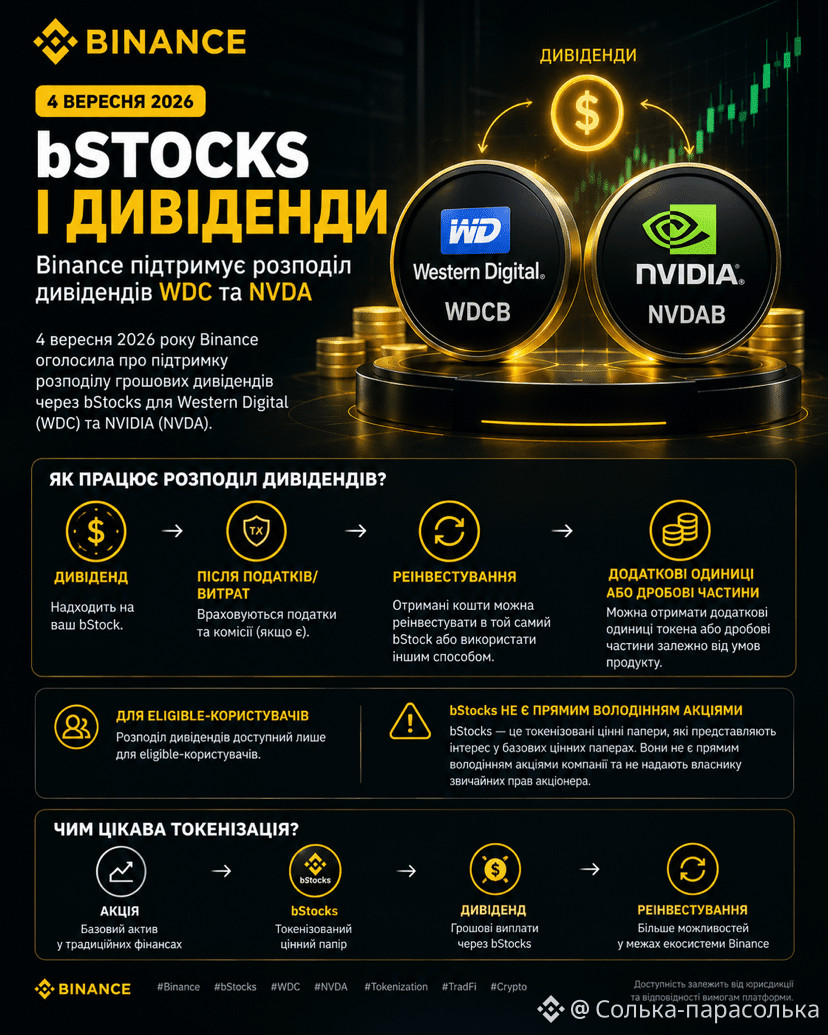
💰 bStocks — it’s no longer just “a token instead of a stock”
There’s one detail that’s easy to miss.
On September 4, Binance announced support for distributing cash dividends via bStocks for Western Digital (WDC) and NVIDIA (NVDA). (Binance)
And it’s interesting not because of the word “dividends” itself.
It’s because of how the role of tokenized securities is changing.
bStocks are tokenized securities that represent an interest in underlying securities. They are not direct ownership of the company’s shares and do not grant the holder the usual rights of a shareholder. (Binance)
So the logic gradually looks like this:
traditional asset → tokenization → 24/7 trading → use within the ecosystem → dividend payments
And that last point shows that tokenization isn’t just a fancy term for moving assets onto a blockchain.
It’s interesting to see where this leads next. 👀
But there’s an important nuance: access to bStocks depends on jurisdiction and platform compliance requirements.
315
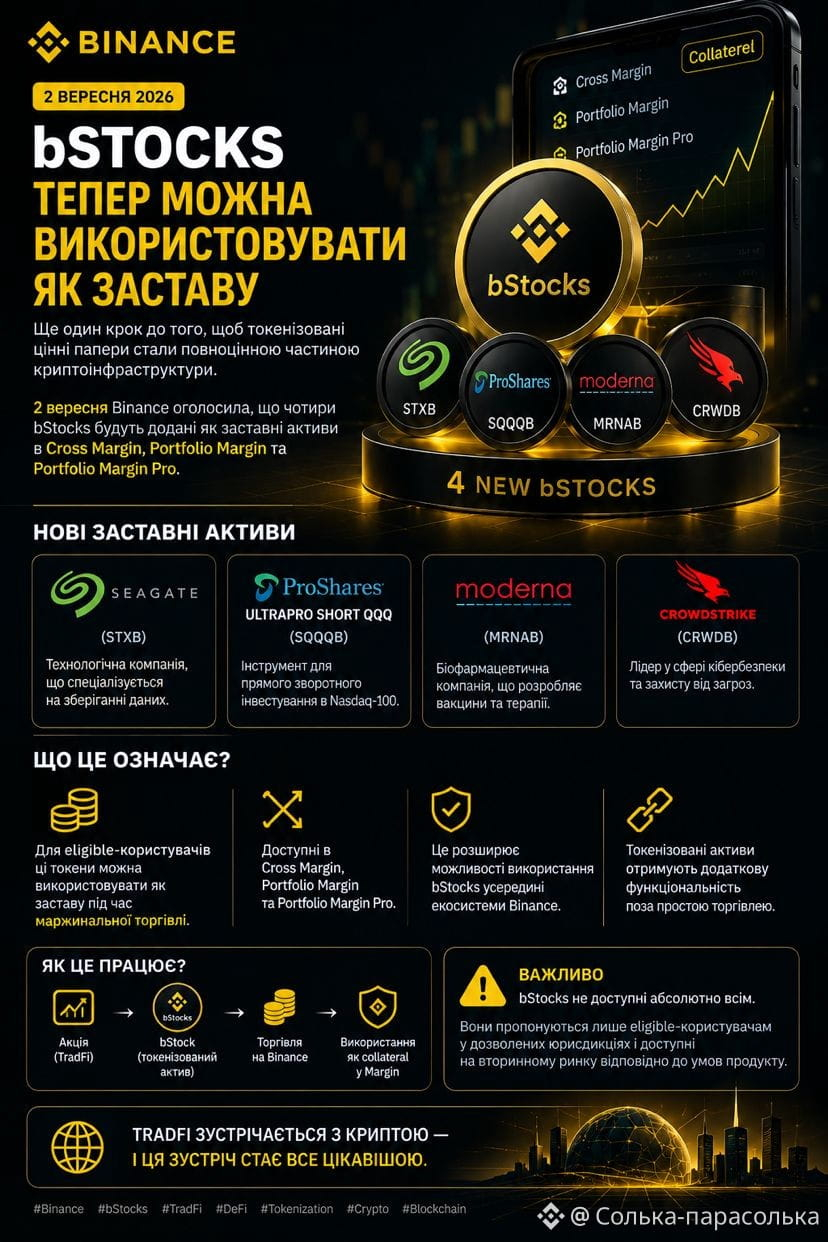
bStocks can now be used for more than just trading. 👀
Another step toward making tokenized securities a full-fledged part of crypto infrastructure.
On September 2, Binance announced that four bStocks will be added as collateral assets in Cross Margin, Portfolio Margin, and Portfolio Margin Pro:
🔹 Seagate (STXB)
🔹 ProShares UltraPro Short QQQ (SQQQB)
🔹 Moderna (MRNAB)
🔹 CrowdStrike (CRWDB)
For eligible users, these tokens can be used as collateral during margin trading. (Binance)
And here’s why that’s interesting.
Previously, the logic looked roughly like this:
stock → token → trading
And now the ecosystem is becoming more complex:
stock → tokenized asset → trading → use as collateral
In other words, a tokenized financial asset gets additional functionality inside a crypto platform.
But there is an important point 👇
bStocks are not available to everyone. Binance notes that tokenized securities are available only to eligible users in permitted jurisdictions. They are offered on the secondary market in accordance with the product terms.
And that, in my opinion, is more interesting than yet another “crypto update.”
We are gradually seeing how traditional financial assets are gaining a new form and new ways of being used thanks to blockchain.
132
What if bStock is not just a way to gain exposure to a stock?
There is one feature that is easy to underestimate.
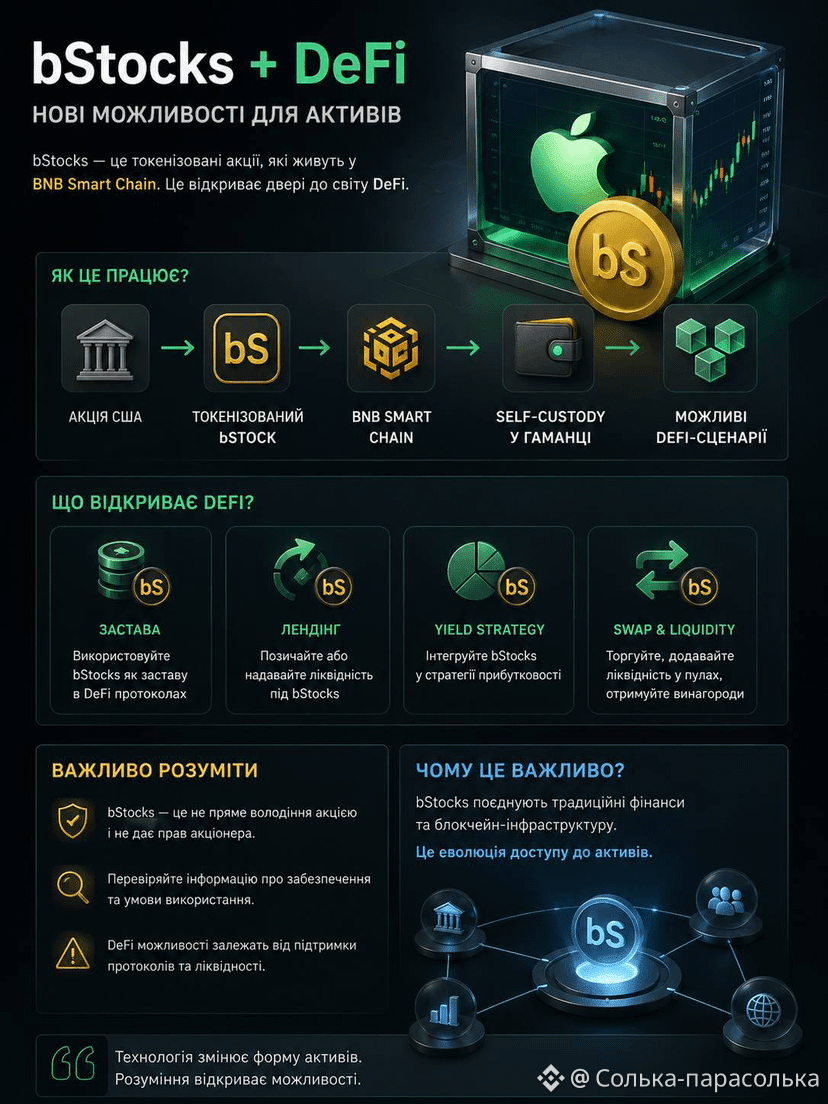
bStocks are issued as BEP-20 tokens on BNB Smart Chain. Therefore, they can be withdrawn to a compatible crypto wallet and stored self-custodially.
But even more interestingly, this structure opens up the possibility of using bStocks in DeFi.
That means a traditional asset gets blockchain infrastructure:
US stock
↓
tokenized bStock
↓
BNB Smart Chain
↓
self-custody
↓
possible DeFi scenarios
This is no longer just a “stock on the blockchain.”
The way the asset is stored, transferred, and potentially used changes.
At the same time, it is important not to overstate it: the fact that a bStock is technically compatible with DeFi does not mean that every protocol automatically supports every bStock.
This is where, in my opinion, the real appeal of RWA begins:
not just to move an asset onto the blockchain, but to make it part of a new financial infrastructure.
97
GameStop can now be used for more than just trading 👀
There’s an interesting update in the world of tokenized stocks.
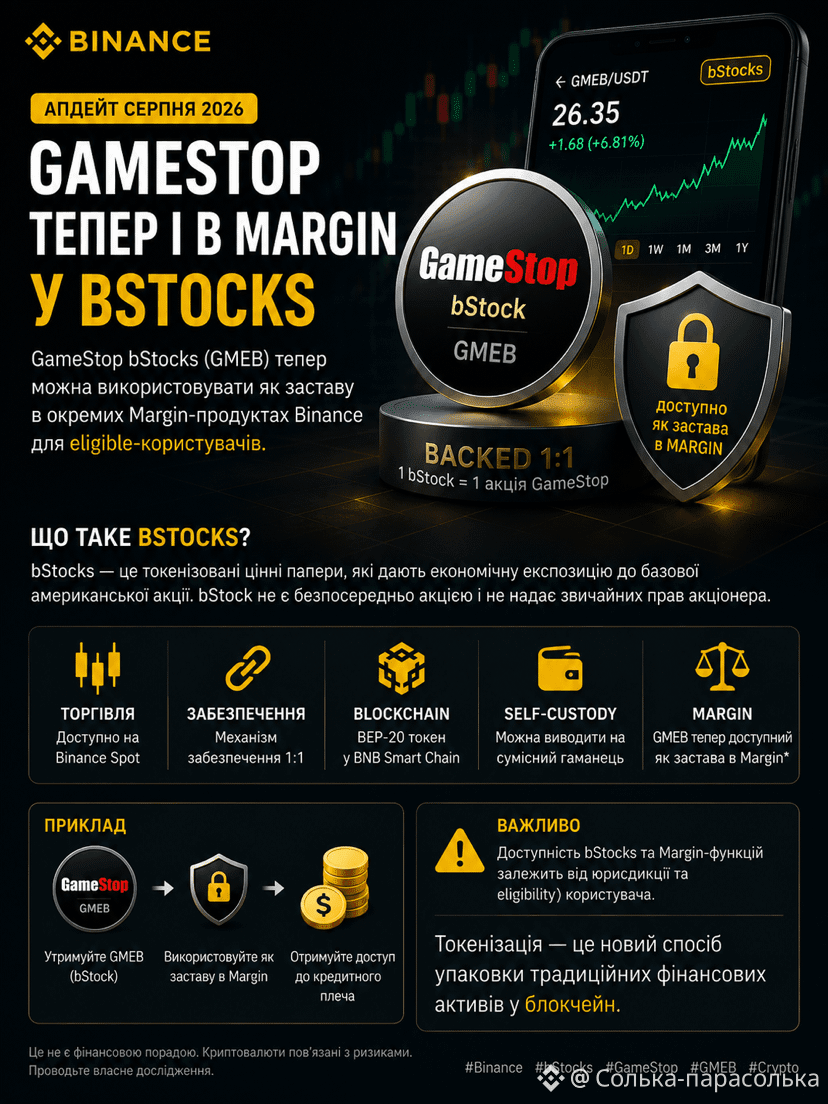
In August 2026, Binance added GameStop bStocks (GMEB) to the list of assets eligible users can use as collateral in Margin.
What does this mean?
bStocks are tokenized securities that provide economic exposure to the underlying U.S. stock. At the same time, a bStock is not directly the stock itself and does not grant the usual shareholder rights.
And here’s where it gets interesting.
🔸 GMEB can be traded on Binance Spot.
🔸 The token is linked to the underlying stock through a 1:1 backing mechanism.
🔸 bStocks operate in BEP-20 format on BNB Smart Chain.
🔸 They can be withdrawn to a compatible crypto wallet for self-custody.
🔸 And now GMEB can also be used as collateral in certain Binance Margin products for eligible users.
And this shows an interesting trend:
a tokenized stock is no longer just a way to “buy a stock through blockchain.”
It becomes an asset that can exist inside crypto infrastructure — traded, moved between wallets, and in some cases used as collateral.
TradFi → blockchain → DeFi/Margin.
The line between traditional finance and crypto is becoming thinner and thinner. 🔥
107
APR ≠ free money. And here’s where the most important thing is hidden 👀
In Binance Earn, there’s a simple principle: you don’t just hold crypto assets — depending on the chosen product, you can earn rewards on them.
But there’s a catch that many people miss.
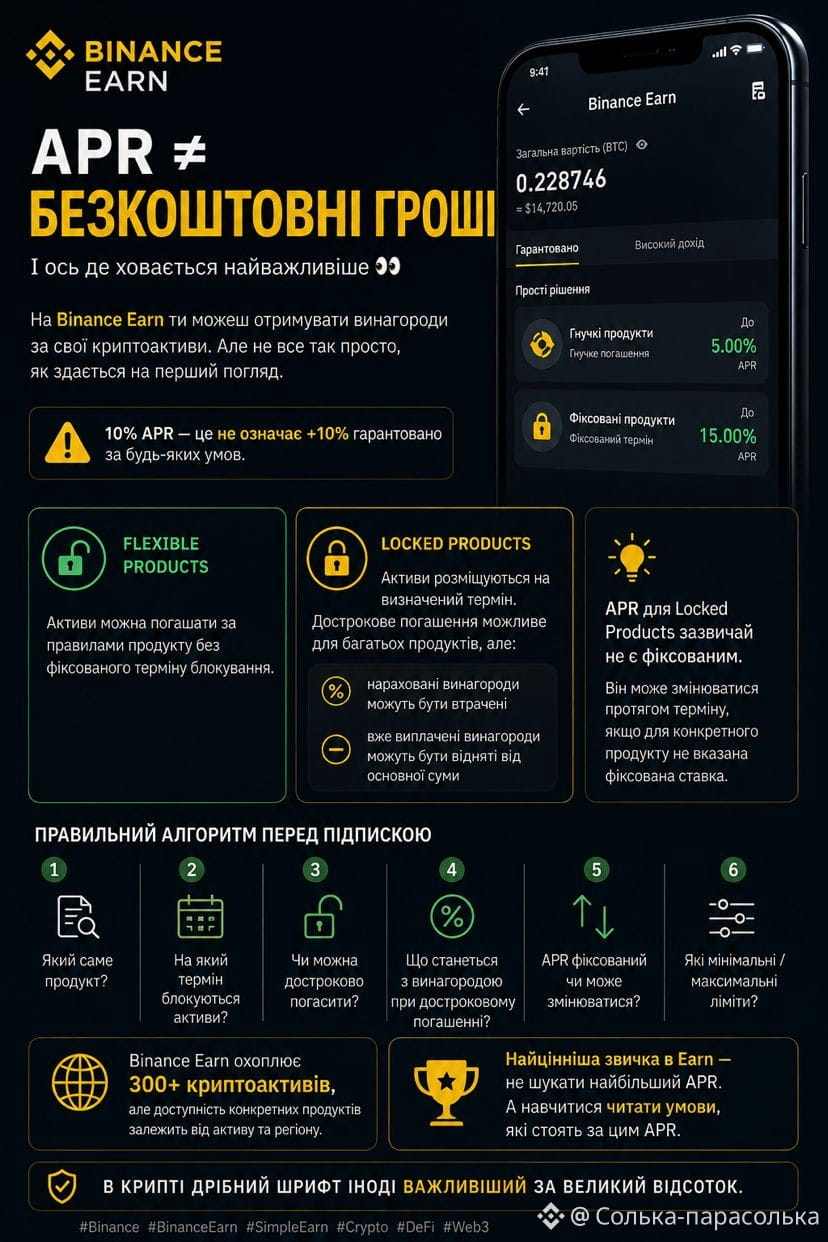
A 10% APR doesn’t mean +10% is guaranteed under any conditions.
For example, in Simple Earn there are Flexible Products and Locked Products.
🔓 Flexible — assets can be redeemed under the product rules without a fixed lock-up period.
🔒 Locked — assets are placed for a specified term. Early redemption is possible for many such products, but then the accrued rewards may be lost, and the rewards you’ve already received may be deducted from the principal amount.
And one more detail:
APR for Locked Products is usually not fixed. Binance states that it may change during the term unless a fixed rate is specified for that particular product.
So the right approach before subscribing looks less like this:
❌ “Oh, 15% APR — I’ll take it.”
And more like this:
✅ Which exact product?
✅ For what lock-up period are the assets?
✅ Can it be redeemed early?
✅ What happens to the rewards if redeemed early?
✅ Is the APR fixed or can it change?
✅ What are the minimum/maximum limits?
83
💰 So what if crypto could work while you do nothing?
In crypto, we’re used to a familiar scenario:
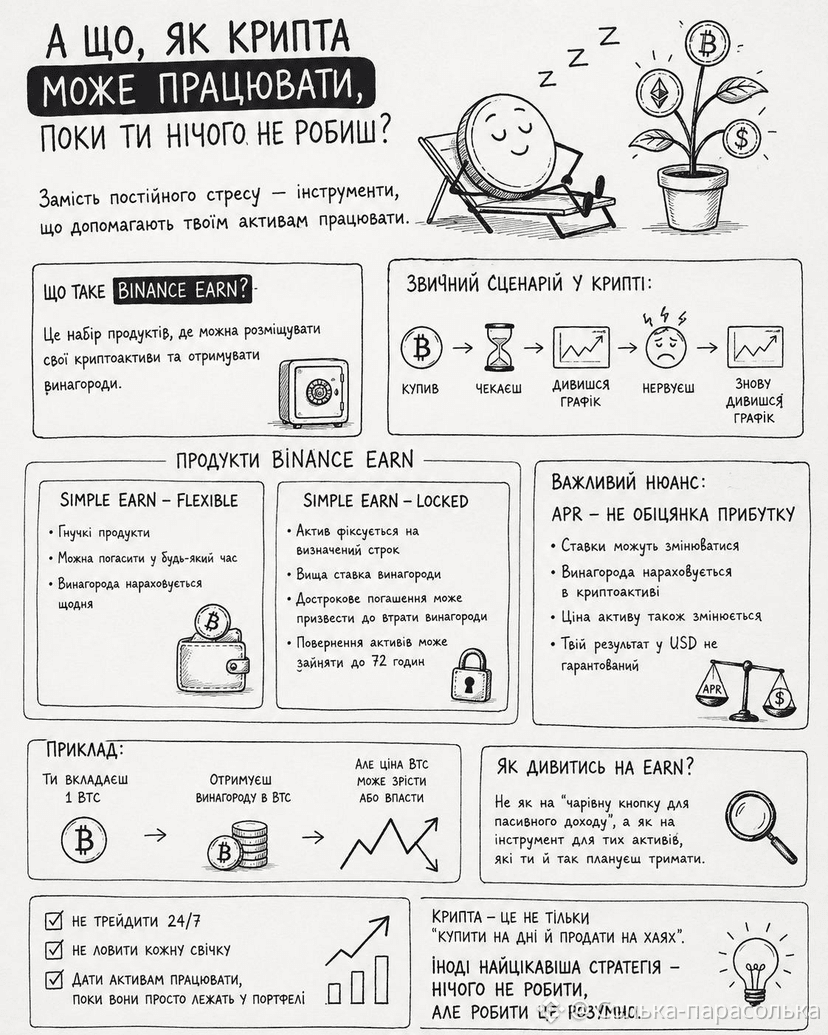
buy → wait → watch the chart → get nervous → watch the chart again 😅
But there’s another approach — Binance Earn.
It’s a set of products where you can place your crypto assets and receive rewards. For example, in Simple Earn there are Flexible products where assets can be redeemed without a fixed term, as well as Locked products with a specified duration. (Binance)
And here’s an important nuance that people often forget:
APR is not a profit promise.
Rates can change, and rewards are accrued in the crypto asset itself. That means if you receive, for example, BTC as a reward, it doesn’t automatically mean that your result in dollars will be the same — the price of BTC also changes. Binance explicitly states that the APR for many products may vary.
Even more interesting — Locked Earn.
There, the asset is locked for a certain period, and if you redeem early, you may lose the accrued rewards; in some cases, returning the assets can take up to 72 hours.
So I’d look at Earn not as a “magic button for passive income,” but as a tool for the assets that you were planning to hold anyway.
Don’t trade 24/7.
Don’t chase every candle.
3
3
597
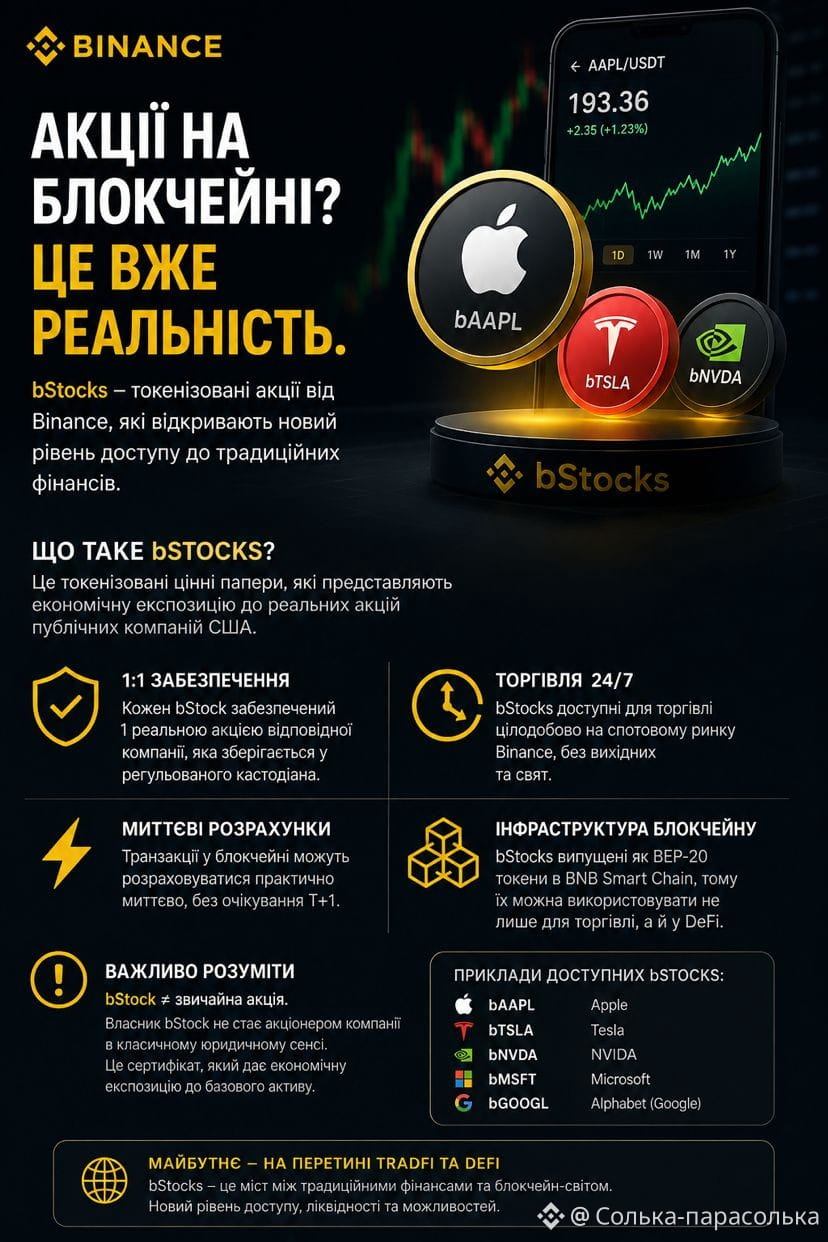
What if shares stop living by the rules of the stock market? 👀
Imagine: you want exposure to NVIDIA or Tesla shares, but instead of a classic brokerage account — a token on the blockchain.
This is no longer science fiction.
In 2026, Binance launched bStocks — tokenized securities that provide economic exposure to individual US stocks.
And here’s the most interesting part 👇
🔹 1 bStock is backed by 1 real share of the corresponding company, which is held by a regulated custodian.
🔹 bStocks can be traded 24/7 on Binance’s spot market — meaning you don’t have to wait for a traditional exchange to open.
🔹 Blockchain transactions can settle almost instantly, without the classic T+1 waiting period.
🔹 bStocks operate as BEP-20 tokens on BNB Smart Chain, so they could potentially be used not only for trading, but also in DeFi protocols.
But there’s an important nuance:
bStock ≠ a normal share.
An owner of a bStock does not become a shareholder of the company in the classical legal sense. It’s a certificate that provides economic exposure to the underlying asset.
And that’s where the most interesting part of the story begins.
TradFi gets a blockchain wrapper, while the crypto market gains access to assets from traditional finance.
135
#termmax @termmax #TermMax
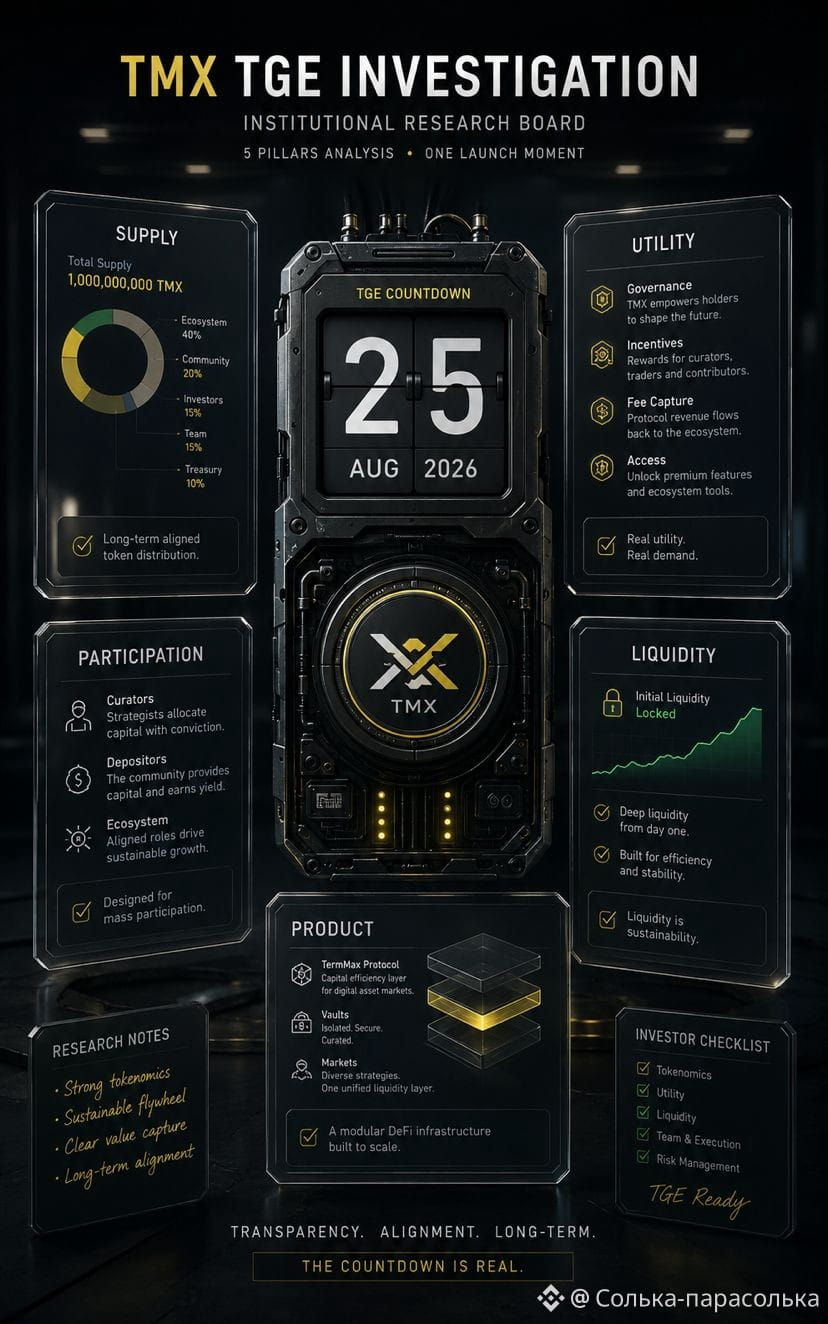
25 August will be more than just a TGE day for me, $TMX.
It will be the moment when you can check how well the entire system works.
I wouldn’t start the analysis with:
"How much will TMX cost?"
I would look at 5 things:
1. Supply
How does the initial circulation behave relative to the stated 1 billion supply?
2. Utility
Does governance and utility for $TMX find real use in the ecosystem?
3. Participation
What happens to TermMax users’ activity and the markets after the TGE?
4. Liquidity
How high-quality will the token’s liquidity be?
5. Product
Does TermMax continue to develop fixed-rate markets, vaults, leverage, and other mechanics?
Because the token is only one part of the system.
According to TermMax’s official materials, $TMX has a fixed supply of 1 billion and is intended for governance, staking rewards, and ecosystem incentives. (TS Finance Documentation)
So I don’t want to guess the price.
I want to see whether the token can be useful for the protocol that issued it.
That, in my opinion, is a much more interesting test.
$TMX
NFA. This is not financial advice.
#termmax @TermMax #TermMax
25 August will be more than just a TGE day for me, $TMX.
It will be the moment when you can check how well the entire system works.
I wouldn’t start the analysis with:
"How much will TMX cost?"
I would look at 5 things:
1. Supply
How does the initial circulation behave relative to the stated 1 billion supply?
2. Utility
Does governance and utility for $TMX find real use in the ecosystem?
3. Participation
What happens to TermMax users’ activity and the markets after the TGE?
4. Liquidity
How high-quality will the token’s liquidity be?
5. Product
Does TermMax continue to develop fixed-rate markets, vaults, leverage, and other mechanics?
Because the token is only one part of the system.
According to TermMax’s official materials, $TMX has a fixed supply of 1 billion and is intended for governance, staking rewards, and ecosystem incentives. (TS Finance Documentation)
So I don’t want to guess the price.
I want to see whether the token can be useful for the protocol that issued it.
That, in my opinion, is a much more interesting test.
$TMX
NFA. This is not financial advice.
219
#termmax @termmax #TermMax
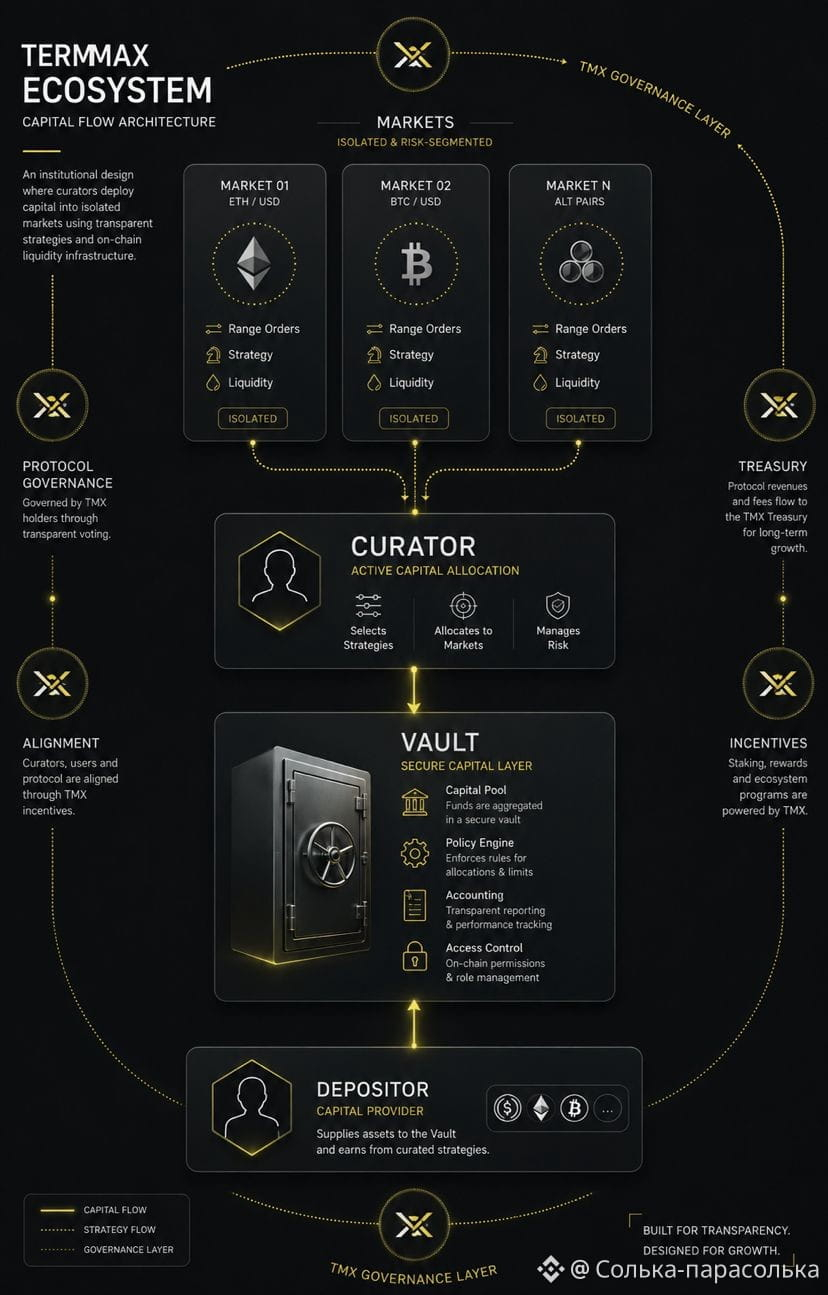
An unpopular opinion: the most interesting thing about TermMax might be that it’s not $TMX at all.
The thing that grabbed me more was the protocol’s mechanics.
In typical DeFi, we’re used to seeing:
deposit → pool → variable APY.
TermMax is built differently.
It uses FTs — Fixed-rate Tokens.
In essence, FT works like a zero-coupon bond:
you can buy it at a discount, and at maturity you receive the face value.
The difference between the purchase price and the redemption value creates a fixed return. (TS Finance Documentation)
And XT is the second part of the construction.
1 FT + 1 XT = 1 debt token.
For me, this is exactly what explains why TermMax doesn’t look like just another lending protocol.
It tries to make the interest rate a separate, tradeable component.
And if fixed-rate markets in DeFi really start to grow, this kind of infrastructure could be far more important than yet another token narrative.
$TMX just adds governance and incentives to this system.
#termmax @TermMax #TermMax
An unpopular opinion: the most interesting thing about TermMax might be that it’s not $TMX at all.
The thing that grabbed me more was the protocol’s mechanics.
In typical DeFi, we’re used to seeing:
deposit → pool → variable APY.
TermMax is built differently.
It uses FTs — Fixed-rate Tokens.
In essence, FT works like a zero-coupon bond:
you can buy it at a discount, and at maturity you receive the face value.
The difference between the purchase price and the redemption value creates a fixed return. (TS Finance Documentation)
And XT is the second part of the construction.
1 FT + 1 XT = 1 debt token.
For me, this is exactly what explains why TermMax doesn’t look like just another lending protocol.
It tries to make the interest rate a separate, tradeable component.
And if fixed-rate markets in DeFi really start to grow, this kind of infrastructure could be far more important than yet another token narrative.
$TMX just adds governance and incentives to this system.
82
·
--
Bullish
#termmax @termmax
#TermMax
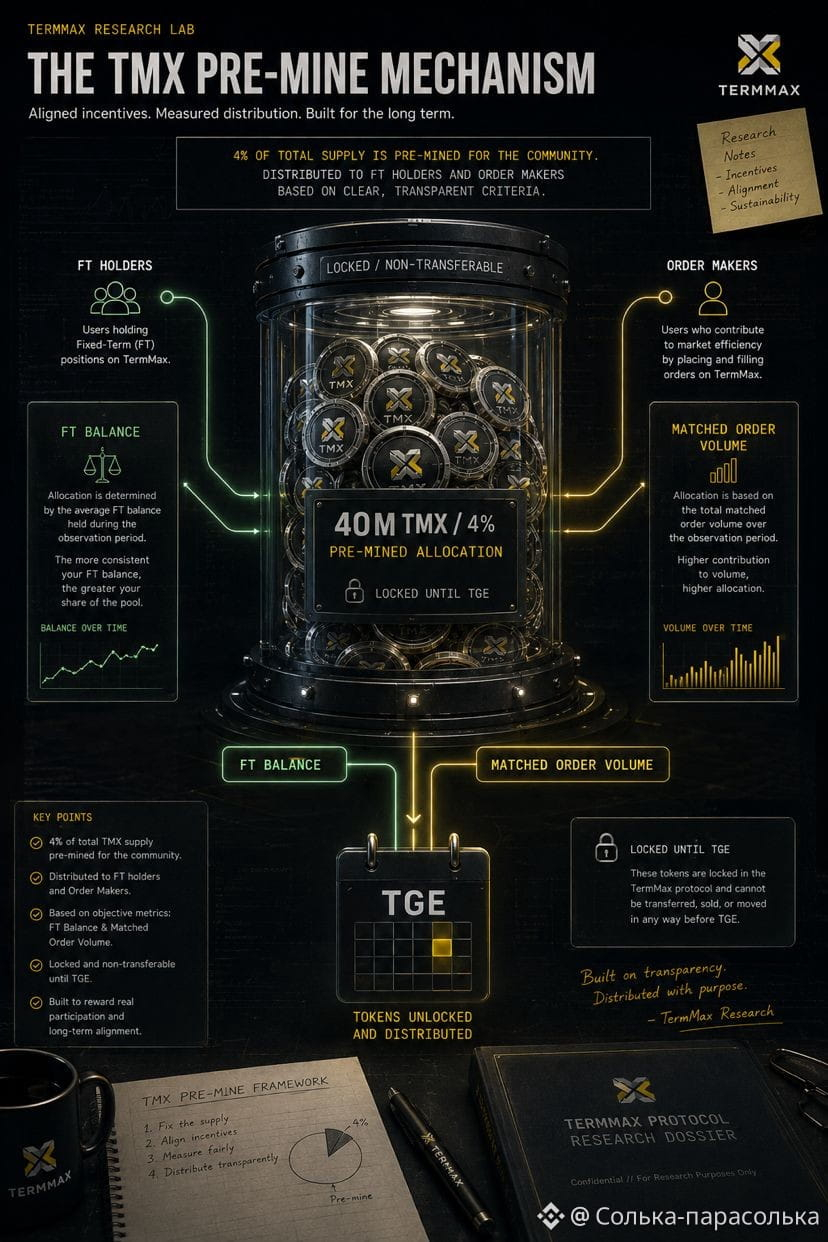
There is one detail in $TMX that’s easy to miss.
TMX Pre-mine.
And this is not just an “airdrop”.
According to TermMax documentation, the pre-mine has a total allocation of 40 million $TMX — 4% of the total supply.
But the rewards are tied to specific activity in the protocol.
For example:
FT holders accumulate pre-mined TMX daily depending on their FT balance.
Order Makers receive TMX depending on the volume of matched orders.
So the mechanism tries to reward not just the existence of a wallet, but participation in TermMax markets.
Another important point:
during the pre-mining campaign, $TMX is non-transferable.
According to the documentation, after the TGE it must be available for claim on a 1:1 basis, with no vesting.
And this is the most interesting part for me.
TermMax is essentially testing a simple idea:
can you reward liquidity + order activity instead of just handing out tokens?
That’s much more interesting than the word “airdrop”.
#termmax @TermMax
#TermMax
There is one detail in $TMX that’s easy to miss.
TMX Pre-mine.
And this is not just an “airdrop”.
According to TermMax documentation, the pre-mine has a total allocation of 40 million $TMX — 4% of the total supply.
But the rewards are tied to specific activity in the protocol.
For example:
FT holders accumulate pre-mined TMX daily depending on their FT balance.
Order Makers receive TMX depending on the volume of matched orders.
So the mechanism tries to reward not just the existence of a wallet, but participation in TermMax markets.
Another important point:
during the pre-mining campaign, $TMX is non-transferable.
According to the documentation, after the TGE it must be available for claim on a 1:1 basis, with no vesting.
And this is the most interesting part for me.
TermMax is essentially testing a simple idea:
can you reward liquidity + order activity instead of just handing out tokens?
That’s much more interesting than the word “airdrop”.
1
3
365
#termmax @termmax
#TermMax
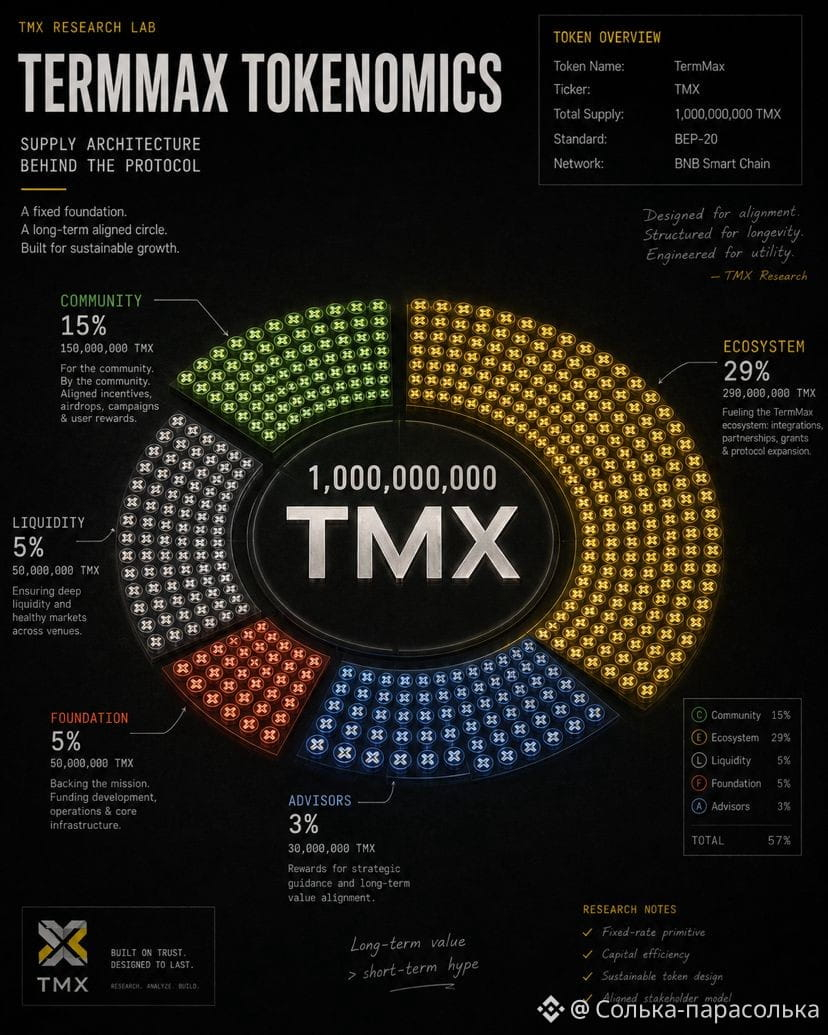
1,000,000,000 $TMX.
This number is easy to see in the tokenomics.
But a much more interesting question is:
where do these tokens get distributed at all?
According to TermMax’s official whitepaper, the maximum supply of $TMX is 1 billion and it has no inflation.
At the TGE, the initial circulation is stated to be approximately at the level of 20%.
But the distribution structure itself is more interesting than the nice number:
Community — 15%
Ecosystem — 29%
Liquidity Provision — 5%
Foundation — 5%
Advisors — 3%
So a significant part of the supply isn’t intended just to sit in wallets.
There is a community, ecosystem, liquidity, and long-term vesting mechanisms.
For me, this is a reminder:
don’t look at the supply only.
With a token, it’s important to know not only “how much exists,” but also:
who owns it,
when it gets unlocked,
what it is used for.
That’s why $TMX tokenomics should be read before the TGE, not after.
#termmax @TermMax
#TermMax
1,000,000,000 $TMX.
This number is easy to see in the tokenomics.
But a much more interesting question is:
where do these tokens get distributed at all?
According to TermMax’s official whitepaper, the maximum supply of $TMX is 1 billion and it has no inflation.
At the TGE, the initial circulation is stated to be approximately at the level of 20%.
But the distribution structure itself is more interesting than the nice number:
Community — 15%
Ecosystem — 29%
Liquidity Provision — 5%
Foundation — 5%
Advisors — 3%
So a significant part of the supply isn’t intended just to sit in wallets.
There is a community, ecosystem, liquidity, and long-term vesting mechanisms.
For me, this is a reminder:
don’t look at the supply only.
With a token, it’s important to know not only “how much exists,” but also:
who owns it,
when it gets unlocked,
what it is used for.
That’s why $TMX tokenomics should be read before the TGE, not after.
124
#bstockscis @BinanceCIS
#bStocksCIS
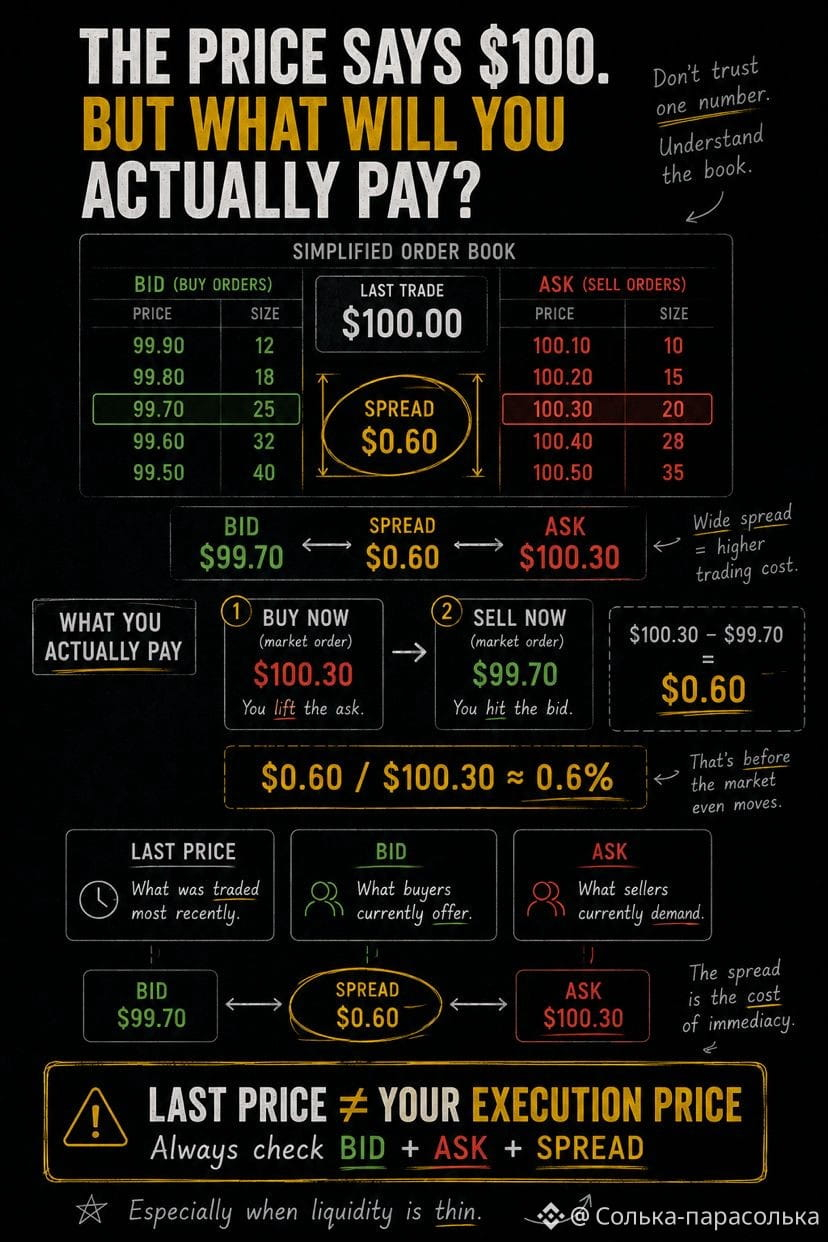
One of the easiest ways to misunderstand a bStock is to look at its price without checking the spread.
Imagine you see:
LAST PRICE: $100
Looks simple.
But the order book might actually show:
BID: $99.70
ASK: $100.30
So if you want to buy immediately, you're paying $100.30.
If you immediately sell, you're getting $99.70.
That $0.60 difference is the **spread**.
And it matters because the price shown on the screen isn't necessarily the price at which you can immediately enter or exit.
Here's the part many beginners miss:
A wider spread creates an immediate trading cost even before the market moves.
Example:
Buy at $100.30
Sell immediately at $99.70
Difference:
$0.60
That's a 0.6% gap relative to the buy price.
The company didn't lose 0.6%.
Your position didn't suddenly become 0.6% worse because of news.
You simply crossed the market from the ask to the bid.
This is why I think the spread is one of the first numbers worth checking before placing an order.
Especially outside the most liquid periods.
📌 My simple checklist:
LAST PRICE → What was the latest trade?
BID → What can I sell for now?
ASK → What can I buy for now?
SPREAD → What's the immediate gap between them?
The practical lesson:
Don't confuse the last traded price with your actual execution price.
When trading bStocks, the order book can tell you much more about the cost of entering a position than the headline price alone.
When you open a bStock, do you check the bid/ask spread before placing the order?
2
1
114
#termmax @termmax
#TermMax
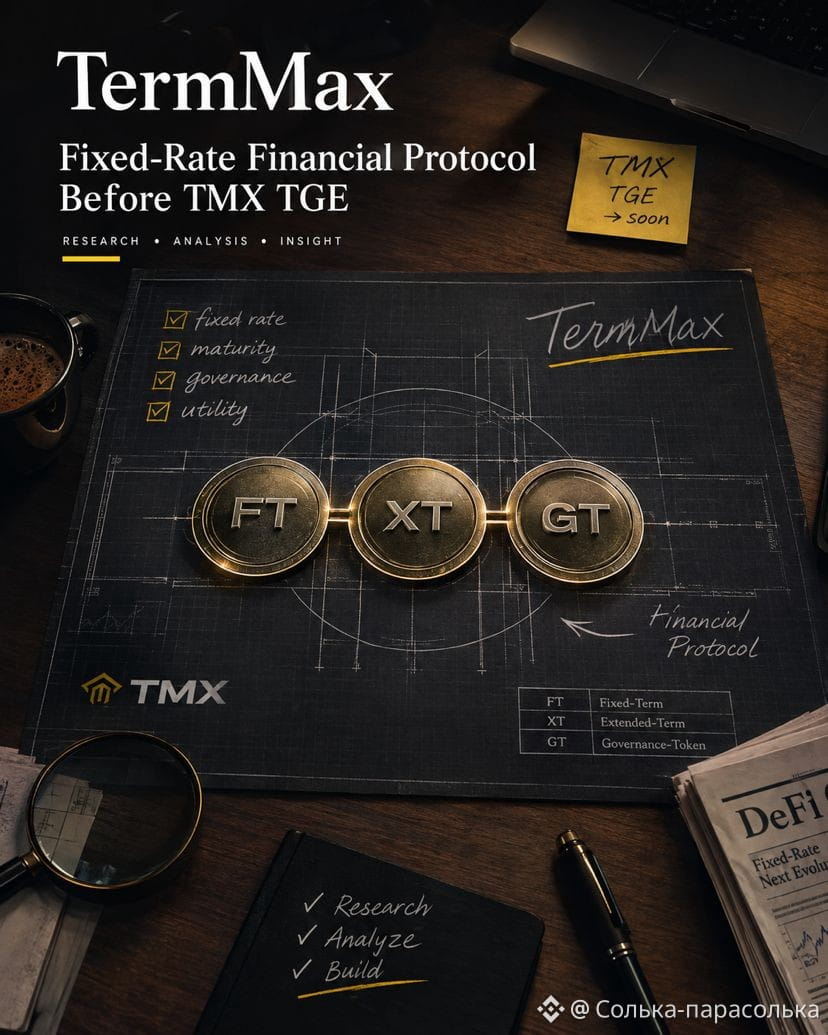
I started breaking down $TMX not with the question “what will the price be?”.
I started with something else:
Why does #TermMax even need its own token?
And that’s more interesting.
TermMax is built around a problem that #DeFi has had for a long time: interest rates on loans often change.
Today you borrowed at one rate — tomorrow the market is already different.
TermMax tries to move the fixed-rate financing logic into DeFi: the rate is fixed, and the position has a defined maturity period.
In the protocol’s mechanics, this is implemented through FT, XT, and GT — not just through a regular lending pool. (TS Finance Documentation)
And $TMX is already the economic layer around this protocol:
• governance
• staking rewards
• ecosystem incentives
And here’s what I like about this story:
first the product → then the token.
Not the other way around.
August 25 is planned for the TGE of $TMX.
So now it’s interesting to look not only at the token itself, but at what system it’s trying to bring together.
#TMX
#termmax @TermMax
#TermMax
I started breaking down $TMX not with the question “what will the price be?”.
I started with something else:
Why does #TermMax even need its own token?
And that’s more interesting.
TermMax is built around a problem that #DeFi has had for a long time: interest rates on loans often change.
Today you borrowed at one rate — tomorrow the market is already different.
TermMax tries to move the fixed-rate financing logic into DeFi: the rate is fixed, and the position has a defined maturity period.
In the protocol’s mechanics, this is implemented through FT, XT, and GT — not just through a regular lending pool. (TS Finance Documentation)
And $TMX is already the economic layer around this protocol:
• governance
• staking rewards
• ecosystem incentives
And here’s what I like about this story:
first the product → then the token.
Not the other way around.
August 25 is planned for the TGE of $TMX.
So now it’s interesting to look not only at the token itself, but at what system it’s trying to bring together.
#TMX
119
#bstockscis @BinanceCIS
#bStocksCIS
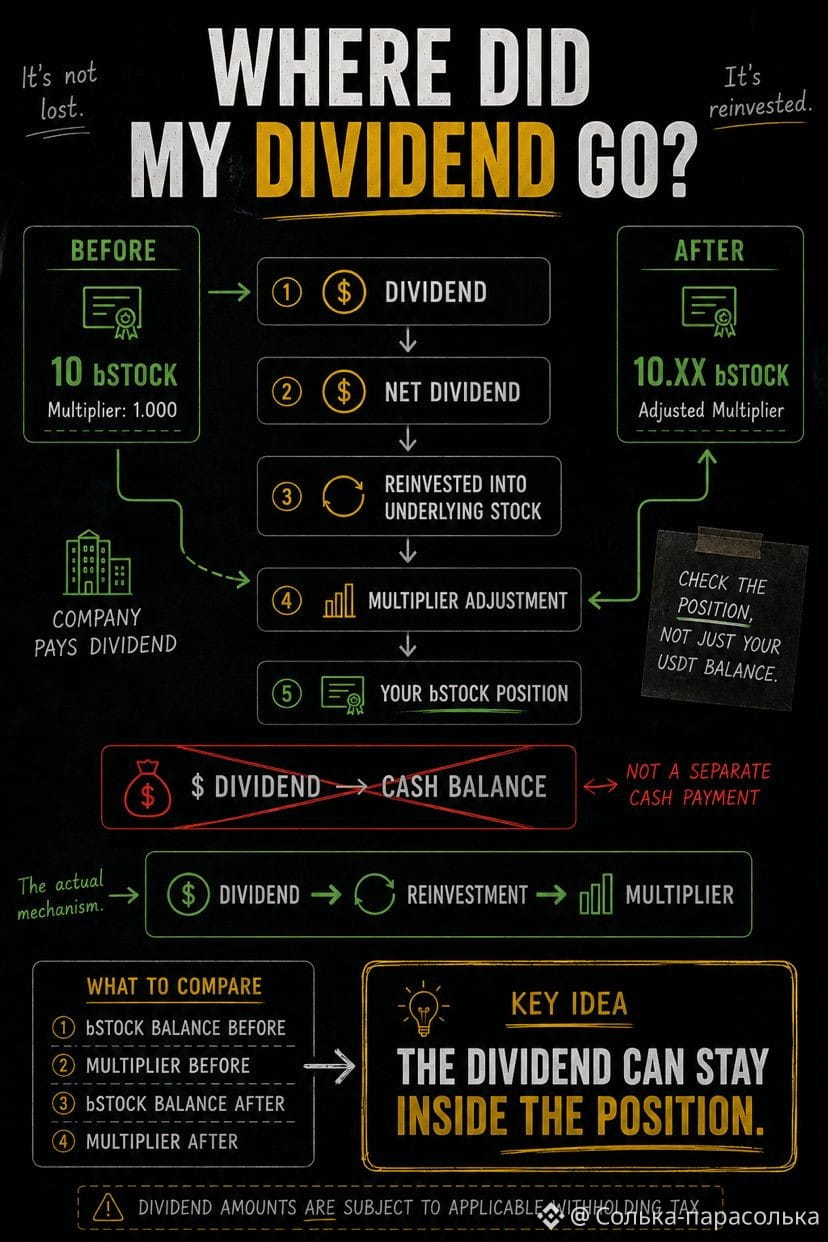
I thought the dividend on bStock should look something like this:
“Company paid $1 → I received $1 USDT.”
But bStocks work differently.
The dividend does not arrive as a separate cash payment.
When the underlying share pays a dividend, its net amount is reinvested into the underlying stock, and your position is adjusted via the Multiplier. Binance also notes that a dividend tax is applied before reinvestment. [oai_citation:0‡Binance](https://academy.binance.com/ky-KG/articles/what-are-bstocks-a-guide-to-tokenized-stocks-on-binance?utm_source=chatgpt.com)
So, for example:
You have
10 bStocks.
The underlying company pays a dividend.
You do not see:
+ $10 USDT
in your Spot balance.
Instead, the number of bStocks you economically represent changes.
This is an important difference from the usual understanding of dividends.
So after a dividend event, I wouldn’t look only at the token balance.
I would compare:
→ number of bStocks BEFORE;
→ Multiplier BEFORE;
→ number of bStocks AFTER;
→ Multiplier AFTER.
That’s the way to understand what actually changed in the position.
And here’s an interesting point.
For an investor, the result may seem almost unnoticeable: there’s no separate “dividend payment” on the balance.
But the economic effect is already accounted for in the position mechanics.
154
#bstockscis @BinanceCIS
#bStocksCIS
I thought for a long time that the main difference between market and limit orders is simply speed.
In reality, the difference is more interesting.
A market order says:
“Execute me now.”
A limit order says:
“Execute me only at this price or better.”
And that’s where the trade-off comes in.
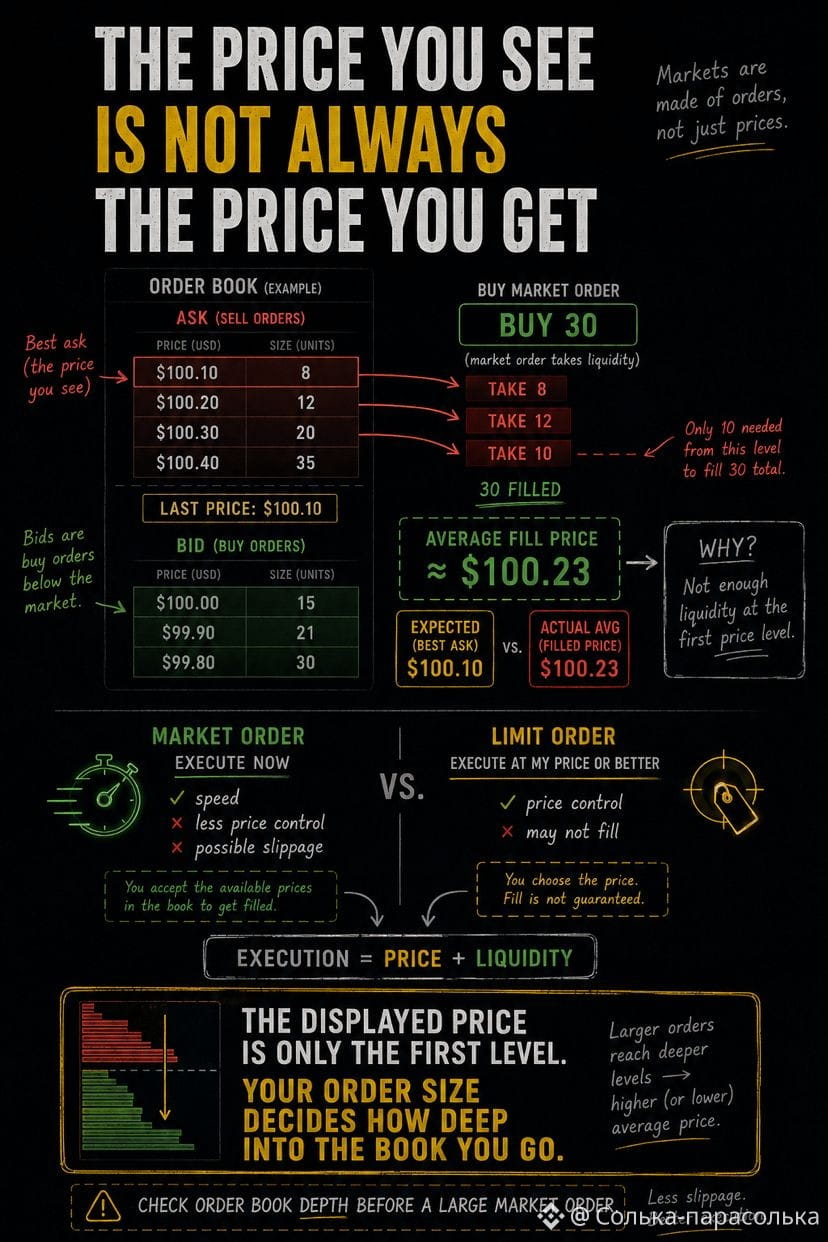
Let’s imagine that bStock is currently showing:
ASK: $100.10
You want to buy.
A market order may go through immediately, but if there aren’t enough sellers at $100.10, the next part of the order will go at $100.20, then $100.30, and so on.
So you get speed—but you lose control over the price.
A limit order at $100.10 works the other way around:
if there is a seller at $100.10—the trade will be executed.
if not—it will simply wait.
That’s the main trade-off:
MARKET
→ high likelihood of fast execution
→ less control over the price
LIMIT
→ more control over the price
→ no guarantee of execution
Binance explains that a market order can be filled across multiple levels of the order book if one level isn’t enough for the entire order. That’s exactly how slippage happens. [oai_citation:0‡Binance](https://academy.binance.com/ur-PK/glossary/market-order?utm_source=chatgpt.com)
My practical takeaway:
Before placing a market order, I would look not only at the last price.
I would check:
• the spread;
• the number of orders around the price;
• the size of your own order;
• how deep the order book is.
1
218
#bstockscis @BinanceCIS
#bStocksCIS
I initially thought too that 1 bStock = 1 share.
But there is a small detail here that’s easy to miss.
bStocks have a Multiplier.
And that means that looking only at the number of tokens is not enough.
For example:
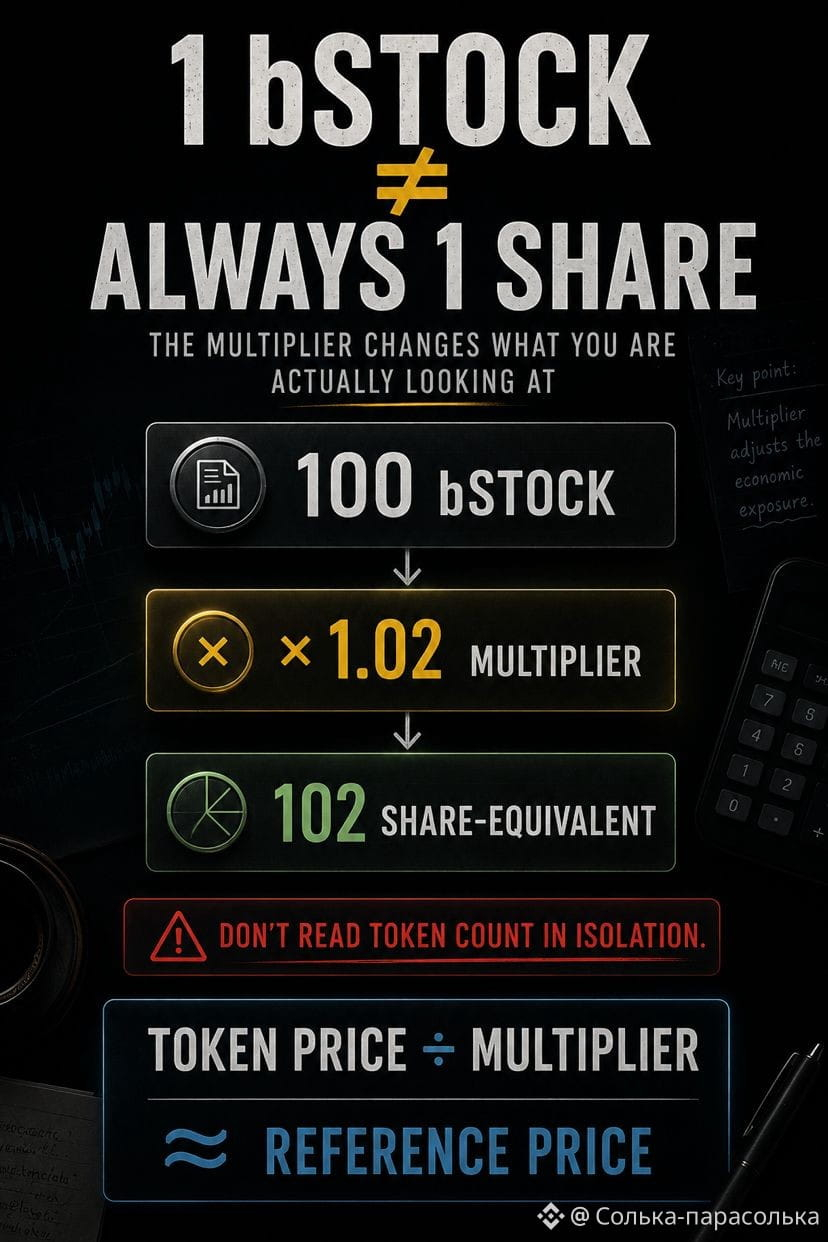
1 bStock
≠
always exactly 1 share.
The Multiplier can change due to corporate actions—such as dividends or a stock split.
That’s why Binance uses it to show the economic position relative to the underlying share.
This is where an interesting trap appears.
Imagine:
100 bStocks
Multiplier = 1.02
Then the economic equivalent is:
100 × 1.02 = 102
So the number of tokens and the number of underlying shares they economically represent—are not necessarily the same number.
And this changes how I would read the chart.
If you simply look at:
"I have 100 tokens"
—there isn’t enough information.
You also need to know:
• what the Multiplier is;
• what the token price is;
• what the underlying share price is;
• whether there were corporate actions.
There’s even a simple way to think about it:
Reference Price ≈ Token Price ÷ Multiplier.
That’s why two numbers can look weird when you compare them without taking the Multiplier into account. match bStock with the underlying share.
117
Verified
#bstockscis
#bStocksCIS
@BinanceCIS
THREE ETFs IN YOUR PORTFOLIO MAY END UP BEING ONE HIDDEN BET.
At first, I thought about diversification in a very simple way:
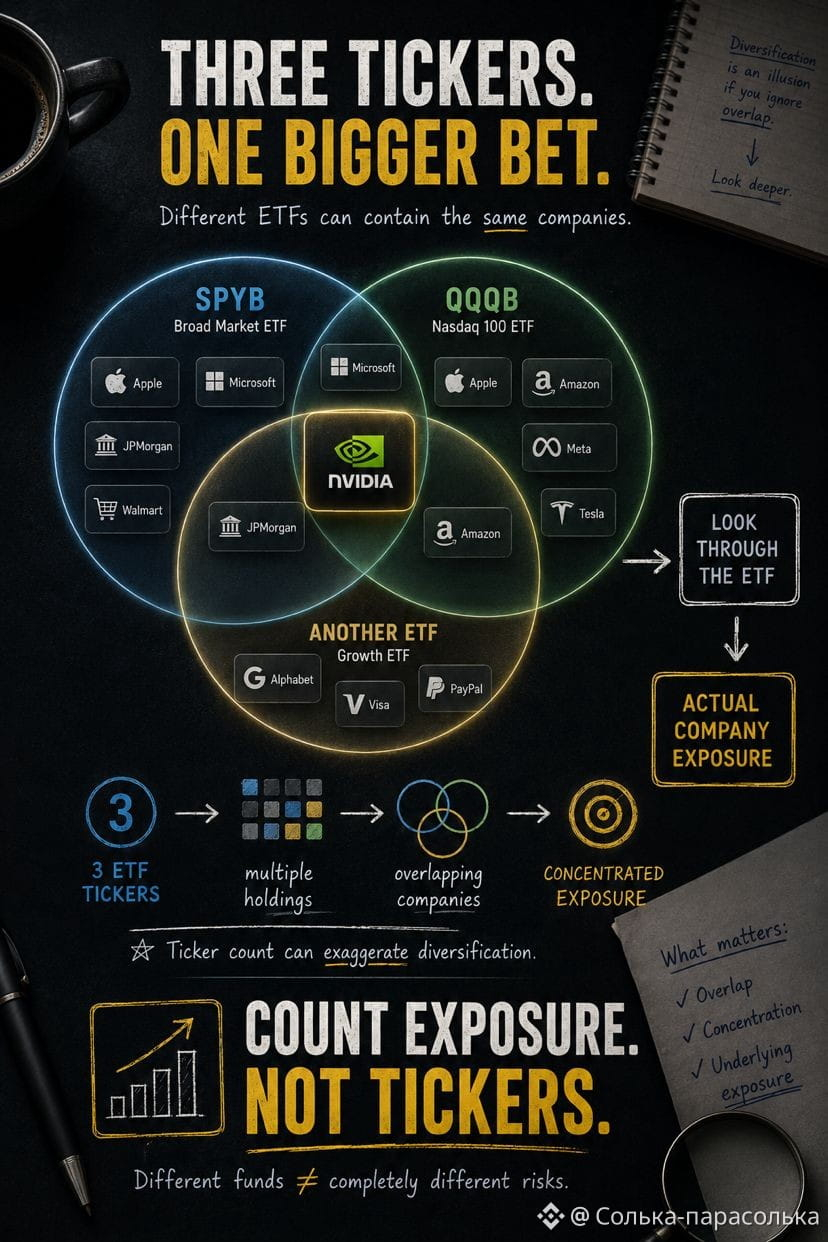
SPYB + QQQB + one more ETF = more different assets.
But tickers are not the same as independent exposures.
SPYB tracks the S&P 500.
QQQB provides exposure to the Nasdaq-100.
Their construction rules differ. But inside, the same big companies can overlap.
And this is where the trap is.
You can buy two different ETFs and psychologically treat it as two separate bets.
But at the level of a specific company, part of the risk can just duplicate.
Imagine:
SPYB → Company A
QQQB → Company A
You don’t have “two companies.”
You have double exposure to the same company through two different instruments.
So before adding another ETF, I would not ask the question:
“what else should I buy?”
I would ask: “which companies am I already effectively holding because of what I own?”
This is especially important for large tech companies: they may carry a significant weight across multiple indexes or ETFs at the same time.
My takeaway:
Number of tickers ≠ number of independent bets.
Sometimes diversification doesn’t start with a new asset, but with the fact that you finally break your old holdings down into their components.
91
#bstockscis
#bStocksCIS
@BinanceCIS
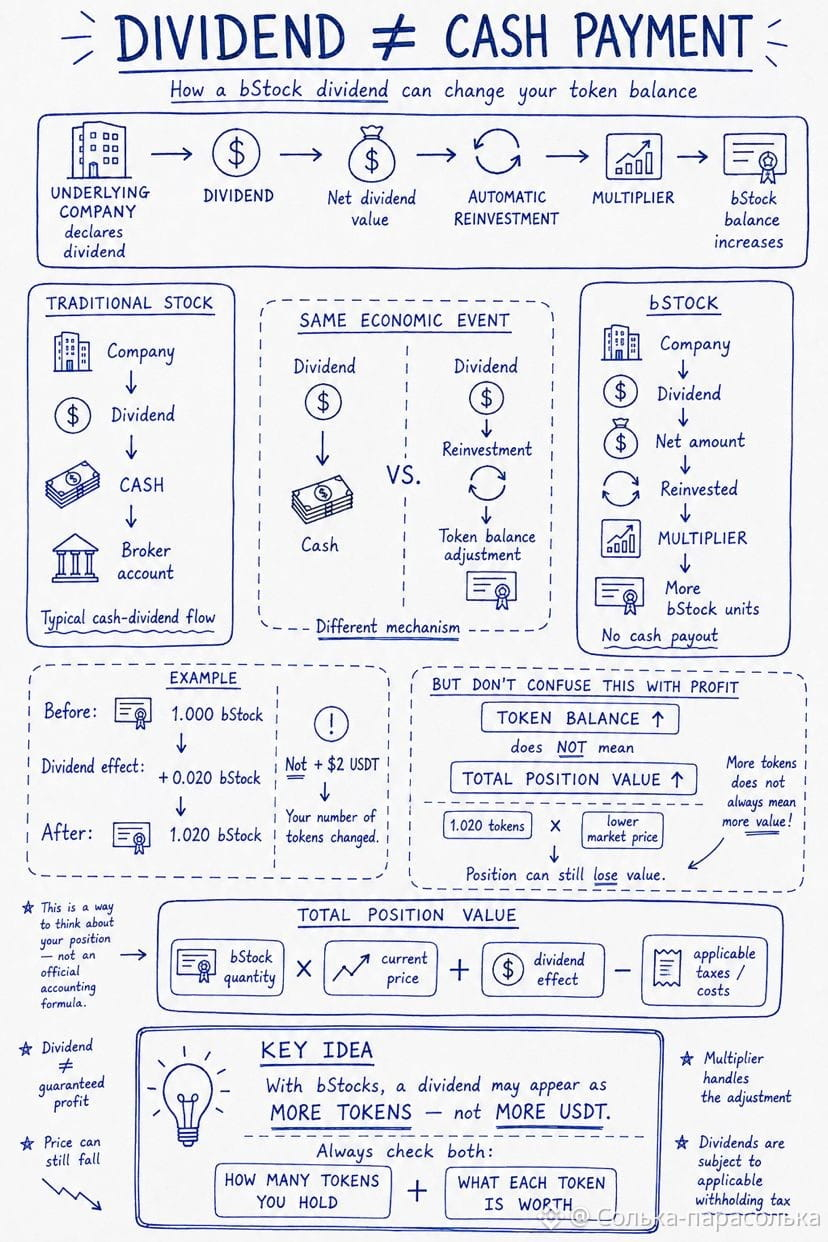
You can receive dividends from bStock — and not get any USDT at all.
At first, it sounds strange.
In a regular share, the logic is simple:
the company pays a dividend → the money comes to your brokerage account.
In bStocks, the mechanics are different.
If the underlying company pays a dividend, its net amount is not credited to you as cash.
It is automatically reinvested into the underlying share, and the number of your bStock increases via the Multiplier mechanism. Binance notes that before this, the appropriate tax withholding is applied. [oai_citation:0‡Binance Academy](https://academy.binance.com/ur-PK/articles/what-are-bstocks-a-guide-to-tokenized-stocks-on-binance?utm_source=chatgpt.com)
A conditional example:
Before:
1.000 bStock
The dividend gives an equivalent of:
+0.020 bStock
After:
1.020 bStock
So you did not see:
"+$2.00 USDT"
You saw a change in the number of tokens itself.
And here’s an important detail.
Don’t think of the token increase as “free money”.
It’s a way to reflect the economic impact of the dividend, not a profit guarantee.
The price of the bStock can still fall after that.
So I would separate two things:
DIVIDEND
→ increases your economic position via the Multiplier
PRICE
→ may move up or down
That’s why looking at only the token count isn’t enough.
69
#bstockscis
#bStocksCIS
@BinanceCIS
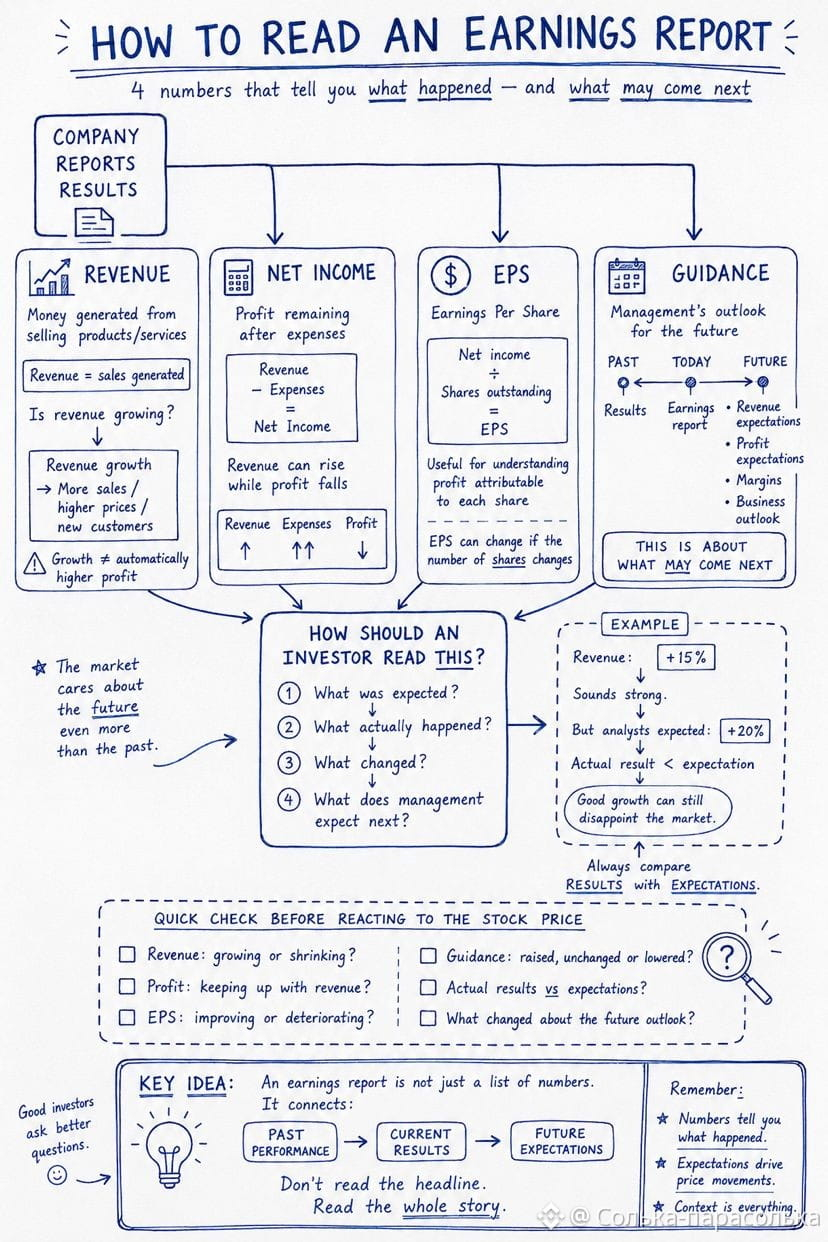
Earnings reports are not just about whether a company made money.
They are a snapshot of how the business performed — and clues about where it may be heading.
For an investor, four numbers are especially useful to understand.
**1. Revenue**
How much money did the company bring in?
If revenue is growing, the business is generally selling more products or services. But growth alone doesn't tell you whether that growth is profitable.
**2. Net income**
What remains after the company's expenses?
A company can have rising revenue while profits stay flat or even fall if costs are growing faster.
**3. EPS — Earnings Per Share**
This shows how much profit is attributable to each share.
It helps investors compare a company's profitability over time, although changes in the number of shares can affect EPS.
**4. Guidance**
What does management expect next?
This can include expectations for future revenue, profits, margins or other business metrics.
And here's where the numbers become useful:
Don't look at them in isolation.
Ask:
**What was expected?**
→ What actually happened?
→ What does management expect next?
For example:
Revenue grew 15%.
That sounds impressive.
But if investors expected 20%, the result may be disappointing.
This is why an earnings report should be read as a **story of expectations**, not just a collection of numbers.
📌 **Practical takeaway:**
When researching a company through Binance bStocks, start with these four questions:
• How fast is revenue growing?
• Is profit keeping up?
• What is happening to EPS?
• What does management expect next?
You don't need to understand every line of an earnings report to start thinking more critically about a business.
**Discussion:**
If revenue grows 20% but profit grows only 5%, what would you investigate next?
89
Log in to explore more content
Join global crypto users on Binance Square
⚡️ Get latest and useful information about crypto.
💬 Trusted by the world’s largest crypto exchange.
👍 Discover real insights from verified creators.
Email / Phone number