

MrYGame07
175 Posts

MrYGame07
Report
Block User
Open Trade
Occasional Trader
8.8 Years
28 Following
29 Followers
51 Liked
Posts
Portfolio
All
Quotes
Videos
PINNED
·
--
Bullish
$CELO Predicting the price of celo: 530 USDT/celo 😄😄😄
Wait and see if it reaches the target price!
{future}(CELOUSDT)
{spot}(CELOUSDT)
$CELO Predicting the price of celo: 530 USDT/celo 😄😄😄
Wait and see if it reaches the target price!
Wait and see if it reaches the target price!
1
62
·
--
$BNB $ETH How Binance was robbed of $5.9 billion.
$BNB $ETH How Binance was robbed of $5.9 billion.
2
389
·
--
🥲🥲🥲 Please tip me; I don't have money to eat. $BTC $BNB $TRX
🥲🥲🥲 Please tip me; I don't have money to eat. $BTC $BNB $TRX

22
·
--
Bearish
The exchange went through, but my crypto withdrawal was rejected. Is there any life left in this world? Is it safe? $BNB !$CELO
The exchange went through, but my crypto withdrawal was rejected. Is there any life left in this world? Is it safe? $BNB !$CELO
205
·
--
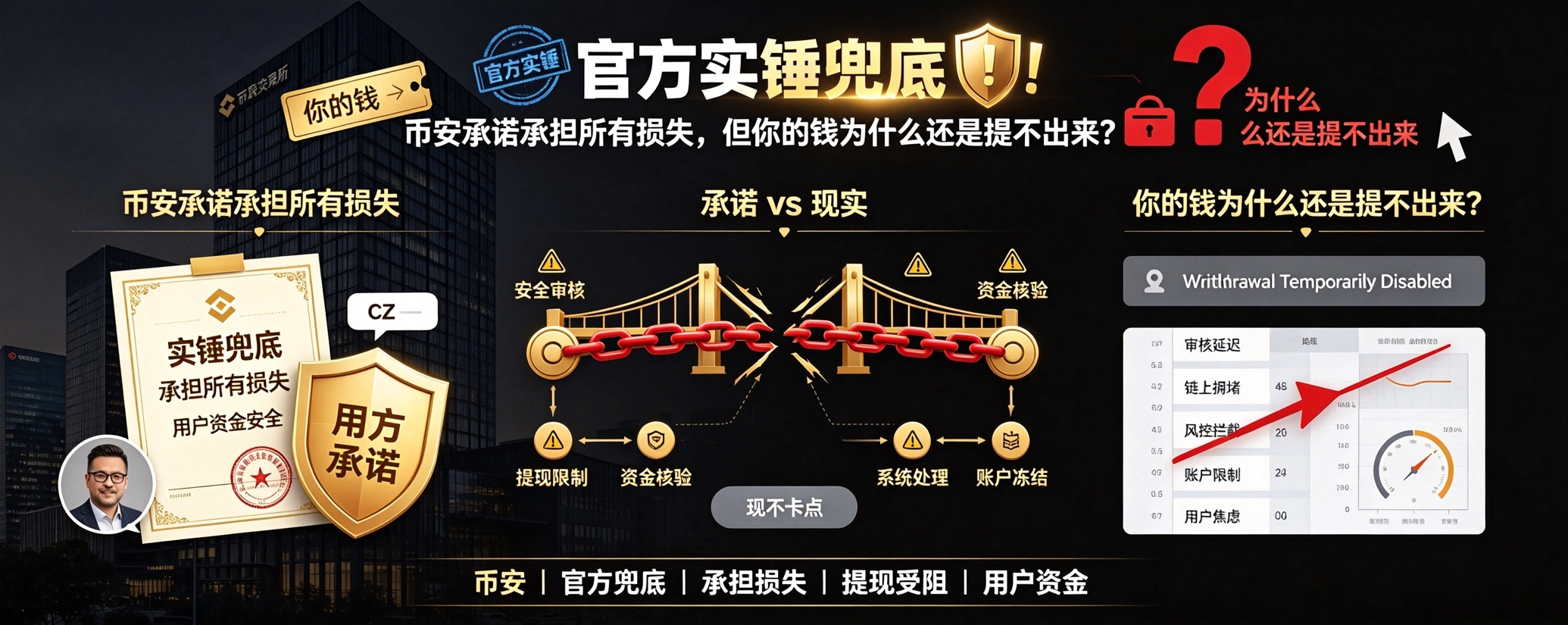
Article
Official confirmation: Binance will cover all losses—but why still can’t you withdraw your money?Official confirmation: Binance will cover all losses—but why still can’t you withdraw your money?
Guys, in response to the shocking news of this massive hack, Binance has finally issued its strongest official statement yet!
Look at this screenshot of the customer service pop-up. The key point is clear: “Binance will cover all losses.”
This simple sentence is worth its weight in gold in today’s jittery market. It shows that despite the major incident, Binance, as a leading exchange, still has principles and a sense of responsibility. Its promise to fully compensate users is the crucial reassurance the market needed, helping prevent an extreme, full-scale panic sell-off.
Official confirmation: Binance will cover all losses—but why still can’t you withdraw your money?
Official confirmation: Binance will cover all losses—but why still can’t you withdraw your money?
Guys, in response to the shocking news of this massive hack, Binance has finally issued its strongest official statement yet!
Look at this screenshot of the customer service pop-up. The key point is clear: “Binance will cover all losses.”
This simple sentence is worth its weight in gold in today’s jittery market. It shows that despite the major incident, Binance, as a leading exchange, still has principles and a sense of responsibility. Its promise to fully compensate users is the crucial reassurance the market needed, helping prevent an extreme, full-scale panic sell-off.
321
·
--

Article
Withdrawal stuck and the support bot giving you the runaround? Don’t panic—your Binance account isn’t that easy to “hack”!Withdrawal stuck and the support bot giving you the runaround? Don’t panic—your Binance account isn’t that easy to “hack”!
A group member just sent this screenshot, saying their withdrawal of 2.5 $CELO from Binance was stuck, with the status continuously showing “Processing.” The support bot replied, “Withdrawals are suspended; your funds are safe,” which scared them into thinking they’d been hit by a “crypto heist.”
With rumors flying over the past couple of days about “$5.6 billion stolen” and “assets wiped out,” I quickly checked the market and the announcements for them.
The conclusion is: Don’t scare yourself—this is simply routine on-chain maintenance.
Withdrawal stuck and the support bot giving you the runaround? Don’t panic—your Binance account isn’t that easy to “hack”!
Withdrawal stuck and the support bot giving you the runaround? Don’t panic—your Binance account isn’t that easy to “hack”!
A group member just sent this screenshot, saying their withdrawal of 2.5 $CELO from Binance was stuck, with the status continuously showing “Processing.” The support bot replied, “Withdrawals are suspended; your funds are safe,” which scared them into thinking they’d been hit by a “crypto heist.”
With rumors flying over the past couple of days about “$5.6 billion stolen” and “assets wiped out,” I quickly checked the market and the announcements for them.
The conclusion is: Don’t scare yourself—this is simply routine on-chain maintenance.
188
·
--

Article
Musk takes a sharp jab at Binance hack: “Every day is zero-day day.” Whose façade does it expose?Musk takes a sharp jab at Binance hack: “Every day is zero-day day.” Whose façade does it expose?
The multibillion-dollar Binance hack is still unfolding, and tech maverick Elon Musk has weighed in on X.
In the face of this epic cyberattack, Musk had just one cutting remark: “Everyday is zeroday.”
What is a zero-day vulnerability? It’s a critical flaw in a system that even its developers haven’t discovered yet—and for which no patch exists. Musk’s remark cuts straight through the illusions of the Web3 industry: don’t think your technology is impenetrable. In this space, getting hacked isn’t an accident—it’s business as usual.
Musk takes a sharp jab at Binance hack: “Every day is zero-day day.” Whose façade does it expose?
Musk takes a sharp jab at Binance hack: “Every day is zero-day day.” Whose façade does it expose?
The multibillion-dollar Binance hack is still unfolding, and tech maverick Elon Musk has weighed in on X.
In the face of this epic cyberattack, Musk had just one cutting remark: “Everyday is zeroday.”
What is a zero-day vulnerability? It’s a critical flaw in a system that even its developers haven’t discovered yet—and for which no patch exists. Musk’s remark cuts straight through the illusions of the Web3 industry: don’t think your technology is impenetrable. In this space, getting hacked isn’t an accident—it’s business as usual.
1
1k
·
--

Article
CZ vows full compensation! Tether urgently freezes nearly $1 billion—but has Binance’s “security underwear” been completely pulled off this time?CZ vows full compensation! Tether urgently freezes nearly $1 billion—but has Binance’s “security underwear” been completely pulled off this time?
Everyone, there’s a new development in the Binance hack. CZ just posted a statement himself: user funds are safe! He also thanked Tether and Circle for freezing funds so quickly (about $970 million and $820 million, respectively), and said clearly: “As a shareholder, I expect all user funds to be fully compensated.”
From a financial standpoint, there’s really no need to panic too much. The billions of dollars stolen are certainly a painful hit for a crypto giant the size of Binance, but they’re well within its ability to absorb. As long as the company steps in to cover the shortfall, this storm will eventually pass.
CZ vows full compensation! Tether urgently freezes nearly $1 billion—but has Binance’s “security underwear” been completely pulled off this time?
CZ vows full compensation! Tether urgently freezes nearly $1 billion—but has Binance’s “security underwear” been completely pulled off this time?
Everyone, there’s a new development in the Binance hack. CZ just posted a statement himself: user funds are safe! He also thanked Tether and Circle for freezing funds so quickly (about $970 million and $820 million, respectively), and said clearly: “As a shareholder, I expect all user funds to be fully compensated.”
From a financial standpoint, there’s really no need to panic too much. The billions of dollars stolen are certainly a painful hit for a crypto giant the size of Binance, but they’re well within its ability to absorb. As long as the company steps in to cover the shortfall, this storm will eventually pass.
3
3.1k
·
--
Bearish
$BNB Now is the best time to go short! Everyone, remember to enter!!!!!!
{future}(BNBUSDT)
$BNB Now is the best time to go short! Everyone, remember to enter!!!!!!
1
105
·
--
Bearish

大饼油条77
·
--
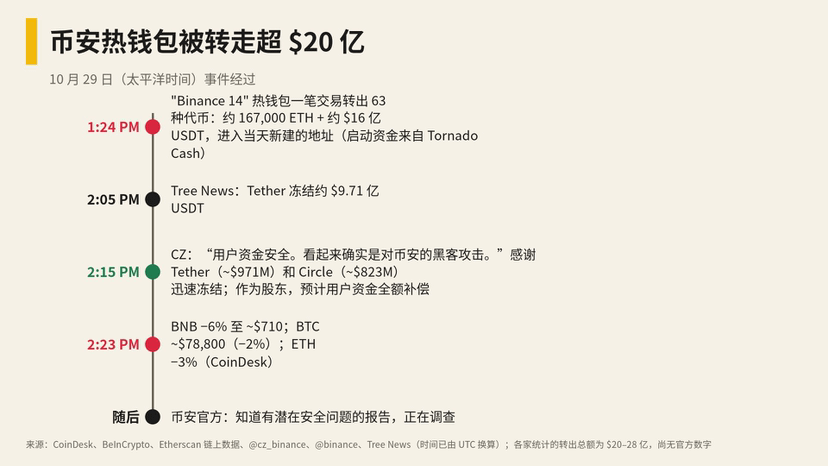
Binance is in trouble: over $2 billion was transferred out of its hot wallet, and CZ himself said, "It was indeed a hack of Binance." $BNB
In a single transaction, 63 tokens were transferred out of Binance's hot wallet, Binance 14: around 167,000 ETH, plus roughly $1.6 billion in USDT. A hot wallet is where an exchange keeps funds for users to withdraw. The receiving address was created that same day, and its initial funding came from Tornado Cash. On-chain estimates from various sources put the total amount transferred between $2.5 billion and $2.8 billion—already more than the roughly $1.5 billion stolen from Bybit in February 2025.
Tether first froze around $971 million in USDT, then Circle froze around $823 million in USDC, for a combined total of roughly $1.8 billion. BNB fell 6% in an hour to around $710, BTC dropped to 78,800, and ETH fell 3%. Binance's official account said only: "We are aware of reports of a potential security issue and are investigating."
CZ was more direct. He said user funds were safe, noted that he had stopped running Binance long ago, but added that as a shareholder, he expected all users to be made whole.
·
--
Article
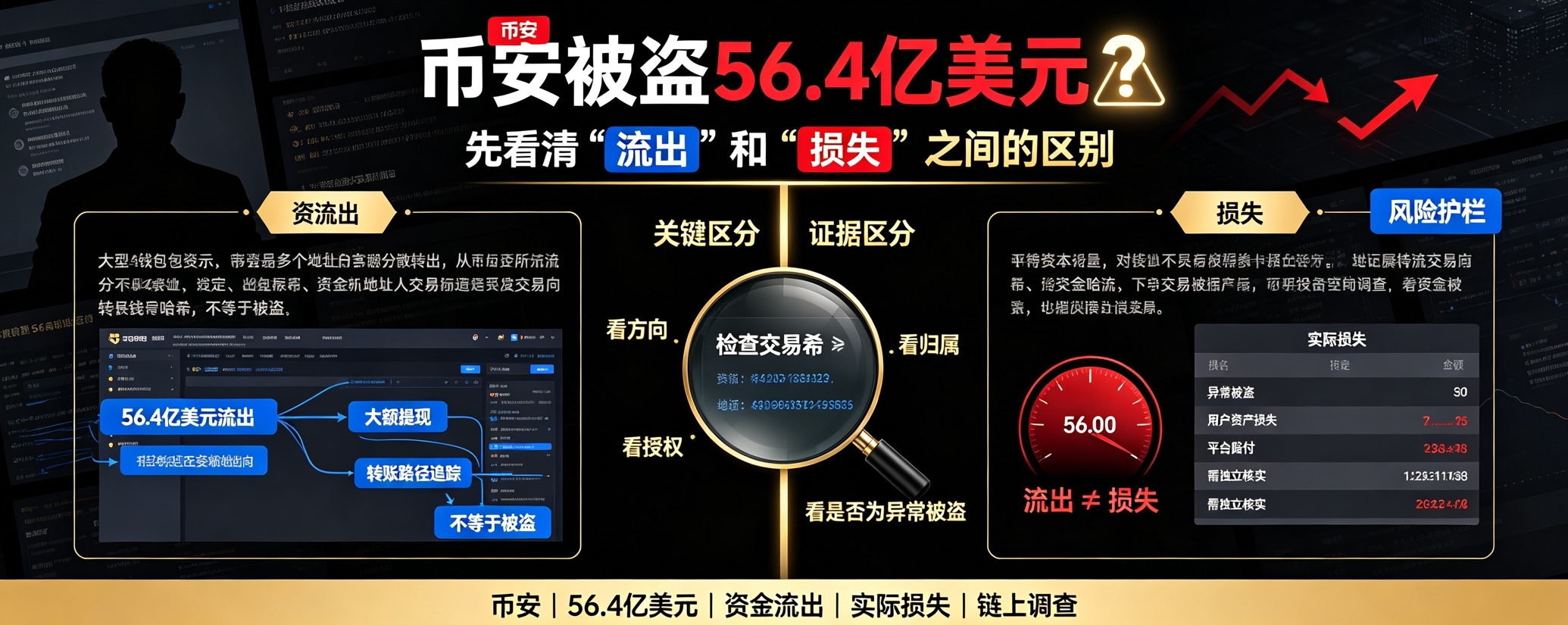
Was $5.64 billion stolen from Binance? First, understand the difference between “outflows” and “losses”Was $5.64 billion stolen from Binance? First, understand the difference between “outflows” and “losses”
The on-chain data is indeed explosive. The Arkham-labeled wallet “binance-hacker-1029” shows that approximately $5.64 billion to $5.7 billion in assets flowed out of Binance-related wallets across multiple chains, including Ethereum, Bitcoin, and Tron. CoinDesk went straight for the headline “The Largest Cryptocurrency Hack in History.”
But “outflows” don’t necessarily mean “taken and unrecoverable.” Right now, there are three things worth paying attention to:
First, stablecoin issuers have already taken action—and they didn’t waste any time.
Was $5.64 billion stolen from Binance? First, understand the difference between “outflows” and “losses”
Was $5.64 billion stolen from Binance? First, understand the difference between “outflows” and “losses”
The on-chain data is indeed explosive. The Arkham-labeled wallet “binance-hacker-1029” shows that approximately $5.64 billion to $5.7 billion in assets flowed out of Binance-related wallets across multiple chains, including Ethereum, Bitcoin, and Tron. CoinDesk went straight for the headline “The Largest Cryptocurrency Hack in History.”
But “outflows” don’t necessarily mean “taken and unrecoverable.” Right now, there are three things worth paying attention to:
First, stablecoin issuers have already taken action—and they didn’t waste any time.
2
1.1k
·
--

Article
Top Silicon Valley VC YC makes a major statement: Crypto’s “killer app” has changed—and this is the main trend behind the next wave of fortunes!Top Silicon Valley VC YC makes a major statement: Crypto’s “killer app” has changed—and this is the main trend behind the next wave of fortunes!
Guys, Silicon Valley’s most legendary startup accelerator, Y Combinator (YC), just published a Crypto Request for Startups, pointing the crypto world straight toward what’s next!
YC opens with an extremely paradigm-shifting definition: Over the past year, crypto adoption was driven for the first time by “institutions” rather than “retail investors.” People used to trade crypto to speculate and get rich quick; now institutions are entering the market to meet real needs—hedging risk and moving funds across borders.
Top Silicon Valley VC YC makes a major statement: Crypto’s “killer app” has changed—and this is the main trend behind the next wave of fortunes!
Top Silicon Valley VC YC makes a major statement: Crypto’s “killer app” has changed—and this is the main trend behind the next wave of fortunes!
Guys, Silicon Valley’s most legendary startup accelerator, Y Combinator (YC), just published a Crypto Request for Startups, pointing the crypto world straight toward what’s next!
YC opens with an extremely paradigm-shifting definition: Over the past year, crypto adoption was driven for the first time by “institutions” rather than “retail investors.” People used to trade crypto to speculate and get rich quick; now institutions are entering the market to meet real needs—hedging risk and moving funds across borders.
209
·
--

Article
FOMC holds steady: Don’t be fooled by the apparent good news—the two dissenting votes for a rate hike are the real warning signFOMC holds steady: Don’t be fooled by the apparent good news—the two dissenting votes for a rate hike are the real warning sign
This morning’s FOMC decision is out: interest rates were held steady at 3.75%-4%, in line with market expectations. After the announcement, $BTC briefly rebounded, climbing back above the $81,000 level.
At first glance, this may seem like a “no surprises” all-clear for risk assets. But if you focus only on the conclusion, you’ll likely get burned by this week’s market action. The statement contains two unmistakable warning signs.
The first warning sign: two rare dissenting votes in favor of a rate hike
The vote was 10–2 this time, rather than unanimous as before. Fed Governor Cook and Cleveland Fed President Hammack dissented, arguing for “another 25-basis-point rate hike,” not a cut. Cook, a centrist, broke ranks for the first time, sending a very clear signal: the committee’s concerns about inflation are far more serious than the market thinks. A pause doesn’t mean the tightening cycle is over.
FOMC holds steady: Don’t be fooled by the apparent good news—the two dissenting votes for a rate hike are the real warning sign
FOMC holds steady: Don’t be fooled by the apparent good news—the two dissenting votes for a rate hike are the real warning sign
This morning’s FOMC decision is out: interest rates were held steady at 3.75%-4%, in line with market expectations. After the announcement, $BTC briefly rebounded, climbing back above the $81,000 level.
At first glance, this may seem like a “no surprises” all-clear for risk assets. But if you focus only on the conclusion, you’ll likely get burned by this week’s market action. The statement contains two unmistakable warning signs.
The first warning sign: two rare dissenting votes in favor of a rate hike
The vote was 10–2 this time, rather than unanimous as before. Fed Governor Cook and Cleveland Fed President Hammack dissented, arguing for “another 25-basis-point rate hike,” not a cut. Cook, a centrist, broke ranks for the first time, sending a very clear signal: the committee’s concerns about inflation are far more serious than the market thinks. A pause doesn’t mean the tightening cycle is over.
179
·
--

Article
Did Justin Sun “buy” $51.25 million worth of PEPE? On-chain data tells a different storyDid Justin Sun “buy” $51.25 million worth of PEPE? On-chain data tells a different story
$PEPE
Here’s the takeaway: PEPE’s 15% rally was driven by sentiment around the name “Justin Sun,” not by a publicly confirmed market buy. Arkham’s data is real, but there’s a gap between “holding” and “buying”—an internal transfer from Poloniex.
What actually happened on-chain? Let's break down the numbers.
The wallet Arkham labels as associated with Justin Sun currently holds 11.85 trillion PEPE tokens, or 2.82% of the total supply, worth approximately $51.25 million. The tokens were withdrawn from Poloniex in two transactions on October 17 and 26, at a combined value of approximately $48.76 million. The average withdrawal price was $0.000004114. At the current price of $0.00000498, the unrealized gain is about 21%.
Did Justin Sun “buy” $51.25 million worth of PEPE? On-chain data tells a different story
Did Justin Sun “buy” $51.25 million worth of PEPE? On-chain data tells a different story
$PEPE
Here’s the takeaway: PEPE’s 15% rally was driven by sentiment around the name “Justin Sun,” not by a publicly confirmed market buy. Arkham’s data is real, but there’s a gap between “holding” and “buying”—an internal transfer from Poloniex.
What actually happened on-chain? Let's break down the numbers.
The wallet Arkham labels as associated with Justin Sun currently holds 11.85 trillion PEPE tokens, or 2.82% of the total supply, worth approximately $51.25 million. The tokens were withdrawn from Poloniex in two transactions on October 17 and 26, at a combined value of approximately $48.76 million. The average withdrawal price was $0.000004114. At the current price of $0.00000498, the unrealized gain is about 21%.
154
·
--
Article
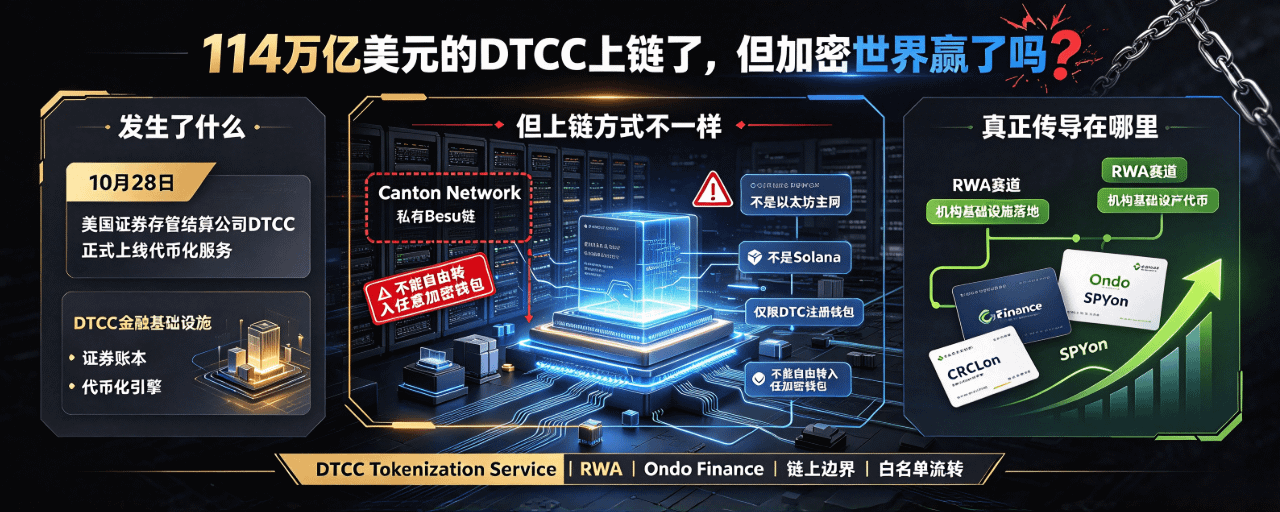
DTCC's $114 trillion has gone on-chain, but did crypto win?DTCC's $114 trillion has gone on-chain, but did crypto win?
Here's the verdict: The launch of DTCC's Tokenization Service is the most significant implementation of blockchain in the history of traditional finance, but it also offers a sober correction to crypto-native narratives. Its scale far exceeds that of the vast majority of on-chain projects, but the way it operates is a far cry from what many crypto believers imagine when they talk about “Wall Street embracing crypto.”
What happened? Let's break down the numbers.
On October 28, the Depository Trust & Clearing Corporation (DTCC) officially launched its Tokenization Service. The first batch supports 34 securities, including some large-cap stocks in the Russell 1000 Index, ETFs, and U.S. Treasury bills, notes, and bonds. These tokens are fully backed 1:1 by securities held in custody by DTCC subsidiary DTC, and holders enjoy the exact same legal rights and economic entitlements as they would with the underlying securities.
DTCC's $114 trillion has gone on-chain, but did crypto win?
DTCC's $114 trillion has gone on-chain, but did crypto win?
Here's the verdict: The launch of DTCC's Tokenization Service is the most significant implementation of blockchain in the history of traditional finance, but it also offers a sober correction to crypto-native narratives. Its scale far exceeds that of the vast majority of on-chain projects, but the way it operates is a far cry from what many crypto believers imagine when they talk about “Wall Street embracing crypto.”
What happened? Let's break down the numbers.
On October 28, the Depository Trust & Clearing Corporation (DTCC) officially launched its Tokenization Service. The first batch supports 34 securities, including some large-cap stocks in the Russell 1000 Index, ETFs, and U.S. Treasury bills, notes, and bonds. These tokens are fully backed 1:1 by securities held in custody by DTCC subsidiary DTC, and holders enjoy the exact same legal rights and economic entitlements as they would with the underlying securities.
205
·
--

Article
Microsoft’s Q1 earnings report is due after the market closes tonight: AI gains are translating into revenue, but the market wants more than just results—it wants to know how fast they’re growing.#微软财报能否兑现ai红利 Microsoft’s Q1 earnings report is due after the market closes tonight: AI gains are translating into revenue, but the market wants more than just results—it wants to know how fast they’re growing.
Bottom line: Azure and Copilot are genuinely converting into revenue, and there’s a good chance results will beat expectations. But whether this earnings report can push the stock higher won’t depend on how much Microsoft earned in Q1; it will depend on management’s tone on FY2027 capital expenditures and margins.
Here are the market consensus estimates: FY2026 Q1 revenue of $90.62 billion, up 16.7% year over year; adjusted EPS of $4.71, up 14%—which would mark Microsoft’s slowest earnings growth in nearly two years, while revenue growth would slow for a second consecutive quarter. The numbers themselves aren’t bad, but the fact that growth is slowing has already weighed on the stock ahead of the earnings report, pulling it back from its October 13 high of $551 to around $531.
Microsoft’s Q1 earnings report is due after the market closes tonight: AI gains are translating into revenue, but the market wants more than just results—it wants to know how fast they’re growing.
#微软财报能否兑现ai红利 Microsoft’s Q1 earnings report is due after the market closes tonight: AI gains are translating into revenue, but the market wants more than just results—it wants to know how fast they’re growing.
Bottom line: Azure and Copilot are genuinely converting into revenue, and there’s a good chance results will beat expectations. But whether this earnings report can push the stock higher won’t depend on how much Microsoft earned in Q1; it will depend on management’s tone on FY2027 capital expenditures and margins.
Here are the market consensus estimates: FY2026 Q1 revenue of $90.62 billion, up 16.7% year over year; adjusted EPS of $4.71, up 14%—which would mark Microsoft’s slowest earnings growth in nearly two years, while revenue growth would slow for a second consecutive quarter. The numbers themselves aren’t bad, but the fact that growth is slowing has already weighed on the stock ahead of the earnings report, pulling it back from its October 13 high of $551 to around $531.
425
·
--

Article
Opera joins Tether’s FASE Foundation—its significance for CELO is greater than it may seemOpera joins Tether’s FASE Foundation—its significance for CELO is greater than it may seem
First, the takeaway: This news itself is not a price catalyst, but it confirms one thing—Opera and MiniPay are moving from being “an app in the Celo ecosystem” to becoming an indispensable part of Tether’s global stablecoin infrastructure. For $CELO , this signals a rise in ecosystem standing, not fuel for a short-term rally.
What is FASE, and why does Opera matter in it?
On October 26, Tether launched the FASE Foundation (Financial Access and Systemic Empowerment) in Switzerland. It is a nonprofit, multi-stakeholder organization built around four pillars: financial security, financial freedom and inclusion, access to basic resources, and responsible AI and robotics. There are 11 founding stakeholders, including Tether, Anchorage Digital, Kraken, Bybit, Chainalysis, Opera, and the Solana Foundation.
Opera joins Tether’s FASE Foundation—its significance for CELO is greater than it may seem
Opera joins Tether’s FASE Foundation—its significance for CELO is greater than it may seem
First, the takeaway: This news itself is not a price catalyst, but it confirms one thing—Opera and MiniPay are moving from being “an app in the Celo ecosystem” to becoming an indispensable part of Tether’s global stablecoin infrastructure. For $CELO , this signals a rise in ecosystem standing, not fuel for a short-term rally.
What is FASE, and why does Opera matter in it?
On October 26, Tether launched the FASE Foundation (Financial Access and Systemic Empowerment) in Switzerland. It is a nonprofit, multi-stakeholder organization built around four pillars: financial security, financial freedom and inclusion, access to basic resources, and responsible AI and robotics. There are 11 founding stakeholders, including Tether, Anchorage Digital, Kraken, Bybit, Chainalysis, Opera, and the Solana Foundation.
192
·
--
Verified

Article
Google’s Q3 earnings after the bell tonight: Cloud is likely to beat expectations, but the real make-or-break factor is its spending guidance#谷歌财报能否守住基本盘
Bottom line: Revenue and the cloud business itself are more likely than not to beat expectations. But whether this report sends the stock higher after hours depends on management’s stance on full-year 2026 capital expenditures—not how much it earned in Q3.
Here’s the consensus: Q3 revenue of about $127.8 billion, up roughly 25% year over year, and EPS of around $3. Ad revenue is expected to come in at $83.2–84.4 billion, up 12.5%–13% year over year. Those are strong numbers, but they’re no longer the main point of contention tonight.
First up: Cloud, the most likely source of a positive surprise
Google Cloud posted revenue of $24.8 billion last quarter, up 82% year over year. Its operating margin rose from 20.7% to 35.6%, while its backlog surged to $514 billion. The company expects slightly more than half of that backlog to convert into revenue within 24 months. That means revenue visibility for the cloud business isn’t deteriorating—it’s strengthening.
Google’s Q3 earnings after the bell tonight: Cloud is likely to beat expectations, but the real make-or-break factor is its spending guidance
#谷歌财报能否守住基本盘
Bottom line: Revenue and the cloud business itself are more likely than not to beat expectations. But whether this report sends the stock higher after hours depends on management’s stance on full-year 2026 capital expenditures—not how much it earned in Q3.
Here’s the consensus: Q3 revenue of about $127.8 billion, up roughly 25% year over year, and EPS of around $3. Ad revenue is expected to come in at $83.2–84.4 billion, up 12.5%–13% year over year. Those are strong numbers, but they’re no longer the main point of contention tonight.
First up: Cloud, the most likely source of a positive surprise
Google Cloud posted revenue of $24.8 billion last quarter, up 82% year over year. Its operating margin rose from 20.7% to 35.6%, while its backlog surged to $514 billion. The company expects slightly more than half of that backlog to convert into revenue within 24 months. That means revenue visibility for the cloud business isn’t deteriorating—it’s strengthening.
2
1.2k
·
--
Article
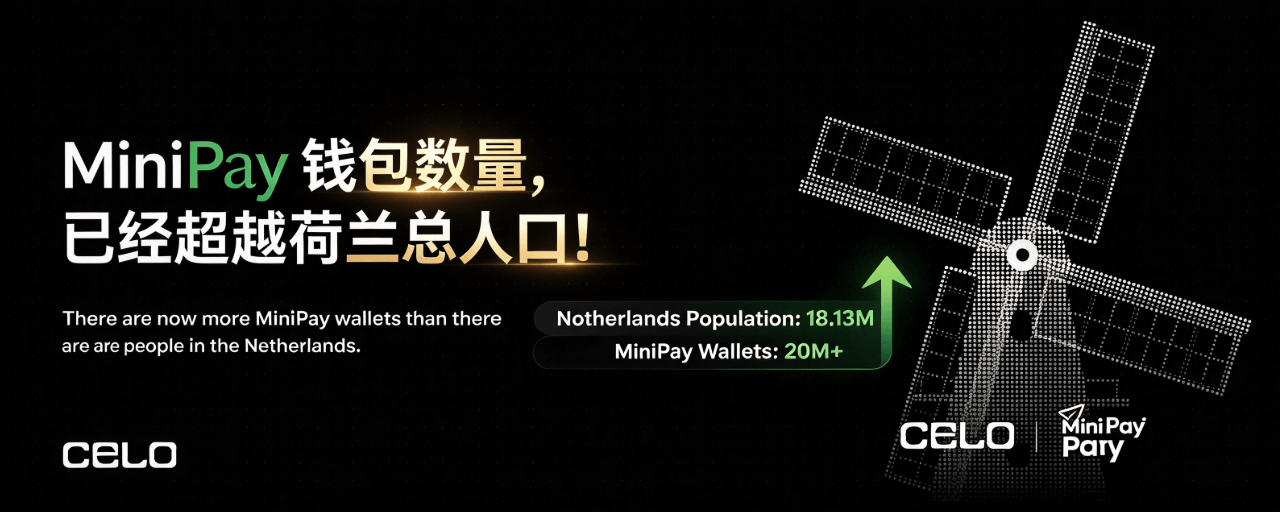
A wallet with more users than the population of an entire country? CELO is quietly making big moves.A wallet with more users than the population of an entire country? CELO is quietly making big moves.
I just came across a really striking set of figures that I had to share with those of you following $CELO :
MiniPay’s wallet count has now surpassed the total population of the Netherlands (over 17 million).
These aren’t fake addresses generated by airdrop-farming scripts. They’re real new users that Opera and Celo have worked hard to bring on board in emerging markets such as Africa. While many public blockchains are still competing fiercely over daily active user numbers and using airdrops to create an illusion of prosperity, Celo has already turned “Web3 payments” into an everyday tool, just like WeChat Pay and Alipay.
A wallet with more users than the population of an entire country? CELO is quietly making big moves.
A wallet with more users than the population of an entire country? CELO is quietly making big moves.
I just came across a really striking set of figures that I had to share with those of you following $CELO :
MiniPay’s wallet count has now surpassed the total population of the Netherlands (over 17 million).
These aren’t fake addresses generated by airdrop-farming scripts. They’re real new users that Opera and Celo have worked hard to bring on board in emerging markets such as Africa. While many public blockchains are still competing fiercely over daily active user numbers and using airdrops to create an illusion of prosperity, Celo has already turned “Web3 payments” into an everyday tool, just like WeChat Pay and Alipay.
343
Log in to explore more content
Join global crypto users on Binance Square
⚡️ Get latest and useful information about crypto.
💬 Trusted by the world’s largest crypto exchange.
👍 Discover real insights from verified creators.
Email / Phone number
Trending Topics
UniswapA16zSeekDeFiExemptionFromIllinoisCryptoTax
17,701 views
654 Discussing
The debate over crypto taxation is heating up as Uniswap and Andreessen Horowitz ( a16z ) push for a DeFi exemption from Illinois proposed crypto tax rules. Their concern is that decentralized finance protocols and non custodial platforms could face unfair tax burdens potentially slowing innovation and making crypto development more difficult. DeFi platforms allow users to trade and manage digital assets without traditional intermediaries so applying conventional financial tax rules may create serious challenges. This could become an important moment for the US crypto industry as regulators must find a balance between fair taxation, investor protection, and innovation. 🚀
The main concern is that the proposed 0.2% tax is calculated on transaction value, not simply trading profits. Uniswap a16z and the DeFi Education Fund want wallet withdrawals and cross chain bridging excluded, while also opposing requirements to maintain private key records. Illinois has agreed to postpone implementation until July 1, 2027 subject to court approval. The outcome could influence how other US states approach DeFi taxation. The Defiant +2
What do you think 🤔 ? Should DeFi transactions be tax free to protect decentralization or should crypto platforms follow traditional tax rules ? 🤔
#UniswapA16zSeekDeFiExemptionFromIllinoisCryptoTax
Volatile
·3 Likes
·162 views
HKDollarStablecoinHKDAPToLaunchOnSolana
11,884 views
396 Discussing
$1.5BInLeveragedCryptoBetsLiquidated
29,978 views
232 Discussing