

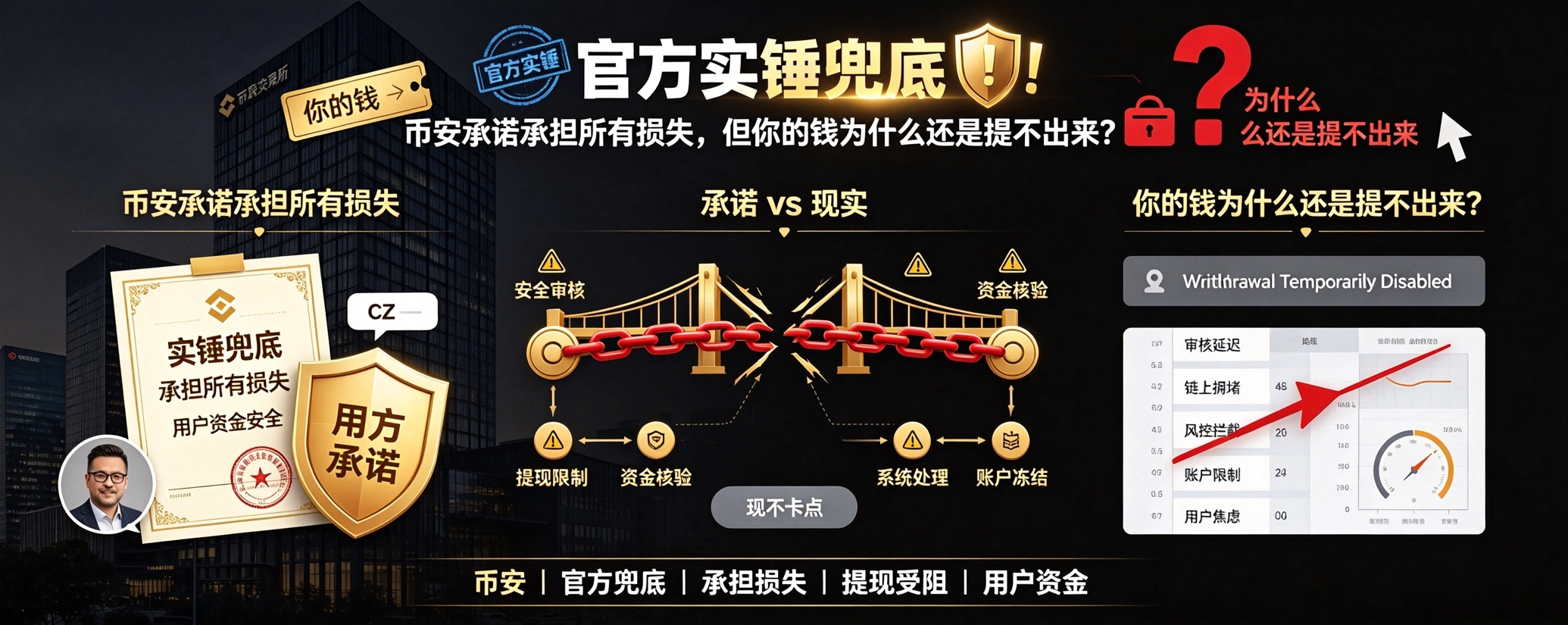

Official confirmation: Binance will cover all losses—but why still can’t you withdraw your money?
Guys, in response to the shocking news of this massive hack, Binance has finally issued its strongest official statement yet!
Look at this screenshot of the customer service pop-up. The key point is clear: “Binance will cover all losses.”
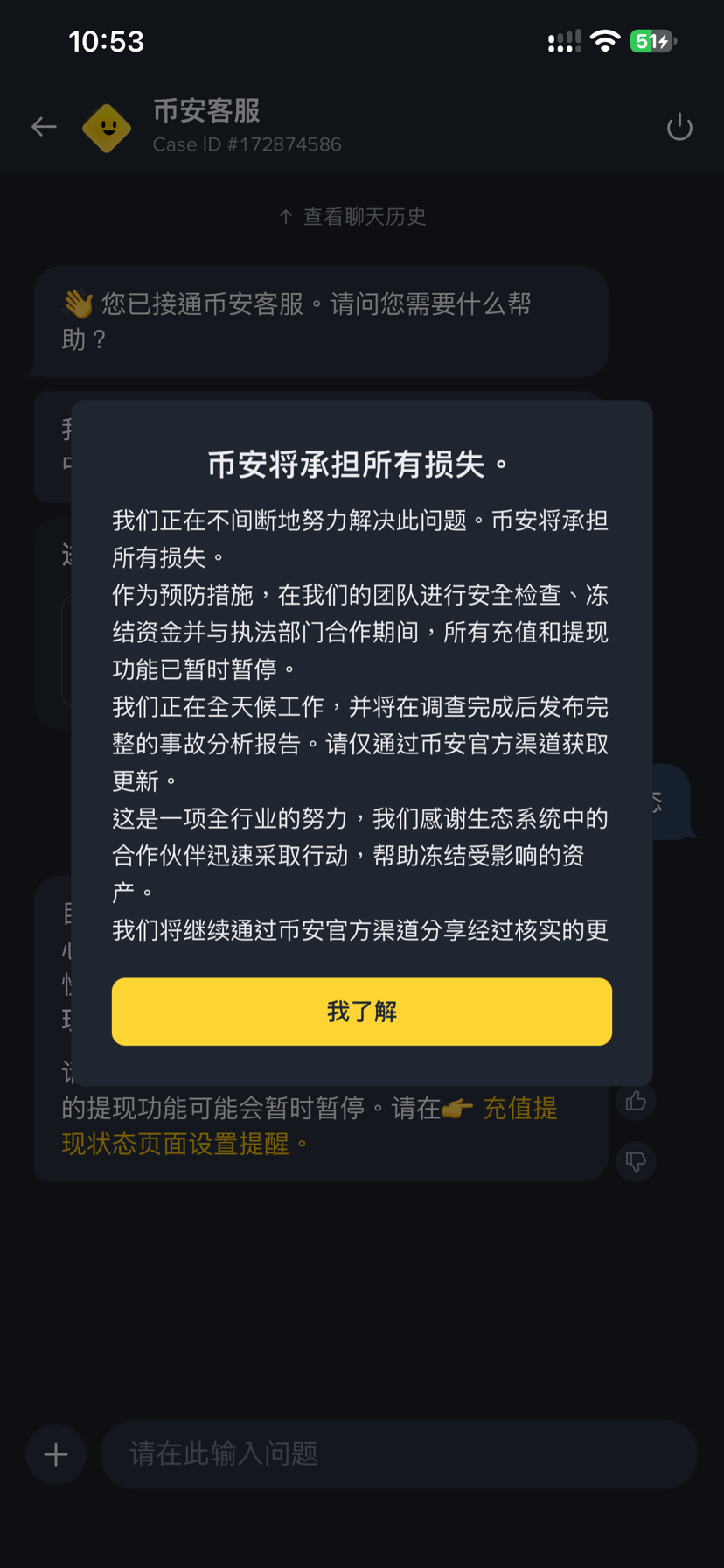
This simple sentence is worth its weight in gold in today’s jittery market. It shows that despite the major incident, Binance, as a leading exchange, still has principles and a sense of responsibility. Its promise to fully compensate users is the crucial reassurance the market needed, helping prevent an extreme, full-scale panic sell-off.
However, an expert perspective calls for a closer look at the second half of the pop-up message—this is where the core issue lies:
“As a precaution, all deposits and withdrawals have been temporarily suspended while the team conducts security checks, freezes funds, and cooperates with law enforcement.”
When you consider the screenshots going viral online today—“a $920,000 account locked for 30 days” and “a small investor’s assets wiped out in an instant”—you can understand the harsh reality: although your assets are backed by a major exchange, you may still face a “liquidity crisis.”
Let’s break down the underlying logic from an expert’s perspective:
First, suspending deposits and withdrawals is a necessary “last-resort measure.”
Billions of dollars in stolen funds are moving across the blockchain. If Binance doesn’t immediately close its deposit and withdrawal channels, hackers could launder money quickly through the vast network of retail investors. Suspending deposits and withdrawals is meant to support Tether and Circle’s freezing efforts, locking the funds firmly within the system and preventing them from escaping again.
Second, compliance reviews can harm countless innocent users.
Why might retail investors be locked out for 30 days? Because the risk-control system follows the principle of “better to wrongly detain a thousand than let one slip through.” If there’s even the slightest connection between your account’s IP address or trading activity and a hacker’s address, the system will automatically flag it. This may be for the greater good, but for innocent users who urgently need their money, it can be devastating.
Third, the cost of being “too big to fail.”
A major exchange can reimburse users because it has profits and cash flow to support it—something smaller exchanges can’t do. But this also means that, in extreme circumstances, a major exchange has absolute control over how users’ assets are handled, including freezing and reviewing them.
Advice for retail investors on how to protect themselves:
1. Don’t panic, but be prepared. For the next few days, as long as your assets are on Binance, they should generally be safe. But if you urgently need to withdraw money, you’ll most likely have to wait until this round of reviews is over.
2. If you’re trading on the exchange, be very careful. While withdrawals are restricted, funds on the exchange can’t be moved out, making sharp price swings and “discounts/premiums” more likely. Definitely don’t open highly leveraged futures positions, or you could get stopped out by a deliberate move from major players.
3. Until the incident report is released, watch more and trade less. Wait for the official, full incident analysis report before making any further adjustments to your positions.
The official promise to “make users whole” — can it restore your trust in centralized exchanges? If you urgently needed money that was currently stuck in an exchange, what would you do? Share your thoughts in the comments! 👇