
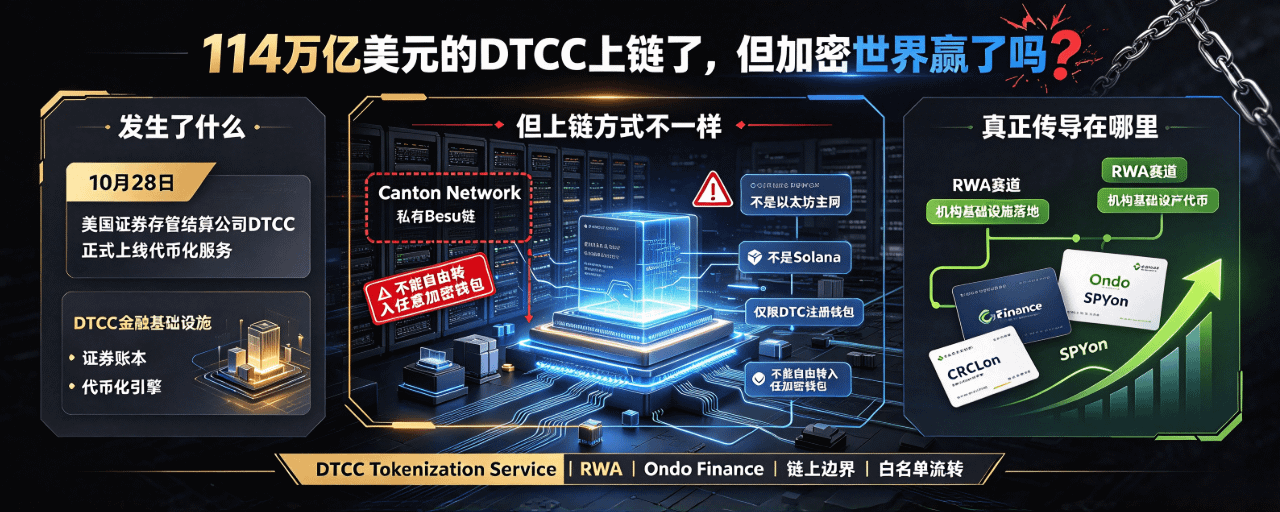

DTCC's $114 trillion has gone on-chain, but did crypto win?
Here's the verdict: The launch of DTCC's Tokenization Service is the most significant implementation of blockchain in the history of traditional finance, but it also offers a sober correction to crypto-native narratives. Its scale far exceeds that of the vast majority of on-chain projects, but the way it operates is a far cry from what many crypto believers imagine when they talk about “Wall Street embracing crypto.”
What happened? Let's break down the numbers.
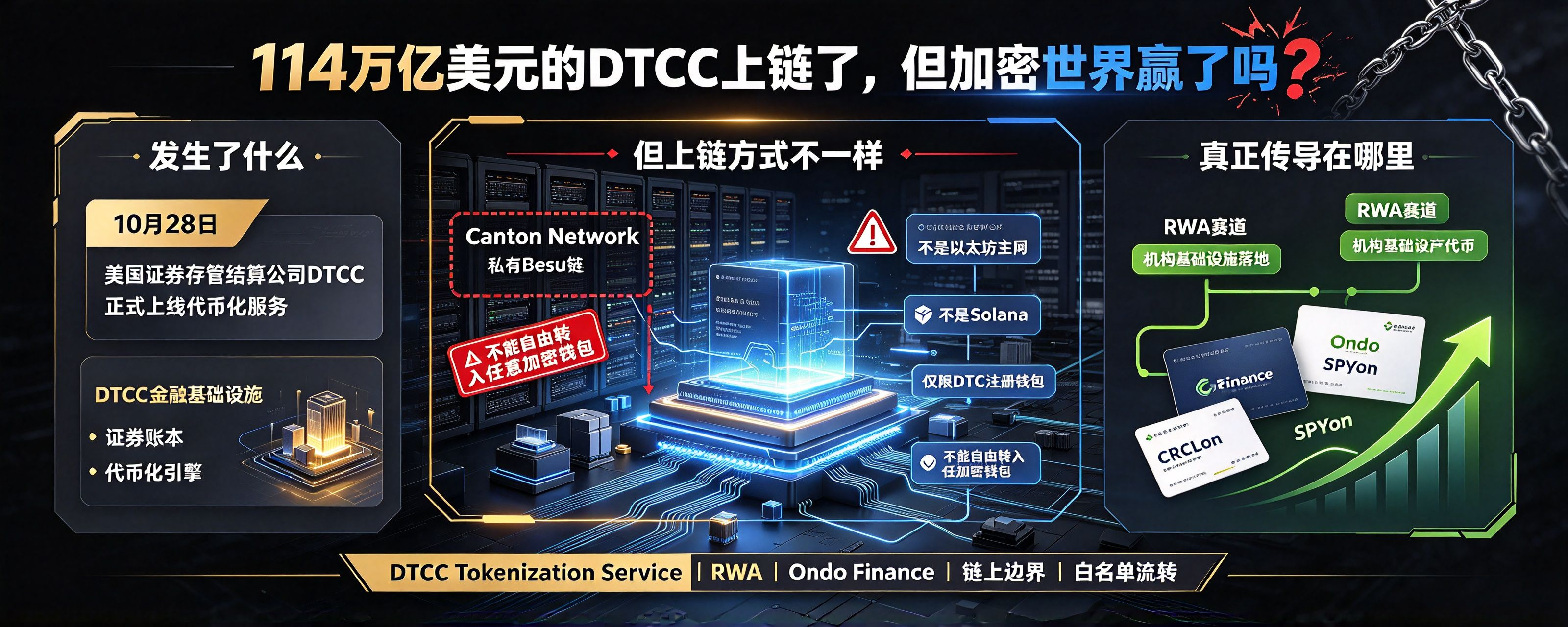
On October 28, the Depository Trust & Clearing Corporation (DTCC) officially launched its Tokenization Service. The first batch supports 34 securities, including some large-cap stocks in the Russell 1000 Index, ETFs, and U.S. Treasury bills, notes, and bonds. These tokens are fully backed 1:1 by securities held in custody by DTCC subsidiary DTC, and holders enjoy the exact same legal rights and economic entitlements as they would with the underlying securities.
The “$114 trillion” mentioned in the user-provided material refers to the total assets under DTC custody. But it’s important to distinguish between two figures: the 34 securities in the first batch represent a market value of around $30 trillion—not the entire $114 trillion going on-chain overnight. The $114 trillion is DTCC’s overall custody base, the potential pool for this long-term tokenization effort, not the actual scale on day one.
The list of institutions that have already signed on speaks for itself: Bank of America, Barclays, Citi, Fidelity, JPMorgan Chase, Morgan Stanley, Citadel Securities, State Street, and UBS—20 DTC participants in total. This isn’t a few crypto funds running a test; it’s major players from the core settlement layer of the U.S. securities market entering as a group.
But the way this is “going on-chain” differs from what crypto natives might imagine
The tokens will run on Canton Network and DTCC’s private Besu chain—not Ethereum mainnet or Solana. Transfers will be peer-to-peer, 24/7, but only between DTC-registered wallets. The tokens will also have transfer restrictions and cannot be freely moved to any crypto wallet. The target processing time for converting traditional holdings into tokens is under 15 minutes, but conversion orders will only be processed during specific hours on business days.
In other words, DTCC is using blockchain as a settlement-efficiency tool, not turning securities into permissionless DeFi Legos. DTCC President Frank La Salla put it this way: “Extending DTC’s resilience, governance, and operational standards to digital markets lays the foundation for responsible institutional adoption at scale.” The key phrase is “DTC’s governance standards,” not “decentralization.”
Where the real impact on the crypto market lies
The RWA (real-world asset) sector’s narrative stands to benefit directly. Ondo Finance, as an ecosystem partner, had already launched CRCLon and SPYon, which are linked to DTC-custodied securities, during a July pilot.$ONDO The logic behind its rise is that it is an “early-stage gateway participant in Wall Street tokenization”—not that DTCC itself is buying ONDO.
But the more important signal lies elsewhere: DTCC is bringing tokenization into its existing compliance and custody framework, rather than starting from scratch to build a parallel crypto market. This means tokenized securities will most likely take the form of “digital twins” issued and transferred by licensed institutions on regulated, permissioned chains—not ERC-20 tokens that retail traders can freely trade on DEXs. The crypto-native vision of “putting everything on-chain, permissionlessly” is not being realized through this route.
In December 2025, DTC had already received an SEC No-Action Letter authorizing it to tokenize Russell 1000 constituent stocks. The compliance foundation for this route is an SEC exemption, not the “new legislative framework” the crypto industry has long sought. Control rests with established financial giants, not with native on-chain protocols.

Risks and things to watch
Liquidity for tokenized assets is still limited to the DTC-registered wallet ecosystem. On-chain net settlement and digital cash instruments are on the roadmap for 2027 and beyond. Until then, this looks more like an efficiency upgrade to the settlement back end than a liquidity event that the crypto market can price directly.$ONDO Short-term reactions in RWA tokens like these are more a spillover of narrative-driven sentiment than a direct on-chain purchase of these tokens by DTCC.
💡 Do you think DTCC moving onto the blockchain marks the real starting point for the RWA sector, or is it Wall Street’s “compliant takeover” of the crypto world? Share your take in the comments.