

Re Protocol
109 Posts

Re Protocol
 Square Verified
Report
Block User
Onchain capital for real-world risk. Stewarded by the Resilience Foundation. Website: re.xyz
4 Following
49 Followers
155 Liked
Posts
All
Videos
PINNED
·
--

Article
August Performance Update: Capital Growth and Cross-Chain ExpansionAugust was another month of major growth for Re. Re passed a quarter-billion in total deposits. Deposits grew by nearly 36%, the protocol's largest month-over-month increase since March and the second largest on record. August also brought continued cross-chain expansion. reUSD went live on Solana via Chainlink CCIP, and added new lending and collateral integrations across Jupiter Lend, Kamino, and Feather.
$648.5M Total Value Locked+11.7% TVL Growth$256.4M Total Deposits+35.8% Deposit Growth
Capital Position
Capital position & liquidity.
All figures reflect the August 31, 2026, reporting snapshot unless otherwise noted. Past performance is not a reliable indicator of future results.
Re's Total Value Locked (TVL) stood at $648.5M on August 31, an increase of 11.7% over July.
As of the reporting period, capital was distributed as follows:
Onchain Capital: $150.1M (23.1% of total assets)Offchain Reserves: $179.5M (27.7% of total)Contracted Premium Receivable: $318.9M (49.2% of total)
Reporting note. Reflects contracted premium receivable on policies bound as of the reporting date. Actual receipts may vary based on policy performance, cessions, and other factors.
Onchain capital supports Re-backed underwriting structures. Offchain capital is maintained as reserves within regulated insurance entities. Contracted written premium receivable reflects premiums contractually owed but not yet received.
TVL growth in August was powered primarily by a marked increase in reUSD deposits, which grew from $170.1M to $236.4M. reUSDe deposits grew from $18.8M to $20.0M.
Underwriting Portfolio
Portfolio composition.
Re's underwriting portfolio remained steady at $510.5 million in August.
Re's portfolio remains spread across diverse lines of business, helping reduce the impact that losses in any one area can have on the overall book. Underwriting strategy continues to focus on shorter-term risks and on contracts whose losses must reach meaningful levels before Re is responsible for paying claims. Together, those choices are intended to help guard against losses and support consistent underwriting performance over time.
Ecosystem
reUSD launched on Solana.
August marked reUSD's launch on Solana. Solana has become a significant network for real-world asset tokenization, with deep liquidity and a fast-growing DeFi ecosystem. The launch gives Re access to another major onchain economy and opens reUSD to Solana's lending, trading, and liquidity protocols.
Read the full announcement here [1].
Integrations
Ecosystem expansion.
Several integrations expanded how reUSD can be deployed across DeFi:
Jupiter Lend. reUSD went live as collateral on Jupiter Lend [2], allowing holders to borrow jupUSD against their reUSD positions in Jupiter's $2 billion lending market without the need to sell or redeem. reUSD Smart Vaults on Jupiter Lend v2 reached $6 million in total supply in under three hours after launch.Kamino. reUSD also went live as collateral in Kamino's [3] $2.2 billion-plus credit market on Solana, where deposits earn 5x Re Points. The initial $1 million supply cap filled in 76 minutes, and the cap was raised in stages to $20 million. Eight days after launch, the reUSD market on Kamino had surpassed $20 million.Feather. reUSD expanded to Sei as collateral in Feather's [4] PYUSD0 and PYUSD0 Y10k Capital vaults, powered by Morpho and curated by Feather and RockawayX.
Token Activity
$RE token activity.
Per the standard ecosystem release schedule, 7.09 million $RE unlocked from the ecosystem allocation on August 17.
$RE has a fixed maximum supply of one billion tokens, with no ongoing inflation or perpetual emissions.
7.09M tokens released (ecosystem allocation, August 17)1B fixed maximum supply (no ongoing inflation)
Looking Ahead
What's next.
Beginning in September, USDC will become the sole redemption asset for reUSD. Previously, reUSD redemptions settled in sUSDe. This change was made with user convenience in mind, as reUSD will redeem into the most widely integrated onchain dollar.
We look forward to delivering our next update in September.
— Re Management Team
Originally published on re.xyz: https://re.xyz/insights/august-2026-performance-update
Re Protocol. Internet-native reinsurance capital: diversified, transparent, and open to global participants at re.xyz (https://re.xyz).
Visit re.xyz: https://re.xyz
#reinsurance #RWA #TradFi
Sources
re.xyz/insights/reusd-live-on-solanajup.ag/lend/borrow/smart/97/depositkamino.com/borrowapp.feather.zone/sei/borrow
Disclosures
This blog post is for informational and educational purposes only and does not constitute investment, legal, tax, or financial advice. Nothing in this article should be construed as an offer or solicitation to buy or sell any security, token, or financial product.
Affiliate disclosure. The "re" brand, the re protocol, and re.xyz are operated by Resilience Foundation Cayman LLC ("Resilience Foundation"), an Exempted Limited Guarantee Foundation Company incorporated in the Cayman Islands with Limited Liability with registered number IC-414560, together with its affiliate Resilience (BVI) Ltd and Resilience Inv SPC. Resilience Foundation, Resilience BVI, and Resilience Inv do not provide insurance or reinsurance services, do not act as insurance broker or agent, and do not hold an insurance license. All regulated reinsurance activities are conducted exclusively by Cover Reinsurance SPC Ltd. ("Cover Re SPC"), a Class B(iii) licensed exempted segregated portfolio company in the Cayman Islands, operating under the "Cover Re" brand at coverre.com (https://coverre.com).
Access and eligibility. reUSDe is available exclusively to non-U.S. persons, as defined under Regulation S of the U.S. Securities Act of 1933, in specific permitted jurisdictions. Use by U.S. persons or residents is strictly prohibited. reUSDe may be classified as a security in certain jurisdictions, and participation is subject to eligibility requirements, KYC/AML verification, and jurisdiction-specific restrictions. reUSDe is not a bank deposit, is not FDIC insured, and is not government backed.
Yield. reUSD/reUSDe yield is variable, is not guaranteed, and may change at any time. Any references to yield, APR, APY, returns, or performance are informational only, and past performance is not a reliable indicator of future results. The value and stability of reUSD/reUSDe are subject to market volatility, smart contract vulnerabilities, regulatory uncertainty, and the performance of underlying collateral and protocol activity.
Risk disclosure. Digital assets and blockchain-based products involve significant risk, including the potential loss of principal, smart contract vulnerabilities, liquidity constraints, and regulatory uncertainty. Any references to APR, returns, or performance are not guaranteed, and past performance is not a reliable indicator of future results.
Regulatory environment. The regulatory environment for digital assets, stablecoins, tokenized real-world assets, and onchain financial products is dynamic and continues to evolve across jurisdictions. The information in this post reflects the understanding as of the date of publication and may not reflect subsequent legal or regulatory developments. Readers should consult qualified legal, tax, and financial professionals before making any decisions.
Terms apply. For full terms, disclosures, and risk disclaimers, please see the Re website at https://re.xyz, Terms of Service (https://re.xyz/terms), and Disclaimers (https://docs.re.xyz/disclaimers).
August Performance Update: Capital Growth and Cross-Chain Expansion
August was another month of major growth for Re. Re passed a quarter-billion in total deposits. Deposits grew by nearly 36%, the protocol's largest month-over-month increase since March and the second largest on record. August also brought continued cross-chain expansion. reUSD went live on Solana via Chainlink CCIP, and added new lending and collateral integrations across Jupiter Lend, Kamino, and Feather.
$648.5M Total Value Locked+11.7% TVL Growth$256.4M Total Deposits+35.8% Deposit Growth
Capital Position
Capital position & liquidity.
All figures reflect the August 31, 2026, reporting snapshot unless otherwise noted. Past performance is not a reliable indicator of future results.
Re's Total Value Locked (TVL) stood at $648.5M on August 31, an increase of 11.7% over July.
As of the reporting period, capital was distributed as follows:
Onchain Capital: $150.1M (23.1% of total assets)Offchain Reserves: $179.5M (27.7% of total)Contracted Premium Receivable: $318.9M (49.2% of total)
Reporting note. Reflects contracted premium receivable on policies bound as of the reporting date. Actual receipts may vary based on policy performance, cessions, and other factors.
Onchain capital supports Re-backed underwriting structures. Offchain capital is maintained as reserves within regulated insurance entities. Contracted written premium receivable reflects premiums contractually owed but not yet received.
TVL growth in August was powered primarily by a marked increase in reUSD deposits, which grew from $170.1M to $236.4M. reUSDe deposits grew from $18.8M to $20.0M.
Underwriting Portfolio
Portfolio composition.
Re's underwriting portfolio remained steady at $510.5 million in August.
Re's portfolio remains spread across diverse lines of business, helping reduce the impact that losses in any one area can have on the overall book. Underwriting strategy continues to focus on shorter-term risks and on contracts whose losses must reach meaningful levels before Re is responsible for paying claims. Together, those choices are intended to help guard against losses and support consistent underwriting performance over time.
Ecosystem
reUSD launched on Solana.
August marked reUSD's launch on Solana. Solana has become a significant network for real-world asset tokenization, with deep liquidity and a fast-growing DeFi ecosystem. The launch gives Re access to another major onchain economy and opens reUSD to Solana's lending, trading, and liquidity protocols.
Read the full announcement here [1].
Integrations
Ecosystem expansion.
Several integrations expanded how reUSD can be deployed across DeFi:
Jupiter Lend. reUSD went live as collateral on Jupiter Lend [2], allowing holders to borrow jupUSD against their reUSD positions in Jupiter's $2 billion lending market without the need to sell or redeem. reUSD Smart Vaults on Jupiter Lend v2 reached $6 million in total supply in under three hours after launch.Kamino. reUSD also went live as collateral in Kamino's [3] $2.2 billion-plus credit market on Solana, where deposits earn 5x Re Points. The initial $1 million supply cap filled in 76 minutes, and the cap was raised in stages to $20 million. Eight days after launch, the reUSD market on Kamino had surpassed $20 million.Feather. reUSD expanded to Sei as collateral in Feather's [4] PYUSD0 and PYUSD0 Y10k Capital vaults, powered by Morpho and curated by Feather and RockawayX.
Token Activity
$RE token activity.
Per the standard ecosystem release schedule, 7.09 million $RE unlocked from the ecosystem allocation on August 17.
$RE has a fixed maximum supply of one billion tokens, with no ongoing inflation or perpetual emissions.
7.09M tokens released (ecosystem allocation, August 17)1B fixed maximum supply (no ongoing inflation)
Looking Ahead
What's next.
Beginning in September, USDC will become the sole redemption asset for reUSD. Previously, reUSD redemptions settled in sUSDe. This change was made with user convenience in mind, as reUSD will redeem into the most widely integrated onchain dollar.
We look forward to delivering our next update in September.
— Re Management Team
Originally published on re.xyz: https://re.xyz/insights/august-2026-performance-update
Re Protocol. Internet-native reinsurance capital: diversified, transparent, and open to global participants at re.xyz (https://re.xyz).
Visit re.xyz: https://re.xyz
#reinsurance #RWA #TradFi
Sources
re.xyz/insights/reusd-live-on-solanajup.ag/lend/borrow/smart/97/depositkamino.com/borrowapp.feather.zone/sei/borrow
Disclosures
This blog post is for informational and educational purposes only and does not constitute investment, legal, tax, or financial advice. Nothing in this article should be construed as an offer or solicitation to buy or sell any security, token, or financial product.
Affiliate disclosure. The "re" brand, the re protocol, and re.xyz are operated by Resilience Foundation Cayman LLC ("Resilience Foundation"), an Exempted Limited Guarantee Foundation Company incorporated in the Cayman Islands with Limited Liability with registered number IC-414560, together with its affiliate Resilience (BVI) Ltd and Resilience Inv SPC. Resilience Foundation, Resilience BVI, and Resilience Inv do not provide insurance or reinsurance services, do not act as insurance broker or agent, and do not hold an insurance license. All regulated reinsurance activities are conducted exclusively by Cover Reinsurance SPC Ltd. ("Cover Re SPC"), a Class B(iii) licensed exempted segregated portfolio company in the Cayman Islands, operating under the "Cover Re" brand at coverre.com (https://coverre.com).
Access and eligibility. reUSDe is available exclusively to non-U.S. persons, as defined under Regulation S of the U.S. Securities Act of 1933, in specific permitted jurisdictions. Use by U.S. persons or residents is strictly prohibited. reUSDe may be classified as a security in certain jurisdictions, and participation is subject to eligibility requirements, KYC/AML verification, and jurisdiction-specific restrictions. reUSDe is not a bank deposit, is not FDIC insured, and is not government backed.
Yield. reUSD/reUSDe yield is variable, is not guaranteed, and may change at any time. Any references to yield, APR, APY, returns, or performance are informational only, and past performance is not a reliable indicator of future results. The value and stability of reUSD/reUSDe are subject to market volatility, smart contract vulnerabilities, regulatory uncertainty, and the performance of underlying collateral and protocol activity.
Risk disclosure. Digital assets and blockchain-based products involve significant risk, including the potential loss of principal, smart contract vulnerabilities, liquidity constraints, and regulatory uncertainty. Any references to APR, returns, or performance are not guaranteed, and past performance is not a reliable indicator of future results.
Regulatory environment. The regulatory environment for digital assets, stablecoins, tokenized real-world assets, and onchain financial products is dynamic and continues to evolve across jurisdictions. The information in this post reflects the understanding as of the date of publication and may not reflect subsequent legal or regulatory developments. Readers should consult qualified legal, tax, and financial professionals before making any decisions.
Terms apply. For full terms, disclosures, and risk disclaimers, please see the Re website at https://re.xyz, Terms of Service (https://re.xyz/terms), and Disclaimers (https://docs.re.xyz/disclaimers).
$648.5M Total Value Locked+11.7% TVL Growth$256.4M Total Deposits+35.8% Deposit Growth
Capital Position
Capital position & liquidity.
All figures reflect the August 31, 2026, reporting snapshot unless otherwise noted. Past performance is not a reliable indicator of future results.
Re's Total Value Locked (TVL) stood at $648.5M on August 31, an increase of 11.7% over July.
As of the reporting period, capital was distributed as follows:
Onchain Capital: $150.1M (23.1% of total assets)Offchain Reserves: $179.5M (27.7% of total)Contracted Premium Receivable: $318.9M (49.2% of total)
Reporting note. Reflects contracted premium receivable on policies bound as of the reporting date. Actual receipts may vary based on policy performance, cessions, and other factors.
Onchain capital supports Re-backed underwriting structures. Offchain capital is maintained as reserves within regulated insurance entities. Contracted written premium receivable reflects premiums contractually owed but not yet received.
TVL growth in August was powered primarily by a marked increase in reUSD deposits, which grew from $170.1M to $236.4M. reUSDe deposits grew from $18.8M to $20.0M.
Underwriting Portfolio
Portfolio composition.
Re's underwriting portfolio remained steady at $510.5 million in August.
Re's portfolio remains spread across diverse lines of business, helping reduce the impact that losses in any one area can have on the overall book. Underwriting strategy continues to focus on shorter-term risks and on contracts whose losses must reach meaningful levels before Re is responsible for paying claims. Together, those choices are intended to help guard against losses and support consistent underwriting performance over time.
Ecosystem
reUSD launched on Solana.
August marked reUSD's launch on Solana. Solana has become a significant network for real-world asset tokenization, with deep liquidity and a fast-growing DeFi ecosystem. The launch gives Re access to another major onchain economy and opens reUSD to Solana's lending, trading, and liquidity protocols.
Read the full announcement here [1].
Integrations
Ecosystem expansion.
Several integrations expanded how reUSD can be deployed across DeFi:
Jupiter Lend. reUSD went live as collateral on Jupiter Lend [2], allowing holders to borrow jupUSD against their reUSD positions in Jupiter's $2 billion lending market without the need to sell or redeem. reUSD Smart Vaults on Jupiter Lend v2 reached $6 million in total supply in under three hours after launch.Kamino. reUSD also went live as collateral in Kamino's [3] $2.2 billion-plus credit market on Solana, where deposits earn 5x Re Points. The initial $1 million supply cap filled in 76 minutes, and the cap was raised in stages to $20 million. Eight days after launch, the reUSD market on Kamino had surpassed $20 million.Feather. reUSD expanded to Sei as collateral in Feather's [4] PYUSD0 and PYUSD0 Y10k Capital vaults, powered by Morpho and curated by Feather and RockawayX.
Token Activity
$RE token activity.
Per the standard ecosystem release schedule, 7.09 million $RE unlocked from the ecosystem allocation on August 17.
$RE has a fixed maximum supply of one billion tokens, with no ongoing inflation or perpetual emissions.
7.09M tokens released (ecosystem allocation, August 17)1B fixed maximum supply (no ongoing inflation)
Looking Ahead
What's next.
Beginning in September, USDC will become the sole redemption asset for reUSD. Previously, reUSD redemptions settled in sUSDe. This change was made with user convenience in mind, as reUSD will redeem into the most widely integrated onchain dollar.
We look forward to delivering our next update in September.
— Re Management Team
Originally published on re.xyz: https://re.xyz/insights/august-2026-performance-update
Re Protocol. Internet-native reinsurance capital: diversified, transparent, and open to global participants at re.xyz (https://re.xyz).
Visit re.xyz: https://re.xyz
#reinsurance #RWA #TradFi
Sources
re.xyz/insights/reusd-live-on-solanajup.ag/lend/borrow/smart/97/depositkamino.com/borrowapp.feather.zone/sei/borrow
Disclosures
This blog post is for informational and educational purposes only and does not constitute investment, legal, tax, or financial advice. Nothing in this article should be construed as an offer or solicitation to buy or sell any security, token, or financial product.
Affiliate disclosure. The "re" brand, the re protocol, and re.xyz are operated by Resilience Foundation Cayman LLC ("Resilience Foundation"), an Exempted Limited Guarantee Foundation Company incorporated in the Cayman Islands with Limited Liability with registered number IC-414560, together with its affiliate Resilience (BVI) Ltd and Resilience Inv SPC. Resilience Foundation, Resilience BVI, and Resilience Inv do not provide insurance or reinsurance services, do not act as insurance broker or agent, and do not hold an insurance license. All regulated reinsurance activities are conducted exclusively by Cover Reinsurance SPC Ltd. ("Cover Re SPC"), a Class B(iii) licensed exempted segregated portfolio company in the Cayman Islands, operating under the "Cover Re" brand at coverre.com (https://coverre.com).
Access and eligibility. reUSDe is available exclusively to non-U.S. persons, as defined under Regulation S of the U.S. Securities Act of 1933, in specific permitted jurisdictions. Use by U.S. persons or residents is strictly prohibited. reUSDe may be classified as a security in certain jurisdictions, and participation is subject to eligibility requirements, KYC/AML verification, and jurisdiction-specific restrictions. reUSDe is not a bank deposit, is not FDIC insured, and is not government backed.
Yield. reUSD/reUSDe yield is variable, is not guaranteed, and may change at any time. Any references to yield, APR, APY, returns, or performance are informational only, and past performance is not a reliable indicator of future results. The value and stability of reUSD/reUSDe are subject to market volatility, smart contract vulnerabilities, regulatory uncertainty, and the performance of underlying collateral and protocol activity.
Risk disclosure. Digital assets and blockchain-based products involve significant risk, including the potential loss of principal, smart contract vulnerabilities, liquidity constraints, and regulatory uncertainty. Any references to APR, returns, or performance are not guaranteed, and past performance is not a reliable indicator of future results.
Regulatory environment. The regulatory environment for digital assets, stablecoins, tokenized real-world assets, and onchain financial products is dynamic and continues to evolve across jurisdictions. The information in this post reflects the understanding as of the date of publication and may not reflect subsequent legal or regulatory developments. Readers should consult qualified legal, tax, and financial professionals before making any decisions.
Terms apply. For full terms, disclosures, and risk disclaimers, please see the Re website at https://re.xyz, Terms of Service (https://re.xyz/terms), and Disclaimers (https://docs.re.xyz/disclaimers).
2
309
·
--
Verified

Article
Inside Re’s Reinsurance StrategySo how is Re’s insurance strategy structured to keep that yield flowing? What goes into deciding which opportunities depositor capital will back?
Re’s value equation is fairly simple: depositors either provide capital and mint assets (reUSD or reUSDe) or acquire those assets on the secondary market. Those assets earn yield: for reUSD, a blended yield of SOFR and the seven-day trailing average of the sUSDe yield rate, plus a protocol-determined spread; for reUSDe, SOFR plus a protocol-determined spread.
That spread (2.5% for reUSD and 8.5% for reUSDe, as of August 2026) is provided by Re’s yield source: real reinsurance activity. Depositor capital provides collateral with which Cover Re, Re’s licensed reinsurance partner, signs new reinsurance contracts. The yield from those contracts flows back to Re, and thence to holders of reUSD and reUSDe.
Returning that yield depends, of course, upon the performance of those contracts. So how is Re’s insurance strategy structured to keep that yield flowing? What goes into deciding which opportunities depositor capital will back? Let’s explore.
How Reinsurance Works
From a financial perspective, reinsurance is simple: primary insurers (those who sell insurance directly to customers) pass on a portion of the risk they’re taking on to reinsurers. They do so for multiple reasons [1]: to smooth out earnings, to protect themselves from extreme outcomes, and to provide themselves with capital relief.
Insurers charge premiums to customers; in exchange for taking on that portion of risk, a reinsurer will inherit some of those premiums. Provided that those premiums exceed the costs incurred on the policy (payouts plus business expenses), the reinsurer will walk away with a profit.
Whether or not that happens depends in substantial part on a reinsurer’s strategy. And a substantial portion of reinsurer strategy is choosing its mix of risk.
Choose Your Risk
Reinsurance risk profiles exist across a spectrum between two poles: everyday stuff on one end, and catastrophes on the other.
Everyday losses cover events like car accidents, workers’ compensation, damage to a home, and so on. Across a given policy, such occurrences can be expected to happen frequently, but the claims are relatively small, they carry little or no correlation with each other (for example, a single car crash typically won’t generate a rash of other car crashes), and decades of loss data make them relatively predictable. Lower magnitude of risk often means lower premiums for the reinsurer, but it also means more predictable and more consistent results.
Catastrophe losses cover events like hurricanes, earthquakes, or wildfires, and they behave in a near-opposite way. Whereas everyday losses may happen every day (it’s in the name!), catastrophes happen rarely. But when they happen, losses are huge, and they’re inherently concentrated: the same event hits large geographical areas all at once. The premiums to be earned are greater than those from safer policies, but the results are more volatile, and the worst-case outcome is far worse.
Every reinsurance contract a reinsurer writes is a calculated bet. The closer the contract sits to the catastrophe end of the spectrum, the less safe the bet, and a bet on a catastrophe policy can land a stiff fiscal punch on a reinsurer if the covered event comes.
Indeed, the direction of the entire reinsurance market - how much reinsurance capacity is available, how much reinsurers charge, and the supply-demand balance - can reverse itself based on a single bad catastrophe year.
The Importance of Diversification
Reinsurers rarely hold only a single reinsurance contract at a given time. They almost invariably bundle together numerous contracts into their overall portfolio. A critical subcategory of the aforementioned risk profiles, when applied across a reinsurer’s overall portfolio, is diversification.
The diversification of a given portfolio answers a simple question: if a given event hits, what degree of impact will it have on the portfolio as a whole?
Take everyday losses, for example. These tend to be small in magnitude. A reinsurer can write a lot of them, and it can vary them: by line of business, and by geography. A given US reinsurer could (and often does) write contracts across any number of insurance categories in dozens of states.
The benefit of doing so: losses will rarely be correlated with each other. An extreme winter that causes an unusually bad auto insurance year in Maine won’t impact auto insurance losses in California, and it won’t correlate with workers’ compensation losses anywhere. If a reinsurer were to have concentrated heavily on auto policies in Maine, however, then that one bad winter would have had a much greater impact upon its portfolio (and balance sheet) as a whole. Risks are less concentrated.
Catastrophe losses are, again, the opposite. They’re inherently concentrated. Hurricane policies, for example, will cover large areas. If an area gets hit, that means a great deal of losses at the same time. Geographic diversification offers less protection; bad hurricane seasons often impact vast areas of hurricane-prone coastline (say, the US eastern seaboard), and a dry summer can increase the fire risk across wide swathes of territory.
And because catastrophe policies come with an inherently high ceiling on losses, each constitutes a larger slice of the portfolio pie. A single catastrophe may have a major impact upon a reinsurer’s financial big picture.
Re’s Strategy
Re’s goal is to deliver consistent yield to its holders. That means pursuing a strategy which prioritizes steadier, lower-volatility returns and consistent results: a focus upon low-volatility, everyday policies, diversified across a range of business lines and a wide geographical area, with minimal exposure to catastrophe risk.
Re’s portfolio has been consistently spread across five different categories of business: homeowners, commercial auto, small business, workers’ compensation, and personal auto. All are distinct from one another; unexpectedly high losses in any one are unlikely to correlate with high losses in any other. And these policies are spread across nearly every US state, reducing the likelihood a single loss event in any one, or two, or five locations will have an outsized impact upon the overall portfolio.
That’s the goal of building the book this way. Because no single event can swing the portfolio, results are more predictable and don’t lurch from year to year. The payoff of that strategy has been clear: profitability in every year of the protocol’s operation, and consistent yield delivered to holders as a result.1
Full details on Re’s portfolio and strategy can always be found on the Re App [2].
1 As of August 2026. Past performance is not a reliable indicator of future results.
Originally published on re.xyz: https://re.xyz/insights/inside-res-reinsurance-strategy
Consistent yield, by design.
Re’s strategy prioritizes steadier, lower-volatility returns - diversified across business lines and geography, with minimal exposure to catastrophe risk.
Explore Re: https://re.xyz
#reinsurance #RWA #TradFi
Sources
https://blog.re.xyz/why-insurers-buy-reinsurancehttps://app.re.xyz/capital-strategy
Disclosures: This blog post is for informational and educational purposes only and does not constitute investment, legal, tax, or financial advice. Nothing in this article should be construed as an offer or solicitation to buy or sell any security, token, or financial product.Affiliate disclosure. The "re" brand, the re protocol, and re.xyz are operated by Resilience Foundation Cayman LLC ("Resilience Foundation"), an Exempted Limited Guarantee Foundation Company incorporated in the Cayman Islands with Limited Liability with registered number IC-414560, together with its affiliate Resilience (BVI) Ltd and Resilience Inv SPC. Resilience Foundation, Resilience BVI, and Resilience Inv do not provide insurance or reinsurance services, do not act as insurance broker or agent, and do not hold an insurance license. All regulated reinsurance activities are conducted exclusively by Cover Reinsurance SPC Ltd. ("Cover Re SPC"), a Class B(iii) licensed exempted segregated portfolio company in the Cayman Islands, operating under the "Cover Re" brand at coverre.com.Access and eligibility. reUSD and reUSDe are not registered or qualified for public offer or sale in the United States or to U.S. persons, and are offered only in reliance on exemptions from registration, including under Regulation S. Access may be restricted based on jurisdiction, and prospective holders are responsible for determining whether they are eligible to acquire or hold these assets under applicable law.Yield. Any yield generated by reUSD/reUSDe is variable, is not guaranteed, and depends on the performance of underlying reinsurance and other strategies. Yield may fluctuate significantly, may be reduced to zero, and past yield is not indicative of future results.Risk disclosure. Digital assets and blockchain-based products involve significant risk, including the potential loss of principal, smart contract vulnerabilities, liquidity constraints, and regulatory uncertainty. Any references to APR, returns, or performance are not guaranteed, and past performance is not a reliable indicator of future results.Regulatory environment. The regulatory environment for digital assets, stablecoins, tokenized real-world assets, and onchain financial products is dynamic and continues to evolve across jurisdictions. The information in this post reflects the understanding as of the date of publication and may not reflect subsequent legal or regulatory developments. Readers should consult qualified legal, tax, and financial professionals before making any decisions.Terms apply. For full terms, disclosures, and risk disclaimers, please see the Re website at https://re.xyz, Terms of Service (https://re.xyz/terms), and Disclaimers (https://docs.re.xyz/disclaimers).
Inside Re’s Reinsurance Strategy
So how is Re’s insurance strategy structured to keep that yield flowing? What goes into deciding which opportunities depositor capital will back?
Re’s value equation is fairly simple: depositors either provide capital and mint assets (reUSD or reUSDe) or acquire those assets on the secondary market. Those assets earn yield: for reUSD, a blended yield of SOFR and the seven-day trailing average of the sUSDe yield rate, plus a protocol-determined spread; for reUSDe, SOFR plus a protocol-determined spread.
That spread (2.5% for reUSD and 8.5% for reUSDe, as of August 2026) is provided by Re’s yield source: real reinsurance activity. Depositor capital provides collateral with which Cover Re, Re’s licensed reinsurance partner, signs new reinsurance contracts. The yield from those contracts flows back to Re, and thence to holders of reUSD and reUSDe.
Returning that yield depends, of course, upon the performance of those contracts. So how is Re’s insurance strategy structured to keep that yield flowing? What goes into deciding which opportunities depositor capital will back? Let’s explore.
How Reinsurance Works
From a financial perspective, reinsurance is simple: primary insurers (those who sell insurance directly to customers) pass on a portion of the risk they’re taking on to reinsurers. They do so for multiple reasons [1]: to smooth out earnings, to protect themselves from extreme outcomes, and to provide themselves with capital relief.
Insurers charge premiums to customers; in exchange for taking on that portion of risk, a reinsurer will inherit some of those premiums. Provided that those premiums exceed the costs incurred on the policy (payouts plus business expenses), the reinsurer will walk away with a profit.
Whether or not that happens depends in substantial part on a reinsurer’s strategy. And a substantial portion of reinsurer strategy is choosing its mix of risk.
Choose Your Risk
Reinsurance risk profiles exist across a spectrum between two poles: everyday stuff on one end, and catastrophes on the other.
Everyday losses cover events like car accidents, workers’ compensation, damage to a home, and so on. Across a given policy, such occurrences can be expected to happen frequently, but the claims are relatively small, they carry little or no correlation with each other (for example, a single car crash typically won’t generate a rash of other car crashes), and decades of loss data make them relatively predictable. Lower magnitude of risk often means lower premiums for the reinsurer, but it also means more predictable and more consistent results.
Catastrophe losses cover events like hurricanes, earthquakes, or wildfires, and they behave in a near-opposite way. Whereas everyday losses may happen every day (it’s in the name!), catastrophes happen rarely. But when they happen, losses are huge, and they’re inherently concentrated: the same event hits large geographical areas all at once. The premiums to be earned are greater than those from safer policies, but the results are more volatile, and the worst-case outcome is far worse.
Every reinsurance contract a reinsurer writes is a calculated bet. The closer the contract sits to the catastrophe end of the spectrum, the less safe the bet, and a bet on a catastrophe policy can land a stiff fiscal punch on a reinsurer if the covered event comes.
Indeed, the direction of the entire reinsurance market - how much reinsurance capacity is available, how much reinsurers charge, and the supply-demand balance - can reverse itself based on a single bad catastrophe year.
The Importance of Diversification
Reinsurers rarely hold only a single reinsurance contract at a given time. They almost invariably bundle together numerous contracts into their overall portfolio. A critical subcategory of the aforementioned risk profiles, when applied across a reinsurer’s overall portfolio, is diversification.
The diversification of a given portfolio answers a simple question: if a given event hits, what degree of impact will it have on the portfolio as a whole?
Take everyday losses, for example. These tend to be small in magnitude. A reinsurer can write a lot of them, and it can vary them: by line of business, and by geography. A given US reinsurer could (and often does) write contracts across any number of insurance categories in dozens of states.
The benefit of doing so: losses will rarely be correlated with each other. An extreme winter that causes an unusually bad auto insurance year in Maine won’t impact auto insurance losses in California, and it won’t correlate with workers’ compensation losses anywhere. If a reinsurer were to have concentrated heavily on auto policies in Maine, however, then that one bad winter would have had a much greater impact upon its portfolio (and balance sheet) as a whole. Risks are less concentrated.
Catastrophe losses are, again, the opposite. They’re inherently concentrated. Hurricane policies, for example, will cover large areas. If an area gets hit, that means a great deal of losses at the same time. Geographic diversification offers less protection; bad hurricane seasons often impact vast areas of hurricane-prone coastline (say, the US eastern seaboard), and a dry summer can increase the fire risk across wide swathes of territory.
And because catastrophe policies come with an inherently high ceiling on losses, each constitutes a larger slice of the portfolio pie. A single catastrophe may have a major impact upon a reinsurer’s financial big picture.
Re’s Strategy
Re’s goal is to deliver consistent yield to its holders. That means pursuing a strategy which prioritizes steadier, lower-volatility returns and consistent results: a focus upon low-volatility, everyday policies, diversified across a range of business lines and a wide geographical area, with minimal exposure to catastrophe risk.
Re’s portfolio has been consistently spread across five different categories of business: homeowners, commercial auto, small business, workers’ compensation, and personal auto. All are distinct from one another; unexpectedly high losses in any one are unlikely to correlate with high losses in any other. And these policies are spread across nearly every US state, reducing the likelihood a single loss event in any one, or two, or five locations will have an outsized impact upon the overall portfolio.
That’s the goal of building the book this way. Because no single event can swing the portfolio, results are more predictable and don’t lurch from year to year. The payoff of that strategy has been clear: profitability in every year of the protocol’s operation, and consistent yield delivered to holders as a result.1
Full details on Re’s portfolio and strategy can always be found on the Re App [2].
1 As of August 2026. Past performance is not a reliable indicator of future results.
Originally published on re.xyz: https://re.xyz/insights/inside-res-reinsurance-strategy
Consistent yield, by design.
Re’s strategy prioritizes steadier, lower-volatility returns - diversified across business lines and geography, with minimal exposure to catastrophe risk.
Explore Re: https://re.xyz
#reinsurance #RWA #TradFi
Sources
https://blog.re.xyz/why-insurers-buy-reinsurancehttps://app.re.xyz/capital-strategy
Disclosures: This blog post is for informational and educational purposes only and does not constitute investment, legal, tax, or financial advice. Nothing in this article should be construed as an offer or solicitation to buy or sell any security, token, or financial product.Affiliate disclosure. The "re" brand, the re protocol, and re.xyz are operated by Resilience Foundation Cayman LLC ("Resilience Foundation"), an Exempted Limited Guarantee Foundation Company incorporated in the Cayman Islands with Limited Liability with registered number IC-414560, together with its affiliate Resilience (BVI) Ltd and Resilience Inv SPC. Resilience Foundation, Resilience BVI, and Resilience Inv do not provide insurance or reinsurance services, do not act as insurance broker or agent, and do not hold an insurance license. All regulated reinsurance activities are conducted exclusively by Cover Reinsurance SPC Ltd. ("Cover Re SPC"), a Class B(iii) licensed exempted segregated portfolio company in the Cayman Islands, operating under the "Cover Re" brand at coverre.com.Access and eligibility. reUSD and reUSDe are not registered or qualified for public offer or sale in the United States or to U.S. persons, and are offered only in reliance on exemptions from registration, including under Regulation S. Access may be restricted based on jurisdiction, and prospective holders are responsible for determining whether they are eligible to acquire or hold these assets under applicable law.Yield. Any yield generated by reUSD/reUSDe is variable, is not guaranteed, and depends on the performance of underlying reinsurance and other strategies. Yield may fluctuate significantly, may be reduced to zero, and past yield is not indicative of future results.Risk disclosure. Digital assets and blockchain-based products involve significant risk, including the potential loss of principal, smart contract vulnerabilities, liquidity constraints, and regulatory uncertainty. Any references to APR, returns, or performance are not guaranteed, and past performance is not a reliable indicator of future results.Regulatory environment. The regulatory environment for digital assets, stablecoins, tokenized real-world assets, and onchain financial products is dynamic and continues to evolve across jurisdictions. The information in this post reflects the understanding as of the date of publication and may not reflect subsequent legal or regulatory developments. Readers should consult qualified legal, tax, and financial professionals before making any decisions.Terms apply. For full terms, disclosures, and risk disclaimers, please see the Re website at https://re.xyz, Terms of Service (https://re.xyz/terms), and Disclaimers (https://docs.re.xyz/disclaimers).
Re’s value equation is fairly simple: depositors either provide capital and mint assets (reUSD or reUSDe) or acquire those assets on the secondary market. Those assets earn yield: for reUSD, a blended yield of SOFR and the seven-day trailing average of the sUSDe yield rate, plus a protocol-determined spread; for reUSDe, SOFR plus a protocol-determined spread.
That spread (2.5% for reUSD and 8.5% for reUSDe, as of August 2026) is provided by Re’s yield source: real reinsurance activity. Depositor capital provides collateral with which Cover Re, Re’s licensed reinsurance partner, signs new reinsurance contracts. The yield from those contracts flows back to Re, and thence to holders of reUSD and reUSDe.
Returning that yield depends, of course, upon the performance of those contracts. So how is Re’s insurance strategy structured to keep that yield flowing? What goes into deciding which opportunities depositor capital will back? Let’s explore.
How Reinsurance Works
From a financial perspective, reinsurance is simple: primary insurers (those who sell insurance directly to customers) pass on a portion of the risk they’re taking on to reinsurers. They do so for multiple reasons [1]: to smooth out earnings, to protect themselves from extreme outcomes, and to provide themselves with capital relief.
Insurers charge premiums to customers; in exchange for taking on that portion of risk, a reinsurer will inherit some of those premiums. Provided that those premiums exceed the costs incurred on the policy (payouts plus business expenses), the reinsurer will walk away with a profit.
Whether or not that happens depends in substantial part on a reinsurer’s strategy. And a substantial portion of reinsurer strategy is choosing its mix of risk.
Choose Your Risk
Reinsurance risk profiles exist across a spectrum between two poles: everyday stuff on one end, and catastrophes on the other.
Everyday losses cover events like car accidents, workers’ compensation, damage to a home, and so on. Across a given policy, such occurrences can be expected to happen frequently, but the claims are relatively small, they carry little or no correlation with each other (for example, a single car crash typically won’t generate a rash of other car crashes), and decades of loss data make them relatively predictable. Lower magnitude of risk often means lower premiums for the reinsurer, but it also means more predictable and more consistent results.
Catastrophe losses cover events like hurricanes, earthquakes, or wildfires, and they behave in a near-opposite way. Whereas everyday losses may happen every day (it’s in the name!), catastrophes happen rarely. But when they happen, losses are huge, and they’re inherently concentrated: the same event hits large geographical areas all at once. The premiums to be earned are greater than those from safer policies, but the results are more volatile, and the worst-case outcome is far worse.
Every reinsurance contract a reinsurer writes is a calculated bet. The closer the contract sits to the catastrophe end of the spectrum, the less safe the bet, and a bet on a catastrophe policy can land a stiff fiscal punch on a reinsurer if the covered event comes.
Indeed, the direction of the entire reinsurance market - how much reinsurance capacity is available, how much reinsurers charge, and the supply-demand balance - can reverse itself based on a single bad catastrophe year.
The Importance of Diversification
Reinsurers rarely hold only a single reinsurance contract at a given time. They almost invariably bundle together numerous contracts into their overall portfolio. A critical subcategory of the aforementioned risk profiles, when applied across a reinsurer’s overall portfolio, is diversification.
The diversification of a given portfolio answers a simple question: if a given event hits, what degree of impact will it have on the portfolio as a whole?
Take everyday losses, for example. These tend to be small in magnitude. A reinsurer can write a lot of them, and it can vary them: by line of business, and by geography. A given US reinsurer could (and often does) write contracts across any number of insurance categories in dozens of states.
The benefit of doing so: losses will rarely be correlated with each other. An extreme winter that causes an unusually bad auto insurance year in Maine won’t impact auto insurance losses in California, and it won’t correlate with workers’ compensation losses anywhere. If a reinsurer were to have concentrated heavily on auto policies in Maine, however, then that one bad winter would have had a much greater impact upon its portfolio (and balance sheet) as a whole. Risks are less concentrated.
Catastrophe losses are, again, the opposite. They’re inherently concentrated. Hurricane policies, for example, will cover large areas. If an area gets hit, that means a great deal of losses at the same time. Geographic diversification offers less protection; bad hurricane seasons often impact vast areas of hurricane-prone coastline (say, the US eastern seaboard), and a dry summer can increase the fire risk across wide swathes of territory.
And because catastrophe policies come with an inherently high ceiling on losses, each constitutes a larger slice of the portfolio pie. A single catastrophe may have a major impact upon a reinsurer’s financial big picture.
Re’s Strategy
Re’s goal is to deliver consistent yield to its holders. That means pursuing a strategy which prioritizes steadier, lower-volatility returns and consistent results: a focus upon low-volatility, everyday policies, diversified across a range of business lines and a wide geographical area, with minimal exposure to catastrophe risk.
Re’s portfolio has been consistently spread across five different categories of business: homeowners, commercial auto, small business, workers’ compensation, and personal auto. All are distinct from one another; unexpectedly high losses in any one are unlikely to correlate with high losses in any other. And these policies are spread across nearly every US state, reducing the likelihood a single loss event in any one, or two, or five locations will have an outsized impact upon the overall portfolio.
That’s the goal of building the book this way. Because no single event can swing the portfolio, results are more predictable and don’t lurch from year to year. The payoff of that strategy has been clear: profitability in every year of the protocol’s operation, and consistent yield delivered to holders as a result.1
Full details on Re’s portfolio and strategy can always be found on the Re App [2].
1 As of August 2026. Past performance is not a reliable indicator of future results.
Originally published on re.xyz: https://re.xyz/insights/inside-res-reinsurance-strategy
Consistent yield, by design.
Re’s strategy prioritizes steadier, lower-volatility returns - diversified across business lines and geography, with minimal exposure to catastrophe risk.
Explore Re: https://re.xyz
#reinsurance #RWA #TradFi
Sources
https://blog.re.xyz/why-insurers-buy-reinsurancehttps://app.re.xyz/capital-strategy
Disclosures: This blog post is for informational and educational purposes only and does not constitute investment, legal, tax, or financial advice. Nothing in this article should be construed as an offer or solicitation to buy or sell any security, token, or financial product.Affiliate disclosure. The "re" brand, the re protocol, and re.xyz are operated by Resilience Foundation Cayman LLC ("Resilience Foundation"), an Exempted Limited Guarantee Foundation Company incorporated in the Cayman Islands with Limited Liability with registered number IC-414560, together with its affiliate Resilience (BVI) Ltd and Resilience Inv SPC. Resilience Foundation, Resilience BVI, and Resilience Inv do not provide insurance or reinsurance services, do not act as insurance broker or agent, and do not hold an insurance license. All regulated reinsurance activities are conducted exclusively by Cover Reinsurance SPC Ltd. ("Cover Re SPC"), a Class B(iii) licensed exempted segregated portfolio company in the Cayman Islands, operating under the "Cover Re" brand at coverre.com.Access and eligibility. reUSD and reUSDe are not registered or qualified for public offer or sale in the United States or to U.S. persons, and are offered only in reliance on exemptions from registration, including under Regulation S. Access may be restricted based on jurisdiction, and prospective holders are responsible for determining whether they are eligible to acquire or hold these assets under applicable law.Yield. Any yield generated by reUSD/reUSDe is variable, is not guaranteed, and depends on the performance of underlying reinsurance and other strategies. Yield may fluctuate significantly, may be reduced to zero, and past yield is not indicative of future results.Risk disclosure. Digital assets and blockchain-based products involve significant risk, including the potential loss of principal, smart contract vulnerabilities, liquidity constraints, and regulatory uncertainty. Any references to APR, returns, or performance are not guaranteed, and past performance is not a reliable indicator of future results.Regulatory environment. The regulatory environment for digital assets, stablecoins, tokenized real-world assets, and onchain financial products is dynamic and continues to evolve across jurisdictions. The information in this post reflects the understanding as of the date of publication and may not reflect subsequent legal or regulatory developments. Readers should consult qualified legal, tax, and financial professionals before making any decisions.Terms apply. For full terms, disclosures, and risk disclaimers, please see the Re website at https://re.xyz, Terms of Service (https://re.xyz/terms), and Disclaimers (https://docs.re.xyz/disclaimers).
1
2
548
·
--
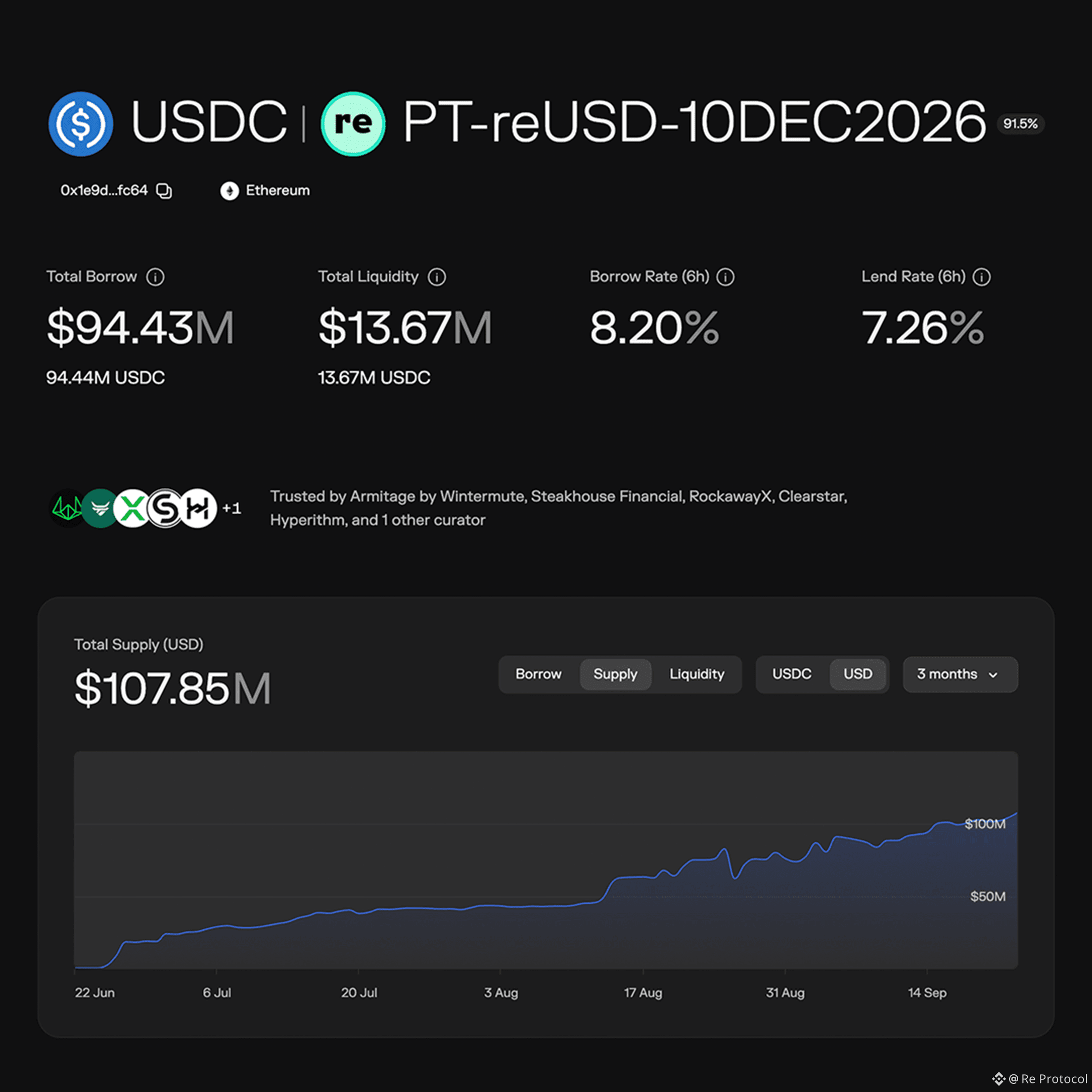
The USDC / PT-reUSD market on Morpho crossed $100M+ in supply.
If you're sitting on idle USDC, lend it against PT-reUSD for 7.26% APY.
Real-world yield composable at scale.
Lend here:
https://app.morpho.org/ethereum/variable/0x1e9d614631a7df0ec07fb05b2c8cb2491575fd1a63a33bf187a6afb295a4fc64/usdc-pt-reusd-10dec2026
#reinsurance #RWA #DeFi #TradFi
The USDC / PT-reUSD market on Morpho crossed $100M+ in supply.
If you're sitting on idle USDC, lend it against PT-reUSD for 7.26% APY.
Real-world yield composable at scale.
Lend here:
https://app.morpho.org/ethereum/variable/0x1e9d614631a7df0ec07fb05b2c8cb2491575fd1a63a33bf187a6afb295a4fc64/usdc-pt-reusd-10dec2026
#reinsurance #RWA #DeFi #TradFi
If you're sitting on idle USDC, lend it against PT-reUSD for 7.26% APY.
Real-world yield composable at scale.
Lend here:
https://app.morpho.org/ethereum/variable/0x1e9d614631a7df0ec07fb05b2c8cb2491575fd1a63a33bf187a6afb295a4fc64/usdc-pt-reusd-10dec2026
#reinsurance #RWA #DeFi #TradFi
1
2
71
·
--

Article
The Next Re Milestone: $10M in Yield2026 has been a year of milestones for Re. The launch of $RE [1], the protocol’s governance token. A quarter-billion in deposits. Half a billion in bound premium [2]. Cross-chain expansion [3].
Now comes another: $10M in total yield generated for holders of reUSD and reUSDe. But where does that yield come from? And how does it flow back to holders? Let’s explore.
All About Yield
reUSD [2] and reUSDe [3] are Re (https://re.xyz)'s yield-generating tokens. Users either deposit stablecoins to mint them or acquire them via the secondary markets. Each token has its own yield profile: a base rate plus a spread added by the protocol.
reUSD earns from two sources simultaneously, with a blended average depending upon the proportion of reUSD that remains onchain or is deployed offchain. Onchain reUSD (maintained as a liquidity buffer for user redemptions) is backed by sUSDe; it earns the yield one would receive from staking USDe on Ethena.
Offchain reUSD earns the Secured Overnight Financing Rate (SOFR), a widely used benchmark for baseline interest rates in U.S. financial markets.
reUSDe, which is intended to be deployed offchain in full, earns SOFR.
On top of that is the spread, which Re adds as its own component of the yield profile: 2.5% for reUSD and 8.5% for reUSDe (as of September 2026).
reUSD Spread - 2.5%
reUSDe Spread - 8.5%
About the Spread
Essentially, that spread is the protocol’s compensation to users for providing capital. But what funds that spread?
The answer lies at the foundation of the yield model: the funding comes from licensed reinsurance activity.
When users mint reUSD or reUSDe, the stablecoins they deposit may be deployed offchain to Cover Re, a licensed reinsurer that works in partnership with Re Protocol, for use as collateral to back new reinsurance contracts. Those contracts earn premiums, and a portion of those premiums flows back to holders in the form of the spread.
The Value of Uncorrelated Assets
That mechanism is Re’s secret sauce, so to speak. The value of the average crypto asset rises or falls in value based on the performance and activity of the crypto markets themselves. reUSD and reUSDe depend instead on revenue generated by one of the world’s stablest financial markets.
That makes reUSD and reUSDe largely uncorrelated to the performance of the crypto markets at large.
How NAV Works
The values of reUSD and reUSDe are expressed in NAV.
Conventional NAV calculations divide net assets by total token supply. Re uses an accrual model for NAV instead. Every day at midnight UTC, the NAV oracle for each token incrementally increases the token’s value on the basis of its respective yield profile.
To date, token NAV has exclusively moved in a single direction: up. NAV could technically decrease in the highly unlikely event that losses to Re’s reinsurance portfolio reach levels extreme enough to deplete its accumulated capital (currently $77M as of September 2026). Re’s portfolio has posted a meaningful profit in each year of the company’s operation.
Why the Milestone Matters
A quarter-billion in total deposits reflects the capital that has entered the protocol.Half a billion in bound premium measures the volume of reinsurance business that capital has backed.$10M in yield reflects what the protocol has generated for holders.
Together, the three demonstrate that the model is working.
More Information
For further insight on the flow of depositor money within Re, visit How Your Money Moves within Re (https://re.xyz/insights/how-your-money-moves-within-re)
For full information on Re’s token suite, visit Re Protocol’s Token Suite, Explained: reUSD, reUSDe, and $RE (https://re.xyz/insights/re-protocol-token-suite-explained)
For a full suite of Re’s protocol metrics, visit the Re App (https://app.re.xyz)
Explore reUSD and reUSDe
See live yield, NAV, and protocol metrics for reUSD and reUSDe on the Re App.
Open the Re App: https://app.re.xyz
#reinsurance #RWA #TradFi
Originally published on re.xyz: https://re.xyz/insights/next-re-milestone-10m-yield
Sources
https://docs.re.xyz/governance-and-tokenomics/re-tokenomicshttps://re.xyz/insights/half-billion-milestonehttps://re.xyz/insights/reusd-live-on-solanahttps://docs.re.xyz/products/about-reusdhttps://docs.re.xyz/products/about-reusde
Disclosures: This blog post is for informational and educational purposes only and does not constitute investment, legal, tax, or financial advice. Nothing in this article should be construed as an offer or solicitation to buy or sell any security, token, or financial product.Affiliate disclosure. The "re" brand, the re protocol, and re.xyz are operated by Resilience Foundation Cayman LLC ("Resilience Foundation"), an Exempted Limited Guarantee Foundation Company incorporated in the Cayman Islands with Limited Liability with registered number IC-414560, together with its affiliate Resilience (BVI) Ltd and Resilience Inv SPC. Resilience Foundation, Resilience BVI, and Resilience Inv do not provide insurance or reinsurance services, do not act as insurance broker or agent, and do not hold an insurance license. All regulated reinsurance activities are conducted exclusively by Cover Reinsurance SPC Ltd. ("Cover Re SPC"), a Class B(iii) licensed exempted segregated portfolio company in the Cayman Islands, operating under the "Cover Re" brand at coverre.com (https://coverre.com).Access and eligibility. reUSD and reUSDe are available exclusively to non-U.S. persons, as defined under Regulation S of the U.S. Securities Act of 1933, in specific permitted jurisdictions. Use by U.S. persons or residents is strictly prohibited. reUSD and reUSDe may be classified as securities in certain jurisdictions, and participation is subject to eligibility requirements, KYC/AML verification, and jurisdiction-specific restrictions. reUSD and reUSDe are not bank deposits, are not FDIC insured, and are not government backed.Yield. reUSD/reUSDe yield is variable, is not guaranteed, and may change at any time. Any references to yield, APR, APY, returns, or performance are informational only, and past performance is not a reliable indicator of future results. The value and stability of reUSD/reUSDe are subject to market volatility, smart contract vulnerabilities, regulatory uncertainty, and the performance of underlying collateral and protocol activity.Risk disclosure. Digital assets and blockchain-based products involve significant risk, including the potential loss of principal, smart contract vulnerabilities, liquidity constraints, and regulatory uncertainty. Any references to APR, returns, or performance are not guaranteed, and past performance is not a reliable indicator of future results.Regulatory environment. The regulatory environment for digital assets, stablecoins, tokenized real-world assets, and onchain financial products is dynamic and continues to evolve across jurisdictions. The information in this post reflects the understanding as of the date of publication and may not reflect subsequent legal or regulatory developments. Readers should consult qualified legal, tax, and financial professionals before making any decisions.Terms apply. For full terms, disclosures, and risk disclaimers, please see the Re website at https://re.xyz, Terms of Service (https://re.xyz/terms), and Disclosures (https://docs.re.xyz/disclaimers).
The Next Re Milestone: $10M in Yield
2026 has been a year of milestones for Re. The launch of $RE [1], the protocol’s governance token. A quarter-billion in deposits. Half a billion in bound premium [2]. Cross-chain expansion [3].
Now comes another: $10M in total yield generated for holders of reUSD and reUSDe. But where does that yield come from? And how does it flow back to holders? Let’s explore.
All About Yield
reUSD [2] and reUSDe [3] are Re (https://re.xyz)'s yield-generating tokens. Users either deposit stablecoins to mint them or acquire them via the secondary markets. Each token has its own yield profile: a base rate plus a spread added by the protocol.
reUSD earns from two sources simultaneously, with a blended average depending upon the proportion of reUSD that remains onchain or is deployed offchain. Onchain reUSD (maintained as a liquidity buffer for user redemptions) is backed by sUSDe; it earns the yield one would receive from staking USDe on Ethena.
Offchain reUSD earns the Secured Overnight Financing Rate (SOFR), a widely used benchmark for baseline interest rates in U.S. financial markets.
reUSDe, which is intended to be deployed offchain in full, earns SOFR.
On top of that is the spread, which Re adds as its own component of the yield profile: 2.5% for reUSD and 8.5% for reUSDe (as of September 2026).
reUSD Spread - 2.5%
reUSDe Spread - 8.5%
About the Spread
Essentially, that spread is the protocol’s compensation to users for providing capital. But what funds that spread?
The answer lies at the foundation of the yield model: the funding comes from licensed reinsurance activity.
When users mint reUSD or reUSDe, the stablecoins they deposit may be deployed offchain to Cover Re, a licensed reinsurer that works in partnership with Re Protocol, for use as collateral to back new reinsurance contracts. Those contracts earn premiums, and a portion of those premiums flows back to holders in the form of the spread.
The Value of Uncorrelated Assets
That mechanism is Re’s secret sauce, so to speak. The value of the average crypto asset rises or falls in value based on the performance and activity of the crypto markets themselves. reUSD and reUSDe depend instead on revenue generated by one of the world’s stablest financial markets.
That makes reUSD and reUSDe largely uncorrelated to the performance of the crypto markets at large.
How NAV Works
The values of reUSD and reUSDe are expressed in NAV.
Conventional NAV calculations divide net assets by total token supply. Re uses an accrual model for NAV instead. Every day at midnight UTC, the NAV oracle for each token incrementally increases the token’s value on the basis of its respective yield profile.
To date, token NAV has exclusively moved in a single direction: up. NAV could technically decrease in the highly unlikely event that losses to Re’s reinsurance portfolio reach levels extreme enough to deplete its accumulated capital (currently $77M as of September 2026). Re’s portfolio has posted a meaningful profit in each year of the company’s operation.
Why the Milestone Matters
A quarter-billion in total deposits reflects the capital that has entered the protocol.Half a billion in bound premium measures the volume of reinsurance business that capital has backed.$10M in yield reflects what the protocol has generated for holders.
Together, the three demonstrate that the model is working.
More Information
For further insight on the flow of depositor money within Re, visit How Your Money Moves within Re (https://re.xyz/insights/how-your-money-moves-within-re)
For full information on Re’s token suite, visit Re Protocol’s Token Suite, Explained: reUSD, reUSDe, and $RE (https://re.xyz/insights/re-protocol-token-suite-explained)
For a full suite of Re’s protocol metrics, visit the Re App (https://app.re.xyz)
Explore reUSD and reUSDe
See live yield, NAV, and protocol metrics for reUSD and reUSDe on the Re App.
Open the Re App: https://app.re.xyz
#reinsurance #RWA #TradFi
Originally published on re.xyz: https://re.xyz/insights/next-re-milestone-10m-yield
Sources
https://docs.re.xyz/governance-and-tokenomics/re-tokenomicshttps://re.xyz/insights/half-billion-milestonehttps://re.xyz/insights/reusd-live-on-solanahttps://docs.re.xyz/products/about-reusdhttps://docs.re.xyz/products/about-reusde
Disclosures: This blog post is for informational and educational purposes only and does not constitute investment, legal, tax, or financial advice. Nothing in this article should be construed as an offer or solicitation to buy or sell any security, token, or financial product.Affiliate disclosure. The "re" brand, the re protocol, and re.xyz are operated by Resilience Foundation Cayman LLC ("Resilience Foundation"), an Exempted Limited Guarantee Foundation Company incorporated in the Cayman Islands with Limited Liability with registered number IC-414560, together with its affiliate Resilience (BVI) Ltd and Resilience Inv SPC. Resilience Foundation, Resilience BVI, and Resilience Inv do not provide insurance or reinsurance services, do not act as insurance broker or agent, and do not hold an insurance license. All regulated reinsurance activities are conducted exclusively by Cover Reinsurance SPC Ltd. ("Cover Re SPC"), a Class B(iii) licensed exempted segregated portfolio company in the Cayman Islands, operating under the "Cover Re" brand at coverre.com (https://coverre.com).Access and eligibility. reUSD and reUSDe are available exclusively to non-U.S. persons, as defined under Regulation S of the U.S. Securities Act of 1933, in specific permitted jurisdictions. Use by U.S. persons or residents is strictly prohibited. reUSD and reUSDe may be classified as securities in certain jurisdictions, and participation is subject to eligibility requirements, KYC/AML verification, and jurisdiction-specific restrictions. reUSD and reUSDe are not bank deposits, are not FDIC insured, and are not government backed.Yield. reUSD/reUSDe yield is variable, is not guaranteed, and may change at any time. Any references to yield, APR, APY, returns, or performance are informational only, and past performance is not a reliable indicator of future results. The value and stability of reUSD/reUSDe are subject to market volatility, smart contract vulnerabilities, regulatory uncertainty, and the performance of underlying collateral and protocol activity.Risk disclosure. Digital assets and blockchain-based products involve significant risk, including the potential loss of principal, smart contract vulnerabilities, liquidity constraints, and regulatory uncertainty. Any references to APR, returns, or performance are not guaranteed, and past performance is not a reliable indicator of future results.Regulatory environment. The regulatory environment for digital assets, stablecoins, tokenized real-world assets, and onchain financial products is dynamic and continues to evolve across jurisdictions. The information in this post reflects the understanding as of the date of publication and may not reflect subsequent legal or regulatory developments. Readers should consult qualified legal, tax, and financial professionals before making any decisions.Terms apply. For full terms, disclosures, and risk disclaimers, please see the Re website at https://re.xyz, Terms of Service (https://re.xyz/terms), and Disclosures (https://docs.re.xyz/disclaimers).
Now comes another: $10M in total yield generated for holders of reUSD and reUSDe. But where does that yield come from? And how does it flow back to holders? Let’s explore.
All About Yield
reUSD [2] and reUSDe [3] are Re (https://re.xyz)'s yield-generating tokens. Users either deposit stablecoins to mint them or acquire them via the secondary markets. Each token has its own yield profile: a base rate plus a spread added by the protocol.
reUSD earns from two sources simultaneously, with a blended average depending upon the proportion of reUSD that remains onchain or is deployed offchain. Onchain reUSD (maintained as a liquidity buffer for user redemptions) is backed by sUSDe; it earns the yield one would receive from staking USDe on Ethena.
Offchain reUSD earns the Secured Overnight Financing Rate (SOFR), a widely used benchmark for baseline interest rates in U.S. financial markets.
reUSDe, which is intended to be deployed offchain in full, earns SOFR.
On top of that is the spread, which Re adds as its own component of the yield profile: 2.5% for reUSD and 8.5% for reUSDe (as of September 2026).
reUSD Spread - 2.5%
reUSDe Spread - 8.5%
About the Spread
Essentially, that spread is the protocol’s compensation to users for providing capital. But what funds that spread?
The answer lies at the foundation of the yield model: the funding comes from licensed reinsurance activity.
When users mint reUSD or reUSDe, the stablecoins they deposit may be deployed offchain to Cover Re, a licensed reinsurer that works in partnership with Re Protocol, for use as collateral to back new reinsurance contracts. Those contracts earn premiums, and a portion of those premiums flows back to holders in the form of the spread.
The Value of Uncorrelated Assets
That mechanism is Re’s secret sauce, so to speak. The value of the average crypto asset rises or falls in value based on the performance and activity of the crypto markets themselves. reUSD and reUSDe depend instead on revenue generated by one of the world’s stablest financial markets.
That makes reUSD and reUSDe largely uncorrelated to the performance of the crypto markets at large.
How NAV Works
The values of reUSD and reUSDe are expressed in NAV.
Conventional NAV calculations divide net assets by total token supply. Re uses an accrual model for NAV instead. Every day at midnight UTC, the NAV oracle for each token incrementally increases the token’s value on the basis of its respective yield profile.
To date, token NAV has exclusively moved in a single direction: up. NAV could technically decrease in the highly unlikely event that losses to Re’s reinsurance portfolio reach levels extreme enough to deplete its accumulated capital (currently $77M as of September 2026). Re’s portfolio has posted a meaningful profit in each year of the company’s operation.
Why the Milestone Matters
A quarter-billion in total deposits reflects the capital that has entered the protocol.Half a billion in bound premium measures the volume of reinsurance business that capital has backed.$10M in yield reflects what the protocol has generated for holders.
Together, the three demonstrate that the model is working.
More Information
For further insight on the flow of depositor money within Re, visit How Your Money Moves within Re (https://re.xyz/insights/how-your-money-moves-within-re)
For full information on Re’s token suite, visit Re Protocol’s Token Suite, Explained: reUSD, reUSDe, and $RE (https://re.xyz/insights/re-protocol-token-suite-explained)
For a full suite of Re’s protocol metrics, visit the Re App (https://app.re.xyz)
Explore reUSD and reUSDe
See live yield, NAV, and protocol metrics for reUSD and reUSDe on the Re App.
Open the Re App: https://app.re.xyz
#reinsurance #RWA #TradFi
Originally published on re.xyz: https://re.xyz/insights/next-re-milestone-10m-yield
Sources
https://docs.re.xyz/governance-and-tokenomics/re-tokenomicshttps://re.xyz/insights/half-billion-milestonehttps://re.xyz/insights/reusd-live-on-solanahttps://docs.re.xyz/products/about-reusdhttps://docs.re.xyz/products/about-reusde
Disclosures: This blog post is for informational and educational purposes only and does not constitute investment, legal, tax, or financial advice. Nothing in this article should be construed as an offer or solicitation to buy or sell any security, token, or financial product.Affiliate disclosure. The "re" brand, the re protocol, and re.xyz are operated by Resilience Foundation Cayman LLC ("Resilience Foundation"), an Exempted Limited Guarantee Foundation Company incorporated in the Cayman Islands with Limited Liability with registered number IC-414560, together with its affiliate Resilience (BVI) Ltd and Resilience Inv SPC. Resilience Foundation, Resilience BVI, and Resilience Inv do not provide insurance or reinsurance services, do not act as insurance broker or agent, and do not hold an insurance license. All regulated reinsurance activities are conducted exclusively by Cover Reinsurance SPC Ltd. ("Cover Re SPC"), a Class B(iii) licensed exempted segregated portfolio company in the Cayman Islands, operating under the "Cover Re" brand at coverre.com (https://coverre.com).Access and eligibility. reUSD and reUSDe are available exclusively to non-U.S. persons, as defined under Regulation S of the U.S. Securities Act of 1933, in specific permitted jurisdictions. Use by U.S. persons or residents is strictly prohibited. reUSD and reUSDe may be classified as securities in certain jurisdictions, and participation is subject to eligibility requirements, KYC/AML verification, and jurisdiction-specific restrictions. reUSD and reUSDe are not bank deposits, are not FDIC insured, and are not government backed.Yield. reUSD/reUSDe yield is variable, is not guaranteed, and may change at any time. Any references to yield, APR, APY, returns, or performance are informational only, and past performance is not a reliable indicator of future results. The value and stability of reUSD/reUSDe are subject to market volatility, smart contract vulnerabilities, regulatory uncertainty, and the performance of underlying collateral and protocol activity.Risk disclosure. Digital assets and blockchain-based products involve significant risk, including the potential loss of principal, smart contract vulnerabilities, liquidity constraints, and regulatory uncertainty. Any references to APR, returns, or performance are not guaranteed, and past performance is not a reliable indicator of future results.Regulatory environment. The regulatory environment for digital assets, stablecoins, tokenized real-world assets, and onchain financial products is dynamic and continues to evolve across jurisdictions. The information in this post reflects the understanding as of the date of publication and may not reflect subsequent legal or regulatory developments. Readers should consult qualified legal, tax, and financial professionals before making any decisions.Terms apply. For full terms, disclosures, and risk disclaimers, please see the Re website at https://re.xyz, Terms of Service (https://re.xyz/terms), and Disclosures (https://docs.re.xyz/disclaimers).
3
2
455
·
--
New milestone: Re has crossed $300M in total deposits.
As of Sept 21st, 2026.
#reinsurance #RWA #Stablecoins
New milestone: Re has crossed $300M in total deposits.
As of Sept 21st, 2026.
#reinsurance #RWA #Stablecoins
As of Sept 21st, 2026.
#reinsurance #RWA #Stablecoins
1
3
473
·
--
$10,000,000 in total yield paid to reUSD and reUSDe holders.
Paid from premiums on regulated insurance programs.
Stablecoin capital put to productive use in the real economy.
#reinsurance #RWA #yield
$10,000,000 in total yield paid to reUSD and reUSDe holders.
Paid from premiums on regulated insurance programs.
Stablecoin capital put to productive use in the real economy.
#reinsurance #RWA #yield
Paid from premiums on regulated insurance programs.
Stablecoin capital put to productive use in the real economy.
#reinsurance #RWA #yield
1
2
120
·
--
The reUSD market is live on Exponent.
• PT-reUSD (Dec-2026) · Fixed rate to maturity
• YT-reUSD (Dec-2026) · 30x Re Points
• reUSD LP (Dec-2026) · 30x Re Points
Visit the markets:
PT-reUSD:
app.exponent.finance/market/income/reUSD-10DEC26
YT-reUSD:
app.exponent.finance/market/farm/reUSD-10DEC26
reUSD LP:
app.exponent.finance/liquidity/pool/reUSD-10DEC26
#reinsurance #RWA #SolanaDeFi #Solana
The reUSD market is live on Exponent.
• PT-reUSD (Dec-2026) · Fixed rate to maturity
• YT-reUSD (Dec-2026) · 30x Re Points
• reUSD LP (Dec-2026) · 30x Re Points
Visit the markets:
PT-reUSD:
app.exponent.finance/market/income/reUSD-10DEC26
YT-reUSD:
app.exponent.finance/market/farm/reUSD-10DEC26
reUSD LP:
app.exponent.finance/liquidity/pool/reUSD-10DEC26
#reinsurance #RWA #SolanaDeFi #Solana
• PT-reUSD (Dec-2026) · Fixed rate to maturity
• YT-reUSD (Dec-2026) · 30x Re Points
• reUSD LP (Dec-2026) · 30x Re Points
Visit the markets:
PT-reUSD:
app.exponent.finance/market/income/reUSD-10DEC26
YT-reUSD:
app.exponent.finance/market/farm/reUSD-10DEC26
reUSD LP:
app.exponent.finance/liquidity/pool/reUSD-10DEC26
#reinsurance #RWA #SolanaDeFi #Solana
1
2
71
·
--
Verified

Article
How Re Opens Reinsurance: Access and Transparency for a Closed MarketWhen you buy insurance, it’s something you can see: you purchase a policy, and if anything goes wrong that’s covered by that policy, you file a claim. Behind that policy, however, sits another layer you’ll never see: reinsurance.
Reinsurance is effectively a hidden layer in more ways than that. Traditional reinsurance has long been the realm of a relatively small number of industry giants, and it’s a black box. The market has always operated behind closed doors: pricing, deals, and performance data are typically private and inaccessible to outsiders. Treaties are negotiated privately between insurers and reinsurers; terms are disclosed to the counterparties involved and to regulators, and hardly anyone else gets access to them.
The market itself has also typically been closed to anyone outside of those industry giants. Though reinsurance is a highly desirable market, the capital requirements, the necessary industry relationships, and that very opacity of it all have historically created a barrier to entry for non-institutions. Re changes that. It opens up the ability for individuals to access the reinsurance capital markets by contributing to the capital pool that backs reinsurance programs, from which depositors can earn yield drawn from real-world reinsurance premiums and other protocol sources.
The necessity of transparency.
The standard black box reinsurance model doesn’t work here. Public transparency isn’t necessary in the reinsurance market, because the parties with money at stake can see what they need to see privately. The insurers negotiating a treaty and the regulators overseeing the reinsurer get access to its books directly. The general public never does, and never needed to, because it was never in the market.
A depositor participating onchain has none of that. For an onchain reinsurer to work, those who are providing capital need to know the details of what they’re putting money into. They can’t simply be asked to take it on trust. It would be the same black box, just with a lesser barrier to participation.
How Re does it differently.
Re backs the same underlying reinsurance business and provides the same capital, but with full transparency.
Onchain Capital - All capital held onchain is visible onchain, broken down asset-by-asset and chain-by-chain, down to the vaults and custodians that hold it. This is the one layer that needs no attester at all: it sits on public ledgers, so anyone can inspect it directly rather than relying on someone to check and report it. Reserves are also tracked independently by outside parties such as Dune, DeBank, and DefiLlama, so the backing can be confirmed without going through Re at all.Offchain Capital - Capital held offchain, whether in banks awaiting deployment or in trusts that back live reinsurance contracts, cannot be inspected that way, so it’s a figure that an outside entity checks and attests: it’s verified daily by The Network Firm [1], an independent third party, and published to a public oracle.The Reinsurance Book - The reinsurance book itself [2], an aspect that’s generally held invisible in traditional reinsurance, is published in full. Re’s reinsurance strategy, profile breakdown, and treaty performance are all held transparent in detail. Every treaty, past and present, is presented with granularity, all the way down to how a treaty is performing versus expectations.Financial Statement Audit - Finally, Re has completed a full financial statement audit [3] from Grant Thornton, one of the largest auditing firms in the US. A financial statement audit is a deep examination of a company’s finances that issues a formal opinion on whether its financial statements fairly present the business. In keeping with Re’s commitment to transparency, that report has been made publicly available.
You can find all protocol metrics and audits on the Re App (https://app.re.xyz).
Bringing it together.
For a century, reinsurance was both closed and hidden. It was closed because getting in demanded enormous capital and industry relationships that almost no one outside the club could assemble. It was hidden because a market that insular had no reason to open its books to anyone beyond the counterparties and regulators who needed to see them.
Re changes both. The same reinsurance business, capital, and real risk are involved, but it’s open to anyone and visible to everyone. The latter sets an entirely new standard for a traditionally opaque industry. The whole business of reinsurance is based upon trust. In Re’s model, nobody, whether participants or regulators, needs to simply trust the protocol from the outside; everything is transparent, from the audited financials down to the performance of any single treaty.
Originally published on re.xyz: https://re.xyz/insights/how-re-opens-reinsurance
Learn More
For a full accounting of protocol metrics, visit the Re App (https://app.re.xyz). For more information about the protocol, visit the Re docs (https://docs.re.xyz).
About Re
Re is the onchain protocol connecting real-world reinsurance capital with decentralized finance. Its flagship product, reUSD, is a deposit token issued by Resilience Foundation Cayman LLC and made available to non-U.S. persons in specific geographies. The Re ecosystem brings together the onchain “re” protocol at re.xyz (https://re.xyz), operated by Resilience Foundation Cayman LLC, with the regulated reinsurance business under the “Cover Re” brand at coverre.com (https://coverre.com), operated by Cover Reinsurance SPC Ltd., a Cayman Islands Class B(iii) licensed exempted segregated portfolio company. Resilience Foundation, Resilience (BVI) Ltd, and Resilience Inv SPC do not provide insurance or reinsurance services and do not hold an insurance license. Learn more at re.xyz (https://re.xyz).
Explore Re: https://re.xyz
#reinsurance #RWA #TradFi
Sources
https://www.thenetworkfirm.comhttps://app.re.xyz/capital-strategyhttps://storage.googleapis.com/re-files-production/docs/Cover%20Re%20SP1%20FS%202025_ISSUED.pdf
Disclosures: This blog post is for informational and educational purposes only and does not constitute investment, legal, tax, or financial advice. Nothing in this article should be construed as an offer or solicitation to buy or sell any security, token, or financial product.Affiliate disclosure. The “re” brand, the re protocol, and re.xyz are operated by Resilience Foundation Cayman LLC (“Resilience Foundation”), an Exempted Limited Guarantee Foundation Company incorporated in the Cayman Islands with Limited Liability with registered number IC-414560, together with its affiliate Resilience (BVI) Ltd and Resilience Inv SPC. Resilience Foundation, Resilience BVI, and Resilience Inv do not provide insurance or reinsurance services, do not act as insurance broker or agent, and do not hold an insurance license. All regulated reinsurance activities are conducted exclusively by Cover Reinsurance SPC Ltd. (“Cover Re SPC”), a Class B(iii) licensed exempted segregated portfolio company in the Cayman Islands, operating under the “Cover Re” brand at coverre.com (https://coverre.com).Access and eligibility. reUSDe is available exclusively to non-U.S. persons, as defined under Regulation S of the U.S. Securities Act of 1933, in specific permitted jurisdictions. Use by U.S. persons or residents is strictly prohibited. reUSDe may be classified as a security in certain jurisdictions, and participation is subject to eligibility requirements, KYC/AML verification, and jurisdiction-specific restrictions. reUSDe is not a bank deposit, is not FDIC insured, and is not government backed.Yield. reUSD/reUSDe yield is variable, is not guaranteed, and may change at any time. Any references to yield, APR, APY, returns, or performance are informational only, and past performance is not a reliable indicator of future results. The value and stability of reUSD/reUSDe are subject to market volatility, smart contract vulnerabilities, regulatory uncertainty, and the performance of underlying collateral and protocol activity.Risk disclosure. Digital assets and blockchain-based products involve significant risk, including the potential loss of principal, smart contract vulnerabilities, liquidity constraints, and regulatory uncertainty. Any references to APR, returns, or performance are not guaranteed, and past performance is not a reliable indicator of future results.Regulatory environment. The regulatory environment for digital assets, stablecoins, tokenized real-world assets, and onchain financial products is dynamic and continues to evolve across jurisdictions. The information in this post reflects the understanding as of the date of publication and may not reflect subsequent legal or regulatory developments.Terms apply. For full terms, disclosures, and risk disclaimers, please see the Re website at https://re.xyz, Terms of Service (https://re.xyz/terms), and Disclosures (https://docs.re.xyz/disclaimers).
How Re Opens Reinsurance: Access and Transparency for a Closed Market
When you buy insurance, it’s something you can see: you purchase a policy, and if anything goes wrong that’s covered by that policy, you file a claim. Behind that policy, however, sits another layer you’ll never see: reinsurance.
Reinsurance is effectively a hidden layer in more ways than that. Traditional reinsurance has long been the realm of a relatively small number of industry giants, and it’s a black box. The market has always operated behind closed doors: pricing, deals, and performance data are typically private and inaccessible to outsiders. Treaties are negotiated privately between insurers and reinsurers; terms are disclosed to the counterparties involved and to regulators, and hardly anyone else gets access to them.
The market itself has also typically been closed to anyone outside of those industry giants. Though reinsurance is a highly desirable market, the capital requirements, the necessary industry relationships, and that very opacity of it all have historically created a barrier to entry for non-institutions. Re changes that. It opens up the ability for individuals to access the reinsurance capital markets by contributing to the capital pool that backs reinsurance programs, from which depositors can earn yield drawn from real-world reinsurance premiums and other protocol sources.
The necessity of transparency.
The standard black box reinsurance model doesn’t work here. Public transparency isn’t necessary in the reinsurance market, because the parties with money at stake can see what they need to see privately. The insurers negotiating a treaty and the regulators overseeing the reinsurer get access to its books directly. The general public never does, and never needed to, because it was never in the market.
A depositor participating onchain has none of that. For an onchain reinsurer to work, those who are providing capital need to know the details of what they’re putting money into. They can’t simply be asked to take it on trust. It would be the same black box, just with a lesser barrier to participation.
How Re does it differently.
Re backs the same underlying reinsurance business and provides the same capital, but with full transparency.
Onchain Capital - All capital held onchain is visible onchain, broken down asset-by-asset and chain-by-chain, down to the vaults and custodians that hold it. This is the one layer that needs no attester at all: it sits on public ledgers, so anyone can inspect it directly rather than relying on someone to check and report it. Reserves are also tracked independently by outside parties such as Dune, DeBank, and DefiLlama, so the backing can be confirmed without going through Re at all.Offchain Capital - Capital held offchain, whether in banks awaiting deployment or in trusts that back live reinsurance contracts, cannot be inspected that way, so it’s a figure that an outside entity checks and attests: it’s verified daily by The Network Firm [1], an independent third party, and published to a public oracle.The Reinsurance Book - The reinsurance book itself [2], an aspect that’s generally held invisible in traditional reinsurance, is published in full. Re’s reinsurance strategy, profile breakdown, and treaty performance are all held transparent in detail. Every treaty, past and present, is presented with granularity, all the way down to how a treaty is performing versus expectations.Financial Statement Audit - Finally, Re has completed a full financial statement audit [3] from Grant Thornton, one of the largest auditing firms in the US. A financial statement audit is a deep examination of a company’s finances that issues a formal opinion on whether its financial statements fairly present the business. In keeping with Re’s commitment to transparency, that report has been made publicly available.
You can find all protocol metrics and audits on the Re App (https://app.re.xyz).
Bringing it together.
For a century, reinsurance was both closed and hidden. It was closed because getting in demanded enormous capital and industry relationships that almost no one outside the club could assemble. It was hidden because a market that insular had no reason to open its books to anyone beyond the counterparties and regulators who needed to see them.
Re changes both. The same reinsurance business, capital, and real risk are involved, but it’s open to anyone and visible to everyone. The latter sets an entirely new standard for a traditionally opaque industry. The whole business of reinsurance is based upon trust. In Re’s model, nobody, whether participants or regulators, needs to simply trust the protocol from the outside; everything is transparent, from the audited financials down to the performance of any single treaty.
Originally published on re.xyz: https://re.xyz/insights/how-re-opens-reinsurance
Learn More
For a full accounting of protocol metrics, visit the Re App (https://app.re.xyz). For more information about the protocol, visit the Re docs (https://docs.re.xyz).
About Re
Re is the onchain protocol connecting real-world reinsurance capital with decentralized finance. Its flagship product, reUSD, is a deposit token issued by Resilience Foundation Cayman LLC and made available to non-U.S. persons in specific geographies. The Re ecosystem brings together the onchain “re” protocol at re.xyz (https://re.xyz), operated by Resilience Foundation Cayman LLC, with the regulated reinsurance business under the “Cover Re” brand at coverre.com (https://coverre.com), operated by Cover Reinsurance SPC Ltd., a Cayman Islands Class B(iii) licensed exempted segregated portfolio company. Resilience Foundation, Resilience (BVI) Ltd, and Resilience Inv SPC do not provide insurance or reinsurance services and do not hold an insurance license. Learn more at re.xyz (https://re.xyz).
Explore Re: https://re.xyz
#reinsurance #RWA #TradFi
Sources
https://www.thenetworkfirm.comhttps://app.re.xyz/capital-strategyhttps://storage.googleapis.com/re-files-production/docs/Cover%20Re%20SP1%20FS%202025_ISSUED.pdf
Disclosures: This blog post is for informational and educational purposes only and does not constitute investment, legal, tax, or financial advice. Nothing in this article should be construed as an offer or solicitation to buy or sell any security, token, or financial product.Affiliate disclosure. The “re” brand, the re protocol, and re.xyz are operated by Resilience Foundation Cayman LLC (“Resilience Foundation”), an Exempted Limited Guarantee Foundation Company incorporated in the Cayman Islands with Limited Liability with registered number IC-414560, together with its affiliate Resilience (BVI) Ltd and Resilience Inv SPC. Resilience Foundation, Resilience BVI, and Resilience Inv do not provide insurance or reinsurance services, do not act as insurance broker or agent, and do not hold an insurance license. All regulated reinsurance activities are conducted exclusively by Cover Reinsurance SPC Ltd. (“Cover Re SPC”), a Class B(iii) licensed exempted segregated portfolio company in the Cayman Islands, operating under the “Cover Re” brand at coverre.com (https://coverre.com).Access and eligibility. reUSDe is available exclusively to non-U.S. persons, as defined under Regulation S of the U.S. Securities Act of 1933, in specific permitted jurisdictions. Use by U.S. persons or residents is strictly prohibited. reUSDe may be classified as a security in certain jurisdictions, and participation is subject to eligibility requirements, KYC/AML verification, and jurisdiction-specific restrictions. reUSDe is not a bank deposit, is not FDIC insured, and is not government backed.Yield. reUSD/reUSDe yield is variable, is not guaranteed, and may change at any time. Any references to yield, APR, APY, returns, or performance are informational only, and past performance is not a reliable indicator of future results. The value and stability of reUSD/reUSDe are subject to market volatility, smart contract vulnerabilities, regulatory uncertainty, and the performance of underlying collateral and protocol activity.Risk disclosure. Digital assets and blockchain-based products involve significant risk, including the potential loss of principal, smart contract vulnerabilities, liquidity constraints, and regulatory uncertainty. Any references to APR, returns, or performance are not guaranteed, and past performance is not a reliable indicator of future results.Regulatory environment. The regulatory environment for digital assets, stablecoins, tokenized real-world assets, and onchain financial products is dynamic and continues to evolve across jurisdictions. The information in this post reflects the understanding as of the date of publication and may not reflect subsequent legal or regulatory developments.Terms apply. For full terms, disclosures, and risk disclaimers, please see the Re website at https://re.xyz, Terms of Service (https://re.xyz/terms), and Disclosures (https://docs.re.xyz/disclaimers).
Reinsurance is effectively a hidden layer in more ways than that. Traditional reinsurance has long been the realm of a relatively small number of industry giants, and it’s a black box. The market has always operated behind closed doors: pricing, deals, and performance data are typically private and inaccessible to outsiders. Treaties are negotiated privately between insurers and reinsurers; terms are disclosed to the counterparties involved and to regulators, and hardly anyone else gets access to them.
The market itself has also typically been closed to anyone outside of those industry giants. Though reinsurance is a highly desirable market, the capital requirements, the necessary industry relationships, and that very opacity of it all have historically created a barrier to entry for non-institutions. Re changes that. It opens up the ability for individuals to access the reinsurance capital markets by contributing to the capital pool that backs reinsurance programs, from which depositors can earn yield drawn from real-world reinsurance premiums and other protocol sources.
The necessity of transparency.
The standard black box reinsurance model doesn’t work here. Public transparency isn’t necessary in the reinsurance market, because the parties with money at stake can see what they need to see privately. The insurers negotiating a treaty and the regulators overseeing the reinsurer get access to its books directly. The general public never does, and never needed to, because it was never in the market.
A depositor participating onchain has none of that. For an onchain reinsurer to work, those who are providing capital need to know the details of what they’re putting money into. They can’t simply be asked to take it on trust. It would be the same black box, just with a lesser barrier to participation.
How Re does it differently.
Re backs the same underlying reinsurance business and provides the same capital, but with full transparency.
Onchain Capital - All capital held onchain is visible onchain, broken down asset-by-asset and chain-by-chain, down to the vaults and custodians that hold it. This is the one layer that needs no attester at all: it sits on public ledgers, so anyone can inspect it directly rather than relying on someone to check and report it. Reserves are also tracked independently by outside parties such as Dune, DeBank, and DefiLlama, so the backing can be confirmed without going through Re at all.Offchain Capital - Capital held offchain, whether in banks awaiting deployment or in trusts that back live reinsurance contracts, cannot be inspected that way, so it’s a figure that an outside entity checks and attests: it’s verified daily by The Network Firm [1], an independent third party, and published to a public oracle.The Reinsurance Book - The reinsurance book itself [2], an aspect that’s generally held invisible in traditional reinsurance, is published in full. Re’s reinsurance strategy, profile breakdown, and treaty performance are all held transparent in detail. Every treaty, past and present, is presented with granularity, all the way down to how a treaty is performing versus expectations.Financial Statement Audit - Finally, Re has completed a full financial statement audit [3] from Grant Thornton, one of the largest auditing firms in the US. A financial statement audit is a deep examination of a company’s finances that issues a formal opinion on whether its financial statements fairly present the business. In keeping with Re’s commitment to transparency, that report has been made publicly available.
You can find all protocol metrics and audits on the Re App (https://app.re.xyz).
Bringing it together.
For a century, reinsurance was both closed and hidden. It was closed because getting in demanded enormous capital and industry relationships that almost no one outside the club could assemble. It was hidden because a market that insular had no reason to open its books to anyone beyond the counterparties and regulators who needed to see them.
Re changes both. The same reinsurance business, capital, and real risk are involved, but it’s open to anyone and visible to everyone. The latter sets an entirely new standard for a traditionally opaque industry. The whole business of reinsurance is based upon trust. In Re’s model, nobody, whether participants or regulators, needs to simply trust the protocol from the outside; everything is transparent, from the audited financials down to the performance of any single treaty.
Originally published on re.xyz: https://re.xyz/insights/how-re-opens-reinsurance
Learn More
For a full accounting of protocol metrics, visit the Re App (https://app.re.xyz). For more information about the protocol, visit the Re docs (https://docs.re.xyz).
About Re
Re is the onchain protocol connecting real-world reinsurance capital with decentralized finance. Its flagship product, reUSD, is a deposit token issued by Resilience Foundation Cayman LLC and made available to non-U.S. persons in specific geographies. The Re ecosystem brings together the onchain “re” protocol at re.xyz (https://re.xyz), operated by Resilience Foundation Cayman LLC, with the regulated reinsurance business under the “Cover Re” brand at coverre.com (https://coverre.com), operated by Cover Reinsurance SPC Ltd., a Cayman Islands Class B(iii) licensed exempted segregated portfolio company. Resilience Foundation, Resilience (BVI) Ltd, and Resilience Inv SPC do not provide insurance or reinsurance services and do not hold an insurance license. Learn more at re.xyz (https://re.xyz).
Explore Re: https://re.xyz
#reinsurance #RWA #TradFi
Sources
https://www.thenetworkfirm.comhttps://app.re.xyz/capital-strategyhttps://storage.googleapis.com/re-files-production/docs/Cover%20Re%20SP1%20FS%202025_ISSUED.pdf
Disclosures: This blog post is for informational and educational purposes only and does not constitute investment, legal, tax, or financial advice. Nothing in this article should be construed as an offer or solicitation to buy or sell any security, token, or financial product.Affiliate disclosure. The “re” brand, the re protocol, and re.xyz are operated by Resilience Foundation Cayman LLC (“Resilience Foundation”), an Exempted Limited Guarantee Foundation Company incorporated in the Cayman Islands with Limited Liability with registered number IC-414560, together with its affiliate Resilience (BVI) Ltd and Resilience Inv SPC. Resilience Foundation, Resilience BVI, and Resilience Inv do not provide insurance or reinsurance services, do not act as insurance broker or agent, and do not hold an insurance license. All regulated reinsurance activities are conducted exclusively by Cover Reinsurance SPC Ltd. (“Cover Re SPC”), a Class B(iii) licensed exempted segregated portfolio company in the Cayman Islands, operating under the “Cover Re” brand at coverre.com (https://coverre.com).Access and eligibility. reUSDe is available exclusively to non-U.S. persons, as defined under Regulation S of the U.S. Securities Act of 1933, in specific permitted jurisdictions. Use by U.S. persons or residents is strictly prohibited. reUSDe may be classified as a security in certain jurisdictions, and participation is subject to eligibility requirements, KYC/AML verification, and jurisdiction-specific restrictions. reUSDe is not a bank deposit, is not FDIC insured, and is not government backed.Yield. reUSD/reUSDe yield is variable, is not guaranteed, and may change at any time. Any references to yield, APR, APY, returns, or performance are informational only, and past performance is not a reliable indicator of future results. The value and stability of reUSD/reUSDe are subject to market volatility, smart contract vulnerabilities, regulatory uncertainty, and the performance of underlying collateral and protocol activity.Risk disclosure. Digital assets and blockchain-based products involve significant risk, including the potential loss of principal, smart contract vulnerabilities, liquidity constraints, and regulatory uncertainty. Any references to APR, returns, or performance are not guaranteed, and past performance is not a reliable indicator of future results.Regulatory environment. The regulatory environment for digital assets, stablecoins, tokenized real-world assets, and onchain financial products is dynamic and continues to evolve across jurisdictions. The information in this post reflects the understanding as of the date of publication and may not reflect subsequent legal or regulatory developments.Terms apply. For full terms, disclosures, and risk disclaimers, please see the Re website at https://re.xyz, Terms of Service (https://re.xyz/terms), and Disclosures (https://docs.re.xyz/disclaimers).
1
2
332
·
--
Three new deals completed. Re took on the following treaties:
→ Specialty auto: business vehicles on the road
→ Professional lines for startups: claims against a company
→ Large excess casualty: coverage that pays after a company's primary insurance runs out
Every treaty is a company paying to transfer risk it cannot hold alone. That premium takes ITD bound to $510.6M.
#reinsurance #RWA #DeFi #TradFi
Three new deals completed. Re took on the following treaties:
→ Specialty auto: business vehicles on the road
→ Professional lines for startups: claims against a company
→ Large excess casualty: coverage that pays after a company's primary insurance runs out
Every treaty is a company paying to transfer risk it cannot hold alone. That premium takes ITD bound to $510.6M.
#reinsurance #RWA #DeFi #TradFi
→ Specialty auto: business vehicles on the road
→ Professional lines for startups: claims against a company
→ Large excess casualty: coverage that pays after a company's primary insurance runs out
Every treaty is a company paying to transfer risk it cannot hold alone. That premium takes ITD bound to $510.6M.
#reinsurance #RWA #DeFi #TradFi

1
2
310
·
--
Most reUSD doesn't sit idle.
$199.97M is working across nine lending venues. DeFi composability, measured in collateral.
#reinsurance #RWA #lending
Most reUSD doesn't sit idle.
$199.97M is working across nine lending venues. DeFi composability, measured in collateral.
#reinsurance #RWA #lending
$199.97M is working across nine lending venues. DeFi composability, measured in collateral.
#reinsurance #RWA #lending
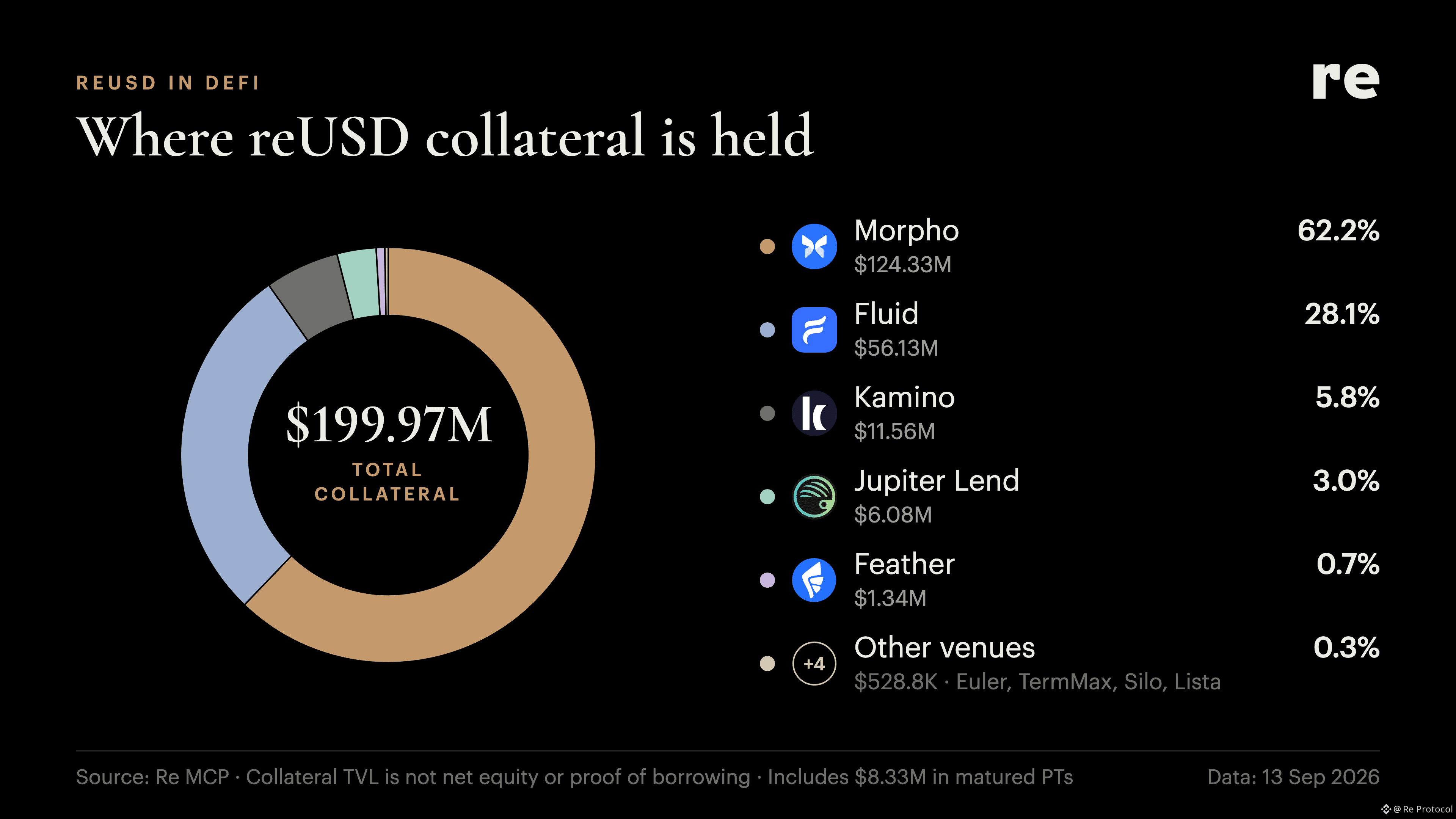
1
2
180
·
--

Article
Inside Cover Re's Broker Relationships: Where Deal Flow Comes FromCover Re is the licensed reinsurer in the Re ecosystem. A portion of the capital deposited with Re is deployed offchain as collateral for reinsurance contracts written by Cover Re, helping generate yield for reUSD and reUSDe depositors. But who connects Cover Re with the insurers on the other side?
Reinsurance is a relationship-driven market in which hundreds of billions of dollars of risk are transferred through private transactions rather than a public exchange. Brokers sit at the center of this, acting as a primary channel through which insurers bring treaty business to reinsurers, helping them identify appropriate markets, negotiate terms, and manage transactions after they are bound.
A broker's role continues after the deal is signed.
The matchmaking is the visible part. A broker knows the insurers in its market; it knows their books, their renewal calendars, and when a client needs capacity; and it recommends the counterparties it trusts.
But deal origination is only the start. The broker facilitates the deal from end to end, shaping the structure of the treaty, negotiating terms between the parties, and carrying the transaction through to binding. Once the treaty is bound, the broker services the contract for its entire duration. That means managing the technical accounting between the parties, reconciling the collateral and trust accounts that stand behind the contract, remitting premium to the reinsurer as it comes in, and moving claims between the parties when losses occur. A reinsurance contract can remain active for years, and the broker's role continues well after the contract is signed. For Re depositors, that means the contracts their capital backs are supported by established processes for moving premiums, documents, and claims between the insurer and Cover Re.
Access across global insurance markets.
The major brokers Cover Re works with have offices across global insurance hubs, from London to Bermuda to Singapore. Their local teams can help Cover Re access business in markets where it does not maintain its own presence.
As a result, Cover Re doesn't need its own office in a foreign market to do business there. A broker with a local team can reach those insurers on its behalf. And if Cover Re does want to move into a new region, that broker relationship provides a way in.
Brokers also bring local market knowledge. Every market has its own regulatory regime, conventions, and commercial culture. Working with a team that already understands those conditions can reduce the friction involved in entering a new market.
And every corner of the U.S. economy.
Within the United States, brokers connect Cover Re to insurers of many kinds, from large national carriers to regional and specialty companies.
Take regional mutual insurers as an example. They're the policyholder-owned companies that cover much of small-town and rural America. These often cover small risks: a farm insuring its heavy equipment, a retail establishment with a storefront policy, and so on. The premiums might come to only a few thousand dollars a year each, but there are a lot of them. Insurers like these write thousands of these small policies and pool them into a single book of business. Through a broker, they then pass a portion of that book's risk to Cover Re.
The businesses themselves may never know that Re's capital stands behind their coverage. Reinsurance [1] operates in the background, and the broker network is how it reaches them.
Brokers work in the other direction too.
So far we've described brokers bringing business to Cover Re. The same relationships can run the other way.
A reinsurer takes on risk from insurers. It can then buy reinsurance of its own on that risk, passing a portion of it to another reinsurer. That's called retrocession: reinsurance for reinsurers.
Reinsurers do this to protect themselves against concentration. If a reinsurer keeps writing similar contracts, it can end up holding too much of one kind of risk. That might mean heavy exposure to a single region, or to one type of event. A single bad year could then cause a serious financial loss. Passing part of that risk to another reinsurer can reduce the amount of exposure the original reinsurer retains, much as an insurer uses reinsurance in the first place.
If Cover Re chooses to buy retrocession, those same broker relationships can connect it with other reinsurers.
Why this matters for Re.
Re's mission is to make reinsurance transparent and accessible onchain. Depositors provide capital in stablecoins. Re publishes the information needed to verify how capital is held and deployed, rather than asking depositors to take it on trust. Onchain reserves are visible in real time. Data on capital held offchain as collateral against live treaties is independently attested and published onchain as well. And treaty-level data on Cover Re's portfolio is disclosed rather than kept opaque, as it would be in traditional reinsurance.
The reinsurance market itself remains private and relationship-driven. These contracts aren't bought on an open market; each is negotiated between an insurer and reinsurer, usually with a broker arranging the transaction. That's how Cover Re reaches this business, and those broker relationships matter to depositors in three ways.
Choice - Because Cover Re works with many of the major brokers, it can evaluate more potential business than it ultimately writes. A broader opportunity set gives the underwriting team more room to be selective about pricing and risk.Operational reliability - Brokers remain involved after contracts are signed, helping coordinate premiums, accounting, collateral records, documentation, and claims between insurers and Cover Re. That established servicing infrastructure reduces the amount the two sides need to manage directly over the life of a contract.Durability - Established broker relationships are far harder to reproduce than software. Brokers need confidence in a reinsurer's underwriting appetite, capacity, and ability to meet its obligations. That confidence develops through experience working together; it can't be replicated simply by launching similar technology.
For Re, the broker network is core infrastructure: it's how Cover Re reaches the market where depositor capital is actually put to work.
Originally published on re.xyz: https://re.xyz/insights/cover-re-broker-relationships
Learn more.
For more information on the protocol (https://re.xyz), visit our official docs (https://docs.re.xyz) and read more of our blogs (https://re.xyz/insights).
Explore Re: https://re.xyz
#reinsurance #RWA #TradFi
Sources
https://docs.re.xyz/getting-started-with-re/what-reinsurance-is
Disclosures: This blog post is for informational and educational purposes only and does not constitute investment, legal, tax, or financial advice. Nothing in this article should be construed as an offer or solicitation to buy or sell any security, token, or financial product.Affiliate disclosure. The "re" brand, the re protocol, and re.xyz are operated by Resilience Foundation Cayman LLC ("Resilience Foundation"), an Exempted Limited Guarantee Foundation Company incorporated in the Cayman Islands with Limited Liability with registered number IC-414560, together with its affiliate Resilience (BVI) Ltd and Resilience Inv SPC. Resilience Foundation, Resilience BVI, and Resilience Inv do not provide insurance or reinsurance services, do not act as insurance broker or agent, and do not hold an insurance license. All regulated reinsurance activities are conducted exclusively by Cover Reinsurance SPC Ltd. ("Cover Re SPC"), a Class B(iii) licensed exempted segregated portfolio company in the Cayman Islands, operating under the "Cover Re" brand at coverre.com.Access and eligibility. reUSDe is available exclusively to non-U.S. persons, as defined under Regulation S of the U.S. Securities Act of 1933, in specific permitted jurisdictions. Use by U.S. persons or residents is strictly prohibited. reUSDe may be classified as a security in certain jurisdictions, and participation is subject to eligibility requirements, KYC/AML verification, and jurisdiction-specific restrictions. reUSDe is not a bank deposit, is not FDIC insured, and is not government backed.Yield. reUSD/reUSDe yield is variable, is not guaranteed, and may change at any time. Any references to yield, APR, APY, returns, or performance are informational only, and past performance is not a reliable indicator of future results. The value and stability of reUSD/reUSDe are subject to market volatility, smart contract vulnerabilities, regulatory uncertainty, and the performance of underlying collateral and protocol activity.Risk disclosure. Digital assets and blockchain-based products involve significant risk, including the potential loss of principal, smart contract vulnerabilities, liquidity constraints, and regulatory uncertainty. Any references to APR, returns, or performance are not guaranteed, and past performance is not a reliable indicator of future results.Regulatory environment. The regulatory environment for digital assets, stablecoins, tokenized real-world assets, and onchain financial products is dynamic and continues to evolve across jurisdictions. The information in this post reflects the understanding as of the date of publication and may not reflect subsequent legal or regulatory developments. Readers should consult qualified legal, tax, and financial professionals before making any decisions.Terms apply. For full terms, disclosures, and risk disclaimers, please see the Re website at https://re.xyz, Terms of Service (https://re.xyz/terms), and Disclaimers (https://docs.re.xyz/disclaimers).
Inside Cover Re's Broker Relationships: Where Deal Flow Comes From
Cover Re is the licensed reinsurer in the Re ecosystem. A portion of the capital deposited with Re is deployed offchain as collateral for reinsurance contracts written by Cover Re, helping generate yield for reUSD and reUSDe depositors. But who connects Cover Re with the insurers on the other side?
Reinsurance is a relationship-driven market in which hundreds of billions of dollars of risk are transferred through private transactions rather than a public exchange. Brokers sit at the center of this, acting as a primary channel through which insurers bring treaty business to reinsurers, helping them identify appropriate markets, negotiate terms, and manage transactions after they are bound.
A broker's role continues after the deal is signed.
The matchmaking is the visible part. A broker knows the insurers in its market; it knows their books, their renewal calendars, and when a client needs capacity; and it recommends the counterparties it trusts.
But deal origination is only the start. The broker facilitates the deal from end to end, shaping the structure of the treaty, negotiating terms between the parties, and carrying the transaction through to binding. Once the treaty is bound, the broker services the contract for its entire duration. That means managing the technical accounting between the parties, reconciling the collateral and trust accounts that stand behind the contract, remitting premium to the reinsurer as it comes in, and moving claims between the parties when losses occur. A reinsurance contract can remain active for years, and the broker's role continues well after the contract is signed. For Re depositors, that means the contracts their capital backs are supported by established processes for moving premiums, documents, and claims between the insurer and Cover Re.
Access across global insurance markets.
The major brokers Cover Re works with have offices across global insurance hubs, from London to Bermuda to Singapore. Their local teams can help Cover Re access business in markets where it does not maintain its own presence.
As a result, Cover Re doesn't need its own office in a foreign market to do business there. A broker with a local team can reach those insurers on its behalf. And if Cover Re does want to move into a new region, that broker relationship provides a way in.
Brokers also bring local market knowledge. Every market has its own regulatory regime, conventions, and commercial culture. Working with a team that already understands those conditions can reduce the friction involved in entering a new market.
And every corner of the U.S. economy.
Within the United States, brokers connect Cover Re to insurers of many kinds, from large national carriers to regional and specialty companies.
Take regional mutual insurers as an example. They're the policyholder-owned companies that cover much of small-town and rural America. These often cover small risks: a farm insuring its heavy equipment, a retail establishment with a storefront policy, and so on. The premiums might come to only a few thousand dollars a year each, but there are a lot of them. Insurers like these write thousands of these small policies and pool them into a single book of business. Through a broker, they then pass a portion of that book's risk to Cover Re.
The businesses themselves may never know that Re's capital stands behind their coverage. Reinsurance [1] operates in the background, and the broker network is how it reaches them.
Brokers work in the other direction too.
So far we've described brokers bringing business to Cover Re. The same relationships can run the other way.
A reinsurer takes on risk from insurers. It can then buy reinsurance of its own on that risk, passing a portion of it to another reinsurer. That's called retrocession: reinsurance for reinsurers.
Reinsurers do this to protect themselves against concentration. If a reinsurer keeps writing similar contracts, it can end up holding too much of one kind of risk. That might mean heavy exposure to a single region, or to one type of event. A single bad year could then cause a serious financial loss. Passing part of that risk to another reinsurer can reduce the amount of exposure the original reinsurer retains, much as an insurer uses reinsurance in the first place.
If Cover Re chooses to buy retrocession, those same broker relationships can connect it with other reinsurers.
Why this matters for Re.
Re's mission is to make reinsurance transparent and accessible onchain. Depositors provide capital in stablecoins. Re publishes the information needed to verify how capital is held and deployed, rather than asking depositors to take it on trust. Onchain reserves are visible in real time. Data on capital held offchain as collateral against live treaties is independently attested and published onchain as well. And treaty-level data on Cover Re's portfolio is disclosed rather than kept opaque, as it would be in traditional reinsurance.
The reinsurance market itself remains private and relationship-driven. These contracts aren't bought on an open market; each is negotiated between an insurer and reinsurer, usually with a broker arranging the transaction. That's how Cover Re reaches this business, and those broker relationships matter to depositors in three ways.
Choice - Because Cover Re works with many of the major brokers, it can evaluate more potential business than it ultimately writes. A broader opportunity set gives the underwriting team more room to be selective about pricing and risk.Operational reliability - Brokers remain involved after contracts are signed, helping coordinate premiums, accounting, collateral records, documentation, and claims between insurers and Cover Re. That established servicing infrastructure reduces the amount the two sides need to manage directly over the life of a contract.Durability - Established broker relationships are far harder to reproduce than software. Brokers need confidence in a reinsurer's underwriting appetite, capacity, and ability to meet its obligations. That confidence develops through experience working together; it can't be replicated simply by launching similar technology.
For Re, the broker network is core infrastructure: it's how Cover Re reaches the market where depositor capital is actually put to work.
Originally published on re.xyz: https://re.xyz/insights/cover-re-broker-relationships
Learn more.
For more information on the protocol (https://re.xyz), visit our official docs (https://docs.re.xyz) and read more of our blogs (https://re.xyz/insights).
Explore Re: https://re.xyz
#reinsurance #RWA #TradFi
Sources
https://docs.re.xyz/getting-started-with-re/what-reinsurance-is
Disclosures: This blog post is for informational and educational purposes only and does not constitute investment, legal, tax, or financial advice. Nothing in this article should be construed as an offer or solicitation to buy or sell any security, token, or financial product.Affiliate disclosure. The "re" brand, the re protocol, and re.xyz are operated by Resilience Foundation Cayman LLC ("Resilience Foundation"), an Exempted Limited Guarantee Foundation Company incorporated in the Cayman Islands with Limited Liability with registered number IC-414560, together with its affiliate Resilience (BVI) Ltd and Resilience Inv SPC. Resilience Foundation, Resilience BVI, and Resilience Inv do not provide insurance or reinsurance services, do not act as insurance broker or agent, and do not hold an insurance license. All regulated reinsurance activities are conducted exclusively by Cover Reinsurance SPC Ltd. ("Cover Re SPC"), a Class B(iii) licensed exempted segregated portfolio company in the Cayman Islands, operating under the "Cover Re" brand at coverre.com.Access and eligibility. reUSDe is available exclusively to non-U.S. persons, as defined under Regulation S of the U.S. Securities Act of 1933, in specific permitted jurisdictions. Use by U.S. persons or residents is strictly prohibited. reUSDe may be classified as a security in certain jurisdictions, and participation is subject to eligibility requirements, KYC/AML verification, and jurisdiction-specific restrictions. reUSDe is not a bank deposit, is not FDIC insured, and is not government backed.Yield. reUSD/reUSDe yield is variable, is not guaranteed, and may change at any time. Any references to yield, APR, APY, returns, or performance are informational only, and past performance is not a reliable indicator of future results. The value and stability of reUSD/reUSDe are subject to market volatility, smart contract vulnerabilities, regulatory uncertainty, and the performance of underlying collateral and protocol activity.Risk disclosure. Digital assets and blockchain-based products involve significant risk, including the potential loss of principal, smart contract vulnerabilities, liquidity constraints, and regulatory uncertainty. Any references to APR, returns, or performance are not guaranteed, and past performance is not a reliable indicator of future results.Regulatory environment. The regulatory environment for digital assets, stablecoins, tokenized real-world assets, and onchain financial products is dynamic and continues to evolve across jurisdictions. The information in this post reflects the understanding as of the date of publication and may not reflect subsequent legal or regulatory developments. Readers should consult qualified legal, tax, and financial professionals before making any decisions.Terms apply. For full terms, disclosures, and risk disclaimers, please see the Re website at https://re.xyz, Terms of Service (https://re.xyz/terms), and Disclaimers (https://docs.re.xyz/disclaimers).
Reinsurance is a relationship-driven market in which hundreds of billions of dollars of risk are transferred through private transactions rather than a public exchange. Brokers sit at the center of this, acting as a primary channel through which insurers bring treaty business to reinsurers, helping them identify appropriate markets, negotiate terms, and manage transactions after they are bound.
A broker's role continues after the deal is signed.
The matchmaking is the visible part. A broker knows the insurers in its market; it knows their books, their renewal calendars, and when a client needs capacity; and it recommends the counterparties it trusts.
But deal origination is only the start. The broker facilitates the deal from end to end, shaping the structure of the treaty, negotiating terms between the parties, and carrying the transaction through to binding. Once the treaty is bound, the broker services the contract for its entire duration. That means managing the technical accounting between the parties, reconciling the collateral and trust accounts that stand behind the contract, remitting premium to the reinsurer as it comes in, and moving claims between the parties when losses occur. A reinsurance contract can remain active for years, and the broker's role continues well after the contract is signed. For Re depositors, that means the contracts their capital backs are supported by established processes for moving premiums, documents, and claims between the insurer and Cover Re.
Access across global insurance markets.
The major brokers Cover Re works with have offices across global insurance hubs, from London to Bermuda to Singapore. Their local teams can help Cover Re access business in markets where it does not maintain its own presence.
As a result, Cover Re doesn't need its own office in a foreign market to do business there. A broker with a local team can reach those insurers on its behalf. And if Cover Re does want to move into a new region, that broker relationship provides a way in.
Brokers also bring local market knowledge. Every market has its own regulatory regime, conventions, and commercial culture. Working with a team that already understands those conditions can reduce the friction involved in entering a new market.
And every corner of the U.S. economy.
Within the United States, brokers connect Cover Re to insurers of many kinds, from large national carriers to regional and specialty companies.
Take regional mutual insurers as an example. They're the policyholder-owned companies that cover much of small-town and rural America. These often cover small risks: a farm insuring its heavy equipment, a retail establishment with a storefront policy, and so on. The premiums might come to only a few thousand dollars a year each, but there are a lot of them. Insurers like these write thousands of these small policies and pool them into a single book of business. Through a broker, they then pass a portion of that book's risk to Cover Re.
The businesses themselves may never know that Re's capital stands behind their coverage. Reinsurance [1] operates in the background, and the broker network is how it reaches them.
Brokers work in the other direction too.
So far we've described brokers bringing business to Cover Re. The same relationships can run the other way.
A reinsurer takes on risk from insurers. It can then buy reinsurance of its own on that risk, passing a portion of it to another reinsurer. That's called retrocession: reinsurance for reinsurers.
Reinsurers do this to protect themselves against concentration. If a reinsurer keeps writing similar contracts, it can end up holding too much of one kind of risk. That might mean heavy exposure to a single region, or to one type of event. A single bad year could then cause a serious financial loss. Passing part of that risk to another reinsurer can reduce the amount of exposure the original reinsurer retains, much as an insurer uses reinsurance in the first place.
If Cover Re chooses to buy retrocession, those same broker relationships can connect it with other reinsurers.
Why this matters for Re.
Re's mission is to make reinsurance transparent and accessible onchain. Depositors provide capital in stablecoins. Re publishes the information needed to verify how capital is held and deployed, rather than asking depositors to take it on trust. Onchain reserves are visible in real time. Data on capital held offchain as collateral against live treaties is independently attested and published onchain as well. And treaty-level data on Cover Re's portfolio is disclosed rather than kept opaque, as it would be in traditional reinsurance.
The reinsurance market itself remains private and relationship-driven. These contracts aren't bought on an open market; each is negotiated between an insurer and reinsurer, usually with a broker arranging the transaction. That's how Cover Re reaches this business, and those broker relationships matter to depositors in three ways.
Choice - Because Cover Re works with many of the major brokers, it can evaluate more potential business than it ultimately writes. A broader opportunity set gives the underwriting team more room to be selective about pricing and risk.Operational reliability - Brokers remain involved after contracts are signed, helping coordinate premiums, accounting, collateral records, documentation, and claims between insurers and Cover Re. That established servicing infrastructure reduces the amount the two sides need to manage directly over the life of a contract.Durability - Established broker relationships are far harder to reproduce than software. Brokers need confidence in a reinsurer's underwriting appetite, capacity, and ability to meet its obligations. That confidence develops through experience working together; it can't be replicated simply by launching similar technology.
For Re, the broker network is core infrastructure: it's how Cover Re reaches the market where depositor capital is actually put to work.
Originally published on re.xyz: https://re.xyz/insights/cover-re-broker-relationships
Learn more.
For more information on the protocol (https://re.xyz), visit our official docs (https://docs.re.xyz) and read more of our blogs (https://re.xyz/insights).
Explore Re: https://re.xyz
#reinsurance #RWA #TradFi
Sources
https://docs.re.xyz/getting-started-with-re/what-reinsurance-is
Disclosures: This blog post is for informational and educational purposes only and does not constitute investment, legal, tax, or financial advice. Nothing in this article should be construed as an offer or solicitation to buy or sell any security, token, or financial product.Affiliate disclosure. The "re" brand, the re protocol, and re.xyz are operated by Resilience Foundation Cayman LLC ("Resilience Foundation"), an Exempted Limited Guarantee Foundation Company incorporated in the Cayman Islands with Limited Liability with registered number IC-414560, together with its affiliate Resilience (BVI) Ltd and Resilience Inv SPC. Resilience Foundation, Resilience BVI, and Resilience Inv do not provide insurance or reinsurance services, do not act as insurance broker or agent, and do not hold an insurance license. All regulated reinsurance activities are conducted exclusively by Cover Reinsurance SPC Ltd. ("Cover Re SPC"), a Class B(iii) licensed exempted segregated portfolio company in the Cayman Islands, operating under the "Cover Re" brand at coverre.com.Access and eligibility. reUSDe is available exclusively to non-U.S. persons, as defined under Regulation S of the U.S. Securities Act of 1933, in specific permitted jurisdictions. Use by U.S. persons or residents is strictly prohibited. reUSDe may be classified as a security in certain jurisdictions, and participation is subject to eligibility requirements, KYC/AML verification, and jurisdiction-specific restrictions. reUSDe is not a bank deposit, is not FDIC insured, and is not government backed.Yield. reUSD/reUSDe yield is variable, is not guaranteed, and may change at any time. Any references to yield, APR, APY, returns, or performance are informational only, and past performance is not a reliable indicator of future results. The value and stability of reUSD/reUSDe are subject to market volatility, smart contract vulnerabilities, regulatory uncertainty, and the performance of underlying collateral and protocol activity.Risk disclosure. Digital assets and blockchain-based products involve significant risk, including the potential loss of principal, smart contract vulnerabilities, liquidity constraints, and regulatory uncertainty. Any references to APR, returns, or performance are not guaranteed, and past performance is not a reliable indicator of future results.Regulatory environment. The regulatory environment for digital assets, stablecoins, tokenized real-world assets, and onchain financial products is dynamic and continues to evolve across jurisdictions. The information in this post reflects the understanding as of the date of publication and may not reflect subsequent legal or regulatory developments. Readers should consult qualified legal, tax, and financial professionals before making any decisions.Terms apply. For full terms, disclosures, and risk disclaimers, please see the Re website at https://re.xyz, Terms of Service (https://re.xyz/terms), and Disclaimers (https://docs.re.xyz/disclaimers).
2
339
·
--
We added ReChat to the Re App.
Ask about reUSD supply, TVL, price history or anything from the docs.
Open app.re.xyz → tap the bubble in the bottom right corner.
#reinsurance #RWA #defi
We added ReChat to the Re App.
Ask about reUSD supply, TVL, price history or anything from the docs.
Open app.re.xyz → tap the bubble in the bottom right corner.
#reinsurance #RWA #defi
Ask about reUSD supply, TVL, price history or anything from the docs.
Open app.re.xyz → tap the bubble in the bottom right corner.
#reinsurance #RWA #defi
2
101
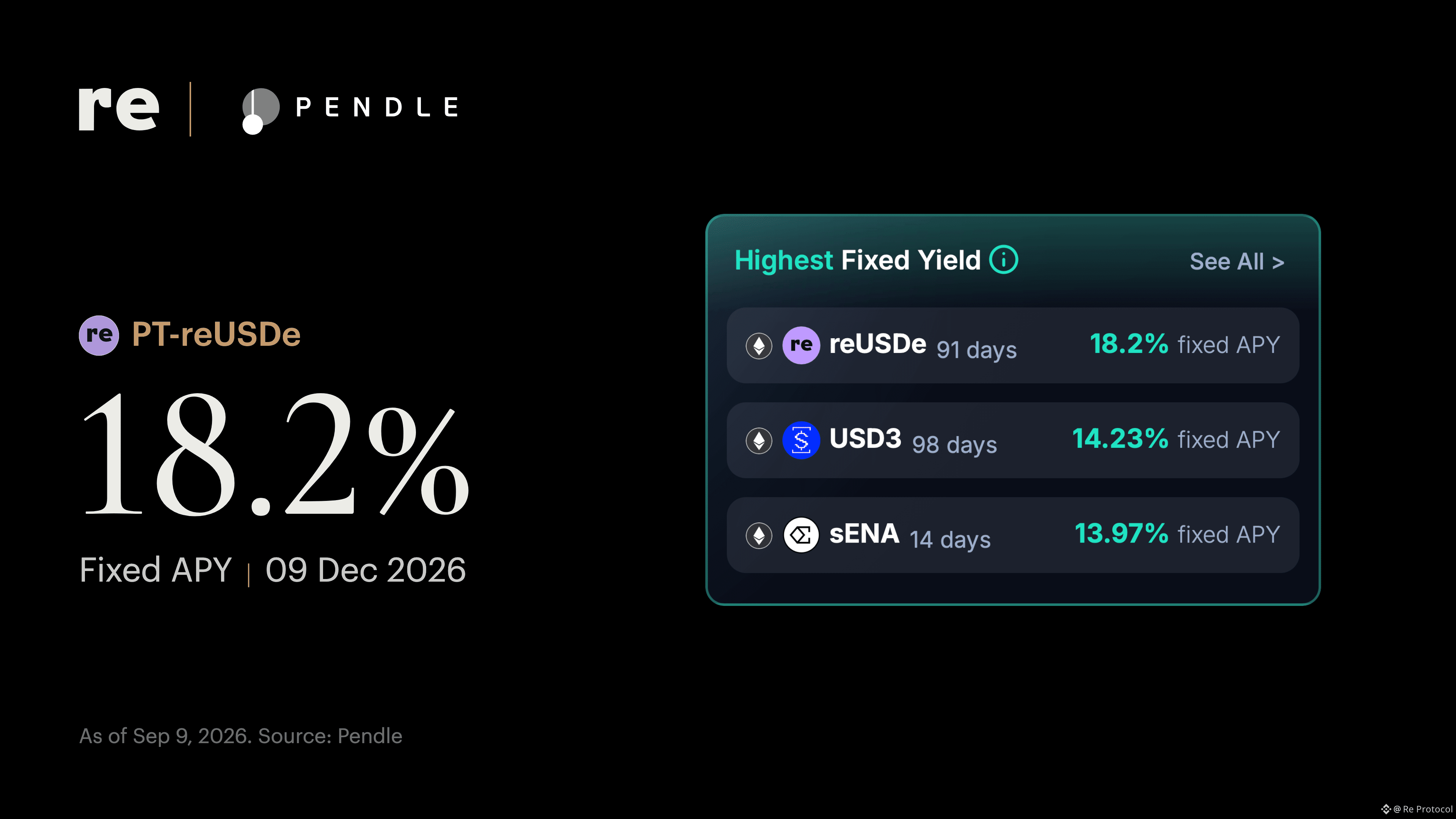
·
--
Five years, one direction.
Bound premium refers to signed reinsurance treaties (contracts). The dollars are committed for the full contract term.
#reinsurance #RWA #DeFi
Five years, one direction.
Bound premium refers to signed reinsurance treaties (contracts). The dollars are committed for the full contract term.
#reinsurance #RWA #DeFi
Bound premium refers to signed reinsurance treaties (contracts). The dollars are committed for the full contract term.
#reinsurance #RWA #DeFi
2
108
·
--

Article
How Your Money Moves Within ReEntry into Re Protocol is simple: deposit stablecoins, mint reUSD [1] or reUSDe [2].
But what's the exact flow of your money? What does it do while it's within the protocol? How does it earn? And how does it find its way back to the depositor? Let's explore.
Where your deposit goes.
The stablecoins you deposit are used to mint the token of your choice. USDC, DAI, USDe, or sUSDe can be used as deposit tender to mint reUSD; USDe, sUSDe are the accepted tender for reUSDe.
Whether you mint reUSD or reUSDe (or both), your tokens won't necessarily exist in the same place. From the start, they'll be split across two destinations: onchain and offchain.
Onchain capital is kept in liquid form inside the protocol. reUSD is designed as a liquid instrument, and at least 50% of the high-water mark of reUSD deposits is held onchain to serve as redemption liquidity. reUSDe is intended as a much longer-term instrument; a much smaller proportion of its backing is held onchain as liquidity for future redemption windows. The remainder of both reUSD and reUSDe is deployed offchain to licensed reinsurers, to serve as collateral [3] that backs new reinsurance contracts. Collateral is an amount of money, defined by local jurisdictions and insurers, that serves as assurance that the reinsurer will pay out claims.
Understanding backing.
Before following the money offchain, it helps to understand backing.
When you hold reUSD or reUSDe, you effectively hold a claim. Backing is the real stablecoin capital that stands behind that claim, deposited at the time of minting. reUSD and reUSDe are not moved around the system; instead, what moves is the stablecoin backing behind them. Both the liquidity held onchain and the capital sent offchain are in the form of that backing.
Fully backed. Re's tokens are fully backed, meaning there are real assets behind every unit of value. That way, the tokens hold their worth and redemptions can be fully honored.
Offchain mechanics.
Offchain reUSD and reUSDe follow the same shared path. It runs as a loop.
When enough reUSD and reUSDe has been deposited, a licensed reinsurance partner requests a transfer of the offchain portion. The Resilience Foundation transfers the backing, which creates a debt: the reinsurer now owes that money back to the protocol. It's essentially money lent from protocol to reinsurer, to be repaid over time.
Once the reinsurer receives the funds, it converts the stablecoins into dollars and deposits those dollars into locked trust accounts, each sized to the collateral that a given reinsurance contract needs. Not all deployed funds are necessarily deployed at the same time; after the necessary collateral is transferred, the remainder is held in reserve, ready to deploy as new reinsurance contracts are agreed to.
Value comes back from the offchain side in two ways, on two different clocks. The debt grows each month by an agreed-to amount, known as a coupon. At the end of the year, all accrued coupon payments become due (requests for earlier payment can be made if reUSD liquidity becomes low). That return flows back to the protocol, is moved back onchain, and refreshes redemption liquidity for reUSD. Separately, as contracts mature, collateral is gradually released, pulled out of trust accounts, and used to repay debt the reinsurer owes to the protocol. This is used to fund both ongoing reUSD redemptions and quarterly redemptions for reUSDe.
How your money earns.
reUSD earns from two places at once. Its onchain portion is held in sUSDe and earns that yield (what you'd earn by staking USDe on Ethena). Its offchain portion earns a return anchored to short-term US treasuries, sourced from reinsurance activity. Both come with a set spread on top, and your reUSD return combines the two.
reUSDe earns a return anchored to short-term US treasuries alone, also sourced to reinsurance activity. In exchange for modestly higher risk and substantially lower liquidity (with quarterly rather than ongoing redemptions), it earns a significantly higher spread than reUSD. Live target yields can be found on the Re App (https://app.re.xyz).
Withdrawing your money.
Because reUSD keeps much of its backing onchain and liquid, it's generally available for instant redemption. As long as at least 1% of the initial buffer is available, redemptions are available, with two caveats: no single redemption can exceed 10% of the available buffer per day, and total redemptions are limited to 20% of the available buffer per day. Should the buffer fall below 1%, redemptions enter a quarterly queue; in practice, however, the quantity of reUSD held onchain as redemption liquidity makes this outcome highly unlikely. reUSDe, on the other hand, is chiefly converted into cash, locked into trusts, and only released as reinsurance contracts mature; its liquidity is substantially lower, and redemptions are available on only a quarterly basis. The amount of liquidity released for any given redemption window depends upon release of collateral by regulators and determination by company actuaries. If total redemption requests exceed the available liquidity, redemptions are filled pro rata.
Regardless of which token you're redeeming, you receive payment in sUSDe at the token's current NAV. The stablecoins backing your tokens remained the whole way through; redemption is where that backing returns to you as spendable value.
Originally published on re.xyz: https://re.xyz/insights/how-your-money-moves-within-re
Learn more.
Go deeper. For a full accounting of protocol metrics, visit the Re App (https://app.re.xyz). For more information about the protocol, visit the Re docs (https://docs.re.xyz).
Explore Re: https://re.xyz
About Re
Re is the onchain protocol connecting real-world reinsurance capital with decentralized finance. Its flagship product, reUSD, is a deposit token issued by Resilience Foundation Cayman LLC and made available to non-U.S. persons in specific geographies. The Re ecosystem brings together the onchain "re" protocol at re.xyz, operated by Resilience Foundation Cayman LLC, with the regulated reinsurance business under the "Cover Re" brand at coverre.com (https://coverre.com), operated by Cover Reinsurance SPC Ltd., a Cayman Islands Class B(iii) licensed exempted segregated portfolio company. Resilience Foundation, Resilience (BVI) Ltd, and Resilience Inv SPC do not provide insurance or reinsurance services and do not hold an insurance license. Learn more at re.xyz.
#reinsurance #RWA #REUSD
Sources
https://docs.re.xyz/reusdhttps://docs.re.xyz/reusdehttps://docs.re.xyz/getting-started-with-re/how-re-works
Disclosures
This blog post is for informational and educational purposes only and does not constitute investment, legal, tax, or financial advice. Nothing in this article should be construed as an offer or solicitation to buy or sell any security, token, or financial product.
Affiliate disclosure. The "re" brand, the re protocol, and re.xyz are operated by Resilience Foundation Cayman LLC ("Resilience Foundation"), an Exempted Limited Guarantee Foundation Company incorporated in the Cayman Islands with Limited Liability with registered number IC-414560, together with its affiliate Resilience (BVI) Ltd and Resilience Inv SPC. Resilience Foundation, Resilience BVI, and Resilience Inv do not provide insurance or reinsurance services, do not act as insurance broker or agent, and do not hold an insurance license. All regulated reinsurance activities are conducted exclusively by Cover Reinsurance SPC Ltd. ("Cover Re SPC"), a Class B(iii) licensed exempted segregated portfolio company in the Cayman Islands, operating under the "Cover Re" brand at coverre.com.
Access and eligibility. reUSDe is available exclusively to non-U.S. persons, as defined under Regulation S of the U.S. Securities Act of 1933, in specific permitted jurisdictions. Use by U.S. persons or residents is strictly prohibited. reUSDe may be classified as a security in certain jurisdictions, and participation is subject to eligibility requirements, KYC/AML verification, and jurisdiction-specific restrictions. reUSDe is not a bank deposit, is not FDIC insured, and is not government backed.
Yield. reUSDe yield is variable, is not guaranteed, and may change at any time. Any references to yield, APR, APY, returns, or performance are informational only, and past performance is not a reliable indicator of future results. The value and stability of reUSDe are subject to market volatility, smart contract vulnerabilities, regulatory uncertainty, and the performance of underlying collateral and protocol activity.
Risk disclosure. Digital assets and blockchain-based products involve significant risk, including the potential loss of principal, smart contract vulnerabilities, liquidity constraints, and regulatory uncertainty. Any references to APR, returns, or performance are not guaranteed, and past performance is not a reliable indicator of future results.
Regulatory environment. The regulatory environment for digital assets, stablecoins, tokenized real-world assets, and onchain financial products is dynamic and continues to evolve across jurisdictions. The information in this post reflects the understanding as of the date of publication and may not reflect subsequent legal or regulatory developments. Readers should consult qualified legal, tax, and financial professionals before making any decisions.
Terms apply. For full terms, disclosures, and risk disclaimers, please see the Re website (https://re.xyz), Terms of Service (https://re.xyz/terms), and Disclaimers (https://re.xyz/disclosure).
How Your Money Moves Within Re
Entry into Re Protocol is simple: deposit stablecoins, mint reUSD [1] or reUSDe [2].
But what's the exact flow of your money? What does it do while it's within the protocol? How does it earn? And how does it find its way back to the depositor? Let's explore.
Where your deposit goes.
The stablecoins you deposit are used to mint the token of your choice. USDC, DAI, USDe, or sUSDe can be used as deposit tender to mint reUSD; USDe, sUSDe are the accepted tender for reUSDe.
Whether you mint reUSD or reUSDe (or both), your tokens won't necessarily exist in the same place. From the start, they'll be split across two destinations: onchain and offchain.
Onchain capital is kept in liquid form inside the protocol. reUSD is designed as a liquid instrument, and at least 50% of the high-water mark of reUSD deposits is held onchain to serve as redemption liquidity. reUSDe is intended as a much longer-term instrument; a much smaller proportion of its backing is held onchain as liquidity for future redemption windows. The remainder of both reUSD and reUSDe is deployed offchain to licensed reinsurers, to serve as collateral [3] that backs new reinsurance contracts. Collateral is an amount of money, defined by local jurisdictions and insurers, that serves as assurance that the reinsurer will pay out claims.
Understanding backing.
Before following the money offchain, it helps to understand backing.
When you hold reUSD or reUSDe, you effectively hold a claim. Backing is the real stablecoin capital that stands behind that claim, deposited at the time of minting. reUSD and reUSDe are not moved around the system; instead, what moves is the stablecoin backing behind them. Both the liquidity held onchain and the capital sent offchain are in the form of that backing.
Fully backed. Re's tokens are fully backed, meaning there are real assets behind every unit of value. That way, the tokens hold their worth and redemptions can be fully honored.
Offchain mechanics.
Offchain reUSD and reUSDe follow the same shared path. It runs as a loop.
When enough reUSD and reUSDe has been deposited, a licensed reinsurance partner requests a transfer of the offchain portion. The Resilience Foundation transfers the backing, which creates a debt: the reinsurer now owes that money back to the protocol. It's essentially money lent from protocol to reinsurer, to be repaid over time.
Once the reinsurer receives the funds, it converts the stablecoins into dollars and deposits those dollars into locked trust accounts, each sized to the collateral that a given reinsurance contract needs. Not all deployed funds are necessarily deployed at the same time; after the necessary collateral is transferred, the remainder is held in reserve, ready to deploy as new reinsurance contracts are agreed to.
Value comes back from the offchain side in two ways, on two different clocks. The debt grows each month by an agreed-to amount, known as a coupon. At the end of the year, all accrued coupon payments become due (requests for earlier payment can be made if reUSD liquidity becomes low). That return flows back to the protocol, is moved back onchain, and refreshes redemption liquidity for reUSD. Separately, as contracts mature, collateral is gradually released, pulled out of trust accounts, and used to repay debt the reinsurer owes to the protocol. This is used to fund both ongoing reUSD redemptions and quarterly redemptions for reUSDe.
How your money earns.
reUSD earns from two places at once. Its onchain portion is held in sUSDe and earns that yield (what you'd earn by staking USDe on Ethena). Its offchain portion earns a return anchored to short-term US treasuries, sourced from reinsurance activity. Both come with a set spread on top, and your reUSD return combines the two.
reUSDe earns a return anchored to short-term US treasuries alone, also sourced to reinsurance activity. In exchange for modestly higher risk and substantially lower liquidity (with quarterly rather than ongoing redemptions), it earns a significantly higher spread than reUSD. Live target yields can be found on the Re App (https://app.re.xyz).
Withdrawing your money.
Because reUSD keeps much of its backing onchain and liquid, it's generally available for instant redemption. As long as at least 1% of the initial buffer is available, redemptions are available, with two caveats: no single redemption can exceed 10% of the available buffer per day, and total redemptions are limited to 20% of the available buffer per day. Should the buffer fall below 1%, redemptions enter a quarterly queue; in practice, however, the quantity of reUSD held onchain as redemption liquidity makes this outcome highly unlikely. reUSDe, on the other hand, is chiefly converted into cash, locked into trusts, and only released as reinsurance contracts mature; its liquidity is substantially lower, and redemptions are available on only a quarterly basis. The amount of liquidity released for any given redemption window depends upon release of collateral by regulators and determination by company actuaries. If total redemption requests exceed the available liquidity, redemptions are filled pro rata.
Regardless of which token you're redeeming, you receive payment in sUSDe at the token's current NAV. The stablecoins backing your tokens remained the whole way through; redemption is where that backing returns to you as spendable value.
Originally published on re.xyz: https://re.xyz/insights/how-your-money-moves-within-re
Learn more.
Go deeper. For a full accounting of protocol metrics, visit the Re App (https://app.re.xyz). For more information about the protocol, visit the Re docs (https://docs.re.xyz).
Explore Re: https://re.xyz
About Re
Re is the onchain protocol connecting real-world reinsurance capital with decentralized finance. Its flagship product, reUSD, is a deposit token issued by Resilience Foundation Cayman LLC and made available to non-U.S. persons in specific geographies. The Re ecosystem brings together the onchain "re" protocol at re.xyz, operated by Resilience Foundation Cayman LLC, with the regulated reinsurance business under the "Cover Re" brand at coverre.com (https://coverre.com), operated by Cover Reinsurance SPC Ltd., a Cayman Islands Class B(iii) licensed exempted segregated portfolio company. Resilience Foundation, Resilience (BVI) Ltd, and Resilience Inv SPC do not provide insurance or reinsurance services and do not hold an insurance license. Learn more at re.xyz.
#reinsurance #RWA #REUSD
Sources
https://docs.re.xyz/reusdhttps://docs.re.xyz/reusdehttps://docs.re.xyz/getting-started-with-re/how-re-works
Disclosures
This blog post is for informational and educational purposes only and does not constitute investment, legal, tax, or financial advice. Nothing in this article should be construed as an offer or solicitation to buy or sell any security, token, or financial product.
Affiliate disclosure. The "re" brand, the re protocol, and re.xyz are operated by Resilience Foundation Cayman LLC ("Resilience Foundation"), an Exempted Limited Guarantee Foundation Company incorporated in the Cayman Islands with Limited Liability with registered number IC-414560, together with its affiliate Resilience (BVI) Ltd and Resilience Inv SPC. Resilience Foundation, Resilience BVI, and Resilience Inv do not provide insurance or reinsurance services, do not act as insurance broker or agent, and do not hold an insurance license. All regulated reinsurance activities are conducted exclusively by Cover Reinsurance SPC Ltd. ("Cover Re SPC"), a Class B(iii) licensed exempted segregated portfolio company in the Cayman Islands, operating under the "Cover Re" brand at coverre.com.
Access and eligibility. reUSDe is available exclusively to non-U.S. persons, as defined under Regulation S of the U.S. Securities Act of 1933, in specific permitted jurisdictions. Use by U.S. persons or residents is strictly prohibited. reUSDe may be classified as a security in certain jurisdictions, and participation is subject to eligibility requirements, KYC/AML verification, and jurisdiction-specific restrictions. reUSDe is not a bank deposit, is not FDIC insured, and is not government backed.
Yield. reUSDe yield is variable, is not guaranteed, and may change at any time. Any references to yield, APR, APY, returns, or performance are informational only, and past performance is not a reliable indicator of future results. The value and stability of reUSDe are subject to market volatility, smart contract vulnerabilities, regulatory uncertainty, and the performance of underlying collateral and protocol activity.
Risk disclosure. Digital assets and blockchain-based products involve significant risk, including the potential loss of principal, smart contract vulnerabilities, liquidity constraints, and regulatory uncertainty. Any references to APR, returns, or performance are not guaranteed, and past performance is not a reliable indicator of future results.
Regulatory environment. The regulatory environment for digital assets, stablecoins, tokenized real-world assets, and onchain financial products is dynamic and continues to evolve across jurisdictions. The information in this post reflects the understanding as of the date of publication and may not reflect subsequent legal or regulatory developments. Readers should consult qualified legal, tax, and financial professionals before making any decisions.
Terms apply. For full terms, disclosures, and risk disclaimers, please see the Re website (https://re.xyz), Terms of Service (https://re.xyz/terms), and Disclaimers (https://re.xyz/disclosure).
But what's the exact flow of your money? What does it do while it's within the protocol? How does it earn? And how does it find its way back to the depositor? Let's explore.
Where your deposit goes.
The stablecoins you deposit are used to mint the token of your choice. USDC, DAI, USDe, or sUSDe can be used as deposit tender to mint reUSD; USDe, sUSDe are the accepted tender for reUSDe.
Whether you mint reUSD or reUSDe (or both), your tokens won't necessarily exist in the same place. From the start, they'll be split across two destinations: onchain and offchain.
Onchain capital is kept in liquid form inside the protocol. reUSD is designed as a liquid instrument, and at least 50% of the high-water mark of reUSD deposits is held onchain to serve as redemption liquidity. reUSDe is intended as a much longer-term instrument; a much smaller proportion of its backing is held onchain as liquidity for future redemption windows. The remainder of both reUSD and reUSDe is deployed offchain to licensed reinsurers, to serve as collateral [3] that backs new reinsurance contracts. Collateral is an amount of money, defined by local jurisdictions and insurers, that serves as assurance that the reinsurer will pay out claims.
Understanding backing.
Before following the money offchain, it helps to understand backing.
When you hold reUSD or reUSDe, you effectively hold a claim. Backing is the real stablecoin capital that stands behind that claim, deposited at the time of minting. reUSD and reUSDe are not moved around the system; instead, what moves is the stablecoin backing behind them. Both the liquidity held onchain and the capital sent offchain are in the form of that backing.
Fully backed. Re's tokens are fully backed, meaning there are real assets behind every unit of value. That way, the tokens hold their worth and redemptions can be fully honored.
Offchain mechanics.
Offchain reUSD and reUSDe follow the same shared path. It runs as a loop.
When enough reUSD and reUSDe has been deposited, a licensed reinsurance partner requests a transfer of the offchain portion. The Resilience Foundation transfers the backing, which creates a debt: the reinsurer now owes that money back to the protocol. It's essentially money lent from protocol to reinsurer, to be repaid over time.
Once the reinsurer receives the funds, it converts the stablecoins into dollars and deposits those dollars into locked trust accounts, each sized to the collateral that a given reinsurance contract needs. Not all deployed funds are necessarily deployed at the same time; after the necessary collateral is transferred, the remainder is held in reserve, ready to deploy as new reinsurance contracts are agreed to.
Value comes back from the offchain side in two ways, on two different clocks. The debt grows each month by an agreed-to amount, known as a coupon. At the end of the year, all accrued coupon payments become due (requests for earlier payment can be made if reUSD liquidity becomes low). That return flows back to the protocol, is moved back onchain, and refreshes redemption liquidity for reUSD. Separately, as contracts mature, collateral is gradually released, pulled out of trust accounts, and used to repay debt the reinsurer owes to the protocol. This is used to fund both ongoing reUSD redemptions and quarterly redemptions for reUSDe.
How your money earns.
reUSD earns from two places at once. Its onchain portion is held in sUSDe and earns that yield (what you'd earn by staking USDe on Ethena). Its offchain portion earns a return anchored to short-term US treasuries, sourced from reinsurance activity. Both come with a set spread on top, and your reUSD return combines the two.
reUSDe earns a return anchored to short-term US treasuries alone, also sourced to reinsurance activity. In exchange for modestly higher risk and substantially lower liquidity (with quarterly rather than ongoing redemptions), it earns a significantly higher spread than reUSD. Live target yields can be found on the Re App (https://app.re.xyz).
Withdrawing your money.
Because reUSD keeps much of its backing onchain and liquid, it's generally available for instant redemption. As long as at least 1% of the initial buffer is available, redemptions are available, with two caveats: no single redemption can exceed 10% of the available buffer per day, and total redemptions are limited to 20% of the available buffer per day. Should the buffer fall below 1%, redemptions enter a quarterly queue; in practice, however, the quantity of reUSD held onchain as redemption liquidity makes this outcome highly unlikely. reUSDe, on the other hand, is chiefly converted into cash, locked into trusts, and only released as reinsurance contracts mature; its liquidity is substantially lower, and redemptions are available on only a quarterly basis. The amount of liquidity released for any given redemption window depends upon release of collateral by regulators and determination by company actuaries. If total redemption requests exceed the available liquidity, redemptions are filled pro rata.
Regardless of which token you're redeeming, you receive payment in sUSDe at the token's current NAV. The stablecoins backing your tokens remained the whole way through; redemption is where that backing returns to you as spendable value.
Originally published on re.xyz: https://re.xyz/insights/how-your-money-moves-within-re
Learn more.
Go deeper. For a full accounting of protocol metrics, visit the Re App (https://app.re.xyz). For more information about the protocol, visit the Re docs (https://docs.re.xyz).
Explore Re: https://re.xyz
About Re
Re is the onchain protocol connecting real-world reinsurance capital with decentralized finance. Its flagship product, reUSD, is a deposit token issued by Resilience Foundation Cayman LLC and made available to non-U.S. persons in specific geographies. The Re ecosystem brings together the onchain "re" protocol at re.xyz, operated by Resilience Foundation Cayman LLC, with the regulated reinsurance business under the "Cover Re" brand at coverre.com (https://coverre.com), operated by Cover Reinsurance SPC Ltd., a Cayman Islands Class B(iii) licensed exempted segregated portfolio company. Resilience Foundation, Resilience (BVI) Ltd, and Resilience Inv SPC do not provide insurance or reinsurance services and do not hold an insurance license. Learn more at re.xyz.
#reinsurance #RWA #REUSD
Sources
https://docs.re.xyz/reusdhttps://docs.re.xyz/reusdehttps://docs.re.xyz/getting-started-with-re/how-re-works
Disclosures
This blog post is for informational and educational purposes only and does not constitute investment, legal, tax, or financial advice. Nothing in this article should be construed as an offer or solicitation to buy or sell any security, token, or financial product.
Affiliate disclosure. The "re" brand, the re protocol, and re.xyz are operated by Resilience Foundation Cayman LLC ("Resilience Foundation"), an Exempted Limited Guarantee Foundation Company incorporated in the Cayman Islands with Limited Liability with registered number IC-414560, together with its affiliate Resilience (BVI) Ltd and Resilience Inv SPC. Resilience Foundation, Resilience BVI, and Resilience Inv do not provide insurance or reinsurance services, do not act as insurance broker or agent, and do not hold an insurance license. All regulated reinsurance activities are conducted exclusively by Cover Reinsurance SPC Ltd. ("Cover Re SPC"), a Class B(iii) licensed exempted segregated portfolio company in the Cayman Islands, operating under the "Cover Re" brand at coverre.com.
Access and eligibility. reUSDe is available exclusively to non-U.S. persons, as defined under Regulation S of the U.S. Securities Act of 1933, in specific permitted jurisdictions. Use by U.S. persons or residents is strictly prohibited. reUSDe may be classified as a security in certain jurisdictions, and participation is subject to eligibility requirements, KYC/AML verification, and jurisdiction-specific restrictions. reUSDe is not a bank deposit, is not FDIC insured, and is not government backed.
Yield. reUSDe yield is variable, is not guaranteed, and may change at any time. Any references to yield, APR, APY, returns, or performance are informational only, and past performance is not a reliable indicator of future results. The value and stability of reUSDe are subject to market volatility, smart contract vulnerabilities, regulatory uncertainty, and the performance of underlying collateral and protocol activity.
Risk disclosure. Digital assets and blockchain-based products involve significant risk, including the potential loss of principal, smart contract vulnerabilities, liquidity constraints, and regulatory uncertainty. Any references to APR, returns, or performance are not guaranteed, and past performance is not a reliable indicator of future results.
Regulatory environment. The regulatory environment for digital assets, stablecoins, tokenized real-world assets, and onchain financial products is dynamic and continues to evolve across jurisdictions. The information in this post reflects the understanding as of the date of publication and may not reflect subsequent legal or regulatory developments. Readers should consult qualified legal, tax, and financial professionals before making any decisions.
Terms apply. For full terms, disclosures, and risk disclaimers, please see the Re website (https://re.xyz), Terms of Service (https://re.xyz/terms), and Disclaimers (https://re.xyz/disclosure).
2
123
·
--
$72M net inflows into reUSD over the last 30 days according to RWA.xyz.
Capital is choosing reinsurance-backed collateral.
#reinsurance #RWA #REUSD
$72M net inflows into reUSD over the last 30 days according to RWA.xyz.
Capital is choosing reinsurance-backed collateral.
#reinsurance #RWA #REUSD
Capital is choosing reinsurance-backed collateral.
#reinsurance #RWA #REUSD
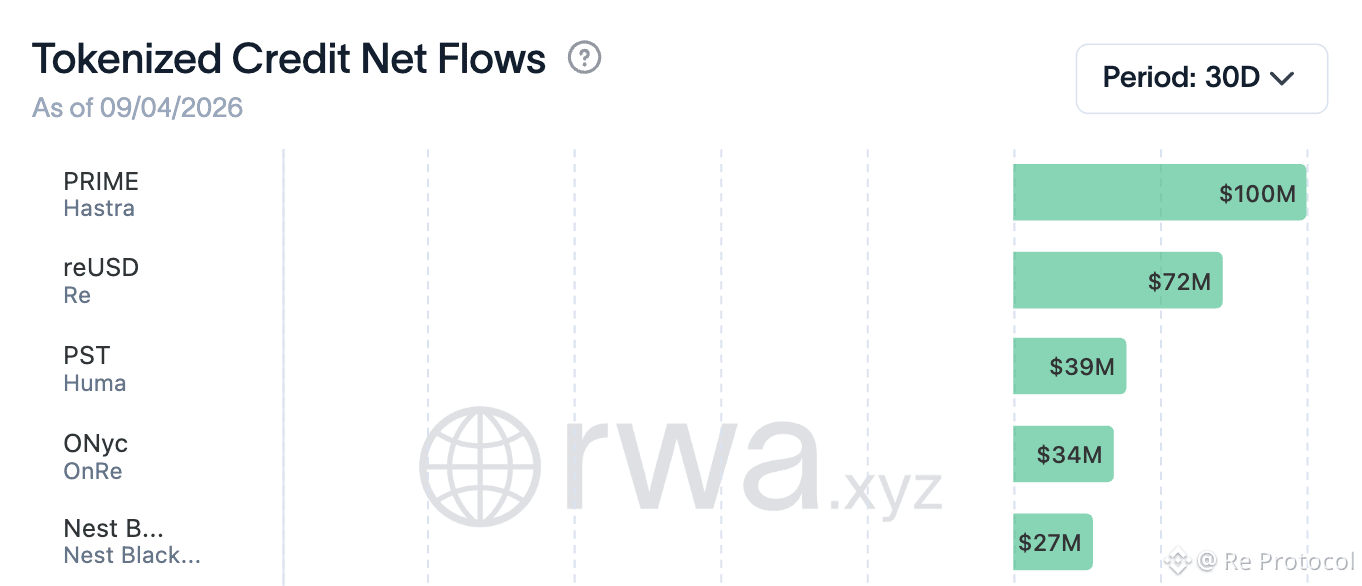
1
2
103
·
--
Refer a wallet, earn Re Points.
Referrals work both ways:
✅ Your referral gets a 6% boost on their points
✅ You earn 6% of their daily unboosted points
To get your link:
→ Open app.re.xyz/points
→ Scroll down to "Your Referrals" and copy your link
→ Optional: Create your own custom referral link under "Add referral code"
#reinsurance #RWA #DeFi
Refer a wallet, earn Re Points.
Referrals work both ways:
✅ Your referral gets a 6% boost on their points
✅ You earn 6% of their daily unboosted points
To get your link:
→ Open app.re.xyz/points
→ Scroll down to "Your Referrals" and copy your link
→ Optional: Create your own custom referral link under "Add referral code"
#reinsurance #RWA #DeFi
Referrals work both ways:
✅ Your referral gets a 6% boost on their points
✅ You earn 6% of their daily unboosted points
To get your link:
→ Open app.re.xyz/points
→ Scroll down to "Your Referrals" and copy your link
→ Optional: Create your own custom referral link under "Add referral code"
#reinsurance #RWA #DeFi
2
99
·
--
August was one of Re's strongest months on record.
→ TVL: $650.7M
→ Total deposits: $258.6M
→ reUSD live on Solana
→ reUSD live as collateral on Jupiter Earn, Kamino, and Featherlend
View the full August performance update:
blog.re.xyz/august-2026-performance-update
#reinsurance #RWA #solana #Kamino #jupiter
August was one of Re's strongest months on record.
→ TVL: $650.7M
→ Total deposits: $258.6M
→ reUSD live on Solana
→ reUSD live as collateral on Jupiter Earn, Kamino, and Featherlend
View the full August performance update:
blog.re.xyz/august-2026-performance-update
#reinsurance #RWA #solana #Kamino #jupiter
→ TVL: $650.7M
→ Total deposits: $258.6M
→ reUSD live on Solana
→ reUSD live as collateral on Jupiter Earn, Kamino, and Featherlend
View the full August performance update:
blog.re.xyz/august-2026-performance-update
#reinsurance #RWA #solana #Kamino #jupiter
4
336
·
--
Where does Re fit into the RWA movement?
Most RWAs need retail or institutional demand to generate stables and digital assets. Reinsurance generates those assets on its own.
Karn Saroya, CEO of Re, on the Edge Podcast with DeFi Dad:
#reinsurance #RWA #realworldassets
Where does Re fit into the RWA movement?
Most RWAs need retail or institutional demand to generate stables and digital assets. Reinsurance generates those assets on its own.
Karn Saroya, CEO of Re, on the Edge Podcast with DeFi Dad:
#reinsurance #RWA #realworldassets
Most RWAs need retail or institutional demand to generate stables and digital assets. Reinsurance generates those assets on its own.
Karn Saroya, CEO of Re, on the Edge Podcast with DeFi Dad:
#reinsurance #RWA #realworldassets
3
229
·
--

Article
Karn Saroya on The Edge Podcast: Unlocking One of Finance's Most Exclusive YieldsKarn Saroya, CEO of Re, joined DeFi Dad on The Edge Podcast to walk through how Re's capital stack is structured, and why reinsurance is one of the few real-world assets (RWAs) that generates more than it absorbs.
Twelve Years into Insurance
Karn is now in his twelfth year building technology in the insurance space.
The team's experience scaling the business toward a billion dollars in premiums revealed a deep disconnect between how people wanted to buy insurance and how the industry delivered it. The team responded by building a national insurance agency operating in all fifty states, and eventually stood up an insurance company from scratch, hiring executives who had run publicly traded insurers and working directly with reinsurance brokers and reinsurers along the way.
"We're amongst the few people on earth that have stood up an insurer from scratch and then also made the bridge directly into DeFi. And of those few people, most of them are on our team at this point."
— Karn Saroya, CEO of Re
Reinsurance, From First Principles
Karn's explanation of reinsurance rests on the premise that though insurance companies promise to pay, a promise to pay also requires proof of the ability to pay. Reinsurance is the financial backstop behind that promise.
The market is enormous. More than half a trillion dollars in reinsurance premium [3] sits beneath seven and a half trillion in global insurance premium.
"We are an insurance company for insurance companies, at the end of the day."
Why Onchain, Why Now
Re brings two strengths of onchain finance, transparency and verifiable capital, to the capital behind reinsurance. That approach is working. At the time of recording, Re had 51 reinsurance treaties across the United States, roughly 30 insurance company partners, and more than half a billion in business.
"It's not a toy anymore. It's really at the inflection point where this zooms to tens of billions in premium over the mid-term. The implication is that digital assets are going to be supporting tens of millions of business owners, people trying to get to work, people trying to buy homes."
The Capital Stack, and Who Takes the First Hit
The segment that landed most for the hosts was Re's first-loss structure. The stack has three layers:
Re's own capital: Roughly $80 million of earned premium and equity sits at the bottom of the stack as the first-loss layer, absorbing portfolio losses before they reach depositor capital. It earns an annual return on equity in the mid-teens to low twenties.reUSDe: A mezzanine layer with quarterly, actuarially gated redemptions. It takes on some insurance risk in exchange for a higher spread.reUSD: The senior tranche, with instant redemptions. It takes on lower risk than reUSDe and has access to higher liquidity, but receives a lower spread as a result. It's the Re product with the widest DeFi integration so far.
The structure is designed so that Re does not have to rely on insurance capital becoming liquid before the underlying policies have run their course. Re's own capital absorbs portfolio losses first, while collateral is released over time as policies earn out. The differing liquidity and yield profiles for reUSD and reUSDe reflect where each sits within that structure.
"We've got this massive safety pool, which is our assets, earned premium, and our equity, that eats any volatility in the underlying insurance portfolio first. So we can credibly say that if we win, you win. If we lose, you probably are still going to win."
A Moat Built on Execution and a Balanced Book
Re's moat lies in the combination of capabilities required to connect onchain capital with the reinsurance market. The onchain components can be copied; the token structure, contracts, and mechanics are all visible. But replicating the model as a whole would require a competitor to build the regulated infrastructure needed to conduct reinsurance business and to develop the broker and insurer relationships needed to source it. Re has been approved as a reinsurance market with most of the major reinsurance brokers in the world.
The book is deliberately balanced, with minimal exposure to catastrophe risk. It focuses on lines of insurance in which losses are generally smaller and more predictable, such as auto, home, small-business commercial, and parts of workers' compensation.
"There's no circumstance here where you have a binary outcome. If a hurricane hits Florida, we're not going to show up and say we lost all of your money, because that's not the type of business that we write."
AI Underwriters and the 30-Cent Problem
Re already uses agents internally to ingest data, run actuarial analysis, draft underwriting write-ups, and recommend capital provisioning. But Karn sees the bigger unlock one level up as AI-enabled insurance companies sitting on top of programmable capital.
His example imagines a CFO whose AI system analyzes the company's financials, flags its most significant insurable risks, and finds coverage, matched behind the scenes with onchain capital supplied through Re and adjusted as needs change.
"What I just described is like 30 cents on the dollar in insurance: the expense load, the origination load, taxes and everything else that doesn't come back into the pocket of the policyholder. That's going to get squashed."
Reinsurance as a Capital Formation Engine
Where does Re fit into the real-world asset (RWA) [4] movement, the push to bring offchain assets like treasuries and private credit onchain? Karn's view is that insurance and reinsurance [5] could plausibly encompass 10% to 15% of all of DeFi at scale, because the asset class does something few RWAs can: it creates capital rather than merely absorbing demand.
"You stick a dollar of collateral in an account, you can now write four or five dollars of insurance business. That could find its way back into stables, into other digital assets. It ends up being a force multiplier on the aggregate amount of digital assets out there in a way that very few RWAs can do."
What to Watch on Re's Dashboard
Karn highlighted two metrics for evaluating Re's progress: total premium written and underwriting performance. Re publishes combined ratios across all of its reinsurance treaties. A combined ratio below 100 means the premiums earned on that business exceeded the total of claims and underwriting expenses. Re's active treaties all enjoy ratios in the 80s and 90s, indicating profitable underwriting.
Premium receivable provides another view, that of business already under contract but not yet collected. Those premiums arrive over time as payments come due. Re does not deploy the corresponding collateral until the premium has been received, avoiding a situation where it puts capital at risk before the insurer has paid.
Governance Modeled on Lloyd's
Cover Re is the first reinsurer to use Re's protocol to access onchain capital. The infrastructure is designed to eventually support other insurers and reinsurers as well. Karn compared Re's model to Lloyd's, in which multiple insurers operate through shared marketplace infrastructure and capital.
Governance with the $RE token [6] is designed to emulate the Council of Lloyd's, allowing stakers to vote on acceptable counterparties, required collateral, aligned economics, and network fees.
Karn closed with the reason he calls reinsurance his life's work:
"This is civilizational technology. It enables risk taking everywhere by folks who want to take risks and build things. It is only natural that it ends up onchain."
Watch the full conversation.
Watch on YouTube: www.youtube.com/watch?v=S3bQESyYI8U
#reinsurance #RWA #TradFi
Sources
x.com/karnsaroyayoutube.com/playlist?list=PLNzMl-Xdbc4YfQcYdy96wgTAWoMr-3b-jmordorintelligence.com/industry-reports/global-reinsurance-marketoinbase.com/learn/crypto-glossary/what-are-real-world-assets-rwadocs.re.xyz/how-reinsurance-works/reinsurance-101app.re.xyz/re
Disclosures
This blog post is for informational and educational purposes only and does not constitute investment, legal, tax, or financial advice. Nothing in this article should be construed as an offer or solicitation to buy or sell any security, token, or financial product.
Affiliate disclosure. The "re" brand, the re protocol, and re.xyz are operated by Resilience Foundation Cayman LLC ("Resilience Foundation"), an Exempted Limited Guarantee Foundation Company incorporated in the Cayman Islands with Limited Liability with registered number IC-414560, together with its affiliate Resilience (BVI) Ltd and Resilience Inv SPC. Resilience Foundation, Resilience BVI, and Resilience Inv do not provide insurance or reinsurance services, do not act as insurance broker or agent, and do not hold an insurance license. All regulated reinsurance activities are conducted exclusively by Cover Reinsurance SPC Ltd. ("Cover Re SPC"), a Class B(iii) licensed exempted segregated portfolio company in the Cayman Islands, operating under the "Cover Re" brand at coverre.com.
Access and eligibility. reUSDe is available exclusively to non-U.S. persons, as defined under Regulation S of the U.S. Securities Act of 1933, in specific permitted jurisdictions. Use by U.S. persons or residents is strictly prohibited. reUSDe may be classified as a security in certain jurisdictions, and participation is subject to eligibility requirements, KYC/AML verification, and jurisdiction-specific restrictions. reUSDe is not a bank deposit, is not FDIC insured, and is not government backed.
Yield. reUSD/reUSDe yield is variable, is not guaranteed, and may change at any time. Any references to yield, APR, APY, returns, or performance are informational only, and past performance is not a reliable indicator of future results. The value and stability of reUSD/reUSDe are subject to market volatility, smart contract vulnerabilities, regulatory uncertainty, and the performance of underlying collateral and protocol activity.
Risk disclosure. Digital assets and blockchain-based products involve significant risk, including the potential loss of principal, smart contract vulnerabilities, liquidity constraints, and regulatory uncertainty. Any references to APR, returns, or performance are not guaranteed, and past performance is not a reliable indicator of future results.
Regulatory environment. The regulatory environment for digital assets, stablecoins, tokenized real-world assets, and onchain financial products is dynamic and continues to evolve across jurisdictions. The information in this post reflects the understanding as of the date of publication and may not reflect subsequent legal or regulatory developments.
Terms apply. For full terms, disclosures, and risk disclaimers, please see the Re website at re.xyz, Terms of Service (https://re.xyz/terms), and Disclaimers (https://docs.re.xyz/disclaimers).
Karn Saroya on The Edge Podcast: Unlocking One of Finance's Most Exclusive Yields
Karn Saroya, CEO of Re, joined DeFi Dad on The Edge Podcast to walk through how Re's capital stack is structured, and why reinsurance is one of the few real-world assets (RWAs) that generates more than it absorbs.
Twelve Years into Insurance
Karn is now in his twelfth year building technology in the insurance space.
The team's experience scaling the business toward a billion dollars in premiums revealed a deep disconnect between how people wanted to buy insurance and how the industry delivered it. The team responded by building a national insurance agency operating in all fifty states, and eventually stood up an insurance company from scratch, hiring executives who had run publicly traded insurers and working directly with reinsurance brokers and reinsurers along the way.
"We're amongst the few people on earth that have stood up an insurer from scratch and then also made the bridge directly into DeFi. And of those few people, most of them are on our team at this point."
— Karn Saroya, CEO of Re
Reinsurance, From First Principles
Karn's explanation of reinsurance rests on the premise that though insurance companies promise to pay, a promise to pay also requires proof of the ability to pay. Reinsurance is the financial backstop behind that promise.
The market is enormous. More than half a trillion dollars in reinsurance premium [3] sits beneath seven and a half trillion in global insurance premium.
"We are an insurance company for insurance companies, at the end of the day."
Why Onchain, Why Now
Re brings two strengths of onchain finance, transparency and verifiable capital, to the capital behind reinsurance. That approach is working. At the time of recording, Re had 51 reinsurance treaties across the United States, roughly 30 insurance company partners, and more than half a billion in business.
"It's not a toy anymore. It's really at the inflection point where this zooms to tens of billions in premium over the mid-term. The implication is that digital assets are going to be supporting tens of millions of business owners, people trying to get to work, people trying to buy homes."
The Capital Stack, and Who Takes the First Hit
The segment that landed most for the hosts was Re's first-loss structure. The stack has three layers:
Re's own capital: Roughly $80 million of earned premium and equity sits at the bottom of the stack as the first-loss layer, absorbing portfolio losses before they reach depositor capital. It earns an annual return on equity in the mid-teens to low twenties.reUSDe: A mezzanine layer with quarterly, actuarially gated redemptions. It takes on some insurance risk in exchange for a higher spread.reUSD: The senior tranche, with instant redemptions. It takes on lower risk than reUSDe and has access to higher liquidity, but receives a lower spread as a result. It's the Re product with the widest DeFi integration so far.
The structure is designed so that Re does not have to rely on insurance capital becoming liquid before the underlying policies have run their course. Re's own capital absorbs portfolio losses first, while collateral is released over time as policies earn out. The differing liquidity and yield profiles for reUSD and reUSDe reflect where each sits within that structure.
"We've got this massive safety pool, which is our assets, earned premium, and our equity, that eats any volatility in the underlying insurance portfolio first. So we can credibly say that if we win, you win. If we lose, you probably are still going to win."
A Moat Built on Execution and a Balanced Book
Re's moat lies in the combination of capabilities required to connect onchain capital with the reinsurance market. The onchain components can be copied; the token structure, contracts, and mechanics are all visible. But replicating the model as a whole would require a competitor to build the regulated infrastructure needed to conduct reinsurance business and to develop the broker and insurer relationships needed to source it. Re has been approved as a reinsurance market with most of the major reinsurance brokers in the world.
The book is deliberately balanced, with minimal exposure to catastrophe risk. It focuses on lines of insurance in which losses are generally smaller and more predictable, such as auto, home, small-business commercial, and parts of workers' compensation.
"There's no circumstance here where you have a binary outcome. If a hurricane hits Florida, we're not going to show up and say we lost all of your money, because that's not the type of business that we write."
AI Underwriters and the 30-Cent Problem
Re already uses agents internally to ingest data, run actuarial analysis, draft underwriting write-ups, and recommend capital provisioning. But Karn sees the bigger unlock one level up as AI-enabled insurance companies sitting on top of programmable capital.
His example imagines a CFO whose AI system analyzes the company's financials, flags its most significant insurable risks, and finds coverage, matched behind the scenes with onchain capital supplied through Re and adjusted as needs change.
"What I just described is like 30 cents on the dollar in insurance: the expense load, the origination load, taxes and everything else that doesn't come back into the pocket of the policyholder. That's going to get squashed."
Reinsurance as a Capital Formation Engine
Where does Re fit into the real-world asset (RWA) [4] movement, the push to bring offchain assets like treasuries and private credit onchain? Karn's view is that insurance and reinsurance [5] could plausibly encompass 10% to 15% of all of DeFi at scale, because the asset class does something few RWAs can: it creates capital rather than merely absorbing demand.
"You stick a dollar of collateral in an account, you can now write four or five dollars of insurance business. That could find its way back into stables, into other digital assets. It ends up being a force multiplier on the aggregate amount of digital assets out there in a way that very few RWAs can do."
What to Watch on Re's Dashboard
Karn highlighted two metrics for evaluating Re's progress: total premium written and underwriting performance. Re publishes combined ratios across all of its reinsurance treaties. A combined ratio below 100 means the premiums earned on that business exceeded the total of claims and underwriting expenses. Re's active treaties all enjoy ratios in the 80s and 90s, indicating profitable underwriting.
Premium receivable provides another view, that of business already under contract but not yet collected. Those premiums arrive over time as payments come due. Re does not deploy the corresponding collateral until the premium has been received, avoiding a situation where it puts capital at risk before the insurer has paid.
Governance Modeled on Lloyd's
Cover Re is the first reinsurer to use Re's protocol to access onchain capital. The infrastructure is designed to eventually support other insurers and reinsurers as well. Karn compared Re's model to Lloyd's, in which multiple insurers operate through shared marketplace infrastructure and capital.
Governance with the $RE token [6] is designed to emulate the Council of Lloyd's, allowing stakers to vote on acceptable counterparties, required collateral, aligned economics, and network fees.
Karn closed with the reason he calls reinsurance his life's work:
"This is civilizational technology. It enables risk taking everywhere by folks who want to take risks and build things. It is only natural that it ends up onchain."
Watch the full conversation.
Watch on YouTube: www.youtube.com/watch?v=S3bQESyYI8U
#reinsurance #RWA #TradFi
Sources
x.com/karnsaroyayoutube.com/playlist?list=PLNzMl-Xdbc4YfQcYdy96wgTAWoMr-3b-jmordorintelligence.com/industry-reports/global-reinsurance-marketoinbase.com/learn/crypto-glossary/what-are-real-world-assets-rwadocs.re.xyz/how-reinsurance-works/reinsurance-101app.re.xyz/re
Disclosures
This blog post is for informational and educational purposes only and does not constitute investment, legal, tax, or financial advice. Nothing in this article should be construed as an offer or solicitation to buy or sell any security, token, or financial product.
Affiliate disclosure. The "re" brand, the re protocol, and re.xyz are operated by Resilience Foundation Cayman LLC ("Resilience Foundation"), an Exempted Limited Guarantee Foundation Company incorporated in the Cayman Islands with Limited Liability with registered number IC-414560, together with its affiliate Resilience (BVI) Ltd and Resilience Inv SPC. Resilience Foundation, Resilience BVI, and Resilience Inv do not provide insurance or reinsurance services, do not act as insurance broker or agent, and do not hold an insurance license. All regulated reinsurance activities are conducted exclusively by Cover Reinsurance SPC Ltd. ("Cover Re SPC"), a Class B(iii) licensed exempted segregated portfolio company in the Cayman Islands, operating under the "Cover Re" brand at coverre.com.
Access and eligibility. reUSDe is available exclusively to non-U.S. persons, as defined under Regulation S of the U.S. Securities Act of 1933, in specific permitted jurisdictions. Use by U.S. persons or residents is strictly prohibited. reUSDe may be classified as a security in certain jurisdictions, and participation is subject to eligibility requirements, KYC/AML verification, and jurisdiction-specific restrictions. reUSDe is not a bank deposit, is not FDIC insured, and is not government backed.
Yield. reUSD/reUSDe yield is variable, is not guaranteed, and may change at any time. Any references to yield, APR, APY, returns, or performance are informational only, and past performance is not a reliable indicator of future results. The value and stability of reUSD/reUSDe are subject to market volatility, smart contract vulnerabilities, regulatory uncertainty, and the performance of underlying collateral and protocol activity.
Risk disclosure. Digital assets and blockchain-based products involve significant risk, including the potential loss of principal, smart contract vulnerabilities, liquidity constraints, and regulatory uncertainty. Any references to APR, returns, or performance are not guaranteed, and past performance is not a reliable indicator of future results.
Regulatory environment. The regulatory environment for digital assets, stablecoins, tokenized real-world assets, and onchain financial products is dynamic and continues to evolve across jurisdictions. The information in this post reflects the understanding as of the date of publication and may not reflect subsequent legal or regulatory developments.
Terms apply. For full terms, disclosures, and risk disclaimers, please see the Re website at re.xyz, Terms of Service (https://re.xyz/terms), and Disclaimers (https://docs.re.xyz/disclaimers).
Twelve Years into Insurance
Karn is now in his twelfth year building technology in the insurance space.
The team's experience scaling the business toward a billion dollars in premiums revealed a deep disconnect between how people wanted to buy insurance and how the industry delivered it. The team responded by building a national insurance agency operating in all fifty states, and eventually stood up an insurance company from scratch, hiring executives who had run publicly traded insurers and working directly with reinsurance brokers and reinsurers along the way.
"We're amongst the few people on earth that have stood up an insurer from scratch and then also made the bridge directly into DeFi. And of those few people, most of them are on our team at this point."
— Karn Saroya, CEO of Re
Reinsurance, From First Principles
Karn's explanation of reinsurance rests on the premise that though insurance companies promise to pay, a promise to pay also requires proof of the ability to pay. Reinsurance is the financial backstop behind that promise.
The market is enormous. More than half a trillion dollars in reinsurance premium [3] sits beneath seven and a half trillion in global insurance premium.
"We are an insurance company for insurance companies, at the end of the day."
Why Onchain, Why Now
Re brings two strengths of onchain finance, transparency and verifiable capital, to the capital behind reinsurance. That approach is working. At the time of recording, Re had 51 reinsurance treaties across the United States, roughly 30 insurance company partners, and more than half a billion in business.
"It's not a toy anymore. It's really at the inflection point where this zooms to tens of billions in premium over the mid-term. The implication is that digital assets are going to be supporting tens of millions of business owners, people trying to get to work, people trying to buy homes."
The Capital Stack, and Who Takes the First Hit
The segment that landed most for the hosts was Re's first-loss structure. The stack has three layers:
Re's own capital: Roughly $80 million of earned premium and equity sits at the bottom of the stack as the first-loss layer, absorbing portfolio losses before they reach depositor capital. It earns an annual return on equity in the mid-teens to low twenties.reUSDe: A mezzanine layer with quarterly, actuarially gated redemptions. It takes on some insurance risk in exchange for a higher spread.reUSD: The senior tranche, with instant redemptions. It takes on lower risk than reUSDe and has access to higher liquidity, but receives a lower spread as a result. It's the Re product with the widest DeFi integration so far.
The structure is designed so that Re does not have to rely on insurance capital becoming liquid before the underlying policies have run their course. Re's own capital absorbs portfolio losses first, while collateral is released over time as policies earn out. The differing liquidity and yield profiles for reUSD and reUSDe reflect where each sits within that structure.
"We've got this massive safety pool, which is our assets, earned premium, and our equity, that eats any volatility in the underlying insurance portfolio first. So we can credibly say that if we win, you win. If we lose, you probably are still going to win."
A Moat Built on Execution and a Balanced Book
Re's moat lies in the combination of capabilities required to connect onchain capital with the reinsurance market. The onchain components can be copied; the token structure, contracts, and mechanics are all visible. But replicating the model as a whole would require a competitor to build the regulated infrastructure needed to conduct reinsurance business and to develop the broker and insurer relationships needed to source it. Re has been approved as a reinsurance market with most of the major reinsurance brokers in the world.
The book is deliberately balanced, with minimal exposure to catastrophe risk. It focuses on lines of insurance in which losses are generally smaller and more predictable, such as auto, home, small-business commercial, and parts of workers' compensation.
"There's no circumstance here where you have a binary outcome. If a hurricane hits Florida, we're not going to show up and say we lost all of your money, because that's not the type of business that we write."
AI Underwriters and the 30-Cent Problem
Re already uses agents internally to ingest data, run actuarial analysis, draft underwriting write-ups, and recommend capital provisioning. But Karn sees the bigger unlock one level up as AI-enabled insurance companies sitting on top of programmable capital.
His example imagines a CFO whose AI system analyzes the company's financials, flags its most significant insurable risks, and finds coverage, matched behind the scenes with onchain capital supplied through Re and adjusted as needs change.
"What I just described is like 30 cents on the dollar in insurance: the expense load, the origination load, taxes and everything else that doesn't come back into the pocket of the policyholder. That's going to get squashed."
Reinsurance as a Capital Formation Engine
Where does Re fit into the real-world asset (RWA) [4] movement, the push to bring offchain assets like treasuries and private credit onchain? Karn's view is that insurance and reinsurance [5] could plausibly encompass 10% to 15% of all of DeFi at scale, because the asset class does something few RWAs can: it creates capital rather than merely absorbing demand.
"You stick a dollar of collateral in an account, you can now write four or five dollars of insurance business. That could find its way back into stables, into other digital assets. It ends up being a force multiplier on the aggregate amount of digital assets out there in a way that very few RWAs can do."
What to Watch on Re's Dashboard
Karn highlighted two metrics for evaluating Re's progress: total premium written and underwriting performance. Re publishes combined ratios across all of its reinsurance treaties. A combined ratio below 100 means the premiums earned on that business exceeded the total of claims and underwriting expenses. Re's active treaties all enjoy ratios in the 80s and 90s, indicating profitable underwriting.
Premium receivable provides another view, that of business already under contract but not yet collected. Those premiums arrive over time as payments come due. Re does not deploy the corresponding collateral until the premium has been received, avoiding a situation where it puts capital at risk before the insurer has paid.
Governance Modeled on Lloyd's
Cover Re is the first reinsurer to use Re's protocol to access onchain capital. The infrastructure is designed to eventually support other insurers and reinsurers as well. Karn compared Re's model to Lloyd's, in which multiple insurers operate through shared marketplace infrastructure and capital.
Governance with the $RE token [6] is designed to emulate the Council of Lloyd's, allowing stakers to vote on acceptable counterparties, required collateral, aligned economics, and network fees.
Karn closed with the reason he calls reinsurance his life's work:
"This is civilizational technology. It enables risk taking everywhere by folks who want to take risks and build things. It is only natural that it ends up onchain."
Watch the full conversation.
Watch on YouTube: www.youtube.com/watch?v=S3bQESyYI8U
#reinsurance #RWA #TradFi
Sources
x.com/karnsaroyayoutube.com/playlist?list=PLNzMl-Xdbc4YfQcYdy96wgTAWoMr-3b-jmordorintelligence.com/industry-reports/global-reinsurance-marketoinbase.com/learn/crypto-glossary/what-are-real-world-assets-rwadocs.re.xyz/how-reinsurance-works/reinsurance-101app.re.xyz/re
Disclosures
This blog post is for informational and educational purposes only and does not constitute investment, legal, tax, or financial advice. Nothing in this article should be construed as an offer or solicitation to buy or sell any security, token, or financial product.
Affiliate disclosure. The "re" brand, the re protocol, and re.xyz are operated by Resilience Foundation Cayman LLC ("Resilience Foundation"), an Exempted Limited Guarantee Foundation Company incorporated in the Cayman Islands with Limited Liability with registered number IC-414560, together with its affiliate Resilience (BVI) Ltd and Resilience Inv SPC. Resilience Foundation, Resilience BVI, and Resilience Inv do not provide insurance or reinsurance services, do not act as insurance broker or agent, and do not hold an insurance license. All regulated reinsurance activities are conducted exclusively by Cover Reinsurance SPC Ltd. ("Cover Re SPC"), a Class B(iii) licensed exempted segregated portfolio company in the Cayman Islands, operating under the "Cover Re" brand at coverre.com.
Access and eligibility. reUSDe is available exclusively to non-U.S. persons, as defined under Regulation S of the U.S. Securities Act of 1933, in specific permitted jurisdictions. Use by U.S. persons or residents is strictly prohibited. reUSDe may be classified as a security in certain jurisdictions, and participation is subject to eligibility requirements, KYC/AML verification, and jurisdiction-specific restrictions. reUSDe is not a bank deposit, is not FDIC insured, and is not government backed.
Yield. reUSD/reUSDe yield is variable, is not guaranteed, and may change at any time. Any references to yield, APR, APY, returns, or performance are informational only, and past performance is not a reliable indicator of future results. The value and stability of reUSD/reUSDe are subject to market volatility, smart contract vulnerabilities, regulatory uncertainty, and the performance of underlying collateral and protocol activity.
Risk disclosure. Digital assets and blockchain-based products involve significant risk, including the potential loss of principal, smart contract vulnerabilities, liquidity constraints, and regulatory uncertainty. Any references to APR, returns, or performance are not guaranteed, and past performance is not a reliable indicator of future results.
Regulatory environment. The regulatory environment for digital assets, stablecoins, tokenized real-world assets, and onchain financial products is dynamic and continues to evolve across jurisdictions. The information in this post reflects the understanding as of the date of publication and may not reflect subsequent legal or regulatory developments.
Terms apply. For full terms, disclosures, and risk disclaimers, please see the Re website at re.xyz, Terms of Service (https://re.xyz/terms), and Disclaimers (https://docs.re.xyz/disclaimers).
4
241
Log in to explore more content
Join global crypto users on Binance Square
⚡️ Get latest and useful information about crypto.
💬 Trusted by the world’s largest crypto exchange.
👍 Discover real insights from verified creators.
Email / Phone number
Trending Topics
ETHBreaksAbove$2,700
87 views
20 Discussing
$BTC dropped below $85,000.
$ETH falls below $2,700.
$157 Million longs liquidated in 15 minutes.
Bit Beacon
·1 Likes
·5.7k views
USWeighsPromotingDollarStablecoinsAbroad
9,514 views
540 Discussing
US10YTreasuryYieldHits19YearHigh
8,114 views
442 Discussing