
MUGEN9
90 Posts

MUGEN9
Report
Block User
Binance enthusiast since 2018 | Sharing crypto discoveries, Binance campaigns, rewards, and community updates 🚀
Open Trade
Frequent Trader
8.5 Years
28 Following
32 Followers
107 Liked
Posts
Portfolio
All
Quotes
PINNED
·
--
9 years ago, Binance started with a vision.
Today, it connects millions of users worldwide and continues to make crypto more accessible for everyone.
My favorite part of this journey is seeing how education, innovation, and community have grown together.
Happy 9th Anniversary, Binance! 🟡
What was your first Binance experience?
Since when did you start Binance?
#BinanceTurns9 #BNB #crypto #Binance
2017
0%
2018
100%
2019
0%
2020-2026
0%
1 votes • Voting closed
1
161
PINNED
·
--
New to crypto?
Before chasing profits, learn these 3 things:
• Risk management
• Position sizing
• Long-term patience
The best investors don't focus on making money fast—they focus on staying in the game.
What's the most important lesson crypto has taught you?
$BTC $BNB #CryptoEducation💡🚀 #BinanceSquare
Before chasing profits, learn these 3 things:
• Risk management
• Position sizing
• Long-term patience
The best investors don't focus on making money fast—they focus on staying in the game.
What's the most important lesson crypto has taught you?
$BTC $BNB #CryptoEducation💡🚀 #BinanceSquare
1
133
·
--
Black Friday hits different when checkout is this smooth. 😂💛
Why make shopping complicated when Binance Pay gives crypto another way to pay? More shopping, less checkout stress!
What's your go-to payment method this Black Friday?
#ShopWithBinance
Black Friday hits different when checkout is this smooth. 😂💛
Why make shopping complicated when Binance Pay gives crypto another way to pay? More shopping, less checkout stress!
What's your go-to payment method this Black Friday?
#ShopWithBinance
Why make shopping complicated when Binance Pay gives crypto another way to pay? More shopping, less checkout stress!
What's your go-to payment method this Black Friday?
#ShopWithBinance

1
78
·
--
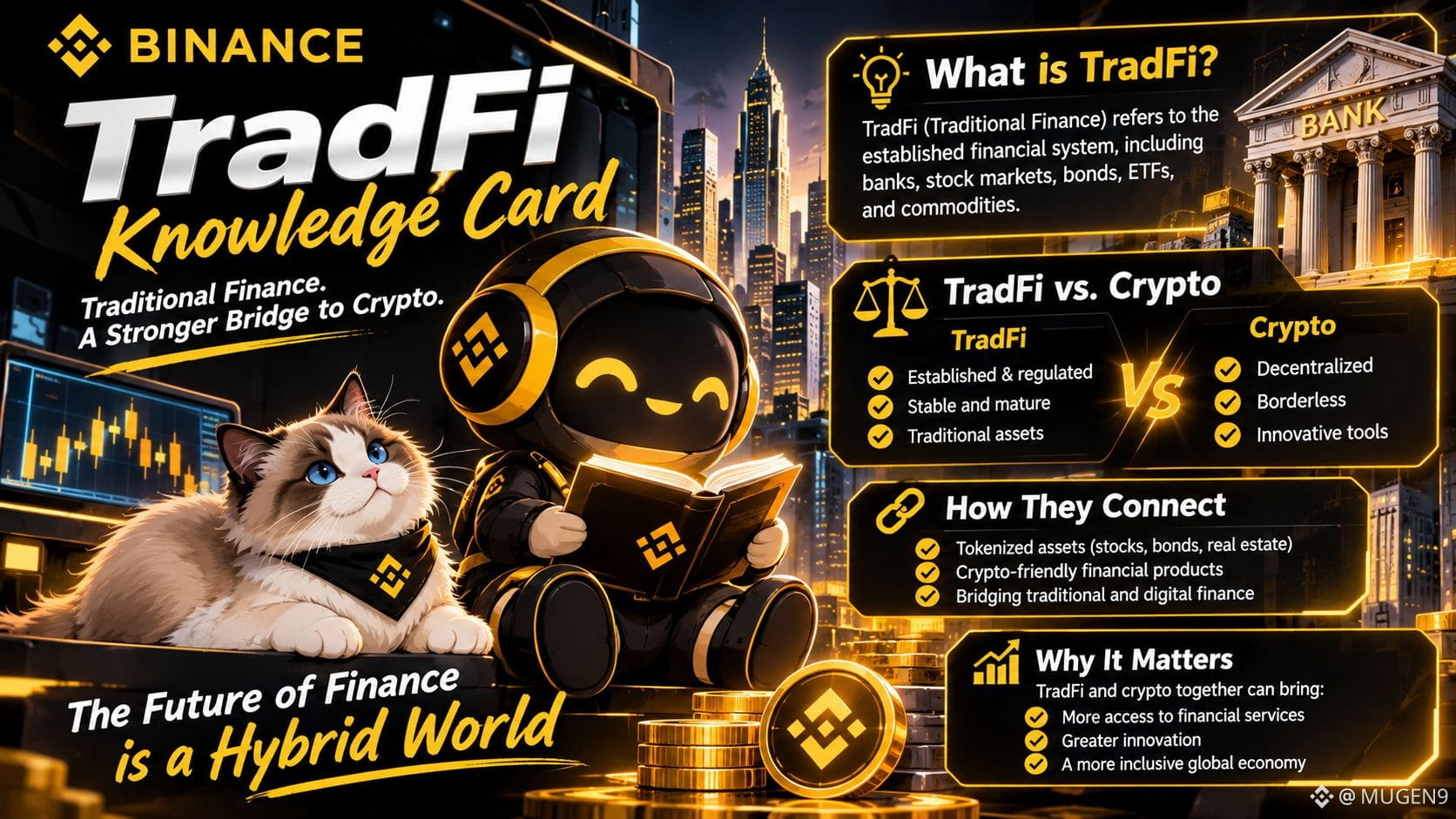
TradFi and crypto are not competitors. They're two worlds creating new opportunities together.
TradFi gives us access to established markets like stocks, bonds, ETFs, and commodities. Crypto brings blockchain technology, transparency, and new ways to access financial services.
The future of finance could bring both worlds closer together.
My pick: $TSLA 💛
#BinanceSquareTG
TradFi gives us access to established markets like stocks, bonds, ETFs, and commodities. Crypto brings blockchain technology, transparency, and new ways to access financial services.
The future of finance could bring both worlds closer together.
My pick: $TSLA 💛
#BinanceSquareTG
1
82
·
--
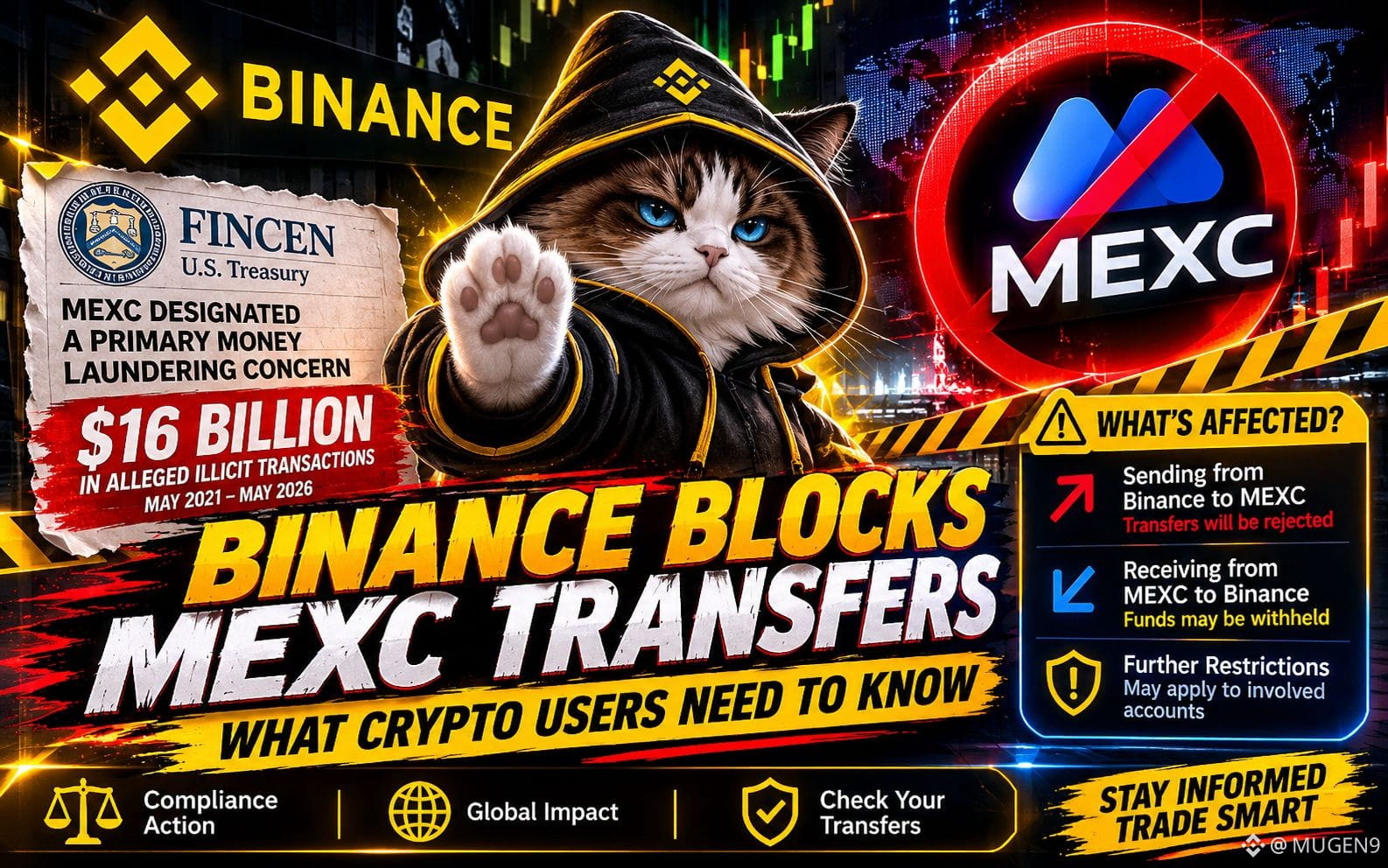
BREAKING: BINANCE BLOCKS TRANSFERS INVOLVING MEXC
A major compliance development is shaking up the crypto exchange landscape.
On November 6, the US Treasury's FinCEN designated MEXC Global a “Primary Money Laundering Concern,” alleging that at least $16 billion in transactions were connected to illicit activity between May 2021 and May 2026.
Following that action, Binance announced restrictions on November 10.
Here's what Binance users need to know:
• Outgoing transfers: Transfers to covered MEXC entities will be rejected.
• Incoming transfers: Funds received from covered entities may be withheld for compliance review.
• Account restrictions: Further limitations may apply to accounts involved in these transactions.
Why does this matter?
Crypto exchanges operate in an increasingly interconnected environment. A compliance action involving one platform can affect how users move funds across other platforms.
But there's an important distinction: FinCEN's designation contains allegations, not a criminal conviction. Binance's platform restrictions are also separate from the US order applying to covered financial institutions.
The takeaway: Always verify the destination and source of your funds before making exchange-to-exchange transfers.
Do you think exchanges should take a stricter approach to compliance, even if it creates inconvenience for legitimate users?
#Binance #MEXC #CryptoNews #CryptoRegulation
1
125
·
--
Bullish
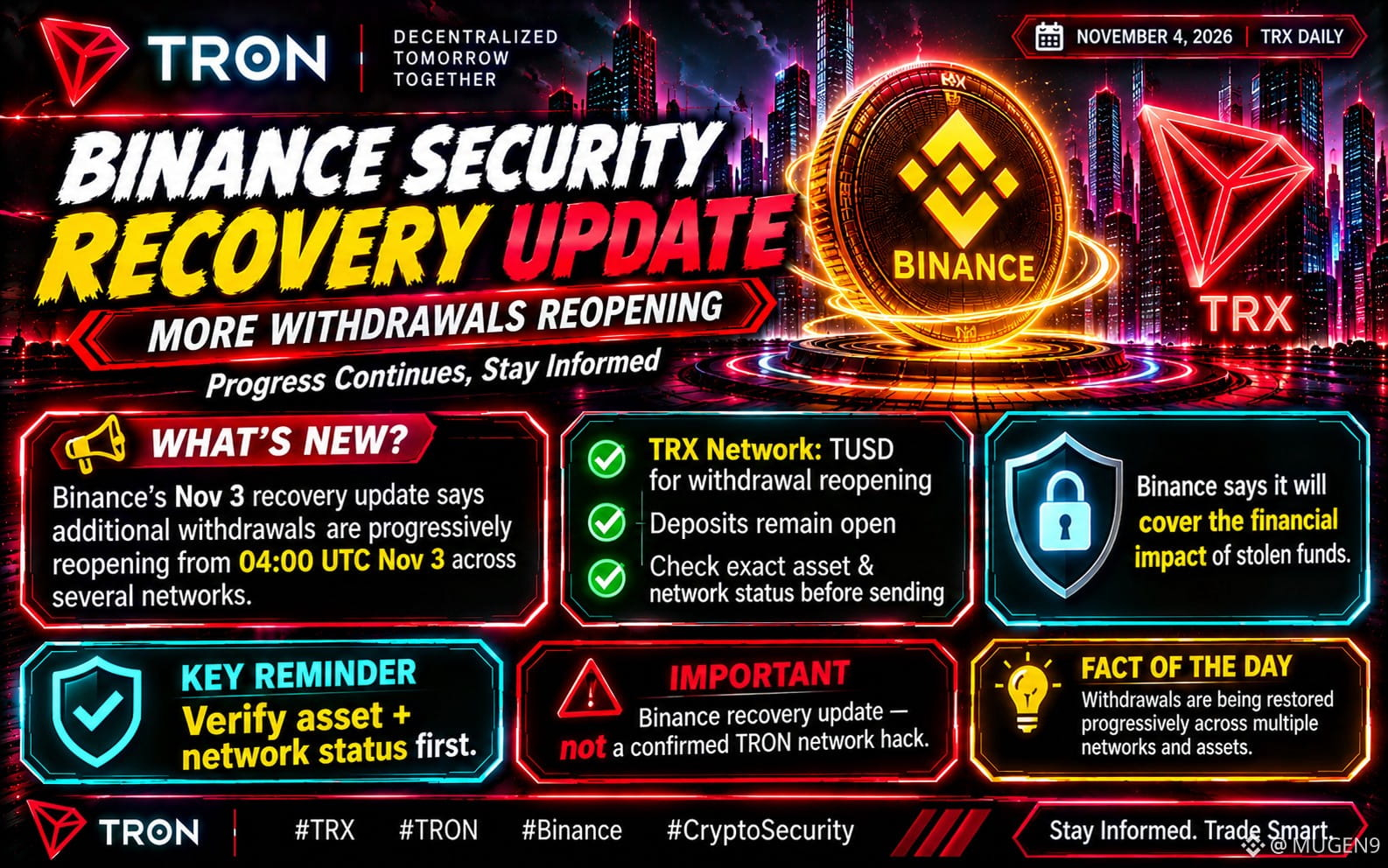
Binance’s recovery continues, with more withdrawals reopening in phases.
In its November 3 update, Binance said additional withdrawals would resume across several networks. On the TRON (TRX) network, TUSD was listed for reopening.
A few important reminders:
• Deposits remain open
• Reopening is progressive, not simultaneous for every asset
• Check the exact coin and network status before withdrawing
• Binance says it will absorb the financial impact of the stolen funds
This is a Binance recovery update—not a confirmed TRON network hack.
Stay informed, and always verify before sending.
#TRX #TRON #Binance #CryptoSecurity
1
203
·
--
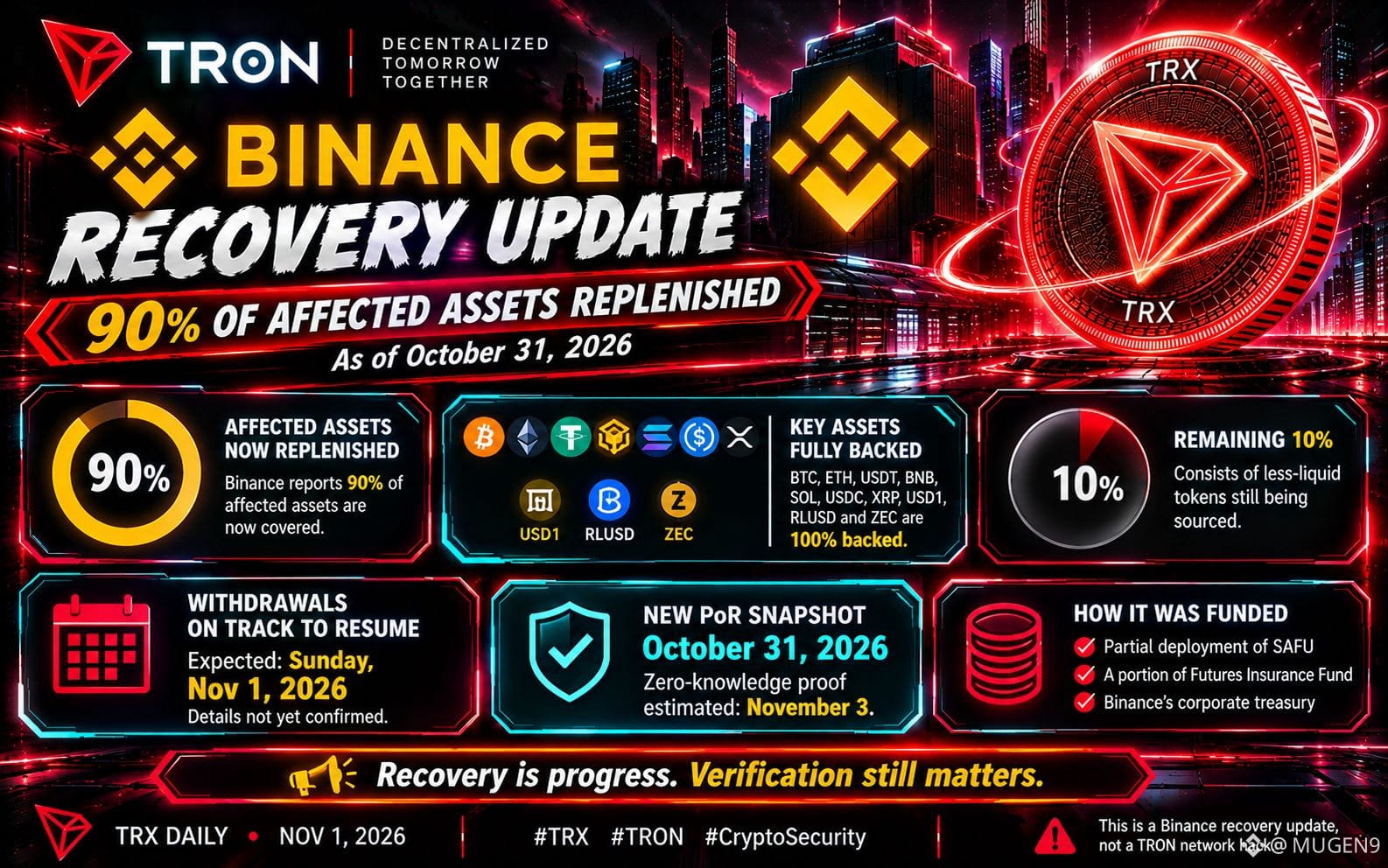
Binance’s recovery update shows progress—but the final checks still matter.
• 90% of affected assets reportedly replenished, up from 80%
• BTC, ETH, USDT, BNB, SOL, USDC, XRP, USD1, RLUSD and ZEC reported 100% backed
• The remaining 10% consists of less-liquid tokens still being sourced
• Withdrawals were expected to resume today; Binance said it would confirm the exact details
• A new Proof of Reserves snapshot was taken, with the full zero-knowledge proof estimated for November 3
The lesson for the wider crypto ecosystem: recovery is important, but transparency and independent verification matter just as much.
This is a Binance recovery update—not a confirmed TRON network hack.
#TRX #TRON #CryptoSecurity #ProofOfReserves
1
123
·
--
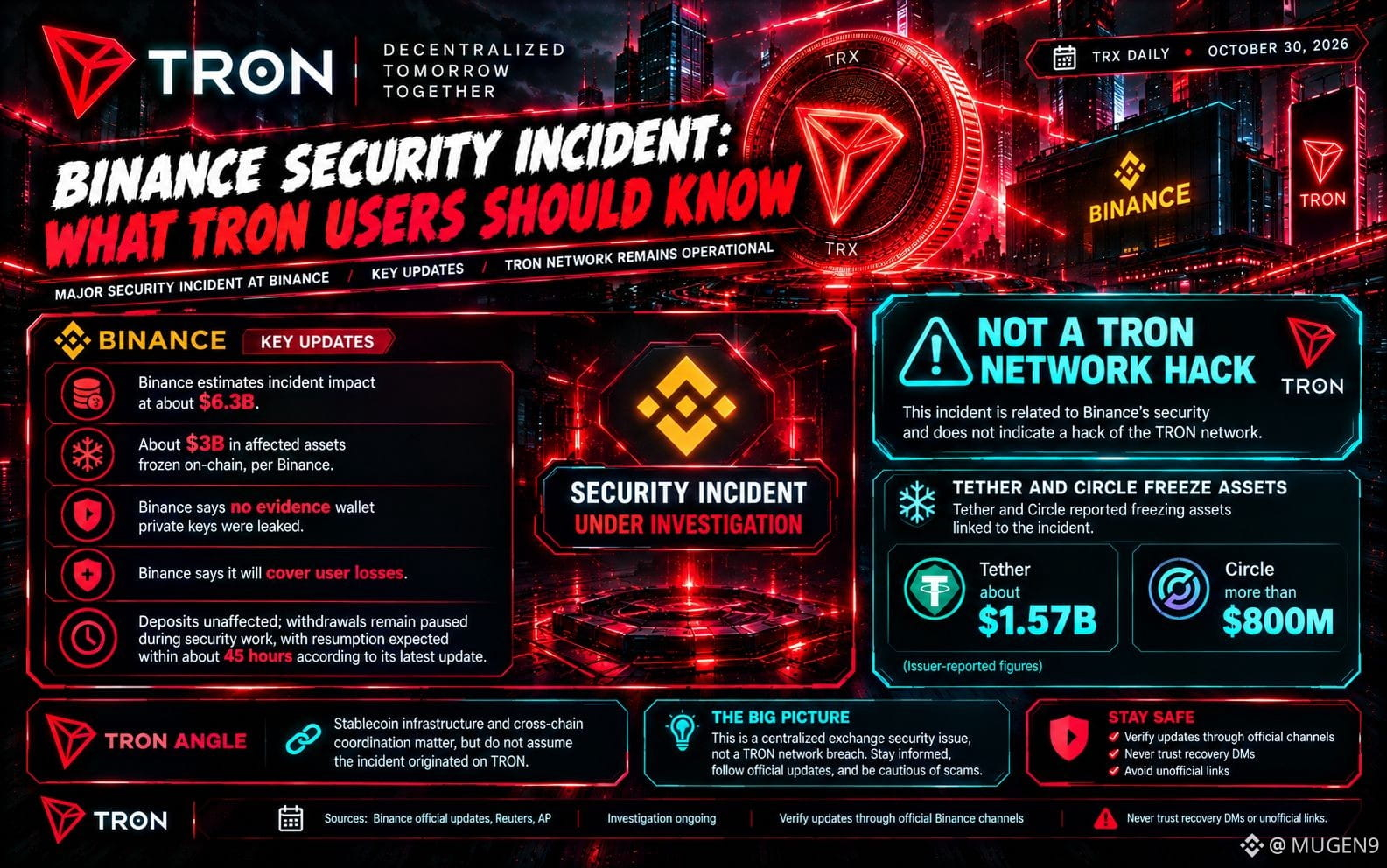
A major security incident has shaken the crypto industry.
Binance estimates the impact at approximately $6.3 billion and says around $3 billion in affected assets has been frozen so far.
Here's what we know:
• Binance's investigation points to a compromised employee laptop and additional breach points.
• No evidence of wallet private-key leaks has been found.
• Binance says it will cover all user losses.
• Deposits remain unaffected, while withdrawals are temporarily paused.
• Tether and Circle have also frozen assets linked to the incident.
What does this mean for TRON?
This is not a confirmed attack on the TRON network. But it's a reminder that crypto security goes beyond blockchain technology.
Exchanges, custodians, wallets, stablecoin issuers, and cross-chain infrastructure all matter.
Stay informed. Verify official announcements. Never trust unsolicited recovery messages or suspicious links.
Security is everyone's responsibility.
#TRX #TRON #Binance #CryptoSecurity
2
399
·
--
Bullish
Blockchain adoption takes more than transactions. It takes education, builders, and real-world use cases.
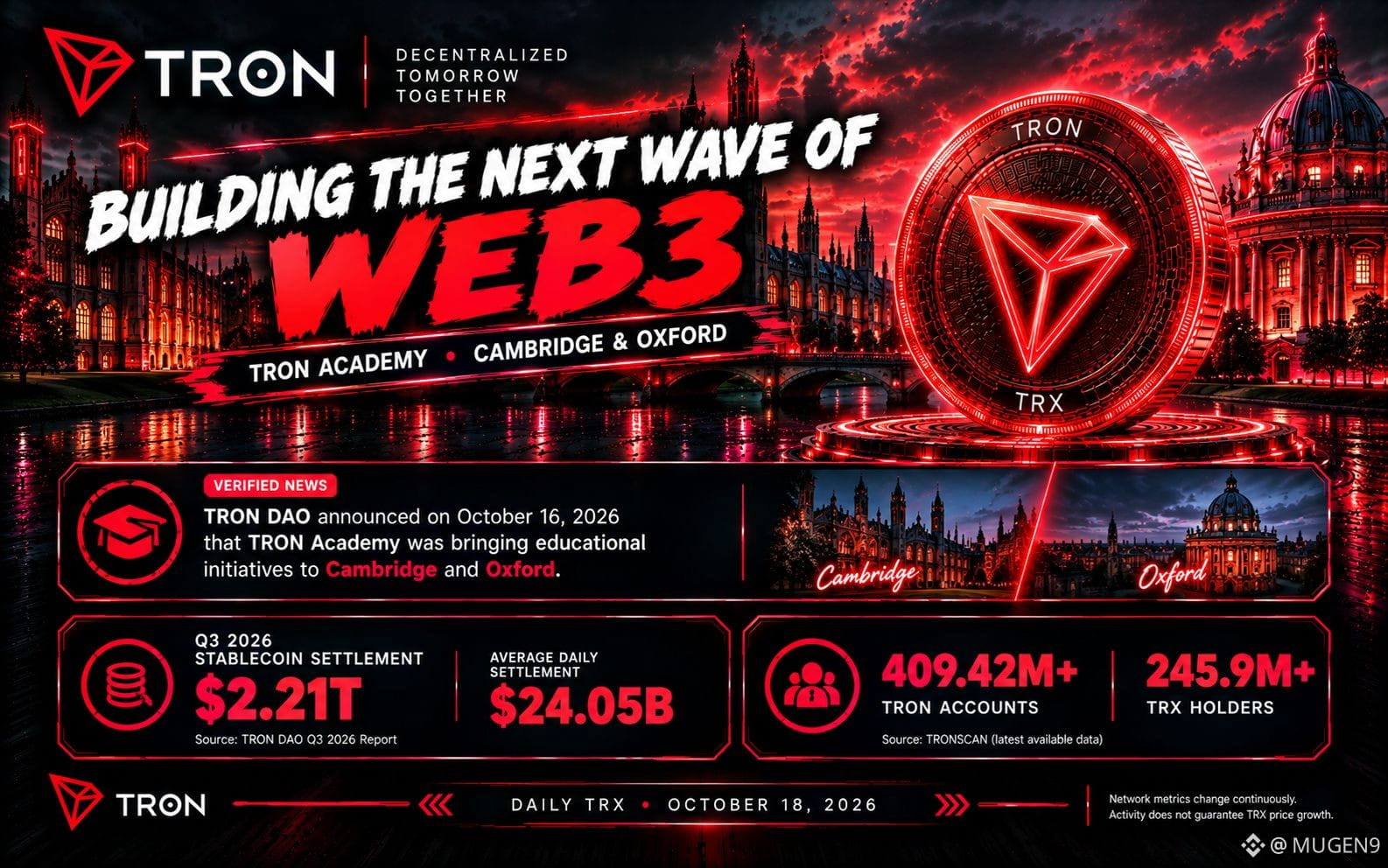
On October 16, TRON DAO announced that TRON Academy was bringing educational initiatives to Cambridge and Oxford.
Meanwhile, TRON’s Q3 2026 report highlighted:
• $2.21T in quarterly stablecoin settlement
• $24.05B in average daily settlement
• 18M average rolling monthly active addresses, up 9.8% from Q2
The takeaway? Infrastructure matters, but so does helping the next generation understand and build with it.
The real measure of adoption is whether the ecosystem keeps creating lasting value.
@TRONDAO
#TRX #TRON #Web3 #Blockchain
Blockchain adoption takes more than transactions. It takes education, builders, and real-world use cases.
On October 16, TRON DAO announced that TRON Academy was bringing educational initiatives to Cambridge and Oxford.
Meanwhile, TRON’s Q3 2026 report highlighted:
• $2.21T in quarterly stablecoin settlement
• $24.05B in average daily settlement
• 18M average rolling monthly active addresses, up 9.8% from Q2
The takeaway? Infrastructure matters, but so does helping the next generation understand and build with it.
The real measure of adoption is whether the ecosystem keeps creating lasting value.
@TRON DAO
#TRX #TRON #Web3 #Blockchain
1
121
·
--
Bullish
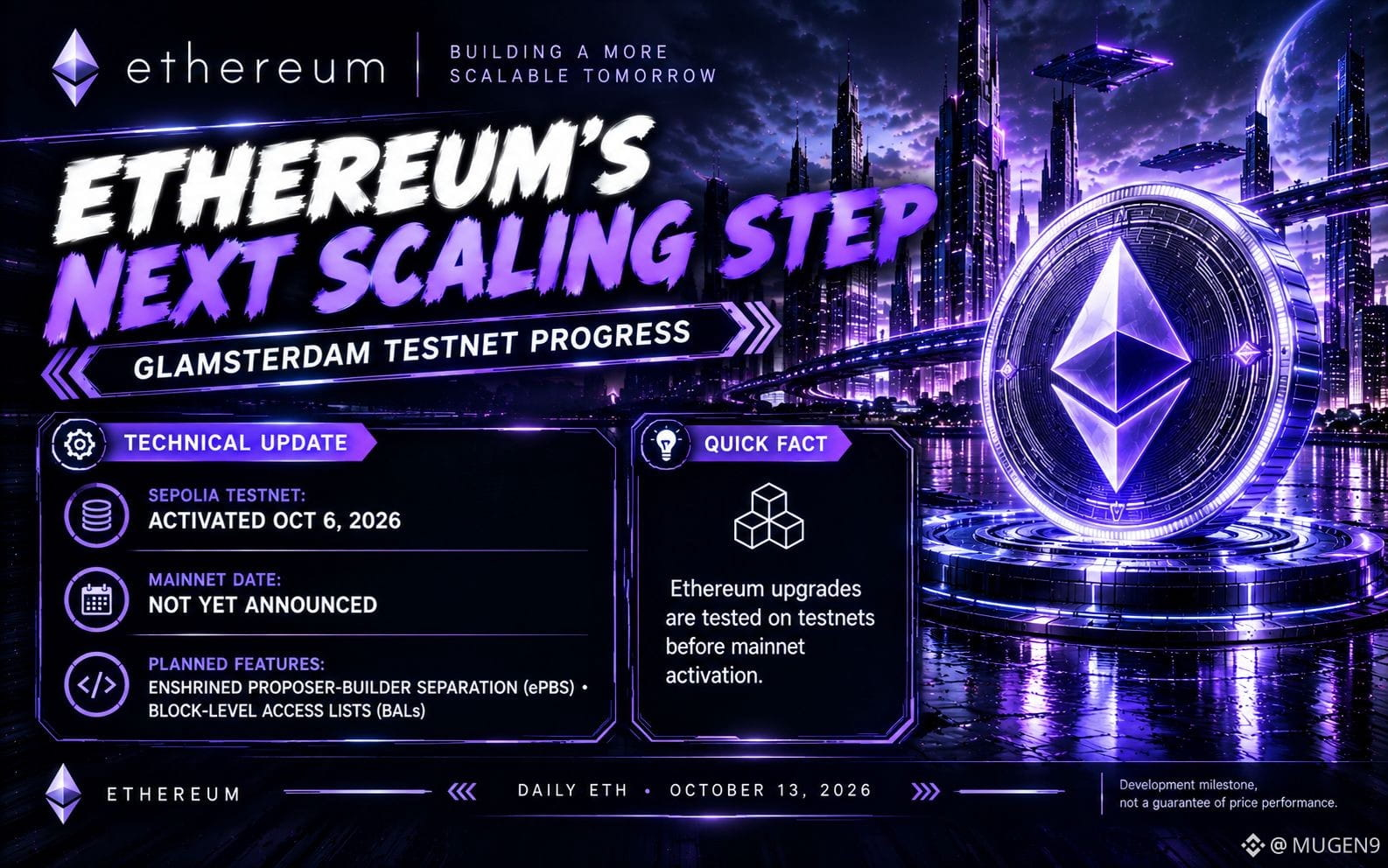
Ethereum is preparing for its next scaling step.
The Glamsterdam upgrade has reached the Sepolia testnet, with planned changes including enshrined proposer-builder separation and block-level access lists.
Why it matters:
• Improvements to block production
• More efficient access to block data
• Continued work toward greater Layer 1 throughput
Sepolia activated the upgrade on October 6, but Ethereum mainnet activation has not yet been scheduled.
Development progress is worth watching—but it doesn't guarantee ETH price gains.
#ETH #Ethereum #Crypto #Blockchain
1
126
·
--
Bullish
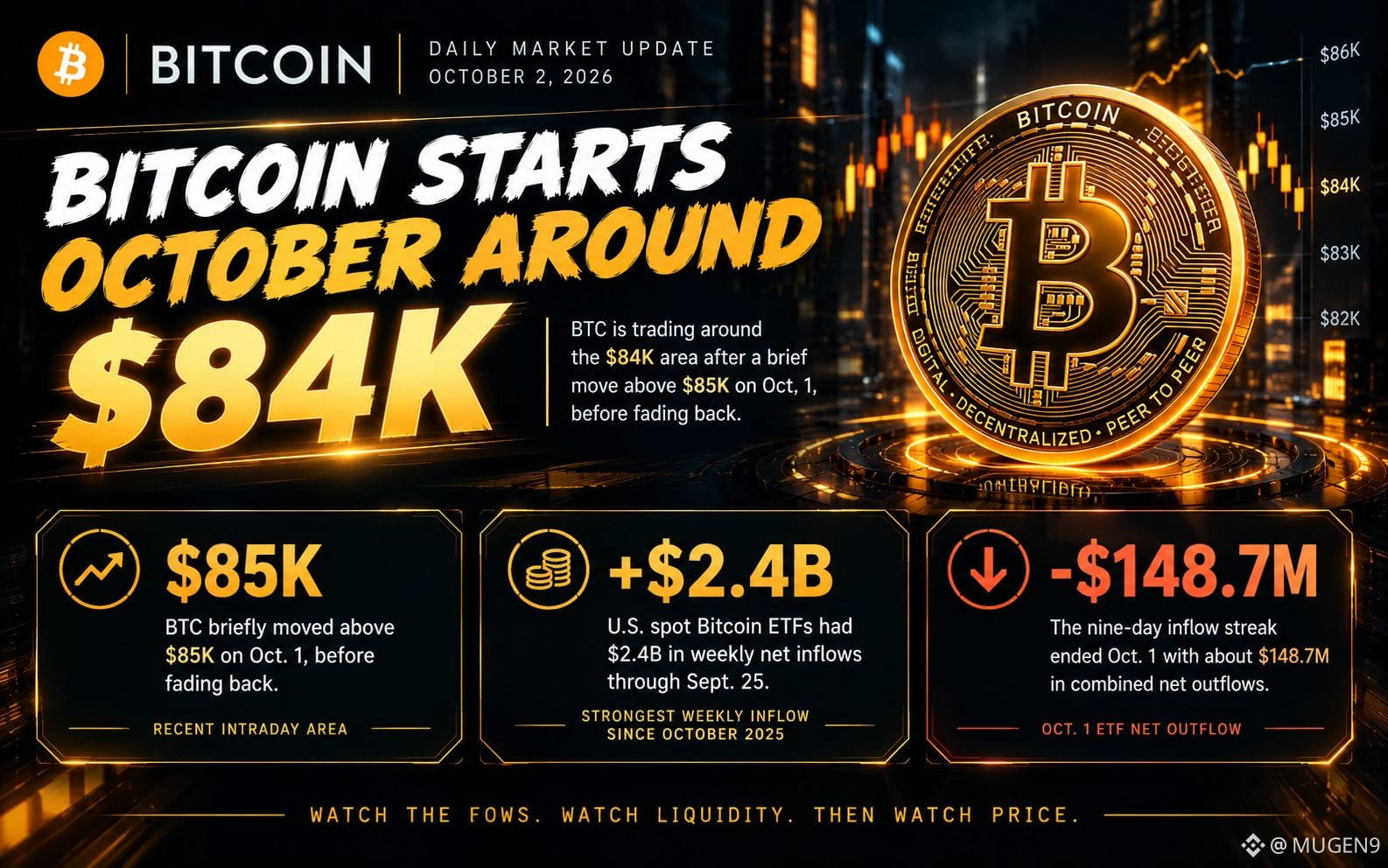
Bitcoin is starting October around the $84K area after briefly pushing above $85K.
The interesting part isn't just the price.
U.S. spot Bitcoin ETFs had a strong $2.4B weekly inflow through September 25, but that momentum recently cooled, with $148.7M in net outflows on September 30.
At the same time, high Treasury yields continue to pressure risk assets.
So for BTC, the bigger question right now is:
Will fresh spot demand keep showing up?
Watch the flows. Watch liquidity. Then watch the price.
@bitcoin
#BTC #Bitcoin #Crypto #Blockchain
Bitcoin is starting October around the $84K area after briefly pushing above $85K.
The interesting part isn't just the price.
U.S. spot Bitcoin ETFs had a strong $2.4B weekly inflow through September 25, but that momentum recently cooled, with $148.7M in net outflows on September 30.
At the same time, high Treasury yields continue to pressure risk assets.
So for BTC, the bigger question right now is:
Will fresh spot demand keep showing up?
Watch the flows. Watch liquidity. Then watch the price.
@Bitcoin
#BTC #Bitcoin #Crypto #Blockchain
1
97
·
--
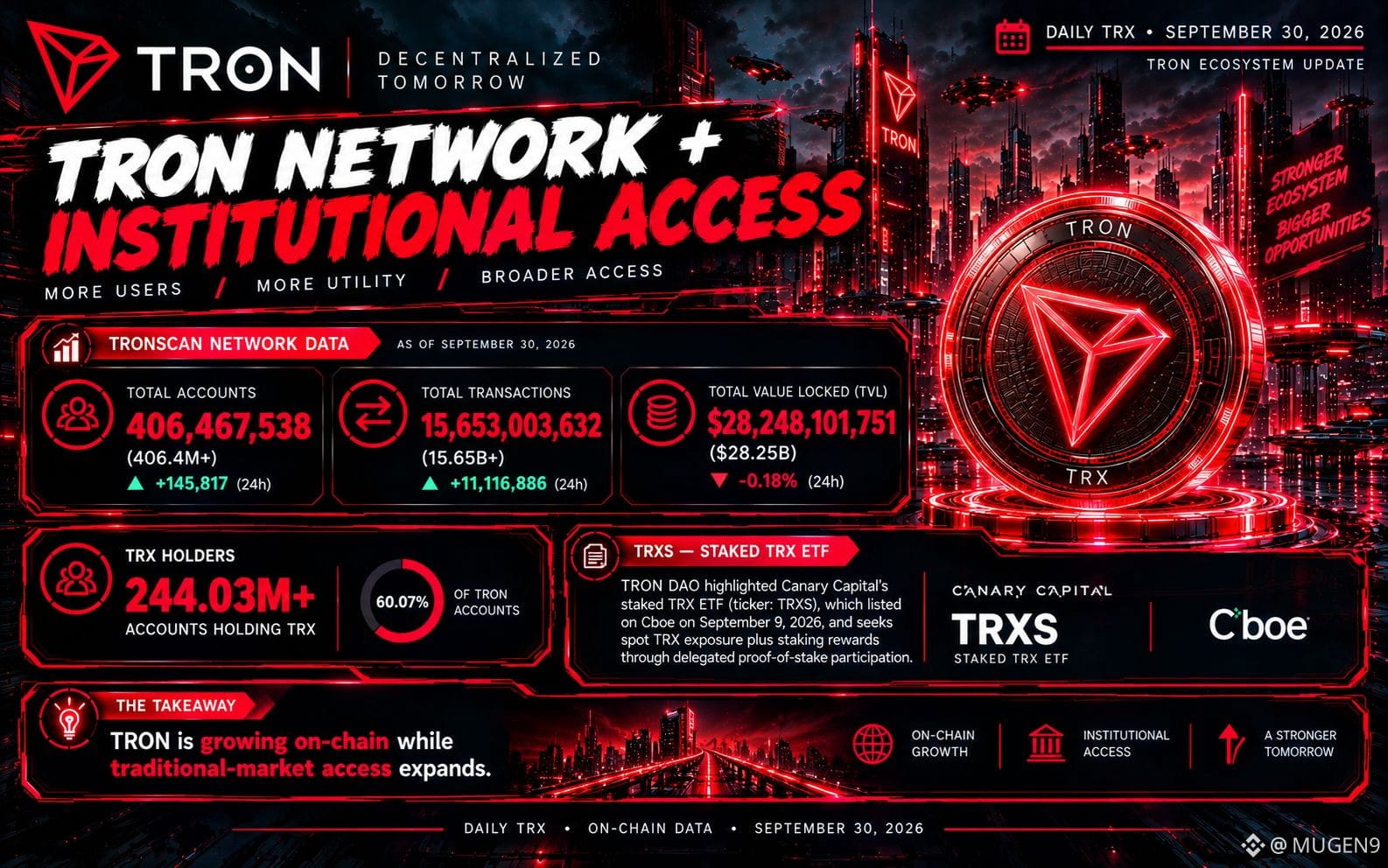
TRON is growing on-chain while access to TRX continues expanding.
Latest TRONSCAN data:
• 406.4M+ accounts
• 15.65B+ transactions
• 244M+ TRX holders
• $28.25B TVL
Around 60% of TRON accounts now hold TRX.
And in traditional markets, the TRXS Staked TRX ETF is giving investors a new way to gain spot TRX exposure while participating in TRON staking.
Different pieces, same bigger picture:
More network activity. More TRX holders. Broader access.
@TRONDAO
#TRX #TRON #Crypto #Blockchain
TRON is growing on-chain while access to TRX continues expanding.
Latest TRONSCAN data:
• 406.4M+ accounts
• 15.65B+ transactions
• 244M+ TRX holders
• $28.25B TVL
Around 60% of TRON accounts now hold TRX.
And in traditional markets, the TRXS Staked TRX ETF is giving investors a new way to gain spot TRX exposure while participating in TRON staking.
Different pieces, same bigger picture:
More network activity. More TRX holders. Broader access.
@TRON DAO
#TRX #TRON #Crypto #Blockchain
1
110
·
--
Bullish
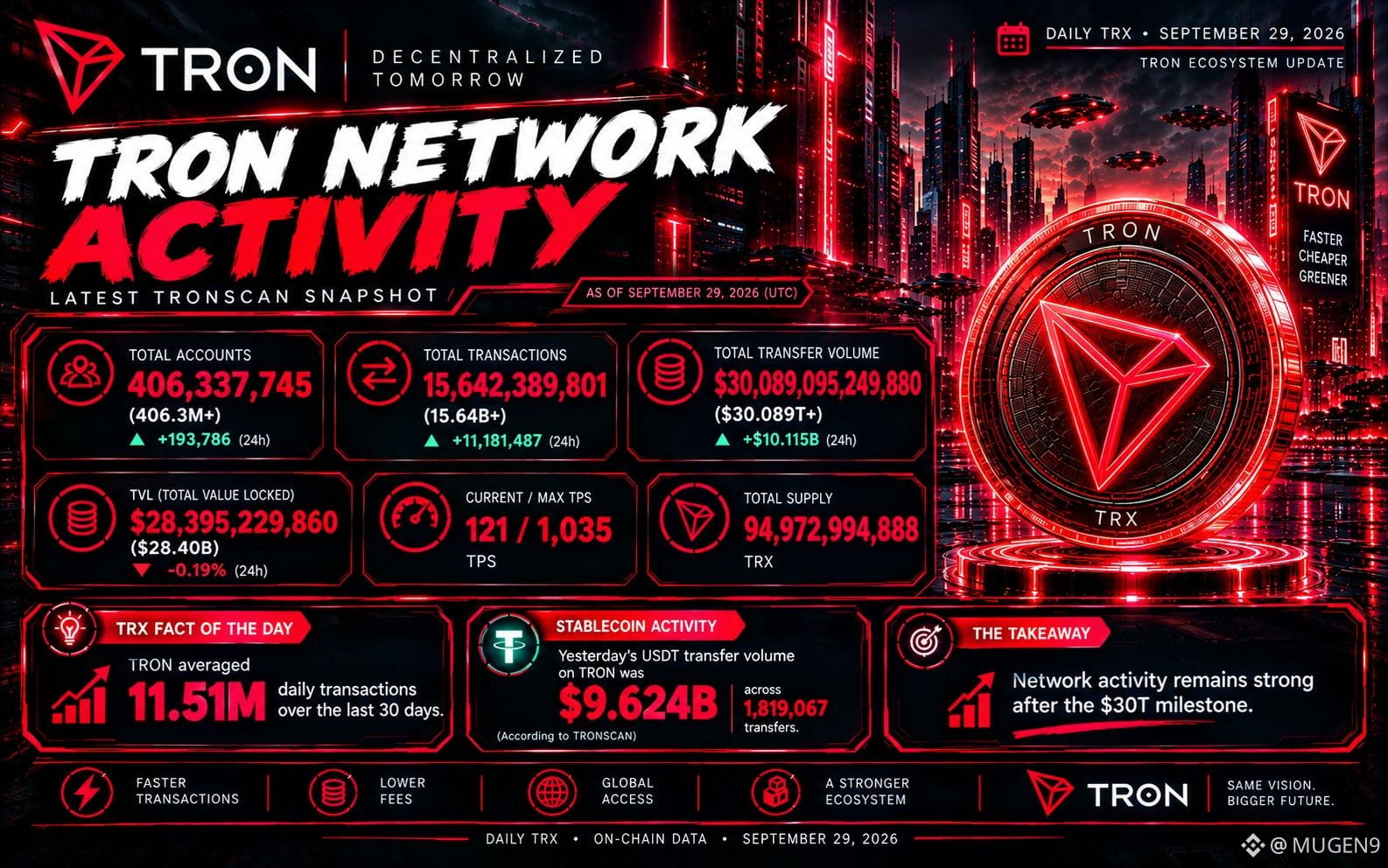
TRON’s network activity keeps moving.
Latest TRONSCAN data:
• 406.3M+ accounts
• 15.64B+ transactions
• $30.08T+ transfer volume
• $28.4B TVL
• +11.18M transactions in 24H
And stablecoins remain a major part of the network.
Yesterday alone, USDT on TRON recorded roughly $9.62B in transfer volume across 1.82M+ transfers.
The $30T milestone was only one checkpoint.
Now watch the activity behind the number.
@TRONDAO
#TRX #TRON #Crypto #Blockchain
TRON’s network activity keeps moving.
Latest TRONSCAN data:
• 406.3M+ accounts
• 15.64B+ transactions
• $30.08T+ transfer volume
• $28.4B TVL
• +11.18M transactions in 24H
And stablecoins remain a major part of the network.
Yesterday alone, USDT on TRON recorded roughly $9.62B in transfer volume across 1.82M+ transfers.
The $30T milestone was only one checkpoint.
Now watch the activity behind the number.
@TRON DAO
#TRX #TRON #Crypto #Blockchain
1
120
·
--
Bullish
Today’s TRX data is worth watching.
According to TRONSCAN, on September 25:
🔥 2.08M TRX burned
⚡ 3.92M TRX generated
📈 +1.84M TRX net increase
TRON has also burned 16.92B+ TRX cumulatively through network resources and fees.
The takeaway? TRX supply isn't simply deflationary every day. It depends on the balance between generation and burn activity.
Watch the network. Watch the supply.
@TRONDAO
#TRX #TRON #Crypto #Blockchain
Today’s TRX data is worth watching.
According to TRONSCAN, on September 25:
🔥 2.08M TRX burned
⚡ 3.92M TRX generated
📈 +1.84M TRX net increase
TRON has also burned 16.92B+ TRX cumulatively through network resources and fees.
The takeaway? TRX supply isn't simply deflationary every day. It depends on the balance between generation and burn activity.
Watch the network. Watch the supply.
@TRON DAO
#TRX #TRON #Crypto #Blockchain
1
97
·
--
Bullish
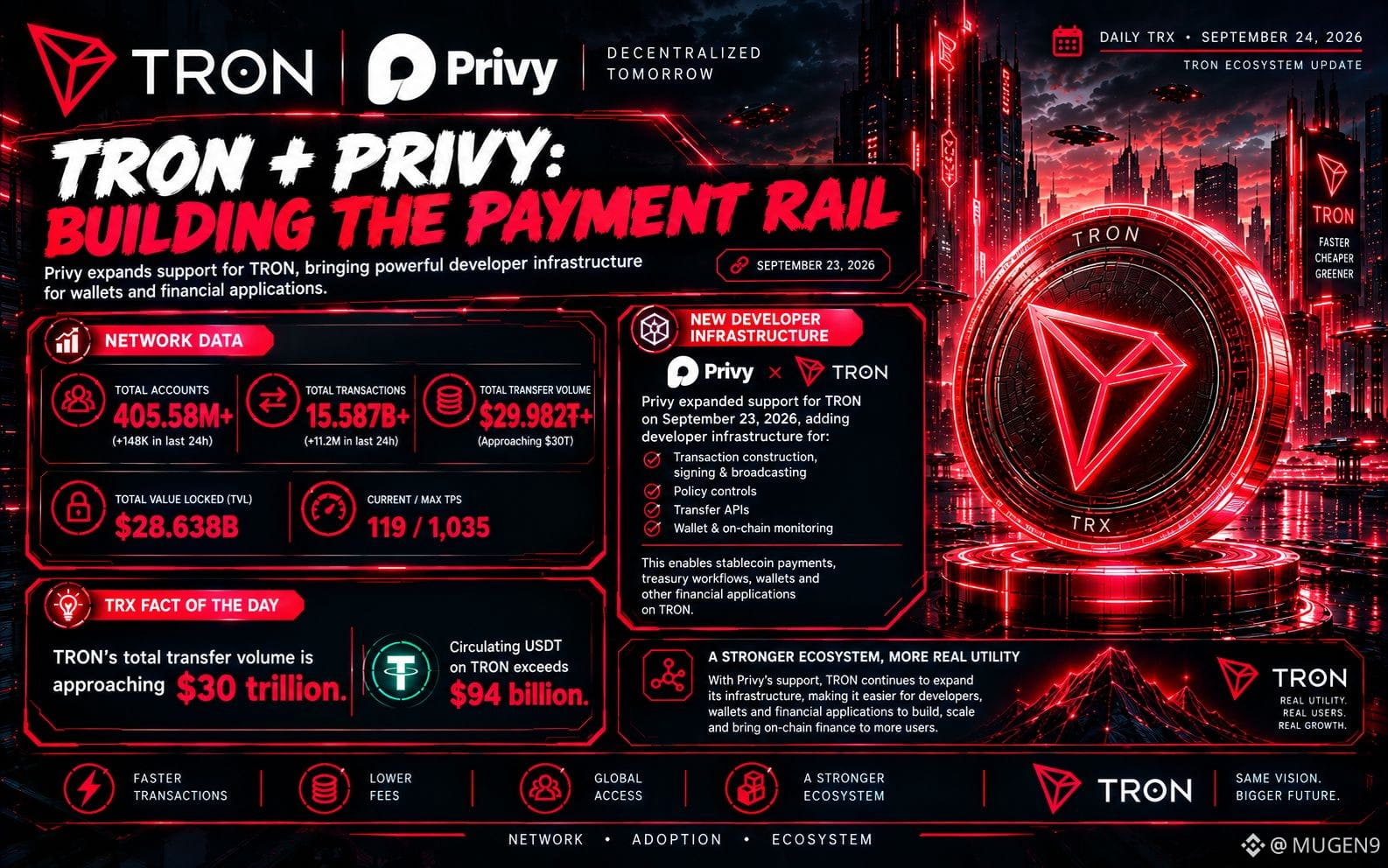
TRON is building more infrastructure around real-world payments.
Privy has expanded its support for TRON, giving developers tools for wallets, transaction signing, transfers, policy controls and on-chain monitoring.
That opens the door for more stablecoin payment apps, treasury workflows and financial products to be built on TRON.
And the network is already operating at scale:
405.6M+ accounts
15.59B+ transactions
$29.98T+ transfer volume
TRON is getting closer to the $30T milestone.
More infrastructure. More builders. More utility.
Follow the network, not just the price.
#TRX #TRON #Crypto #Blockchain
1
75
·
--
Bullish
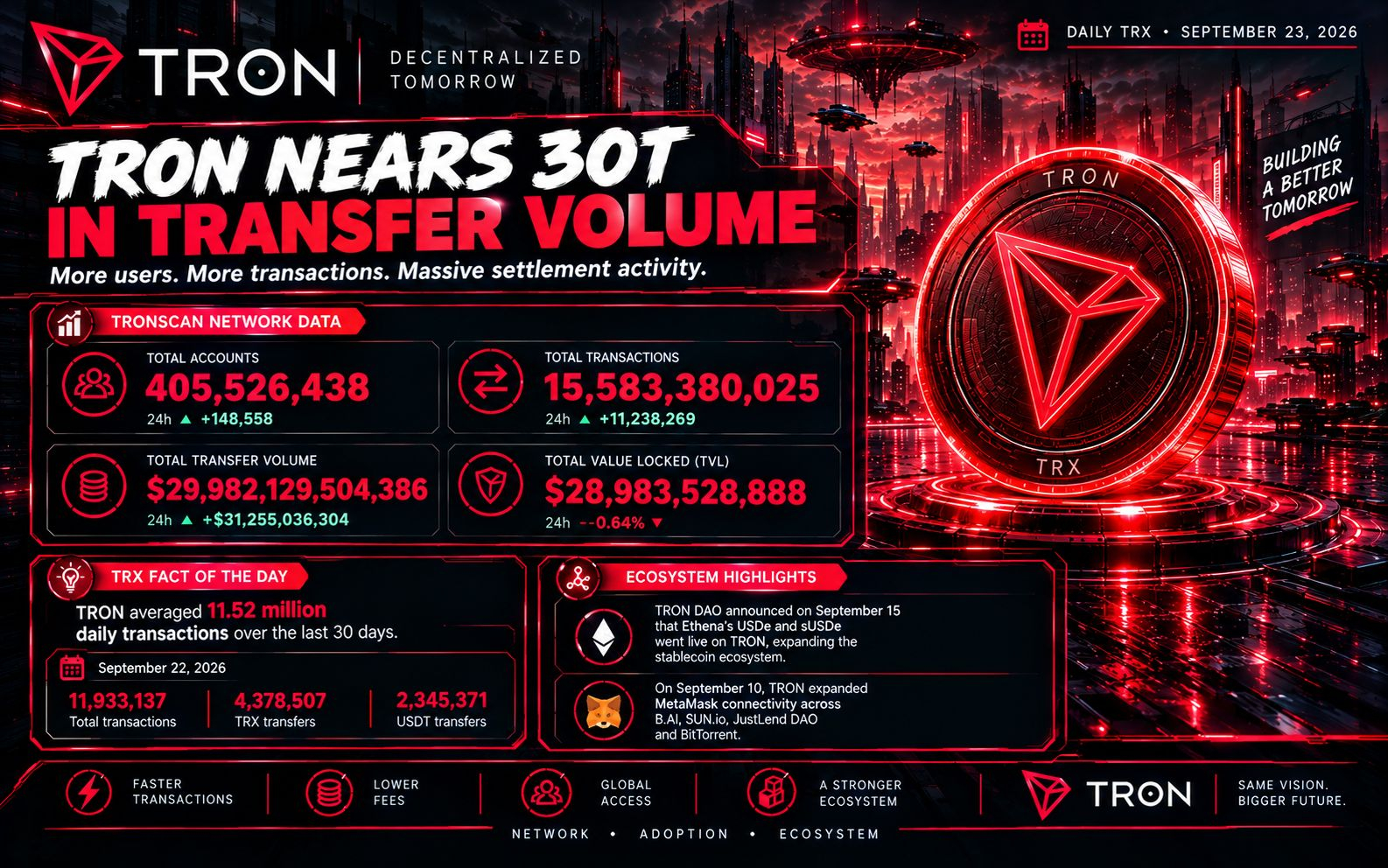
TRON is getting close to a massive network milestone.
TRONSCAN now shows 405.5M+ accounts, 15.58B+ transactions, and almost $30 TRILLION in cumulative transfer volume.
The network is also averaging around 11.52M transactions per day over the last 30 days.
And the activity isn't just TRX transfers — USDT continues to represent a major part of TRON's daily on-chain activity.
$30T is getting closer.
@TRONDAO
#TRX #TRON #Crypto #Blockchain
TRON is getting close to a massive network milestone.
TRONSCAN now shows 405.5M+ accounts, 15.58B+ transactions, and almost $30 TRILLION in cumulative transfer volume.
The network is also averaging around 11.52M transactions per day over the last 30 days.
And the activity isn't just TRX transfers — USDT continues to represent a major part of TRON's daily on-chain activity.
$30T is getting closer.
@TRON DAO
#TRX #TRON #Crypto #Blockchain
1
105
·
--
Bullish
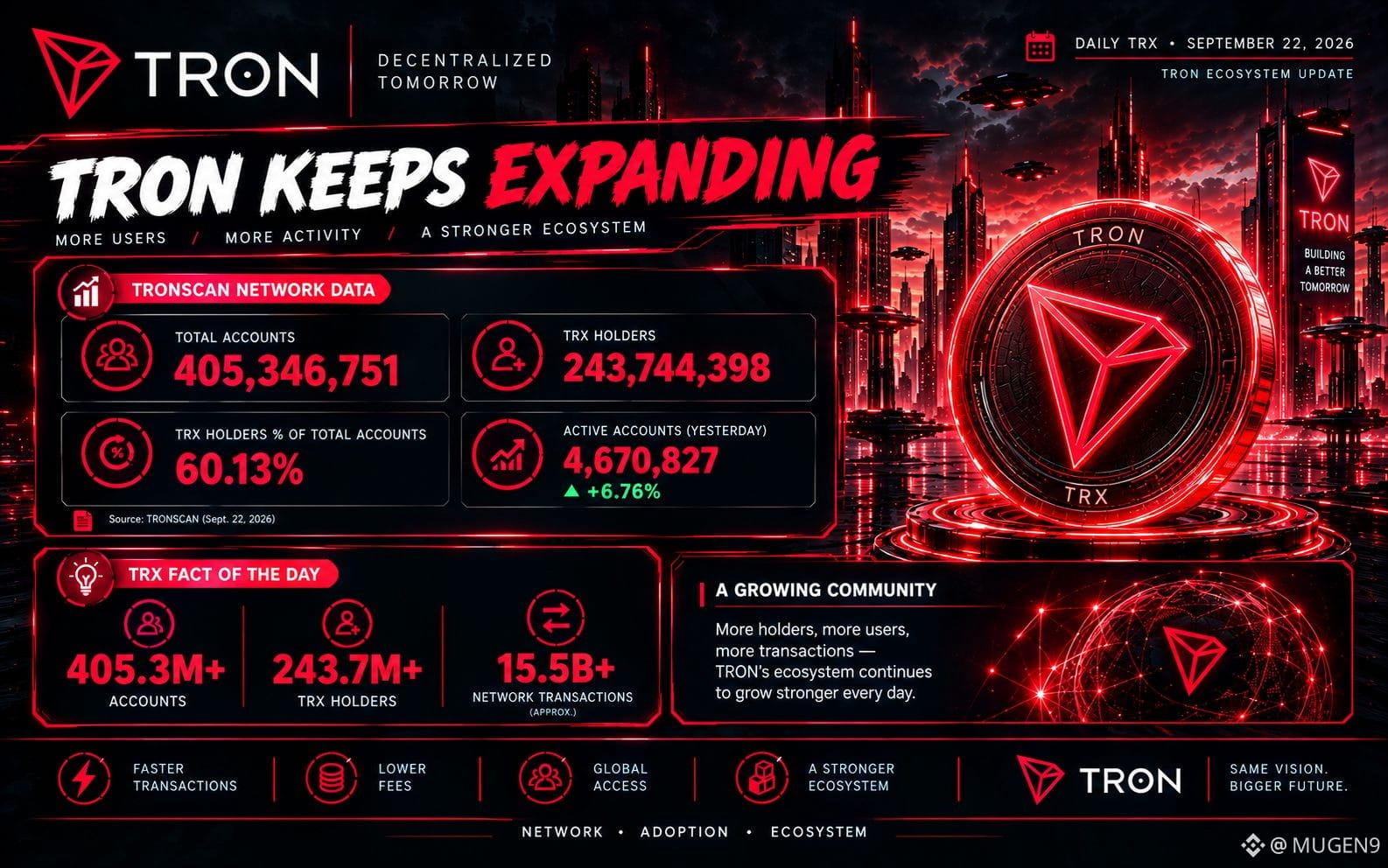
TRON keeps expanding.
TRONSCAN currently shows 405.35M+ total accounts, with 243.74M+ accounts holding TRX.
That means roughly 60.13% of all TRON accounts hold TRX.
Even more interesting: TRON recorded 4.67M+ active accounts yesterday, showing continued on-chain activity.
More users. More holders. More network activity.
Follow the network, not just the price.
@TRONDAO
#TRX #TRON #Crypto #Blockchain
TRON keeps expanding.
TRONSCAN currently shows 405.35M+ total accounts, with 243.74M+ accounts holding TRX.
That means roughly 60.13% of all TRON accounts hold TRX.
Even more interesting: TRON recorded 4.67M+ active accounts yesterday, showing continued on-chain activity.
More users. More holders. More network activity.
Follow the network, not just the price.
@TRON DAO
#TRX #TRON #Crypto #Blockchain
1
132
·
--
Bullish
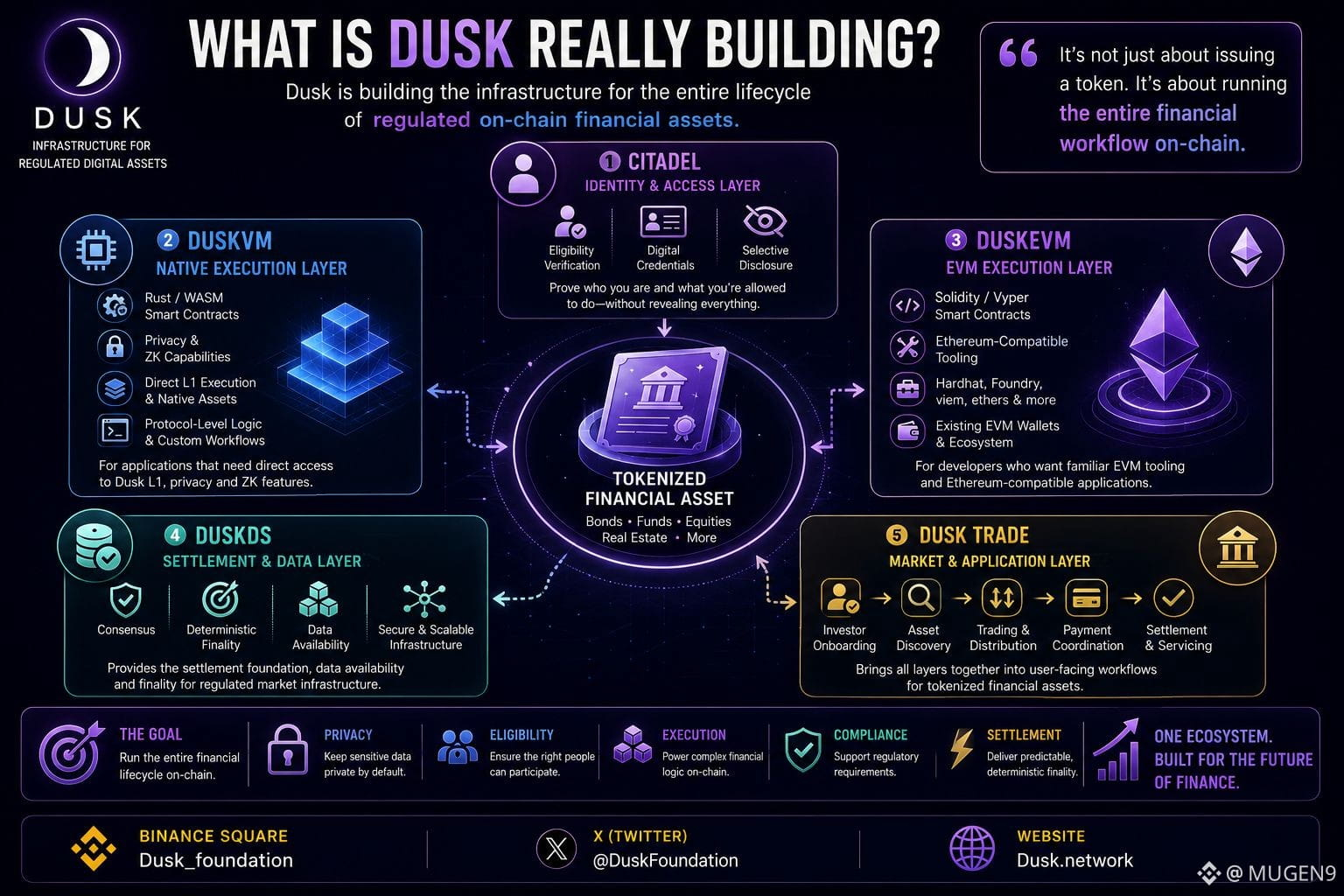
SO… WHAT IS DUSK REALLY BUILDING?
After looking at privacy, selective disclosure, confidential smart contracts, settlement, tokenized assets, identity and developer infrastructure, I think the bigger picture becomes clearer.
Dusk isn't simply trying to put another type of asset on a blockchain.
It's building infrastructure around the entire financial workflow.
Think about a tokenized security:
1️⃣ An investor needs to prove eligibility.
2️⃣ The asset needs rules controlling who can hold or transfer it.
3️⃣ Sensitive information may need to remain private.
4️⃣ Smart contracts need to execute the financial logic.
5️⃣ The asset and payment need predictable settlement.
6️⃣ Developers need practical ways to build applications around all of this.
That's where the different pieces of Dusk fit together.
Citadel handles identity and selective disclosure.
DuskVM provides native Rust/WASM smart-contract execution.
DuskEVM gives developers an Ethereum-compatible environment.
DuskDS provides consensus, settlement and data availability.
And Dusk Trade brings these capabilities into user-facing workflows for tokenized financial assets.
The interesting part isn't any single component.
It's how they work together.
The bigger question for me is no longer:
“Can financial assets be tokenized?”
It's:
“Can the entire financial lifecycle actually run on-chain while respecting privacy, eligibility and regulatory requirements?”
That's the experiment I'm watching.
What part of this infrastructure do you think matters most?
#dusk $DUSK @Dusk_Foundation
SO… WHAT IS DUSK REALLY BUILDING?
After looking at privacy, selective disclosure, confidential smart contracts, settlement, tokenized assets, identity and developer infrastructure, I think the bigger picture becomes clearer.
Dusk isn't simply trying to put another type of asset on a blockchain.
It's building infrastructure around the entire financial workflow.
Think about a tokenized security:
1️⃣ An investor needs to prove eligibility.
2️⃣ The asset needs rules controlling who can hold or transfer it.
3️⃣ Sensitive information may need to remain private.
4️⃣ Smart contracts need to execute the financial logic.
5️⃣ The asset and payment need predictable settlement.
6️⃣ Developers need practical ways to build applications around all of this.
That's where the different pieces of Dusk fit together.
Citadel handles identity and selective disclosure.
DuskVM provides native Rust/WASM smart-contract execution.
DuskEVM gives developers an Ethereum-compatible environment.
DuskDS provides consensus, settlement and data availability.
And Dusk Trade brings these capabilities into user-facing workflows for tokenized financial assets.
The interesting part isn't any single component.
It's how they work together.
The bigger question for me is no longer:
“Can financial assets be tokenized?”
It's:
“Can the entire financial lifecycle actually run on-chain while respecting privacy, eligibility and regulatory requirements?”
That's the experiment I'm watching.
What part of this infrastructure do you think matters most?
#dusk $DUSK @Dusk
1
96
·
--
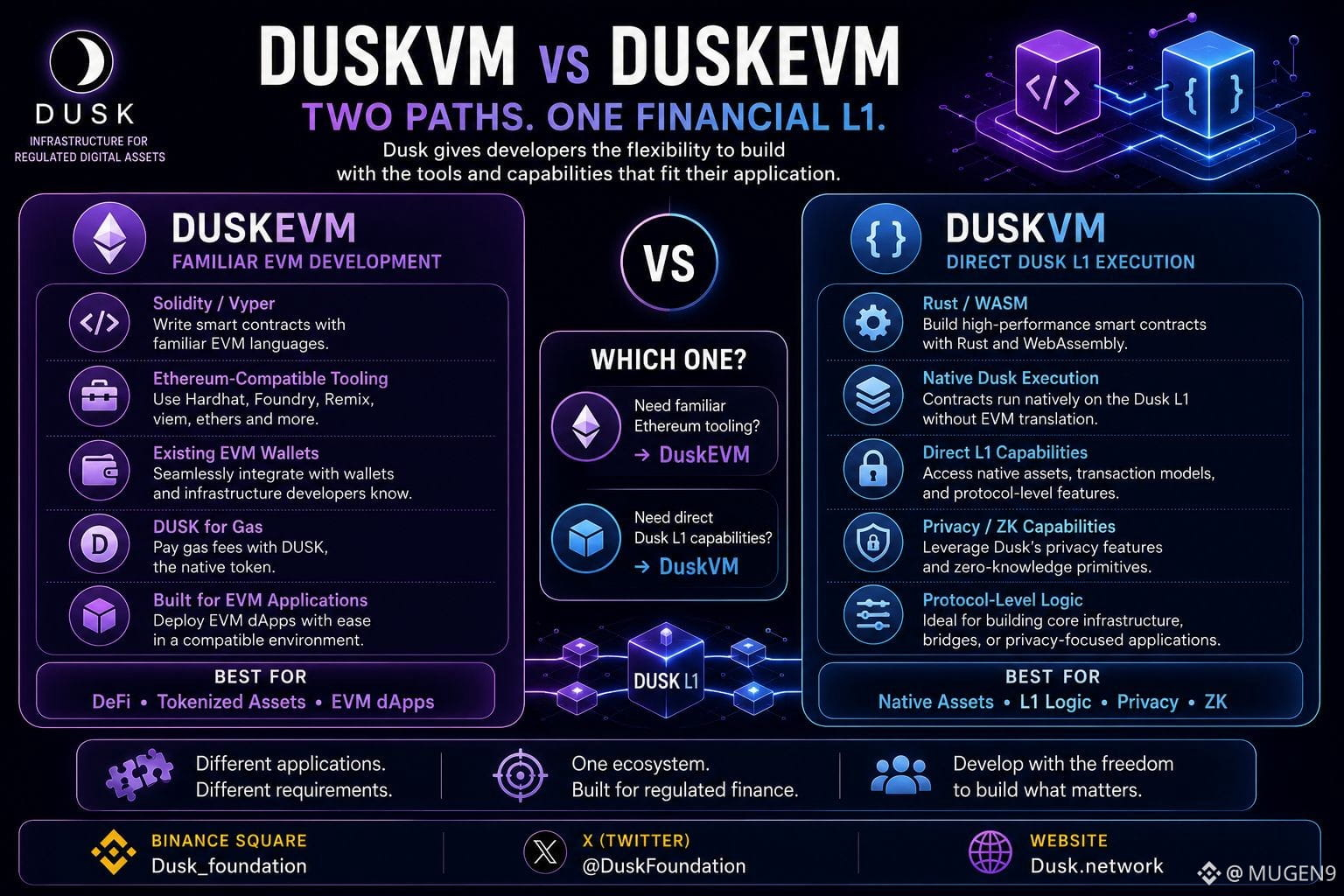
WHY DOES DUSK HAVE TWO SMART-CONTRACT PATHS?
At first, having both DuskEVM and DuskVM might sound unnecessarily complicated.
But developers don't all need the same environment.
DuskEVM is designed for applications that want the familiar Ethereum ecosystem.
Developers can use Solidity or Vyper alongside tools such as Hardhat, Foundry, viem and ethers, while DUSK serves as the native gas token.
Then there's DuskVM.
It's built for Rust/WASM contracts that execute directly on the Dusk L1, making it the option for applications that need closer access to Dusk's native assets, transaction models, privacy or zero-knowledge capabilities.
So the simple version is:
🟣 DuskEVM = EVM compatibility + familiar tooling
🔵 DuskVM = direct L1 execution + native Dusk capabilities
It's less about choosing which one is “better” and more about choosing the right tool for the application.
For developers building financial applications, having both paths could make the ecosystem more flexible.
If you were building on Dusk, which would you choose?
EVM compatibility or native L1 capabilities?
#dusk $DUSK @Dusk_Foundation
WHY DOES DUSK HAVE TWO SMART-CONTRACT PATHS?
At first, having both DuskEVM and DuskVM might sound unnecessarily complicated.
But developers don't all need the same environment.
DuskEVM is designed for applications that want the familiar Ethereum ecosystem.
Developers can use Solidity or Vyper alongside tools such as Hardhat, Foundry, viem and ethers, while DUSK serves as the native gas token.
Then there's DuskVM.
It's built for Rust/WASM contracts that execute directly on the Dusk L1, making it the option for applications that need closer access to Dusk's native assets, transaction models, privacy or zero-knowledge capabilities.
So the simple version is:
🟣 DuskEVM = EVM compatibility + familiar tooling
🔵 DuskVM = direct L1 execution + native Dusk capabilities
It's less about choosing which one is “better” and more about choosing the right tool for the application.
For developers building financial applications, having both paths could make the ecosystem more flexible.
If you were building on Dusk, which would you choose?
EVM compatibility or native L1 capabilities?
#dusk $DUSK @Dusk
1
105
·
--
Bullish
WHO SHOULD BE ALLOWED TO BUY A TOKENIZED ASSET?
This sounds simple until you put regulated finance on-chain.
Imagine a tokenized security that can only be held by eligible investors.
The network needs to know that a participant meets certain requirements—but does it really need to expose that person's entire identity to everyone?
This is where privacy-preserving identity becomes interesting.
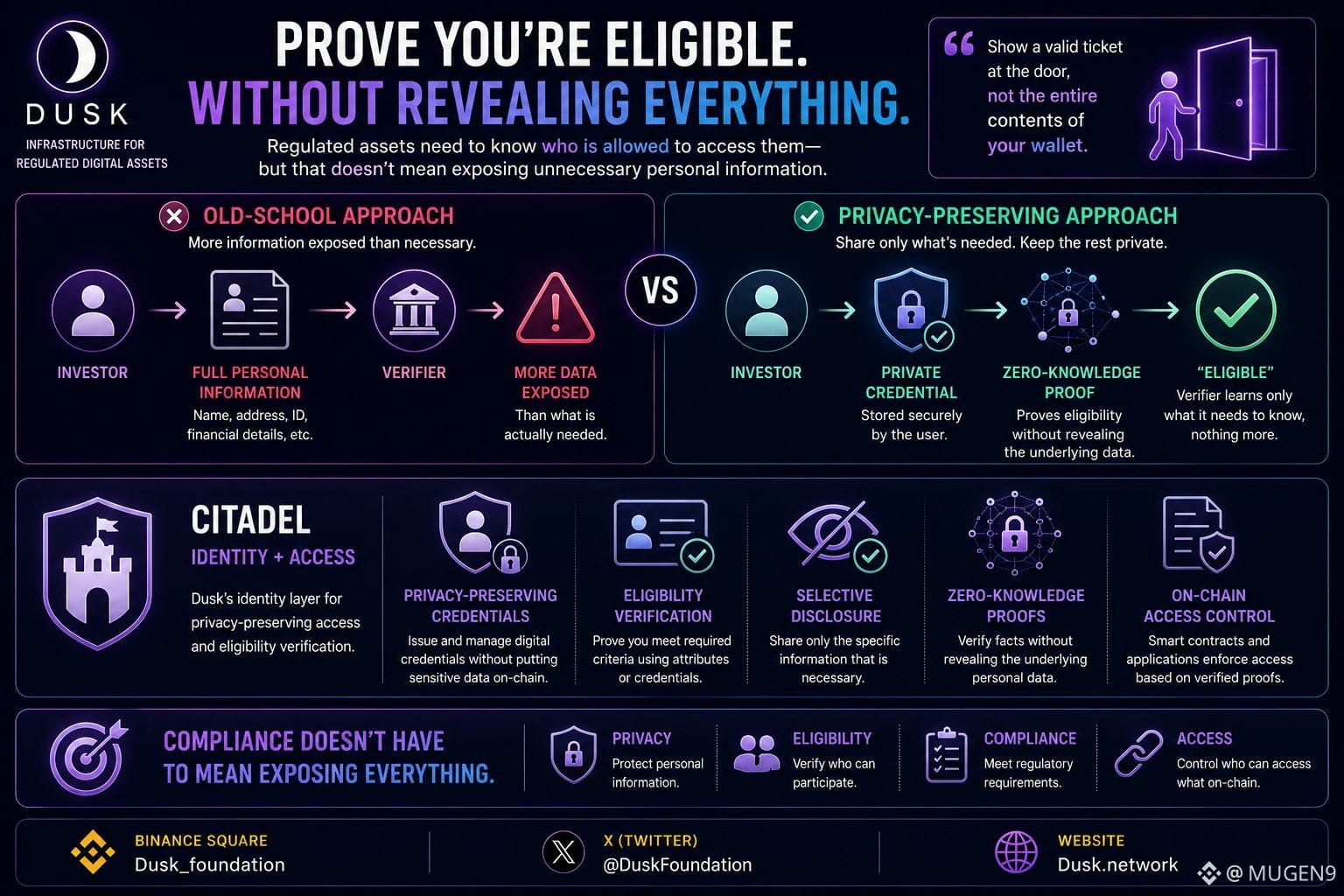
Dusk's Citadel identity layer is designed around credentials and selective disclosure.
Instead of putting sensitive personal information directly on-chain, a user can prove that they hold a valid credential or meet a required attribute without revealing unnecessary details.
Think of it like showing a valid ticket at the door without handing the entire contents of your wallet to the security guard.
For regulated assets, that distinction could be important.
You can have:
🔐 Privacy
✅ Eligibility checks
📋 Compliance requirements
🧩 On-chain access controls
without making every participant's personal information public.
To me, this is one of the more interesting pieces of bringing regulated finance on-chain.
Would you rather prove “I'm eligible” or reveal “everything about me”?
#dusk $DUSK @Dusk_Foundation
WHO SHOULD BE ALLOWED TO BUY A TOKENIZED ASSET?
This sounds simple until you put regulated finance on-chain.
Imagine a tokenized security that can only be held by eligible investors.
The network needs to know that a participant meets certain requirements—but does it really need to expose that person's entire identity to everyone?
This is where privacy-preserving identity becomes interesting.
Dusk's Citadel identity layer is designed around credentials and selective disclosure.
Instead of putting sensitive personal information directly on-chain, a user can prove that they hold a valid credential or meet a required attribute without revealing unnecessary details.
Think of it like showing a valid ticket at the door without handing the entire contents of your wallet to the security guard.
For regulated assets, that distinction could be important.
You can have:
🔐 Privacy
✅ Eligibility checks
📋 Compliance requirements
🧩 On-chain access controls
without making every participant's personal information public.
To me, this is one of the more interesting pieces of bringing regulated finance on-chain.
Would you rather prove “I'm eligible” or reveal “everything about me”?
#dusk $DUSK @Dusk
1
92
Log in to explore more content
Join global crypto users on Binance Square
⚡️ Get latest and useful information about crypto.
💬 Trusted by the world’s largest crypto exchange.
👍 Discover real insights from verified creators.
Email / Phone number
Trending Topics
CanMarketsReboundAfterThanksgiving?
176,720 views
1,903 Discussing
Rate-Hike Bets Linger as US Markets Head Into Thanksgiving Closure
Binance News
·7 Likes
·5.4k views
CouldSpaceX’sOrbitalDataCentersBoostAIChipDemand?
86,513 views
1,145 Discussing
SouthKoreaProposesMandatoryDigitalAssetTransactionDisclosure
3,703 views
91 Discussing