

LOGAN PARKER
2.9k Posts

LOGAN PARKER
Report
Block User
Building a space for crypto learners & traders 🤝Join the movement. Learn. Earn. Thrive. 🔶
119 Following
13.7K+ Followers
3.4K+ Liked
Posts
All
Quotes
Live
·
--
Bullish
#baby $BABY @babylonlabs_io
Imagine you're a watchtower operator. A siren blares—someone's cheating.
In the old world (BitVM2), answering that call costs you $15,000. Just to post the proof. That's not a security expense; that's a kamikaze mission. You answer once, you're done. Financially decapitated.
Babylon's new numbers? **$93** for a challenged case. $2.66 if no one fights.
That's not an upgrade. That's a genre change.
Run the math and you're staring at a 160x compression. But "compression" is a sterile word. Let's call it what it is: the difference between a protocol that assumes goodwill and one that can afford to enforce it.
At $15k, fraud-proofs live in whitepapers. At $93, they live on your monthly P&L as a rounding error. The entire watchtower incentive question—which always felt like abstract game theory—suddenly becomes a spreadsheet. Does watching pay for itself? For the first time, the answer isn't "maybe." It's "run the numbers and stop guessing."
Now, the elephant: congestion. 10x base fees turn $93 into $930. Still an order of magnitude under $15k, but does the incentive curve hold that same crisp slope? Unclear from the docs. Yet here's the gut check—even at $930, that's cheaper than a single hour of litigation in TradFi. The bar isn't "free." The bar is "survivable."
So no, this isn't slideware. This isn't about disputes being rare. This is about the one time they aren't rare—and the person who catches the fraud walks away with a win, not a bankruptcy filing.
That's the quiet revolution hiding inside a decimal point. 👍
#baby $BABY @BabylonLabs_io
Imagine you're a watchtower operator. A siren blares—someone's cheating.
In the old world (BitVM2), answering that call costs you $15,000. Just to post the proof. That's not a security expense; that's a kamikaze mission. You answer once, you're done. Financially decapitated.
Babylon's new numbers? **$93** for a challenged case. $2.66 if no one fights.
That's not an upgrade. That's a genre change.
Run the math and you're staring at a 160x compression. But "compression" is a sterile word. Let's call it what it is: the difference between a protocol that assumes goodwill and one that can afford to enforce it.
At $15k, fraud-proofs live in whitepapers. At $93, they live on your monthly P&L as a rounding error. The entire watchtower incentive question—which always felt like abstract game theory—suddenly becomes a spreadsheet. Does watching pay for itself? For the first time, the answer isn't "maybe." It's "run the numbers and stop guessing."
Now, the elephant: congestion. 10x base fees turn $93 into $930. Still an order of magnitude under $15k, but does the incentive curve hold that same crisp slope? Unclear from the docs. Yet here's the gut check—even at $930, that's cheaper than a single hour of litigation in TradFi. The bar isn't "free." The bar is "survivable."
So no, this isn't slideware. This isn't about disputes being rare. This is about the one time they aren't rare—and the person who catches the fraud walks away with a win, not a bankruptcy filing.
That's the quiet revolution hiding inside a decimal point. 👍
Imagine you're a watchtower operator. A siren blares—someone's cheating.
In the old world (BitVM2), answering that call costs you $15,000. Just to post the proof. That's not a security expense; that's a kamikaze mission. You answer once, you're done. Financially decapitated.
Babylon's new numbers? **$93** for a challenged case. $2.66 if no one fights.
That's not an upgrade. That's a genre change.
Run the math and you're staring at a 160x compression. But "compression" is a sterile word. Let's call it what it is: the difference between a protocol that assumes goodwill and one that can afford to enforce it.
At $15k, fraud-proofs live in whitepapers. At $93, they live on your monthly P&L as a rounding error. The entire watchtower incentive question—which always felt like abstract game theory—suddenly becomes a spreadsheet. Does watching pay for itself? For the first time, the answer isn't "maybe." It's "run the numbers and stop guessing."
Now, the elephant: congestion. 10x base fees turn $93 into $930. Still an order of magnitude under $15k, but does the incentive curve hold that same crisp slope? Unclear from the docs. Yet here's the gut check—even at $930, that's cheaper than a single hour of litigation in TradFi. The bar isn't "free." The bar is "survivable."
So no, this isn't slideware. This isn't about disputes being rare. This is about the one time they aren't rare—and the person who catches the fraud walks away with a win, not a bankruptcy filing.
That's the quiet revolution hiding inside a decimal point. 👍
4
119
·
--
Bullish
#baby $BABY @babylonlabs_io
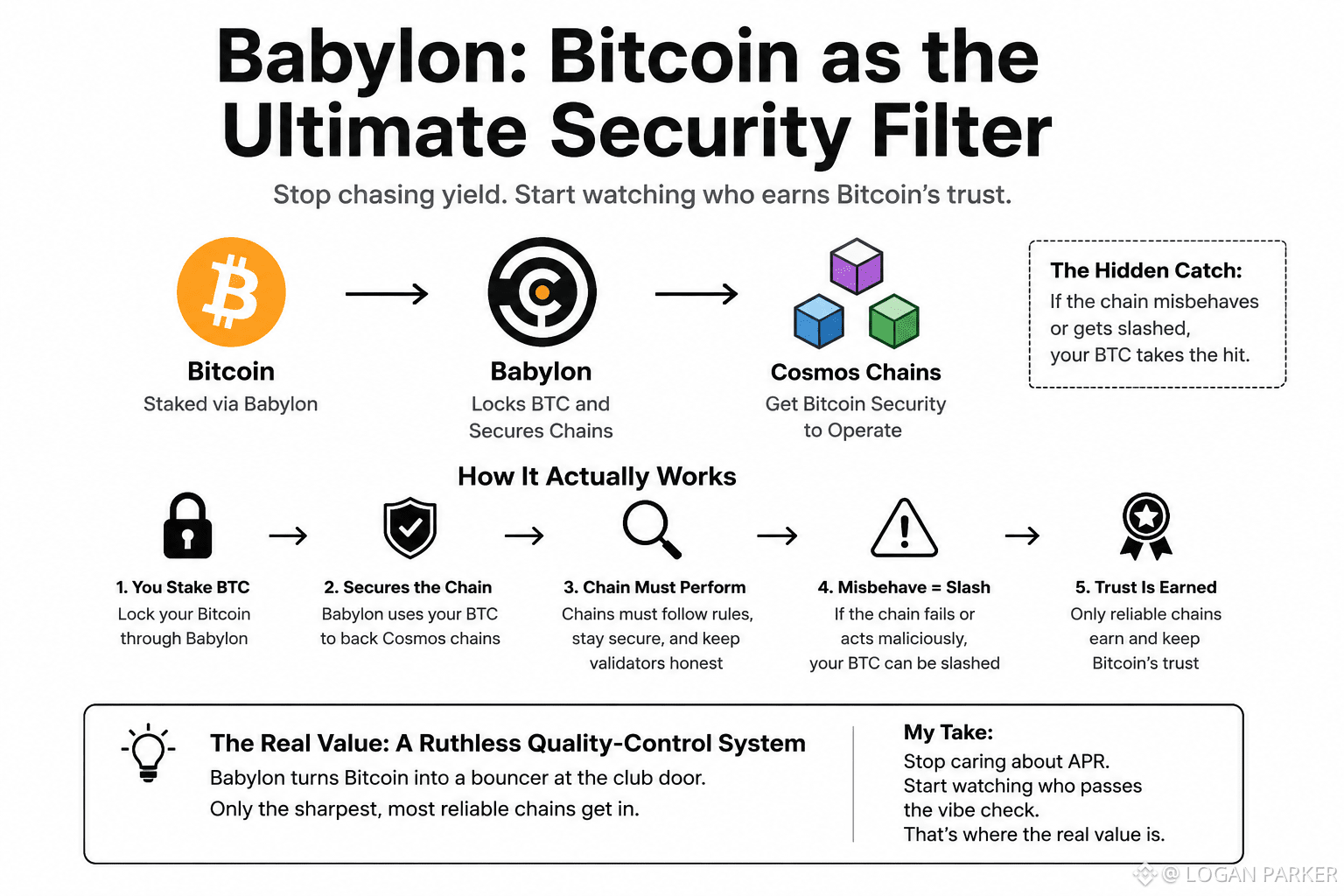
You know that feeling when everyone's screaming about APY and you're just sitting there, squinting at the fine print? That's me with Babylon right now.
Everyone's calling it a yield farm for Bitcoin. But here's the uncomfortable question nobody's asking: what happens when a chain you've never heard of gets slashed, and your BTC takes the hit?
Because that's the hidden catch. Babylon doesn't just lock your Bitcoin—it ties your money to the operational competence of some random Cosmos zone you couldn't name if your life depended on it. Suddenly, being a "passive" staker means you're now a part-time security auditor. You're reading upgrade proposals. You're checking validator uptime. You're doing homework you never signed up for.
And here's the thing: most people won't. They'll chase the number, click "stake," and pray.
But that laziness creates something beautiful—an organic filter. Chains that attract serious BTC will be the ones that actually run clean ships. Because if they mess up, they lose not just their own tokens, but Bitcoin's trust. That's a reputation hit you can't buy back.
So the real value here isn't the yield. It's the quiet, ruthless quality-control system Babylon is building. It turns Bitcoin into a bouncer at the club door. Only the sharpest chains get in.
My take? Stop caring about the APR. Start watching which projects pass the vibe check. Those are the ones worth your attention—and your Bitcoin.
#baby $BABY @BabylonLabs_io
You know that feeling when everyone's screaming about APY and you're just sitting there, squinting at the fine print? That's me with Babylon right now.
Everyone's calling it a yield farm for Bitcoin. But here's the uncomfortable question nobody's asking: what happens when a chain you've never heard of gets slashed, and your BTC takes the hit?
Because that's the hidden catch. Babylon doesn't just lock your Bitcoin—it ties your money to the operational competence of some random Cosmos zone you couldn't name if your life depended on it. Suddenly, being a "passive" staker means you're now a part-time security auditor. You're reading upgrade proposals. You're checking validator uptime. You're doing homework you never signed up for.
And here's the thing: most people won't. They'll chase the number, click "stake," and pray.
But that laziness creates something beautiful—an organic filter. Chains that attract serious BTC will be the ones that actually run clean ships. Because if they mess up, they lose not just their own tokens, but Bitcoin's trust. That's a reputation hit you can't buy back.
So the real value here isn't the yield. It's the quiet, ruthless quality-control system Babylon is building. It turns Bitcoin into a bouncer at the club door. Only the sharpest chains get in.
My take? Stop caring about the APR. Start watching which projects pass the vibe check. Those are the ones worth your attention—and your Bitcoin.
You know that feeling when everyone's screaming about APY and you're just sitting there, squinting at the fine print? That's me with Babylon right now.
Everyone's calling it a yield farm for Bitcoin. But here's the uncomfortable question nobody's asking: what happens when a chain you've never heard of gets slashed, and your BTC takes the hit?
Because that's the hidden catch. Babylon doesn't just lock your Bitcoin—it ties your money to the operational competence of some random Cosmos zone you couldn't name if your life depended on it. Suddenly, being a "passive" staker means you're now a part-time security auditor. You're reading upgrade proposals. You're checking validator uptime. You're doing homework you never signed up for.
And here's the thing: most people won't. They'll chase the number, click "stake," and pray.
But that laziness creates something beautiful—an organic filter. Chains that attract serious BTC will be the ones that actually run clean ships. Because if they mess up, they lose not just their own tokens, but Bitcoin's trust. That's a reputation hit you can't buy back.
So the real value here isn't the yield. It's the quiet, ruthless quality-control system Babylon is building. It turns Bitcoin into a bouncer at the club door. Only the sharpest chains get in.
My take? Stop caring about the APR. Start watching which projects pass the vibe check. Those are the ones worth your attention—and your Bitcoin.
6
4
81
·
--
Bullish
$GIGGLE
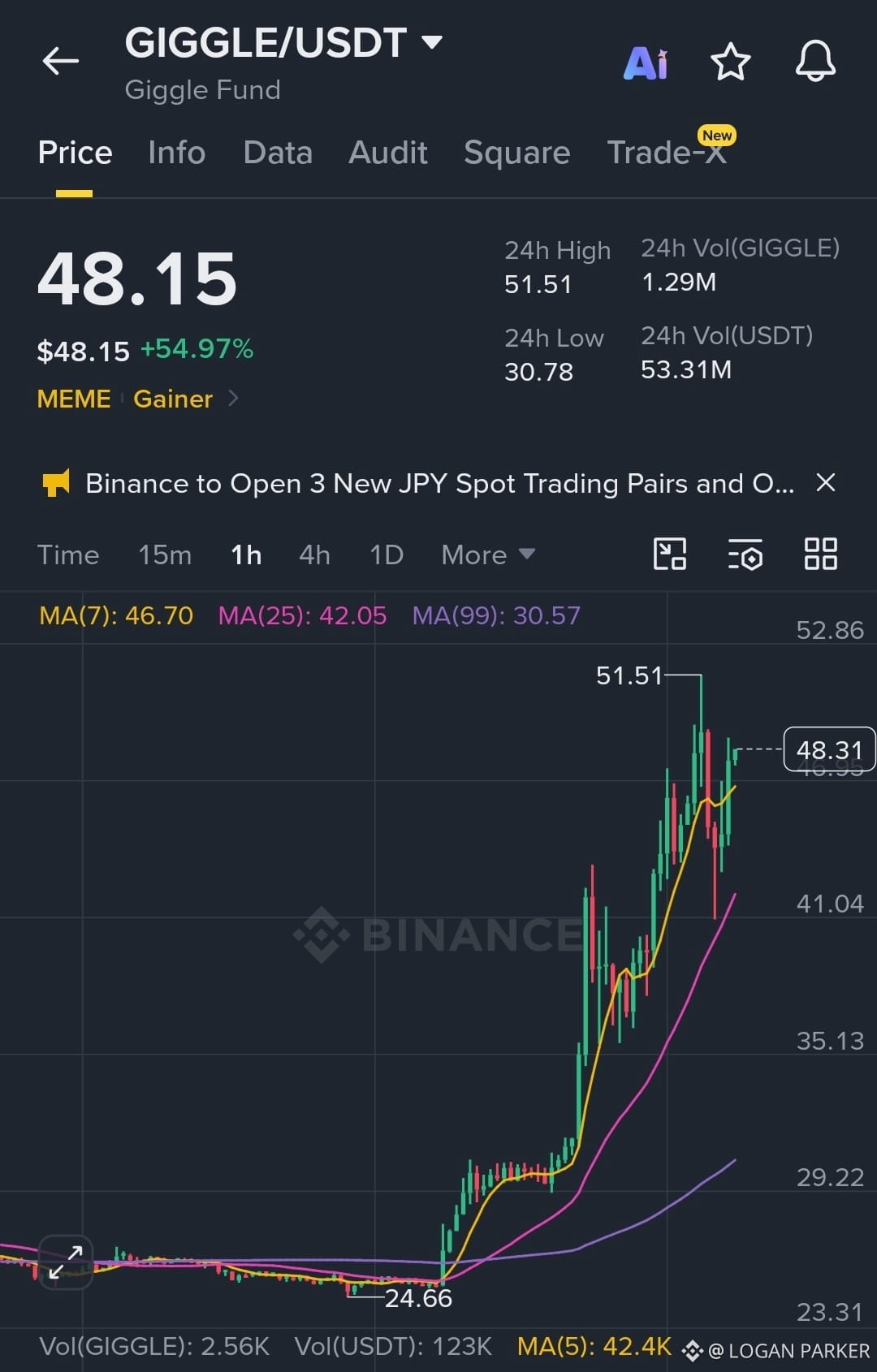
GIGGLE is one of the strongest movers on the 1H chart, surging 54.97% to 48.15 after printing a high of 51.51. The trend remains firmly bullish with price holding above MA(7): 46.70, MA(25): 42.05, and MA(99): 30.57. As long as price stays above 46.70, buyers remain in control. A breakout above 51.51 could ignite the next expansion leg.
Trade Setup
EP: 47.80 – 48.50
TP1: 51.50
TP2: 54.00
TP3: 58.00
SL: 45.80
Momentum remains strong, but after a sharp rally, expect higher volatility. Holding above 46.70 favors continuation, while losing 45.80 could trigger a deeper pullback before the next move.
{spot}(GIGGLEUSDT)
#SouthKoreanStocksReboundAfterSelloff #SouthKoreanStocksReboundAfterSelloff
#KospiSurgesAsMuchAs17%RecordGain
$GIGGLE
GIGGLE is one of the strongest movers on the 1H chart, surging 54.97% to 48.15 after printing a high of 51.51. The trend remains firmly bullish with price holding above MA(7): 46.70, MA(25): 42.05, and MA(99): 30.57. As long as price stays above 46.70, buyers remain in control. A breakout above 51.51 could ignite the next expansion leg.
Trade Setup
EP: 47.80 – 48.50
TP1: 51.50
TP2: 54.00
TP3: 58.00
SL: 45.80
Momentum remains strong, but after a sharp rally, expect higher volatility. Holding above 46.70 favors continuation, while losing 45.80 could trigger a deeper pullback before the next move.
#SouthKoreanStocksReboundAfterSelloff #SouthKoreanStocksReboundAfterSelloff
#KospiSurgesAsMuchAs17%RecordGain
GIGGLE is one of the strongest movers on the 1H chart, surging 54.97% to 48.15 after printing a high of 51.51. The trend remains firmly bullish with price holding above MA(7): 46.70, MA(25): 42.05, and MA(99): 30.57. As long as price stays above 46.70, buyers remain in control. A breakout above 51.51 could ignite the next expansion leg.
Trade Setup
EP: 47.80 – 48.50
TP1: 51.50
TP2: 54.00
TP3: 58.00
SL: 45.80
Momentum remains strong, but after a sharp rally, expect higher volatility. Holding above 46.70 favors continuation, while losing 45.80 could trigger a deeper pullback before the next move.
#SouthKoreanStocksReboundAfterSelloff #SouthKoreanStocksReboundAfterSelloff
#KospiSurgesAsMuchAs17%RecordGain
100
·
--
$ETH
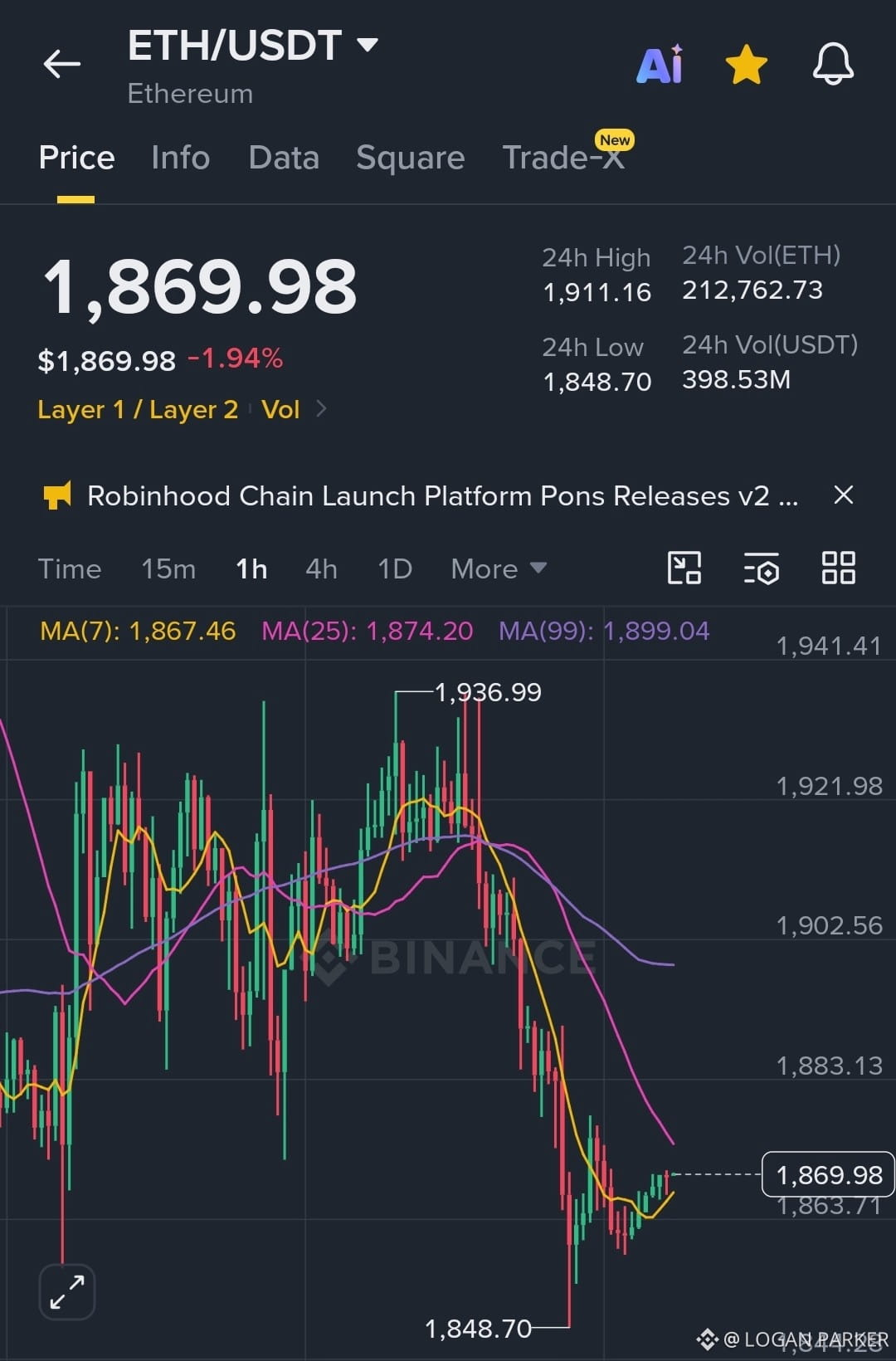
Ethereum is showing signs of stabilization after a sharp pullback from 1,936.99. Price is trading around 1,869.98, with MA(7) at 1,867.46 providing immediate support, while MA(25) at 1,874.20 and MA(99) at 1,899.04 remain key resistance levels. A break above 1,875 could trigger a stronger recovery, but rejection below this zone may lead to another retest of support.
Trade Setup
EP: 1,868 – 1,872
TP1: 1,885
TP2: 1,900
TP3: 1,920
SL: 1,850
Holding above 1,865 keeps the recovery attempt alive. A decisive move above 1,875 would strengthen bullish momentum, while a break below 1,850 increases the probability of revisiting the recent swing low near 1,848.
{spot}(ETHUSDT)
#KospiUp15.13%InMorningTrade #OmanCrudeSeptemberOSPFalls
$ETH
Ethereum is showing signs of stabilization after a sharp pullback from 1,936.99. Price is trading around 1,869.98, with MA(7) at 1,867.46 providing immediate support, while MA(25) at 1,874.20 and MA(99) at 1,899.04 remain key resistance levels. A break above 1,875 could trigger a stronger recovery, but rejection below this zone may lead to another retest of support.
Trade Setup
EP: 1,868 – 1,872
TP1: 1,885
TP2: 1,900
TP3: 1,920
SL: 1,850
Holding above 1,865 keeps the recovery attempt alive. A decisive move above 1,875 would strengthen bullish momentum, while a break below 1,850 increases the probability of revisiting the recent swing low near 1,848.
#KospiUp15.13%InMorningTrade #OmanCrudeSeptemberOSPFalls
Ethereum is showing signs of stabilization after a sharp pullback from 1,936.99. Price is trading around 1,869.98, with MA(7) at 1,867.46 providing immediate support, while MA(25) at 1,874.20 and MA(99) at 1,899.04 remain key resistance levels. A break above 1,875 could trigger a stronger recovery, but rejection below this zone may lead to another retest of support.
Trade Setup
EP: 1,868 – 1,872
TP1: 1,885
TP2: 1,900
TP3: 1,920
SL: 1,850
Holding above 1,865 keeps the recovery attempt alive. A decisive move above 1,875 would strengthen bullish momentum, while a break below 1,850 increases the probability of revisiting the recent swing low near 1,848.
#KospiUp15.13%InMorningTrade #OmanCrudeSeptemberOSPFalls
54
·
--
$BTC
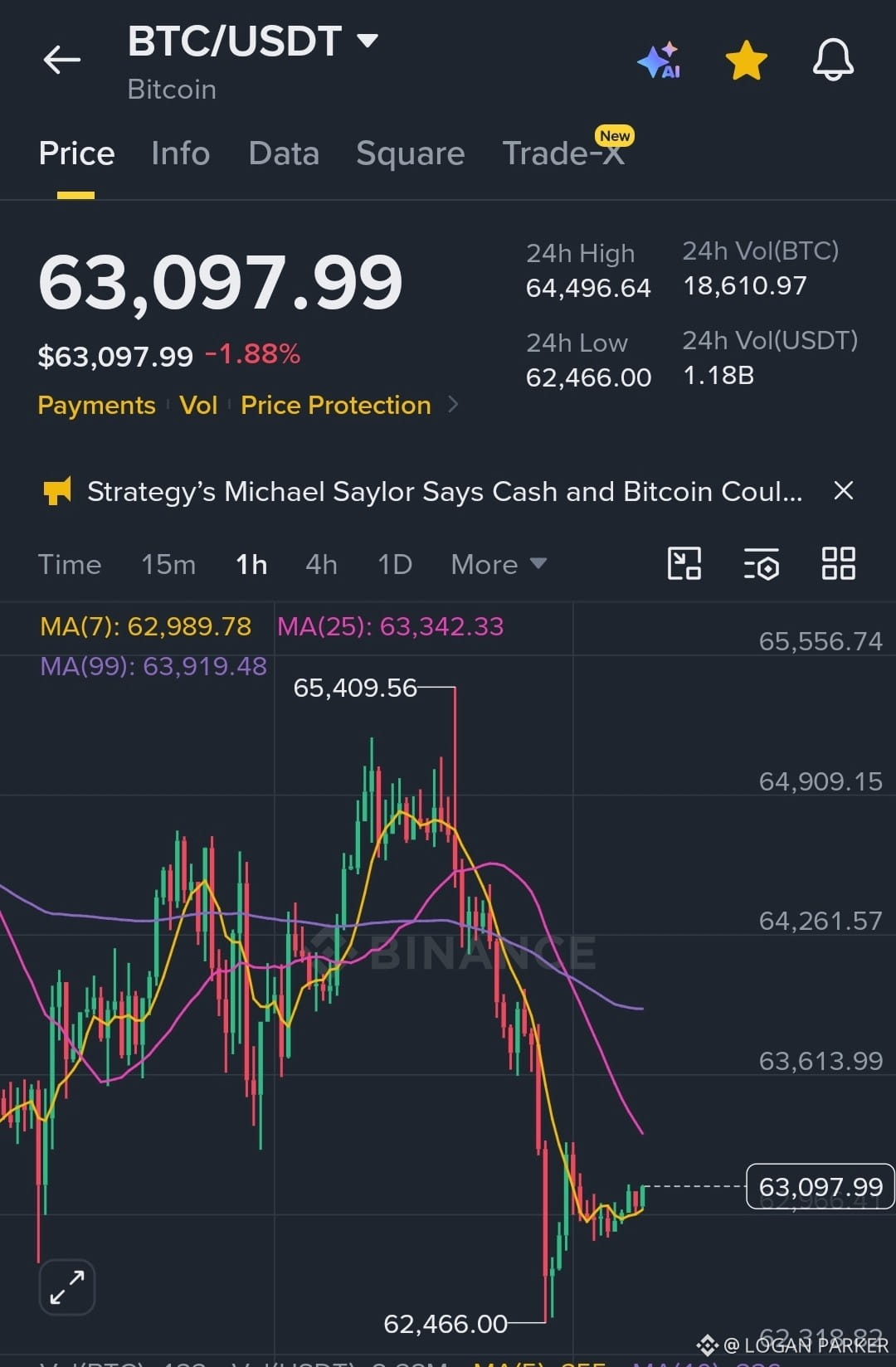
Bitcoin is attempting to recover after a sharp rejection from 65,409, but the 1H trend remains under pressure. Price is trading around 63,098, below the MA(25) at 63,342 and MA(99) at 63,919, while the MA(7) at 62,990 is starting to curl upward. Bulls need to reclaim 63.3K–63.9K to confirm a stronger recovery. Until then, expect volatility with resistance overhead.
Trade Setup
EP: 63,000 – 63,150
TP1: 63,350
TP2: 63,900
TP3: 64,500
SL: 62,650
A sustained move above 63,350 would strengthen the bullish recovery, while a break below 62,650 could send BTC back to retest the 62,466 support zone. Manage risk and wait for confirmation before increasing position size.
{spot}(BTCUSDT)
#SaudiOilTankersRerouteAroundAfrica #OmanCrudeSeptemberOSPFalls
$BTC
Bitcoin is attempting to recover after a sharp rejection from 65,409, but the 1H trend remains under pressure. Price is trading around 63,098, below the MA(25) at 63,342 and MA(99) at 63,919, while the MA(7) at 62,990 is starting to curl upward. Bulls need to reclaim 63.3K–63.9K to confirm a stronger recovery. Until then, expect volatility with resistance overhead.
Trade Setup
EP: 63,000 – 63,150
TP1: 63,350
TP2: 63,900
TP3: 64,500
SL: 62,650
A sustained move above 63,350 would strengthen the bullish recovery, while a break below 62,650 could send BTC back to retest the 62,466 support zone. Manage risk and wait for confirmation before increasing position size.
#SaudiOilTankersRerouteAroundAfrica #OmanCrudeSeptemberOSPFalls
Bitcoin is attempting to recover after a sharp rejection from 65,409, but the 1H trend remains under pressure. Price is trading around 63,098, below the MA(25) at 63,342 and MA(99) at 63,919, while the MA(7) at 62,990 is starting to curl upward. Bulls need to reclaim 63.3K–63.9K to confirm a stronger recovery. Until then, expect volatility with resistance overhead.
Trade Setup
EP: 63,000 – 63,150
TP1: 63,350
TP2: 63,900
TP3: 64,500
SL: 62,650
A sustained move above 63,350 would strengthen the bullish recovery, while a break below 62,650 could send BTC back to retest the 62,466 support zone. Manage risk and wait for confirmation before increasing position size.
#SaudiOilTankersRerouteAroundAfrica #OmanCrudeSeptemberOSPFalls
67
·
--
$BNB
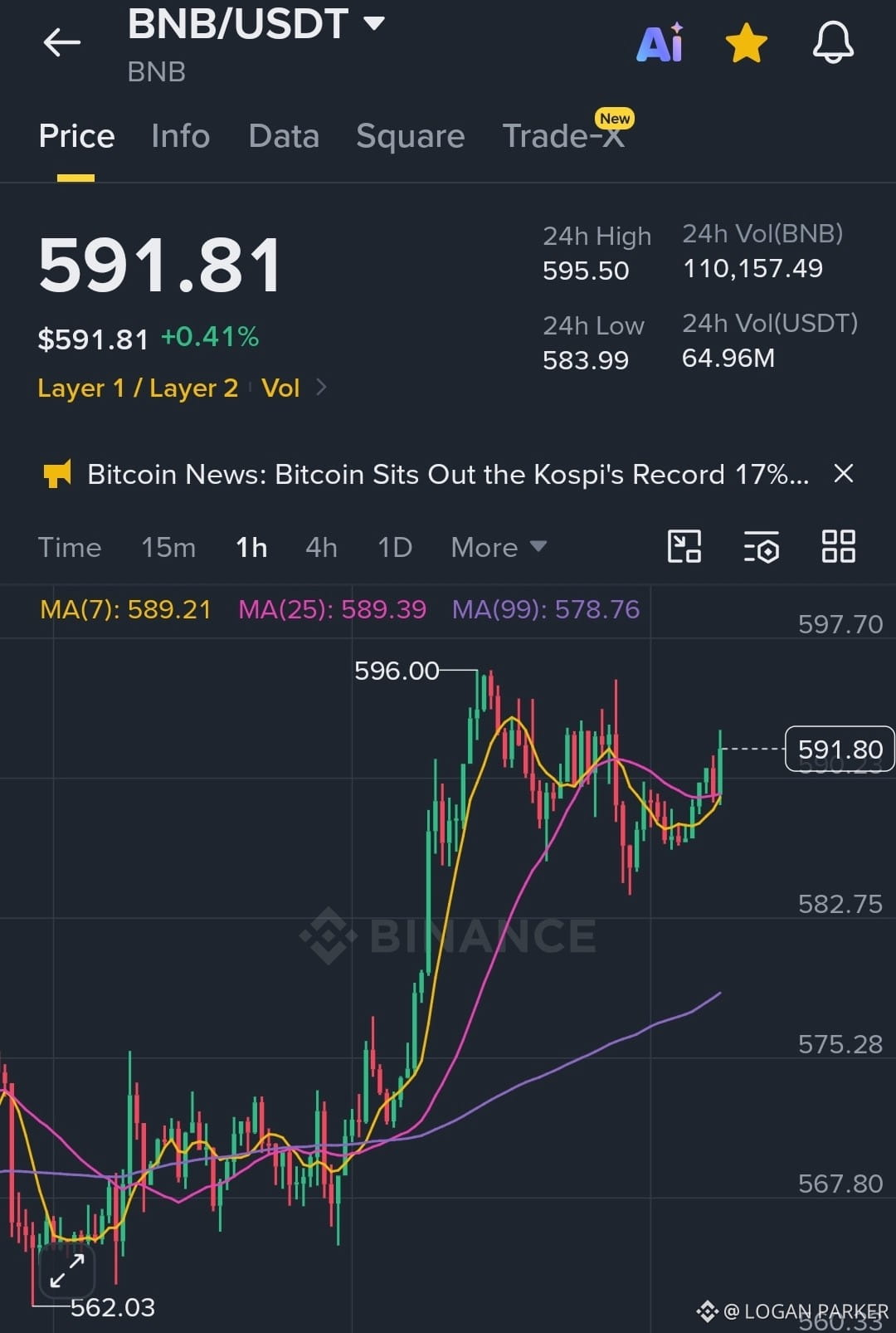
BNB is holding above the key moving averages on the 1H chart with price trading around 591.81. MA(7): 589.21, MA(25): 589.39, and MA(99): 578.76 all suggest short-term bullish momentum remains intact. Price recently rejected the 596.00 resistance and is attempting another push. A clean breakout above 596 could open the door for the next leg higher, while holding above 589 keeps buyers in control.
Trade Setup
EP: 591.50 – 593.00
TP1: 596.00
TP2: 600.00
TP3: 606.00
SL: 586.80
Watch the 596 resistance closely. A strong hourly close above this level would confirm bullish continuation, while losing 589 increases the chance of a pullback toward the 583–585 support zone.
{spot}(BNBUSDT)
#USAndJapanJointlyInterveneToBuyYen #SouthKoreanStocksReboundAfterSelloff
$BNB
BNB is holding above the key moving averages on the 1H chart with price trading around 591.81. MA(7): 589.21, MA(25): 589.39, and MA(99): 578.76 all suggest short-term bullish momentum remains intact. Price recently rejected the 596.00 resistance and is attempting another push. A clean breakout above 596 could open the door for the next leg higher, while holding above 589 keeps buyers in control.
Trade Setup
EP: 591.50 – 593.00
TP1: 596.00
TP2: 600.00
TP3: 606.00
SL: 586.80
Watch the 596 resistance closely. A strong hourly close above this level would confirm bullish continuation, while losing 589 increases the chance of a pullback toward the 583–585 support zone.
#USAndJapanJointlyInterveneToBuyYen #SouthKoreanStocksReboundAfterSelloff
BNB is holding above the key moving averages on the 1H chart with price trading around 591.81. MA(7): 589.21, MA(25): 589.39, and MA(99): 578.76 all suggest short-term bullish momentum remains intact. Price recently rejected the 596.00 resistance and is attempting another push. A clean breakout above 596 could open the door for the next leg higher, while holding above 589 keeps buyers in control.
Trade Setup
EP: 591.50 – 593.00
TP1: 596.00
TP2: 600.00
TP3: 606.00
SL: 586.80
Watch the 596 resistance closely. A strong hourly close above this level would confirm bullish continuation, while losing 589 increases the chance of a pullback toward the 583–585 support zone.
#USAndJapanJointlyInterveneToBuyYen #SouthKoreanStocksReboundAfterSelloff
79
·
--
Bullish
#baby $BABY @babylonlabs_io
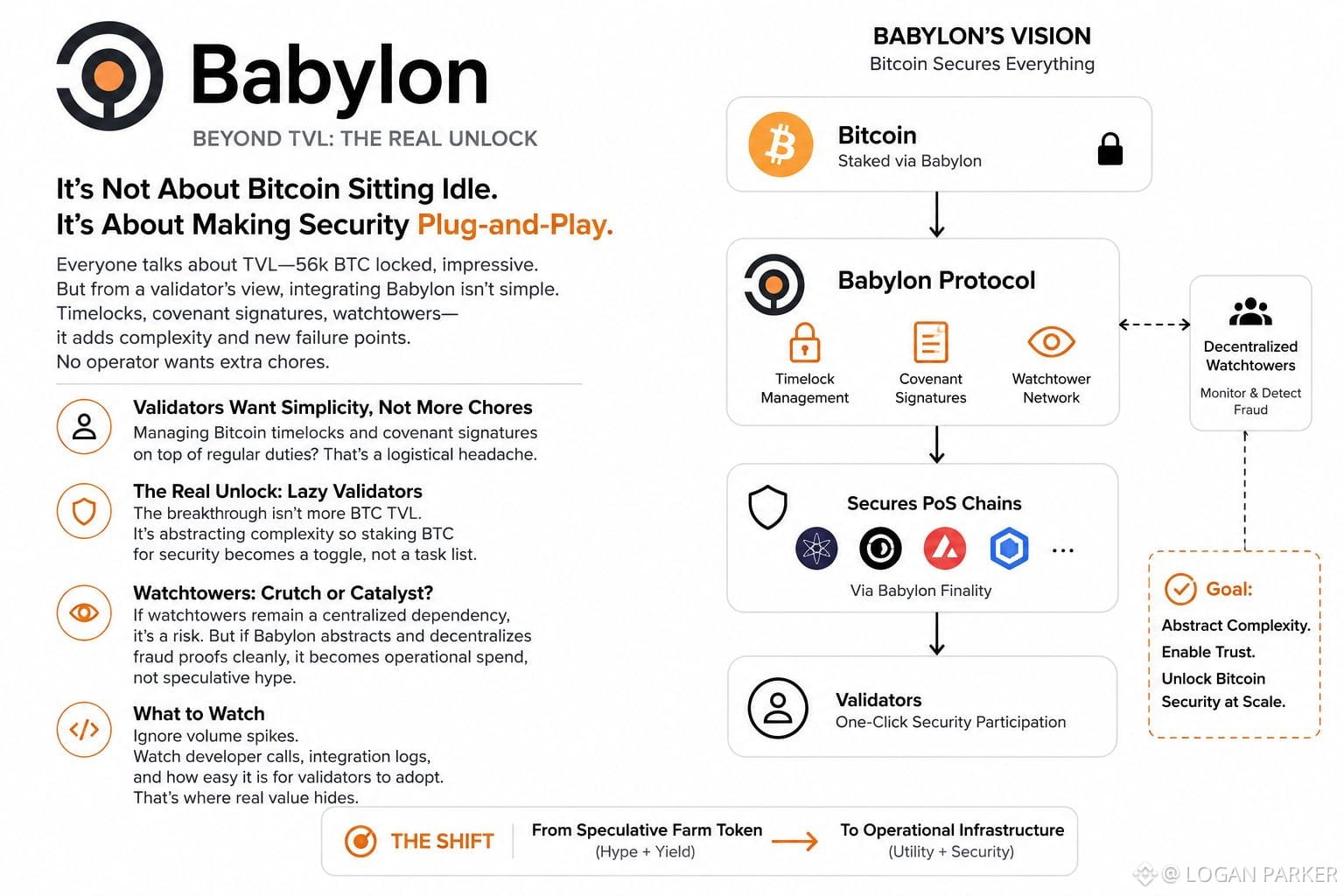
Honestly, the BABY price action makes my eye twitch. Everyone's screaming about TVL—56k BTC, wow—but whenever I stare at that chart, I can't shake the feeling we're looking at the wrong metric. It's not about the Bitcoin sitting idle. Try actually integrating Babylon from a validator's view. Go on, peek at the docs. It's a logistical headache. Managing Bitcoin timelocks and covenant signatures on top of regular duties? No operator wants that extra failure point. We're over-indexing on yield seekers when the real unlock is lazy validators wanting plug-and-play security. The market prices BABY like a speculative farm token. But watchtowers—the fraud-catching mechanism—feel like a centralized crutch. If they successfully abstract that, if staking becomes a toggle for Bitcoin finality, BABY shifts from hype to operational spend. I'm not buying the inflow narrative; I'm watching to see if they reduce chores for node runners. Bitcoin supply is massive, but validator patience is tiny. My two sats? Ignore volume spikes. Watch developer calls and integration logs. That's where the value hides.
#baby $BABY @BabylonLabs_io
Honestly, the BABY price action makes my eye twitch. Everyone's screaming about TVL—56k BTC, wow—but whenever I stare at that chart, I can't shake the feeling we're looking at the wrong metric. It's not about the Bitcoin sitting idle. Try actually integrating Babylon from a validator's view. Go on, peek at the docs. It's a logistical headache. Managing Bitcoin timelocks and covenant signatures on top of regular duties? No operator wants that extra failure point. We're over-indexing on yield seekers when the real unlock is lazy validators wanting plug-and-play security. The market prices BABY like a speculative farm token. But watchtowers—the fraud-catching mechanism—feel like a centralized crutch. If they successfully abstract that, if staking becomes a toggle for Bitcoin finality, BABY shifts from hype to operational spend. I'm not buying the inflow narrative; I'm watching to see if they reduce chores for node runners. Bitcoin supply is massive, but validator patience is tiny. My two sats? Ignore volume spikes. Watch developer calls and integration logs. That's where the value hides.
Honestly, the BABY price action makes my eye twitch. Everyone's screaming about TVL—56k BTC, wow—but whenever I stare at that chart, I can't shake the feeling we're looking at the wrong metric. It's not about the Bitcoin sitting idle. Try actually integrating Babylon from a validator's view. Go on, peek at the docs. It's a logistical headache. Managing Bitcoin timelocks and covenant signatures on top of regular duties? No operator wants that extra failure point. We're over-indexing on yield seekers when the real unlock is lazy validators wanting plug-and-play security. The market prices BABY like a speculative farm token. But watchtowers—the fraud-catching mechanism—feel like a centralized crutch. If they successfully abstract that, if staking becomes a toggle for Bitcoin finality, BABY shifts from hype to operational spend. I'm not buying the inflow narrative; I'm watching to see if they reduce chores for node runners. Bitcoin supply is massive, but validator patience is tiny. My two sats? Ignore volume spikes. Watch developer calls and integration logs. That's where the value hides.
5
4
115
·
--
Bullish
#baby $BABY @babylonlabs_io
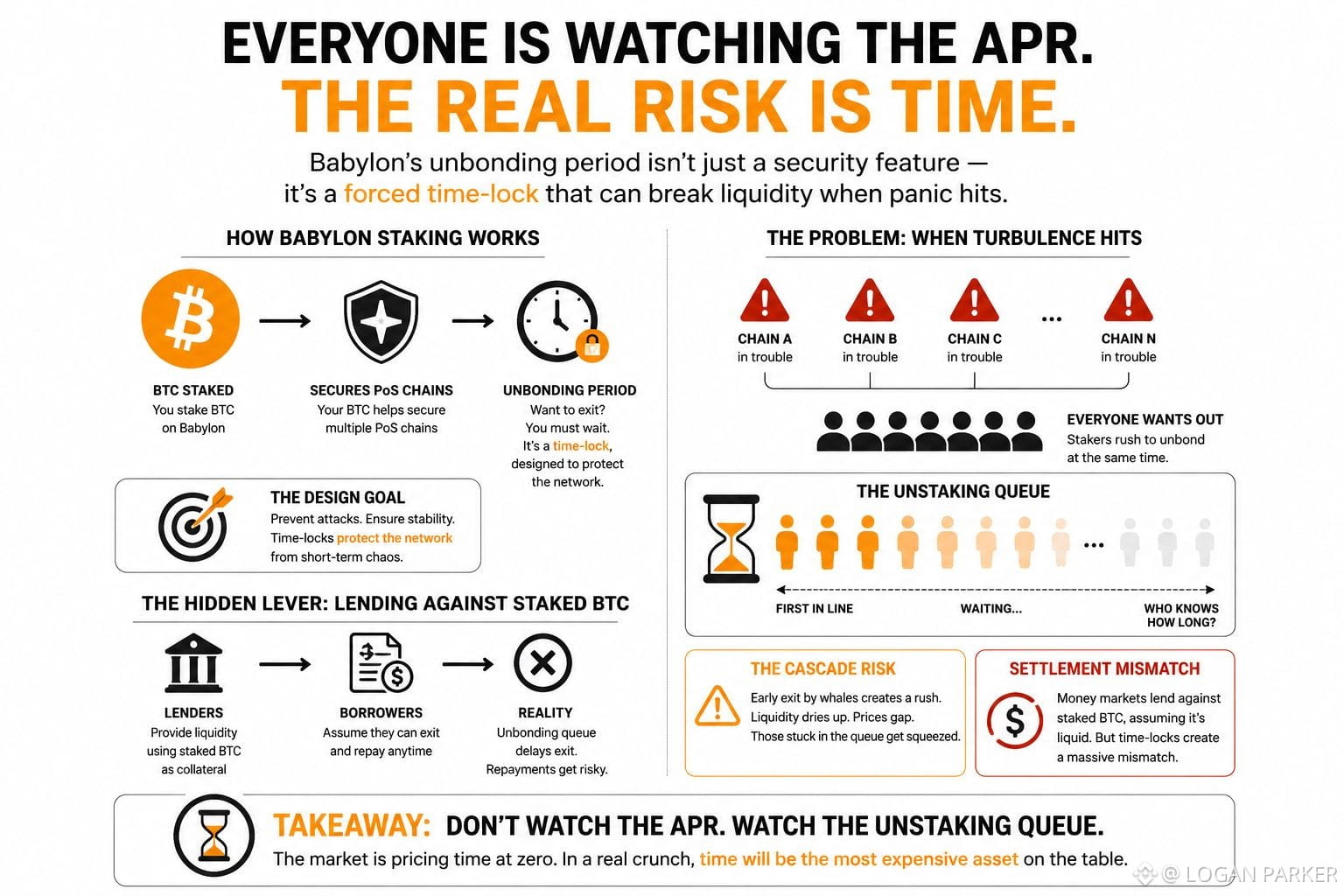
Everyone is squinting at Babylon's APR, but I think the market is looking in the wrong direction. This isn't a yield play—it's a ticking coordination bomb hiding in plain sight.
Here’s the gritty reality nobody is talking about: that unbonding period isn't just a security feature. It’s a forced time-lock that directly warps liquidity behavior during panic. Imagine you're staking BTC to secure a dozen different PoS chains. Suddenly, one of those chains gets shaky. You want out, but the protocol forces you to wait. That delay isn't a bug—it's designed to protect the network. But here's the catch: what happens when multiple chains face turbulence at once?
We’re looking at a potential queue for exits. And if money markets are lending against these staked positions, that queue creates a massive settlement mismatch. It’s a classic game of musical chairs, but the music stops during a crash, and the chairs are Bitcoin liquidity. The market is pricing this like standard staking, assuming infinite throughput and instantaneous settlement.
But the real bottleneck isn't yield—it's time. The protocol physically cannot process everyone leaving at the same speed. When panic hits, the most rational move for a whale is to exit early, triggering a cascade that squeezes everyone behind them.
So while everyone chases the percentages, the actual value proposition is a stress-test for Bitcoin's fungibility. The market acts like this liquidity is always accessible. It's not. The moment demand to unbond exceeds the pipeline, the whole derived liquidity house folds.
Takeaway: Don't watch the APR. Watch the unstaking queue. The market is pricing time at zero, but in a real crunch, time will be the most expensive asset on the table.
#baby $BABY @BabylonLabs_io
Everyone is squinting at Babylon's APR, but I think the market is looking in the wrong direction. This isn't a yield play—it's a ticking coordination bomb hiding in plain sight.
Here’s the gritty reality nobody is talking about: that unbonding period isn't just a security feature. It’s a forced time-lock that directly warps liquidity behavior during panic. Imagine you're staking BTC to secure a dozen different PoS chains. Suddenly, one of those chains gets shaky. You want out, but the protocol forces you to wait. That delay isn't a bug—it's designed to protect the network. But here's the catch: what happens when multiple chains face turbulence at once?
We’re looking at a potential queue for exits. And if money markets are lending against these staked positions, that queue creates a massive settlement mismatch. It’s a classic game of musical chairs, but the music stops during a crash, and the chairs are Bitcoin liquidity. The market is pricing this like standard staking, assuming infinite throughput and instantaneous settlement.
But the real bottleneck isn't yield—it's time. The protocol physically cannot process everyone leaving at the same speed. When panic hits, the most rational move for a whale is to exit early, triggering a cascade that squeezes everyone behind them.
So while everyone chases the percentages, the actual value proposition is a stress-test for Bitcoin's fungibility. The market acts like this liquidity is always accessible. It's not. The moment demand to unbond exceeds the pipeline, the whole derived liquidity house folds.
Takeaway: Don't watch the APR. Watch the unstaking queue. The market is pricing time at zero, but in a real crunch, time will be the most expensive asset on the table.
Everyone is squinting at Babylon's APR, but I think the market is looking in the wrong direction. This isn't a yield play—it's a ticking coordination bomb hiding in plain sight.
Here’s the gritty reality nobody is talking about: that unbonding period isn't just a security feature. It’s a forced time-lock that directly warps liquidity behavior during panic. Imagine you're staking BTC to secure a dozen different PoS chains. Suddenly, one of those chains gets shaky. You want out, but the protocol forces you to wait. That delay isn't a bug—it's designed to protect the network. But here's the catch: what happens when multiple chains face turbulence at once?
We’re looking at a potential queue for exits. And if money markets are lending against these staked positions, that queue creates a massive settlement mismatch. It’s a classic game of musical chairs, but the music stops during a crash, and the chairs are Bitcoin liquidity. The market is pricing this like standard staking, assuming infinite throughput and instantaneous settlement.
But the real bottleneck isn't yield—it's time. The protocol physically cannot process everyone leaving at the same speed. When panic hits, the most rational move for a whale is to exit early, triggering a cascade that squeezes everyone behind them.
So while everyone chases the percentages, the actual value proposition is a stress-test for Bitcoin's fungibility. The market acts like this liquidity is always accessible. It's not. The moment demand to unbond exceeds the pipeline, the whole derived liquidity house folds.
Takeaway: Don't watch the APR. Watch the unstaking queue. The market is pricing time at zero, but in a real crunch, time will be the most expensive asset on the table.
4
3
117
·
--
Bullish
#baby $BABY @babylonlabs_io
You know what scares me more than a bear market? Bridges.
Every time I hear about a bridge hack – billions lost, users devastated – I cringe.
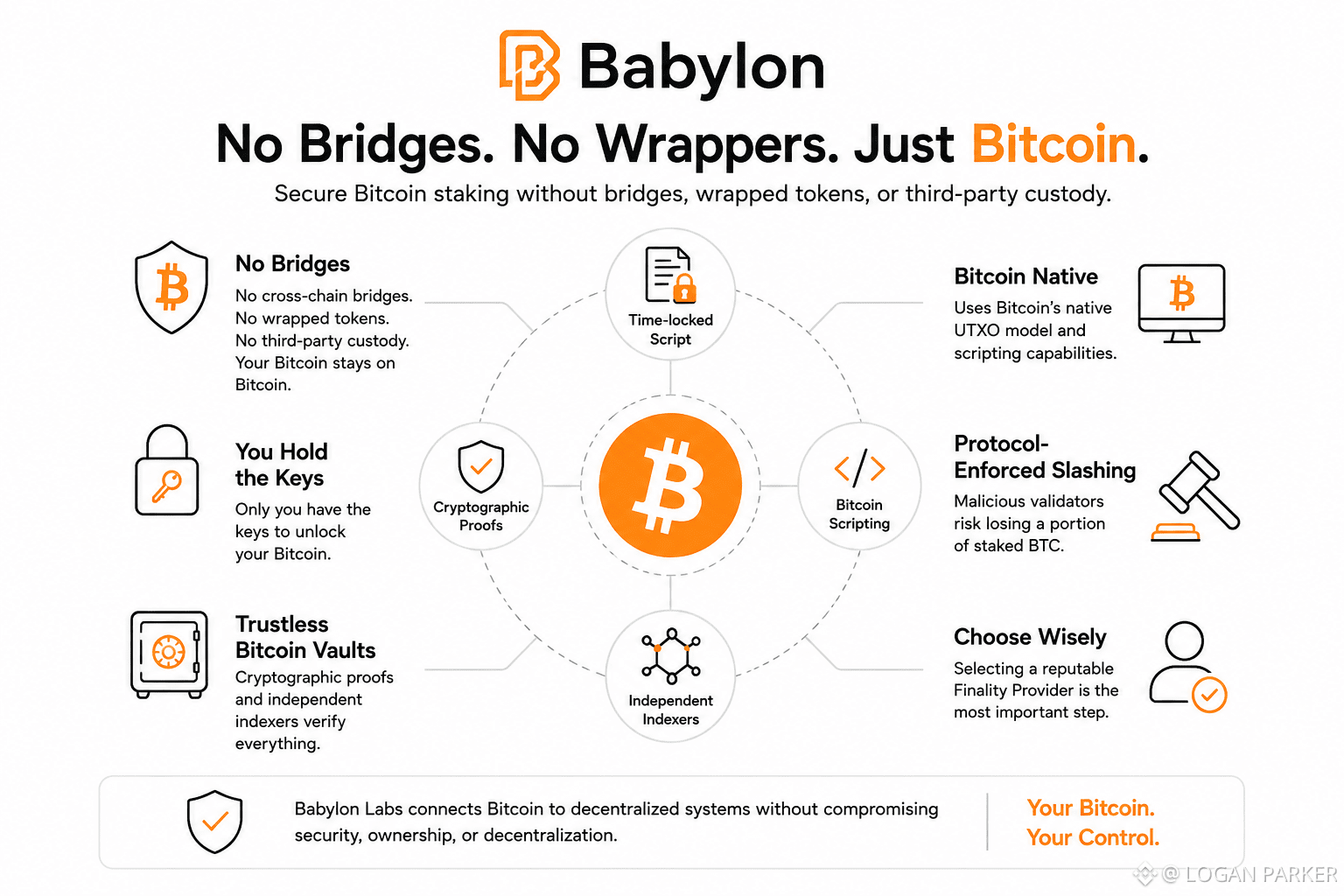
Babylon Labs' whole thing is no bridges. No wrapped tokens. No third-party custody. Your Bitcoin stays exactly where it is: on the Bitcoin blockchain.
The protocol uses Bitcoin's native UTXO model and scripting capabilities. When you stake, you're creating a time-locked script on Bitcoin itself. Only you have the keys to unlock it.
The staking mechanism uses what they call Trustless Bitcoin Vaults – a toolkit that securely connects Bitcoin state to external smart contracts. It uses cryptographic proofs and independent indexers to verify everything without trusting any single third party.
The slashing mechanism? Protocol-enforced.
If a validator you delegate to acts maliciously – like trying to double-spend or attack the network – a portion of your staked BTC can be forfeited. That's why choosing a reputable Finality Provider is the most important step.
Would you trust a bridge with your Bitcoin? I wouldn't. That's why this approach actually makes sense to me.
#baby $BABY @BabylonLabs_io
You know what scares me more than a bear market? Bridges.
Every time I hear about a bridge hack – billions lost, users devastated – I cringe.
Babylon Labs' whole thing is no bridges. No wrapped tokens. No third-party custody. Your Bitcoin stays exactly where it is: on the Bitcoin blockchain.
The protocol uses Bitcoin's native UTXO model and scripting capabilities. When you stake, you're creating a time-locked script on Bitcoin itself. Only you have the keys to unlock it.
The staking mechanism uses what they call Trustless Bitcoin Vaults – a toolkit that securely connects Bitcoin state to external smart contracts. It uses cryptographic proofs and independent indexers to verify everything without trusting any single third party.
The slashing mechanism? Protocol-enforced.
If a validator you delegate to acts maliciously – like trying to double-spend or attack the network – a portion of your staked BTC can be forfeited. That's why choosing a reputable Finality Provider is the most important step.
Would you trust a bridge with your Bitcoin? I wouldn't. That's why this approach actually makes sense to me.
You know what scares me more than a bear market? Bridges.
Every time I hear about a bridge hack – billions lost, users devastated – I cringe.
Babylon Labs' whole thing is no bridges. No wrapped tokens. No third-party custody. Your Bitcoin stays exactly where it is: on the Bitcoin blockchain.
The protocol uses Bitcoin's native UTXO model and scripting capabilities. When you stake, you're creating a time-locked script on Bitcoin itself. Only you have the keys to unlock it.
The staking mechanism uses what they call Trustless Bitcoin Vaults – a toolkit that securely connects Bitcoin state to external smart contracts. It uses cryptographic proofs and independent indexers to verify everything without trusting any single third party.
The slashing mechanism? Protocol-enforced.
If a validator you delegate to acts maliciously – like trying to double-spend or attack the network – a portion of your staked BTC can be forfeited. That's why choosing a reputable Finality Provider is the most important step.
Would you trust a bridge with your Bitcoin? I wouldn't. That's why this approach actually makes sense to me.
2
98
·
--
I was skeptical at first, assuming Babylon would rely on bridges or wrapped tokens like so many others, but the design genuinely keeps Bitcoin in self-custody using time-locks and Taproot scripts, which forced me to reconsider. My hesitation now centers on the covenant committee, a necessary middleman that introduces both liveness and collusion risks, and I am not sure I will ever fully trust that tradeoff. Still, seeing over fifty-seven thousand BTC voluntarily lock into the system, from holders who clearly did their homework, makes me think there is something substantive here, even if I am not ready to move my own coins yet.
#baby @babylonlabs_io $BABY
{spot}(BABYUSDT)
I was skeptical at first, assuming Babylon would rely on bridges or wrapped tokens like so many others, but the design genuinely keeps Bitcoin in self-custody using time-locks and Taproot scripts, which forced me to reconsider. My hesitation now centers on the covenant committee, a necessary middleman that introduces both liveness and collusion risks, and I am not sure I will ever fully trust that tradeoff. Still, seeing over fifty-seven thousand BTC voluntarily lock into the system, from holders who clearly did their homework, makes me think there is something substantive here, even if I am not ready to move my own coins yet.
#baby @BabylonLabs_io $BABY
#baby @BabylonLabs_io $BABY
4
3
705
·
--
Bullish
#baby $BABY @babylonlabs_io
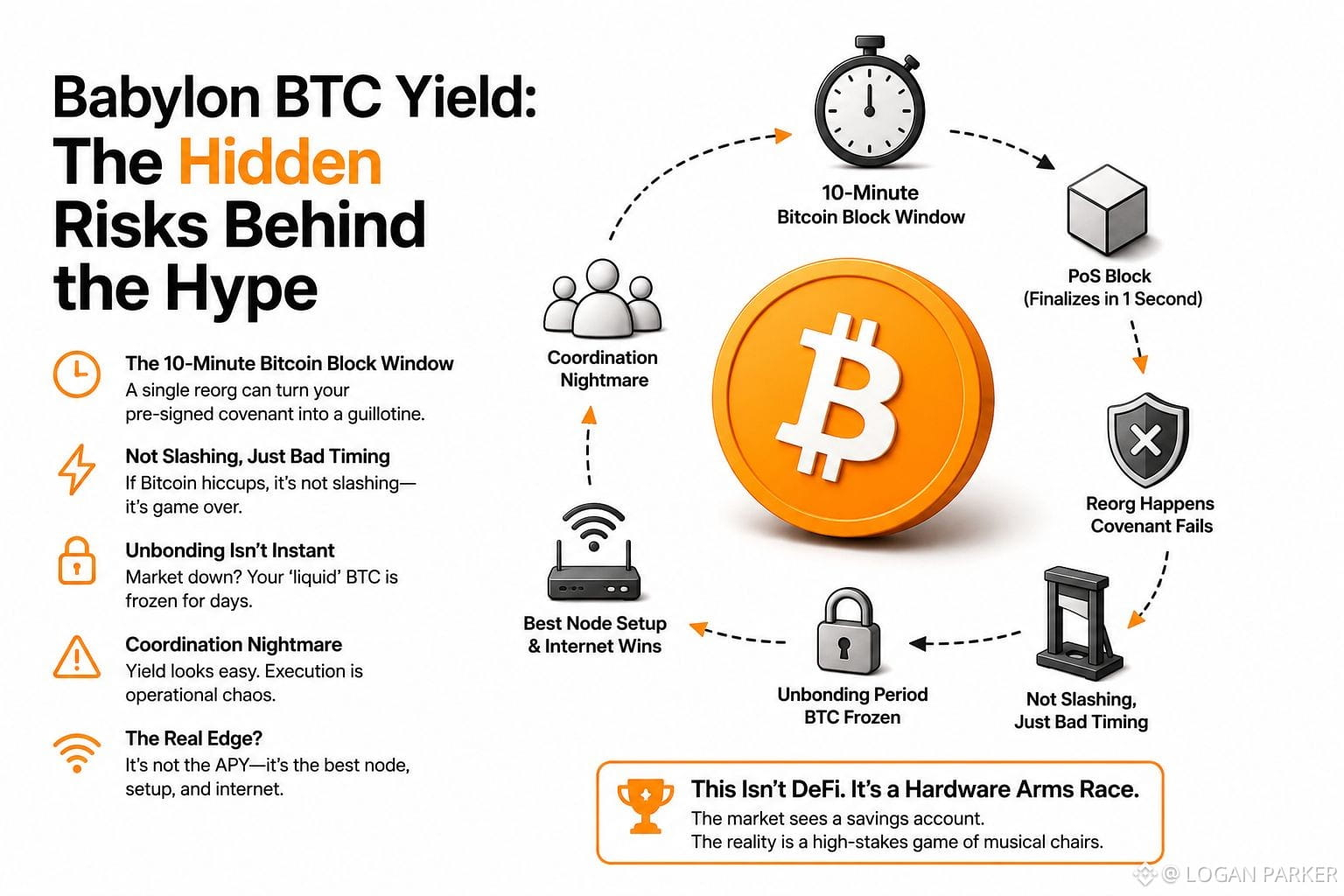
I almost aped into Babylon purely for the BTC yield. But the more I dug into the mechanics, the less it felt like DeFi and the more it felt like a high-stakes game of musical chairs. Everyone’s hyping self-custody, but no one’s talking about the sheer anxiety of that 10-minute Bitcoin block window. Imagine trying to validate a PoS block that finalizes in a second, while praying the Bitcoin network doesn't hiccup and reorg during that exact moment. If it does, your pre-signed covenant acts less like a safety net and more like a guillotine. That’s not slashing; that’s just bad timing. Suddenly, you aren't a passive staker anymore; you're a latency trader racing against network propagation. And the unbonding period? Good luck if the market tanks—you're watching your 'liquid' BTC sit frozen for days. The market is pricing this like a savings account, but it's actually a coordination nightmare. We're all so busy counting the yield that we're ignoring the operational heartburn. The real edge here isn't the APY; it's who can afford the best node setup and internet connection. That's not a protocol—that's a hardware arms race.
#baby $BABY @BabylonLabs_io
I almost aped into Babylon purely for the BTC yield. But the more I dug into the mechanics, the less it felt like DeFi and the more it felt like a high-stakes game of musical chairs. Everyone’s hyping self-custody, but no one’s talking about the sheer anxiety of that 10-minute Bitcoin block window. Imagine trying to validate a PoS block that finalizes in a second, while praying the Bitcoin network doesn't hiccup and reorg during that exact moment. If it does, your pre-signed covenant acts less like a safety net and more like a guillotine. That’s not slashing; that’s just bad timing. Suddenly, you aren't a passive staker anymore; you're a latency trader racing against network propagation. And the unbonding period? Good luck if the market tanks—you're watching your 'liquid' BTC sit frozen for days. The market is pricing this like a savings account, but it's actually a coordination nightmare. We're all so busy counting the yield that we're ignoring the operational heartburn. The real edge here isn't the APY; it's who can afford the best node setup and internet connection. That's not a protocol—that's a hardware arms race.
I almost aped into Babylon purely for the BTC yield. But the more I dug into the mechanics, the less it felt like DeFi and the more it felt like a high-stakes game of musical chairs. Everyone’s hyping self-custody, but no one’s talking about the sheer anxiety of that 10-minute Bitcoin block window. Imagine trying to validate a PoS block that finalizes in a second, while praying the Bitcoin network doesn't hiccup and reorg during that exact moment. If it does, your pre-signed covenant acts less like a safety net and more like a guillotine. That’s not slashing; that’s just bad timing. Suddenly, you aren't a passive staker anymore; you're a latency trader racing against network propagation. And the unbonding period? Good luck if the market tanks—you're watching your 'liquid' BTC sit frozen for days. The market is pricing this like a savings account, but it's actually a coordination nightmare. We're all so busy counting the yield that we're ignoring the operational heartburn. The real edge here isn't the APY; it's who can afford the best node setup and internet connection. That's not a protocol—that's a hardware arms race.
2
107
·
--
Bullish
#baby $BABY @babylonlabs_io
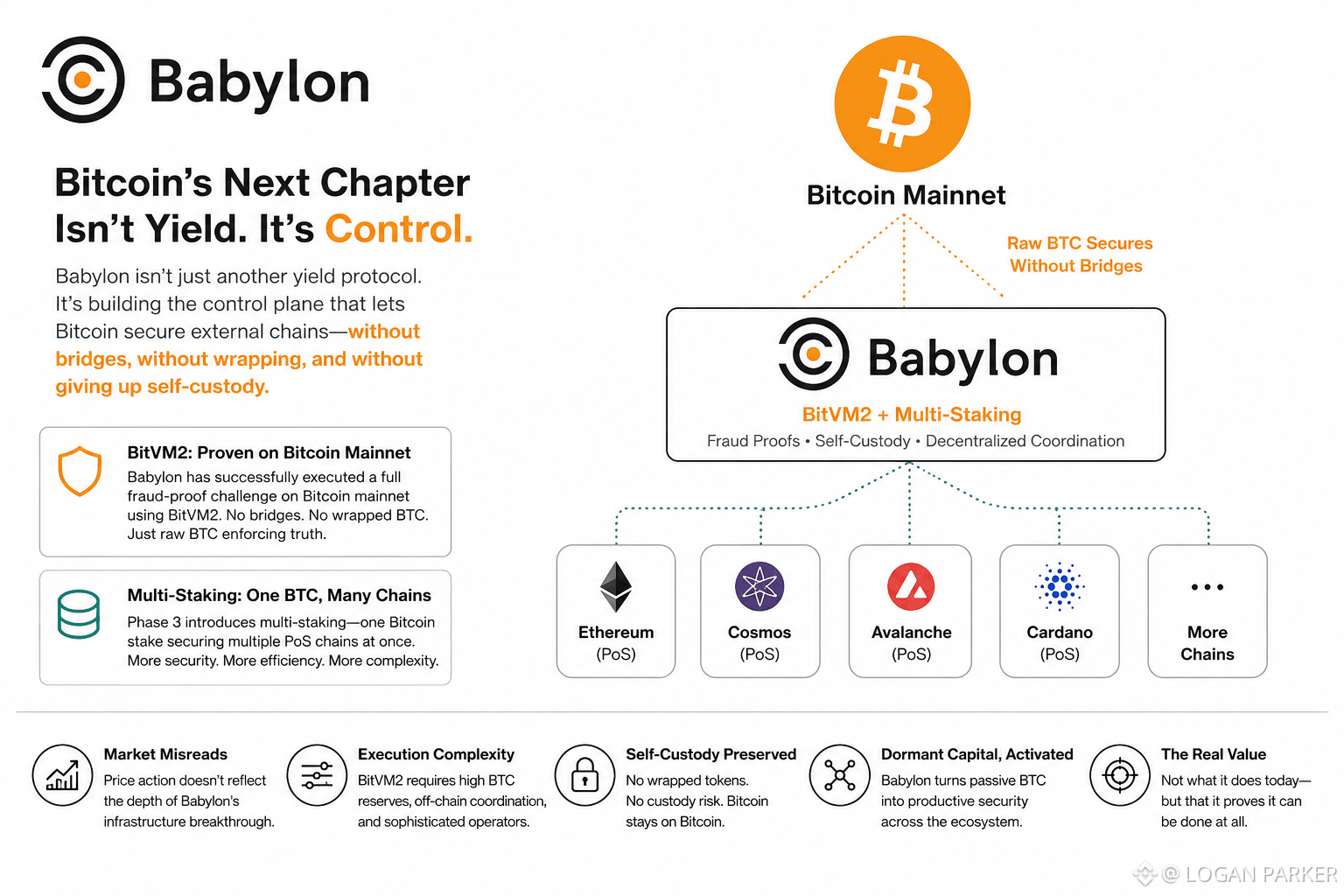
Let's be real: Babylon's price action feels disconnected from its hype. Everyone's parroting the "multi-billion TVL" narrative, but I suspect the market is focusing on the wrong friction point.
We keep looking at Babylon as just another yield-generating protocol. But the quiet revolution happening under the hood is BitVM2. They actually pulled it off—running a full fraud-proof challenge on Bitcoin's mainnet. No bridges, no wrapped tokens, just raw BTC securing external chains. That's not a feature; that's a fundamental rebuild of what Bitcoin can do.
Here's what bothers me though. Phase 3 promises "multi-staking"—one Bitcoin stake securing multiple PoS chains at once. Sounds great in theory, but the execution complexity is dizzying. Running BitVM2 requires massive BTC reserves for operators and intricate off-chain data coordination. This isn't plug-and-play infrastructure.
The market looks at the token price and shrugs. But look deeper: Babylon is quietly solving Bitcoin's biggest coordination problem—making dormant capital productive without sacrificing self-custody. It's messy, it's capital intensive, but if they nail the execution, they aren't building a protocol. They're building a control plane for Bitcoin's future.
Maybe the real value isn't what Babylon does today. It's that they're proving it can be done at all.
#baby $BABY @BabylonLabs_io
Let's be real: Babylon's price action feels disconnected from its hype. Everyone's parroting the "multi-billion TVL" narrative, but I suspect the market is focusing on the wrong friction point.
We keep looking at Babylon as just another yield-generating protocol. But the quiet revolution happening under the hood is BitVM2. They actually pulled it off—running a full fraud-proof challenge on Bitcoin's mainnet. No bridges, no wrapped tokens, just raw BTC securing external chains. That's not a feature; that's a fundamental rebuild of what Bitcoin can do.
Here's what bothers me though. Phase 3 promises "multi-staking"—one Bitcoin stake securing multiple PoS chains at once. Sounds great in theory, but the execution complexity is dizzying. Running BitVM2 requires massive BTC reserves for operators and intricate off-chain data coordination. This isn't plug-and-play infrastructure.
The market looks at the token price and shrugs. But look deeper: Babylon is quietly solving Bitcoin's biggest coordination problem—making dormant capital productive without sacrificing self-custody. It's messy, it's capital intensive, but if they nail the execution, they aren't building a protocol. They're building a control plane for Bitcoin's future.
Maybe the real value isn't what Babylon does today. It's that they're proving it can be done at all.
Let's be real: Babylon's price action feels disconnected from its hype. Everyone's parroting the "multi-billion TVL" narrative, but I suspect the market is focusing on the wrong friction point.
We keep looking at Babylon as just another yield-generating protocol. But the quiet revolution happening under the hood is BitVM2. They actually pulled it off—running a full fraud-proof challenge on Bitcoin's mainnet. No bridges, no wrapped tokens, just raw BTC securing external chains. That's not a feature; that's a fundamental rebuild of what Bitcoin can do.
Here's what bothers me though. Phase 3 promises "multi-staking"—one Bitcoin stake securing multiple PoS chains at once. Sounds great in theory, but the execution complexity is dizzying. Running BitVM2 requires massive BTC reserves for operators and intricate off-chain data coordination. This isn't plug-and-play infrastructure.
The market looks at the token price and shrugs. But look deeper: Babylon is quietly solving Bitcoin's biggest coordination problem—making dormant capital productive without sacrificing self-custody. It's messy, it's capital intensive, but if they nail the execution, they aren't building a protocol. They're building a control plane for Bitcoin's future.
Maybe the real value isn't what Babylon does today. It's that they're proving it can be done at all.
9
6
65
·
--
Bullish
$PIXEL
{spot}(PIXELUSDT)
PIXEL is recovering with buyers stepping back into the market. Holding above support keeps the bullish structure intact.
Trade Setup
EP: $0.00468 - $0.00478 TP: $0.00500 / $0.00530 / $0.00570 SL: $0.00450
$PIXEL
PIXEL is recovering with buyers stepping back into the market. Holding above support keeps the bullish structure intact.
Trade Setup
EP: $0.00468 - $0.00478 TP: $0.00500 / $0.00530 / $0.00570 SL: $0.00450
PIXEL is recovering with buyers stepping back into the market. Holding above support keeps the bullish structure intact.
Trade Setup
EP: $0.00468 - $0.00478 TP: $0.00500 / $0.00530 / $0.00570 SL: $0.00450
52
·
--
Bullish
$1000CAT
{spot}(1000CATUSDT)
1000CAT is gradually building bullish pressure. A breakout above the current range could bring a fast expansion.
Trade Setup
EP: $0.00132 - $0.00136 TP: $0.00145 / $0.00155 / $0.00170 SL: $0.00126
$1000CAT
1000CAT is gradually building bullish pressure. A breakout above the current range could bring a fast expansion.
Trade Setup
EP: $0.00132 - $0.00136 TP: $0.00145 / $0.00155 / $0.00170 SL: $0.00126
1000CAT is gradually building bullish pressure. A breakout above the current range could bring a fast expansion.
Trade Setup
EP: $0.00132 - $0.00136 TP: $0.00145 / $0.00155 / $0.00170 SL: $0.00126
69
·
--
Bullish
$TURTLE
{spot}(TURTLEUSDT)
TURTLE is showing signs of accumulation with momentum shifting in favor of buyers. Watch for a breakout confirmation.
Trade Setup
EP: $0.0380 - $0.0390 TP: $0.0415 / $0.0440 / $0.0470 SL: $0.0365
$TURTLE
TURTLE is showing signs of accumulation with momentum shifting in favor of buyers. Watch for a breakout confirmation.
Trade Setup
EP: $0.0380 - $0.0390 TP: $0.0415 / $0.0440 / $0.0470 SL: $0.0365
TURTLE is showing signs of accumulation with momentum shifting in favor of buyers. Watch for a breakout confirmation.
Trade Setup
EP: $0.0380 - $0.0390 TP: $0.0415 / $0.0440 / $0.0470 SL: $0.0365
57
·
--
Bullish
$AVAX
{spot}(AVAXUSDT)
AVAX is reclaiming strength after bouncing from support. A successful breakout could extend the bullish trend.
Trade Setup
EP: $6.50 - $6.65 TP: $7.00 / $7.40 / $8.00 SL: $6.20
$AVAX
AVAX is reclaiming strength after bouncing from support. A successful breakout could extend the bullish trend.
Trade Setup
EP: $6.50 - $6.65 TP: $7.00 / $7.40 / $8.00 SL: $6.20
AVAX is reclaiming strength after bouncing from support. A successful breakout could extend the bullish trend.
Trade Setup
EP: $6.50 - $6.65 TP: $7.00 / $7.40 / $8.00 SL: $6.20
50
·
--
Bullish
$YB
{spot}(YBUSDT)
YB is recovering with improving market sentiment. Buyers need to maintain control for further upside.
Trade Setup
EP: $0.0745 - $0.0765 TP: $0.080 / $0.085 / $0.090 SL: $0.0715
$YB
YB is recovering with improving market sentiment. Buyers need to maintain control for further upside.
Trade Setup
EP: $0.0745 - $0.0765 TP: $0.080 / $0.085 / $0.090 SL: $0.0715
YB is recovering with improving market sentiment. Buyers need to maintain control for further upside.
Trade Setup
EP: $0.0745 - $0.0765 TP: $0.080 / $0.085 / $0.090 SL: $0.0715
52
·
--
Bullish
$GENIUS
{spot}(GENIUSUSDT)
GENIUS is gaining traction as bullish momentum strengthens. A sustained push could unlock higher resistance targets.
Trade Setup
EP: $0.372 - $0.380 TP: $0.395 / $0.420 / $0.450 SL: $0.360
$GENIUS
GENIUS is gaining traction as bullish momentum strengthens. A sustained push could unlock higher resistance targets.
Trade Setup
EP: $0.372 - $0.380 TP: $0.395 / $0.420 / $0.450 SL: $0.360
GENIUS is gaining traction as bullish momentum strengthens. A sustained push could unlock higher resistance targets.
Trade Setup
EP: $0.372 - $0.380 TP: $0.395 / $0.420 / $0.450 SL: $0.360
58
·
--
Bullish
$AVAX
{spot}(AVAXUSDT)
AVA is steadily climbing with buyers defending key levels. Momentum remains positive for a continuation move.
Trade Setup
EP: $0.164 - $0.167 TP: $0.175 / $0.185 / $0.195 SL: $0.158
$AVAX
AVA is steadily climbing with buyers defending key levels. Momentum remains positive for a continuation move.
Trade Setup
EP: $0.164 - $0.167 TP: $0.175 / $0.185 / $0.195 SL: $0.158
AVA is steadily climbing with buyers defending key levels. Momentum remains positive for a continuation move.
Trade Setup
EP: $0.164 - $0.167 TP: $0.175 / $0.185 / $0.195 SL: $0.158
32
·
--
Bullish
$SCRT
{spot}(SCRTUSDT)
SCR is showing renewed buying interest with bullish momentum building. Holding support keeps the upside scenario active.
Trade Setup
EP: $0.0225 - $0.0229 TP: $0.0240 / $0.0255 / $0.0270 SL: $0.0216
$SCRT
SCR is showing renewed buying interest with bullish momentum building. Holding support keeps the upside scenario active.
Trade Setup
EP: $0.0225 - $0.0229 TP: $0.0240 / $0.0255 / $0.0270 SL: $0.0216
SCR is showing renewed buying interest with bullish momentum building. Holding support keeps the upside scenario active.
Trade Setup
EP: $0.0225 - $0.0229 TP: $0.0240 / $0.0255 / $0.0270 SL: $0.0216
85
Log in to explore more content
Join global crypto users on Binance Square
⚡️ Get latest and useful information about crypto.
💬 Trusted by the world’s largest crypto exchange.
👍 Discover real insights from verified creators.
Email / Phone number
Trending Topics
BinanceLaunchesBinanceIntelligence
751,364 views
4,672 Discussing
#binancelaunchesbinanceintelligence 🚨 WHAT IF THE NEXT BIG EXCHANGE BATTLE ISN’T ABOUT FEES? 👀
Binance just made a bigger move than adding another AI chatbot.
With Binance Intelligence, AI is moving deeper into the exchange — from understanding market data to building trading workflows. 🤖⚡
The real question is:
Who has the best liquidity?
Or who has the smartest AI layer?
If users can research, test ideas and manage trading workflows without switching between different tools, the exchange itself could become a financial assistant.
That could be a much bigger shift than it looks today.
If Binance Intelligence drives more users, more strategies and more trading activity, $BNB could become one of the tokens to watch. 👀
Is Binance building the future of AI-powered finance?
$BNB
#binancelaunchesbinanceintelligence #BinanceAI #CryptoAI #AITrading
Suleman Khan Haqqani
·27 Likes
·28.3k views
BTCFallsBelow$84K
33,981 views
115 Discussing
DubaiVARAIssuesReserveAssetAuditCircular
9,690 views
378 Discussing