
ALY_0
2.5k Posts

ALY_0
Report
Block User
Open Trade
Frequent Trader
10.6 Months
284 Following
1.0K+ Followers
709 Liked
Posts
Portfolio
All
Quotes
Live
·
--
Bullish
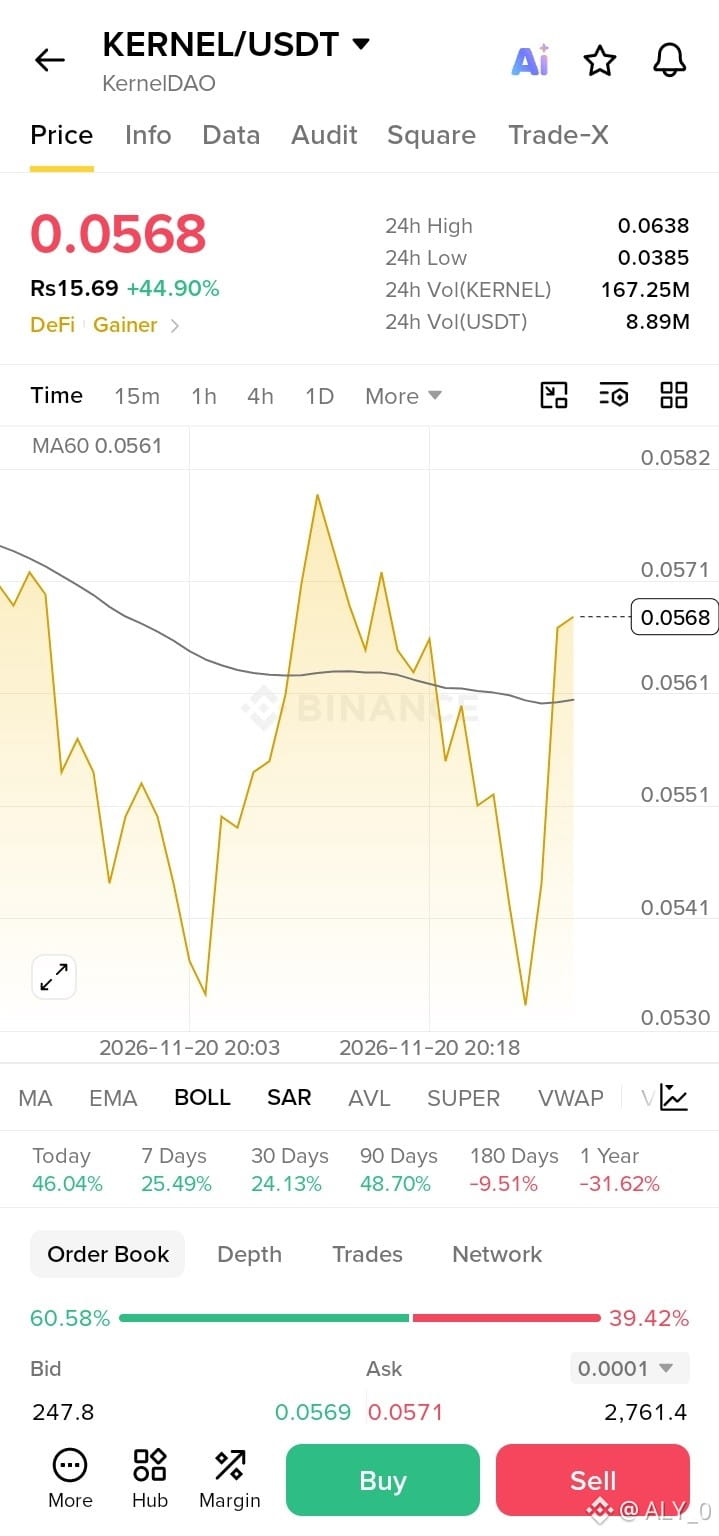
📊 $KERNEL
{spot}(KERNELUSDT)
/USDT Market Update 🚀
🪙 Coin: KernelDAO (KERNEL)
💰 Current Price: $0.0568
🟢 24H Change: +44.90% 🔥
📈 24H High: $0.0638
📉 24H Low: $0.0385
📊 Technical Analysis:
- Price is currently above MA60 ($0.0561), showing short-term bullish momentum.
- Strong V-shaped recovery from the $0.0530 area.
- Buyers dominate the order book with 60.58% buy pressure.
- Sellers account for 39.42%.
- Price is attempting to maintain its recovery near $0.0568.
🎯 Key Levels:
- Immediate Support: $0.0551
- Strong Support: $0.0541 – $0.0530
- Immediate Resistance: $0.0571
- Next Resistance: $0.0582
- Major Resistance: $0.0638
🚀 Possible Scenarios:
🟢 Bullish: A strong breakout above $0.0571–$0.0582 could open the way toward higher resistance levels.
🔴 Bearish: Rejection near resistance could trigger a pullback toward $0.0551 or $0.0541.
⚠️ Trading Strategy: Watch for confirmation before entering. Avoid chasing sudden pumps. Always manage risk and use proper stop-loss levels.
#KERNEL #KERNELUSDT #CryptoUpdate #Binance #CryptoTrading
📊 $KERNEL
/USDT Market Update 🚀
🪙 Coin: KernelDAO (KERNEL)
💰 Current Price: $0.0568
🟢 24H Change: +44.90% 🔥
📈 24H High: $0.0638
📉 24H Low: $0.0385
📊 Technical Analysis:
- Price is currently above MA60 ($0.0561), showing short-term bullish momentum.
- Strong V-shaped recovery from the $0.0530 area.
- Buyers dominate the order book with 60.58% buy pressure.
- Sellers account for 39.42%.
- Price is attempting to maintain its recovery near $0.0568.
🎯 Key Levels:
- Immediate Support: $0.0551
- Strong Support: $0.0541 – $0.0530
- Immediate Resistance: $0.0571
- Next Resistance: $0.0582
- Major Resistance: $0.0638
🚀 Possible Scenarios:
🟢 Bullish: A strong breakout above $0.0571–$0.0582 could open the way toward higher resistance levels.
🔴 Bearish: Rejection near resistance could trigger a pullback toward $0.0551 or $0.0541.
⚠️ Trading Strategy: Watch for confirmation before entering. Avoid chasing sudden pumps. Always manage risk and use proper stop-loss levels.
#KERNEL #KERNELUSDT #CryptoUpdate #Binance #CryptoTrading
175
·
--
Bullish
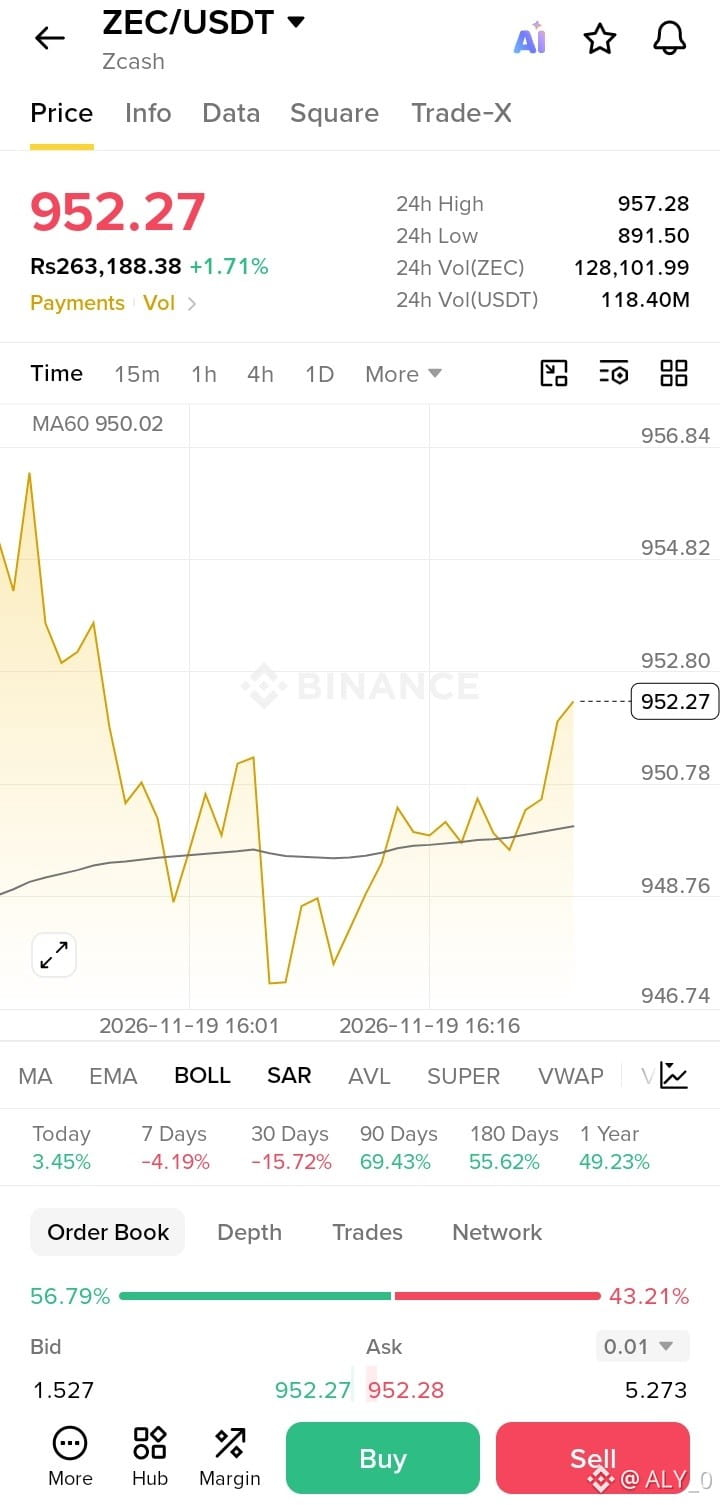
📊 $ZEC
{spot}(ZECUSDT)
/USDT Market Update
⚡ Zcash (ZEC)
💰 Current Price: 952.27 USDT
📈 24H High: 957.28
📉 24H Low: 891.50
🟢 24H Change: +1.71%
Technical Analysis:
- Price is trading above MA60 (950.02), showing short-term bullish momentum.
- Buyers dominate the order book with 56.79%.
- Sellers hold 43.21%.
- Price has recovered from recent lows and is approaching resistance.
🎯 Key Levels
- Support: 950.00
- Strong Support: 946.70
- Resistance: 957.28
- Breakout above 957.28 could open the way for further upside.
⚠️ Watch price action near resistance. Always use proper risk management.
#ZEC #ZECUSDT #CryptoUpdate #Binance #CryptoTrading
📊 $ZEC
/USDT Market Update
⚡ Zcash (ZEC)
💰 Current Price: 952.27 USDT
📈 24H High: 957.28
📉 24H Low: 891.50
🟢 24H Change: +1.71%
Technical Analysis:
- Price is trading above MA60 (950.02), showing short-term bullish momentum.
- Buyers dominate the order book with 56.79%.
- Sellers hold 43.21%.
- Price has recovered from recent lows and is approaching resistance.
🎯 Key Levels
- Support: 950.00
- Strong Support: 946.70
- Resistance: 957.28
- Breakout above 957.28 could open the way for further upside.
⚠️ Watch price action near resistance. Always use proper risk management.
#ZEC #ZECUSDT #CryptoUpdate #Binance #CryptoTrading
180
·
--
Bullish
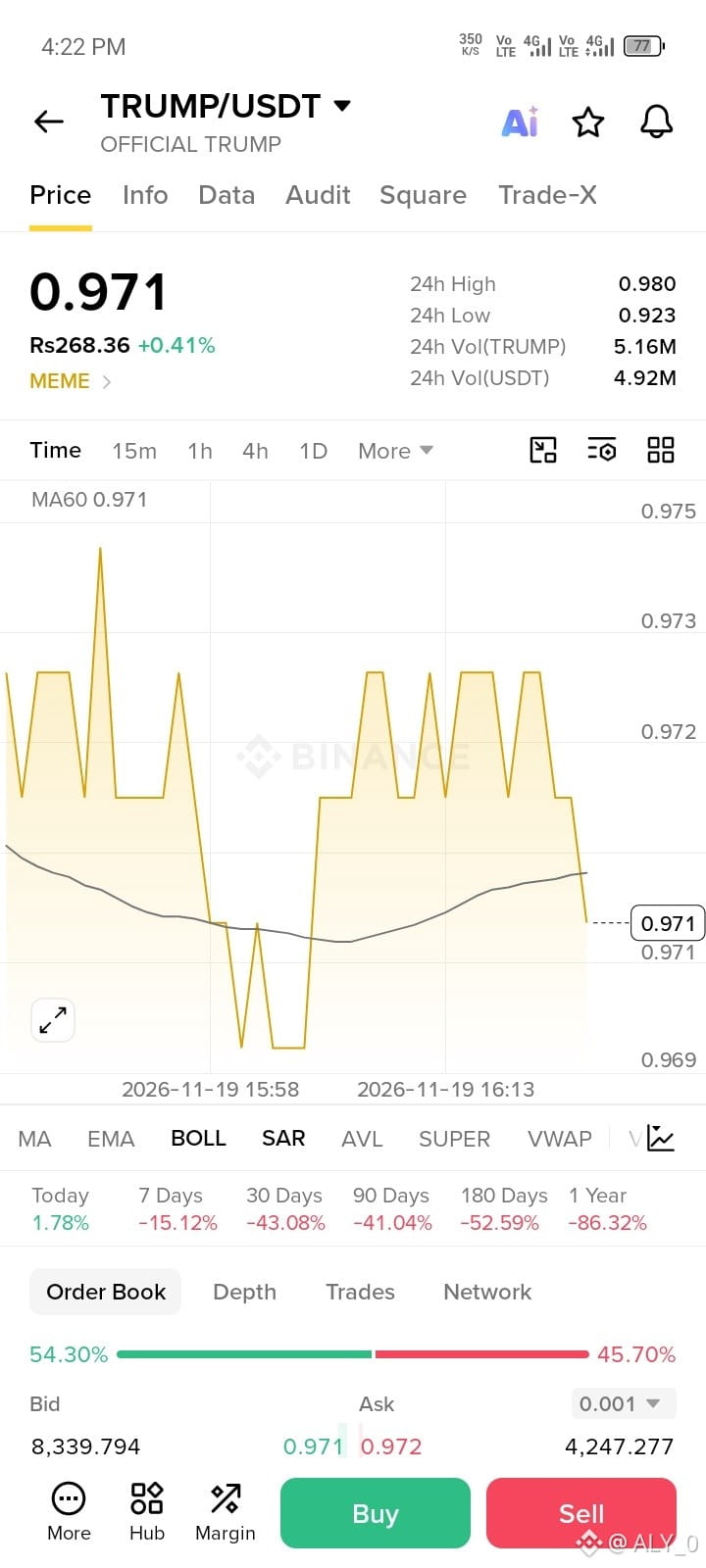
📊 $TRUMP /USDT Market Update
🇺🇸 OFFICIAL $TRUMP
{spot}(TRUMPUSDT)
💰 Current Price: 0.971 USDT
📈 24H High: 0.980
📉 24H Low: 0.923
🟢 24H Change: +0.41%
Technical Analysis:
- Price is trading around MA60 (0.971).
- Buyers control 54.30% of the order book.
- Sellers hold 45.70%.
- Short-term trend is sideways with mixed momentum.
🎯 Key Levels
- Support: 0.969
- Resistance: 0.980
- Breakout above 0.980 may signal bullish momentum.
- Losing 0.969 could bring further downside pressure.
⚠️ Trade carefully and use proper stop-loss management.
#TRUMP #TRUMPUSDT #CryptoUpdate #Binance #CryptoTrading
📊 $TRUMP /USDT Market Update
🇺🇸 OFFICIAL $TRUMP
💰 Current Price: 0.971 USDT
📈 24H High: 0.980
📉 24H Low: 0.923
🟢 24H Change: +0.41%
Technical Analysis:
- Price is trading around MA60 (0.971).
- Buyers control 54.30% of the order book.
- Sellers hold 45.70%.
- Short-term trend is sideways with mixed momentum.
🎯 Key Levels
- Support: 0.969
- Resistance: 0.980
- Breakout above 0.980 may signal bullish momentum.
- Losing 0.969 could bring further downside pressure.
⚠️ Trade carefully and use proper stop-loss management.
#TRUMP #TRUMPUSDT #CryptoUpdate #Binance #CryptoTrading
118
·
--
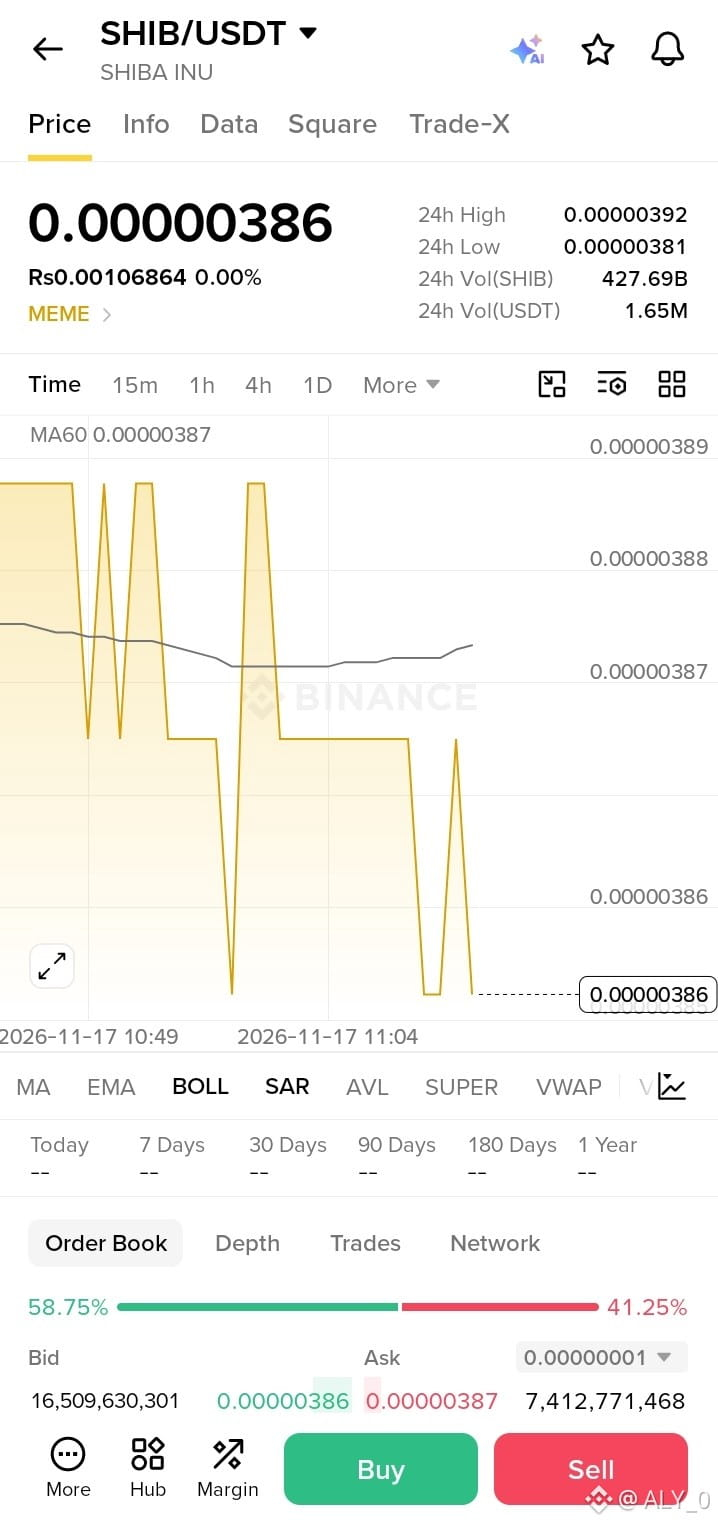
📊 $SHIB /USDT Market Update
🐕 $SHIB
{spot}(SHIBUSDT)
INU (SHIB)
💰 Current Price: 0.00000386 USDT
📈 24H High: 0.00000392
📉 24H Low: 0.00000381
📊 24H Change: 0.00%
Market Analysis:
- Price is trading slightly below MA60 (0.00000387).
- Buyers hold 58.75% of the order book.
- Sellers hold 41.25%.
- Short-term momentum remains sideways with slight bearish pressure.
🎯 Key Levels
- Support: 0.00000381
- Resistance: 0.00000392
⚠️ Watch for a breakout above resistance or a breakdown below support. Manage risk carefully.
#SHIB #SHIBUSDT #CryptoUpdate #Binance #CryptoTrading
📊 $SHIB /USDT Market Update
🐕 $SHIB
INU (SHIB)
💰 Current Price: 0.00000386 USDT
📈 24H High: 0.00000392
📉 24H Low: 0.00000381
📊 24H Change: 0.00%
Market Analysis:
- Price is trading slightly below MA60 (0.00000387).
- Buyers hold 58.75% of the order book.
- Sellers hold 41.25%.
- Short-term momentum remains sideways with slight bearish pressure.
🎯 Key Levels
- Support: 0.00000381
- Resistance: 0.00000392
⚠️ Watch for a breakout above resistance or a breakdown below support. Manage risk carefully.
#SHIB #SHIBUSDT #CryptoUpdate #Binance #CryptoTrading
2
116
·
--
Bullish
🚀 $EVAA /USDT Market Update
🔥 $EVAA
{future}(EVAAUSDT)
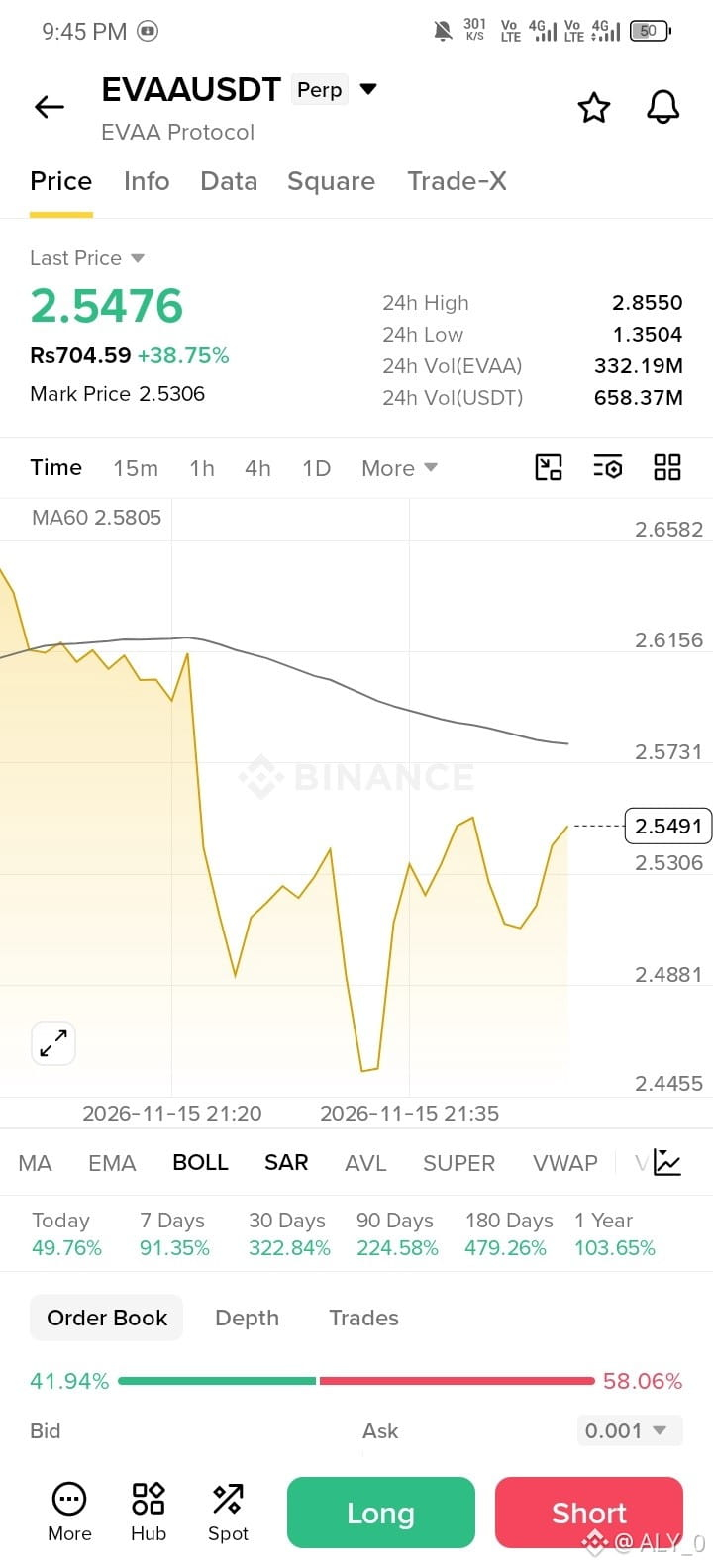
Protocol is showing strong bullish momentum with an impressive +38.75% gain!
💰 Current Price: $2.5476
📈 24H High: $2.8550
📉 24H Low: $1.3504
📊 24H Volume: 658.37M USDT
📊 Technical Outlook:
EVAA is attempting to recover after a sharp pullback. The price is currently below MA60 ($2.5805).
🟢 Support: $2.4880
🔴 Resistance: $2.5730 – $2.6150
A breakout above resistance could strengthen bullish momentum. Watch for volatility and manage risk carefully.
⚡ Trade smart, stay alert!
#EVAA #USDT #Crypto #Binance #Trading
🚀 $EVAA /USDT Market Update
🔥 $EVAA
Protocol is showing strong bullish momentum with an impressive +38.75% gain!
💰 Current Price: $2.5476
📈 24H High: $2.8550
📉 24H Low: $1.3504
📊 24H Volume: 658.37M USDT
📊 Technical Outlook:
EVAA is attempting to recover after a sharp pullback. The price is currently below MA60 ($2.5805).
🟢 Support: $2.4880
🔴 Resistance: $2.5730 – $2.6150
A breakout above resistance could strengthen bullish momentum. Watch for volatility and manage risk carefully.
⚡ Trade smart, stay alert!
#EVAA #USDT #Crypto #Binance #Trading
1
360
·
--
Bullish
🚀 $GLMR /USDT Market Update
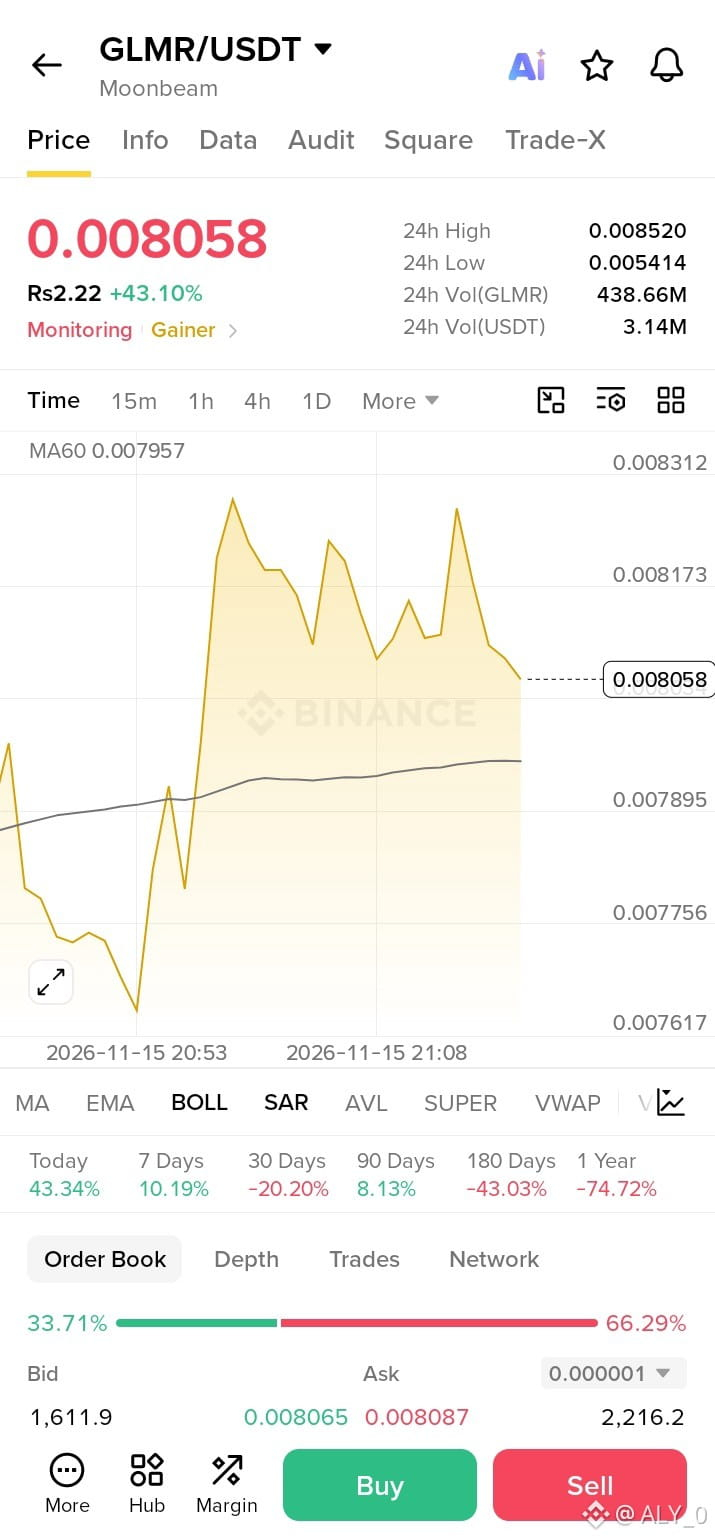
🔥 Moonbeam is pumping strongly with an impressive +43.10% gain!
💰 Current Price: $0.008058
📈 24H High: $0.008520
📉 24H Low: $0.005414
📊 24H Volume: 3.14M USDT
Technical Outlook:
$GLMR
{spot}(GLMRUSDT)
is trading above MA60 (0.007957), showing short-term bullish momentum. Watch $0.00800 as support and $0.00852 as resistance.
⚡ A breakout above resistance could bring further upside, but volatility remains high. Trade with caution!
#GLMR #USDT #Crypto #Binance #Trading
🚀 $GLMR /USDT Market Update
🔥 Moonbeam is pumping strongly with an impressive +43.10% gain!
💰 Current Price: $0.008058
📈 24H High: $0.008520
📉 24H Low: $0.005414
📊 24H Volume: 3.14M USDT
Technical Outlook:
$GLMR
is trading above MA60 (0.007957), showing short-term bullish momentum. Watch $0.00800 as support and $0.00852 as resistance.
⚡ A breakout above resistance could bring further upside, but volatility remains high. Trade with caution!
#GLMR #USDT #Crypto #Binance #Trading
210
·
--
Bullish
🚨🔥 SIREN/USDT PERP — BULLISH BREAKOUT ALERT! 🚀
🐂 $SIREN
{future}(SIRENUSDT)
IS SURGING! CAN BUYERS PUSH IT EVEN HIGHER? 👀
📊 MARKET UPDATE
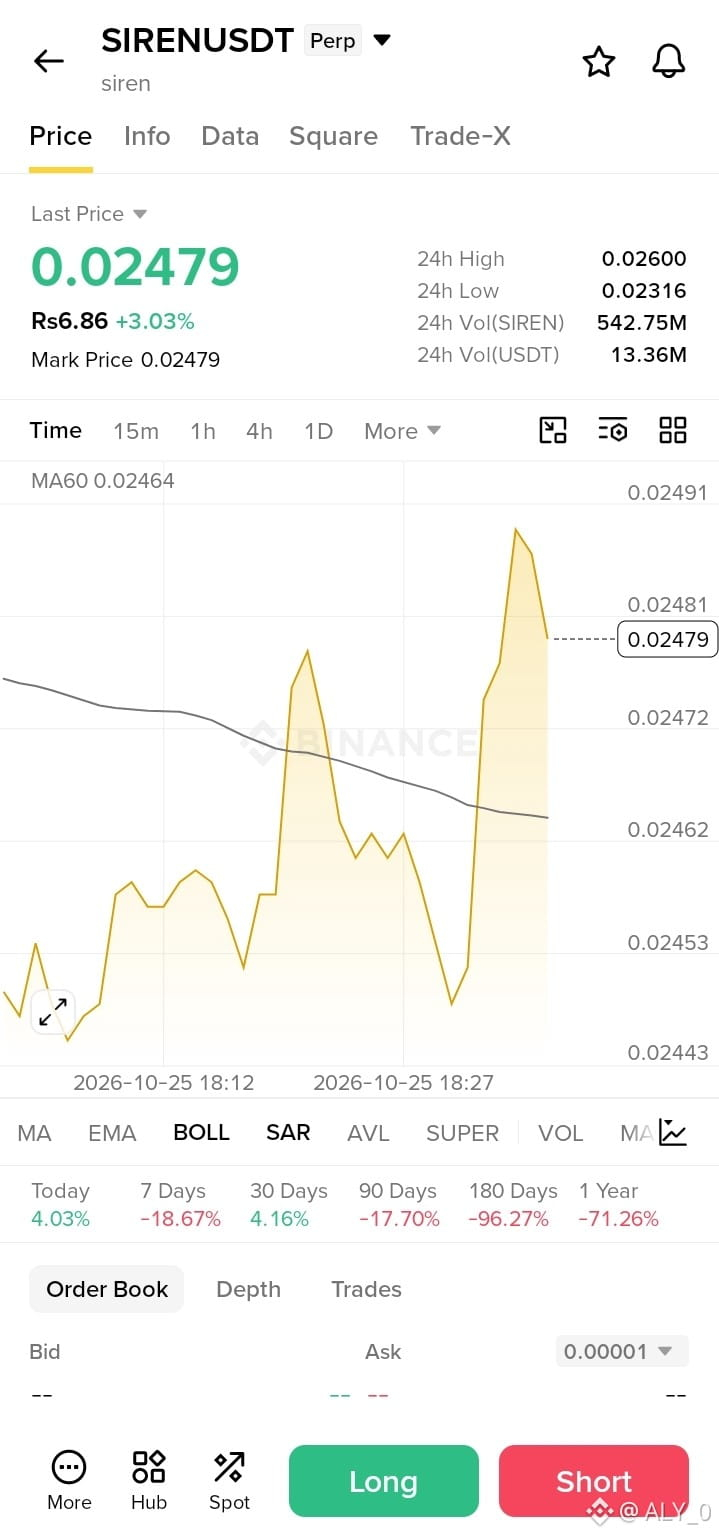
💰 Price: $0.02479
🟢 24H Change: +3.03%
📈 24H High: $0.02600
📉 24H Low: $0.02316
💎 24H Volume: 13.36M USDT
⚡ SIREN has jumped above its MA60 at $0.02464, showing short-term bullish momentum. But after the sharp spike, a pullback is also possible!
🎯 KEY LEVELS TO WATCH
🟢 Support: $0.02464 – $0.02453
🚀 Resistance: $0.02491 – $0.02500
🔥 Major Resistance: $0.02600
📈 BULLISH SCENARIO: A confirmed breakout above $0.02500 with strong volume could open the door to further upside.
📉 BEARISH SCENARIO: Rejection near resistance or a drop below $0.02453 could trigger a pullback.
⚠️ PERP TRADERS: Avoid FOMO, manage leverage, and set a stop-loss. The order book is unavailable in this screenshot, so confirmation is essential.
🔥 WHAT'S NEXT FOR SIREN?
🚀 LONG 📈 OR SHORT 📉? Drop your prediction below! 👇
#SIREN #SIRENUSDT #Crypto #Binance #Altcoins
🚨🔥 SIREN/USDT PERP — BULLISH BREAKOUT ALERT! 🚀
🐂 $SIREN
IS SURGING! CAN BUYERS PUSH IT EVEN HIGHER? 👀
📊 MARKET UPDATE
💰 Price: $0.02479
🟢 24H Change: +3.03%
📈 24H High: $0.02600
📉 24H Low: $0.02316
💎 24H Volume: 13.36M USDT
⚡ SIREN has jumped above its MA60 at $0.02464, showing short-term bullish momentum. But after the sharp spike, a pullback is also possible!
🎯 KEY LEVELS TO WATCH
🟢 Support: $0.02464 – $0.02453
🚀 Resistance: $0.02491 – $0.02500
🔥 Major Resistance: $0.02600
📈 BULLISH SCENARIO: A confirmed breakout above $0.02500 with strong volume could open the door to further upside.
📉 BEARISH SCENARIO: Rejection near resistance or a drop below $0.02453 could trigger a pullback.
⚠️ PERP TRADERS: Avoid FOMO, manage leverage, and set a stop-loss. The order book is unavailable in this screenshot, so confirmation is essential.
🔥 WHAT'S NEXT FOR SIREN?
🚀 LONG 📈 OR SHORT 📉? Drop your prediction below! 👇
#SIREN #SIRENUSDT #Crypto #Binance #Altcoins
1
461
·
--
Bearish
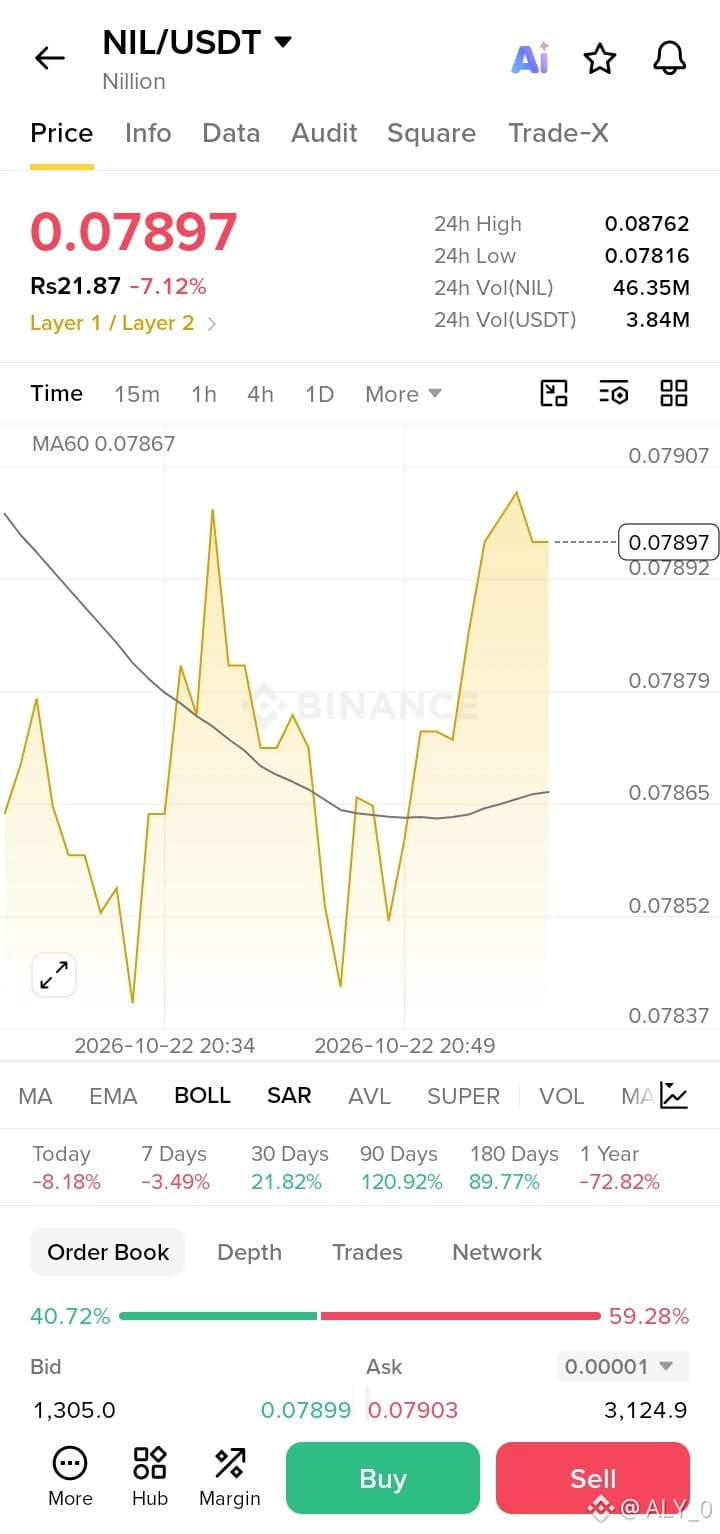
🚨 NIL/USDT — RECOVERY ALERT! 📈
⚡ $NIL
{spot}(NILUSDT)
is bouncing from its intraday low, but can buyers sustain the move?
💰 Price: $0.07897
🔴 24H Change: -7.12%
📈 24H High: $0.08762
📉 24H Low: $0.07816
💎 24H Volume: $3.84M USDT
🎯 KEY LEVELS
🟢 Support: $0.07865 – $0.07816
🔴 Resistance: $0.07903 – $0.07920
🚀 A breakout above resistance with strong volume could support further recovery.
⚠️ If support breaks, sellers may regain control. The order book currently shows greater sell-side pressure, so confirmation is essential.
🔥 Will NIL bounce back or drop lower?
💬 Comment your prediction: LONG 📈 or SHORT 📉?
#NIL #NILUSDT #Crypto #Binance #Altcoins
🚨 NIL/USDT — RECOVERY ALERT! 📈
⚡ $NIL
is bouncing from its intraday low, but can buyers sustain the move?
💰 Price: $0.07897
🔴 24H Change: -7.12%
📈 24H High: $0.08762
📉 24H Low: $0.07816
💎 24H Volume: $3.84M USDT
🎯 KEY LEVELS
🟢 Support: $0.07865 – $0.07816
🔴 Resistance: $0.07903 – $0.07920
🚀 A breakout above resistance with strong volume could support further recovery.
⚠️ If support breaks, sellers may regain control. The order book currently shows greater sell-side pressure, so confirmation is essential.
🔥 Will NIL bounce back or drop lower?
💬 Comment your prediction: LONG 📈 or SHORT 📉?
#NIL #NILUSDT #Crypto #Binance #Altcoins
125
·
--
🚨🔥 BTTC/USDT MARKET UPDATE — BULLISH MOMENTUM ALERT! 🔥🚀
💎 BITTORRENT IS BACK IN FOCUS! WILL $BTTC
{spot}(BTTCUSDT)
BREAK HIGHER? 👀
📊 MARKET SNAPSHOT
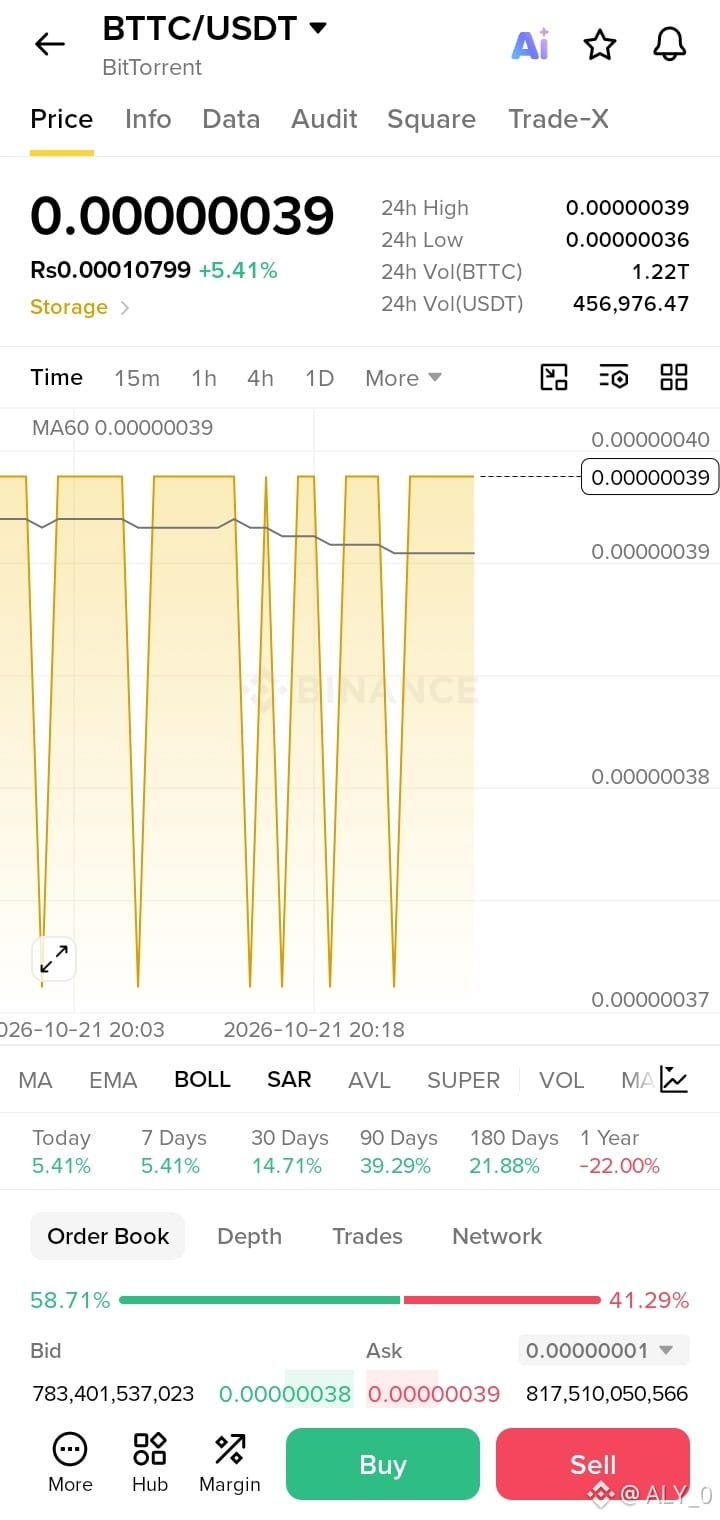
💰 Current Price: $0.00000039
🟢 24H Change: +5.41%
📈 24H High: $0.00000039
📉 24H Low: $0.00000036
💎 24H Volume: 456.97K USDT
🐂 BUYERS ARE SHOWING STRENGTH — BUT THE NEXT MOVE NEEDS CONFIRMATION!
BTTC is trading near its 24-hour high after gaining 5.41%. The displayed order book shows a slight bid-side advantage, but selling pressure remains close by. ⚡
🎯 KEY LEVELS TO WATCH
🟢 Support: $0.00000038
🚀 Resistance: $0.00000040
🔥 A confirmed breakout above $0.00000040 with strong volume could open the door to further upside.
📉 BEARISH WARNING: If BTTC loses $0.00000038, a pullback toward $0.00000037 may follow.
🧠 SMART TRADER STRATEGY
✅ Wait for a confirmed breakout
✅ Monitor volume and liquidity
✅ Set a clear stop-loss
❌ Don't chase the pump blindly!
🔥 THE BIG QUESTION: CAN BTTC BREAK THE NEXT RESISTANCE?
👇 Drop your prediction:
🚀 $0.00000040 OR HIGHER?
📉 OR WILL SELLERS TAKE CONTROL?
❤️ LIKE | 🔁 SHARE | 🔔 FOLLOW for more crypto market updates!
#BTTCUSDT #BitTorrent #Binance #Altcoins #MarketUpdate
🚨🔥 BTTC/USDT MARKET UPDATE — BULLISH MOMENTUM ALERT! 🔥🚀
💎 BITTORRENT IS BACK IN FOCUS! WILL $BTTC
BREAK HIGHER? 👀
📊 MARKET SNAPSHOT
💰 Current Price: $0.00000039
🟢 24H Change: +5.41%
📈 24H High: $0.00000039
📉 24H Low: $0.00000036
💎 24H Volume: 456.97K USDT
🐂 BUYERS ARE SHOWING STRENGTH — BUT THE NEXT MOVE NEEDS CONFIRMATION!
BTTC is trading near its 24-hour high after gaining 5.41%. The displayed order book shows a slight bid-side advantage, but selling pressure remains close by. ⚡
🎯 KEY LEVELS TO WATCH
🟢 Support: $0.00000038
🚀 Resistance: $0.00000040
🔥 A confirmed breakout above $0.00000040 with strong volume could open the door to further upside.
📉 BEARISH WARNING: If BTTC loses $0.00000038, a pullback toward $0.00000037 may follow.
🧠 SMART TRADER STRATEGY
✅ Wait for a confirmed breakout
✅ Monitor volume and liquidity
✅ Set a clear stop-loss
❌ Don't chase the pump blindly!
🔥 THE BIG QUESTION: CAN BTTC BREAK THE NEXT RESISTANCE?
👇 Drop your prediction:
🚀 $0.00000040 OR HIGHER?
📉 OR WILL SELLERS TAKE CONTROL?
❤️ LIKE | 🔁 SHARE | 🔔 FOLLOW for more crypto market updates!
#BTTCUSDT #BitTorrent #Binance #Altcoins #MarketUpdate
5
990
·
--
Bearish
🚨🔥 ETH/USDT MARKET ALERT — IMPORTANT MOVE AHEAD! 🔥🚨
📉 $ETH
{spot}(ETHUSDT)
IS FACING SELLING PRESSURE! WILL THE BULLS DEFEND SUPPORT? 👀
📊 ETHEREUM MARKET UPDATE
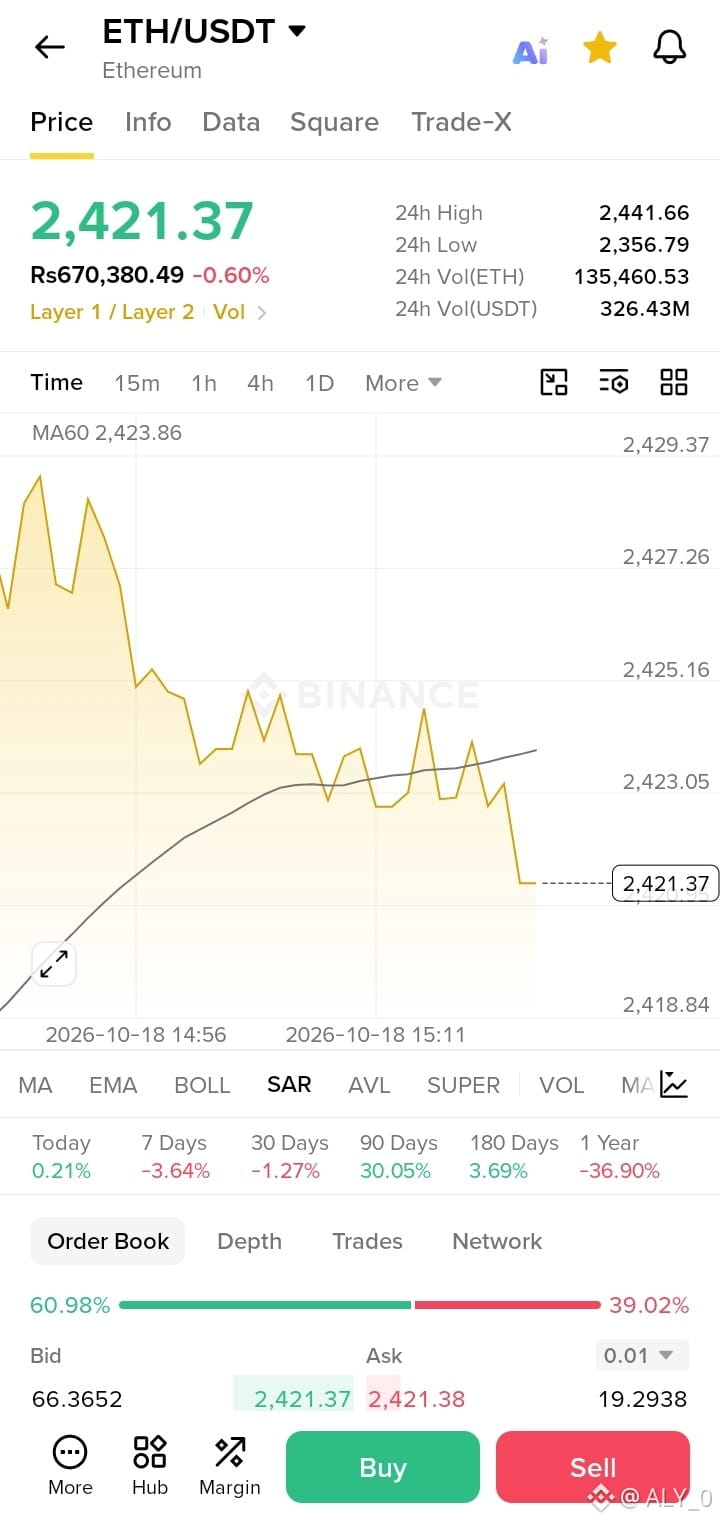
💰 Current Price: $2,421.37
🔴 24H Change: -0.60%
📈 24H High: $2,441.66
📉 24H Low: $2,356.79
💎 24H Volume: 326.43M USDT
⚠️ KEY MOMENT FOR ETH TRADERS!
ETH is trading below its MA60 level of $2,423.86, while the short-term chart shows downward pressure. Buyers have a larger share of the displayed order book, but this alone does not guarantee a reversal. 🐂
🎯 KEY LEVELS TO WATCH
🟢 Support: $2,418 – $2,415
🔴 Resistance: $2,423 – $2,425
🚀 Next Resistance: $2,429 – $2,432
📈 BULLISH SCENARIO:
If ETH reclaims $2,425 with strong volume, a recovery toward $2,429–$2,432 may become possible.
📉 BEARISH SCENARIO:
If ETH breaks below $2,418, further downside could follow. Watch the next support zone before entering.
🧠 SMART TRADER CHECKLIST
✅ Wait for a confirmed candle close
✅ Check volume and momentum
✅ Always manage your risk
❌ Don't blindly chase a move!
🔥 THE BIG QUESTION: WILL ETH RECLAIM $2,425 OR DROP LOWER?
👇 Share your prediction:
🟢 LONG 📈 or SHORT 📉?
❤️ LIKE | 🔁 SHARE | 🔔 FOLLOW for more crypto market updates!
#CryptoTrading #Bitcoin #Binance #Altcoins #MarketUpdate
🚨🔥 ETH/USDT MARKET ALERT — IMPORTANT MOVE AHEAD! 🔥🚨
📉 $ETH
IS FACING SELLING PRESSURE! WILL THE BULLS DEFEND SUPPORT? 👀
📊 ETHEREUM MARKET UPDATE
💰 Current Price: $2,421.37
🔴 24H Change: -0.60%
📈 24H High: $2,441.66
📉 24H Low: $2,356.79
💎 24H Volume: 326.43M USDT
⚠️ KEY MOMENT FOR ETH TRADERS!
ETH is trading below its MA60 level of $2,423.86, while the short-term chart shows downward pressure. Buyers have a larger share of the displayed order book, but this alone does not guarantee a reversal. 🐂
🎯 KEY LEVELS TO WATCH
🟢 Support: $2,418 – $2,415
🔴 Resistance: $2,423 – $2,425
🚀 Next Resistance: $2,429 – $2,432
📈 BULLISH SCENARIO:
If ETH reclaims $2,425 with strong volume, a recovery toward $2,429–$2,432 may become possible.
📉 BEARISH SCENARIO:
If ETH breaks below $2,418, further downside could follow. Watch the next support zone before entering.
🧠 SMART TRADER CHECKLIST
✅ Wait for a confirmed candle close
✅ Check volume and momentum
✅ Always manage your risk
❌ Don't blindly chase a move!
🔥 THE BIG QUESTION: WILL ETH RECLAIM $2,425 OR DROP LOWER?
👇 Share your prediction:
🟢 LONG 📈 or SHORT 📉?
❤️ LIKE | 🔁 SHARE | 🔔 FOLLOW for more crypto market updates!
#CryptoTrading #Bitcoin #Binance #Altcoins #MarketUpdate
104
·
--
Bearish
🚨 RSR/USDT MARKET UPDATE 🚨
⚠️ BIG MOVE AHEAD? RSR AT A CRITICAL ZONE! 👀
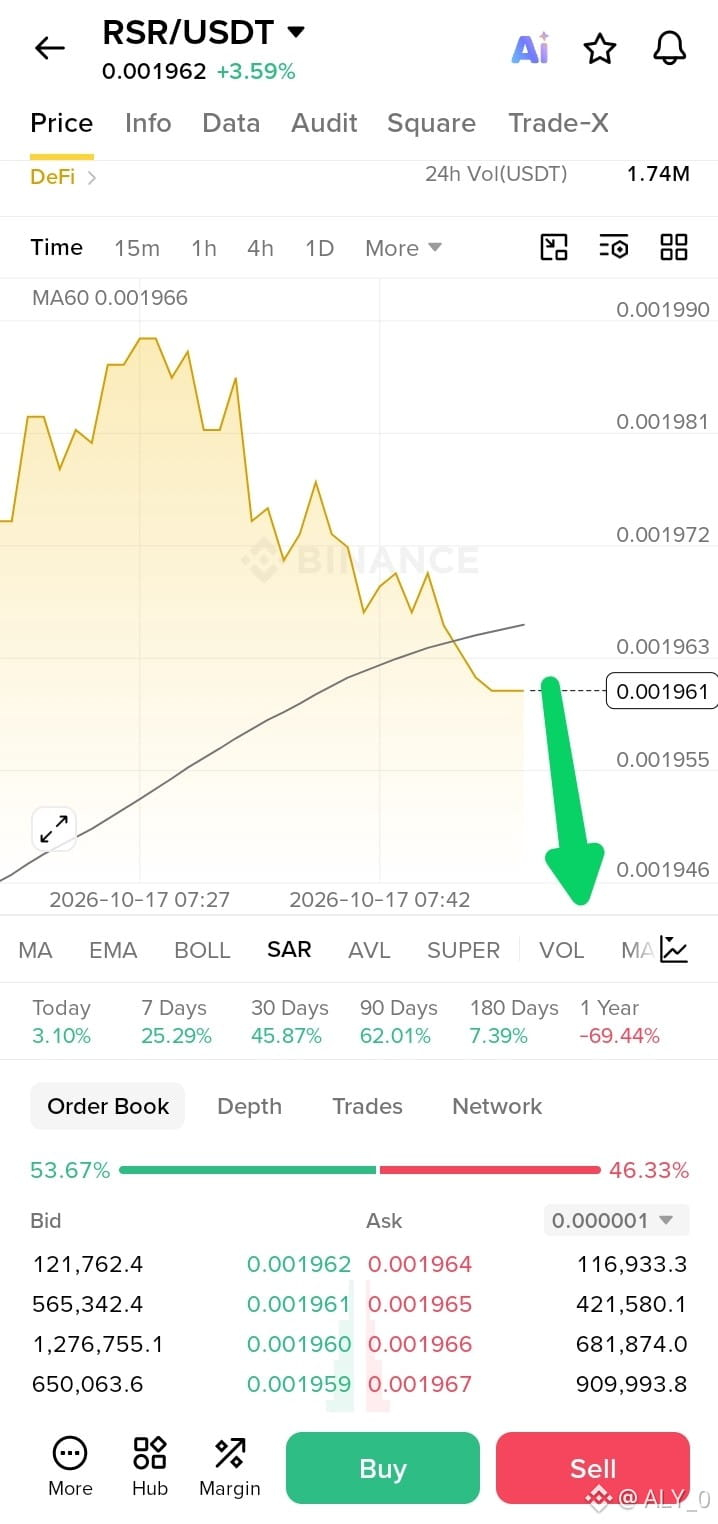
📊 Current Price: $0.001962
🟢 24H Change: +3.59%
💰 24H Volume: 1.74M USDT
RSR is showing an interesting setup! 🔥 Price has pulled back from recent highs and is now testing an important support area.
🎯 KEY LEVELS TO WATCH:
🟢 Support: $0.001959 – $0.001946
🔴 Resistance: $0.001966 – $0.001972
🚀 A strong breakout above resistance could open the door for further upside.
⚠️ A breakdown below support could trigger another downside move.
🐋 Order Book Watch: Buyers currently have a slight edge, but confirmation is still needed!
💎 SMART TRADER STRATEGY:
✅ Wait for breakout confirmation
✅ Watch volume before entering
✅ Use proper stop-loss
❌ Don't FOMO into a trade!
🔥 RSR is at a decision zone — breakout or breakdown? Keep your eyes on the chart!
💬 What's your move? LONG 📈 or SHORT 📉? Comment below!
🔔 Follow for more crypto market updates.
#RSR #RSRUSDT #CryptoTrading #Altcoins #PriceAction
247
·
--
Bullish
🚀 Nillion: A New Era of Privacy-Preserving Computation!
What excites me most about @nillionnetwork is its vision of making sensitive data useful without exposing the underlying information. 🔐
With its core product, Covenants, and its first release, Dusk, Nillion is exploring new possibilities for secure computation on encrypted data. This could be valuable for AI agents, blockchain applications, and other use cases where privacy matters.
As the AI and Web3 ecosystems continue to grow, privacy-preserving technology could become increasingly important. I’m excited to see how Nillion develops its ecosystem and what innovations come next!
What potential do you see in Nillion’s approach to privacy and computation? 👇
$NIL #NIL #Web3 #AI @nillionnetwork
🚀 Nillion: A New Era of Privacy-Preserving Computation!
What excites me most about @Nillion is its vision of making sensitive data useful without exposing the underlying information. 🔐
With its core product, Covenants, and its first release, Dusk, Nillion is exploring new possibilities for secure computation on encrypted data. This could be valuable for AI agents, blockchain applications, and other use cases where privacy matters.
As the AI and Web3 ecosystems continue to grow, privacy-preserving technology could become increasingly important. I’m excited to see how Nillion develops its ecosystem and what innovations come next!
What potential do you see in Nillion’s approach to privacy and computation? 👇
$NIL #NIL #Web3 #AI @Nillion
3
311
·
--
#dusk $DUSK @Dusk_Foundation
Citadel: Dusk's Privacy-Preserving Digital Identity Protocol
What caught my attention about Dusk isn’t just the privacy angle, but how Citadel fits into the bigger picture.
Digital identity usually comes with a trade-off: either you reveal too much personal information, or you lose access to services that require verification.
Citadel takes a different approach by using privacy-preserving technology to let users prove what’s necessary without exposing everything behind that proof.
That distinction matters.
If identity verification can happen without constantly sharing sensitive data, it could make compliance feel less like a compromise between privacy and usability.
What I’m curious about is how Citadel performs in real-world scenarios: onboarding, credentials, verification, and cross-platform identity checks.
The interesting part isn’t simply “private identity.”
It’s whether Dusk can make privacy-preserving identity practical enough that users barely notice the complexity underneath.
{spot}(DUSKUSDT)
#dusk $DUSK @Dusk
Citadel: Dusk's Privacy-Preserving Digital Identity Protocol
What caught my attention about Dusk isn’t just the privacy angle, but how Citadel fits into the bigger picture.
Digital identity usually comes with a trade-off: either you reveal too much personal information, or you lose access to services that require verification.
Citadel takes a different approach by using privacy-preserving technology to let users prove what’s necessary without exposing everything behind that proof.
That distinction matters.
If identity verification can happen without constantly sharing sensitive data, it could make compliance feel less like a compromise between privacy and usability.
What I’m curious about is how Citadel performs in real-world scenarios: onboarding, credentials, verification, and cross-platform identity checks.
The interesting part isn’t simply “private identity.”
It’s whether Dusk can make privacy-preserving identity practical enough that users barely notice the complexity underneath.
Identity Simplified
0%
Privacy First
0%
0 votes • Voting closed
1
1
82
·
--
#dusk $DUSK @Dusk_Foundation DuskEVM is interesting for a reason that becomes clearer the longer you look at it: it is not really trying to replace Solidity with something unfamiliar. It is trying to make the familiar EVM model useful inside an architecture where privacy and regulated settlement matter more than they usually do.
The part I find most compelling is the separation of responsibilities. DuskEVM provides an EVM-equivalent execution environment for Solidity and standard Ethereum tooling, while DuskDS handles settlement and data availability. Privacy can then enter through Hedger and the wider Dusk stack rather than forcing every application into an entirely different development model.
That sounds straightforward, but I think the long-term value is in the foundation rather than the headline. Builders can keep familiar languages, wallets, and tooling while exploring confidential financial flows, selective disclosure, and regulated asset infrastructure.
I’m still cautious. Compatibility alone does not create adoption, and privacy is never solved by architecture diagrams alone. It has to survive real applications, audits, liquidity, user experience, and years of operational pressure.
Still, after looking closely at the design, DuskEVM feels less like a quick compatibility play and more like an attempt to quietly remove one of blockchain’s biggest trade-offs: choosing between familiar infrastructure and meaningful privacy. That is the kind of foundation whose value may take time to become obvious.
{spot}(DUSKUSDT)
#dusk $DUSK @Dusk DuskEVM is interesting for a reason that becomes clearer the longer you look at it: it is not really trying to replace Solidity with something unfamiliar. It is trying to make the familiar EVM model useful inside an architecture where privacy and regulated settlement matter more than they usually do.
The part I find most compelling is the separation of responsibilities. DuskEVM provides an EVM-equivalent execution environment for Solidity and standard Ethereum tooling, while DuskDS handles settlement and data availability. Privacy can then enter through Hedger and the wider Dusk stack rather than forcing every application into an entirely different development model.
That sounds straightforward, but I think the long-term value is in the foundation rather than the headline. Builders can keep familiar languages, wallets, and tooling while exploring confidential financial flows, selective disclosure, and regulated asset infrastructure.
I’m still cautious. Compatibility alone does not create adoption, and privacy is never solved by architecture diagrams alone. It has to survive real applications, audits, liquidity, user experience, and years of operational pressure.
Still, after looking closely at the design, DuskEVM feels less like a quick compatibility play and more like an attempt to quietly remove one of blockchain’s biggest trade-offs: choosing between familiar infrastructure and meaningful privacy. That is the kind of foundation whose value may take time to become obvious.
EVM First
0%
Privacy + EVM
0%
0 votes • Voting closed
126
·
--
#dusk $DUSK @Dusk_Foundation At first i thought zero knowledge proofs on Dusk were mainly about hiding transaction details but the more i looked into it the more i saw the bigger idea is proving something is valid without exposing everything behind that proof. A transaction can still be checked against the rules while sensitive details like balances, ownership or transaction data do not have to become visible to everyone. That made me think the interesting part is not simply adding privacy to a blockchain. It is creating a way for financial activity to remain verifiable while keeping the information itself confidential. I am still wondering how well this balance works once more complex assets and higher transaction volumes start using Dusk . Can zero knowledge proofs really make privacy and transparency work together at scale?
{spot}(DUSKUSDT)
#dusk $DUSK @Dusk At first i thought zero knowledge proofs on Dusk were mainly about hiding transaction details but the more i looked into it the more i saw the bigger idea is proving something is valid without exposing everything behind that proof. A transaction can still be checked against the rules while sensitive details like balances, ownership or transaction data do not have to become visible to everyone. That made me think the interesting part is not simply adding privacy to a blockchain. It is creating a way for financial activity to remain verifiable while keeping the information itself confidential. I am still wondering how well this balance works once more complex assets and higher transaction volumes start using Dusk . Can zero knowledge proofs really make privacy and transparency work together at scale?
2
1
1
110
·
--
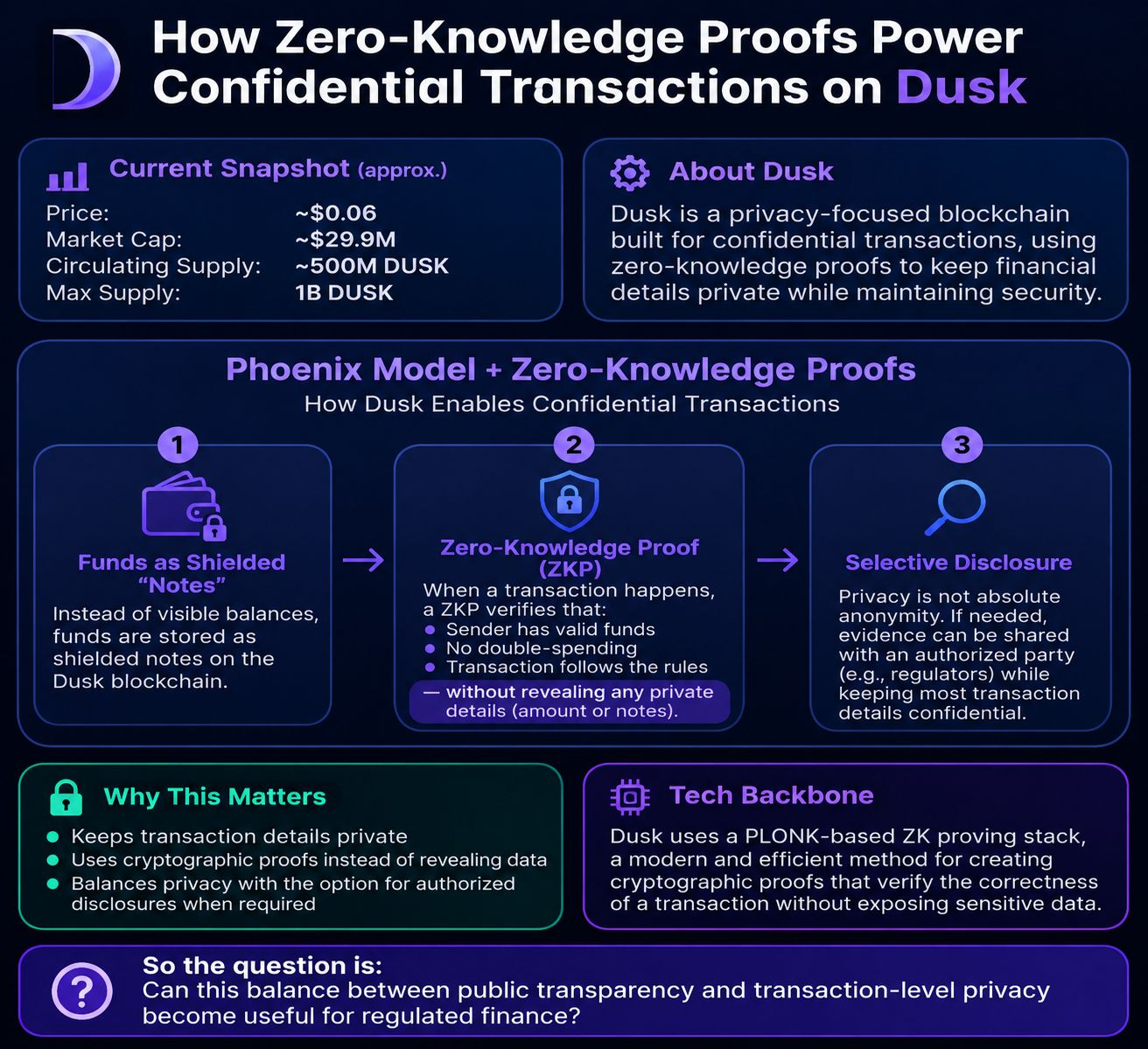
#dusk $DUSK @Dusk_Foundation While flipping through the charts, I noticed DUSK trading around $0.06, but the price wasn’t what caught my attention. It was the privacy architecture.
Dusk uses the Phoenix model, where funds are handled as shielded “notes” rather than simple public balances. During a transaction, a Zero-Knowledge Proof can verify that the sender has valid funds, isn’t double-spending, and that the transaction follows the rules — without revealing the actual amount or specific notes publicly.
The interesting part is the PLONK-based ZK proving stack. In simple terms, instead of showing the network all the private information, you provide a cryptographic proof that basically says: “the computation was done correctly, but the hidden details don’t need to be revealed.”
What caught my attention is that Dusk isn’t treating privacy as just anonymous transfers. It also supports selective disclosure, meaning evidence can be shared with an authorized party when needed.
So I’m left wondering: can this kind of balance between public transparency and transaction-level privacy actually become useful for regulated finance?
{spot}(DUSKUSDT)
#dusk $DUSK @Dusk While flipping through the charts, I noticed DUSK trading around $0.06, but the price wasn’t what caught my attention. It was the privacy architecture.
Dusk uses the Phoenix model, where funds are handled as shielded “notes” rather than simple public balances. During a transaction, a Zero-Knowledge Proof can verify that the sender has valid funds, isn’t double-spending, and that the transaction follows the rules — without revealing the actual amount or specific notes publicly.
The interesting part is the PLONK-based ZK proving stack. In simple terms, instead of showing the network all the private information, you provide a cryptographic proof that basically says: “the computation was done correctly, but the hidden details don’t need to be revealed.”
What caught my attention is that Dusk isn’t treating privacy as just anonymous transfers. It also supports selective disclosure, meaning evidence can be shared with an authorized party when needed.
So I’m left wondering: can this kind of balance between public transparency and transaction-level privacy actually become useful for regulated finance?
2
107
·
--
#dusk $DUSK @Dusk_Foundation I remember checking a crypto transaction once and realizing how much information a public blockchain can quietly reveal. The transfer itself was simple, but the wallet balance, history, timing, and counterparties were all sitting there for anyone to inspect.
That made me think differently about privacy.
When I started looking into Dusk, what caught my attention wasn't simply the promise of private transactions. It was the architecture behind them.
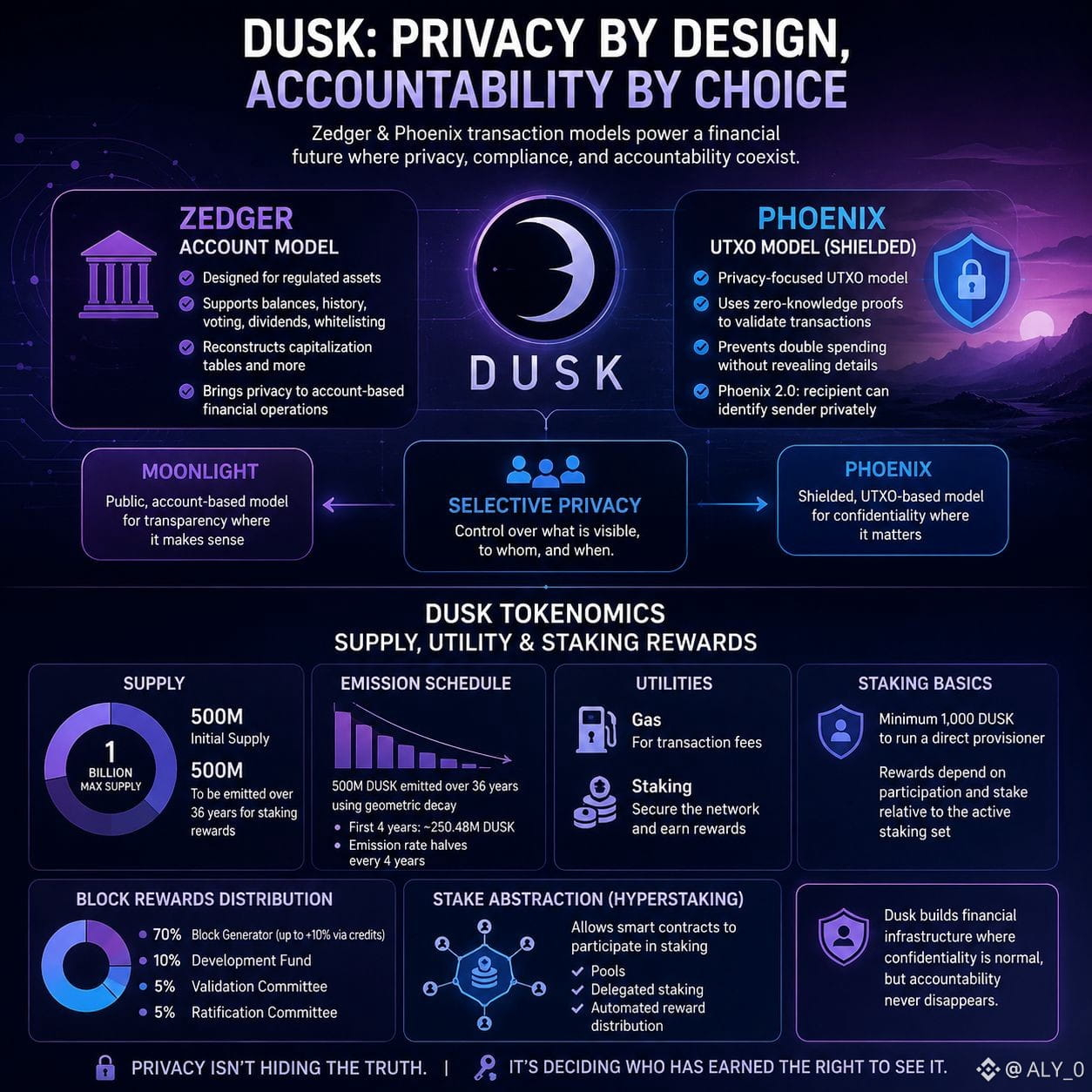
Dusk’s Zedger model was designed around the needs of regulated assets, combining account-based functionality with privacy-focused transaction mechanisms. Phoenix takes that idea further with a shielded UTXO model, using zero-knowledge technology to prove transactions are valid without exposing everything publicly.
That distinction matters.
Privacy doesn't have to mean hiding everything. Sometimes it means deciding what information should remain private and what information should remain verifiable.
The same thinking appears in DUSK’s tokenomics.
DUSK is used for gas and staking, with an initial supply of 500 million and a maximum potential supply of 1 billion. The additional 500 million is emitted gradually over 36 years to support network security through staking rewards.
What I found interesting is that rewards aren't simply free money. They are connected to participation in consensus and the security of the network.
So, the more I explored Dusk, the less I saw it as just another privacy blockchain.
Zedger, Phoenix, and the DUSK economic model all point toward the same challenge: building financial infrastructure where privacy, compliance, and accountability can coexist.
That changed my perspective.
I used to think privacy meant disappearing from view.
Now I think better privacy means having control over what becomes visible—and to whom.
#dusk $DUSK @Dusk I remember checking a crypto transaction once and realizing how much information a public blockchain can quietly reveal. The transfer itself was simple, but the wallet balance, history, timing, and counterparties were all sitting there for anyone to inspect.
That made me think differently about privacy.
When I started looking into Dusk, what caught my attention wasn't simply the promise of private transactions. It was the architecture behind them.
Dusk’s Zedger model was designed around the needs of regulated assets, combining account-based functionality with privacy-focused transaction mechanisms. Phoenix takes that idea further with a shielded UTXO model, using zero-knowledge technology to prove transactions are valid without exposing everything publicly.
That distinction matters.
Privacy doesn't have to mean hiding everything. Sometimes it means deciding what information should remain private and what information should remain verifiable.
The same thinking appears in DUSK’s tokenomics.
DUSK is used for gas and staking, with an initial supply of 500 million and a maximum potential supply of 1 billion. The additional 500 million is emitted gradually over 36 years to support network security through staking rewards.
What I found interesting is that rewards aren't simply free money. They are connected to participation in consensus and the security of the network.
So, the more I explored Dusk, the less I saw it as just another privacy blockchain.
Zedger, Phoenix, and the DUSK economic model all point toward the same challenge: building financial infrastructure where privacy, compliance, and accountability can coexist.
That changed my perspective.
I used to think privacy meant disappearing from view.
Now I think better privacy means having control over what becomes visible—and to whom.
2
2
103
·
--
#dusk $DUSK @Dusk_Foundation
I used to think smart-contract standards were mostly about making different protocols speak the same language.
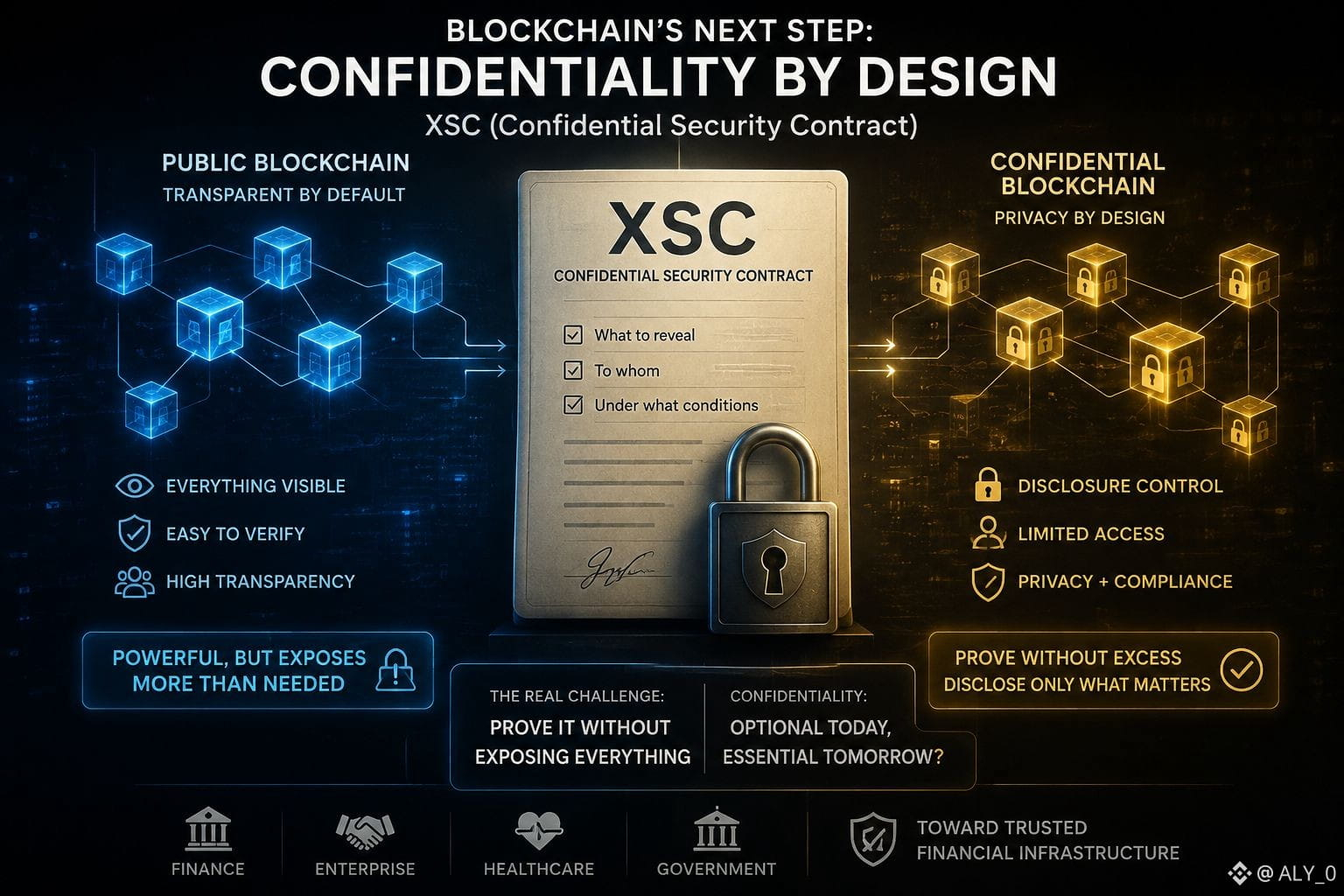
Then I looked deeper into XSC (Confidential Security Contract) and realized that confidentiality changes the question entirely.
The interesting part isn't simply adding privacy to a contract. It's about deciding what a blockchain should reveal, to whom, and under what conditions.
Public blockchains are powerful because everything can be verified. But that same transparency can become a weakness when transactions contain sensitive financial or business information. A system can be secure and still expose more than users actually want to disclose.
That is where I find the XSC idea worth watching. A Confidential Security Contract standard aims to bring privacy-aware rules into the contract layer, rather than treating confidentiality as an afterthought.
My takeaway is that the real challenge isn't proving something happened. It's proving it without unnecessarily exposing everything behind it.
I don't think standards alone solve the privacy problem, and adoption, implementation, and real-world use will matter more than the concept itself.
But it raises a question I keep coming back to:
If blockchains are supposed to become financial infrastructure, should confidentiality be optional—or eventually become a basic design principle?
#dusk $DUSK @Dusk
I used to think smart-contract standards were mostly about making different protocols speak the same language.
Then I looked deeper into XSC (Confidential Security Contract) and realized that confidentiality changes the question entirely.
The interesting part isn't simply adding privacy to a contract. It's about deciding what a blockchain should reveal, to whom, and under what conditions.
Public blockchains are powerful because everything can be verified. But that same transparency can become a weakness when transactions contain sensitive financial or business information. A system can be secure and still expose more than users actually want to disclose.
That is where I find the XSC idea worth watching. A Confidential Security Contract standard aims to bring privacy-aware rules into the contract layer, rather than treating confidentiality as an afterthought.
My takeaway is that the real challenge isn't proving something happened. It's proving it without unnecessarily exposing everything behind it.
I don't think standards alone solve the privacy problem, and adoption, implementation, and real-world use will matter more than the concept itself.
But it raises a question I keep coming back to:
If blockchains are supposed to become financial infrastructure, should confidentiality be optional—or eventually become a basic design principle?
96
Log in to explore more content
Join global crypto users on Binance Square
⚡️ Get latest and useful information about crypto.
💬 Trusted by the world’s largest crypto exchange.
👍 Discover real insights from verified creators.
Email / Phone number
Trending Topics
XRPDropsToTwoYearLowNear87Cents
4,815 views
112 Discussing
🚨 XRP CRASHES TO $0.87! IS A BIGGER SELL-OFF COMING? 📉
XRP is facing another major setback as selling pressure spreads across the crypto market!
On November 21, XRP dropped to approximately $0.87, reaching its lowest level since November 2024. 👀
🔍 Here's what happened:
• Sharp decline: XRP fell around 9% in 24 hours and approximately 11.5% over the week.
• ETF pressure: US Spot XRP ETFs recorded around $4.97 million in net outflows on Friday.
• Liquidations: Approximately $18 million in XRP futures positions were liquidated, with nearly 94% coming from long positions.
• ETF assets decline: Total net assets across five US Spot XRP ETFs slipped below $1 billion.
• Oversold territory: XRP's daily RSI dropped below 30, suggesting heavy selling pressure. However, this does not guarantee an immediate recovery.
The decline is happening alongside a broader crypto market sell-off, showing that XRP is not facing pressure alone.
🔥 Can XRP recover above $1, or could sellers push the price even lower?
$XRP - $DODO - $RARE
#xrp #Ripple #CryptoMarket #XRPDropsToTwoYearLowNear87Cents
"Can XRP recover above $1 soon"!?⚡
GirlyHub
·3 Likes
·1.2k views
BitcoinFallsBelow$57KToTwoYearLow
3,011 views
23 Discussing
NvidiaLoses$2.7TrillionInMonthAndAHalf
797 views
36 Discussing