

einsteinx
17 Posts

einsteinx
Report
Block User
permabull by conviction, shitposter by necessity
Open Trade
Occasional Trader
5.6 Years
4 Following
17 Followers
28 Liked
Posts
Portfolio
·
--
Bullish
The strongest infrastructure projects eventually disappear into the products built on top of them.
That’s what I kept thinking while looking at Burnt’s tenant-screening launch.
On the surface, it’s a rental product.
Underneath, it’s a demonstration of Verona’s verification infrastructure.
And that’s what caught my attention.
If verified information can solve a problem in housing, how many other industries still depend on documents, identity checks, and manual verification?
Finance?
Insurance?
Employment?
AI agents?
My takeaway: don’t evaluate Verona by looking at a single application.
Look at how many industries its infrastructure can potentially expand into.
That’s where the real opportunity might be.
#verona #USJulyCPI&PPIDueThisWeek #DogecoinLeadsMajorsUpNearly3% #CFTCOrdersKalshiToKeepOperating #KOSPIRisesNearly5%TriggersBuySideSidecar
The strongest infrastructure projects eventually disappear into the products built on top of them.
That’s what I kept thinking while looking at Burnt’s tenant-screening launch.
On the surface, it’s a rental product.
Underneath, it’s a demonstration of Verona’s verification infrastructure.
And that’s what caught my attention.
If verified information can solve a problem in housing, how many other industries still depend on documents, identity checks, and manual verification?
Finance?
Insurance?
Employment?
AI agents?
My takeaway: don’t evaluate Verona by looking at a single application.
Look at how many industries its infrastructure can potentially expand into.
That’s where the real opportunity might be.
#verona #USJulyCPI&PPIDueThisWeek #DogecoinLeadsMajorsUpNearly3% #CFTCOrdersKalshiToKeepOperating #KOSPIRisesNearly5%TriggersBuySideSidecar
That’s what I kept thinking while looking at Burnt’s tenant-screening launch.
On the surface, it’s a rental product.
Underneath, it’s a demonstration of Verona’s verification infrastructure.
And that’s what caught my attention.
If verified information can solve a problem in housing, how many other industries still depend on documents, identity checks, and manual verification?
Finance?
Insurance?
Employment?
AI agents?
My takeaway: don’t evaluate Verona by looking at a single application.
Look at how many industries its infrastructure can potentially expand into.
That’s where the real opportunity might be.
#verona #USJulyCPI&PPIDueThisWeek #DogecoinLeadsMajorsUpNearly3% #CFTCOrdersKalshiToKeepOperating #KOSPIRisesNearly5%TriggersBuySideSidecar
67
·
--
Bullish
Can Human Communication Become an Asset?
AI is getting better at answering questions, but the quality of those answers still depends on the people behind the data.
That’s the idea behind Smoothly.
Instead of generating generic AI responses, Smoothly lets users prove their communication skills through an assessment. Those who pass can create an AI agent trained on their own communication style and earn whenever someone interacts with it.
It’s a different take on AI. Rather than replacing human expertise, it turns it into a reusable digital asset.
As AI becomes more integrated into everyday life, platforms that reward real human knowledge instead of simply generating more content could carve out an interesting niche. Smoothly is one example of that shift.
#USIranDealOrNoDeal #SpaceXToReportQ2Results #GoldHoldsAbove$4000PerOunce #KOSPINikkeiOpenHigherOnChipStocks #VERONA
Can Human Communication Become an Asset?
AI is getting better at answering questions, but the quality of those answers still depends on the people behind the data.
That’s the idea behind Smoothly.
Instead of generating generic AI responses, Smoothly lets users prove their communication skills through an assessment. Those who pass can create an AI agent trained on their own communication style and earn whenever someone interacts with it.
It’s a different take on AI. Rather than replacing human expertise, it turns it into a reusable digital asset.
As AI becomes more integrated into everyday life, platforms that reward real human knowledge instead of simply generating more content could carve out an interesting niche. Smoothly is one example of that shift.
#USIranDealOrNoDeal #SpaceXToReportQ2Results #GoldHoldsAbove$4000PerOunce #KOSPINikkeiOpenHigherOnChipStocks #VERONA
AI is getting better at answering questions, but the quality of those answers still depends on the people behind the data.
That’s the idea behind Smoothly.
Instead of generating generic AI responses, Smoothly lets users prove their communication skills through an assessment. Those who pass can create an AI agent trained on their own communication style and earn whenever someone interacts with it.
It’s a different take on AI. Rather than replacing human expertise, it turns it into a reusable digital asset.
As AI becomes more integrated into everyday life, platforms that reward real human knowledge instead of simply generating more content could carve out an interesting niche. Smoothly is one example of that shift.
#USIranDealOrNoDeal #SpaceXToReportQ2Results #GoldHoldsAbove$4000PerOunce #KOSPINikkeiOpenHigherOnChipStocks #VERONA
68
·
--
Bullish
Why AI Agents Need Verifiable Data to Make Better Decisions
AI agents are becoming better at reasoning, but reasoning alone isn’t enough. The quality of an agent’s output depends on the quality of the information it can trust.
If an AI agent is making decisions based on unverified identities, ownership claims, or outdated information, it can still arrive at the wrong conclusion.
That’s where verification infrastructure comes in.
Projects like Verona are building systems that let AI interact with verified facts instead of relying solely on raw internet data. Whether it’s identity, ownership, employment, or other real-world information, verified data gives AI a stronger foundation for making decisions.
As AI moves deeper into finance, commerce, and everyday applications, the next wave of innovation may not come from bigger models alone. It may come from making the data those models use more trustworthy.
#USIranDealOrNoDeal #SpaceXToReportQ2Results #KoreaMarginHikeCutsLeveragedETFTrading #btc #Verona
Why AI Agents Need Verifiable Data to Make Better Decisions
AI agents are becoming better at reasoning, but reasoning alone isn’t enough. The quality of an agent’s output depends on the quality of the information it can trust.
If an AI agent is making decisions based on unverified identities, ownership claims, or outdated information, it can still arrive at the wrong conclusion.
That’s where verification infrastructure comes in.
Projects like Verona are building systems that let AI interact with verified facts instead of relying solely on raw internet data. Whether it’s identity, ownership, employment, or other real-world information, verified data gives AI a stronger foundation for making decisions.
As AI moves deeper into finance, commerce, and everyday applications, the next wave of innovation may not come from bigger models alone. It may come from making the data those models use more trustworthy.
#USIranDealOrNoDeal #SpaceXToReportQ2Results #KoreaMarginHikeCutsLeveragedETFTrading #btc #Verona
AI agents are becoming better at reasoning, but reasoning alone isn’t enough. The quality of an agent’s output depends on the quality of the information it can trust.
If an AI agent is making decisions based on unverified identities, ownership claims, or outdated information, it can still arrive at the wrong conclusion.
That’s where verification infrastructure comes in.
Projects like Verona are building systems that let AI interact with verified facts instead of relying solely on raw internet data. Whether it’s identity, ownership, employment, or other real-world information, verified data gives AI a stronger foundation for making decisions.
As AI moves deeper into finance, commerce, and everyday applications, the next wave of innovation may not come from bigger models alone. It may come from making the data those models use more trustworthy.
#USIranDealOrNoDeal #SpaceXToReportQ2Results #KoreaMarginHikeCutsLeveragedETFTrading #btc #Verona
93
·
--
The World Cup is over. But the competition isn’t.
Raven Run is live until August 7, and only one player walks away with the $500.
Fly through the skyline, collect verified brand logos, dodge the bots, and survive as long as you can. Longer runs and rarer logos earn you more points, and every run is verified before it counts.
Think you’ve got the top score?
https://builtonverona.com/raven-run
#btc #ETH #bnb #altcycle #Verona
The World Cup is over. But the competition isn’t.
Raven Run is live until August 7, and only one player walks away with the $500.
Fly through the skyline, collect verified brand logos, dodge the bots, and survive as long as you can. Longer runs and rarer logos earn you more points, and every run is verified before it counts.
Think you’ve got the top score?
https://builtonverona.com/raven-run
#btc #ETH #bnb #altcycle #Verona
Raven Run is live until August 7, and only one player walks away with the $500.
Fly through the skyline, collect verified brand logos, dodge the bots, and survive as long as you can. Longer runs and rarer logos earn you more points, and every run is verified before it counts.
Think you’ve got the top score?
https://builtonverona.com/raven-run
#btc #ETH #bnb #altcycle #Verona
69
·
--
Bullish
Why Provenance Matters More Than Ever
The resale economy has a trust problem.
Buying high-value collectibles often comes down to photos, receipts, and a seller’s word. Every new owner has to piece the story together all over again.
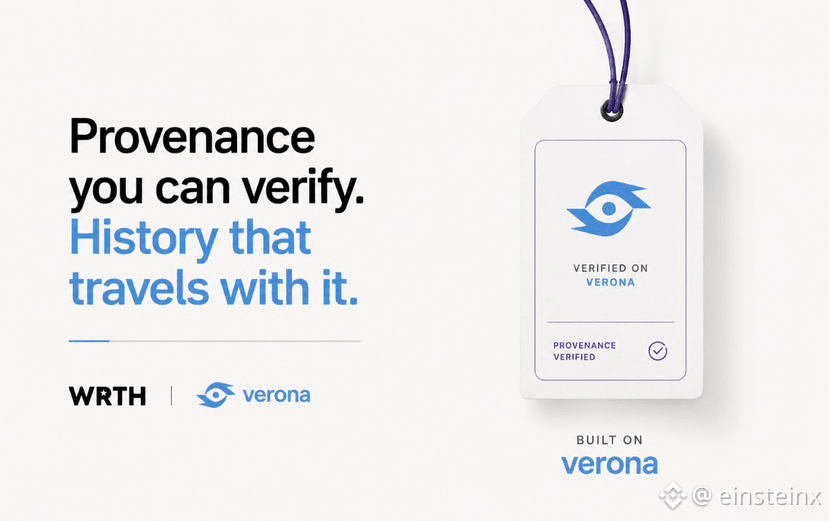
WRTH approaches that differently by giving physical assets a verifiable history on Verona that stays with the item as it changes hands.
The idea of provenance isn’t new. Making it part of the resale workflow is what caught my attention.
As more real-world assets move on-chain, trust may become something buyers can verify instead of something they simply assume.
#BTC #ETH #VERONA #bnb #KRXActivatesSellSideSidecar
Why Provenance Matters More Than Ever
The resale economy has a trust problem.
Buying high-value collectibles often comes down to photos, receipts, and a seller’s word. Every new owner has to piece the story together all over again.
WRTH approaches that differently by giving physical assets a verifiable history on Verona that stays with the item as it changes hands.
The idea of provenance isn’t new. Making it part of the resale workflow is what caught my attention.
As more real-world assets move on-chain, trust may become something buyers can verify instead of something they simply assume.
#BTC #ETH #VERONA #bnb #KRXActivatesSellSideSidecar
The resale economy has a trust problem.
Buying high-value collectibles often comes down to photos, receipts, and a seller’s word. Every new owner has to piece the story together all over again.
WRTH approaches that differently by giving physical assets a verifiable history on Verona that stays with the item as it changes hands.
The idea of provenance isn’t new. Making it part of the resale workflow is what caught my attention.
As more real-world assets move on-chain, trust may become something buyers can verify instead of something they simply assume.
#BTC #ETH #VERONA #bnb #KRXActivatesSellSideSidecar
114
·
--
Bullish
most ecosystems chase tvl. #Verona is chasing gdp instead - how much real value its products actually earn, not what’s sitting locked in a dashboard.
case in point: Burnt, built on Verona, just launched tenant screening that verifies income straight from the payroll source — no pdf, nothing for ai to forge. Verona takes a revenue share as Burnt expands into new markets (lending, insurance, and beyond).
real usage, real revenue, shared directly with the ecosystem. worth watching.
#BinanceTurns9 #btc #ETH #JuneCPIFedHike20%
most ecosystems chase tvl. #Verona is chasing gdp instead - how much real value its products actually earn, not what’s sitting locked in a dashboard.
case in point: Burnt, built on Verona, just launched tenant screening that verifies income straight from the payroll source — no pdf, nothing for ai to forge. Verona takes a revenue share as Burnt expands into new markets (lending, insurance, and beyond).
real usage, real revenue, shared directly with the ecosystem. worth watching.
#BinanceTurns9 #btc #ETH #JuneCPIFedHike20%
case in point: Burnt, built on Verona, just launched tenant screening that verifies income straight from the payroll source — no pdf, nothing for ai to forge. Verona takes a revenue share as Burnt expands into new markets (lending, insurance, and beyond).
real usage, real revenue, shared directly with the ecosystem. worth watching.
#BinanceTurns9 #btc #ETH #JuneCPIFedHike20%
1
105
·
--
Verona Tokenomics: The Flywheel Behind $VERONA
The most interesting part of Verona’s tokenomics isn’t the burn—it’s what funds it.
The network already has a foundation of:
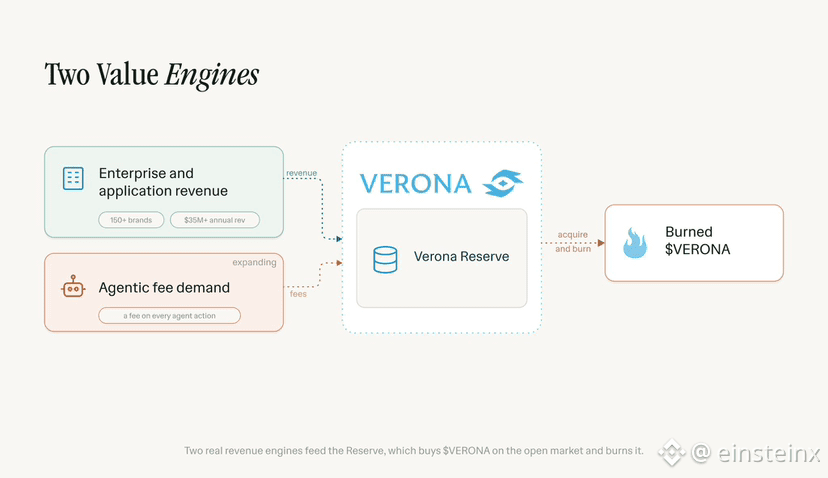
* 68M+ verified interactions
* 150+ brands live
* $35M+ in signed annualized revenue
Instead of relying on token emissions or liquidity mining, a portion of network revenue is used to buy back and burn $VERONA.
Another key design choice is that users are rewarded in stable-value terms when their verified data is reused, helping reduce token sell pressure.
The AI component is where the model becomes interesting.
AI agents don’t verify information once—they do it constantly. Every time a verified fact is reused by an authorized app or AI agent, it generates another fee for the network.
That creates a simple flywheel:
More verified facts → More reuse → More revenue → More $VERONA bought and burned.
The burn isn’t the story.
The flywheel is.
#BTC #CashCatTops$200MMarketCap #ETH #JapanUrgesGPIFToBoostDomesticAssets #verona
Verona Tokenomics: The Flywheel Behind $VERONA
The most interesting part of Verona’s tokenomics isn’t the burn—it’s what funds it.
The network already has a foundation of:
* 68M+ verified interactions
* 150+ brands live
* $35M+ in signed annualized revenue
Instead of relying on token emissions or liquidity mining, a portion of network revenue is used to buy back and burn $VERONA.
Another key design choice is that users are rewarded in stable-value terms when their verified data is reused, helping reduce token sell pressure.
The AI component is where the model becomes interesting.
AI agents don’t verify information once—they do it constantly. Every time a verified fact is reused by an authorized app or AI agent, it generates another fee for the network.
That creates a simple flywheel:
More verified facts → More reuse → More revenue → More $VERONA bought and burned.
The burn isn’t the story.
The flywheel is.
#BTC #CashCatTops$200MMarketCap #ETH #JapanUrgesGPIFToBoostDomesticAssets #verona
The most interesting part of Verona’s tokenomics isn’t the burn—it’s what funds it.
The network already has a foundation of:
* 68M+ verified interactions
* 150+ brands live
* $35M+ in signed annualized revenue
Instead of relying on token emissions or liquidity mining, a portion of network revenue is used to buy back and burn $VERONA.
Another key design choice is that users are rewarded in stable-value terms when their verified data is reused, helping reduce token sell pressure.
The AI component is where the model becomes interesting.
AI agents don’t verify information once—they do it constantly. Every time a verified fact is reused by an authorized app or AI agent, it generates another fee for the network.
That creates a simple flywheel:
More verified facts → More reuse → More revenue → More $VERONA bought and burned.
The burn isn’t the story.
The flywheel is.
#BTC #CashCatTops$200MMarketCap #ETH #JapanUrgesGPIFToBoostDomesticAssets #verona
1
148
·
--
“For years, the user was the product.”
That’s the internet Burnt Banksy (founder of $VERONA) says EarnOS is trying to change.
Instead of brands paying platforms to guess who might convert, they pay verified users directly.
Examples:
• $100 to convince a Lyft user to switch.
• $1,000 if you’re a high-value customer.
• $15 if your value is lower.
The verification happens with ZK technology, so users prove eligibility without revealing personal data.
The idea is simple:
Stop paying platforms for impressions. Start paying people for attention.
If EarnOS succeeds, digital advertising could shift from platform-first to user-first.
#SpaceXToJoinNasdaq100OnJuly7 #btc #ETH #sol #bnb
“For years, the user was the product.”
That’s the internet Burnt Banksy (founder of $VERONA) says EarnOS is trying to change.
Instead of brands paying platforms to guess who might convert, they pay verified users directly.
Examples:
• $100 to convince a Lyft user to switch.
• $1,000 if you’re a high-value customer.
• $15 if your value is lower.
The verification happens with ZK technology, so users prove eligibility without revealing personal data.
The idea is simple:
Stop paying platforms for impressions. Start paying people for attention.
If EarnOS succeeds, digital advertising could shift from platform-first to user-first.
#SpaceXToJoinNasdaq100OnJuly7 #btc #ETH #sol #bnb
That’s the internet Burnt Banksy (founder of $VERONA) says EarnOS is trying to change.
Instead of brands paying platforms to guess who might convert, they pay verified users directly.
Examples:
• $100 to convince a Lyft user to switch.
• $1,000 if you’re a high-value customer.
• $15 if your value is lower.
The verification happens with ZK technology, so users prove eligibility without revealing personal data.
The idea is simple:
Stop paying platforms for impressions. Start paying people for attention.
If EarnOS succeeds, digital advertising could shift from platform-first to user-first.
#SpaceXToJoinNasdaq100OnJuly7 #btc #ETH #sol #bnb
1
101
·
--
Verona: Why XION’s Rebrand Matters for the AI EraXION is no more—at least in name.
The project has officially rebranded to Verona, signaling a shift from being a chain abstraction protocol to becoming infrastructure for the AI-powered internet.
This isn’t just a cosmetic change. It reflects a broader vision of where Web3 is heading.
For years, blockchain has focused on making transactions trustless. But AI introduces a different challenge: trusting the data and identity behind autonomous agents. If AI is going to make payments, sign agreements, or interact with decentralized applications on our behalf, it needs access to verifiable information without compromising user privacy.
That’s the problem Verona aims to solve.
The project is building what it calls a trust layer—an infrastructure where credentials, identity, and other verified data can be securely reused across applications instead of being verified from scratch every time. Users remain in control of what they share, while AI agents gain access to trusted information they can act upon.
Importantly, Verona isn’t abandoning what made XION stand out.
The project’s chain abstraction technology remains at its core, continuing to remove blockchain complexity by hiding wallets, gas fees, and cryptographic hurdles from end users. The difference is that this seamless user experience is now paired with infrastructure designed for an AI-native future.
The timing also makes sense.
As AI agents become increasingly capable of handling real-world tasks, demand will grow for systems that can prove identity, ownership, and permissions without exposing sensitive personal data. Blockchain has long excelled at verification, and Verona is positioning itself at the intersection of that capability and the rapidly expanding AI economy.
The rebrand also coincides with ecosystem expansion, including the launch of ero and continued development around EarnOS, reinforcing Verona’s ambition to move beyond blockchain infrastructure into a broader ecosystem where verifiable data powers intelligent applications.
Whether Verona becomes the trust layer for AI remains to be seen. But one thing is clear: the project is no longer competing solely in the blockchain infrastructure space.
It’s betting that the next wave of adoption won’t just be about abstracting Web3—it will be about enabling AI to interact with the digital world securely, privately, and with verifiable trust.
The question is no longer whether AI will use blockchain. It’s which blockchain infrastructure AI will trust.
#BTC #bitcoin #Verona #altcoins #ETH
Verona: Why XION’s Rebrand Matters for the AI Era
XION is no more—at least in name.
The project has officially rebranded to Verona, signaling a shift from being a chain abstraction protocol to becoming infrastructure for the AI-powered internet.
This isn’t just a cosmetic change. It reflects a broader vision of where Web3 is heading.
For years, blockchain has focused on making transactions trustless. But AI introduces a different challenge: trusting the data and identity behind autonomous agents. If AI is going to make payments, sign agreements, or interact with decentralized applications on our behalf, it needs access to verifiable information without compromising user privacy.
That’s the problem Verona aims to solve.
The project is building what it calls a trust layer—an infrastructure where credentials, identity, and other verified data can be securely reused across applications instead of being verified from scratch every time. Users remain in control of what they share, while AI agents gain access to trusted information they can act upon.
Importantly, Verona isn’t abandoning what made XION stand out.
The project’s chain abstraction technology remains at its core, continuing to remove blockchain complexity by hiding wallets, gas fees, and cryptographic hurdles from end users. The difference is that this seamless user experience is now paired with infrastructure designed for an AI-native future.
The timing also makes sense.
As AI agents become increasingly capable of handling real-world tasks, demand will grow for systems that can prove identity, ownership, and permissions without exposing sensitive personal data. Blockchain has long excelled at verification, and Verona is positioning itself at the intersection of that capability and the rapidly expanding AI economy.
The rebrand also coincides with ecosystem expansion, including the launch of ero and continued development around EarnOS, reinforcing Verona’s ambition to move beyond blockchain infrastructure into a broader ecosystem where verifiable data powers intelligent applications.
Whether Verona becomes the trust layer for AI remains to be seen. But one thing is clear: the project is no longer competing solely in the blockchain infrastructure space.
It’s betting that the next wave of adoption won’t just be about abstracting Web3—it will be about enabling AI to interact with the digital world securely, privately, and with verifiable trust.
The question is no longer whether AI will use blockchain. It’s which blockchain infrastructure AI will trust.
#BTC #bitcoin #Verona #altcoins #ETH
The project has officially rebranded to Verona, signaling a shift from being a chain abstraction protocol to becoming infrastructure for the AI-powered internet.
This isn’t just a cosmetic change. It reflects a broader vision of where Web3 is heading.
For years, blockchain has focused on making transactions trustless. But AI introduces a different challenge: trusting the data and identity behind autonomous agents. If AI is going to make payments, sign agreements, or interact with decentralized applications on our behalf, it needs access to verifiable information without compromising user privacy.
That’s the problem Verona aims to solve.
The project is building what it calls a trust layer—an infrastructure where credentials, identity, and other verified data can be securely reused across applications instead of being verified from scratch every time. Users remain in control of what they share, while AI agents gain access to trusted information they can act upon.
Importantly, Verona isn’t abandoning what made XION stand out.
The project’s chain abstraction technology remains at its core, continuing to remove blockchain complexity by hiding wallets, gas fees, and cryptographic hurdles from end users. The difference is that this seamless user experience is now paired with infrastructure designed for an AI-native future.
The timing also makes sense.
As AI agents become increasingly capable of handling real-world tasks, demand will grow for systems that can prove identity, ownership, and permissions without exposing sensitive personal data. Blockchain has long excelled at verification, and Verona is positioning itself at the intersection of that capability and the rapidly expanding AI economy.
The rebrand also coincides with ecosystem expansion, including the launch of ero and continued development around EarnOS, reinforcing Verona’s ambition to move beyond blockchain infrastructure into a broader ecosystem where verifiable data powers intelligent applications.
Whether Verona becomes the trust layer for AI remains to be seen. But one thing is clear: the project is no longer competing solely in the blockchain infrastructure space.
It’s betting that the next wave of adoption won’t just be about abstracting Web3—it will be about enabling AI to interact with the digital world securely, privately, and with verifiable trust.
The question is no longer whether AI will use blockchain. It’s which blockchain infrastructure AI will trust.
#BTC #bitcoin #Verona #altcoins #ETH
1
82
·
--
Bullish
UX was never Web3’s biggest problem. Trust was.
A smoother interface doesn’t fix fake users. Lower fees don’t fix fake engagement. A smoother scam is still a scam.
The average person doesn’t look at Web3 and think “programmable money.” They think: what if this project is fake? What if these users are bots? What if this drains my wallet?
They’re not wrong. The internet runs on manufactured signals — fake followers, fake credentials, fake communities. We’ve gotten very good at faking trust without building it.
The real barrier isn’t complexity. It’s uncertainty.
The most interesting projects right now aren’t making blockchains faster. They’re making digital interactions more trustworthy. Proving a user is human. Proving an action happened. Proving a credential is valid — without forcing anyone to expose everything about themselves.
That’s what XION is building toward. 68M+ verified interactions, 150+ brands, 4M+ users — not vanity metrics, but evidence that the demand exists.
Web3 won’t scale because people learn to tolerate more risk. It will scale when trust becomes infrastructure.
#btc #bnb #ETH #XION #SenatorsAdvanceCLARITYActTowardFloorVote
UX was never Web3’s biggest problem. Trust was.
A smoother interface doesn’t fix fake users. Lower fees don’t fix fake engagement. A smoother scam is still a scam.
The average person doesn’t look at Web3 and think “programmable money.” They think: what if this project is fake? What if these users are bots? What if this drains my wallet?
They’re not wrong. The internet runs on manufactured signals — fake followers, fake credentials, fake communities. We’ve gotten very good at faking trust without building it.
The real barrier isn’t complexity. It’s uncertainty.
The most interesting projects right now aren’t making blockchains faster. They’re making digital interactions more trustworthy. Proving a user is human. Proving an action happened. Proving a credential is valid — without forcing anyone to expose everything about themselves.
That’s what XION is building toward. 68M+ verified interactions, 150+ brands, 4M+ users — not vanity metrics, but evidence that the demand exists.
Web3 won’t scale because people learn to tolerate more risk. It will scale when trust becomes infrastructure.
#btc #bnb #ETH #XION #SenatorsAdvanceCLARITYActTowardFloorVote
A smoother interface doesn’t fix fake users. Lower fees don’t fix fake engagement. A smoother scam is still a scam.
The average person doesn’t look at Web3 and think “programmable money.” They think: what if this project is fake? What if these users are bots? What if this drains my wallet?
They’re not wrong. The internet runs on manufactured signals — fake followers, fake credentials, fake communities. We’ve gotten very good at faking trust without building it.
The real barrier isn’t complexity. It’s uncertainty.
The most interesting projects right now aren’t making blockchains faster. They’re making digital interactions more trustworthy. Proving a user is human. Proving an action happened. Proving a credential is valid — without forcing anyone to expose everything about themselves.
That’s what XION is building toward. 68M+ verified interactions, 150+ brands, 4M+ users — not vanity metrics, but evidence that the demand exists.
Web3 won’t scale because people learn to tolerate more risk. It will scale when trust becomes infrastructure.
#btc #bnb #ETH #XION #SenatorsAdvanceCLARITYActTowardFloorVote
1
126
·
--
the internet moves information. it was never built to move trust.
every time you use the internet, you generate proof — identity, income, credentials, reputation. constantly, across dozens of platforms that don’t share any of it.
that proof disappears the moment the session ends. when you need it again, you start from zero.
xion is building the layer that fixes this.
the argument isn’t “crypto should be easier to use.” it’s that verified real-world data should be portable, programmable, and owned by you.
the mechanism is zkTLS. your bank verifies your financial history once. a cryptographic proof is generated. a lending protocol receives the verification — not your documents, not your raw data. just the proof. reusable on-chain, anywhere.
what this unlocks:
a freelancer’s payment history becomes loan collateral. a driver’s rating record travels with them to a new platform. a user proves they’re over 18 without revealing their birthdate.
programmable trust. not a concept — a set of applications that couldn’t exist before this infrastructure did.
previous identity projects failed because they asked people to build new on-chain identities from scratch. xion starts from where people already are — existing credentials, existing reputation, bridged on-chain.
the infrastructure argument for blockchains, applied to the right problem.
follow for more breakdowns on protocols building real infrastructure.
#xion #BTC #altcoins #TRUMP #ALT
the internet moves information. it was never built to move trust.
every time you use the internet, you generate proof — identity, income, credentials, reputation. constantly, across dozens of platforms that don’t share any of it.
that proof disappears the moment the session ends. when you need it again, you start from zero.
xion is building the layer that fixes this.
the argument isn’t “crypto should be easier to use.” it’s that verified real-world data should be portable, programmable, and owned by you.
the mechanism is zkTLS. your bank verifies your financial history once. a cryptographic proof is generated. a lending protocol receives the verification — not your documents, not your raw data. just the proof. reusable on-chain, anywhere.
what this unlocks:
a freelancer’s payment history becomes loan collateral. a driver’s rating record travels with them to a new platform. a user proves they’re over 18 without revealing their birthdate.
programmable trust. not a concept — a set of applications that couldn’t exist before this infrastructure did.
previous identity projects failed because they asked people to build new on-chain identities from scratch. xion starts from where people already are — existing credentials, existing reputation, bridged on-chain.
the infrastructure argument for blockchains, applied to the right problem.
follow for more breakdowns on protocols building real infrastructure.
#xion #BTC #altcoins #TRUMP #ALT
every time you use the internet, you generate proof — identity, income, credentials, reputation. constantly, across dozens of platforms that don’t share any of it.
that proof disappears the moment the session ends. when you need it again, you start from zero.
xion is building the layer that fixes this.
the argument isn’t “crypto should be easier to use.” it’s that verified real-world data should be portable, programmable, and owned by you.
the mechanism is zkTLS. your bank verifies your financial history once. a cryptographic proof is generated. a lending protocol receives the verification — not your documents, not your raw data. just the proof. reusable on-chain, anywhere.
what this unlocks:
a freelancer’s payment history becomes loan collateral. a driver’s rating record travels with them to a new platform. a user proves they’re over 18 without revealing their birthdate.
programmable trust. not a concept — a set of applications that couldn’t exist before this infrastructure did.
previous identity projects failed because they asked people to build new on-chain identities from scratch. xion starts from where people already are — existing credentials, existing reputation, bridged on-chain.
the infrastructure argument for blockchains, applied to the right problem.
follow for more breakdowns on protocols building real infrastructure.
#xion #BTC #altcoins #TRUMP #ALT
289
·
--
The internet doesn’t have a content problem.
It has a trust problem.
Every day, users navigate fake engagement, AI-generated identities, manipulated content, and unverifiable claims. Platforms respond with moderation, but moderation is reactive — it addresses the damage after trust is already broken.
What’s missing is infrastructure for verification that is:
• Provable
• Private
• Portable
This is where XION is positioning itself.
Through technologies like zkTLS, zkEmail, and protocol-level zero-knowledge verification, XION is building infrastructure that allows users and applications to verify information without exposing sensitive data or relying on centralized intermediaries.
The opportunity extends far beyond crypto:
• Digital identity
• Advertising verification
• Creator authenticity
• Financial onboarding
• Gaming economies
• Online credentials
As AI-generated content scales, verifiable proof systems may become as essential to the internet as HTTPS is today.
Trust didn’t break overnight.
Rebuilding it starts with infrastructure.
#XION #Web3 #blockchain #BTC #crypto #BinanceSquare
The internet doesn’t have a content problem.
It has a trust problem.
Every day, users navigate fake engagement, AI-generated identities, manipulated content, and unverifiable claims. Platforms respond with moderation, but moderation is reactive — it addresses the damage after trust is already broken.
What’s missing is infrastructure for verification that is:
• Provable
• Private
• Portable
This is where XION is positioning itself.
Through technologies like zkTLS, zkEmail, and protocol-level zero-knowledge verification, XION is building infrastructure that allows users and applications to verify information without exposing sensitive data or relying on centralized intermediaries.
The opportunity extends far beyond crypto:
• Digital identity
• Advertising verification
• Creator authenticity
• Financial onboarding
• Gaming economies
• Online credentials
As AI-generated content scales, verifiable proof systems may become as essential to the internet as HTTPS is today.
Trust didn’t break overnight.
Rebuilding it starts with infrastructure.
#XION #Web3 #blockchain #BTC #crypto #BinanceSquare
It has a trust problem.
Every day, users navigate fake engagement, AI-generated identities, manipulated content, and unverifiable claims. Platforms respond with moderation, but moderation is reactive — it addresses the damage after trust is already broken.
What’s missing is infrastructure for verification that is:
• Provable
• Private
• Portable
This is where XION is positioning itself.
Through technologies like zkTLS, zkEmail, and protocol-level zero-knowledge verification, XION is building infrastructure that allows users and applications to verify information without exposing sensitive data or relying on centralized intermediaries.
The opportunity extends far beyond crypto:
• Digital identity
• Advertising verification
• Creator authenticity
• Financial onboarding
• Gaming economies
• Online credentials
As AI-generated content scales, verifiable proof systems may become as essential to the internet as HTTPS is today.
Trust didn’t break overnight.
Rebuilding it starts with infrastructure.
#XION #Web3 #blockchain #BTC #crypto #BinanceSquare
1
105
·
--
Bullish
most blockchain SDKs start simple… then slowly break.
first JavaScript.
then Python. then Kotlin. then mobile and backend teams each end up with their own version — slightly different, slightly incompatible.
same chain. different behavior.
XION’s Mob fixes that.
instead of rebuilding the same wallet logic in every language, they wrote it once in Rust.
then used UniFFI to make it work across Swift, Kotlin, Python, and Rust — all from a single core.
so everywhere behaves the same.
one system. one source of truth.
what that means in practice:
mobile apps can support advanced wallet features like gasless transactions and session keys natively — no workarounds.
backend systems can sign and verify using the same logic as the app.
no wrappers. no duplicated SDKs. no drift between teams.
most blockchains force every team to “figure it out” differently.
XION removes that split. blockchain tools start behaving like real infrastructure.
#btc #XION #bitcoin #ETH #BitcoinBreaksBelow75KAsWarshTakesFedHelm
most blockchain SDKs start simple… then slowly break.
first JavaScript.
then Python. then Kotlin. then mobile and backend teams each end up with their own version — slightly different, slightly incompatible.
same chain. different behavior.
XION’s Mob fixes that.
instead of rebuilding the same wallet logic in every language, they wrote it once in Rust.
then used UniFFI to make it work across Swift, Kotlin, Python, and Rust — all from a single core.
so everywhere behaves the same.
one system. one source of truth.
what that means in practice:
mobile apps can support advanced wallet features like gasless transactions and session keys natively — no workarounds.
backend systems can sign and verify using the same logic as the app.
no wrappers. no duplicated SDKs. no drift between teams.
most blockchains force every team to “figure it out” differently.
XION removes that split. blockchain tools start behaving like real infrastructure.
#btc #XION #bitcoin #ETH #BitcoinBreaksBelow75KAsWarshTakesFedHelm
first JavaScript.
then Python. then Kotlin. then mobile and backend teams each end up with their own version — slightly different, slightly incompatible.
same chain. different behavior.
XION’s Mob fixes that.
instead of rebuilding the same wallet logic in every language, they wrote it once in Rust.
then used UniFFI to make it work across Swift, Kotlin, Python, and Rust — all from a single core.
so everywhere behaves the same.
one system. one source of truth.
what that means in practice:
mobile apps can support advanced wallet features like gasless transactions and session keys natively — no workarounds.
backend systems can sign and verify using the same logic as the app.
no wrappers. no duplicated SDKs. no drift between teams.
most blockchains force every team to “figure it out” differently.
XION removes that split. blockchain tools start behaving like real infrastructure.
#btc #XION #bitcoin #ETH #BitcoinBreaksBelow75KAsWarshTakesFedHelm
1
104
·
--
crypto spent years optimizing ownership.
own your assets.
own your keys.
own your identity.
technically revolutionary.
but most people don’t wake up wanting ownership infrastructure.
they want participation.
they want to:
- join communities
- support creators
- play games
- transact globally
- access experiences instantly
ownership is often just the mechanism behind those things — not the reason people show up.
that’s where crypto got stuck.
before users could participate, they had to:
- create wallets
- secure seed phrases
- understand chains
- manage gas fees
- sign transactions
the infrastructure became the experience.
projects like XION are pushing toward a different model:
participation-first crypto.
where users focus on experiences instead of operational complexity.
because mass adoption probably won’t happen when everyone becomes a blockchain expert.
it happens when people barely notice the infrastructure at all.
#XION #bitcoin #DAC$ #BinanceSquare #NotFinancialAdvice #Web3 #HODL
crypto spent years optimizing ownership.
own your assets.
own your keys.
own your identity.
technically revolutionary.
but most people don’t wake up wanting ownership infrastructure.
they want participation.
they want to:
- join communities
- support creators
- play games
- transact globally
- access experiences instantly
ownership is often just the mechanism behind those things — not the reason people show up.
that’s where crypto got stuck.
before users could participate, they had to:
- create wallets
- secure seed phrases
- understand chains
- manage gas fees
- sign transactions
the infrastructure became the experience.
projects like XION are pushing toward a different model:
participation-first crypto.
where users focus on experiences instead of operational complexity.
because mass adoption probably won’t happen when everyone becomes a blockchain expert.
it happens when people barely notice the infrastructure at all.
#XION #bitcoin #DAC$ #BinanceSquare #NotFinancialAdvice #Web3 #HODL
own your assets.
own your keys.
own your identity.
technically revolutionary.
but most people don’t wake up wanting ownership infrastructure.
they want participation.
they want to:
- join communities
- support creators
- play games
- transact globally
- access experiences instantly
ownership is often just the mechanism behind those things — not the reason people show up.
that’s where crypto got stuck.
before users could participate, they had to:
- create wallets
- secure seed phrases
- understand chains
- manage gas fees
- sign transactions
the infrastructure became the experience.
projects like XION are pushing toward a different model:
participation-first crypto.
where users focus on experiences instead of operational complexity.
because mass adoption probably won’t happen when everyone becomes a blockchain expert.
it happens when people barely notice the infrastructure at all.
#XION #bitcoin #DAC$ #BinanceSquare #NotFinancialAdvice #Web3 #HODL
1
106
·
--
crypto’s biggest UX problem was never “too many clicks.”
it was that users were expected to operate infrastructure.
manage wallets.
store seed phrases.
bridge assets.
switch networks.
monitor gas fees.
the industry normalized operational complexity and called it onboarding.
but mainstream users don’t want to become crypto experts.
they want outcomes:
- buy
- play
- connect
- create
- transact
without thinking about the rails underneath.
that’s why projects like XION matter.
the future of crypto isn’t simplifying infrastructure.
it’s making infrastructure invisible.
mass adoption starts when users stop feeling like sysadmins.
#macro #XION #crypto #BTC #ai
crypto’s biggest UX problem was never “too many clicks.”
it was that users were expected to operate infrastructure.
manage wallets.
store seed phrases.
bridge assets.
switch networks.
monitor gas fees.
the industry normalized operational complexity and called it onboarding.
but mainstream users don’t want to become crypto experts.
they want outcomes:
- buy
- play
- connect
- create
- transact
without thinking about the rails underneath.
that’s why projects like XION matter.
the future of crypto isn’t simplifying infrastructure.
it’s making infrastructure invisible.
mass adoption starts when users stop feeling like sysadmins.
#macro #XION #crypto #BTC #ai
it was that users were expected to operate infrastructure.
manage wallets.
store seed phrases.
bridge assets.
switch networks.
monitor gas fees.
the industry normalized operational complexity and called it onboarding.
but mainstream users don’t want to become crypto experts.
they want outcomes:
- buy
- play
- connect
- create
- transact
without thinking about the rails underneath.
that’s why projects like XION matter.
the future of crypto isn’t simplifying infrastructure.
it’s making infrastructure invisible.
mass adoption starts when users stop feeling like sysadmins.
#macro #XION #crypto #BTC #ai
1
137
·
--
XION Mainnet Upgrade — ZK Just Got Native
XION just rolled out a major upgrade focused on zero-knowledge verification.
What changed
XION now supports native ZK proof verification at the protocol level (x/zk).
That means developers no longer need to build or deploy custom verifier contracts.
What’s supported
* Groth16 proofs (Circom, Gnark)
* Barretenberg UltraHonk (Noir stack)
What it means in practice
Before:
Build circuit → generate proof → deploy verifier → integrate manually
Now:
Build circuit → generate proof → submit → chain verifies it natively
Why it matters
* Removes verifier contract complexity for builders
* Makes ZK app development faster and cleaner
* Standardizes proof verification across stacks
Bottom line
XION shifts ZK verification from app-level infrastructure → built-in protocol function.
#xion #xionmainnetupgrade
XION Mainnet Upgrade — ZK Just Got Native
XION just rolled out a major upgrade focused on zero-knowledge verification.
What changed
XION now supports native ZK proof verification at the protocol level (x/zk).
That means developers no longer need to build or deploy custom verifier contracts.
What’s supported
* Groth16 proofs (Circom, Gnark)
* Barretenberg UltraHonk (Noir stack)
What it means in practice
Before:
Build circuit → generate proof → deploy verifier → integrate manually
Now:
Build circuit → generate proof → submit → chain verifies it natively
Why it matters
* Removes verifier contract complexity for builders
* Makes ZK app development faster and cleaner
* Standardizes proof verification across stacks
Bottom line
XION shifts ZK verification from app-level infrastructure → built-in protocol function.
#xion #xionmainnetupgrade
XION just rolled out a major upgrade focused on zero-knowledge verification.
What changed
XION now supports native ZK proof verification at the protocol level (x/zk).
That means developers no longer need to build or deploy custom verifier contracts.
What’s supported
* Groth16 proofs (Circom, Gnark)
* Barretenberg UltraHonk (Noir stack)
What it means in practice
Before:
Build circuit → generate proof → deploy verifier → integrate manually
Now:
Build circuit → generate proof → submit → chain verifies it natively
Why it matters
* Removes verifier contract complexity for builders
* Makes ZK app development faster and cleaner
* Standardizes proof verification across stacks
Bottom line
XION shifts ZK verification from app-level infrastructure → built-in protocol function.
#xion #xionmainnetupgrade
11
85
·
--
Bullish
Web3 Doesn’t Have a Technology Problem. It Has a UX Problem.
Blockchains have become faster and more scalable, but adoption still lags. The issue is not performance—it is usability.
Most users are still expected to:
* Set up wallets
* Store seed phrases
* Manage gas fees
These requirements create friction before any real value is experienced.
XION takes a different approach by addressing the problem at the infrastructure level.
Instead of optimizing only for throughput or cost, XION focuses on removing user-facing complexity. Through protocol-level abstraction, it enables applications where accounts, transactions, and fees are handled without exposing users to underlying blockchain mechanics.
This allows developers to build products that resemble familiar Web2 experiences, while still operating on decentralized infrastructure.
The implication is straightforward: adoption will depend less on how powerful blockchains are, and more on how invisible they become to the end user.
XION is part of that shift. #XION
Web3 Doesn’t Have a Technology Problem. It Has a UX Problem.
Blockchains have become faster and more scalable, but adoption still lags. The issue is not performance—it is usability.
Most users are still expected to:
* Set up wallets
* Store seed phrases
* Manage gas fees
These requirements create friction before any real value is experienced.
XION takes a different approach by addressing the problem at the infrastructure level.
Instead of optimizing only for throughput or cost, XION focuses on removing user-facing complexity. Through protocol-level abstraction, it enables applications where accounts, transactions, and fees are handled without exposing users to underlying blockchain mechanics.
This allows developers to build products that resemble familiar Web2 experiences, while still operating on decentralized infrastructure.
The implication is straightforward: adoption will depend less on how powerful blockchains are, and more on how invisible they become to the end user.
XION is part of that shift. #XION
Blockchains have become faster and more scalable, but adoption still lags. The issue is not performance—it is usability.
Most users are still expected to:
* Set up wallets
* Store seed phrases
* Manage gas fees
These requirements create friction before any real value is experienced.
XION takes a different approach by addressing the problem at the infrastructure level.
Instead of optimizing only for throughput or cost, XION focuses on removing user-facing complexity. Through protocol-level abstraction, it enables applications where accounts, transactions, and fees are handled without exposing users to underlying blockchain mechanics.
This allows developers to build products that resemble familiar Web2 experiences, while still operating on decentralized infrastructure.
The implication is straightforward: adoption will depend less on how powerful blockchains are, and more on how invisible they become to the end user.
XION is part of that shift. #XION
8
55
Log in to explore more content
Join global crypto users on Binance Square
⚡️ Get latest and useful information about crypto.
💬 Trusted by the world’s largest crypto exchange.
👍 Discover real insights from verified creators.
Email / Phone number
Trending Topics
BitgetHackerFailsToMoveStolenFunds
116 views
39 Discussing
#bitgethackerfailstomovestolenfunds
🚨 BITGET HACKER CAN’T MOVE THE STOLEN FUNDS! 👀
The attacker behind the reported Bitget exploit is reportedly struggling to move the stolen assets, as attempts to transfer or launder the funds face increasing on-chain monitoring. 🕵️♂️
🔒 Stolen funds remain under close watch
👀 Blockchain activity is being tracked
⚠️ Attempts to move the assets could trigger further alerts
🌐 On-chain transparency is making it harder to disappear
Crypto hacks can move fast…
But blockchains remember everything. 👁️
The hacker may have stolen the funds.
Moving them is another story. 💀
#Bitge t #CryptoSecurity #crypto $BTC
Faizan Crypto Learner
·0 Likes
·72 views
BitMineETHHoldingsTop6Million
3,428 views
204 Discussing
StrategyAdds1666BTCHoldingsReach847666
2,449 views
153 Discussing