

DmitriRich
899 Posts

DmitriRich
Report
Block User
Crypto setups, catalysts & market data.
BNB Chain, altcoins, derivatives.
No hype. Just what matters.
6 Following
189 Followers
880 Liked
Posts
All
Quotes
Videos
PINNED
·
--
Article
bStocks ARE COMING TO THENA!Now #THENA 2.0 is preparing to integrate #BStocks , tokenized versions of stocks and ETFs on #BNBChain .
This is not just about launching new pools.
The aim is to build liquid markets that trade around the clock and complement traditional market access.
A bStock is a BEP-20 token that tracks the economics of an underlying stock or #etf .
BTECH handles issuance and the underlying security structure. Token holders gain economic exposure, but not direct ownership or shareholder voting rights.
Interest in these assets is growing quickly.
According to the data cited by THENA, bStocks reached about $18.7B in cumulative #DEX and RFQ volume by August 16.
As of August 20, RWA xyz tracked 67 bStocks worth roughly $520.8M.
But there is an important gap.
Hundreds of millions of dollars in tokenized equities are already onchain, while only a small share is being used in DeFi.
The assets are here, but the liquidity and infrastructure around them are still developing.
A token being available 24/7 does not guarantee equally good trading conditions all day.
When traditional markets are closed, fair pricing becomes less certain.
Spreads may widen, available depth may fall and larger trades may receive worse execution.
That is why THENA does not plan to open dozens of markets at once.
Potential initial candidates include $SPCXB, $TSLAB , $NVDAB , $MUB, #CRCLB, $SNDKB and $QQQB.
The final assets, quote pairs and pool settings have not yet been confirmed.
THENA will not issue bStocks or manage the underlying securities.
That remains BTECH’s role.
THENA’s job is to build AMM markets where traders can swap these assets, LPs can provide liquidity and routers can find another source of execution.
More strong trading venues can improve $THE market.
Routers get more prices to compare, arbitrage helps align prices across pools and traders and LPs gain more options.
In this case, competition between liquidity venues can strengthen the wider ecosystem.
For LPs, this is not a risk-free passive deposit.
Concentrated liquidity can use capital more efficiently near the current price.
But if price leaves the chosen range, the position stops earning fees until price returns or the LP repositions it.
bStocks connect two priorities of THENA 2.0: rebuilding productive spot liquidity and expanding into real-world markets.
One asset could eventually support spot trading, perpetual exposure and LP strategies, allowing separate products to work as ONE system.
Thanks for reading.
bStocks ARE COMING TO THENA!
Now #THENA 2.0 is preparing to integrate #BStocks , tokenized versions of stocks and ETFs on #BNBChain .
This is not just about launching new pools.
The aim is to build liquid markets that trade around the clock and complement traditional market access.
A bStock is a BEP-20 token that tracks the economics of an underlying stock or #etf .
BTECH handles issuance and the underlying security structure. Token holders gain economic exposure, but not direct ownership or shareholder voting rights.
Interest in these assets is growing quickly.
According to the data cited by THENA, bStocks reached about $18.7B in cumulative #DEX and RFQ volume by August 16.
As of August 20, RWA xyz tracked 67 bStocks worth roughly $520.8M.
But there is an important gap.
Hundreds of millions of dollars in tokenized equities are already onchain, while only a small share is being used in DeFi.
The assets are here, but the liquidity and infrastructure around them are still developing.
A token being available 24/7 does not guarantee equally good trading conditions all day.
When traditional markets are closed, fair pricing becomes less certain.
Spreads may widen, available depth may fall and larger trades may receive worse execution.
That is why THENA does not plan to open dozens of markets at once.
Potential initial candidates include $SPCXB, $TSLAB , $NVDAB , $MUB, #CRCLB, $SNDKB and $QQQB.
The final assets, quote pairs and pool settings have not yet been confirmed.
THENA will not issue bStocks or manage the underlying securities.
That remains BTECH’s role.
THENA’s job is to build AMM markets where traders can swap these assets, LPs can provide liquidity and routers can find another source of execution.
More strong trading venues can improve $THE market.
Routers get more prices to compare, arbitrage helps align prices across pools and traders and LPs gain more options.
In this case, competition between liquidity venues can strengthen the wider ecosystem.
For LPs, this is not a risk-free passive deposit.
Concentrated liquidity can use capital more efficiently near the current price.
But if price leaves the chosen range, the position stops earning fees until price returns or the LP repositions it.
bStocks connect two priorities of THENA 2.0: rebuilding productive spot liquidity and expanding into real-world markets.
One asset could eventually support spot trading, perpetual exposure and LP strategies, allowing separate products to work as ONE system.
Thanks for reading.
This is not just about launching new pools.
The aim is to build liquid markets that trade around the clock and complement traditional market access.
A bStock is a BEP-20 token that tracks the economics of an underlying stock or #etf .
BTECH handles issuance and the underlying security structure. Token holders gain economic exposure, but not direct ownership or shareholder voting rights.
Interest in these assets is growing quickly.
According to the data cited by THENA, bStocks reached about $18.7B in cumulative #DEX and RFQ volume by August 16.
As of August 20, RWA xyz tracked 67 bStocks worth roughly $520.8M.
But there is an important gap.
Hundreds of millions of dollars in tokenized equities are already onchain, while only a small share is being used in DeFi.
The assets are here, but the liquidity and infrastructure around them are still developing.
A token being available 24/7 does not guarantee equally good trading conditions all day.
When traditional markets are closed, fair pricing becomes less certain.
Spreads may widen, available depth may fall and larger trades may receive worse execution.
That is why THENA does not plan to open dozens of markets at once.
Potential initial candidates include $SPCXB, $TSLAB , $NVDAB , $MUB, #CRCLB, $SNDKB and $QQQB.
The final assets, quote pairs and pool settings have not yet been confirmed.
THENA will not issue bStocks or manage the underlying securities.
That remains BTECH’s role.
THENA’s job is to build AMM markets where traders can swap these assets, LPs can provide liquidity and routers can find another source of execution.
More strong trading venues can improve $THE market.
Routers get more prices to compare, arbitrage helps align prices across pools and traders and LPs gain more options.
In this case, competition between liquidity venues can strengthen the wider ecosystem.
For LPs, this is not a risk-free passive deposit.
Concentrated liquidity can use capital more efficiently near the current price.
But if price leaves the chosen range, the position stops earning fees until price returns or the LP repositions it.
bStocks connect two priorities of THENA 2.0: rebuilding productive spot liquidity and expanding into real-world markets.
One asset could eventually support spot trading, perpetual exposure and LP strategies, allowing separate products to work as ONE system.
Thanks for reading.
1
257
PINNED
·
--
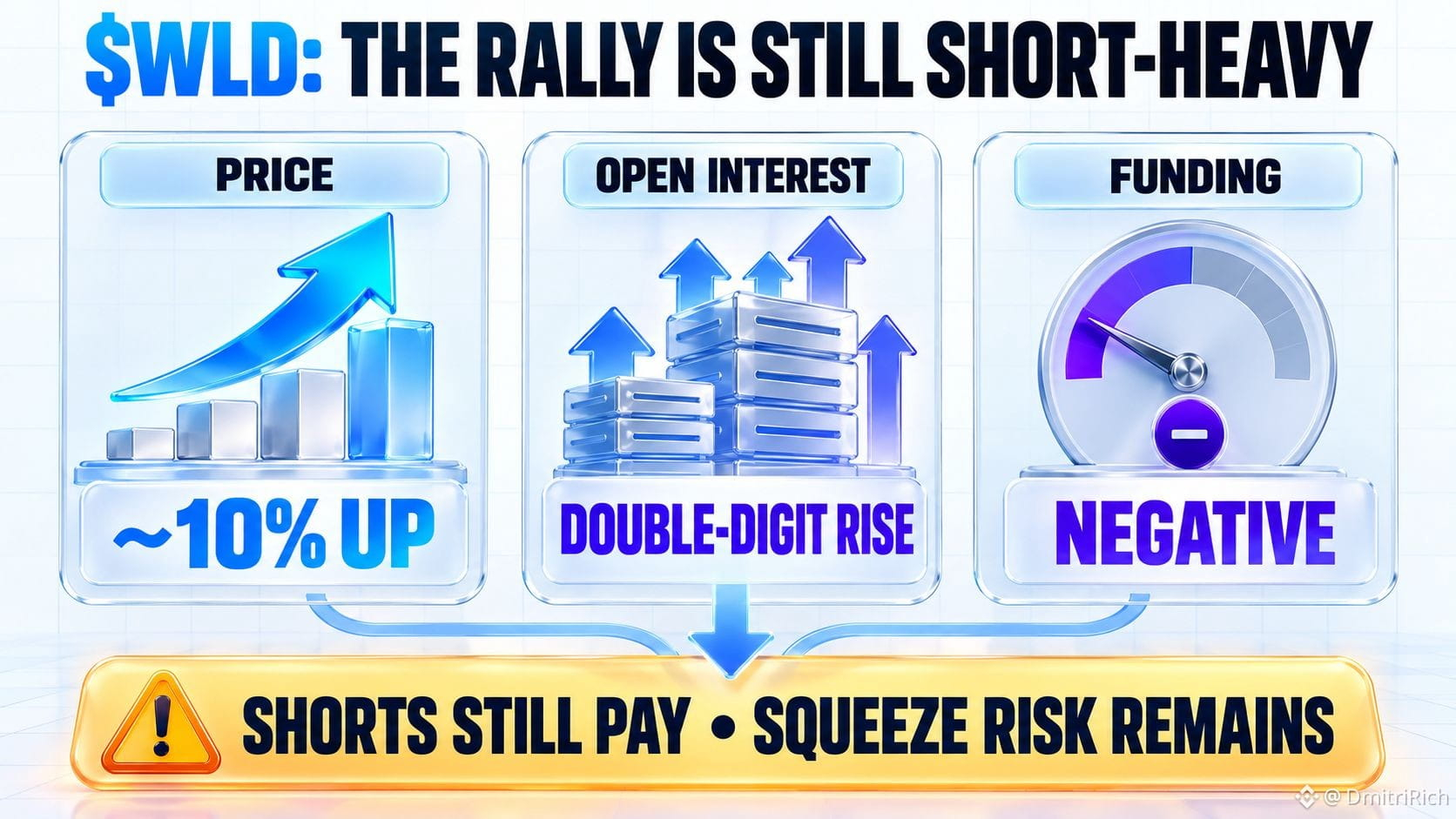
$WLD is rallying, but the derivatives board still leans bearish.
#Worldcoin is trading near $0.54, roughly 10% above the previous close. Loris Tools shows about $1.1 billion in 24-hour perpetual volume, open interest near $483 million and up 19%, while average funding remains negative. Coinalyze shows different venue-level totals, but the same structure: price and open interest rising while shorts are still paying longs.
That is not the usual late-stage long chase. New leverage is still leaning against the move.
If $WLD holds its gains while funding resets toward neutral, the rally becomes healthier. If price keeps making new highs while funding stays negative, the squeeze can extend.
The warning comes if price stalls while open interest keeps expanding, that leaves a crowded market vulnerable to a fast liquidation move.
{future}(WLDUSDT)
$WLD is rallying, but the derivatives board still leans bearish.
#Worldcoin is trading near $0.54, roughly 10% above the previous close. Loris Tools shows about $1.1 billion in 24-hour perpetual volume, open interest near $483 million and up 19%, while average funding remains negative. Coinalyze shows different venue-level totals, but the same structure: price and open interest rising while shorts are still paying longs.
That is not the usual late-stage long chase. New leverage is still leaning against the move.
If $WLD holds its gains while funding resets toward neutral, the rally becomes healthier. If price keeps making new highs while funding stays negative, the squeeze can extend.
The warning comes if price stalls while open interest keeps expanding, that leaves a crowded market vulnerable to a fast liquidation move.
#Worldcoin is trading near $0.54, roughly 10% above the previous close. Loris Tools shows about $1.1 billion in 24-hour perpetual volume, open interest near $483 million and up 19%, while average funding remains negative. Coinalyze shows different venue-level totals, but the same structure: price and open interest rising while shorts are still paying longs.
That is not the usual late-stage long chase. New leverage is still leaning against the move.
If $WLD holds its gains while funding resets toward neutral, the rally becomes healthier. If price keeps making new highs while funding stays negative, the squeeze can extend.
The warning comes if price stalls while open interest keeps expanding, that leaves a crowded market vulnerable to a fast liquidation move.
168
·
--
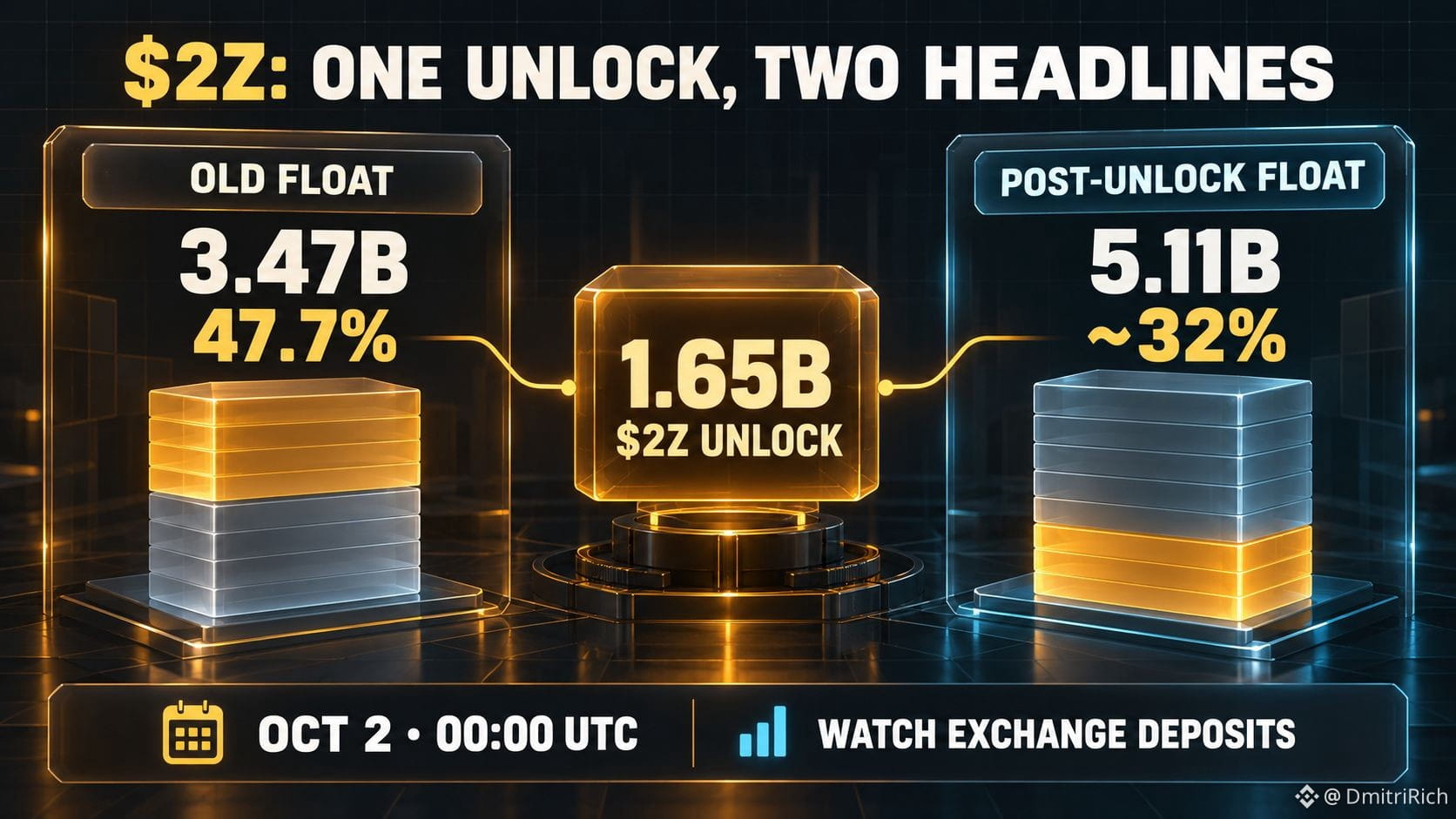
$2Z’s October 2 unlock is being sold as a simple 47.7% supply shock. The number is real only against the old float.
About 1.65 billion $2Z is scheduled to unlock at 00:00 UTC, with the largest tranches going to Jump Crypto, Malbec Labs, institutions and the team. #CoinMarketCap. still shows 3.47 billion tokens circulating, which makes the event nearly 48% of float. #DeFiLlama and Tokenomist already show roughly 5.11 billion, effectively counting the post-unlock supply; on that base, the same event is about 32%.
That accounting gap matters more than the headline. $2Z is already down roughly 9% over 24 hours, but funding is mixed across venues rather than showing one clean crowded short.
The useful confirmation comes after the unlock: watch whether recipient wallets send tokens to exchanges and whether spot volume can absorb them. No deposits, no automatic dump. Heavy deposits with weak bids would validate the bearish thesis.
$2Z ’s October 2 unlock is being sold as a simple 47.7% supply shock. The number is real only against the old float.
About 1.65 billion $2Z is scheduled to unlock at 00:00 UTC, with the largest tranches going to Jump Crypto, Malbec Labs, institutions and the team. #CoinMarketCap. still shows 3.47 billion tokens circulating, which makes the event nearly 48% of float. #DeFiLlama and Tokenomist already show roughly 5.11 billion, effectively counting the post-unlock supply; on that base, the same event is about 32%.
That accounting gap matters more than the headline. $2Z is already down roughly 9% over 24 hours, but funding is mixed across venues rather than showing one clean crowded short.
The useful confirmation comes after the unlock: watch whether recipient wallets send tokens to exchanges and whether spot volume can absorb them. No deposits, no automatic dump. Heavy deposits with weak bids would validate the bearish thesis.
About 1.65 billion $2Z is scheduled to unlock at 00:00 UTC, with the largest tranches going to Jump Crypto, Malbec Labs, institutions and the team. #CoinMarketCap. still shows 3.47 billion tokens circulating, which makes the event nearly 48% of float. #DeFiLlama and Tokenomist already show roughly 5.11 billion, effectively counting the post-unlock supply; on that base, the same event is about 32%.
That accounting gap matters more than the headline. $2Z is already down roughly 9% over 24 hours, but funding is mixed across venues rather than showing one clean crowded short.
The useful confirmation comes after the unlock: watch whether recipient wallets send tokens to exchanges and whether spot volume can absorb them. No deposits, no automatic dump. Heavy deposits with weak bids would validate the bearish thesis.
124
·
--
So $BTC just failed the cleanest version of the post-PCE bull case.
#bitcoin spiked to $85.5K after softer core inflation, then slipped back below $84K within hours. Meanwhile, U.S. stocks stayed green and Treasury yields remained slightly lower. That divergence matters: the macro headline helped, but crypto-specific supply was still strong enough to erase the breakout.
This makes $85K a cleaner level than before. A reclaim now would show buyers can absorb the first wave of profit-taking. Continued rejection says the PCE move was liquidity, not acceptance.
The next test is no longer whether inflation cooled. It did. The test is whether spot demand can hold a breakout without leverage doing the work. Until $85K is recovered, chasing the first green candle is the weaker trade.
{future}(BTCUSDT)
So $BTC just failed the cleanest version of the post-PCE bull case.
#bitcoin spiked to $85.5K after softer core inflation, then slipped back below $84K within hours. Meanwhile, U.S. stocks stayed green and Treasury yields remained slightly lower. That divergence matters: the macro headline helped, but crypto-specific supply was still strong enough to erase the breakout.
This makes $85K a cleaner level than before. A reclaim now would show buyers can absorb the first wave of profit-taking. Continued rejection says the PCE move was liquidity, not acceptance.
The next test is no longer whether inflation cooled. It did. The test is whether spot demand can hold a breakout without leverage doing the work. Until $85K is recovered, chasing the first green candle is the weaker trade.
#bitcoin spiked to $85.5K after softer core inflation, then slipped back below $84K within hours. Meanwhile, U.S. stocks stayed green and Treasury yields remained slightly lower. That divergence matters: the macro headline helped, but crypto-specific supply was still strong enough to erase the breakout.
This makes $85K a cleaner level than before. A reclaim now would show buyers can absorb the first wave of profit-taking. Continued rejection says the PCE move was liquidity, not acceptance.
The next test is no longer whether inflation cooled. It did. The test is whether spot demand can hold a breakout without leverage doing the work. Until $85K is recovered, chasing the first green candle is the weaker trade.

47
·
--
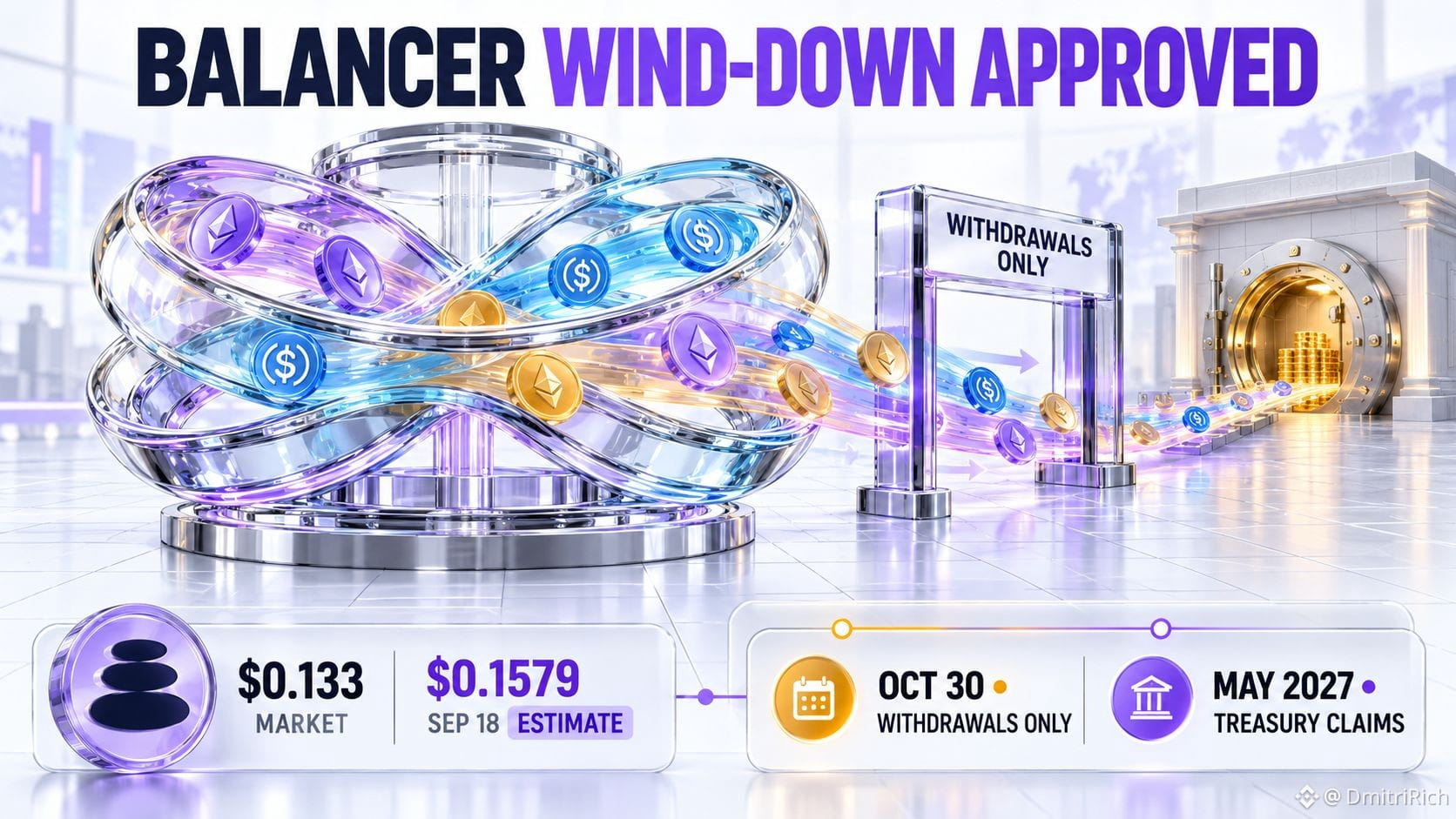
Balancer’s shutdown vote is not a clean 16-cent arbitrage.
More than 99% of votes backed BIP-928. Pausable pools move to withdrawals-only on Oct 30, and the bug bounty ends the same day. $BAL holders are expected to burn tokens from late May 2027 for a pro-rata share of treasury assets distributed in kind.
$BAL trades around $0.133, while the proposal’s Sep 18 measurement estimated $0.1579 per redeemable BAL. The discount looks interesting, but the payout is not fixed. Treasury holdings, token prices, wind-down costs and the final snapshot can all change before claims open.
For LPs, Oct 30 matters more than today’s candle. For traders, this is now a liquidation-value setup with a long wait, not a protocol-growth thesis.
Balancer’s shutdown vote is not a clean 16-cent arbitrage.
More than 99% of votes backed BIP-928. Pausable pools move to withdrawals-only on Oct 30, and the bug bounty ends the same day. $BAL holders are expected to burn tokens from late May 2027 for a pro-rata share of treasury assets distributed in kind.
$BAL trades around $0.133, while the proposal’s Sep 18 measurement estimated $0.1579 per redeemable BAL. The discount looks interesting, but the payout is not fixed. Treasury holdings, token prices, wind-down costs and the final snapshot can all change before claims open.
For LPs, Oct 30 matters more than today’s candle. For traders, this is now a liquidation-value setup with a long wait, not a protocol-growth thesis.
More than 99% of votes backed BIP-928. Pausable pools move to withdrawals-only on Oct 30, and the bug bounty ends the same day. $BAL holders are expected to burn tokens from late May 2027 for a pro-rata share of treasury assets distributed in kind.
$BAL trades around $0.133, while the proposal’s Sep 18 measurement estimated $0.1579 per redeemable BAL. The discount looks interesting, but the payout is not fixed. Treasury holdings, token prices, wind-down costs and the final snapshot can all change before claims open.
For LPs, Oct 30 matters more than today’s candle. For traders, this is now a liquidation-value setup with a long wait, not a protocol-growth thesis.
37
·
--
Verified
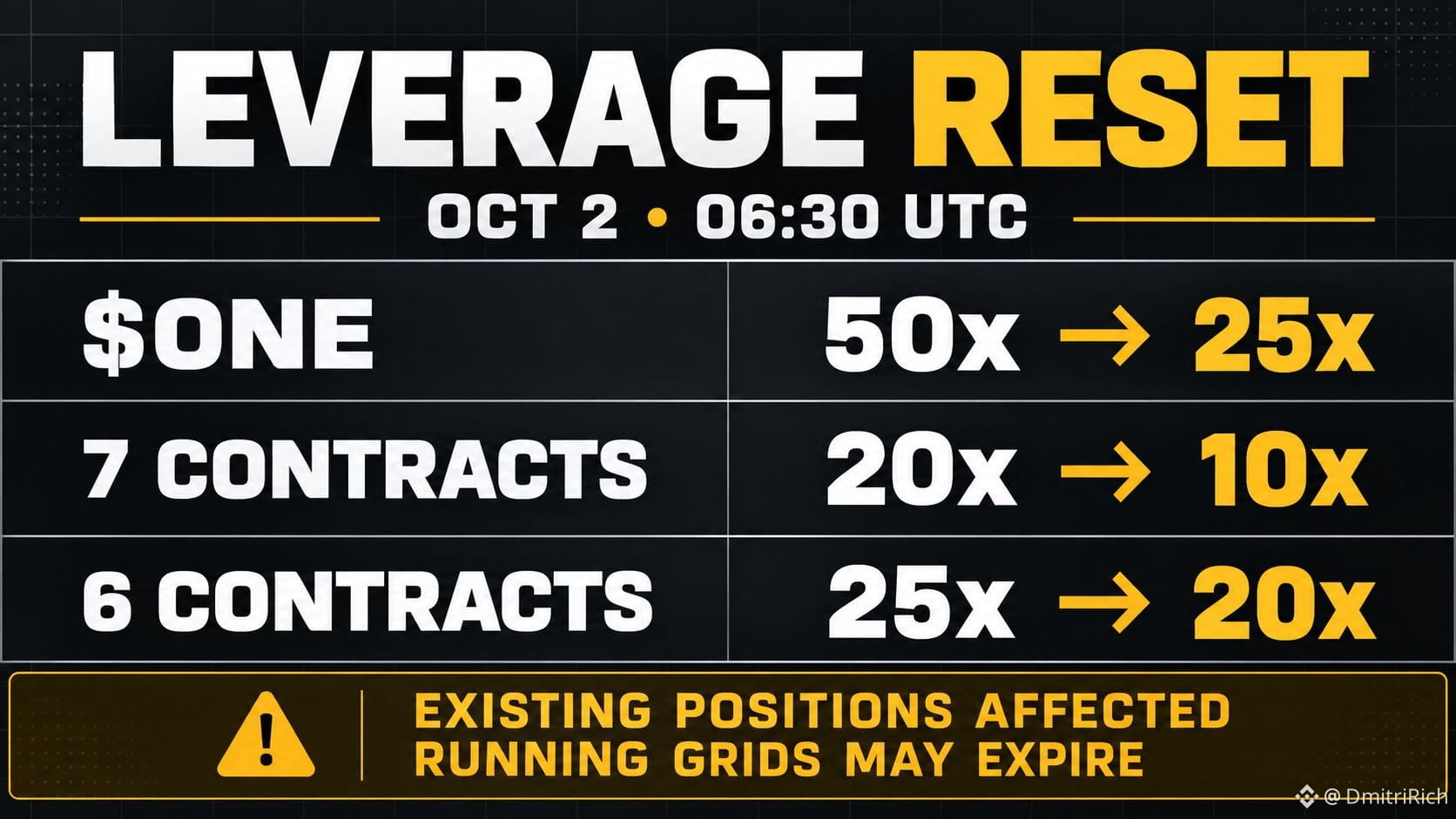
Binance’s Oct 2 futures update is more than a routine table change. It cuts the top leverage tier on 14 USDⓈ-M contracts and existing positions are affected.
The sharpest reset is $ONE : maximum leverage falls from 50x to 25x.
$MOVE, $EPIC, $AWE, $SOPH, $AVA, $ARK and $RAVE lose their 11–20x tier, leaving 10x as the new maximum.
$UAI, $BLUR, $VELODROME, $MOVR, $B2 and $LSK lose the 21–25x tier.
The practical risk is not the headline. It is margin mechanics.
#Binance says running #futures grids may expire, while the new tiers can change liquidation buffers.
Before 06:30 UTC on Oct. 2, check leverage, grid settings and liquidation distance, not just direction.👀
{future}(ONEUSDT)
Binance’s Oct 2 futures update is more than a routine table change. It cuts the top leverage tier on 14 USDⓈ-M contracts and existing positions are affected.
The sharpest reset is $ONE : maximum leverage falls from 50x to 25x.
$MOVE, $EPIC, $AWE, $SOPH, $AVA, $ARK and $RAVE lose their 11–20x tier, leaving 10x as the new maximum.
$UAI, $BLUR, $VELODROME, $MOVR, $B2 and $LSK lose the 21–25x tier.
The practical risk is not the headline. It is margin mechanics.
#Binance says running #futures grids may expire, while the new tiers can change liquidation buffers.
Before 06:30 UTC on Oct. 2, check leverage, grid settings and liquidation distance, not just direction.👀
The sharpest reset is $ONE : maximum leverage falls from 50x to 25x.
$MOVE, $EPIC, $AWE, $SOPH, $AVA, $ARK and $RAVE lose their 11–20x tier, leaving 10x as the new maximum.
$UAI, $BLUR, $VELODROME, $MOVR, $B2 and $LSK lose the 21–25x tier.
The practical risk is not the headline. It is margin mechanics.
#Binance says running #futures grids may expire, while the new tiers can change liquidation buffers.
Before 06:30 UTC on Oct. 2, check leverage, grid settings and liquidation distance, not just direction.👀
1k
·
--
Be informed #Binance 's Oct 2 Margin and Loans removal covers $REQ , $WIN , $GNS , $TFUEL, $GNO, $QKC, $LAZIO and $OSMO.
Open liabilities can trigger sales of other collateral, isolated orders will be cancelled.
Borrowing stops Sep 30.
Check exposure before the cutoff 👀
Be informed #Binance 's Oct 2 Margin and Loans removal covers $REQ , $WIN , $GNS , $TFUEL, $GNO, $QKC, $LAZIO and $OSMO.
Open liabilities can trigger sales of other collateral, isolated orders will be cancelled.
Borrowing stops Sep 30.
Check exposure before the cutoff 👀
Open liabilities can trigger sales of other collateral, isolated orders will be cancelled.
Borrowing stops Sep 30.
Check exposure before the cutoff 👀

246
·
--
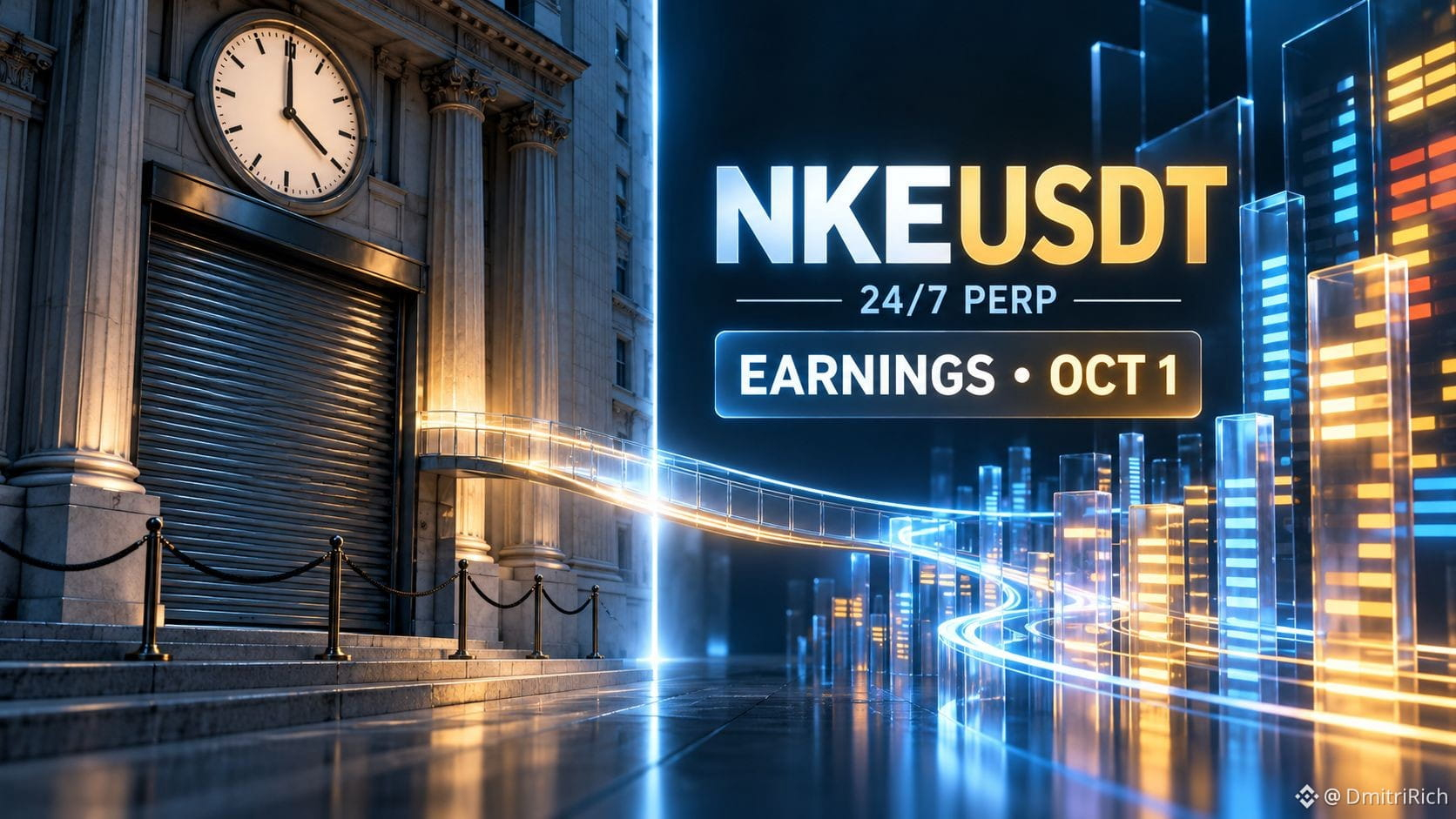
The timing of #Binance 's new $NKE / $USDT perpetual matters more than the listing itself.
It launched today, two days before #NIKE plans to report earnings on Oct 1, after the US stock market closes. The contract trades 24/7, settles in USDT and allows up to 20x leverage. That creates a live market for the earnings reaction even when the underlying stock is outside regular trading hours.
But this is a perpetual contract, not a Nike share. During off-hours, its pricing relies partly on the futures market and smoothing mechanisms. A fast move in the perp is useful information, not a guaranteed preview of where the stock will open.
The real test: how $NKEUSDT responds to the release, whether spreads and funding become costly, and how that reaction compares with the underlying stock when regular trading resumes.
{future}(NKEUSDT)
The timing of #Binance 's new $NKE / $USDT perpetual matters more than the listing itself.
It launched today, two days before #NIKE plans to report earnings on Oct 1, after the US stock market closes. The contract trades 24/7, settles in USDT and allows up to 20x leverage. That creates a live market for the earnings reaction even when the underlying stock is outside regular trading hours.
But this is a perpetual contract, not a Nike share. During off-hours, its pricing relies partly on the futures market and smoothing mechanisms. A fast move in the perp is useful information, not a guaranteed preview of where the stock will open.
The real test: how $NKEUSDT responds to the release, whether spreads and funding become costly, and how that reaction compares with the underlying stock when regular trading resumes.
It launched today, two days before #NIKE plans to report earnings on Oct 1, after the US stock market closes. The contract trades 24/7, settles in USDT and allows up to 20x leverage. That creates a live market for the earnings reaction even when the underlying stock is outside regular trading hours.
But this is a perpetual contract, not a Nike share. During off-hours, its pricing relies partly on the futures market and smoothing mechanisms. A fast move in the perp is useful information, not a guaranteed preview of where the stock will open.
The real test: how $NKEUSDT responds to the release, whether spreads and funding become costly, and how that reaction compares with the underlying stock when regular trading resumes.
157
·
--
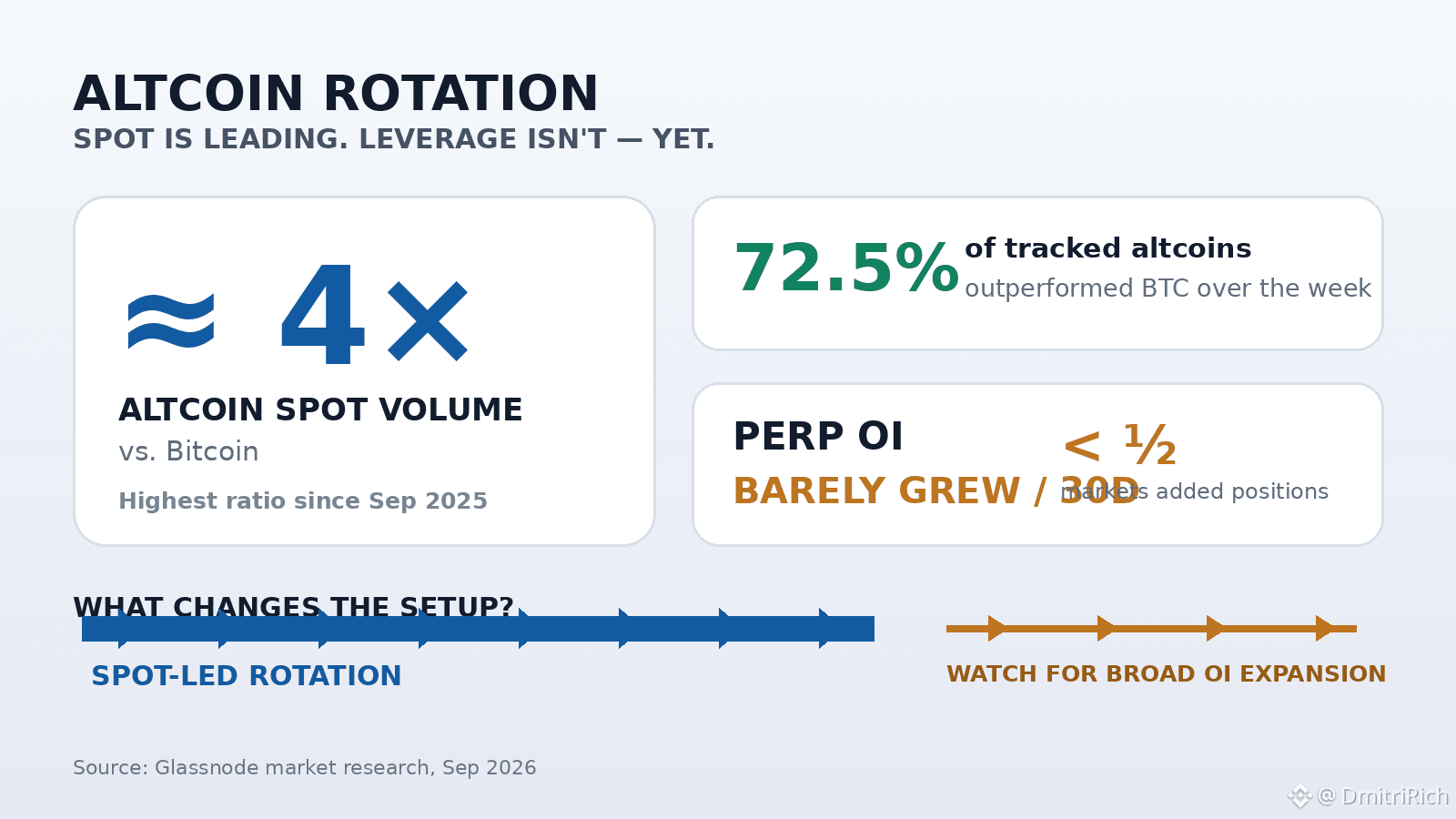
Altcoin spot volume is now running close to 4x Bitcoin’s, the highest ratio since September 2025.
That sounds like “altseason.” The leverage data says something more useful.
#Glassnode found that 72.5% of tracked altcoins outperformed $BTC over the prior week, while altcoin perpetual open interest barely grew over 30 days and fewer than half of markets added positions.
So this rotation is still being driven mostly by spot activity, not a broad leverage build. That lowers the risk of a sudden liquidation cascade compared with the overheated setups seen in 2021 and 2024.
But 4x volume does not mean 4x new money. Volume measures trading activity, not net buying. Glassnode also notes that this kind of high-risk demand has often appeared near local $BTC tops.
The signal I’d watch next is simple: broad altcoin OI expansion.
Spot rotation is healthy. A leverage chase would change the setup fast.
{future}(BTCUSDT)
Altcoin spot volume is now running close to 4x Bitcoin’s, the highest ratio since September 2025.
That sounds like “altseason.” The leverage data says something more useful.
#Glassnode found that 72.5% of tracked altcoins outperformed $BTC over the prior week, while altcoin perpetual open interest barely grew over 30 days and fewer than half of markets added positions.
So this rotation is still being driven mostly by spot activity, not a broad leverage build. That lowers the risk of a sudden liquidation cascade compared with the overheated setups seen in 2021 and 2024.
But 4x volume does not mean 4x new money. Volume measures trading activity, not net buying. Glassnode also notes that this kind of high-risk demand has often appeared near local $BTC tops.
The signal I’d watch next is simple: broad altcoin OI expansion.
Spot rotation is healthy. A leverage chase would change the setup fast.
That sounds like “altseason.” The leverage data says something more useful.
#Glassnode found that 72.5% of tracked altcoins outperformed $BTC over the prior week, while altcoin perpetual open interest barely grew over 30 days and fewer than half of markets added positions.
So this rotation is still being driven mostly by spot activity, not a broad leverage build. That lowers the risk of a sudden liquidation cascade compared with the overheated setups seen in 2021 and 2024.
But 4x volume does not mean 4x new money. Volume measures trading activity, not net buying. Glassnode also notes that this kind of high-risk demand has often appeared near local $BTC tops.
The signal I’d watch next is simple: broad altcoin OI expansion.
Spot rotation is healthy. A leverage chase would change the setup fast.
74
·
--
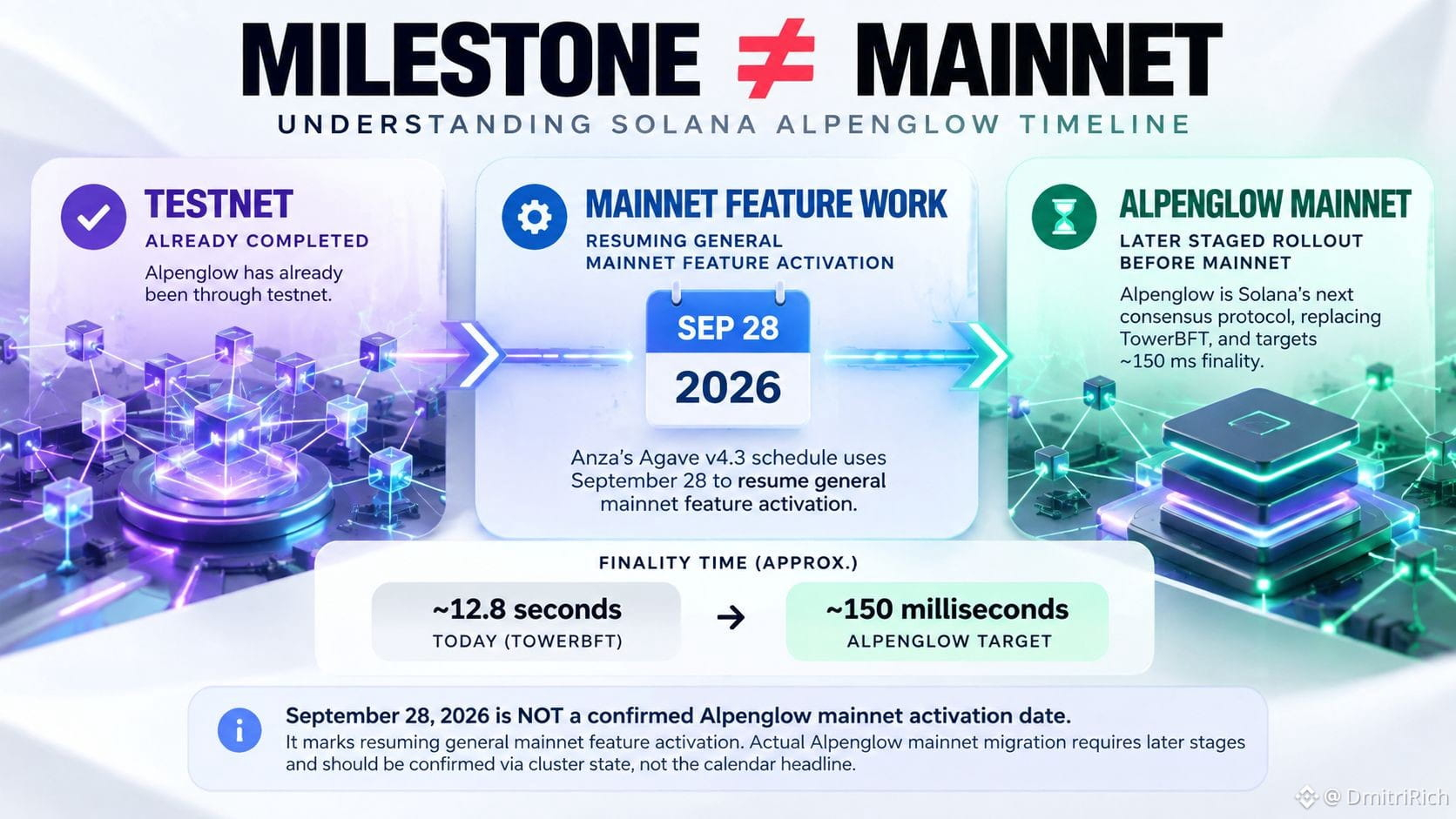
Sep 28 is being treated like Solana’s Alpenglow mainnet launch. It isn’t.
Anza’s corrected Agave v4.3 schedule says today is when general mainnet feature activation resumes. Alpenglow itself has been rolling out testnet-first, then devnet, with mainnet-beta coming only after an observation period.
That distinction matters because the upgrade is a big one: #Alpenglow replaces TowerBFT with Votor and targets roughly 150ms finality versus about 12.8 seconds today.
But installing the software, resuming feature gates and actually migrating consensus are three different milestones.
So a “$SOL gets 150ms finality today” headline is ahead of the evidence.
The useful confirmation isn’t the calendar. It’s cluster state showing Alpenglow has actually migrated on mainnet-beta.
Until then, Sep 28 is a rollout milestone, not the finish line.
{future}(SOLUSDT)
Sep 28 is being treated like Solana’s Alpenglow mainnet launch. It isn’t.
Anza’s corrected Agave v4.3 schedule says today is when general mainnet feature activation resumes. Alpenglow itself has been rolling out testnet-first, then devnet, with mainnet-beta coming only after an observation period.
That distinction matters because the upgrade is a big one: #Alpenglow replaces TowerBFT with Votor and targets roughly 150ms finality versus about 12.8 seconds today.
But installing the software, resuming feature gates and actually migrating consensus are three different milestones.
So a “$SOL gets 150ms finality today” headline is ahead of the evidence.
The useful confirmation isn’t the calendar. It’s cluster state showing Alpenglow has actually migrated on mainnet-beta.
Until then, Sep 28 is a rollout milestone, not the finish line.
Anza’s corrected Agave v4.3 schedule says today is when general mainnet feature activation resumes. Alpenglow itself has been rolling out testnet-first, then devnet, with mainnet-beta coming only after an observation period.
That distinction matters because the upgrade is a big one: #Alpenglow replaces TowerBFT with Votor and targets roughly 150ms finality versus about 12.8 seconds today.
But installing the software, resuming feature gates and actually migrating consensus are three different milestones.
So a “$SOL gets 150ms finality today” headline is ahead of the evidence.
The useful confirmation isn’t the calendar. It’s cluster state showing Alpenglow has actually migrated on mainnet-beta.
Until then, Sep 28 is a rollout milestone, not the finish line.
42
·
--
Make your assets work for you. Momentum is everything.
Top #THENA TVL pools are waiting for you:
▹ $BNB by #Binance : ecosystem backbone, holding strong
▹ $SINGULARRY by #singularryai : DeFAI meta is the future
▹ $ETH be #Ethereum : still got plenty of power
Assess, decide, execute. Success requires $THE action.
Make your assets work for you. Momentum is everything.
Top #THENA TVL pools are waiting for you:
▹ $BNB by #Binance : ecosystem backbone, holding strong
▹ $SINGULARRY by #singularryai : DeFAI meta is the future
▹ $ETH be #Ethereum : still got plenty of power
Assess, decide, execute. Success requires $THE action.
Top #THENA TVL pools are waiting for you:
▹ $BNB by #Binance : ecosystem backbone, holding strong
▹ $SINGULARRY by #singularryai : DeFAI meta is the future
▹ $ETH be #Ethereum : still got plenty of power
Assess, decide, execute. Success requires $THE action.
52
·
--
Bullish
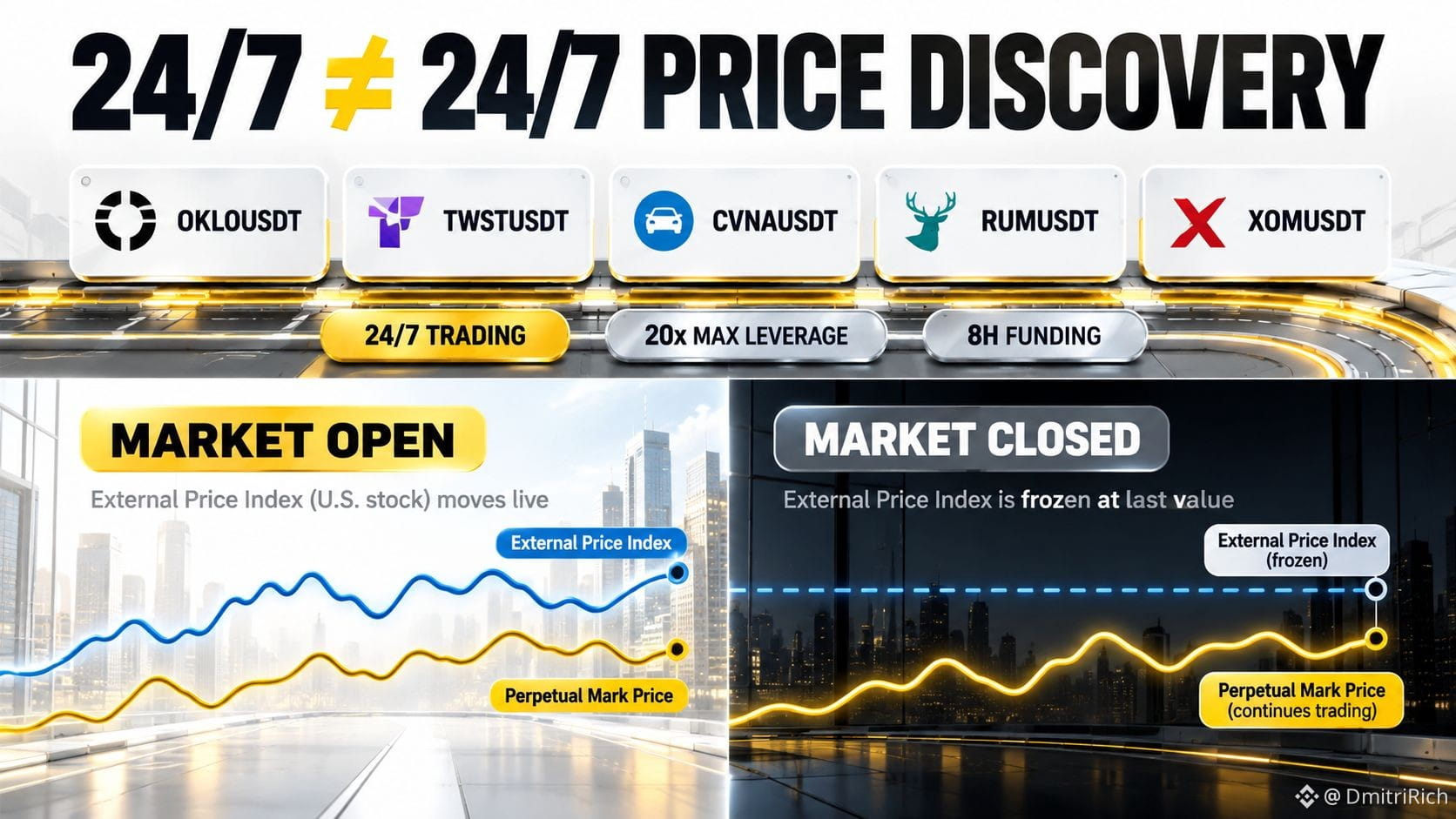
Binance just added 5 stock-linked perps: OKLO, TWST, $CVNA , $RUM and XOM. The part traders can’t treat like normal crypto perps is the clock.
All five trade 24/7 with up to 20x leverage and funding every 8 hours. But the underlying U.S. stocks do not have continuous price discovery.
#Binance ’s TradFi-perp model handles that gap differently: while the external market is open, the Price Index updates every second. Outside those trading hours, the index stays at its last value, while the Mark Price uses a smoothed futures price.
That matters because liquidation is based on Mark Price, not simply the last stock print.
So overnight or weekend exposure is not just “stock trading after hours.” You’re trading a perpetual while its external reference market may be closed.
The new contracts are useful. The risk model is the part worth learning before using the 20x button!
{future}(XOMUSDT)
{future}(TWSTUSDT)
{future}(OKLOUSDT)
Binance just added 5 stock-linked perps: OKLO, TWST, $CVNA , $RUM and XOM. The part traders can’t treat like normal crypto perps is the clock.
All five trade 24/7 with up to 20x leverage and funding every 8 hours. But the underlying U.S. stocks do not have continuous price discovery.
#Binance ’s TradFi-perp model handles that gap differently: while the external market is open, the Price Index updates every second. Outside those trading hours, the index stays at its last value, while the Mark Price uses a smoothed futures price.
That matters because liquidation is based on Mark Price, not simply the last stock print.
So overnight or weekend exposure is not just “stock trading after hours.” You’re trading a perpetual while its external reference market may be closed.
The new contracts are useful. The risk model is the part worth learning before using the 20x button!
All five trade 24/7 with up to 20x leverage and funding every 8 hours. But the underlying U.S. stocks do not have continuous price discovery.
#Binance ’s TradFi-perp model handles that gap differently: while the external market is open, the Price Index updates every second. Outside those trading hours, the index stays at its last value, while the Mark Price uses a smoothed futures price.
That matters because liquidation is based on Mark Price, not simply the last stock print.
So overnight or weekend exposure is not just “stock trading after hours.” You’re trading a perpetual while its external reference market may be closed.
The new contracts are useful. The risk model is the part worth learning before using the 20x button!
288
·
--
FF has an unlock tomorrow. The problem is that the headline number itself is disputed.
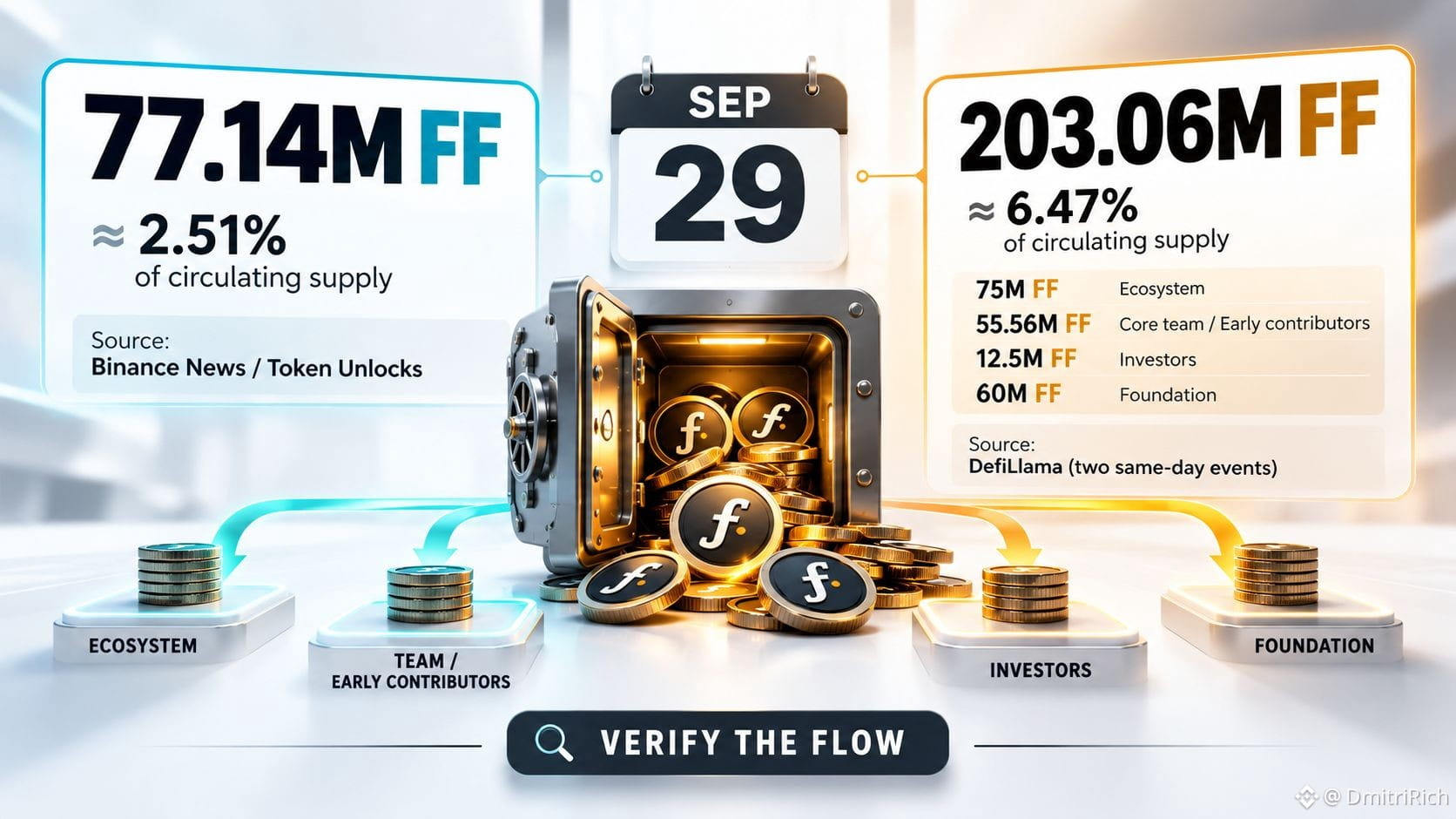
#Binance News, citing Token Unlocks data, says about 77.14M $FF unlocks on Sept 29, roughly 2.51% of circulating supply.
#DeFiLlama currently shows two same-day events totaling about 203.06M FF: 75M ecosystem tokens, plus 55.56M for the core team/early contributors, 12.5M for investors and 60M for the foundation.
Falcon Finance’s own tokenomics confirms the important part: team and investor allocations have a one-year cliff followed by three years of vesting. But the project documentation doesn’t publish the exact Sept 29 tranche size.
So I wouldn’t trade the 77M or 203M headline as settled fact.
The useful signal comes after the cliff: which wallets actually receive tokens, how much becomes transferable, and whether any of it moves toward exchanges.
With unlock data this inconsistent, wallet flows beat calendar estimates.
{future}(FFUSDT)
FF has an unlock tomorrow. The problem is that the headline number itself is disputed.
#Binance News, citing Token Unlocks data, says about 77.14M $FF unlocks on Sept 29, roughly 2.51% of circulating supply.
#DeFiLlama currently shows two same-day events totaling about 203.06M FF: 75M ecosystem tokens, plus 55.56M for the core team/early contributors, 12.5M for investors and 60M for the foundation.
Falcon Finance’s own tokenomics confirms the important part: team and investor allocations have a one-year cliff followed by three years of vesting. But the project documentation doesn’t publish the exact Sept 29 tranche size.
So I wouldn’t trade the 77M or 203M headline as settled fact.
The useful signal comes after the cliff: which wallets actually receive tokens, how much becomes transferable, and whether any of it moves toward exchanges.
With unlock data this inconsistent, wallet flows beat calendar estimates.
#Binance News, citing Token Unlocks data, says about 77.14M $FF unlocks on Sept 29, roughly 2.51% of circulating supply.
#DeFiLlama currently shows two same-day events totaling about 203.06M FF: 75M ecosystem tokens, plus 55.56M for the core team/early contributors, 12.5M for investors and 60M for the foundation.
Falcon Finance’s own tokenomics confirms the important part: team and investor allocations have a one-year cliff followed by three years of vesting. But the project documentation doesn’t publish the exact Sept 29 tranche size.
So I wouldn’t trade the 77M or 203M headline as settled fact.
The useful signal comes after the cliff: which wallets actually receive tokens, how much becomes transferable, and whether any of it moves toward exchanges.
With unlock data this inconsistent, wallet flows beat calendar estimates.
285
·
--
2Z has a supply event coming that’s hard to ignore: about 1.6B tokens unlock on Oct 2: roughly 46–48% of today’s circulating supply.
The headline number is ugly. The useful part is who gets the tokens.
Current vesting data shows most of this release goes to insiders, with
another meaningful share going to private investors. That makes this
very different from an ecosystem-reward unlock where supply is
distributed across thousands of users.
$2Z is around $0.068 after gaining roughly 40% over the past week. So the market is actually rallying into a major dilution event.
I wouldn’t short an unlock just because the calendar says so. Unlock ≠
instant selling.
What I’d watch instead: whether those newly transferable tokens start
moving toward exchanges as Oct 2 approaches. If they don’t, the scary supply number may be less important than it looks. If they do, the market gets a real absorption test.
Five days to go.
{future}(2ZUSDT)
2Z has a supply event coming that’s hard to ignore: about 1.6B tokens unlock on Oct 2: roughly 46–48% of today’s circulating supply.
The headline number is ugly. The useful part is who gets the tokens.
Current vesting data shows most of this release goes to insiders, with
another meaningful share going to private investors. That makes this
very different from an ecosystem-reward unlock where supply is
distributed across thousands of users.
$2Z is around $0.068 after gaining roughly 40% over the past week. So the market is actually rallying into a major dilution event.
I wouldn’t short an unlock just because the calendar says so. Unlock ≠
instant selling.
What I’d watch instead: whether those newly transferable tokens start
moving toward exchanges as Oct 2 approaches. If they don’t, the scary supply number may be less important than it looks. If they do, the market gets a real absorption test.
Five days to go.
The headline number is ugly. The useful part is who gets the tokens.
Current vesting data shows most of this release goes to insiders, with
another meaningful share going to private investors. That makes this
very different from an ecosystem-reward unlock where supply is
distributed across thousands of users.
$2Z is around $0.068 after gaining roughly 40% over the past week. So the market is actually rallying into a major dilution event.
I wouldn’t short an unlock just because the calendar says so. Unlock ≠
instant selling.
What I’d watch instead: whether those newly transferable tokens start
moving toward exchanges as Oct 2 approaches. If they don’t, the scary supply number may be less important than it looks. If they do, the market gets a real absorption test.
Five days to go.

261
Log in to explore more content
Join global crypto users on Binance Square
⚡️ Get latest and useful information about crypto.
💬 Trusted by the world’s largest crypto exchange.
👍 Discover real insights from verified creators.
Email / Phone number
Trending Topics
MetaMaskExitsLidoValidatorsAfterSecurityIncident
24,515 views
538 Discussing
🚨 METAMASK JUST STARTED EXITING ETH VALIDATORS AFTER A SECURITY INCIDENT.
MetaMask says an ongoing security incident hit part of its infrastructure, forcing it to proactively exit affected validators from its non-custodial staking operations. The company says it has found no immediate threat to MetaMask wallets so far.
The key detail?
These validators are tied to Lido staking, and the exit process may temporarily remove ETH from staking while the investigation continues. Lido-related reports say the full exit, withdrawal and re-entry cycle could take up to roughly 45 days.
That means the market should separate two things:
Wallet users are not currently being told they’re at immediate risk.
But validator infrastructure clearly was serious enough to trigger an emergency exit.
And when one of Ethereum’s biggest wallet brands starts pulling validators as a precaution, traders pay attention.
Security incidents don’t need stolen funds to become market-moving.
Sometimes the reaction itself is the signal. 👀
$ETH $LDO
#metamaskexitslidovalidatorsaftersecurityincident
KimHotbae
·0 Likes
·2.5k views
MicronBeatsEarningsLiftsGuidance
18,437 views
466 Discussing
CFTCSubmitsTwoEventContractRulesToWhiteHouse
15,732 views
418 Discussing