

The Chart Oracle
146 Posts

The Chart Oracle
Report
Block User
Trader de tesis. Analizo cómo el capital fluye entre Bitcoin, IA, identidad digital y activos tokenizados. 📊🚀
Open Trade
High-Frequency Trader
3.7 Years
2 Following
73 Followers
81 Liked
Posts
Portfolio
PINNED
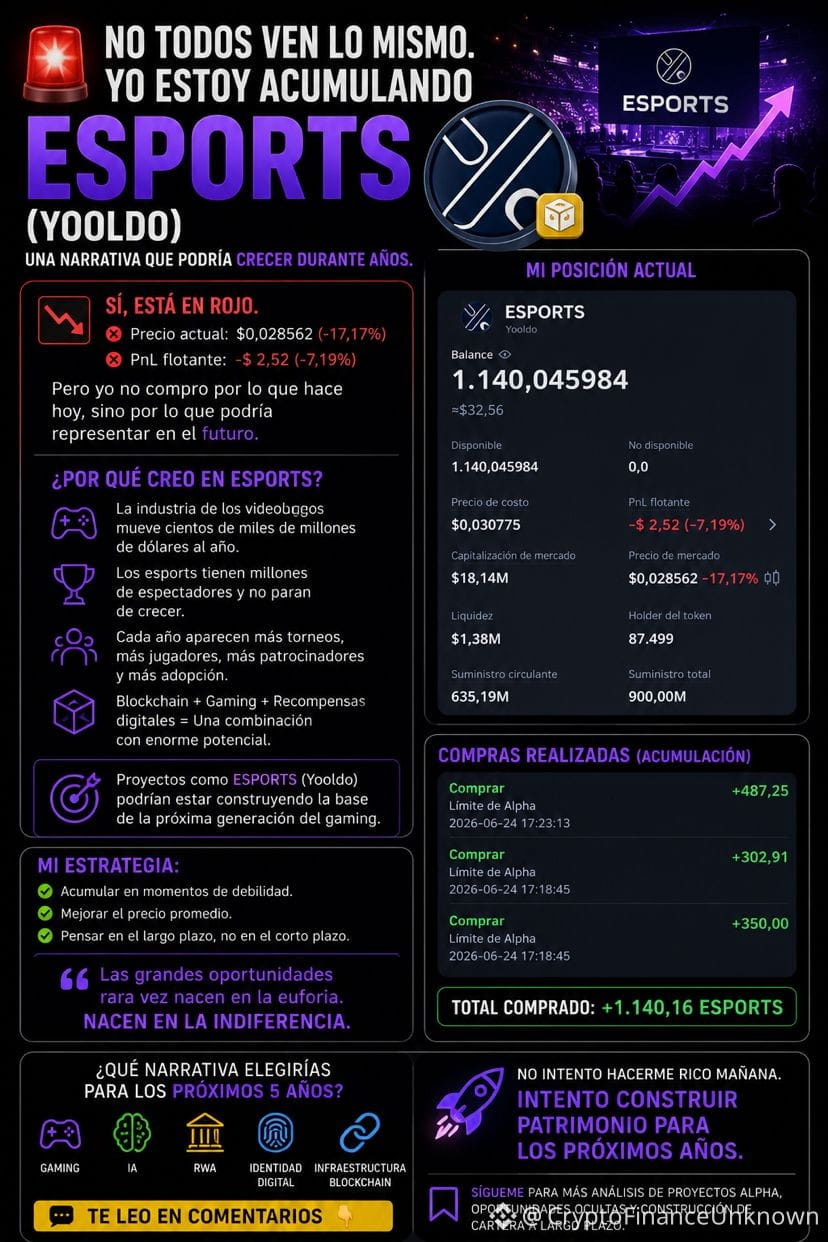
🚨 HOLD UP.
While many are chasing the next coin that has already pumped 300%...
I'm stacking a narrative that could grow over the years.
🎮 $ESPORTS (Yooldo)
And yes, I know it's currently in the red.
📉 My position shows a floating loss close to 7%.
But this is where investors separate from speculators.
Because I didn't buy ESPORTS for what it did this week.
I bought it for what it could represent in the future, and that’s the difference between trading it spot and not in futures.
💡 Let's think for a moment.
The gaming industry moves hundreds of billions of dollars a year.
Esports have millions of viewers.
More tournaments pop up every year.
More players.
More sponsors.
More adoption.
So the question I ask myself is:
🤔 What will happen when blockchain, gaming, and digital rewards integrate more and more?
That's where projects like ESPORTS catch my eye.
That's why I've been gradually accumulating the position.
📊 Over 1,140 tokens stacked.
📊 Multiple staggered buys.
📊 Improving the average price.
Because when I find a narrative I like, I don't try to guess the exact bottom.
I try to build a position.
Many investors want to buy only when everything is green.
I prefer to study projects when no one is paying attention.
Because historically, great opportunities rarely emerge in euphoria.
They tend to emerge in indifference.
Does that mean ESPORTS will be a success?
No.
No one can know for sure.
But it does mean I see enough potential to allocate a small part of my portfolio to this Alpha bet.
🚨 HOLD UP.
While many are chasing the next coin that has already pumped 300%...
I'm stacking a narrative that could grow over the years.
🎮 $ESPORTS (Yooldo)
And yes, I know it's currently in the red.
📉 My position shows a floating loss close to 7%.
But this is where investors separate from speculators.
Because I didn't buy ESPORTS for what it did this week.
I bought it for what it could represent in the future, and that’s the difference between trading it spot and not in futures.
💡 Let's think for a moment.
The gaming industry moves hundreds of billions of dollars a year.
Esports have millions of viewers.
More tournaments pop up every year.
More players.
More sponsors.
More adoption.
So the question I ask myself is:
🤔 What will happen when blockchain, gaming, and digital rewards integrate more and more?
That's where projects like ESPORTS catch my eye.
That's why I've been gradually accumulating the position.
📊 Over 1,140 tokens stacked.
📊 Multiple staggered buys.
📊 Improving the average price.
Because when I find a narrative I like, I don't try to guess the exact bottom.
I try to build a position.
Many investors want to buy only when everything is green.
I prefer to study projects when no one is paying attention.
Because historically, great opportunities rarely emerge in euphoria.
They tend to emerge in indifference.
Does that mean ESPORTS will be a success?
No.
No one can know for sure.
But it does mean I see enough potential to allocate a small part of my portfolio to this Alpha bet.
While many are chasing the next coin that has already pumped 300%...
I'm stacking a narrative that could grow over the years.
🎮 $ESPORTS (Yooldo)
And yes, I know it's currently in the red.
📉 My position shows a floating loss close to 7%.
But this is where investors separate from speculators.
Because I didn't buy ESPORTS for what it did this week.
I bought it for what it could represent in the future, and that’s the difference between trading it spot and not in futures.
💡 Let's think for a moment.
The gaming industry moves hundreds of billions of dollars a year.
Esports have millions of viewers.
More tournaments pop up every year.
More players.
More sponsors.
More adoption.
So the question I ask myself is:
🤔 What will happen when blockchain, gaming, and digital rewards integrate more and more?
That's where projects like ESPORTS catch my eye.
That's why I've been gradually accumulating the position.
📊 Over 1,140 tokens stacked.
📊 Multiple staggered buys.
📊 Improving the average price.
Because when I find a narrative I like, I don't try to guess the exact bottom.
I try to build a position.
Many investors want to buy only when everything is green.
I prefer to study projects when no one is paying attention.
Because historically, great opportunities rarely emerge in euphoria.
They tend to emerge in indifference.
Does that mean ESPORTS will be a success?
No.
No one can know for sure.
But it does mean I see enough potential to allocate a small part of my portfolio to this Alpha bet.
2
5
3.1k
PINNED
·
--
Bullish
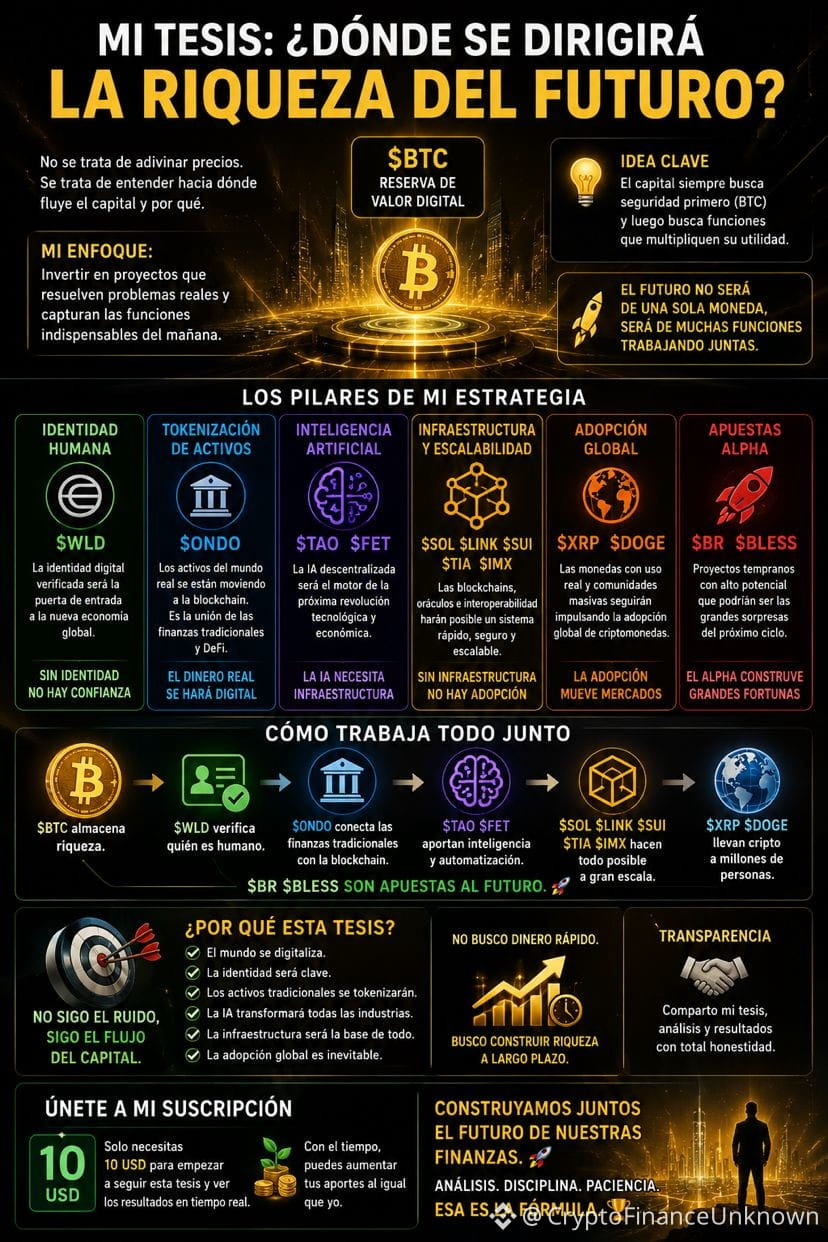
🚀 I'm building a thesis-based portfolio, not chasing quick bets.
My approach is straightforward:
🏦 #BTC as a wealth reserve.
🪪 $WLD for digital identity.
🏛️ $ONDO for asset tokenization.
🧠 #TAO and #FET for AI.
⚡ Infrastructure and Alphas like $BR and #Bless .
You don’t need thousands of dollars to get started.
In fact, I believe one can kick off with just 10 USDT and track the evolution of theses over time.
I will continue to increase my contributions gradually as my conviction grows.
If you're interested in joining this long-term experiment, analyzing ideas, sharing results, and watching how these narratives evolve over the coming years, you can join my subscription.
I don’t promise profits.
I don’t promise quick riches.
Just transparency, analysis, and the public building of a thesis on where digital wealth might head in the future.
See you in the next cycle. 🚀📈
🚀 I'm building a thesis-based portfolio, not chasing quick bets.
My approach is straightforward:
🏦 #BTC as a wealth reserve.
🪪 $WLD for digital identity.
🏛️ $ONDO for asset tokenization.
🧠 #TAO and #FET for AI.
⚡ Infrastructure and Alphas like $BR and #Bless .
You don’t need thousands of dollars to get started.
In fact, I believe one can kick off with just 10 USDT and track the evolution of theses over time.
I will continue to increase my contributions gradually as my conviction grows.
If you're interested in joining this long-term experiment, analyzing ideas, sharing results, and watching how these narratives evolve over the coming years, you can join my subscription.
I don’t promise profits.
I don’t promise quick riches.
Just transparency, analysis, and the public building of a thesis on where digital wealth might head in the future.
See you in the next cycle. 🚀📈
My approach is straightforward:
🏦 #BTC as a wealth reserve.
🪪 $WLD for digital identity.
🏛️ $ONDO for asset tokenization.
🧠 #TAO and #FET for AI.
⚡ Infrastructure and Alphas like $BR and #Bless .
You don’t need thousands of dollars to get started.
In fact, I believe one can kick off with just 10 USDT and track the evolution of theses over time.
I will continue to increase my contributions gradually as my conviction grows.
If you're interested in joining this long-term experiment, analyzing ideas, sharing results, and watching how these narratives evolve over the coming years, you can join my subscription.
I don’t promise profits.
I don’t promise quick riches.
Just transparency, analysis, and the public building of a thesis on where digital wealth might head in the future.
See you in the next cycle. 🚀📈
3
980
·
--
Bullish
$CHIP 🚨IMPORTANT
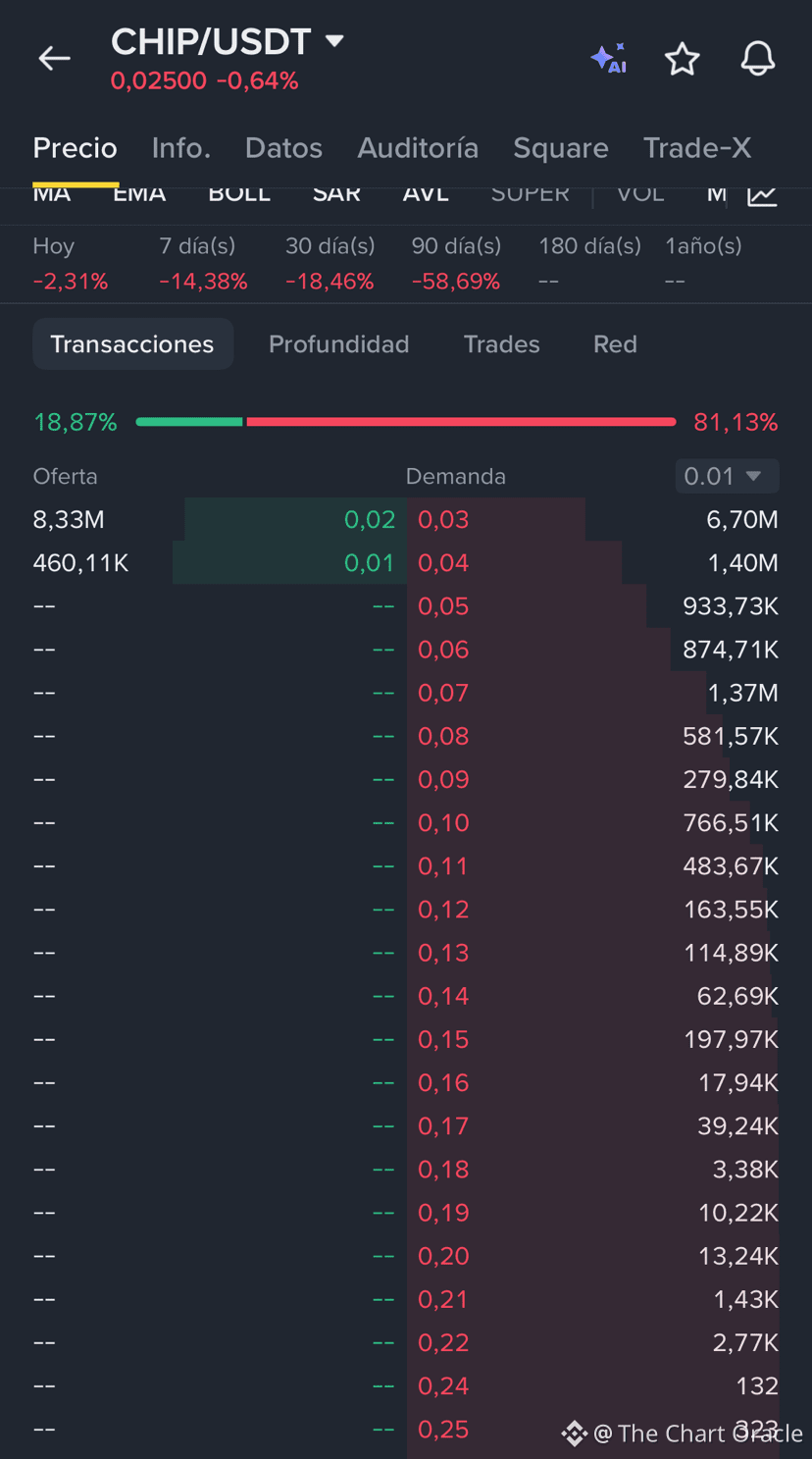
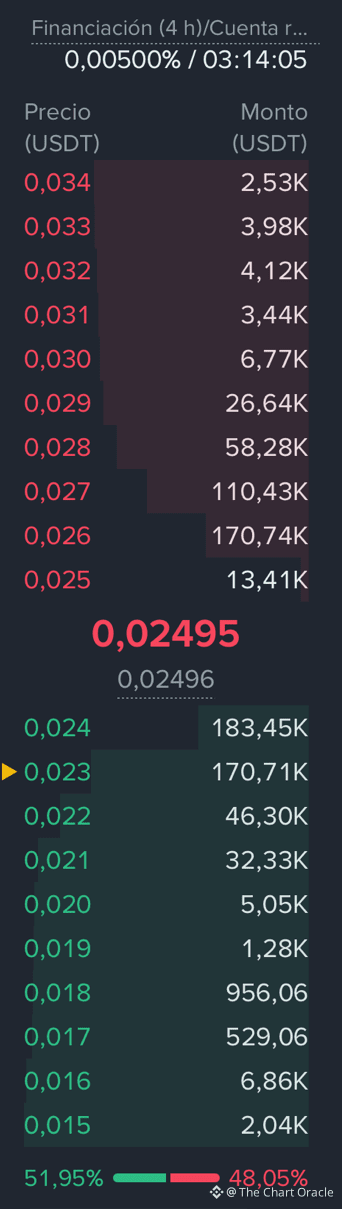
Check the order book in Spot and Futures; within the 0.023 USDT zone there is the rebound zone. Comparing both books, a large move is expected in the coming days or weeks.
ENTRY ZONE: 0.023.
Probable TPs: Time will decide—entering with leverage up to x20 is the safest; an entry at x10 could be almost definitive for taking profits.
I don't affirm any facts, I only see a great opportunity and choose to share it.
{future}(CHIPUSDT)
$CHIP 🚨IMPORTANT
Check the order book in Spot and Futures; within the 0.023 USDT zone there is the rebound zone. Comparing both books, a large move is expected in the coming days or weeks.
ENTRY ZONE: 0.023.
Probable TPs: Time will decide—entering with leverage up to x20 is the safest; an entry at x10 could be almost definitive for taking profits.
I don't affirm any facts, I only see a great opportunity and choose to share it.
Check the order book in Spot and Futures; within the 0.023 USDT zone there is the rebound zone. Comparing both books, a large move is expected in the coming days or weeks.
ENTRY ZONE: 0.023.
Probable TPs: Time will decide—entering with leverage up to x20 is the safest; an entry at x10 could be almost definitive for taking profits.
I don't affirm any facts, I only see a great opportunity and choose to share it.
1
404
·
--
Bullish
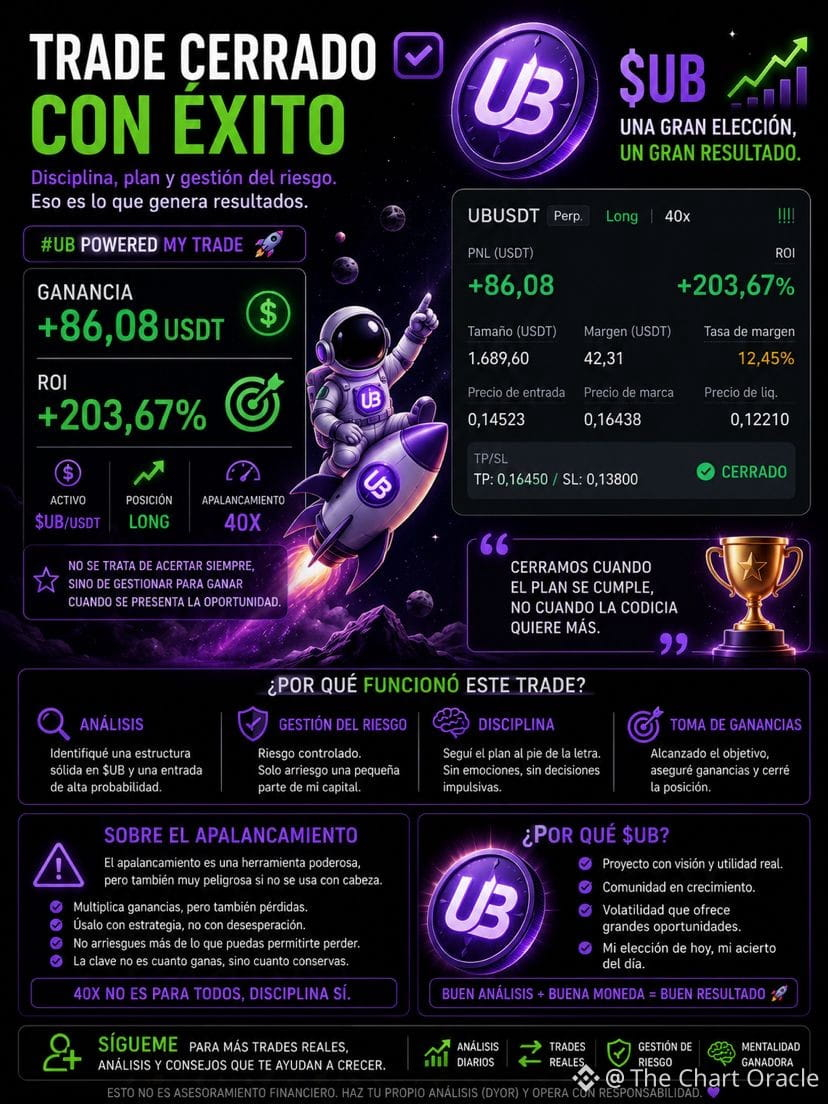
🚀 TRADE CLOSED SUCCESSFULLY: +86,08 USDT IN A FEW HOURS 📈🔥
Today I closed a trade on $UB Futures USDT with a LONG position using 40x leverage.
📊 Trade results:
💰 Profit: +86,08 USDT
📈 ROI: +203,67%
Does this mean trading with 40x is easy? Not at all.
Leverage multiplies both gains and losses. A good entry can deliver extraordinary results, but poor risk management can wipe out an account in minutes.
In this trade, I decided to close the position when the target was reached. I’m not trying to guess the market’s maximum; I’d rather lock in profits and wait for the next opportunity.
Over time I learned that a profitable trader isn’t the one who wins every trade, but the one who:
✅ Has a plan before entering.
✅ Manages risk in every trade.
✅ Doesn’t let greed decide when to exit.
✅ Protects their capital to keep trading tomorrow.
Every trade is a lesson, and every secured profit is one step closer to a consistent strategy.
📢 If you’re interested in seeing my analyses, my trades in real time, and learning about risk management, follow me. I share both wins and mistakes, because both are part of a trader’s journey.
🚀 TRADE CLOSED SUCCESSFULLY: +86,08 USDT IN A FEW HOURS 📈🔥
Today I closed a trade on $UB Futures USDT with a LONG position using 40x leverage.
📊 Trade results:
💰 Profit: +86,08 USDT
📈 ROI: +203,67%
Does this mean trading with 40x is easy? Not at all.
Leverage multiplies both gains and losses. A good entry can deliver extraordinary results, but poor risk management can wipe out an account in minutes.
In this trade, I decided to close the position when the target was reached. I’m not trying to guess the market’s maximum; I’d rather lock in profits and wait for the next opportunity.
Over time I learned that a profitable trader isn’t the one who wins every trade, but the one who:
✅ Has a plan before entering.
✅ Manages risk in every trade.
✅ Doesn’t let greed decide when to exit.
✅ Protects their capital to keep trading tomorrow.
Every trade is a lesson, and every secured profit is one step closer to a consistent strategy.
📢 If you’re interested in seeing my analyses, my trades in real time, and learning about risk management, follow me. I share both wins and mistakes, because both are part of a trader’s journey.
Today I closed a trade on $UB Futures USDT with a LONG position using 40x leverage.
📊 Trade results:
💰 Profit: +86,08 USDT
📈 ROI: +203,67%
Does this mean trading with 40x is easy? Not at all.
Leverage multiplies both gains and losses. A good entry can deliver extraordinary results, but poor risk management can wipe out an account in minutes.
In this trade, I decided to close the position when the target was reached. I’m not trying to guess the market’s maximum; I’d rather lock in profits and wait for the next opportunity.
Over time I learned that a profitable trader isn’t the one who wins every trade, but the one who:
✅ Has a plan before entering.
✅ Manages risk in every trade.
✅ Doesn’t let greed decide when to exit.
✅ Protects their capital to keep trading tomorrow.
Every trade is a lesson, and every secured profit is one step closer to a consistent strategy.
📢 If you’re interested in seeing my analyses, my trades in real time, and learning about risk management, follow me. I share both wins and mistakes, because both are part of a trader’s journey.
2
1
597
·
--
Bullish
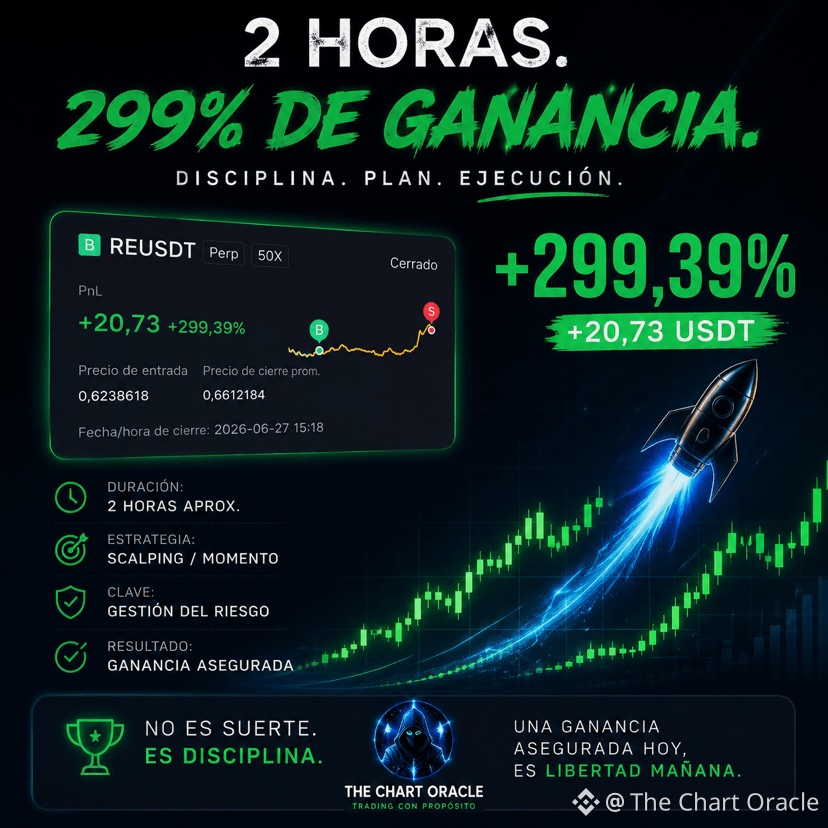
🚨 299% profit… in just 2 hours.
Today I opened a trade on REUSDT using futures and closed it as soon as it hit the target. The result was a profit of 20.73 USDT (+299.39%) in approximately 2 hours.
What’s most important wasn’t the percentage. It was discipline.
📈 Enter with a plan.
🎯 Have a clear goal.
💰 Lock in profits when the market offers them.
Many traders make the mistake of trying to squeeze the last dollar out of a trade. I prefer to secure gains and protect capital so I can keep trading tomorrow.
Futures can multiply profits, but they can also multiply losses. That’s why I never risk all my capital on a single trade. Risk management always comes before emotion.
Every successful trade isn’t an invitation to be more impulsive—it’s a reminder that consistency and patience end up delivering better results than greed.
Could I have made more? Maybe.
Do I regret taking profits? Not at all.
In trading, a locked-in profit is always worth more than an imagined one.
If you’re interested in seeing how I analyze the market, how I manage risk, and how I combine spot investments with futures trades, follow me. I share both the wins and the process behind every decision.
🚨 299% profit… in just 2 hours.
Today I opened a trade on REUSDT using futures and closed it as soon as it hit the target. The result was a profit of 20.73 USDT (+299.39%) in approximately 2 hours.
What’s most important wasn’t the percentage. It was discipline.
📈 Enter with a plan.
🎯 Have a clear goal.
💰 Lock in profits when the market offers them.
Many traders make the mistake of trying to squeeze the last dollar out of a trade. I prefer to secure gains and protect capital so I can keep trading tomorrow.
Futures can multiply profits, but they can also multiply losses. That’s why I never risk all my capital on a single trade. Risk management always comes before emotion.
Every successful trade isn’t an invitation to be more impulsive—it’s a reminder that consistency and patience end up delivering better results than greed.
Could I have made more? Maybe.
Do I regret taking profits? Not at all.
In trading, a locked-in profit is always worth more than an imagined one.
If you’re interested in seeing how I analyze the market, how I manage risk, and how I combine spot investments with futures trades, follow me. I share both the wins and the process behind every decision.
Today I opened a trade on REUSDT using futures and closed it as soon as it hit the target. The result was a profit of 20.73 USDT (+299.39%) in approximately 2 hours.
What’s most important wasn’t the percentage. It was discipline.
📈 Enter with a plan.
🎯 Have a clear goal.
💰 Lock in profits when the market offers them.
Many traders make the mistake of trying to squeeze the last dollar out of a trade. I prefer to secure gains and protect capital so I can keep trading tomorrow.
Futures can multiply profits, but they can also multiply losses. That’s why I never risk all my capital on a single trade. Risk management always comes before emotion.
Every successful trade isn’t an invitation to be more impulsive—it’s a reminder that consistency and patience end up delivering better results than greed.
Could I have made more? Maybe.
Do I regret taking profits? Not at all.
In trading, a locked-in profit is always worth more than an imagined one.
If you’re interested in seeing how I analyze the market, how I manage risk, and how I combine spot investments with futures trades, follow me. I share both the wins and the process behind every decision.
1
232
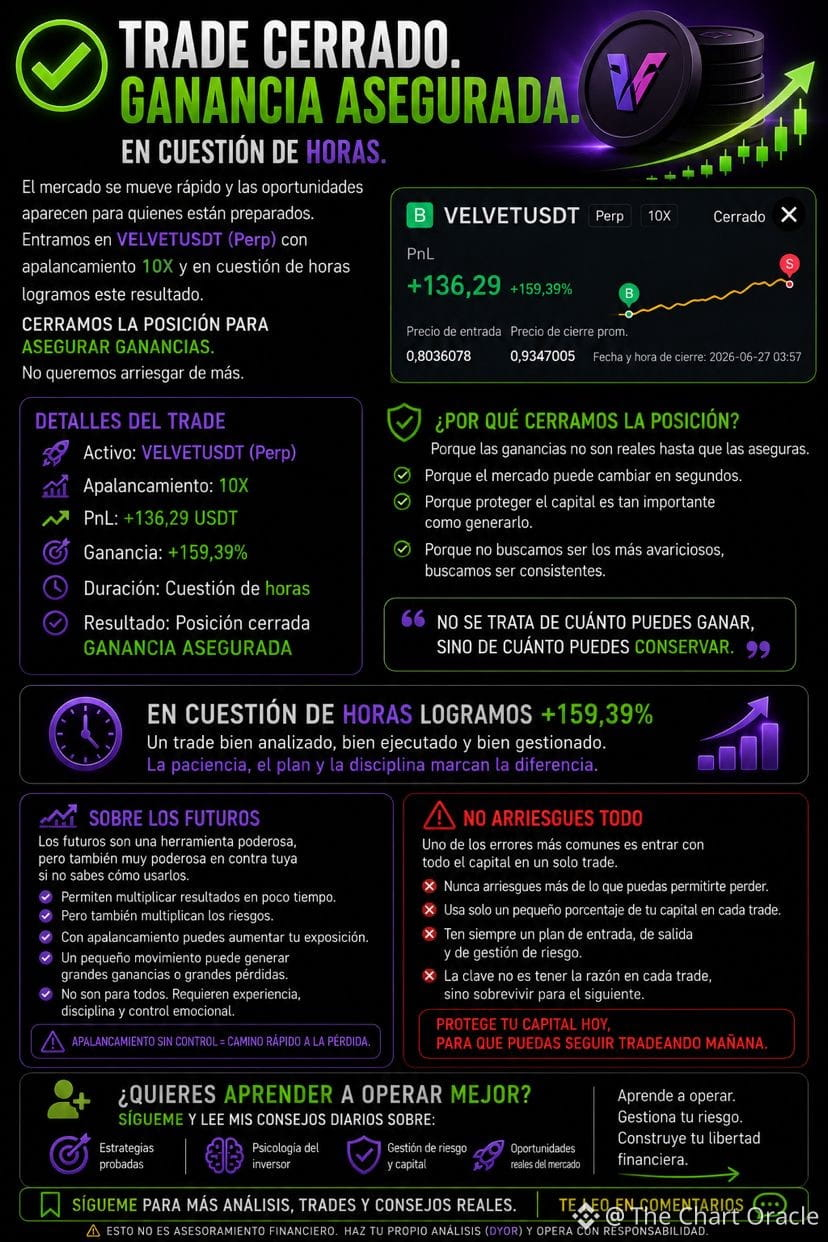
🚨 TRADE CLOSED. GUARANTEED PROFITS.
In trading, I learned a lesson that completely changed the way I operate:
It’s not always the one who earns the most who wins. Wins the one who knows how to protect their capital.
Just a few hours ago, I spotted an opportunity in $VELVET Perpetual and decided to open a futures position with a clear strategy, a defined plan, and strict risk management.
📈 Result in just a few hours:
✅ +159.39% return
💰 +136.29 USDT
And most importantly…
🔒 I decided to close the position to secure the profits.
Why?
Because the market can change in seconds.
I’m not trying to guess the last cent of an up move.
I’d rather walk away with an excellent gain than wait a bit longer and end up giving back a significant portion of the profits.
That’s risk management.
Futures are an incredible tool when used correctly.
But they can also be extremely dangerous if you trade impulsively.
That’s why I follow a few rules I never break:
✅ Never risk all the capital in a single trade.
✅ Always have an exit point before entering.
✅ Secure profits once the market has already given me a major move.
✅ Don’t let greed make the decisions.
Many traders lose entire accounts just because they want to “make a little more.”
I prefer to build consistent results, trade after trade.
Because the goal isn’t to win one trade.
The goal is to stay alive to trade the next one.
🔥 Now I want to know your opinion:
What would you do after +159% in a matter of hours?
1️⃣ I would close the position to secure profits.
2️⃣ I would let the trade run.
3️⃣ I would close only part of it.
👇 I’m reading your thoughts in the comments!
📌 Follow me if you want to see more real trades, market analysis, risk management strategies, and tips to become a better trader.
🚨 TRADE CLOSED. GUARANTEED PROFITS.
In trading, I learned a lesson that completely changed the way I operate:
It’s not always the one who earns the most who wins. Wins the one who knows how to protect their capital.
Just a few hours ago, I spotted an opportunity in $VELVET Perpetual and decided to open a futures position with a clear strategy, a defined plan, and strict risk management.
📈 Result in just a few hours:
✅ +159.39% return
💰 +136.29 USDT
And most importantly…
🔒 I decided to close the position to secure the profits.
Why?
Because the market can change in seconds.
I’m not trying to guess the last cent of an up move.
I’d rather walk away with an excellent gain than wait a bit longer and end up giving back a significant portion of the profits.
That’s risk management.
Futures are an incredible tool when used correctly.
But they can also be extremely dangerous if you trade impulsively.
That’s why I follow a few rules I never break:
✅ Never risk all the capital in a single trade.
✅ Always have an exit point before entering.
✅ Secure profits once the market has already given me a major move.
✅ Don’t let greed make the decisions.
Many traders lose entire accounts just because they want to “make a little more.”
I prefer to build consistent results, trade after trade.
Because the goal isn’t to win one trade.
The goal is to stay alive to trade the next one.
🔥 Now I want to know your opinion:
What would you do after +159% in a matter of hours?
1️⃣ I would close the position to secure profits.
2️⃣ I would let the trade run.
3️⃣ I would close only part of it.
👇 I’m reading your thoughts in the comments!
📌 Follow me if you want to see more real trades, market analysis, risk management strategies, and tips to become a better trader.
In trading, I learned a lesson that completely changed the way I operate:
It’s not always the one who earns the most who wins. Wins the one who knows how to protect their capital.
Just a few hours ago, I spotted an opportunity in $VELVET Perpetual and decided to open a futures position with a clear strategy, a defined plan, and strict risk management.
📈 Result in just a few hours:
✅ +159.39% return
💰 +136.29 USDT
And most importantly…
🔒 I decided to close the position to secure the profits.
Why?
Because the market can change in seconds.
I’m not trying to guess the last cent of an up move.
I’d rather walk away with an excellent gain than wait a bit longer and end up giving back a significant portion of the profits.
That’s risk management.
Futures are an incredible tool when used correctly.
But they can also be extremely dangerous if you trade impulsively.
That’s why I follow a few rules I never break:
✅ Never risk all the capital in a single trade.
✅ Always have an exit point before entering.
✅ Secure profits once the market has already given me a major move.
✅ Don’t let greed make the decisions.
Many traders lose entire accounts just because they want to “make a little more.”
I prefer to build consistent results, trade after trade.
Because the goal isn’t to win one trade.
The goal is to stay alive to trade the next one.
🔥 Now I want to know your opinion:
What would you do after +159% in a matter of hours?
1️⃣ I would close the position to secure profits.
2️⃣ I would let the trade run.
3️⃣ I would close only part of it.
👇 I’m reading your thoughts in the comments!
📌 Follow me if you want to see more real trades, market analysis, risk management strategies, and tips to become a better trader.
7
1
9
11.4k
·
--
Bullish
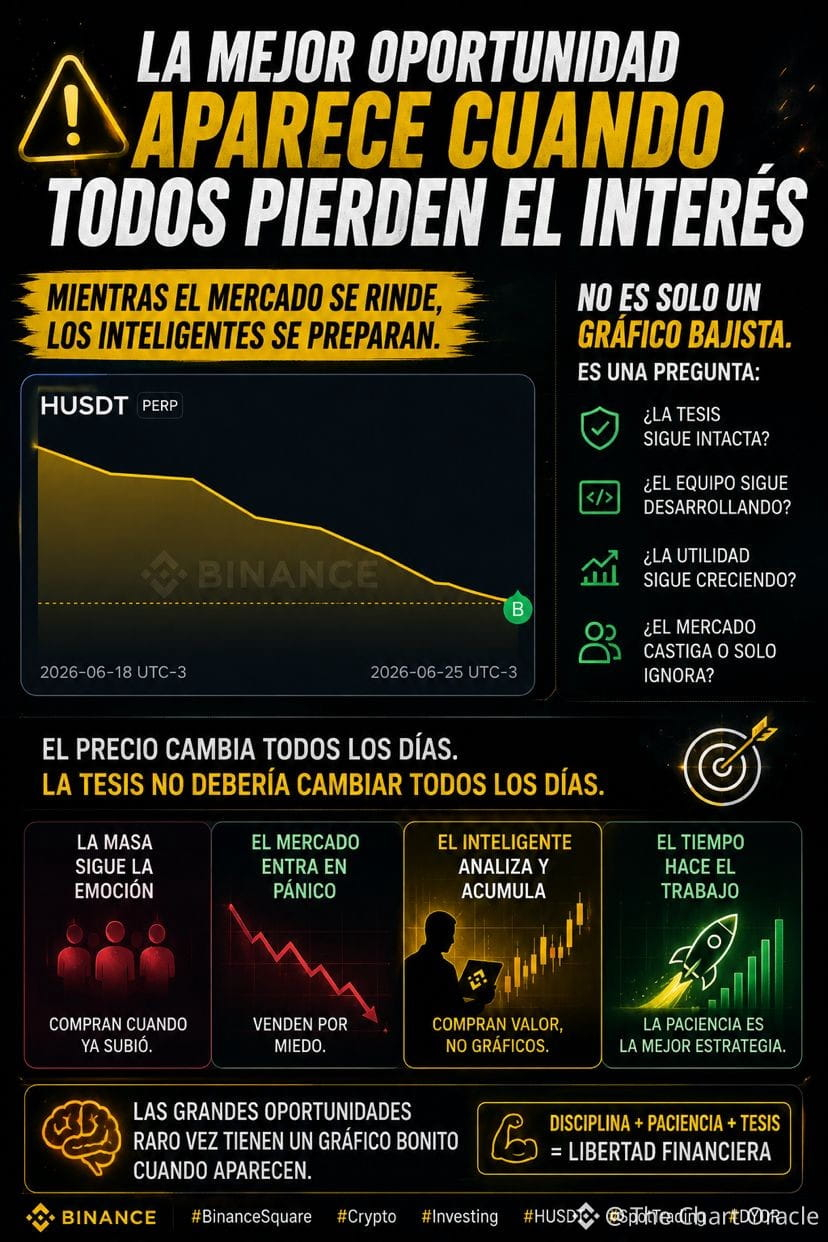
🚨 Most people buy once the chart has already exploded… but the best opportunities often show up when nobody wants to look.
$H
While everyone chases the coin that’s up 30% in a day, very few pause to analyze the ones going through a phase of weakness.
Why?
Because the market punishes patience and rewards emotion.
A bearish chart doesn’t automatically mean a project is dead.
The real question is:
Did the price fall because the thesis broke… or simply because the market temporarily lost interest?
That difference is what can separate a bad investment from an extraordinary opportunity.
My way of investing isn’t about buying any asset that’s going down.
First, I ask myself these questions:
✅ Is the team still developing the project?
✅ Is the token’s utility still growing?
✅ Does the narrative that drove it still have a future?
✅ Is the market punishing the price, or has the project’s value truly changed?
If the thesis remains intact, many times the best buys don’t happen during the hype… they happen when almost nobody wants to enter.
The price changes every day. The thesis shouldn’t change every day.
That’s why I build my portfolio with years in mind, not hours.
📉 Big opportunities rarely come with a “pretty” chart when they appear.
Do you buy when everyone is talking about a coin… or when almost nobody wants it?
🚨 Most people buy once the chart has already exploded… but the best opportunities often show up when nobody wants to look.
$H
While everyone chases the coin that’s up 30% in a day, very few pause to analyze the ones going through a phase of weakness.
Why?
Because the market punishes patience and rewards emotion.
A bearish chart doesn’t automatically mean a project is dead.
The real question is:
Did the price fall because the thesis broke… or simply because the market temporarily lost interest?
That difference is what can separate a bad investment from an extraordinary opportunity.
My way of investing isn’t about buying any asset that’s going down.
First, I ask myself these questions:
✅ Is the team still developing the project?
✅ Is the token’s utility still growing?
✅ Does the narrative that drove it still have a future?
✅ Is the market punishing the price, or has the project’s value truly changed?
If the thesis remains intact, many times the best buys don’t happen during the hype… they happen when almost nobody wants to enter.
The price changes every day. The thesis shouldn’t change every day.
That’s why I build my portfolio with years in mind, not hours.
📉 Big opportunities rarely come with a “pretty” chart when they appear.
Do you buy when everyone is talking about a coin… or when almost nobody wants it?
$H
While everyone chases the coin that’s up 30% in a day, very few pause to analyze the ones going through a phase of weakness.
Why?
Because the market punishes patience and rewards emotion.
A bearish chart doesn’t automatically mean a project is dead.
The real question is:
Did the price fall because the thesis broke… or simply because the market temporarily lost interest?
That difference is what can separate a bad investment from an extraordinary opportunity.
My way of investing isn’t about buying any asset that’s going down.
First, I ask myself these questions:
✅ Is the team still developing the project?
✅ Is the token’s utility still growing?
✅ Does the narrative that drove it still have a future?
✅ Is the market punishing the price, or has the project’s value truly changed?
If the thesis remains intact, many times the best buys don’t happen during the hype… they happen when almost nobody wants to enter.
The price changes every day. The thesis shouldn’t change every day.
That’s why I build my portfolio with years in mind, not hours.
📉 Big opportunities rarely come with a “pretty” chart when they appear.
Do you buy when everyone is talking about a coin… or when almost nobody wants it?
1
4.9k
·
--
Bullish
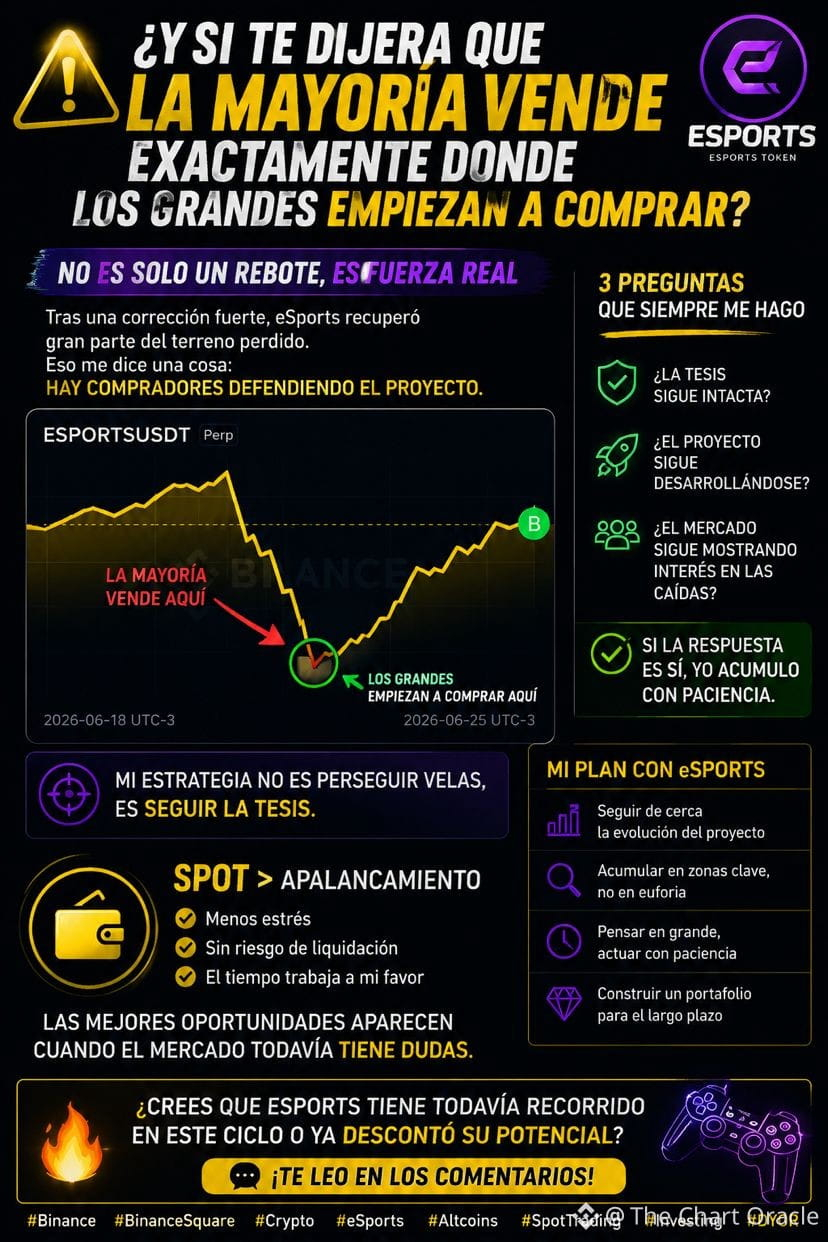
🚨 What if I told you that most people sell exactly where the big players start buying?
While many see a dip and run for cover, I look at something else.
In the chart of $ESPORTS , I’m not only interested in the bounce. I care that after a sharp correction, the price found buyers again and recovered a large part of the move. That can be a sign that there’s still real interest behind the project.
My strategy isn’t about chasing green candles or entering out of FOMO.
It comes down to answering three questions:
✅ Does the thesis still hold?
✅ Is the project still developing?
✅ Does the market keep defending the price when sell pressure shows up?
If those answers remain positive, I’d rather accumulate patiently than try to guess every high and every low.
That’s why I keep building my portfolio mainly in Spot. I want time to work in my favor, not to depend on leverage that forces me to be right every single day.
Many times, the best opportunities show up when the market still has doubts.
Do you think eSports is just starting a new push, or that this rebound won’t have follow-through?
🚨 What if I told you that most people sell exactly where the big players start buying?
While many see a dip and run for cover, I look at something else.
In the chart of $ESPORTS , I’m not only interested in the bounce. I care that after a sharp correction, the price found buyers again and recovered a large part of the move. That can be a sign that there’s still real interest behind the project.
My strategy isn’t about chasing green candles or entering out of FOMO.
It comes down to answering three questions:
✅ Does the thesis still hold?
✅ Is the project still developing?
✅ Does the market keep defending the price when sell pressure shows up?
If those answers remain positive, I’d rather accumulate patiently than try to guess every high and every low.
That’s why I keep building my portfolio mainly in Spot. I want time to work in my favor, not to depend on leverage that forces me to be right every single day.
Many times, the best opportunities show up when the market still has doubts.
Do you think eSports is just starting a new push, or that this rebound won’t have follow-through?
While many see a dip and run for cover, I look at something else.
In the chart of $ESPORTS , I’m not only interested in the bounce. I care that after a sharp correction, the price found buyers again and recovered a large part of the move. That can be a sign that there’s still real interest behind the project.
My strategy isn’t about chasing green candles or entering out of FOMO.
It comes down to answering three questions:
✅ Does the thesis still hold?
✅ Is the project still developing?
✅ Does the market keep defending the price when sell pressure shows up?
If those answers remain positive, I’d rather accumulate patiently than try to guess every high and every low.
That’s why I keep building my portfolio mainly in Spot. I want time to work in my favor, not to depend on leverage that forces me to be right every single day.
Many times, the best opportunities show up when the market still has doubts.
Do you think eSports is just starting a new push, or that this rebound won’t have follow-through?
2
2
3.1k
·
--
Bullish
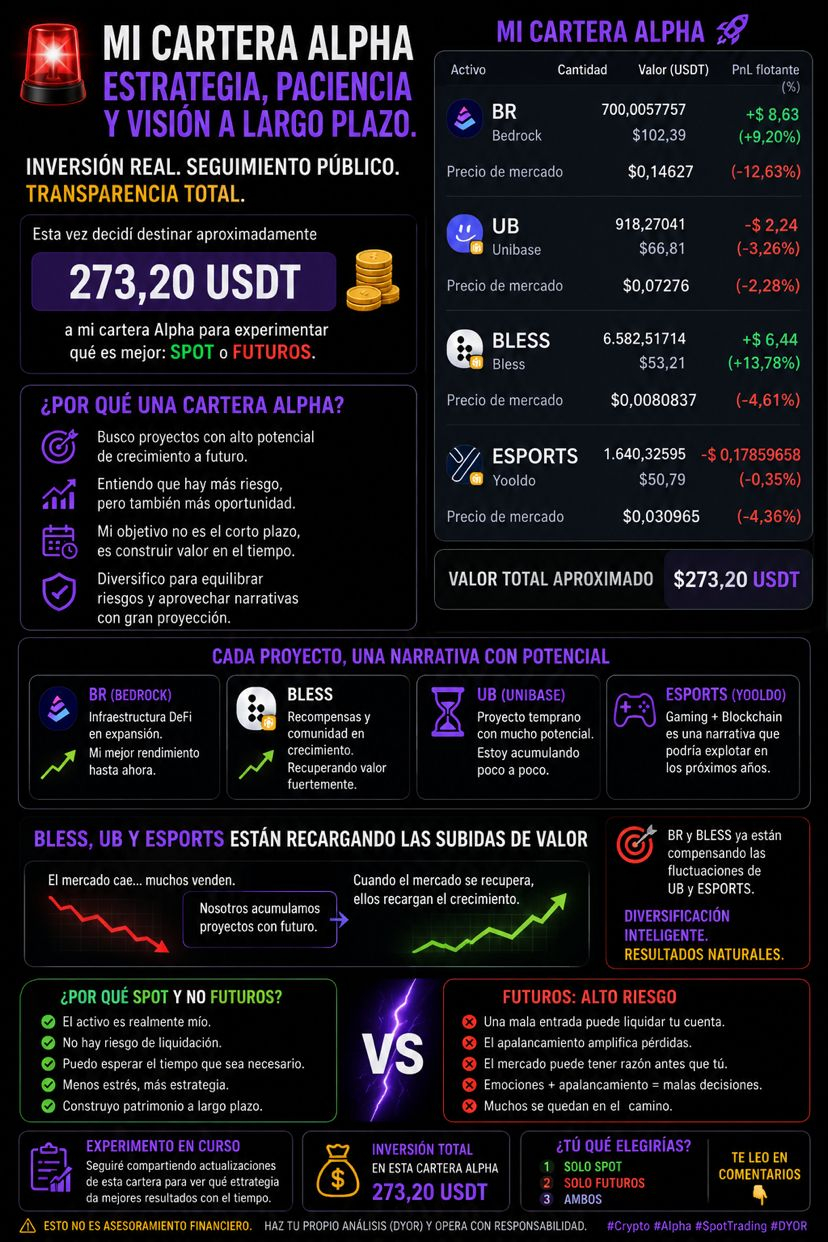
🚨 A LOT OF PEOPLE ASK ME WHY I HAVE AN "ALPHA" PORTFOLIO.
The answer is simple.
Because part of my strategy involves hunting for projects with higher growth potential, understanding that it also comes with greater risk.
This time, I decided to allocate approximately 273.20 USDT to my Alpha portfolio to keep a real-time watch on its evolution.
Currently, it consists of:
🟣 @Bedrock (Bedrock) – My top-performing position so far, with a floating gain of around +9.20%.
⚪ $BLESS – It’s recovering ground and already shows a floating gain of +13.78%, demonstrating a solid reaction after the recent buys.
🔵 $UB (Unibase) – Still in an accumulation phase. I’m gradually building this position because I believe it’s still a very early project.
🎮 $ESPORTS (Yooldo) – Also continuing in the accumulation stage. The Gaming + Blockchain sector seems to me like a narrative that could grow significantly in the coming years.
The most interesting part is that BR and BLESS are already helping to offset the fluctuations of UB and ESPORTS, showcasing why diversification within an Alpha portfolio can be a useful tool.
My goal with this portfolio isn’t to make a quick trade.
I want to compare, with real data, what happens when a strategy is based on:
✅ Buying in Spot.
✅ Holding an investment thesis.
✅ Accumulating during dips.
✅ Giving time for projects to develop.
Many people dive straight into Futures looking for quick gains.
I chose to conduct this experiment in Spot, because the asset remains mine and I can hold the position as long as my thesis stays intact. That doesn’t guarantee profits, but it does mitigate some major risks, like the liquidation that comes with leverage.
📊 This will be a public follow-up.
I’ll be sharing how the portfolio evolves over the months to see which strategy yields the best results.
{future}(ESPORTSUSDT)
{future}(UBUSDT)
{future}(BLESSUSDT)
🚨 A LOT OF PEOPLE ASK ME WHY I HAVE AN "ALPHA" PORTFOLIO.
The answer is simple.
Because part of my strategy involves hunting for projects with higher growth potential, understanding that it also comes with greater risk.
This time, I decided to allocate approximately 273.20 USDT to my Alpha portfolio to keep a real-time watch on its evolution.
Currently, it consists of:
🟣 @Bedrock (Bedrock) – My top-performing position so far, with a floating gain of around +9.20%.
⚪ $BLESS – It’s recovering ground and already shows a floating gain of +13.78%, demonstrating a solid reaction after the recent buys.
🔵 $UB (Unibase) – Still in an accumulation phase. I’m gradually building this position because I believe it’s still a very early project.
🎮 $ESPORTS (Yooldo) – Also continuing in the accumulation stage. The Gaming + Blockchain sector seems to me like a narrative that could grow significantly in the coming years.
The most interesting part is that BR and BLESS are already helping to offset the fluctuations of UB and ESPORTS, showcasing why diversification within an Alpha portfolio can be a useful tool.
My goal with this portfolio isn’t to make a quick trade.
I want to compare, with real data, what happens when a strategy is based on:
✅ Buying in Spot.
✅ Holding an investment thesis.
✅ Accumulating during dips.
✅ Giving time for projects to develop.
Many people dive straight into Futures looking for quick gains.
I chose to conduct this experiment in Spot, because the asset remains mine and I can hold the position as long as my thesis stays intact. That doesn’t guarantee profits, but it does mitigate some major risks, like the liquidation that comes with leverage.
📊 This will be a public follow-up.
I’ll be sharing how the portfolio evolves over the months to see which strategy yields the best results.
The answer is simple.
Because part of my strategy involves hunting for projects with higher growth potential, understanding that it also comes with greater risk.
This time, I decided to allocate approximately 273.20 USDT to my Alpha portfolio to keep a real-time watch on its evolution.
Currently, it consists of:
🟣 @Bedrock (Bedrock) – My top-performing position so far, with a floating gain of around +9.20%.
⚪ $BLESS – It’s recovering ground and already shows a floating gain of +13.78%, demonstrating a solid reaction after the recent buys.
🔵 $UB (Unibase) – Still in an accumulation phase. I’m gradually building this position because I believe it’s still a very early project.
🎮 $ESPORTS (Yooldo) – Also continuing in the accumulation stage. The Gaming + Blockchain sector seems to me like a narrative that could grow significantly in the coming years.
The most interesting part is that BR and BLESS are already helping to offset the fluctuations of UB and ESPORTS, showcasing why diversification within an Alpha portfolio can be a useful tool.
My goal with this portfolio isn’t to make a quick trade.
I want to compare, with real data, what happens when a strategy is based on:
✅ Buying in Spot.
✅ Holding an investment thesis.
✅ Accumulating during dips.
✅ Giving time for projects to develop.
Many people dive straight into Futures looking for quick gains.
I chose to conduct this experiment in Spot, because the asset remains mine and I can hold the position as long as my thesis stays intact. That doesn’t guarantee profits, but it does mitigate some major risks, like the liquidation that comes with leverage.
📊 This will be a public follow-up.
I’ll be sharing how the portfolio evolves over the months to see which strategy yields the best results.
2
1
2.1k
·
--
Bullish
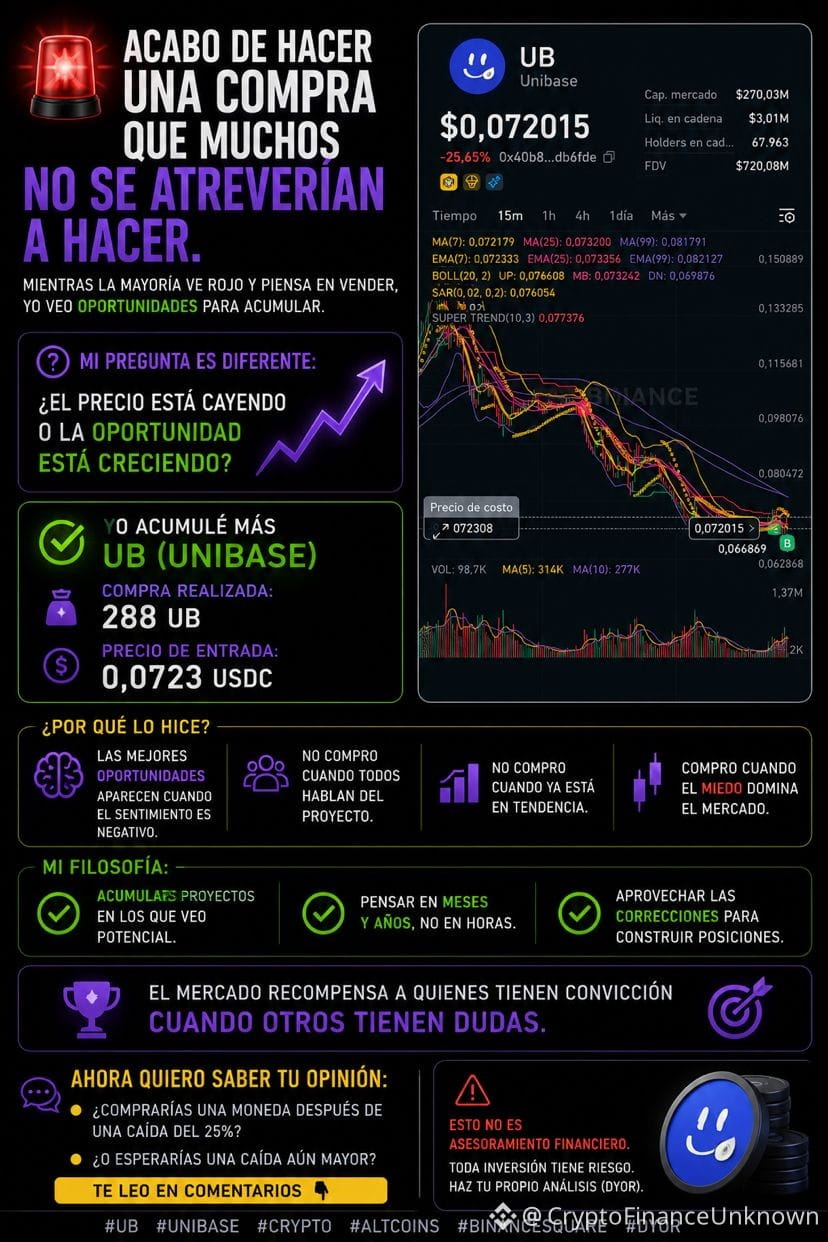
🚨 I JUST MADE A BUY THAT MANY WOULDN'T DARE TO MAKE.
While most are watching a 25% dip and thinking about going short…
I asked myself a different question:
🤔 Is the price dropping or is the opportunity growing?
That's why I decided to increase my position in UB (Unibase).
📈 Purchase made: 288 $UB
💰 Entry price: 0.0723 USDC
Why?
Because often the best opportunities arise when sentiment is negative.
Not when everyone is talking about the project.
Not when it’s trending.
Not when the charts are filled with green candlesticks.
But when fear dominates the market.
Of course, this doesn't guarantee anything.
Every investment carries risk.
But historically, big gains rarely come during moments of euphoria.
They are usually built during periods when most lose patience.
My philosophy remains the same:
✅ Accumulate projects where I see potential.
✅ Think in months and years, not in hours.
✅ Take advantage of corrections to build positions.
Because at the end of the day, the market rewards those who have conviction when others have doubts.
🔥 Now I want to know your opinion:
Would you buy a coin after a 25% drop?
Or would you wait for an even bigger dip?
👇 I’m reading your comments.
#UB #Unibase #Crypto #Altcoins
🚨 I JUST MADE A BUY THAT MANY WOULDN'T DARE TO MAKE.
While most are watching a 25% dip and thinking about going short…
I asked myself a different question:
🤔 Is the price dropping or is the opportunity growing?
That's why I decided to increase my position in UB (Unibase).
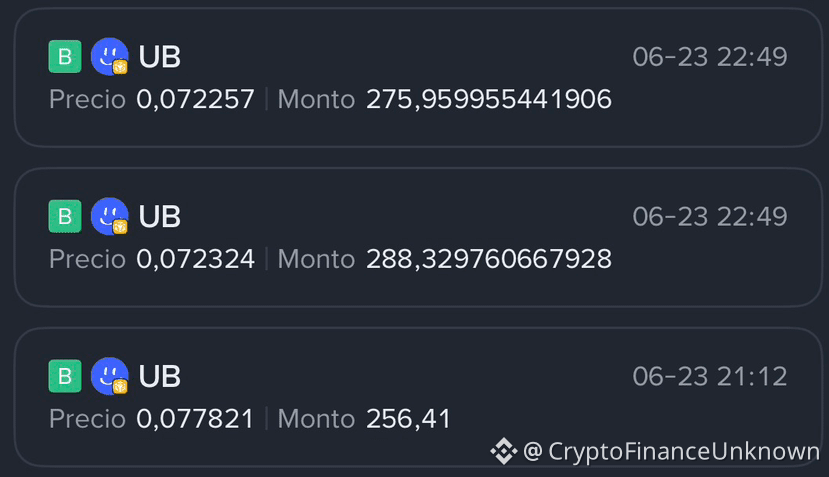
📈 Purchase made: 288 $UB
💰 Entry price: 0.0723 USDC
Why?
Because often the best opportunities arise when sentiment is negative.
Not when everyone is talking about the project.
Not when it’s trending.
Not when the charts are filled with green candlesticks.
But when fear dominates the market.
Of course, this doesn't guarantee anything.
Every investment carries risk.
But historically, big gains rarely come during moments of euphoria.
They are usually built during periods when most lose patience.
My philosophy remains the same:
✅ Accumulate projects where I see potential.
✅ Think in months and years, not in hours.
✅ Take advantage of corrections to build positions.
Because at the end of the day, the market rewards those who have conviction when others have doubts.
🔥 Now I want to know your opinion:
Would you buy a coin after a 25% drop?
Or would you wait for an even bigger dip?
👇 I’m reading your comments.
#UB #Unibase #Crypto #Altcoins
While most are watching a 25% dip and thinking about going short…
I asked myself a different question:
🤔 Is the price dropping or is the opportunity growing?
That's why I decided to increase my position in UB (Unibase).
📈 Purchase made: 288 $UB
💰 Entry price: 0.0723 USDC
Why?
Because often the best opportunities arise when sentiment is negative.
Not when everyone is talking about the project.
Not when it’s trending.
Not when the charts are filled with green candlesticks.
But when fear dominates the market.
Of course, this doesn't guarantee anything.
Every investment carries risk.
But historically, big gains rarely come during moments of euphoria.
They are usually built during periods when most lose patience.
My philosophy remains the same:
✅ Accumulate projects where I see potential.
✅ Think in months and years, not in hours.
✅ Take advantage of corrections to build positions.
Because at the end of the day, the market rewards those who have conviction when others have doubts.
🔥 Now I want to know your opinion:
Would you buy a coin after a 25% drop?
Or would you wait for an even bigger dip?
👇 I’m reading your comments.
#UB #Unibase #Crypto #Altcoins
2
2
1.5k
·
--
Bullish
🚨 MOST PEOPLE LOSE MONEY FOR A VERY SIMPLE REASON.
Not because they buy bad coins.
Not because the market is manipulated.
Not because they have bad luck.
They lose money because they buy when everyone is hyped…
And sell when everyone is scared.
Think about this:
When Bitcoin is breaking all-time highs, everyone wants to buy.
When the market drops 20%, 30%, or 50%…
Everyone wants to sell.
And that’s the problem.
Because the big players usually do the exact opposite.
💡 They buy when there’s fear.
💡 They accumulate when no one is watching.
💡 They hold while others panic.
I’m not saying every dip is a buying opportunity.
But I do believe that the biggest opportunities often arise when sentiment is at its worst.
That’s why I try to focus on long-term narratives:
⚡ Solana and mass adoption.
🤖 $TAO and decentralized AI.
🏦 $ONDO and RWA.
🔗 #LINK and blockchain infrastructure.
🌍 $WLD and digital identity.
Because in a few years, probably no one will remember how the market felt today.
But they will remember who had the patience to hold on.
🔥 Now tell me:
What was the best buy you made during a dip?
👇 I’m listening in the comments.
📌 Follow me for more analysis, strategies, and crypto opportunities.
🚨 MOST PEOPLE LOSE MONEY FOR A VERY SIMPLE REASON.
Not because they buy bad coins.
Not because the market is manipulated.
Not because they have bad luck.
They lose money because they buy when everyone is hyped…
And sell when everyone is scared.
Think about this:
When Bitcoin is breaking all-time highs, everyone wants to buy.
When the market drops 20%, 30%, or 50%…
Everyone wants to sell.
And that’s the problem.
Because the big players usually do the exact opposite.
💡 They buy when there’s fear.
💡 They accumulate when no one is watching.
💡 They hold while others panic.
I’m not saying every dip is a buying opportunity.
But I do believe that the biggest opportunities often arise when sentiment is at its worst.
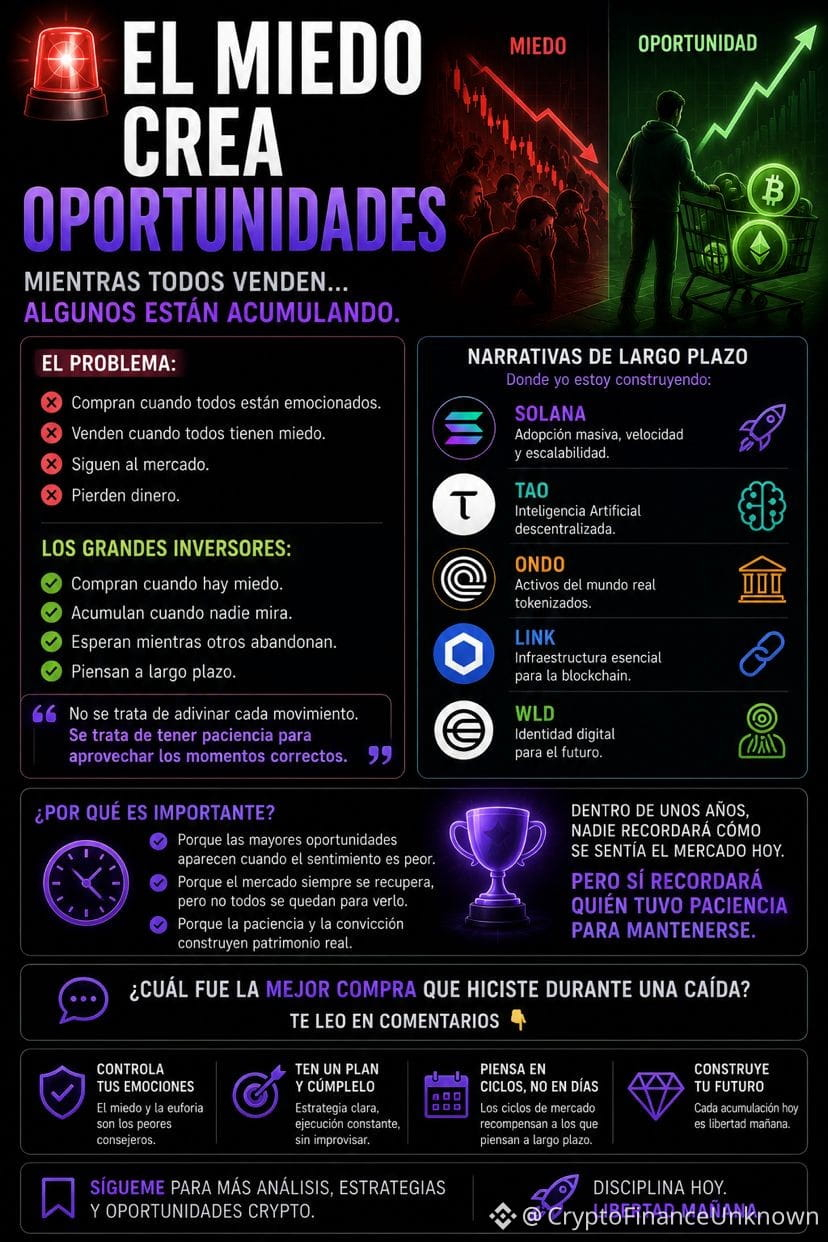
That’s why I try to focus on long-term narratives:
⚡ Solana and mass adoption.
🤖 $TAO and decentralized AI.
🏦 $ONDO and RWA.
🔗 #LINK and blockchain infrastructure.
🌍 $WLD and digital identity.
Because in a few years, probably no one will remember how the market felt today.
But they will remember who had the patience to hold on.
🔥 Now tell me:
What was the best buy you made during a dip?
👇 I’m listening in the comments.
📌 Follow me for more analysis, strategies, and crypto opportunities.
Not because they buy bad coins.
Not because the market is manipulated.
Not because they have bad luck.
They lose money because they buy when everyone is hyped…
And sell when everyone is scared.
Think about this:
When Bitcoin is breaking all-time highs, everyone wants to buy.
When the market drops 20%, 30%, or 50%…
Everyone wants to sell.
And that’s the problem.
Because the big players usually do the exact opposite.
💡 They buy when there’s fear.
💡 They accumulate when no one is watching.
💡 They hold while others panic.
I’m not saying every dip is a buying opportunity.
But I do believe that the biggest opportunities often arise when sentiment is at its worst.
That’s why I try to focus on long-term narratives:
⚡ Solana and mass adoption.
🤖 $TAO and decentralized AI.
🏦 $ONDO and RWA.
🔗 #LINK and blockchain infrastructure.
🌍 $WLD and digital identity.
Because in a few years, probably no one will remember how the market felt today.
But they will remember who had the patience to hold on.
🔥 Now tell me:
What was the best buy you made during a dip?
👇 I’m listening in the comments.
📌 Follow me for more analysis, strategies, and crypto opportunities.
3
1
2.3k
·
--
Bullish
🚨 IF YOUR PORTFOLIO RELIES ON JUST ONE COIN, YOU DON'T HAVE A PORTFOLIO.
You have a bet.
And there's a big difference.
Many investors are chasing the next 100x.
I prefer to build something different.
A portfolio capable of surviving various scenarios.
That's why I like to diversify across different narratives:
⚡ $SOL → Mass adoption.
🤖 $TAO → Artificial Intelligence.
🏦 $ONDO → Tokenized assets.
🔗 #LINK → Blockchain infrastructure.
🌍 #WLD → Digital identity.
Each one targets a different market.
Each one solves a different problem.
And each one could benefit from different trends.
Does that mean all will go up?
No.
But it does mean I'm not relying on just one narrative to succeed.
Because in crypto, it’s not about guessing a coin.
It's about surviving long enough to capitalize on the big opportunities.
🔥 Now let me ask you:
If you could only hold one coin for the next 5 years…
Which one would you choose?
👇 I’m reading your thoughts in the comments.
📌 Follow me for more portfolio analysis, investment theses, and opportunities before they trend.
🚨 IF YOUR PORTFOLIO RELIES ON JUST ONE COIN, YOU DON'T HAVE A PORTFOLIO.
You have a bet.
And there's a big difference.
Many investors are chasing the next 100x.
I prefer to build something different.
A portfolio capable of surviving various scenarios.
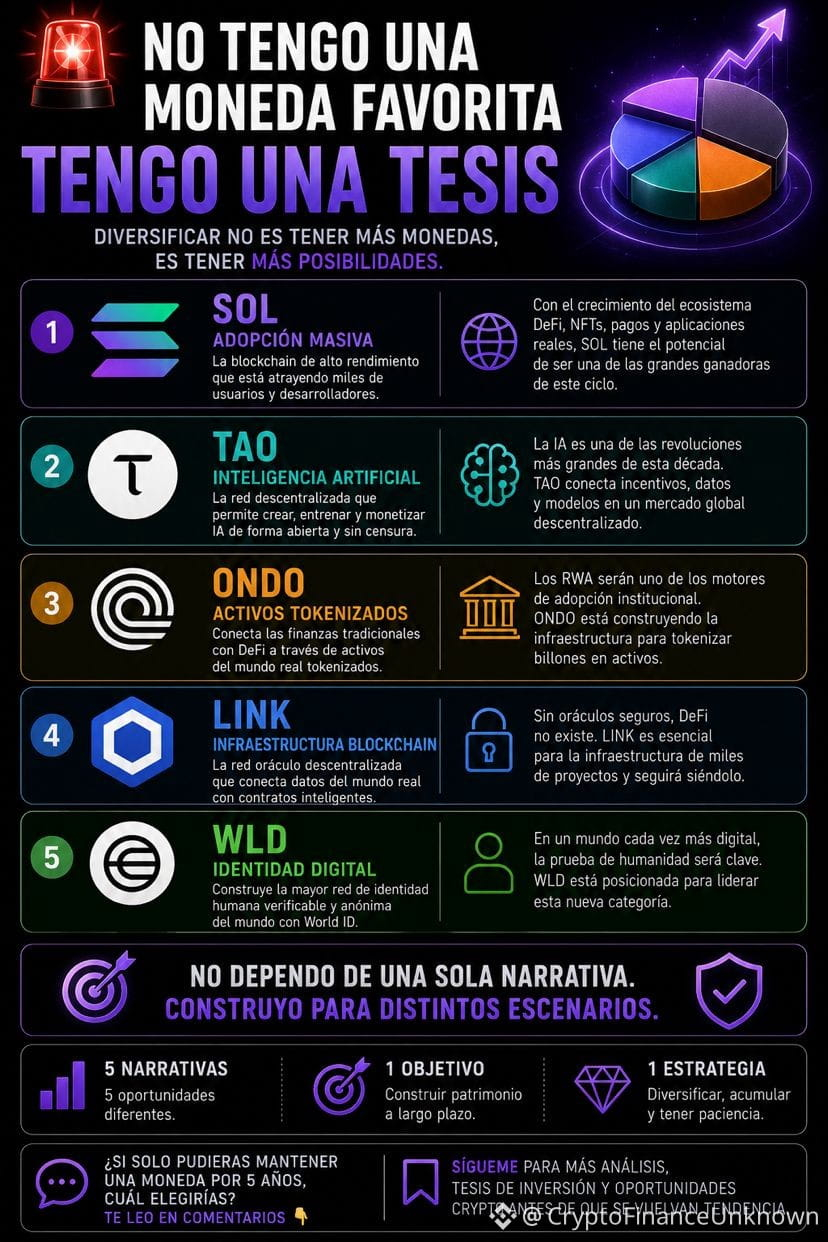
That's why I like to diversify across different narratives:
⚡ $SOL → Mass adoption.
🤖 $TAO → Artificial Intelligence.
🏦 $ONDO → Tokenized assets.
🔗 #LINK → Blockchain infrastructure.
🌍 #WLD → Digital identity.
Each one targets a different market.
Each one solves a different problem.
And each one could benefit from different trends.
Does that mean all will go up?
No.
But it does mean I'm not relying on just one narrative to succeed.
Because in crypto, it’s not about guessing a coin.
It's about surviving long enough to capitalize on the big opportunities.
🔥 Now let me ask you:
If you could only hold one coin for the next 5 years…
Which one would you choose?
👇 I’m reading your thoughts in the comments.
📌 Follow me for more portfolio analysis, investment theses, and opportunities before they trend.
You have a bet.
And there's a big difference.
Many investors are chasing the next 100x.
I prefer to build something different.
A portfolio capable of surviving various scenarios.
That's why I like to diversify across different narratives:
⚡ $SOL → Mass adoption.
🤖 $TAO → Artificial Intelligence.
🏦 $ONDO → Tokenized assets.
🔗 #LINK → Blockchain infrastructure.
🌍 #WLD → Digital identity.
Each one targets a different market.
Each one solves a different problem.
And each one could benefit from different trends.
Does that mean all will go up?
No.
But it does mean I'm not relying on just one narrative to succeed.
Because in crypto, it’s not about guessing a coin.
It's about surviving long enough to capitalize on the big opportunities.
🔥 Now let me ask you:
If you could only hold one coin for the next 5 years…
Which one would you choose?
👇 I’m reading your thoughts in the comments.
📌 Follow me for more portfolio analysis, investment theses, and opportunities before they trend.
5
1
3k
·
--
Bullish
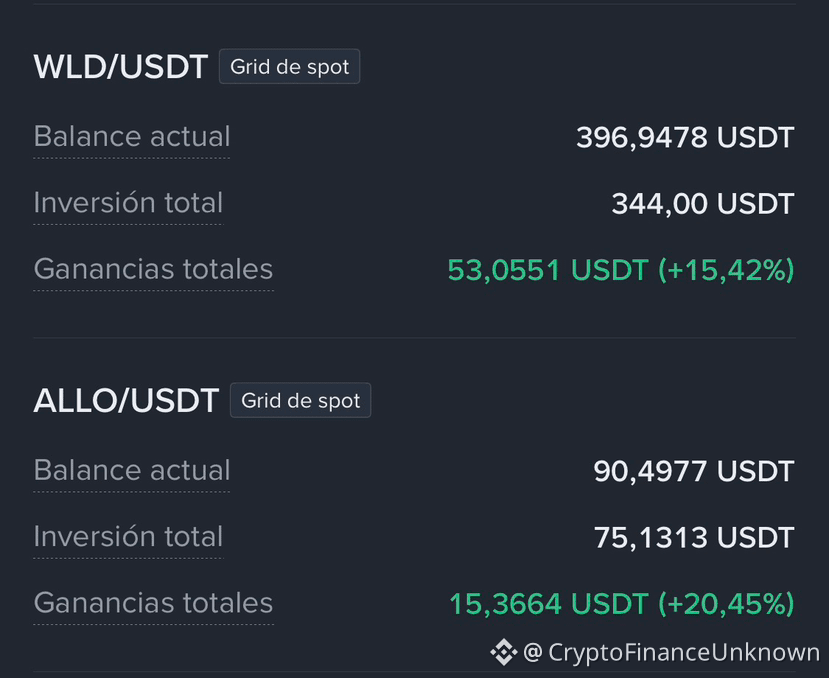
🚨 A LOT OF PEOPLE ASK ME IF BOTS REALLY WORK.
My answer is always the same:
💡 It depends on how you use them.
While some spend hours trying to guess the next market move, my bots keep grinding 24/7.
And today the numbers speak for themselves.
📈 Bot $WLD /USDT
✅ Initial investment: 344 USDT
✅ Current balance: 397 USDT
✅ Total profit: +53 USDT
✅ Performance: +15.43%
📈 Bot $ALLO /USDT
✅ Initial investment: 75 USDT
✅ Current balance: 90 USDT
✅ Total profit: +15 USDT
✅ Performance: +20.45%
What's interesting is not just the profit.
What's interesting is how it's generated.
While the market goes up, down, and moves constantly, the Grid Bot leverages the volatility to buy low and sell high automatically.
No emotions.
No fear.
No FOMO.
No staring at charts all day.
And here's the part I love the most:
While my main positions keep building my long-term thesis…
⚡ SOL
🤖 TAO
🏦 ONDO
🔗 LINK
🌍 WLD
…the bots are working in parallel generating additional yield.
I don't see bots as a replacement for a portfolio.
I see them as a complementary tool.
A machine that works while I keep stacking assets.
🔥 Because at the end of the day, there is a huge difference between:
Waiting for the market to pay you.
And building systems that work for you.
Are bots perfect?
No.
Do they generate profits every day?
Neither.
But when used correctly, they can turn volatility into opportunity.
And that's exactly what I'm trying to do.
🚀 My goal is not just for my coins to go up.
My goal is for my money to work even when the market moves sideways.
👇 Now I want to know:
Have you ever used Grid Trading bots?
Did they give you profits or losses?
{future}(WLDUSDT)
{future}(ALLOUSDT)
🚨 A LOT OF PEOPLE ASK ME IF BOTS REALLY WORK.
My answer is always the same:
💡 It depends on how you use them.
While some spend hours trying to guess the next market move, my bots keep grinding 24/7.
And today the numbers speak for themselves.
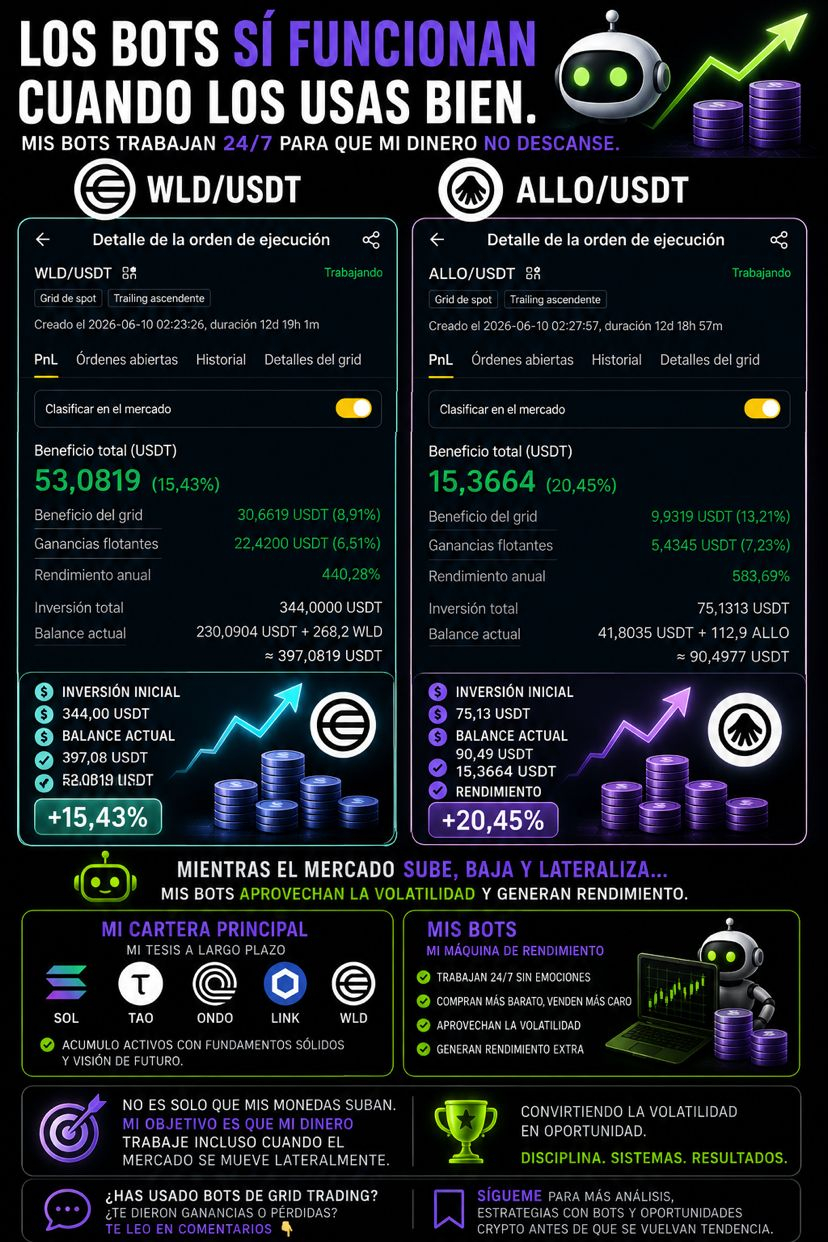
📈 Bot $WLD /USDT
✅ Initial investment: 344 USDT
✅ Current balance: 397 USDT
✅ Total profit: +53 USDT
✅ Performance: +15.43%
📈 Bot $ALLO /USDT
✅ Initial investment: 75 USDT
✅ Current balance: 90 USDT
✅ Total profit: +15 USDT
✅ Performance: +20.45%
What's interesting is not just the profit.
What's interesting is how it's generated.
While the market goes up, down, and moves constantly, the Grid Bot leverages the volatility to buy low and sell high automatically.
No emotions.
No fear.
No FOMO.
No staring at charts all day.
And here's the part I love the most:
While my main positions keep building my long-term thesis…
⚡ SOL
🤖 TAO
🏦 ONDO
🔗 LINK
🌍 WLD
…the bots are working in parallel generating additional yield.
I don't see bots as a replacement for a portfolio.
I see them as a complementary tool.
A machine that works while I keep stacking assets.
🔥 Because at the end of the day, there is a huge difference between:
Waiting for the market to pay you.
And building systems that work for you.
Are bots perfect?
No.
Do they generate profits every day?
Neither.
But when used correctly, they can turn volatility into opportunity.
And that's exactly what I'm trying to do.
🚀 My goal is not just for my coins to go up.
My goal is for my money to work even when the market moves sideways.
👇 Now I want to know:
Have you ever used Grid Trading bots?
Did they give you profits or losses?
My answer is always the same:
💡 It depends on how you use them.
While some spend hours trying to guess the next market move, my bots keep grinding 24/7.
And today the numbers speak for themselves.
📈 Bot $WLD /USDT
✅ Initial investment: 344 USDT
✅ Current balance: 397 USDT
✅ Total profit: +53 USDT
✅ Performance: +15.43%
📈 Bot $ALLO /USDT
✅ Initial investment: 75 USDT
✅ Current balance: 90 USDT
✅ Total profit: +15 USDT
✅ Performance: +20.45%
What's interesting is not just the profit.
What's interesting is how it's generated.
While the market goes up, down, and moves constantly, the Grid Bot leverages the volatility to buy low and sell high automatically.
No emotions.
No fear.
No FOMO.
No staring at charts all day.
And here's the part I love the most:
While my main positions keep building my long-term thesis…
⚡ SOL
🤖 TAO
🏦 ONDO
🔗 LINK
🌍 WLD
…the bots are working in parallel generating additional yield.
I don't see bots as a replacement for a portfolio.
I see them as a complementary tool.
A machine that works while I keep stacking assets.
🔥 Because at the end of the day, there is a huge difference between:
Waiting for the market to pay you.
And building systems that work for you.
Are bots perfect?
No.
Do they generate profits every day?
Neither.
But when used correctly, they can turn volatility into opportunity.
And that's exactly what I'm trying to do.
🚀 My goal is not just for my coins to go up.
My goal is for my money to work even when the market moves sideways.
👇 Now I want to know:
Have you ever used Grid Trading bots?
Did they give you profits or losses?
436
·
--
Bullish
🚨 HOLD UP.
Most folks think winning in crypto means never selling.
I see winning a bit differently.
💡 It's about building wealth while protecting your gains.
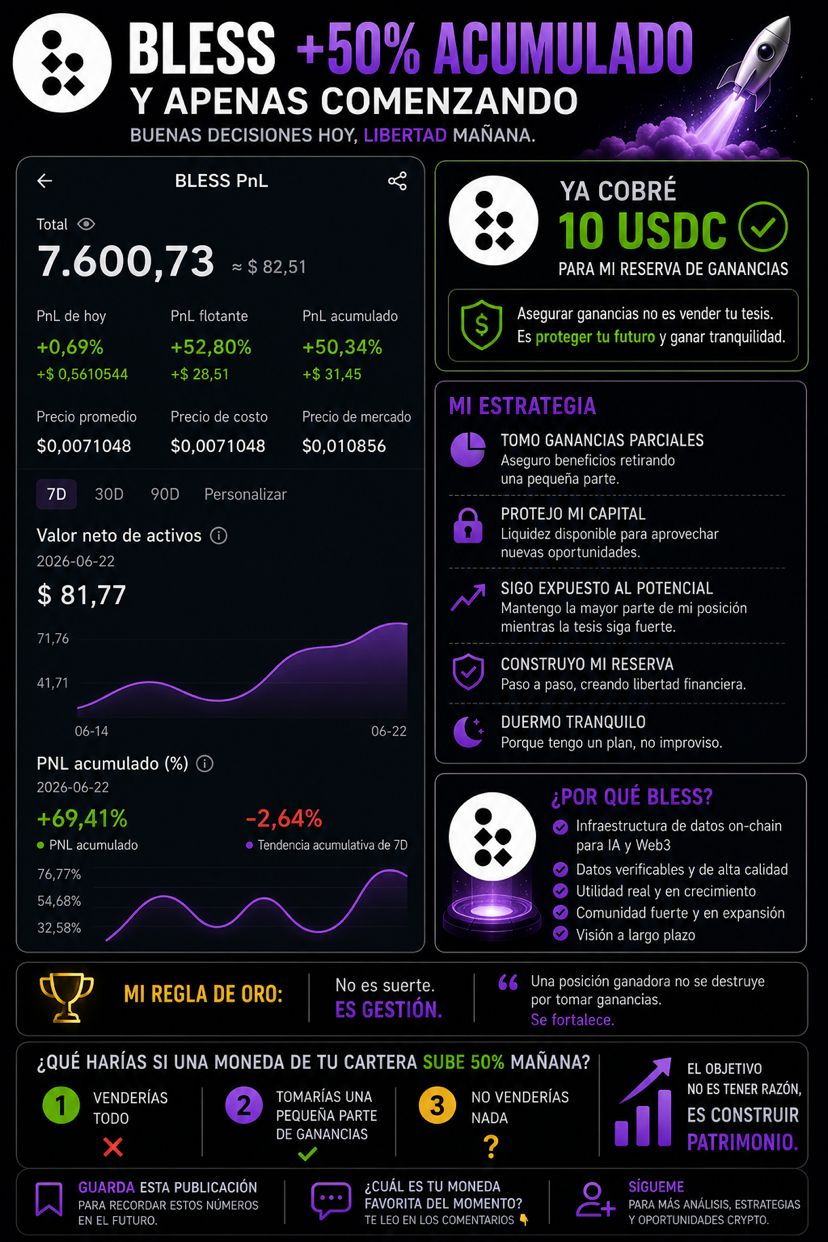
Today, while checking one of my smaller positions, $BLESS , I came across something I love to see:
📈 +52.80% floating profit.
📈 +50.34% realized profit.
📈 Over 7,600 BLESS accumulated.
And here's the most important part…
✅ I've already withdrawn 10 USDC to my profit reserve.
Why?
Because one of my favorite rules is this:
"I don’t need to sell the entire position to secure profits."
I can stick to my thesis.
I can remain exposed to the potential of the project.
And at the same time, build a reserve that allows me to seize future opportunities.
Many people operate in one of two ways:
❌ They never take profits.
❌ Or they sell all their positions.
I prefer a middle ground.
When a position performs well:
💰 A small part can turn into $USDC
📈 The rest keeps working.
That way, if the project continues to grow, I’m still in the game.
And if a correction hits, I have liquidity on hand.
For me, that's not a lack of conviction.
It's risk management.
Because at the end of the day, the goal isn't to be right.
The goal is to build wealth.
🔥 And here’s a question for you:
If a coin in your portfolio jumped 50% tomorrow…
What would you do?
1️⃣ Sell everything.
2️⃣ Take a small part of profits.
3️⃣ Not sell anything.
👇 I’m all ears in the comments.
📌 Follow me for more portfolio analysis, USDC reserve building, and strategies to grow without wrecking a solid investment thesis.
{future}(BLESSUSDT)
🚨 HOLD UP.
Most folks think winning in crypto means never selling.
I see winning a bit differently.
💡 It's about building wealth while protecting your gains.
Today, while checking one of my smaller positions, $BLESS , I came across something I love to see:
📈 +52.80% floating profit.
📈 +50.34% realized profit.
📈 Over 7,600 BLESS accumulated.
And here's the most important part…
✅ I've already withdrawn 10 USDC to my profit reserve.
Why?
Because one of my favorite rules is this:
"I don’t need to sell the entire position to secure profits."
I can stick to my thesis.
I can remain exposed to the potential of the project.
And at the same time, build a reserve that allows me to seize future opportunities.
Many people operate in one of two ways:
❌ They never take profits.
❌ Or they sell all their positions.
I prefer a middle ground.
When a position performs well:
💰 A small part can turn into $USDC
📈 The rest keeps working.
That way, if the project continues to grow, I’m still in the game.
And if a correction hits, I have liquidity on hand.
For me, that's not a lack of conviction.
It's risk management.
Because at the end of the day, the goal isn't to be right.
The goal is to build wealth.
🔥 And here’s a question for you:
If a coin in your portfolio jumped 50% tomorrow…
What would you do?
1️⃣ Sell everything.
2️⃣ Take a small part of profits.
3️⃣ Not sell anything.
👇 I’m all ears in the comments.
📌 Follow me for more portfolio analysis, USDC reserve building, and strategies to grow without wrecking a solid investment thesis.
Most folks think winning in crypto means never selling.
I see winning a bit differently.
💡 It's about building wealth while protecting your gains.
Today, while checking one of my smaller positions, $BLESS , I came across something I love to see:
📈 +52.80% floating profit.
📈 +50.34% realized profit.
📈 Over 7,600 BLESS accumulated.
And here's the most important part…
✅ I've already withdrawn 10 USDC to my profit reserve.
Why?
Because one of my favorite rules is this:
"I don’t need to sell the entire position to secure profits."
I can stick to my thesis.
I can remain exposed to the potential of the project.
And at the same time, build a reserve that allows me to seize future opportunities.
Many people operate in one of two ways:
❌ They never take profits.
❌ Or they sell all their positions.
I prefer a middle ground.
When a position performs well:
💰 A small part can turn into $USDC
📈 The rest keeps working.
That way, if the project continues to grow, I’m still in the game.
And if a correction hits, I have liquidity on hand.
For me, that's not a lack of conviction.
It's risk management.
Because at the end of the day, the goal isn't to be right.
The goal is to build wealth.
🔥 And here’s a question for you:
If a coin in your portfolio jumped 50% tomorrow…
What would you do?
1️⃣ Sell everything.
2️⃣ Take a small part of profits.
3️⃣ Not sell anything.
👇 I’m all ears in the comments.
📌 Follow me for more portfolio analysis, USDC reserve building, and strategies to grow without wrecking a solid investment thesis.
189
·
--
Bullish
🚨 HOLD UP.
A lot of traders sell a coin as soon as they see a 10% or 15% gain.
And that's exactly where they often miss out on the biggest opportunities.
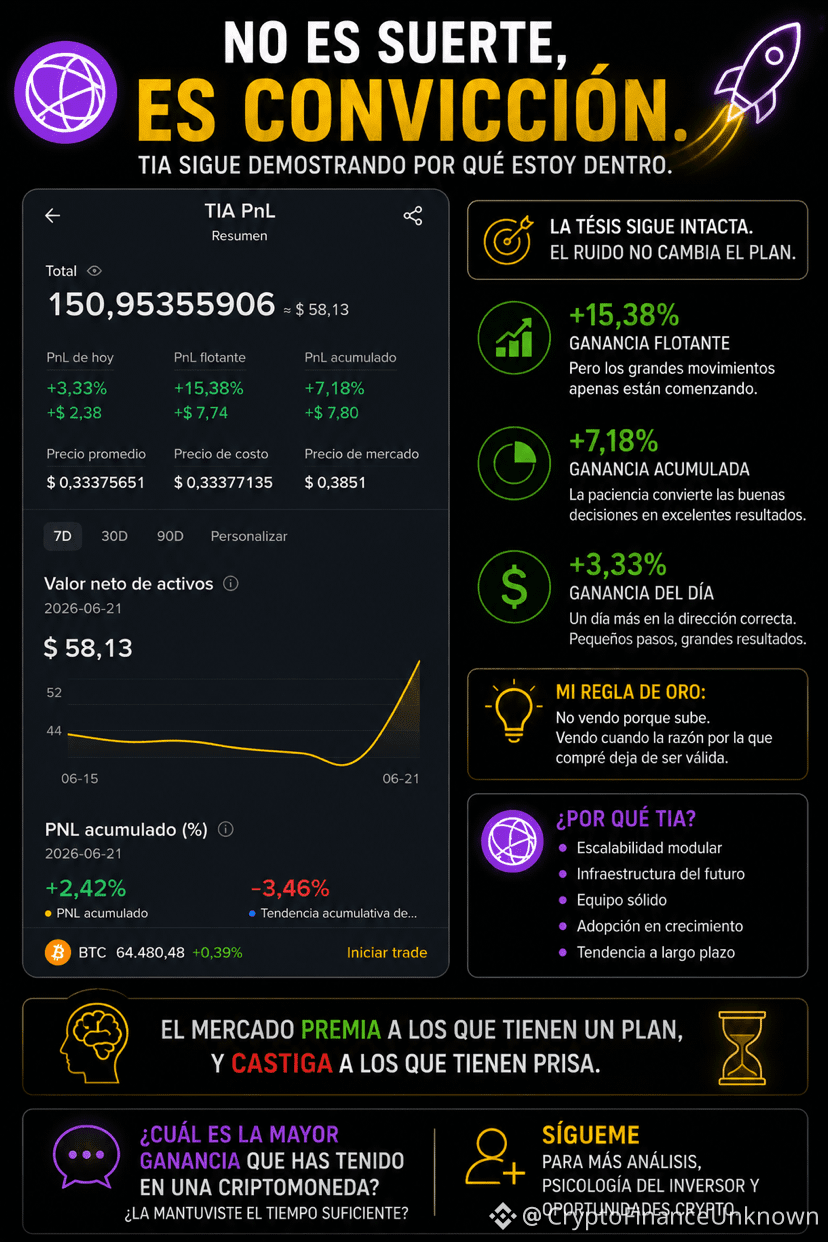
Today, while checking one of my positions, $TIA (Celestia), I see something interesting:
📈 +15.38% floating profit.
📈 +7.18% realized gains.
📈 +3.33% just today.
But the important question isn't how much it went up.
The question is:
🤔 Did the thesis change?
Because if the reason you bought is still valid…
Why sell just because the price went up a bit?
Many traders spend years searching for projects with potential.
And when they finally find one…
They sell too soon.
The reality is that major trends don't usually develop in days.
They unfold over months.
Sometimes even years.
💡 That's why I try to remind myself of something constantly:
I'm not just investing in a coin.
I'm investing in a narrative.
I'm investing in a thesis.
I'm investing in a vision for the future.
And as long as that thesis remains intact, short-term fluctuations are just noise.
Of course, taking profits makes sense.
But taking profits without a plan usually ends in regret.
🔥 Now I want to know your thoughts:
What's the biggest gain you've ever had in a cryptocurrency?
And more importantly…
Did you hold it long enough?
👇 I'm reading your comments.
📌 Follow me for more portfolio analysis, investor psychology, and crypto opportunities before they trend.
{future}(TIAUSDT)
🚨 HOLD UP.
A lot of traders sell a coin as soon as they see a 10% or 15% gain.
And that's exactly where they often miss out on the biggest opportunities.
Today, while checking one of my positions, $TIA (Celestia), I see something interesting:
📈 +15.38% floating profit.
📈 +7.18% realized gains.
📈 +3.33% just today.
But the important question isn't how much it went up.
The question is:
🤔 Did the thesis change?
Because if the reason you bought is still valid…
Why sell just because the price went up a bit?
Many traders spend years searching for projects with potential.
And when they finally find one…
They sell too soon.
The reality is that major trends don't usually develop in days.
They unfold over months.
Sometimes even years.
💡 That's why I try to remind myself of something constantly:
I'm not just investing in a coin.
I'm investing in a narrative.
I'm investing in a thesis.
I'm investing in a vision for the future.
And as long as that thesis remains intact, short-term fluctuations are just noise.
Of course, taking profits makes sense.
But taking profits without a plan usually ends in regret.
🔥 Now I want to know your thoughts:
What's the biggest gain you've ever had in a cryptocurrency?
And more importantly…
Did you hold it long enough?
👇 I'm reading your comments.
📌 Follow me for more portfolio analysis, investor psychology, and crypto opportunities before they trend.
A lot of traders sell a coin as soon as they see a 10% or 15% gain.
And that's exactly where they often miss out on the biggest opportunities.
Today, while checking one of my positions, $TIA (Celestia), I see something interesting:
📈 +15.38% floating profit.
📈 +7.18% realized gains.
📈 +3.33% just today.
But the important question isn't how much it went up.
The question is:
🤔 Did the thesis change?
Because if the reason you bought is still valid…
Why sell just because the price went up a bit?
Many traders spend years searching for projects with potential.
And when they finally find one…
They sell too soon.
The reality is that major trends don't usually develop in days.
They unfold over months.
Sometimes even years.
💡 That's why I try to remind myself of something constantly:
I'm not just investing in a coin.
I'm investing in a narrative.
I'm investing in a thesis.
I'm investing in a vision for the future.
And as long as that thesis remains intact, short-term fluctuations are just noise.
Of course, taking profits makes sense.
But taking profits without a plan usually ends in regret.
🔥 Now I want to know your thoughts:
What's the biggest gain you've ever had in a cryptocurrency?
And more importantly…
Did you hold it long enough?
👇 I'm reading your comments.
📌 Follow me for more portfolio analysis, investor psychology, and crypto opportunities before they trend.
175
·
--
Bullish
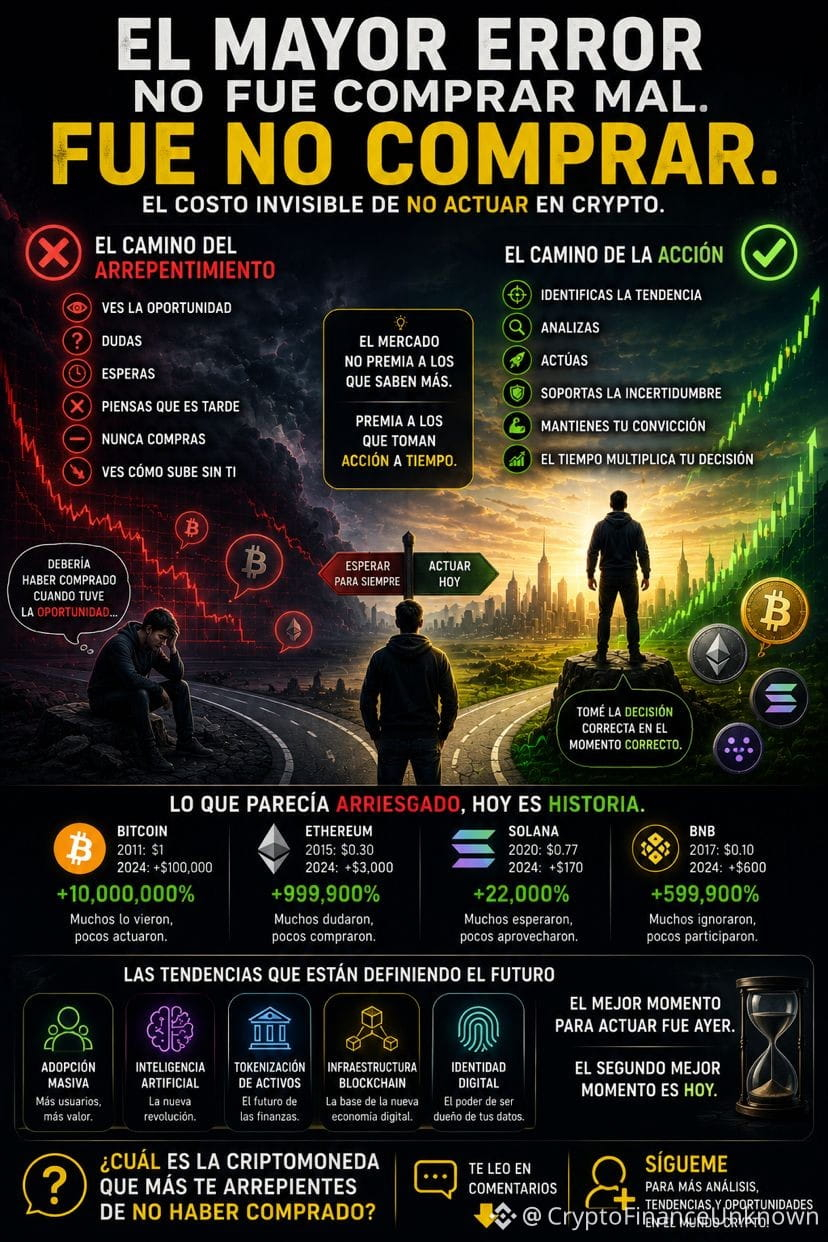
🚨 MOST PEOPLE THINK THEIR BIGGEST MISTAKE IN CRYPTO WAS BUYING WRONG.
I think it was something else.
Not buying.
Yep.
It’s that simple.
Because when we reflect on our mistakes, we remember:
❌ The coin that tanked.
❌ The trade that went south.
❌ The position that made us lose money.
But we rarely think about something much more painful.
The opportunities we let slip by.
Take a moment to think.
How many times did you see Bitcoin and think:
"I’ll wait a bit longer?"
How many times did you spot a coin you liked and say:
"I’ll buy later?"
How many times did you wait for the perfect correction that never came?
Because the market has a unique way of punishing people.
Sometimes it punishes you for acting too quickly.
But often it punishes you for waiting too long.
💡 Excessive fear also costs money.
Most of the big opportunities in history seemed risky when they appeared.
Bitcoin seemed risky.
Ethereum seemed risky.
Solana seemed risky.
And probably the next big opportunities will seem risky too.
Because if they were obvious...
Everyone would be rich.
That’s why today I’m trying to do something different.
I’m not looking for absolute certainties.
I’m looking for favorable probabilities.
I’m scouting sectors that could be way bigger in 5 or 10 years.
⚡ Mass adoption.
🤖 Artificial Intelligence.
🏦 Tokenization of real assets.
🔗 Blockchain infrastructure.
🌍 Digital identity.
Not because I know exactly which project will win.
But because I know the world is moving in those directions.
And I prefer to be in when the changes happen.
Than to watch from the sidelines after they’ve occurred.
🔥 Now I want to ask you a question:
What cryptocurrency do you regret the most NOT buying?
The one you saw early.
The one you analyzed.
The one you liked.
But never bought.
📌 Follow me if you’re interested in trends that could define the next decade, not just the next market move.
🚨 MOST PEOPLE THINK THEIR BIGGEST MISTAKE IN CRYPTO WAS BUYING WRONG.
I think it was something else.
Not buying.
Yep.
It’s that simple.
Because when we reflect on our mistakes, we remember:
❌ The coin that tanked.
❌ The trade that went south.
❌ The position that made us lose money.
But we rarely think about something much more painful.
The opportunities we let slip by.
Take a moment to think.
How many times did you see Bitcoin and think:
"I’ll wait a bit longer?"
How many times did you spot a coin you liked and say:
"I’ll buy later?"
How many times did you wait for the perfect correction that never came?
Because the market has a unique way of punishing people.
Sometimes it punishes you for acting too quickly.
But often it punishes you for waiting too long.
💡 Excessive fear also costs money.
Most of the big opportunities in history seemed risky when they appeared.
Bitcoin seemed risky.
Ethereum seemed risky.
Solana seemed risky.
And probably the next big opportunities will seem risky too.
Because if they were obvious...
Everyone would be rich.
That’s why today I’m trying to do something different.
I’m not looking for absolute certainties.
I’m looking for favorable probabilities.
I’m scouting sectors that could be way bigger in 5 or 10 years.
⚡ Mass adoption.
🤖 Artificial Intelligence.
🏦 Tokenization of real assets.
🔗 Blockchain infrastructure.
🌍 Digital identity.
Not because I know exactly which project will win.
But because I know the world is moving in those directions.
And I prefer to be in when the changes happen.
Than to watch from the sidelines after they’ve occurred.
🔥 Now I want to ask you a question:
What cryptocurrency do you regret the most NOT buying?
The one you saw early.
The one you analyzed.
The one you liked.
But never bought.
📌 Follow me if you’re interested in trends that could define the next decade, not just the next market move.
I think it was something else.
Not buying.
Yep.
It’s that simple.
Because when we reflect on our mistakes, we remember:
❌ The coin that tanked.
❌ The trade that went south.
❌ The position that made us lose money.
But we rarely think about something much more painful.
The opportunities we let slip by.
Take a moment to think.
How many times did you see Bitcoin and think:
"I’ll wait a bit longer?"
How many times did you spot a coin you liked and say:
"I’ll buy later?"
How many times did you wait for the perfect correction that never came?
Because the market has a unique way of punishing people.
Sometimes it punishes you for acting too quickly.
But often it punishes you for waiting too long.
💡 Excessive fear also costs money.
Most of the big opportunities in history seemed risky when they appeared.
Bitcoin seemed risky.
Ethereum seemed risky.
Solana seemed risky.
And probably the next big opportunities will seem risky too.
Because if they were obvious...
Everyone would be rich.
That’s why today I’m trying to do something different.
I’m not looking for absolute certainties.
I’m looking for favorable probabilities.
I’m scouting sectors that could be way bigger in 5 or 10 years.
⚡ Mass adoption.
🤖 Artificial Intelligence.
🏦 Tokenization of real assets.
🔗 Blockchain infrastructure.
🌍 Digital identity.
Not because I know exactly which project will win.
But because I know the world is moving in those directions.
And I prefer to be in when the changes happen.
Than to watch from the sidelines after they’ve occurred.
🔥 Now I want to ask you a question:
What cryptocurrency do you regret the most NOT buying?
The one you saw early.
The one you analyzed.
The one you liked.
But never bought.
📌 Follow me if you’re interested in trends that could define the next decade, not just the next market move.
102
·
--
Bullish
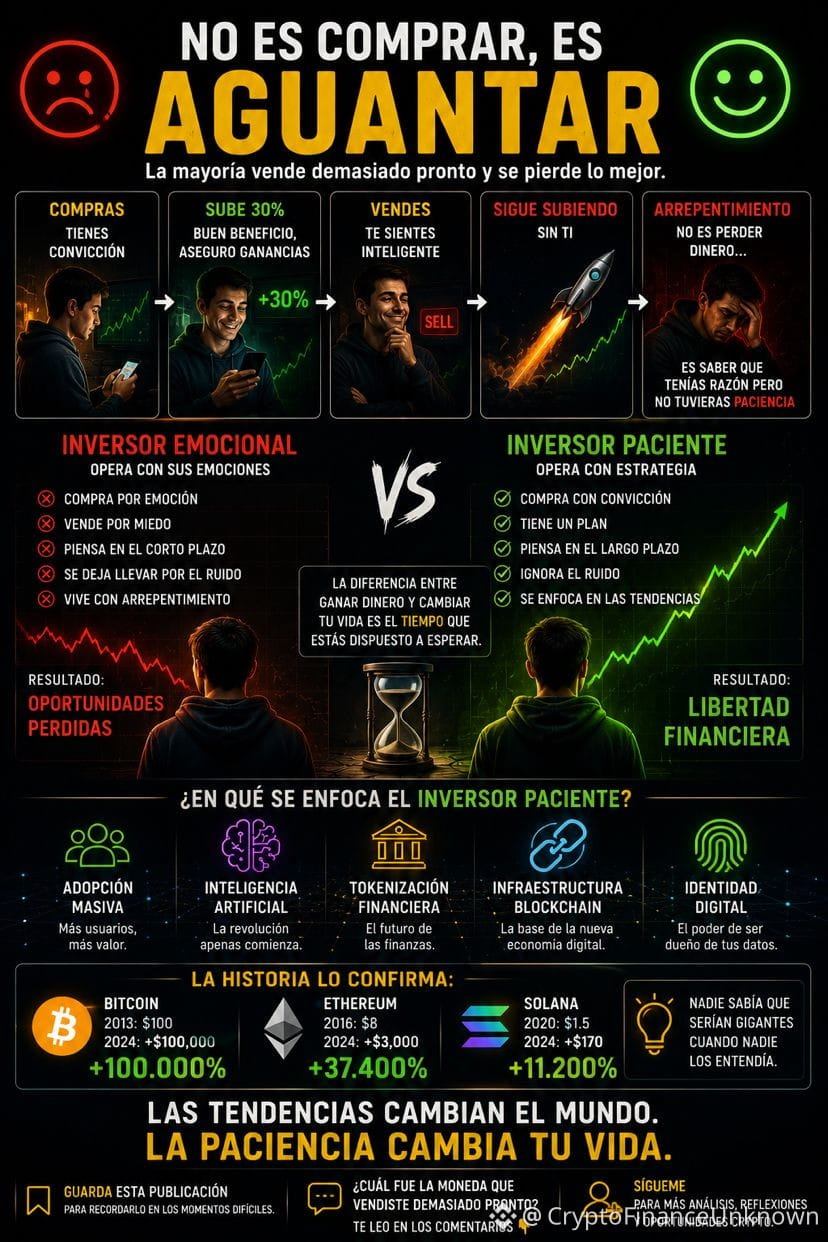
🚨 TELL ME IF THIS HAS HAPPENED TO YOU…
You buy a cryptocurrency.
📈 It goes up 30%.
You think:
"Good profit, I’m going to secure my gains."
You sell.
You feel smart.
You congratulate yourself on the trade.
And then it happens.
📈 +100%
📈 +300%
📈 +500%
📈 +1000%
Without you.
And the worst part isn’t losing money.
The worst part is knowing you were right…
But you didn’t have the patience.
Over time, I’ve discovered something:
Most people don’t fail at picking a coin.
They fail at calculating how much time they need to give it.
Because we’re trained to think in days.
While big trends usually develop over years.
Look at Bitcoin’s history.
Look at Ethereum’s history.
Look at Solana’s history.
The biggest gains never seemed obvious while they were happening.
They seemed slow.
Boring.
Uncertain.
And that’s exactly why most people bailed out too early.
💡 Today, I no longer ask:
"How much can this coin go up this week?"
I ask:
"What narrative could dominate the next 5 years?"
Because if the narrative is right, the price usually ends up reflecting it sooner or later.
⚡ Mass adoption.
🤖 Artificial Intelligence.
🏦 Financial tokenization.
🔗 Blockchain infrastructure.
🌍 Digital identity.
Those are the things I try to follow.
Not the daily noise.
Not the fear.
Not the euphoria.
The trends.
Because trends build wealth.
Emotions usually destroy it.
🔥 Now I want to know something:
What coin did you sell that later made you say…
"I should have waited a little longer"?
👇 I’m reading your comments.
📌 Follow me if you’re interested in the big crypto trends, investor psychology, and the opportunities that most see too late.
🚨 TELL ME IF THIS HAS HAPPENED TO YOU…
You buy a cryptocurrency.
📈 It goes up 30%.
You think:
"Good profit, I’m going to secure my gains."
You sell.
You feel smart.
You congratulate yourself on the trade.
And then it happens.
📈 +100%
📈 +300%
📈 +500%
📈 +1000%
Without you.
And the worst part isn’t losing money.
The worst part is knowing you were right…
But you didn’t have the patience.
Over time, I’ve discovered something:
Most people don’t fail at picking a coin.
They fail at calculating how much time they need to give it.
Because we’re trained to think in days.
While big trends usually develop over years.
Look at Bitcoin’s history.
Look at Ethereum’s history.
Look at Solana’s history.
The biggest gains never seemed obvious while they were happening.
They seemed slow.
Boring.
Uncertain.
And that’s exactly why most people bailed out too early.
💡 Today, I no longer ask:
"How much can this coin go up this week?"
I ask:
"What narrative could dominate the next 5 years?"
Because if the narrative is right, the price usually ends up reflecting it sooner or later.
⚡ Mass adoption.
🤖 Artificial Intelligence.
🏦 Financial tokenization.
🔗 Blockchain infrastructure.
🌍 Digital identity.
Those are the things I try to follow.
Not the daily noise.
Not the fear.
Not the euphoria.
The trends.
Because trends build wealth.
Emotions usually destroy it.
🔥 Now I want to know something:
What coin did you sell that later made you say…
"I should have waited a little longer"?
👇 I’m reading your comments.
📌 Follow me if you’re interested in the big crypto trends, investor psychology, and the opportunities that most see too late.
You buy a cryptocurrency.
📈 It goes up 30%.
You think:
"Good profit, I’m going to secure my gains."
You sell.
You feel smart.
You congratulate yourself on the trade.
And then it happens.
📈 +100%
📈 +300%
📈 +500%
📈 +1000%
Without you.
And the worst part isn’t losing money.
The worst part is knowing you were right…
But you didn’t have the patience.
Over time, I’ve discovered something:
Most people don’t fail at picking a coin.
They fail at calculating how much time they need to give it.
Because we’re trained to think in days.
While big trends usually develop over years.
Look at Bitcoin’s history.
Look at Ethereum’s history.
Look at Solana’s history.
The biggest gains never seemed obvious while they were happening.
They seemed slow.
Boring.
Uncertain.
And that’s exactly why most people bailed out too early.
💡 Today, I no longer ask:
"How much can this coin go up this week?"
I ask:
"What narrative could dominate the next 5 years?"
Because if the narrative is right, the price usually ends up reflecting it sooner or later.
⚡ Mass adoption.
🤖 Artificial Intelligence.
🏦 Financial tokenization.
🔗 Blockchain infrastructure.
🌍 Digital identity.
Those are the things I try to follow.
Not the daily noise.
Not the fear.
Not the euphoria.
The trends.
Because trends build wealth.
Emotions usually destroy it.
🔥 Now I want to know something:
What coin did you sell that later made you say…
"I should have waited a little longer"?
👇 I’m reading your comments.
📌 Follow me if you’re interested in the big crypto trends, investor psychology, and the opportunities that most see too late.
163
Log in to explore more content
Join global crypto users on Binance Square
⚡️ Get latest and useful information about crypto.
💬 Trusted by the world’s largest crypto exchange.
👍 Discover real insights from verified creators.
Email / Phone number