

The fourth quarter at $BTC has long been considered the 'quarter of power': the end of the year often brought growth because new demand appeared in the market, and expectations for the next year became bolder. But now the picture has turned upside down. The current Q4 is already going deeply into the negative and is comparable in scale of decline only to the most severe episodes in the history of Bitcoin — this looks atypical and psychologically difficult precisely because it breaks the usual seasonal scenario.

Why is this happening? Seasonality works when it is fueled by conditions: sufficient liquidity, a willingness to take risks, and a clear trajectory of money in the system. When instead caution, 'short horizons', and constant risk reassessment dominate, even strong statistical patterns start to fail. The market stops buying 'by the calendar' and begins to buy only 'by the conditions' — and this time the conditions turned out to be noticeably tougher than most participants expect when entering Q4.
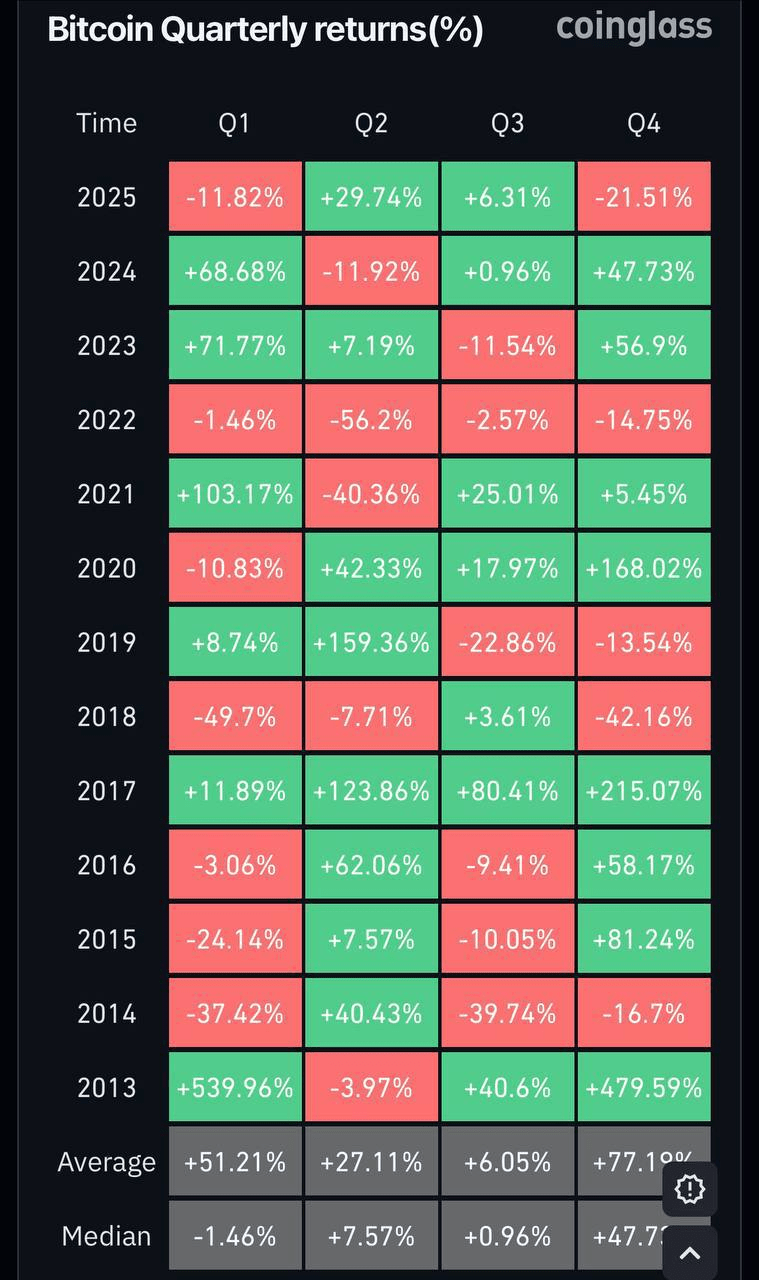
In this contrast, historical figures stand out especially: over the past 12 years, Q4 has averaged about +77% for bitcoin, and the median return was close to +48%. This means that usually the fourth quarter is not just 'positive', but often the most productive. And this is precisely why the current drawdown is perceived as a blow to the market's fundamental belief: if the 'strong quarter' doesn't work, it means that many bets on the usual cycle were made too early and too confidently.
At the same time, there is a strengthening symbolic rotation into 'defensive' assets: gold has recently updated historical highs — around $4,400–$4,420 per ounce. On one screen, it creates almost a textbook picture: bitcoin is having one of the worst Q4s, while gold sets a record. For the market, this is a signal of not 'who is better forever', but 'where is fear and liquidity flowing now'. And as long as this flow is directed towards defense, bitcoin finds it harder to engage its usual quarterly drive without a clear change in financial conditions.