
Why the same setup works on some days and fails on others — and how to read the “state of the market” before thinking about entering.
🚨 1. THE MISTAKE THAT COSTS CAREERS
Most traders ask: “What setup to use now?”. Institutions ask: “What regime is the market in?”.
Setup without regime is noise. Edge without regime is illusion.
🔍 2. MARKET REGIME IS NOT TREND OR RANGE
Regime is the essence of price behavior. It defines:
How liquidity is treated.
How displacement develops.
How the market rewards or punishes the operator's initiative.
Two trending markets can present completely different regimes.
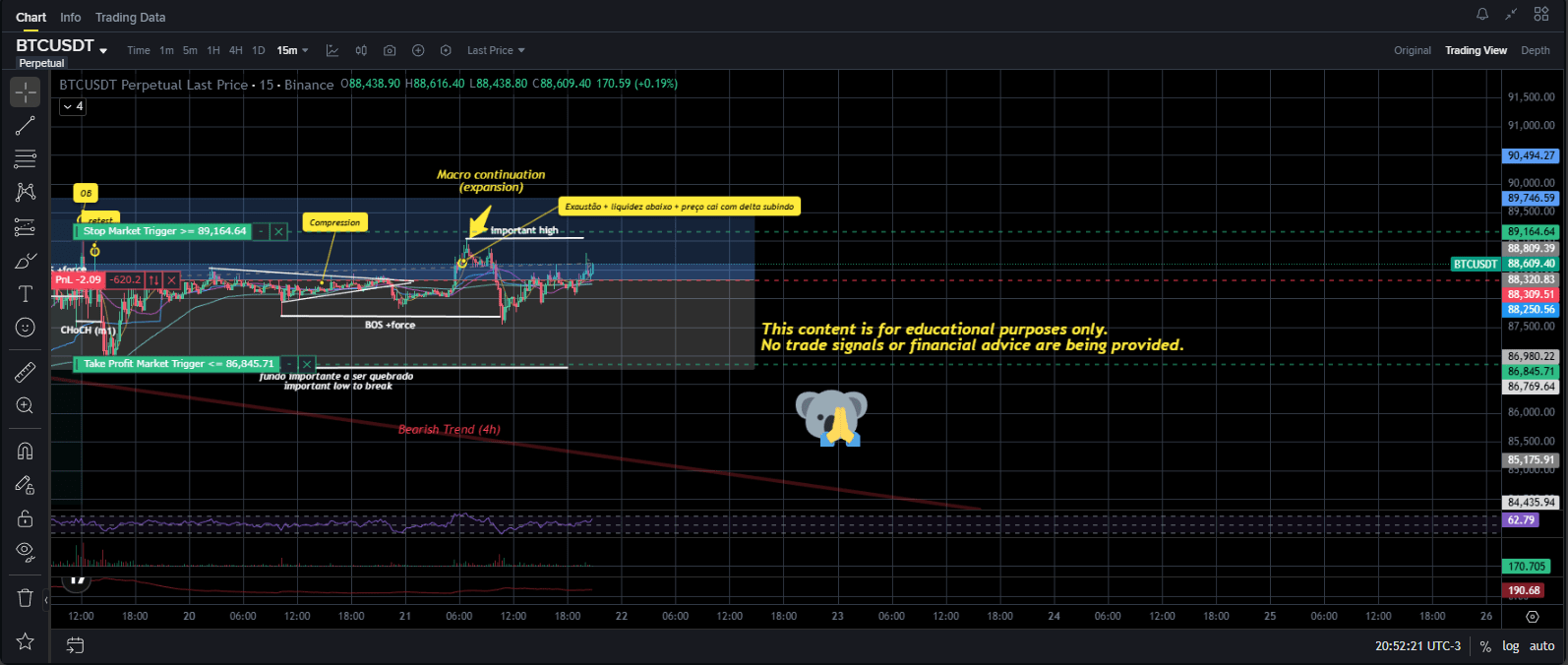
🚀 3. EXPANSION REGIME (FLOW MARKET)
Characteristics: Clean displacements, clear continuity after BOS, targets reached fluidly, and little candle overlap.
In this regime:
The market rewards timing.
Imperfect entries tend to survive.
Targets can (and should) be extended.
Common mistake: Exiting too early or reducing targets out of fear.
📦 4. COMPRESSION REGIME (COIL MARKET)
Characteristics: Small candles, constant overlap, frequent false breaks, and recurring technical stops.
In this regime:
The market punishes aggression.
Setups seem visually correct but fail in execution.
Price consumes liquidity without moving.
Common mistake: Insisting on trading, increasing frequency, or trying to 'guess' the breakout.
⚠️ 5. TRANSITION REGIME (DANGEROUS ZONE)
The transition occurs when the market exits compression but has not yet confirmed expansion.
Characteristics: BOS without continuity, confusing CHoCH, short displacements, and constant liquidity tests.
Institutions treat this as:
Observation zone, not aggression.
Common mistake: Anticipating the new regime and trading before real confirmation.
🕸️ 6. TRAP REGIME (LIQUIDITY HARVEST)
Characteristics: Very fast movements followed by sharp reversals, clean stops on both sides, and breakouts that fail instantly.
Here:
The market hunts predictable behaviors.
Purely technical traders become liquidity.
Only deep structural reading survives.
Common mistake: Trading out of anger, revenge, or frustration.
🔄 7. THE MARKET CHANGES REGIME WITHOUT WARNING
Regimes do not last forever, do not respect fixed hours, and do not follow exact mathematical rules. The professional trader:
Detects change early.
Reduces exposure immediately.
Does not force a continuity that no longer exists in price.
📜 8. THE CONCEPT OF 'OPERATIONAL PERMISSION'
Before clicking, the fundamental question is: "Does this regime allow this type of entry?"
Continuation setup in compression = Mistake.
Aggressive setup in transition = Mistake.
Target extension in trap regime = Mistake.
The regime defines what is allowed by the market.
❌ 9. WRONG REGIME + RIGHT SETUP = LOSS
This is one of the most difficult concepts to accept: the market can respect structure, form zones and give perfect technical triggers, but still punish your entry because the current regime does not favor expansion.
🧘 10. THE DIFFERENCE BETWEEN PATIENCE AND PASSIVITY
Professional patience: Observe, wait for regime confirmation, and accept staying out if necessary.
Emotional passivity: Fear of trading, insecurity, and freezing due to lack of a plan.
Institutions train for strategic patience, never for passivity.
🛠️ 11. HOW TO ADAPT WITHOUT CHANGING THE MODEL
Adaptation does not mean improvising rules or changing the setup. It means adjusting risk parameters:
Reduce the frequency of clicks.
Shorten targets.
Reduce risk per trade.
Trade only what is 'obvious'.
📝 12. CLASS 33 EXERCISES
Exercise 1 — Session Classification: Review past days and classify them as expansion, compression, transition, or trap. Focus on the regime, not on profit.
Exercise 2 — Replay by Regime: Observe how the same setup behaves in different regimes. This will bring immediate maturity to your reading.
Exercise 3 — Observation Session: Spend an entire session without trading, just noting the changes in regime throughout the day.
🔓 13. WHAT THIS CLASS UNLOCKS
After Class 33, you understand that the regime comes before the setup. The market changes state and insistence is what kills a trader's edge.
📌 The trader who respects the regime does not need to fight against the market.
🔜 NEXT CLASS (DAY 34)
👉 CLASS 34 — Institutional Days vs Dead Days: When to Trade, When to Reduce, and When to Stay Out
👉Previous Classes
___________________________
📌 Trading BTC
$ASR
$VTHO
$ALPINE
#LearningFromMistakes
#LearningTogether
#learningbyearning
